Category Archives: Working

People are hiding from me! On purpose! In 2012, when all info is supposed to be easily accessible!

Yes, we live in amazing times, even though we still don’t have flying cars.

Michael Rodgers is NOT hiding.

Just one example, from today, of the sort of miracle we take for granted, but which would have sounded like the wildest sort of science fiction back in, say, 1987 — the year I came to Columbia to become governmental affairs editor.

We were kicking around an idea for a TV commercial for a potential client, and suddenly I had a sort of half-memory of having seen an ad, long ago, that did something familiar. I whipped my iPhone from its holster (and if I wanted so see Cleavon Little say, “Just let me whip dis out” in “Blazing Saddles” within a few seconds, I’d do the same), and found a reference to the ad I was thinking of within 30 seconds. Within another 30 — still using my phone (my own  personal phone that goes everywhere I go, which was conceivable in 1987 but still fantastic) — I was watching that ad on YouTube. An ad that last ran in — get ready for it — 1987.

If, in 1987, I had wanted to find out about an ad from 1962, I would have had to spend half the day or more at the library, and whether I even found a reference to it would depend on some pretty tedious guesswork with a periodicals index, and I would have to cross my fingers for a miracle hoping that the library stocked that particular publication, and kept them going back 25 years.

Kathryn Fenner is NOT hiding.

As for actually seeing the ad, without a trip to New York or L.A. and a pretty tedious search once I got there — well, I would have been s__t out of luck, to use the technical term. Oh, maybe if I reached the right person on the phone in one of those places, and they were willing to make me a VHS tape and mail it to me, I might get to see it within a week. But it would have been iffy at best.

Anyway, I say all this to express my appreciation for all the things we can so easily find and experience now, right at our fingertips.

But this post is about the things we can’t, and how frustrating that is.

Phillip Bush is NOT hiding.

Today, the very day of the 1987 ad miracle, I was looking for a mug shot for my contacts list. You know how Google Contacts and iPhones and even Blackberries and Palms allow you to attach a picture of a person to their contact info? Well, I try to take advantage of that whenever I create a new contact. It usually only takes a few seconds. (It took me maybe a minute total to find the four mugs you see here, using Google Images.) I do this because I’m terrible at keeping names and faces straight — I know, or sorta know, too many people for that. By having this feature in widely used software, we are encouraged to do this. It’s normal. (If you had tried it in 1962 — the way the dwarf character did to Mel Gibson’s character in “The Year of Living Dangerously,” keeping a dossier on him and other friends — it would have creeped people out.)

For instance, if you Google me, you get a lot of pictures that are not me, but just people associated with me, but in the first couple of pages of results, there are about 17 images of yours truly. That’s high, on account of my blog and my long association with the newspaper, but not all that high. I get similar results with a lot of people on my contacts list.

But then… every once in a while… there’s someone I can’t find. Sometimes it’s understandable. They are quiet people who work in some private business that doesn’t require a lot of public interaction. But sometimes… it’s like Winston Smith and the gang in 1984 have expunged the person from existence.

Today, it was someone who actually leads a very public organization that advocates on behalf of a very hot local political issue. I had that person’s contact info, from an email, and while I could sort of picture the person in my mind from past interactions, I wanted the crutch of having the mug shot there in case memory failed me at a critical moment.

Doug Ross is NOT hiding.

And I could not find this person anywhere. Eventually, I set my pride aside and tried her Facebook page, which for me is really last-ditch (and feels, even in 2012, even for an unreconstructed journalist, a bit like prying sometimes). And discovered that this was one of those people who not only doesn’t have her own face as her profile picture, but doesn’t have a single image in which she appears among any of her Facebook photos.

At which point I started hearing that little dee-dee-DEE-dee music from “The Twilight Zone.”

Yeah, I realize, some people are just private, as anachronistic as that is in 2012. But I don’t see how a person who is heavily involved in the community manages to disappear so completely.

Thoughts about this? Does this happen to you? Does it drive you nuts? It does me. Maybe it shouldn’t, but it does. Information is normally so extremely accessible, that when it isn’t, it just seems wrong

The news story that was (in part) about itself

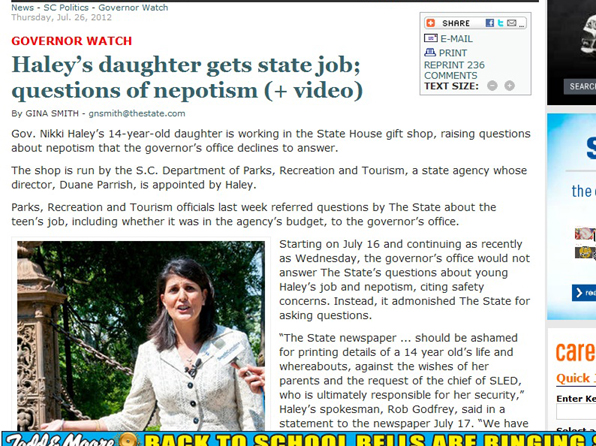
You may or may not have seen that the finished version of the story about the ramifications of Nikki Haley’s daughter getting a PRT job finally appeared in The State today. Of course, it was far more involved and complete than the “draft” version that appeared inadvertently on the web pages of The Rock Hill Herald and (so I’m told) The Charlotte Observer last week.

In the end, the story turned out to be almost as much about itself as about the suggestion of nepotism.

While nothing can really erase the embarrassment for the newspaper of readers knowing about the story for a week before it appeared, the editors did everything they possibly could to make up for it. Most importantly, they thoroughly explored the ridiculous “controversy,” generated by the governor herself, about whether it should be published.

I particularly like the sidebar box that lists all the perfectly rational, professional questions that the newspaper had been asking the governor’s office from the beginning of this silly saga, followed by the immature, petulant, emotional statement from the governor’s office, refusing to answer those questions — all of which a public official who actually does believe in transparency would have answered immediately. Let’s quote that sidebar in full:

Questions, but no answers

Emailed questions sent by a State reporter to the governor’s office on Monday, July 16. (The State has removed the name of the governor’s daughter in the email exchange below.)

Here are my questions about (NAME REMOVED) Haley working at the State House gift shop:

When was she hired? When she did she start work? Will she continue to work at the shop after school starts?

What are her duties?

How many hours a week does she work?

How much is she paid?

Is this her first job?

Who does she report to? How many people work at the shop?

Was this job posted to the public? (If so, can I see a copy of the posting?)

Was the job budgeted? (If not, how was this job added and funded?)

Were work hours of shop employees adjusted to accommodate (NAME REMOVED)?

Why did her parents choose the gift shop as a place to work?

Some people might not think it’s fair for (NAME REMOVED) to have a job tied to a state agency where the director is appointed by her mother (PRT). Response?

If the governor’s office has concerns about (NAME REMOVED)’s safety, about the public knowing where she works, why does she have a job at one the state’s most-prominent and most-visited historical sites?

Would she have needed additional security if she got a job outside the State House?

The governor’s office response

Sent on Tuesday, June 17

What follows constitutes our office’s response for any story you plan to write regarding (NAME REMOVED) Haley.

Quote from Rob Godfrey, Haley spokesman: “The State newspaper – the reporter who wrote it, editors who approved it, and ownership who published it – should be ashamed for printing details of a fourteen year old’s life and whereabouts, against the wishes of her parents and the request of the Chief of SLED, who is ultimately responsible for her security. We have nothing more to say.”

Quote from South Carolina Law Enforcement Division Chief Mark Keel: “I have expressed my concerns, as of yesterday, that publication of information regarding minor children of elected officials creates problems for State Law Enforcement and its efforts to provide security for the children of this governor or any governor. In my 30 years-plus of experience at SLED, the security or activities of minor children of elected officials is something that the media in general has taken a ‘hands off’ approach to in reporting except as officially released by the elected official’s office.”

Did the newspaper manage to convey to you that it was going out of its way not to name the child, or do you need to get hammered over the head with (NAME REMOVED) a couple more times? No? OK, good, we’ll move on…

The story was unaccompanied by editorial comment (unless you count Mark Lett’s statement of the newsroom’s thinking on publishing the story), but for anyone able to put two and two together, the lesson to be learned here is obvious: This governor, when backed into a corner, will use hypocritical obfuscation in an effort to manipulate an emotional backlash reaction from her base so that she can hide behind it, rather than give straight answers.

Most telling on that score was the fact that Gov. Haley herself has consistently disclosed information about her children and their doings, even to providing the name of her daughter’s orthodontist — and yet has the nerve to (apparently) induce the head of SLED to say, absurdly, that disclosing that her daughter has a job that is just outside the governor’s office and protected by more than one layer of security somehow threatens her safety. Yes, any information published about any person’s whereabouts could, conceivably, make that person marginally less safe. So maybe the governor will think about that in the future when she posts on Facebook.

Substantively, in terms of the bare bones of the original story, what this story contained that last week’s draft did not were some basic facts that Nikki provided to the Charleston paper after refusing to answer The State (more petulance): such as her daughter’s hours, and what she was being paid. (Actually, the Charleston story turned out to be less about the governor, and more about the continuing, puzzling absence of the story from The State.)

No one who brought the draft story to my attention ever mentioned the one significant fact that was missing from it: What the child was being paid, or even whether she was being paid. This seems to be what held up the story. I think that’s a lousy excuse to hold the story– I would simply have written, we don’t know whether she’s being paid because the officials who should tell us refuse to — but it does seem to explain the delay. As soon as it had that information, from the third party, the paper ran the story.

Nikki Haley will continue, to the extent she acknowledges this story’s subject, to try to dupe her base into rage that the paper intruded on her child’s privacy.

But to anyone with even a rudimentary capacity for reason, it should be obvious that this story, now that it has finally appeared, is not about a child. It’s about the governor’s childishness.

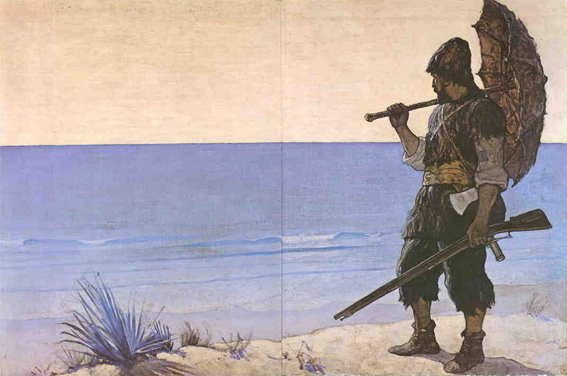
Only Robinson Crusoe did it alone — and then only until Friday came along

And note that not even he made the musket, or the hatchet.

Since I’m not at the paper any more, it fell to Cindi Scoppe to write this column that ran today, basically addressing the orgy of indignation among the libertarians who call themselves conservatives over President Obama’s unfortunate choice of words in explaining the painfully obvious fact that practically no one in our crowded, interdependent world achieves anything worthwhile alone:

A LOT OF what the president says and does is ripe for criticism. But what he said the other day about no one being an island, about how our parents and our communities and our teachers and mentors and, yes, our government all contributed to our success is not one of those things.

If you’re wondering who in the world would criticize such obvious commentary, it’s because you don’t recognize the full context of that bizarre, ridiculous, one hopes bungled quote that came in the middle of it: “If you’ve got a business — you didn’t build that. Somebody else made that happen.”…

Of course business owners built their businesses — unless they inherited them or bought them from someone who did. Their initiative and hard work and luck set them apart.

As important as parents are to our success, one sibling can create a multi-billion-dollar business while another languishes on welfare. As much as we need good teachers, even the best have some students who drop out of school. Although government policy can give some businesses a leg up, others can go bankrupt even with too-generous government grants.

That’s because some people have initiative, and some do not. Some people are creative, and some are not. Some people are smart, and some are not. And while the schools can affect which group any individual is in, government does not eliminate those basic differences.

At the same time though, the vast majority of people who own businesses would not have been able to do that if we didn’t have a monetary system and a court system and roads and police and other functions of government. The vast majority of people who have any sort of success would not have it in a world without government. In fact, they wouldn’t have it if not for the peculiar kind of government that our country embraced from the start: self-government.

Can, and should, our government be more efficient? Of course so. Is there room to debate whether the government should bail out the banks or the auto industry or help pay for our medical care? By all means. Is there a legitimate question as to whether taxes are too high or too low? Certainly.

But the vast majority of Americans would not have the lives we take for granted — lives that are inconceivably luxurious compared to the lives lived by the overwhelming majority of people throughout human history — if it weren’t for our flawed but better-than-any-alternatives government.

Seems to me Cindi was being slightly over-cautious in saying that only “the vast majority of people” would have gotten nowhere without the basic conditions — civil order, rule of law, basic infrastructure — that are provided through the processes we call “government.” I suppose there are some to whom that doesn’t apply, but very few. It’s even harder to think of anyone who accomplished anything worthwhile completely and utterly alone — without anyone, whether you’re talking about government or not.

I suppose there’s Robinson Crusoe — that is, until Friday came along. This reminds me of an economics exercise we did in high school. We had to suppose we were stranded on a desert island, and we had to allocate our resources — which included time, and effort — so as to survive. This much time building a shelter out of available materials meant that much less time spent gathering food. X amount of time spent making a tool that would facilitate building that shelter cuts the construction time, leaving more time to weave a net to make fishing easier, etc.

A castaway who is completely alone can create something useful — to him, anyway — without anyone else’s involvement. But a business, in our crowded society? Well, to start with, you have to have customers. And then, depending on your business, there are suppliers, and vendors providing services that it would be inefficient to perform yourself. And as you grow, there are employees who become essential to your further growth, etc. Without the willing participation of those often vast networks of people, you can work and create all you want, but you’re not getting anywhere.

The extreme libertarians would put government in another category from just “people.” But in our system, the government and the people are the same thing. “Government” is just the word for the set of arrangements that we have among us, the people, for handling certain things that are best handled that way, such as building roads or deepening a port or passing and enforcing the laws without which the concept of private property is meaningless.

In fact, if I had a quibble with Cindi’s column, it would be that, in her litany of things for which government is essential, she kept referring to government as “it.” As in, “It creates and maintains a monetary system,” and “It provides a civil justice system…”

Given the screwy way so many of our neighbors these days think of government, that can be misunderstood as government being some separate entity that provides certain things to us, the people. But it’s not that at all. A better word than “it” would be “we,” because government is simply the process through which we create and maintain a monetary system, provide a civil justice system, and so forth.

Government does not give or take away. It’s just the arrangements through which we, the people, do certain things that we decide, through our system of representative democracy, are best done that way.

Driveby Beat, Hawaiian Style: Thanks for sharing, Burl!

On a previous post, I noted that years ago I lobbied for creation of a “driveby beat” at The State — to have a reporter dedicated to answering people’s understandable curiosity about things they drove by and wondered about in the Midlands. It would have been a wonderful way to root the paper and readers solidly in the community, aside from telling people something they actually wanted, and occasionally perhaps even needed, to know.

Also, it would satisfy my own curiosity about a lot of things, which to my mind was, to a great extent, what reporters were for. There was always that.

Anyway, it never happened — although I saw that today, The State actually did have a story about what was going on at the State Fairgrounds, which I had driven by and wondered about just yesterday.

Anyway, when I brought it up, Burl Burlingame noted that he actually used to have such a beat, which was his idea (it must have been subliminal planted in both our brains at Radford High School) at the Honolulu Star-Bulletin. Here and here and here are some links.

And here’s an excerpt from his “Wat Dat” (I don’t think I’ll have to translate that pidgin for you) feature:

Somebody whose name we can’t read – but who does draw a nice map – was curious about a brown statue or chimney standing at the end of row of trees just north of the Mililani exit.
It is a statue, and it’s of a tree trunk, rising more than 30 feet above a circular grassy platform, which is in turn surrounded by a large gravel walkway, which is atop a tall wall – kind of a rounded ziggurat – which is accessed by a grand tile stairway, which is approached by carefully tended Japanese gardens, which are guarded by carefully repaired antique marble Chinese lions, which are flanked by enormous granite slabs, which cap hobbit-like stools and benches that seem to be made out of logs but are really cast cement, which are parked beneath a series of carefully tended trees, which have the names of local politicians inscribed upon signs at the foot of each.

The area is grand and imposing, and at the same time intimate and quiet. It’s also generally deserted, which adds to the otherworldly experience.

This is one of the WatDatiest of WatDats to come along in some time!

The site is the local mission of the Honbushin Honbu, a Shinto religious sect with nearly a million followers, mostly in Japan. There is also a mission in China…

The “sculpture” is a koa log that seems to be protected by a coat of brown paint. It’s called “GENTEN,” which, translated from Japanese, means roughly “starting point” or “origin.”

The sculpture represents nature and the unity of hearts, religions and countries that work toward peace. Honbushin missionaries regularly gather around the genten and pray…

Of course, in Hawaii, the stuff you drive by and wonder about has a tendency to be slightly more exotic than what we have around here…

Haley suspended mayor who allegedly hired son

Catching up with e-mail (my inbox is down to 296!), I came across one from several days back, from one of a number of readers who remain puzzled as to why The State still hasn’t published Gina Smith’s now-you-see-it-now-you-don’t story about Nikki Haley’s daughter getting a job working for an agency she supervises.

I wonder about it myself. But that’s not what this post is about. What it’s about is something else I had missed, and which this reader was attempting to bring to my attention:

The Associated Press

NORWAY, S.C. — The mayor of the Orangeburg County town of Norway has been indicted on charges of misconduct in office and nepotism.

Gov. Nikki Haley has suspended Jim Preacher from office while the charges are pending.

The indictment says Preacher gave himself a raise without the approval of the town council and hired his son at the town’s water treatment department…

There was more to it than that, including a bizarre alleged interaction between the mayor and a state trooper. One senses that more than nepotism brought the mayor to this pass. But what struck me was the irony that the governor has suspended this guy who among other things is charged of providing his son with a job in a department that apparently is under his purview.

Yet, in the story that briefly appeared in the Rock Hill Herald before disappearing, we found this:

State law prohibits public officials from causing the employment of a family member to a position they supervise or manage, according to the State Elections Commission. However, Haley does not supervise the gift shop; she supervises the agency that operates it, making the teen’s summer job permissible, an attorney with the commission said.

Really? So we’re to suppose that the governor’s position had nothing to do with an agency that reports to her deciding to hire a 14-year-old child?

This is a strange little story. To quote Jubal Harshaw, “this has more aspects than a cat has hair.”

Playing the unemployment blame game

On the national level, it’s the Republicans touting high unemployment and blaming it on President Obama.

On the state level, it’s the Democrats who eagerly greet each piece of bad employment news, only they blame it on the local Republicans:

Representative Leon Stavrinakis Statement on Spike in SC Jobless Rate
Charleston, SC – South Carolina’s jobless rate rose to 9.4% in June from 9.1% in May, while Charleston County’s unemployment rate rose significantly from 7.9% last month to 8.5% in June. Charleston State Representative Leon Stavrinakis released a statement in response:
“These unemployment numbers are troubling and unacceptable for the Charleston area and the state of South Carolina as a whole. As the nation’s unemployment rate continues to drop or hold steady, South Carolina’s rate is going in the wrong direction and at an alarmingly fast rate. Perhaps Governor Haley should stop her international travels and simply attending every press opportunity she can find so she can actually put real time and work into creating jobs in South Carolina. The last place potential businesses want to relocate is a state led by a Governor who is only interested in being a celebrity, cutting education, and refusing to invest in infrastructure. We can also be sure that Governor Haley’s recent budget attacks on existing South Carolina industry are not helping our ability to attract and recruit jobs to our state. It is time for Governor Haley to quit stalling and present the legislature with a comprehensive jobs plan. If she refuses to give us a plan, I suggest she take a look at the plan I released months ago,  which to date she has not indicated she has even taken the time to read.”
###

Funny how things can look so different from Columbia (or Charleston) than they do from Washington.

An example of an op-ed rebuttal: Answering Glenn McConnell in 2007

During the discussion on a previous post, I noted that “I have been known, on one or two occasions, to allow a source space for a full op-ed piece, even when the piece is almost 100 percent nonsense… and run a piece of my own, right across from it, demolishing it. That way the reader/voter has a chance to see that party’s full case, as well as the arguments against it.”

Bud, quite reasonably, asked, “An example would be good. Sometimes people think they demolish something but it turns out not to be the case. Let the bloggers be the judge.”

Fine. Except I could only think of a couple of cases (as I said, there were “one or two”), but I couldn’t immediately lay my hands on either one of them.

I’ve now located one of my examples. It’s not a perfect one. In this case, for instance, I didn’t rebut the op-ed piece until days later — either because I didn’t have column space until then, or because something that happened later in the week got my dander up, and caused me to recall the previous piece. I don’t know; it’s been almost five years now.

Anyway, the piece that (eventually) set me off was by Glenn McConnell, and I ran it in The State on Friday, Oct. 19, 2007. Here it is:

By Glenn F. McConnell Guest Columnist

South Carolina can only have an orderly, predictable and consistent growth rate in state spending by constitutionally mandating it. It cannot be accomplished on a reliable basis by hanging onto slim majorities in the Legislature and having the right governor. The political pressures are too great unless there is a constitutional bridle on the process.

That is the reason I created a task force to consider a constitutional amendment that would cap the growth in spending by the state. The first meeting of the Senate study committee on constitutionally capping state government spending is scheduled for 1 p.m. Wednesday in Room 105 of the Gressette Senate office building in Columbia.

There will always be more needs than revenue no matter what the economic times and the amount of available new funds. Government must, therefore, temper its conduct to spend so that over the highs and lows in revenue forecasts, the necessary revenue will be there to fund essential needs without the pressure for new taxes.

When government is flush with money, the spending goes up to fund many new initiatives — some good, some questionable and some not good. In other words, projects get funded not so much out of merit but merely because the money was available. Some one-time expenditures also occur the same way. In the face of a bountiful taxpayer buffet, government cannot control its appetite, so its stomach must be stapled.

At stake is the need to at least control the rate of growth in the recurring base. So I have introduced a constitutional amendment to cap the rate of spending of our state government. Government would be limited to growth at an amount that would not exceed the rate of population growth plus the growth in personal income. Basically, government should not grow any bigger than it needs to be or any faster than people’s ability to pay for it.

I have been an ardent supporter of both Barry Goldwater and Ronald Reagan, and I believe that government is best which governs least. I also believe that as much money as possible is best left in the hands of people if we are to economically advance. If people keep more, they have greater opportunities to invest and spend so our economy will expand. It is a matter of fairness.

If there are surpluses in Columbia, these should not expand the obligation to fund a growing government but instead should be used to reduce long-term debt and obligations, fund capital projects to avoid issuing costly bonds, cover one-time costs, save and carry forward for a rainy day, and/or fund tax refunds and tax cuts.

The constitutional amendment would foster growth in the private sector, challenge legislators to prioritize spending better, seek better efficiencies in the operation of government and privatize operations where it is in the state’s best interest. This will present new opportunities to create rainy-day funds, to create a more debt-free South Carolina and to replenish trust funds that too often have been tapped in lean times to fuel the insatiable appetite of government created by overspending in good times.

Finally, we all must realize that our state government, just as much as any business, has to be competitive in order to attract and retain jobs. We need to provide essential services, but we need to do it in a way that ensures excellence, efficiency and long-term cost control. Throwing dollars at an agency does not ensure that it will be better. Limiting the growth in spending ensures that the challenge for each budgeting year is to do more with what we have available rather than to spend more to get the job done.

Working together, we can give the people of South Carolina an opportunity to vote on whether they want this limitation on the growth of spending. As I said, the limitation, if adopted, would ensure our future is not one of ups and downs based on political fortunes but instead one of predictability and orderliness in the growth of South Carolina.

Mr. McConnell, a Charleston attorney and businessman, is president pro tempore of the Senate and chairs the Senate Judiciary Committee.

As I said, that ran on Friday, so I’m beginning to see what probably happened. I generally wrote my Sunday columns on Fridays. I would have read the senator’s piece — most likely for the first time — on the page proof Thursday afternoon, so it would have been quite fresh in my mind. I might have even ripped out a few grafs of my response right then, and polished them somewhat the next morning.

You’ll note, though, that my column wasn’t just a response to McConnell. I didn’t even get to him until about halfway through. This column was of a certain type, the type that puts me in mind of a line Mark Twain wrote: “And now that my temper is up, I may as well go on and abuse every body I can think of.” I always liked that line because it describes a mood that is very familiar to me.

Here’s my column that ran on Sunday, Oct. 21, 2007:
IN SOUTH CAROLINA, WE KEEP TALKING ABOUT THE WRONG THINGS

By Brad Warthen Editorial Page Editor

We always seem to be having the wrong conversations in South Carolina. Sometimes, we don’t even talk at all about the things that cry out for focused, urgent debate.

Look at this joke of a commission that was assigned to examine whether the city of Columbia should ditch its ineffective, unaccountable, “don’t ask me” form of government. It was supposed to report something two years ago. And here we are, still waiting, with a city that can’t even close its books at the end of the year. Whether its that fiscal fiasco, or the failure to justify what it did with millions in special tax revenues, or the rehiring of a cop who was said to be found drunk, naked and armed in public, there is no one who works directly for the voters who has control over those things.

But as bad as it is to have no one to blame, there is no one to look to for a vision of positive action. A city that says it wants to leap forward into the knowledge economy with Innovista really, really needs somebody accountable driving the process.

Columbia needed a strong-mayor form of government yesterday, and what have we done? Sat around two years waiting for a panel that didn’t want to reach that conclusion to start with to come back and tell us so.

It’s worse on the state level.

What does South Carolina need? It needs to get up and off its duff and start catching up with the rest of the country. There are many elements involved in doing that, but one that everybody knows must be included is bringing up the level of educational achievement throughout our population.

There are all sorts of obvious reforms that should be enacted immediately to improve our public schools. Just to name one that no one can mount a credible argument against, and which the Legislature could enact at any time it chooses, we need to eliminate waste and channel expertise by drastically reducing the number of school districts in the state.

So each time the Legislature meets, it debates how to get that done, right? No way. For the last several years, every time any suggestion of any kind for improving our public schools has come up, the General Assembly has been paralyzed by a minority of lawmakers who say no, instead of fixing the public schools, let’s take funding away from them and give it to private schools — you know, the only kind of schools that we can’t possibly hold accountable.

As long as we’re talking about money, take a look at what the most powerful man in the Legislature, Sen. Glenn McConnell, had to say on our op-ed page Friday (to read the full piece, follow the link at the end of this column):

South Carolina can only have an orderly, predictable and consistent growth rate in state spending by constitutionally mandating it. It cannot be accomplished on a reliable basis by hanging onto slim majorities in the Legislature and having the right governor. The political pressures are too great unless there is a constitutional bridle on the process.

The people of South Carolina elect 170 people to the Legislature. In this most legislative of states, those 170 people have complete power to do whatever they want with regard to taxing and spending, with one caveat — they are already prevented by the constitution from spending more than they take in.

But they could raise taxes, right? Only in theory. The State House is filled with people who’d rather be poked in the eye with a sharp stick than ever raise our taxes, whether it would be a good idea to do so or not.

All of this is true, and of all those 170 people, there is no one with more power to affect the general course of legislation than Glenn McConnell.

And yet he tells us that it’s impossible for him and his colleagues to prevent spending from getting out of hand.

What’s he saying here? He’s saying that he’s afraid that the people of South Carolina may someday elect a majority of legislators who think they need to spend more than Glenn McConnell thinks we ought to spend. Therefore, we should take away the Legislature’s power to make that most fundamental of legislative decisions. We should rig the rules so that spending never exceeds an amount that he and those who agree with him prefer, even if most South Carolinians (and that, by the way, is what “political pressures” means — the will of the voters) disagree.

Is there a problem with how the Legislature spends our money? You betcha. We don’t spend nearly enough on state troopers, prisons, roads or mental health services. And we spend too much on festivals and museums and various other sorts of folderol that help lawmakers get re-elected, but do little for the state overall.

So let’s talk about that. Let’s have a conversation about the fact that South Carolinians aren’t as safe or healthy or well-educated as folks in other parts of the country because lawmakers choose to spend on the wrong things.

But that’s not the kind of conversation we have at our State House. Instead, the people with the bulliest pulpits, from the governor to the most powerful man in the Senate, want most of all to make sure lawmakers spend less than they otherwise might, whether they spend wisely or not.

The McConnell proposal would make sure that approach always wins all future arguments.

For Sen. McConnell, this thing we call representative democracy is just a little too risky. Elections might produce people who disagree with him. And he’s just not willing to put up with that.

As you can see, that was a very South Carolina column. Everything addressed in it, everything that was getting my temper up, was something that one could just as well be said today. Because in South Carolina, very little that ought to change ever changes.


Onion gets the scoop on The Daily Planet

This was a mildly amusing piece in The Onion yesterday:

NEW YORK—Frustrated fans of the Superman comic book said Monday the continued financial stability and cultural relevance of the series’ Daily Planet newspaper is now the most unrealistic part of its universe and an annoying distraction that has ruined their reading experience.

While they acknowledged that enjoying the adventures of a superhero who can fly, lift a bus over his head, and shoot beams of intense heat from his eyes requires some suspension of disbelief, longtime fans told reporters they simply could not accept a daily metropolitan newspaper still thriving in the media landscape of 2012.

“I can play along with Superman using a steel girder to swat someone into outer space, but I just can’t get past the idea that The Daily Planet still occupies one of the largest skyscrapers in all of Metropolis and is totally impervious to newsroom layoffs or dwindling home subscriptions,” said comics blogger Marc Daigle, adding that it was impossible for him to even look at Superman’s alter ego, Clark Kent, without immediately thinking he would have been replaced long ago by a freelancer who gets paid nine cents a word and receives no health benefits. “Every time The Daily Planetshows up, I just get taken out of the story completely. I usually flip ahead to Superman freezing a volcano with his breath or something.”…

I say “mildly” because the idea of a health Daily Planet was sufficiently absurd that it was hard to make fun of effectively.

One last excerpt:

“The least they could do is have [Daily Planet editor-in-chief] Perry White be forced into retirement by an MBA 25 years his junior,” Taft continued. “It’d be a start.”

See? Too real, too true, too matter-of-fact to be funny.

Perry! Great Caesar’s Ghost!

Only 80,000 — low jobs figure depresses markets, casts pall on Obama’s re-election

No virtual front page today, because there’s not much I’d willingly put on a front page. The biggest story of the day by far is the softer-than-expected jobs numbers — which, combined with bad news out of Spain, has sent global markets plunging.

(The only thing competing for the front with that is Hillary Clinton talking tough to China and Russia about Syria. I might do a separate post about that.)

The BBC does the basic overview:

US shares have fallen after official data showed firms had created only 80,000 new jobs in June, leaving the jobless rate unchanged at 8.2%.

Job creation remains below the 100,000 judged necessary by the Federal Reserve for a stable job market, according to the US Labor Department.

Shares slipped after the news, with the opening Dow Jones index falling 1%.

President Barack Obama said the rise in employment was “a step in the right direction”.

Campaigning in the swing state of Ohio on Friday, President Obama acknowledged that “it’s still tough out there” for ordinary Americans…

Republican White House candidate Mitt Romney said from Wolfeboro, New Hampshire, that the jobs data underlined the need for a new president, adding “this kick in the gut has got to end”…

Other angles include:

  1. String of Weak Jobs Reports Likely to Set Tone for Voters (NYT)
  2. Obama Promotes a Long View on Jobs (NYT)
  3. Jobs Report And Politics: The Monthly Spin Cycle (NPR)
  4. Jobs report makes it tougher for Obama to tout progress (WashPost)

As you can see, the political angle is getting heavy play. Although the Post did manage to show some concern for the actual economy in its lede headline: Weak jobs report adds to worry of faltering recovery.

The European problems feeding into the drop in markets is at least briefly discussed in this WSJ story. Here’s some more, courtesy of The Guardian.

Remembering (or not) the creative act

This morning on NPR, Nora Ephron was remembered. Here are the opening lines of that report:

Nora Ephron brought us two of the most indelible scenes in contemporary cinema — and they’re startlingly different.

There’s the infamous “Silkwood shower,” from the 1983 movie, with Meryl Streep as a terrified worker at a nuclear power plant, being frantically scrubbed after exposure to radiation.

Then there’s the scene in which Meg Ryan drives home a point to Billy Crystal at Katz’s Deli, in 1989’s When Harry Met Sally. You know — the one that ends with “I’ll have what she’s having.”…

But here’s the thing. On the same radio station over the weekend, I heard Rob Reiner being interviewed on “Wait Wait… Don’t Tell Me!” He directed “When Harry Met Sally,” and he said this about it:

GROSZ: You know, so many of your movies specifically have very quotable lines. From “I’ll have what she’s having,” or, you know, “turn it up to 11,” or, you know, how many times do you ask a waiter for something and he turns to you and he says “as you wish?”

(LAUGHTER)

GROSZ: I mean there’s so many lines from your movies that are quotable. Do you go for that? Do you grab the script and scream at the writer?

REINER: No, no, you know, you just make a movie and you put these things in. And you never know what’s going to – you know, “I’ll have what she’s having” was a line that Billy Crystal came up with in that scene. We didn’t – my mother, you know, is the one who delivered that line…

So which was it? If she were alive, would Ms. Ephron agree with Mr. Reiner’s memory? I guess when a lot of creative people get together and collaborate on something that works and is remembered, it’s sometimes tough to remember who did what.

I know I sometimes have trouble remembering, from my career, whether I came up with a particular idea — or even whether I wrote a particular editorial — because all I know for sure was that I was heavily involved in the discussion.

It’s funny the things you can’t remember, years later. For instance, when I mentioned the other day meeting Barack Obama, it got me to thinking about others I had met. And I remembered the first presidential candidate I covered. It was Jimmy Carter. I remember being excited to be there, not only because it was an exciting thing to be covering an aspect of a presidential election (it was a routine reception in Memphis), but because I really liked Jimmy, and was excited about his 1976 candidacy. I remember a number of details about the event — such as the Secret Service requiring me to take a telephoto lens I’d brought with me out of its cylindrical case, to make sure it wasn’t a weapon — but I realized I couldn’t remember whether I shook hands with Gov. Carter or interacted with him in any way.

Odd that I have no idea about that. Memory is a funny thing.

I was struck by this when I interviewed the late Ted Sorensen, JFK’s legendary speechwriter. In the video below, you’ll see him be unsure about who came up with a certain line, but generously and loyally giving the credit to President Kennedy…

Drat those computers! They’re so… stupid…

I hope Marvin the Martian will forgive me for paraphrasing him with such liberty.

But that’s what came to mind when I saw my latest job tip.

As I’ve told y’all, back when I was unemployed, I signed up for all kinds of services that would give me a heads-up on jobs that would be a good fit for me. Or rather, on jobs that some software decided would be a good fit for me. Which is where the entertainment value lies, which is why I don’t take the trouble to get off these email lists.

Today, the very first tip that CareerBuilder.com gave me was “Head of Investor Relations.” Which cracked me up by itself. Applied to me, that is. But then, giving it a chance, I clicked on it to find the nugget, the correlation, that caused this tip to come to me. Perhaps, I thought, it was investor relations in a field that otherwise was just me all over. Here’s what I found:

[The company in question] is the world leader in the design, development and manufacture of arc welding products, robotic arc welding systems, plasma and oxyfuel cutting equipment and has a leading global position in the brazing and soldering alloys market.

You read that, and immediately my mug pops into your head, right?

Somewhere, there’s someone that job description was written for. And I hope they find each other, and are very happy. But it ain’t me, babe.

Being too ‘smart’ to see your own errors

Bart brings my attention to this thought-provoking piece:

Jonah Lehrer’s new post at The New Yorker details some worrying research on cognition and thinking through biases, indicating that “intelligence seems to make [such] things worse.” This is because, as Richard West and colleagues concluded in their study, “people who were aware of their own biases were not better able to overcome them.” Being smarter does not make you better at transcending unjustified views and bad beliefs, all of which naturally then play into your life. Smarter people are better able to narrate themselves, internally, out of inconsistencies, blunders and obvious failures at rationality, whereas they would probably be highly critical of others who demonstrated similar blunders.

I am reminded of Michael Shermer’s view, when he’s asked why smart people believe weird things, like creationism, ghosts and (as with Sir Arthur Conan Doyle) fairies: “Smart people are very good at rationalizing things they came to believe for non-smart reasons.” If you’ve ever argued with a smart person about an obviously flawed belief, like ghosts or astrology, you’ll recognise this: their justifications often involve obfuscation, deep conjecture into areas you probably haven’t considered (and that probably aren’t) relevant, and are all tied together neatly and eloquently because she’s a smart person…

Interesting proposition.

Here’s how I responded to it…

Well, I think there is little doubt that smart people are better at rationalizing a bad position.

I’ll also agree with the proposition that it is harder to argue a smart person out of a position if he is wrong. But only because it is harder to argue a smart person out of a position whether he is wrong OR right.

I’m going to strain your credulity by using myself as an example, even though that requires you, solely for the sake of argument, to consider me to be a smart person (but hey, I consider this to be a community of smart people — dumb people would be watching TV rather than debating ideas in writing, right?).

People — smart people — on my blog get frustrated sometimes with their inability to talk me out of a position. It’s not that I’m incapable of changing my mind on something. I sometimes do so quite abruptly. But usually not on the kinds of things we talk about on the blog. That’s because I have spent SO much time over the years honing my positions on those issues. And much of that time has been spent thinking about, and one by one knocking down, the arguments that might be offered in an effort to change my mind.

It’s not that I’m smarter than any of y’all. It’s that it was my job, every day for many years, to write my opinions for publication. When you do that, you take much greater care than most people do with their opinions. (I was very surprised to realize, over time, how much more carefully considered my positions on issues were after a couple of years on the editorial board. Before that, my opinions were private, and therefore largely untested. After I joined the board, every opinion I had went through the wringer before and after being expressed, and I took greater care accordingly.) You obsess about everything that could be wrong in your position, and raise every possible objection that you can think of that the hundreds of thousands of folks out there likely to read your opinion — including people more knowledgeable than you about the particular subject under discussion — might raise to knock it down. You work through each and every one of them before you finish writing and editing your opinion piece. Add to that the fact that it won’t get into the paper until it’s been read, and potentially challenged, by other people who do the same thing for a living, and go through the same daily exercises.

It makes for positions that, once fully formed, are hard to shake — whether they are wrong or right. I also believe that the process helps one be right, but whether wrong or right, shaking it takes some doing.

So basically, I admit that I could be wrong. It’s just that the process I went through in arriving at my wrong answer was sufficiently rigorous that even if you’re smarter than I am, you probably aren’t willing to invest the time it would take to dismantle the constructs upon which my position rests.

But I do hope you’ll keep trying. I like to think there’s hope for me…

Rielle Hunter: The assignment I declined to take

Sunday, I was having Father’s Day dinner with my two sons (all my daughters being out of town), my daughter-in-law and two of my grandchildren at Yesterday’s, and my phone rang.

It was The New York Post. If you’ll recall, I represented that paper at the infamous Mark Sanford confessional press conference in June 2009, and they have called me since then from time to time when pursuing a story in SC. I’m generally glad to help when I can. Working with those folks can be an interesting change of pace.

This time, when the editor heard I was having Father’s Day dinner, he said he’d let me go, which I appreciated. But my curiosity was piqued.

A couple of hours later, he called me again, and asked if I could do a job for them. I asked what job.

Basically, they had heard that someone in this part of the country had advance copies of Rielle Hunter’s book. They wanted me to obtain a copy, read it quickly, and file a story that night.

I declined, and offered them someone else who might be interested in doing the story for them.

Part of it was that I was behind on some stuff I had meant to get done during my week off, and needed to get done before heading back to the office on Monday.

But part of it, I confess, was… well, you know the adage, You couldn’t pay me enough to do that? I’d rather have my gums scraped with a rusty screwdriver than read a single page of a tell-all book by Rielle Hunter. Every second I would spend doing that, I’d be acutely aware of all the good books out there that I probably won’t have time to read in my lifetime, and the sense of wasted time would be like a physical pain. I don’t even want to spend time passively listening to someone sum up her book in 25 words or less, much less spend any of my finite time on this planet reading anything that she might have to say. Just the thought of the exertion required to pick up such a book made me recoil.

I see they got somebody to do the story. Good. Especially since it wasn’t me.

I hope this doesn’t mean they won’t call me when they have something I would jump at (like the Sanford thing — I was burning with curiosity to know where our gov had been). But if so, having dodged any contact with a book by Rielle Hunter would have been worth the loss.

Post-newspaper retail environment born in 1962

This morning was one of those moments when several threads came together for me, providing a small insight into the shape of the world in which we live.

It’s related to a moment of revelation I experienced in about 1996. I was attending one of a series of monthly meetings that our then-new publisher, Fred Mott, had instituted to brief employees in general about the state of the business side of the newspaper. I was probably sitting there trying not to let my eyes glaze over too obviously when he said something that cut through. Something that should have been obvious, but was not until that moment.

He observed — I forget exactly how he said it, but this was what I got out of it — that Walmart had shifted the ground upon which the business model of newspapers had been built. The key element was “everyday low prices.” Everyone knew that Walmart was the place to get the lowest prices available locally on anything they sold. And they sold everything. If everyone knows that you have low prices every day — and not now and then, in the form of sales events — you have nothing to communicate, on a regular basis, through advertising.

To show how that affected but one of the newspaper industry’s key advertising constituencies… people were used to reading about all the grocery stores’ specials — which changed if not day to day, then at least week to week — in the newspaper. But what’s the point in that if you can get all those same groceries — same brands and everything — cheaper at Walmart? And every day. So beyond some general branding, which it does mainly through television, reminding people of said everyday low prices, what does Walmart have to communicate? There is no news to pass on. That gives it yet another competitive advantage over those regular advertisers, because it saves the ad costs. To try to compete, those advertisers cut back on their ad budgets, and so forth.

And since Walmart sells practically everything a mass market wants, there is no retailing area unaffected. Department stores, appliance stores, clothing stores — everybody is competing against an adversary that doesn’t have to advertise to the extent that they traditionally had done.

That was just a piece of what was strangling newspapers, but a significant piece. Hence the expense cutbacks and hiring freezes that were already a monotonous part of newspaper life. The next year, Fred made me his editorial page editor, and shortly thereafter, as a measure of his confidence in me and his perception of the importance of the editorial mission, I was able to grow my department by one FTE. That was it. From then on, every budget year was an exercise in doing it with less. And less. And less. Until, two publishers later, it was decided to do without me.

But where did Walmart come from?

I got to thinking about that this morning. I was reading, in the WSJ, an oped piece about Eugene Ferkauf, who recently died at the age of 91.

In the postwar years, he pioneered discounting through his chain of stores called E.J. Korvette. This required challenging the “fair trade” price-fixing laws then in place in many states:

Retail price-fixing in the United States—often packaged for popular consumption as “fair-trade” laws—was a Depression-era concoction. Launched in California in 1931, it was quickly copied by state legislatures across the country. These statutes were premised on the idea that manufacturers retain a legal interest in the price of their products even after actual ownership has moved downstream to retailers. The laws were written so that once a single retailer in a fair-trade state agreed to observe the manufacturer’s proposed retail price list, it would in effect impose those prices on all other retailers in the state.

Conceived as a means of protecting small, independent merchants against predatory chains, fair-trade laws were pushed through state houses by legislators beholden to the influential retail chambers of commerce. The big manufacturers, especially appliance makers like GE, Westinghouse, RCA and Motorola, usually lent tacit support. It was easier for them to deal with a multitude of small customers through their wholesalers than to directly confront retailers big enough to muscle them for price concessions and promotional allowances…

I had never heard of E.J. Korvette stores, but I got to thinking, when was the first time I experienced discount store shopping? I realized that it was when we moved to New Orleans in 1965, after having lived in South America since late 1962. One of the elements of modern American culture that made an impression on me that year was the local Woolco store, a short drive from my home.

Anybody remember Woolco? They went out of business for good in the 80s, but this one was thriving in 1965.

I looked it up on Wiki, and found that Woolco was founded in 1962. This made me curious, and I looked to see when Kmart was founded. 1962. When did the first Walmart open? As it happens, 1962.

Then there was this passage in the oped piece this morning about Ferkauf:

In the end, the demise of fair-trade laws didn’t help E.J. Korvette. Ventures into high-end audio, home furnishings, soft goods and even supermarkets made E.J. Korvette considerably bigger but also shakier financially. In July 1962, Ferkauf was on the cover of Time magazine, hailed as the PiedPiper of the new consumer-centered retailing. Four years later he was ejected from his company, which by 1980 went into final bankruptcy. Ferkauf’s legacy, though, was secure. He had finally killed off legally protected price fixing.

Something about that year. A cusp of sorts. A changing of the guard, as retailing pivoted.

In his awesome book The Catalog of Cool (and if you can lay hands on a copy, you should buy it — although you may want to go the used route, since Amazon prices new copies at $127 and more), Gene Sculatti published an essay titled “The Last Good Year.” An excerpt:

Sixty-two seems, in retrospect, a year when the singular naivete of the spanking new decade was at its guileless height, with only the vaguest, most indistinct hints of the agonies and ecstasies to come marring the fresh-scrubbed, if slightly sallow complexion of the times. On the first day of that year, the Federal Reserve raised the maximum interest on savings accounts to 4 percent while “The Twist” was sweeping the nation. A month later “Duke of Earl” was topping the charts, and John Glenn was orbiting the good, green globe. That spring Wilt Chamberlain set the NBA record by scoring 100 points in a single game and West Side Story won the Oscar for Best Picture. The Seattle World’s Fair opened, followed five weeks later by the deployment of five thousand U.S. troops in Thailand. Dick Van Dyke and The Defenders won Emmys, and Adolph Eichman got his neck stretched. By that summer, the Supreme Court had banned prayer in public school, Algeria went indy, and Marilyn Monroe died of an overdose…

No mention of a major shift in retailing, though, as I recall.

One last tidbit, which you may consider to be unrelated…

Recently, I picked up several old paperbacks for 50 cents each at Heroes and Dragons on Bush River Road. One of them was The Ipcress File, which is what originally turned me on to spy fiction. You may recall the 1965 film, with Michael Caine — who expressed the cooler, hipper side of the 60s, as opposed to the mass-production James Bond.

In it is a passage in which the protagonist has a conversation with an American Army general who points out that the essential difference between the United States and Europe was this: A European develops a ballpoint pen, and sells it for a couple of quid and makes a modest living from it. An American, he said, invents the same thing and sells it for 5 cents a pop and becomes a millionaire.

Where am I going with this? Well, The Ipcress File was first published in 1962.

Oh, yeah? They looking for anyone over 55?

This just in from Ad Age:

The Central Intelligence Agency is looking for a few good men and women, and what’s more, it wants the next generation of spies to be more diverse.

The highly secretive organization has reached out to big shops on Madison Avenue to evaluate whether they may be suited for working with the CIA down the road on its recruitment advertising campaigns. According to an unclassified document obtained by Ad Age: “The Central Intelligence Agency seeks to build on its existing brand identity and be positioned as the No. 1 employer of choice for a variety of career paths by reaching and engaging with prospective employees.” The document added, the CIA “seeks to optimize its marketability to this audience by focusing on creative and innovative advertising.”

Responses to what the CIA is calling a “market survey” are due back this week. Depending on the answers the agencies provide, it could lead to an official request for proposal.

One key goal of the CIA’s recruiting messages seems to be attempting to attract a more diverse workforce. The document sent to agencies said the CIA is focused on “increasing the percentage of officers from ethic and minority backgrounds, as well as those with relevant foreign languages.”…

I’ve gotta think that there’s nothing new in the CIA looking for “diversity” in its recruiting. The job requirements have always called for it. Yeah, I think I once read that in the postwar period it was kind of heavy on Irish Catholics (or was that the FBI?), but it seems I’ve also heard that field officers tend to be people who had spent extensive time in their youths in foreign cultures.

Or have I gotten the wrong impression?

There was a time when I might have been a good prospect — but I let my Spanish slide after living in South America in my youth.

At one point when we lived in Guayaquil, Ecuador, my parents considered the possibility of sending me to the local school for German expatriates, at which all classes were taught in that language. I didn’t much like the idea then, but that would have been awesome — a working fluency with German at the same time that my day-to-day life was making Spanish second nature to me. I thought and dreamed in Spanish in those days. No more. (Although I suspect it would come flooding back with total immersion, I don’t know that.)

I’ve wondered what course my life would have taken if I’d seized that opportunity to be trilingual.

Oh, well. Even if I had the languages, they’d really have to embrace diversity to hire me. As in, accept trainees over the age of 55…

Recall is never a good idea

I didn’t agree with everything that E.J. Dionne said in his column about the failed Wisconsin recall effort, but I was pleased to read this part:

Perhaps the most significant exit poll finding was this one: Only about a quarter of those who went to the polls Tuesday said that a recall was appropriate for any reason. Roughly six in 10 said a recall should be used only in the case of official misconduct. And another tenth thought a recall was never appropriate. Most voters, in other words, rejected the very premise of the election in which they were casting ballots. This proved to be a hurdle too high for Milwaukee Mayor Tom Barrett (D), Walker’s opponent.

Voters should have to live with their bad decisions until the next election, to allow for some order in government — and to lessen the already toxic atmosphere of the perpetual campaign.

If an official does something really heinous, there’s impeachment. But this “make us mad and we’ll have another election” stuff is inimical to our system of representative democracy.

E.J.’s column was about what left and right should learn from Wisconsin. He suggests, although doesn’t say  it overtly, that it would be wrong to think the left has a losing proposition with its support for public employee unions.

But it does. I found this piece, also in the WashPost today, more to the point:

“Anybody, anybody would have been better than Scott Walker,” said Gregory J. Junemann, president of the International Federation of Professional and Technical Engineers, which represents workers in more than a dozen federal agencies. Junemann commutes weekly to Washington from Milwaukee, where his union member wife is a public school employee.

Like many political observers, Junemann can point to the tremendous funding advantage Walker had over Barrett, but the union leader isn’t satisfied with that as an excuse for the mayor’s defeat.

“The people of Wisconsin said that the attack by Scott Walker and his allies on public employes and their unions was acceptable,” Junemann said. “That’s what they said with their votes. This puts us in a very uphill battle for November.”

Colleen M. Kelley, president of the National Treasury Employees Union, has a different spin: “I do not believe the results of the Wisconsin election demonstrate strong support for anti-employee policies.” Instead, “the broader long-term message,” she said, is “working men and women, and their unions, will not stand idly by while reactionary forces attempt to roll back hard-won rights.”

They might not stand idly by, but they also might lose.

The State roundly rejects Kara for the Senate

Yes, the endorsement of Ronnie Cromer today in The State discussed him and the other two people challenging him as well, but I take interest in what was said about Kara Gormley Meador in particular because I’ve written about her here.

Here’s what the editors said:

Kara Gormley Meador promises to shake up the status quo without the anger that often accompanies such pledges. Yet despite the fact that our state has some of the lowest taxes in the nation and our Legislature has a fixation on tax cuts, “tax reform” in her mind must include cutting taxes. Even after years of budget cuts, she’s convinced we need spending caps. And while she makes a point of saying she wants to strengthen the public schools, every time we asked her for specifics, she turned the conversation back to home schooling and private schools, and the need to excuse parents from paying their taxes if they take their kids out of public schools.

Dang, I really can’t argue with any of that. Right down the line, she advocates some really ill-considered ideas. And I was sort of vaguely aware of that when I wrote about her.

But it’s interesting to me to be reminded how differently I would have seen her if I had been talking with her for the purpose of deciding whether to endorse her — and the words in that editorial seem consistent with what I would have concluded, given the same evidence. But since I hadn’t been trying to judge Kara — since I was writing about her within the context of it just being interesting that this local personality had tried to vote in one district, then had to run in another — the picture didn’t gel in my mind. I even encouraged her to run.

Not that I was blind to her faults. Here’s part of what I wrote before:

Those of you who know me can see some significant disconnects with my own positions on issues. For instance, as an ardent believer in representative democracy, I would neither unduly limit the voters’ ability to elect whom they like (term limits) nor use a mathematical formula to supersede the representative’s powers to write a budget (“cap government growth”).

Further, I see inconsistencies in her vision. Today, she indicated that she believed enough waste could be found in state spending to both fully fund the essential functions of state government (which she correctly describes as currently underfunded) and return enough money to taxpayers to stimulate our economy.

In a state as tax-averse as this one, there’s just not enough money there to have your cake and eat it, too, barring a loaves-and-fishes miracle. (OK, enough with the clashing metaphors.)

But she’s smart, she’s energetic, and she seems to have no axes to grind. I think she’d quickly see that you can’t do it all, and make realistic assessments of what can and should be done. Her disgust with the pointless conflicts of modern politics, and the way they militate against a better future for South Carolina’s people.

Ohmygosh, do you see what I just said? “I think she’d quickly see that you can’t do it all, and make realistic assessments of what can and should be done.” And then later, I wrote, “My impression is that Kara has the character to be a positive force in politics, whatever her current notions of specific policy proposals.” Wow. Those are the same excuses I used to make about a certain other attractive young woman with a lot of energy and a nice smile. You know, the one who never really learned much of anything, and takes pride in the unchanging nature of her mind. The one who is now our governor, if you need me to get specific.

Once again, I’m reminded of the value of the endorsement process, properly done (and my regret that newspapers do so few of them now). Its value to the journalist, and to the reader. In that process, you get past vague impressions and force yourself to ask the questions that help you evaluate your initial impressions more systematically. Which The State did today.

I still like Kara personally, but that has little to do with whether she’d be a better senator than Ronnie Cromer.

They got a union just for SERGEANTS? Really?

When I saw this headline at the Chicago Sun-Times site — “Ex-head of Chicago police sergeants union sentenced to 12 years in prison” — I thought what any ol’ Southern boy would think:

They got so many unions up there, they got a special one just for sergeants?

Apparently so.

Which means that those other parts of the country are… really different… from down here. And I don’t mean that in a good way.

As I’ve said before, I don’t hold with public employee unions. Public employees work for the people, not some separate private entity. That means they serve themselves as well as their friends and neighbors. Given that special relationship, there’s something really twisted about employer and employed being on opposite sides of a bargaining table. We should be able to rely on their being on the same side.

Fortunately, that’s one thing (one of the few) that I don’t have to worry about in South Carolina. We ain’t got none o’ that.

Unfortunately, we do get some of the negative effects of public employee unions here, with none of the dubious benefits. For instance… you know all that money that flows into our state from people trying to elect legislators who will undermine public education? They are to a great extent motivated by their animus toward “teacher unions.” Well, we don’t have any of those here, which is why it’s bitterly ironic that we should be a battleground for that issue (thanks in large part to Mark Sanford — his being governor persuaded those interests that South Carolina was fertile ground for their movement). The SCEA is a professional association, not a collective bargaining unit.

Today in the WSJ, there was yet another screed against teacher unions — which of course has no application to South Carolina. Sadly, too few in our state understand that, based on how many times I hear public education critics in our state moan about how the “teacher unions” stand in the way of improving education here. (I actually heard it from the lips of a Rotary speaker recently.)

Anyway, these are the things I’m thinking about as voters in Wisconsin decide whether to recall their governor over a battle about public employee unions. A fight in which we do not have a dog.

I don’t go for these same-sex work partnerships

Having decided it was time, after 10 years, for me to leave The Jackson (TN) Sun, I started putting out feelers in the spring of 1985.

Just before I flew out to Wichita to interview for a job I would eventually take, I got a call from an editor at The Charlotte News, who wanted me to come there before making up my mind. By the end of the conversation, we had made travel arrangements for right after the Kansas trip. (But then days later, the editor called me back to cancel. The hiring freeze word had just gone out; the afternoon paper would close later that year.)

It was a fairly lengthy call. When I got off the phone, my wife asked who I’d been talking to.

“An editor in Charlotte who wants me to go there instead of Wichita.”

“Was it a woman?” she asked.

“Yeah… how could you tell?”

“You were enjoying yourself,” she said.

She knows me very well. Most of my career, my closest working relationships — certainly most of the really enjoyable ones — have been with women. (One of my best friends at the Jackson paper once referred to herself as one of “Brad’s women.” Some might have misunderstood that, but all within hearing knew what she meant.) I don’t know why. Nothing against guys. I’ve had a great working partnership with plenty of guys, such as Robert Ariail, as I described back here. But who’s to say? — maybe if we’d also had a cartoonist who was a woman, I might have an even closer partnership with her. Or not. I never set out to work more closely with women. It just keeps happening.

Earlier today I mentioned the Power Failure project. While I worked with people from across the newsroom off and on during that year, there was a core group of three women, from start to finish, without whom I couldn’t have gotten it done. One of them was assigned to the project mainly to keep me on track, to make sure that all my theories and plans and ideas were actually translated into articles and graphics and photos, on time. She was essential to the project becoming something that you could hold in your hand.

And anyone who had occasion to observe the portion of my career spent at The State knows how important was the partnership I had with Cindi Scoppe, from when I first supervised her as a 23-year-old reporter in the late ’80s through those last 12 years on the editorial board.

Anyway, I share all this to explain why I thought this piece in The Wall Street Journal today was such a crock:

Picking Someone for a Project? Chances Are, He’ll Look Like You

Here’s at least one instance of parity among the sexes: Men and women are equally biased when it comes to choosing work partners, a new study suggests.

When selecting colleagues to collaborate with on a daily basis, males and females are both significantly more likely to choose someone of their own gender, according to an analysis by Innovisor, a Copenhagen-based management consulting firm…

“We prefer to collaborate with people who look just like us,” says Jeppe Hansgaard, a managing partner at Innovisor. “That’s a management issue, because you want your employees to collaborate with the right people, not just people who look like them.”…

Maybe the piece set me off particularly because I’d just read (part of) this distressing report telling me that the Obama campaign plans to stress Identity Politics more in this election. But every time I read anything about  how people choose to associate with “people like them,” it ticks me off. I like to think people are broader than that.

Ladies and gentlemen, Mr. Jeff Wilkinson

So I was at this presser at midday today, at which Lindsey Graham and Joe Wilson and Steve Benjamin and others had gathered to defend the Pentagon’s budget (more on that when I’ve had a chance to write it) and I was aiming my iPhone around doing what I always do at news events these days — looking for interesting, extremely horizontal images that I could use as a new header image. And as you see at the top of this page, I succeeded. At least, it’s extremely horizontal.

At which point Jeff Wilkinson, who still has a job writing for The State, stuck his face in to say, “What are you doing?”

I showed him, and he said, “You have my permission not to use that on your blog.” Or maybe he said, “You have my permission not to publish that.” Whatever. I’m only sure about the first few words.

Which, I want you to attest, is not the same as saying, “You do not have my permission to use that on your blog.”

And I’m a literal kind of guy.

I’m trying to be very careful with this sort of thing. I don’t want to get into the kind of trouble my fellow blogger is in.

Sorry about the focus, Jeff. But I wasn’t aiming at you…