Category Archives: Working

‘What It Feels Like To Be Photographed In A Moment Of Grief’

Here’s something for us all to ponder in these days when journalism is more and more about emotion…

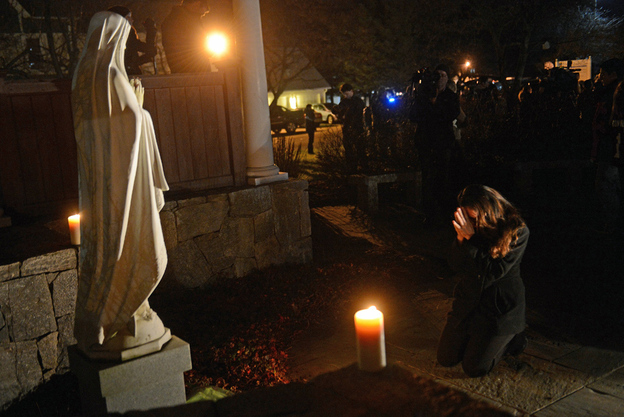
On the night of the shootings in Newtown, Conn., a woman named Aline Marie attended a prayer vigil at St. Rose of Lima Roman Catholic Church, which was packed with local residents and the media. After about 45 minutes, Marie saw the statue of Mary and knelt down to pray.

“I sat there in a moment of devastation with my hands in prayer pose asking for peace and healing in the hearts of men,” she recalls. “I was having such a strong moment and my heart was open, and I started to cry.”

Her mood changed abruptly, she says, when “all of a sudden I hear ‘clickclickclickclickclick’ all over the place. And there are people in the bushes, all around me, and they are photographing me, and now I’m pissed. I felt like a zoo animal.”

What particularly troubles her, she says, is “no one came up to me and said ‘Hi, I’m from this paper and I took your photograph.’ No one introduced themselves. I felt violated. And yes, it was a lovely photograph, but there is a sense of privacy in a moment like that, and they didn’t ask.”…

Here is the picture in question. NPR goes on to pose this question:

What are your thoughts? Should photographers interact with their subjects in moments of grief, or is it more respectful to leave them alone?

Which is a good one.

I’m old school on this. Way old school. Recently, in a comment on another thread, I told this anecdote about an experience that deeply affected the way I look at this sort of thing:

One of my first assignments as a reporter, back in the 70s, was to go interview a family that had lost some children in a fire. It was one of those awful situations of a family that lived in a rural shack heated by a wood-or-coal-burning stove, and some coals got out of the stove and caused the house to burn like kindling.

The photographer and I found the home where the survivors were staying with relatives. It was a house just like the one that had burned, way out in the country. The parents of the dead children were at the funeral home making arrangements. The family that lived in the home let us in, and then left us to wait in the front room while they congregated back in the kitchen. There was no conversation between us.

The photographer — much older and more experienced than I was — and I sat on the edges of our chairs, feeling EXTREMELY awkward, intensely feeling how much we were intruding, and unwelcome. But I guess maybe those poor folks didn’t feel empowered to turn us away.

We glanced at each other uncomfortably every few moments, and stared around the room the rest of the time.

I couldn’t take my eyes off the wood-burning stove in the center of the room. There were burned spots in the battered linoleum floor all around it. Another imminent tragedy, staring me in the face.

We just sat there, waiting to pester those poor bereaved parents, dreading their return, for about an hour.

Finally, one of us — I think it was Bob, the photog — said “Let’s get out of here.” And we did.

Here’s the upshot of the story. Although it became more and more common over the years for news organizations to harass bereaved families in their grief and demand to know how they felt — I even worked with some people who maintained that it gave families a welcome catharsis — I resolved that day that if I were ever an editor, I would never send anyone on such an assignment.

As it turns out, I was an editor a couple of years later, and for the rest of my career. And I never forgot that resolution. Reporters can attest that I sent them on a lot of awkward, unpleasant assignments over the years, but I never sent anyone out on one like that.

Now, having declared myself entirely against this sort of thing, I can offer some defense of the photographer in this case. First, this doesn’t appear to have been the worst sort of intrusion, as there is no indication that the subject of the photo was a bereaved family member. Second, if you are going to take pictures like this — and that is to me debatable — then it’s disingenuous to demand that the subject be asked first. The journalistic version of the Observer Effect kicks in. You can’t get a picture like that — an honest, real one — after you’ve made the subject aware of your presence. And really, do you even want a picture of someone who would say “yes,” and then strike a pose for you? I think not. Such a photo would not only be ethically compromised, it would be downright creepy.

Thoughts? Or feelings, considering the topic?
View of Jim DeMint changed radically after the 2004 campaign

I was rather startled to run across something I’d written about Jim DeMint in 2004.

For so many years now, I’ve seen him as a hyperpartisan ideologue, as responsible as anyone in the country for pulling his party into Tea Party extremism right up until his recent resignation from the Senate, that I’d forgotten I used to see him differently.

Here’s what I wrote right after the 2004 election, when he had defeated Inez Tenenbaum in the contest to replace Fritz Hollings:

While I criticized Rep. DeMint heavily for choosing to run as a hyperpartisan (despite his record as an independent thinker), there’s little doubt that that strategy was his key to victory. The president won South Carolina 58-41, and Mr. DeMint beat Mrs. Tenenbaum 54-44, demonstrating the power of the coattail effect. I congratulate him, and sincerely hope he now returns to being the thoughtful policy wonk he was before he wrapped himself in party garb in recent weeks.

Wow. What a difference a few years make. “Thoughtful policy wonk?” I only vaguely remember that Jim DeMint.

So that’s when it began. Before the 2004 campaign, I saw him as a fairly thoughtful guy. But I guess that campaign showed him what red meat could do for him…

Randy Scott back as police chief

Thought I’d go ahead and pass this on, since some of y’all expressed a lot of interest in the story earlier:

Randy Scott has been rehired as Columbia’s police chief.

Scott retired Jan. 1 to take advantage of changes in the state’s retirement system. He had to stay retired for 15 days, then reapply for his job under the state’s retirement rules.

He will return to work Wednesday, which is the first day he is eligible to return to work.

The city said Scott was one of two applicants for the job, according to a news release, though it did not say who the other applicant was. The chief’s vacancy was posted on a city website.

Scott will be paid $112,200, the same salary he earned prior to his retirement.

That was from The State. WLTX has much the same story, with one or two different details.

Personally, I’m glad the chief is back on the job, as bizarre as the whole retiring and getting rehired thing is. And I look forward to seeing a more complete story, answering questions not addressed above.

I know there are other opinions out there…

Is McBride’s new $75k gig-to-be an outrage, or what?

Initially, I would have been in the “or what” category.

If, early on in this process — before all the stonewalling, and the is-she-resigning-or-is-she-not stuff — I would have been in the “or what” camp. After all, she supposedly did the job they’re moving her to adequately (or at least not disastrously) before. So why not move her back there?

But now, after all that has passed, the idea that she would go back to the same job with an $8,000 raise from what she was paid in that job before is pretty hard to take. In whose universe is that an appropriate response to her performance running the 2012 election? What happened between 2011 and now that made her that much more valuable in the proposed new/old job?

Some of y’all have been commenting on this already on other posts, but now I’m finally getting around to doing a separate post on it. Here’s the news story from this morning:

COLUMBIA, SC — Former Richland County elections director Lillian McBride is on track to be offered a $74,600-a-year job as deputy director in a newly reorganized elections and voter registration office.

In that new position, McBride – who last week agreed to step out of her $89,124-a-year director’s job – would stay in the office, overseeing county voter registration efforts and absentee balloting. That’s the job she held 18 months ago before becoming the state’s highest-paid county elections director and presiding Nov. 6 over the most bungled county election in modern state history…

McBride was paid $66,429 in 2011 as the county’s director of voter registration when Mike Cinnamon ran the separate county elections office. She got a raise to $85,000 in mid-2011 when she was named director of the newly merged voter registration and elections office…

Have at it, those of you who haven’t sounded off yet…

When will the senseless bloodletting (or blood-letting) end?

Stan Dubinsky brings my attention to another bit of brilliance from The Onion. Of course, you have to have spent years of your life (years you’ll never get back!) as an editor to fully appreciate it:

Law enforcement officials confirmed Friday that four more copy editors were killed this week amid ongoing violence between two rival gangs divided by their loyalties to the The Associated Press Stylebook and The Chicago Manual Of Style. “At this time we have reason to believe the killings were gang-related and carried out by adherents of both the AP and Chicago styles, part of a vicious, bloody feud to establish control over the grammar and usage guidelines governing American English,” said FBI spokesman Paul Holstein, showing reporters graffiti tags in which the word “anti-social” had been corrected to read “antisocial.” “The deadly territory dispute between these two organizations, as well as the notorious MLA Handbook gang, has claimed the lives of more than 63 publishing professionals this year alone.” Officials also stated that an innocent 35-year-old passerby who found himself caught up in a long-winded dispute over use of the serial, or Oxford, comma had died of a self-inflicted gunshot wound.

Farewell to a solid reporter, Jim Davenport

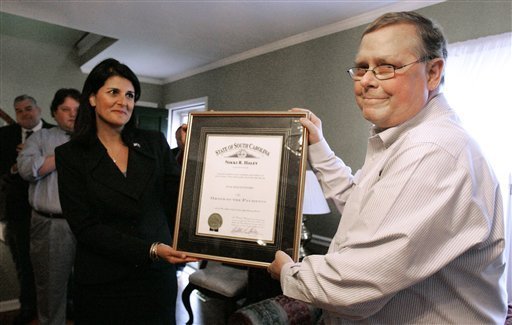
Back in October, Nikki Haley gave Jim the Order of the Palmetto -- which frankly made me feel better about Nikki than I had in awhile.

Back in October, Nikki Haley gave Jim the Order of the Palmetto — which frankly made me feel better about Nikki than I had in awhile.

My favorite Jim Davenport story won’t make much sense to most people, but it always makes me smile.

Jim, whom we called “Dav” because that was his login on the Atex mainframe system we used at The State back then, first came to work for the paper on a sort of unofficial basis while he was still a graduate student at USC. Tom McLean, who was the executive editor in those days, paid him from some mysterious fund only he had access to — so Dav was working for us, but invisible to the folks in H.R.

The managing editor didn’t know about him, either. This was in the very late ’80s or very early ’90s, because that was when Bobby Hitt, now our secretary of commerce, was the M.E. One day in an editor’s meeting, Bobby (who had been away on a fellowship) asked, “Who’s this Jim Davenport and why are we cutting him checks?” One of my colleagues explained that he did various special projects and answered to the executive editor, but wasn’t able to provide any details.

At that moment, then-Features Editor Jim Foster leaped to his feet and cried, “Clarence Beeks!” At which point I just about literally fell on the floor laughing — although most in the room didn’t get it.

Assuming most of y’all are in the same boat, “Clarence Beeks” was the name of a shadowy character in the comedy “Trading Places,” who did top-secret, off-the-books jobs for these two rich guys who employed him to, among other things, get ahold of a top-secret crop report so that they could corner the market on frozen concentrated orange juice. There’s a sort of “eureka” moment in the movie when both Eddie Murphy and Dan Akroyd leap to their feet crying out in unison, “Clarence Beeks!”

OK, so maybe that story doesn’t tell you much about Jim Davenport, who died today at age 54 after a two-year battle with cancer. But in a way it does, because even that early in his career, he had a quiet, matter-of-fact competence about him that made you believe that he could go out and get done whatever needed doing. Tom McLean obviously thought so, or he wouldn’t have brought Jim on board when there was no actual position open for him. He was something of a jack-of-all-trades, as the story by his AP colleagues today attests:

Before entering journalism, he drove a barge for a dredging operation, worked as a roadie for a band and made tires at a factory. He also had a master’s degree in English. The journalism bug bit him while he was at the University of South Carolina…

… which was about when I met him.

Today, most in the trade in South Carolina know Jim as the Associated Press’s longtime stalwart watchdog over the State House. He’s known for such attention-grabbers as being the first to report when our governor went missing in 2009 (only to turn up later on a return flight from Argentina).

But Jim was also the kind of reporter that an editor like me particularly appreciates. I’ve never been a big admirer of the reporters who just hit an occasional home run and then rest on their laurels. I like the ones who get on base at least once in every game. Jim was solid day after day. Nothing stopped him. Just as one small example — it was his dogged persistence, nagging at the governor’s office, that finally got Nikki Haley to admit that she had no idea what she was talking about when she claimed that half of job applicants at the Savannah River Site had failed drug tests (the actual rate was less than 1 percent).

What I like is the kind of reporter who just doesn’t let feckless politicians get away with routine assertions about things that fit their ideologies, but not the facts, and that’s the kind of reporter Jim was.

I knew some months ago that the end was coming for Jim. Still, he was out there working, even when the sweat was pouring from his brow as he showed up for yet another press conference. Despite the obvious physical strain, he would still set the tone for the event, calmly asking his common-sense questions, not letting anything get by him.

The last time I saw him out there, I asked how he was doing. Not well, he told me matter-of-factly. He wasn’t going to get over it, not this time. I didn’t know what to say. I told him I didn’t know what to say. He just nodded, like a man who had already sorted it out in his own mind, but understood that others might have trouble dealing with it.

I so wanted to say something that would make it better somehow. But I couldn’t. Now he’s gone, and South Carolina is the less for having lost him.

The State’s call for McBride to resign

This was several days ago now — on Christmas Eve eve — but what with the holiday and all you may have missed it, so I call your attention now to the editorial in The State Sunday calling on Lillian McBride to do what she has thus far (unless something has happened that hasn’t been reported) refused to do:

GIVEN THE gravity of Richland County’s Nov. 6 elections debacle, we don’t know if there is anything Lillian McBride could have said or done to restore public confidence in her leadership or to warrant her continuing as director of elections and voter registration. But it is telling and disappointing that she has failed to try.

Other than an early attempt to blame her predecessor and a belated apology at a Richland County legislative delegation hearing, Ms. McBride has done far too little to take responsibility for or explain the fiasco that had some voters waiting up to seven hours to cast votes and led to lawsuits, lost ballots and weeks’ late final results.

We see no other way forward but for Ms. McBride to step down as a majority of county lawmakers have requested, not simply because of the Election Day disaster, but because of her overall failure to properly prepare and manage the process leading up to Nov. 6 and her inability to lead through this crisis….

Spot on. The Election Day mess was one thing. Her utter failure to show us anything whatsoever that would give us even a wisp of confidence in her since then seals the deal. If any of you have seen anything that would make you want to hire her for a position of public responsibility, please share.

Which is Rothko, and which is ADCO?

Three years ago, the staff of ADCO had our annual Christmas party at Hobby Lobby. After refreshments, each us was given a canvas and paints, and challenged to create something for the walls of our offices.

We were encouraged to paint in the style of Mark Rothko, and most of us cooperated. We were generally pleased with the results, which you can still see today adorning the walls of 1220 Pickens St.

Fast-forward to this year…

Last Thursday, our office Christmas party consisted of lunch at Hampton Street Vineyard, followed by a tour of the Rothko exhibit at Columbia Museum of Art.

Now, here’s a test of your artistic perspicacity: Above and below are images of two paintings. Can you tell which is by ADCO, and which is by Rothko himself?

No cheating! To check yourself, you may look it up on Google Images after you share your answer. You’re all on the honor system, and sure, you are all honorable men. And women.

IMG_1022

No, wait! McBride says she HASN’T quit…

OK, so disregard the previous report. Check this out instead:

Columbia, SC (WLTX) – Richland County Election Director Lillian McBride is denying reports that she has resigned her position. Rep. Todd Rutherford (D-Richland) told reporters earlier that McBride has agreed to step down on January 8 and possibly take another position at the county.

A short while after those reports, McBride emailed the media saying that was not the case. Her email read: “Dear valued members of the press: This is to inform you that I have not submitted my resignation to the Board of Elections and Voter Registration or to the members of the Richland County Legislative Delegation. Any discussion of this is entirely premature and erroneous. Sincerely, Lillian McBride Executive Director of Richland County Elections and Voter Registration”…

Wow.

Of course the first question that arises is, if she hasn’t quit, why not?

The next question is, did we ever identify anyone who had the power to fire her? Because if so, it’s getting time to make a move…

Report: McBride quits as Richland elections chief

DISREGARD THE FOLLOWING! Lillian McBride now DENIES that she has quit!

Most of y’all will likely regard this as a positive development:

COLUMBIA, SC (WIS) – Richland County’s embattled elections director has resigned six weeks after an election plagued by long lines and an insufficient number of voting machines.

Representative Todd Rutherford (D-Richland) says Lillian McBride’s resignation is effective January 8th. The decision comes two days after the commission’s chairwoman, Liz Crum, stepped down.

McBride’s attorney, John Nichols, submitted the resignation to the delegation Wednesday afternoon.

Rutherford says he does not believe there is any compensation tied to her resignation. He also believes the election board intends to try and find a position for her in the voter registration office where she worked with a good track record for 23 years.

This follows a story in The State this morning that showed most members of the county legislative delegation being in favor of her stepping down.

Where Burl gets to go to work every day

Here’s further proof that life is unfair, as though you needed any.

As you know, several months back, regular Burl Burlingame, my high school classmate, became the first newspaperman I’d known in years to leave the business voluntarily.

He became curator of the Pacific Aviation Museum, on Ford Island, smack in the middle of Pearl Harbor.

A few days ago, he posted the above picture of his workplace. I just now saw it.

It’s just not right that anybody gets to call that his “workplace.”

It’s not just the rainbow, folks. It would be awesome without that…

The firing of Keven Cohen

Somehow I missed this this morning, until Silence brought it to my attention on a previous thread:

Keven Cohen, the longtime afternoon drive host on WVOC-FM 100.1, was fired Thursday afternoon before he went on the air.

Cohen had been hosting the 3-6 p.m. slot since 1999.

“I had a great run at WVOC,” Cohen, sounding gracious, said when reached at his home Thursday evening. “It will always have a special place in my heart.”

Removing Cohen, who peppered his talk show with news and opinion, is a curious decision by the Clear Channel-owned station, especially with a momentous presidential election just four days away. Cohen also anchored the station’s pre- and post-game coverage of USC Gamecock football.

“It’s a scary and confusing time,” Cohen said. “It’s a very challenging time for me emotionally to not know what I’m going to do when I wake up tomorrow morning.”…

From what I’ve seen, radio is more abrupt than print is about these things. I had a couple of weeks to clear my stuff out of the editorial suite; this seemed to hit more suddenly.

For my part, I always thought Keven did a good job. I didn’t hear his show much because of the time of day, but I was a guest on it a few times, and always thought he was a considerate host and a thorough professional. I wasn’t the only one who thought so. I recall walking around Madison Square Garden with Lindsey Graham during the 2004 Republican National Convention (I was doing a column on the way he was working the media), and between chatting with Tim Russert and Biff Henderson of the Letterman show, he paused to take a call from Keven.

There was no one else like him in this market, to my knowledge. He will be missed in that role. I hope he finds another one, just as fulfilling, as soon as possible.

Trust: My Theory of Everything, from 1995

The recent talk about “trust” with regard to the transportation sales tax referendum reminds me of one of my earliest columns for The State‘s editorial page. This ran on Feb. 7, 1995. I had only been on the editorial board a year at the time. Back then, board members rarely wrote columns; I was the only one to do so on a regular basis — I just couldn’t hold back. (Fellow Associate Editor Kent Krell called me “the Energizer Bunny” behind my back.) When I became editorial page editor two years later, I started requiring associate editors to write at least a column a week.

Anyway, while the headline was amazingly boring, I still like the column, and wouldn’t change a word of it:

Shortage of trust underlies most current problems

BRAD WARTHEN
Associate Editor

British Prime Minister John Major says the Irish peace process is threatened by a lack of trust among the Protestants of Ulster.

Well, we can’t help him with that one. American citizens have been pretty good about supplying weapons to Irish killers over the years, but we can’t spare any trust just now. We’re fresh out.

In fact, I am increasingly convinced that virtually every social problem we have in America arises from a shortage of that commodity.

The more I think about this, the more it seems like a universal principle: When mutual trust is high, society runs smoothly; when trust is low, it doesn’t. That sounds simple, but when it first occurred to me, I was startled to realize how much it explained. It seemed the sociopolitical equivalent of the unified field theory that physicists seek.

Look around. Depending on who we are, we don’t trust : the rich, the poor, the congressman, the congresswoman, the teacher, the student, older people, younger people, TV, newspapers, the courts, the police, the boss, the employees, liberals, conservatives, the guy next door, the guy across town, the guy walking down the sidewalk toward us, feminists, preachers, lawyers, doctors, businesses or customers.

A lack of basic trust of each other explains why:

  • We have so many laws, and so many lawyers. We trust nothing to common sense.
  • Thirty years after the Civil Rights Act, black and white Americans still seem to be at odds on so many fronts. So we have affirmative action and racially gerrymandered legislative districts.
  • Feminists continue to believe that a “glass ceiling” keeps women down.
  • Political discourse has gotten ugly. We no longer trust people who disagree with us to speak in good faith.
  • We want term limits, spending caps and other ways of putting government on autopilot. (We don’t trust either elected representatives or our fellow voters.)
  • We buy so many guns and build so many prisons.
  • We call the cops rather than tell those kids on the corner to “cut that out!”

It’s why we form taxpayer advocacy groups. We don’t trust government with our money.

Government! Why, we don’t trust government to do anything right, and we almost never think of the government as us anymore, as though the great American experiment in self-government were over. Now, government seems to many of us like this menacing thing out there, an intruder to be cast out of our lives. Yet what is “government” but the means by which we come together to decide, as a people, how we will live with one another?

Basically, we’ve lost faith in most of the institutions, large and small, through which our public life once found meaning.

It wasn’t always like this. There was a time, just a generation or two ago, when people sort of took it for granted that the rest of the world wasn’t out to get them. Back during the Depression, people were poor, but they didn’t resent it too much because they looked around and saw other people were poor, too. Then we beat Hitler and imperial Japan, and our greatest weapon was our ability to pull together in trusting teamwork. The government asked us not only to pay our taxes but place further trust in it by buying war bonds, and we did. The government told us that the boys at the front needed rubber and steel more than we did, and we went without and conducted drives.

After the war, we found even more reasons to trust government and the larger society. Government policies, paired with an exponentially expanding economy, helped create the affluent middle class of the ’50s and ’60s through enactment of bold policies in the late ’40s, such as the GI bill and subsidized low-interest mortgages.

Citizens who had been left out of what prosperity had existed before in America were given a fair shot at the American dream for the first time — partly because of court and congressional action, but mostly because the majority of Americans were convinced that it was wrong to treat people differently because of skin color.

So what happened? A lot. We fought a war that, instead of pulling us together, pulled us apart. Leveling the playing field between black and white didn’t level social and economic inequities, and we’re still fighting over why. A President was brought low, and people started looking at their leaders in a different way. Women sought equity with men at the same time that a shifting economy forced them into the workplace whether they wanted to be there or not. And yes, the press has had a lot to do with the decline of trust and sense of community in our society. For too long, we saw our job as being largely to tell you what was wrong with government and society so you, the voter, could fix it. We’ve focused on failures and conflict, and then we sit back and wonder why everybody seems to think society’s gone rotten. Our friends in the electronic media have done their bit, too, of course. You’d think from watching TV news that there’s nothing going on outside your door but random murders, rapes, robberies and lousy weather. So why go out and get involved?

And yet that is precisely what we must do if we’re going to fix this problem. We’ve got to unlock the door, go outside and encounter each other. We’ve got to take chances.

We have to engage — pay attention, think, run for office, circulate petitions, vote.

But first we have to believe that we can make a difference, that we can form communities rooted in good faith, that we can govern ourselves with civility. It may seem like a long shot, but it can be done. Trust me.

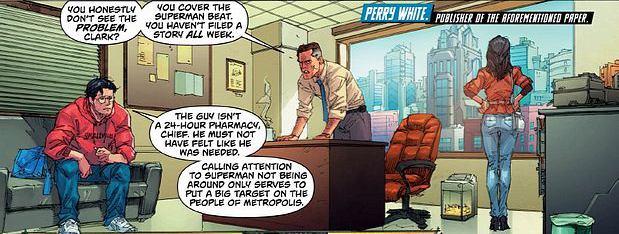
Clark Kent following in my footsteps

Except, get this — the dope doesn’t get laid off. He quits The Daily Planet, a newspaper still perfectly willing to keep giving him a paycheck to do what he does, to become a blogger on purpose.

Of course, I don’t suppose he’ll starve. The whole blog business model probably works a whole lot better when you can squeeze a lump of coal into a diamond whenever your ad revenues run low.

It’s all well and good to argue with your editor over news judgment. Everybody does it. And yeah, I like the touch where you invoke “truth, justice and the American way,” in the pontifical manner of scribes everywhere. But the thing is, you come back into work the next day, when you and the editor and everybody else has forgotten yesterday’s argument, and is ready to start on today’s.

Sorry, but I guess my problem is that I spent most of my newspaper career as an editor, supervising prima donna writers, so I tend to have a bit more sympathy for the multitudinous headaches of Perry White.

Oh, and another thing, Kent: Put on a damn’ tie! Great Caesar’s Ghost..

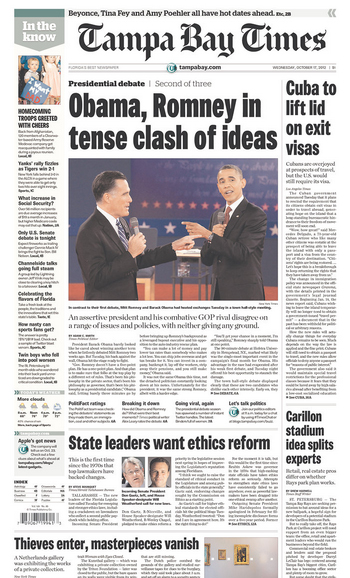
Last night’s debate news (or part of it) this morning — another problem for what’s left of newspapers

OK, so I’m behind the curve today. I got home from final dress rehearsal last night at about 11:30, heated up some dinner, watched a few minutes of both the beginning and the end of the debate (having heard a BBC assessment of it on the radio on the drive home) then watched some of the PBS commentary after the debate, then hit the sack.

But I’m not as far behind the curve as most daily newspapers were in today’s print editions.

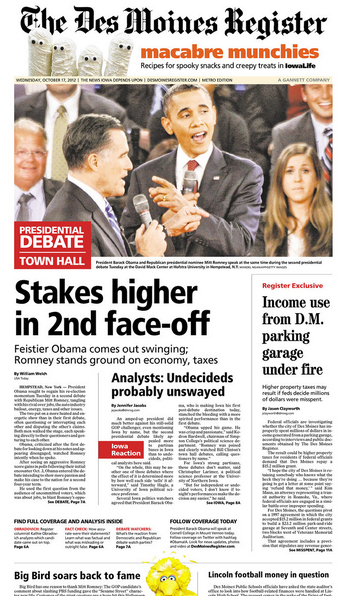
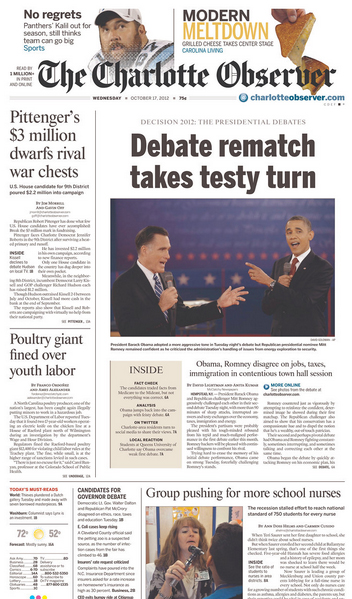
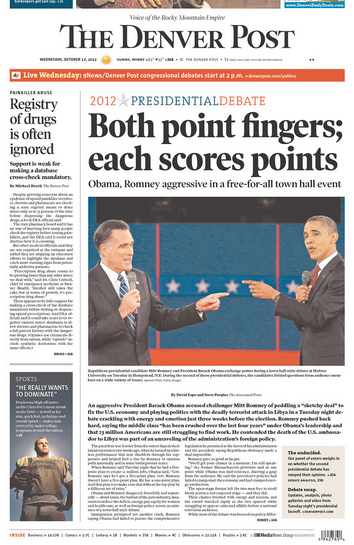
Slate calls our attention to today’s front pages (all taken from the Newseum, where you can see plenty of others), which have a sameness about them: They pretty much all say the same thing in their headlines, and most run photos of the same moment, with the candidates’ fingers pointed at each other. Sure, you might find some “analysis” in there somewhere, and the more enterprising (and better-staffed) opinion pages will have some sketchy opinions expressed. As Slate’s Josh Voorhees writes:

As we explained late last night, the insta-polls and the pundits saw a tight contest on the Long Island stage on Tuesday, but one that was won narrowly by President Obama. Given the lack of a clear-cut win, however, it should come as little surprise that a quick scan of the morning’s front pages show the nation’s headline writers and art teams focused on the on-stage clash and largely left the who-won question to the domain of the cable news talking heads (as most papers had likewise done following the previous two debates).

Once, this sameness, this lack of personality or individualized expression was the glory of newspapers. If 10 different journalists from 10 different papers covered the same event, they would all write pretty much the same thing. It was a measure of their professionalism, and the self-effacement that news writing demanded of them. It was about giving it to you straight, unadorned, plain, and God forbid there should be any hint of opinion in it. Who, what, where, when, maybe how, and, if you put an “Analysis” sig on it, why.

The monotony of it didn’t strike the reading public because unless they lived near an urban newsstand, most people only saw one daily newspaper.

But here’s the problem with that today: What newspapers put in those lede headlines today, and what they conveyed in those pictures, was all old news by the time I was driving home from rehearsal last night.

I hadn’t driven more than a few blocks when I knew the conventional wisdom on what had happened. It went something like this: Obama did all the things he failed to do in the first debate, particularly having a strong finish. Romney did fine, although was maybe not quite as sharp as in the first debate. If you’re declaring a winner, it’s Obama, although I didn’t get the sense that he dominated in this debate the way Romney did in the first one, so if you’re going on cumulative totals, Romney’s probably still ahead in this debate series. How this affects the polls remains to be seen.

I had even heard about “binders full of women,” but I was mostly confused by that.

In the post-debate analysis I watched after I got home, I heard David Brooks and Mark Shields give their assessments. Brooks said Obama won because he was able to exploit Romney’s biggest weakness better than Romney was able to press Obama on his biggest weakness. He said Romney’s biggest weakness is that his numbers don’t add up, and Obama’s problem is that he never provides a vision of what the next four years will be like if he is re-elected. Shields said it might surprise everyone, but he agreed with Brooks on all those points.

Since then, on the radio this morning, I’ve heard that “Obama hasn’t sketched a vision going forward” meme several more times.

I was also interested in what a young woman (didn’t catch her name) who analyses Twitter during debates for PBS had to say. I didn’t get as much of an overview of the Twitter take as I wanted because she decided to zero in on the reactions of women. But I’ve found her assessments interesting in the past: What was trending? What were the memes people were obsessing over? What caught on? I’ve become more and more interested in the instant reactions of Tweeters in the aggregate during events like this. It has something to do with the wisdom of crowds. It’s like having sensors attached to the brains of millions of highly engaged, clever voters — which is what the most-followed people on Twitter tend to be.

And I felt left out because I wasn’t on Twitter myself during the debate. Increasingly, that’s where I like to be during these kinds of real-time shared events, sifting through the flood of reaction as it washes over me.

And in a Twitter world, seeing these front pages feels like reading ancient history. No, it’s worse than that. Historians look at the whole of a thing after it’s over and draw conclusions. There’s a wholeness to historical accounts. These reports — and I’m just reacting to the headlines, mind you — don’t do that. They give only the most noncommital account, essentially just telling you that the candidates came together and vied against one another, and there the account ends. The Des Moines Register headline (“Stakes higher in 2nd face-off”) could have been, and possibly was, written before the debate started. (And pre-Gannett, that was one of the best papers in the country for political coverage.)

And I was already so far beyond that, without even trying hard to be, last night — without even having seen the debate.

I’m not saying these papers aren’t doing their jobs well. What I’m saying is that the job they’re doing, within two kinds of constraints — the convention of not drawing conclusions in a news account, and the severe time problem of the debate ending as they have to get those pages to the press room (depending on the edition we’re talking about, a lot of editions went to bed BEFORE that) — fails to satisfy in a Twitter world.

Again, there might be all kinds of good stuff in the stories, but the presentation — the quick impression that a glance at the front page provides — is deeply lacking. It makes you not want to read more deeply. It causes me to want to go read those papers’ websites today, and see what good stuff didn’t make it into the paper. (And the better papers will have something for me when I go there.) Because the conversation has moved, by the time the paper hits your stoop, so very far beyond what’s in those headlines.

The Ron Morris/Steve Spurrier brouhaha

Things have come to this: The other night, Mr. Darcy asked me whether Ron Morris had been fired by The State.

OK, so it wasn’t actually Mr. Darcy, who after all is a fictional character (don’t tell Bridget Jones that!), who in any case would be long dead had he ever lived. No, it was local actor Gene Aimone, who will portray Mr. Darcy in the SC Shakespeare Company’s production of “Pride and Prejudice,” which opens at Saluda Shoals Friday night. See, I can get a plug into anything.

I told him I had no idea. I wondered why he asked. He said hostilities had resumed between Coach Steve Spurrier and Ron, and that the coach had said something mysterious on the radio, or on TV, or on one of those newfangled gadgets that Mr. Darcy has no business listening to, suggesting that there would be developments forthcoming that would pleasing, at least to him.

I said I ran into Ron at Barnes and Noble several months ago and we chatted pleasantly for a time, and he appeared alive and well, and that’s the last I knew of him.

And I thought no more of it, until Neil McLean mentioned it over breakfast at Cap City this morning. Neil is the new executive director of New Carolina (replacing the retiring George Fletcher), and the son of Tom, my old boss at The State. Neil and I were talking economic development and world travel and all sorts of things, when suddenly he, too, got on the subject of Morris and Spurrier.

And I realized that I was probably the only person in South Carolina not fully briefed on this burning issue. So I went and read up on it. The State itself did not have anything on the controversy, beyond this self-effacing column by Ron (the message, in a nutshell: It was business, not personal).

Then I found this column by Dan Cook at the Free Times:

For a man who seemingly has everything — a multimillion-dollar salary and one of the most successful teams in college football, for starters, not to mention a Heisman trophy — Steve Spurrier is no doubt lacking at least one thing: a thick skin.

How else to explain Spurrier’s repeated tantrums about the writings and comments of a sports columnist, Ron Morris at The State?

At first glance — and second, third and fourth — the situation seems utterly absurd. How can the mighty Spurrier, a legendary coach revered by literally millions of college football fans, even care what a lowly local sports columnist says?

And yet, he does — apparently a lot.

Last week, it was a comparison Morris made between Penn State and the University of South Carolina that set Spurrier off.

Speaking off the cuff on Bill King’s XM radio show in response to a question about whether Spurrier would take questions at an upcoming press conference (Spurrier had recently instituted a policy of refusing questions), Morris said, “I think it’s a real test of the [USC] administration. This is how things like Penn State happen — when the administration won’t step up and confront the football coach, and he becomes all-powerful. When the football coach begins to dictate company policy, I think you’re asking for trouble.”

Spurrier responded in a later radio appearance by implying that if he had to put up with Morris any longer, he might as well retire and “head to the beach” instead. “That’s not part of the job, so we’re going to get it straightened out,” Spurrier said…

So now I see what it was about. And as I see the actual words Ron spoke, I see the matter quite differently from the Gamecock fans who have gotten so upset over it. I understand how a fan (to the extent that I can understand a sports fan, a breed not unlike political partisans, who often mystify me) would get upset if he heard, “Hey, that Ron Morris compared the Gamecock football program to the Penn State mess.” But of course, that would be a grossly unfair characterization of what he said.

To a dispassionate observer, it’s obvious that he was saying this situation was like that other in that you had a popular, successful coach, and if that popular coach becomes beyond reproach in your community, and becomes the tail that wags the dog that is your state’s flagship university, that’s a problem.

While the statement can be defended on rational grounds, there’s no question that Ron stepped in it, and that all this emotion could have been avoided if he’d just found a better way to express himself.

Of course, if he’d simply said, “Steve Spurrier’s getting too big for his breeches,” and not mentioned Penn State, he’d still be in trouble, because, well, Mr. Spurrier actually does happen to be a coach who has become beyond reproach in his community. A lot of people are fine with that state of affairs. As a skeptical journalist, Ron seems to have a problem with it. And therein lies the conflict.

Disclaimer regarding the current header

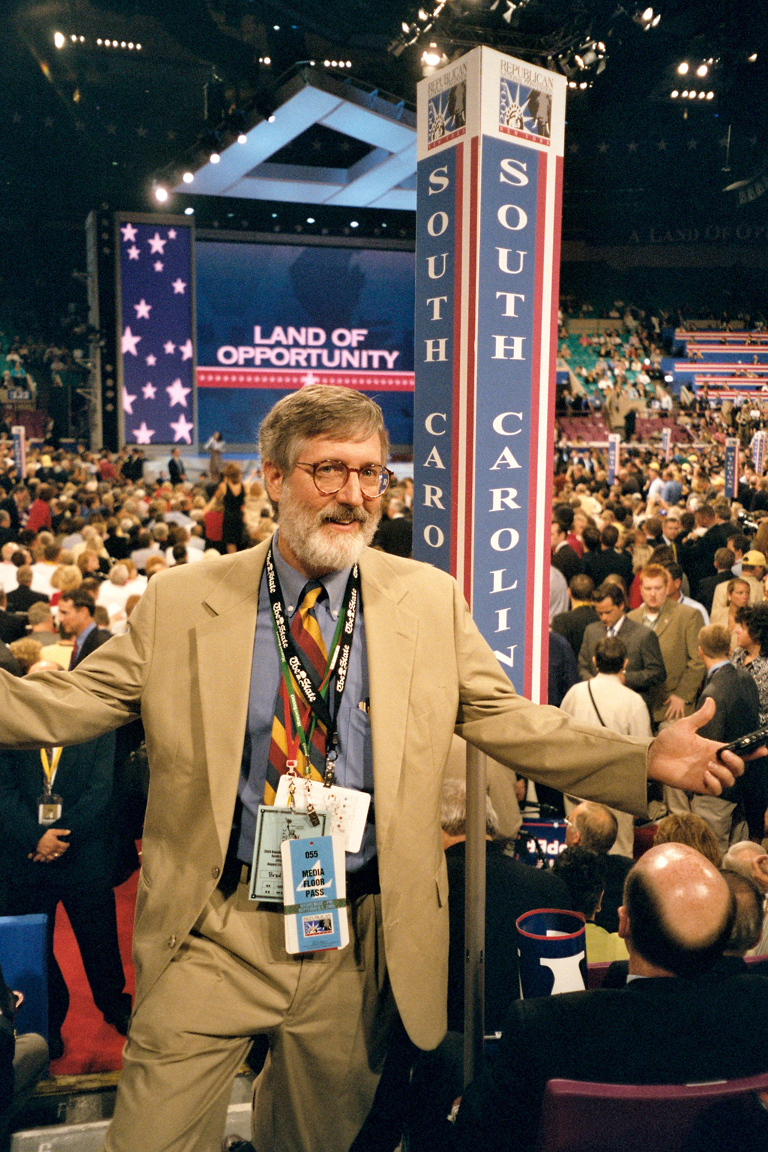
If you’ve on the main page of this blog, you see a header image with me standing on the convention floor, next to the South Carolina delegation’s sign, at the RNC in New York in 2004 — the last convention I actually attended. At left is the uncropped image.

The photo was taken by current SC Speaker Bobby Harrell, using my camera. My left hand hovers over the head of the then-speaker, David Wilkins.

I just say that to make sure no one thinks I’m trying to fool you into thinking I personally attended the recent conventions. I did not. I just figured that, with Labor Day being behind us, this was more seasonal than the picture of the Surfside Pier I had up before.

Also, I currently have a beard, so I look like that again. Just older.

Chicago teacher union seems to be doing all that it can to undermine Obama’s re-election effort

As we were discussing yesterday, the advantage in this election belongs to the president. But things can happen to change that. The teacher’s union in Chicago, his old stomping grounds, is doing what it can in that regard.

Not that I think it will hurt him that much, but they’re doing their best.

Why would the rest of us care about a labor dispute in Chicago, of course, except for its potential impact on a national conversation.

This is one of those moments in which Democrats and their constituencies do their best to live down to the very worst portraits that Republicans paint of them.

The Republican (or Viable Libertarian) Party dislikes public education, because it costs money, for which taxes must be paid. So it paints public education as a vast patronage machine, run by people who care little about actually educating our society, but only about their own prerogatives and self-interest. The legitimate interest of the public in an educated populace, this argument goes, is held hostage to public employee unions.

This, of course, is a grossly unfair characterization (and grossly inaccurate in SC, where we do not have collective bargaining for public employees, and therefore have no teachers’ union), except for when it is dead on.

Argue all you like about any supposedly legitimate grievances these union members have. It really doesn’t matter. When I Google “chica” — that’s all I have to type — I get a Chicago Tribune story that is encapsulated on the search page with these words: “More than 350,000 children will be locked out of Chicago public schools for a second day as striking teachers and the school board remain at…”

News stories out of Chicago are replete with the disruption to the lives of children who ought to be in school learning something. Here’s how it plays, from the Tribune story. This is in reference to the city’s effort to provide the parks as safe places for working parents to drop off their kids during the strike:

But Rachelle Cirrintano, who works at the University of Illinois at Chicago, still worried about her 8-year-old son Rocco. The boy has a hard time adjusting to change, she explained. When she dropped him off this morning, he sat on a bench alone because he didn’t know anyone.

She focused her frustration at the teachers.

“There was no reason to do this when they just got situated,” Cirrintano said. “All the teachers should be let go for their irresponsibility to the children and their families.”

And who is the wicked boss the union is striking against, as far as the world can see? Why, Rahm Emanuel, the president’s former chief of staff. The mayor’s sin was to try to implement some basic education reforms. The union claims the mayor “disrespected” it.

Republican critics of public education couldn’t have written a better script for illustrating their argument that the greatest barrier to education reform is the very people who work in public education.

Enjoying reading about the last time I was this ticked off

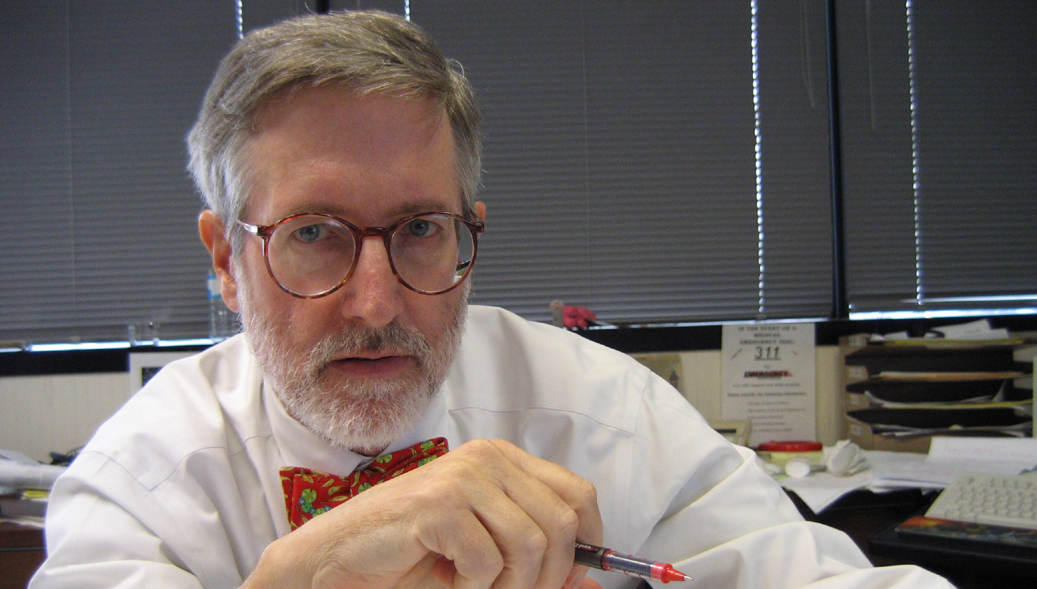
At my desk at The State, evincing one of those moods./file photo from 2007

Today, grumpily wondering whether I’ll find the Democratic Convention next week as vapid, monotonous, insulting and obnoxious as I did the sliver of the GOP convention I listened to last night, I was reminded of column I wrote four years ago.

If past is prologue, it would seem the answer to my dreary question is “yes.”

That column, which ran on Aug. 31, 2008, was headlined, “Yelling at the television.” If you go back and read it, it will tell you what the rest of this week and all of next week will be like, if you find the parties as disgusting as I do.

A favorite excerpt:

What sets me off? Oh, take your pick — the hyperbole, the self-importance, the us-against-them talk, the stuff that Huck Finn called “tears and flapdoodle.”

Take, for instance, this typical bit from Hillary Clinton’s speech:

My friends, it is time to take back the country we love. And whether you voted for me or you voted for Barack, the time is now to unite as a single party with a single purpose. We are on the same team. And none of us can afford to sit on the sidelines. This is a fight for the future. And it’s a fight we must win together. I haven’t spent the past 35 years in the trenches… to see another Republican in the White House squander our promise…

Let’s deconstruct that a bit.

Take back the country? From whom? Did I miss something? Did the Russians roll right on through Gori and into Washington? No? You say Americans are still in charge, just the “wrong” Americans, of the wrong party? But your party controls Congress! Take it back from whom?

… a single party with a single purpose. Now there you’ve hit on the biggest lie propagated by each of the major parties, the conceit that there is something coherent and consistent about such loose confederations of often-incompatible interest groups. Did you not just spend the last few months playing with all the force you could muster upon those very differences, those very tensions — between feminists and black voters, between the working class and the wine and cheese set? What single purpose, aside from winning an election?

This is a fight… No, it isn’t, however much you love to say that. Again, I refer you to what the Russians are doing in Georgia — that’s a fight, albeit a one-sided one.

… that we must win together. Actually, that raises a particularly pertinent point, which is that the only “fights” that “must” be won are the ones in which “together” is defined as all Americans, or all freedom-loving peoples, whereas such divisive factions as your party and that other one that will meet in St. Paul militate against our being able to win such fights together.

I haven’t spent the past 35 years in the trenches… You’re absolutely right; you haven’t. So spare us the war metaphors.

… to see another Republican in the White House squander our promise… Like that’s what matters, the stupid party label. Like there isn’t more difference between you and Barack Obama in terms of philosophy and goals and experience and what you would bring to office than there is between John McCain and Joe Biden. Come on! Please!…

Sigh. Fume. Mutter.

Yep. I was thinking almost identical thoughts last night watching this convention.

I was pretty disgusted back then. Now, I enjoy reading about how disgusted I was. I always find that my writing improves with distance…

WIS takes media convergence to a new level

wistv.com – Columbia, South Carolina |

It’s interesting — to me, anyway, as a longtime editor — to watch what’s happening as general-circulation newspapers do less of what they once did.

I recently had breakfast with Donita Todd, general manager of WIS, and her news director Rashida Jones (no, not that Rashida Jones, this Rashida Jones). They told me about some new things they were doing at the station, particularly their stepped-up investigative efforts.

But even if they hadn’t told me they were putting new effort into that direction, I would have noticed.

For instance, this morning, my attention was drawn (via Twitter, of course) to this story on the WIS website, by the station’s Jody Barr. An excerpt:

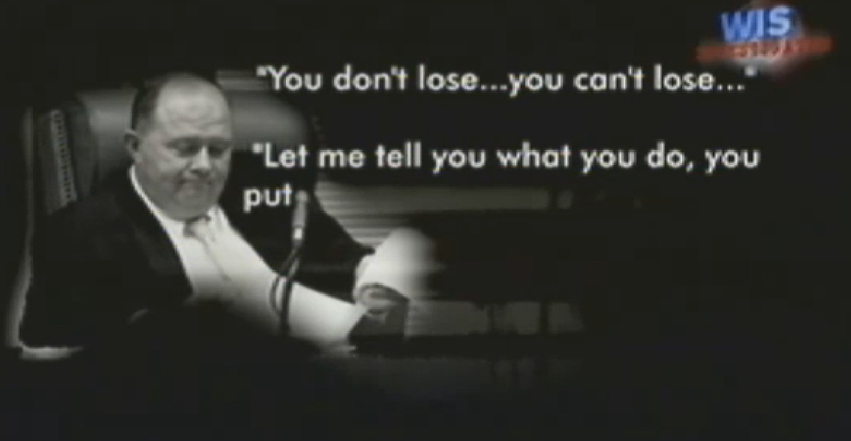
LEXINGTON COUNTY, SC (WIS) – A secret audio recording of Lexington town councilman Danny Frazier gives a detailed look inside an underground video poker operation working inside Lexington County. Frazier brags about his ability to operate illegal video poker sweepstakes businesses within Lexington County. A WIS investigation uncovers Frazier’s political connections and whether those connections are allowing him to continue doing business.

We obtained the recording from a source who secretly recorded a conversation with Frazier. The source posed as a businessman, interested in getting into the illegal video poker operation inside Lexington County. The source went undercover after fearing Lexington County law enforcement was purposefully ignoring and protecting Frazier’s operations. The recording links Frazier to at least two separate sweepstakes businesses, both near West Columbia.

The people who made the recordings tell WIS they have turned them over to state and federal authorities…

The recording indeed is fascinating. Of course, it raises a lot of questions in my mind that might not occur to some readers — questions the reporter would have had to answer for the story to get into any newspaper I ever edited.

We would have had a long, long conversation about this self-appointed Batman who went “undercover,” starting with the word itself. Can average citizens technically go “undercover?” Doesn’t the term refer to a law enforcement officer hiding the fact that that’s what he is? What does it mean when a layman does it? What are the implications? What sort of deception was involved, and to what extent does it expose the individual, or the media outlet that uses the product, to allegations of illegality? Who takes that upon himself, however lofty his motives? And speaking of that, what were his motives, and what does that tell us? (Ultimately, the test is whether the information is good, not the motives of the source. But knowing the motive could lead to relevant questions that I can’t even imagine at this point.)

And why are we concealing his identity? There may be a good reason, but I’d like to hear it.

I’d also like to know whether the recording, obtained as it was, could possibly have any value to the “state and federal authorities” to whom it was given. I don’t know enough to answer that question. Fortunately, it’s secondary to this story, but I do wonder.

There’s a Wild West sort of feel to this sort of investigative reporting, on its face. It reminds me of the way reporters so often are portrayed in fiction, starting with Lois Lane and Jimmy Olsen in the old “Superman” TV series. They were always taking it upon themselves to try to personally catch the bad guys, rather than simply report the story. Fortunately for them, Superman was always nearby to save them when the bad guys tied them up in an abandoned warehouse.

Of course, that’s only the way it looks to me from the outside. It could be that the folks at WIS who decided to go with this have very good answers to all of the questions I raise — I just can’t tell, as the reader.

There is one thing in the story that makes me feel better about reporting the contents of the recording — and I suspect is what made WIS management feel OK about the story — it’s that Danny Frazier, incredibly, “admitted to the recording.” Although I’m not clear on to what extent he did so, since he doesn’t admit to having said what the recording seems to show him saying. But let’s say he does confirm the legitimacy of the recording itself. This, of course, raises a bunch of other questions, such as: OK, if he knows the recording is legit, then doesn’t he know who was with him when he said those things? Does he not recognize the voice? In which case, tell me again why we’re not identifying the “undercover” guy…

Of course, to the casual reader, what we have here is a fascinating glimpse into the video poker bidness in 2012, and plenty of reasons to ask questions of Jake Knotts and Jimmy Metts. And that’s where Mr. Barr sticks to the book, asking those questions of each player and dutifully recording the answers. He got some great quotes:

The sheriff said he was too busy meeting and greeting voters to pay attention to who gave to his campaign, although the contributions were maximum contributions. “Very rarely do I look at the checks,” Metts said, “I do have access to who contributed to the campaign through the computer, but really and truly, I don’t go back and look at that.”

“If you held a shotgun to my head right now and told me you were going to pull the trigger unless I told you everybody who contributed to my campaign, you’d just have to kill me,” Metts said.

Several times during the interview, Metts denied any participation in or knowledge of any of the illegal video poker businesses in his county. “I know people say, in something like that breeds corruption, but I can tell you in no uncertain terms I am not a part of any Lexington County ring, I am not part of any illegal gambling. I don’t own. I don’t receive. I’m not involved. I’m not protecting anybody. As a matter of fact, [it’s] quite the opposite. I’ll put their [expletive] in jail.”…

Knotts admits Danny Frazier is a close friend whom he’s known for years, but denies any knowledge of protection for Frazier to continue to operate the illegal sweepstakes machines. “Do you have any involvement in what these tapes show that Danny Frazier may be involved in?” Barr asked. “None whatsoever,” Knotts replied.

“I’ve got contributions when I first ran, every time I’ve ever run and I don’t back away from it,” Knotts said of accepting campaign contributions from the video poker industry.

“If there’s any more money out there that any of those people want to send me, send it to me,” said Knotts. “I could take money from the devil and make it do God’s will.”

Bottom line, this new assertiveness by WIS, and by such others as the Free Times‘ Corey Hutchins, is bound to uncover a lot of fascinating stuff in our community going forward, however they go about it.

WIS is aggressively moving into the territory once held firmly by newspapers. For some time, of course, the text stories on TV websites have been more than mere come-ons for the video. And the networks, with their greater resources, have gone deeply into the realm of publishing the written word. But this sort of extended investigative report — 1,866 words, close to twice the length of one of my columns at The State — seems to go well beyond anything local television has attempted to do in the past.