Author Archives: Brad Warthen

The return of the bots

Not this kind of Spam — which frankly, I’ve enjoyed since I was a kid. No, the other kind…

Well, this is weird…

I saw I had 9 comments awaiting moderation, so I went to deal with them, and they were all spam. I haven’t seen those in awhile — like, years. I guess something happened when the folks at Godaddy did that emergency rebuild to bring my blog back to life yesterday. I know they ditched a bunch of plug-ins. Maybe one of those was protecting me from “comments” such as:

Ignite your originative spark with compound THCA flower. Because hybrids like buy thca flower online connexion the recess between rational distinctness and mortal relaxation, they are incredibly favourite to each artists, writers, and thinkers. It provides due ample physical placidity to calm the fidgets while keeping your certain acrimonious, running, and at the ready to brainstorm. Observation a balanced movement situation like not in a million years before.

A “balanced movement situation?” What is this, dope or laxatives?

Anyway, beyond the amusement, I’m worried that maybe real comments aren’t getting through. In fact, I’m kind worried that no one has been able to see the blog at all.

Let me know if you’re seeing this…

Good for Shane Massey, and the others who voted ‘no’

Here’s how the NYT recorded this momentous moment at our State House.

Well, the madness has passed us by, for now. Or at least that wave of it has.

I mentioned yesterday that Senate Majority Leader Shane Massey was expected to oppose Trump’s plan to usurp (for his own purposes, as is his wont) a key responsibility of our state Legislature — drawing election maps. And he stood up and did so in fine style:

“If we don’t consider the concerns of South Carolina, there is no one left,” Massey said. “We are the last lines. I have too much Southern blood in me to surrender.”

Amen to that, brother Shane. It’s time that someone in this state stood up for for a States’ right that matters, and is entirely justified. Something good, instead of, you know, what our ancestors stood up for that other time.

Enough Republicans stood up with him to defeat the effort to eliminate the sole Democratic member member of South Carolina’s congressional delegation, Jim Clyburn.

These are the other four:

  • Sean Bennett, R-Summerville
  • Chip Campsen, R-Isle of Palms
  • Tom Davis, R-Beaufort
  • Greg Hembree, R-Little River

Good for Tom Davis and the rest.

Those were the votes that took courage. Of course, they would have accomplished nothing if the Democrats hadn’t all been voting against it. The Dems celebrated appropriately after:

South Carolina Senate Democrats welcome today’s defeat of the sine die resolution that would have allowed the legislature to return for a politically motivated special session on congressional redistricting.

“Today’s vote sends a clear message that South Carolina should not be dragged into another unnecessary and divisive redistricting battle driven by Washington insiders,” said Senate Democratic Leader Brad Hutto. “South Carolinians rejected a politically motivated power grab orchestrated by a White House shaped by perpetually online New York City activists with little understanding of South Carolina. The people of this state expect us to focus on real issues affecting their daily lives, not carry out an outside political agenda.”

Senate Democrats will continue fighting for fair representation, transparency, and a government focused on the needs of South Carolina families rather than national political gamesmanship.

Brad Hutto was also quoted in The State as saying:

“We just don’t take documents from Washington and say ‘thank you, sir. Thank you, ma’am.’ We are the deliberative body,” Hutto said.

No, we don’t. I was afraid we might be, that we might do what just happened in Tennessee, but for now South Carolina did the right thing. It’s nice to be able to say that.

The utter madness going on now at a state capitol near you

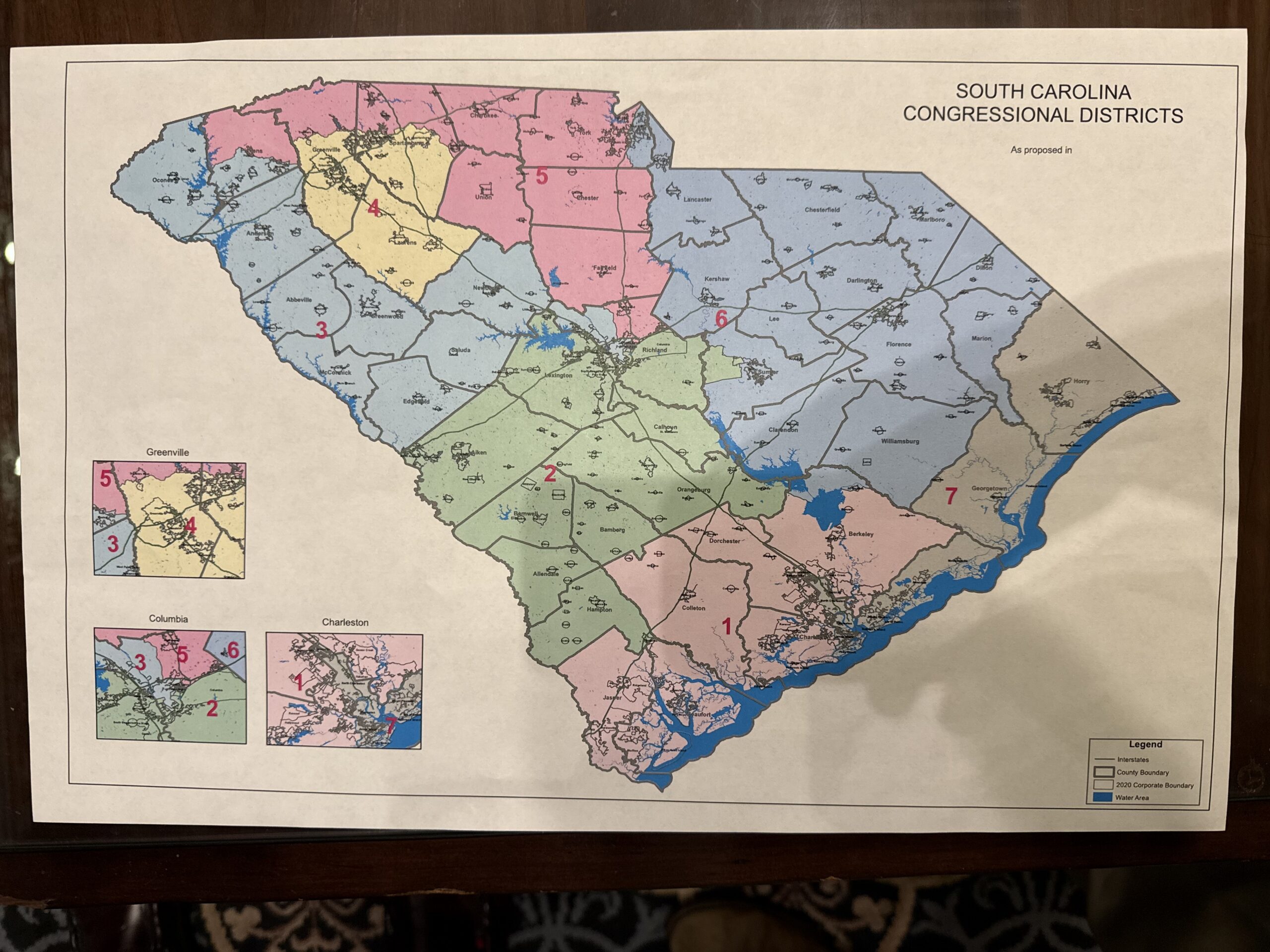
One of the maps being discussed.

Unbelievably, I just learned about this last night, because as y’all know I’m not paying NEARLY as much attention to news as I once did.

Perhaps you’ve been as inattentive as I have. I hope not. But in any case, none of us knows how it’s going to turn out.

I’m talking about this.

Here’s another version from The State.

What’s going on in this: Donald Trump is trying his best to redraw all the Southern states’ maps (and maybe others as well; I’m just looking at the South here) so that there is no hope of them ever electing another Democrat. No Jim Clyburn, and so forth. This is all sparked by the recent Supreme Court decision regarding the Louisiana map, which has thrown the doors open to this sort of thing. This is now apparently a big part of his vision of becoming permanent Fürher of America, along with such things as changing the rules so he can run for a 3rd time in what would likely prove to be our last presidential election (in his lifetime, anyway), and making sure he can win it in the House, no matter what the voters say.

I had sorta, kinda been following this — elsewhere. My wife, who’s from Memphis, had focused my attention on what Tennessee just did. They had torn apart the 9th Congressional District that since the early ’70s had been mostly electing black representatives. (I voted for the first of those, Harold Ford. Later regretted it. But I liked his son.) So now, black Memphians (who are the majority in the city) are raging about the “racist” map, and the current incumbent (who, incidentally, is white and the first Jewish congressman from Tennessee, and can’t really play the usual Memphis race card), is talking about the indiscriminate elimination of Democrats.

Which is somewhat more to the point in the Memphis case. If Trump thought black members would support him as slavishly (and that’s the word here) as white Republicans do, he’d be looking for a way to make ALL the districts majority-minority, if that were possible. For that matter, if only Democrats loved him as the terrified Republicans do, he’d go for more Dems. He’s not particular. But neither of those fantasies being the case, he’ll settle for a plan that elects only Republicans. He only cares about Number One — never forget that.

As for SC, I only heard about this last night from a Democratic friend whom I had called about something else entirely. I’ve talked to a couple of other people since then — well, one other person, a Republican. But I’m trying to reach a lobbyist by text who can tell me what the hell is going on right now. Other that, I’ve been reading but not learning much. Because going into today, nobody knew what was going to happen. This is moving very fast.

It seems it will depend on whether the Senate goes along with a last-second reapportionment. I hear Majority Leader Shane Massey is against it, but I can’t swear to that. We’ll see.

Meanwhile, over in the House, I hear about Republicans running around talking about the latest “White House map.”

Y’all do understand the extent to which this means we are living in a different country than the one in which I have spent most of life. Right? Sure, presidents have always been highly interested in the makeup of Congress, and therefore very interested in the maps, and quietly keeping track of what’s happening.

But that’s not THIS America, in which the president openly barges in and takes over this process, and his minions in Columbia are unembarrassed about making it clear what’s going on.

You see, folks, legally — constitutionally — remapping is entirely the responsibility and prerogative of state legislatures. In any previous decade, lawmakers of both parties would have been fiercely defending their turf, furious if any mere president tried to muscle in.

But not these guys. Not in Trump World.

We won’t even get into the completely uncaring betrayal of the Legislative Black Caucus, which in the early ’90s made the deal with the Republicans that let the GOP take over the S.C. House. But let’s not be too harsh in judging today’s Republican members. They, and their Master, are even more ignorant about history than most Americans. Thirty years ago, when that deal with the caucus was made, I doubt Trump knew where South Carolina was, much less which party was running it. (Here he is in those days.)

At the top of this post, I’ve including one of the maps that’s been floating around. If they go ahead with this, no telling what the final version will look like. This one is intriguing. It does away with the salamanderlike district the Republicans drew for Clyburn back then — not to elect a Democrat, but to get all those black voters out of their districts, to make them “safe.”

So the new 6th looks “normal.” it also looks like something they may regret if they go for it. That Democrat I spoke with about this last night is already thinking about running for it.

But what do the doofuses in the White House know about the political geography of South Carolina?

OK, I’m back. I think…

Looks like I’m back to DEFCON 5. Whew…

I’m just emerging from a blog crash that occurred around 9 or 10 last night.

After trying for a couple of hours last night to reach a human with my host, I gave up and started over this morning.

Eventually, about 10 minutes or so ago, I was able to log in again — only to find a slight problem in the dashboard. I’m hoping my new buddy at the host — I’ve got his email now — can straighten that out.

Meanwhile, while the experts were working on the disaster this morning, they apparently switched me to the new, improved, ultra-modern writing interface. I’m using it now. I have no idea what the result will be.

But after he fixed the little red warning problem I mentioned above, I may ask my new friend to restore the interface I’m used to. I feel a little like the deputy in the first episode of “The Walking Dead,” coming out of a coma and finding the world is way different that what I knew.

When I get these things sorted, I’ll resume blogging. First topic: This reapportionment mess over at the State House. Something dramatic is likely to happen on that today. I hope Shane Massey sticks to his guns, and the rest of the Senate goes along with him. We’ll see.

I was going to go to the State House and ride herd on this today, but instead of that, I’ve been struggling to put out the aforementioned fires.

See you soon…

Willkommen im Stalaggarten

From a garden to Stalag Luft III.

Speaking of trying to foil wildlife, I’ve done quite a bit of upgrading to our raised-bed garden since I put out those fig trees.

See how natural and innocent it looked back then?

Well, not long after that, something ate off one of the three measly leaves the smaller of the two trees back. And it still hasn’t been able to grow any new ones since then.

My wife had donated that space, since she didn’t feel up to the struggles of gardening this year — too many hassles, too little produce. So I decided I would do the rest of the boxes — except one we’ve left fallow for the year. Of course, I’m planting okra. That’s my area of agricultural specialization.

But while I was planting the okra, I was thinking about that missing figleaf. I was also thinking about how the deer (who dwell in those woods you see beyond the garden) had feasted on my okra leaves the last couple of years (not the pods, just the leaves — which of course kills the plant). Last year, we put up fences with those green poles and light plastic netting around a couple of the boxes.

This year, with my heavy investment in okra — and the danger to the figs — I went much bigger — I used heavier netting, and I went all around the whole shebang, except for the fallow box. I left one small, easily-blocked gate where I can get in and have access to all the boxes.

I was very proud when I finished putting it up two days ago, just before the rain came.

But then, the next time I walked out, intending to admire it, instead of a garden I saw … one of these. Yeah, a POW camp. A Stalag.

But it isn’t! This isn’t to keep people in! It’s to keep critters out!

It’s morally very different, I think. Oh, and if you think I’m trying to starve the deer like The Squirrel, note all those leaves right behind the garden. Millions of them. Also, I planted some okra in large tubs outside the wire. It’s my “rabbit garden,” only for deer.

And for The Squirrel, I may put out a dish of sunflower seeds. I think that’s what he’s after in the bird feeder…

Don’t tell me I’m going to have to build guard towers now…

Wile E. Squirrel, foiled once again! Beep-beep!

Yeah, that’s right — you can’t get to it! Hahahahaha!

We enjoy our little victories while we can.

Yesterday, I finally stumped my adversary in the battle to keep seed in the feeder for the birds.

Yes, I’m talking about The Squirrel. I use the singular because — although it’s probably been quite a number of them over the years — I only ever see one at a time. Also, lately I think it’s been the same ctitter. He’s gotten quite fat off his crimes.

I capitalize it because we also capitalize Wile E. Coyote. Archenemies have proper names, you see. In this metaphor, the multiple birds I’m trying to feed are, collectively, the Roadrunner. (Some, after hearing of my efforts to foil the rodent, may think I’m Wile E. and The Squirrel is the Roadrunner. But I don’t accept such wildly erroneous interpretations.)

As in other forms of warfare, new measures tend to engender countermeasures. For instance the chariot was unstoppable for centuries in ancient times, but countermeasures — phalanxes, hoplites and the simple engineering feat of digging trenches — put an end to their dominance.

This, too, started simply. We used to hang feeders on a short bar from the deck rail. But that was too easy. We went to the long bar years ago. The Squirrel adopted effective countermeasures — not only climbing out on the bar and down to the feeder (sometimes hanging upside-down by their toes to eat), but more dramatically, simply leaping from the rail to the feeder. They do it in trees, so why not here.

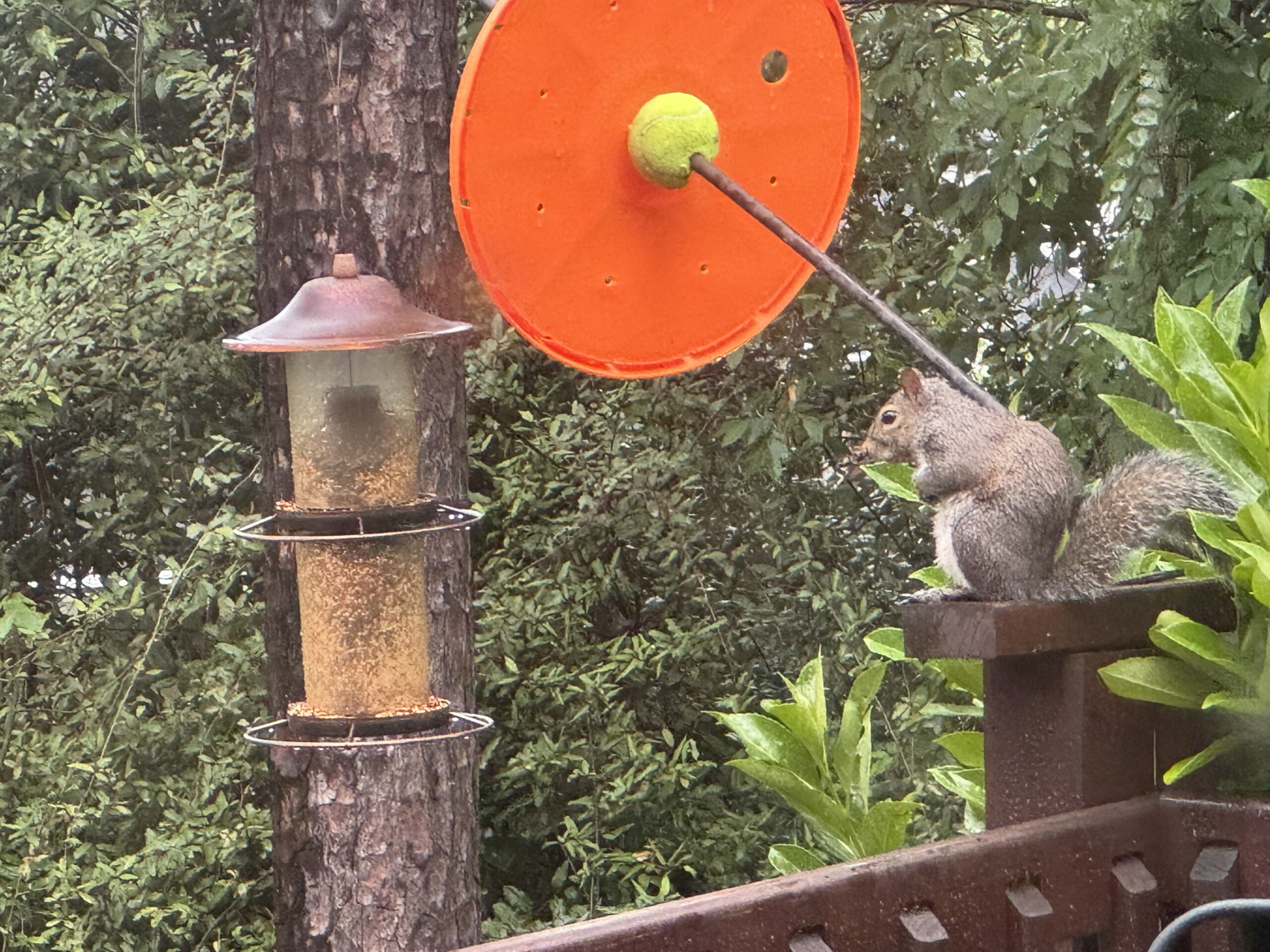
But for some time, I have been working on a foolproof (I thought) countermeasure to their derring-do. I pondered for some time how to construct a wall along the bar that could not be bypassed — if The Squirrel tried to climb over it, it would spin around and drop him (I see him as male because as a gentleman, I refuse to have a lady as an archenemy). I found that orange thing — manufactured to sit in the bottom of a huge plant pot — at Lowe’s. It had a large hole in the middle, easily bigger than the bar.

I set it up, and put it out at a new angle. (I’m getting way technical. I’m like the Werner von Braun of anti-squirrel technology. There’s math and everything.) The new position goes straight out from the corner of the deck so that it’s at an obtuse angle from both of the rails that meet at the corner, meaning that the orange thingy would effectively block a leap from either direction.

And it worked. The picture above shows it working. This was my moment of triumph. I’m so happy I witnessed this moment and was able to photograph it. In the above image, you see The Squirrel beholding his defeat with resignation. He’s squatting there regarding my invention. He did that for five or ten words, occasionally tipping his head the way a puzzled dog does.

Finally, he walked out a bit on the rail, with the idea of trying his chances anyway. He eyed the target, and tensed his fat body up for the leap… and then changed his mind. He slunk off into the bushes you see to the right, and was not seen for the rest of the day.

I didn’t think he’d given up — not my archenemy, no way. I pictured him in his lair cooking up an invention of his own, maybe on the lines of some of these.

But what he came up with was simpler, though. He found that he still had a good angle for a leap from the bushes that you see to the right. My wife saw him pigging out on the upper level of the feeder this morning.

So I’m going to get out my poletrimmer and cut that bush back — at the very least, make it too low for him to have a good trajectory for the leap.

That’s OK. That’s the way things go — measure, countermeasure, measure, countermeasure, on and on. And yeah, I know — squirrels gotta eat, too.

But I enjoyed yesterday. I really did…

Frustratin’, ain’t it?

Reminiscing with Lamar

My brother-in-law in Memphis sent us this link to a tweet by Lamar Alexander, two-term governor of Tennessee, two-year Education secretary, and three-term U.S. senator — one of the last remaining hopes of moderate Republicans until he retired in 2020…

I responded to Steve in Memphis with my own anecdote:

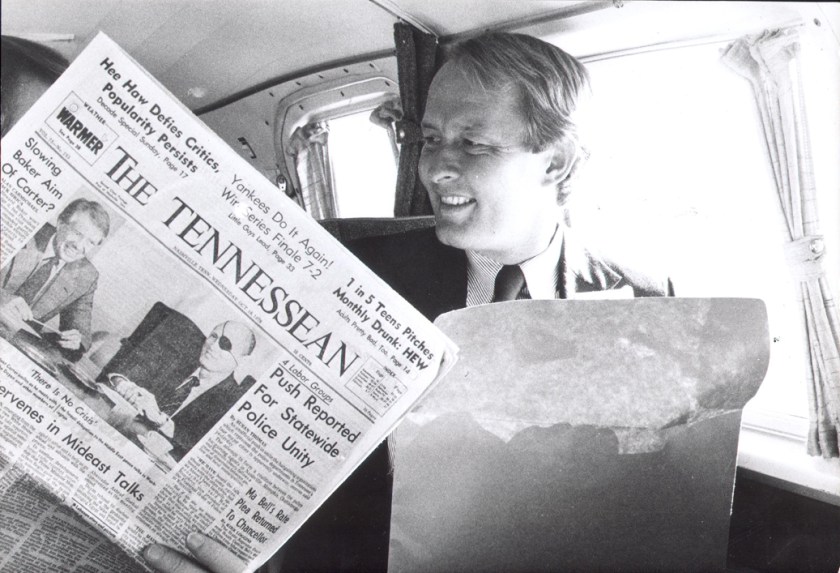
I heard his story about how he decided to run again when I was flying on the campaign plane with him in 1978, one late night not long before the election. He was just chatting with a reporter from The Tennessean, and they were enjoying an end of the day drink, and I sat off to the side, quietly taking notes. I wrote a story about his description of his comeback, and it was the first time John Parish, the Dean of Tennessee journalism, told me I’d written a good political story.

Alexander was reminiscing, so I thought I’d reminisce along with him.

Of course, I’m sure Lamar doesn’t remember me. I was a rookie reporter experiencing my first statewide election (and in Tennessee, a statewide election is stateWIDE, which is why they have to fly back and forth a lot). I was just with him that one week — Parish had stepped back to allow both another reporter and me to have a week each with both nominees. I spent the next week with Jake Butcher (it became apparent to me that Jake had no business running for governor, and for once in that rookie year, the voters proved me right).

Lamar and the Tennessean guy were totally relaxed; the reporter and he were just chatting over drinks; those day were long and hard. But I was scribbling away. Being a rookie, I sort of wondered whether what I was doing was ethical — grabbing a story off Alexander’s answers to the reporter’s questions. But they could see I was taking notes. And I could see the other guy wasn’t. I just charged ahead. I think we ran the story the day after he won the election. And I got a pat on the head from The Bear. Which meant a lot back then.

I got to know Alexander better when he was governor from 1978-85. He used to drop by the paper and visit now and then when I was news editor in Jackson. But I wasn’t surprised when he came to see us at The State more than a decade later when he briefly ran for president in 1996, and I mentioned those days, and he didn’t really seem to remember. Never mind. Too bad he had to drop out in ’96. He’d have been a much better nominee than Bob Dole….

I’ll close with a picture taken on that campaign plane. Not at night, but in the early morning, when the candidate was alert and ready to go…

Lamar Alexander, back when we were all young.

How famous are these celebrities to you?

Robin Thede, Patton Oswalt, and Margaret Cho on Celebrity Jeopardy.

Here’s another one for my “Aging” catergory — although I suspect that’s not the whole story.

For quite some time — for decades, really — I’ve had this happen a lot: I’ll see someone on a magazine cover, or on a TV screen. This person is being presented in a context that indicates that he or she is a celebrity, and I as the beholder am expected to know who that is. There are hints. For instance, the magazine will be one that pretty much only features “celebrities” on its covers. Or the person will be identified by first-name only, as though I were a fantasist who imagines that I am on such intimate terms with that person. Or, the writer of that text believes that I would be insulted by anyone assuming that I would need to see a surname to know who it is.

As for television… I’ll give you an example from this evening. I was over visiting my mother, and she was watching “Celebrity Jeopardy.” Only I didn’t know who the people were. There was a man flanked by two women. The man looked familiar, but I couldn’t name him or recall where I had seen him. I had no clue with the women.

Fortunately, there’s the Web. I looked, and saw they were Robin Thede, Patton Oswalt, and Margaret Cho. Patton was the guy who seemed familiar, and now that I saw it, so was his name. And I had heard or read Margaret Cho’s name quite frequently in recent years, in connection with comedy, but I could not have identified her by her image. This was worsened by the fact that when I Google her image, she looks different. But I wouldn’t have recognized her when she looked like that, either.

I thought “Celebrity Jeopardy” had more recognizable names and faces. Admittedly, I’m basing that on those SNL spoofs, which at least in the past have been hilarious. My favorite might have been the one with “Sean Connery,” “Burt Reynolds” and “French Stewart.”

And I actually knew whom they were impersonating.

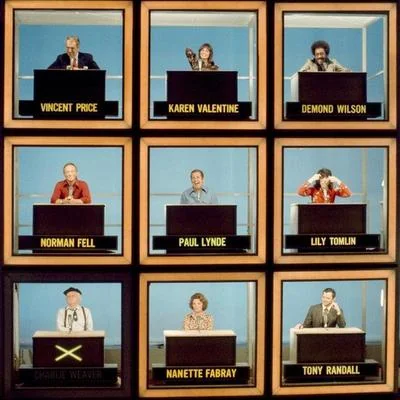
Now I’m going to really embarrass myself. When I was quite young, I watched pretty much everything on the three channels available, and that includes the game shows. And I knew who all those people were — even on “Hollywood Squares.” Do you know who all these people were?

Well, I did. Even though that’s a very blurry picture. (I probably wouldn’t have complained about that in 1968, though. I was also watching it in black and white.)

I’m pretty sure that if I were younger, I would have known who those affable people were on Jeopardy tonight. After all, I knew the guy’s face and one woman’s name! I must apologize to Ms. Thede, though — I had no idea.

But I knew all those people on the Squares, and looking back, some of them were pretty marginal celebs. But I knew them, and could tell you where I’d seen them. For instance, Wally Cox had once played a birdwatcher on “The Beverly Hillbillies.” I think I’d also seen him do standup. So there.

There were some people who were famous to me simply because they were on game shows a lot. I’d known Kitty Carlisle and Orson Bean for a couple of decades before I learned they were actors.

So some of it’s age. But here’s something I think is a significant contributing factor. I’ve mentioned this before in a different context:

It’s the profusion of available media in the post-cable, streaming world that makes it impossible to see and know everyone being beamed at us. So many people who are intensely famous within genres and subgenres of public entertainment, but not as known to the full population.

Back in the day, we ALL knew who all the “famous” people were.

I wasn’t the only person watching those three stations all the time in the ’60s. Everybody was, to some extent. Even old people saw The Beatles, the Rolling Stones, Peter and Gordon, Robert Goulet, the inescapable Topo Gigio, and the guys who spun plates atop sticks. And with the possible exception of the guys with the plates, people of all ages could probably name them. That’s because they HAD to come to their fans and everyone else through the Ed Sullivan Show, or the Smothers Brothers, or Dean Martins’ show, or Andy Williams’, or Merv Griffin’s daytime talk show.

The supply was limited. That’s my excuse for sort-of knowing who “Charlie Weaver” was.


What do you trust AI to do?

Real vs. AI. AI is so dumb, it ‘thinks’ it was being racially sensitive.

The pictures above are from one of texts from my linguistics course. The one on the left is real. The one on the right was created by artificial intelligence.

Don’t blame AI entirely. As we learned from Hal, who explained his behavior in “2001” in the sequel, “2010,” you have to be really careful how you program these machines.

Hal was programmed to remove any obstacle that threatened the success of the mission to Jupiter. If that meant killing those pesky astronauts on board, so be it.

The AI (Google’s LLM Gemini) that added a black member to the Wehrmacht “was apparently trained to generate (racially and ethnically) diverse, but had no way to know in what actual, factual contexts such diversity existed (or did not exist),” according to the book.

This happened in 2015. We know that AI is exponentially “smarter” today. But we would still do well to be careful in what we trust it to do.

Seeing that reminded me of something I recently realized about my own attitude toward artificial “intelligence.”

I’m not engaged in creating fake images that look real (although sometimes I do play around with Photoshop), so I’m not really concerned about ending up with fake black Nazis.

I write and edit. And ever since people around me (people who are not writers and artists) started using AI to generate text, I’ve thought, “I would never do that.” And not because I feared losing my job; I’m basically retired.

But I’ve avoided saying that, because I knew how people would react: “Look at the old Luddite who started out writing on manual typewriters!” Which I did; but I’m not a Luddite. I’ve enthusiastically embraced every new technology that has come along since those early days. I was usually at the vanguard of each change, and coached others in how to use it.

But not this. And one day recently, listening to some other people talking back and forth about the advantages and disadvantages of using AI, it suddenly hit me why I refused even to think about it.

No matter what technology was involved, I have never entirely trusted anyone else to express something I wanted to say. Oh, sure, I trusted my reporters and my associates on the editorial board. But I coached them ahead of time on how to write it, and as editor had complete control of the final form.

Sometimes I would rewrite it completely. Not because I was smart and they were dumb. I did the same thing to myself. Over and over, I would write an entire column and then throw it away and rewrite it entirely — sometimes I’d be so disgusted with the draft I’d even abandon the subject and write about something else.

No matter how much I fed to the machine ahead of time, when it was done, I’d be dissatisfied and rewrite it, taking pretty much as much time as if I were rewriting something I or a trusted subordinate had written.

So where’s the advantage in doing it in the first place?

So I basically just use AI to help with searches, and I apply plenty of caveats to that. Just as a way of sniffing the air as I start out on serious work; I always dig deeper than Google’s AI shows me.

So what about you? In what ways do you use AI, and to what extent do you trust it?

Remember Hal?

One of my favorite Bible passages

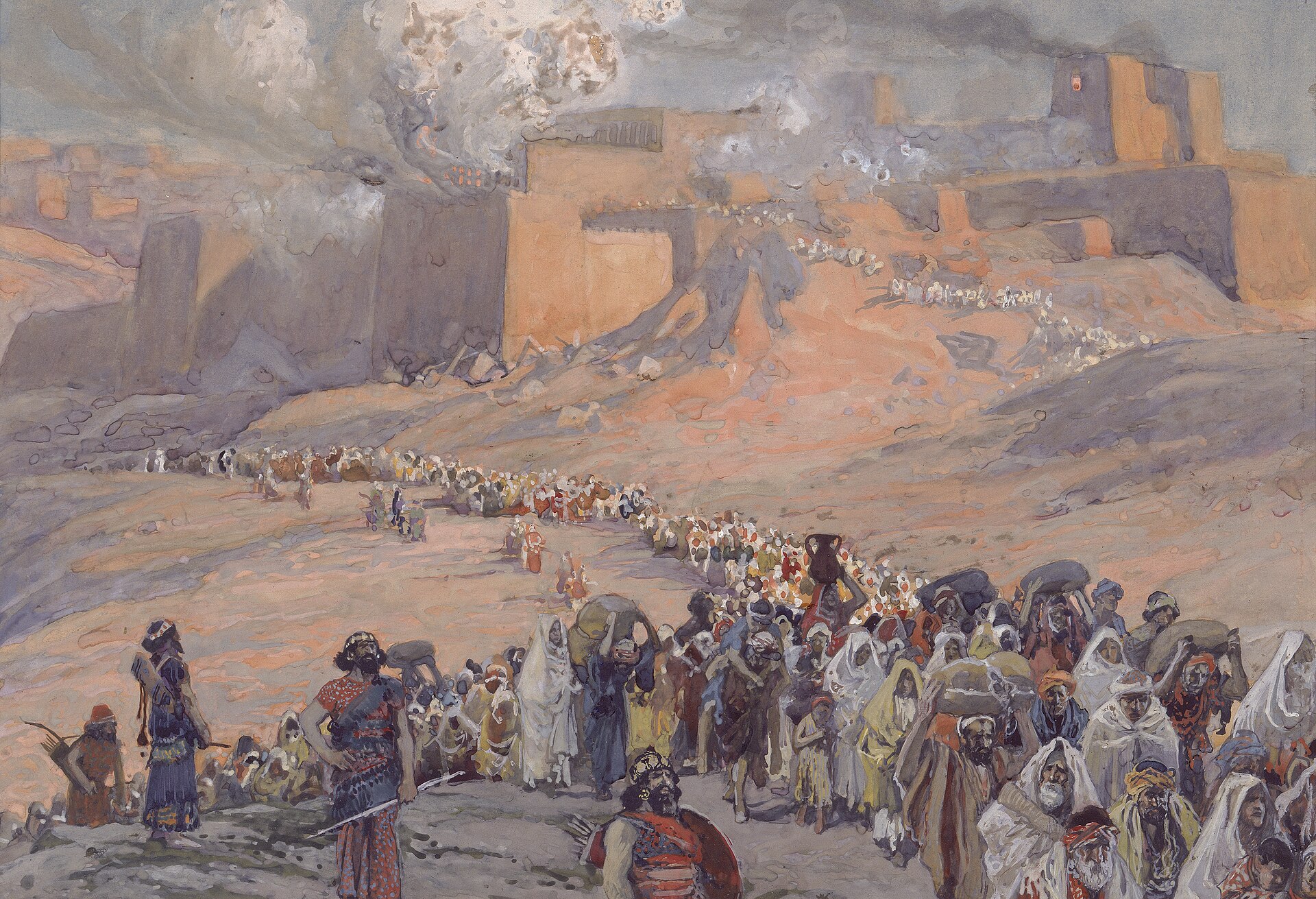
The Flight of the Prisoners (1896) by James Tissot; the exile of the Jews to Babylon

I said I’m getting close to finishing James Kugel’s book about How to Read the Bible, and I am. I’m in the last 100 pages. (It’s taken me months because I just read a few pages at a time during meals. Just a few pages give you a LOT to digest. It’s very deep.)

Anyway, over breakfast this morning, during a chapter about Jeremiah, I ran across one of my favorite passages in the whole Bible. I wrote about this bit before in 2009. Right after I got laid off, Rep. Nathan Ballentine brought it to my attention, for which I am grateful. I’d never read it before.

It’s in Jeremiah 29. Here’s the part I got from Nathan:

11 For I know well the plans I have in mind for you—oracle of the LORD—plans for your welfare and not for woe, so as to give you a future of hope.

But I like the whole chapter, which Jeremiah aimed at the Hebrews during their Babylonian exile. Especially this part:

4 Thus says the LORD of hosts, the God of Israel, to all the exiles whom I exiled from Jerusalem to Babylon:
5 Build houses and live in them; plant gardens and eat their fruits.
6 Take wives and have sons and daughters; find wives for your sons and give your daughters to husbands, so that they may bear sons and daughters. Increase there; do not decrease.
7 Seek the welfare of the city to which I have exiled you; pray for it to the LORD, for upon its welfare your own depends.

In other words, however bad you think things are, don’t give up on life. Embrace it, wherever you are. Build houses. Have children. Marry them off so you can have grandchildren. Don’t moan about being so far from Jerusalem. Stand in the place where you live. In fact, you should even “Seek the welfare of the city to which I have exiled you.”

This may look like the end, but as long as you engage life positively, things will be better someday.

The people of Judah returned to Jerusalem about 70 years after Nebuchadnezzer dragged them away, thanks to Cyrus the Great.

These are good words to ponder in the Trumpist era. Maybe I won’t get to return to the America I knew all my life before 2016. (The problems that caused his election are complex, and likely to outlive him.) If not, I still hope for my children and grandchildren. In the meantime, I’m living my life in this world with joyful gratitude for my blessings, and all the energy I can muster…

Remember that noise on ‘Lost?’

After the infinitessimal bit of “rain” we got this morning, I went out to look at the garden — my fig trees, and the okra I recently planted.

And it was nice out there, with the world slightly moist, and everything green except the grass.

But it was hard to fully enjoy for the noise. I shot some footage (above) of the “forest” behind our deck, which has a sort of subtropical lushness, to capture the difference between that and the obscene, crashing mechanical noises filling the area.

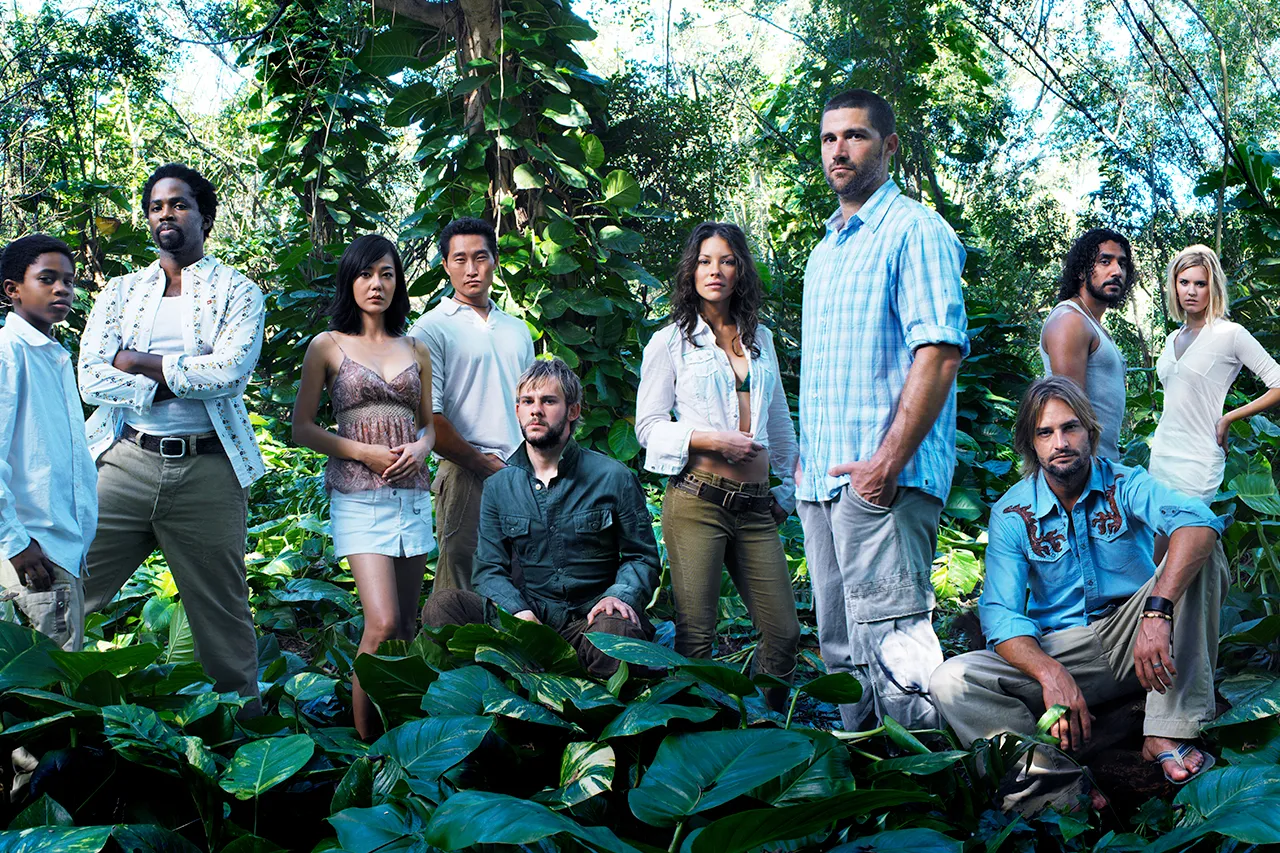
It immediately reminded me of the bizarre noises the people on “Lost” kept hearing in the jungle, before they ever knew about the “smoke monster.”

That’s not what this was, though. About two houses away from us, workmen with large, clanking vehicles — including a huge, self-propelled chipper-shredder — were chewing up some trees that were recently felled in a neighbor’s yard.

Sounded like more than that, though…

Uh… what’s that noise in the jungle?

And now, my SECOND favorite team…

Bad news for the Phillies, but good for the Braves.

This one almost snuck by me yesterday, until I ran across a live press conference about it on my MLBtv app…

You know about the Saturday Night Massacre in Boston. Just three days later, the bosses in Philadelphia got rid of the manager of my second favorite team — which was at the bottom of its division in the NL, just as the Sox were in the cellar of the AL East.

I’ve told you about my hierarchy of fave teams. Now I’m starting to worry a bit about Dave Roberts. But not really. They’re not only leading their division, but they’re tied with the Yankees for the best season so far in the big leagues, at .667. Which is good. I like Dave.

You know who’s got the best? My former favorite team, the Braves (see image above). They’re at .700. You know, the team MLBtv won’t let me watch, ever. It’s gotten to where I don’t think I can name a single player I used to watch who’s still in Atlanta.

At least I can still see Freddie Freeman out in L.A. — along with Mookie, who of course should still be in Boston…

The Dodgers are more than OK…

Great game, Alex! Yer fired!

Just before Cora got fired.

I was pretty excited yesterday when the Red Sox stomped the Orioles, and kept on stomping: 17-1. I joined the game late. In the 9th inning, for some reason, the Orioles pitcher was throwing like a slow-pitch softpall pitcher.They must have told him not to waste his arm when there was no chance. I’d never seen anything like it, but maybe that happens a lot. It was only recently that I got to see baseball again on a regular basis, after decades of deprivation.

The Sox had gone into the game 9-17, and were in the cellar of the American League East, so I was very happy. So were the players.

An hour or two after the game, my phone informed me that Red Sox Manager Alex Cora and six of his coaches had just been fired by the front office.

Great game, guys! Now go away, all of yez…

I’m still not sure what happened. Sure management was unhappy with the way the season has started. So was I. But what timing! Surely the decision had been made ahead of the game. Do you suppose there was a discussion along the lines of, “Do we want to fire him right now, after THIS game?” If there was, we know the answer to the question.

Did Cora know during that game that this was coming? Did the coaches? Taking it further, did the players? Is that why they won so big? Were they winning it for Alex?

Again, I dunno. But when I saw this headline, I was anxious to reach Shaughnessy’s take on it:

It wasn’t Alex Cora’s fault the Red Sox roster stinks, and he shouldn’t have been fired over it

Before reading it, I agreed (on an emotional level; I can’t say I KNOW how much of the fault was or wasn’t his) that he shouldn’t have been fired over it. I like Alex.

But I disagreed that the Red Sox roster stinks. Except for Alex Bregman, it seems to me that they had all their best players still — and Roman Anthony was back from his injury. This was the same team (except for Bregman) that won all those games in that surge last summer, after they got rid of Devers.

The first game of this season, I saw what I was hoping to see — the Sox doing what I thought they could do. But I hadn’t really seen that team since then. Not until yesterday.

So yeah, there was a problem, and something needed to be done, but this?

Shaughnessy’s column, like the headline, swung back and forth between things that I agreed with, and things that ticked me off. Shaughnessy’s good at that.

I enjoyed his lede:

There you go.

The Saturday Night Massacre.

Settling All Family Business….

Yep.

But then it’s back and forth, good and bad (from my perspective). Examples:

I’m all for shaking things up, and understand that you can’t fire all your players in late April, but put me down as one who did not think Cora was the problem with this Fenway F Troop.

It’s the roster. It’s the 26 guys Henry and Breslow gave Cora. That’s the problem…

F Troop? Getoutta here!

Cora is the same manager who won 119 games for you in 2018. He’s the third-winningest manager in franchise history, a guy who relates to players, knows when the other team is tipping pitches, and is better than most when it comes to situations, matchups, and day-to-day lineups.

Cora is not the one who traded Mookie Betts, let Xander Bogaerts walk, and got no players in return for the salary dump of Rafael Devers….

I’m with ya! As long as you’re not saying they should have kept Devers, and I don’t think you are…

Cora’s not the one who spent on the wrong players (Masataka Yoshida, Trevor Story), traded Chris Sale at exactly the wrong time, and pulled away from every big-name free agent last winter.

Hey! Trevor’s one of my favorites! He’s a clutch hitter, time after time!

Cora is not the one who failed to give Alex Bregman a no-trade clause, then said, “If Alex Bregman wanted to be in Boston, he’d be in Boston.”

OK, if that’s the way you heard it, and it’s right, I agree. I’m ever-mindful you know a thousand times as much about the Sox as I ever will…

But you know, this was uncalled-for:

Is it Alex Cora’s fault that a Red Sox third base position once filled by the likes of Frank Malzone, Wade Boggs, Devers, and Bregman is now manned by 5-foot-6-inch Caleb Durbin, he of the .165 batting average and one home run (off a utility player in mop-up duty Saturday)?..

Hey, I miss Bregman, too, but that’s just mean. No wonder so many don’t like Dan. He didn’t need to mock the new guy like that.

Anyway, to update, the Sox won again today, 5-3. So I’m happy about that. But everybody should note: This winning streak — if that’s what it is — started with Alex still in the dugout. And that was a big win…

Screenshot

Are you getting more cold-call emails lately?

‘Why do you keep sending me emails?’ asks Will Robinson.

I am. And I assume AI is to blame. At least, I hope it is. If actual humans are sending these mindless, hopeless missives, they have my sympathy. Well, a little sympathy. Not enough for me to respond to them.

The sympathy is because, well… during my newspaper days, I used to tell people that there were a lot of things I could imagine myself doing other than journalism, but there was one thing I knew I could NEVER do: sales. (I have a horror of the idea of making a pitch to someone that I wouldn’t want someone to make to me. And I almost never want to hear a sales pitch.)

Having my impression is that the most miserable kind of selling cold-calling. So yeah, I pity the humans who have to do it.

But I think these are bots. I think they’re a reflection of the trend toward more and more businesses turning to AI. Here’s a recent example I just dug out of my trash folder:

Brad,

Unlike most banks, we can give you funding that matches Adco Ideas’s timelines.

Upto 250K-5M USD approved in just 24 hours (as a revolving line). No collateral required.

And interest applies just on the amount you use.

Can I tell you more?

Best,

Xxxxxx

I don’t take the utter cluelessness (the name of the agency is ADCO, not Adco Ideas. They’re getting that from the URL. And there’s not a single word indicating awareness of what ADCO is or does) as proof that this is AI. A lot of humans are that unobservant.

I think it’s AI because since about the first of the year, I’ve been getting so MANY of them on my ADCO email.

How about you? Are y’all seeing the same?

The Red Sox didn’t need this right now

Here’s what I was worrying about earlier today:


That’s a notification on the lockscreen of my phone. It came across awhile before tonight’s game started. It shows the odds for the game. I don’t remember signing up for these, but I like getting the reminder that a game is coming up.

The bad thing is, as lousy as Boston’s start has been this season, up to the last few days, they were still being shown as likely winners. But not now. Not against the Yankees. Not after last night’s game — which was at Fenway, and the first of the season between these ultimate rivals.

Then, about an hour later, I saw this update:


You’ll note that was just in the first inning. Dare I watch the game?

Before I decided, I thought I’d take a glance at my email, and encountered this from The Boston Globe:

An ‘iconic image’ or ‘white supremacist propaganda’? It’s not clear why DHS posted a photo of Fenway Park.

I went to the story, and it seemed to be about this tweet:

ICE, a wholly owned subsidiary of DHS, is not terribly popular in Beantown, and that prompted this from one of my fave local pols, Seth Moulton:

“This is our [expletive] city, and nobody is going to dictate our freedom,” Representative Seth Moulton, a Salem Democrat, wrote on his repost of the DHS meme. His comment echoed David Ortiz’s famous declaration in the first Sox game at Fenway after the 2013 Marathon bombing.

“They’re trying to get under our skin, and they’re trying to poke us to see if we’re willing to stand up,” Moulton told the Globe Wednesday. “And we need to show that we as a city and as a community are not going to take this [expletive]. We’re going to stand up.”

But if you think that’s bad news, check out what appeared on the Red Sox’ own Twitter feed before the season started:

Hey, y’all know I love baseball, and am fond of history and nostalgia as well. Those two things feed into why I love baseball. But you can imagine the stir that video clip caused in our troubled times:

Ahead of the Sox home opener, a team account on X posted a reel of old footage from Opening Day in Boston in the 1950s, presumably to invoke fond nostalgia at the timelessness of America’s Pastime.

Instead, the clip went viral among right-wingers for a different reason: the all-white crowd at Fenway, representative of the idealized country they want to “return” to through mass deportations and curbing immigration. Some made explicitly racist comments about how much more diverse the country and Boston have become since…

That’s the thing, see. I was wondering whether Seth and the rest were overreacting to the DHS post — although I didn’t like it, either. But I guess they had the context of knowing about the reactions to the previous post.

All I know is that America really doesn’t need this stuff right now. And the Red Sox — the team I love, the team of people like Willson Contreras, Cedanne Rafaela, Andrew Monasterio, Wilyer Abreu and, going back a bit, David Ortiz — really, really don’t need it.

We REALLY don’t. As I sign off, here’s the score:

Screenshot

How do you get a seat in this restaurant, anyway?

‘No dice over here! How does it look on your side?’

An update on events on our backporch bird feeder…

For years, we’ve had a pair of doves hang around our deck, eyeing our feeder, which is designed for much smaller birds. They can land on one of the little perches, but can’t get their heads down to the seed without pushing themselves off.

They haven’t give up. A couple of days back, they both managed a landing on the roof of the feeder, then for several minutes kept sneaking peaks over the edge, trying to figure out how to get down there and enjoy a meal. Eventually, they gave it up as hopeless.

NOTICE: Diners must be this small or smaller.

As usual, I felt bad for them. They reminded me of paupers gazing hungrily through the windows of a fancy restaurant. I did what I could — I scattered a bunch of seed on the ground below the feeder. Happily, my wife noticed at least one of them eating on the ground later.

They were both terribly genteel about the injustice of it all.

Not this guy below. He doesn’t care how fat his arse is; he will leap to the feeders, grab on with fingers and toes, and chow down. I’m guessing these rats with fluffy tales consume about two-thirds of the food we put out for birds.

He doesn’t care. And he’s not a gentleman about it. Nor are the other squirrels. And after all that free insulation we let them have when it was cold…

If you’ll notice from the doves pic, this guy or one of his thieving brethren had already cleaned out the bottom chamber of the feeder. Now he’s working on the top.

Is forgetting the past particularly an American thing?

I often rail about the lack of interest in history, which seems one of the defining characteristics of most modern humans. (The lack of interest, not the railing about it.)

But is it modern humans in general, or particularly an American thing? I suspect it’s both.

I started thinking about this this morning because I recently returned to reading a book I started to read last year, but didn’t finish. I’m now getting close to finishing How to Read the Bible: A Guide to Scripture, Then and Now, by James Kugel.

Anyway, toward the end Kugel’s writing about some puzzling things about the book of Isaiah, and wondering why it was written/edited that way, and then jumps back to raise the same points with regard to the Pentateuch. That takes him to talking about how so much of the Torah started as short, etiological (his favorite word) stories told orally from generation to generation, long before they were put together in early Hebrew.

And I paused to imagine American families doing that. I couldn’t.

Oh, there are exceptions. Alex Haley said Roots came from stories his family told about Kunta Kinte and subsequent generations. But it’s generally hard to find examples among descendants of people who came here willingly, on purpose.

I think there’s something in the makeup of a person who decides to take a hazardous journey across the ocean in a frail wooden ship, leaving all he or his ancestors ever knew, that causes him to want to forget all that went before. I don’t get it, but I know that’s a thing.

Such people passed that on in their DNA. The ancient Israelites passed on stories about ancestors, and even memories of the switch from foraging to agriculture 10,000 years earlier (hence the Adam and Eve story). Americans — I mean deliberate, voluntary Americans — seemed to pass on forgetfulness.

I’ve traced every line in my family — save one, that of my mother’s father’s mother’s father, who created a dead end when he died during the Siege of Petersburg — back to the old country. But I’ve never found a single story clearly answering my biggest question about them coming here: Why?

Why did they pull up stakes and come here? Oh, I know all the standard answers from the elementary school — freedom, especially of religion. And if you were a Pilgrim, that’s a good answer. I suspect most people came for economic and social opportunity — a chance to get out of the box in which their old, established societies placed them. They came for land and upward mobility, or so I gather. Of course, some did have an anarchic streak that had to do with not wanting to be told what to do, but I suspect that was a side benefit, and wasn’t quite the refined sense of liberty that Adams, Hamilton, Jefferson and Madison left us.

I do have a hint from one immigrant ancestor — John Barton Wathen (the R was added by my branch a century later) came over as an indentured servant in 1670. That’s seems a clear indication of A motive, if not necessarily TH motive. It seems to have worked out for him — after his servitude, he acquired and passed on a good bit of land.

But I’d still like to have a chat with him. I’m glad that I’m an American. But I still want to know why I’m an American.

And you know what? As much as I know about John Wathen, I still have no idea what his life back in England (or perhaps Wales) was like.

Which makes me like most Americans. But I wish I knew much more…

Impromptu Top Five List of Favorite Painters

This is not a thoughtful list. I’m just throwing it together because something made me think about John Singer Sargent, and that made me want to do a Top Five list, so I’m assembling this hastily because I’ve got a lot to do today.

It’s also not an honest list, because an honest list of favorites would consist entirely of people in my family, but my wife would give me trouble if I showed any of her watercolors, so consider this a Top Five List of Painters to Whom I Am Not Related by Blood or Marriage.

Maybe I’ll do a more thoughtful one later.

Here goes:

  1. John Singer Sargent. Y’all are probably tired of him because I know I’ve mentioned him before, such as when we visited the Isabella Stewart Gardner Museum in Boston. Now I’ve gotta to BACK to Boston because I just learned about his Triumph of Religion set of murals that he spent the last 29 years of his life trying to finish. I love his range, as well as his mastery in achieving he’s trying to do. He’s called an impressionist, but he’s good at whatever style you choose. Check out his use of light in this, or the hypnotic eyes in this. And dig the shadows in my very favorite, El Jaléo, which I encountered at Isabella’s museum.
  2. Caravaggio. I learned about Caravaggio from a print that hangs in a hallway of my church, The Calling of St. Matthew. That’s it at the top of this post.
  3. Vermeer. Everybody talks about the Girl with the Pearl Earring, but my fave is Het melkmeisje, which I saw at the Rijsmuseum in Amsterdam. It’s not very big, but it is very impressive. I saw a lot of Rembrandt there, too — some greats including The Night Watch and those dudes from the Dutch Masters cigar box, but that would be so cliche to choose him, right?
  4. Anders Zorn. OK this is almost the same as picking Sargent, because I mistake his work for Sargent’s sometimes, but I like his work on its own. Especially his portait of the aforementioned Isabella (which is better than Sargent’s portrait of her), and The Omnibus. Although, as I’ve said before, I like George William Joy’s version of the omnibus them better (more communitarian, or something — more people, anyway). Y’all know how I love public transportation. And though I definitely don’t love tobacco, I like this one as well.
  5. Boticelli. Nope, not the Venus one. My fave is Primavera, especially this detail.

That’s it. Thoughts? I know a lot of this is repetitive, but I don’t remember doing a Top Five on painters, and am curious to see what y’all will tell me I left out.

Don’t mention Michelangelo, though. I’ve got a bone to pick with him, which I’ll explain in a subsequent post…

A moment to recall ‘a previous America’

I’m very busy — which is why I generally restrict myself to simple posts that take less time and don’t say much — but I want to mention this before it gets too far in the past.

This was three days ago.

About the only time I see anything that falls within the definition of “TV news” is when I’m checking in on my Mom at an hour when she watches it. On this occasion, it was something worth watching, and I would have missed it otherwise.

I had heard about Artemis II, in passing. What I heard made me promise myself to pause and read more about it, but with all I’ve been doing, I didn’t get around to it. And now, it appeared, the spacecraft was coming back. We watched the whole re-entry and splashdown, and I was struck by how I was seeing something I hadn’t seen in many a year.

I had watched some of the shuttle launches in the ’80s, especially after the horror of Challenger. I felt I had to keep an eye on these strange things that landed rather than splashing down, if only in case we were going to have to scrap our plans for the next day’s front and whole A section.

But they lacked the excitement of the launches in the ”60s. After all, while the new craft was higher tech and carried a larger crew, these shuttles were just tooling around in low orbit, the way John Glenn had done in 1962. And I’d seen that. Everybody had seen that. My 3rd-grade class — indeed, I suppose the whole school — assembled in the auditorium to watch it live. The black-and-white TV was on a wheeled trolley placed down in front of the stage, to bring the small screen a bit closer to us. It was the biggest thing that happened that year, even bigger than Mantle and Maris vying to beat the Babe’s record back at the start of the term.

What was interesting about this Artemis II return over the weekend was that… well, it was a bit like that day in the school auditorium — or at least it seemed to be to the people on the screen.

There were differences, of course:

  • The screen itself. HD, and rich color that none of us could have imagined back in the Mercury, Gemini and Apollo days. Better sound, better everything — except, no John Glenn, the Single-Combat Warrior fighting the godless Soviets in the Heavens, as Tom Wolfe would later describe it.
  • Instead of Glenn, there was a group of four I’d never heard of. Of course, this being the 21st century, there was a lot of hoopla about one being black and another being a woman! Like we hadn’t seen that before. You know what “diversity” point meant more to me? At least three of the crew were military — and two of them U.S. Navy pilots. Ike wanted astronauts to be military test pilots, and I’ve always agreed with him. They tend to already meet many prerequisites, and they take orders well.

But the most startling thing to me wasn’t those minor differences. It was the sameness. The breathlessness, in every voice that came on the air. For instance… people kept saying, over and over, that there was going to be a terribly suspenseful few minutes during re-entry when we wouldn’t be able to communicate with the capsule!!!! Also the capsule will turn into a ball of intensely hot fire as it entered the atmostphere!!!

Like no one had ever seen such a thing before. Like it hadn’t been standard in all those flights in the ”60s. Like Hollywood Opie hadn’t Apollo 13, in which the most suspenseful moment was the one in which the capsule was making its re-entry, and the loss of signal was longer than expected.

Finally, of course, it dawned on me that most people hadn’t seen this before, as unimaginable as that was for me. Only 12-15 percent of people today were even living in 1962, much less in the 3rd grade. Only about 22 percent here living on the planet the last time we sent astronauts to the moon.

For that matter, only about half today’s population was even around when the heavily nostalgic “Apollo 13” came out!

So this was a complete, unprecedented novelty to most people watching — as well as to the network TV folks and possibly everyone at Mission Control, and even the astronauts themselves!

Which was weird.

This was underlined by one young TV guy who had drawn the job of interviewing regular folks who had gathered to watch the spectacle. He spoke of their awe at witnessing such a thing for the first time. And he was particularly impressed to have spoken to a man who was so old he could  actually remember the early flights back during the Space Age!

But then the young man with the microphone said something that made him sound older and wiser himself. He said that to the people with whom he had spoken, what was happening “seems like something a previous America would have accomplished.”

And he was right. I remember that America. Early in my career I referred to the WWII generation as “the America that got things done.” Later, I realized that generation was still accomplishing things for decades after 1945, because at that point they were still in charge of this country. And they were still pulling together across the lines of division we know today, to get one tough thing after another done. So we got things like the Civil Rights Act, Medicare, Medicaid, the Peace Corps, and… the Space Program.

JFK and his veep got the Moon Landing done, with the whole country dedicated to the goal after Kennedy’s assassination. We were still pulling together then, even as Vietnam was starting to tear us apart.

You know who launched the Artemis program? Trump. Really. Of course, to the extent that he actually deserves credit for that, I suppose this is the ONE way in which he has acted to, in some way, make America great again.

But of course, he is still someone who owes his prominence to division — to the way Democrats and Republicans view each other as members of different species, to the rally crowds that roar approval when a speaker says things about OTHER people that no politician would have dreamed of publicly uttering when when we had some mutual respect, and got things done together.

(Of course, he didn’t inspire the nation with a speech like this. He couldn’t, both because he lacks the ability and inclination and because this isn’t that America. But hey, he signed the paperwork.)

Wouldn’t it be wonderful if the Artemis program served somehow as a portal that led to us being that country again. ‘Tis a consummation
Devoutly to be wished…

The Mercury Seven

Maybe not a dream cure, but at least I’m learning stuff…

My dreams aren’t as bad as Scrooge’s, but they’re tiresome…

Remember, when I told you I was taking a linguistics course this semester, I expressed the hope that it would have a secondary benefit?

Perhaps I can even do well enough to put an end to those dreams. You know, the ones in which you have to go take your exam at the end of a term, and you suddenly realize that you have no idea where the class meets, because you haven’t attended it even once. You’d meant to, but somehow never got around to it.

Well… that might have been a wish too far. I’ve had variations on that dream twice in the past week. The first one had an interesting twist.

In that one, there was an awareness that I’m actually currently taking a course, and doing pretty well at it — which is the way I’d describe how things have been going in this linguistics course. So the dream began with a “this is working as hoped” sort of vibe.

But then I experienced that evil moment common to these dreams — the point at which I am suddenly reminded that I’m actually taking a full load, and while I’ve been engaging this one course fairly well, it has caused me to completely forget the other four or so. I say “four or so” because I absolutely couldn’t find the slip of paper (like the kind we might have had in the ’70s) that listed the courses, the professors, and times and locations. Like this one, although I seemed to remember the one in the dream as being neatly printed, with no handwritten entries.

In the dream, it was a Monday, and in the real world my classes are on Tuesdays and Thursdays — but now I felt sure that I had classes, maybe two or three of them, on Mondays. And I had never been to them, and had no idea where they were, and I was panicking.

There was no resolution of this problem, of course. That’s one of the rules in this sort of dream.

The second dream was less interesting — just a standard “panicking because I’ve never been to class” dream, with no reference to the one course I’m actually taking.

So maybe I’m not going to get that side benefit. I’ll just have to be satisfied with learning stuff. And I am.

And it’s stuff that I wanted to learn (or some of it is — this being an intro course, there’s a lot of material from sub-fields aside from the stuff I like, but that’s fine). These last weeks — since this post about accents — have been very good. The next week we were on language change — things such as why Beowolf was so different from Shakespeare, and why so many can’t understand Shakespeare today. And this week we’re doing names — looking at given names in various languages, the development of surnames in various cultures in recent centuries, and so forth. Good stuff, if you’re me and you have a family tree with 10,000 people on it — so far.

Just four classes left — today, Thursday, and the two next week. And I have part of a project due Friday, and the full project due a few days after the last class.

In my slacker days…

So. I plan to enjoy these last days, and do well on the project, and get a good grade. Maybe then the Superintendent of Dreams will decide that I’m no longer the slacker I was back in the early ’70s, and he can give me a break on the stress dreams. After all, aside from grades, I’ve made it to every class — although I might be a bit late today (but it’s excused).

Maybe. But I suspect those dreams are just a fact of life. I’ll just have to be satisfied with having learned things I wanted to know about. That will be sufficient reward…