Category Archives: History

Reminiscing with Lamar

My brother-in-law in Memphis sent us this link to a tweet by Lamar Alexander, two-term governor of Tennessee, two-year Education secretary, and three-term U.S. senator — one of the last remaining hopes of moderate Republicans until he retired in 2020…

I responded to Steve in Memphis with my own anecdote:

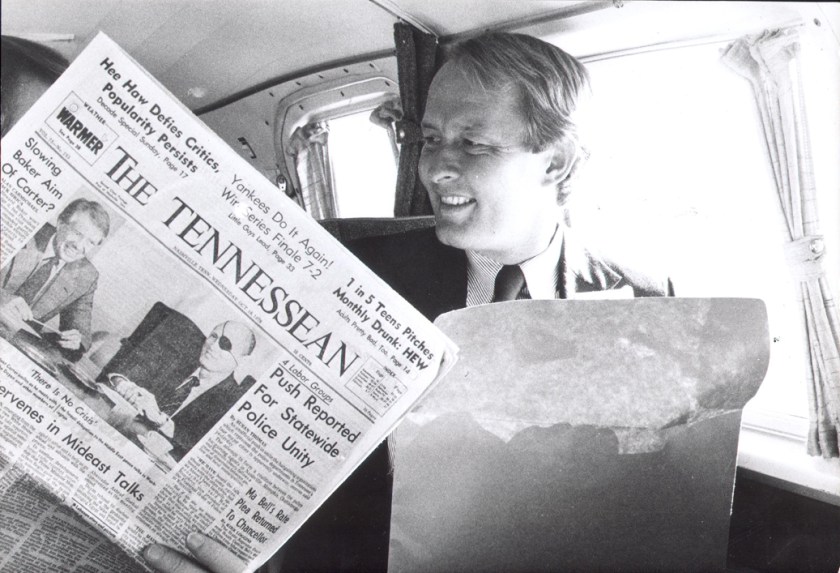
I heard his story about how he decided to run again when I was flying on the campaign plane with him in 1978, one late night not long before the election. He was just chatting with a reporter from The Tennessean, and they were enjoying an end of the day drink, and I sat off to the side, quietly taking notes. I wrote a story about his description of his comeback, and it was the first time John Parish, the Dean of Tennessee journalism, told me I’d written a good political story.

Alexander was reminiscing, so I thought I’d reminisce along with him.

Of course, I’m sure Lamar doesn’t remember me. I was a rookie reporter experiencing my first statewide election (and in Tennessee, a statewide election is stateWIDE, which is why they have to fly back and forth a lot). I was just with him that one week — Parish had stepped back to allow both another reporter and me to have a week each with both nominees. I spent the next week with Jake Butcher (it became apparent to me that Jake had no business running for governor, and for once in that rookie year, the voters proved me right).

Lamar and the Tennessean guy were totally relaxed; the reporter and he were just chatting over drinks; those day were long and hard. But I was scribbling away. Being a rookie, I sort of wondered whether what I was doing was ethical — grabbing a story off Alexander’s answers to the reporter’s questions. But they could see I was taking notes. And I could see the other guy wasn’t. I just charged ahead. I think we ran the story the day after he won the election. And I got a pat on the head from The Bear. Which meant a lot back then.

I got to know Alexander better when he was governor from 1978-85. He used to drop by the paper and visit now and then when I was news editor in Jackson. But I wasn’t surprised when he came to see us at The State more than a decade later when he briefly ran for president in 1996, and I mentioned those days, and he didn’t really seem to remember. Never mind. Too bad he had to drop out in ’96. He’d have been a much better nominee than Bob Dole….

I’ll close with a picture taken on that campaign plane. Not at night, but in the early morning, when the candidate was alert and ready to go…

Lamar Alexander, back when we were all young.

The Red Sox didn’t need this right now

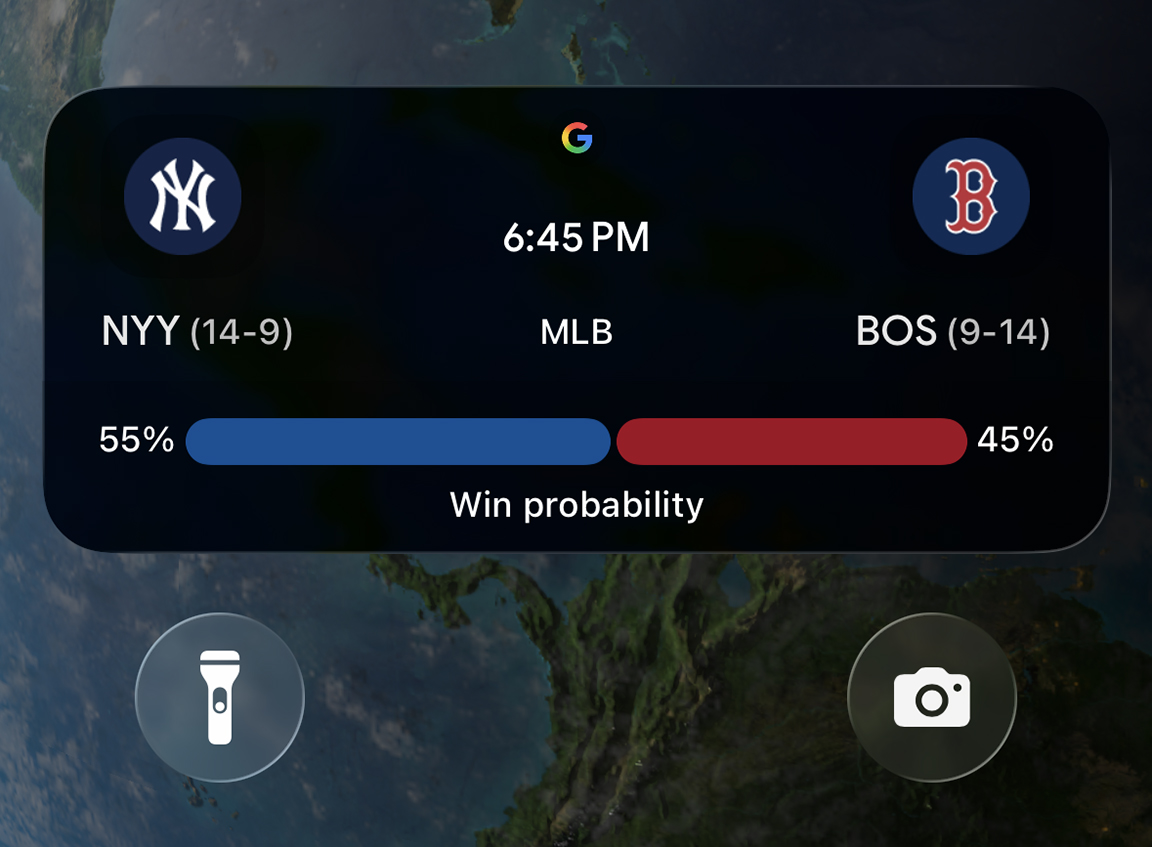
Here’s what I was worrying about earlier today:


That’s a notification on the lockscreen of my phone. It came across awhile before tonight’s game started. It shows the odds for the game. I don’t remember signing up for these, but I like getting the reminder that a game is coming up.

The bad thing is, as lousy as Boston’s start has been this season, up to the last few days, they were still being shown as likely winners. But not now. Not against the Yankees. Not after last night’s game — which was at Fenway, and the first of the season between these ultimate rivals.

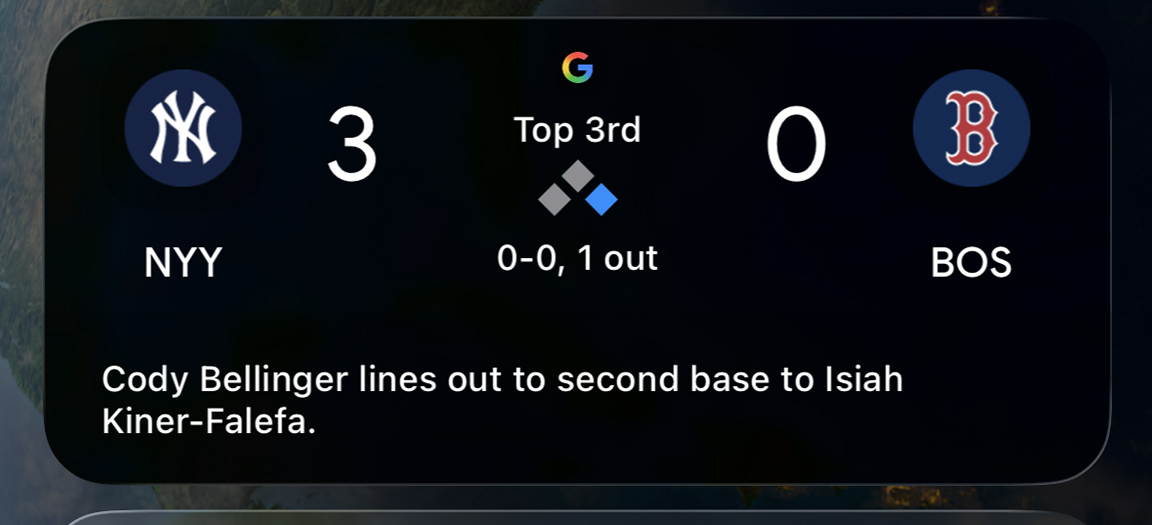
Then, about an hour later, I saw this update:


You’ll note that was just in the first inning. Dare I watch the game?

Before I decided, I thought I’d take a glance at my email, and encountered this from The Boston Globe:

An ‘iconic image’ or ‘white supremacist propaganda’? It’s not clear why DHS posted a photo of Fenway Park.

I went to the story, and it seemed to be about this tweet:

ICE, a wholly owned subsidiary of DHS, is not terribly popular in Beantown, and that prompted this from one of my fave local pols, Seth Moulton:

“This is our [expletive] city, and nobody is going to dictate our freedom,” Representative Seth Moulton, a Salem Democrat, wrote on his repost of the DHS meme. His comment echoed David Ortiz’s famous declaration in the first Sox game at Fenway after the 2013 Marathon bombing.

“They’re trying to get under our skin, and they’re trying to poke us to see if we’re willing to stand up,” Moulton told the Globe Wednesday. “And we need to show that we as a city and as a community are not going to take this [expletive]. We’re going to stand up.”

But if you think that’s bad news, check out what appeared on the Red Sox’ own Twitter feed before the season started:

Hey, y’all know I love baseball, and am fond of history and nostalgia as well. Those two things feed into why I love baseball. But you can imagine the stir that video clip caused in our troubled times:

Ahead of the Sox home opener, a team account on X posted a reel of old footage from Opening Day in Boston in the 1950s, presumably to invoke fond nostalgia at the timelessness of America’s Pastime.

Instead, the clip went viral among right-wingers for a different reason: the all-white crowd at Fenway, representative of the idealized country they want to “return” to through mass deportations and curbing immigration. Some made explicitly racist comments about how much more diverse the country and Boston have become since…

That’s the thing, see. I was wondering whether Seth and the rest were overreacting to the DHS post — although I didn’t like it, either. But I guess they had the context of knowing about the reactions to the previous post.

All I know is that America really doesn’t need this stuff right now. And the Red Sox — the team I love, the team of people like Willson Contreras, Cedanne Rafaela, Andrew Monasterio, Wilyer Abreu and, going back a bit, David Ortiz — really, really don’t need it.

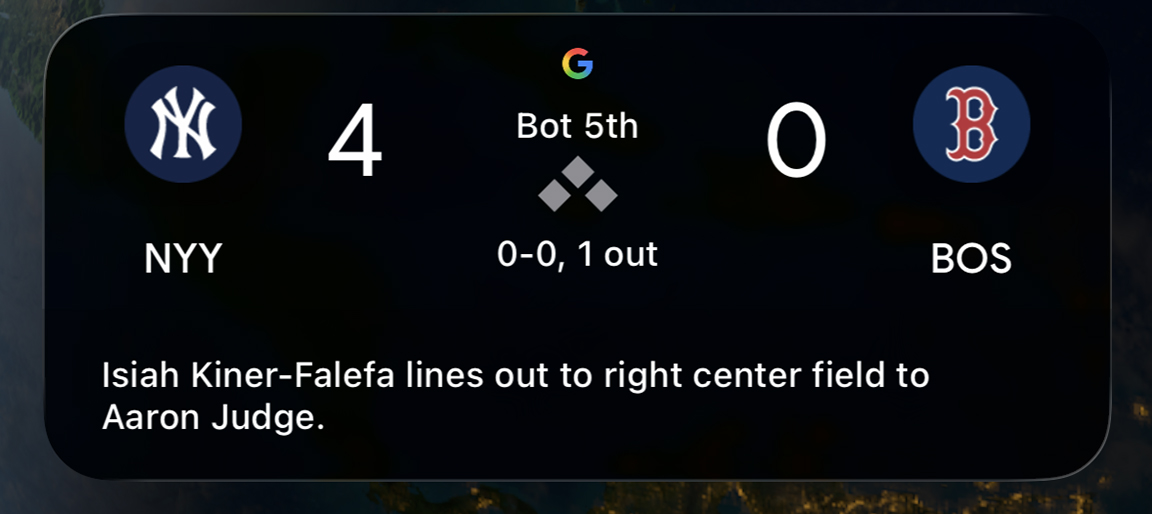
We REALLY don’t. As I sign off, here’s the score:

Screenshot

Is forgetting the past particularly an American thing?

I often rail about the lack of interest in history, which seems one of the defining characteristics of most modern humans. (The lack of interest, not the railing about it.)

But is it modern humans in general, or particularly an American thing? I suspect it’s both.

I started thinking about this this morning because I recently returned to reading a book I started to read last year, but didn’t finish. I’m now getting close to finishing How to Read the Bible: A Guide to Scripture, Then and Now, by James Kugel.

Anyway, toward the end Kugel’s writing about some puzzling things about the book of Isaiah, and wondering why it was written/edited that way, and then jumps back to raise the same points with regard to the Pentateuch. That takes him to talking about how so much of the Torah started as short, etiological (his favorite word) stories told orally from generation to generation, long before they were put together in early Hebrew.

And I paused to imagine American families doing that. I couldn’t.

Oh, there are exceptions. Alex Haley said Roots came from stories his family told about Kunta Kinte and subsequent generations. But it’s generally hard to find examples among descendants of people who came here willingly, on purpose.

I think there’s something in the makeup of a person who decides to take a hazardous journey across the ocean in a frail wooden ship, leaving all he or his ancestors ever knew, that causes him to want to forget all that went before. I don’t get it, but I know that’s a thing.

Such people passed that on in their DNA. The ancient Israelites passed on stories about ancestors, and even memories of the switch from foraging to agriculture 10,000 years earlier (hence the Adam and Eve story). Americans — I mean deliberate, voluntary Americans — seemed to pass on forgetfulness.

I’ve traced every line in my family — save one, that of my mother’s father’s mother’s father, who created a dead end when he died during the Siege of Petersburg — back to the old country. But I’ve never found a single story clearly answering my biggest question about them coming here: Why?

Why did they pull up stakes and come here? Oh, I know all the standard answers from the elementary school — freedom, especially of religion. And if you were a Pilgrim, that’s a good answer. I suspect most people came for economic and social opportunity — a chance to get out of the box in which their old, established societies placed them. They came for land and upward mobility, or so I gather. Of course, some did have an anarchic streak that had to do with not wanting to be told what to do, but I suspect that was a side benefit, and wasn’t quite the refined sense of liberty that Adams, Hamilton, Jefferson and Madison left us.

I do have a hint from one immigrant ancestor — John Barton Wathen (the R was added by my branch a century later) came over as an indentured servant in 1670. That’s seems a clear indication of A motive, if not necessarily TH motive. It seems to have worked out for him — after his servitude, he acquired and passed on a good bit of land.

But I’d still like to have a chat with him. I’m glad that I’m an American. But I still want to know why I’m an American.

And you know what? As much as I know about John Wathen, I still have no idea what his life back in England (or perhaps Wales) was like.

Which makes me like most Americans. But I wish I knew much more…

Are we talking history or current events?

The quiz gives you this attention-grabber to start you off…

I’ve mentioned before my fondness for the NYT’s Flashback history quiz (of course I love it — I usually ace it, because it’s about historical context rather than details). But this week it offered kind of a weird one. Weird in the sense that it was even easier than usual.

I don’t always ace this quiz. When I don’t, the thing that trips me up is usually something that happened in the early Middle Ages, or in the eons before Christ. Often, I’m not sure whether some dynasty I’ve barely heard of started in 500 B.C. or 1500 B.C. And when they get into geological eras, fuggedaboudit.

But for this one all the answers — all of them — were in the 20th century. That’s like an allegedly citywide scavenger hunt in which all the items are in your own backyard.

Of course, that can be trickier — the quiz is about knowing what happened before and after what, and if you don’t know the century well, that can be harder than if they’re spread apart. If these had all happened in the 8th century, I’d have been in trouble (that would be the rise of Charlemagne, and… I can’t think of anything else). But not the 20th. Five of the eight answers happened in my own lifetime!

Now that I’ve given that much away, have at it, if the NYT will let you in…

Thanks for caring and leading, Jesse Jackson

I just thought, in light of his passing this week, it would be good to revisit the last time I spoke to Jesse Jackson. It was back in 2015.

It was at an important moment for South Carolina — his state and mine. The S.C. Senate had just voted to unconditionally remove that imitation Confederate battle flag from the State House grounds. As senators emerged from the chamber, I saw him among them. Here’s how I wrote about it at the time:

I was also a little surprised that I was the only media type to call out, “Rev. Jackson,” which brought him over to speak with me. Maybe some of those young media folks don’t know who he is.

Of course, I was more interested in what the senators had to say, but they were all occupied at the moment and, after all, Jesse Jackson is, like me, a South Carolina native. I was curious how he felt about his state today — or at least the SC Senate….

So he came over and started talking. You can hear what he said above. I’m glad I called out to him.

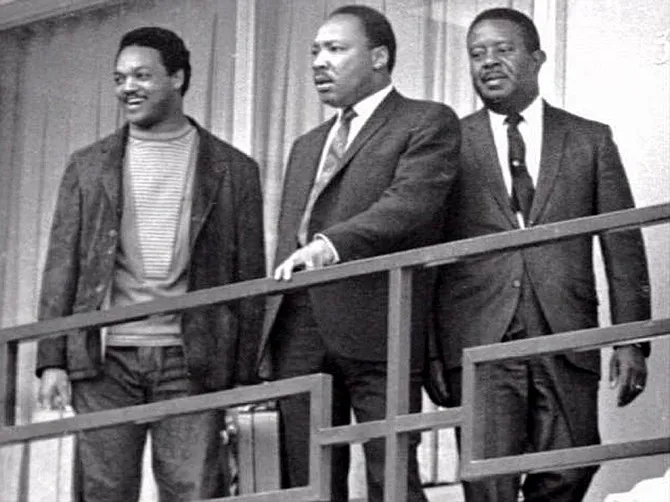
And I’m glad he spent those 84 years on this Earth, doing the best he could to make a positive difference for us all. He wasn’t Martin Luther King, but he was there with him when it mattered, and had been for years, and he was committed to justice and compassion, and he stayed that way.

And I thank him for that.

The best podcast you can find: The Rest is History

Tom Holland and Dominic Sandbrook, hosts of “The Rest is History.”

I’ve previously mentioned my favorite podcast ever: “The Rest is History.” I’ve only mentioned it in passing, though, and have meant for some time to say more about it in a separate post.

And now I have the perfect news peg for doing so.

Apple, which provides the podcast app through which I listen regularly to hosts Tom Holland and Dominic Sandbrook, has named this brilliant gem its 2025 Show of the Year.

And rightly so. I had never heard it before this prize-winning year, but I can attest that what I have heard stands far above any podcast I’ve heard previously. As Apple said:

Apple is proud to celebrate The Rest Is History with the Apple Podcasts Award for Show of the Year, a recognition that honors a show that demonstrates quality and cultural impact in podcasting. Produced by Goalhanger, the series has captivated a global audience with its witty, insightful, and endlessly entertaining exploration of the past, becoming the first UK-based show to be named Show of the Year.
Hosted by acclaimed historians Tom Holland and Dominic Sandbrook, The Rest Is History has become a fixture at the top of the charts worldwide by bringing history’s biggest moments to life. From the rise and fall of the Roman Empire, to the sinking of the Titanic, the hosts blend deep expertise with gripping storytelling and unexpected humor to make complex subjects accessible and compelling for millions of listeners…

Absolutely. I don’t know about those millions of listeners, but I certainly love it. And in my opinion, their audience should be in the billions — or at least, whatever the number of people who can understand English well enough to follow.

And not just because I think everyone should enjoy the same things I do. As I’m always saying, the failure to understand history is possibly the greatest problem facing our country today. Not that Americans were in general great historians in previous generations. But the gross ignorance today is more dangerous than ever, because we live in a time when dimly-perceived history is one of the favorite weapons of the warring tribes into which our once-great society has been divided. The armies of left and right charge again and again into battle waving their opposing misconceptions like so many heavy, dull swords.

It’s not about names and dates, or about which tribe got wronged by which other tribe in the past, but about understanding. It’s about perceiving and accepting, on a deep level, the people who came before us, and lived normal human lives day after day, just as we do. They’re not black and white object lessons, they’re people, like our families and friends.

And their stories are fascinating. And sometimes hilarious as well. Apple mentions these guys’ “unexpected humor.” Well, it’s not unexpected at all once you get to know these guys. They are brilliant historians, and so comfortable with their material that they fully appreciate the human comedy they are telling about. And while they don’t neglect the serious stuff, sometimes they go off on wonderful digressions about the really fun stuff.

You’ll hear that if you listen to this one short (half an hour, compared to the usual hour) episode they released this week to celebrate their award. They review some of their favorite episodes this year such as:

I became besotted with this show in April, when I ran across it in the middle of their four-part series on the year 1066, a year that of course has tremendous meaning to these two Brits. I immediately found that the site allowed me to go back and hear the previous episodes in the series — and for that matter every one of the more than 800 episodes since the show began.

I hadn’t listened long before I signed up to become a member of the show, which means I don’t have to “tune in next week” to hear the rest of the current series. I also get to hear their bonus episodes either riffing further on the current topic, of going far off the track on something they enjoy talking about.

All that is well worth $6 a month. Go give it a listen. You’ll be glad you did. You’ll also walk away smarter. You could start with the one celebrating their award.

Oh, and as Americans, don’t be put off by their constant “Bully for England” shtik. They worry about that a bit, although it doesn’t stop them:

Tom: What makes us particularly humble is that we are the first non-American show ever to win show of the year. So it’s a victory not just for us, but for Britain.

Dominic: Yeah, in a very real sense, for Britain.

Tom: Yeah. So Dominic, I’m a bit worried that our tone of British smugness may have scared away lots of readers who are tuning in wondering what the fuss is all about, and they’ve never actually listened to us before, so why don’t we just talk a little bit about what we do….”

Which they go on and do. Then, to celebrate the giver of the award, they riff on the Top Five Apples in History. Give it a listen

The Beloved Children of the Holocaust

I’ve mentioned my neighbor Mary Burkett before. We had one of her campaign signs in our yard ahead of the last election. She won election to the Lexington District 2 school board.

Hers was one of five signs we had in our yard, four of whom won, but no one running for school board won as big as Mary did. And if you knew her, you would understand why.

But Mary’s more than a pleasant neighbor and someone with real concern for our schools. Several years back, she took on a new avocation: She started drawing portraits of children who died in the Holocaust. This was in January 2017. Over the course of the next seven months, she produced a collection she calls “Beloved: Children of the Holocaust.”

Why did she do this? She explains:

I felt that not only their lives, but their voices had been taken from them, and I wanted to give them a chance to speak to the world. Simply put, I wanted to honor their precious little lives. My hope is that you will be blessed by them as I have been.

She had no great ambition in taking this on. She doesn’t even see herself as an artist. But her work has been celebrated. Three years ago, a film about her project was shown in Greenville at the Peace Center. If you missed that, you can find it on Amazon Prime.

Anyway, I suppose that’s enough to set up what I wanted to tell you about. I saw this a few days ago on her Facebook page:

I’m going to open us up for a little discussion today, but please remember not to name specific politicians or parties from any country.
Here we go… A major university in the US recently denied a faculty request to show my exhibit, In the Land of Wooden Shoes. Their reason? It is too political…now if you have followed Beloved for any time at all, you know that this work is purposefully non-political.
So, here’s our point of discussion –
How does this type of action relate to Germany in the 1930s, if at all? Perhaps it is simply prudent on the part of the university not to exhibit historical portraits that might be deemed controversial. On the other hand, does the silencing of history matter and where might it lead?
We have a large worldwide audience here; let’s see what people think…

When I called Mary to ask about this, she explained that “In the Land of Wooden Shoes” is a sort of offshoot of her initial “Beloved,” and is “a joint project between myself and the Anne Frank Center at USC.” (Mary was a recipient of the Anne Frank Award in 2024.) It consists of six portraits of Anne at different ages, plus 20 of other children taken from the Netherlands by the Nazis and sent east to their deaths. The portraits are accompanied by biographies.

That’s it. “I don’t tell people what to think. There’s never a punch line.
Look at the pictures, read their stories, and walk away with what you perceive…. I don’t show and don’t talk about numbers of trains” or other details of the Final Solution.

The exhibit has been presented to 5th-graders without causing a problem. Yet for a “major university,” it was too much. Too “political.” (Speaking of universities, though, there was also a showing at the South Caroliniana Library.)

The thing is, Mary is very, very careful to stay away from politics. Note her appeal to commenters “not to name specific politicians or parties from any country.” Makes her kind of the opposite of me, huh? But I appreciate what she’s trying to do, and it’s a version of what I’ve praised and called for in the past. It’s a worthy goal for me, and for all of us, if we’ll only embrace it.

Yet in her unassuming work, she’s run into “politics” in recent years. Take that Facebook page. Before Oct. 7, 2023, she had a huge following — about 5 million at one point, from all over the world. Then, it dropped to about 20,000. Apparently, there were complaints that it was “offensive.”

She thought the drop was something Facebook was doing deliberately. Then she hears from the social medium that “Because of your high-quality content, we’re going to extend your reach.”

Her following has gone back up (to 53,000 at the moment), but is “nowhere in the range of where it was.” She is sad that “Very few from Europe, Canada, Australia comment any more.” She suspects they’re not able to see it. This is because she frequently gets FB messages from abroad asking where her page went.

Note that Mary doesn’t name the university or the faculty member who proposed to show the exhibit. The last thing she wants to do is hurt anyone. I didn’t press her on that. I just wanted to share what I’ve shared here.

By the way, at her website, you can learn about some other projects she’s taken on, such as “Beloved: Legacy of Slavery.”

So much for the legendary hero of McNairy County

The Wikipedia page for Adamsville, TN, features this pic of local boy Buford Pusser’s house.

It’s been so long since Buford Pusser was a household name that this didn’t make all that much of a splash, near as I could tell (maybe it was bigger on TV, which I don’t see). Fifty years ago, it would have been as big nationally as Alex Murdaugh’s crimes — maybe bigger.

Certainly bigger. Alex Murdaugh was a prominent small-town Southern lawyer who murdered his wife and son, among a host of less-shocking crimes. Pusser was a rural Southern sheriff who impressively wielded a big stick in fighting rampant crime in his county, to the point that the bad guys ambushed him and murdered his wife, and Hollywood made him a hero — several times, if you count the two sequels and the made-for-TV movie. Apparently, a TV series as well.

Pauline Mullins Pusser

And now, the authorities say Buford himself killed his wife. This at least has made The New York Times take notice. One wonders how Hollywood will react to the news.

Pauline Mullins Pusser was killed in 1967, and her husband died seven years later. There will be no killer to prosecute, but authorities are pursuing an indictment in the cause of “giving dignity and closure to Pauline and her family and ensuring that the truth is not buried with time.” A good call, I’d say. Called for in this case, if not in others.

“Walking Tall” was something of a national hit in 1973. The NYT cites Variety in saying that it “was made for about $500,000 and earned more than $40 million worldwide.” Not one of the top-grossing films of the year, but impressive nevertheless, given the tiny investment. It reminds me in that regard of “Billy Jack” a couple of years earlier.

It’s hard for me to recall accurately how big a hit is was nationally, because I was living at the time in small-town West Tennessee, where it was a sensation. Of course, my small town was nothing like McNairy County. Millington was just a few miles north of Memphis, and was the home of NAS Memphis (now known as Naval Support Activity Mid-South). I lived on the base. I was a sophomore at Memphis State, but I knew some of the high school kids on base, who attended the local public school. And they were absolutely nuts about “Walking Tall.” Kind of the way kids my age had been about “Billy Jack” in 1971.

This one girl who lived around the corner from us on the base was certainly impressed. I didn’t really know her and don’t recall her name, but I did fall into conversation with her one day in front of her house. I say “conversation,” but I think it was mostly her talking about how wonderful the movie was. So I asked her if she’d like to see it again. She said yes, and I took her to the Millington drive-in that night.

You can forget any sordid imaginings that may conjur — the college kid taking the high school girl to a drive-in. It just seemed a natural thing to do since she was so enthusiastic about the film, and the drive-in was where it was showing.

I sat on my side of the car and she sat way over on hers, with her eyes glued on the screen, rapt. I had felt a bit awkward thinking she might be nervous about this older (like two years, I guess) guy she hardly knew taking her to the drive-in, but that didn’t seem to be a problem. I was not in her thoughts. She was just digging Joe Don Baker up there and all the awesome things he was doing. I’m trying to remember whether her lips moved along with the dialog as she saw it, because it certainly seems likely given she was so fascinated and had seen it before.

I don’t remember interacting with her in any way after that night. There didn’t seem any ground for the establishment of even a platonic friendship. She was only interested in one thing, and it did not lie within my universe of interests.

No matter. I met my wife a couple of months later. The night we met we had a long talk about Jack Kerouac and On The Road. This was a good start, and things got better from there. Did I tell y’all about our big 50th-anniversary celebration with our children and grandchildren last year?

I wonder, though, whether that girl has heard this latest news. I hope she’s not too shaken by it.

Above, I sort of wondered idly how Hollywood would react. Of course, if there is ever a new movie, it won’t be in the same vein at all. It won’t inspire folks across the nation to idolize the ex-professional wrestler who becomes sheriff in a corrupt corner of the countryside and lets no one stop him while he addresses crime by whupping bad guys with his big stick. Or to idolize anyone else.

It will instead be painfully sad. I don’t think I want to see that flick, either…

Joe Don Baker as Pusser in ‘Walking Tall.’

The beauty of knowing where you are

One nice thing about ebooks is that you can keep them always handy.

I don’t have a temporary relationship with books. I think public libraries are very wonderful things, essential community assets, but I don’t often borrow books from them. If I read a book, and enjoy it or learn something from it or both, I don’t want to give it back. I want to have it handy to refer to, always.

This has led to a good bit of bookshelf-building on my part, but also a gradual turn toward downloading some of my favorite books to my iPad, using the Kindle and iBooks apps. This way, I always have a few of my favorites with me, because that’s where my iPad stays. This enables me to indulge, in quiet moments, my great weakness — rereading books I love. It’s something I can do for five or ten minutes, then move on to something else. And I almost always gain something that I didn’t fully get before.

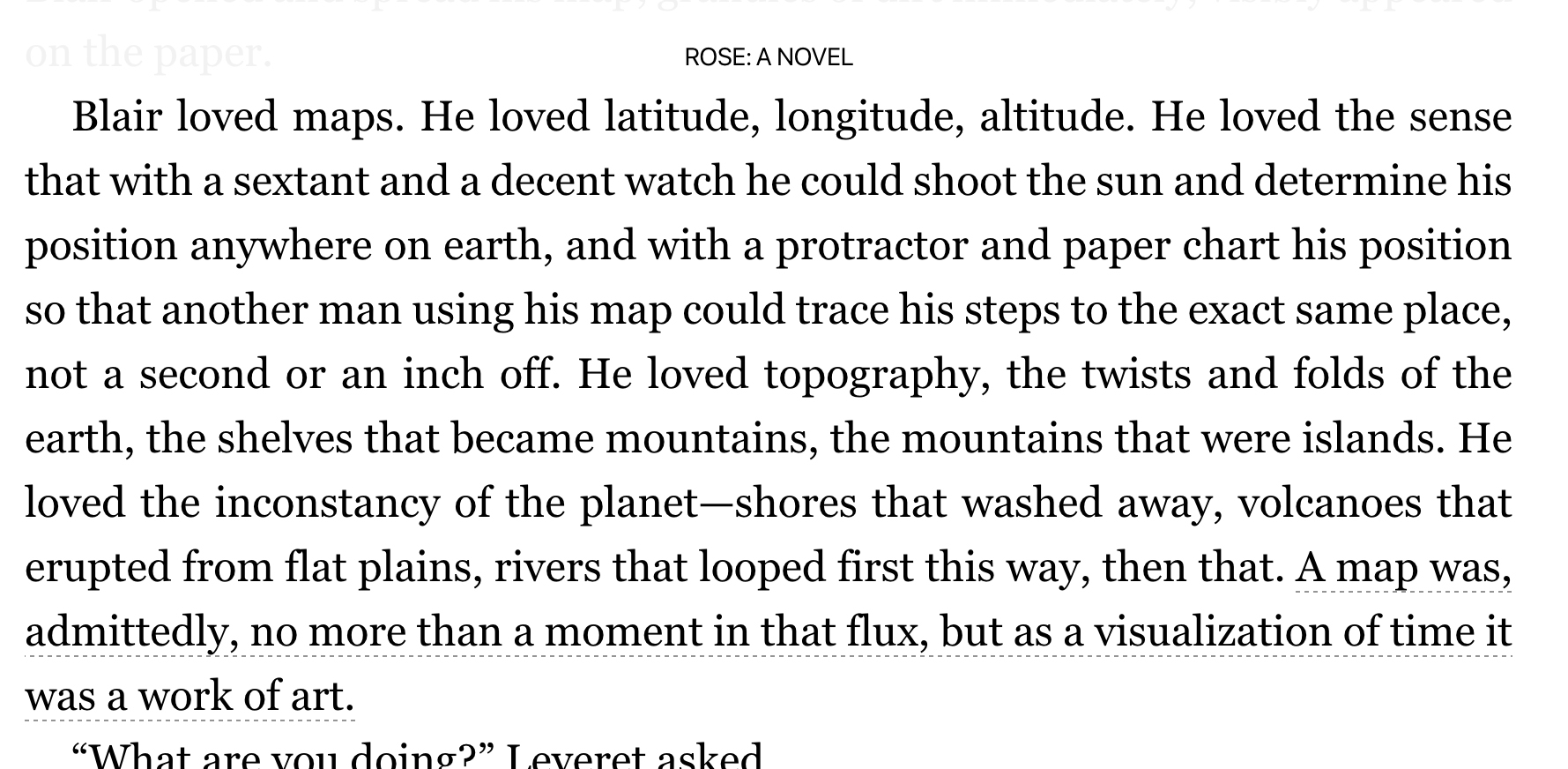
This morning, at breakfast, it was one I’ve mentioned before — Rose, by Martin Cruz Smith. I’ve praised it before, said some of the same things before, but I promise I’m making my way to a different point today. Above is one of the passages I read this morning. It’s a good reminder of why I’m so into this book. Of course, this has been a forte of Smith’s work ever since Gorky Park. As I’ve said before, of both him and Patrick O’Brian, they are “capable, to an extent I’ve never seen anywhere else, to take their readers to an alien place and time and make them feel like they are really there.”

That passage above helps me to connect closely to Blair with a certain fondness (despite his extremely off-putting personality), because while I lack his skills as a mining engineer and explorer, I have always loved maps myself — even when studying one involved pulling it out of the glove compartment, and then enduring the challenge of trying to fold it back properly when I was done. Now, of course, Google Maps and Google Earth are always right there, the apps ready for reference as I read a book, or serving as a constant guide on my car’s dashboard. Blair would have loved interactive maps.

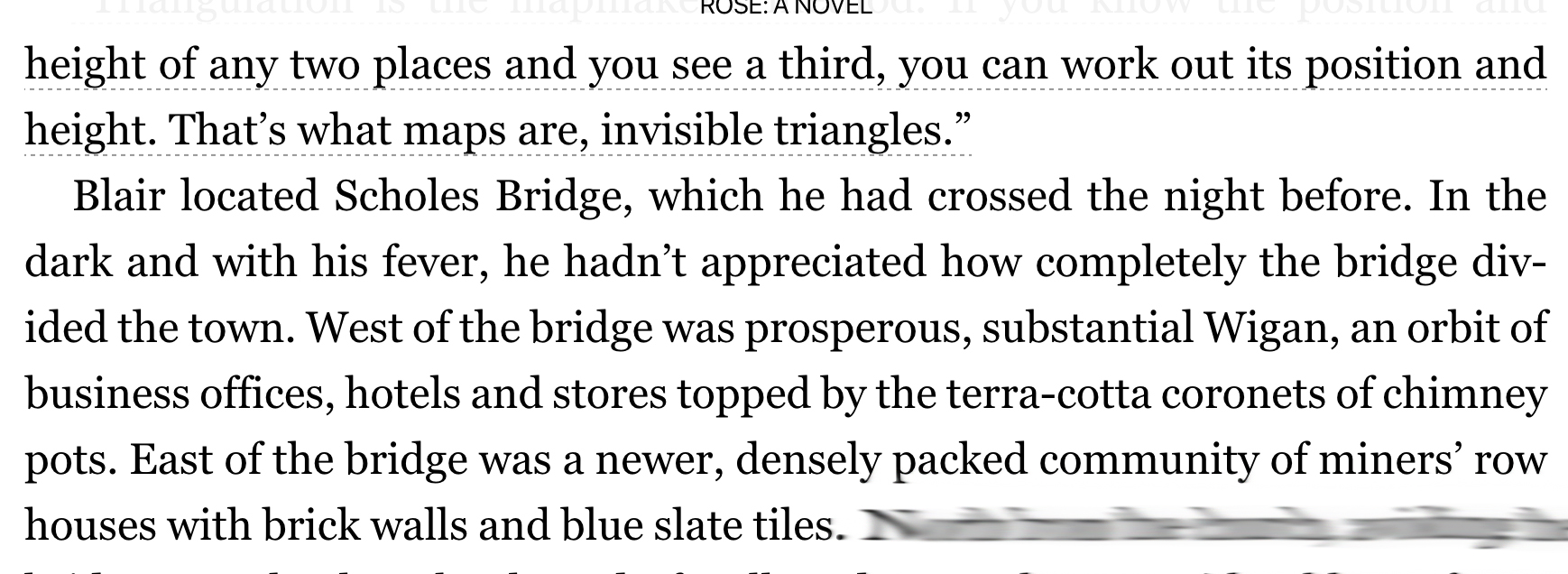
Today, though, I’m really focusing on something about entirely familiar places rather than exotic ones — although places I wish I knew as well as I know 19th-century Wigan from Smith, and Port Mahon circa 1800 from O’Brian. This is inspired by a paragraph that appears a bit after the one posted above:

Screenshot

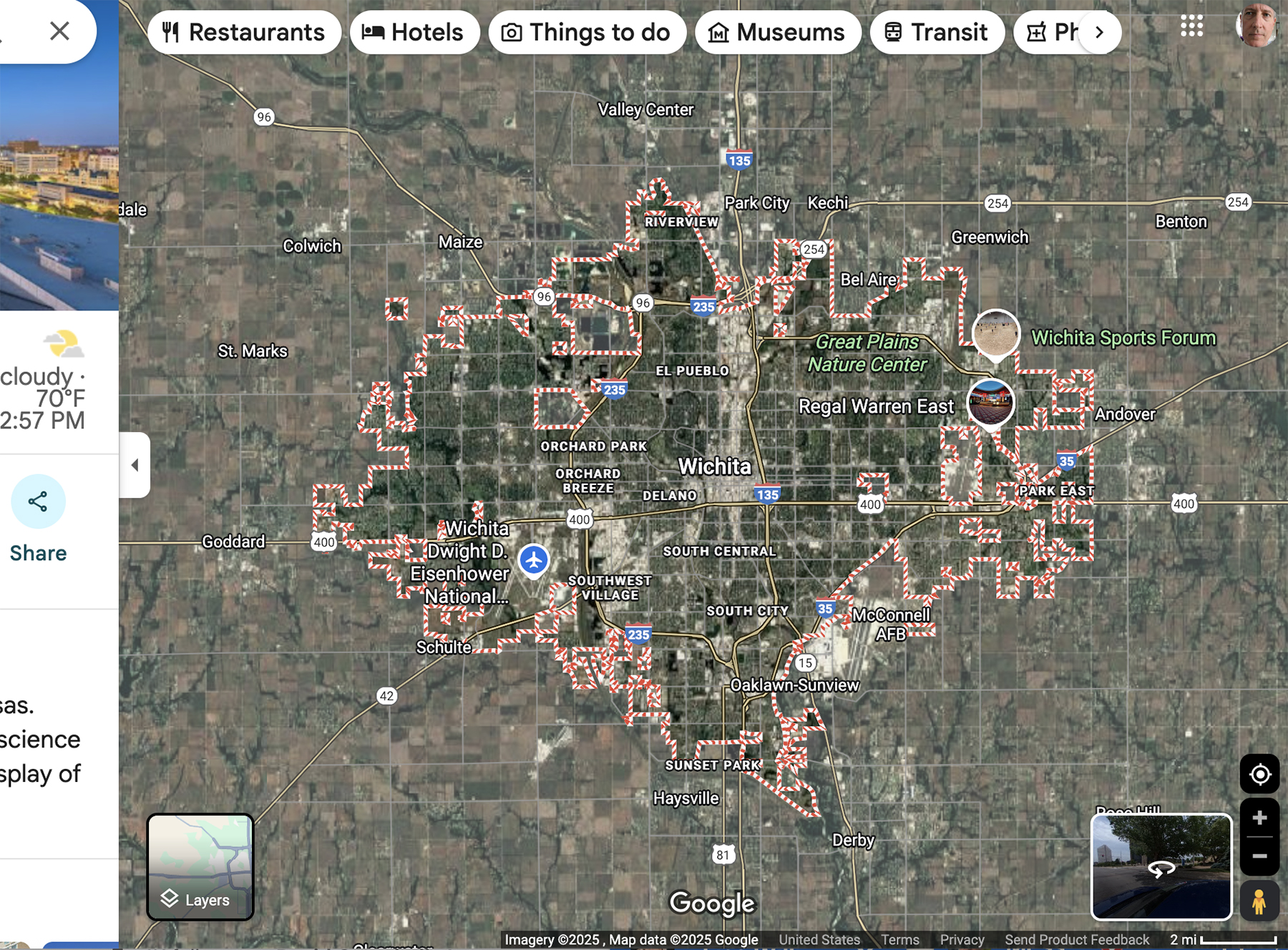
That immediately brings to mind a place where I have have actually been: Wichita, KS, which is where I lived and worked before returning to South Carolina. It’s a city like Columbia in some superficially impressive ways. For instance, it’s located at, and sprawls across, the confluence of two rivers, the Arkansas and Little Arkansas (pronounce “ar-KANSAS,” not “arkansaw”). The place where the rivers came together to form one had been an important gathering point for pow-wows between Indian tribes before the whites arrived. A cultural center sits on the joining delta today. (I’ve witnessed a pow-wow there.)

Wichita is nothing like Wigan, except in this one respect: It is historically sharply divided, by class and culture, by the river at and below the confluence. The West side was like Smith’s miner side: When the city developed in the 19th century, that was where the stockyards, saloons and brothels waited eagerly to welcome exhausted, filthy cowboys who had driven their herds hundreds of miles to get them to the railhead. They had a lot of steam built up when they got there, and Wyatt Earp was among those lawmen trying to keep them in line until they left.

Across the river to the east were the respectable folk — the people who owned those stockyards, saloons and brothels — where they lived comfortable, proper lives with their families, insulated by the river from their rowdy source of income.

An ironic thing about that… we all know that newspaper editors are, or at least do their best to emulate, “liberal elites,” right? Just full of politically correct values. Well, one of the first things I learned about my fellow editors at that paper was that they all lived on the proper, safe, smug East side of the river, largely in a Shandon-like area called College Hill.

All of them but one, a guy named Tom Suchan. I liked Tom, naturally enough. He was a Catholic like me, and had four kids, as I soon would (my fourth was born there, my fifth not until we got here). And he lived as far West as possible while remaining in the city. Across the street from his house there was a wheat field, and nothing else visible beyond it for miles and miles of prairie.

The other editors gave him constant grief for being such an outcast, a wild man beyond the pale. Oh, they did it kiddingly, but I felt the jokes covered something of a real difference between him and them, one that reflected to his credit, in my book.

When I moved to Columbia in 1987, I immediately perceived a similar dynamic. When we had our daily editors’ meetings, I looked around at the dozen or so crowded around the table, and knew that most of them lived in Shandon (while I lived over here on the West side). But a starker difference was that all of them were alumni of USC (I had never encountered such a uniformity at a newspaper). Well, all but one. Tom Priddy (who ironically had almost the same job as Suchan, being over the photographers and artists at the paper) had gone to Clemson. No one ever let him forget — joshingly, of course — what a pariah that made him.

I don’t know where he lived while he was here. But the similarity in the situations was striking.

But there was an important difference. Although I know South Carolina overall so much better than I do Kansas, I can’t sum up the central narrative of Columbia nearly as well as I can that of Wichita. There, it was simple: Cows, the railroad, cowboys and the townspeople who lived off of them. It was hard to forget, with historical reminders such as that Indian cultural center, and the “Cowtown” attraction that was located, of course, on the western side.

I know lots of things about Columbia. By the way, when I use that name, I’m referring to the overall metro area, which is stunningly fragmented, legally and politically — two counties, about 10 separate municipalies, five school districts, and so forth. Wichita has one advantage over that. Despite the historic split, it’s all one city (except from some odd little conclaves similar to, say, Arcadia Lakes. It’s all in one county. And there’s one public school district (although my kids attended a parish school in the large, separate, Catholic system).

Consequently, it’s a community that finds it easier to get its act together. For instance, its riverfront areas were completely and beautifully developed long before I there. Progress has been made here, but it’s been fitful.

Of course, there’s that huge similarity in the Big Split between East and West. And I can give you all sorts of reasons why that alienation exists here. And it’s very long-standing. It has to do with why the first editor of The State was shot and killed by the lieutenant governor in broad daylight, in front of a cop, across Gervais Street from the State House in 1903 — and his lawyers got him office by obtaining a change of venue to across the river, where folks reckoned he had it coming.

But this post is already too long for me to elaborate. I know the division exists, and you know it exists. The difference is that I can’t explain it as simply and starkly as I can the split in Wichita. The causes are more complicated here on the Eastern Seaboard. There are things we know and could explain if we were willing to talk about them, and other things we have trouble fully wrapping our heads around.

I’d like to be able to do that. I’d like to be able to explain it — to myself, to my neighbors, and to outsiders — as clearly as I can explain Wichita (or at least, how it formed).

Can anyone recommend a book that treats this entire community in a way that makes that manageable? The author doesn’t have to be a Patrick O’Brian or a Martin Cruz Smith. Just someone who explains us and the place we live clearly, coherently, accessibly, and most of all accurately.

If y’all don’t know, I’ll check with friends at the libraries on both sides of the river. I don’t check out their books much, but I know what a valuable resource they are…

Screenshot

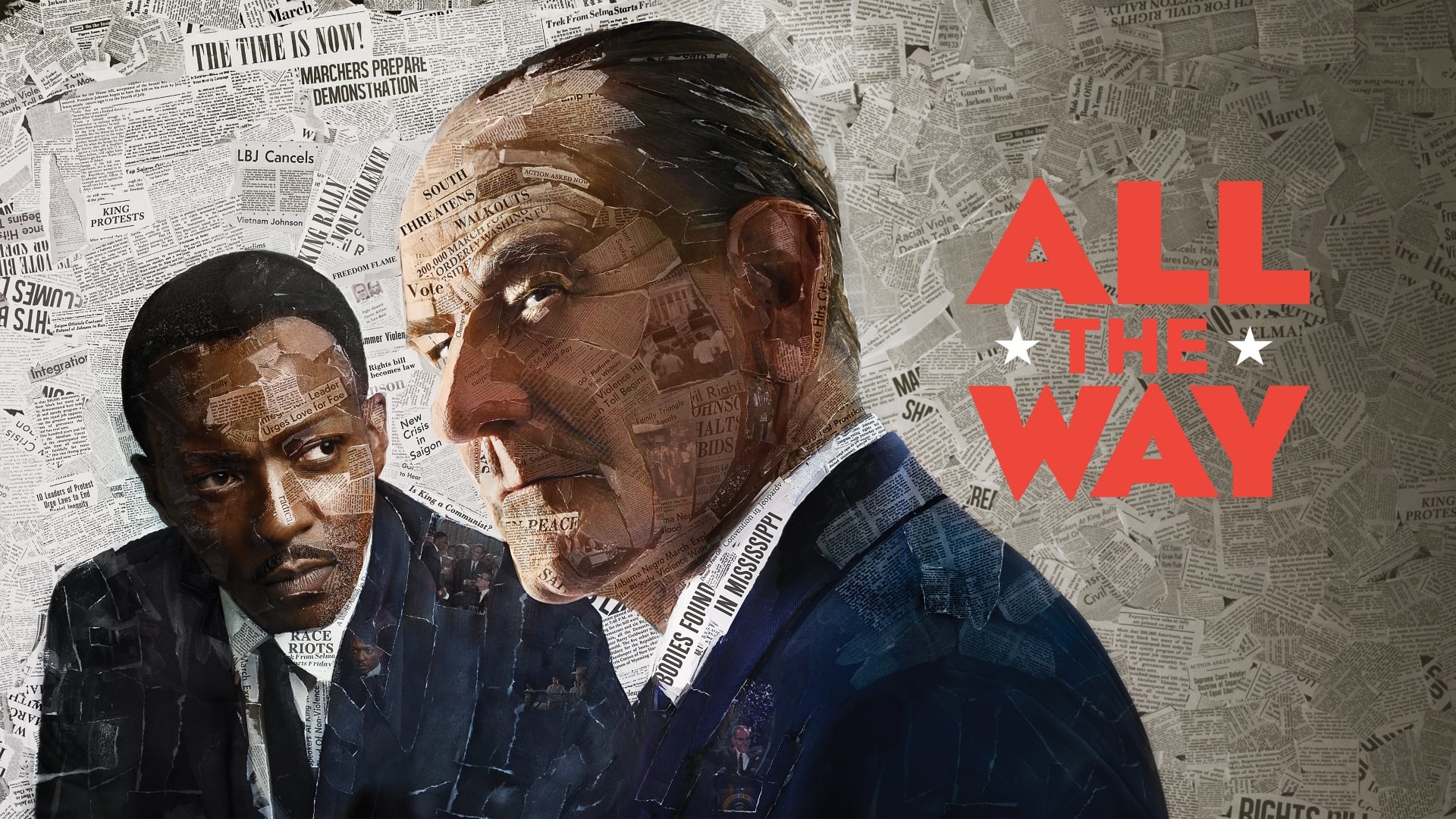
All the Way with LBJ

Here’s another movie that should have been on somebody’s list of the best since the turn of the century. I had forgotten about it, then ran across it on HBO and watched it again last night. I was more impressed this time than the first time.

It’s “All the Way,” starring Bryan Cranston as Lyndon Baines Johnson. It covers his first year as president, from the moment JFK was pronounced dead in the hospital in Dallas to LBJ’s stunning victory over Barry Goldwater.

It was technically amazing. Cranston’s embodiment of Johnson, aided by remarkable makeup, made me feel constantly that I was watching and hearing the original man. If anything, Melissa Leo was even more impressive as Lady Bird, although she didn’t have nearly as much screen time.

Also noteworthy: Bradley Whitford as HHH, Stephen Root as J. Edgar Hoover, and Aisha Hinds as Fannie Lou Hamer. Towering above those was Frank Langella’s deft, nuanced portrayal of Senator Richard Russell. (I was less impressed with the portrayals of MLK and, in a bit part, our own Strom Thurmond. Sadly, I’ve yet to see any actor come close to recreating the power of Dr. King’s presence.)

Beyond the technical stuff, since I was out of the country during that year, I learned a lot watching it. Sure, I knew about (or learned later about) the events that were portrayed — the extraordinary exertions to pass the Civil Rights Act, the destruction of the Democratic Party’s Solid South, the deaths of the three civil rights workers in Mississippi, the Gulf of Tonkin incident, and much more — I hadn’t fully had the sense that they all happened in that year, when Johnson was trying to establish his legitimacy in the office while also winning an election. With hindsight, I’ve tended to think Goldwater was easy to beat. But not from LBJ’s perspective, with all those other things going on.

I enjoyed “Breaking Bad,” but maybe the best thing about it was that it gave Cranston the celebrity to do something like this. It was made in 2016, and it’s amazing to me that it didn’t make more of a splash (as in, the kind that gets you on a “Top 100” list.) Perhaps because it’s wasn’t available to anyone but subscribers.

If you have access to Max, or whatever you call HBO, watch this right away…

You say you want a revolution?

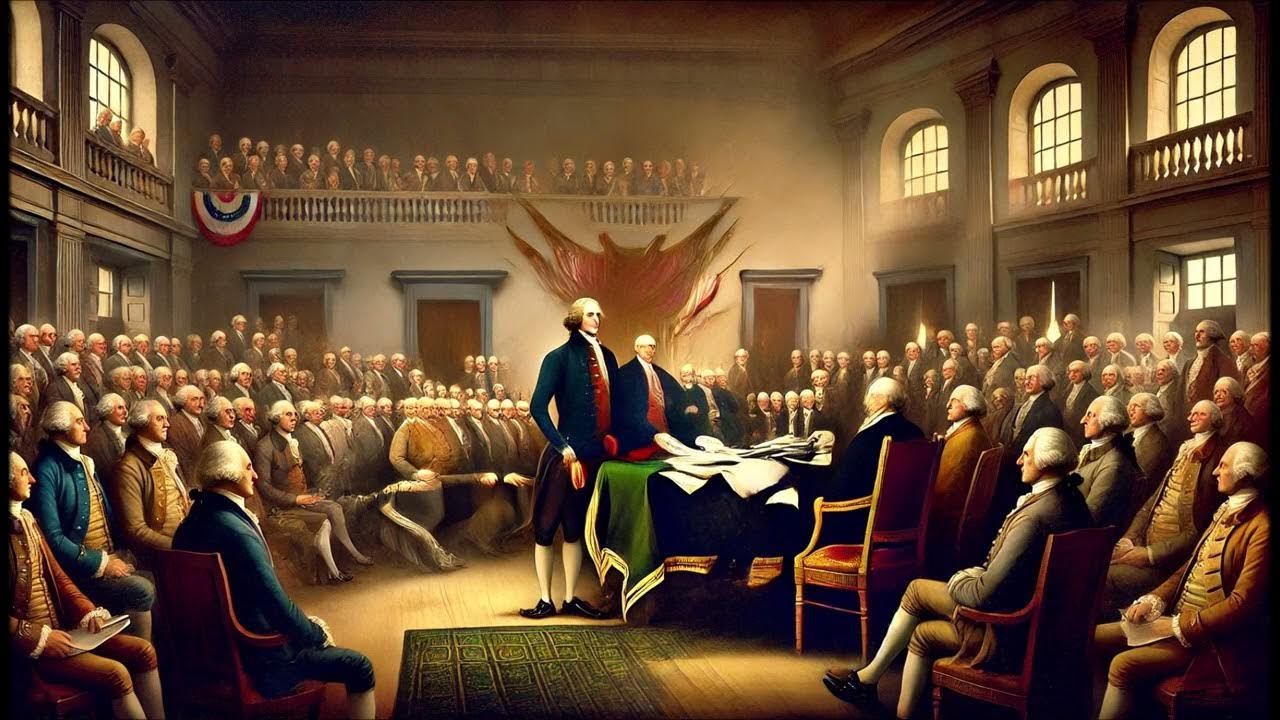
Well, today is the day (as you know I love to tell people over and over) that was supposed to be forever cherished as our national Day of Independence. That’s what John Adams expected, and predicted at the time, because that was the day that the Second Continental Congress actually voted to separate these 13 states from the British Empire.

What happened two days later was everybody lined up and signed a piece of paper saying so. And sure, you can call that Independence Day, too, for that very reason. No argument about that. But Adams has always been my favorite Founder, so this date causes me to want to stress his achievement, which was more significant than what Thomas Jefferson did. And yet everyone associates this big move with ol’ Tom. It’s almost like his personal holiday. But come on, people. Jefferson never opened his mouth during those weeks that Adams harangued the Congress so furiously to get them to step off and make the decision. Jefferson wrote the hard-copy version because Adams persuaded him to, because he admired the Virginian’s ability to turn a phrase (and also thought it would help that Jefferson was way more popular in the Congress than he was, since Tom didn’t make such an effort to tick everybody off), and he did it not alone, but as a member of a committee including Adams, Ben Franklin and a couple of other guys.

And I’m afraid that far too many of my favorites Americans, when they think about something beyond hot dogs and fireworks at all, think of the Declaration as somethign that genius Thomas Jefferson dreamed up on his own in his hotel room in Philadelphia, and then unveiled to the whole world’s enduring admiration and gratitude. Or something like that. Which isn’t right, and doesn’t give credit where due. Y’all know that no one respects a well-turned phrase more than I, but Independence was the result of more strenuous efforts than applying quill to paper.

I could go on, but now I’m going to switch to the subject of popular music….

I’ve been sort of halfway following a newsletter feature in The New York Times called The Amplifier. Well, “follow” is a bit strong. Basically, I sometimes look at the song lists they regularly email me, and have frequently been impressed by the selections I find. These folks are widely knowledgable, and you can’t pigeonhole them. They’re neither desperately trying to convince us that pop music in the 21st century is seriously wonderful, nor stuck in 1973 and telling us that all music has been crap since Lester Bangs died, if not earlier. They have a much broader perspective.

Anyway, this week they sent out this list:

10 songs of rebellion and defiance for the Fourth

… so I thought I’d share that with you for your enjoyment, or serious appreciation, or whatever.

I gave you the link for that list above, and I hope it works for you. If not, these are the songs:

  1. Tracy Chapman: ‘Talkin’ Bout a Revolution’
  2. The Isley Brothers: ‘Fight the Power, Pts. 1 and 2’
  3. Public Enemy: ‘Fight the Power’
  4. Michael Franti & Spearhead: ‘Yell Fire!’
  5. Bob Marley & the Wailers: ‘Get Up, Stand Up’
  6. Mavis Staples: ‘Eyes on the Prize’
  7. Patti Smith: ‘People Have the Power’
  8. Björk: ‘Declare Independence’
  9. Rage Against the Machine: ‘Know Your Enemy’
  10. Antibalas: ‘Uprising’

I looked at the list eagerly, having enjoyed past ones, but then I realized something… As much as a lot of people may dig those songs, they’re not really in my wheelhouse, to my knowledge. I haven’t even heard a bunch of them, but that’s beside my point.

My point is that as an Independence Day list, well, it really doesn’t work. But don’t blame the NYT folks. As much as I love American pop music, and have since “Hound Dog,” it’s just not the medium for addressing the American Revolution. Pimply-faced outcries against the Man are certainly within the reach of pop music, but that’s not what this country’s revolution was.

If you even want to call it a “revolution,” which I tend to doubt. You want a revolution? You want something that fits the tone of these kinds of songs? Well, the French had one of those, perhaps the ultimate one. And now that they’re on their Fifth Republic, I’m still not sure think they ever got over the trauma of it. The Russians, in their way, had one, too, and Vladimir Putin still isn’t coping with it in a well-adjusted manner.

Not that I’m running down our own, or anything — certainly not in this first year of our 250th commemoration. No, the American Revolution was one of the most significant and positive developments in the political history of the human race, which is why I am so grief-stricken now as I watch what it produced, all those things I love, being so rudely, stupidly and cruelly dismantled.

What do I call it? Well, one way to describe it is as a parting of the ways between a unique new country that had come into being and the country that had fostered it. This was not about oppressed people (paying taxes on tea? call that oppression?) rising up to destroy the established order, murder the royal family, obliterate religion, and that other sort of carrying-on we’ve seen elsewhere.

And it certainly wasn’t some class uprising by the sans cullotes against the rich and powerful. If you look carefully, the same people, in terms of social class or property or education levels, were in charge after independence as before. People of all classes took part, on both sides. But the guys who initiated and led this were people who knew how to run a city or colony or country (or a business, for that matter), and had been doing it in the past. Which, all the noble (and they are noble) words about freedom aside, is one of the very biggest reasons why our republic worked so well until very recently.

No. Our “revolution” was about serious people who had followed their fathers and grandfathers in building a new kind of country in what was to them (although not to, say, the Hurons) a New World. And they were pretty satisfied with what they’d built, and wanted it to continue. They saw themselves as Englishmen, but they were getting the strong impression that the British Crown didn’t really get them any more, and didn’t fully appreciate what they had become, and how they deserved to run it themselves without increasingly pesky interference from London.

Well, KIng George wasn’t going to go for that — certainly not after having expended all that treasure to protect the colonies from the French a few years earlier, as any Tory could have explained to you at the time. So yeah, there had to be a rupture, a ripping-away of the ties that bound. And eventually, starting a year before the Declaration (which continues to make me very uncomfortable, as I’ll explain again if you need me to), there was a very serious war. A particularly nasty war if you were down here in South Carolina (and elsewhere) — not a simple ones-and-zeroes matter of Patriots vs., Redcoats, but bloody, fratricidal violence between people who lived side-by-side. And (with the help of the French, of course), that war had an astounding outcome, with the world’s great superpower losing to a bunch of farmers, lawyers, shopkeepers and the like with a minimal amount of military expertise.

And the world was never the same again, and in so many ways, I thank God for that.

But “revolution?” In the French sense? In the sense of someone with such a pimply moniker as Rage Against the Machine? No. I don’t think so. It was something far bigger, far more important to human history.

But as I’ve probably also said before many times, I do have a favorite rock song about revolution. When the 45 came out, it seemed that the juke box in the cafeteria of Robinson High School in Tampa was broken. Whenever I was in there, whenever I walked by, I would hear the sweet sound of “Hey, Jude.” Which was wonderful because it’s truly one of the greats, and I love it.

However, I was frustrated because I didn’t think I was hearing the flip side nearly enough, certainly not as much as the tune deserved. So after the bus took me back home to MacDill Air Force Base after school, I made a habit for awhile of walking over over to “the Wherry.” That was a small building a couple of blocks from our apartment that contained two things — a sort of convenience store run by the Base Exchange, and a tiny snack bar where airmen, dependents and such could stop in to order a burger or hot dog or whatever.

And this snack bar had a juke box, which was very well stocked (I can’t remeber all the tunes, but I remember being impressed perusing the choices). At that time of the day the place was pretty empty, but I’d plug in my change and sit and listen to that song, which rang out with all the raw energy of its title. And then do it again. And again.

Mind you, it wouldn’t be all that long before I outgrew thinking John Lennon was a particularly wise political analyst (“Imagine” was a beautiful song, but the lyrics were vapid, which I realize I say in contradiction to wide and fervent popular opinion), but I always thought that he — in his instinctive cynicism — pretty much had the more fiery, self-righteous sort of revolutionary pegged. And he wasn’t buying. I mean people like John Adams’ cousin Samuel, or Robespierre, or certain adolescents who knew little beyond three guitar chords, but felt passionately. In this song, his was the more reflective attitude that there was a lot to consider beyond the romantic notion that revolution, per se, is necessarily a good idea, much less the perfect solution that its enthusiasts so fervently imagine:

You say you want a revolution, well, you know
We all wanna change the world
You tell me that it’s evolution, well, you know
We all wanna change the world…

But when you talk about destruction
Don’t you know that you can count me out?

You say you got a real solution, well, you know
We’d all love to see the plan
You ask me for a contribution, well, you know
We’re all doin’ what we can…

But if you want money for people with minds that hate
All I can tell you is, brother, you have to wait…

But if you go carryin’ pictures of Chairman Mao
You ain’t gonna make it with anyone anyhow…

Hey, let’s put in a quarter and listen to it AGAIN…

A misnamed battle, 250 years ago today

A few days back, I missed mentioning D-Day the way I usually do, so I’ll try to make up for it by saying something about the famously misnamed Battle of Bunker Hill that occurred on June 18, 1775.

Actually, I’ll share several somethings about it, since it’s been on my mind lately…

  • First, the easy one… this fight mostly occurred on nearby Breed’s Hill, not Bunker — although the Patriots did end up retreating over Bunker at the end of the battle.
  • Second, I’ve mentioned that I’ve been helping the Relic Room with its frequent Noon Debrief free lectures, at the museum itself, and at Richland and Lexington County libraries. We’ve had some good military history programs, and lately we’ve been rewarded by growing crowds of attendees. Anyway, the latest one, just this past Friday, was about “Bunker Hill,” and it was delivered at Richland Library by our own inimitable Joe Long, curator of education at the museum. I had helped set it up, but missed this particular program. So I’m going to go back and watch it, which you can do at your convenience at this address. I hope you enjoy, and decide to come to a future program. Here’s some info about our next one, on July 11. You can also read about other recent programs at this address.
  • This being the first year of the big Sestercentennial, you’ve probably already heard about South Carolina being the place where the most Revolutionary battles occurred. Of course, the Boston area had a little to do with it, with this battle being firm evidence of the fact. Today, the Boston Globe had a story touching on that, headlined “The Revolutionary War was more brutal than you probably learned in school.” This battle was a prominent example of them of that — for the Patriots, who were forced to give up their position on Breed’s Hill, but especially for the British, who “won” a particularly costly engagement. They suffered 1,054 casualties to the rebels’ 450, with a total of 226 killed compared to 115 American lives lost.
  • Those numbers convinced Britain, the world’s greatest power, that this was going to be a real war, and would take a lot more to win than anyone had imagined. They were up against a determined enemy that wasn’t just trying to register a protest. The colonists famously waited (although scholars doubted anyone actually said it) until they saw the whites of the British regulars’ eyes, and shot to kill. This was more than a year before the Declaration of Independence.
  • It also helped solidify resolve among American onlookers. The Washington Post ran a piece today by the historian Joseph Ellis, who has begun a series in the paper based on the correspondence between Abigail and John Adams. John was off doing his thing with the Continental Congress in Philadelpia (a year later he would convince his colleagues that independence was necessary). Abigail was home in Braintree (now Quincy), a few miles south of the battle in Charlestown, but she and eldest son John Quincy watched it from a height near their home, a good four-hour walk south of the fighting. They couldn’t see much from there, and they didn’t know until later that their family doctor Joseph Warren had been killed, shot between the eyes as the third wave of redcoats attacked, and the Americans had run out of ammunition. Abigail wrote to John that ““Our dear Friend Dr. Warren is no more… but fell gloriously fighting for his Country.” The thing her husband was debating in Philadelphia was intensely personal back home.
  • I’ve been both to Quincy and Breed’s hill, where I saw the Bunker Hill monument. Seeing that obelisk from the banks of the Charles River, I had thought “not much of a hill…” I was wrong. On our last day in Boston, with my wife resting back at the B&B with back pain, I went to see the USS Constitution for a second time. When I had walked her decks long enough (not that I won’t go back if I get the chance), I looked up the hill and decided to climb it. I assure you there was plenty of hill for a July day, even in that mild Massachusetts summer.

After I had respectfully considered the battle site and descended back toward the Charles, I still had my mixed feelings about what happened up there. Y’all know I’m a pretty patriotic guy, and deeply love this country that is fading now before our eyes. Some of my post-Vietnam friends out there even see me as jingoistic, a war-monger. But I remain torn about those early events in Massachusetts, such as the “Boston Massacre,” the Tea Party, and those shots fired at Lexington and Concord some weeks before this battle. Well, more than torn. I’m unable to justify taking up arms against the duly consituted authority and shooting and killing draftees from Liverpool and such places because of a few unpopular taxes. King George had his faults like all of us, but he was no Hitler, or even a Saddam Hussein.

Being a Rule of Law guy, I feel differently about the war that continued after the Declaration. A definite course of separation had been decided upon after due process and prolonged deliberation. And if I’d been in Congress, I think I’d have been persuaded by Abigail’s husband. After all, he was a rule-of-law guy himself, who had even defended the soldiers accused in the Boston Massacre. He was nothing like his cousin Samuel. In fact, I don’t think anyone but John Adams could have convinced me.

And I can understand why Abigail felt as she did. After all, their friend the doctor would still have been alive if the Brits hadn’t insisted on taking that hill.

I admire the doctor’s courage. I’m just not sure I’d have been able to justify, at that particular point in time, before the Declaration. I really, really wish I felt differently, though.

It’s ironic, isn’t it? I have all these arguments with people who think our involvement in Vietnam, and later Iraq, are The Worst Things That Ever Happened and totally unjustified. I disagree almost completely with them, yet here I am, having all these doubts about the steps that led to the country I love so much….

In the summer of 2022, I visited the Bunker Hill monument, hiking up from the Navy Yard.

Is this what the end of a great civilization looks like?

As a kid, I thought of societal collapse in terms of the fall of Rome.

As you know, I’ve been fascinated by history my whole life (and I still fail to understand why everyone else isn’t). Not as a profession, more of an avocation. I’m into it the way some people are into football. I earned a second major in it at Memphis State, completely by accident — I just took that many elective courses in the subject. (I had time for them for a number of reasons, including the fact that I didn’t go to football games.)

And ever since I was a kid, I’ve been somewhat morbidly interested in one of history’s most ominous questions: What would it be like to live in a great, thriving civilization that you deeply loved, and you were seeing it falling apart all around you?

I generally framed it in terms of Rome. It ruled the known world for centuries (despite a form of government that seems unstable at every point at which I’ve studied it), and then it was just gone. Suddenly, Rome is in the hands of barbarians, the last legion has pulled out of Britain, and all of Western Europe has sunk into chaotic darkness, ruled by local warlords of one sort or another.

But lately, I’ve gotten interested more in other collapses of great cultures, such as, say, the British Empire. It exceeded the Roman in geographic breadth and possibly global cultural hegemony (the adoption of English as the current lingua franca, for instance), so its collapse from what it was in Victoria’s day is pretty remarkable. But it still isn’t as complete or as crushing as the Roman fall (I was there last summer, and London still seemed to be thriving), and when I was in school my teachers didn’t cover it. Too recent, I suppose. And no barbarians have yet succeeded the Windsors.

At the moment, though, I’ve been fascinated by an earlier event on that sceptered isle. I’ve been listening to a wonderful (not only informative, but entertaining) podcast called The Rest is History, and I’ve been entralled by several episodes dealing with the events of 1066 (“the most important year in English history”), including what led up to it, and the details of the final erasure of real English (that is to say, Anglo-Saxon) rule. The last episode was the denouement, “The Battle of Hastings.” (But wait! I see there’s a fourth episode after that: “The Norman Conquest.” What joy. Unless, of course, you’re a Saxon.)

And remember last year when I suddenly discovered, to my great embarrassment, the Late Bronze Age Collapse? Well, I’m digging deeper into that now by reading a book about it, titled 1177 B.C.: The Year Civilization Collapsed. Not that all of it — the attacks of the Sea Peoples, havoc caused by global warming, etc. — happened in that one year. It took awhile. I’m simultaneously studying the same period, or a bit later, from a different angle through James Kugel’s How to Read the Bible. (Turns out those Philistines who keep coming up in the Old Testament were actually Sea People. Who knew?)

You’ll notice I’m looking into collapses a bit more intently recently. You can probably figure out why. I haven’t paid all that much attention lately to stuff that’s happened since about a millennium ago. And considering what’s happening now, I haven’t missed too much that would give me joy.

When I was a kid, past collapses were an idle interest, and not very threatening — compared to, say, nuclear annihilation. In the 1950s and ’60s, I was growing up in a country and a period that was more firmly stable than anything I could see in the past. We were at the peak of an arc that started, as many reckoned it, with the Magna Carta in 1215. Several centuries later the process soared to previously unknown heights with the drafting and adoption of the U.S. Constitution — which was almost immediately a success, but would go through another two centuries of gradual perfection, with particularly big leaps during the presidential tenures of Abraham Lincoln, Franklin Roosevelt and yes, Lyndon Johnson. The strains and splits that emerged in the 1960s were to me dramatic demonstrations of how resilient this rational and humane rule of, by and for the people really was. We carried on, and saw our Cold War adversaries do the collapsing.

We didn’t have an empire in the usual historical sense (despite all that nattering you heard in the ’60s), but since 1945 our global influence — and responsibility (that thing that so many on both the left and right now spit upon) — exceeded that of any emperor who ever sat upon a throne. I continue to love those stories of the incomparable Royal Navy in the Napoleonic era, but Lords Nelson and Cochrane, and my fictional hero Jack Aubrey, would have had to cut and run in the face of the Service in which my father served.

I read a lot of Mad magazines in the mid-’60s, and that’s fitting. If anyone had mentioned societal collapse to me in 1965, I’d have said, “What, me worry?

And now, this. All this stuff going on around us, in this beautiful country and throughout the West — in fact, throughout all the developed countries that a reasonable person might have wrongly, but reasonably, assumed were beyond such societal pratfalls as we read about in history books.

Do I have to detail all the evidence of collapse all around us as our liberal republican-democracy just goes “poof” in practically an instant? That shouldn’t be necessary. I take it most of you are paying more attention than I am to the daily nightmare.

Just last week, Donald the Unready destroyed $10 trillion in weath in this country and others, on an idiotic whim (idiotic whims being the only kind for which he possesses a certain genius). A lot of people had voted for him with one of the favorite slogans of people who understand neither government nor business on their lips: “Run Government Like a Business.” I saw a crack about that on social media in recent days. I can’t remember who said it, but it doesn’t matter, because the observation was so obvious that attribution seems unnecessary. (Actually, quite a few said it on Twitter.) Something like “They didn’t know he was going to run it like one of HIS businesses.” Of course, they had no excuse for not knowing, since they’d been warned a million times since 2016 — they just disregarded anyone who told them, because it didn’t fit within the fantasy in which they so fervently believed.

Of course, a few days back, Trump did his Emily Litella routine — “Never mind!” So everything’s OK, right? Well, no. There’s this thing that a functioning society needs leaders not only to project, but embody: stability. In the business world, “uncertainty” is a scary word. It keeps businesses from planning, growing, creating jobs, and all the rest.

Expect more surprise attacks on global financial growth and stability. Just as a garnish on top of his usual shtick of abandoning allies and hugging bad guys abroad, and pouring gasoline on ANY fire that serves to divide us at home.

Now let me pause to say what it’s always necessary to keep in mind, if we can stand to be that depressed: Trump isn’t the problem. The problem is that a majority of people in this country have so lost sight of what has always made America great (not just that — they’ve simply lost common sense) that they would actually vote for someone like that — repeatedly.

And just to make sure I tick off everybody, no one on the left should be nodding smugly at this point. If we had a Democratic Party capable of projecting an image of a strong, unified movement committed to principles and causes with broad appeal, we wouldn’t be in this mess.

I cite that book Sapiens a lot — not because I agree with everything Yuval Noah Harari says, but because when he’s right about something, he explains it well. And one thing he makes plain about what separates humans from other creatures and has enabled us to work together to advance to an extraordinary extent is the ability to coalesce around unifying ideas. We don’t have to all agree, but we need to embrace a consensus about certain basic principles. All successful human endeavors involving groups larger than, say, a troop of chimpanzees (somewhere between a couple of dozen individuals and a hundred) depends on that ability. It is in fact the one major thing that separates us from those other apes.

But quite suddenly, we have lost that special gift. Now we can’t even agree on what facts are, much less work together effectively to change and shape a commonly perceived reality.

(At this point, I should point out to you that I’ve been thinking about writing this post since sometime last summer but have not for a reason that should by now be evident to you: It just takes too much time, and too many words. After about 1,500 of them, I’m really just getting into the meat of the problem. And I’ve been writing it, in short bursts at a time, for two or three days. I’ll redouble my efforts to get to the end as quickly as possible…)

How do we pull out of this nose dive? I have no idea, which is one reason I haven’t written much on our current plight, and have spent more and more time on the distant past.

As elusive as solutions might be, it’s somewhat easier to diagnose the problem. I refer you back to every post I’ve written in the last couple of years that uses the term “Rabbit Hole.” You should probably start with this one.

Of course, now some of you are warming up your intense objections to the Rabbit Hole thesis. Some of your fave arguments are:

  • That I’m ignoring all the things that led up to the current situation. No, I’m not. I would never. The thing is, every major development has antecedents. The creators of those works I mention above touting 1177 B.C. and 1066, know full well that a great deal led up to those pivotal dates. For instance, England had been invaded successfully by non-Anglo Saxons exactly a half-century before 1066. (Check out King Cnut‘s big takeover in 1016.) But nothing so decisively changed the present and the entire future as what happened at Hastings in October 1066. And it was all quite sudden, as Harold Godwinson would tell you if he could. A similar book or podcast or whatever addressing what I’m talking about in this post would have “2016” in the title. That doesn’t mean a lot of it hadn’t already happened by that time, or that it isn’t still developing now. But that year was pivotal. It’s when some definitive disaster fell — a disaster that would have been impossible at any previous time in this one nation’s history. (Of course, this one nation isn’t the whole story of that year. Remember Brexit? The collapse of the Trans-Pacific Partnership? The election of Duterte in the Philippines?)
  • That Brad has a helluva nerve trying to tell you that the end of newspapers and its replacement by technology that could be (and pretty much always is) programmed to always tell you what you want to hear plays a huge role in the Decline of the West. Does he really think we’re too stupid to see the utter transparency of such self-interested pleading of a has-been career newspaper editor? No, he doesn’t. But he’s still confident in making that assertion, whether you accept it or not, precisely because of his extensive experience communicating all day every day in both eras.

So, those objections having been dealt with, I’ll get back to my premise…

The thing is, evolution grinds slowly — very slowly. It took many tens of thousand of years after humans got clever before they settled down to farm life, which led to the development of cities, kingdoms, empires, money, and writing, along with a gazillion other things. That started about 12,000 years ago, and we haven’t fully adjusted well to the changes. This very recent development is a big reason obesity is such a problem. Any hunter-gatherer with initiative stuffed himself with as many calories as he could, whenever he could. He had to. Now that most folks in developed countries can gorge themselves on sweets and other carbs without limit, our brains still haven’t completely evoved to the point that we understand that we shouldn’t. (Other creatures have to mutate for big things to happen. It is both the great advantage and flaw of humans that we just go ahead and change, and don’t wait around for new hardware and software to be installed.)

So consider what happens if you live in a modern liberal democracy with a deliberative system built to allow people to engage in lively disagreements, but do so in a manner that still allows for, even encourages, effective, amicable solutions. And then, all of a sudden, practically no one seems to believe in the abstractions necessary to such a system — the rule of law, the peaceful transfer of power, pluralism, Voltaire’s “I disagree with what you say…” principle, liberal democracy itself, all of it. They’ve all suddenly gone “poof,” in what amounts to a microsecond in evolutionary terms. (Of course, despite the words that follow, it wasn’t just our beloved technology that did this to us. There’s the classic American attitude that history is, as Henry Ford said, bunk. We are not a grounded people, in terms of internalizing the most important principles we have inherited.)

The internet, and a decade later social media, made it possible for the first time in human history for a sad, maladjusted person (and there are millions who fit this description on the planet; it’s not just that one guy) to communicate instantaneously with thousands (out of billions, a statistical fact in which we once could take comfort) of other people just as deluded as he is, and he and they become instantly convinced that they must not be crazy, because so many people agree! He, and every one of those thousands, now possess greater power to publish their musings than anyone previously in the history of written communication — and to do so instantly, and to the entire planet at once.

Consider the case of RFK Jr. In previous decades, he would simply have been (and I suppose was, up until recently) the embarrassing secret of a great American family. But today, he can in short order find himself leading an army of anti-vaxxers, and eventually become United States Secretary of Health and Human Services. In what previous time, since the U.S. Constitution was drafted, was such a thing possible? (Sure, the sadly lacking, even demented, son of a prince might once have raised an army and taken the throne, but isn’t one of the main points of this country the fact that we’ve put that sort of thing behind us? We had, and now suddenly it’s back.)

As a people, we have by and large simply turned our backs on the great American experiment. We were not overrun by Sea Peoples or other enemies. No Vesuvius went off and buried our cities in ash. We did it as whimsically, and unnecessarily, as Trump erased that $10 trillion in market value. We didn’t even do it consciously, near as I can tell. We just did it. And to the extent we’re conscious of the damage wrought, we’ve blamed it on those other guys (who used to be our fellow Americans).

How long will it take for our species to find its way through this unforeseen shock? How long will it take us to adapt, if we do?

I do not know. When Julius Caesar crossed the Rubicon, it was the beginning of the end of the Roman Republic. Europe would not see another republic for 1,000 years. And that didn’t involve a new technological development that outstripped the human capacity to think clearly.

Am I saying things are hopeless? Nope. I’m not giving up. It’s not in my nature. Remember, I’m the guy who set aside everything he was doing to try to unseat an incumbent white Republican in South Carolina in 2018 — two years after that ominous date mentioned above.

But at the moment, I’m sort of out of ideas as to how we pull out of this. I suppose I’ll come up with something — that is, we’ll come up with something. I’m just describing the situation: that technology and our weaker tendencies have already done something to our cognitive abilities that we were not ready for. And mind you, AI hasn’t even gotten warmed up. Anyway, that’s my diagnosis over the last few months. Beyond that, I’m hearing a paucity of ideas regarding effective remedies.

But I’ll keep listening. There are plenty of smart people out there, even though it’s often hard to tell at the moment. And if I think of something myself, I’ll give you a heads-up. You know me.

In the meantime, maybe some of y’all have an idea, one that has so far escaped notice, for how we can return to building a rational civilization together. But don’t waste your breaths, as some tend to do, telling me I’m wrong. I’m not. Boy, do I wish I were…

Here’s hoping you were among those viewers on Facebook

Professor Johnston often said that if you didn’t know history, you didn’t  know anything. You were a leaf that didn’t know it was part of a tree.

Timeline, by Michael Crichton

The book being quoted is no great work of literature. But I found the idea of a novel about historians who have the opportunity to go back in time irresistible, and I’ve read it more than once. And at least the book was way less lame than the movie it inspired.

But whatever the book’s shortcomings, that’s a great way of summarizing our nation’s greatest problem. Nothing could be truer than the idea being set forth with that analogy. Tragically, we live in a world densely crowded with such trees, bearing such leaves. And since the leaves have no idea they are part of a tree, they don’t have the slightest indication that the forest exists, or what maintains it and has caused it to flourish to this point.

Only in a world like this could a man like Donald Trump be taken seriously for any position. But whatever his shortcomings, his emergence as a perceived leader in the minds of millions points to the larger problem — the sickness of ignorance that has infested the whole tree. Because only people who have no notion of the origins of this country and the principles that made it great, people who have no idea how important this liberal democracy is to the entire world (and don’t care), could possibly turn this precious country over to him.

But don’t those of you on the “left” read that last paragraph with smugness in your hearts. You’ve got serious perceptive issues yourselves. Otherwise, you wouldn’t be just as eager as the Trumpistas to elect a majority plus one so you can cram your agenda down the throats of the despised other side. That’s because you’d understand that this is supposed to be a deliberative republic in which we sit down with people who disagree with us, speak and listen respectfully, and grow wiser as we work to achieve things together.

I learned about the faults of right and left during all those decades as a newspaper editor. Mike Burgess — remenber Mike from the last post? — learns it every day in an even harsher environment. And he’s pretty sick of being battered constantly by the left and right, both wanting history taught in ways that advance their agendas.

Our nation is dying because it is awash in ignorance and apathy. Mike’s trying to address that with all his might. When he’s not teaching the kids at River Bluff High School, he’s traveling around our state addressing adults on the subject he spoke on today at Richland Library. This would be an uphill fight even if everyone were required to attend and listen, and do that rare and magical thing: think.

Which is why I say in the headline, I hope you saw and heard the video. Our turnout today was respectable, but not what it needed to be. However, our videographer came up to me as the event ended and said something like 300 people had watched on Facebook Live.

That’s very good news. They couldn’t ask questions, which Mike had saved half his time to allow them to do — and the folks present took full advantage of that. But it’s still very good. I wasn’t sure I had heard the number right, because of my hearing problems, and the fact that the program was over and a lot of people were talking at the same time.

But I checked on Facebook, and it appears that at least part of it has been seen now by 596 people. I hope some of y’all were among them. If not, here’s your chance:

Mike Burgess, 3/14/2025

(The little clip you see at the top of this post just shows a couple of random moments when I happened to turn my phone to video. It’s not a highlight or anything like that; I just figured it was better than a still picture.)

If you prefer to read, here’s a version of his speech, which he gives regularly.

Watch, or read, and let’s discuss it…

This was right at the beginning; a few more folks came in after this.

A great free lecture at Richland Library on Friday

History teacher Mike Burgess speaking at the museum last year.

What does Brad do when he’s not blogging? Well, lots of stuff. Some of it involves work for ADCO‘s clients, one of which is the Relic Room.

For the past year I’ve been particularly wrapped up in a project I particularly enjoy, which is arranging, coordinating and publicizing the frequent live programs on military history that we call Noon Debriefs (they used to be called “Lunch and Learns,” but there was no actual lunch, so it was changed).

They are free lectures featuring such speakers as veterans, historians and others about some aspect of military history bearing on South Carolina. This is one of my favorite things to work on, because I always learn from them. They’ve been a bit of a challenge, though, since last June, since the room usually used for lectures at the museum has been tied up by renovations.

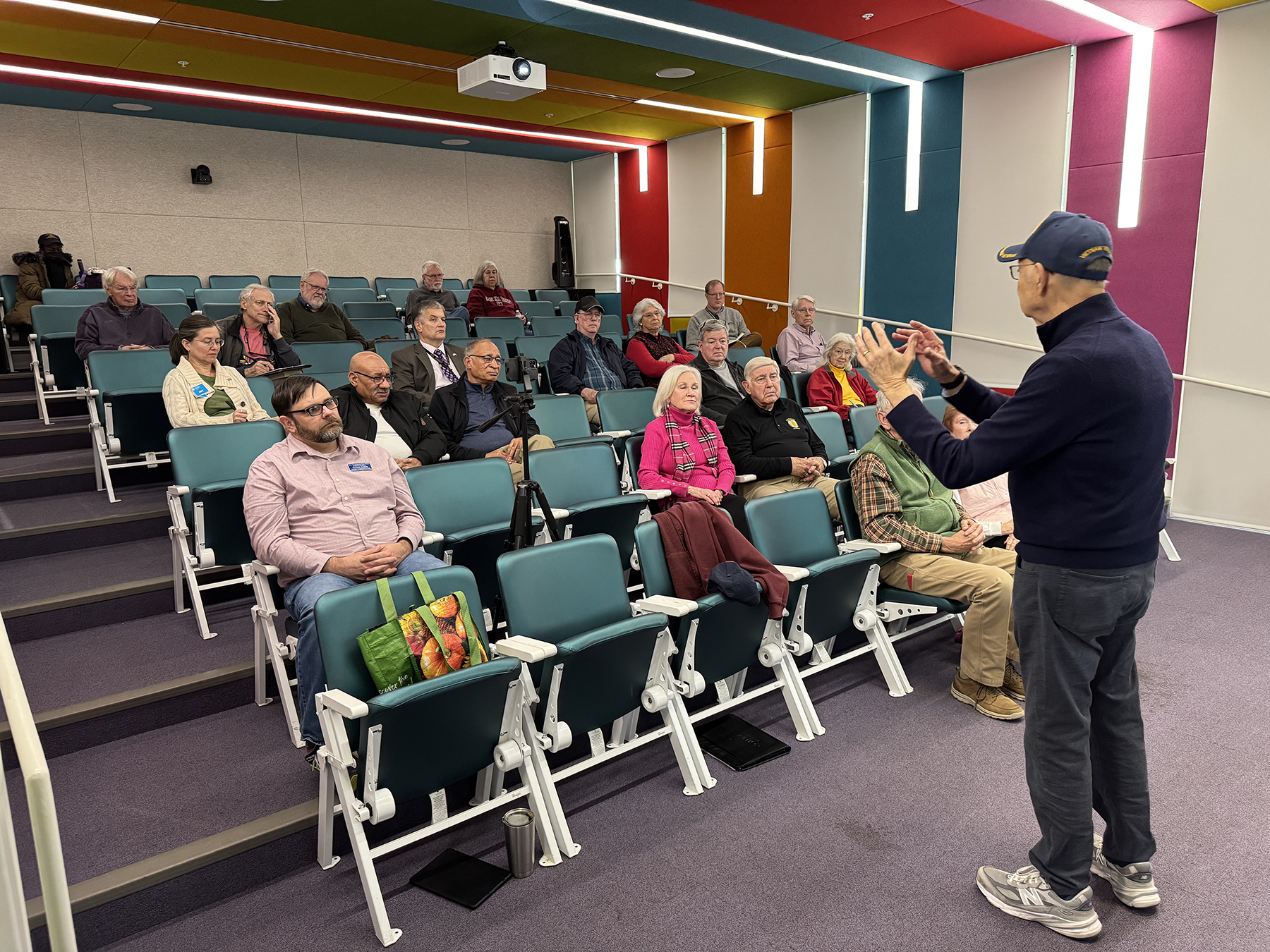
But that’s been an opportunity to reach out to the wider community, and Richland Library has generously let us use the Theater room at their main location, which is a fantastic venue for such programs. To simplify the transition, we relied at first on museum staff as speakers, but we’ve recently resumed our usual practice of having quest speakers from outside. There, we’ve presented such lectures as:

  • Joe Long, curator of education at the museum, on American POWs at the Hanoi Hilton, stressing prisoners with South Carolina connections. Video.
  • Joe again, talking about “The Unpronounceable Patriot,” Thaddeus Kosciuszko, and his SC involvement during the Revolutionary War.
  • On this past Veterans Day, Fritz Hamer, former curator of history at the Relic Room, spoke about the Battle of Ia Drang at that time of year in 1965. That’s the battle that the film “We Were Soldiers” was about. Video.
  • Joe again on “Wade Hampton’s Great Beefsteak Raid” in 1864, which may have been the biggest cattle-rustling episode in American history.
  • Moss Blachman (the first at the library with a guest speaker) on his experiences as an Air Force intelligence officer in Vietnam in 1965-66. This was a return engagement after a presentation Moss made at the museum last year. Video.

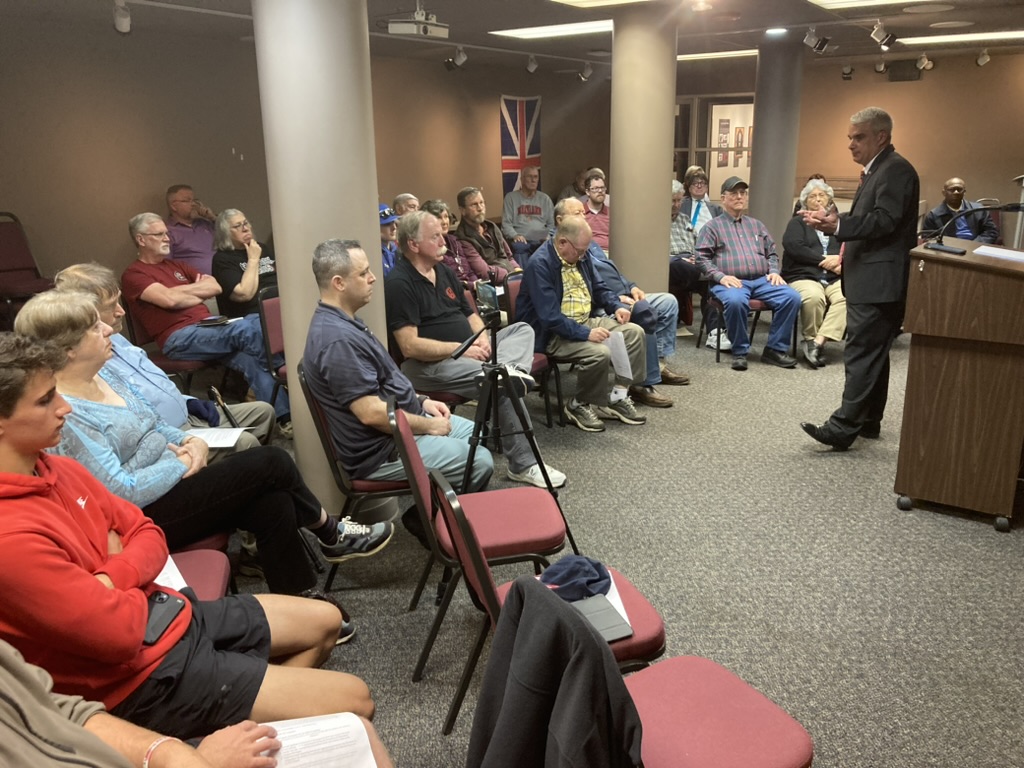
We’ve got another great guest speaker tomorrow at noon. Mike Burgess, who has in recent years been dubbed the best history teacher in the state more than once, will talk about the increasing difficulty of teaching the subject in public schools amid America’s roaring political battles over our past.

Mike addresses the subject quite fearlessly, as I can tell you based on the similar lecture he gave at the museum last year. And the past year, of course, has only made his job more difficult, as the Kulturkampf flames have been fanned ever higher.

Anyway, since his topic is the very nature of history itself, and why it is essential in a functioning republic, I figured this would be a good time to give y’all a heads-up on these programs. I assure you it will be an informative one.

We’ll continue to present such fascinating programs at Richland Library in the coming months, and perhaps even after we get the Education Room at the museum back. And in May, we’ll branch out further, with a couple of programs at the Cayce/West Columbia Branch of Lexington County Libary.

If you want to learn, as I have been doing, come on out. Oh, and we’ve started offering something extra the last few times — a free tour of the Relic Room itself, following the program. If you haven’t been to the museum before, you should definitely take advantage of that. I particularly urge you to check out the Vietnam exhibit in the Cistern Gallery (which is one reason so many of our recent programs have emphasized the experiences of South Carolina veterans in the conflict)….

Moss Blachman spoke at the library Feb. 14 about serving as an intelligence officer in Vietnam.

I am so abysmally ignorant

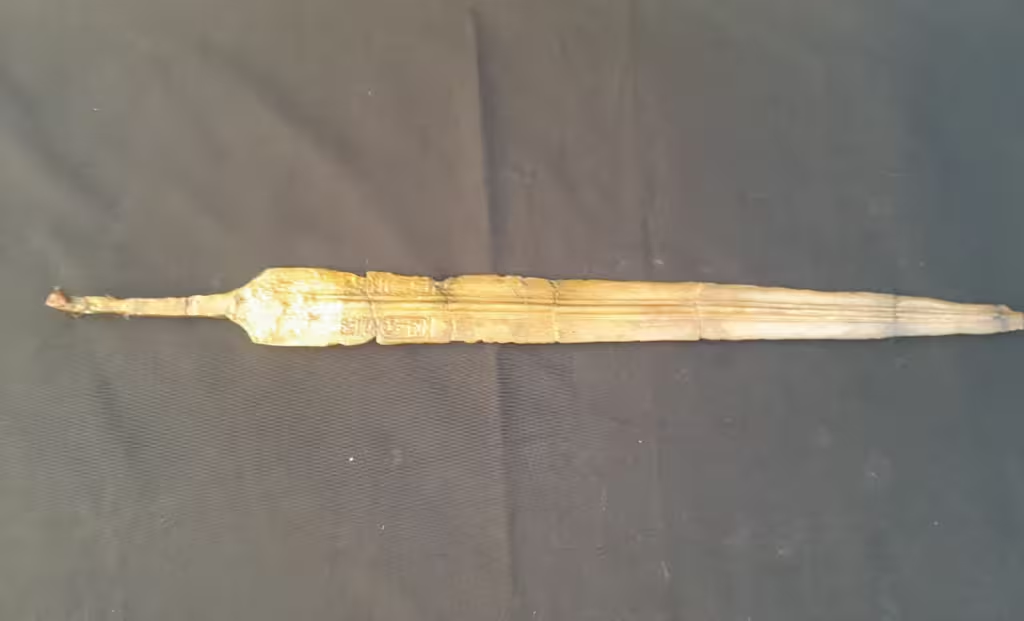
The Washington Post shared this, courtesy of the Egyptian Ministry of Tourism and Antiquities.

Would someone please give me a pile of money — that pile that Walter White gave to the Schwartzes should be enough — so I can support my family, but spend the rest of my life studying?

The thing is, I am so abysmally ignorant. I’m not talking about neo-Boolean math, or how to perform a bypass on a beating heart. I’m happy to leave those things to people who have devoted their lives to those areas. (And yes, I know someone right here in Columbia who can perform a bypass with the heart still beating. It leaves me in awe.) I’m thinking right now of something that has fascinated me, and drawn my energy and attention, for my whole life — history.

I’ve mentioned this a number of times, usually with regard to recent history. I constantly find that there are big, important things I don’t know about periods I’ve really concentrated on at various points — the early days of this young republic of ours, or even the Second World War.

But there are entire periods of history — things that had as much, or nearly as much, impact on the world as, say, the centuries of disorder in Europe after the collapse of Rome — about which I know nothing. Not just very little, but nothing.

And I’m not talking about ancient China, or anything that we westerners normally neglect. I’m talking about things that are fairly essential to understanding how Western civilization came about.

I’ve come to realize this more as my attention has drifted away from the headlines of the moment, and more to the overall sweep of human history. For instance, the lede story today in The Washington Post was about what polls say about the presidential election. Well, I didn’t read that. Y’all know how sick and tired I am of “journalists” trying vainly to predict the future — in great detail. They should devote their extremely limited resources to reporting and increasing understanding of what is happening and has happened, and if they are opinion writers, stick to trying to express what should happen, not what they think will happen…

But I don’t want to get off on that tangent. I want to talk about the story that did interest me — the one about that sword you see above. It’s pretty fascinating. An excerpt:

More than 3,000 years ago, a long bronze sword emblazoned with the insignia of Ancient Egypt’s Ramses II — the most powerful pharaoh of the era — was set down in a mud hut somewhere in the Nile Delta.

A team of archaeologists digging up an ancient fort in the area spotted the bronze blade and cleaned it, revealing this month they had found a shimmering blade with the intricacies of an ornamental cartouche — the personal emblem used by the pharoahs still visible. It had not lost its reflective shine under the layers of rust and grime accumulated over millennia….

My first thought was to send out a tweet with a wisecrack like “I suppose those swords weren’t much help with the Red Sea crashing down upon the pharoah’s troops.” Because Ramses II was the pharoah Moses dealt with. I figured that even people as ignorant as I am would get that.

But I didn’t do that. Because the next second, I thought, “Bronze? Was the Bronze age still going on at the point?” So I started looking things up, mostly on Wikipedia (criticize Wikipedia all you want, but if you’re looking for basics — when and where, and a rough idea of how this fits into the overall human saga — it can’t be beat).

And I found that the lengthy reign of Ramses II was at the tail end of the Bronze Age. Reading on, I learned that that period ended more dramatically than with a technological development (iron). You have to look more broadly at something called the Late Bronze Age Collapse:

The Late Bronze Age collapse was a time of widespread societal collapse during the 12th century BC associated with environmental changemass migration, and the destruction of cities. The collapse affected a large area of the Eastern Mediterranean (North Africa and Southeast Europe) and the Near East, in particular Egypteastern Libya, the Balkans, the AegeanAnatolia, and, to a lesser degree, the Caucasus

And I’m like, what the what? The next sentence confuses me more:

It was sudden, violent, and culturally disruptive for many Bronze Age civilizations, and it brought a sharp economic decline to regional powers, notably ushering in the Greek Dark Ages

Nope. I had no idea the Greeks — the West’s ultimate trendsetters — just couldn’t wait for the rest of Europe, and went ahead and had their own Dark Ages about 1,700 years earlier.

I mean, I sort of knew that the Greeks’ heyday was in the past by the time the Romans took the baton, but I hadn’t ever thought about how that decline happened.

(Of course, of course, of course, when you click on that Greek Dark Ages link above, you find that “Currently, the term Greek Dark Ages is being abandoned.” You know that had to happen, right? That’s what experts do. Somehow they sense I’m about to learn and maybe even to some extent understand something, and decide that they’ll start calling it something else.)

So how did this Late Bronze Age Collapse happen? Well, there were a bunch of causes, such as the Sea Peoples. And here we are again. I had never heard of these Sea Peoples. And yet they were a major thorn in the side of the established order.

So who were they? Well, there the record is pretty scarce, and the “experts” don’t know exactly. I find this a bit reassuring. They set themselves up as the authorities on the Sea Peoples, and don’t know much more than I do.

But at least they’d heard of them. I really, really need to find more time to study…

Where’s the time for it, though? Human life is so absurdly short…

‘Historic?’ More of a footnote, but pretty interesting…

Screenshot

From the bottom of page one of The Boston Globe today.

I dunno if it’s “historic,” though. That’s one of the more overused words we see in headlines these days, although not as overused as “iconic,” of course.

But it’s pretty fascinating. And nice work by the photog. Makes it looks like he’s magically changing uniforms in the middle of the same swing. Cool.

As history — well, it’s one for the record books, all right. But as history, it’s only maybe slightly bigger than Moonlight Graham’s major league career consisting of a brief appearance in one game in 1905. Which was interesting enough to appear in Ray Kinella’s book, and the movie based on it.

And I found today’s picture interesting enough to share…

How lieutenants and sergeants saved the day at Omaha

If you’re a newspaper editor, you know that if you don’t say something about major historical events on their anniversaries, you will catch hell from some readers. And good for those readers; ignorance of history is one of the many things wrong with our country.

I don’t have to worry about that these days, but I hate to let June 6 pass without an acknowledgement. Some would call that day in 1944 the pivotal point in the past century. To some extent, that’s just Western-centrism. The Russians were keeping the Germans pretty busy on the other end of the continent. In fact, many of the “Germans” on those bluffs defending Normandy were from Ost battalions — conscripts from Eastern Europe forced into their conquerer’s service. But even Stalin had impatiently waited and nagged us to open our Second Front, because he expecte it to make a monumental difference. And it did.

But even if you set aside the huge strategic significance, it was an impressive feat. To put 175,000 men on the beach in one day (at least that was the plan, I’ve seen different numbers as to how many did land, but the lowest I’ve seen is 133,000). I’m no great scholar of military history, but I don’t think there’s anything in the annals to match it. Anyway, there was plenty of hard fighting ahead after that day, but the Germans were basically on the retreat from then on.

So I certainly wanted to say something. But it seemed corny to put up yet another clip from Band of Brothers, as much as I love that show.

Then I saw a tweet from Richard M. Nixon (one of my favorite feeds on what’s left of Twitter), and was moved to answer it, so I thought I’d share it here:

What Ike was talking about was the fact that all that planning that he and so many others labored over for two years was essential to winning Normandy. But the effort would have failed on that first day — at least on the one beach, which would have had a terrible effect on the overall operation — if not for the fact that American junior officers and non-coms could think, and act, for themselves.

Once the action starts, you can ball up the plan and toss it. Because not only does the enemy get a say in what happens from that point, but you have an uncountable number of other unpredictable factors that change the situation radically from moment to moment. You have to deal with those, not the events you had anticipated.

At Omaha, especially on Easy Red Sector, the defenses were just too strong for the plan. All those guns, presighted upon every square inch of sand. By midmorning, the landing was a shambles, our men were either lying dead at the water’s edge or cowering and confused behind any bit of cover they could find.

Out on the cruiser USS Augusta, Gen. Omar Bradley watched and listened in horror as the reports came in: “disaster,” he heard, along with “terrible casualties” and “chaos.” He began to consider, privately, withdrawal. But that would have been impractical, and perhaps impossible. “I agonized over the withdrawal decision, praying that our men could hang on,” he would later say.

The guys on the beach were stuck there, with death and confusion all around them. They knew their only way out was forward, and the lower-ranking leaders started giving commands based not on any plan, but on what they were facing. And their men got up and followed. A few at a time at first, they got off the beach and triumphed.

You can draw all the lessons you’d like about American initiative and ingenuity, and there would be a lot to that. American infantry troops are trained to think, and improvise as necessary. Not all armies train that way. And obviously, flexibility and initiative are not words you think of to describe Ost defenders standing at their guns with German sergeants pointing pistols at their heads to ensure they stayed at those posts and kept firing.

So “Nixon” was right in his tweet. And so was his old boss Dwight Eisenhower, all those years before…

And He did it with no mass (or social) communication

If you’d come today
You could have reached a whole nation
Israel in 4 BC
Had no mass communication…

— Jesus Christ Superstar

After persusing the various papers I subscribe to this morning, and finding little to engage my interest, I turned to my daily (well, most days) Bible readings for the day, and this was in the Gospel:

“If I testify on my own behalf, my testimony is not true.
But there is another who testifies on my behalf,
and I know that the testimony he gives on my behalf is true.
You sent emissaries to John, and he testified to the truth.
I do not accept human testimony,
but I say this so that you may be saved.
He was a burning and shining lamp,
and for a while you were content to rejoice in his light.
But I have testimony greater than John’s….

And it occurred to me that it would be great to know a lot more than we do about John the Baptist. We know he was this highly countercultural dude who lived in the wilderness and wore camel fur and ate locusts and honey. And he baptized people, most famously Jesus himself. And he came to a horrible end on this Earth.

But that isn’t enough to fully explain how big a deal he was in his day. Or apparently was, anyway. To a lot of people who lived in that place and time, it seems like he was even a bigger deal than Jesus for awhile. I infer that from the fact that so often in the New Testament, Jesus is explained to people in terms of his relationship to John. There seems to be an assumption at times that the writer of the Gospel or epistle knows people knew about John, and uses him as a launching point. For instance, The Gospel of Mark starts with John.

It would be great to be able to read a biography of John that’s as in-depth and detailed as a modern book such as Ron Chernow’s Alexander Hamilton, or David McCullogh’s John Adams, or Edmund Morris’ Theodore Rex. And then go from there to fully grasping the foundation of Christianity.

But we can’t. The sources just don’t exist. And not just about John, but about any historical figure from before, say, Gutenberg came along. In fact, we should be grateful that we have more info on John that we do a lot of the more obscure Roman emperors.

Still, to a modern person, it’s frustrating. So we can all dig Judas’ complaint in “Superstar,” about Israel in 4 B.C. having no mass communication. Or even a printing press.

But you know what? That’s what makes Jesus more impressive. You don’t have to be a believer to grasp how awesome his achievement was. This rabbi from the boondocks took a local religion that was only embraced by this one tribe on the borders of an ancient empire, and made it into the dominant faith of the world (yes, Islam is big, but…). And he did it with word of mouth, for the first generation. That, and a few letters written by others.

Which, to me, is exactly the way God would do it. It’s more impressive (and certainly more dignified) than building a rep on “American Idol” and inspiring a billion tweets.

It’s sort of like the way I view evolution. I shake my head at all the arguments between creationists and Darwinists. Of COURSE evolution (and geology and cosmology and all that other stuff) is the way God would make the world. The abracadabra opening of Genesis is a great way to tell an allegory, but come on, people. Look at the sheer, gradual majesty of doing it through subtle changes over billions of years.

Anyway, that’s what I was thinking while doing today’s readings…

St. John the Baptist Preaching, c. 1665, by Mattia Preti

December 6: Any Martin Cruz Smith fans out there?

Pearl Harbor on Dec. 6, 1941. Found this on the East Tennessee Veterans Honor Guard FB page.

Call this a sneak attack, coming on the eve of the date that will live in infamy.

I just had to write down today’s date for some reason, and it got me to thinking about Martin Cruz Smith. Well, specifically, one of his less-known novels, December 6. You ever read it? Here’s a synopsis from Wikipedia:

In late 1941, Harry Niles owns a bar for American and European expatriates, journalists, and diplomats, in Tokyo’s entertainment district, called the “Happy Paris”. With only 24 hours until Japanese fighters and bombers attack Pearl Harbor, Niles has to consult with the local US ambassador, break up with a desperate lover, evade the police, escape the vengeance of an aggrieved samurai officer and leave the island, the exit points from which are all closed. Having grown up in Tokyo, Niles is fluent in the Japanese language and culture, and is highly streetwise.[2][3]
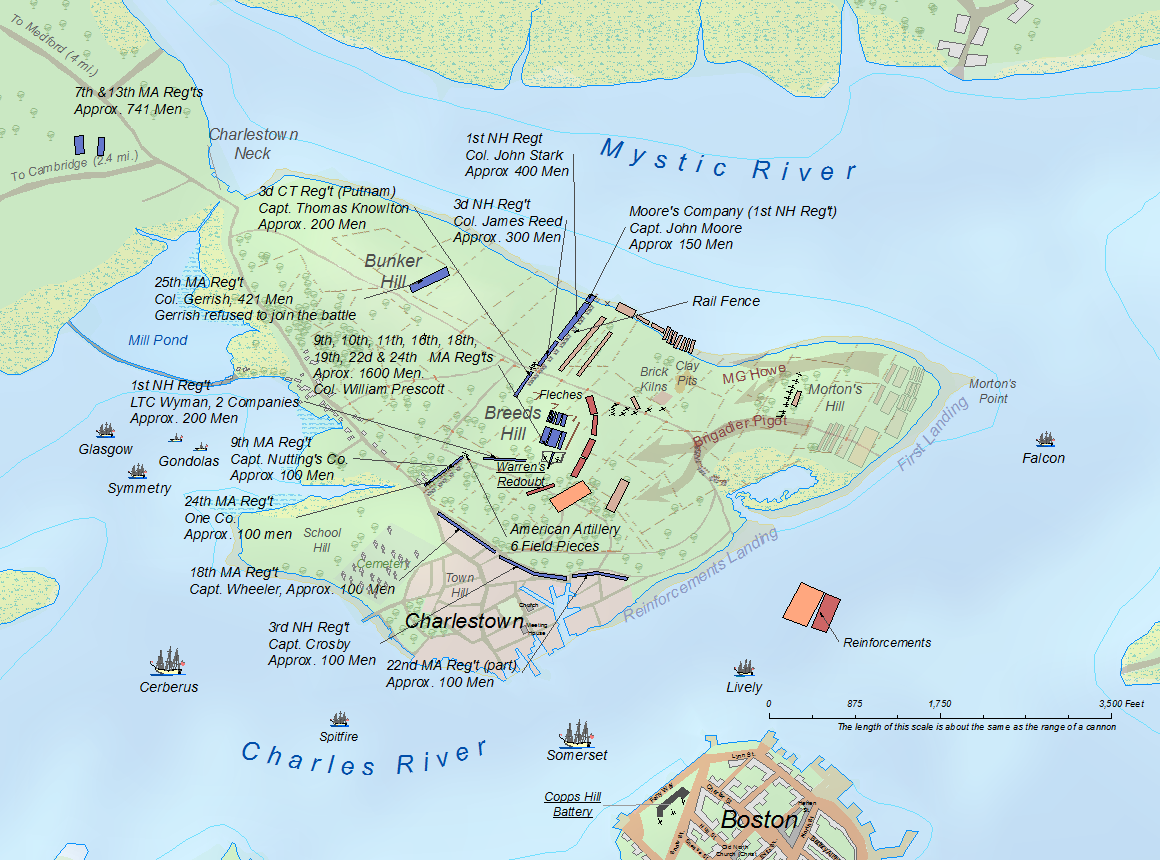
In other words, he’s streetwise for a gaijin, which is a word that comes up frequently in the book as Japanese folk interact with him. But it’s been awhile since I read it. I’ve never reread it as often as I have Rose and some of his Arkady Renko stories, especially Red Square. Although the one that pulled me and so many others toward his work was his amazingly brilliant first Renko story, Gorky Park.

So — are any of y’all fans? I’d like to have a discussion about his stuff sometime. The dude can tell a story. His characters are a bit repetitive — it’s like the same people crop up in both 1870s Lancashire and 1980s Russia — but he makes it work. It’s actually kind of fun to see a familiar character, just with a different name, show up in an entirely different situation…