Category Archives: Working

Bad news, good news about newspapers

I learned yesterday that one of America’s great cities will no longer have a daily newspaper in the unkindest way, courtesy of my favorite celebrity Twitter follower, Adam Baldwin:

Adam Baldwin Adam Baldwin
@adamsbaldwin

Buggy-Whipped?! | RT @carr2n “Times-Picayune facing deep layoffs, may cut back from daily publication.” – http://nyti.ms/Jsib87

He jests at scars that never felt a wound. How would ol’ Jayne Cobb feel if the financial underpinnings of movies and TV suddenly collapsed? (Hey, don’t say it could never happen. Have you heard about Autohop? Remember, newspapers didn’t start dying because people didn’t want news; it was the ads drying up.)

That newspapers are having to cut back isn’t new (especially not to me), although nothing quite like this has happened before in a major city, so it’s a milestone (and the same company is doing the same with its papers in several other cities, including Birmingham). But my sadness is for the city as well. I lived in New Orleans almost as long as anywhere else growing up — I went to school there for two years (7th and 8th grades) instead of the usual one — and news like this makes it feel like the city itself is dying, with a vital spark fading:

The latest to go to three days a week: The storied New Orleans Times-Picayune, one of America’s oldest papers, which announced Thursday that it plans to limit its print schedule — beginning this fall — to Wednesday, Friday and Sunday editions. It will maintain 24/7 online reporting via its site, Nola.com.

This is a tactical trend for New York-based Advance Publications, which owns the Times-Picayune, as it pushes toward a limited print-digital model. Advance said Thursday that in addition to the Times-Picayune, it will also cut back the print frequency of its three papers in Birmingham, Mobile and Huntsville, Ala., to three days….

First Katrina, now this.

But enough bad news. We have some startlingly good news from closer to home: Warren Buffett is investing in newspapers. Including in South Carolina.

You may have seen that news last week. I was sufficiently surprised that I didn’t know what to make of it, and haven’t commented yet. But I have a new news peg: Buffett has written a letter to his editors and publishers, communicating his thinking in making this move. It’s a bracingly confident message:

Until recently, Berkshire has owned only one daily newspaper, The Buffalo News, purchased in 1977. In a month or so, we will own 26 dailies.

I’ve loved newspapers all of my life — and always will. My dad, when attending the University of Nebraska, was editor of The Daily Nebraskan. (I have copies of the papers he edited in 1924.) He met my mother when she applied for a job as a reporter at the paper. Her father owned a small paper in West Point, Nebraska and my mother worked at various jobs at the paper in her teens, even mastering the operation of a linotype machine. From as early as I can remember, my two sisters and I devoured the contents of the World-Herald that my father brought home every night.

In Washington, DC, I delivered about 500,000 papers over a four-year period for the Post, Times-Herald and Evening Star. While in college at Lincoln, I worked fifteen hours a week in country circulation for the Lincoln Journal (earning all of 75? an hour). Today, I read five newspapers daily. Call me an addict.

Berkshire buys for keeps. Our only exception to permanent ownership is when a business faces unending losses, a remote prospect for virtually all of our dailies. So let me express a few thoughts about what lies ahead as we join forces.

Though the economics of the business have drastically changed since our purchase of The Buffalo News, I believe newspapers that intensively cover their communities will have a good future. It’s your job to make your paper indispensable to anyone who cares about what is going on in your city or town.

That will mean both maintaining your news hole — a newspaper that reduces its coverage of the news important to its community is certain to reduce its readership as well and thoroughly covering all aspects of area life, particularly local sports. No one has ever stopped reading when half-way through a story that was about them or their neighbors…

So… if we are to take Mr. Buffett at his word, this isn’t some bid to rack up losses for tax reasons, or any other convoluted strategy. He actually believes this is a good investment. And he’s not known for being wrong about such things.

Back when I was first laid off, the executive editor position at the Florence paper was open. But I didn’t apply for the job — a combination of wanting to stay where my grandchildren are, and a reluctance to jump back into a dying industry, having done more than my share of laying-off and cutting back in the last few years.

But had the opening occurred under these circumstances — with new ownership, and that owner being Warren Buffett, and he bullish on newspapers — I might have looked at it differently.

Organized labor hits back — again and again…

Still have a lack of details regarding this video clip (which won’t let me embed it, so you have to follow the link). I don’t consider the text explanations one gets from YouTube as the most helpful or authoritative, but so far that’s all I have to go on here:

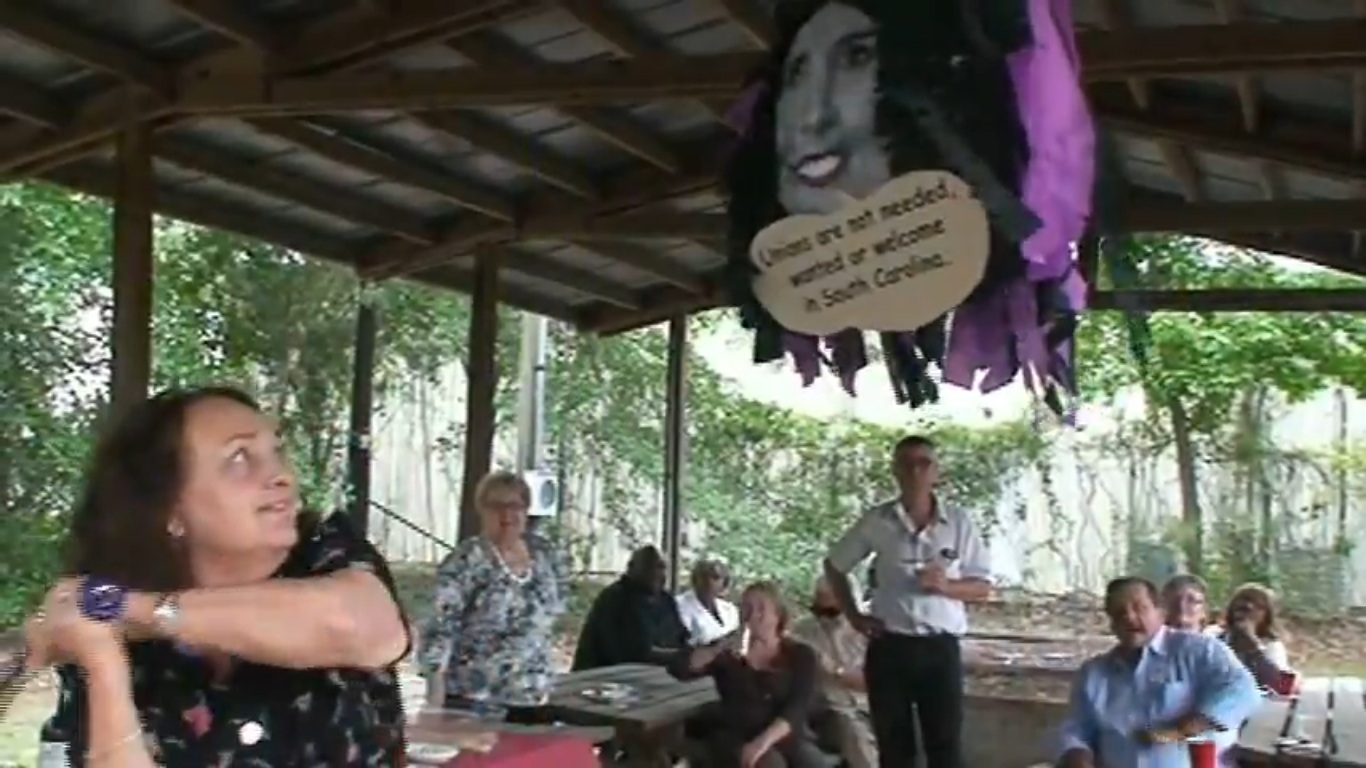
Gov. Nikki Haley has been vicious to organized labor, saying in her State of the State address that “unions are not needed, wanted or welcome in South Carolina.” After years of being treated like a union thug, Donna Dewitt gets sweet revenge at a retirement reception in her honor.

I just want to go on the record as saying, right here and now, that I do not believe that Nikki Haley should be bludgeoned with a baseball bat. Even symbolically.

Did anyone at this event go, “Umm… wait a minute…” and think it was excessive? Was anyone creeped out? One hopes so. But one doesn’t know…

The key quote: “Wait ’till her face comes around, and WHACK her… Give her another whack! Hit her again!

Yep. We’ve sunk pretty low, folks.

This was brought to my attention by Bryan Caskey, who got it from CNN’s Peter Hamby:

South Carolina labor official beats a Nikki Haley pinata with a baseball bat —http://bit.ly/KQ70py

Of COURSE state primaries should be in August

Exaggerating as so many readers do, Rusty DePass (who probably agrees with editors far more often than he thinks) expressed shocked pleasure that he actually agreed with something in an editorial in The State on Sunday.

He was referring to this passage in an edit about the issue of all those candidates disqualified from running in the June primaries:

The Legislature has to fix this problem.

That won’t be easy, but it must be done. And with the primaries just five weeks away, it must be done immediately. It would be difficult to keep the elections on schedule even if every member of the Legislature agreed to a solution. That won’t happen, so part of the solution needs to be delaying the primaries, which we shouldn’t hold until August to begin with…

I assured Rusty that advocating August primaries is a long-standing position of the editorial board. It certainly is of mine.

And it is of Rusty’s. Rusty takes credit for the one time state primaries were held at a rational time in all the years since I moved home to South Carolina — 1992, when a lawsuit over reapportionment delayed the vote.

Rusty tells the story this way: As head of the state election commission (or was the past chairman at this point? I forget now), he wrote to the judge in the remap case asking that the primaries be delayed on account of the legal action. He recalls with satisfaction that all the lawyers he knew were shocked and appalled that he would so address such a view to the judge in the midst of a lawsuit. But the judge read the letter aloud from the bench and said, that’s just what we’ll do.

I had forgotten that part of the story, but I remember how gratifying it was to have the primaries thus separated from the legislative session for once.

Even back when we had loads of reporters and other resources, June primaries were extremely difficult for the newspaper — and other news organizations — to cover adequately. The people who covered legislative and other state elections were the very same people who covered the Legislature. The legislative session didn’t end until the first week in June, and didn’t really, really end until the sine die return session a couple of weeks later.

That lack of coverage, of course, benefited incumbents enormously, because there were fewer opportunities for lesser-known challengers to get their names in the paper. And name recognition is a huge part of the battle.

But the timing benefits incumbents in other, more direct, ways. The reason reporters are so extremely busy in those last weeks of the legislative session is because that’s when almost everything of consequence in the session happens. And those weeks happen to be after the filing deadline for the primaries.

So it is impossible for anyone to decide to run against an incumbent (except as that long shot of long shots, a write-in) on the basis of how that incumbent votes on the most important votes of the session. Aside from the fact that even if the challenger had already filed, he or she will get little coverage.

It’s an absolutely ridiculous problem, which would be completely fixed by always holding the primaries in August, as some other states do (including Tennessee, the “other state” whose politics I have the most experience with).

‘Thriving’ isn’t the word that comes to mind

Some people yell at the TV. I yell at press releases. Today I got this one, from a guy named Justin Lehmann:

It’s no secret that newspapers are having their clocks cleaned by digital, and now mobile, media in the past several years. But one form of newspaper content has not only survived, it’s thriving, and tomorrow is its anniversary: the editorial cartoon. On May 9, 1754, John Adams published the first editorial cartoon in the US in his Pennsylvania Gazette, the now infamous ‘Join or Die’ graphic. John Adam’s cartoon editorialized a political revolution. I would like to share with you a crop of cartoons that editorialize an IT revolution — the consumerization of IT — which has made managing a datacenter more ridiculous than ever. https://docs.google.com/open?id=0B3405IoeanmfODM5ZGY4ZWMtMThjMy00OTA3LWFlOTItNDRjMWU2ZWNkMDA5 Feel free to use the cartoons if you choose to write anything about the anniversary. They’re royalty free with this CC license: CA Technologies’ CHIEF & CHUCK is licensed under a Creative Commons Attribution-NoDerivs 3.0 Unported License. Based on a work at http://www.ca.com/cdit. Thanks!

As soon as I saw it, I shot back,

Thriving? You’re kidding, right? Every friend I have who was an editorial cartoonist has been laid off in recent years — Robert Ariail of The State (I, the editorial page editor, was laid off the same day). Richard Crowson of The Wichita Eagle. Bill Day of The Commercial Appeal in Memphis.

Yeah, I realize there are a few who still have jobs, but since every one that I knew personally is gone, it’s a bit hard to accept your “thriving” characterization…

Then, glancing at the release again, I added,

Oh, and by the way. It was Benjamin Franklin, not John Adams…

You know, the founder who was actually a newspaperman. As opposed to the lawyer. I have to say that Mr. Lehmann took it well, responding:

Damn. Game, set, and match.

I want to bite that hand so badly

Anybody see “Mad Men” this week?

If so, what do you think?

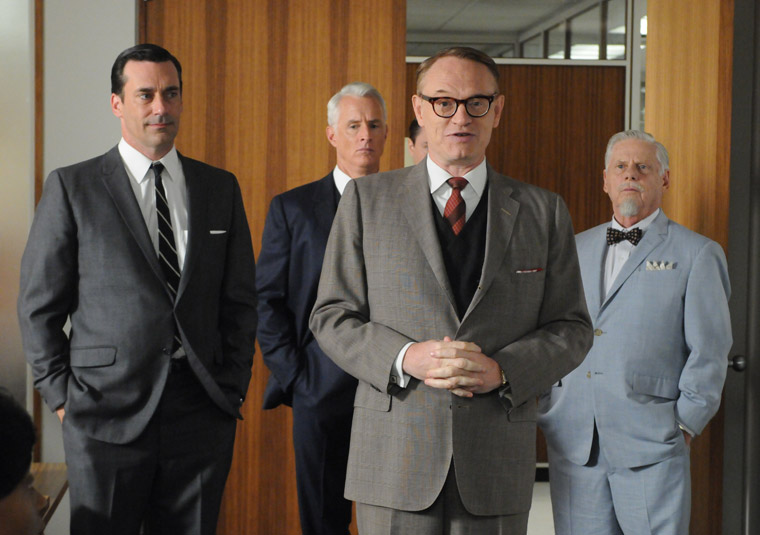
Is it all over for Sterling Cooper Draper Pryce?

The firm has had enough trouble clawing its way back, and now this…

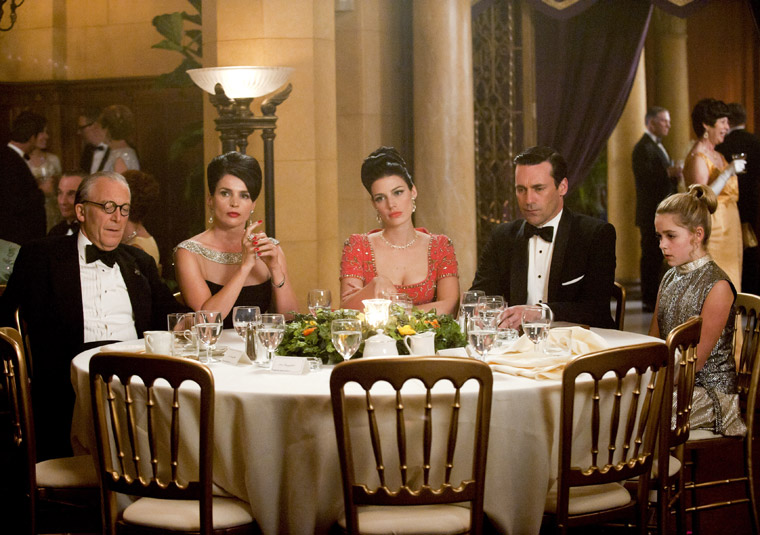
Don Draper, who created a sensation last season by biting the hand that fed his agency — Lucky Strike — with an anti-tobacco letter published in the NYT, seems to have been vindicated. He’s to get an award for taking a courageous stand, and captains of industry will be there to see him get it. Roger Sterling goes along to the banquet and is happy as a clam passing out his business cards in that target-rich environment. (By the way, I’m sort of the Roger Sterling at ADCO, because that’s the sort of thing I do. Fortunately, dropping acid is optional.)

But then, in a calculatingly offhand manner, the guy from Dow Corning confides to Don that sure, all those people will give him awards, but none of them will ever work with him, because his letter demonstrated that no client could ever trust him. And then asks him if he’d like another drink. Yes, as it turns out.

The episode ends with Draper sitting back at his table at the banquet looking like he just got hit by a stun gun. (Everyone else at the table looks the same way, for differing reasons.)

So was the guy from Dow just blowing smoke? Was he just saying Dow will never work with SCDP? Or was he delivering a message on behalf of the other fat cats? Or was he just speculating? And will Don share what he’s learned with his partners (I’m guessing not)? Or will Roger, his mind having been expanded, figure it out?

I don’t know, but I wish I could have found a clip of my favorite line of the episode. It’s when Roger shares yet another “brilliant” insight with Don, and Don tells him that even some people who have not experienced LSD know that…

Great to see my old friend Michael Mercer!

An old friend sent me the above video. When I got home last night, I asked my wife to watch it without telling her why. She looked at it only a second before saying “Michael!”

Yep. The guy playing the “English teacher” at the beginning is Michael Mercer. Michael and I started out as copy editors together at The Jackson (TN) Sun in 1975, soon after I graduated from Memphis State. Michael got out of the business long before I did, taking a teaching gig at Auburn. Now he’s at another college in San Antonio, as he explained when I asked about the video:

The young lady featured in the film is one of my student-advisees at the University of the Incarnate Word in San Antonio. She’s a communication arts major concentrating in journalism — although broadcast like most of them do today. She asked me at the last minute to be in the video that she and the filmmaker — her boyfriend from another school in San Antonio — were doing for a video contest promoting San Antonio park recreation.

They didn’t win the contest but I thought they, too, did an excellent job. I was only familiar with the classroom scene where they asked me to  mouth a few words as an “English teacher.” Those other students in the video in the classroom are UIW students but not any of mine. We spent about an hour shooting various takes, angles, short bites. I was told it would only take about five minutes. Then a week later, my student asked me to wear the same shirt and pants for a scene they wanted to shoot minus the class in that same classroom showing me walking out the door after that “chill” comment.

No, most of my South Carolina readers won’t know Michael, but some of our former colleagues will see this, which is why I share it here. The fact that I can do so so easily — the fact that a student could even produce something like this — is testament to how the world has changed since Michael and I started out.

In those days, the copy desk was still a big horseshoe (or “elephant’s commode,” as one of my Tennessee colleagues referred to it), with the slot man (or woman) sitting in the center, distributing copy to those on the rim who would edit it and write headlines as assigned by the slot. The copy and headlines would then be passed back to the slot for checking before being sent to the composing room. Except that the editing wasn’t done on paper at this point. The text had been scanned and output onto a paper punchtape, which was clipped to the hard copy with a clothespin (without clothespins, we couldn’t have gotten the paper out). After an editor received the copy with attached tape from the slot, he or she would take it over to a Harris 1100 editing machine, and feed the punch tape into it. The copy would appear on a CRT screen, and the editor would use a keyboard to edit it. When done, the edited text would be output to another punch tape of a different color, which the editor would roll up the tape (using a little electrical device that was sort of like one of those handheld, flashlight-sized fans) and clip it back to the copy. That bundle is what the editor would pass back to the slot, along with a headline written in pencil on a hand-torn strip of paper.

A couple of months after I joined The Sun, I was pulling shifts in the slot, and I found I liked it so much that by the time I moved on from the desk, I was doing it most days. The job entailed what would have been three to five jobs at a paper the size of The State in those days. The slot not only supervised the editing process, but laid out the entire A section, monitored the wires and selected all wire copy, and oversaw the production process in the composing room. If a page was late, it was the slot’s fault. And in those days, things were so loose and informal at The Sun that an assertive slot (which, I confess, I was) could pretty much decide how all of the news in the paper was played, including local copy.

The day started at 5:30 a.m., and the whole first edition (which was more pages than you find today in The State) had to be out at 11. Then we’d grab a quick lunch before having the city edition out by 1:30.

Doing that job at the age of 22 gave me a lot of confidence that stood me in good stead in the years to come. And it gave me a taste for calling the shots. Which is why after that gig, I only spent a couple of years as a reporter before becoming a supervising editor. You can learn a lot by starting out in a small pond.

Michael followed a similar path, without being quite as power-mad as I was (you can probably tell in his brief appearance that Michael is a nicer guy than I am — which I’m betting is why he was cast in this film; I’m sure he’s the sort of teacher who might be students’ favorite). He was one of my assistant editors over the news reporters at The Sun in later years.

And now there he is, playing the “English teacher.”

I still don’t understand how ANYONE was fooled by John Edwards, at any point in time

Here is an explanation by one accomplished professional (Walter Shapiro) who was completely taken in. Excerpts:

About three weeks after Sept. 11, 2001, my wife, Meryl Gordon, and I had an off-the-record dinner with John and Elizabeth Edwards at the Washington restaurant Olives. The dinner was at the blurry intersection of Washington life—ostensibly social (Meryl had bonded with Elizabeth after writing an Elle magazine profile of her husband in 2001) but at its core professional (I was a columnist for USA Today and Edwards had White House dreams). Everyone was in a shell-shocked daze after the terrorist attacks, but my only clear memory of that dinner was Edwards’ palpable dislike for John Kerry, an obvious rival for the 2004 Democratic presidential nomination.

That was the beginning of a political-journalistic courtship that now makes me cringe. With Edwards on trial in North Carolina on charges of violating federal campaign-finance laws—after the disgrace of being caught with a mistress and denying being the father of her baby—I wish I had befriended a comparatively more honorable political figure like Eliot Spitzer or Mark Sanford…

In hindsight, I feel like the jaded city slicker, bristling with self-confidence that he can never be fooled, who ends up hoodwinked by the smiling rural Southern confidence man. Please understand: I did not deliberately put a thumb on the scale when I wrote about Edwards. It was more that I was convinced by Edwards’ sincerity when he talked passionately about poverty and the Two Americas. And I especially believed (because I spent so much time with Elizabeth) the romantic myth of the Edwards marriage.

Many Edwards insiders from the 2004 campaign say the vice-presidential nomination (bestowed by, yes, John Kerry) changed him. The entourage, the plane, the Secret Service detail and the frenzy of a fall campaign all supposedly fueled Edwards’ self-importance and sense of entitlement. But as I struggle to understand my own entanglement with a scandal-scarred presidential contender, I wonder if this arbitrary division between pre-veep Edwards and post-veep Edwards is too glib.

The danger signs and character flaws were always there, and I failed to notice them. I was certainly not alone in my blindness. David Axelrod, for example, was Edwards’ first media consultant during the 2004 primary campaign. Even after Axelrod drifted away to concentrate on a long-shot Senate race for a candidate named Barack Obama in Illinois, he returned for Edwards’ last stand in the Wisconsin primary. I recall running into Axelrod in the Pfister Hotel in Milwaukee on primary day and hearing him say of Edwards, “He’ll be president someday.”…

Yes, the “danger signs and character flaws WERE always there,” and they stuck out a mile. While I hadn’t reached the point of completely dismissing him in print as a phony, you can see my uneasiness with him in this column from 2003:

… There are few things more unbecoming than a millionaire trial lawyer presenting himself to a crowd as the ultimate populist. Huey Long could pull it off; he had the common touch. So did George Wallace. But John Edwards is one of those “sleek-headed” men that Shakespeare wrote of in “Julius Caesar.” He may be lean, but he hath not the hungry look. Mr. Edwards is decidedly lacking in rough edges. Not even age can stick to him.
His entrance was predictably corny. Other speakers had unobtrusively climbed the back steps onto the platform. Mr. Edwards snuck around to the back of the crowd, then leaped out of his hiding place with a huge grin and his hand out, looking for all the world like he was surprised to find himself among all these supporters. He hand-shook his way through the audience to the podium, a la Bill Clinton , thereby signifying that he comes “from the people.” Watch for that shot in upcoming TV commercials.
His speech was laced with populist non-sequiturs. For instance, he went way over the top exhibiting his incredulity at Bush’s “jobless recovery,” chuckling with his audience at such an oxymoron – as though the current administration had invented the term. (A computer scan found the phrase 641 times in major news sources during calendar year 1993 ; so much for novelty.)…

(The point of the column was to say that some protesters who were there to picket Edwards were even worse than he was. But first I had to establish what I’d thought of him. This incident formed part of my better-known “phony” column in 2007, in which I particularly concentrated on a detail I had not used in this piece — because it involved such a subjective impression that I didn’t have the confidence to attach importance to it until I’d had more experience with him.)

I’m not smug for having been put off, from the first time I saw him in person, by what seems to have taken in others. I’m just surprised that they didn’t see it, too.

Turns out America likes Edwards less than I do

If y’all will recall, I experienced an unexpected, and not entirely pleasant, moment in the national spotlight back in 2007 when I wrote a column headlined, “Why I see John Edwards as a big phony.”

I caught a lot of heat about it at the time. I later had the gratification of having many people tell me I’d been right all along, even though what was learned about him later was somewhat different from what I was accusing him of. Nevertheless, all of it spoke to his general failure to be what he represented himself to be.

But even I, who first started raising questions about the guy in 2003, was slightly started to read this this morning, as Edwards’ trial started:

(CBS News) With opening arguments in the trial of former U.S. senator and presidential candidate John Edwards set to begin on on Monday, a CBS News/New York Times poll shows that public opinion of him has plummeted since he was a candidate for the Democratic presidential nomination in 2007. Now, he is now most known for cheating on his wife.

The CBS/NYT poll reveals that only 3 percent of those polled hold a favorable view of Edwards, who has been charged with misusing campaign funds. That is down from 30 percent in 2007 when he was running for the Democratic nomination, which is also the last time the question was asked among registered voters.

Since 2007, Edwards’ unfavorable ratings have risen eleven points, from 30 percent to 41 percent today. However, half of those polled are undecided or don’t have an opinion of Edwards.

Women, however, especially dislike Edwards, with just 2 percent holding a favorable view of him compared to 45 percent who view him unfavorably…

And who can blame them?

But 2 percent? It almost makes me feel sorry for the guy. Almost.

I’m a lumberjack, and I’m OK (or not)…

A friend points out to me that “newspaper reporter” is now listed as one of the five worst jobs to have. Right down there with lumberjack. Here’s the CNN Headline News report:

On the heels of a report indicating good job prospects for the college class of 2012, career guidance website CareerCast released its list of the best and worst jobs of the year, and after reviewing 200 professions across a wide range of industries.

The five “best” jobs are software engineer, actuary, human resources manager, dental hygienist and financial planner. The top five “worst” jobs are lumberjack, dairy farmer, enlisted military soldier, oil rig worker and newspaper reporter.

So what makes a job among the best or the worst? CareerCast based the rankings on a methodology that rated each profession’s work environment by assessing both the physical and emotional demands, including: necessary energy, physical demands (crawling, stooping), work conditions (toxic fumes, noise), degree of competitiveness, degree of hazards personally faced and degree of contact with the public. Each category was broken into elements and then each element was given points. In the end, a higher point total made a job less desirable, while a lower total indicated a job was more desirable….

I’m not sure whether that was supposed to make me feel good or bad. Actually, it’s sort of irrelevant, since I haven’t been a reporter since the early months of 1980. But I can tell you that being a newspaper editor is not what it once was, if you can even find such a job.

Which of course is the problem. The main thing wrong with being a newspaper anything is that if that’s what you do, it probably won’t be long before you join the ranks of those who used to do it.

Beyond that, I’m suspicious of the criteria used in compiling this list. Lumberjack? Obviously they’re not taking into account such factors as leaping from tree to tree as they float down the mighty rivers of British Columbia… the giant redwood, the larch, the fir, the mighty Scotch pine… the smell of fresh-cut timber… the crash of mighty trees… with my best girly by my side…

Why does Nikki Haley want to unionize SC school bus drivers?

Here’s one of the things that puzzles me about Nikki Haley. To hear her talk sometimes, you’d get the idea that unions are a bad thing.

And yet she keeps pushing and pushing and pushing to unionize the drivers who operate public school buses in South Carolina.

Oh, you didn’t know that? Well, she calls it something different. She calls it “privatizing” school buses.

But what’s the first thing that happens whenever a private entity takes over the school buses in a South Carolina district? The Teamsters (and folks, if unions are bad, you’d think Jimmy Hoffa‘s old outfit would be superbad) come in right behind it.

How do we know this? Experience. There are three districts in South Carolina where the buses are no longer operated by the state. Let’s run down the list, shall we?

  1. Charleston — the drivers are represented by the Teamsters.
  2. Beaufort — the drivers are also Teamsters.
  3. Dorchester 2 — As of Friday the 13th, Teamsters Local 509 is celebrating having won the right to represent bus drivers.

So thanks to Nikki Haley and her ilk, the Teamsters are batting 1.000 in South Carolina.

I don’t know why she keeps pushing this privatization thing, given this apparently inevitable result. Maybe the answer is in her book. If anyone out there actually reads it, let us know.

All irony aside, this is yet another example of what you get when you are governed by people who do not have a clue how the world actually works.

What Nikki’s privatization scheme does is provide a back-door way to unionize public employees — just make them private employees. Neat, huh?

Were any of these “members” female?

Note how self-restrained I am. I held myself back from using as my headline, “I got your ‘member’ right here!” Even though that would have better expressed my exasperation.

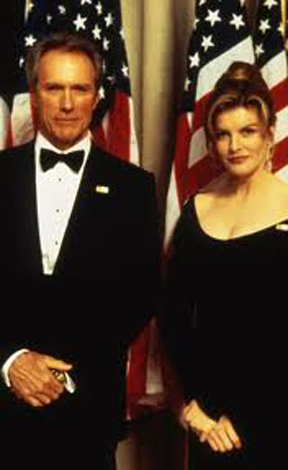
Clint Eastwood and Rene Russo as Secret Service 'members' in 'In the Line of Fire.'

We used to have “servicemen” in our armed forces. Or, more broadly, military personnel. Now, we have this horrendous construction that drives me nuts every time I hear it: “military members.” That’s the best we seem to be able to come up with as a way of referring generically to soldiers, sailors, marines, and that least ideologically correct of all designations, airmen.

What are we saying? That the military is a club? Like belonging to Rotary, or the Elks? To me, it sounds vaguely insulting to those who serve us in uniform, to refer to them as “members.” Like fingers or toes, or perhaps some even less presentable member.

With the scandal over the weekend involving both Secret Service and military personnel, this linguistic absurdity has been taken to new depths.

To begin with, one assumes that all the agents sent home for consorting with prostitutes were male. And if you read non-American news sources such as Agence France-Presse or the Daily Mail, they go ahead and refer to them as male. That’s because in those countries, the fact that men tend to do certain things that women tend not to do (such as, bring hookers to their rooms) is confronted somewhat more directly, and not treated like a secret of which we must not speak. (Someone is inevitably going  to contradict me by pointing to U.S. sources that do mention gender. But the fact remains that, after having read U.S. sources that did not mention gender, the first ones I found that did were foreign. It’s a tendency thing, not an absolute rule.)

I haven’t yet found any stories that tell the gender of the five “military personnel” who were also implicated, but not sent home, supposedly because their skills were too much in demand in protecting the president (rooftop snipers, perhaps?). If anyone has seen such a reference, please share it, if only to satisfy my morbid curiosity.

But whether they are male or (against the odds) female, there are better ways to refer to them than as “military service members,” as the NYT does here in its own stilted fashion:

Five United States military service members who were working with the Secret Service and staying in the same hotel are also facing an investigation because they violated a curfew and may have participated in the misconduct.

The use of such a slightly off-sounding construction has a bad effect on journalists. They become jaded to awkwardness, and therefore their radar doesn’t go off when they inadvertently type something that is not just awkward, but downright nonsensical:

Mr. Obama’s comments came several hours after Representative Darrell Issa, Republican of California and chairman of the House Oversight and Government Reform Committee, suggested that more Secret Service personnel members may have been involved in the incident.

Did you catch that? “Secret Service personnel members”? Really? Not “Secret Service members,” which would sound awkward enough, or “Secret Service personnel,” which would have been fine, but the entirely redundant “Secret Service personnel members”!

Why not take it to another level, or two? Why not “Secret Service personnel members people employees,” while you’re at it?

Or… and excuse me for getting radical here… how about if the reporter covering this for you just went ahead and asked the question, “Are any of these people female?” Because if not, you don’t have to perform any of these acrobatics, and can just go ahead and refer to the “men.” And if they are, even an awkward construction like “servicemen and -women” would be less jarring than referring to them as “personnel members.”

Or how about just scraping your fingernails on a blackboard? That would probably get on my nerves less…

(Sort of) thrilled to see ‘subsidiarity’ mentioned

You sort of have to be a member, or former member, of The State‘s editorial board to get what this means to me, but I was excited to see that, in a column in yesterday’s WSJ, Daniel Henninger made repeated references to the concept of subsidiarity.

Subsidiarity is a concept I first ran across, and was intrigued by, in the communitarian classic The Good Society by Robert Bellah, et al.

In the years after I first read about it, I was enough of a bore about the concept in the editorial suite of The State that one April 1st, at the instigation of then-Publisher Ann Caulkins, my colleagues played a truly elaborate April Fool’s prank on me that was entirely based on some supposed new research debunking subsidiarity. It was probably the most esoteric, nerdy prank ever played on anyone in South Carolina history. The sort of thing the geeks on “The Big Bang” might play on each other, only with them it would be about physics instead of political philosophy — some knee-slapper having to do with the Heisenberg Uncertainty Principle, perhaps.

The Bellah book, and other references I have seen since, defined the concept this way:

As you can see, the idea is sorta, kinda related to what conservatives in the early 90s used to call “devolution” — the concept of moving governmental functions down to lower, more local levels. And yes, subsidiarity generally demands that. But it can also work the other way when you consider the duty “of the larger unit being to support and assist the local body in carrying out its tasks.” Also, the smallest unit isn’t necessarily the best; you look for the smallest unit “at which decisions might reasonably be made.”

While I haven’t used the word much over the years, if you peruse my work, you’ll see the influence of the concept in, for instance, my constant battles with the Legislative State to let local governments make the decisions that are properly left to the governments closest to the people. (I know of no state in the union more reluctant to allow that than South Carolina.) You also see it in my occasional mentions that the federal government has no business trying to run public schools. But then you see it work the other way, too — I’ve realized that many of the poor, small districts in South Carolina are unable to govern themselves effectively, and have a need for the state to “support and assist” them (by, for starters, consolidating many of them).

Anyway, so I was at first pleased to see Henninger mention “subsidiarity” — not once, but three times! But as I read the way he and Paul Ryan defined it, I grew confused:

Subsidiarity—an awful but important word—attempts to discover where the limits lie in the demands a state can make on its people. Identifying that limit was at the center of the Supreme Court’s mandate arguments.

Huh? I hadn’t run across that before. It’s a concept I’ve certainly encountered thousands of times in the WSJ, but I’d never heard it called “subsidiarity.”

But he’s not completely out of line. Sure enough, the Wikipedia entry on the Catholic social teaching (forgive me for citing such a plebeian source, but I’m too tired on a Friday evening to go poring through papal encyclicals) does mention this:

The principle of subsidiarity was developed by German theologian Oswald von Nell-Breuning.[2] His work influenced the social teaching of Pope Pius XI in Quadragesimo Anno and holds that government should undertake only those initiatives which exceed the capacity of individuals or private groups acting independently.

Of course, it does so after citing the more general definition that I have always understood:

Subsidiarity is an organizing principle that matters ought to be handled by the smallest, lowest or least centralized competent authority. Political decisions should be taken at a local level if possible, rather than by a central authority. [1] The Oxford English Dictionary defines subsidiarity as the idea that a central authority should have a subsidiary function, performing only those tasks which cannot be performed effectively at a more immediate or local level.

The word subsidiarity is derived from the Latin word subsidiarius and has its origins in Catholic social teaching.

So forgive me if I continue to believe that the concept is about the proper relationships between the biggest entity for making societal decisions (the federal government, the United Nations) and the smaller units (municipal government, neighborhood associations, the family — and taken to an extreme, the individual, although it seems to me that any concept of social structures sort of needs two or more to be present), and not yet another way of speaking of the monotonous, never-ending political battle between public and private, which is a different sort of dynamic altogether.

When, I wondered, did emphasis on the word’s meaning shift from the idea that things should be handled on the most local competent level, and become a servant of the libertarian concept of freeing the individual from the supposed “tyranny” of government, a mere matter of asserting the superiority of private over public?

Again, Wikipedia helps me out:

Subsidiarity is also a tenet of some forms of conservative or libertarian thought. For example, conservative author Reid Buckley writes:

Will the American people never learn that, as a principle, to expect swift response and efficiency from government is fatuous? Will we never heed the principle of subsidiarity (in which our fathers were bred), namely that no public agency should do what a private agency can do better, and that no higher-level public agency should attempt to do what a lower-level agency can do better – that to the degree the principle of subsidiarity is violated, first local government, the state government, and then federal government wax in inefficiency? Moreover, the more powers that are invested in government, and the more powers that are wielded by government, the less well does government discharge its primary responsibilities, which are (1) defense of the commonwealth, (2) protection of the rights of citizens, and (3) support of just order.[2]

Aha! Suddenly, I realize that the editorial board of The State was not the only entity in South Carolina given to pulling pranks regarding the concept of subsidiarity. Reid Buckley runs The Buckley School of Public Speaking right up the road in Camden.

So…  I see the libertarian ideologues have gone to messing with my pet concept, emphasizing one small consideration at the expense of the larger, more constructive idea, in their never-ending battle against the notion that we might ever dare to work together as a society to address concerns that are legitimately public.

Oh, well. At least I got to read the word in a general-circulation newspaper.

The videos we did for the Coble campaign

Here are the three videos ADCO created for the Daniel Coble runoff campaign. I like the way they came out.

I think you’ll find they’re a little different from what you usually see from a political campaign.

There are no “gotchas” here. We haven’t edited the truth to try to embarrass the opponent or make him look bad. Our purpose was more journalistic, to provide the voter with information they weren’t getting from news media, to help them make up their minds. Yes, we thought Daniel looked a little better than Moe in these clips. But the clips weren’t just chosen on that basis — in fact, we thought Daniel came across better throughout the debate, although Moe handled himself well, too. They were chosen because they struck a nice balance between complete answers, more than you’d get on TV news, without being so lengthy that the viewer wouldn’t lose interest and go away. (For instance, there were some really pertinent passages when the candidates discussed an important issue at some length — such as when Coble explained his position on water and sewer funds being used in the general fund, and did a good job with it — but we felt they were too long for this purpose.)

At the end of this forum, before the Melrose Neighborhood Association on Monday night, Moe Baddourah thanked the group and praised the format. He liked it because he wasn’t limited to 30-second answers as in some such gatherings. I think he was right, and you should be able to see some of what he liked about the format in these clips, even though we didn’t use some of the longer answers.

Each of the answers you see is mostly complete and unedited. I say “mostly” because in several cases, we trimmed the beginning of an answer and started the clip at the point when the candidate settled down to really answering the question — to the extent that he actually did answer it, which didn’t always happen.

You might watch these and decide you prefer Moe to Daniel, although I think most people will not. In any case, you can get a pretty good sense from watching them which of them approaches issues, and public service, in the way that you would prefer an elected representative to do.

I could elaborate here on the three clips and why we chose them, but I’d rather that those of you who are interested (particularly those who live in Columbia’s third district) would look at them with a fresh eye first, and after I see your reaction, I’ll elaborate.

Enjoy.

Here’s what a Coble endorsement looks like

Some readers seemed confused earlier as to what an “endorsement” of a candidate looked like. It looks like this, in The State today:

COLUMBIA City Council District 3 runoff opponents Moe Baddourah and Daniel Coble are solid candidates who share common priorities, from focusing on district needs to improving public safety and providing long-term funding for the public bus system.

They also share a common drawback: We fear their strong focus on constituent and district needs could lead them to put those interests ahead of more important citywide issues.

While the two men are pretty even in many ways, Mr. Coble does distinguish himself as the better candidate. His knowledge and understanding of city issues and how government works stood out among all candidates in the just-concluded council races….

Now I can’t say it’s a ringing, unequivocal endorsement. Daniel is The State‘s second choice for the seat. My old colleagues initially endorsed Jenny Isgett, who did not make it into the runoff.

Now if I did endorse someone, it would be Daniel. It so happens that the candidate ADCO is doing work for is the one I would choose were I endorsing. But wait, you say! Isn’t my saying that an endorsement?

Not to me. I’ve spent many years of my life doing endorsements, and I have a very clear idea of what one is. To me, an endorsement involves setting forth a series of arguments as to why someone is the better candidate. As I’ve said thousands of times over the years, the value in an endorsement is the reasons why, not the mere who.

That goes to the core of why newspapers do endorsements (and should do endorsements). It doesn’t matter whether a reader ultimately agrees with the endorsement or not. It is valuable to have considered the arguments, whether you accept them in the end or not. For having spent that time reading a carefully constructed case for a candidate, your own ultimate decision will have been better-considered.

The endorsement in The State today is pretty good. It’s not exactly what I would have written, and were I still the editor I’d have made some changes in the piece, but I generally agree with the points made.

Something you should know: I’m helping Coble

The Melrose event Monday night.

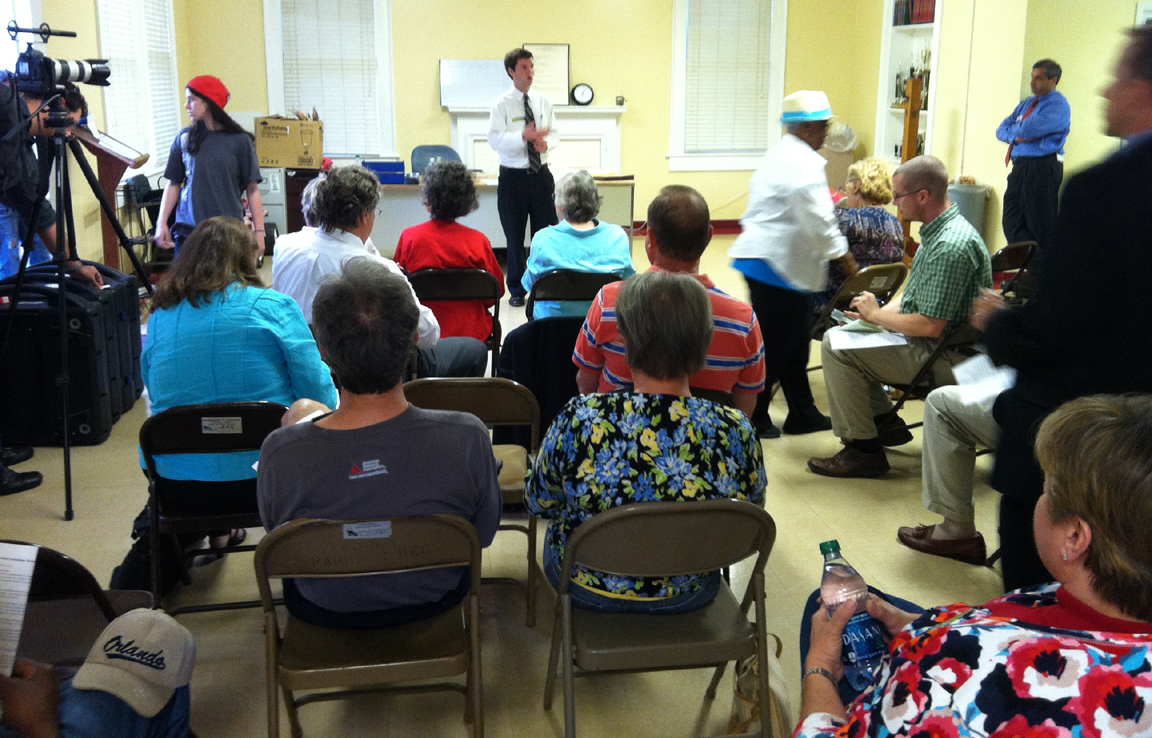
Last night I went to a debate between Daniel Coble and Moe Baddourah sponsored by the Melrose Neighborhood Association. But I’m not going to tell you what I think about what was said there because I wasn’t there as a blogger. This is complicated by the fact that various people who saw me there, including Moe, probably think I was there as a blogger. So this is to set the record straight.

I’ll start at the beginning.

Lately, a large part of my job with ADCO has been business development. In connection with that, I went to breakfast one morning several weeks ago (Feb. 23) with my old friend Bud Ferillo, and I urged him that if he ever finds himself in a situation where he’s representing a client who needs some of the services that ADCO provides, he should give me a call.

Sometime later (I’m not exactly sure when, but my first email on the subject was on the Ides of March), he gave me a buzz and said he needed some help with the production of some last-minute mailings for the Daniel Coble campaign. Fine. I put him in contact with colleagues here at ADCO with expertise in that area, and they helped him out.

At that point, I wasn’t directly involved, beyond getting people together. (I didn’t even see the mailings until after they were done and gone.) Nevertheless, when I interviewed Moe for this post, and when I interviewed Mike Miller for this one, I mentioned what my company was doing to help out Bud on Daniel’s behalf. Neither of them expressed any concern. (I meant to tell Jenny Isgett when I interviewed her, but later realized I had forgotten. And given the reactions of the other candidates, it didn’t seem worth a separate call. I’ll let you be the judge whether I was right about that.)

Then, over the next couple of weeks, I got slightly more involved, but only in the sense of being a conduit for communications between the campaign and folks at ADCO.

Last Thursday, my status changed. On that day, Bud asked whether ADCO could shoot video at a debate Monday night, and provide YouTube clips contrasting the candidates. I checked, and our usual in-house people couldn’t do it that night. There wasn’t time for handling things the usual way. I went ahead and personally lined up a free-lancer, Brett Flashnick, who readily agreed to help out.

So I was there last night in case he had questions, and also so I could witness the whole debate, and be able to help him in editing the video. This afternoon, Brett and Bud and I spent between two and three hours going through video and choosing some clips of good YouTube length. Brett has left now and will send Bud and Daniel the finished product to see if they approve.

So basically, I’ve been heavily involved now in making editorial judgments about campaign materials. I wasn’t involved in that way at all before, but I am now.

Even before things got to this point, I was worried about what, if anything, I should write about the campaign. When I wrote about all those endorsements that Daniel got on March 29, the news was so helpful (in my opinion) to the Coble campaign that I worried that I wasn’t reporting anything of similar impact from the other campaigns, and that it could look like I was favoring him. But I couldn’t figure out how to balance things out. Neither Moe nor Jenny were generating news like that; I wasn’t seeing anything new to react to.

Now that I write that, I realize that as indirect as my involvement was before, I should have told y’all about it. The fact that it was entering my head, that I was worrying about whether I was being 100 percent fair or not, even a little bit, means I should have told y’all so you could judge for yourselves. But I didn’t. I thought about it, but I decided that I was overthinking things, and that all I would accomplish would be to make the connection sound like a bigger deal than it was. Which is a case of over-overthinking, now that I think further (over-over-overthink) about it.

Also, I thought this: The fact that Daniel was the only candidate advertising on my blog (and I assure you, the other candidates had the same opportunities to do so that he did) was a greater apparent conflict than my indirect involvement with those mailings. And y’all knew about that — you could see the ad — and were therefore forewarned and armed to make any judgments you chose to make as to whether I was being fair.

Regardless of decisions I made in the past, there’s no question now: Y’all should know that I am involved at this point. So, anything else I say about this runoff (which probably won’t be much) must be considered in light of the fact that I’ve definitely, directly, done work to help the Coble campaign. I fact, I invite you to go back and read everything else I’ve written up to now (just use the search feature to look for the candidates’ names), and decide for yourself.

Of course, this is an opinion blog. I never make any pretense to news-style “objectivity.” But what I invite you to do is see whether you think any subjective judgments I’ve made were ones I would have made anyway, without any involvement in the campaign. Actually, what I see when I look back is that I held back from expressing any strong opinions or preferences. Which means that what I wrote was affected. Because that’s not normal for me.

All of this is making my head hurt. This, of course, is why people who make their livings as reporters and editors just don’t get involved, period. Or at least, that’s the way it used to be when there were good, full-time jobs to be had in that field.

Now, increasingly, news (or at least commentary) is brought to you by people who make their livings some other way. Which is something you have long known about me.

Life is confusing here in the New Normal, and all I can figure out to do about it is to tell y’all what I’m doing. Which I just did.

Could future journalists uncover a Watergate?

I was intrigued by this question that The Washington Post posed on Twitter today: “Could the Web generation uncover a Watergate-type scandal?”

I followed the link and saw that the piece was based on a panel discussion featuring Bob Woodward and Carl Bernstein. They had their doubts:

“One of the colleges asked students in a journalism class to write a one-page paper on how Watergate would be covered now,” said Bob Woodward, “and the professor — ”

“Why don’t you say what school it was,” suggested Carl Bernstein, sitting to Woodward’s left in a session titled “Watergate 4.0: How Would the Story Unfold in the Digital Age?”

“Yale,” Woodward said. “He sent the one-page papers that these bright students had written and asked that I’d talk to the class on a speakerphone afterward. So I got them on a Sunday, and I came as close as I ever have to having an aneurysm, because the students wrote that, ‘Oh, you would just use the Internet and you’d go to “Nixon’s secret fund” and it would be there.’ ”

“This is Yale,” Bernstein said gravely.

“That somehow the Internet was a magic lantern that lit up all events,” Woodward said. “And they went on to say the political environment would be so different that Nixon wouldn’t be believed, and bloggers and tweeters would be in a lather and Nixon would resign in a week or two weeks after Watergate.”

A small ballroom of journalists — which included The Washington Post’s top brass, past and present — chuckled or scoffed at the scenario…

I also enjoyed the way the piece, written by Dan Zak, characterized the Woodstein legacy:

Tuesday’s panel briefly reunited the pair, whose untangling of the Nixon administration inspired a generation of journalists who have since been laid off or bought out in large numbers. Woodward and Bernstein’s main point was evocative of a previous, plentiful era: Editors gave them the time and encouragement to pursue an intricate, elusive story, they said, and then the rest of the American system (Congress, the judiciary) took over and worked. It was a shining act of democratic teamwork that neither man believes is wholly replicable today — either because news outlets are strapped or gutted, or because the American people have a reduced appetite for ponderous coverage of a not-yet-scandal, or because the current Congress would never act as decisively to investigate a president.

For the record, while I may indeed be one of those “who have since been laid off or bought out in large numbers,” I didn’t get the idea to go into journalism from these two guy — however much their example may have encouraged me. I was already working as a copy boy at The Commercial Appeal when I first heard of them…

Three times in a week, I’m mistaken for Mike

It happened two more times last night.

Mike Miller

After dropping by the victory party Cameron Runyan was having at 701 Whaley, I went to Kit Smith’s house to see what was happening with Daniel Coble. I went in wondering whether things were going well — and knowing that if they weren’t, people would feel somewhat constrained with a blogger in their midst. It only took a moment to find out that Daniel was a close second in a runoff, and that the campaign felt good about that — better than if they had been in a runoff with Jenny Isgett.

As I was absorbing that, a nice lady came up to me and started telling me that while she hadn’t followed me all that closely when I was at the newspaper, she had really come to appreciate my work, and she really, truly appreciated that I had decided to throw in my lot with the Coble campaign, and then she gave me a big hug. As I was trying figure this out, and muttering, “But I’m not… that is, I’m neutral… I mean…,” Bud Ferillo explained that I was there as a blogger. At which point the lady stepped back and looked at me and realized who I was.

Which was not Mike Miller.

A very short while later, I was in another room discussing the state of the world with Joel Smith, and a man came up to me and said, “Hi, you’re Mike Miller. I’m…,” at which point I interrupted to say, “No, I’m not.”

Not Mike Miller.

I told you previously about how this happened over at Belinda Gergel’s house the day she and Mike and Steve Morrison endorsed Daniel.

I don’t know what it is (it’s not like Mike looks like THIS guy), but I can almost sorta kinda see it. And I have this vague memory of this mistake having happened once or twice, long ago, when we worked at the paper together. Something about general similarity in height and weight and maybe head shape, and now hair color. We’re both from the Pee Dee (he’s from Dillon;  I’m from Bennettsville), but I don’t think that’s it.

Most of the folks at that gathering had on Daniel Coble stickers. I felt like I needed my own sticker, in the same yellow-and-black motif that Rob Barge designed for him, saying “I’m not Mike Miller.” But I don’t know if it would do any good…

Anybody want to talk Mad Men?

I called AT&T (and be sure to check out the ad at right) on Saturday to upgrade my TV options so that I could see the season premiere of “Mad Men” Sunday night. In HD.

I even went to see Dreher High School’s production of “How to Succeed in Business Without Really Trying” — twice — over the weekend to help get me in the mood. (Quick, what is the most direct connection between that play — and I’m thinking the original Broadway production — and “Mad Men”? There’s a hint in the photo above.)

And it was all that I had expected it to be.

So I come in to work at my own ad agency Monday morning, and we usually spend a few minutes batting the breeze at the start of the traffic meeting, but… no one but me watches “Mad Men”! So there was no one to discuss it with.

Anybody want to talk about it? Here, I’ll start…

My favorite story line wasn’t Don’s relationship with his hot new wife, or Lane’s dilemma over the picture he found in a wallet. It was the one that went (SPOILER ALERT):

  • Young white twerps at competing agency, tired of hearing civil rights marchers outside their window, start dropping water bombs on them — which makes news.
  • Our protagonists at Sterling Cooper Draper Pryce decide (in their own white-twerpy fashion) to add to the competitors’ discomfiture by running a help-wanted display ad declaring that they are “an equal opportunity employer.”
  • Joan (my very favorite Mad Man, even though “Man” fits her less well than it does anyone else on television), who is on maternity leave, thinks the agency is hiring someone to replace her, and charges into the office with her baby to demand explanations.
  • A reception-room full of earnest young black applicants, quite naturally taking the ad at face value, show up to apply for the job. NOW what are our wiseguys going to do — say there IS no job, and risk getting as big a black eye as the rival agency did?

Suddenly, our “heroes” are entangled in the mid-60s, and they have to figure out how to cope with it. And it’s deftly and realistically handled, if a bit larger than life.

Getting in the mood for ‘Mad Men’

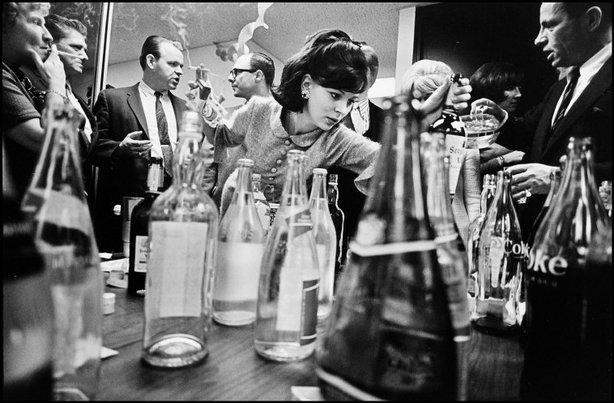
NEW YORK CITY—An office party, 1966. © Leonard Freed / Magnum Photos

Slate has put up a really interesting photo slide show invoking the “Mad Men” era, to help us all get psyched up for the season premiere coming Sunday.

This is but one. I urge you to go view the whole package. And check out other excellent archival images from Magnum Photos.

Oh, and in case you wondered, fans — working at an ad agency is just like that. Only without the smoke.