Category Archives: Words

Todd Kincannon seems to have found his own Heart of Darkness


I’m not sure how else to put it.

I’ve known Todd, slightly, for several years now. Once, I would have said, “I know him to say hello to.” Now, I say, “I know him to exchange Tweets with,” which I have done frequently. I’ve only met him in person a handful of times, and when I have, he’s been a polite, friendly young man who seems to know how to behave himself in public.

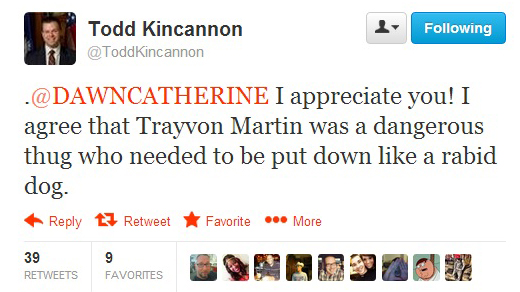
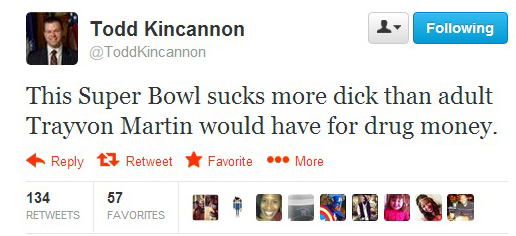
But lately, his Tweets — and there are a LOT of them; I don’t personally know anyone who Tweets more constantly — have been trailing off into a strange, dark, extreme place. Following them is like traveling up the Congo (or, in Coppola’s version, the Mekong) in search of Kurtz, who had lost himself in savagery. Increasingly, they are of a sort that I can’t quote here without violating my own standards. Even showing you the ones that this post is about is a departure. But now that Todd has gone on national media to defend these truly indefensible Tweets, and not backed down an inch or admitted in any way that they are beyond the pale, and been identified to the world as a former executive director of the state GOP, well… I’m laying them out before you.

Here’s the one that the above video interview is about:
todd1

Here’s another related to it:

todd2

I don’t know what has led Todd on this path. I know that when he stepped it up (or rather, down) a few degrees a month or so ago, he found himself gaining a lot more attention, and I’ve seen that do bad things to people’s heads before.

Is it just immaturity? When Rusty DePass posted something on Facebook that deeply offended all who saw it, he immediately took it down (too late; it had been grabbed and preserved) and truly, sincerely apologized to everyone for it. (I think Kathryn, and others here who know Rusty, will back me up as to his sincerity.)

Todd operates in an environment where… well, the maturity level is pretty well established in the language used in this Wonkette piece criticizing him. A place where there are no rules of civility, or at least it seems that there aren’t — until Todd manages to find a way to violate them. (The problem with Wonkette’s reaction, of course, is that it helps Todd believe in his explanation that this is just a left-right thing, and he’s just doing what everybody does to people on the other side.) A place where obscenities that would only sound daring to a 7th-grader are the standard.

How hard is it to simply say that, for instance, Trayvon Martin was just this kid, you know? He was neither an angel nor a devil, he was just a kid who didn’t deserve to die because he had a run-in with this George Zimmerman guy, who wasn’t an angel or a devil either. MIsguided people on the left and right have glommed onto these people as some sorts of symbols, but they were just people. And his shooting was what the prosecutors in Tom Wolfe’s Bonfire of the Vanities would have called a “piece a s__t case,” a case that’s just a horrible, tragic mess any way you look at it, with no heroes, no one to admire, no good coming out of it, no redeeming lesson to be drawn.

But one thing is clear: Now that the kid’s dead, he sure as hell doesn’t deserve to have his memory trashed in terms that shouldn’t be used in public under any circumstances, about anybody.

Todd’s performance in the above video is nothing short of appalling. I don’t know what to say but to define it in Conradian terms, and express how sorry I am to see it. He might not be sorry, but I am…

Yeah, but they didn’t necessarily mean it as a compliment…

I enjoyed seeing the profile on Larry Grooms’ Twitter feed:

SC Senator who believes in faith, family and freedom. Named the “Conservative’s Conservative” by @TheState. Candidate for SC’s 1st Congressional District.

Leave it to Larry to hear “conservative’s conservative” as an honorific. But he’s far from alone in his  party. As I’ve said before, I expect that any day now, we’ll see a release from a GOP candidate — one running in a contested primary, of course — that consists of nothing but the word “conservative” repeated over and over, 40 or 50 times.

There are some who have come pretty close to that ideal.

By the way, I was being ironic when I said “ideal.”

Graham: ‘Hillary Clinton got away with murder’

Our senior senator is just all over the place this week, to the point I’m having trouble keeping up with him.

FIrst, he and John McCain are in bipartisan moderate mode as they attempt to revive the issue that almost did McCain in (and did Graham a world of hurt back home) the last time they tried it. Then we see him trying to hold his base at bay by standing up against gun control (here’s video of that, which his office put out today).

Somehow in all this, I missed that he said the following words yesterday on FoxNews:

I haven’t forgotten about Benghazi. Hillary Clinton got away with murder, in my view.

Somehow this escaped me until some friends mentioned it this afternoon. The way I heard it was “Lindsey Graham said Hillary Clinton got away with murder in Benghazi.”

Now when you look at what he said in context, it’s not nearly that bad. He didn’t say she “got away with murder” in Benghazi. It seems pretty clear that he was just saying she got off too easy in the hearings last week.

But still.

That he would use words that could be (and of course, would be) misconstrued that way — especially with a clip as short and context-free as this one on Politico — is remarkable given that this is Hillary Clinton we’re talking about. Yes, there are those in Mr. Graham’s base who may consider her a she-devil of some sort, but Lindsey Graham and Hillary Clinton have long formed a well-known mutual admiration society. Each has only had kind things to say about the other since their early days in the Senate together, and each has used the other to prop up his and her bipartisan cred.

That he would rhetorically throw her under the bus (just to use another common expression) this way is surprising.

I mean, come on, Lindsey — the lady just got out of the hospital

Whoa! I missed the part about ‘Peace in our time’!

MunichAgreement_

As I said before, I didn’t catch all of the president’s speech yesterday, and something rather important got by me:

The WTF moment for me in Obama’s second inaugural address, delivered Monday at noon, was his use of the phrase “peace in our time.” This came during his discussion of foreign policy, and in such circles, that phrase is a synonym for appeasement, especially of Hitler by Neville Chamberlain in September 1938. What signal does his using it send to Iran? I hope he was just using it to jerk Netanyahu’s chain.

I also simply didn’t understand what he meant by “a world without boundaries.” But my immediate thought was, No, right now we need boundaries — like those meant to keep Iran out of Syria and Pakistan out of Afghanistan…

Yikes. You know, there are certain phrases that anyone with an understanding of history would be careful to avoid. Such as “Mistakes were made.” “I am not a crook.” “It depends on what the meaning of ‘is’ is.”

And of course, “peace in our time.” What was the thinking on that? Did the president think that his base would like the sound of it, and not understand the profoundly disturbing historical allusion? Hey, it was politically popular when Chamberlain said it, although Britain woke up later.

I just don’t see how a line like that appears in such a formal speech by accident. And no other explanation is excusable.

That’s an association you don’t want. And for another thing, it doesn’t fit well with the president’s ongoing aggressive drone war. That suggests cynicism. As in, the president gave the gift of peace to four al Qaeda militants on Monday…

Oh, and another thing… since when did people who right for Foreign Policy start using such expressions as “WTF”?

Your thoughts on Obama’s second inaugural speech?

I don’t have time to get into it right now, but I thought y’all might have some thoughts to get off your respective chests.

I didn’t quite hear all of it, but from what I heard, well, it’s wasn’t Lincoln’s second inaugural, which I was just reading about last night (almost done with “Team of Rivals”!). But that’s unfair. Lincoln had just been elected while guiding the nation, successfully (that is, he was on the verge of success, and all knew it), through its greatest crisis ever. But then, he also rose to the occasion as a speaker, with what is regarded by many as the greatest political speech in our history.

But then, on the other end of the spectrum, I thought there was more to it than Chris Cillizza’s distillation: “I’m the president, deal with it.

It was somewhere between the two. Thoughts?

Hey, I LIKE my pols to be off-message…

Today in the WSJ, Daniel Henninger asks the unmusical question, “Where Is the GOP’s Jay Carney?” By which he meant that the president — and by extension the Democrats as a class (as Henninger sees it) — has someone who can be out there constantly, every day, pushing a consistent message. And that message gets pushed without the president himself having to waste his own capital by commenting on every little thing.

An excerpt:

The whole wide world is living in an age of always-on messaging, and the Republican Party is living in the age of Morse code. It isn’t that no one is listening to the GOP. There is nothing to hear.

Smarting from defeat by Barack Obama’s made-in-Silicon-Valley messaging network, congressional Republicans in Washington are getting tutorials to bring them into a Twitterized world. I have a simpler idea: First join the 20th-century communication revolution by creating an office of chief party spokesman. One for the House and one for the Senate…

Henninger goes on at some length about how the GOP lack that everyday messenger — and complains that our own senior senator makes matter worse (for the party), not better:

The best members are becoming frustrated at the messaging vacuum, and some are moving to fill the void. Marco Rubio comes to mind, and more power to him given the nonexistent alternative. But others will follow, creating a GOP tower of Babel. The TV networks know they can dial up a Lindsey Graham to blow a hole Sunday morning in any leadership effort at a unified message. It will get worse, and the near-term consequence of getting worse is being out of power.

But of course, that’s precisely what I like about Lindsey Graham. He can be relied upon to think for himself. Oh, sure, he’ll mouth orthodoxies now and then, as with this release on the president’s gun proposals. But an unusual amount of the time for a Washington politician, he has something more thoughtful to say than what may be in the party playbook. Not as off-message as Chris Christie, perhaps, but he still says things that show he actually thought about the issue himself.

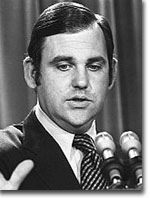
Would it really be a good thing for the House to have its own Ron Ziegler?

Would it really be a good thing for the House to have its own Ron Ziegler?

(Oh, and by the way — unlike some of my friends here, I see nothing wrong with Graham going out of his way to let us know when he DOES agree with the orthodox position. That doesn’t make him inconsistent, or a hypocrite, or anything else that some of y’all call him. I, too, sometimes agree with the party zampolits on an issue. And if I were a Republican officeholder — or Democratic; the dynamic is the same — and wanted to continue to serve in that office, I would put out releases emphasizing the issues on which I agreed with my likely primary voters. Why wouldn’t I? I’m sure I’d do plenty of things to tick off those voters at other times, so why not say, when I can honestly do so, “Hey, we agree on this one”?  I want Lindsey Graham to stay in office, so I’m glad he puts out such releases.)

Also, I think Henninger overemphasizes the extent to which a presidential press secretary is a spokesman for the entire party that the president belongs to. He speaks for the president. And yeah, in these hyperpartisan times, that can benefit his party. But it’s more of an institutional phenomenon than a partisan one. It’s in the nature of the presidency, and has been since long before the modern office of press secretary developed. The president speaks with one voice; the House is not expected to (and I would argue, should not, except in the context of the outcome of a specific vote). The presidential press secretary is a surrogate standing in the bully pulpit. I see no good reason for the House, or Senate, having a similar functionary.

Reagan told Irmo kid to get his act together

This, “Letters of Note,” is a pretty cool site that was first brought to my attention several days ago. The letter in question was one that a 16-year-old Sidney Poitier wrote to FDR asking him for a $100 loan to help him get back home to Nassau. He promised to pay it back. Poitier had come to this country, alone, at 15 with nothing, and was ready to pack it in. This was before he discovered acting.

He didn’t get the loan, of course. Which is why we’ve heard of him.

Today, I see another such letter — written with a similar intent — from a kid in Irmo. He wrote it to Ronald Reagan, but unlike Poitier, he got a reply from the president. I guess, when you’re a Republican, you sit up and take notice when someone from Irmo writes.

Seventh-grader Andy Smith wrote as follows to the president in 1984:

Today my mother declared my bedroom a disaster area. I would like to request federal funds to hire a crew to clean up my room.

Reagan responded, in part:

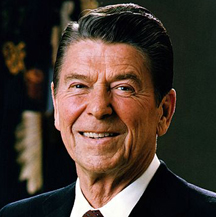
Your application for disaster relief has been duly noted but I must point out one technical problem: the authority declaring the disaster is supposed to make the request. In this case your mother…Official_Portrait_of_President_Reagan_1981

May I make a suggestion? This administration, believing that government has done many things that could better be done by volunteers at the local level, has sponsored a Private Sector Initiative program, calling upon people to practice voluntarism in the solving of a number of local problems.

Your situation appears to be a natural. I’m sure your mother was fully justified in proclaiming your room a disaster. Therefore you are in an excellent position to launch another volunteer program to go along with the more than 3,000 already underway in our nation—congratulations.

Go read the whole letter.

Yep, that’s Mark Sanford running all right…

Back on the day we'll not soon forget.

Back on the day we’ll not soon forget.

Mark Sanford has now told the National Review — apparently his ability to charm SC media has worn thin — that he is running for his old seat in the 1st Congressional District, and he’s doing it in order to save the country from budget deficits.

There’s a bunch of other stuff in the interview should you like to peruse it. Me, I just wanted to check it for his verbal DNA, and make sure it really was Mark Sanford they spoke to.

At first, I worried, because he didn’t say “at the end of the day” or “soil conditions” a single time. But there is one “I would say” (which he used to say so often that I wanted to shout, “Well then why don’t you just say it?”).

And he says “look under the hood” no fewer than four times, which was reassuring. I am not making this up:

You have to, in essence, look under the hood. There’s a larger philosophical question. In life we’re all going to make mistakes, we’re all going to come up short. The key is, how do you get back up and how do you learn from those mistakes? . . . But I think that the bigger issue is, don’t judge any one person by their best day, don’t judge them by their worst day. Look at the totality, the whole of their life, and make judgments accordingly…

You’ve got to look under the hood. There’s that sensational headline, to look and say, “Wow, big ethics charge.” Beyond the headline, what does that mean? You say, “Hm. There were 37 counts the ethics committee brought, and did you know half of those are for taking a business-class ticket?” You look under the hood and you say, “Wow.”…

It’s important in this instance to look under the hood and say, “Wait a minute, they keep talking about default, and that’s just not true.” You can prioritize spending. When I was in Congress, I remember a GAO report that said that Treasury has the capacity. There’s no statutory requirement for them to default. They could prioritize their spending, and they’re doing things in the short run, to shuffle things around, all based on prioritization…

Yep, that’s Mark Sanford.

Oh, by the way, someone else is getting set to announce he’s running, too:

MEDIA ADVISORY
FOR RELEASE ON JANUARY 15, 2013

SOUTH CAROLINA SENATOR LARRY GROOMS WILL ANNOUNCE RUN FOR SOUTH CAROLINA’S FIRST CONGRESSIONAL DISTRICT

WHO
South Carolina State Senator Larry Grooms

WHAT
Grooms will announce his bid for South Carolina’s First Congressional District.

WHEN
Thursday, January 17, 2013
3:00p.m.

WHERE
Scout Boats
2531 Hwy 78 West
Summerville, SC 29483
Next to Summerville Auto Auction

Maybe one of y’all would like to cover that for us. I’m not going to be down that way.

When will the senseless bloodletting (or blood-letting) end?

Stan Dubinsky brings my attention to another bit of brilliance from The Onion. Of course, you have to have spent years of your life (years you’ll never get back!) as an editor to fully appreciate it:

Law enforcement officials confirmed Friday that four more copy editors were killed this week amid ongoing violence between two rival gangs divided by their loyalties to the The Associated Press Stylebook and The Chicago Manual Of Style. “At this time we have reason to believe the killings were gang-related and carried out by adherents of both the AP and Chicago styles, part of a vicious, bloody feud to establish control over the grammar and usage guidelines governing American English,” said FBI spokesman Paul Holstein, showing reporters graffiti tags in which the word “anti-social” had been corrected to read “antisocial.” “The deadly territory dispute between these two organizations, as well as the notorious MLA Handbook gang, has claimed the lives of more than 63 publishing professionals this year alone.” Officials also stated that an innocent 35-year-old passerby who found himself caught up in a long-winded dispute over use of the serial, or Oxford, comma had died of a self-inflicted gunshot wound.

Joe Wilson release satirizes itself

joe release

This happened a couple of weeks ago, and I haven’t figured out why it happened either time.

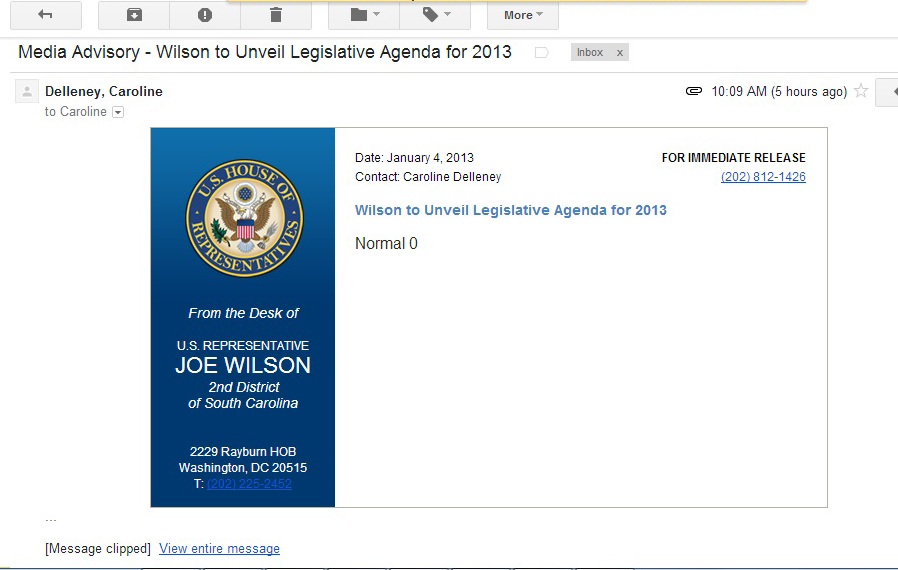
The first time, Joe Wilson sent me a release via email with a headline and an introduction to a statement from Joe, but no statement.

This time, there was the headline — “Wilson to Unveil Legislative Agenda for 2013” — followed by nothing but this:

Normal 0

Which sort of read like a joke at Joe’s expense: The usual. Nothing.

Just as last time, way down on the email, there was a link where I could go read the actual release, which basically said Joe is having press conferences tomorrow in West Columbia, Aiken and North Augusta. Where he’ll talk about his agenda.


No, actually, ‘Islamist’ has a pretty clear meaning

Just got a release from CAIR on this subject:

(WASHINGTON, D.C., 1/3/13) — The Council on American-Islamic Relations (CAIR) today distributed a commentary urging media outlets to drop the term “Islamist” because it is “currently used in an almost exclusively pejorative context.”…

In this connection, the group offered an op-ed from Ibrahim Hooper, CAIR’s national communications director. Here are the first few grafs:

As many people make promises to themselves to improve their lives or their societies in the coming year, here is a suggested New Year’s resolution for media outlets in America and worldwide: Drop the term “Islamist.”

Hooper-thumbnail

Hooper

The Associated Press (AP) added the term to its influential Stylebook in 2012. That entry reads: “Islamist — Supporter of government in accord with the laws of Islam. Those who view the Quran as a political model encompass a wide range of Muslims, from mainstream politicians to militants known as jihadi.

The AP says it sought input from Arabic-speaking experts and hoped to provide a neutral perspective by emphasizing the “wide range” of religious views encompassed in the term.

Many Muslims who wish to serve the public good are influenced by the principles of their faith. Islam teaches Muslims to work for the welfare of humanity and to be honest and just. If this inspiration came from the Bible, such a person might well be called a Good Samaritan. But when the source is the Quran, the person is an “Islamist.”

Unfortunately, the term “Islamist” has become shorthand for “Muslims we don’t like.” It is currently used in an almost exclusively pejorative context and is often coupled with the term “extremist,” giving it an even more negative slant…

Look, I sympathize with people who feel like their group is marginalized or misunderstood. But I’m sorry, “Islamist” has a clear meaning in newswriting, one that the AP set out quite well. It most assuredly does not mean “Muslims we don’t like.”

What it does mean, and what professional journalists are careful to use it to refer to, is someone or something based in a worldview that holds “the Quran as a political model.” It’s about theistic government (which is not the same as being influenced by the principles of one’s faith in seeking to serve the public good, although of course the two things can coincide). If that comes across as pejorative, that’s because in the West, we believe in pluralistic government that neither dominates, nor is dominated by, a particular faith. So yeah, even when we’re not talking about an Islamist extremist (another very useful word, which by its employment lets anyone who understands English know that not all Islamists are extremists), we’re talking about someone whose political views are fairly inimical to values we hold as fundamental.

“Islamist” is also useful from an American context (since we do distinguish between the political and the religious) because it allows us to separate the political viewpoint from Islam itself. It’s important to most of us to respect the faith, even as we disagree with the idea of its being used as a basis for government.

Distinctions are important. “Islamist” allows us to make distinctions. I’d be surprised, and disappointed, if any news organizations respond as CAIR asks here.

A better version of the Second Amendment

Well, I just learned something from Wikipedia I didn’t know before, but should have known — given all that time I spent studying that period in college.

I’ve always found the punctuation (and capitalization, but hey, it was the 18th century) of the Second Amendment problematic to the point that it was little better than gibberish. That’s because I was looking at the version that Congress passed:

A well regulated Militia, being necessary to the security of a free State, the right of the people to keep and bear Arms, shall not be infringed.

That comma after “Militia” just destroyed any clear meaning that may have been intended.

But now I’ve seen the version that was ratified by the states and authenticated by Thomas Jefferson in his capacity as secretary of state:

A well regulated militia being necessary to the security of a free state, the right of the people to keep and bear arms shall not be infringed.

Much better. It actually seems to have been composed by someone whose first language is English. And it certainly makes the role of the militia in the rationale of amendment much clearer.

Speaking of militias… I have another post I want to write on that subject. I’ll see if I can get to it before I need to leave this evening…

Did YOU think Romney was a ‘poopy-head’?

That’s what Grover Norquist says President Obama portrayed him as:

Grover Norquist, founder and president of Americans For Tax Reform, has a new theory about why President Barack Obama won — he portrayed Mitt Romney as a “poopy head.”

“The president was committed; elected on the basis that he was not Romney and Romney was a poopy head and you should vote against Romney and he won by two points,” Norquist said on CBS’ “This Morning” Monday. “But he didn’t make the case that we should have higher taxes and higher spending, he kind of sounded like the opposite.”…

This was a neat way, for Mr. Norquist, of distracting us from the fact that exit polls show that most voters last Tuesday want to raise taxes on higher-income individuals.

Last night’s debate news (or part of it) this morning — another problem for what’s left of newspapers

OK, so I’m behind the curve today. I got home from final dress rehearsal last night at about 11:30, heated up some dinner, watched a few minutes of both the beginning and the end of the debate (having heard a BBC assessment of it on the radio on the drive home) then watched some of the PBS commentary after the debate, then hit the sack.

But I’m not as far behind the curve as most daily newspapers were in today’s print editions.

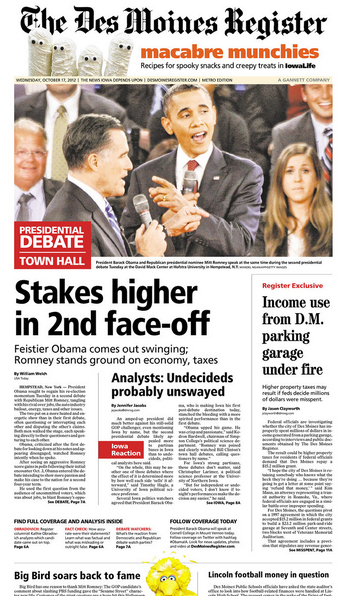
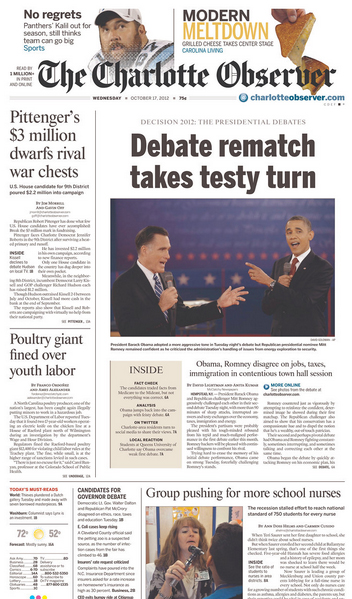
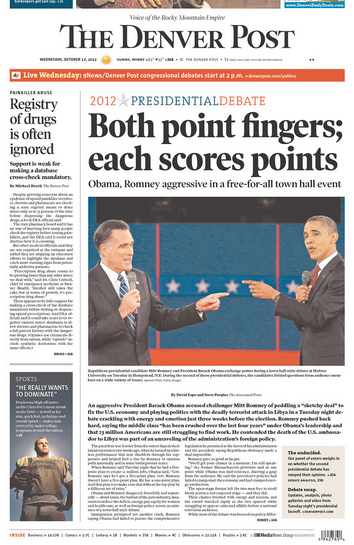
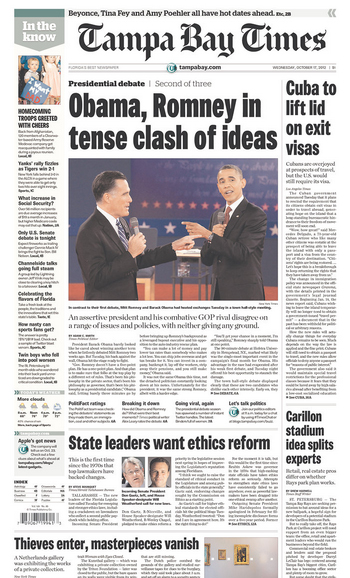
Slate calls our attention to today’s front pages (all taken from the Newseum, where you can see plenty of others), which have a sameness about them: They pretty much all say the same thing in their headlines, and most run photos of the same moment, with the candidates’ fingers pointed at each other. Sure, you might find some “analysis” in there somewhere, and the more enterprising (and better-staffed) opinion pages will have some sketchy opinions expressed. As Slate’s Josh Voorhees writes:

As we explained late last night, the insta-polls and the pundits saw a tight contest on the Long Island stage on Tuesday, but one that was won narrowly by President Obama. Given the lack of a clear-cut win, however, it should come as little surprise that a quick scan of the morning’s front pages show the nation’s headline writers and art teams focused on the on-stage clash and largely left the who-won question to the domain of the cable news talking heads (as most papers had likewise done following the previous two debates).

Once, this sameness, this lack of personality or individualized expression was the glory of newspapers. If 10 different journalists from 10 different papers covered the same event, they would all write pretty much the same thing. It was a measure of their professionalism, and the self-effacement that news writing demanded of them. It was about giving it to you straight, unadorned, plain, and God forbid there should be any hint of opinion in it. Who, what, where, when, maybe how, and, if you put an “Analysis” sig on it, why.

The monotony of it didn’t strike the reading public because unless they lived near an urban newsstand, most people only saw one daily newspaper.

But here’s the problem with that today: What newspapers put in those lede headlines today, and what they conveyed in those pictures, was all old news by the time I was driving home from rehearsal last night.

I hadn’t driven more than a few blocks when I knew the conventional wisdom on what had happened. It went something like this: Obama did all the things he failed to do in the first debate, particularly having a strong finish. Romney did fine, although was maybe not quite as sharp as in the first debate. If you’re declaring a winner, it’s Obama, although I didn’t get the sense that he dominated in this debate the way Romney did in the first one, so if you’re going on cumulative totals, Romney’s probably still ahead in this debate series. How this affects the polls remains to be seen.

I had even heard about “binders full of women,” but I was mostly confused by that.

In the post-debate analysis I watched after I got home, I heard David Brooks and Mark Shields give their assessments. Brooks said Obama won because he was able to exploit Romney’s biggest weakness better than Romney was able to press Obama on his biggest weakness. He said Romney’s biggest weakness is that his numbers don’t add up, and Obama’s problem is that he never provides a vision of what the next four years will be like if he is re-elected. Shields said it might surprise everyone, but he agreed with Brooks on all those points.

Since then, on the radio this morning, I’ve heard that “Obama hasn’t sketched a vision going forward” meme several more times.

I was also interested in what a young woman (didn’t catch her name) who analyses Twitter during debates for PBS had to say. I didn’t get as much of an overview of the Twitter take as I wanted because she decided to zero in on the reactions of women. But I’ve found her assessments interesting in the past: What was trending? What were the memes people were obsessing over? What caught on? I’ve become more and more interested in the instant reactions of Tweeters in the aggregate during events like this. It has something to do with the wisdom of crowds. It’s like having sensors attached to the brains of millions of highly engaged, clever voters — which is what the most-followed people on Twitter tend to be.

And I felt left out because I wasn’t on Twitter myself during the debate. Increasingly, that’s where I like to be during these kinds of real-time shared events, sifting through the flood of reaction as it washes over me.

And in a Twitter world, seeing these front pages feels like reading ancient history. No, it’s worse than that. Historians look at the whole of a thing after it’s over and draw conclusions. There’s a wholeness to historical accounts. These reports — and I’m just reacting to the headlines, mind you — don’t do that. They give only the most noncommital account, essentially just telling you that the candidates came together and vied against one another, and there the account ends. The Des Moines Register headline (“Stakes higher in 2nd face-off”) could have been, and possibly was, written before the debate started. (And pre-Gannett, that was one of the best papers in the country for political coverage.)

And I was already so far beyond that, without even trying hard to be, last night — without even having seen the debate.

I’m not saying these papers aren’t doing their jobs well. What I’m saying is that the job they’re doing, within two kinds of constraints — the convention of not drawing conclusions in a news account, and the severe time problem of the debate ending as they have to get those pages to the press room (depending on the edition we’re talking about, a lot of editions went to bed BEFORE that) — fails to satisfy in a Twitter world.

Again, there might be all kinds of good stuff in the stories, but the presentation — the quick impression that a glance at the front page provides — is deeply lacking. It makes you not want to read more deeply. It causes me to want to go read those papers’ websites today, and see what good stuff didn’t make it into the paper. (And the better papers will have something for me when I go there.) Because the conversation has moved, by the time the paper hits your stoop, so very far beyond what’s in those headlines.

‘The full Joe Biden treatment,’ God love him

Over the weekend, Mike Fitts posted on Facebook a link to an excellent, fun piece in The New Yorker, along with the blurb, “For anyone like Brad Warthen who has ever gotten the full Joe Biden treatment:”

Hey, chief. There’s the guy. How you doin’? Got your friends here, party of six. Lady in the hat. Great to see you. My name is Joe Biden and I’ll be your server tonight. Lemme tell you a story. (He pulls up a chair and sits.)

Folks, when I was six years old my dad came to me one night. My dad was a car guy. Hard worker, decent guy. Hadn’t had an easy life. He climbed the stairs to my room one night and he sat on the edge of my bed and he said to me, he said, “Champ, your mom worked hard on that dinner tonight. She worked hard on it. She literally worked on it for hours. And when you and your brothers told her you didn’t like it, you know what, Joey? That hurt her. It hurt.” And I felt (lowers voice to a husky whisper) ashamed. Because lemme tell you something. He was right. My dad was right. My mom worked hard on that dinner, and it was delicious. Almost as delicious as our Chicken Fontina Quesadilla with Garlicky Guacamole. That’s our special appetizer tonight. It’s the special. It’s the special. (His voice rising) And the chef worked hard on it, just like my mom, God love her, and if you believe in the chef’s values of hard work and creative spicing you should order it, although if you don’t like chicken we can substitute shrimp for a small upcharge….

Yep, that’s the Joe Biden I know, God love him.

Thanks, Mike!

That’s just where I would expect to find it

Recently I asserted that in a world so dominated by libertarian impulses on both the left and right, there aren’t all that many widely known communitarian sayings. I mentioned “It takes a village to raise a child,” and “We’re all in this together.”

But that wasn’t a fully inclusive list. In fact, our society has other ways of giving at least lip service to notions that would raise us above purely selfish considerations. Here’s another sort-of communitarian saying with which we’re all familiar:

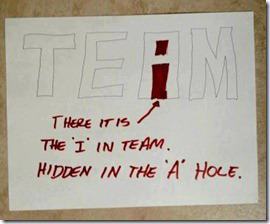
“There’s no ‘I’ in ‘TEAM.'”

But as much as I appreciate the sentiment, I did enjoy this sendup of the saying, which was shared on Facebook today by Diane Lore, a former reporter at The State.

And, yes — if there is an “I” in “TEAM,” that is exactly where I would expect to find it…

What does a ‘like’ mean, as we slouch toward post-verbalism (if that’s what we’re doing)?

The top of my main Pinterest page.

Some years ago — it could have been 20 — I read an article by Umberto Eco that seems appropriate to this topic. I don’t remember all the particulars of the piece, or even in which magazine it appeared. But I seem to recall that the semiotician and novelist set forth the notion that we might be moving, beyond a post-literate society, to becoming post-verbal, returning to means of communication common in medieval days when, say, a pub called the Rose and Crown would be identified by a hanging sign showing pictures of those things, rather than words.

The premise would seem excessively alarmist, or at least premature, since the decades since I read that have seen an explosion of the written word on the Web. More people are writing, and reading, a greater profusion of words than at any time in the history of this planet.

But sometimes, we are faced with images alone, and words fail us. On friends’ Facebook pages, I’m occasionally confronted with images that just beg for accompanying text to explain them, but nary a word is offered.

And recently, I found myself in a world that brought the Eco piece back powerfully.

I was going to (and eventually did) write a light item for the ADCO blog about the addictiveness of Pinterest, which has hooked a couple of my co-workers. The spark was a study indicating that 20 percent of women who are online were into the site.

At first, I supposed that only women could possibly get into it, for as I perused the boards created by my female co-workers, I was overwhelmed by all the images of food and housewares and decorating ideas. As I said in that ADCO blog post, those screens looked like “the result of Edward Scissorhands going to town on a 10-foot-high stack of old copies of Better Homes and Gardens and Southern Living.”

But as I went through the little signup ritual for creating my own account, I saw how quickly the screen would morph into something that more interested me.

Here’s what happens: You sign in to the site. You are offered a screen full of slightly-bigger-than-thumbnail images. You are asked to “like” the ones that appeal to you. What you “like” affects what you see as you continue to scroll down. It’s rather fascinating to watch as the algorithm does its work. For a time, for a long time, the wave of images coming at you seems never-ending. The scroll bar on the right will seem to be approaching the bottom, then suddenly it will glide back up toward the middle as a new load of images arrives.

I saw a lot of images that interested me a great deal, but I couldn’t decide whether to “like” them or not. I mean, what does it say if you click “like” on a picture of a B-26 going down in flames? I don’t like that it’s going down, with American airmen dying in it. But I do want the program to know that I find images of WWII warplanes interesting.

Or what about a picture of Michael Caine as spy Harry Palmer? Will it think I like the raincoat, or “The Ipcress File?” This is a place where words would help.

And what does it mean when I “like” a picture of Marilyn Monroe? I mean, have you ever seen a picture of her you didn’t like, on some level or other? I haven’t. And yet, after I liked one or two of them, they kept coming in a profusion that suggested that Pinterest thought I had some kind of Elton-John-like celebrity fetish centered on her. I continued to “like” them, because that was my honest and uncomplicated answer. But I didn’t want it to offer me nothing but movie-star pictures going forward.

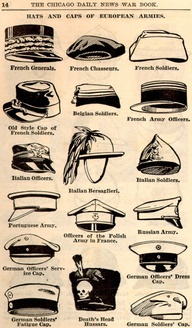
Just because I like Sean Connery doesn’t mean I want to see pictures of Rock Hudson (not that there’s anything wrong with that). And my liking a picture of Natalie Wood doesn’t mean I want to see Robert Wagner. And what’s with these Jody Foster pictures you keep throwing at me? I haven’t liked a single one, and they keep coming. Who do you think I am, John Hinckley? And just because I click on an interesting diagram of old military headgear doesn’t mean I want to look at one Confederate kepi after another!

So here’s where you end up, or where I ended up anyway: Pinterest now “knows” me well enough that one out of 10 or 12 things it throws at me will be mildly interesting. Which I guess is an achievement for a computer program.

But the language of social media — “like” and “friend” and other terms that so often don’t exactly describe the relationship in a given case — still needs work. Let’s not give up on words just yet.

Below are some of the pictures I “liked” as they were thrown at me. But really: What does it mean to “like” a picture of Bonnie and Clyde?

The Ron Morris/Steve Spurrier brouhaha

Things have come to this: The other night, Mr. Darcy asked me whether Ron Morris had been fired by The State.

OK, so it wasn’t actually Mr. Darcy, who after all is a fictional character (don’t tell Bridget Jones that!), who in any case would be long dead had he ever lived. No, it was local actor Gene Aimone, who will portray Mr. Darcy in the SC Shakespeare Company’s production of “Pride and Prejudice,” which opens at Saluda Shoals Friday night. See, I can get a plug into anything.

I told him I had no idea. I wondered why he asked. He said hostilities had resumed between Coach Steve Spurrier and Ron, and that the coach had said something mysterious on the radio, or on TV, or on one of those newfangled gadgets that Mr. Darcy has no business listening to, suggesting that there would be developments forthcoming that would pleasing, at least to him.

I said I ran into Ron at Barnes and Noble several months ago and we chatted pleasantly for a time, and he appeared alive and well, and that’s the last I knew of him.

And I thought no more of it, until Neil McLean mentioned it over breakfast at Cap City this morning. Neil is the new executive director of New Carolina (replacing the retiring George Fletcher), and the son of Tom, my old boss at The State. Neil and I were talking economic development and world travel and all sorts of things, when suddenly he, too, got on the subject of Morris and Spurrier.

And I realized that I was probably the only person in South Carolina not fully briefed on this burning issue. So I went and read up on it. The State itself did not have anything on the controversy, beyond this self-effacing column by Ron (the message, in a nutshell: It was business, not personal).

Then I found this column by Dan Cook at the Free Times:

For a man who seemingly has everything — a multimillion-dollar salary and one of the most successful teams in college football, for starters, not to mention a Heisman trophy — Steve Spurrier is no doubt lacking at least one thing: a thick skin.

How else to explain Spurrier’s repeated tantrums about the writings and comments of a sports columnist, Ron Morris at The State?

At first glance — and second, third and fourth — the situation seems utterly absurd. How can the mighty Spurrier, a legendary coach revered by literally millions of college football fans, even care what a lowly local sports columnist says?

And yet, he does — apparently a lot.

Last week, it was a comparison Morris made between Penn State and the University of South Carolina that set Spurrier off.

Speaking off the cuff on Bill King’s XM radio show in response to a question about whether Spurrier would take questions at an upcoming press conference (Spurrier had recently instituted a policy of refusing questions), Morris said, “I think it’s a real test of the [USC] administration. This is how things like Penn State happen — when the administration won’t step up and confront the football coach, and he becomes all-powerful. When the football coach begins to dictate company policy, I think you’re asking for trouble.”

Spurrier responded in a later radio appearance by implying that if he had to put up with Morris any longer, he might as well retire and “head to the beach” instead. “That’s not part of the job, so we’re going to get it straightened out,” Spurrier said…

So now I see what it was about. And as I see the actual words Ron spoke, I see the matter quite differently from the Gamecock fans who have gotten so upset over it. I understand how a fan (to the extent that I can understand a sports fan, a breed not unlike political partisans, who often mystify me) would get upset if he heard, “Hey, that Ron Morris compared the Gamecock football program to the Penn State mess.” But of course, that would be a grossly unfair characterization of what he said.

To a dispassionate observer, it’s obvious that he was saying this situation was like that other in that you had a popular, successful coach, and if that popular coach becomes beyond reproach in your community, and becomes the tail that wags the dog that is your state’s flagship university, that’s a problem.

While the statement can be defended on rational grounds, there’s no question that Ron stepped in it, and that all this emotion could have been avoided if he’d just found a better way to express himself.

Of course, if he’d simply said, “Steve Spurrier’s getting too big for his breeches,” and not mentioned Penn State, he’d still be in trouble, because, well, Mr. Spurrier actually does happen to be a coach who has become beyond reproach in his community. A lot of people are fine with that state of affairs. As a skeptical journalist, Ron seems to have a problem with it. And therein lies the conflict.

‘It’s a word. That’s it. That’s all…’

Speaking of words, I need to warn you of the use of offensive language in this video. Which, like the one I posted earlier, I cannot embed. (All together now: I. Hate. Facebook.)

But since all sorts of strong opinions are being expressed back and forth on the violence in Five Points, I thought I’d share this one, which is… very passionate, to say the least.

I’d not agreeing with this guy, and I’m not disagreeing with him. I just thought this was one of the most interesting comments I’d heard so far. I like it because it’s idiosyncratic. It doesn’t fit into any boxes, at all. Just a man with a very strong opinion.

I apologize again, in advance, for his language, which is of a sort that I don’t normally allow here. But I thought I’d point you to a part of the dialogue you might have missed…