Category Archives: Words

Mitt Romney, peering deep into the abyss

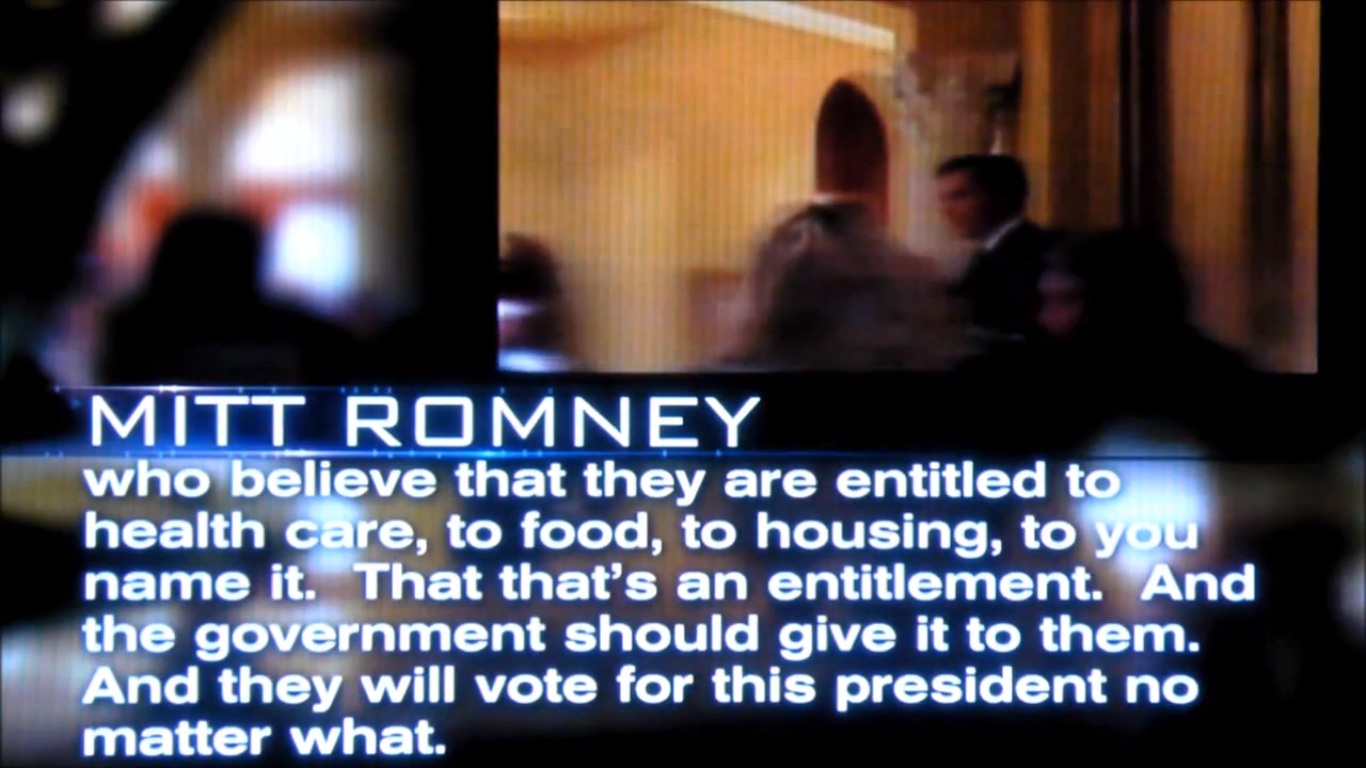
How bad has the past week been for Romney, between the Libya remarks and the “47 percent” video? Bad enough that this bit from The Onion is just barely funny:

DALLAS—With his campaign still reeling from a series of miscues, Republican presidential nominee Mitt Romney asked a group of top advisers Wednesday whether it would be worth going after Obama by questioning the nation of his birth. “What about that whole deal with his birth certificate, or him being born in Kenya or wherever—you think that might stick?” said Romney, adding he was “just spitballing here.” “Also, wasn’t he connected to that terrorist guy, what’s-his-name? Ayers? Bill Ayers? That might have legs, right? Let’s look into that.” After agreeing that the situations should be investigated, Romney and his aides then reportedly sat in silence for 10 whole minutes.

And somewhere out there, some second-guessing Republicans are thinking, “The Donald is tanned, rested and ready…”

Meanwhile, over in a quarter where none of this is funny, one WSJ columnist is lecturing the nominee that his loyalty should be to the country, not his hapless campaign staff, and Karl Rove is saying yes, the situation is bad, but it’s not over — after all, Jimmy Carter was leading Ronald Reagan at this point in 1980.

Speaking of Reagan, Peggy Noonan is writing that it’s “Time for an Intervention:”

What should Mitt Romney do now? He should peer deep into the abyss. He should look straight into the heart of darkness where lies a Republican defeat in a year the Republican presidential candidate almost couldn’t lose. He should imagine what it will mean for the country, for a great political philosophy, conservatism, for his party and, last, for himself. He must look down unblinkingly.

And then he needs to snap out of it, and move…

The central problem revealed by the tape is Romney’s theory of the 2012 election. It is that a high percentage of the electorate receives government checks and therefore won’t vote for him, another high percentage is supplying the tax revenues and will vote for him, and almost half the people don’t pay taxes and presumably won’t vote for him.

My goodness, that’s a lot of people who won’t vote for you. You wonder how he gets up in the morning.

This is not how big leaders talk, it’s how shallow campaign operatives talk: They slice and dice the electorate like that, they see everything as determined by this interest or that. They’re usually young enough and dumb enough that nobody holds it against them, but they don’t know anything. They don’t know much about America.

We are a big, complicated nation. And we are human beings. We are people. We have souls. We are complex. We are not data points. Many things go into our decisions and our political affiliations.

You have to be sophisticated to know that. And if you’re operating at the top of national politics, you’re supposed to be sophisticated…

And this is what Mitt Romney is hearing from what should be his cheering section.

Some stretch goals for all of us here on the blog

Steve Gordy brings to our attention this helpful test for blog commenters, courtesy of one John Scalzi, who has blogged since 1998 — which is sort of like having written books before Gutenberg. Before leaving a comment, one is urged to consider the following:

1. Do I actually have anything to say?

2. Is what I have to say actually on topic?

3. Does what I write actually stay on topic?

4. If I’m making an argument, do I actually know how to make an argument?

5. If I’m making assertions, can what I say be backed up by actual fact?

6. If I’m refuting an assertion made by others, can what I say be backed up by fact?

7. Am I approaching this subject like a thoughtful human being, or like a particularly stupid fan?

8. Am I being an asshole to others?

9. Do I want to have a conversation or do I want to win the thread?

10. Do I know when I’m done?

It’s a good test. Maybe too good. I know almost no one on this planet who would always be able to honestly and accurately say “yes” to every question. Myself included. Especially on that “want to win” thing, which trips up most of us.

In any event, it’s a good set of stretch goals for all of us.

Are we actually being offered a clear choice between libertarianism and communitarianism?

Back when he was elected governor in 2002, Mark Sanford was an outlier in the Republican Party. He called himself a “conservative,” but his words and actions in his first months in office made it increasingly clear that he was not that at all, but was a rather extreme libertarian — which is to say, a classical liberal.

For years, this put him at odds with most elected Republicans, who were more conventionally conservative. Among people who knew and understood him, his fan base was generally limited to the Club for Growth, the editorial board of The Wall Street Journal, and such anti-public education activists as Howard Rich.

Then came the Republican defeats of 2008. After that, the party went through paroxysms of self-accusation, and the loudest voices were those that said the party’s problem was that it was not extreme enough (especially in nominating iconoclast John McCain), in particular that didn’t hate government enough. And those voices, belonging to Jim DeMint and others, started to gain traction quite rapidly. While they were still calling themselves “conservative” and still do, they were defining the term away from the more traditional meaning that I have long embraced.

Then came the election of 2010, which brought together the elite theorists of the Club for Growth and the lowest-common-denominator populists of the Tea Party, united only by the fact that they deeply despised the idea that citizens can ban together to address their common challenges as a community — that is to say, despised the very idea of government in a free society.

In spite of all that, the Republicans in 2012 chose as their standard-bearer a relative nonideologue. But he only got the nod by the skin of his teeth, after the extremists failed to unite, for more than a few days or weeks at a time, behind a candidate they liked better. And in order to make sure the muscular, energized libertarian elements of the party turn out in November, he chose the most vocal and articulate exponent of their worldview as his running mate.

And so the picture was complete: The GOP ticket was fully onboard with the libertarian agenda. (Economic libertarianism, anyway. Cultural libertarianism has generally been left to the Democrats.)

But who, if anyone, was out there to champion what I see as the viable alternative to that view — communitarianism?

Well, to my great interest, key Democrats started saying some very communitarian things this week. Bill Clinton put it as strongly as anyone:

We Democrats think the country works better with a strong middle class, real opportunities for poor people to work their way into it and a relentless focus on the future, with business and government working together to promote growth and broadly shared prosperity.  We think “we’re all in this together” is a better philosophy than “you’re on your own.”

The former president accomplished two things there: He shoved aside so much of the divisive class-warfare rhetoric we had heard from other DNC speakers (such as the one just before him), and said the one thing that is the simplest possible assertion of the communitarian worldview — that “we’re all in this together.”

At  least — and here’s a huge disclaimer — I think of that as being a purely communitarian statement. Truth be told, there is so little discussion of communitarianism out there that I’m not always entirely sure I understand it, which is why I say I think I have communitarian tendencies, rather than “I am a communitarian.”

But to me at least, “we’re all in this together” isn’t just a description of how the world should be. It is a simple description of the way the world is, and you can’t engage the world realistically and effectively if you don’t recognize it.

But if I liked that, I really liked the things the president had to say the next night. First, there was his use of the word “citizenship.” That probably doesn’t sound like much to you, just another Civics 101 kind of term that you would expect to hear in a political speech. But actually, we haven’t heard it all that much since JFK’s “ask what you can do for your country” speech. You won’t find it, for instance, in the speeches of Paul Ryan or Mitt Romney at the RNC the week before.

“Citizenship” jumps out at me because of something I noticed several years ago — that the radical libertarian wing of the GOP, which now so dominates the party, doesn’t really believe in it. Or at least, doesn’t believe in it in any way I would recognize it.

I wrote about this several years back, in the context of the “school choice” debate. I had noticed something fundamental about the thinking of the people who advocated for tax credits and vouchers: They saw themselves as consumers, rather than as citizens. A citizen understands that he pays taxes to support public schools because they are a public good that benefits the whole society, not just the children who attend the schools or their families. Because he wants to live in a society in which everyone has some education and some ability to support themselves and contribute to the community, rather than having vast swaths of the society being incapable of constructive engagement. By contrast, the “school choice” advocates saw themselves as consumers. They saw themselves as paying for a service with those taxes — and if they, personally, had no one in their families attending those schools (ifthey were childless, or if their children attended private school or were homeschooled), then they shouldn’t be paying for the service. To them, this was irresistible logic — because they related to the world as consumers rather than as citizens.

So the word got my attention. Here’s how the president used it:

But we also believe in something called citizenship — citizenship, a word at the very heart of our founding, a word at the very essence of our democracy, the idea that this country only works when we accept certain obligations to one another and to future generations.

Exactly. But Mr. Obama went beyond that. He went on to use language that seemed directly lifted from a communitarian website or something:

We don’t think the government can solve all of our problems, but we don’t think the government is the source of all of our problems — any more than our welfare recipients or corporations or unions or immigrants or gays or any other group we’re told to blame for our troubles — because — because America, we understand that this democracy is ours.
We, the people — recognize that we have responsibilities as well as rights; that our destinies are bound together; that a freedom which asks only, what’s in it for me, a freedom without a commitment to others, a freedom without love or charity or duty or patriotism, is unworthy of our founding ideals, and those who died in their defense.
As citizens, we understand that America is not about what can be done for us. It’s about what can be done by us, together — through the hard and frustrating but necessary work of self-government. That’s what we believe.

“Rights and Responsibilities” is essentially the tagline of The Communitarian Network.

But use whatever words you want to describe it — communitarianism, citizenship, civic-mindedness, or Donne’s “no man is an island” — the fact is that the president, and Bill Clinton before him, were offering a powerful alternative to the radical individualism that the GOP ticket is offering.

There is still much I find terribly off-putting about the Democrats, all of which was on display this week — the Identity Politics, the unquestioning embrace of abortion on demand, the unrealistic way so many of them still speak of national security (for that matter, their general lack of concern about it, as so many of them prefer to dwell on domestic issues).

But this notion of citizenship, set against a very different view of reality being set forth by the GOP ticket, to me rather powerfully recommends President Obama going forward. Now that he has framed the choice in this manner, I will listen with great interest for the GOP response. At this point, I fear that it is sadly predictable.

Obama provides strong finish to successful convention

OK, the quick, overall assessment: However this election turns out, in the short term the Democrats will likely get the bigger convention bounce. They earned it these last two nights.

Yes, there was just as much irritating nonsense at this convention as at the one last week — I turned down the sound and picked up a book to spare myself the aggravation just as many times. But the headliners were stronger. They showed greater conviction, presented more compelling ideas (and, alas, emotions), and I believe did a better job of engaging not only the true believers in the room, but the more important audience at home.

Doubt me? Honestly, now, whatever your political persuasion — do you really think Mitt Romney truly believes all the things he said as much as Barack Obama does, whether you agree with the president or not? And sincerity sells; it connects.

Of course, it didn’t hurt the president a bit that veteran Bill Clinton left him a five-run lead going into the last inning. He just had to hold on to it, and he actually did better than that.

But I’m just repeating what I already said on Twitter. So here are my Tweets as they came to me, starting at 9:02 p.m.:

  • David Brooks just made the good point that if you talk to both sides’ advisors, there’s not that much polarization over national security…
  • Biden says Romney & Obama bring vastly different values to the contest. I wish they didn’t. This nation so badly needs sensible consensus.
  • Tim Kelly ‏@tdkelly Drinking a Red Hoptober by @newbelgium — http://untp.it/NfjegL
  • One ping. One ping only, Vasily…
  • The Daily Beast ‏@thedailybeast Biden: Conviction, Resolve, Barack Obama. That’s what saved the automobile industry.
  • “The finest soldiers in the history of the world.” Hooah, Joe, Hooah.
  • This may be the first time in my life that talk of whacking a guy was applause line at a national convention. Not criticizing, just noting.
  • Benjy Sarlin ‏@BenjySarlin Clinton was about policy. Biden speech entirely about character, through policy lens. Different but very effective approaches.
  • Yeah, but only under a yellow sun… “@scott_english: Biden on Obama: “A spine of steel.” And adamantium claws? #wolverine
  • Coo-coo-ca-choo… “@TheFix: Biden’s call outs of people in the audience — “Mrs. Robinson” — is hilarious. #dnc2012
  • Even tho admiral advised against. “@alexcast: Per joe biden, Barack Obama is a man of courage. must be. He gave Biden a live mic.#cnn2012
  • God love him… “@JKuenzie: Biden says “look” at least as often as “literally.” #DNC2012
  • Sometimes I get tired of hearing about all the people who lost their jobs in the Great Recession. And I’m one of them…
  • I was gonna say “what are VMAs?” but I looked it up. Oh. “@BlondeScientist: Why in the hell are the VMAs on tonight?!?!”
  • Forrest L. Alton ‏@YoungGunCEO come on Brad, you know you’re a VMA kinda’ guy.
  • I’m not an ANY kind of pop culture awards guy. And I quit watching MTV when they quit showing videos 24/7.
  • I love movies, but hate the Oscars…
  • Commenter on PBS said it looks like Biden WILL stay on the ticket now. Funny thing was, she didn’t sound entirely, 100% certain…
  • I kid about Joe Biden, but I’ve always really liked the guy. And tonight, his performance was full of Joeness…
  • Was that George Clooney just then? The voice?
  • Dan Cook ‏@DanCookSC yes
  • So was that what we got tonight instead of Eastwood?
  • Let the man talk! [during prolonged applause when Obama came out]
  • That critique was dead-on. A philosophy that responds to every situation with a tax cut is surreal, and moronic.. .
  • “Our problems can be solved.” The candidate who more confidently asserts that is the one who wins. Or should win, anyway…
  • Cars going twice as far on a gallon of gas is at least less grandiose than lowering the oceans. Magical, but more achievable-sounding.
  • This is not, and probably won’t be, as exciting as Clinton’s speech. But then, I don’t think it really has to be. POTUS should be cooler…
  • “… and Osama bin Laden is dead.” Matter-of-fact, not cheerleading. As befits the office. More Michael than Santino
  • “My opponent and his running mate are.. . new… to foreign policy.” Excellent timing.
  • As one who sees POTUS in terms of international relations, I didn’t like that “nation-building at home” bit of pandering.
  • Nothing against nation-building at home, but don’t suggest we’ll do it by turning our backs on the world…
  • “This is what this election comes down to”… Have a feeling we’ll hear that as voiceover on an ad…
  • “Citizenship.” That’s the most welcome word I’ve heard these two weeks.
  • Roll Call ‏@rollcall Obama: We don’t think government can solve all our problems. But we don’t think that government is the source of all our problems.
  • “Responsibilities as well as rights.” Wow. Pure communitarianism in a presidential acceptance speech! Who wrote this, Amitai Etzioni?
  • This isn’t Bill Clinton, but it’s solid, even masterful. More to the point, it’s more powerful, easily, than Romney’s speech.
  • There was much irritating nonsense in this convention, just as in GOP’s. But the Democrats’ headliners have been stronger, more engaging…
  • I don’t know how this ends up, but the Democrats seem sure to get the bigger convention bounce. The headliners were more inspiring, engaging
  • … of course, it helped that Bill Clinton left the closer a five-run lead going into the last inning…
  • One big difference between Obama and Romney, for good or ill, is that you know Obama really believes the things he’s telling us…
  • Yeah. Sorta glad I didn’t end up going up there tonight… “@JKuenzie: And now, the traffic. #DNC2012

It means you’re a couple of jurors shy of a load

I see that an ex-cop up in Illinois was convicted today of killing his third wife. But that’s not what grabbed my attention. This did:

Earlier Thursday, the seven-man, five-woman jury asked the judge in a note: What does unanimous mean?

Their note to Judge Edward Burmila came after about 13 hours of deliberations. After a brief objection by the prosecution, who did not want the judge to respond at all, Burmila wrote that unanimous means that the verdict has to be agreed upon by all 12 jurors…

Yes. This question was asked by a group of people with the power of making a life-and-death decision.

I’ve seen juries selected before, and I know that it’s not exactly done on the basis of scholastic aptitude, but golly, folks. And it had seemed this jury had it so, um, together, as the story also noted: “The jury – which garnered attention for coordinating the color of their clothing through much of the trial…”

Yeahhh… If you can’t look smart, at least look like a team…

Bill Clinton just gave the best political speech of this century, thus far

Earlier today I wrote something about the contrast that was expected between Elizabeth Warren’s speech and Bill Clinton’s. That was certainly dead on. She gave one of those speeches full of resentments and blame, the kind that makes me dislike political parties so much.

And then Bill Clinton gave a speech that, while lifting the crowd in the arena to their feet, talked right on through them and to all of America, making the case for Barack Obama as no one has ever made it before, in a way that was a feel-good celebration of politics and democracy and this country and the things that make it great.

I can’t remember the last time I heard a political speech this good. Here are my thoughts, via Twitter, as it unfolded. You can see my enthusiasm build from the moment the former president started talking. The Tweets that follow, starting at 9:29 p.m., are mine, except where otherwise indicated:

  • The most warmly positive, uplifting speech I’ve heard tonight so far was from the sister from Nuns on the Bus. It was beatific…
  • Back in the day, when there were 3 networks covering gavel to gavel, I seem to recall less gab and more voting; less show, more action.
  • Wow, they weren’t kidding about this woman [Warren]. Who wrote her speech? Huey Long? https://fpp.3be.myftpupload.com/?p=17980
  • amhistorymuseum ‏@amhistorymuseum Abraham Lincoln was the first presidential candidate to distribute his campaign portrait all over the country. #campaigncollecting
  • … Which you wouldn’t automatically assume would have been to his advantage…
  • Billy’s doing his duty, actually talking about Obama rather than himself. How about that?
  • Good line about “cool on the inside”…
  • “Business and government working together… ” That’s a welcome contrast to Warren’s anti-biz, populist rant…
  • He’s giving the Third Way a hard sell, and doing it well…
  • They’re not quite sure what to make of Clinton’s lauding of Republicans for the good things they’ve done…
  • The speech Bill Clinton is giving fulfills the Democrats’ best hopes (and stills their worst loose-cannon fears). This is impressive.
  • Bill Clinton is reminding American what it’s like to be a Democrat, a winning Democrat, whose politics aren’t based in resentment…
  • Maybe President Obama should let Bill Clinton do the speech TOMMOROW night, too…
  • He may have lost weight, but he hasn’t lost his touch. The Comeback Kid still has it. Maybe some of it will rub off.
  • No, Bill! Don’t say “listen to me…” Shades of the Lewinsky denial. You’re on a roll! Don’t go off course…
  • When Bill Clinton’s talking, it almost sounds like it would be fun to be a Democrat…
  • Warren Bolton ‏@BoltonWarren If nothing else, this will have Obama juiced for tomorrow for sure. Can he deliver?
  • I don’t know, but Bill sure is teeing it up for him. The key to what he’s doing is the confidence, and the sheer joy.
  • He [Obama] just needs to come out cool on the outside, and burning inside for America…
  • Bill is the first person speaking positively to independents tonight — except for maybe Sister Simone…
  • I’ve never heard anyone make the case for Barack Obama this well.
  • The thing about Clinton is, he convinces you he really understands the wonkish details (mainly because he does), and is really INTO them.
  • “It takes some brass.” His second best line of the speech. The best was the “cool on the outside” thing…
  • He knows he’s got them. He can feel it. He can slow it down, or speed it up, and they’re right there with him every second…
  • John O’Connor ‏@johnroconnor I really only needed Clinton 101, not 201 and 315
  • This is the graduate seminar course. This is Bill Clinton under a yellow sun, with all his powers.
  • One of the many things Bill Clinton understands is the importance of talking to the millions of us who are NOT in that room.
  • Bill knows how to tear the Republicans a new one — or two — without making you think he hates them…
  • Warren Bolton ‏@BoltonWarren This is where the preacher, with the congregation firmly in his hands, says “I’ about to take my seat.” Then 15 minutes later …
  • Now he’s schoolin’ ’em on ‘rithmetic…
  • No, don’t shake your finger at us, Bill. It evokes bad stuff. Stick with the good stuff…
  • This speech is the most generous and selfless thing that Bill Clinton has done in his whole life.
  • Bet on America… we always come back… Man, he’s hitting every note, and hitting it just right…

It was amazing. He’s just that good. And I say that as the editor who presided over an editorial board that was tied as first in the country to call on him to resign after he admitted lying to us. But he was always really, really good at this, and I don’t just mean in ways that were good for him. It’s actually good for the country to hear a speech like this. So much of politics these days is depressing, dispiriting. We all needed a lift like this.

Some were complaining that the speech was too long. No. Bill Clinton has given some of the longest, most tedious speeches most of us can remember. But tonight he wasn’t indulging himself. Tonight he was giving.

‘The night Democrats reclaimed “Obamacare”’

I thought this piece at the WashPost was interesting:

There’s been a major development in health-care politics over the last few months. The Obama administration and the Republicans came to an agreement on health reform. Not the law itself — they’re still at each other’s throats over that. But they finally agree on how to refer to it. Nowadays, both sides are calling it Obamacare. And during the first night of the Democratic National Convention, the Democrats talked about Obamacare. A lot.

That was, in itself, a surprise. Obamacare — or, as it’s officially called, the Patient Protection and Affordable Care Act — doesn’t poll particularly well, and it’s believed to have been a key contributor to the Republican victory in 2010. But Democrats appear to think that the politics have changed. Indeed, if the first night of the Democratic Convention is to be remembered for anything aside from Michelle Obama’s speech, it will probably be remembered as the night that Democrats stood up and began fighting for their health-care law.

Well, good for them. It certainly beats much of the divisive nonsense parties embrace at their conventions. Of course, it’s not what we need — it’s not single-payer — but it beats what the Dems’ opposition offer toward fixing our insane system of paying for health care, which is nothing.

God is all very well and good, as long as he makes himself useful to the cause?

So I noticed on Facebook that a blogger with the Christian Broadcasting Network is making a bit of an issue of the fact that a plank in the proposed Democratic platform that mentioned God four years ago no longer does:

Guess what? God’s name has been removed from the Democratic National Committee platform.

This is the paragraph that was in the 2008 platform:

“We need a government that stands up for the hopes, values, and interests of working people, and gives everyone willing to work hard the chance to make the most of their God-given potential.”

Now the words “God-given” have been removed. The paragraph has been restructured to say this:

“We gather to reclaim the basic bargain that built the largest middle class and the most prosperous nation on Earth – the simple principle that in America, hard work should pay off, responsibility should be rewarded, and each one of us should be able to go as far as our talent and drive take us.”

Yes, that could have been the work of an overzealous secularizer, but it could also have been inadvertent. After all, “God-given” (something a Deist could well have said, by the way, not exactly a Bible-thumping sort of mention) wasn’t just deleted, as such; the whole sentence was recast.

I was more interested in what the blogger went on to cite as the platform’s only remaining mention of “faith:”

“Faith has always been a central part of the American story, and it has been a driving force of progress and justice throughout our history. We know that our nation, our communities, and our lives are made vastly stronger and richer by faith and the countless acts of justice and mercy it inspires. Faith-based organizations will always be critical allies in meeting the challenges that face our nation and our world – from domestic and global poverty, to climate change and human trafficking. People of faith and religious organizations do amazing work in communities across this country and the world, and we believe in lifting up and valuing that good work, and finding ways to support it where possible. We believe in constitutionally sound, evidence-based partnerships with faith-based and other non-profit organizations to serve those in need and advance our shared interests. There is no conflict between supporting faith-based institutions and respecting our Constitution, and a full commitment to both principles is essential for the continued flourishing of both faith and country.”

Anything strike you about that? Here’s what struck me: that the value of faith is set entirely in terms of how it furthers the political and social agenda of those writing the words. “a driving force of progress and justice… critical allies in meeting the challenges that face our nation and our world… We believe in constitutionally sound, evidence-based partnerships…” In other words, there is no particular inherent value; religion is only useful insofar as it is, well, useful.

Which isn’t exactly the way most people of faith would look at it. In fact, they’d be more apt to evaluate a party in terms of the degree to which it further’s God’s, or Allah’s, will. This seems the other way around, more like, God is good, but only when he votes our way.

I in no way malign the Democrats by interpreting the paragraph this way, though. Does anyone doubt that Republicans try to use the Almighty in the same manner? The Dems are just being franker about it. The main difference is that Democrats feel that they have to go through all kinds of explanations as to why it is, too, constitutional for them to be talking about faith.

A good speech that failed to move the needle

Here’s my reaction to Mitt Romney’s big speech last night (you remember Romney; he came a couple of speakers after Clint Eastwood’s extraordinary presentation of surrealistic performance art), in two parts:

First, I really appreciated his tone. We had heard he would take this opportunity to reach out to us swing voters, and he did, mainly by leaving out any hint of the crazy hate-Obama talk that has become so common among Republicans. Not that he would have talked that way anyway — without the condescension that Marco Rubio applied in saying the president is a “good man,” let me say that I see Mitt Romney as a nice man — but he could have thrown the crowd a little more red meat, and he didn’t. He reached out.

In fact, I think he made his case in as positive a way as anyone could. He mentioned “Hope and Change” without the usual sneering contempt with which Republicans imbue the words, and said too bad, it just didn’t work out. So let’s try something different.

I think that’s his case, put as positively as possible.

That’s part one of my reaction. Here’s part two: I don’t think he made the case — again, to us swing voters, not the faithful in the hall — that he necessarily has a better approach than Obama. In fact, when he tried to explain the difference between the Obama approach and the Romney/GOP approach, he had a tendency to fall back on the red meat stuff, the favorite stereotypes that Republicans spout with regard to Democrats. You know, like the one about how liberals hate success, which was probably one of his bigger applause lines. It went like this: “In America, we celebrate success, we don’t apologize for it.” It has the added bonus of implying, I don’t know how they do it in the country YOU come from, but in America

And the problem, for folk who are not Tea Partisans or birthers or Club for Growth types, is that we don’t hear much positive in what Romney would do instead that would be better. The clearest message about what he would do that is more or less understandable to all is repeal Obamacare. Which I certainly don’t want him or anybody else to do, especially when they don’t want to replace it with anything better.

And that brings us to the problem with Romney. The poor guy; he’s just a non-ideological businessman who wants this job, and he has to charm all these crazies in order to get to it. So you get some odd behavior. Someone on the radio noted this morning that in the video before his speech, there was not one mention of his one great accomplishment as governor of Massachusetts — the health care reform that helped inspire the national reform that he is obliged to attack.

So here’s what we’re left with: Romney is this nice, non-ideological  guy who makes the entirely credible case that what President Obama has done hasn’t worked, or hasn’t worked very well. So we are asked to trust him, as a proven, competent businessman, to run things better. Never mind the details (because when we get into details, it doesn’t help his case).

On the whole, I think it was a good speech. He didn’t hurt himself. But I’m not at all sure he moved the needle, in any way that will last through the polling bump that Democrats will likely get next week.

Speaking of that — some commenters on the radio this morning were saying that puts the Democrats in “a box” — they have to prove next week that what they have done has prevented things from being worse, and that better days are ahead with them in charge of the executive branch. That’s probably doable, if Democrats can rise above their own pander-to-the-base foibles and project pragmatic confidence. We’ll see.

But in the meantime, here are my Tweets and reTweets from last night, showing my real-time impressions of the proceedings from 10:05 p.m. on. All are by me, except where otherwise indicated:

  • I’m Clint Eastwood, and I don’t have to comb my damn’ hair if I don’t feel like it, punk.
  • Larry Sabato ‏@LarrySabato George H.W. Bush briefly entertained the idea of making Clint Eastwood his1988 VP ticketmate. It’s true.
  • I wish Clint weren’t struggling like this…
  • Scott English ‏@scott_english Clint Eastwood is doing a one man show at the #RNC entitled “This what happens when you cut Medicare.”
  • Wesley Donehue‏@wesleydonehue Watching Gamecocks, but according to twitter Clint Eastwood is either sucking or killing it.
  • Kinda both. It’s weird…
  • Roger Ebert ‏@ebertchicago Clint, my hero, is coming across as sad and pathetic. He didn’t need to do this to himself. It’s unworthy of him.
  • OK, what’s up? Rubio’s wearing that same weird flag pin with the superimposed star that Ryan was wearing last night. Is it a cult thing?
  • Oops, I was wrong. It’s not a star; it’s an “R”…
  • Todd Kincannon‏@ToddKincannon I think the Eastwood speech is absolutely brilliant. He’s not a politician and he doesn’t sound like one.
  • No. “Gran Torino” — now THAT was brilliant.
  • Wesley Donehue ‏@wesleydonehue Gotta get Phil back on twitter so that he quits suggesting tweets to me all night. He may become my ghost tweet writer.
  • Is he trying to get you to post something about a “Mormon Jesus“?
  • I’ve never watched Rubio before. Good speaker. But I’m struck that Eastwood is followed by someone you’d expect him to call a “punk”…
  • Wow, they’ve got Mitt doing a “Bill Clinton” through the crowd. Are they desperate to humanize him or what?
  • Well, the suspense is over — he accepts…
  • Mitt just said “iPod.” Wow, he must be cool…That hepcat!
  • Bruce Haynes‏@BrucePurple 10:34pm EST. Working people parties want to appeal to really want to be in bed now. And probably are. When will convention planners get it?
  • Yeah. And all the really cool voters live in EDT…
  • At this point, I’d like to see Clint come back out and pretend Mitt is an empty chair: “No, Mitt! I can’t do that to myself!”
  • Ed O’Keefe‏@edatpost The Clint Eastwood transcript:http://wapo.st/UfbT12 #gop2012
  • You mean that was WRITTEN DOWN???
  • Greg Reibman ‏@Greg_Reibman I’m still chuckling over the story of Mitt’s mom discovering her husband died. Nice to see the real Mitt.
  • You mean like, “Where’s my flower?” That was … odd.
  • Todd Kincannon ‏@ToddKincannon We may have a new Reagan.
  • Maybe they should have invited him to the convention… 🙂
  • Rick Stilwell ‏@RickCaffeinated Somebody please explain the “attack on success” to me. Haven’t seen it, want to know where that’s coming from. #learn #notjudging
  • Dunno, but @KarenFloyd just quoted it without irony. It’s something Republicans are convinced Democrats believe…
  • I liked that he cited “Hope and Change” without sneering. OK, that shouldn’t be a biggie, but the civility bar is really low these days…
  • He’s playing his role. He showed up for work, and he’s doing the job. Not inspiring, not exciting. But solid, workmanlike…
  • “Unlike President Obama, I will not raise taxes on the middle class.” OK, remind me again where “middle class” starts and ends…
  • “I want to help you and your family.” Is this the Democratic convention? I mean, is that what I want a POTUS for?
  • TeresaKopec ‏@TeresaKopec There sure are a lot of countries with CIA installed dictators that would disagree with Romney on that “America takes out dictators” line.
  • On that one, he was right. Moral relativism (“Oh, America is just as bad as anybody”) is dead end, politically & geopolitically
  • TeresaKopec ‏@TeresaKopec Obama has never said that. (At least the Obama who is visible to the human eye & not the invisible one Clint was talking to.)
  • No, he hasn’t. But some of my Democratic friends DO talk that way, as though this country were a net evil in the world.
  • Where he was WRONG is that in the aggregate, Obama has projected US power more aggressively than any predecessor.
  • Jack Kuenzie ‏@JKuenzie Ah, the K-Tel version of “Living in America.” #GOP2012
  • And if you act now, you get The Fifth Dimension performing “Up, Up and Away”…
  • Bonus question: Compare and contrast this balloon drop to others throughout history…
  • Amy Derjue ‏@derjue Joe Biden is gonna SCHOOL Clint Eastwood on how to ramble incoherently in Charlotte. See ya next week, nerds! #gop2012 #dnc
  • Scott English ‏@scott_english Sometimes I wish it was the Party of “Hell No.” RT @tdkelly: Mitt leads crowd in reaffirmation of “party of no.’
  • No, that would be the Tea Party…

Note that there were a couple of errors, only one of which I correct here (changing “Wow, he must me cool” to “Wow, he must be cool”). Romney did not exactly say, “I want to help you and your family.” He said, “MY promise… is to help you and your family.” That was my best effort to reproduce it on the fly; I messed up.

Your comments on the Ryan speech?

I missed his big speech last night — I hope to find time to watch it later — but I thought I’d provide this place for the comments of those of you who did catch it.

And if you didn’t, here’s the video. And here’s the text.

Once I have a chance to study it myself, I’ll join the conversation. In the meantime, what did you think?

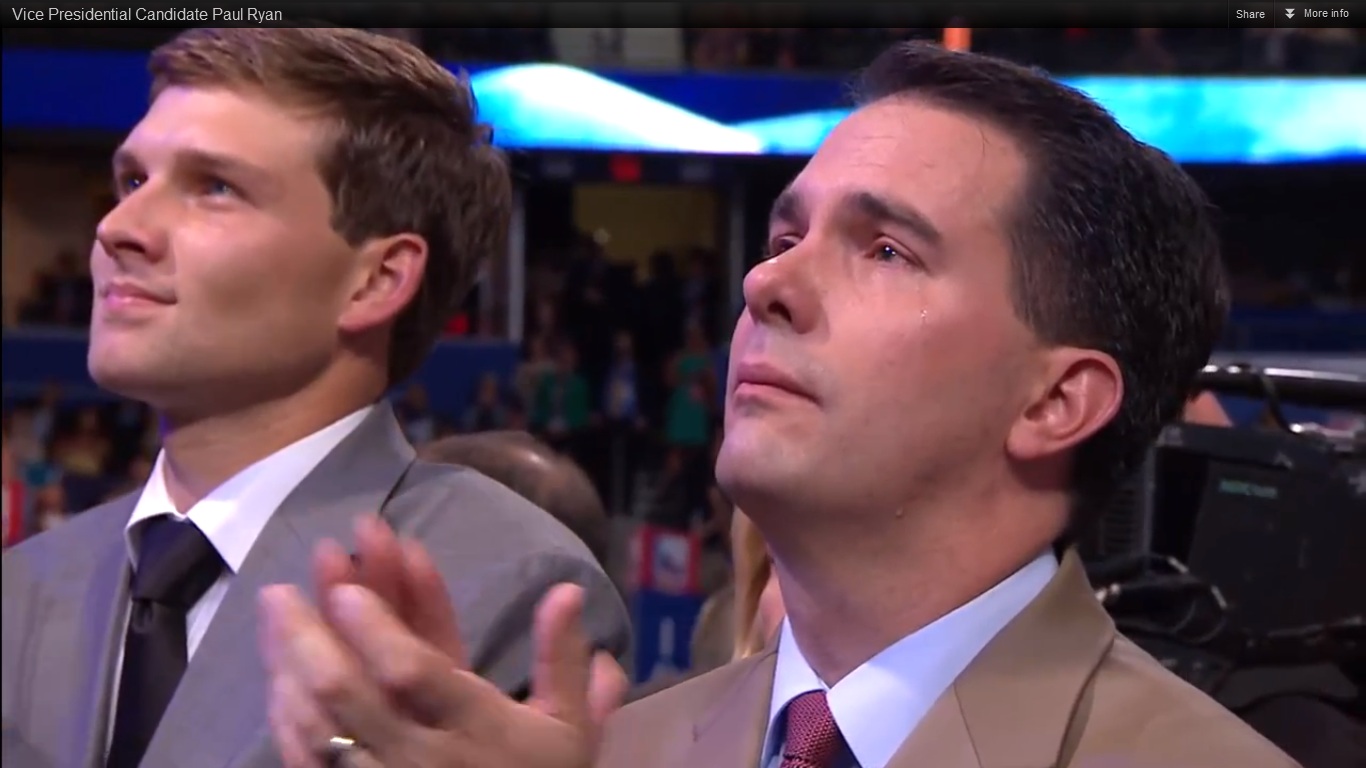
It brought Scott Walker to tears. How about you?

Enjoying reading about the last time I was this ticked off

At my desk at The State, evincing one of those moods./file photo from 2007

Today, grumpily wondering whether I’ll find the Democratic Convention next week as vapid, monotonous, insulting and obnoxious as I did the sliver of the GOP convention I listened to last night, I was reminded of column I wrote four years ago.

If past is prologue, it would seem the answer to my dreary question is “yes.”

That column, which ran on Aug. 31, 2008, was headlined, “Yelling at the television.” If you go back and read it, it will tell you what the rest of this week and all of next week will be like, if you find the parties as disgusting as I do.

A favorite excerpt:

What sets me off? Oh, take your pick — the hyperbole, the self-importance, the us-against-them talk, the stuff that Huck Finn called “tears and flapdoodle.”

Take, for instance, this typical bit from Hillary Clinton’s speech:

My friends, it is time to take back the country we love. And whether you voted for me or you voted for Barack, the time is now to unite as a single party with a single purpose. We are on the same team. And none of us can afford to sit on the sidelines. This is a fight for the future. And it’s a fight we must win together. I haven’t spent the past 35 years in the trenches… to see another Republican in the White House squander our promise…

Let’s deconstruct that a bit.

Take back the country? From whom? Did I miss something? Did the Russians roll right on through Gori and into Washington? No? You say Americans are still in charge, just the “wrong” Americans, of the wrong party? But your party controls Congress! Take it back from whom?

… a single party with a single purpose. Now there you’ve hit on the biggest lie propagated by each of the major parties, the conceit that there is something coherent and consistent about such loose confederations of often-incompatible interest groups. Did you not just spend the last few months playing with all the force you could muster upon those very differences, those very tensions — between feminists and black voters, between the working class and the wine and cheese set? What single purpose, aside from winning an election?

This is a fight… No, it isn’t, however much you love to say that. Again, I refer you to what the Russians are doing in Georgia — that’s a fight, albeit a one-sided one.

… that we must win together. Actually, that raises a particularly pertinent point, which is that the only “fights” that “must” be won are the ones in which “together” is defined as all Americans, or all freedom-loving peoples, whereas such divisive factions as your party and that other one that will meet in St. Paul militate against our being able to win such fights together.

I haven’t spent the past 35 years in the trenches… You’re absolutely right; you haven’t. So spare us the war metaphors.

… to see another Republican in the White House squander our promise… Like that’s what matters, the stupid party label. Like there isn’t more difference between you and Barack Obama in terms of philosophy and goals and experience and what you would bring to office than there is between John McCain and Joe Biden. Come on! Please!…

Sigh. Fume. Mutter.

Yep. I was thinking almost identical thoughts last night watching this convention.

I was pretty disgusted back then. Now, I enjoy reading about how disgusted I was. I always find that my writing improves with distance…

What do you mean, “we,” Kemo Sabe?

I imagine some in the GOP will be echoing that classic punchline after the latest pronouncement from Todd Akin:

“I haven’t done anything morally or ethically wrong,” Akin told Huckabee, saying the backlash against him “does seem like a little bit of an overreaction.”

“We are going to continue this race for the U.S. Senate,” Akin continued. “We believe taking this stand is going to strengthen our country, going to strengthen, ultimately, the Republican Party.”

So… who is this “we,” Kemo Sabe?

I’ve often wondered at politician’s odd penchant for saying “we” when they mean, “I.” So many times over the years I’ve asked an elected official, “What do you think about X?” and heard in reply, “We’re taking the position that…” No. There is no “we” here, white man. It’s you. You are the elected official (or the candidate), the only person responsible to the voters for the position you are taking, so don’t be trying to dilute accountability. You might have a team behind you, but you’re the only player who counts.

Sometimes I think pols believe it sounds less self-centered to say it that way. Other times, I believe they are presuming a certain grandiosity, as in the royal “we.”

Of course, a casual observer might note that I have often written “we” during my career as an editorialist. But that was different. If I were speaking of a personal column, I said, “I think.” If I were speaking for the editorial board — expressing the opinion of an institution, not an individual — I said “we.” The word added to clarity (assuming the listener was paying attention to the distinction), rather than detracting from it.

In any case, I would imagine there are plenty of Republicans right now who wish Akin would ixnay the eeway.

The new stylebooks are here! The new stylebooks are here!

I exchanged Tweets this morning with Paul Colford, director of media relations at The Associated Press. He was busily promoting the AP’s new U.S. Elections Style Guide, with tidbits such as this:

Election Day is uppercase; election night is not. See @AP’s new U.S. Elections Style Guide: http://bit.ly/Mrvs5u

I replied that I thought that had always been the rule, which caused Mr. Colford (see how I violated AP style there by calling him “Mr.”? I’m such a rebel) to respond that there was lots of other good stuff there.

I started looking into the subject, and saw that a whole new AP stylebook came out a couple of months ago, and I didn’t even know it. I’m not sure I even would have known it had I still been working at a newspaper. Aside from the fact that as editorial page editor I had long been deviating from AP style intentionally for years, I sensed that it wasn’t as big a deal as it had once been even among the mullahs of style orthodoxy.

(For those who have not spent their adult lives as journalists, perhaps I should explain: The AP stylebook is the guide to proper spelling and usage most widely accepted in print journalism. Newspapers that didn’t have their own full stylebooks — the vast majority — used it as their official bible, only issuing addenda for exceptions, local place names and the like.)

In my long-ago days as a copy editor (which was so long ago that I forget whether it is properly spelled that way or “copyeditor,” a lapse on my part that may be some sort of PTSD symptom), things were different. My colleagues and I who spent our days around the horseshoe-shaped desk at The Jackson Sun were really excited about the 1977 edition. We actually had a party at the managing editor’s house to distribute them. And there was much in this new release to satisfy the socially-challenged pedant. That was when the stylebook went, for the first time, from being a slim paper pamphlet that resembled the tracts that fundamentalists passed out with titles like “The Antichrist in Rome” to the thick, rich, spiral-bound volume that made it seem more like the Ultimate Answer to All Questions.

But that was then. In my last years at the paper, think I had one somewhere around my desk, but I almost never consulted it, and it was probably badly out of date. On the rare occasions when I looked something up to see what the style was so I could decide whether I wanted to follow it or not, I did so electronically. And yet I see one can still order the spiral-bound version.

Which is kind of nice. But it feels like almost as much an artifact of the past as those phone books that once so excited Navin Johnson.

A blast from SC’s past (and present, alas)

There was a meme bouncing around on Twitter this morning having to do with the expression “dog whistle politics.” It’s a phrase you’ve probably heard before, which is easy to understand intuitively, but I was curious about its provenance, so I looked it up. And I found a little gem that, if I had read it before, I had forgotten.

This is from the Wikipedia entry on the term. WARNING: OFFENSIVE LANGUAGE:

One group of alleged code words in the United States is claimed to appeal to racism of the intended audience. The phrase “states’ rights“, although literally referring to powers of individual state governments in the United States, was described by David Greenberg in Slate as “code words” for institutionalized segregation and racism.[8] In 1981, former Republican Party strategist Lee Atwater when giving an anonymous interview discussing the GOP’s Southern Strategy, said:

You start out in 1954 by saying, “Nigger, nigger, nigger.” By 1968, you can’t say “nigger” — that hurts you. Backfires. So you say stuff like forced busing, states’ rights and all that stuff. You’re getting so abstract now [that] you’re talking about cutting taxes, and all these things you’re talking about are totally economic things and a byproduct of them is [that] blacks get hurt worse than whites. And subconsciously maybe that is part of it. I’m not saying that. But I’m saying that if it is getting that abstract, and that coded, that we are doing away with the racial problem one way or the other. You follow me — because obviously sitting around saying, “We want to cut this,” is much more abstract than even the busing thing, and a hell of a lot more abstract than “Nigger, nigger.”[9][10]

Assuming that actually was South Carolina’s own Lee Atwater speaking (and it sounds like him), that’s the most direct line I’ve ever seen drawn — by an insider, that is — from the old segregationist politics, through the Southern Strategy and the redefinition of the Solid South, to today’s anti-government, anti-tax ideology.

The implication has been, ever since we entered this phase, that government is all about taking money from people like us and giving it to those people. Which of course is an idiotic understanding of what government is and whom it benefits, but it’s a line of thinking we often hear, with varying degrees of explicitness.

The thing is, most of the anti-government crowd would be furious at being called racist, and would indignantly point to Tim Scott and the sometimes nonwhite Nikki Haley as “proof” that they haven’t a racist bone in their bodies. And indeed, some of them (such as Mark Sanford, and his longtime friend and ally Tom Davis) are just natural-born libertarians. But far, far from all.

The thing about Atwater was that unlike the true believers, he was aware of what he was doing. That’s what made him so good at it.

Of course, as he points out, this is a process of distillation that takes us from the physical-world idea of race and transforms it to a pure abstraction that doesn’t literally bear on skin color. So it actually does become something other than racism, a set of attitudes more intellectualized than merely a visceral response to melanin. So those who become indignant at cries of “racism” do have a leg to stand on, and get angrier and angrier at having such an epithet flung at them. And so the back-and-forth accusations about what such attitudes really imply leads to even greater alienation, and the polarization of our politics gets worse and worse.

But you knew that, right?

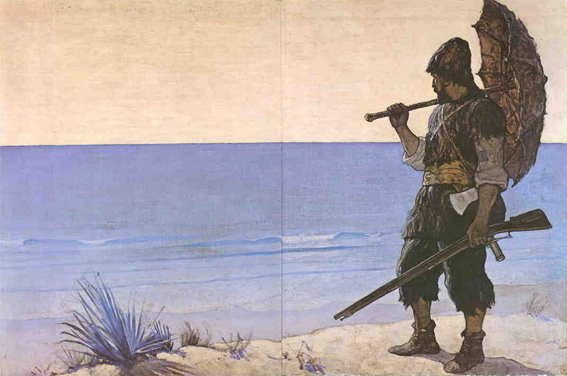
Only Robinson Crusoe did it alone — and then only until Friday came along

And note that not even he made the musket, or the hatchet.

Since I’m not at the paper any more, it fell to Cindi Scoppe to write this column that ran today, basically addressing the orgy of indignation among the libertarians who call themselves conservatives over President Obama’s unfortunate choice of words in explaining the painfully obvious fact that practically no one in our crowded, interdependent world achieves anything worthwhile alone:

A LOT OF what the president says and does is ripe for criticism. But what he said the other day about no one being an island, about how our parents and our communities and our teachers and mentors and, yes, our government all contributed to our success is not one of those things.

If you’re wondering who in the world would criticize such obvious commentary, it’s because you don’t recognize the full context of that bizarre, ridiculous, one hopes bungled quote that came in the middle of it: “If you’ve got a business — you didn’t build that. Somebody else made that happen.”…

Of course business owners built their businesses — unless they inherited them or bought them from someone who did. Their initiative and hard work and luck set them apart.

As important as parents are to our success, one sibling can create a multi-billion-dollar business while another languishes on welfare. As much as we need good teachers, even the best have some students who drop out of school. Although government policy can give some businesses a leg up, others can go bankrupt even with too-generous government grants.

That’s because some people have initiative, and some do not. Some people are creative, and some are not. Some people are smart, and some are not. And while the schools can affect which group any individual is in, government does not eliminate those basic differences.

At the same time though, the vast majority of people who own businesses would not have been able to do that if we didn’t have a monetary system and a court system and roads and police and other functions of government. The vast majority of people who have any sort of success would not have it in a world without government. In fact, they wouldn’t have it if not for the peculiar kind of government that our country embraced from the start: self-government.

Can, and should, our government be more efficient? Of course so. Is there room to debate whether the government should bail out the banks or the auto industry or help pay for our medical care? By all means. Is there a legitimate question as to whether taxes are too high or too low? Certainly.

But the vast majority of Americans would not have the lives we take for granted — lives that are inconceivably luxurious compared to the lives lived by the overwhelming majority of people throughout human history — if it weren’t for our flawed but better-than-any-alternatives government.

Seems to me Cindi was being slightly over-cautious in saying that only “the vast majority of people” would have gotten nowhere without the basic conditions — civil order, rule of law, basic infrastructure — that are provided through the processes we call “government.” I suppose there are some to whom that doesn’t apply, but very few. It’s even harder to think of anyone who accomplished anything worthwhile completely and utterly alone — without anyone, whether you’re talking about government or not.

I suppose there’s Robinson Crusoe — that is, until Friday came along. This reminds me of an economics exercise we did in high school. We had to suppose we were stranded on a desert island, and we had to allocate our resources — which included time, and effort — so as to survive. This much time building a shelter out of available materials meant that much less time spent gathering food. X amount of time spent making a tool that would facilitate building that shelter cuts the construction time, leaving more time to weave a net to make fishing easier, etc.

A castaway who is completely alone can create something useful — to him, anyway — without anyone else’s involvement. But a business, in our crowded society? Well, to start with, you have to have customers. And then, depending on your business, there are suppliers, and vendors providing services that it would be inefficient to perform yourself. And as you grow, there are employees who become essential to your further growth, etc. Without the willing participation of those often vast networks of people, you can work and create all you want, but you’re not getting anywhere.

The extreme libertarians would put government in another category from just “people.” But in our system, the government and the people are the same thing. “Government” is just the word for the set of arrangements that we have among us, the people, for handling certain things that are best handled that way, such as building roads or deepening a port or passing and enforcing the laws without which the concept of private property is meaningless.

In fact, if I had a quibble with Cindi’s column, it would be that, in her litany of things for which government is essential, she kept referring to government as “it.” As in, “It creates and maintains a monetary system,” and “It provides a civil justice system…”

Given the screwy way so many of our neighbors these days think of government, that can be misunderstood as government being some separate entity that provides certain things to us, the people. But it’s not that at all. A better word than “it” would be “we,” because government is simply the process through which we create and maintain a monetary system, provide a civil justice system, and so forth.

Government does not give or take away. It’s just the arrangements through which we, the people, do certain things that we decide, through our system of representative democracy, are best done that way.

Driveby Beat, Hawaiian Style: Thanks for sharing, Burl!

On a previous post, I noted that years ago I lobbied for creation of a “driveby beat” at The State — to have a reporter dedicated to answering people’s understandable curiosity about things they drove by and wondered about in the Midlands. It would have been a wonderful way to root the paper and readers solidly in the community, aside from telling people something they actually wanted, and occasionally perhaps even needed, to know.

Also, it would satisfy my own curiosity about a lot of things, which to my mind was, to a great extent, what reporters were for. There was always that.

Anyway, it never happened — although I saw that today, The State actually did have a story about what was going on at the State Fairgrounds, which I had driven by and wondered about just yesterday.

Anyway, when I brought it up, Burl Burlingame noted that he actually used to have such a beat, which was his idea (it must have been subliminal planted in both our brains at Radford High School) at the Honolulu Star-Bulletin. Here and here and here are some links.

And here’s an excerpt from his “Wat Dat” (I don’t think I’ll have to translate that pidgin for you) feature:

Somebody whose name we can’t read – but who does draw a nice map – was curious about a brown statue or chimney standing at the end of row of trees just north of the Mililani exit.
It is a statue, and it’s of a tree trunk, rising more than 30 feet above a circular grassy platform, which is in turn surrounded by a large gravel walkway, which is atop a tall wall – kind of a rounded ziggurat – which is accessed by a grand tile stairway, which is approached by carefully tended Japanese gardens, which are guarded by carefully repaired antique marble Chinese lions, which are flanked by enormous granite slabs, which cap hobbit-like stools and benches that seem to be made out of logs but are really cast cement, which are parked beneath a series of carefully tended trees, which have the names of local politicians inscribed upon signs at the foot of each.

The area is grand and imposing, and at the same time intimate and quiet. It’s also generally deserted, which adds to the otherworldly experience.

This is one of the WatDatiest of WatDats to come along in some time!

The site is the local mission of the Honbushin Honbu, a Shinto religious sect with nearly a million followers, mostly in Japan. There is also a mission in China…

The “sculpture” is a koa log that seems to be protected by a coat of brown paint. It’s called “GENTEN,” which, translated from Japanese, means roughly “starting point” or “origin.”

The sculpture represents nature and the unity of hearts, religions and countries that work toward peace. Honbushin missionaries regularly gather around the genten and pray…

Of course, in Hawaii, the stuff you drive by and wonder about has a tendency to be slightly more exotic than what we have around here…

An example of an op-ed rebuttal: Answering Glenn McConnell in 2007

During the discussion on a previous post, I noted that “I have been known, on one or two occasions, to allow a source space for a full op-ed piece, even when the piece is almost 100 percent nonsense… and run a piece of my own, right across from it, demolishing it. That way the reader/voter has a chance to see that party’s full case, as well as the arguments against it.”

Bud, quite reasonably, asked, “An example would be good. Sometimes people think they demolish something but it turns out not to be the case. Let the bloggers be the judge.”

Fine. Except I could only think of a couple of cases (as I said, there were “one or two”), but I couldn’t immediately lay my hands on either one of them.

I’ve now located one of my examples. It’s not a perfect one. In this case, for instance, I didn’t rebut the op-ed piece until days later — either because I didn’t have column space until then, or because something that happened later in the week got my dander up, and caused me to recall the previous piece. I don’t know; it’s been almost five years now.

Anyway, the piece that (eventually) set me off was by Glenn McConnell, and I ran it in The State on Friday, Oct. 19, 2007. Here it is:

By Glenn F. McConnell Guest Columnist

South Carolina can only have an orderly, predictable and consistent growth rate in state spending by constitutionally mandating it. It cannot be accomplished on a reliable basis by hanging onto slim majorities in the Legislature and having the right governor. The political pressures are too great unless there is a constitutional bridle on the process.
That is the reason I created a task force to consider a constitutional amendment that would cap the growth in spending by the state. The first meeting of the Senate study committee on constitutionally capping state government spending is scheduled for 1 p.m. Wednesday in Room 105 of the Gressette Senate office building in Columbia.

There will always be more needs than revenue no matter what the economic times and the amount of available new funds. Government must, therefore, temper its conduct to spend so that over the highs and lows in revenue forecasts, the necessary revenue will be there to fund essential needs without the pressure for new taxes.

When government is flush with money, the spending goes up to fund many new initiatives — some good, some questionable and some not good. In other words, projects get funded not so much out of merit but merely because the money was available. Some one-time expenditures also occur the same way. In the face of a bountiful taxpayer buffet, government cannot control its appetite, so its stomach must be stapled.

At stake is the need to at least control the rate of growth in the recurring base. So I have introduced a constitutional amendment to cap the rate of spending of our state government. Government would be limited to growth at an amount that would not exceed the rate of population growth plus the growth in personal income. Basically, government should not grow any bigger than it needs to be or any faster than people’s ability to pay for it.

I have been an ardent supporter of both Barry Goldwater and Ronald Reagan, and I believe that government is best which governs least. I also believe that as much money as possible is best left in the hands of people if we are to economically advance. If people keep more, they have greater opportunities to invest and spend so our economy will expand. It is a matter of fairness.

If there are surpluses in Columbia, these should not expand the obligation to fund a growing government but instead should be used to reduce long-term debt and obligations, fund capital projects to avoid issuing costly bonds, cover one-time costs, save and carry forward for a rainy day, and/or fund tax refunds and tax cuts.

The constitutional amendment would foster growth in the private sector, challenge legislators to prioritize spending better, seek better efficiencies in the operation of government and privatize operations where it is in the state’s best interest. This will present new opportunities to create rainy-day funds, to create a more debt-free South Carolina and to replenish trust funds that too often have been tapped in lean times to fuel the insatiable appetite of government created by overspending in good times.

Finally, we all must realize that our state government, just as much as any business, has to be competitive in order to attract and retain jobs. We need to provide essential services, but we need to do it in a way that ensures excellence, efficiency and long-term cost control. Throwing dollars at an agency does not ensure that it will be better. Limiting the growth in spending ensures that the challenge for each budgeting year is to do more with what we have available rather than to spend more to get the job done.

Working together, we can give the people of South Carolina an opportunity to vote on whether they want this limitation on the growth of spending. As I said, the limitation, if adopted, would ensure our future is not one of ups and downs based on political fortunes but instead one of predictability and orderliness in the growth of South Carolina.

Mr. McConnell, a Charleston attorney and businessman, is president pro tempore of the Senate and chairs the Senate Judiciary Committee.

As I said, that ran on Friday, so I’m beginning to see what probably happened. I generally wrote my Sunday columns on Fridays. I would have read the senator’s piece — most likely for the first time — on the page proof Thursday afternoon, so it would have been quite fresh in my mind. I might have even ripped out a few grafs of my response right then, and polished them somewhat the next morning.

You’ll note, though, that my column wasn’t just a response to McConnell. I didn’t even get to him until about halfway through. This column was of a certain type, the type that puts me in mind of a line Mark Twain wrote: “And now that my temper is up, I may as well go on and abuse every body I can think of.” I always liked that line because it describes a mood that is very familiar to me.

Here’s my column that ran on Sunday, Oct. 21, 2007:
IN SOUTH CAROLINA, WE KEEP TALKING ABOUT THE WRONG THINGS

By Brad Warthen Editorial Page Editor

We always seem to be having the wrong conversations in South Carolina. Sometimes, we don’t even talk at all about the things that cry out for focused, urgent debate.

Look at this joke of a commission that was assigned to examine whether the city of Columbia should ditch its ineffective, unaccountable, “don’t ask me” form of government. It was supposed to report something two years ago. And here we are, still waiting, with a city that can’t even close its books at the end of the year. Whether its that fiscal fiasco, or the failure to justify what it did with millions in special tax revenues, or the rehiring of a cop who was said to be found drunk, naked and armed in public, there is no one who works directly for the voters who has control over those things.

But as bad as it is to have no one to blame, there is no one to look to for a vision of positive action. A city that says it wants to leap forward into the knowledge economy with Innovista really, really needs somebody accountable driving the process.

Columbia needed a strong-mayor form of government yesterday, and what have we done? Sat around two years waiting for a panel that didn’t want to reach that conclusion to start with to come back and tell us so.

It’s worse on the state level.

What does South Carolina need? It needs to get up and off its duff and start catching up with the rest of the country. There are many elements involved in doing that, but one that everybody knows must be included is bringing up the level of educational achievement throughout our population.

There are all sorts of obvious reforms that should be enacted immediately to improve our public schools. Just to name one that no one can mount a credible argument against, and which the Legislature could enact at any time it chooses, we need to eliminate waste and channel expertise by drastically reducing the number of school districts in the state.

So each time the Legislature meets, it debates how to get that done, right? No way. For the last several years, every time any suggestion of any kind for improving our public schools has come up, the General Assembly has been paralyzed by a minority of lawmakers who say no, instead of fixing the public schools, let’s take funding away from them and give it to private schools — you know, the only kind of schools that we can’t possibly hold accountable.

As long as we’re talking about money, take a look at what the most powerful man in the Legislature, Sen. Glenn McConnell, had to say on our op-ed page Friday (to read the full piece, follow the link at the end of this column):

South Carolina can only have an orderly, predictable and consistent growth rate in state spending by constitutionally mandating it. It cannot be accomplished on a reliable basis by hanging onto slim majorities in the Legislature and having the right governor. The political pressures are too great unless there is a constitutional bridle on the process.

The people of South Carolina elect 170 people to the Legislature. In this most legislative of states, those 170 people have complete power to do whatever they want with regard to taxing and spending, with one caveat — they are already prevented by the constitution from spending more than they take in.

But they could raise taxes, right? Only in theory. The State House is filled with people who’d rather be poked in the eye with a sharp stick than ever raise our taxes, whether it would be a good idea to do so or not.

All of this is true, and of all those 170 people, there is no one with more power to affect the general course of legislation than Glenn McConnell.

And yet he tells us that it’s impossible for him and his colleagues to prevent spending from getting out of hand.

What’s he saying here? He’s saying that he’s afraid that the people of South Carolina may someday elect a majority of legislators who think they need to spend more than Glenn McConnell thinks we ought to spend. Therefore, we should take away the Legislature’s power to make that most fundamental of legislative decisions. We should rig the rules so that spending never exceeds an amount that he and those who agree with him prefer, even if most South Carolinians (and that, by the way, is what “political pressures” means — the will of the voters) disagree.

Is there a problem with how the Legislature spends our money? You betcha. We don’t spend nearly enough on state troopers, prisons, roads or mental health services. And we spend too much on festivals and museums and various other sorts of folderol that help lawmakers get re-elected, but do little for the state overall.

So let’s talk about that. Let’s have a conversation about the fact that South Carolinians aren’t as safe or healthy or well-educated as folks in other parts of the country because lawmakers choose to spend on the wrong things.

But that’s not the kind of conversation we have at our State House. Instead, the people with the bulliest pulpits, from the governor to the most powerful man in the Senate, want most of all to make sure lawmakers spend less than they otherwise might, whether they spend wisely or not.

The McConnell proposal would make sure that approach always wins all future arguments.

For Sen. McConnell, this thing we call representative democracy is just a little too risky. Elections might produce people who disagree with him. And he’s just not willing to put up with that.

As you can see, that was a very South Carolina column. Everything addressed in it, everything that was getting my temper up, was something that one could just as well be said today. Because in South Carolina, very little that ought to change ever changes.

More evidence in defense of John Rainey

As long as I’m mentioning Cindi and Warren today, I’ll go ahead and call your attention to something else I saw in The State this morning. It was a column by Kathleen Parker, in which she stuck up for John Rainey in light of our governor’s emotional attack on him.

Remember her oh-so-classy way of defending herself against the ethical questions Rainey had raised? She called him “a racist, sexist bigot who has tried everything in his power to hurt me and my family.”

I briefly touched on a couple of things that just leapt to mind about John Rainey that seemed at odds with that assessment. Since Kathleen is still paid to write columns, she dug a good bit deeper and came up with some other examples of things that make Rainey sound like anything but what Nikki Haley says he is:

Inarguably, the governor’s charges, made publicly and aimed at a citizen, albeit a powerful one, are far more damaging than whatever Rainey said during a private meeting. Judge as you may but consider the following facts before accepting Haley’s indictment of Rainey.

Rainey

For no personal gain, Rainey frequently has raised money and organized groups in common cause across party lines. He and his wife, Anne, marched in 2000 with 46,000 others to protest the Confederate flag, which then flew atop the state Capitol dome. He personally hosted several private meetings with NAACP and legislative leaders to find a compromise for the flag’s removal.

He served as executive producer and raised funds to finance Bud Ferillo’s documentary “Corridor of Shame,” about the dismal condition of public schools along the Interstate 95 corridor through South Carolina. Candidate Barack Obama visited one of those schools and cited the corridor in campaign speeches.

In 1999, Rainey chaired the fundraising committee for the African-American History Monument on Statehouse grounds. In 2002, while chairman of Brookgreen Gardens, he raised funds to erect a World War I doughboy statue in Columbia’s Memorial Park and sponsored a bust of a 54th Massachusetts Infantry African American soldier. He received the sixth annual I. DeQuincey Newman Humanitarian Award in 2004, named for the United Methodist minister and first African American elected to the state Senate following Reconstruction.

Latest to the roster is a sculpture that Rainey has commissioned, honoring two Camden natives, financier Bernard Baruch and baseball great Larry Doby. Baruch was a philanthropist, statesman and consultant to presidents (Woodrow Wilson and Franklin D. Roosevelt). Doby was the first African American to play in the American League and was inducted into the National Baseball Hall of Fame in 1998.

The sculpture, which will be unveiled in April, is a monument not only to two local heroes but also to the sort of reconciliation Rainey represents. His record speaks louder than words.

Warren’s absolutely right, Moe

What caused him to change his mind?/Photo by Brett Flashnick

I certainly hope Moe Baddourah read Warren Bolton’s column this morning, and took it to heart. Excerpts:

WHILE COLUMBIA City Councilman Moe Baddourah will take his first formal vote at today’s council meeting, it’s doubtful that many of his official votes loom as large as an unofficial decision he made following a May 8 public hearing.

That was the day he back-tracked on what had been a strong stance in favor of allowing voters to decide whether the city should change its form of government from council-manager to strong mayor. Up until then, it seemed evident that when Mr. Baddourah and Cameron Runyan joined the council — they both were sworn in last week — the seven-member body would have a majority in favor of putting strong mayor on the ballot.

As a matter of fact, some had questioned whether the council seated in May should even have voted, knowing that it could make a decision very different from what the new council that assembles today would make. It was generally thought that there was a 4-3 split against strong mayor at that time…

When Mr. Baddourah visited with our editorial board prior to the April city elections, he was emphatic in saying that Mayor Steve Benjamin needed more authority. “I think Columbia is ready for that,” he said.

“We need a (full-time) mayor for the city to bring business in,” Mr. Baddourah said. “I’d love for Benjamin to be a full-time mayor. I think he’s a really good face for the city.”

So, imagine my surprise as I watched the public hearing, held during a council meeting, live online only to see Mr. Baddourah do a 180 when he and Mr. Runyan were put on the spot as to how they might vote once they joined the council.

Maybe it was the pressure of the moment. Or maybe he genuinely changed his mind. Whatever the case, it was abrupt and damaging to the effort to allow voters to have a say as to what form of government they choose to live under…

I’m not much of one for campaign promises. I generally think candidates should keep their options open for what they encounter in office. I even think when they do make the mistake of promising something, they should be free to change their minds — as long as they can make a good case for it.

But come on. In this case, Moe had just been elected, and had been elected not only indicating he’d support letting voters decide, but asserting strongly that he favored a certain outcome from that public vote.

And then, without having been through any discussion or other discernment process that was visible to the voters, he announces that he won’t even let the voters themselves decide the issue, and does it before he even takes office? Really?

It’s as shocking and as sudden and as premature a turn-around as I’ve ever seen.

This is indeed a case in which a mind so easily changed should carefully consider changing back. And then he should explain fully to the people who elected him what caused him to make such a strange announcement between the election and taking office.

Yes, “trackers” HAVE gone wild, and then some

A shot from video footage taken outside the home of a candidate.

Earlier today, Politico posed the question on Twitter, “Democratic trackers gone wild?

While most serious campaigns on both sides use campaign trackers — staffers whose job is to record on video every public appearance and statement by an opponent — House Democrats are taking it to another level. They’re now recording video of the homes of GOP congressmen and candidates and posting the raw footage on the Internet for all to see.

That ratcheting up of the video surveillance game is unnerving Republicans who insist that even by political standards, it’s a gross invasion of privacy. Worse, they say, it creates a safety risk for members of Congress and their families at a time when they are already on edge after a deranged gunman shot former Arizona Democratic Rep. Gabrielle Giffords 18 months ago.

Wisconsin GOP Rep. Reid Ribble, who said he’s also been followed by a cameraman when shopping for groceries, said the home videos cross a line.

“I feel it’s totally inappropriate,” said Ribble, a freshman facing a competitive race for reelection. “It was disturbing to me that they would put that online. I don’t understand any political benefit that can be achieved with that.”…

Yes, indeed, say I. They’ve gone too far. But then, I think the whole phenomenon went overboard, across the spectrum, years ago. I have a low threshold with this kind of stuff.

There’s nothing illegal, certainly, about following one’s opponent around with a video camera. And everyone does it, right? One can even argue that a conscientious candidate should be fully aware of what his opponent has to say.

But in this era of saturation communication, stalking one’s opponent with a camera hoping for a slipup, a gotcha! moment, is not only unnecessary, there’s something low about it. And I confess that when I’m at a political event, and I spot the opposition’s tracker, I can’t help looking upon that person with something akin to disdain.

I don’t expect many people to agree with me on this. Certainly not many journalists today, since so much of their material comes from this sort of thing.

But I was always a different sort of journalist. I always wanted to know what a candidate has to say after he thinks for a minute, not what he says when he misspeaks. Some pop-Freudians believe the slip is the truth. Sometimes it is, sadly. But I’ve always valued more what the candidate says when you give him or her a chance to think a little harder about it. When a candidate says, “That’s not what I meant,” the gotcha folks snicker. Me, I start paying closer attention to find out what he or she did mean. And I flatter myself that I can tell, usually, if the further explanation is just blowing smoke.

Maybe I look for the second thought because that’s how I hope (idealist that I am) that they will govern — in a deliberative manner, with their ideas morphing and growing and getting better in a ferment with other ideas. I want to be governed by what people think upon further reflection, not the first thing that pops into their heads.

And even if they never achieve that, I want to give them every opportunity to do so.  I want to hear the “yes, but…,” the second and third and fourth thoughts. I want depth of consideration. Deliberation, the thing upon which republican government relies.

But the “tracker” is a manifestation of a political culture that does not value further reflection. And therefore is a sign of a political culture in decline.