Category Archives: Technology

Spam of the Day: ‘Your dog had been 100% appropriate’

Sometimes I read the spam comments before deleting them, because I enjoy their wonderfully eccentric use of language. This one today was particularly pleasing:

My cousin encouraged I’d personally possibly this way web page. Your dog had been 100 % appropriate. This particular blog post really designed this morning. Anyone can not consider only how the ton period I had created wasted for this information and facts! Thanks!

Judging by the URL, it was some sort of porn site. And no, I didn’t click on it. You can catch something doing that. But in any case, I doubt there was anything there as diverting as that cockeyed attempt to make me think I was dealing with a fan.

That seems to be the usual approach of these things, something like, “Your site am delicious. Me come back many time.”

Does it ever actually work? Are some bloggers and website hosts really that desperate for praise that they’ll go, “This person really LIKES me! To the point that he’s rendered incoherent! I must in return check out his site…?”

Of COURSE we trust the NSA more than Facebook

Someone over at Slate seemed to be marveling over this “contradiction:”

One big reason why Americans aren’t that outraged by the revelations that the U.S. government runs a massive online and cellphone spying operation: People already assume they’re being tracked all over the Internet by companies like Google and Facebook.

Yesterday’s Washington Post/Pew poll showed that 56 percent of Americans view the NSA’s snooping as “acceptable,” while 45 percent think it should be allowed to go even further. Contrast that with a 2012 AP-CNBC poll that found only 13 percent of Americans trust Facebook to keep their data private, while another 28 percent trust the company “somewhat.” The majority had little to no faith in the company to protect their privacy.

The numbers aren’t perfectly parallel. But they suggest that the average American is more comfortable with the government’s spying than with Facebook’s control over their personal information…

Well, duh. Of course we trust the NSA more than we do Facebook. The NSA, the hysteria of recent days notwithstanding, works for us, and is constrained by the laws of this country and the elected and appointed representatives who have oversight over it, and who ultimately answer to us. Yes, that’s the way it actually is, contrary to all the “Big Brother” hyperventilating from the likes of Rand Paul.

Whereas Facebook works for Mark Zuckerberg. I didn’t elect Mark Zuckerberg. Nor did I elect anyone who appointed Mark Zuckerberg, or in any way keeps an eye on him and holds him to account in my behalf.

And in fact, after pulling us in with the headline, “People Trust the NSA More Than Facebook. That’s a Shame,” the Slate writer acknowledges some of the reasons why that would be so:

From a selfish perspective, that makes some sense: Most Americans assume they’ll never be the target of a terror investigation—and that the government has little use for their information otherwise. Facebook, in contrast, relies on the personal information of all of its users. It doesn’t intend to prosecute them for crimes, of course—just show them personalized advertisements. But for many people, the fear of having an illicit relationship, a racy photo, or personal communications unintentionally revealed to their friends and colleagues is more visceral—and more realistic—than the fear of being wrongly prosecuted for a crime. And whereas most people can appreciate the NSA’s interest in monitoring their communications, they have a harder time seeing the upside to Facebook’s data collection. It’s not like Mark Zuckerberg is going to use their old status updates to prevent the next terror attack.

And that doesn’t just make sense “from a selfish perspective.” It makes sense, period. As this piece notes, Mark Zuckerberg isn’t going to prevent the next terror attack, nor is he expected to. His job is making money for Facebook. Leave him to it. That’s his business, not ours (unless we’re one of the saps who jumped at his IPO).

If we trusted Facebook more than we did the NSA, now that would be a shame. It would mean that our whole system of representative democracy was failing. Which it isn’t.

HD images that weren’t meant for HD

spock

I find it interesting to view old TV series and other works from the pre-HD era in HD.

It’s strange, for instance, to look at “Star Trek” — the original series — on Netflix on my iPad, with its Retina display.

We just weren’t meant to see every detail of Mr. Spock’s makeup, or count the pores on his face. With the TVs we had in 1966, we were lucky even to be able to tell it was Mr. Spock.

As unemotional as he was, I think even Spock himself would regard this phenomenon as… unsettling, Captain…

spock2

NSA data-mining vs. actual invasion of privacy

I thought the WSJ made an interesting point in an editorial this morning:

The NSA is collecting “metadata”—logs of calls received and sent, and other types of data about data for credit card transactions and online communications. Americans now generate a staggering amount of such information—about 161 exabytes per year, equal to the information stored in 37,000 Libraries of Congress. Organizing and making sense of this raw material is now possible given advances in information technology, high-performance computing and storage capacity. The field known as “big data” is revolutionizing everything from retail to traffic patterns to epidemiology.

Mr. Obama waved off fears of “Big Brother” but he might have mentioned that the paradox of data-mining is that the more such information the government collects the less of an intrusion it is. These data sets are so large that only algorithms can understand them. The search is for trends, patterns, associations, networks. They are not in that sense invasions of individual privacy at all.

If the NSA isn’t scrubbing vast amounts of data, then it can’t discover who is potentially a threat. The alternative to automated sweeps is more pervasive use of lower-tech methods like wiretaps, tracking and searches—in a word, invasions of persons rather than statistical probabilities. The political attack on data-mining could increase rather than alleviate the risk to individual rights.

3D food printer, circa 1956

On my previous post about space travel and 3D printers, mention was made of the Star Trek “food replicator.”

But I seemed to recall that sci-fi had imagined this device much earlier than that.

Indeed, in the 1956 classic “Forbidden Planet,” starring Walter PidgeonAnne Francis, and Leslie Nielsen, there is a robot that has a sort of miniature 3D food printer built into its torso.

I couldn’t find a clip showing that from the actual film, but I did find this promotional short in which the robot explains how it is able to replicate food of any kind, in any amount. All that is needed is a small sample of the food — which I suppose makes it more of a 3D food copier than printer.

But whatever. I thought I’d share it. Also, I refer you to a story Burl brought to our attention, about how a 3D printer saved a baby’s life.

This is just astounding technology…

Robbie the Robot, a pre-comedy Leslie Nielsen, and pre-Honey West Anne Francis (who showed her gams a LOT in this one).

Robbie the Robot, a pre-comedy Leslie Nielsen, and pre-“Honey West” Anne Francis (who showed her gams a LOT in this one).

Why does Google’s so-called “All Access” service not want my business?

Pandora accommodates me with an iPad app. Why won't Google All Access?

Pandora accommodates me with an iPad app. Why won’t Google All Access?

The moment I heard that Google was starting a music subscription service, I decided I would do with this one what I had not done with Pandora or Spotify: Pay for it.

Well, not right away. I saw that I could get it free for a month, and then pay at the discounted rate of $8 a month thereafter. If I didn’t like it the first month, I just wouldn’t pay.

But I figured it’s Google, right? So I’ll probably like it. Anyway, it would probably be integrated with my gmail and my YouTube account and everything else, so it would be convenient. Just yesterday, I used Google’s Hangout for the first time, for a three-way conversation that worked pretty seamlessly within my Google+ iPad app. There were glitches, but so far I like it better than Skype.

So I was all set to sign up when I saw this AP review:

LOS ANGELES (AP) — Google Inc.’s new music service offers a lot of eye candy to go with the tunes. The song selection of around 18 million tracks is comparable to popular services such as Spotify and Rhapsody, and a myriad of playlists curated along different genres provides a big playground for music lovers.

The All Access service represents Google’s attempt to grab a bigger piece of the digital music market as more people stream songs over mobile phones. Such services are also meant to further wed smartphone users to Google’s Android operating system, where the search leader makes money from advertising and transactions on its digital content store, Google Play.

For a monthly fee, All Access lets you listen to as much music as you want over an Internet connection. You can also download songs onto mobile devices for smooth playback later when you don’t have cellphone or Wi-Fi access.

It’s worth a try for the discounted monthly rate of $8 if you sign up by the end of June. Those who sign up later will pay $10 a month, the same amount charged by the main competitors, Spotify and Rhapsody. Either way, you get the first month free and can cancel at any time…

Sounds good, right? Then I got to this part…

All Access works on the free Google Play Music app for Android devices and over Web browsers on computers — but not on the iPhone. (Spotify and Rhapsody work on both Android and the iPhone).

And not, as I read elsewhere, on my iPad, either.

I’ve got some news for Google…

According to Google’s own Analytics, more than a fifth — 22.48 percent — of this blog’s readers read it on a smartphone or tablet.

Of those, more than three-fourths — 75.8 percent — are reading this on an Apple device.

So, unless my audience is unrepresentative of the larger world (or unless, ahem, Google Analytics is wrong), right off the bat, Google is saying it only wants the business of less than one-fourth of the mobile/tablet market.

How stupid is that?

Does anyone at Google really think that satisfied iPhone and iPad users — who know, according to Google’s own Analytics, that their platforms are the current standard for which most software will be written — are going to switch to what they consider to be a lesser product just because they can sign up for a music service? When they can already get Spotify and Pandora? And when they know that an iTunes subscription service is in the works?

This speaks to a larger problem in the tech world: I thought the people at Apple were insane when they came out with the iPhone 5 without Google Maps. It really irritated me that they weren’t smart enough, humble enough to realize that Google did maps best, that it was way out ahead of anything Apple could do to imitate it, and if they really wanted their customers to have the best, they would serve them up Google Maps, as they had done with the iPhone 4. YouTube, too.

Fortunately, I was immediately able to download those Google apps for both my phone and my iPad, so no harm done.

And I see in this report from Wired that a third-party iPhone app that will give me Google All Access is in the works, too (although, when I tried to get it from the Apps Store just now, I was told it still doesn’t work for the new service).

But why should I need workarounds? Why can’t Apple recognize that Google does maps better, and Google recognize that Apple does phones and tablets better? Or, at the very least, recognize that three-fourths of the market out there believes it does, and isn’t going to use your product unless it is accommodated?

I just don’t get these people and their proprietary hubris…

Would you like a 3D print of fries with that?

star-trek-food-replicator

We don’t have flying cars yet, or time travel, but I’m encouraged to see that NASA is at least working on this

NASA can send robots to Mars, no problem. But if it’s ever going to put humans on the Red Planet, it has to figure out how to feed them over the course of a years-long mission.

So the space agency has funded research for what could be the ultimate nerd solution: a 3-D printer that creates entrees or desserts at the touch of a button.

Yes, it’s another case of life imitating “Star Trek” (remember the food replicator?). In this case, though, the creators hope there is an application beyond deep-space pizza parties. The technology could also be used to feed hungry populations here on Earth.

Texas-based Systems and Materials Research Corp. has been selected for a $125,000 grant from NASA to develop a 3-D printer that will create “nutritious and flavorful” food suitable for astronauts, according to the company’s proposal. Using a “digital recipe,” the printers will combine powders to produce food that has the structure and texture of, well, actual food. Including smell…

Obviously, the food would not be created out of thin air. The “toner” on this copier would have to consist of the chemical building blocks of the actual food items. The story doesn’t really spell out why that’s such an advantage, but I’m guessing it’s because powders containing those compounds are more easily stored.

But still… you would have to have the water that would flesh out the food, and… I don’t know why this would be an improvement over Tang.

But it sounds cool.

Personally, I want a 3D printer that would print diamonds out of coal dust. Or make a really convincing 3D print of Christina Hendricks. Just as a for-instance. I think that would be highly marketable.

aria130517_cmyk.8x1ka4jp8k9mgw4ogk04owco4.6uwurhykn3a1q8w88k040cs08.th

Blaming media, Nobel for rise of modern terrorism

Probably for the same reason I got a second major in history in college, I enjoy when someone takes a step back from events to provide a bit of historical perspective, as Max Boot did this morning in the WSJ on the history of modern terrorism.

And just as Eli Whitney revived the cotton industry and therefore slavery in this country, Boot (I love that guy’s name; sounds like a character Arnold Schwarzenegger would play in  a movie) says three things helped launch a wave of terrorist groups around the world about a century ago: the inventions of dynamite, the telegraph and the high-speed newspaper press:

AlfredNobel2

Nobel

It is no coincidence that the era of modern terrorism began at almost the same time that Alfred Nobel invented dynamite: 1867. There had been a few isolated terrorist gangs before then—which is to say, groups that murdered civilians in order to further a political or religious agenda. The Sicarri, the Jewish dagger-men who killed Roman collaborators in first-century Judaea, come to mind. So do the Assassins, the Shiite sect that terrorized Middle Eastern leaders in the Middle Ages. But such examples are few and far between, whereas the late 19th century saw the flowering of the first age of international terrorism, featuring such organizations as the Ku Klux Klan, the Irish Fenians, the Russian Nihilists and the anarchists who operated in both Europe and the Americas.

Their growth was greatly aided by the invention of portable weapons such as breech-loading revolvers and especially dynamite, which was 20 times more powerful than the gunpowder that Guy Fawkes and his fellow Catholic conspirators had used in an attempt to blow up the British Parliament in 1605.

Just as important was the invention of the telegraph and the high-speed printing press, which made possible the rise of cheap newspapers and magazines—the world’s first mass media. Terrorism is above all an act of communication, insofar as terrorist groups are too small and too weak to fight conventional armies in the open field. Unlike guerrilla groups, most purely terrorist organizations don’t even attempt attacks on security forces; they prefer to strike “soft” targets such as the Boston Marathon, where they know that their actions, the more heinous the better, will attract widespread publicity. (Note, however, that many insurgencies use both guerrilla and terrorist tactics, striking both security forces and civilians, as the Irish Republican Army and the Viet Cong did.)…

There’s one flaw in this explanation, as it applies to the most recent incident: The pressure-cooker bombs used in Boston may have used black powder, rather than dynamite or plastique.

Still, I like a good theory.

Anyone know what’s happening to these pictures?

The way the azaleas really looked.

The way the azaleas really looked.

I raised this question on a previous thread, but I decided to post it separately with actual images of the problem…

I had originally intended to run my little post about the azalea explosion two days ago, when I shot it. But when I went to do so, I saw that my free trial of PhotoShop Elements had run out. (Long story. I got a new laptop several months ago, and it’s wonderful in every way except that I’ve been unable to transfer the very old copy of Photoshop I had on my old laptop to the new one. And the disk is long gone. So until recently, I kept using the old one for blogging, because I had to have something to work pictures with.)

I didn’t want to deal with that right then, so I set the matter aside.

Then yesterday, I went ahead and paid the 100 bucks (technically, $99.99) to buy the PhotoShop Elements (having determined that while it was not full PhotoShop, it did the things I needed — the main thing being, allowing me to quickly reduce the size of picture files).

So, having emailed the azaleas picture to myself from my iPhone, I called it up in my newly purchased application.

And the color was all screwed up. That rich, deep color you see above (quite accurate) was totally washed out to a sort of light lavender or something. I fiddled with the color settings, and lightness and darkness and contrast, and couldn’t make it look anything like reality. Then, I started flipping through other pictures in that folder, and all were sort of weirdly off. Mostly, they were too dark, or had too much contrast. But on some the colors were off, just not this dramatically.

Then I realized that when I called up the azalea file in Windows Live Photo Gallery, the colors were similarly distorted. Which made me think it was something in the display settings of my laptop. And I remembered that I had noticed a similar phenomenon a few days ago when I had transferred photos from my phone, but had been busy and forgot about it.

But… here’s where it gets very weird… when I viewed the emailed azaleas picture within gmail, it looked fine. On the same laptop.

Then… I realized that those distorted-looking pictures I was calling up in the folder where I put photos for the blog on my laptop — pictures I had recently posted — looked fine on the blog itself.

So, I decided to completely ignore the fact that the azaleas picture looked like a color negative or something, and just resize the picture and post it, as an experiment.

And I did. And it looked fine on the blog. It had magically turned back to normal.

So, it looked fine when I sent it to myself, including on the laptop. But if I called it up in the Windows photo viewer, or in PhotoShop, the exposure was distorted to a bizarre degree. But if I didn’t do anything to it and went ahead and put it on the blog, it was back to normal.

Anybody know what in the world is going on? Because I’ve just wasted a lot of money on PhotoShop if I can’t realistically see color and contrast and make adjustments. A hundred bucks is a lot to blow on just being able to take an image down from 36 inches to 16…

The way they looked in PhotoShop Elements.

The way they looked in PhotoShop Elements.

Cindi Scoppe’s righteous rant this morning

Cindi had a column this morning on the new post of cybersecurity chief that the Legislature is adding to the state payroll (maybe the title could be, “Officer in Charge of Closing the Barn Door after the Horses have Run Off”) — or rather, on the outrageous fact that they want this person to be immune from firing by the governor.

As she correctly points out, we have too many state employees like that already — people who don’t really “work for” anyone, since no one can fire them.

There is zero reason to make this particular person independent — unlike, say, the attorney general or the inspector general. Arguments can be made for those. Not for this new post.

Cindi and I have been fighting the Legislature’s aversion to accountability for a lot of years now. So she can be forgiven for winding up into a bit of a rant at the end:

Frankly, I’m willing to trust that politics will keep the governor in line on this one. It’s tough enough for a governor to have to explain that 6.4 million individuals’ and businesses’ Social Security numbers and bank records were hacked because her agency director either didn’t know about or ignored concerns from his own IT people. She certainly doesn’t want to have to explain that we had another breach because she fired the state cybersecurity chief, or cowed him into backing off basic protections.

Truth be told, I’d be more concerned that a governor wouldn’t be aggressive enough if a cybersecurity chief gets out of control.

As much as some legislators are fond of saying that no price is too high to secure our personal information, the fact is that there is always, always more that can be done to provide security, be it for our computer networks or our cities or our businesses or our homes. The fact is that some prices are indeed too high, and it’s the job of our Legislature and our governor, or whoever a cybersecurity director reports to, to balance the risk against the cost, in money and in time.

If you’re going to give union-style job protections to the cybersecurity chief, then why not give them to the governor’s lobbyists — since she might not like it if they tell her that legislators don’t like her? Or to the prison director — since she might not like it if he tells her how much it’s going to cost to keep the prisons safe?

In fact, why not just go back to the way we did things when I moved to South Carolina, when the governor couldn’t fire the directors of any state agencies? When those directors reported to part-time board members who, even if the governor could appoint them, couldn’t be fired.

For that matter, if S.C. governors are that untrustworthy, maybe we ought to go back to the old system whereby the Legislature elected the governor. After all, what’s the point of bothering voters with the matter of electing a governor if the governor has no power to carry out the agenda those voters elected her to carry out?

Or maybe, just maybe, we could decide that government officials should be held accountable for their actions. Maybe we could decide that it’s better to trust that a governor won’t abuse her power over powerful officials than it is to risk that those officials will either get too comfortable in their jobs or else let their power go to their heads, and be less aggressive, or more aggressive, than they ought to be, because they don’t have a boss — and they know they’ve got a job for life.

Amen to all that.

Does anybody out there read ‘terms and conditions,’ ever? If not, it gives me hope…

I almost ignored the essay in the WSJ today about simplicity, because it started out with something about Henry David Thoreau. I’ve never been a fan. I don’t like anything about Walden. Life can indeed be simple if you isolate yourself from society — simple, but not worth living. (I say this as a person who is given to self-absorption, but that’s not a quality I like in myself, which causes me to react viscerally against Thoreau.) Also, it’s hard to avoid snorting in contempt at anyone who thought “modern” life in the first half of the 19th century had too much hustle and bustle in it.

But my interest was engaged a few grafs on, when I got to this bit:

Do you know anyone who stops to read “click-through” agreements on websites in the middle of performing a task? One company, PC Pitstop, deliberately buried a clause in its end-user license agreement in 2004, offering $1,000 to the first person who emailed the company at a certain address. It took five months and 3,000 sales until someone claimed the money. The situation hadn’t improved by 2010 when Gamestation played an April Fools’ Day joke by embedding a clause in their agreement saying that users were selling them their souls…

For a long time, I’ve meant to write a post asking, “Does anybody out there ever read those ‘terms and conditions’ agreements that you have to click ‘Agree’ to in order to proceed?” I tell myself that no one does, but I was a bit leery of posting the question because everyone might respond, “Of course we do,” at which point I would know for sure that what I’ve often suspected in the past was true: I’m on the wrong planet.

If it turned out everyone else was reading them, it was going to make me feel guilty every time I clicked “Agree” without reading all that crapola. It wasn’t going to change my behavior — I’d rather go to Room 101 than read a single one of those monstrosities. But it would make me feel bad. A little.

Those things always come up when I’ve already been substantially inconvenienced, having been forced to go through unanticipated steps in order to get on with whatever I was trying to do when the process started. You know those nightmare traps, in which you’re trying to do A, but realize that you can’t do A until you’ve done B, and then it turns out that B can’t be accomplished without first having completed C, etc. Those 20,000-word masterpieces of unreadability only come up when you’re fuming your way through G or H, and you’ve had it.

Besides, I couldn’t read one if I tried — not if by “reading” it, you mean get anything out of it. The surface of every letter in such documents is polished, then coated with grease, so that my brain can’t grab ‘hold of them. I can only read them on proofreading level. I don’t know if everyone experiences this or only someone who’s spent a lot of years as an editor, but there’s a certain level of reading on which I can catch spelling, punctuation and even grammatical errors, but when I’m finished, I can’t tell you what I just read. That’s as deeply as I can go into those kinds of documents.

The authors of the essay in the WSJ note with justice that much of the unnecessary complexity of life — the sort that’s too much to deal with — is caused by lawyers and technologists. On the one hand, lawyers try to protect their clients by covering every base to an absurd degree. Then there are those people who think everything can be quantified — people like “Clive,” a character created by John le Carre, of whom he wrote, “He believed that facts were the only kind of information and he despised whoever was not ruled by them.”

But you know what? If everyone else — or at least a goodly proportion of the populace — clicks through all those things without reading them, it gives me some hope for the world.

I tend to lump in this sort of complexity with the lack of trust in the world. I wrote a column back in the ’90s that was sort of my Unified Field Theory of public life. I said everything that was wrong with society resulted from the fact that we didn’t trust each other. Overly lawyered, too-complex-to-read contractual agreements are monuments to this problem. As I wrote in 1995, “A lack of basic trust of each other explains why… We have so many laws, and so many lawyers. We trust nothing to common sense…”

One of the great ironies of this is that so many people come to hate government because they get fed up with bureaucracy and overly complex rules. And yet the reason we have all those excessive rules is that someone insisted that we add them because they didn’t trust government just to use good judgment.

But I just realized something about those agreements I click on without reading: They show that I trust the entity that posted the agreement. I know I’m not signing away one of my grandchildren or my house or whatever, because I know that society wouldn’t stand for that. I know that if the agreement for this software that millions of others have downloaded meant that I was selling myself into slavery, I would have heard about it. Society, that thing too many of us distrust, wouldn’t have stood for it. So, even more than the entity that drafted the agreement, I’m trusting society as a whole. I’m trusting the village, or the wisdom of crowds, or whatever you choose to call it.

Which makes me feel better about the world, and about myself. And about everyone else who clicks on “Agree” without reading the agreement, and gets on with life. It makes me feel better about the world I live in.

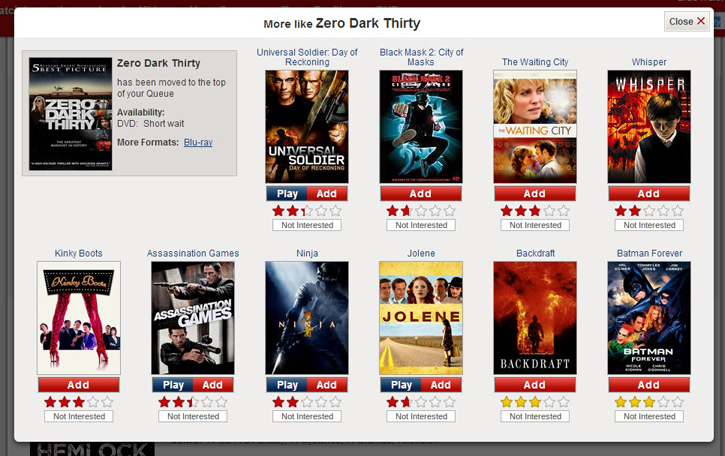
REALLY? Netflix thinks these are ‘like “Zero Dark Thirty”?’

netflix

Some fret that the algorithms that surround us know too much about us. I don’t. Not yet.

Over the last few years, I’ve rated 2,383 movies on Netflix — so I really think I can claim to have given this thing a chance — and the service still doesn’t have a clue what I’m likely to like.

I guess there are just too many variables in what makes a motion picture enjoyable.

I find that Pandora does a somewhat better job of throwing me an occasional song I haven’t heard before, but like upon hearing. Don’t get me wrong — it’s not batting 1.000 or anything. But every once in a while, something I didn’t ask for makes me think yeahhh. It manages this more often than Netflix does. At least it seems that way. I haven’t kept a spreadsheet on it or anything.

Really, I like Netflix very much. It’s a great service, for what it does (both the DVD and instant sides). But what it does not do is understand my preferences. And I hold out little hope of it achieving that feat when it doesn’t have a clue what sorts of movies are “like ‘Zero Dark Thirty’.”

You’ve got to be kidding me. “Universal Soldier?” “Batman Forever?” “Kinky Boots?”

Here are some movies I would say are actually like “Zero Dark Thirty:”

  • Black Hawk Down” — A true story featuring U.S. Special Forces troops in action.
  • Body of Lies” — Also fictional, but it involves dusty, gritty intelligence work on the ground in the same region. It even has torture scenes, as I recall.
  • Green Zone” — Much in the same genre as “Body of Lies.”
  • Homeland” — OK, it’s TV and not the big screen, and fictional, but the main female character has a lot in common with the lead in “Zero,” and may actually be based on the same real-life woman.
  • The Hurt Locker” — Same director, also set in the region, very similar feel (and a better movie, although “Zero” is good).

See where I’m going with this, Netflix? Probably not. Anyway, I see little reason to worry, based on this at least, that machines are reading my mind…

So there’s something we can DO about asteroids?

asteroids

Last week, we saw quite an array of celestial events. First, lightning struck St. Peter’s Basilica only hours after the Pope shocked the world by announcing his retirement, suggesting that Someone preferred to keep such decisions to Himself.

Then, on the same day that we smugly expected an asteroid that we knew would come closer than some man-made satellites, but miss us, a smaller one that we weren’t anticipating didn’t. Miss us, I mean. It put on a light show and did spectacular damage in Siberia, injuring more than a thousand people. (Apparently, meteors hate Siberia more than tornadoes hate trailer parks.)

It’s like the heavens were mocking us and our belief that we have a handle on things.

Speaking of which, I thought I’d pass on this interesting piece that I saw in The Guardian from ex-astronaut Rusty Schweickart. He said that we need to know more about these smaller asteroids, and that we can, if we invest in new telescope technology. But the most surprising thing he said was that if we spot these rogue rocks early enough, we can actually do something to keep them from hitting us. Excerpts:

Spaceship Earth just took two celestial shots across its bow as, first, a meteor struck Russia, showering the Chelyabinsk region with fragments and reportedly injuring several hundred people, and second, as Asteroid 2012 DA14 whizzed past on 15 February. Traditionally, a torpedo across the bow is fired as a warning to change one’s behavior – and this coincidence of events should be a warning to humanity that meteors are not always as benign as “shooting stars” and that the next asteroid might not miss! Will we, the crew of SS Earth heed this warning?…

Nevertheless, the Earth is hit by one of these relatively small DA14-sized asteroids about once every 300 years, on average. And “small” is far, far from insignificant. The DA14-like asteroid that hit Earth in 1908 did so in a remote region of Siberia, where the explosion (the equivalent of about 250 Hiroshima nuclear bombs going off at one time) destroyed over 800 square miles of the countryside. This disaster zone, superimposed on any city in the world, would have wiped it and all its residents from the face of the Earth. I refer you, as a graphic reminder of the power of such explosions, to the post-facto Hiroshima bomb pictures readily found online.

The second way to view DA14 is to realize that, until just about a year ago, it was one of about 1 million similarly sized, near-Earth asteroids, which we know are out there, statistically, but that we haven’t yet seen. Consequently, until we find them in our telescopes, we are like sitting ducks in a shooting gallery with nothing more than luck to prevent a disaster. Regrettably, the Earth-based telescopes we’ve been using to discover and track these objects have, practically speaking, reached their limitations for finding the vast majority of these cosmic torpedoes.

Why do we care about finding them if there’s nothing we can do about it? Because, unknown to most people, is that if we have adequate early warning, our current space technology is sufficiently advanced to deflect these asteroids. For smaller impacts, even a last-minute warning of several days could enable a local evacuation and save many lives.

Deflection, however, will generally require several decades of warning. Fortunately, due to the relatively pure nature of space dynamics, forecasting an asteroid impact 100 years in advance is possible once its orbit is well known. The sine qua non, therefore, is finding them…

He goes on to make a pitch for the Sentinel telescope. He’s involved with a nonprofit that wants to build this thing and save the planet. Which is good of him.

What he does not to, to my frustration, is explain his claim that we can deflect these things. However, Stuart Clark, also writing in The Guardian, answers my question:

“There are three ways to deflect a dangerous asteroid: the gently pull, the swift kick and nuking it,” says Fitzsimmons. Which method is best depends on the asteroid’s size, composition, orbit, and crucially, how much warning we get. Typically, warning times of a decade or so would be required.

With plenty of warning, the gentle pull may be all that is needed. In this scenario, you send the heaviest spacecraft you can launch to “hover” close to the dangerous asteroid. The tiny gravitational pull that the spacecraft produces on the asteroid then adds up over many years to shift it off collision course. It’s a concept known as the gravity tractor.

The swift kick actually involves a collision. You hit the asteroid with a heavy spacecraft that instantaneously changes its orbit. The more warning you have, the smaller the kick you need to give it. Observations can quickly show whether the method has worked or whether another kick is needed.

Finally, if things are desperate, nuke it. This can provide the biggest kick of all. But don’t shatter the asteroid. The last thing you want to do is break it up. That turns a cannonball into buck shot without significantly changing its orbit.

Instead, a nearby nuclear explosion would evaporate the surface layers of the asteroid. As the vaporised rock jets into space, the asteroid would be pushed in the opposite direction.

But — correct me if I’m wrong — in order for us to do any of that, our space program needs to be more advanced than it is now. The gentle pull, anyway. To be able to intercept an asteroid decades away from us in time to gradually pull it off course sounds to me well beyond our current technology. Seems that we might want to step up our game a bit. As Clark quotes Larry Niven as saying, “The dinosaurs became extinct because they didn’t have a space programme.”

My favorite spam of the day

Mostly, my spam filter works pretty well, but some days small groups of them sneak through. I got four of them back-to-back this morning.

I get a kick out of the way these bots try so hard to produce comments that sound real, but still fall so short of their goal. Here’s my favorite today:

I’ve been browsing on-line more than three hours lately, yet I never discovered any fascinating article like yours. It is beautiful price enough for me. In my view, if all website owners and bloggers made good content as you probably did, the internet will probably be a lot more useful than ever before.

I love this part: “…if all website owners and bloggers made good content as you probably did….” It doesn’t want to go too far and commit itself…

It is beautiful price enough for me, too.

Everything that is wrong with our politics, in state & nation

Haley Palin

OK, so maybe it’s not everything — there’s personal pettiness, and anti-intellectualism, and an appalling willingness on the parts of too many to stoop to the lowest common public impulses for advantage — but it’s something that runs through it all, and ruins everything it touches. And besides, those things are more or less related to this thing.

It was on display in this story today about the campaign “warchest” — oh, let’s not forget that another thing that is wrong with our politics is that we pretend that it is war, with all that attendant “fighting for you” trash — that Nikki Haley has assembled for an as-yet-undeclared re-election campaign.

I’m not talking about Nikki Haley in particular here. I’m talking about something that is all too much a part of modern politics, and she just provides us with a good example, because she’s a particularly avid practitioner of what I’m talking about. The relevant passage:

Haley had six fundraisers last quarter, half of them out of state, in California, New York and Florida.

Donations from S.C.-based businesses and residents accounted for less than 60 percent of the total she raised during the quarter. Florida donations were next at 10 percent, followed by New Yorkers at nearly 6 percent.

Californians’ 51 donations ranked second in number behind the 418 reported from South Carolina, but their combined $21,000 ranked fifth in total amount, at 4 percent.

“It’s a strong showing,” Pearson said. “It shows that people in and outside the state want her to be re-elected gov

Haley had six fundraisers last quarter, half of them out of state, in California, New York and Florida.

Donations from S.C.-based businesses and residents accounted for less than 60 percent of the total she raised during the quarter. Florida donations were next at 10 percent, followed by New Yorkers at nearly 6 percent.

Californians’ 51 donations ranked second in number behind the 418 reported from South Carolina, but their combined $21,000 ranked fifth in total amount, at 4 percent.

“It’s a strong showing,” Pearson said. “It shows that people in and outside the state want her to be re-elected governor if she runs.”

And no, I’m not saying it’s awful that she goes after money where she can get it, or anything like that. The thing that I am saying is a problem is the fact that it is possible for a governor, any governor, to go outside his or her state to raise campaign money. It’s the fact that those outsiders will give, when asked the right way, that is the problem of which I speak.

Reading that story, I tried putting myself in Nikki Haley’s place. I tried imagining that I was running for governor, and I was on a fund-raising trip to New York or Florida or California or wherever, and I was standing in front of a well-heeled group of people with checkbooks in their pockets, and I thought:

What on Earth would I say to those people to get them to give money to me for my campaign for governor of South Carolina?

And I couldn’t think of a thing. I mean, I think about the reasons I would run for governor if I did, and they are many. I refer you to my last column at the paper for just a tiny few of those reasons. But not one of the reasons that could ever conceivably motivate me to run could ever possibly motivate someone who does not live in South Carolina and has no stake in South Carolina to give me money.

I would have nothing to say to them. Nothing that would be relevant to them, in any case.

But Nikki Haley, and other politicians who do what she does, have no problem in that regard. That’s because pretty much everything they say, and think, as political creatures is cookie-cutter stuff, the kind of stuff the national talking heads constantly spew out of the Beltway via 24/7 TV “news.” You can’t tell one from another.

That’s why it’s so easy and comfortable for someone like Sarah Palin to campaign alongside Nikki Haley, which they did with such aplomb and comfort in one another’s company during our governor’s first campaign. That’s because, even though they are from very different states with different issues and different needs, they think the same thoughts and say the same things. Henry Ford’s methods of mass production have been applied to politics, so that parts are interchangeable.

This is made possible by the fact that all these folks talk about is ideology — pure, simple, lowest-common-denominator ideology, unsullied by the specifics of reality, which is understood everywhere because of modern communications.

Their words and their thoughts have nothing to do with the messy, organic, ad hoc, practical, idiosyncratic business of governing — which to an honest person who engages it with an open and critical mind practically never meshes with the neat constructs of ideology.

And that’s what’s wrong. That’s what that story made me think about.

Joe Wilson release satirizes itself

joe release

This happened a couple of weeks ago, and I haven’t figured out why it happened either time.

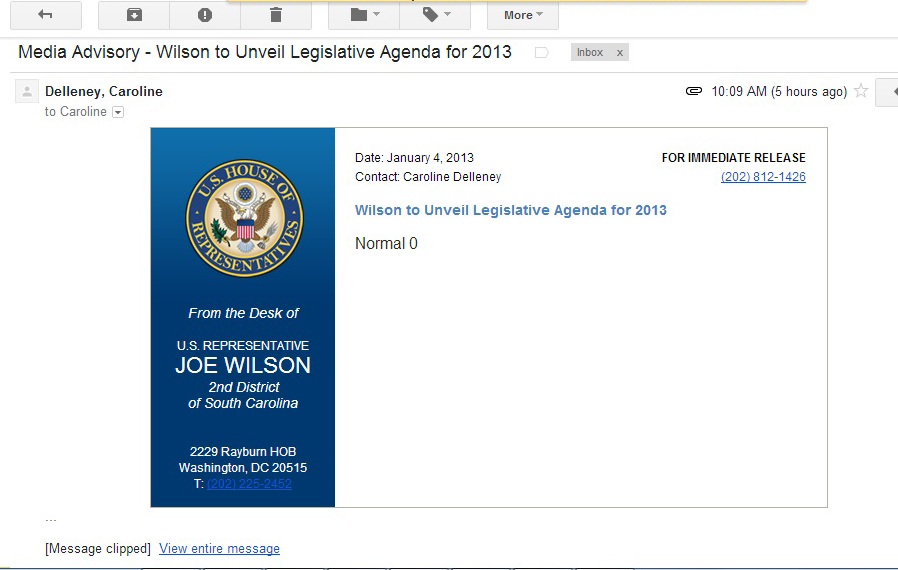
The first time, Joe Wilson sent me a release via email with a headline and an introduction to a statement from Joe, but no statement.

This time, there was the headline — “Wilson to Unveil Legislative Agenda for 2013” — followed by nothing but this:

Normal 0

Which sort of read like a joke at Joe’s expense: The usual. Nothing.

Just as last time, way down on the email, there was a link where I could go read the actual release, which basically said Joe is having press conferences tomorrow in West Columbia, Aiken and North Augusta. Where he’ll talk about his agenda.


Do y’all like this design better?

Some of y’all were complaining about the formatting on comments on the new blog design — that the comments were so narrow, and got narrower as you replied.

Being the sensitive guy that I am, I gently urged y’all to suck it up and get used to it for now, because there were many things about the new design that I liked — and which some of y’all liked, too — and I was not inclined to start over from scratch without giving this more of a chance.

But Chip Oglesby, who hosts my site now, saw the complaints and offered to address them. So he came up with a new theme. It’s in place now. I’m still tinkering with it, and there are some small things I liked about the old theme better, but… you’ll find that the comments aren’t so narrow.

So let us know what y’all think…

Welcome to the new blog!

Yeah, it kinda looks different, doesn’t it?

But it should function much the same. Which I know some of y’all will see as a good thing, others not so good.

This was sort of a quick, semi-emergency move, meant to deal with three factors:

  1. I needed to move to a new host, because my old host — Period Three, which had generously supported me for close to three years — was getting out of doing that sort of thing.
  2. Google had for months been giving an ominous-sounding warning, along the lines of “This site may be compromised” on the search result for this blog. When I looked it up, Google said it was something only my host could solve, and I eventually determined that it was essential to get on a newer version of WordPress, which should clean up the problem. That made the need to move more urgent.
  3. I had not had any working stats for several months (Webalizer had collapsed on me, for reasons I don’t fully understand), so I had no idea what my current traffic was — which is one reason I hadn’t sold more than one or two ads during that period. Which was not good.

Chip Oglesby of Creative Spark Columbia is my new host, and he’s been extremely helpful and responsive, basically getting all of the above and more besides done in a short time span. Chip is a former colleague at the newspaper, who among many other things shot this picture of me (or my shoulder, anyway) with Barack Obama.

Beyond the immediate challenge of dealing with the above three factors, Chip has also solved some knotty problems associated with my old blog, from when I was with the paper. I continue to link regularly to posts and comments from 2005-2009 (to me, one of the best things about the Web is that everything said in the past on a topic can be instantly available), but when you got there, you probably found that the links from that period were broken. Chip has fixed those thousands of links, something I had thought impossible. Now, through this blog, you experience a seamless continuity from May 2005 to today.

Now that the main move has been made, let me know if you identify any problems in your interactions with bradwarthen.com. And yes, I know there are things that readers have long wanted, such as the ability to edit their comments. I intend to try to address those in the near future. But I needed to make this big move first. Thanks for your patience.

Look out! China only about a century behind now

The hulk of the Varyag before it was turned into the Liaoning.

Mike Fitts, whom I can rely on to keep me apprised as to foreign military intel, particularly of a naval variety, calls my attention to this report about China beginning flight operations on its first aircraft carrier:

While we here at Killer Apps were enjoying the last day of our Thanksgiving holiday, the Chinese navy was busy conducting its first ever takeoffs and landings from its brand new aircraft carrier, the Liaoning, with brand-new J-15 fighter jets.

Some observers have hailed this as the start of a new era in naval history while others aren’t so impressed. So far, the U.S. Defense Department seems unconcerned.

“We are aware of media reports that the Chinese successfully landed an aircraft on the deck of a carrier,” said Pentagon press secretary George Little during a briefing with reporters this morning. “This would come as no surprise. We’ve been monitoring Chinese military developments for some time…

Which is impressive, until you read this:

The Liaoning was built with the hull of an incomplete Soviet carrier that China bought from Ukraine in 1998, claiming that it would be turned into a casino or something. Instead, China completely refurbished the ship, installing new engines, modern electronics, and sensor systems, turning the old hulk into a “starter carrier.”…

Really? China is this gigantic economic powerhouse with superpower ambitions, and yet they had to buy their first carrier third-hand, and spend 14 years tinkering with it before the first plane lands on its deck?

This got me to thinking — how many built-from-scratch carriers did little old Japan next door have in during WWII — seven decades ago? Looks like about 25 that were actually commissioned, from various sources I’ve glanced at. (Burl, help me out.)

And when was the first time a pilot landed on a carrier? An American did it in 1911. Of course, the ship wasn’t moving. The first to land on a moving warship was Squadron Commander E.H. Dunning of the Royal Navy, in 1917. The first purpose-built aircraft carrier (as opposed to a repurposed hull) was Japan’s Hōshō in 1922.

It is believed that China will commission its first homemade carrier in 2015 or 2016 — as much as 94 years after the first Japanese flattop. It will be sometime after that before the Chinese navy has worked itself  up into having an effective naval air operations force.

Yeah, I know — these new ships will do things that would look like magic from the perspective of 1922. But still. As fast as China is running to catch up, it’s rather stunning to consider how very far that nation is behind in the simple fact of naval aviation.