Category Archives: Technology

I’ve GOT an ‘iPad Mini’ — it’s called an ‘iPhone’

Got to say I was seriously underwhelmed by Apple’s news yesterday:

SAN JOSE, Calif. — Steve Jobs once mocked tablets with small screens, saying they would need to come with sandpaper so people could sand down their fingertips to use them. But that didn’t stop his company from shrinking the iPad.

Apple’s iPad Mini, which it unveiled at a press event here on Tuesday, weighs about two-thirds of a pound and has a screen that measures 7.9 inches diagonally, making its surface area significantly smaller than that of the 9.7-inch iPad. Philip W. Schiller, Apple’s vice president for marketing, said the smaller, lighter tablet would be a good fit for people who want something more portable than the 1.44-pound iPad.

The company is selling the lowest price Mini for $330, about $130 more than similar-size tablets from competitors…

So what burst of innovation will they come out with next — an iPad that’s between the iPhone and the mini in size, or one between the mini and the full-size? Or maybe a 60 inch, for that home-theater effect while you’re sitting in the coffee shop?

And in the WSJ in the same news cycle, Walter Mossberg was highly praising the new Microsoft tablet set to come out at the end of the week. Ouch, Apple.

All of this Apple angst brings to mind this hilarious sendup of the iPhone 5 complaints, from SNL a couple of weeks back…

‘The power of Zeus,’ in the president’s hands

The teaser headline at the bottom of a Slatest email said, “New Drones in Libya Will Give Obama the Power of Zeus.”

The item it links to says, in part:

After the attack on American diplomats in Benghazi last month, President Obama vowed to hunt down the killers and bring them to justice. There is a good chance that this means that they will be incinerated by missiles fired from drones. If so, the United States will have used drones to kill members of al-Qaida and affiliated groups in Afghanistan, Iraq, Pakistan, Somalia, Yemen, and Libya—six countries in just a few years. Mali may take its turn as the seventh. This startlingly fast spread of drone warfare signifies a revolution in foreign affairs. And, for good or for ill, in an unprecedented way it has transformed the U.S. presidency into the most powerful national office in at least half a century.

A MQ-9 Reaper flies above Creech AFB during a local training mission. (from Wikipedia)

In the past, presidents faced two major obstacles when trying to use force abroad. The first was technological. The available options—troops, naval vessels, or air power—posed significant risks to American military personnel, cost a lot of money, proved effective only under limited conditions, or all of the above. Dead and maimed soldiers, hostages, the massive expense of a large-scale military operation, and backlash from civilian casualties can destroy a presidency, as Vietnam and Iraq showed.

The second obstacle was constitutional. The Constitution includes a clause that gives Congress the power to declare war. Presidents have been able to evade this clause for small wars—those involving only naval or air power, or a small number of troops for a limited period of time. They have mostly felt compelled to seek congressional authorization for large wars, no doubt in part so that they could spread the blame if something went awry.

But drones have changed the calculus. Because they are cheap and do not risk the lives of American soldiers, these weapons remove the technological obstacle to the use of force. And because drone strikes resemble limited air attacks, they seem to fall into the de facto “small wars” exception to the Constitution’s declare-war requirement. Unlike large wars, drone actions do not provoke congressional attention or even much political debate…

The thing is, this isn’t theoretical. This is power that this president is regularly using (in keeping with my thesis that Bush was Sonny Corleone, Obama is Michael).

When was the last time we killed people in six or seven different countries in one year? WWII? Then, even?

And now it’s with no muss, no fuss. Seriously, how many of you could even have named, without prompting, all those countries where we’ve engaged in this kind of warfare? Sort of makes our continuing arguments over the Iraq invasion and Vietnam seem quaint, doesn’t it? Maybe it’s good I look like someone out of the Regency Period while I address such subjects…

Scott thinks F-35 pretty cool after ‘flying’ it

Remember that previous post about the dog-and-pony show up in North Carolina, the one that was to allow reporters to check out an F-35 simulator?

Well, Lockheed had another one on USS Yorktown in Charleston, and they managed to wow Rep. Tim Scott:

U.S. REP. TIM SCOTT FLIES F-35 COCKPIT DEMONSTRATOR DURING USS YORKTOWN VISIT

F-35 will serve as a cornerstone of global security and create South Carolina jobs

CHARLESTON, S.C., October 18 – U.S. Rep. Tim Scott, (R-S.C.), today joined local elected officials and community leaders on the USS Yorktown at Patriots Point Naval and Maritime Museum to receive an update on the Lockheed Martin [NYSE: LMT] F-35 Lightning II program and hear about its contribution to South Carolina, national security, and the U.S. economy.

During his visit, Scott “flew” the F-35 cockpit demonstrator to experience firsthand how advanced stealth, fighter agility and integrated information systems make the F-35 the most capable multi-role fighter in the world. The cockpit is visually and audibly interactive and provides a realistic look at the F- 35’s performance, air-to-air and air-to-ground capabilities, sophisticated sensor fusion and advanced computational capabilities.

“Coming from a military family, I understand and appreciate that American men and women serving in uniform deserve the best technology that this nation can provide. Those that threaten our country are evolving everyday, and it is essential we stay ahead of them.” Scott said. “There is no doubt the fifth generation, multi-role F-35 Lightning II’s ability to defeat sophisticated surface-to-air missiles and enemy fighters in the air and on the ground will allow us to do just that.

“Our military leadership associated with Beaufort Air Station, McEntire Joint National Guard Base, and Shaw Air Force Base has told me clearly and convincingly that these capabilities are critical to defending our freedoms,” Scott added.

Lockheed officials noted that even at its current low rate of production, the F-35 program supports a broad industrial base of more than 1,300 suppliers in 45 states, contributing to more than 133,000 direct and indirect U.S. jobs and over $17.7 billion in direct and indirect annual economic impact. Those numbers are expected to grow as the program ramps up to full rate production over the next few years.

In South Carolina, the F-35 program generates nearly 123 jobs and more than $5 million annually in direct and indirect economic impact. Currently, there are four South Carolina companies supporting the program.

The F-35 is a supersonic multi-role fighter designed to replace a wide range of aging fighter and strike aircraft. Three variants derived from a common design will ensure the F-35 achieves its security mission while staying within strict affordability targets.

Lockheed Martin is developing the F-35 in conjunction with its principal partners, Northrop Grumman [NYSE: NOC] and BAE Systems, and Pratt & Whitney. Among the aircraft F-35 will replace are the A- 10, AV-8B Harrier, F-16, F/A-18, and the United Kingdom’s Harrier GR-7 and Sea Harrier.

Headquartered in Bethesda, Md., Lockheed Martin is a global security and aerospace company that employs about 123,000 people worldwide and is principally engaged in the research, design, development, manufacture, integration and sustainment of advanced technology systems, products and services. The Corporation’s net sales for 2011 were $46.5 billion.

The USS Yorktown was commissioned on April 15, 1943, and was one of the preeminent aircraft carriers to serve in the Pacific theater of operations during World War II. In the 1950’s, Yorktown was modified with the addition of an angled deck to better operate jet aircraft. In 1958, the ship was designated an anti-submarine aircraft carrier, and served admirably during the Vietnam conflict. Yorktown was decommissioned in 1970 and placed in reserve. In 1975, the ship was towed from Bayonne, N.J. to Charleston to become the centerpiece of Patriots Point Naval and Maritime Museum.

###

Hey, if I’d had a chance to go try it out, I’d probably think it was pretty cool, too. At a projected $323 billion, this is “the Pentagon’s most expensive weapons program.” In a budget like that, they ought to be able to come up with something better than my old Microsoft Combat Flight Simulator.

From 1902: World’s earliest movie in color

Lately, I’ve been marveling at some of the silent films TCM has been showing from before 1910. But none of them impressed me as much as this:

The world’s first colour moving pictures dating from 1902 have been found by the National Media Museum in Bradford after lying forgotten in an old tin for 110 years.

The discovery is a breakthrough in cinema history.

Michael Harvey from the National Media Museum and Bryony Dixon from the British Film Institute talk about the importance of the discovery.

The previous earliest colour film, using the Kinemacolour process, was thought to date from 1909 and was actually an inferior method.

The newly-discovered films were made by pioneer Edward Raymond Turner from London who patented his colour process on 22 March 1899.

The story of Edwardian colour cinema then moved to Brighton. Turner shot the test films in 1902 but his pioneering work ended abruptly when he died suddenly of a heart attack.

Watch the video. It’s pretty cool. Some guy just invented it on his own, and shot home movies of his kids — but he couldn’t figure how to make it work with a projector. So they were never seen, until now (with computer help).

This Turner, I assume, is not to be confused with colorization pioneer Ted…

Kids are savvy: They find their music on YouTube

The video is often secondary (here, a still photo displays throughout the song). YouTube's just the easiest place to hear what you want for free.

Remember when I wondered where kids were hearing current music enough to get to like it? Actually, to explain: I initially wrote a post that rated recent music at the low end of a zero-to-five scale, but after listening to the same music over and over for awhile, came back and upgraded some of the tracks. Then I realized that I loved the older music because I heard it everywhere I went back in the day. And I was wondering where kids were hearing music so much today that it was becoming an acquired taste, because it was generally out of my hearing.

Yes, I know, they’re listening on earbuds, but from what sources? MP3 players? Stuff passed to them by friends via social media? Where?

Part of an answer comes from this piece the other day in the WSJ:

Among the issues dividing teenagers and their parents, add whether to listen to music on YouTube or on CD.

Nearly two-thirds of U.S. teenagers under the age of 18 say they use Google Inc.’sGOOG +0.65% video-sharing site to listen to music, more than any other medium, according to a new consumer survey from Nielsen Co., one of many challenges facing record companies as they transition into the digital world.

In addition to treating YouTube as a de facto free music service, young people said they are less inclined than those 18 years old and up to listen to CDs or the radio.

Neither age group reported making much use of Spotify AB, Rhapsody International Inc. or other on-demand streaming music services, though Pandora Media Inc.’s P -3.60%custom online radio service was among the five most-popular methods for both groups.

My first reaction was, who’s listening to CDs at all — aside from those burned to listen to in the car? And I see it’s clueless old people. In fact, older generations — from whom I’m disassociating myself as much as possible in my wording here — are more out of it than that:

In fact, among adults, cassette tapes remain more popular than many online music services, or even vinyl records, despite the latter medium’s purported comeback in recent years.

Just to make an excuse for adults here: I think that might be because so many of us these days are driving older cars. For instance, my wife drives a Volvo that she inherited from her father, and it has a cassette player but no CD player or MP3 jack. If our cars had turntables for vinyl, I suppose we’d sound cooler, but it would be rough on our record collections.

But back to the kids: Turns out they’re pretty smart. I discovered sometime back that YouTube is the quickest, easiest way to listen to almost any song, from any genre, for free. It’s not as easy as turning on one of your Pandora stations and letting it run, but at least you get to listen to exactly what you want to hear.

... but the video can add something.

Good thinking, kids.

People are hiding from me! On purpose! In 2012, when all info is supposed to be easily accessible!

Yes, we live in amazing times, even though we still don’t have flying cars.

Michael Rodgers is NOT hiding.

Just one example, from today, of the sort of miracle we take for granted, but which would have sounded like the wildest sort of science fiction back in, say, 1987 — the year I came to Columbia to become governmental affairs editor.

We were kicking around an idea for a TV commercial for a potential client, and suddenly I had a sort of half-memory of having seen an ad, long ago, that did something familiar. I whipped my iPhone from its holster (and if I wanted so see Cleavon Little say, “Just let me whip dis out” in “Blazing Saddles” within a few seconds, I’d do the same), and found a reference to the ad I was thinking of within 30 seconds. Within another 30 — still using my phone (my own  personal phone that goes everywhere I go, which was conceivable in 1987 but still fantastic) — I was watching that ad on YouTube. An ad that last ran in — get ready for it — 1987.

If, in 1987, I had wanted to find out about an ad from 1962, I would have had to spend half the day or more at the library, and whether I even found a reference to it would depend on some pretty tedious guesswork with a periodicals index, and I would have to cross my fingers for a miracle hoping that the library stocked that particular publication, and kept them going back 25 years.

Kathryn Fenner is NOT hiding.

As for actually seeing the ad, without a trip to New York or L.A. and a pretty tedious search once I got there — well, I would have been s__t out of luck, to use the technical term. Oh, maybe if I reached the right person on the phone in one of those places, and they were willing to make me a VHS tape and mail it to me, I might get to see it within a week. But it would have been iffy at best.

Anyway, I say all this to express my appreciation for all the things we can so easily find and experience now, right at our fingertips.

But this post is about the things we can’t, and how frustrating that is.

Phillip Bush is NOT hiding.

Today, the very day of the 1987 ad miracle, I was looking for a mug shot for my contacts list. You know how Google Contacts and iPhones and even Blackberries and Palms allow you to attach a picture of a person to their contact info? Well, I try to take advantage of that whenever I create a new contact. It usually only takes a few seconds. (It took me maybe a minute total to find the four mugs you see here, using Google Images.) I do this because I’m terrible at keeping names and faces straight — I know, or sorta know, too many people for that. By having this feature in widely used software, we are encouraged to do this. It’s normal. (If you had tried it in 1962 — the way the dwarf character did to Mel Gibson’s character in “The Year of Living Dangerously,” keeping a dossier on him and other friends — it would have creeped people out.)

For instance, if you Google me, you get a lot of pictures that are not me, but just people associated with me, but in the first couple of pages of results, there are about 17 images of yours truly. That’s high, on account of my blog and my long association with the newspaper, but not all that high. I get similar results with a lot of people on my contacts list.

But then… every once in a while… there’s someone I can’t find. Sometimes it’s understandable. They are quiet people who work in some private business that doesn’t require a lot of public interaction. But sometimes… it’s like Winston Smith and the gang in 1984 have expunged the person from existence.

Today, it was someone who actually leads a very public organization that advocates on behalf of a very hot local political issue. I had that person’s contact info, from an email, and while I could sort of picture the person in my mind from past interactions, I wanted the crutch of having the mug shot there in case memory failed me at a critical moment.

Doug Ross is NOT hiding.

And I could not find this person anywhere. Eventually, I set my pride aside and tried her Facebook page, which for me is really last-ditch (and feels, even in 2012, even for an unreconstructed journalist, a bit like prying sometimes). And discovered that this was one of those people who not only doesn’t have her own face as her profile picture, but doesn’t have a single image in which she appears among any of her Facebook photos.

At which point I started hearing that little dee-dee-DEE-dee music from “The Twilight Zone.”

Yeah, I realize, some people are just private, as anachronistic as that is in 2012. But I don’t see how a person who is heavily involved in the community manages to disappear so completely.

Thoughts about this? Does this happen to you? Does it drive you nuts? It does me. Maybe it shouldn’t, but it does. Information is normally so extremely accessible, that when it isn’t, it just seems wrong

Could (should) Big Brother have stopped Holmes?

Fascinating piece in the WSJ today, posing the following question:

Would Total Information Awareness have stopped James Eagan Holmes?

You perhaps remember the fuss. That program by the Defense Department was curtailed when the Senate voted to revoke funding amid a privacy furor in 2003. The project had been aimed partly at automatically collecting vast amounts of data and looking for patterns detectable only by computers.

It was originated by Adm. John Poindexter—yes, the same one prosecuted in the Reagan-era Iran-Contra scandal—who said the key to stopping terrorism was “transaction” data. For terrorists to carry out attacks, he explained in a 2002 speech, “their people must engage in transactions and they will leave signatures in this information space.”

The Colorado shooter Mr. Holmes dropped out of school via email. He tried to join a shooting range with phone calls and emails going back and forth. He bought weapons and bomb-making equipment. He placed orders at various websites for a large quantity of ammunition. Aside from privacy considerations, is there anything in principle to stop government computers, assuming they have access to the data, from algorithmically detecting the patterns of a mass shooting in the planning stages?…

This not only evokes 1984, but the department of “pre-crime” envisioned in “Minority Report.” Which should send all sorts of shivers down the sensitive spines of libertarians.

But a legitimate question is being posed here. Since such data is being mined, should not someone be on the lookout for transactional patterns such as those Holmes engaged in? Guy suddenly isolates himself from society (a step leading to what I call the Raskolnikov syndrome), buys several rapid-fire weapons and lots and lots of ammunition? If it’s possible for such patterns to raise red flags, then shouldn’t it, if it can prevent the deaths of innocents?

In passing on this question, I’m not thinking in terms of having the cops bust down doors and file charges against people for having raised red flags. But I do think it might be worthwhile to have a chat with someone displaying such signs, to ascertain what is going on — or perhaps making the people in that person’s life aware of what’s happening, to empower them to intervene if they see fit. That could go a long way toward snapping some potential killers out of their trip down the rabbit hole.

As the columnist asks of the NSA: “Did it, or could it have, picked up on Mr. Holmes’s activities?” And if not, why not? And if it did, what should it have done?

Good thing the Fenners keep their home tidy

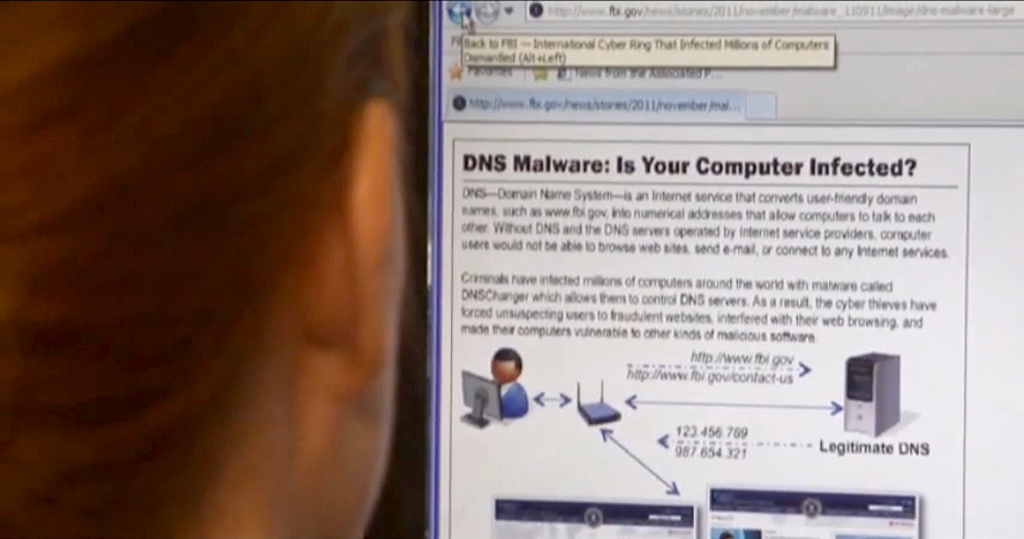
Kathryn Fenner shares this ABCColumbia clip, in which her husband was quoted as an expert on what to do about the computer virus that caused yesterday’s stir.

I was particularly struck by the dramatic, under-the-coffee table shot of Dr. Stephen sitting on the sofa with his laptop.

Good thing the Fenners keep the underside of that table as neat and tidy as the rest of their home. I didn’t see any chewed gum stuck under there, or anything like that…

Yes, “trackers” HAVE gone wild, and then some

A shot from video footage taken outside the home of a candidate.

Earlier today, Politico posed the question on Twitter, “Democratic trackers gone wild?

While most serious campaigns on both sides use campaign trackers — staffers whose job is to record on video every public appearance and statement by an opponent — House Democrats are taking it to another level. They’re now recording video of the homes of GOP congressmen and candidates and posting the raw footage on the Internet for all to see.

That ratcheting up of the video surveillance game is unnerving Republicans who insist that even by political standards, it’s a gross invasion of privacy. Worse, they say, it creates a safety risk for members of Congress and their families at a time when they are already on edge after a deranged gunman shot former Arizona Democratic Rep. Gabrielle Giffords 18 months ago.

Wisconsin GOP Rep. Reid Ribble, who said he’s also been followed by a cameraman when shopping for groceries, said the home videos cross a line.

“I feel it’s totally inappropriate,” said Ribble, a freshman facing a competitive race for reelection. “It was disturbing to me that they would put that online. I don’t understand any political benefit that can be achieved with that.”…

Yes, indeed, say I. They’ve gone too far. But then, I think the whole phenomenon went overboard, across the spectrum, years ago. I have a low threshold with this kind of stuff.

There’s nothing illegal, certainly, about following one’s opponent around with a video camera. And everyone does it, right? One can even argue that a conscientious candidate should be fully aware of what his opponent has to say.

But in this era of saturation communication, stalking one’s opponent with a camera hoping for a slipup, a gotcha! moment, is not only unnecessary, there’s something low about it. And I confess that when I’m at a political event, and I spot the opposition’s tracker, I can’t help looking upon that person with something akin to disdain.

I don’t expect many people to agree with me on this. Certainly not many journalists today, since so much of their material comes from this sort of thing.

But I was always a different sort of journalist. I always wanted to know what a candidate has to say after he thinks for a minute, not what he says when he misspeaks. Some pop-Freudians believe the slip is the truth. Sometimes it is, sadly. But I’ve always valued more what the candidate says when you give him or her a chance to think a little harder about it. When a candidate says, “That’s not what I meant,” the gotcha folks snicker. Me, I start paying closer attention to find out what he or she did mean. And I flatter myself that I can tell, usually, if the further explanation is just blowing smoke.

Maybe I look for the second thought because that’s how I hope (idealist that I am) that they will govern — in a deliberative manner, with their ideas morphing and growing and getting better in a ferment with other ideas. I want to be governed by what people think upon further reflection, not the first thing that pops into their heads.

And even if they never achieve that, I want to give them every opportunity to do so.  I want to hear the “yes, but…,” the second and third and fourth thoughts. I want depth of consideration. Deliberation, the thing upon which republican government relies.

But the “tracker” is a manifestation of a political culture that does not value further reflection. And therefore is a sign of a political culture in decline.

Is Spotify worth the price? (Hold on a second… THAT’s not Paul Simon!)

Wait a second... THAT'S not Paul Simon...

Recently, I’ve been listening to Spotify instead of Pandora. And at first, it seems an incredibly good deal. Pandora (at least in the free version) won’t let you directly pick a particular track, whereas Spotify not only lets me go to the track I have in mind (if it’s in its database — I’ve hit a couple of misses so far), but plays the whole album for me. Which is awesome.

And the price — having to listen to ads — is inconsequential. I’ve listened to radio ads my whole life — only with this, I can hear songs on demand. For free (so far).

But today, Spotify exacted a terrible price on me.

I was happily listening to Paul Simon’s first solo album — I had sought out “Everything Put Together Falls Apart,” with which Pandora had failed to connect me in the past — and then, suddenly and without warning, right between “Run that Body Down” and “Armistice Day,” I started hearing this awful, trite, saccharine bubble gum voice singing something like, “If I was your boyfriend… never let you go.”

Alarmed, I ALT-TABbed over to the application, and saw that it was… Justin Bieber. Fortunately, the ad — for that’s what it was — was quickly over, and I was back to stuff worth listening to. Stuff with, you know, at least a modicum of wit and creativity.

I suppose I can stand this if it happens again. But I’ve just had another reminder (shudder), as if I needed it, that nothing is really free.

Will you lose access to the Internet today?

Let’s hope not, because that could put a serious crimp in your enjoyment of bradwarthen.com. Which would be awful.

Fortunately, The Washington Post has provided a handy guide to the threatening virus, and what to do about it if it you have it.

You should probably go check now, since it’s harder to cure after it strikes than before:

To see if you have the virus, you can head to any number of checker Web sites such as the DNS Changer Working Group or theFBI itself to either enter your IP address or simply click a button to run a check against addresses known to have problems. With any luck, you’ll be free and clear and won’t have to worry about the problem any further.

If you are infected with the virus, then you’ve got a longer — but not impossible — process ahead of you. According to the DCWG, those infected with the virus should first back up any important files. You can do that fairly easily with an external hard drive or even a thumb drive.

From there, you can run one of several trusted tools to get rid of the virus. Again, the DCWG has a list of them on its site, which includes programs such as Microsoft Windows Defender Off line, Norton Power Eraser and MacScan, all of which have updated their definitions to include this particular virus.

Here’s hoping you, and I, enjoy a virtual disease-free Monday.

Apple, leave my Google Maps alone

I’m really getting sick of this Total War between the big technology communities, based upon the absurd assumptions that each provider of products and services become the provider of all products and services.

It’s like all of these companies — Apple, Google, Facebook, Microsoft, and to some extent AT&T, Time Warner, Verizon, etc. — think that to survive, they must succeed in becoming Ma Bell on steroids. The old Bell monopoly only dominated telephony. Now, the quest is to dominate it all, providing all of the services once provided by separate telephone, cable, and internet providers as well as manufacturers of all of the devices used as the platforms for such services.

This, of course, is happening at the same time that the potential services to be provided are expanding at explosive rates — which you would think would make for enough business for everybody, wouldn’t you?

Now, it seems Facebook wants to put out its own phone — which to me is the height of absurdity. Why would I want one of those? It would be like, I don’t know, having an AOL phone. (I have this pet theory that Facebook is the AOL of this decade — trying to be everyone’s gateway to everything, when no one needs it to be that.)

The latest is that Apple wants to boot Google Maps from its iPhones. Which, frankly, would make me like my iPhone less:

Later this year, Apple is planning to oust Google Maps as the preloaded, default maps app from the iPhone and iPad and release a new mapping app that runs Apple’s own technology, according to current and former Apple employees. Apple could preview the new software, which will be part of its next mobile-operating system, as soon as next week at its annual developer conference in San Francisco, one person familiar with the plans says. Apple plans to encourage app developers to embed its maps inside their applications like social-networking and search services. Technology blog 9to5Mac earlier reported that Apple will launch its own maps app in its next mobile-operating system.

Apple has been hatching the plan to evict Google Maps from the iPhone for years, according to current and former Apple employees. The plan accelerated as smartphones powered by Google’s Android software overtook the iPhone in shipments…

I want to know how far Apple plans to go with it. Will it duplicate Google Maps entirely, with a fleet of street-level cameras photographing every foot of every street in the developed world? Or will it merely use mapping technology to serve its other apps, and never mind providing the full range of service provided by Google? (Actually, my preloaded Google Maps app doesn’t do street level — which strikes me as odd, because it worked on my old Blackberry.)

The WSJ indicates that Apple will add functionality that Google lacks. And since Apple is Apple, there is bound to be some gee-whiz factor built in. And beauty. If the spirit of Steve Jobs still lives in the company at all, there will be beauty.

But I have to wonder, whatever happened to stressing one’s core competency, and just letting others do what they do well? I guess it’s out of style.

GM says ads on Facebook don’t work (Oh, and why is it going public anyway?)

At the worst possible time — on the eve of the social site’s IPO — The Wall Street Journal reports that General Motors plans to quit advertising on Facebook because ads there don’t get the job done:

General Motors Co. plans to stop advertising with Facebook Inc. after deciding that paid ads on the site have little impact on consumers’ car purchases, according to a GM official.

The move by GM, one of the largest advertisers in the U.S., puts a spotlight on an issue that many marketers have been raising: whether ads on Facebook help them sell more products. On Friday, Facebook is expected to sell shares in an initial public offering that could put a market value on the company of as much as $104 billion…

That aside… personally, I have trouble understanding why Facebook wants to go public anyway. Of course, I’m pretty sure Mark Zuckerberg doesn’t want to — hence his childish, obnoxious gesture of showing up for business meetings on Wall Street in a sweatshirt.

But while I blame him for not dressing like a grownup, I find any reluctance he feels to go public totally understandable. I say this as someone who suffered for decades working for publicly-traded newspaper companies — and who would still be a newspaperman if his paper had not been owned by an overleveraged public company. To me, anyone who is making plenty of money from his private company would be totally insane to go public.

No one, but no one, would accuse me of being any sort of financial whiz. But I fail to see the presence of any of the usual reasons for going public. What does Facebook really need an infusion of cash for? It’s not capital-intensive like, say, a steel mill. It’s always been able to rake in the money for relative little investment.

Yes, I’ve gone out there and read explanations of why. But I’m unconvinced. So what if, for instance, going public would be a huge windfall for Facebook employees? Why would I, as an investor (if I were an investor), want to spend my money to give them that windfall? Where’s the competitive advantage in encouraging a company’s founding talent — the people responsible for making the property valuable — to cash out?

The one rational excuse seems to be that in this converging online world, the only way to compete with the other titans out there, such as Google, is to have mountains of cash on hand, so you can beat the others to the punch when it comes time to buy a YouTube or an Instagram.

In other words, it’s a necessary step in the bid to become all things to all people online. Which seems, in and of itself, a debatable goal. But hey, nobody’s asking me.

Something else women would never think of

This week, we’re going to be celebrating the particular genius of the human male — why he is special and essential, as wonderful as women may be. I mean, as wonderful as they are.

I’ll explain why later.

Here’s something else (in addition to the subject of this earlier post) a woman would never think of.

Seriously. First of all, it’s hard to get most of them even to care about video games. You may have noticed this. But to think of inserting Bo Jackson into Super Mario Brothers to run the board? That is something that only the male of the species, with his uncanny willingness to sit and think about stuff like this for hours on end, could possible conceive. And to actually spend the time turning the idea into reality? Well, you have to have that extra bone in your head that the male is blessed with to achieve it.

Watch the video, and bask in the brilliance of the concept, even if the execution is a bit lacking (obviously, Bo should have been bigger, so you could see him better — but that leaves room for the next generation of guys to improve the concept, so it’s all good).

Could future journalists uncover a Watergate?

I was intrigued by this question that The Washington Post posed on Twitter today: “Could the Web generation uncover a Watergate-type scandal?”

I followed the link and saw that the piece was based on a panel discussion featuring Bob Woodward and Carl Bernstein. They had their doubts:

“One of the colleges asked students in a journalism class to write a one-page paper on how Watergate would be covered now,” said Bob Woodward, “and the professor — ”

“Why don’t you say what school it was,” suggested Carl Bernstein, sitting to Woodward’s left in a session titled “Watergate 4.0: How Would the Story Unfold in the Digital Age?”

“Yale,” Woodward said. “He sent the one-page papers that these bright students had written and asked that I’d talk to the class on a speakerphone afterward. So I got them on a Sunday, and I came as close as I ever have to having an aneurysm, because the students wrote that, ‘Oh, you would just use the Internet and you’d go to “Nixon’s secret fund” and it would be there.’ ”

“This is Yale,” Bernstein said gravely.

“That somehow the Internet was a magic lantern that lit up all events,” Woodward said. “And they went on to say the political environment would be so different that Nixon wouldn’t be believed, and bloggers and tweeters would be in a lather and Nixon would resign in a week or two weeks after Watergate.”

A small ballroom of journalists — which included The Washington Post’s top brass, past and present — chuckled or scoffed at the scenario…

I also enjoyed the way the piece, written by Dan Zak, characterized the Woodstein legacy:

Tuesday’s panel briefly reunited the pair, whose untangling of the Nixon administration inspired a generation of journalists who have since been laid off or bought out in large numbers. Woodward and Bernstein’s main point was evocative of a previous, plentiful era: Editors gave them the time and encouragement to pursue an intricate, elusive story, they said, and then the rest of the American system (Congress, the judiciary) took over and worked. It was a shining act of democratic teamwork that neither man believes is wholly replicable today — either because news outlets are strapped or gutted, or because the American people have a reduced appetite for ponderous coverage of a not-yet-scandal, or because the current Congress would never act as decisively to investigate a president.

For the record, while I may indeed be one of those “who have since been laid off or bought out in large numbers,” I didn’t get the idea to go into journalism from these two guy — however much their example may have encouraged me. I was already working as a copy boy at The Commercial Appeal when I first heard of them…

Bold new step for IT-ology, Innovista

This just came in a few minutes ago:

It’s a sign of progress. Friday, the Tower at 1301 Gervais — a landmark in the Columbia skyline — becomes IT-oLogy @ Innovista.

The installation of the IT-oLogy @ Innovista signage exemplifies the already successful partnership between IT-oLogy and Innovista to foster the development, growth and relocation of information technology (IT) companies, small and large.

“This marks the fruition of one of our original visions: a district with the strategic clustering of IT companies in one locality,” said Don Herriott, Director of Innovista Partnerships. “More companies are seeing the advantages of co-location, and IT-oLogy @ Innovista now houses 9 IT companies, and counting.”

SignIT-oLogy’s mission is to promote, teach and grow the IT talent pipeline and profession. With Innovista’s mission of creating, attracting and growing knowledge-based companies in the Midlands of South Carolina, the two constitute a perfect partnership for recruiting to the new IT-oLogy @ Innovista building.  Clustering IT companies in a single location, such as the Tower at 1301 Gervais St., can open the door for new opportunities for partnership and business development, stimulate new ideas and industry innovation and help in the recruitment of new companies to the region.

“Our goal is to bring the IT community together in a collaborative environment to develop the IT pipeline through programs at all levels,” said Lonnie Emard, executive director of IT-oLogy. “The partnership with Innovista is a perfect example of this collaborative effort because we are bringing together people and companies that are dedicated to both of our missions.”

The establishment of an IT district is not about a sign at the top of the Tower at 1301 Gervais St. While that is a visible representation of the partnership, the real story is what happens both inside and outside of the building. The uniqueness of IT-oLogy is that it is not a single company or entity; instead, it is a non-profit collaboration of companies, academic institutions and organizations uniting to address the nationwide shortage of skilled IT professionals. To address this challenge, IT-oLogy offers K-12 programs where students explore numerous IT career options, internships for undergraduate students and continuing education opportunities that keep professionals constantly learning and up-to-date. When all this happens, the result is a vibrant economic picture, which is the goal of Innovista.

The confluence of opportunities in IT-oLogy @ Innovista will provide a home in the community for local talent as well. “At the University of South Carolina, our responsibility to students and alumni extends beyond education. It includes a commitment to helping them find jobs, good jobs, when they graduate,” said Dr. Harris Pastides, president of the University of South Carolina. “The pairing of IT-oLogy and Innovista is perfect because of their complementary missions, each focused on growing our innovation economy in this region and across South Carolina.”

“From the outset, the vision of IT-oLogy has been to have business and academic partners collaborate to advance IT talent,” Emard said. “The lack of IT talent is a national epidemic that is solved in a local manner. The establishment of IT-oLogy @ Innovista is a visible representation of bringing companies together to collaborate and partner, fostering new ideas and technologies.”

Recently, IT-oLogy announced the establishment of the branch IT-oLogy @ University Center of Greenville, located in Greenville, S.C. This is yet another way IT-oLogy is working locally to address a national issue. In the future, IT-oLogy will continue to open branches across the nation as a way to advance IT talent in a grassroots manner.

Innovista is a strategic economic development effort that is connecting USC and university-spawned innovations with entrepreneurs, businesses and stakeholders. Its purpose is to help attract and create technology-intensive, knowledge-based companies, which result in higher-paying jobs and raise the standard of living in South Carolina.

For more information about Innovista, visit www.innovista.sc.edu

This is interesting on a number of levels.

Several months ago, I heard a rumor that Innovista’s headquarters were going to move from the USC campus to this building, in part to emphasize the point (emphasized by Don Herriott) that Innovista is about the whole community, not just those blocks in the area described by Assembly and the river, Gervais and the baseball stadium (and certainly far, far more than those couple of buildings people keep going on about).

Then I heard that wasn’t right. Maybe this idea is what started the rumor I’d heard.

Anyway, this is interesting, and I’m not sure what all the ramifications are yet…

What’s the proper price for books that don’t exist?

Just a couple of days after I posted a video of the director of the Ayn Rand Institute, that organization sends out this release:

Apple Should Be Free to Charge $15 for eBooks

WASHINGTON–Apple and five top book publishers have been threatened by federal antitrust authorities. According to the Wall Street Journal, they are to be sued for allegedly colluding to fix ebook prices.

According to Ayn Rand Center fellow Don Watkins, “Traditional books may come from trees but they don’t grow on trees–and ebooks and ebook readers such as the iPad definitely don’t grow on trees. These are amazing values created by publishers and by companies such as Apple. They have a right to offer their products for sale at whatever prices they choose. They cannot force us to buy them. If they could, why would they charge only $15? Why not $50? Why not $1,000?

“There is no mystically ordained ‘right’ price for ebooks–the right price is the one voluntarily agreed to between sellers and buyers. Sure, some buyers may complain about ebook prices–but they are also buying an incredible number of ebooks.

“What in the world justifies a bunch of bureaucrats who have created nothing interfering in these voluntary arrangements and declaring that they get to decide what considerations should go into pricing ebooks?”

Read more from Don Watkins at his blog.

I didn’t know what the Institute was on about until I saw this Wall Street Journal piece:

U.S. Warns Apple, Publishers

The Justice Department has warned Apple Inc. and five of the biggest U.S. publishers that it plans to sue them for allegedly colluding to raise the price of electronic books, according to people familiar with the matter.

Several of the parties have held talks to settle the antitrust case and head off a potentially damaging court battle, these people said. If successful, such a settlement could have wide-ranging repercussions for the industry, potentially leading to cheaper e-books for consumers. However, not every publisher is in settlement discussions.

The five publishers facing a potential suit areCBS Corp.’s Simon & Schuster Inc.;Lagardere SCA’s Hachette Book Group;Pearson PLC’s Penguin Group (USA); Macmillan, a unit of Verlagsgruppe Georg von Holtzbrinck GmbH; and HarperCollins Publishers Inc., a unit of News Corp. , which also owns The Wall Street Journal….

This is truly a fight in which I do not have a dog. I think. And it should please the Randians that my own attitude has to do with market forces. I can’t conceive of paying $15 for a book when, after the transaction, I don’t actually have a book.

So I can approach this dispassionately, and ask, to what extent is this a monopoly situation? After all, Apple has competitors — such as Amazon, which actually pioneered this business of selling “books” to people electronically. The WSJ story addresses that:

To build its early lead in e-books, Amazon Inc. sold many new best sellers at $9.99 to encourage consumers to buy its Kindle electronic readers. But publishers deeply disliked the strategy, fearing consumers would grow accustomed to inexpensive e-books and limit publishers’ ability to sell pricier titles.

Publishers also worried that retailers such as Barnes & Noble Inc. would be unable to compete with Amazon’s steep discounting, leaving just one big buyer able to dictate prices in the industry. In essence, they feared suffering the same fate as record companies at Apple’s hands, when the computer maker’s iTunes service became the dominant player by selling songs for 99 cents.

Now that sounds more like what I would think the market would bear, if the market were like me. $9.99 sounds closer to what I might conceivably be willing to pay in order to have access to the contents of a book without actually getting a book. But it still seems high.

Yes, I can see advantages to a e-book. You can store more of them in a smaller space. They don’t get musty, which for an allergic guy like me is nothing to sneeze at. And you can search them, to look up stuff you read, and want to quote or otherwise share. That last consideration isn’t that great for me because I have an almost eerie facility for quickly finding something I read in a book, remembering by context. But… once I’ve found it, there’s the problem that if I want to quote it, I have to type it — which is not only time-consuming, but creates the potential for introducing transcription errors. Far better to copy and paste. (At least, I think you can copy and paste from ebooks. Google Books doesn’t allow it. See how I got around that back here, by using screenshots of Google  Books.)

But I still want to possess the book. Maybe it’s just pure acquisitiveness, or maybe it’s a survivalist thing — I want something I can read even if someone explodes a thermonuclear device over my community, knocking out all electronics.

In any case, all of us are still sorting out what an ebook is worth to us. Let Apple set the price where it may, and try to compete with Amazon. Then we’ll see what shakes out.

Why haven’t we seen a word cloud of the whole blog yet?

“Why haven’t we seen a photograph of the whole Earth yet?”

Stewart Brand, 1966

Here’s something that has frustrated me, and maybe some of y’all can advise me.

Several times, I’ve wondered what a word cloud of my whole blog — since I started it in 2009 — would show in terms of what has obsessed me over these last three tumultuous years. Or, more practically, what verbal habits I need to dial back on.

But all I can ever get, when I enter my URL, is a cloud made of the last few posts, as you can see above. That’s pretty useless. I mean, I know what I’ve written about today. What I want to see is what sort of result I get over time. That might actually tell me something.

Anyone know how to make that happen?