Category Archives: Technology

First, they came for the Tweets…

I’m not usually persuaded by “slippery slope” arguments, deeming them intellectually lazy. But I have to confess to being a little bothered that Twitter is announcing it has the capability, which it is willing to apply, to censor Tweets by country.

Twitter still maintains that “our policy and philosophy about the importance of supporting free expression has not changed.” But it doesn’t answer the question of whether it would have helped Egypt and other regimes suppress the Arab Spring.

It does draw the line at making a devil’s bargain, as Google did for a time, with China.

Twitter offers the example, to make us feel better, of cooperating with Germany’s anti-nazi laws. So… we’re supposed to feel good that they’re willing to suppress fascism, but personally, that’s a bit outweighed by the fact that the first country they come up with as an example is German. No offense, meine Kameraden.

This makes me wonder… something I am not at all happy about is that the most-viewed video (65,281 views) I’ve ever put on YouTube is a clip of neo-Nazis saying “Sieg Heil!” on the State House steps four years ago (and two make it worse, two other, longer clips I shot at that same rally rank fourth and fifth, which really creeps me out). So I guess that would have been censored, had Twitter been in charge — in Germany, at least.

I like that Twitter is trying to be, if this isn’t too much of an oxymoron, transparent about its censorship:

We haven’t yet used this ability, but if and when we are required to withhold a Tweet in a specific country, we will attempt to let the user know, and we will clearly mark when the content has been withheld. As part of that transparency, we’ve expanded our partnership with Chilling Effects to share this new page,http://chillingeffects.org/twitter, which makes it easier to find notices related to Twitter.

But I’m still not thrilled about it. You?

I want my, I want my, I want my Wikipedia

OK, so that doesn’t quite work, poetically speaking. What’s MTV? Is that a dactyl, or what?

My alternative idea for a headline was “Money for SOPA, money for dopa.” Which do you like better?

Anyway, I’m pretty ticked at somebody, I’m just not sure who, for the fact that I can’t use Wikipedia today. At least Google’s working (having opted for a purely symbolic “blackout”), but what good is it when the best source it keeps sending me to is Wikipedia?

Just a moment ago, trying to look up “dactyl,” I of course clicked on the first thing Google gave me, and for a split second saw the Wikipedia entry on “dactyl” before I got the above brick wall.

This would be OK, if I could just tell myself that Wikipedia isn’t available today, and not try to use it today. But I could hold my breath that long more easily. Using Wikipedia is an autonomic response. I think. I mean, I think that’s the term, but I can’t frickin’ check on Wiki!

At whom am I ticked? Jimmy Wales? Or the gigantic coalition of old-media companies lined up in favor of SOPA? For the last two days, I’ve been hearing in-depth reports on NPR from both sides, and I’ve heard all sorts of claims, but one thing I haven’t heard is an explanation of what on Earth the legislation does. This is the simplest explanation I’ve found:

Under the current wording of the measures, the Attorney General would have the power to order ISPs [internet service prividers] to block access to foreign-based sites suspected of trafficking in pirated and counterfeit goods; order search engines to delist the sites from their indexes; ban advertising on suspected sites; and block payment services from processing transactions for accused sites.

If the same standards were applied to U.S.-based sites, Wikipedia, Tumblr, WordPress, Blogger, Google and Wired could all find themselves blocked.

Such requests would need to be reviewed and approved by a judge. But accused sites would get little notice of a pending action in U.S. courts against them, and, once blacklisted, have little effective means of appeal.

But then, I heard advocates of the legislation this morning on The Takeaway (they were being interviewed by a woman who belongs to one of the associations backing SOPA, by the way) insist that it wouldn’t do that, that it had been amended to remove all objectionable characteristics, and that they’d be happy to have it amended further, etc., etc.

I just don’t know. But I do know this: Today, I’m inclined to cast my vote on Saturday for whichever candidate convinces me that he would keep Wikipedia up and running. SOPA or no SOPA, I don’t care.

(At this point, imagine Sting’s voice fading out, repeating “I want my, I want my…” At least I think it’s Sting. How am I suppose to check?)

Here’s how you can support Wikipedia

Kathryn Fenner asks that I pass this along:

Dear Kathryn B,

Here’s how the Wikipedia fundraiser works: Every year we raise just the funds that we need, and then we stop.

Because you and so many other Wikipedia readers donated over the past weeks, we are very close to raising our goal for this year by December 31 — but we’re not quite there yet.

You’ve already done your part this year. Thank you so much. But you can help us again by forwarding this email to a friend who you know relies on Wikipedia and asking that person to help us reach our goal today by clicking here and making a donation.

If everyone reading this email forwarded it to just one friend, we think that would be enough to let us end the fundraiser today.

Of course, we wouldn’t turn you down if you wanted to make a second donation or a monthly gift.

Google might have close to a million servers. Yahoo has something like 13,000 staff. We have 679 servers and 95 staff.

Wikipedia is the #5 site on the web and serves 470 million different people every month – with billions of page views.

Commerce is fine. Advertising is not evil. But it doesn’t belong here. Not in Wikipedia. Wikipedia is something special. It is like a library or a public park. It is like a temple for the mind. It is a place we can all go to think, to learn, to share our knowledge with others.

When I founded Wikipedia, I could have made it into a for-profit company with advertising, but I decided to do something different. We’ve worked hard over the years to keep it lean and tight. We fulfill our mission, and leave waste to others.

Thanks again for your support this year. Please help spread the word by forwarding this email to someone you know.

Thanks,
Jimmy Wales
Wikipedia Founder

OK, so she asked me this last week and I’m just getting down to that email. But I think they’ll probably still take your money, even though it’s past the 31st.

And once a little more cash flows into the bradwarthen.com kitty, I’m going to give, too. I use this a whole lot more often than I do NPR, and I’ve certainly given gladly to that…

Where the synapses meet: AT&T’s switching center

First, let’s take a moment to welcome new advertiser AT&T. You may have heard of this outfit. It only employs 2,477 people in South Carolina, with a payroll of $173 million. Not to mention handling all those billions of texts. And now it’s hit the big time — advertising on bradwarthen.com. (See the new ad at the top of the stack on the right.)

Today, coincidentally, I visited the nerve center of it all, the very synapses that handle 90 percent of AT&T’s wireless traffic in South Carolina. Where was that? Well, I can’t tell you. That was a condition of my going there. Very hush-hush.

But here are some pictures I managed to smuggle out. That’s OK; you don’t have to thank me. I live to serve.

AT&T’s Pam Lackey and other officials had invited a number of media and economic development types out to let us know that the company has spent $125 million this year in SC to improve wireless service, including new cell sites and the upgrade of dozens of others. For instance, Forest Acres should see improved service from a new cell site at Trenholm Road and North Beltline. Meanwhile, 60 towers in Richland County have been upgraded with “enhanced backhaul connections,” which has something to do with enabling 4G speeds.

AT&T was showcasing its processing power today because increasingly, that’s what it’s about, explained Laurent Therivel, AT&T’s vice president and general manager of Mobility & Consumer Markets for North Carolina and South Carolina. Consumers are less interested in, say, how many songs they can store on a device; they want to make sure they have a good connection to Pandora. Even such apparently device-specific functions as Siri are all about the network. Smart as she is, if you don’t have a good network, Siri can’t think.

As we toured the facility, I heard a lot about MTSOs and RNCs and MSCs, and GSM vs. CDMA, and I nodded and hoped there wouldn’t be a quiz at the end. And tried not to bump into anything. And I kept my mouth shut as to what I was thinking: A bunch of wires running in and out of boxes, and that’s what enables my iPhone to work as it does? I still think it’s magic.

What’s the most interesting thing that I actually learned and absorbed, aside from the fact that AT&T is really serious about enhancing customer service? This: The whole thing runs on batteries.

Really. At  one point, we were in this room that was like all the others, except a little chillier and darker. But the stacks of electronic paraphernalia in that room consisted entirely of batteries rather than high-tech switching equipment. Basically, the idea is that it doesn’t matter whether the grid is working or backup generation, so long as the batteries get recharged. If there’s an outage, the network never knows the difference.

I would never have guessed that, although I suppose that’s one way to make sure the call — or text, or data — always goes through.

Here’s what the future looks like (and yes, Doc Brown, we’ll still need roads in 2015)

Last night, I saw “Back to the Future” for the first time in many a year. And I had to smile at the end. In 1985, it was still credible that we’d have flying cars in 2015. The shocking thing is that that leaves us only four years now. Well, at least it doesn’t take laying down much infrastructure, so I suppose it is conceivable (especially if we’re fueled by a Mr. Fusion).

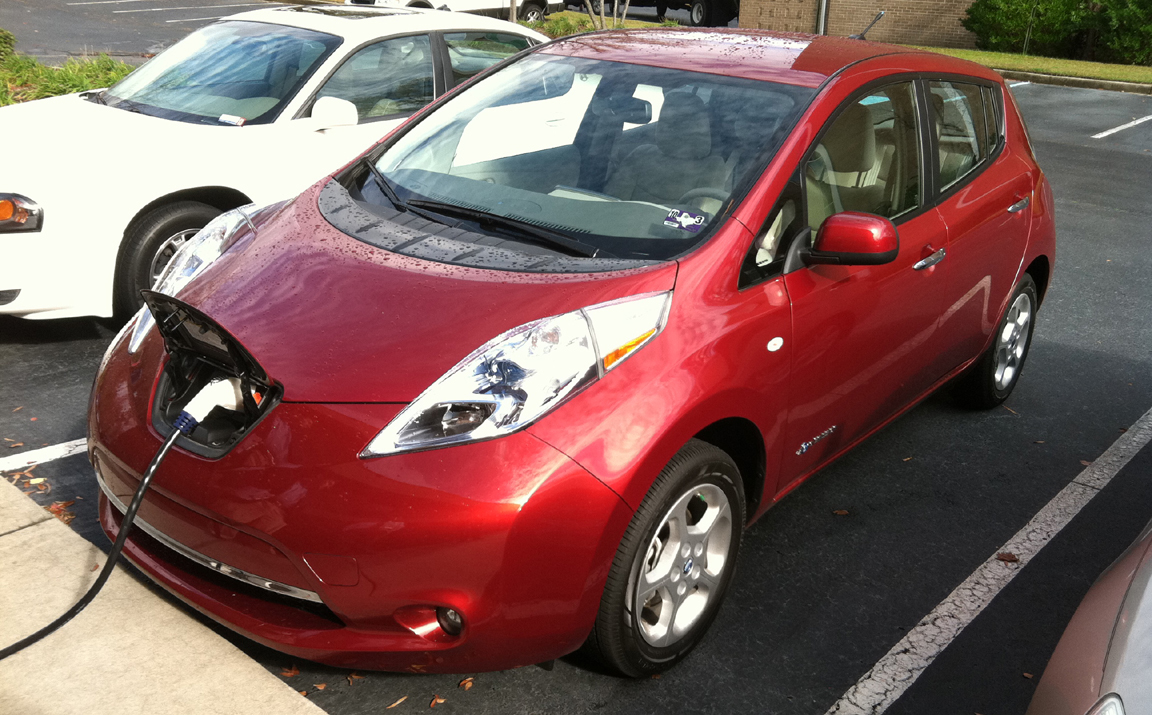
But today, I saw something that is more likely to be our future — a plug-in electric car. In routine use.

I was visiting Mike Couick over at the Electric Cooperatives of South Carolina in Cayce. As it happens, we were talking about sustainable energy (ADCO is working with the Central Midlands Council of Governments and a couple of private partners on a project for local governments). And when we walked outside after the interview, there was some right in front of us.

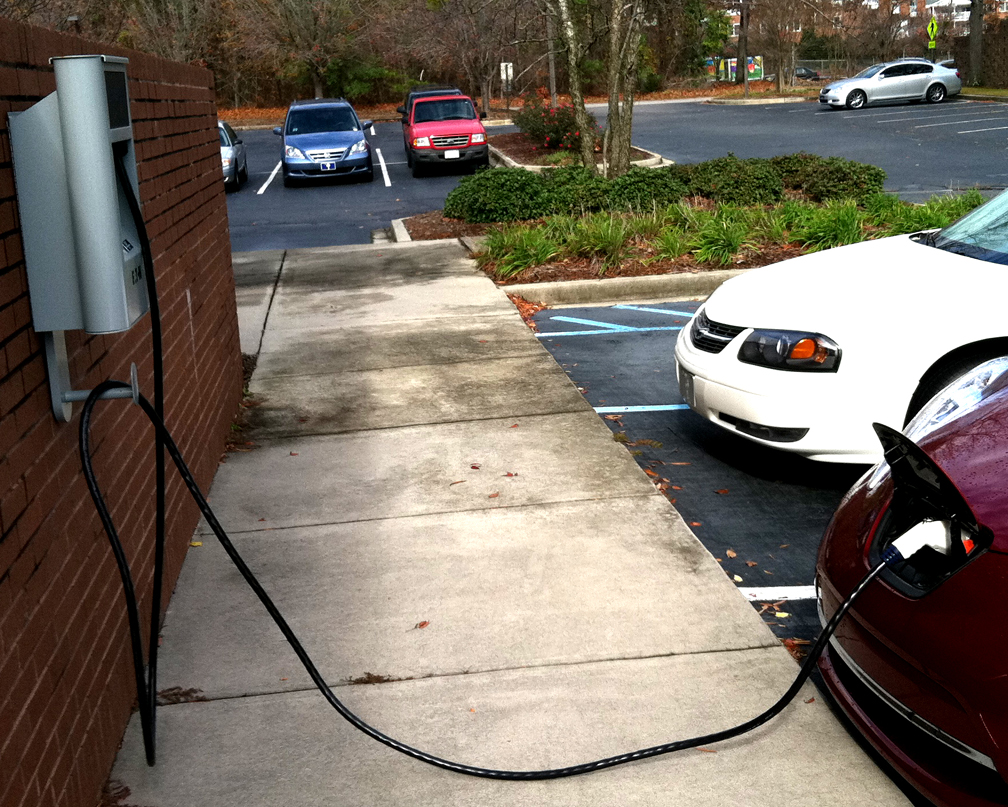
This Nissan Leaf belongs to ECSC, and is used to drive around the state on co-op business, which surprised me — I assumed it was for local use. How does it manage that sort of range? Mike said all the co-ops have charging stations.

Very cool, I thought.

Mike reminded me that this was really sort of retro, since the original automobiles were electric, before the internal combustion engine decided to eat the world (my wording, not his).

With that in mind, I can’t wait to get back to the future and drive one of these myself. And I’ll pass on the gullwing doors, Mr. DeLorean.

How’s Cyber Monday going for you?

For my part, I’m still fighting the battle of the children’s picnic table. I told you about what looked like a happy ending here. And right about that time, I received the following notification:

This is a notification-only email. Please do not reply to this message.

Dear Brad Warthen,

Thank you for ordering from us. Your order number is [bunch of numbers] and has been successfully placed. You’ll soon receive additional emails regarding your order as it is processed.

Here is a review of your order.

Store Pickup summary

The Ready for pickup email typically arrives within 2 hours. Orders placed near or outside store hours may require additional processing time. If you have selected someone else to pick up your order, they will also receive a copy of the Ready for pickup email which provides detailed instructions on what is required to pick up the order….

And so forth and so on. Triumph, right?

But then at 1:33, I got this:

This is a notification-only email. Please do not reply to this message.

Dear Brad Warthen:

Thank you for shopping at Toys“R”Us and Babies“R”Us.

Unfortunately, we were unable to fulfill your order # [same bunch of numbers]. As a result, your order has been cancelled. If you have any questions or concerns regarding your cancellation, please contact Customer Service 1-800-ToysRUs (800 -869-7787) for further assistance.

Order Date: 11/28/11

I’m steeling myself to make that call now.

In spite of this unreality, I’m told that we live in a brave new world of blissful online shopping, and today is that world’s High Holy Day. There are many stories out there celebrating it, such as this one:

A Shopping Day Invented for the Web Comes of Age

Cyber Monday might have started as a made-up occasion to give underdog e-commerce sites jealous of Black Friday a day of their own, but it has become an undeniably real thing — surprising even the people who invented it.

Last year, for the first time, the Monday after Thanksgiving was the biggest online shopping day of the year by sales, and the first day ever that online spending passed $1 billion, according to comScore, a research company that measures Web use.

This year, with a record-breaking Black Friday — shoppers spent $816 million online, 26 percent more than last year, in addition to spending more offline — online retailers are gearing up for Monday to once again be their best of the season…

Yadda-yadda, yadda-yadda, yadda-yadda. I remain less-than-favorably impressed.

No, we can’t ship you that item, Mr. Yossarian…

Maj. Major: Sergeant, from now on, I don’t want anyone to come in and see me while I’m in my office. Is that clear?
First Sgt. Towser: Yes, sir? What do I say to people who want to come in and see you while you’re gone?
Maj. Major: Tell them I’m in and ask them to wait.
First Sgt. Towser: For how long?
Maj. Major: Until I’ve left.
First Sgt. Towser: And then what do I do with them?
Maj. Major: I don’t care.
First Sgt. Towser: May I send people in to see you after you’ve left?
Maj. Major: Yes.
First Sgt. Towser: You won’t be here then, will you?
Maj. Major: No.
First Sgt. Towser: I see, sir. Will that be all?
— Catch-22

To begin with, I tried to do it the old-fashioned way. I asked my Dad if he’d like to ride out to Harbison with me, and he said sure, so I picked him up in the truck and we went out there. We went into the store with me clutching the ad that showed the item on sale. After my usual thing — wandering about the store looking for it without asking for help — didn’t work, my Dad asked someone.

This led, indirectly (I’m giving you the short version here) to someone going to the back and searching for about 20 minutes before informing me that they were out of the item. They offered to order one for me, but I said, don’t bother, I’ll order it online from home. I thought I’d read that shipping was free, and I figured I’d save myself another trip to the store.

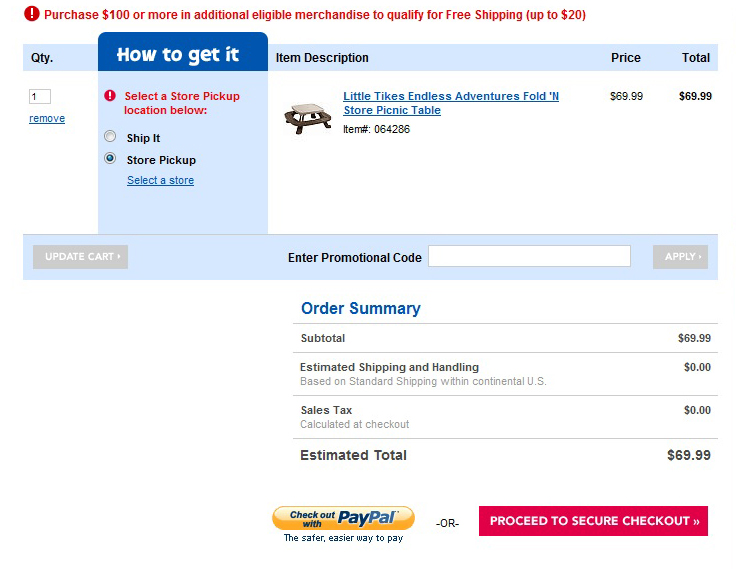
So I got home, and I went online, and there was the item, so I put one in my cart, and went to check out. Where I found that instead of $69.99, it would cost me $111.40. Turns out I would have to order another 40 bucks worth of merchandise from that store to get the free shipping.

OK, so I clicked on the “store pickup” radio button, and presto!, the shipping charges disappeared. Seemed fair enough to me… they put it on a truck that would be going there anyway, and I drive a few miles out of my way, and I pick up the item. Fine.

One more step, though: I had to click on the link that said “select a store.” Fine. I went there, and filled in my zip code, and was shown the two stores in my area.

Then came trouble: I couldn’t click on either store. They were grayed out, because the item was “Out of stock (or not carried) at this store.”

Well, duh. Otherwise I would not be placing an order from it and opting for “store pickup.”

Well, obviously there was a malfunction in the software, so I called the store to go back to Option A, which was to get them to order it for me.

I just needed to deal with a human being, thereby placing me back in the land of sweet reason.

So I called, and after listening to some singularly bad muzak (it was country, and I think it was intended to be patriotic, but it was extremely off-putting), a man came on the line.

Of course, sir, I’ll be happy to help you sir. What’s the item you were trying to order? I give him the stock number, and he keeps me waiting a brief while before politely informing me that they couldn’t order that particular item for me, because it wasn’t in the store already. If it were in the store, I could have store pickup, but not if it wasn’t already in stock.

But… they had offered to order it from me when I was there, I insisted, my voice rising a bit.

They must have meant they would order it for home delivery, he said, beginning to sound a bit put out with me.

But… if we did that, the cost of the item to me would almost double.

Yes, sir. Unfortunately, however, the store could not place the order for me unless the store already had it. Unless I’d like to have it delivered to my house for $50 more, a transaction I could easily have managed without involving him at all.

I was beginning to feel a bit panicky, like Yossarian in the nose of his B-26, surrounded by glass, with flak exploding around him so thick it looked like you could walk on it…

And as he sensed my disorder, the man tried to placate me a bit by admitting that yes, perhaps, the way it is worded, as “store pickup,” implying an item being ordered from elsewhere when it was already there, was a bit misleading, nevertheless…

Fortunately, I calmed down enough to ask him whether… by any chance… this item, which had just been advertised as being at his store today… might be coming in on a subsequent shipment without my having to place an order.

He said that was possible. And he had a truck coming in tonight. Perhaps, if I called first thing in the morning, the item would be there and I could place my order.

So I resolved to do that. But I must confess, there’s this paranoid little voice at the back of my head that tells me that by that time tomorrow morning, Colonel Cathcart will have raised the number of missions on me once again…

Yossarian, screaming: "But why would they have to ship you one if you already HAVE one?!?!"

Even the robots are complaining now

Just got back from lunch, and had a message from Kathryn Fenner saying the blog was down. Again.

The message had come at 12:50, but by the time I saw it at 1:28, everything was OK.

I had similar complaints — along with others about folks having trouble sending me email — Monday. And I couldn’t call up the blog myself for a few minutes on Sunday.

Today, I even had a complaint from LinkedIn that it couldn’t send me emails. So even the robots are complaining.

First, sorry about the inconvenience, folks. Second, somebody’s trying to help me run this down. The tricky thing is, it’s almost always fixed before we look at it.

Please keep the complaints coming if you have trouble. If you can’t reach me at brad@bradwarthen.com, try brad@adcoideas.com. That seems to be working pretty steadily.

And again, I apologize for this thing that is NOT MY FAULT!…

The new iPads arrive at Lexington High School

This student, whom I cannot name because she's just 17, had found time to personalize hers...

Thursday morning I spoke to Michael Burgess’ class at Lexington High School. The format was much like one of Kelly Payne’s classes — the kids had a prepared list of questions, which is what I like. I hate a set speech, with me droning on and wondering whether anyone is interested. With questions, I at least know I’m addressing something my audience cares about — or something their teacher wants them to care about.

Sample questions:

1. How does the media influence the political process? Is this a positive or negative influence?
2. Discuss the impact of social media outlets on the political discourse of today?
3. What is the role of money in determining the outcome of elections?
4.Could you list and describe the various sources of funding for campaigns?
5.What is the real role versus the appropriate role of interest groups in influencing policy?

But my speech was definitely not the most interesting thing happening in those students’ school day, because I arrived on the same day as the new iPads.

I had trouble finding a place to park because the visitor spaces, I was told, were taken up by district people who were there for the iPad rollout.

Here’s a release on the Lexington One website about the new devices:

Last year (the 2010–2011 school year), Lexington County School District One successfully executed a personal mobile computing pilot at Gilbert High School as part of our ongoing search for ways to provide students with the tools they need to support their learning and to prepare them for higher education opportunities and careers.

At that time, we explained that we planned to expand the program to our other high schools.

This year (2011–2012), we are expanding personal mobile computing to our other three high schools. All high schools will begin issuing the devices in November.

The district feels strongly that its personal mobile computing initiative is not about the tool used. It is not about an iPad or a tablet. It is about what a personal mobile computing device enables our students to do.

With these devices, students will acquire the digital competence they need for our increasingly electronic- and technology-driven world. They will learn the essential skills they will need as consumers, citizens and workers.

The devices will give students access to the most current information available through the Internet and to the district’s Learning Management System 24 hours a day, seven days a week during the school year.

Students will be able to complete and turn in assignments, homework, projects or research electronically. Interactive applications will allow them to improve their reading fluency, build mathematics skills or create their own study cards.

Unfortunately, as yet, not all textbook publishers provide electronic copies of every textbook, so the district will not be able to eliminate textbooks. Teachers will be able, however, to supplement material found in textbooks with information they create using various multimedia or with information already available.

Lexington One purchased the personal mobile computing devices as part of the voter-approved 2008 Bond Referendum. That bond referendum included $15 million to expand and upgrade existing technology at all schools.

Read our Personal Mobile Computing Guide for high school students.

I should mention that the students were all politely attentive to my talk. I don’t think I could have been, with a new iPad in front of me…

A little something to creep you out thoroughly on Hallowe’en: “Take this lollipop”

Look who's looking YOU up...

This is a bit of a dare, and you MAY regret it, but if you really want to get into the spirit of horror on this All Hallow’s Eve, check this out.

Click on Take this Lollipop, and then allow it access to your public information on Facebook.

And then sit back and watch.

Then I’d like to hear your thoughts — about privacy in the social media age, and about… well, whatever interests you.

But this is the first interactive, personalized (very short) horror film I’ve ever seen. And it’s scarier that 100 haunted houses.

Here’s part of what CNN had to say about it:

(CNN) — A sweaty, wild-eyed man in a stained undershirt hunches over his computer in a shadowy basement. He’s broken into your Facebook account and is reading your posts as his dirty, cracked fingernails paw at the keyboard.

Rage (jealousy? hate?) builds as he flips through your photos and scrolls through your list of friends. He rocks back and forth, growing more agitated as the pages flash past. Then he consults a map of your city and heads to his car …

So why … oh, why … did you include so much personal information — and your address — in your profile?

If that all sounds like the stuff of a digital-era horror movie, you’re not far off.

“Take This Lollipop” is an interactive short video that’s been making its way around the Web as Halloween approaches. Visitors to the site are first presented with an image of a lollipop with a razor blade in it — don’t take candy from strangers, kids — and asked to grant access to their Facebook account.

Don’t worry: The application claims it uses your data only once, then deletes it. But the creepy results just might make you think twice about who else gets access to your online information.

The video uses the developer tool Facebook Connect and features actor Bill Oberst Jr. (whose credits range from “The Secret Life of Bees” to the inexplicably Oscarless “Nude Nuns With Big Guns”) as the aforementioned grungy nutjob…

Netflix listened! ‘No Qwikster.’ I’m impressed…

… but not overwhelmed with gratitude or anything. After all, the rates DID go up.

But the boss man there had seemed so adamantly sure that his way was the way to do it, and everybody else was an idiot, that I was pleasantly surprised to see this release today:

Dear Brad,
It is clear that for many of our members two websites would make things more difficult, so we are going to keep Netflix as one place to go for streaming and DVDs.
This means no change: one website, one account, one password…in other words, no Qwikster.
While the July price change was necessary, we are now done with price changes.
We’re constantly improving our streaming selection. We’ve recently added hundreds of movies from Paramount, Sony, Universal, Fox, Warner Bros., Lionsgate, MGM and Miramax. Plus, in the last couple of weeks alone, we’ve added over 3,500 TV episodes from ABC, NBC, FOX, CBS, USA, E!, Nickelodeon, Disney Channel, ABC Family, Discovery Channel, TLC, SyFy, A&E, History, and PBS.
We value you as a member, and we are committed to making Netflix the best place to get your movies & TV shows.
Respectfully,
The Netflix Team

The “respectfully” was a nice touch, but unnecessary. You showed your respect by listening.

Now, about some of those videos that still aren’t yet available on Netflix…

Madness has taken hold of Netflix

Did you get an email this morning from Reed Hastings, head honcho at Netflix? I did. Here’s an extended version of it on a Netflix blog. I am spared the trouble of writing a full response, because an NPR blog has spoken for me:

Netflix has figured out that people are very upset about its decision to split streaming video and DVD delivery — a decision that got it in huge hot water earlier this year. Customers who had previously gotten both streaming and DVDs for a single price would now have to pay separately. If you only use one or the other, you could pay less, but if you still wanted both, you’d pay more.

The Netflix response? Separate the businesses even more. In a new blog post, Netflix co-founder Reed Hastings explains that for some reason, he has concluded that separating the businesses completely is going to help people understand what’s going on. Thus, Netflix will not send DVDs at all anymore but will only provide streaming, while the company’s DVD business will happen under the new “Qwikster” brand.

Hastings seems to be operating under the premise that customers don’t really understand what’s going on; that they are angry because they think that a single business has increased its price when in fact it has merely split into two businesses that charge separately. Presumably, the idea is that making the split more definitive will make people slap their foreheads and say, “Oh, now I see. Netflix actually lowered its prices, as long as I don’t buy Qwikster! And new Qwikster is cheaper than old Netflix! I’m coming out ahead, sort of, if I don’t want all the services I used to get!”

The only problems with this approach are that its underlying assumptions are almost certainly wrong, and that it ignores major inefficiencies that will be introduced for customers who do, indeed, want to continue to use both streaming and DVDs. Now, if you want both, you have to go to two different sites with two different queues, you have to pay two different charges to two different entities, and in general, you have to have two different memberships. That’s not psychologically better for consumers. That’s buying two things which are both less helpful than the single thing you could get before.

It’s like a shoe company deciding to sell right shoes and left shoes for 12 dollars each where pairs of shoes used to be 20 dollars and thinking that consumers will notice the lower 12-dollar price but not the fact that it buys only one shoe….

Good response, and I hope NPR will forgive me for quoting it so extensively (please go to NPR and fully experience its services).

Lemme ‘splain somethin’ to you, Mr. Hastings: Neither your DVD service nor your streaming service stands alone; they are complementary. OK, so maybe the DVD service is complete in its way, as a fine service if this were the year 2001. But you and I know (or think we know) that Web streaming is the way the business is going to go, so if you are survive you have to get into that business big. Which you have done.

But here’s the critical point you’re missing: Your streaming business (which you laughably call “instant”) does NOT stand alone. It is not complete. Perhaps you’ve noticed that you are unable to get permission to stream most popular, recent titles. Therefore if your customers want a full service that will provide them with a full selection of the movies and TV shows they want to see, they have to supplement their streaming with DVDs. Which you seemed to get until, quite suddenly, recently.

If I weren’t so dependent on you, I’d drop your service now. But I got rid of my cable (or all of it except local stations, which almost amounts to the same thing), so almost all of the video content I ever watch now comes from you. It’s not the added cost, although that’s not pleasant (I dropped the cable because you were such an economical alternative). It’s the way you’ve done this.

I used to think that Netflix was a company that knew what its customers wanted. Not so much now.

Building the Innovista, one brick at a time

Or maybe it’s one photon at a time. This just in from CRBR:

SCRA announced its newest tenant at the SCRA USC Innovation Center in Columbia, Nitek Inc.

SCRA described the company as a world leader and pioneer in deep ultraviolet-LED lamp technology. Nitek was launched in early 2007 with the goal of commercializing innovative micro-devices using III-Nitride technology, according to the company website.

Nitek is a spin-off of the University of South Carolina’s Photonics and Microelectronics Laboratory, which was started by USC professor Asif Khan in 1997.

The lab was formed as a small-scale, vertically integrated manufacturing facility for ultraviolet emitters, high-power electronics and visible LEDs and lasers…

The company will initially employ about 14 high-tech, high-wage employees. That number is expected to double in the next three years, SCRA said…

So… they’re selling light, from what I gather. Or something. Here’s wishing them huge success.

Empirical proof: Nothing comes anywhere close to “The Graduate”

I’ve always been aware, on a superficial, untested level, that “The Graduate” stood in a league of its own, defying characterization.

I suppose you could call it a sort of dark comedy, if you like, or social satire, or whatever. But try to think of another movie that makes you think and feel anything like what “The Graduate” does. You can’t.

I had empirical confirmation of that tonight. I saw it among the “Watch Instantly” flicks on Netflix. I didn’t need it in my queue because I have it on DVD, but I clicked on it to put it in my queue just to see how the algorithms of Netflix dealt with it.

And as I suspected, it could not come up with movies like “The Graduate.” Look at the lame attempt above. “Kramer vs. Kramer?” “The Paper Chase?” Both fine films, but neither of them anything like “The Graduate.” Aside from the incidental presence of Dustin Hoffman in one of them, which is meaningless.

And please, do not mention the execrable, silly “Tom Jones” in the same conversation.

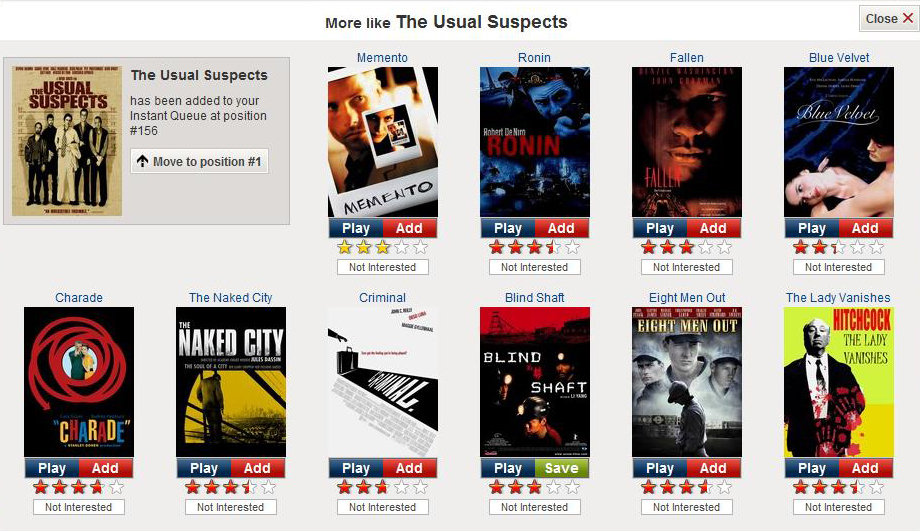
Netflix is far from infallible. But it generally does a better job than this. Take another quirky film, “The Usual Suspects.” A challenge, yes?

OK, there’s nothing exactly like it maybe, but some of these selections — “Memento,” “Blue Velvet,” a Hitchcock or two — at least get its range, landing in a loose pattern around it. I’d throw some of these out, though (“Eight Men Out?” Fine film, but doesn’t fit here), and throw in a Tarantino, or “The Professional.” None score a direct hit. But they come a lot closer than anything does to “The Graduate.”

The big picture for Amazon

South Carolina hardly rates a mention in this report in the WSJ today (“Amazon Battles States Over Sales Tax“), but I thought some of y’all, your nerves still jangled from the recent battle at the State House, might be interested in this step-back report on what was at stake for Amazon, and how SC fits into the company’s grand strategy. An excerpt:

SEATTLE — Amazon.com Inc., the world’s largest online retailer, hasn’t charged sales tax in most states since its founding in 1994. And it has taken some extreme measures to keep it that way.

Among them: Staff traveling around the U.S. have been required to first consult a company map that shades each state red, yellow or green, said three people who have worked for the retailer. These people said they needed permission from managers or company lawyers before entering “red” states because a worker’s actions might trigger laws that force Amazon to collect taxes in those states.

Such steps to avoid local levies allow Amazon to undercut in-state retailers by the amount they must add in sales tax, which can exceed 8%.

A close examination of Amazon’s corporate practices, based on interviews with more than a dozen former employees and people who have done business with the Seattle company, as well as a review of corporate documents, indicates that the company believes its sales-tax policy is critical to its performance…

Bad video of the Benjamin-Runyan thing

I’ve had about enough of outdoor political events.

First, this time of year, it’s too hot. Then, it’s also too noisy.

But those are not the things that make this bad video. The main thing is that I couldn’t edit it. I shot it on my iPhone, which shoots awesome, HD (I think) video.

Trouble is, I can’t edit it. I can call it up in the PC editing software, just as I do with videos from my Canon. But there’s no sound. I tried ignoring that, and cutting it anyway down to the bits that looked and sounded best in Windows Media Player (which plays the format just fine), but the format that it saves to also lacks sound. So, pretty useless.

I have iMovie on the Mac laptop at work, which I think is supposed to edit video, but can’t figure out how to get the files from the phone to that application. Probably something really simple for people who think Mac, but hard for me.

So I just uploaded the whole thing. I said I would use the video to sub for one of the photos back on the previous post, but why take down a perfectly good jpg for a bad video? Make what you will of this.

Press a button, and your iPhone shouts ‘You lie!’

Had to smile at this release about Joe Wilson going all high-tech:

Dear Subscriber,

Today, I am excited to tell you of the newest way you can stay in touch with the campaign by getting the latest updates, news, and stories: a new mobile application available for free to anyone with a smart phone.

As you all know, I love staying in touch with as many of you as I possibly can. This application is designed for just that purpose.   It allows me to reach out to you and post updates on local campaign events in your area, different ways for you and your friends to get involved with the campaign, and opportunities for me to visit with you in your community as well as news on the Second Congressional District of South Carolina.

Other features of the app include: interactive poll questions and direct feedback with me. I am also planning to launch a live video chat service in the future that I am very excited about.

In order to save this application to your phone, all you need to do is open up a webpage from your smart phone and visit www.joewilsonforcongress.com.  The mobile website will automatically redirect you to instructions on how to bookmark the application on your phone for future use.

I look forward to getting to know you better, and I hope you will join me by using your smart phone to visit www.joewilsonforcongress.com.

Sincerely,

Joe Wilson
U.S. Congressman

Actually, back to my intro, does anybody say “high-tech” any more? I think that term was trendy in Esquire back in the ’70s. I need to update myself. Maybe Joe could help me…

People used to live their lives. Now they shoot video of other people shooting video of them…

I found this video of editor Colin Myler’s last address to News of the World staffers interesting — not so much for anything he said (the sound’s not great) — but for what it shows of what we’ve come to culturally in this century.

Nobody just goes ahead and experiences anything any more. They’re too busy shooting video and photos of it. Everybody is doing it — the central figures in the event, and the onlookers. The event itself is delayed while pictures are taken.

It’s pretty weird. Nobody looks at anybody, because they’re all looking at their viewfinders. It’s like the thing isn’t really happening. And when you go back and look at the video you shot, all you’re going to have is video of a bunch of people shooting video.

It’s beyond weird.

It wasn’t like this in the first century and a half of photography. Used to be there’d be a few people taking pictures, and everybody else experiencing the thing. Cell phones did this. Everybody always has a camera on hand now, so every moment has to be captured. Even when the fact that everybody is doing so sort of ruins the visual effect.

This struck me really powerfully last year when the Gamecocks won their first national baseball championship. During the parade, all of the players — or quite a few of them — were busy shooting video of the parade, rather than simply experiencing the moment.

It makes me wonder whether, in the future, anything of moment will ever just happen without all of this looking into a mirror image of a mirror image of a mirror image, etc.

Next, they’ll be dropping bombs on us like rocks from a highway overpass

No, this is not a reference to the report that terrorists are now planning to board planes with surgically-implanted bombs — although we can talk about that if you’d like.

I was just facetiously invoking Tom Wolfe’s characterization of the hysteria in this country when Sputnik went up. I don’t think any politician actually said “the Soviets would send up space platforms from which they could drop nuclear bombs at will, like rocks from a highway overpass,” but I enjoyed Wolfe’s hyperbolic description of the concerns of House Speaker John McCormack.

Anyway, I thought of that when I realized that the Russians are about to have the monopoly on space travel:

The last U.S. space shuttle is scheduled to blast off Friday. After that, the U.S. and other nations will rely on vintage Russian spacecraft to ferry their astronauts to the $100 billion station. Russia will hold a monopoly over manned spaceflight, and tensions already are rising. The Russians are in the process of nearly tripling the cost of using their Soyuz crew capsules for transport to the orbiting base, and other countries have little choice but to pay up.

“We are not in a very comfortable situation, and when I say uncomfortable, that is a euphemism,” said Jean-Jacques Dordain, director general of the European Space Agency, one of five international agencies that jointly manage the orbiting laboratory. “We made a collective mistake.”

While there is less chance today of our going to sleep “by the light of a communist moon” (as LBJ warned), I still find this development disturbing.

I miss the halcyon days when this country did exciting stuff in space (and the Shuttle, essentially a space bus driving around the block, never quite qualified). I’m ready for Mars.

An economic argument for supporting Israel

For years, Samuel Tenenbaum has tried to turn the attention of economic development types in SC toward Israel. This is understandable, given that Samuel is the father of our state’s endowed chairs program, and Israel’s tech prowess.

But I hadn’t seen the same argument presented in strategic terms until I read this piece this morning:

America’s enemies understand deeply and intuitively that no U.S. goals or resources in the Middle East are remotely as important as Israel. Why don’t we?

Israel cruised through the recent global slump with scarcely a down quarter and no deficit or stimulus package. It is steadily increasing its global supremacy, behind only the U.S., in an array of leading-edge technologies. It is the global master of microchip design, network algorithms and medical instruments…

While it wasn’t the main point of the piece, I also was struck by what a neat summation, from the pro-Israel perspective, this was of why the peace process hasn’t worked in recent years:

Actions have consequences. When the Palestinian Liberation Organization launched two murderous Intifadas within a little over a decade, responded to withdrawals from southern Lebanon and Gaza by launching thousands of rockets on Israeli towns, spurned every sacrificial offer of “Land for Peace” from Oslo through Camp David, and reversed the huge economic gains fostered in the Palestinian territories between 1967 and 1990, the die was cast…

Not the whole story. But neither is blaming Israel.