Category Archives: Technology

Regarding the end of film

Saw the oddest thing the other day in a TV show. I was watching an episode, from last season, of “The Good Wife.” There was a scene in which a man who has just committed a murder grabs a camera — a nice-looking SLR — and strips the film out, to destroy evidence.

Wow. Who uses film anymore? No one on-screen explained it. (The character was wealthy and quirky, and perhaps that was supposed to imply an explanation; I don’t know.) Anyway, today Roger Ebert brings our attention to this:

At the turn of the 21st century, American shutterbugs were buying close to a billion rolls of film a year. This year, they might buy a mere 20 million, plus 31 million single-use cameras – the beach-resort staple vacationers turn to in a pinch, according to the Photo Marketing Association.

Eastman Kodak Co. marketed the world’s first flexible roll film in 1888. By 1999, more than 800 million rolls were sold in the United States alone. The next year marked the apex for combined U.S. sales of rolls of film (upward of 786 million) and single-use cameras (162 million).

Equally startling has been the plunge in film camera sales over the last decade. Domestic purchases have tumbled from 19.7 million cameras in 2000 to 280,000 in 2009 and might dip below 100,000 this year, says Yukihiko Matsumoto, the Jackson, Mich.-based association’s chief researcher.

For InfoTrends imaging analyst Ed Lee, film’s fade-out is moving sharply into focus: “If I extrapolate the trend for film sales and retirements of film cameras, it looks like film will be mostly gone in the U.S. by the end of the decade.”

I’m a traditionalist, and was slow to give up film myself. But eventually — in the middle of this past decade — affordable digital got good enough. And since about 2005, my excellent Nikon 8008 has sat abandoned in a drawer. Which is sad. It is SUCH a better camera than I use today (in fact, I seldom use my actual “camera” any more, because the iPhone is so good for most purposes), enabling me to control the image so much better. But who can deal with the hassle and expense of buying the film, paying to have it processed (or paying even MORE in chemicals and such to do it at home, which I used to do), and then store the film safely, etc. And now you can see whether you got the shot immediately — and take unlimited exposures…

But it’s still sad…

There are diehard holdouts, connoisseurs who insist that there’s a quality to film that is lost without it, but to my philistine eye, the difference has disappeared. Same thing with vinyl records: But since I got a USB turntable and started digitizing my vinyl a couple of years back, I’m become pretty acutely aware that sound files that started out digital sound better than ones that came from my records. To me. Which probably also indicates I’m a philistine.

Ah, progress…
Half a century, and still no flying cars

Yeah, I know it’s a cliche — here we are in the high-tech future, a whole other century from when most of the sci-fi we grew up on was written, and there are no flying cars. It’s been said many times before.

But I just got to thinking about it in terms that hadn’t occurred to me before.

My wife was reading a book out on the deck this morning (while the weather was still pleasant), and referred to it having been written 50 years ago.

That’s the shocking thing, you see. It seems that 1961 is no longer just a brief while back. It’s 50 years ago now.

As anyone who has read Gene Sculatti‘s delightful and authoritative Catalog of Cool knows, 1962 was the Last Good Year. But the year before had much to recommend it as well. It’s the year that the iconic 60’s cult novel, Stranger in a Strange Land, made its appearance. Heinlein assumed that by the end of the 20th century (there is one vague reference to the date that places it at the end of a long, hard century — and Jubal Harshaw had served in North Africa in WWII), there would be flying cars — flying cars that flew to one’s destination without being guided by a human occupant. Say your destination aloud, and the car would take you there.

Now we have the technology for most of that. We can do voice commands, and something like Google Maps and GPS working together, along with the ability that SUVs and some other cars have now for sensing the proximity of other vehicles, etc. — we could make the car go where we wanted without guiding it, although personal I wouldn’t want to be one of the first few thousand people to trust my life to it.

It’s the flying part that’s tricky. Heinlein wasn’t specific about how the cars flew. He mentioned the “Lyle Drive” for spacecraft, but not the means for making the cars fly. Aldous Huxley, years before, had had people routinely flying helicopters, but Heinlein was not so explanatory, although one gets the impression that they flew Jetson-style. His characters took such transport for granted, suggesting the technology had been around awhile, so we are expected to take it for granted as well.

There were other things — such as a form of 3D TV called “stereovision,” which I sort of gathered was holographic, and watched in a “tank” like an aquarium. And videophones — although apparently landline-based. And most dramatically (and centrally to the plot) there had been two rather significant manned flights to Mars, the second one leaving colonists.

The assumption in those days seemed to be — with jets relatively new, and JFK pushing us to the moon — that our main technological advances would be in the area of transportation. Little thought was given to information technology. While a number of the things he imagined would have been unlikely without computers — such as doors that opened to spoken commands, and “bounce tubes” replacing elevators — the idea of the personal computer, as an important element of the typical consumer’s life, from the desktop to the smartphone — was completely absent. No email, no texting, no Skype (except from the landline). Hilariously, when a character wanted to send a written message and have a record of it rather than speaking by TV phone, he went to something that sounded like a telegraph office and sent a “statprint.” Ben Caxton, a nationally syndicated columnist in the novel, has such an advanced office that it has its own “statprinter.”

A lot can change in 50 years. Especially the future. What I can’t believe is that it’s been so long.

More on The Filter Bubble

If you were interested in this post back here, you might want to check out this review of Eli Pariser’s book, The Filter Bubble. An excerpt:

… Personalization is meant to make Internet users happy: It shows them information that mathematical calculations indicate is more likely than generalized content to be of interest. Google’s personalized search results track dozens of variables to deliver the links that a user is predicted to be most likely to click on. As a result, Google users click on more of the results that they get. That’s good for Google, good for its advertisers, good for other websites and presumably good for the user.

But Mr. Pariser worries that there’s a dark downside to giving people their own custom version of the Internet. “Personalization isn’t just shaping what we buy,” he writes. “Thirty-six percent of Americans under thirty get their news through social networking sites.” As we become increasingly dependent on the Internet for our view of the world, and as the Internet becomes more and more fine-tuned to show us only what we like, the would-be information superhighway risks becoming a land of cul-de-sacs, with each of its users living in an individualized bubble created by automated filters—of which the user is barely aware.

To Mr. Pariser, these well-intended filters pose a serious threat to democracy by undermining political debate. If partisans on either side of the issues seem uninterested in the opposition’s thinking nowadays, wait until Google’s helpful sorters really step up their game….

If you read the book, let me know how it comes out. The review said was strong on identifying a problem, not so hot on solutions. Which I wouldn’t blame on Pariser. No one else knows the answer, either.

How much do I actually NEED to know about the bin Laden raid?

How much of what THEY know do WE need to know?

Here’s a consideration I hadn’t though much about before now, and should have (given all those spy novels, and military history books, and Tom Clancy thrillers I’ve read):

Has the U.S. Said Too Much About the Bin Laden Raid?

Military officials fret that constant stream of leaks may hinder future missions, put Navy SEALs at risk.

By Josh Voorhees | Posted Friday, May. 13, 2011, at 11:09 AM EDT

In the nearly two weeks since the U.S. operation that killed Osama Bin Laden, a near-constant stream of detailed information about the raid’s specifics has seeped out from White House officials, lawmakers, and pretty much anyone else with security clearance.

But that’s not how things were supposed to be, at least not according to Defense Secretary Robert Gates. “Frankly, a week ago Sunday, in the Situation Room, we all agreed that we would not release any operational details from the effort to take out Bin Laden,” Gates told Marines at a Wednesday town hall at Camp Lejeune. “That all fell apart on Monday—the next day.”…

The White House announced last week that it was done briefing reporters on the specifics of the mission, but that has done little to stop the ongoing flow of new details from being reported. The latest major leak came Thursday night, when CBS News gave a detailed play-by-play of what the Navy SEAL team’s helmet cameras captured during the raid….

There is the danger that the more we know about details of the raid, the greater potential for threatening our capability to do something like it in the future.

For instance, the lede story on The Washington Post‘s front page yesterday told us that a key element in preparing for the raid involved high-altitude drones flying WAY deeper into Pakistan than the Pakistanis suspected we were going. So that we could get higher-resolution photos than you get from satellites. And if you consider how high-resolution satellite photos can be, these images must have been pretty awesome. So… you have a revelation of greater technical capability than the world might have expected, and of a tactical deployment that no one knew about.

Of course, it’s a two-edged thing. Let enemies and potential enemies know what you can do, and it could intimidate them into deciding they don’t want the United States as their enemy after all. Or at least, it MIGHT work that way with some — say, your less fanatical foes. But let anyone know what measures you are capable of, and it empowers them to develop countermeasures. That’s a huge theme in military history — measures and countermeasures — and it never ends.

We may find all these details fascinating — I know I do. But how much of it do we really need to know?

Everybody wants to talk about nuclear, but who wants to listen?

Last night I went for the first time to one of EngenuitySC’s Science Cafe sessions at the Capital City Club. I’d been meaning to go to one for quite some time, and I finally made it to this one.

So did a lot of people. When I called at the last minute to RSVP, the session was full. But I was told to come anyway, as there were usually no-shows.

So I showed up. And while there were a few empty seats as the session was starting, I stood at first in case a latecomer needed one of the seats. Otherwise, SRO.

Neil McLean, Executive Director of EngenuitySC, began the evening with a somewhat wary welcome to the crowd, noting that this was the biggest turnout ever, and that he saw quite a few… new faces… in the audience. He then expressed his hope that the interaction would be civil.

The topic? “Sustainable Nuclear Power: Perspectives on Risk and External Costs.” The speaker was Travis W. Knight, the acting director of USC’s Nuclear Engineering Graduate Program.

He didn’t have an easy night of it. As I tweeted at the time,

Nuclear skeptics in crowd won’t let speaker at Science Cafe get on with his presentation; one keeps interrupting to read from The Economist.

and later…

Neil McLean of EngenuitySC has to change rules — 1 question per person — to let Science Cafe speaker continue with nuclear presentation.

When Mary Pat Baldauf, sustainability facilitator for the city of Columbia, wrote back to say it sounded like she was missing a good one, I told her she was “You’re missing humdinger. Speaker fairly rattled by crowd’s hostile interruptions. No way to have a debate, much less a lecture.”

In retrospect — and things really did settle down after Neil imposed that rule, and the speaker began to hit his stride a bit better — maybe I made it sound more dramatic than it was.

But judge for yourself. Here’s a recording from the first few minutes of the lecture. You’ll note that there are three interruptions during the 3 minutes and 25 seconds on the recording, including one from the Economist reader.

For my part, I found the lecture informative. But I went away thinking, with what is happening in Japan, everybody wants to talk about nuclear power. But how many people want to listen?

Congratulations, Innovista, on landing Ann Marie!

A little earlier, I sent an e-mail to Ann Marie Stieritz congratulating her on her new job:

Ann Marie Stieritz has been named director of business solutions for Innovista at the University of South Carolina.

Stieritz has worked in the S.C. Technical College System for the past four years, most recently as vice president for economic development and workforce competitiveness.

Her responsibilities will include recruiting high-tech businesses to the Midlands and serving as the liaison between USC’s researchers and the business community.

Don Herriott, director of Innovista partnerships, said, “I have worked with Ann Marie on various boards and projects. She has demonstrated exceptional capability and leadership in her role at the South Carolina Technical College System, especially in her economic development and workforce development programs. I am confident that she will provide the industry connectivity that Innovista needs.”


Stieritz has a background in education, workforce and economic development. At the S.C. Technical College System, she has overseen the system’s two nationally recognized economic and workforce development programs, as well as other statewide initiatives that have enhanced the state’s competitiveness through education and training, USC said.

She is former statewide coordinator for 12 Regional Education Centers, which coordinate education, workforce and economic development with business and industry initiatives to develop education and workforce readiness strategies…

But then I realized that I had it all wrong! Congratulating Ann Marie was as wrong-headed, as déclassé, as congratulating the bride on her engagement.

Actually the congratulations are due to Innovista. So, Innovista, I give you joy of your new hire.

Don Herriott was a good call. He did what he should, immediately shifting the conversation about a couple of buildings to the much, much broader concept about what the juxtaposition of an urban research university and all this undeveloped land overlooking a river can add up to.

So is this. Ann Marie’s intelligence and drive will be just what Innovista needs for this movement to take off. I look forward to watching her make that happen.

Don’t ya just love the New Normal? It’s like we’re all living on the frontier, making it up as we go along

Just saw this from Wesley Donehue:

The Pub Politics episode scheduled for tonight has been canceled due to the show’s camera being broken. Unfortunately, the problem is one that cannot be repaired before airtime.

The show’s producer will be taking the camera to a shop to be fixed so that next week’s Pub Politics can continue as planned.

Phil and Wesley are sorry for the inconvenience, but hope you understand and will be patient for next week’s show.

For those who still wish to come to The Whig and hang out with the Pub Politics crew, we’ll be there for $2.50 pints.

Pub Politics is a weekly political show featuring Phil Bailey, SC Senate Democratic Caucus Director, and Wesley Donehue, SC Senate Republican Caucus Director, talking to various SC legislators and other leaders. For more information, please visit www.pubpoliticslive.com.

Dontcha just love the New Normal? Instead of the imposing MSM with its vast resources for bringing us news and commentary, we increasingly rely on new media, which is very catch-as-catch-can, very bailing-wire-and-broomhandles, so close to the edge of viability, that a single camera breaking down puts you out of action.

Sort of like what happens to my blog when the laptop acts up.

It’s like the Wild West, folks, or… living on one of the outer planets on “Firefly.” Hey, I know! Maybe Mal and I can buy the Discovery, now that it’s headed to the scrapheap, and get Mr. Universe to do IT for us, and blog and broadcast from out past Reaver territory, where the Alliance can’t stop us…

Except that Mal, mercenary that he is, would demand to know how he was going to make money off of it. And we New Media types haven’t figured out how to do that any more than the MSM has figured out the same problem going forward. If we had, we’d have more than one frickin’ camera…

They’d better get it fixed quickly, so that I can go on and be the first Six-Timer

Have some fun in the Sistine Chapel

The guy who did the ceiling.

Before I forget about it totally — go check out this cool interactive Vatican site that Burl brought our attention to in a comment the other day. You can spin it around 360 degrees in three dimensions, and do so all sorts of different ways by changing the mouse

setting down in the left-hand corner (where you’ll also find the buttons that let you zoom in and out).

Very cool. And much cheaper than a trip to Rome. I enjoyed it, anyway.

Michelangelo did a pretty awesome job. I wonder what he would have charged, say, to do my TV room?

Just FYI: “Watson” can’t “think”

Last week, I saw this interesting piece in the WSJ that I meant to pass on, and I will now, in case there are some of you feeling terribly inadequate (as a species) because “Watson” won on “Jeopardy.”

The headline and subhed state the case well:

Watson Doesn’t Know It Won on ‘Jeopardy!’

IBM invented an ingenious program—not a computer that can think.

But if you read on, you get a better explanation of why one would not say that “Watson” thinks:

Imagine that a person—me, for example—knows no Chinese and is locked in a room with boxes full of Chinese symbols and an instruction book written in English for manipulating the symbols. Unknown to me, the boxes are called “the database” and the instruction book is called “the program.” I am called “the computer.”

People outside the room pass in bunches of Chinese symbols that, unknown to me, are questions. I look up in the instruction book what I am supposed to do and I give back answers in Chinese symbols.

Suppose I get so good at shuffling the symbols and passing out the answers that my answers are indistinguishable from a native Chinese speaker’s. I give every indication of understanding the language despite the fact that I actually don’t understand a word of Chinese.

And if I do not, neither does any digital computer, because no computer, qua computer, has anything I do not have. It has stocks of symbols, rules for manipulating symbols, a system that allows it to rapidly transition from zeros to ones, and the ability to process inputs and outputs. That is it. There is nothing else….

All the same, as in the original Chinese room, the symbols are meaningless to Watson, which understands nothing. The reason it lacks understanding is that, like me in the Chinese room, it has no way to get from symbols to meanings (or from syntax to semantics, in linguistic jargon). The bottom line can be put in the form of a four-word sentence: Symbols are not meanings.

Feel better? Whether you do or not, it’s useful from time to time to stop and think about what computers actually are.

“It’s more car than electric:” Chevy apologizes for making the kind of car America needs

I keep hearing Chevy’s tagline for promoting the new Volt on the radio:

“It’s more car than electric”

And every time, I am deeply underwhelmed with GM’s lack of enthusiasm for its new product.

You know what it sounds like to me? It sounds like when Nikki Haley tells everyone that her children attend public schools. And then hastens to add that in her Lexington County district, the public school are like private schools. Kind of spoils the affirmation.

What ad wizard decided to say, in effect, “We know you don’t want an electric car any more than we want to make one for you. So rest assured, this is nothing cutting-edge, it’s way more like the sucky cars we’ve made in the past.”

While others out there get the idea that Americans (and the rest of the world; after all, it is a global economy) kind of like something new, something better — take Steve Jobs, who totally gets that people want something better than what they’re used to, something original and even exciting, something that enables them to do things they couldn’t do in the past — GM wants to make sure you don’t think they have any such notions.

I thought GM got the “thanks, America” thing right. But they’ve got this wrong. And I’m not alone. Here’s another view on it:

The Chevrolet brand name is a major problem. Chevrolet stands out in the mind as a classic American brand. In its heyday, they built big steel cars that looked great and endlessly chugged gasoline. In fact, not even two years ago Chevy was running an awesome billboard campaign to reinforce this perception for a powerful and classically American car. Yet now the consumer is supposed to associate Chevy with a small car that can sip gas ever so slightly and still be great.

I doubt that that will happen, especially with the Volt’s current positioning strategy: “More Car Than Electric.” That positioning hardly screams out “Chevy is a small, fuel-efficient car.” Instead, Chevy is attempting the impossible task of fighting deep-rooted perceptions, specifically that small (and electric) cars are not powerful. For consumers, small and powerful are conflicting qualities in a car. Any consumer making judgments on vehicle horsepower or toughness will make a strong determination without even hearing so much as the sound of an engine. A simple eyeball test will tell them that a Chevy Volt is not “more car” than the significantly larger vehicle it’s parked next to. Trying to convince the American consumers otherwise is an exercise in futility.

And yet another one:

I have been waiting for the Volt since it was announced in January 2007. From what I have been able to read through October 2010, all of GM’s buzz about the Volt has been positive. So I was flabbergasted and deeply annoyed that GM should choose the slogan, “It’s more car than electric”, as their lead advertising catch-phrase. What a negative way to advertise GM’s outstanding engineering achievement!

One university student who knows my Volt advocacy — I wear a Volt tee-shirt during the summer — has asked me, “Is GM apologizing for this car?” Another asked, “Why would anyone want to buy it a Volt if GM is ashamed of the engineering that makes this car both unique and ecologically appealing?” I can’t answer them because this phrase is so out of character for the group that made this car and for potential customers like myself who have been cheering on GM since January 2007. Did this phrase arise from a focus group packed with folks who’d rather be driving a Cobalt or a Cruze?

Yeah, I get it that they’re thinking an electric car won’t have the range, or the pickup, that their 2000 Buick Regal with the supercharger (which I mention because, well, I own one) has. But it completely ignores that people likely to buy an electric car are looking for something completely different, something that gets them from point A to point B more efficiently, cheaper and without the harm to the planet and national security. People like that — or at least, like me — don’t even care if that something is a “car.” We actively, ardently want something different.

This approach is made even more ironic, sounds even more tone-deaf, because I hear it during the sponsor breaks on NPR news shows. Like you’ve got to apologize to that audience for making a break with the internal combustion engine. What ARE these people thinking?

(Oh, and why do I, the founder of the Energy Party, drive a 2000 Buick Regal with a supercharger? Because I could afford it, when I suddenly needed a car after my last truck spontaneously combusted one day on I-77. I could NOT afford a Prius, much less a hybrid Camry, which is what I really wanted. Of course, a fully electric car would have been even better. But I’m not likely to be able to afford one of those until someone comes out with a mass-production one and sells a LOT of them, and the technology keeps improving, and the prices drop, so I can pick me up a used one. In the meantime, I take my solace where I can — such as enjoying the sweet way my Regal zips around trucks on the Interstate when I engage the supercharger, which works the way the afterburner on a jet works, by dumping a lot of extra fuel into the burner. Primitive, and wasteful, and foolish, but also exciting — sort of like tossing a water balloon full of gasoline onto a campfire. OOPS, I did it again — another error. It’s corrected below, in the comments…

But GM doesn’t get the likely customer for an electric car. And I wonder whether it ever will.

Happy 45 birthdays, Sammy!

One of the miracles of modern information technology is the fact that one can maintain calendar, contacts, e-mail and so forth on one’s PDA, and have it automatically update on one’s computer, and vice-versa. I used to use Outlook for this, but after a major Outlook meltdown from which I never recovered, I switched to Google, which works fairly well for me.

But, as we Catholics well know, miracles tend to be accompanied by mysteries. And one of the mysteries attending this miracle is this: For some reason, my Google calendar takes note of some people’s birthdays, and not others. What I mean is, it does this spontaneously. There are some — families, close co-workers — whose birthdays I’ve entered onto my calendar, with the annual repetition feature. Others just crop up on their own. This has something to do with the interface between Calendar and Facebook on my Blackberry, but why it picks SOME people’s birthdays to take note of and not others, I have no idea. Probably something to do with the way they set their profile settings on Facebook, but as I say, I don’t know. That’s why it’s a mystery.

Another mystery is this: Sometimes these folks’ birthdays appear on my calendar more than once. Why, I don’t know. I finally figured out that when you reload your contact files onto a platform (because of technical problems such as the aforementioned Outlook meltdown), the contacts will sometimes duplicate. And weirdly, it’s only SOME of the contacts. Some of them will only be there once, others will be double, and still others will appear five or six times. Another mystery.

But I take note of this today because a record has been set. When I came back from England and started trying to get my calendar for January in order last week, I couldn’t even SEE the calendar items for this week, because the entire laptop screen was taken up with repeated notifications of Sammy Fretwell‘s birthday. In fact, “Sammy Fretwell’s Birthday” appeared 45 times at the top of my calendar — I counted them as I deleted them (or, all but one of them — wouldn’t want to forget your birthday, Sammy).

Fortunately, I caught this before the reminders started going off on my Blackberry. Previously, when I’ve had multiple notices of someone’s birthday, I’ve had to click “dismiss” on every one of them, one after the other, before I can use the device.

Now, Sammy and I are buds, and I’m happy for him that it’s his big day. But I really didn’t need to be reminded of it 45 times. Why did this happen? It’s a mystery.

Now that I’ve typed this, one more thing to do: I need to go say “Happy Birthday” to Sammy…

Don’t mess with the hackers of the IDF

Apparently, exploiting the vulnerabilities of our plugged-in world is not just the province of Julian Assange and the pimply anarchists who attacked credit card companies (as well as those they perceived as the “persecutors” of Assange) last week. It can also be done by the good guys, for good purposes.

At least, that’s the case if this story is true:

‘Stuxnet virus set back Iran’s nuclear program by 2 years’

By YAAKOV KATZ
12/15/2010 05:15
Top German computer consultant tells ‘Post’ virus was as effective as military strike, a huge success; expert speculates IDF creator of virus.

The Stuxnet virus, which has attacked Iran’s nuclear facilities and which Israel is suspected of creating, has set back the Islamic Republic’s nuclear program by two years, a top German computer consultant who was one of the first experts to analyze the program’s code told The Jerusalem Post on Tuesday.
“It will take two years for Iran to get back on track,” Langer said in a telephone interview from his office in Hamburg, Germany. “This was nearly as effective as a military strike, but even better since there are no fatalities and no full-blown war. From a military perspective, this was a huge success.”…
So… Israel, sick of the rest of the world dithering, just bought us all another couple of years before Nutjob Ahmadinejad and company have the bomb. And they did it without any bombs of their own, or violence of any kind. Not that there aren’t dangers inherent in this kind of cyberpower.

If this is true.

Fascinating. Of course, if this doesn’t get the job done, Israel is still pretty good at doing things the old messy way, as this T-shirt (brought to my attention by the same alert reader who brought me the above) rather baldly asserts, with a slogan that is a more polite version of what Daniel Craig said in “Munich.” Note that Dubai still hasn’t gotten to the bottom of that hit close to a year ago.

NPR still having a problem with e-mail

NPR is still having a trouble with e-mail. It doesn’t want to give out its journalists’ addresses.

I know. So last century. My kids don’t even DO e-mail, and haven’t for many years, because it’s so slow and indirect and retro. Or something (I confess I don’t fully understand the problem). It’s as though a film studio were still debating whether to take the plunge into VHS.

Don’t know about you, but a pet peeve of mine is going to anyone’s Web page — a business, a nonprofit, any kind of organization or even a personal endeavor such as a blog — and looking for a way to contact the key individuals, only to hit a wall. No e-mail address. Not even a phone number (for those just a step past smoke signals).

I’m not the only one this bugs. In fact, one of our neighbors right here in Colatown made it into an essay on the subject:

NPR does not publish staff email addresses.

It should.

About once a month someone writes to say they find it arrogant and standoffish for a news organization —that demands access to others — to not offer a common form of communication to its audience.

And it’s not always that a listener wants an email address to write a nasty note.

Sometimes they want to share information. Sometimes they want to ask a question, or even provide information to correct an error. Sometimes, they simply want to say “Nice job” directly to a reporter.

“Today I just wanted to tell the ‘A Blog Supreme’ producers-writers how important the blog has been to me,” wrote George Mack, of Columbia, SC., a listener for 20 years.

“However, there is no way to contact them except to post a public comment or to come to a black hole dialog box like the one I’m using this very moment,” he continued. “I’ve always thought this stand-offish concept was just plain arrogant and it gives rise to negative feelings.”

Right now if someone wants to get in touch with NPR via e-mail, they have to go to the “Contact Us” link and fill out a form. It will go to a news show, my office or an office called “listener services.”…

Amen to that, brother. I hate those forms. Whenever I click “contact us” and get a form to fill out, instead of an actual person’s e-mail address, I feel like the message is “Bug off.” Only with a different word in place of “Bug.” Even if that’s not intended, that’s what I receive.

Yes, I know e-mail is a hassle. It consumes too much time, and if you’re a reporter with a national medium, the flood will be Noahesque. But hey, figure out something. If that impersonal box “works” for managing the flood, it’s only because it discourages people from trying to make contact at all, thus reducing the volume.

Nowadays, public radio doesn’t need to be ticking off the listening, voting public. NPR shows great resourcefulness, thoughtfulness and creativity in presenting the news. Apply some of that to basic communcations, please.

And oh, yes. You can reach me at brad@bradwarthen.com. And I’ll get to it as soon as I can (usually same day). And there’s just me.

Is Wikipedia worth kicking in a few bucks for?

No matter what I call up on Wikipedia today, at the top of the page is a big link to this:

An appeal from Wikipedia founder Jimmy Wales

I got a lot of funny looks ten years ago when I started talking to people about Wikipedia.

Let’s just say some people were skeptical of the notion that volunteers from all across the world could come together to create a remarkable pool of human knowledge – all for the simple purpose of sharing.

No ads. No agenda. No strings attached.

A decade after its founding, nearly 400 million people use Wikipedia and its sister sites every month – almost a third of the Internet-connected world.

It is the 5th most popular website in the world but Wikipedia isn’t anything like a commercial website. It is a community creation, written by volunteers making one entry at a time. You are part of our community. And I’m writing today to ask you to protect and sustain Wikipedia.

Together, we can keep it free of charge and free of advertising. We can keep it open – you can use the information in Wikipedia any way you want. We can keep it growing – spreading knowledge everywhere, and inviting participation from everyone.

Each year at this time, we reach out to ask you and others all across the Wikimedia community to help sustain our joint enterprise with a modest donation of $20, $35, $50 or more.

If you value Wikipedia as a source of information – and a source of inspiration – I hope you’ll choose to act right now.

All the best,

Jimmy Wales

Founder, Wikipedia

P.S. Wikipedia is about the power of people like us to do extraordinary things. People like us write Wikipedia, one word at a time. People like us fund it, one donation at a time. It’s proof of our collective potential to change the world.

Wikipedia is to me probably the most useful thing on the Web, or perhaps tied with Google for that distinction.

A lot of people badmouth it — but while it may have its flaws as a result of being open to the world, it also stands as a more complete, and certainly more up-to-date, source of information than anything I’ve ever seen.

Sure, the thrust of an article can be bent by the bias of the unknown author, but hey, the same was true of encyclopedias — which were dead, pitiful little things by comparison.

Wikipedia has no equal when it comes to being a reliable source for basic, factual info, as a check for one’s own memory. It’s the quickest way to find out the little things that may nag you, such as “who was Al Smith’s running mate in 1928?” or “who wrote ‘Soldier of Love (Lay Down Your Arms)’?” Or “who was The Beatles’ manager before Brian Epstein?”

Maybe things like that don’t bother you, but they do me.

Maybe, if I can sell another ad or two, I should kick in a few bucks…

Google will do funny things sometimes

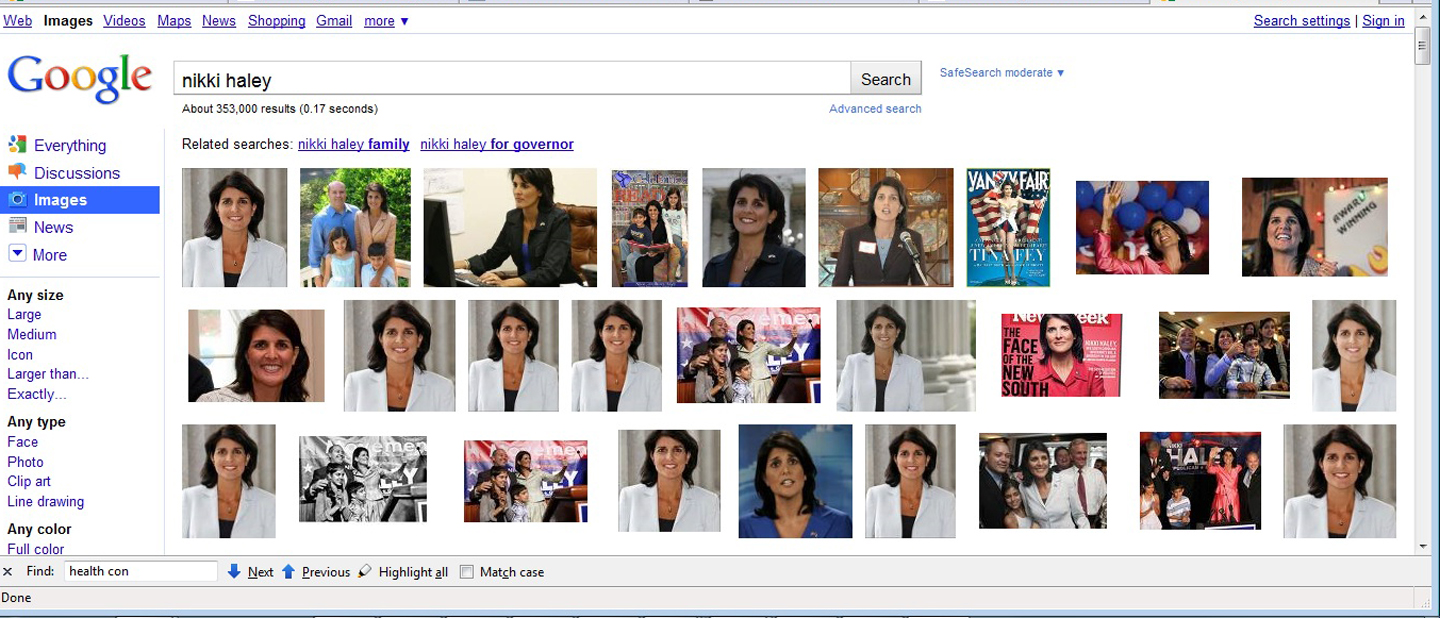
Yesterday, a colleague pointed out to me that if you search for “Nikki Haley” at Google images, you get, amid a sea of actual picturesof Nikki, a picture of Tina Fey linking to a blog post of mine from January 2009.

I forgot about it until I was looking for a certain image of Nikki this morning, and found the same thing. And in fact, as you can see above, it’s the seventh image that shows up out of 353,000. The six before it are actually of Nikki, as are the next 22, before there is the oddity of a picture of Barack Obama.

So, is there some quirk in the Google algorithms that free-associates, going “Nikki Haley… Sarah Palin… Tina Fey…?”

As near as I can tell, the reason this happened was at the top of that Tina Fey post is a link to the post that followed it, headlined “Nikki Haley applauds House action on roll-call voting.” But there is no mention of Nikki in the actual post itself.

Which is reassuring, I suppose. It’s nice to see that even Google can go off on tangents just as weird as the ones we fallible humans let distract us…

How much do YOU text? And why?

There was a fascinating piece in The Wall Street Journal today, headlined, “Y U Luv Texts, H8 Calls.” Cute, huh? Anyway, the short answer to the implied question was, “We Want to Reach Others But Not to Be Interrupted.” But there was more to it than that.

There were some pretty incredible numbers in there:

For anyone who doubts that the texting revolution is upon us, consider this: The average 13- to 17-year-old sends and receives 3,339 texts a month—more than 100 per day, according to the Nielsen Co., the media research firm. Adults are catching up. People from ages 45 to 54 sent and received 323 texts a month in the second quarter of 2010, up 75% from a year ago, Nielsen says.

100 texts a day? Yeah, kids are pretty nuts about these things, but 100 texts a day? And that’s the average, rather than a pathological extreme? Come on.

Still, its undeniable that for the younger generations, texting is far more important than using the phone as a, well, phone.

That’s true even for an alter cocker like me — although “texts” aren’t my preferred medium. I’m far more likely to use my Blackberry to send an e-mail, or post a Tweet, or send a DM, or respond to a blog comment, than I am to use it to talk to anyone. Enough so that I’ve crippled my thumbs. (The pain is still considerable; I see a doctor next week.)

In total, I’ve sent out 2,702 Tweets since I started a little more than a year ago. That’s a lot, but hardly 100 a day.

Texting is undeniably useful, particularly for communicating under certain circumstances with people who have cell phones that are not “smart.” Last night, for instance, I went to a reception at Rosewood’s at the fairgrounds. When I was leaving that, I planned to connect with my daughter, who had brought her kids to the fair. I tried calling her, and couldn’t hear her over the fair noise. So I texted, “Where are you? I couldn’t hear…” She replied, “We’re @ the picnic tables under a tent right outside entrance to grandstand,” and I answered, “OK, stay there…”

Undeniably useful. But as a substitute for other forms of communication, no, I don’t think so. And how on Earth is it appealing for people who don’t have full QWERTY keyboards on their devices? Talk about tedious…

Kids don’t seem to mind, though. Which provokes a thought: Back in the ’60s, many of us thought we were SO different from our parents. And outwardly, perhaps we were. But this latest development suggests that kids today are actually, cognitively different from us. They’re wired entirely different, and technology has done the wiring.

And what are the social, cultural, political and personal consequences of that?

Speaking the same language, but only technically

You know how I just got HD? Well, this process all started with me wanting a Blu-ray player so I could watch Netflix without waiting for the discs to come in the mail.

That part of the project has been… tricky. I’ve spent several late nights in the past week trying to get that one simple thing done.

I thought I’d share with you my conversation — excuse me, “chat,” which isn’t the same thing — about the problem with a tech at Sony. As you read it, imagine unexplained pauses of five or 10 minutes while I wait for short, incomplete answers from the tech. Of course, when I took a couple of minutes to go try what the tech suggested (going through the process on a different browser), I got “Please acknowledge my question, so that I can assist you better.”

Note that, while it’s all in English, there is a distinct… disconnect… in the flow of communication. I get the sense that each comment is being run imperfectly through a translator. And it was amazingly frustrating. I was so desperate to work effectively with this person that I even slipped into a stilted version of English myself, hoping it would facilitate things (“Yes, it persists.” To which I got another deadpan, Hal-9000 answer):

Corinne_ > Hi Brad. Welcome to Sony Online Support. I’m Corinne. Please allow me a moment to review your concern.
Brad Warthen > Here is a full description of the problem:
Brad Warthen > I’m trying to get Netflix on my new Blu-ray player. I have an internet connection, but when it tells me to go to internet.sony.tv/netflix on my computer and enter a password, I run into trouble. That address asks me for my e-mail address and a password. So I enter my e-mail address, and the password that the Blu-ray player told me to use, and I get “The password you entered is invalid. Please enter a valid password.” So I try the password I created when I registered my player, and I get the same message. So I click on “Reset or Forgot your Password” and follow the directions, and you send me a new, temporary password. I’ve done this THREE TIMES now, and each time I enter the new, temporary password minutes (sometimes seconds) after receiving it, and I get “Your temporary password has expired. Please change the existing password at SonyStyle website.” Every time, same message. So what in the world am I supposed to do now?
Corinne_ > I am sorry that the BD Player can not be registerred in the Sony Essential website.
Corinne_ > Thanks for waiting, Brad.
Corinne_ > I’ll be happy to assist you in this regard.
Corinne_ > Do you have a SonyStyle account?
Brad Warthen > Yes.
Corinne_ > Did you try using different Web Brower?
Brad Warthen > No. I just used Firefox.
Brad Warthen > Hello? Are you there?
Corinne_ > Yes, I am online.
Brad Warthen > I said no, I just used Firefox. Is there a preferred browser?
Corinne_ > Brad, it is recommened to open the Eseential website in either Internet Explorer or Mozilla Firefox 3.6.
Corinne_ > Please check the operation with a different web browser.
Brad Warthen > I’m using Firefox. 3.6.10. But I’ll go try IE as well.
Corinne_ > Sure, please go ahead.
Corinne_ > Please let me know if the issue persists.
Brad Warthen > … that is, assuming it still works… I never use IE; I always use Firefox or Chrome…
Corinne_ > Please let me know the result after using Internet Explorer.
Corinne_ > Please acknowledge my question, so that I can assist you better.
Brad Warthen > Yes, it persists.
Brad Warthen > I tried all my passwords, then requested a new one. When I entered the new one, I got “Your temporary password has expired. Please change the existing password at SonyStyle website. ” Again.
Corinne_ > I am sorry to hear this.
Corinne_ > Thanks for the additional information.
Corinne_ > I am really sorry for the delay in response.
Corinne_ > This is a dead lock issue.
Brad Warthen > What does that mean?
Corinne_ > This deadlock issue can handled by our next level of support over phone.
Brad Warthen > OK, what’s the number?
Corinne_ > They are our next level of support and better eqipped to help you resolving the issue.
Brad Warthen > OK. What’s the number, so I can call them?
Corinne_ > They are available at: 239-768-7547.
Corinne_ > Their hours of operation is:
Corinne_ > Mon-Fri 8:00AM-12:00AM (Midnight) ET
Sat-Sun 9:00AM-8:00PM ET
Brad Warthen > OK, I’ll call, and tell them it’s a “deadlock issue.”
Corinne_ > I am sure that they will be more than happy to further assist you resolving the issue.
Corinne_ > Please mention that you have contacted Chat Support Team for the same regard before while contacting the.
Corinne_ > Hence, theyb will be further assist you fixing the issue.
Corinne_ > Thus, you can access Netflix fine in the BD Player.
Corinne_ > Are you able to take it from here?
Brad Warthen > Yes. I was trying to copy the text of this chat so that I’d have the number and times, but the text box doesn’t allow me to select it. Could you e-mail me the info?
Corinne_ > Sure, Brad.
Corinne_ > I’ll forward this chat transcript to your Email ID for future reference.
Brad Warthen > Thanks. Goodbye.
Corinne_ > This Chat Transcript has been sent to: brad@bradwarthen.com.
Corinne_ > You are most welcome.
Corinne_ > It was really nice chatting with you.
Corinne_ > Have great time ahead!
Corinne_ > Good-bye and thank you for contacting Sony Online Support.
Corinne_ > Analyst has closed chat and left the room

So I guess tonight, I’ll be on the phone for several hours.

You still have a landline? Haw! The AZTECS had landlines!

OK, so I stole that line from Dave Barry, who said it once to make fun of people who had Betamax video recorders (“Beta?! The AZTECS had Beta!” — or something very much like that), which is made extra ironic because the triumphant VHS technology is now SO last century…

But you get the point. Landlines are rapidly going the way of buggy whips and, well, TV sets — at least in consumer’s minds.

TV sets? you say. Yes, TV sets. This from the Pew Center for Media Research:

Landlines And Television Sets Losing Importance

According to a new nationwide survey from the Pew Research Center’s Social & Demographic Trends project, reported by Paul Taylor and Wendy Wang with Lee Rainie and Aaron Smith, only 42% of Americans say they consider the television set to be a necessity. Last year, this figure was 52%, and in 2006, it was 64%.

After occupying center stage in the American household for much of the 20th century, says the report, two of the grand old luminaries of consumer technology, the television set and the landline telephone, are suffering from a sharp decline in public perception that they are necessities of life.

The drop-off has been less severe for the landline telephone. 62% of Americans say it’s a necessity of life, down from 68% last year, but 47% of the public now say that the cell phone is a necessity of life…

Note, first, that Pew, or at least the respondents, are using “need” and “necessity” in ways that would have puzzled our hardy pioneer ancestors. Note also that while fewer people see TVs as a necessity, they’re still buying them like crazy:

Even as fewer Americans say they consider the TV set to be a necessity of life, more Americans than ever are stocking up on them. In 2009, the average American home had more television sets than people, 2.86, according to a Nielsen report. In 2000, this figure was 2.43; in 1990, it was 2.0; and in 1975, it was 1.57.

The disconnect between attitudes and behaviors, opines the report, may be that the TV set hasn’t had to deal with competition from new technology that can fully replace all of its functions. If a person wants real-time access to the wide spectrum of entertainment, sports and news programming available on television, there’s still nothing (at least not yet) that can compete with the television set itself…

So don’t write the obit yet. But as for landlines — exactly why DO I still have one? So I won’t miss the telemarketing calls?

I see also that only 10 percent regard flat-screen HDTV as a necessity. It’s probably going to be in the high 90s before I get one. Mainly because, much as I want one, my sense of need is still pretty old-fashioned…

Another step into the Innovista…

Mike Fitts chronicles this latest step toward achieving the potential of Innovista:

A company based on the engineering smarts at USC — in students and faculty — has been launched to commercialize that prowess.

SysEDA, a 10-employee company that provides engineering software, is moving into the USC Columbia Technology Incubator.

SysEDA’s software has been developed over the years principally by Roger Dougal, professor of electrical engineering at USC. Dougal estimates that about 50 students in the past 15 years have provided refinements to it, and many students in the engineering school use it regularly as part of the their work.

The software, called a Virtual Test Bed, is designed to simulate the inner workings of electrical engines. Once it is offered in the Internet “cloud,” it will allow different engineers from around the world to see how their proposed modifications to an engine affect the entire system before a prototype is built….

The company already has a client: the Office of Naval Research.

Dougal has worked with the Navy for more than a decade as it has explored electric power options for its ships. Now SysEDA has a $2.4 million contract to work with global engine giant ABB on such engines and design systems.

SysEDA is working with the incubator and is also receiving mentoring from Bang! Technologies, a company that specializes in boosting tech companies through their growth phases…

Congratulations to all involved as they take one of hundreds, perhaps thousands, of such steps that need to be taken for the Innovista to realize its potential over the next decade or two.

Pandora needs a “like it a LOT” button (although it’s doing pretty well without one)

Here’s a conundrum…

Pandora, the “internet radio” site that attempts to use your feedback to shape “stations” that play stuff you like, has a pretty simple system for your input: After you enter a song or artist (or multiple songs or artists) that you’d like to hear, it guesses what else you might like based on that, and you click on either a thumbs-down button meaning “I don’t like this song,” or a thumbs-up meaning “I like this song.”

That’s it. No gradations of feedback. It’s way binary; ones and zeros. I try to click on one or the other on most songs. I don’t sit there poised with the mouse, but every few songs I ALT-TAB back to Pandora to catch up with my decisions (except when I’ve gotten lost in my work and lost track of what I was “hearing,” and even then if I’m familiar with the song, I render a judgment).

But I find this frustrating everyone once in a while. Most of my “likes” mean, “I don’t mind if you keep this in my mix.” But every once in a while, they play me something I really, REALLY dig.

Examples… I have a lot of stations for different kinds of music, but recently I’ve spent a lot of time defining one called “Brad’s All-Purpose Station.” In the “I don’t mind if you keep this in my mix” on that station, I’d include “After Midnight,” “Angie,” “Another One Bites the Dust,” “It’s Money That Matters,” “Long May You Run,” “Oh! Darling,” “Smoke on the Water,” and so forth.

But there are other songs that I want to make sure Pandora knows I really like a LOT more than those songs. It may be an all-time favorite, or a really good song I seldom here and don’t own a copy of, or something I’ve occasionally heard and loved but didn’t know the name of… all sorts of reasons. Into that category I’d put: “Sexy and 17,” Another Girl,” “Baby, It’s You,” “Badge,” “Adagio for Strings,” “Bring it on home to Me,” “Don’t Think Twice, It’s All Right,” “Gymnopedies (3),” “How Can You Mend a Broken Heart (the Al Green version!),” “I’ll Cry Instead,” “In Germany Before the War,” “I’ve Got A Woman,” “Naked Man,” “New Amsterdam,” “Simple Man,” “Werewolves of London,” and others. Oh, and on that last one: I’d much rather hear “Lawyers, Guns and Money,” or “Roland the Headless Thompson Gunner,” but neither has yet been offered.

When I hear one of those, I want to say, Whoa, I’m sorry I clicked “like” on those last 10, because this is what I REALLY like! Don’t just lump this in with those… But all I can do is click again on the “like” button.

OK, so I’m frustrated that I can’t give more nuanced feedback, but here’s the perplexing thing: In spite of that, Pandora does an increasingly excellent job of guessing what I’ll like. As time goes by, I hit that “don’t like” button quite seldom.

Contrast that to Netflix, which gives me five levels of feedback, from one to five stars — and yet remains pretty much clueless as to what I’d like.

Not that I haven’t put the time in… I’m sort of embarrassed to admit this, but I’ve rated 2,144 movies on that site. I keep thinking, Give ’em more data, and they’ll figure me out. But they don’t. You give “Casablanca” five stars, and Netflix assumes, “He likes any movie that’s more than 50 years old.” Yeah, it’s probably a little more sophisticated than that — but not much.

Frustrating. But kudos to Pandora.