Category Archives: Education

Pope Francis as a marketing draw

St. Thomas More

Lately, I’ve found myself stopping at the light at Gervais and Harden, heading west on Gervais, and having time to contemplate the messages on the electronic billboard that faces the intersection.

Day after day, I saw the “Come to Mass” billboard for St. Thomas More, the Catholic chapel at USC. It caught my eye because I’d heard that the current chaplain — Fr. Marcin Zahuta, a former professional soccer player from Poland with a good sense of humor — was really packing them in at multiple masses each weekend. I’d been meaning to drop by for one of the masses, but hadn’t gotten around to it.

Anyway, the billboard I was seeing originally looked like the right-hand side of the one in the photo above (sorry about the low quality; the traffic light is quite a distance from the sign, and this was just my iPhone) — all maroon (or garnet, or whatever), with white lettering. Still, it caught my eye.

But then, about a week ago, I started seeing this new version with Pope Francis taking up about 40 percent of the space, and the rest of the message squeezed into what’s left.

I guess our new pontiff is seen as a draw. I sort of doubt the sign would have been amended to include a huge photo of his predecessor…

On Pope Francis, Cardinal Bernardin, Vatican II, American politics, and the church today

Today, Massimo Faggioli brought this WashPost story to our attention via Facebook:

Conservative Catholics question Pope Francis’s approach

Rattled by Pope Francis’s admonishment to Catholics not to be “obsessed” by doctrine, his stated reluctance to judge gay priests and his apparent willingness to engage just about anyone — including atheists — many conservative Catholics are doing what only recently seemed unthinkable:

They are openly questioning the pope.

Concern among traditionalists began building soon after Francis was elected this spring. Almost immediately, the new pope told non-Catholic and atheist journalists he would bless them silently out of respect. Soon after, he eschewed Vatican practice and included women in a foot-washing ceremony.

The wary traditionalists became critical when, in an interview a few weeks ago, Francis said Catholics shouldn’t be “obsessed” with imposing doctrines, including on gay marriage and abortion….

This was particularly relevant because Dr. Faggioli was our 2013 Cardinal Joseph Bernardin lecturer last week at USC — and the topic of that news story bears upon what he spoke about in his lecture, and what we discussed in a panel discussion I moderated earlier in the day.

I’ve mentioned this lecture series in past years. (You may recall when E.J. Dionne gave the lecture a couple of years back.) I’ve been on the panel that runs it for more than a decade, along with members of the Religious Studies department at the university, some clergy (Catholic and non), some members of the Bernardin family and Patricia Moore Pastides, USC’s first lady (and my fellow parishioner at St. Peter’s). Cardinal Bernardin, for those who don’t remember him, is easily the most distinguished churchman ever to come out of Columbia. He was born here, grew up in my parish, attended USC, then went on to be come the most influential member of the U.S. Conference of Catholic Bishops in the 1980s.

Our committee’s goal is to establish the Joseph Cardinal Bernardin Chair in Ethical, Moral, and Religious Studies at USC. We moved a huge step toward achieving that this past year, with a $1 million gift from former USC President John Palms and wife Norma, more than half of which goes toward the chair.

Dr. Faggioli’s topic was, “Bernardin’s Common Ground Initiative: Can it Survive Current Political Cultures?

Before I share what he said, I should explain the Common Ground initiative, which the cardinal launched as he was dying of cancer in the mid-90s. It’s founding document, “Called to be Catholic,” was written by the cardinal in the summer of 1996, and began:

Will the Catholic Church in the United States enter the new millennium as a church of promise, augmented by the faith of rising generations and able to be a leavening force in our culture? Or will it become a church on the defensive, torn by dissension and weakened in its core structures? The outcome, we believe, depends on whether American Catholicism can confront an array of challenges with honesty and imagination and whether the church can reverse the polarization that inhibits discussion and cripples leadership. American Catholics must reconstitute the conditions for addressing our differences constructively – a common ground centered on faith in Jesus, marked by accountability to the living Catholic tradition, and ruled by a renewed spirit of civility, dialogue, generosity, and broad and serious consultation…

The cardinal was trying to bridge left and right within the church, calling on Catholics of all stripes to listen respectfully to each other. He was addressing the same long-standing conflict described in today’s WashPost story:

Some Catholics feel Francis is resurfacing fights that followed the Second Vatican Council of the 1960s. Conservatives felt liberal Catholics misinterpreted the Council’s intention and took “open” too far.

The last two popes seemed to agree, making a priority of establishing “Catholic identity” among people and institutions by emphasizing the importance of crystal-clear doctrine,particularly on issues around human reproduction and marriage.

“The angry screaming debates in parishes — I don’t want to go there again,” said Lawler. “Things were calming down.”…

With some Catholics thinking that Pope Francis’ recent remarks will bring back those “screaming debates,” Dr. Faggioli’s lecture was particularly timely.

Massimo Faggioli

Massimo Faggioli

A central theme in his talk that had not occurred to me before was this: In the days of Vatican II and before it, Catholicism was largely a European phenomenon. Today, the American church is so dominant that what happens here has repercussions in his home country of Italy, and everywhere else.

In reading “Called to be Catholic” and its companion document from later that year, “Faithful and Hopeful: The Catholic Common Ground Project,” I can’t help but feel that the cardinal was talking about American politics rather than internal church matters:

The problem of dissent today is not so much the voicing of serious criticism but the popularity of dismissive,demagogic, ‘cute’ commentary, dwelling on alleged motives,exploiting stereotypes, creating stock villains, employing reliable‘laugh lines’ The kind of responsible disagreement of which I speak must not include‘caricatures’ that‘undermine the Church as a community of faith’by assuming Church authorities to be ‘generally ignorant,self-serving,and narrow-minded’ It takes no more than a cursory reading of the more militant segments of the Catholic press, on both ends of the theological and ideological spectrum, to reveal how widespread, and how corrosive,such caricatures have become….

I figured that was just my bias, based on my experience.

But Dr. Faggioli sees that as highly relevant. In fact, he says the American style of political discourse, which in many ways is quite alien to the European mind, has profoundly influenced dialogue, or the lack thereof, within the church.

Well, it’s taken me a lot to get this far, because there’s so much to explain along the way — which is why I haven’t written about the lecture and panel last week before now.

So from here on, I’ll just hit a few highlights:

  • After Dr. Faggioli had indicated, during our panel discussion, that we now had a Vatican II pope after two strict doctrinalists whose appointments had reshaped the U.S. Conference into something very different from what Cardinal Bernardin knew, I asked whether Francis and the largely conservative American bishops were headed for conflict. The other two panelists — political scientist Steven Millies and Fr. Jeff Kirby of the Diocese of Charleston — said they didn’t think so, and I thought their reasoning was both strong and ironic: Their point is that because Pope Francis is less down-from-above, more collegial, more into subsidiarity, he would act more like the bishop of Rome than supreme pontiff, and leave American bishops alone to run their dioceses their way. Dr. Faggioli disagreed, saying conflict is inevitable. I think he’s right.
  • Our speaker provided insight into the interview the pope gave with Jesuit journals — the one that caused such a sensation last month. He’s almost uniquely qualified to do so, as he was one of the people who translated the interview into English, and therefore influenced what the rest of us read. Today’s WashPost story quotes a conservative activist as complaining that “now we’ve got a guy who doesn’t seem to think clear expression is important.” On the contrary, Dr. Faggioli says, the pope was very carefully controlling what he said. He saw some of the rough drafts of the pope’s remarks as well as what appeared eventually, and the pontiff was taking great care. Not only that, but in talking to the Jesuit journals, Pope Francis was deliberately bypassing the Vatican bureaucracy — which is filled with his predecessor’s people. Bottom line, the pontiff knows what he’s saying, and he’s not letting the usual filters get in the way.
  • That said, this pope has one weakness in communicating what he means: His Italian is excellent, says Dr. Faggioli, but his English? Not so much. Worse, he lacks understanding of “the Anglo-Saxon mindset.” Our speaker said the pontiff apparently didn’t fully anticipate exactly how obsessively every word he spoke would be parsed by fussy, picky Americans. (And in keeping with our speaker’s theme, if Americans interpret things a certain way, that influences the perception of the rest of the world.) If he had, there are a couple of different words he might have chosen in that interview.

There was a lot more, but it’s a miracle if any of y’all have read this far, so I’ll stop for now. Dr. Faggioli indicated that his lecture, or part of it, might be available online soon. When it is, I’ll give y’all a link…
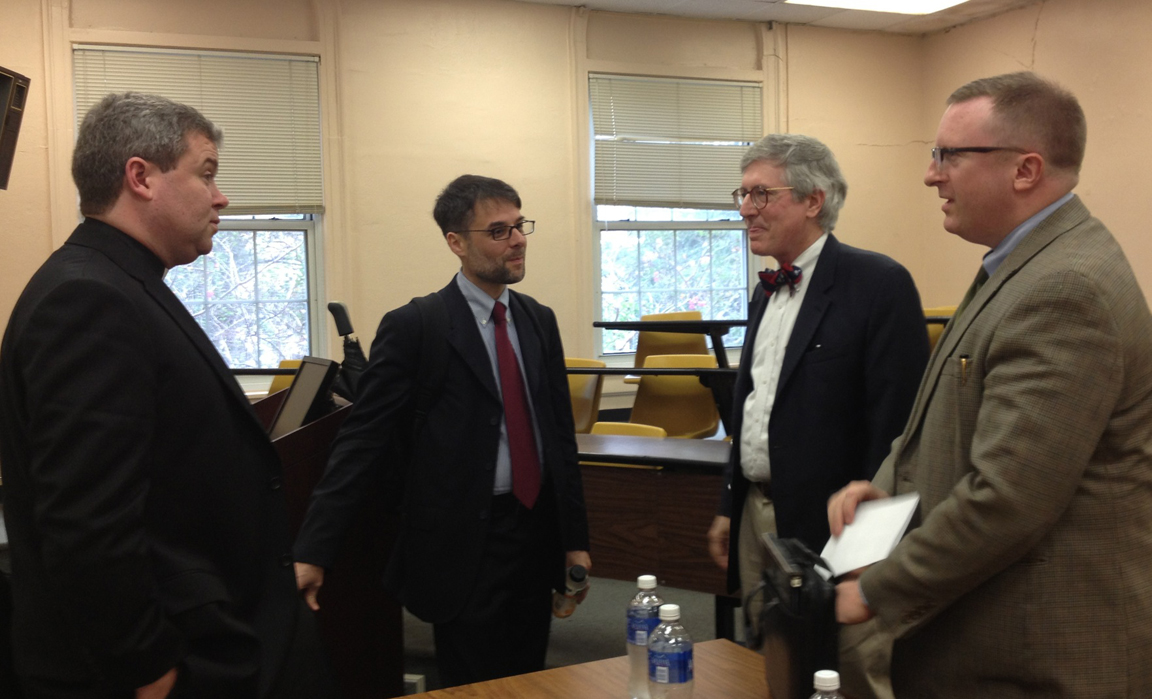
The panel -- Fr. Kirby, Dr. Faggioli, your correspondent, and Dr. Millies. No, I don't know why my tongue is sticking out...

The panel — Fr. Kirby, Dr. Faggioli, your correspondent, and Dr. Millies. No, I don’t know why my tongue is sticking out. I meant no disrespect.

Sheheen hits Haley on absenteeism, education funding

Here’s a release that came in from the Vincent Sheheen gubernatorial campaign:

Dear Brad,

When the going gets tough, Nikki Haley gets going…right out of state. 

This week a published report showed South Carolina topping the list of states slashing school spending and hurting public education, specifically citing Governor Haley’s political ideology as a main reason for the dramatic cuts. 

That’s just after the release of a report showing that South Carolina’s middle-class families are struggling even more with falling incomes since Nikki Haley took office. 

The going is getting tough for the people of South Carolina. And where’s Nikki Haley? Out-of-state raising money for the past three days at events she hid from her public schedule

Tell Nikki Haley that the challenges facing middle-class families and small businesses in our state won’t be solved by her jetting off to New York and Philadelphia to raise money for her campaign. 

Please donate $250, $100 or $50 today to make her a one-term governor so she can spend as much time as she wants outside of South Carolina. 

Thanks, 

Andrew

Of course, before you click on that link and give Vincent money, you’re going to click on this link and give to our Walk for Life team, right?

Here, by the way, is the report to which the release referred about education funding:

Even in 2008, before the dramatic budget cuts the state has enacted in the past few years, South Carolina spent the fourth-lowest amount on education. As fiscal year 2014, South Carolina primary and secondary students will each be educated with about $500 less than before the recession. The lack of education funding is, in part, due to the political ideals of Governor Nikki Haley. In 2011, she vetoed the state’s budget and included $56 million in cuts to education. In addition, Haley refused to accept money from the Education Jobs Fund — a federal program intended to mitigate budget constraints in schools across the country. South Carolina was the only state that did not seek money from this program.

Democrat announces for SC schools superintendent

I had told Tyler Jones yesterday that I would attend this announcement over at Hand Middle School yesterday (I like to actually get out to campaign events sometimes, if only to get some new images for my random header, above), but a client meeting came up at the very same time, so here’s the release about the event instead:

Rep. Mike Anthony Announces Bid for Superintendent of Education


Retired teacher, football coach to make bid to lead SC’s public schools


Union, SC – Retired public school teacher and three-time state champion high school football coach Mike Anthony formally announced his intention to run for Superintendent of Education on Thursday.0038636359

Anthony, 63, spent over thirty years as a high school teacher in South Carolina pubic schools before retiring in 2004. He was elected to the South Carolina House of Representatives in 2002 where he served on the Education Committee for six years.

“I never thought I’d be announcing a campaign for anything – let alone statewide office,” said Rep. Anthony. “But our schools are in desperate need of new leadership, and who better to lead our schools than a teacher with over thirty years of in-the-classroom experience.”

Coach Anthony announced his candidacy in front of friends and family at Union County Stadium, the same place he coached his alma mater Union High School to three state high school football championships in 1999, 2000, and 2002.


“As a high school football coach, I taught kids about accountability,” said Anthony. “If someone wasn’t working hard enough or doing their job, they got benched and replaced by someone who could do better. The current administration isn’t getting the job done and it’s time to bring in someone new.”


Anthony vowed to take the politics out of the office of Superintendent of Education.


“Educating our children shouldn’t be a partisan issue,” said Anthony. “If I’m elected Superintendent, you won’t be getting a Democrat or Republican. You’ll be getting a lifelong public school teacher who has a passion for seeing kids succeed. ”


Anthony will hold a press conference at Hand Middle School in Columbia before speaking to the Charleston County Democratic Party’ this evening in North Charleston.


Learn more: www.AnthonyForEducation.com

I, too, will gladly consider becoming president of College of Charleston

I figured I might as well put my name out there in light of this report:

The Associated Press

CHARLESTON, S.C. — Former South Carolina first lady Jenny Sanford says she’s interested in the president’s job at the College of Charleston.

Sanford tells The Post and Courier of Charleston (http://bit.ly/15JmNz8 ) she would be crazy not to look at the opportunity. And she says that not all schools need to be led by someone with strictly an academic background.

The 50-year-old Sanford says she has management skills from running her former husband Mark Sanford’s campaigns, and working in the governor’s office gave her an understanding of higher education budgets and other state issues….

If Jenny Sanford is at any point seriously considered for the job, and those are her qualifications, then I feel obliged to point out:

  • My own management skills have been honed over a period of 29 years supervising reporters, editors, and others involved in different aspects of producing several different newspapers in three states. This means I’m very much accustomed to supervising extremely independent-minded, egotistical people with intellectual pretensions, which I submit is far, far more like supervising a university than bossing a team of volunteer true believers who agree with you about everything. As head of the editorial board, I daily convened a group of strong-opinioned people and led them to reach agreement on an unlimited variety of extremely controversial issues, agreements written out and published within 24 hours — which is quite different from telling people, here’s the party line and stick to it.
  • I have obtained a far broader — certainly less ideologically narrow — working acquaintance with “higher education budgets and other state issues.” Not only that, but I have demonstrated over the years that I actually believe in public higher education and its importance to our state’s future, unlike certain other possible candidates I could name.
  • I’m well known to state political leaders and many key business leaders, and despite all those critical opinions I’ve caused to be written over the years, have probably done less to permanently irritate them than the team of people of which Jenny Sanford was a part. These folks know me as someone who has strongly advocated well-considered, pragmatic policies for our state, even if they didn’t fully agree all of the time. Among them I have some detractors, but probably not as many as my worthy competition.
  • I get along great with the mayor of Charleston, for whom I have the greatest respect. For what that’s worth.
  • Two of my children have attended the College of Charleston, with one of them graduating just this summer, which gives me a passing acquaintance with the institution.
  • I know at least one former president of the institution pretty well, and can call on him for advice.
  • I’ve actually done consulting work for two college presidents in South Carolina. It’s not a huge part of my resume, but it’s something I don’t think she has.
  • I’m very comfortable wearing bow ties, and own no fewer than four seersucker suits, one of which currently fits me.

I could go on, but this should be sufficient to persuade the trustees to consider me — if they’re considering her. And if they really, you know, don’t care about academic qualifications…

Here’s one argument for a liberal-arts education

A recent essay in The Wall Street Journal scoffed at those who bemoan the decline in the number of students majoring in the humanities.

Perhaps that writer was right. But you know, I think it would really help if some of those left-brain STEM types would take a couple of English classes.

Remember that story from yesterday’s VFP about experiments into whether warp-speed travel is possible?

Did you see this quote?

“Space has been expanding since the Big Bang 13.7 billion years ago,” said Dr. White, 43, who runs the research project. “And we know that when you look at some of the cosmology models, there were early periods of the universe where there was explosive inflation, where two points would’ve went receding away from each other at very rapid speeds.”…

Ow! He might be a heck of a rocket scientist, or whatever, but his abuse of the language is rather distressing.

I’ll take piecemeal reform over none at all, Vincent

I see that the bill to have the governor appoint the state superintendent of education — or rather, to have a referendum so voters can make that constitutional change — is coming along in the Senate, but Vincent Sheheen isn’t satisfied:

Sen. Vincent Sheheen, D-Kershaw, wants to abolish two constitutional officers, the Secretary of State and the Comptroller General, while allowing the governor to appoint two others: the Adjutant General and the Commissioner of Agriculture.

“It doesn’t make sense to do piecemeal reform,” Sheheen said Thursday, after the Senate gave the bill second reading by voice vote only, agreeing to take up the proposed amendments at the next reading…

Well, I’m not satisfied with just doing the superintendent reform, either. Every one of those other changes should have been made long, long ago, starting with the adjutant general. Of all the strange cases of separately electing officials in SC, that one is the most bizarre.

But… since I’ve waited so many years already, I would not demand that we hold up the superintendent bill, if we can pass that, to wait on the others. That’s because several years ago, opponents of reform used the fact that all the constitutional officers were under consideration to pull a fast one. Each defender of the status quo voted for some of the changes and not others, with the precise offices being voted against varying from senator to senator. That way all of them could say they voted for reform, but each office came up short of the two-thirds majority needed. So we got no reform.

Yes, we should approved all of this changes, and do it not just today, but 20, 30, 60 years ago. But if we can get one of them done, let’s do it. Let’s do even if we know that there is so much support for the governor appointing the superintendent mainly because Republicans believe they will usually win the governor’s office, but might lose the superintendent’s.

Let’s just take a step in the right direction. Because this fragmentation of government has never served us well.

7-year-old boy suspended for being 7-year-old boy

Passing on this bit of news from Maryland:

GLEN BURNIE, MD (CNN) – A 7-year-old Maryland boy was expected to return to school Tuesday after serving a suspension for forming his breakfast pastry into the shape of a gun and allegedly saying the words “bang, bang.”

Children at Park Elementary School went home on Friday with a letter explaining there was a disruption in school.

Josh Welch and his father B.J. say the disruption lead to a two day suspension for the second grader in Brooklyn Park.

Academics are hard for Josh, who suffers from ADHD, but he excels in art class. It is Josh’s own creativity that may have gotten him into trouble.

Josh was enjoying his breakfast pastry when he decided to try and shape it into a mountain. “It was already a rectangle and I just kept on biting it and biting it and tore off the top and it kinda looked like a gun but it wasn’t,” Josh said.

Josh takes full responsibly for trying to shape his breakfast pastry, but admits it was in innocent fun. “All I was trying to do was turn it into a mountain but, it didn’t look like a mountain really and it turned out to be a gun kinda,” Josh said.

When his teacher saw the strawberry tart he knew he was in trouble. “She was pretty mad? and I think I was in big trouble.”

Reminds me of when the elder of my sons was a toddler in his high chair eating toast. He ate it down to where he had two crusts left intact in an L shape. He then grasped it by one side, and aiming the other around the room said “Pow, pow!” Nearly broke my wife’s heart. She felt like she had done something wrong raising him — after all, his older sister had never exhibited such “violent tendencies.”

But boys will do things like that.

The fact that this one did it with a dessert-type item reminds me of a bit of silly dialogue from the original version of “The Office:” It was only a trifling matter. Nevertheless, they took him into custard-y.

Yes, public schools should teach Bible as literature

An op-ed in the WSJ today made the case for putting the Bible into the public school curriculum, as a foundational work (or rather, body of works) of Western civilization. The authors were educated in Europe and were taught the Bible as a matter of course. But that reckons without the reflexive horror the suggestion of doing so engenders in this country:

Teaching the Bible is of course a touchy subject. One can’t broach it without someone barking “separation of church and state” and “forcing religion down my throat.”

Yet the Supreme Court has said it’s perfectly OK for schools to do so, ruling in 1963 (Abington School District v. Schempp) that “the Bible is worthy of study for its literary and historic qualities. Nothing we have said here indicates that such study of the Bible or of religion, when presented objectively as a part of a secular (public school) program of education, may not be effected consistently with the First Amendment.”

The Supreme Court understood that we’re not talking about religion here, and certainly not about politics. We’re talking about knowledge. The foundations of knowledge of the ancient world—which informs the understanding of the modern world—are biblical in origin. Teddy Roosevelt, the 26th president known more as a cigar-chomping Rough Rider than a hymn-signing Bible-thumper, once said: “A thorough knowledge of the Bible is worth more than a college education.”

I agree entirely, totally apart from all the phrases with which scripture has enriched the language, or the fact that Shakespeare makes 1,200 biblical references.

I think there are other things we should have to read as well. I’ve always felt sort of ignorant that I’ve never read the Iliad, preferably in the original Greek. But that’s peripheral, compared to having a thorough understanding of such allusions as Adam and Eve, Samson and Delilah, Jonah and Judas Iscariot. Those are basic.

And it’s not just the stories or the language. As an overview of different forms of ancient literature (poetry, allegory, history, etc.) it’s a treasure trove.

Before someone misunderstands me — nothing that I’ve said gives anyone any reason to, but Kulturkampf in this society being emotional rather than rational, someone will — I’m not an advocate of mandatory prayer in public schools. Although people should be (and are) free to pray there as well as anywhere else.

The authors of this piece, if anything, underestimate the objections such a suggestion will meet. For instance, they neglect to anticipate the objection that other religions’ texts, say the Bhagavad Gita, should be given the same status in the K-12 curriculum. But of course, that work is not foundational to western culture. It’s a great subject for upper-division college electives, but there’s no more reason to make it part of everyone’s education than, say, Kerouac’s Dharma Bums as opposed to Huck Finn. One is enrichment; the other is basic.

Anyway, since these folks brought up the subject, I say yeah: Put Genesis and the rest in there with Shakespeare. They are still reading Shakespeare in the schools, aren’t they? If not, I give up…

Howie Rich complains about ‘hit piece’ on him in The State

A blog post at SC Schools Report brings my attention to a letter that Sen. Kevin Bryant received from his fan Howie Rich. Here it is:

Dear Kevin,

First of all congratulations on the “A+” ranking you received this month from the S.C. Club for Growth. I understand you’ve received the highest score in the SC Legislature eight years running – which is quite a feat. Given how many of our elected officials get away with paying lip service to freedom and free markets, it’s gratifying to see when a few of them actually walk the walk – as you have consistantly done.howard

I wanted to write because I’m sure you’ve seen the lates “hit piece” against me in the Columbia newspaper – which is (once again) ramping up its vendetta agains parental choice and those of us who support it. This liberal rag – which gives The New York Times a run for its left – leaning money – apparently believes that demonizing me (and the legal contributions I have made to candidates in South Carolina) passes for a legitimate argument against school choice.

Meanwhile the paper does everything within its power to prop up the grovernment-run school system in the Palmetto State – which as we know is falling further behind the rest of the nation (exacting larger and larger sums of money from the South Carolina taxpayers.)

Thankfully the ongoing proliferation of new (and social) media in South Carolina means we no longer have to coddle this status quo mouthpiece – and can take our case directly to the people. This is exactly what you are doing in your “Blog from the Back Bench,” and I commend you on those efforts.

Ideologically we both know how this debate will progress. Absent the infusion of market-based reforms South Carolina’s government-run monopoly will continue to fail generations of school children – while sticking taxpayers with an ever-escalating bill.

But what is the political future of this debate? On that front I want to make something perfectly clear: Every time I read one of these hit pieces, my commitment to the fundamental reforms we are advancing is redoubled. What we are witnessing in South Carolina right now are the last gasps of a dying status quo – entrenched politicians (and their legacy media supporters) whose only remaining excuse for the poor performance of their government -run system is that parental choice has become a “distraction.” Clearly their House of Cards is close to toppling.

2016 will not be a repeat of 2012 – in which incumbent-created protections denied challengers a chance to compete in an honest primary. Mark my words: Those currently running victory laps around the South Carolina State House after giving up more than a third of the vote to “petition candidates” will be held accountable for their votes in a true GOP primary three years from now. And from what I am told, there will be an even broader coalition of pro-taxpayer, pro-free market interests aligned against them.

It comes down to this: The Republican-controlled Senate will either pass school choice this year or it wont. If it does, South Carolina’s children, parents and taxpayers will be better for it. If it does not, then school choice advocates will focus every bit of energy they have on the 2016 primaries.

On this we have learned over the years is that choice – in addition to being effective everywhere it has been implemented – is a rising tide both politically and legislatively. When we started this fight we were nowhere in the S.C. General Assembly – now the S.C House has passed choice legislation and we were one rigged primary election away from getting it through the Senate.

One way or the other choice is coming. It is only a matter of resources, planning and patience – and I can ssure you we are blessed with an abundance of all three.

Thank you for your leadership on this issue. I look forward to seeing you again soon.
Take care,
howie

Howard Rich

Gosh, I had no idea Mr. Rich was even aware of The State’s existence, much less that he was so bugged by what it said about him. Oddly, the “hit piece” to which he refers is a fairly straightforward, news story that tells readers about his ongoing contributions to SC lawmakers. It’s also a pretty old story — I don’t know the date of his letter to Sen. Bryant.

By the way, I join “Howie” in complimenting Sen. Bryant on his blog. He was the first blogger in the Legislature, and still maintains it pretty religiously. It’s a good thing that we can keep tabs on what he’s doing and thinking.

What should happen to teachers who have sex with students?

Screen Shot 2013-01-11 at 8.29.24 AM

Boyd Brown picked at my friends at The State the other day over the above headline, which inevitably makes one think, “And in related news, Squad Helps Dog Bite Victim“… In The State‘s defense, they caught it and fixed it — I can’t find it anywhere online now. (That’s the awful thing about the 24-hour news cycle. Used to be, you had a chance to catch these things before anyone saw them. Now, even when you catch it, it’s already out there and somebody has preserved it.)

Of course, this is no laughing matter, however much our inner 8th-grader may snicker. There are serious issues at stake. I was intrigued by this angle, raised in a long letter to the editor yesterday:

Don’t prosecute Dreher teacher for having sex with students

The two young men whom a Dreher teacher allegedly or admittedly engaged in sexual intercourse were above the age of consent. There are no allegations of coercion, intimidation, payments or rewards offered or given in return for sex.

Had the teacher been a neighbor or a family friend, a Mrs. Robinson if you will, there would be no crime.

I believe it is unconstitutional to have one law for teachers and another one for everyone else. An act should either be a crime if anyone does it or it should not be a crime…

Of course the teacher should be decertified, fired and counseled. But she never should have been arrested, she should not face prosecution, and she should fight for the right of teachers to not be made criminals for what other women can do without a threat of prosecution…

What do y’all think? Should this be a criminal matter, or merely an administrative one for the district’s H.R. folks to handle?

Personally, I’m not a bit bothered, at least in theory, by the existence of a “double standard” whereby teachers are treated differently from other folks. They hold a special public trust, and should be accordingly accountable to the public.

I just don’t have a strong opinion one way or the other as to whether that accountability should extend to criminal prosecution. Perhaps some of y’all can clarify my thinking on that…

Apparently, the kids like Obama

Got this release today:

November 4, 2012, Mount Hermon, MA – High school students across the country took to the polls this month and chose President Barack Obama to serve another term as President of the United States in a nationwide mock election.

More than 54,000 students from more than 130 schools across the United States–at least two from each of the 50 states and the District of Columbia–participated in this year’s VOTES Project (Voting Opportunities for Teenagers in Every State), one of the nation’s largest mock elections, began in 1988 by teachers at Northfield Mount Hermon School. High school students across the country campaigned on behalf of President Barack Obama and Republican challenger Mitt Romney–as well as third-party candidates–holding rallies, debates and other campaign events leading up to tonight’s announcement of the winner.

Barack Obama received 316 electoral votes and Republican challenger Mitt Romney received 208. Obama received 50.2% of the popular vote (27,107), and Romney earned 41.2% (22,252).

The final tally took place at the 2012 VOTES Election Central gala in James Gym on the NMH campus. The NMH Singers and Jazz Band provided campaign music, and students acted as television moderators, conducting interviews and reporting electoral results by fixing either a blue or a red pin to a map of the United States.

Due to Hurricane Sandy, a total of five schools in New Jersey, New York, and Pennsylvania were unable to hold mock elections, meaning 14 electoral votes were not distributed…

But how valid can that result be when it doesn’t include votes from a single high school that I personally attended (I attended three, in SC, Florida and Hawaii)?

Where Howie Rich et al. are spending these days

Phil Noble’s New Democrats have released a list of those receiving money from Howard Rich and allies (I’m not sure how the allies are defined), in the continuing quest to purchase privatization of education in South Carolina. First, an excerpt from the commentary:

After the Civil War, South Carolina was invaded by Northern carpetbaggers and their local scalawag allies who abused our state and exploited our people.

Howard Rich

They are back – this time Howard Rich is the carpetbagger and there are 25 legislators and candidates, as well as party and legislative organizations, who have joined him to exploit our children with their so-called school voucher social experiment scheme.

We are here today to name these 25 candidates and party organizations that have taken over $333,000 in funds from Rich and his out of state cronies to make our state’s children lab rats in his radical school voucher experiment.

In 2011-12, Rich and his cronies have contributed $325,640 to Republicans and $8,000 to Democrats. They should all be ashamed of what they have done and they should give the money back…

And now the list:

Contributions by Howard Rich and Cronies

Below is a list of the total contributions to South Carolina candidates made by Howard Rich and his cronies in 2011-12. Source: FollowTheMoney.org and the SC Ethics Commission. See itemized list of contributions here.

TOTAL: $333,640
Republicans: $325,640
Democrats: $8000

SC HOUSE
Total: $37,500

Barfield, Liston D (R, 58) $3000
Bowen, Don C (R, 08) $3000
Chumley, Bill (R, 35) $15,000
Crawford, Kris (R, 63) $500
Erickson, Shannon (R, 124) $500
Gambrell, Michael W (R, 07) $500
Hardwick, Nelson (R, 106) $2000
Herbkersman, Bill (R, 118) $1000
Putnam, Joshua (R, 10) $11,000
Smith, Garry R (R, 27) $1000

SC SENATE
Total: $109,000

Bright, Lee (R, 12) $17,000
Bryant, Kevin L (R, 03) $8000
Campsen, Chip (R, 43) $1000
Corbin, Tom (R, 05) $8000
Davis, Tom (R, 46) $1000
Fair, Mike (R, 06) $18,000
Ford, Robert (D, 42) $6000
Grooms, Larry (R, 37) $5000
Massey, Shane (R, 25) $3000
Peeler, Harvey (R, 14) $3000
Rose, Mike (R, 38) $18,000
Thomas, David (R, 08) $18,000
Thurmond, Paul(R, 41) $3000

LEGISLATIVE CAUCUSES
Total: $105,000

House Democratic Caucus Committee $2000
House Republican Caucus Committee $3000
Senate Republican Caucus Committee $100,000

STATEWIDE
Total: $38,500

Loftis, Curtis (R, Treasurer) $31,500
Wilson, Alan (R, AG) $7000

PARTIES
Total: $43,640

South Carolina Republican Party $43,640

The SC Dems site notes that Logan Smith has more over at his blog.

Chicago teacher union seems to be doing all that it can to undermine Obama’s re-election effort

As we were discussing yesterday, the advantage in this election belongs to the president. But things can happen to change that. The teacher’s union in Chicago, his old stomping grounds, is doing what it can in that regard.

Not that I think it will hurt him that much, but they’re doing their best.

Why would the rest of us care about a labor dispute in Chicago, of course, except for its potential impact on a national conversation.

This is one of those moments in which Democrats and their constituencies do their best to live down to the very worst portraits that Republicans paint of them.

The Republican (or Viable Libertarian) Party dislikes public education, because it costs money, for which taxes must be paid. So it paints public education as a vast patronage machine, run by people who care little about actually educating our society, but only about their own prerogatives and self-interest. The legitimate interest of the public in an educated populace, this argument goes, is held hostage to public employee unions.

This, of course, is a grossly unfair characterization (and grossly inaccurate in SC, where we do not have collective bargaining for public employees, and therefore have no teachers’ union), except for when it is dead on.

Argue all you like about any supposedly legitimate grievances these union members have. It really doesn’t matter. When I Google “chica” — that’s all I have to type — I get a Chicago Tribune story that is encapsulated on the search page with these words: “More than 350,000 children will be locked out of Chicago public schools for a second day as striking teachers and the school board remain at…”

News stories out of Chicago are replete with the disruption to the lives of children who ought to be in school learning something. Here’s how it plays, from the Tribune story. This is in reference to the city’s effort to provide the parks as safe places for working parents to drop off their kids during the strike:

But Rachelle Cirrintano, who works at the University of Illinois at Chicago, still worried about her 8-year-old son Rocco. The boy has a hard time adjusting to change, she explained. When she dropped him off this morning, he sat on a bench alone because he didn’t know anyone.

She focused her frustration at the teachers.

“There was no reason to do this when they just got situated,” Cirrintano said. “All the teachers should be let go for their irresponsibility to the children and their families.”

And who is the wicked boss the union is striking against, as far as the world can see? Why, Rahm Emanuel, the president’s former chief of staff. The mayor’s sin was to try to implement some basic education reforms. The union claims the mayor “disrespected” it.

Republican critics of public education couldn’t have written a better script for illustrating their argument that the greatest barrier to education reform is the very people who work in public education.

Yes, a conservative party would be good to have

Vice President Thomas R. Marshall famously said, “What this country needs is a really good five-cent cigar.” Which is debatable.

Less questionable is what Tom Friedman asserted in his latest column, in which he argued that what this country could really use is an actual conservative party. I agree. (In fact, it’s sort of what I’m getting at when I talk about my Grownup Party.)

Nowadays, what was once a home for conservatives has been almost completely commandeering by radicals, he says, and he’s right. Conservatives, true Tories, don’t despise and tear at the basic fabric of civil society. On the contrary, they defend and maintain institutions (of which government is but one). They don’t attend rallies waving snake flags. That’s what revolutionaries do, which is where these latter-day folks got their flag, and the name of their movement. That’s fine if you want to be a revolutionary; it takes all kinds to make up a world. Just don’t call yourself a conservative. And don’t label actual conservatives as “in-name-only.”

Friedman suggests that a real conservative presence in our politics could help us deal meaningfully with the four great issues of the day, which he deems to be “the nexus of debt, taxes and entitlements…[;] how to generate growth and upgrade the skills of every American in an age when the merger of globalization and the information technology revolution means every good job requires more education; how to meet our energy and climate challenges; and how to create an immigration policy that will treat those who are here illegally humanely, while opening America to the world’s most talented immigrants, whom we need to remain the world’s most innovative economy.

He notes that there are real conservatives out there, with useful ideas to contribute with regard to these issues. Such as our own Bob Inglis, so recently ridden out of his party on a rail:

Imagine if the G.O.P. position on energy and climate was set by Bob Inglis, a former South Carolina Republican congressman (who was defeated by the Tea Party in 2010). He now runs George Mason University’s Energy and Enterprise Initiative, which is based on the notion that climate change is real, and that the best way to deal with it and our broader energy challenge is with conservative “market-based solutions” that say to the fossil fuel and wind, solar and nuclear industries: “Be accountable for all of your costs,” including the carbon and pollution you put in the air, and then we’ll “let the markets work” and see who wins.

I told Bob last time I saw him that a new party, a way of running effectively for office outside of the present ideological madness, is exactly what this country needs, so that we can elect more people like him. He listened politely enough, but I fear he’s had his fill of electoral politics for awhile.

Anyway, Friedman definitely is onto something here.

Some views of the Moore School that is to be

This is a story from the “drive-by” beat that I always wanted The State to create, but it never did. The idea would have been to satisfy people’s curiosity about things they drive by every day and wonder about. Today, we answer the question of, “What’s that thing coming out of that hole in the ground next to the Carolina Coliseum?”

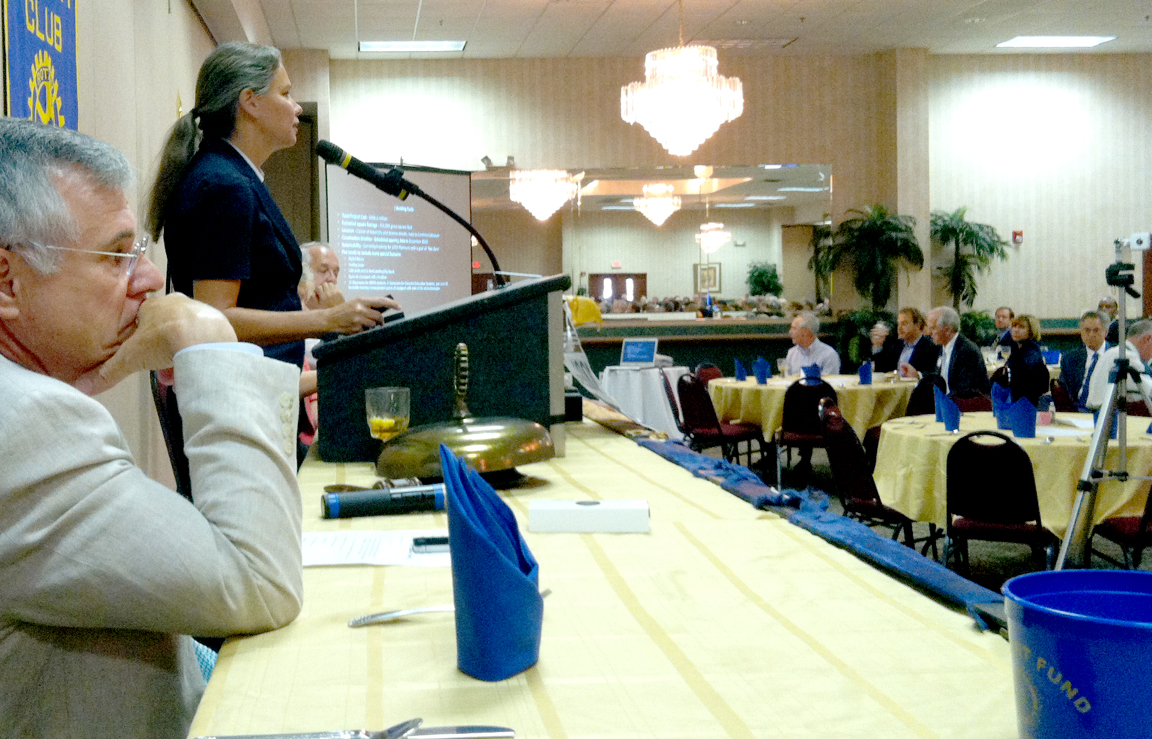
That was the subject of Hildy Teegen’s talk today to the Columbia Rotary Club. (Disclosure, to the extent that it means anything: I invited Hildy to speak to the club, and introduced her.)

Speaking to Rotary. That's Club President J.T. Gandolfo in the foreground.

It’s the new Moore School of Business, of which Dr. Teegen is the dean. It’s intended, among other things, as the gateway to the Innovista, and should go a long way toward helping people understand that Innovista is NOT those two buildings everybody keeps obsessing over, but will constitute a transformation for that whole underdeveloped urban expanse from this location down to the river.

Innovista is conceived around the “live, work, play” concept, and the new Moore school has been designed to complement that. The key word Hildy keeps using to describe it is “permeable.” That goes from the literal sense of the rooftop garden, to the fact that it will be open to the whole community 24/7. In fact, she pointed out, it is architecturally impossible to close off the building.

One of the goals is for the building to achieve “net-zero” status, meaning its energy and carbon impact on the surrounding community will be nonexistent.

The building, which is to be completed in December 2013, will house the nation’s No. 1 international business master’s program and all of the school’s other business education programs — such as the night school that has just entered the top 25 in the U.S — except, of course the multiple distance-learning opportunities the school offers across SC and in Charlotte.

You can see the entire PowerPoint presentation here. And here are some pictures:

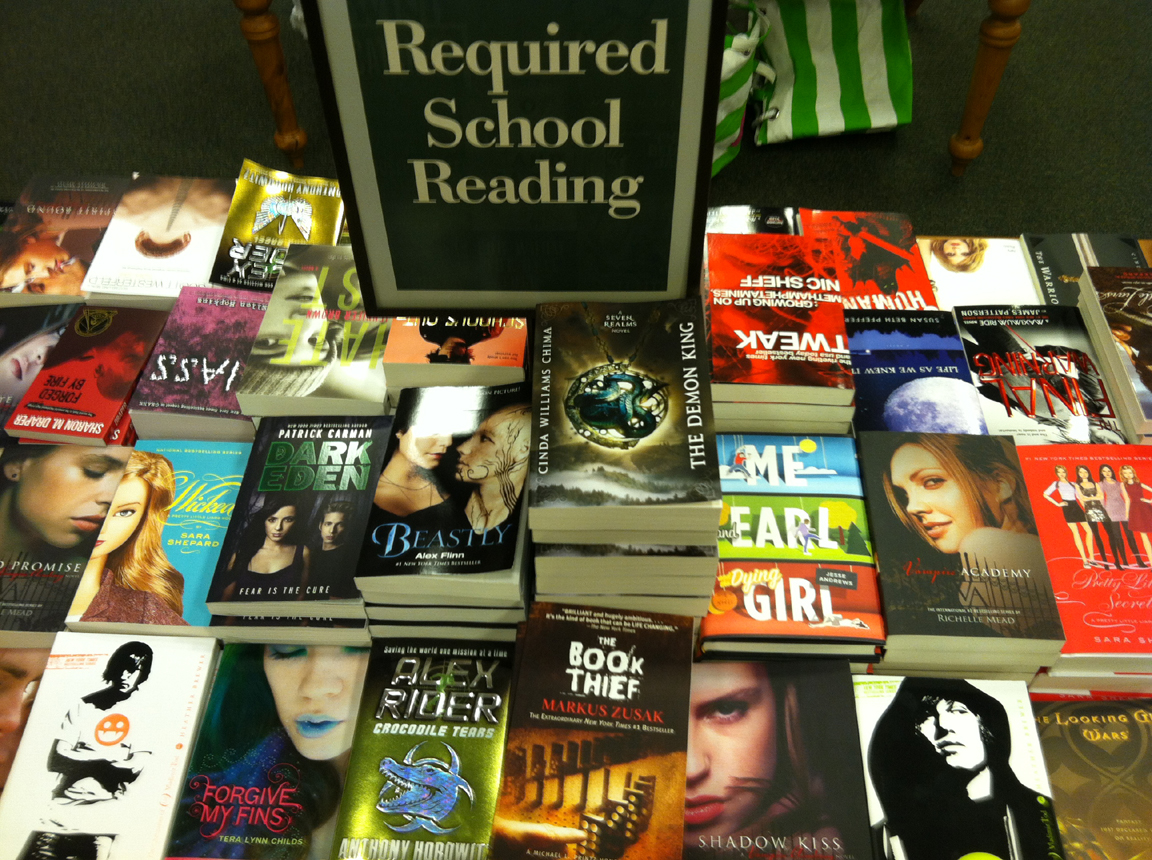
THIS is required reading? Seriously?

Having been required to leave the house because there’s a bridal shower going on there for a family friend, I came by Barnes & Noble and got some coffee, since I hadn’t made any at breakfast.

OK, technically, I got the coffee at the Starbucks about 50 yards away (yes, I’ve become that sort of coffee snob), and came in here to browse books while I drink it. I’m looking for ideas for Father’s Day — both for my Dad, and to see what there is in paperback that I might want to ask for. I’ve found one of each…

Anyway, I passed by the “Required School Reading” table, and of course it was filled with excellent, worthwhile books, many of which were required when I was in school, plus a few more recent classics. I like browsing the school reading table. It feels so substantial and worthwhile, as well as evoking pleasurable memories, because some of these came to be favorites of mine.

Note that you can see Flowers for Algernon, which I mentioned just yesterday in a comment. There were Catch-22, and Utopia, and Emma, and  A Tale of Two Cities, and other usual suspects. Then there were more recent entries, such as Freakonomics and the book that the film “The Social Network” was based on. All things that help kids think, and appreciate language, and understand their world a little better.

Then, I noticed that there were two more “Required School Reading” tables. There I found very different fare. It was all commercial, recent, crank-’em-out-on-an-assembly line “young adult” offerings. You can see them in the picture at the top of this post.

At least a plurality of them were about vampires. Teenage vampires, of course. Filled with all of the usual teenage angst, such as worrying about one’s place in society, finding true love, and of course bloodlust.

I really, really hope this was a case of the wrong sign being placed on a table. I thought of asking one of the employees, “Are these really required reading in school? If so, which school?”

But I was afraid of the answer I might get.

They got a union just for SERGEANTS? Really?

When I saw this headline at the Chicago Sun-Times site — “Ex-head of Chicago police sergeants union sentenced to 12 years in prison” — I thought what any ol’ Southern boy would think:

They got so many unions up there, they got a special one just for sergeants?

Apparently so.

Which means that those other parts of the country are… really different… from down here. And I don’t mean that in a good way.

As I’ve said before, I don’t hold with public employee unions. Public employees work for the people, not some separate private entity. That means they serve themselves as well as their friends and neighbors. Given that special relationship, there’s something really twisted about employer and employed being on opposite sides of a bargaining table. We should be able to rely on their being on the same side.

Fortunately, that’s one thing (one of the few) that I don’t have to worry about in South Carolina. We ain’t got none o’ that.

Unfortunately, we do get some of the negative effects of public employee unions here, with none of the dubious benefits. For instance… you know all that money that flows into our state from people trying to elect legislators who will undermine public education? They are to a great extent motivated by their animus toward “teacher unions.” Well, we don’t have any of those here, which is why it’s bitterly ironic that we should be a battleground for that issue (thanks in large part to Mark Sanford — his being governor persuaded those interests that South Carolina was fertile ground for their movement). The SCEA is a professional association, not a collective bargaining unit.

Today in the WSJ, there was yet another screed against teacher unions — which of course has no application to South Carolina. Sadly, too few in our state understand that, based on how many times I hear public education critics in our state moan about how the “teacher unions” stand in the way of improving education here. (I actually heard it from the lips of a Rotary speaker recently.)

Anyway, these are the things I’m thinking about as voters in Wisconsin decide whether to recall their governor over a battle about public employee unions. A fight in which we do not have a dog.

Great to see my old friend Michael Mercer!

An old friend sent me the above video. When I got home last night, I asked my wife to watch it without telling her why. She looked at it only a second before saying “Michael!”

Yep. The guy playing the “English teacher” at the beginning is Michael Mercer. Michael and I started out as copy editors together at The Jackson (TN) Sun in 1975, soon after I graduated from Memphis State. Michael got out of the business long before I did, taking a teaching gig at Auburn. Now he’s at another college in San Antonio, as he explained when I asked about the video:

The young lady featured in the film is one of my student-advisees at the University of the Incarnate Word in San Antonio. She’s a communication arts major concentrating in journalism — although broadcast like most of them do today. She asked me at the last minute to be in the video that she and the filmmaker — her boyfriend from another school in San Antonio — were doing for a video contest promoting San Antonio park recreation.

They didn’t win the contest but I thought they, too, did an excellent job. I was only familiar with the classroom scene where they asked me to  mouth a few words as an “English teacher.” Those other students in the video in the classroom are UIW students but not any of mine. We spent about an hour shooting various takes, angles, short bites. I was told it would only take about five minutes. Then a week later, my student asked me to wear the same shirt and pants for a scene they wanted to shoot minus the class in that same classroom showing me walking out the door after that “chill” comment.

No, most of my South Carolina readers won’t know Michael, but some of our former colleagues will see this, which is why I share it here. The fact that I can do so so easily — the fact that a student could even produce something like this — is testament to how the world has changed since Michael and I started out.

In those days, the copy desk was still a big horseshoe (or “elephant’s commode,” as one of my Tennessee colleagues referred to it), with the slot man (or woman) sitting in the center, distributing copy to those on the rim who would edit it and write headlines as assigned by the slot. The copy and headlines would then be passed back to the slot for checking before being sent to the composing room. Except that the editing wasn’t done on paper at this point. The text had been scanned and output onto a paper punchtape, which was clipped to the hard copy with a clothespin (without clothespins, we couldn’t have gotten the paper out). After an editor received the copy with attached tape from the slot, he or she would take it over to a Harris 1100 editing machine, and feed the punch tape into it. The copy would appear on a CRT screen, and the editor would use a keyboard to edit it. When done, the edited text would be output to another punch tape of a different color, which the editor would roll up the tape (using a little electrical device that was sort of like one of those handheld, flashlight-sized fans) and clip it back to the copy. That bundle is what the editor would pass back to the slot, along with a headline written in pencil on a hand-torn strip of paper.

A couple of months after I joined The Sun, I was pulling shifts in the slot, and I found I liked it so much that by the time I moved on from the desk, I was doing it most days. The job entailed what would have been three to five jobs at a paper the size of The State in those days. The slot not only supervised the editing process, but laid out the entire A section, monitored the wires and selected all wire copy, and oversaw the production process in the composing room. If a page was late, it was the slot’s fault. And in those days, things were so loose and informal at The Sun that an assertive slot (which, I confess, I was) could pretty much decide how all of the news in the paper was played, including local copy.

The day started at 5:30 a.m., and the whole first edition (which was more pages than you find today in The State) had to be out at 11. Then we’d grab a quick lunch before having the city edition out by 1:30.

Doing that job at the age of 22 gave me a lot of confidence that stood me in good stead in the years to come. And it gave me a taste for calling the shots. Which is why after that gig, I only spent a couple of years as a reporter before becoming a supervising editor. You can learn a lot by starting out in a small pond.

Michael followed a similar path, without being quite as power-mad as I was (you can probably tell in his brief appearance that Michael is a nicer guy than I am — which I’m betting is why he was cast in this film; I’m sure he’s the sort of teacher who might be students’ favorite). He was one of my assistant editors over the news reporters at The Sun in later years.

And now there he is, playing the “English teacher.”

Why does Nikki Haley want to unionize SC school bus drivers?

Here’s one of the things that puzzles me about Nikki Haley. To hear her talk sometimes, you’d get the idea that unions are a bad thing.

And yet she keeps pushing and pushing and pushing to unionize the drivers who operate public school buses in South Carolina.

Oh, you didn’t know that? Well, she calls it something different. She calls it “privatizing” school buses.

But what’s the first thing that happens whenever a private entity takes over the school buses in a South Carolina district? The Teamsters (and folks, if unions are bad, you’d think Jimmy Hoffa‘s old outfit would be superbad) come in right behind it.

How do we know this? Experience. There are three districts in South Carolina where the buses are no longer operated by the state. Let’s run down the list, shall we?

  1. Charleston — the drivers are represented by the Teamsters.
  2. Beaufort — the drivers are also Teamsters.
  3. Dorchester 2 — As of Friday the 13th, Teamsters Local 509 is celebrating having won the right to represent bus drivers.

So thanks to Nikki Haley and her ilk, the Teamsters are batting 1.000 in South Carolina.

I don’t know why she keeps pushing this privatization thing, given this apparently inevitable result. Maybe the answer is in her book. If anyone out there actually reads it, let us know.

All irony aside, this is yet another example of what you get when you are governed by people who do not have a clue how the world actually works.

What Nikki’s privatization scheme does is provide a back-door way to unionize public employees — just make them private employees. Neat, huh?