Category Archives: Education

Governor’s school gets national recognition

I’ve had some exposure to our two Governor’s schools — my oldest attended the one for science and math, my youngest the one for the arts — and it’s nice to see them get some national recognition:

Science and Mathematics Governor’s School Named Top-Performing U.S. School by The Washington Post

Tuesday, April 15, 2014, Columbia, SC – The South Carolina Governor’s School for Science & Mathematics (GSSM) has been named one of “America’s Top-Performing Schools with Elite Students” by The Washington Post. GSSM was the only South Carolina school included in the list.

The 23 schools, listed in alphabetical order, were described as “non-neighborhood schools with SAT or ACT averages above the highest averages for neighborhood schools nationally.”

GSSM is a two-year, public, residential high school in Hartsville, SC, specializing in the advanced study of science, technology, engineering and math (STEM) with a special emphasis on economics and entrepreneurship. GSSM can serve as many as 300 high school juniors and seniors annually from across the state. The current student body represents 96 high schools and 32 counties.

Beyond its distinctive curriculum, GSSM offers unique learning opportunities including the nationally recognized Summer Program for Research Interns (SPRI), the Research Experience Scholars Program (RESP) and January Interim. These innovative programs provide students with mentored, graduate-level internships, study abroad experiences and options to explore non-traditional courses. The School is also educating the next generation of entrepreneurs and business leaders through theBlueCross BlueShield Economics & Finance Institute and the next generation of creative engineers through the Duke Energy Engineering & Innovation Institute.

While there are 12 specialized, public residential schools across the country, only five were included inThe Washington Post’s list. The average SAT score for GSSM students (1989) is 553 points higher than South Carolina’s average. GSSM students’ average ACT score (30.3) is nearly 10 points higher than the state’s average.

“We appreciate The Washington Post publishing this list, and we are honored to be included among other top achieving schools,” said Dr. Murray Brockman, GSSM president. “We do not participate in the rankings of traditional high schools because we don’t fit the traditional mold. Our courses begin at the AP level, which is where most schools end. GSSM students are selected after a long and rigorous application process. It is not a fair comparison.”

See The Washington Post’s full list here. 
Learn more about GSSM by visiting www.scgssm.org.

###

Again we’re reminded that SC can do education right. We just don’t do as well with disadvantaged students who are not the sort who would do well anywhere…

The Republican take on the same education bill

Sen. Peeler, in a 'man of action' photo from his website.

Sen. Peeler, in a ‘man of action’ photo from his website.

OK, now Sen. Harvey Peeler has put out a release touting his portion of the combined bill that included Vincent Sheheen’s 4K expansion proposal:

Read to Succeed legislation clears Senate

PEELER PLAN WOULD ENSURE EARLY READING PROFICIENCY

Columbia, SC – April 10, 2014 – The state Senate today passed on third reading the Read to Succeed bill, a plan introduced by Senate Majority Leader Harvey Peeler to help ensure South Carolina’s children are reading on grade level.

Read to Succeed is the first substantive piece of education reform passed by either chamber of the General Assembly in several years, and is premised upon the idea that proficient reading is the foundation of all future learning in school. Peeler’s plan recognizes this, and starts by ending social promotion for third graders who are not yet reading on grade level.

“There’s a reason that the old song about the three R’s puts reading first,” Peeler said. “Children across the state are making it way too far in our school system without having this building block for success in place. It’s time we fix that, so we’re not setting these kids up for failure later in their educational journey.”

Peeler also noted, “I want to specifically thank Governor Haley for efforts to support and promote this initiative. The Governor’s Executive Budget funded $29.5 million for reading coaches, which was a tremendous catalyst to get things clicking this year. By providing a dedicated funding source, she brought focus to the Read to Succeed proposal, and led the House to adopt it in its budget.”

Among the bill’s provisions:

• beginning in 2017-2018 – a 3rd grader not reading on a 3rd grade level will be retained

• there will be a state reading plan and a district reading plan (to be approved by the State Department of Education)

• beginning with school year 2014-2015, provides a readiness assessment for 4K and 5K, as teachers need to know how far along a child is when they first come to school

• gives school districts flexibility to provide summer reading camps, with a minimum of 6 weeks, 4 days per week, and 4 hours per day

• transportation to summer reading camps will be provided at no cost to the parents

• districts who have trouble finding summer reading camp teachers will be allowed to work with other districts – or contact for services

• if a child has been found to need the summer reading camp — at any grade level —  there will be no cost

The legislation also creates a statutory phase-in of a statewide 4-year-old Kindergarten program, which will be implemented based upon availability of funding.

The bill now goes to the House of Representatives for consideration.

###

This is confusing, having these two proposals jammed into one bill. But maybe having the Republican leader’s strong advocacy will help both proposals in the House. Maybe. I haven’t followed this closely enough to know…

Sheheen’s kindergarten initiative moves ahead

Here’s the Sheheen press release:

Sheheen Bipartisan Leadership Moves 4k Forward for At-Risk Kids


Columbia, SC – Today, Sen. Sheheen’s seven-year-long effort to implement universal 4-year-old kindergarten took yet another step forward as the Senate passed a bill to further expand coverage to all at-risk children in South Carolina.


“Early childhood education is key to improving the quality of education for our students, and I am proud that we’re taking this next important step forward,” said Sen. Sheheen. “We know that the earlier you invest in a child’s education, the better equipped that child is for success and the more bang for the buck the taxpayers get — that’s a recipe for success for South Carolina. We can make great changes for the people of South Carolina, all it takes is leadership and hard work to get things done.”


In a win for bipartisan leadership, Democrats and Republicans supported Sen. Sheheen’s proposal to expand 4-year-old kindergarten once again today. Last year, Senator Sheheen worked across party lines last year to expand pre-kindergarten programs to 17 additional counties around the state, helping an estimated 8,400 more 4-year-olds gain access to kindergarten this year.


###

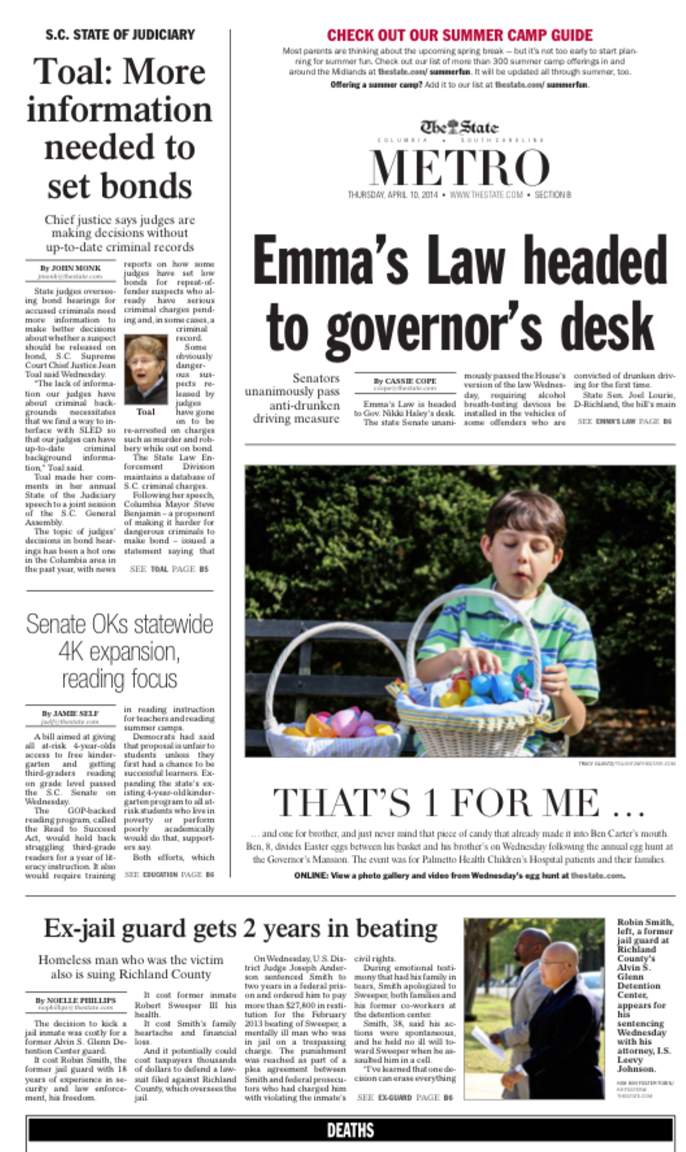
And here’s the news story.

This is kind of a big deal. I was sort of surprised it didn’t get bigger play. The paper led with meaningless Kulturkampf “referenda” on the Republican and Democratic primary ballots, and this was relegated to halfway down the page on the Metro front.

Of course, it has a long way to go to become law — and to get funded. So there’s that to justify the paper’s not getting excited…

4K


Jeb Bush, GOP Establishment Man

I missed coverage of this over the weekend, but learned about it via a WSJ column this morning.

Jeb Bush really poked the Tea Party interlopers (you know, the ones who call real Republicans RINOs) in the eye. He called illegal immigration, at least in some circumstances, “an act of love.” The Fix quoted at greater length:

Photo by Gage Skidmore

Photo by Gage Skidmore

There are means by which we can control our border better than we have. And there should be penalties for breaking the law. But the way I look at this — and I’m going to say this, and it’ll be on tape and so be it. The way I look at this is someone who comes to our country because they couldn’t come legally, they come to our country because their families — the dad who loved their children — was worried that their children didn’t have food on the table. And they wanted to make sure their family was intact, and they crossed the border because they had no other means to work to be able to provide for their family. Yes, they broke the law, but it’s not a felony. It’s an act of love. It’s an act of commitment to your family. I honestly think that that is a different kind of crime that there should be a price paid, but it shouldn’t rile people up that people are actually coming to this country to provide for their families.

He’s also going after the folks who are so worked up about Common Core:

He said those who oppose the standards support the “status quo,” oppose testing and are worried too much about children’s self-esteem.

“Let me tell you something. In Asia today, they don’t care about children’s self esteem. They care about math, whether they can read – in English – whether they understand why science is important, whether they have the grit and determination to be successful,” Bush said.

“You tell me which society is going to be the winner in this 21st Century: The one that worries about how they feel, or the one that worries about making sure the next generation has the capacity to eat everybody’s lunch?”

See what he did there? He defined the Common Core opponents as touchy-feely types worried about self-esteem — one of those qualities conservatives traditionally despise in liberals.

I like this approach. If he runs, he’ll be offering his party a clear choice between spinning off into the fringes (or at least into a demographic dead end), or remaining a party that can muster majorities across the nation. He seems to think there are enough real Republicans left for the party to choose the latter.

Sheheen’s new campaign video: “Failing”

Here’s the TV ad released by the Sheheen campaign today.

Thoughts? My own first reaction is that it looks like Nikki Haley is the incumbent superintendent of education rather than governor. There’s no explanation for why the governor should be held accountable for the performance of schools.

It also seems kind of weird and backwards. Don’t people of Nikki Haley’s wing of the GOP usually bemoan the state of public schools, while SC Democrats stick up for public educators doing the best they can with what they’ve got? I mean, wouldn’t Nikki’s natural reaction be, “Yes, and this is why we need tuition tax credits?” Or another of those old SCRG talking points.

I’m not sure what sort of train of thought this is meant to invoke, beyond “Nikki Haley — bad.” But maybe you see something else…

How McConnell is playing nationally

In one venue, at least…

Slate runs a fairly even-handed (despite the Slate teaser, “IS A MAN WHO DRESSES LIKE A CONFEDERATE GENERAL UNFIT TO BE A COLLEGE PRESIDENT?”) piece that first appeared in Inside Higher Ed. There are no surprises in it. I just find it interesting to see how our controversies in SC play elsewhere, particularly in a case in which the protesters claim that McConnell’s selection will hurt out-of-state recruitment and the value of a College of Charleston education.

An excerpt:

Trustees at the College of Charleston are facing heat from faculty and students for picking South Carolina’s lieutenant governor as the college’s next president. In the process, critics say, the trustees brushed aside warnings that Lt. Gov. Glenn McConnell’s promotion of Confederate history could damage Charleston’s reputation and turn away prospective students and donors.

In picking McConnell, the public liberal arts college’s trustees reportedly ignored the school’s own search committee, which did not recommend the politician—who has never worked in higher education—for president.

Backlash has been swift. Students rallied against McConnell’s selection Monday in the largest campus protest in recent memory. “This is 2014 NOT 1814,” one sign read. On Tuesday the student government voted no confidence in the college’s trustees. …

As you see, not much new. I just thought I’d share.

Glenn McConnell, president-elect of College of Charleston

MoncksCorner

The trustees of the College of Charleston went for political clout over the weekend, unanimously electing Glenn McConnell to be their new president.

It was the smart move, and the best for the public college’s future, to pick the longtime parliamentary master of the State House.

Yes, he has an affinity for all things Confederate. There’s the flag, which still flies in front of the State House because of the “compromise” he and a few other senators crafted when it became inevitable that it would no longer stay up on the dome. There’s the Hunley, the raising and preservation and study of which has been a pet project of his. There’s the memorabilia shop he owned (I don’t think he owns it anymore, but I could be wrong about that). There’s the 17 or 18 re-enactor uniforms he has in his closet.

Then there’s the fact that, as the most powerful and knowledgeable defender of the Legislative State, he has resisted substantive reform for decades.

That’s the bad stuff, which is all detractors have focused on. And you can see how they would.

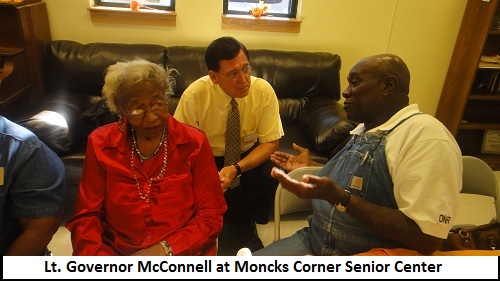
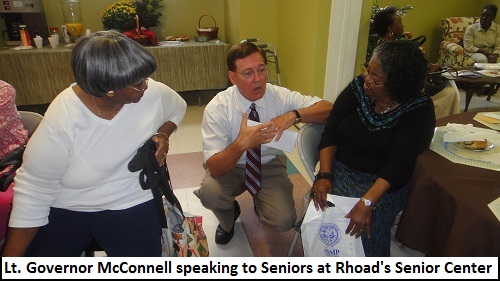
But those who have worked with him in the State House mostly just respect the guy — and not just because he understands how the system works better than they do. He’s a hard worker who can be relied upon to do what he says he will do. And that has benefited South Carolina, from the judicial selection reforms (keeping selection in the hands of the Legislature, but making it much more merit-based) of the ’90s to his conscientious efforts on behalf of the elderly as lieutenant governor.

He earned a huge amount of that respect with the way he gave up his Senate power to accept the lowly job of lieutenant governor when that seemed to him the most honorable course, and rather than mope in the corner, got out and took his responsibility as head of the Office on Aging (lawmakers had put a former lieutenant governor in charge of the office just to give him something to do) seriously.

Those are the kinds of factors that led a couple of young Democrats to issue glowing praise of him on Twitter in response to the news over the weekend.

  • Sen. Thomas McElveen Tweeted, “Congrats to Glenn McConnell on being named @CofC ‘s 22nd president. His statesmanship, pragmatism & steady hand will be missed in the Senate.”
  • Former Rep. Boyd Brown wrote, “Very proud of Glenn McConnell and CofC, and wish both great success. Any entity should hope to have such an honorable and fair leader.”

Brown went further, arguing with the critics in two subsequent Tweets:

  • “Some of the folks manufacturing outrage over Glenn McConnell being tapped to lead CofC have clearly never met the man…”
  • “…Sure, McConnell is an easy target if all you know about him is ‘Civil War buff/politician.’ But as a leader, he’s in a class all his own.”

I’ve spent a lot of time on the opposite side — the losing side, of course — from Glenn McConnell on important state issues. I could get pretty indignant about it. But that has generated respect, and I know what these guys are on about.

As I said, the trustees made the right call. The smart call, certainly. But near as I can tell thus far, the right one, as well.

Study sees future shortfall of college-educated in SC

This release just in:

Study Highlights Major Expected Shortfall in

South Carolina’s Future College-Educated Workforce 

— USC Economists Find S.C. Will Need Many More College-Educated Workers

by 2030 Than It Is On Pace to Provide —

Columbia, SC – March 6, 2013 – South Carolina is facing a major shortfall of skilled, college-educated workers by the year 2030 to fuel its economic growth, according to a major new study prepared by two University of South Carolina professors. The study projects that at current rates, the state will have a shortfall of more than 100,000 graduating students with the necessary post-high school education to be hired.  To put things in perspective, that shortfall is greater than the seating capacity of either Williams-Brice Stadium in Columbia or Memorial Stadium in Clemson.

The study was conducted by Dr. Doug Woodward and Dr. Joey Von Nessen, top research economists in the Darla Moore School of Business. The study will guide the efforts of the Competing Through Knowledge initiative, a group of civic and business leaders seeking to enhance the state’s workforce preparedness through improved higher education.

Based on economic and demographic trends, Woodward and Von Nessen project that by 2030 South Carolina will have a shortfall of 44,010 workers holding two-year degrees and 70,540 workers who hold bachelor’s degrees or higher. This major projected deficit – if not addressed – could cast a shadow over South Carolina’s future, as the USC study notes: “The percentage of the population with a college degree is the single best predictor of a state’s national ranking in personal per capita income levels.”

“This report has to be taken as a call to action,” said Jim Morton, a retired senior executive from both the Michelin and Nissan companies and one of the civic leaders spearheading the Competing Through Knowledge effort. “If South Carolina is going to thrive as we all wish, meeting the educational needs of our growing economy has to be a top priority. Our state needs a comprehensive plan.”

The state’s need for skilled, college-educated workers by 2030 will double or almost double across the three levels of higher education cited in the report: jobs needing some post-high school work, those requiring a two-year degree or those requiring a four-year degree. This outlines a major challenge for the state’s technical colleges as well as four-year colleges and research universities.

The report also identifies several fields as likely to generate the greatest mismatches between what higher education is set to provide and what is needed, most notably the field of nursing. Nearly 40 percent of the shortfall projected in the S.C. workforce is expected in nursing; that is more than 17,000 openings for those with at least an associate’s degree in excess of what our colleges are expected to produce. Other fields that are projected to need thousands more workers than are projected include general and operations managers, schoolteachers and accountants, among others.

In the report’s conclusion, Woodward and Von Nessen write: “For South Carolina to create opportunities for its citizens to have access to good jobs and higher wages, it must create a workforce that is equipped with the skillsets that are in demand in the labor market.”

To help meet that challenge, the S.C. Business Leaders Higher Education Council launched the Competing Through Knowledge initiative. In the coming months, Competing Through Knowledge will be looking at South Carolina’s higher education system and current and future workforce needs. The group, featuring leaders from across the state and many different fields of expertise, will recommend specific on-the-ground changes in how South Carolinians are being educated.

Other states have brought a similar focus to making sure that they are doing all they can to prepare their workforce. In 2009, Virginia launched its Grow by Degrees plan, which resulted in several new initiatives to improve higher education being implemented there.

Former South Carolina Gov. David Beasley, a Competing Through Knowledge board member, said, “The Competing Through Knowledge project is about bringing business and higher education leaders to the table to identify the jobs of the future and create a strategy to make certain that South Carolina workers have the skills necessary to satisfy those jobs.”

The USC study can be accessed by following this link: competingthroughknowledge.org/assets/uploads/references/Higher_Education_Report.pdf

About Competing Through Knowledge

Competing Through Knowledge is an effort driven by business leaders to make South Carolina’s working citizens ready for the emerging economy and the state more globally competitive by 2030. It will work with higher education to assess how South Carolina, at the two-year and four-year levels, is preparing its workforce for the future. The goal is to invigorate South Carolina with the knowledge required to attract and sustain more advanced economic activity while preparing more of its citizens for broader opportunities, through the growth of better-paying industries and entrepreneurship. Learn more at www.competingthroughknowledge.org.

Do you find that a little hard to believe? Maybe it’s because my office is only about a block from the USC campus, and I often feel like I’m trying to move through an ocean of college students.

Yeah, I already knew that we weren’t churning out enough nurses. As for the rest — I see that we’re expected to fall short in “general and operations managers, schoolteachers and accountants, among others.” Except for the teachers, that sounds kind of like the folks who would have been placed on the B Ark from Golgafrincham

Hey, it’s a joke, you general and operations managers! Can’t you take a joke?

ahitchgoat17

Aboard the B Ark from Golgafrincham, with Arthur Dent…

Hodges endorses Anthony for superintendent

This just in:

Former SC Governor Jim Hodges endorses Mike Anthony for Superintendent of Education


Anthony

Mike Anthony

“Mike Anthony has spent his life dedicated to public schools – as a classroom teacher and state champion football coach. He’s the kind of person our public schools need – a proven leader with a track record of success in our schools. I have every reason to believe he will be that strong advocate for kids, parents and teachers we desperately need.”


Governor Jim Hodges is best known for his leadership in bringing the Education Lottery to South Carolina, securing over $1 billion for school construction without raising taxes. He also launched the ‘First Steps to School Readiness’ program. 


Representative Mike Anthony said he was very grateful for Governor Hodges’ endorsement.


“Governor Hodges was truly an ‘education governor,’ said Rep. Anthony. ”He made public education his highest priority and as a result our schools made great strides during his tenure. His work to establish the education lottery and ‘First Steps’ program have done wonders for South Carolina public schools. I’m truly honored that Governor Hodges has decided to support my candidacy.” 


####

Not sure what to make of it. But assuming that a Democrat still has a shot at this office in a race without an incumbent, then having the endorsement of the last Democratic governor has to be a help. To the nomination, at least. Anthony currently has one Democratic opponent, Montrio Belton.

What it would cost to make public college tuition-free

My daughter, who by the way earned a free ride through college through merit scholarships, brought this to my attention today, from a recent piece in The Atlantic:

Here’s Exactly How Much the Government Would Have to Spend to Make Public College Tuition-Free

A mere $62.6 billion dollars!

According to new Department of Education data, that’s how much tuition public colleges collected from undergraduates in 2012 across the entire United States. And I’m not being facetious with the word mere, either. The New America Foundation says that the federal government spent a whole $69 billion in 2013 on its hodgepodge of financial aid programs, such as Pell Grants for low-income students, tax breaks, work study funding. And that doesn’t even include loans.

If we were we scrapping our current system and starting from scratch, Washington could make public college tuition free with the money it sets aside its scattershot attempts to make college affordable today.

Of course, we’re not going to start from scratch (and I’m not even sure we should want to make state schools totally free). But I like to make this point every so often because I think it underscores what a confused mess higher education finance is in this country…

Huh…

If Nikki Haley’s playing politics, that’s good news, too

So if Thigpen's right, we're much less likely to see scenes such as this one this year.

So if Thigpen’s right, we’re much less likely to see scenes such as this one this year.

Having trouble finding anything substantive not to like in Nikki Haley’s education and other proposals, some critics are saying she’s just playing election-year politics.

Well, if that’s the case, that’s good news, too. In fact, unless you’re a Democrat trying to unseat her, it’s hard to see where the downside is for you here.

That occurred to me reading the following, written by Schuyler Kropf at The Post and Courier:

Democrats — and even some political talking heads — were quick to point out Haley’s attention to education and mental health could easily be seen as attempts to neutralize her Democratic opposition.

“They must feel it’s a more moderate electorate out there,” retired Francis Marion University political scientist Neal Thigpen said Monday in assessing her administration’s 2014 spending ideas.

Thigpen, who has followed Republican politics in the state for years, said the most obvious political target in her budget is announced Democratic challenger, state Sen. Vincent Sheheen of Camden.

Haley’s camp must see a need in “trying to block him out,” Thigpen added, “and being ahead of him in trying to blunt those issues that he may be able to use.”…

Look again at what Neal Thigpen just said…

“They must feel it’s a more moderate electorate out there…”

If Nikki Haley and her people are looking around them and seeing a more reasonable world than the one that elected them in the Year of The Tea Party, then that’s gotta be a good thing, right?

So, if that’s correct, her speeches this year will be less about throwing red meat to people who hate government, and more about good governance. Which Vincent Sheheen will be doing as well, because he always does that. Which means that no matter which of them is elected, that person will be committed to such basic things as better schools, and better care for the mentally ill.

Which as I say, is a good thing for all South Carolinians…

Nikki Haley’s education proposal looks very promising

UPDATE: Spoke briefly today with Ted Pitts, who said the governor’s proposal was attached to the relevant press release on the governor’s website. Which seems rather obvious, now that he points it out…

Someone complained, sort of, that I didn’t comment on Nikki Haley’s education proposal yesterday. Sorry. I wasn’t sure I knew enough about it, based on the news stories. (I sort of had the same reaction a bunch of lawmakers did. I wanted to know more.)

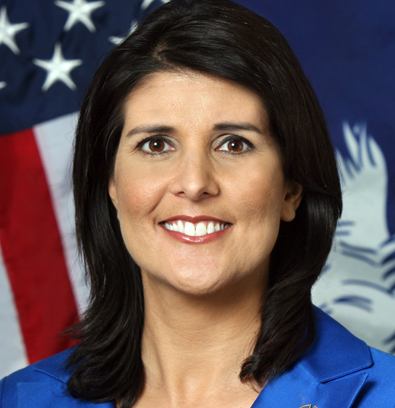
But now I have a little more confidence than I did in saying this: It looks really good. It addresses one of the most serious problems in SC public education, and does so in a way that I think is politically courageous for a Tea Party Republican.Governor Haley Official Portrait

If you doubt it, look no further than the lame response from Democrats. Vincent Sheheen said essentially, Hey, I’ve had a lot of good education proposals way before Nikki did. Todd Rutherford said, Yeah, but how come we had to wait four years for her to pay attention to education? The state party said pretty much what Rutherford did.

If it looks good to me, and even those with a huge motivation to find fault with it can’t find anything to criticize, it must be pretty good, right?

Here’s why it’s good: The public education problem in South Carolina is, to oversimplify a bit, a rural poverty problem. Normally, what you hear from Republicans of a certain stripe is, “Look at those awful standardized test scores (really, they mean the SAT, because we don’t look all that bad on other measures); they prove that public education is a failure.”

But the truth is, we do know how to do public education in affluent suburbs, where there are sufficient resources and kids come to school ready to learn. Not so much in poorer parts of the state.

One of the nagging problems is that kids who start at the back of the pack and who don’t have a lot of help and support at home are harder to educate. And yes, that can mean “more expensive to educate.” They need more highly skilled teachers — not just those who couldn’t get a job in the ‘burbs — and more support services to catch up.

So, how do you get a state where the real political power resides in the suburbs (in those white districts that vote Republican) to go for a plan that sends more of their tax money to the poor, rural areas?

Well, somebody has to exert some leadership to make it happen.

Which is what the governor is proposing to do here. Good for her, and I certainly hope she succeeds.

USC President Pastides rejects boycott of Israel

Stan Dubinsky over at USC brought my attention to this at the end of last week:

President Pastides’ statement on Israeli boycott

The essence of academic freedom is the free exchange of diverse ideas and opinions. I am in agreement with the Association of Public and Land-grant Universities that, “Freedom of inquiry and expression are the foundational principles of [this] vital work, and free exchange of ideas is its lifeblood.” For these reasons, I stand with colleagues throughout the country in strong opposition to a boycott of Israeli academic institutions.

At the time, I asked Stan if he could provide me with some context for this statement. (I mean, I’m aware of the “boycott Israel” movement out there in Western academia, but I wanted to know whether there had been any proximate stimulus for this particular response.

Stan answered me right away, but I’ve just today dug all the way through my email from over the weekend. After responding as follows…

Useful idiots on the Left have passed boycott resolutions of Israeli universities (the American Studies Association being the most recent and prominent of these).  They are clearly paying the price for their foolishness.

… he provided this link for further info:

(JTA) — At least 90 American universities and colleges have rejected the American Studies Association membership vote in favor of an academic boycott of Israel, according to a Jewish umbrella group.

The number, as of Dec. 31,  was tracked by the Conference of Presidents of Major American Jewish Organizations.

The rejections have come in the form of statements by university presidents and chancellors rejecting the decision.

In a statement issued Tuesday, the Presidents Conference expressed its appreciation to the school chiefs who “stood up against this discriminatory and unjustified measure and rejected the ASA boycott of Israel.”…

McConnell to step down from elective office

By all accounts, he has really thrown himself into the work of running the Office on Aging as lt. gov.

By all accounts, he has really thrown himself into the work of running the Office on Aging as lt. gov.

Wow, it’s kind of hard to imagine the State House without Glenn McConnell.

He was, for so many years, arguably (that being every journalist’s favorite hedge word) the most powerful person in state government, for good or ill.

He’s the guy who was the biggest defender of the Legislative State and barrier to reform, yet led a significant improvement in the way South Carolina chooses judges.

He was the champion of limited government and spending ceilings, yet managed to come up with all that dough for the Hunley.

He was, finally, the man who liked to dress up as an Old School Southern gentleman, who then acted like a real gentleman by giving up power for a point of honor (when he agreed to give up his position in the Senate to occupy the low-status job of lieutenant governor, rather than trying to engineer a way around the rules).

Now he’s giving up that job, for a shot at academe:

COLUMBIA — S.C. Lt. Gov. Glenn McConnell will not seek another term and instead push to become president at his alma mater, the College of Charleston.

McConnell has said he wanted to make a decision since the college’s presidential search timetable conflicts with the June primary. A new president to succeed George Benson will not be named until around March.

“Any effort to pursue both goals at the same time is simply not an honorable path,” McConnell said in statement Monday. “It would not be fair to good candidates who may want to seek this office. Most of all, it would not be fair to the voters of South Carolina to ask them to support me for lieutenant governor if there is even a chance I might not remain in the campaign. For those reasons, I have decided I will not be a candidate for re-election. And I will instead formally offer my name for consideration to the College of Charleston.”…

The State House is losing a true original…

Is ‘Common Core’ the ‘whole language’ of 2013?

Maybe I should have gone to that anti-Common Core rally yesterday. Maybe I’d understand better what the beef is.

So far, based on news coverage of the event, I can’t tell. As an issue that stirs people’s (at least, a few people’s) passions to the point of marching, it seems lacking.

People seem to dislike it because it’s federal — except that it isn’t. Or they seem to dislike it because it’s a standard, preferring to leave curriculum up to teachers. I think. Or maybe they just don’t like the word, “common.” I got that last impression from the woman quoted in The State today who asserted, “My kids are not common.”

I haven’t been perplexed this way over an education issue since the phonics-vs.-whole language wars.

Remember those? People who favored the teaching of reading and writing by the phonics method were really, really angry that this thing called “whole language” was being taught in schools.

I always thought it odd that this would be an issue, particularly a political issue. Like there was some deep ideological or even moral principle at stake in whether a kid learned to read “cat” by sounding it out or by recognizing it by context, or on sight.

In learning most Western language, the phonic method is useful. Especially a simple, straightforward language such as Spanish, in which letters usually (but still not always) represent the same sounds.

It’s even useful in English, for “cat” and “hat” and “bat” and “rat.”

But then, it’s not useful at all for recognizing, and knowing how to pronounce, “rough” and “bough” and “though” and “through.” There might be some other ways that “ough” is pronounced, but those are four that come to mind immediately.

You just sorta need to know a lot of words on site — I mean, sight. Or infer them by context (which, as I go and look it up while writing this, seems to be more what “whole language” is about). Phonics can be a big help when you’re trying to make out an unfamiliar word (which makes it a good tool to have in your box), but then, it might not.

I remember having a tremendous argument, when I was a first-grader, with a kid in my neighborhood who insisted that there was no way that “said” was the word we pronounced as “sed.” Phonics were all he knew, which limited his ability to come to grips with the language. What he had learned was valuable, but not everything he needed.

I digress. My point is, I didn’t understand why there was such a battle over phonics, and I don’t get the passionate objection to Common Core, either. Can anyone help me out here?

A big step forward in medical research in SC

We hear a lot about setbacks to the Affordable Care Act, a.k.a. Obamacare. So it’s nice to take note of actual progress in a cooperative effort intended to improve health outcomes here in South Carolina — one that puts SC out ahead of the rest of the nation:

Health Sciences South Carolina Launches Nation’s First Statewide Clinical Data

Warehouse Clemson University, the Medical University of South Carolina, the University of South Carolina and major SC health care systems collaborate to track 3.2 million patients, 25 million health records

COLUMBIA, S.C. – A revolutionary information technology project launched by Health Sciences South Carolina (HSSC) could lead to major breakthroughs in improving the health of South Carolinians and attract millions of dollars of investment to the state’s economy, including the recruitment of biomedical clinical trials and the development of next-generation pharmaceuticals and medical devices—right here to South Carolina.

HSSC’s Clinical Data Warehouse (CDW) links and matches de-identified (anonymous) electronic patient records from South Carolina’s largest health care systems to enable providers and researchers to follow patient conditions in real-time. It also allows biomedical researchers to conduct patient-centered outcomes research and comparative effectiveness studies across a much broader and aggregated patient population base. This is the first system of its kind to bring together three major research universities and several large health care systems.

Bioinformatics for the system came from the Medical University of South Carolina, while the University of South Carolina developed the operations software. Clemson University hosts and provides patient privacy and security for the CDW. And all participating HSSC member hospitals share their data.

The project is a reality in large part thanks to The Duke Endowment, which has made major contributions of over $32 million to HSSC to fund the CDW and other health care initiatives. The South Carolina General Assembly also provided critical support through the creation of the South CarolinaSmartState Program.

Mary Piepenbring, Vice President of The Duke Endowment, said the foundation is proud of its longstanding commitment to Health Sciences South Carolina. “The Endowment’s support of the Clinical Data Warehouse initiative falls squarely within our mission to promote health in both Carolinas. This innovative health care tool has the potential to inform and improve health care outcomes in South Carolina and to serve as a model for information sharing.”

Earlier this year, HSSC began populating the database with historical data from Greenville Hospital System, the Medical University of South Carolina and Palmetto Health. The database currently contains more than 3.2 million medical records. Data from Spartanburg Regional Health System will be added in 2014. The CDW will eventually have data from all HSSC member health systems.

This is an unprecedented achievement for South Carolina,” said Dr. Jay Moskowitz, HSSC president.

“While the United Health Foundation ranks South Carolina among the lowest states in overall health status, we can now say with confidence that we rank among the highest places in the world with this level of collaboration and this kind of access to knowledge that will improve health for all South Carolinians.”

Moskowitz said the CDW will be invaluable to researchers studying rare conditions that affect underrepresented populations. For example, less than one percent of the population is diagnosed with Sickle Cell disease, and using data from a single South Carolina health system yields a very small patient population from which to build a potential research patient cohort. However, with the Clinical Data Warehouse, a researcher can triple or quadruple previous sample sizes, expanding queries to include more than 3 million patients across the state. Researchers in South Carolina now have a better chance of determining the potential success of a given research project and easier ways to build patient cohorts. Moskowitz also pointed to the potential for groundbreaking research on obesity and hypertension, conditions which affect many South Carolinians.

University of South Carolina President Harris Pastides also noted this benefit of the CDW.

“Researchers need large pools of data to develop and test scientific theories. Until recently, they had no simple way to study broad patient populations and doing so in real-time was almost unthinkable,” Pastides said. “The CDW provides clinical researchers with an integrated learning tool where the statewide patient population can now be surveyed and tracked in real time.”

Charles Beaman, president and CEO of Palmetto Health, said the CDW is an example of a new sense of collaboration among universities and health care providers.

“We are sharing data in ways we never have before, because we all realize that we share the same goals and the same mission: to serve the people of South Carolina and help them improve their lives through better health,” Beaman said.

If you would like to learn more about HSSC, CDW and other research endeavors, visit www.healthsciencessc.org.

About Health Sciences South Carolina Health Sciences South Carolina (HSSC) was established in 2004 as the nation’s first statewide biomedical research collaborative. Today its members include six of the state’s largest health systems—Greenville Hospital System University Medical Center, Palmetto Health, Spartanburg Regional Healthcare System, McLeod Health, AnMed Health, and Self Regional Healthcare—and the state’s largest research-intensive universities—Clemson University, the Medical University of South Carolina, and the University of South Carolina. The collaborative was formed with the vision of transforming the state’s public health and economic wellbeing through research. It also is committed to educating and training the health care workforce.

###

Jay Moskowitz told me yesterday, at the data warehouse’s unveiling at the State House, that he expects that 3.2 million number (the number of medical records) to grow as other health systems contribute their data. At the same time, the database will be compared to death records to cull out patients who are no longer among us, eventually providing an up-to-date picture of virtually the entire state population.

For more see the front-page story in The State yesterday.

Apparently, there was NOT a mass exodus from SC schools today

Fun fact: If you do a Google Images search on "Sheri Few," this picture that I took during an editorial board meeting years ago is still the second one that comes up.

Fun fact: If you do a Google Images search on “Sheri Few,” this picture that I took during an editorial board meeting years ago is still the second one that comes up.

There was a lot of talk last week — from people who supported the event to those who were horrified at the idea of encouraging kids to skip school — about this thing Sheri Few was putting together:

Hundreds of South Carolina parents are expected to rally and possibly pull their children from schools on Monday to show their opposition to the Common Core State Standards.

The Columbia event is part of National Don’t Send Your Child to School Day, which was organized to raise awareness about Common Core. Those standards are the new requirements for what K-12 students must learn in English language arts and math.

“It is our hope that it sends a loud message to the education establishment and the decision makers in our state that we’re going to protect our children from these flawed standards,” said Sheri Few, president of South Carolina Parents Involved in Education, a group that is opposed to the standards…

Well, apparently the message wasn’t all that loud.

Jamie Self of The State Tweeted this morning, “About 50ppl have lined up for march against Common Core at SC Dept of Ed on Senate St.” She posted this picture to go with it. She later reported that about 100 showed, so maybe there were some who were tardy.

Anyway, apparently there was no mass exodus from the schools today.

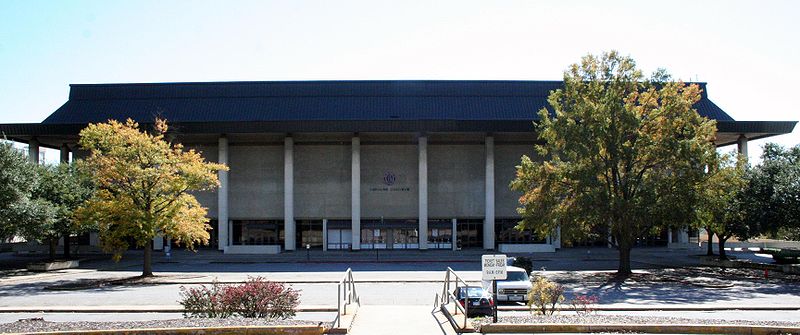
Should $125 million be spent on the Carolina Coliseum?

The Carolina Coliseum, back when you could see it from the north side.

The Carolina Coliseum, back when you could see it from the north side.

I think I entered the Carolina Coliseum for the first time in late summer, 1971. The building was only about three years old then.

The occasion was the “Jesus Christ Superstar” tour. This was long before it was either a play or a movie. The album had come out a few months before, and this was a touring group that performed the music concert-style. It featured Yvonne Elliman, from the original album, as Mary Magdalene.

Great show, even without anyone really acting out the story. You youngsters have to realize we were into listening to albums with our eyes closed and headphones on in those days. In fact, the first time I heard the album, this girl named Mary (Riley, not Magdalene) was lying on her back listening to it on the floor of a beach house that a mutual friend’s family had rented at Barber’s Point on Oahu, with the stereo’s speakers positioned either side of her head, inches from her ears. I don’t recall what I thought of the music at that point because a large part of my brain was occupied just looking at Mary.

Then, a few weeks later, I was back in the Coliseum for registration for the fall, my one and only semester at USC. This involved shuffling around from queue to queue signing up for one class at a time, holding these long computer punchcards in our hands. I think the way it worked was when you signed up for a class, you were given a punchcard for that course and section. Then when you were done, you handed in your small deck of cards, and someone fed them into a computer and presto, you had a schedule.

It was the first time I ever had anything to do with computers (I don’t think I saw a hand-held calculator for another year or two), and I was impressed. It all felt very space-age. Which is a term we used to use for “modern,” in the days when we thought the moon was but the beginning of manned exploration of space.

So, you know, this was a while ago.

It cost $8.5 million to build the Coliseum in 1968 (which would be more than $57 million today). The new Moore School going up next to it has a price tag of $106.5 million.

Now, there is a proposal to renovate the Coliseum for $125 million:

Plans call for turning the 12,000-seat arena into classrooms and labs, a one-stop shop of student services, an adjunct student union and a practice facility for the Gamecock basketball teams.

To quote that revered academic Dr. Peter Venkman, “It just seems a little pricey for a unique fixer-upper opportunity, that’s all.”

But that’s just a first, gut reaction. Perhaps a case can be made for it. What do y’all think?

Pope Francis reviving ideas, tone of Cardinal Bernardin

I’ve hit on these themes before, as did Massimo Faggioli when he delivered the annual Joseph Cardinal Bernardin Lecture at USC earlier this month.

But I thought this piece, which The State picked up over the weekend, further makes the case that the ideas of Columbia native Bernardin may today be more influential than ever in Rome. An excerpt:

(RNS) The election of Pope Francis in March heralded a season of surprises for the Catholic Church, but perhaps none so unexpected – and unsettling for conservatives – as the re-emergence of the late Chicago Cardinal Joseph Bernardin as a model for the American Catholic future.

While there is no indication that Francis knows the writings of Bernardin, who died in 1996, many say the pope’s remarks repeatedly evoke Bernardin’s signature teachings on the “consistent ethic of life” – the view that church doctrine champions the poor and vulnerable from womb to tomb – and on finding “common ground” to heal divisions in the church.

Ironically, the re-emergence of Bernardin — a man who was admired by a young Chicago organizer named Barack Obama — is exposing the very rifts he sought to bridge, especially among conservatives who thought his broad view of Catholicism was buried with him in Mount Carmel Cemetery outside Chicago….

Read the whole thing here.

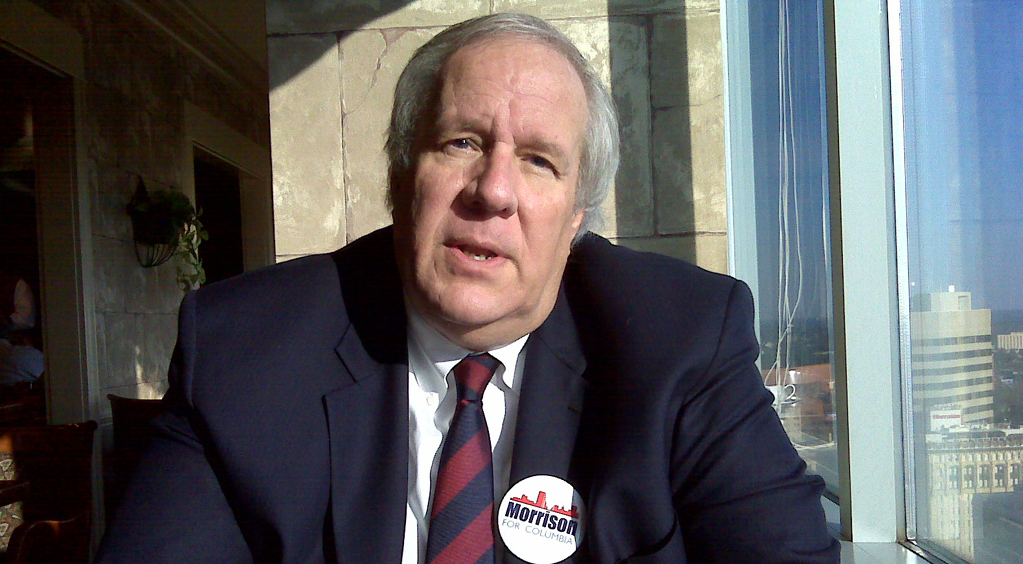
Steve Morrison, a man of great intellect, passion for justice

Steve Morrison during his campaign for mayor, 2010.

Steve Morrison during his campaign for mayor, 2010.

The news being reported by The State today is a terrible shock:

A prominent Columbia attorney who fought for equity in the state’s public education system and left his mark on the community through extensive service to organizations championing the arts, education and South Carolina’s disadvantaged, has died.

Stephen “Steve” Morrison, 64, a partner with Nelson Mullins Riley & Scarborough in Columbia, became ill and passed away unexpectedly sometime between Saturday night and early Sunday morning, said Jim Lehman, the firm’s managing partner.

Morrison was in New York attending a board meeting when he passed away….

This is a great loss for this community, and for South Carolina.

Steve may be best remembered for leading the legal team that fought in court for two decades to try to get the state to bring poor, rural schools up to par, so that the quality of education a child received wouldn’t be so dependent on the accident of where he or she happened to be born.

I never saw him in court during that lengthy case, but I heard him give presentations on the critical issues involved in speeches to community groups. He was always deeply impressive — not only for the intellectual force of his arguments, but for the passion and commitment that he exuded.

He exhibited these qualities in everything he did. And he did a lot.

By the way, here’s a footnote I wrote in 2010 about my own relationship with Steve:

Finally, a disclaimer — aside from the fact that Steve Morrison and I served together on the Urban League board, he has quite recently served as my attorney. Not a big deal, but I thought you should know. Aside from that, having known him for years, I’ve heard him give quite a few quietly compelling speeches, and asked him why he didn’t run for office. He always shrugged it off — until now.

I wrote that in the context of covering his candidacy for mayor. But back to Steve…

The bottom line is, the cause of justice for all in South Carolina has been set back.