Category Archives: Education

Interesting speaker this week..

Carl Evans over at USC brings this to my attention:

Friends,

Sheryl WuDunn, the first Asian-Amerian reporter to win a Pulitzer Prize, will be speaking in Gambrell Hall this Wednesday, April 11, at 6:00 p.m.  If you care about social justice and especially about issues facing women around the globe you will be interested in WuDunn’s talk.

WuDunn is the author of Half the Sky: Turning Oppression into Opportunity for Women Worldwide, co-written with her husband Nicholas Kristoff, a New York Times op-ed writer.

There is also a related colloquium at Columbia College this evening, April 9, from 6-7 p.m.  Please read the attachment for additional details about both the lecture and the colloquium.

Regards,

Carl

Personally, I’m not familiar with her work, but I’m a great admirer of her husband’s, and I sense that she’s been a strong influence on him.

Because of his work, I would not expect this lecture to be a string of feminist cliches. I expect that her critique is reality-based, like Kristof’s, based on what she’s actually seen in the world.

That’s one of the things I really appreciate about Kristof. He’s the kind of liberal who routinely flies in the face of the left’s (and anyone else’s) orthodoxy, based on his first-hand knowledge of real conditions. For instance, he’s the guy who persuaded me of how indefensible the Democratic position was on the Colombia Free Trade agreement several years back.

As for the plight of women, there’s little room for argument over the outrages he exposes in the parts of the world where “war on women” wouldn’t actually be true and not absurd hyperbole. I wouldn’t be surprised if his wife has a similarly compelling message. Perhaps even more so.

Letter from the ‘Alamo’ of Texas public schools

Thought this was interesting. A public school administrator in Texas penned a letter (last year, but I didn’t see it until now), based on that written by South Carolinian William Barret Travis from the Alamo, describing how he was besieged by ideological “reformers” in his state.

Will anyone ride to his rescue? And if he falls, will there be a San Jacinto?

Here’s his letter:

From: John Kuhn, Superintendent, Perrin-Whitt CISD
To: Senator Estes, Representative Hardcastle, Representative Keffer, and Representative King during these grave times:

Gentlemen,
I am besieged, by a hundred or more of the Legislators under Rick Perry. I have sustained a continual Bombardment of increased high-stakes testing and accountability-related bureaucracy and a cannonade of gross underfunding for 10 years at least and have lost several good men and women. The ruling party has demanded another round of pay cuts and furloughs, while the school house be put to the sword and our children’s lunch money be taken in order to keep taxes low for big business. I am answering the demand with a (figurative) cannon shot, and the Texas flag still waves proudly from our flag pole. I shall never surrender the fight for the children of Perrin.

Kuhn

Then, I call on you my legislators in the name of Liberty, of patriotism & everything dear to the American character, to come to our aid, with all dispatch. The enemy of public schools is declaring that spending on a shiny new high-stakes testing system is “non-negotiable”; that, in essence, we must save the test but not the teachers. The enemy of public schools is saying that Texas lawmakers won’t raise 1 penny in taxes in order to save our schools.

If this call is neglected, I am determined to sustain myself as long as possible and fight for the kids in these classrooms like an educator who never forgets what is due to his own honor & that of his community. Make education a priority!

With all due respect and urgency,

John Kuhn
Superintendent
Perrin-Whitt CISD

And here is the Travis letter upon which it is modeled:

Commandancy of the Alamo——

Bejar Fby. 24th 1836

To the People of Texas & all Americans in the world——

Fellow citizens & compatriots——

Travis

I am besieged, by a thousand or more of the Mexicans under Santa Anna —– I have sustained a continual Bombardment & cannonade for 24 hours & have not lost a man —– The enemy has demanded a Surrender at discretion, otherwise, the garrison are to be put to the sword, if the fort is taken —– I have answered the demand with a cannon shot, & our flag still waves proudly from the wall —– I shall never Surrender or retreat

Then, I call on you in the name of Liberty, of patriotism & every thing dear to the American character, to come to our aid, with all dispatch —– The enemy is receiving reinforcements daily & will no doubt increase to three or four thousand in four or five days. If this call is neglected, I am determined to sustain myself as long as possible & die like a soldier who never forgets what is due to his own honor & that of his country —– Victory or Death

William Barret Travis
Lt. Col. Comdt
P. S. The lord is on our side- When the enemy appeared in sight we had not three bushels of corn— We have since found in deserted houses 80 or 90 bushels & got into the walls 20 or 30 head of Beeves—

Travis

You may also be interested in a speech Kuhn delivered more recently at a recent Save Texas Schools rally in Austin. It concludes:

These and other grievances were patiently borne by the teachers of Texas, until they reached that point at which patience is no longer a virtue. We appealed to our government last spring in this very spot, called upon those in power to encourage and support the teachers who day by day struggle to educate the poorest children in the most neglected corners of our state. Yet they responded to our entreaties with new condemnations of the work we do. Our appeals have been made in vain.

We are forced to the melancholy conclusion that this government favors business interests that want a profit-based education system that would enrich investors, rather than a publicly owned system that enriches our children.

You can keep your for-profit schools. I want a locally elected school board that answers to me, to parents and local taxpayers, not to shareholders. I want a quality public education for ALL Texas children. I want adequate and equitable funding, so that families in every part of Texas can count on the consistent quality of our public school system like we count on the consistent quality of our interstate highway system, because we don’t want to wreck our children any more than we want to wreck our cars.

Texas officials, you build your hateful machine that blames teachers for the failures of politicians; we’ll still be here teaching when your engine of shame is laid upon the scrapheap of history. For now, we’ll bravely take these lashes you give because we know that — no matter what you say — the only crime of the public school teacher in 2012 is his or her willingness to embrace and teach broken children. If that’s a crime, then find us guilty. If caring for the least of these makes us unacceptable, then bring on your label gun. We’re not afraid.

Perhaps I was born too late. I miss speeches like that. This guy’s not afraid of anything, least of all a scrap.

The big ‘one size fits all’ lie we keep hearing from school ‘choice’ advocates

OK, I’ve let it go about a thousand times, but this was just one time too many:

“Parents have spoken out enough to make lawmakers understand that they deserve choices,” said state Rep. Eric Bedingfield, R-Greenville, a lead sponsor of the bill. “Education is not a one-size-fits-all proposition. Each child is educationally unique in how they learn.”

Of course, that paragraph is chock-full of nonsense (parents have all the choices they could ask for; this issue is about whether they should be rewarded, at the expense of  the public schools, for exercising those choices in certain ways), but I want to zero in on one point we haven’t discussed before: The laughable notion that public education constitutes a “one-size-fits-all” approach to education, while private school education does not.

In my experience, it’s the other way around.

Of course, you don’t really need personal experience to understand the obvious: Public schools take everybody, and therefore have to make teach all types of learners. While there are some private schools that are specifically set up to address different learning styles, the private schools that get the largest numbers of those fleeing public education tend to be of the “keep-up-or-fail” variety.

Our kids started out in Catholic schools — in Tennessee, then Kansas, then here. After we’d been living here for about a year — this was the late ’80s — we decided for several reasons to switch to public schools. (One factor was cost, another was travel time — we had a very good elementary school in walking distance of our home, as opposed to having to drive the kids downtown every day.)

Another factor was that my younger son, who had always been bright — we marveled at his vocabulary from the time he was a toddler — was really struggling in the first grade. He never got to go to recess, because the teacher kept him in to finish his work. He would strain to complete homework late into the night, past bedtime. He was very conscientious, and always applied himself to finish the work, but it was a struggle — and he was under way too much stress for a first-grader. Like his Dad, he had trouble focusing on a task, but there was more to it than that — we would later discover that he had a form of dyslexia.

His teacher at the Catholic school didn’t know what to do with him, except to make him finish his work however long it took.

After he started in the public school, as soon as his teachers saw how much trouble he was having, a meeting was called with us and the teachers and specialists from the district, to draft a strategy for helping him keep up and learn the material. This strategy was updated and followed all the way until he graduated from Brookland-Cayce High School.

Were the methods perfect? My son, who now has a bachelor’s degree in psychology, says no — he believes the schools still had a lot to learn. And in fact, his dyslexia wasn’t specifically diagnosed until much later than it should have been. But the point is, they did something to help him, and kept on working with him. And that gave him the space and the tools to learn how to learn, to graduate and to earn a college degree. As wonderful as Catholic education is for mainstream learners, that just wasn’t going to happen where he was before.

By definition and by necessity, public education is not one-size-fits-all. They have to educate everybody, so they have to stock all sizes. Many of the debates we have over education — such as over the impact of putting children on different tracks — result from the wide variety of learning needs different children bring to school.

(I don’t know what I would do if I had to attend school in my children’s or grandchildren’s generation. In my day, you could get by just on being smart, being good at tests, and class participation. My teachers knew that I knew the material even if I didn’t get assignments done — I aced the tests that were such a large part of my grade, even when I didn’t finish them. Since then, schools have become much more task-oriented, and place a greater emphasis on homework and daily assignments; I’m not at all sure I would have kept up.)

And for that reason, it really ticks me off when people who want to drain public resources from the public schools try to make us think it’s the other way around.

Talking blogs, reaching no particular conclusions

The seminar from the panelists' point of view.

Late yesterday, I was one of three bloggers — the others being Will Folks and Logan Smith — who spoke to a seminar journalism class taught by Charles Bierbauer at USC.

It went fine, although I can’t tell you with any certainty that the students learned anything useful. They didn’t learn, for instance, how blogging will lead to a business model that will pay for real journalism in the future, because none of us know the answer to that. It’s sort of the Northwest Passage of our day — people keep looking for it, generally in the wrong places.

The unanswerable question is, and has been for some time: How, going forward, are media that report news and share commentary going to pay the bills — most particularly, the salaries and expenses of those who do the reporting, writing, editing and presentation of the content? Mind you, I’m talking about doing so on the state and local levels. One can still make money reporting national and international news and commenting on it, which is why we are inundated to the point of suffocation with news and opinions about Barack Obama and Mitt Romney. But it’s almost impossible for the average voter to be fully informed about state and local government or issues, and increasingly, too few even try. Which does not bode well for the health of our federalist system.

Will blogs be part of the solution to creating an informed electorate on levels below the national? I don’t know. As I joked to one of the students who asked something related to that, obviously The State didn’t think so, because I was the only active blogger at the paper, and they canned me. (Lest the students get the impression that I’m portraying my former employers as Luddites, I quickly added the truth, which is that I was canned for making too much money.)

Among the three of us, Will has made the most progress on the making-it-a-business front. He repeated what Nancy Mace told me months ago, which is that his blog brings in “several thousand” a month. I, so far, am more in the several thousand a year category. Logan is just starting out.

That points to the wide difference between the three of us. Back when I was a newspaperman, you could assemble a panel consisting of me and editors from other papers, and we would have a lot in common. A general-circulation newspaper was a definite thing, and working at one implied certain things that were predictable. Assemble a panel of bloggers, and you’ve got a group of people who are doing entirely different things, and for different reasons. It’s as though you had put together a panel consisting of one newspaper city editor, a photo editor from a magazine, and a newsletter writer.

For instance, among the three of us:

  • Logan started the Palmetto Public Record because he thought the “progressive” outlook was sort of thin on the ground in the SC blogosphere, and he probably has a point, with Tim Kelly and Laurin Manning currently out of the game. He’s trying to build it up from nothing, and learning as he goes.
  • Will started his blog by accident. He wanted to leave a comment on another blog that was criticizing him (he now says that the criticism was justified), and he clicked on the wrong things, and got a page inviting him to start his own blog. Which he did, and used it to push his Sanfordesque political views. But he tried to do more than that, becoming a news source, and breaking stories whenever he could (which, if you ask me, is why he has more traffic than I do — I reject the idea that it’s because of the cheesecake pictures). He devotes himself totally to the editorial content — which you have to do to post as often as he does. His wife handles the money, and Nancy Mace handles the technical side.
  • The roots of my blogging are in the 1980s, when I was governmental affairs editor of The State. I had about 10 reporters working for me in those days, and I was always frustrated by something: Reporters would come into the newsroom and share some interesting incident or exchange with sources that didn’t really rise to the point of being news, and wouldn’t fit logically into the news stories they were writing that day (even then, the finite nature of available space was highly restrictive), but which added color and life and context to my perception of what was happening out there in state government. I wanted readers to have that same benefit, so I started a column made up of such tidbits, which ran on Sunday and was called “Earsay.” (Something roughly like that still exists in the paper, I think.) Later, when I was editorial page editor, I was likewise frustrated by the fact that I had SO many things I wanted to say about the day’s news that I had no room for on the editorial pages. So I started the blog for all that other stuff — things I felt motivated to say beyond what got into print, things that interested me and might interest someone else, but probably not the vast majority of newspaper readers. That’s still what my blog is. I don’t even pretend or try to “report the news.” Having once commanded platoons of reporters, I know how impossible it would be to presume to do that well alone, even if I didn’t have a day job. So it remains a medium consisting of stuff I want to comment on, period. And I still never manage to get to all of that.

A couple of other quick points…

One of the students wanted to know when blogs would command the respect that mainstream media still do. He said he covers prep sports for The State, and when he arrives at an event and tells people that, he gets respect and cooperation that he wouldn’t get otherwise. I told him he had a long wait on that; the blogosphere is still the Wild West and will take some time to settle down and be respectable.

A corollary to that… Logan complained that he can’t get credentials to get onto the Senate or House floor over at the State House. When someone noticed me shaking my head I elaborated… I told Logan it doesn’t matter. Nothing much happens in the chambers anyway. Debate is dead in this country; the days of Daniel Webster and Henry Clay are long gone. To know what really happened on a key vote, you’ll have to talk to people outside afterward anyway. And all the members have cell phones if you want to ask them to come out for a chat.

I’ll close with this postscript that I enjoyed, posted by Logan Smith on Twitter:

Highlight of tonight’s Q&A: @BradWarthen talking about being a reporter in 1980, @FITSNews turns to me and asks “were you born then?” (No)

The funny part is that 1980 was when I stopped being a reporter. I was an editor from then on…

So THAT’s why I don’t feel as smart as I used to

This is an interesting piece brought to my attention by Stan Dubinsky:

SPEAKING two languages rather than just one has obvious practical benefits in an increasingly globalized world. But in recent years, scientists have begun to show that the advantages of bilingualism are even more fundamental than being able to converse with a wider range of people. Being bilingual, it turns out, makes you smarter. It can have a profound effect on your brain, improving cognitive skills not related to language and even shielding against dementia in old age.

This view of bilingualism is remarkably different from the understanding of bilingualism through much of the 20th century. Researchers, educators and policy makers long considered a second language to be an interference, cognitively speaking, that hindered a child’s academic and intellectual development.

They were not wrong about the interference: there is ample evidence that in a bilingual’s brain both language systems are active even when he is using only one language, thus creating situations in which one system obstructs the other. But this interference, researchers are finding out, isn’t so much a handicap as a blessing in disguise. It forces the brain to resolve internal conflict, giving the mind a workout that strengthens its cognitive muscles….

Set aside the fact that this NYT piece is written by one Yudhijit Bhattacharjee, who probably speaks at least two languages, since this is written in English. It fits with what I’ve read and heard elsewhere — aside from the fact that it stands to reason.

It also gives me a clue as to why I used to feel so much smarter when I was a kid than I do now. When I was a kid, I spoke Spanish as easily and smoothly as English. I thought in Spanish, I dreamed in Spanish. I learned the language at what was probably the last possible moment for learning it as easily as I did — when I was 9.

I learned it the best way, in a sense — from being forced to speak it. From the time my family arrived in Guayaquil, Ecuador, most of the people I encountered spoke no English. I did take Spanish as a course in school, but that had little effect, as I recall. Probably a bigger factor was that I took half of my courses in Spanish — including history, geography and science. That was at the Colegio Americano. I was in the Clase Especial, which didn’t quite mean what it means here. There, it meant I was in the one class in my grade that was for native English speakers, and that the classes I took in Spanish were actually a grade-level behind my English classes. Near as I could tell, that didn’t put me behind my peers when I got back to the states. And I certainly knew a lot more than the other kids back home about Latin American history. Not that anybody up here cares about that.

I learned a lot of my Spanish at home as well. My Dad at the time was a lieutenant commander in the Navy, which made us modestly middle class at home. But there, we had two maids, one of whom lived with us 24 hours a day. And no, it wasn’t like Downton Abbey. But the maids had no English, and I interacted with them constantly — I had to, to get through the day. The first word I remember learning from them by way of context happened the first couple of days we were in the country. One of the maids started working for us while we were still staying in the Humboldt Hotel on the waterfront. She took us for walk one day along the quay  (with me probably fuming because, at 9, I felt no need for a babysitter), holding my little brother’s hand. He was only 3, and of course he wanted to touch everything. She would pull him away, saying in an urgent, admonitory tone, “Sucio!” It wasn’t hard to figure out that that meant “dirty.”

Anyway, when we came back to the states two-and-a-half years later, I had this ability that I was seldom called upon to use. I only took Spanish once in school subsequently, and of course aced the course — even though my grammar going in wasn’t so hot (the result of having learned the language naturalistically, and sometimes from people whose own language skills weren’t the best). When I went to college, my skills were still good enough for me to test out of having to take any foreign language at all.

But since then… it’s been slipping away from me.

About a decade or so ago, we started having masses in Spanish at St. Peter’s. I became one of those who would read the Gospel in Spanish at mass. To do this, I read it aloud multiple times before I leave home, just to warm up the necessary muscles in my tongue and mouth — otherwise, I can’t do the accent. My accent still isn’t perfect when I get up there and read (to my critical ear), but it’s better than that of people who learned as adults. It’s good enough that folks who have no English come up to me after Mass and ask me questions, which only embarrasses me and causes me to say, “Lo siento, pero necesitas hablar con María…” and refer them to our Hispanic Minister.

Because the thing is, I can hardly understand a word they’re saying to me. When I do speak the language (and I only fully understand what I’m reading if I look up some of the words), it’s very halting. And to my mortification, whether speaking or listening, I have to translate the words or idiomatic phrases in my head — which would never have been necessary when I was a kid.

So I think being bilingual made me smarter — I remember the couple of years after I came back as a time when everything, from school subjects to popular culture, gave me a fantastic rush in my brain as I soaked it all up.

But I don’t think I’m that smart any more.

Bold new step for IT-ology, Innovista

This just came in a few minutes ago:

It’s a sign of progress. Friday, the Tower at 1301 Gervais — a landmark in the Columbia skyline — becomes IT-oLogy @ Innovista.

The installation of the IT-oLogy @ Innovista signage exemplifies the already successful partnership between IT-oLogy and Innovista to foster the development, growth and relocation of information technology (IT) companies, small and large.

“This marks the fruition of one of our original visions: a district with the strategic clustering of IT companies in one locality,” said Don Herriott, Director of Innovista Partnerships. “More companies are seeing the advantages of co-location, and IT-oLogy @ Innovista now houses 9 IT companies, and counting.”

SignIT-oLogy’s mission is to promote, teach and grow the IT talent pipeline and profession. With Innovista’s mission of creating, attracting and growing knowledge-based companies in the Midlands of South Carolina, the two constitute a perfect partnership for recruiting to the new IT-oLogy @ Innovista building.  Clustering IT companies in a single location, such as the Tower at 1301 Gervais St., can open the door for new opportunities for partnership and business development, stimulate new ideas and industry innovation and help in the recruitment of new companies to the region.

“Our goal is to bring the IT community together in a collaborative environment to develop the IT pipeline through programs at all levels,” said Lonnie Emard, executive director of IT-oLogy. “The partnership with Innovista is a perfect example of this collaborative effort because we are bringing together people and companies that are dedicated to both of our missions.”

The establishment of an IT district is not about a sign at the top of the Tower at 1301 Gervais St. While that is a visible representation of the partnership, the real story is what happens both inside and outside of the building. The uniqueness of IT-oLogy is that it is not a single company or entity; instead, it is a non-profit collaboration of companies, academic institutions and organizations uniting to address the nationwide shortage of skilled IT professionals. To address this challenge, IT-oLogy offers K-12 programs where students explore numerous IT career options, internships for undergraduate students and continuing education opportunities that keep professionals constantly learning and up-to-date. When all this happens, the result is a vibrant economic picture, which is the goal of Innovista.

The confluence of opportunities in IT-oLogy @ Innovista will provide a home in the community for local talent as well. “At the University of South Carolina, our responsibility to students and alumni extends beyond education. It includes a commitment to helping them find jobs, good jobs, when they graduate,” said Dr. Harris Pastides, president of the University of South Carolina. “The pairing of IT-oLogy and Innovista is perfect because of their complementary missions, each focused on growing our innovation economy in this region and across South Carolina.”

“From the outset, the vision of IT-oLogy has been to have business and academic partners collaborate to advance IT talent,” Emard said. “The lack of IT talent is a national epidemic that is solved in a local manner. The establishment of IT-oLogy @ Innovista is a visible representation of bringing companies together to collaborate and partner, fostering new ideas and technologies.”

Recently, IT-oLogy announced the establishment of the branch IT-oLogy @ University Center of Greenville, located in Greenville, S.C. This is yet another way IT-oLogy is working locally to address a national issue. In the future, IT-oLogy will continue to open branches across the nation as a way to advance IT talent in a grassroots manner.

Innovista is a strategic economic development effort that is connecting USC and university-spawned innovations with entrepreneurs, businesses and stakeholders. Its purpose is to help attract and create technology-intensive, knowledge-based companies, which result in higher-paying jobs and raise the standard of living in South Carolina.

For more information about Innovista, visit www.innovista.sc.edu

This is interesting on a number of levels.

Several months ago, I heard a rumor that Innovista’s headquarters were going to move from the USC campus to this building, in part to emphasize the point (emphasized by Don Herriott) that Innovista is about the whole community, not just those blocks in the area described by Assembly and the river, Gervais and the baseball stadium (and certainly far, far more than those couple of buildings people keep going on about).

Then I heard that wasn’t right. Maybe this idea is what started the rumor I’d heard.

Anyway, this is interesting, and I’m not sure what all the ramifications are yet…

The infrastructure of a healthy society

Well, I’m back. I had some sort of crud yesterday that made me leave the office about this time yesterday– upset stomach, weakness, achiness. It lasted until late last night. When I got up this morning, I was better, but puny. So I went back to bed, and made it to the office just after noon. Much better now.

Anyway, instead of reading newspapers over breakfast at the Capital City Club the way I usually do, I read a few more pages in my current book, 1493: Uncovering the New World Columbus Created, by Charles C. Mann. Remember how I was all in a sweat to read it several months ago after reading an excerpt in The Wall Street Journal? Well, having read the prequel, 1491, I’m finally well into this one.

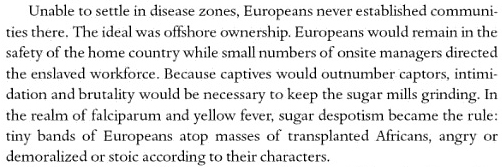
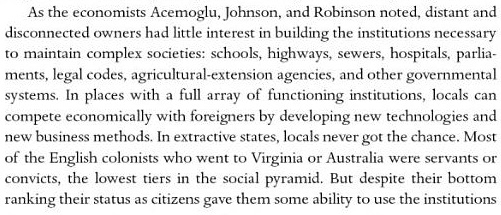
And I’m reading about how settlement by Europeans in many parts of the New World established “extraction societies.” At least, I think that was the term. (It’s one I’ve seen elsewhere, related to “extraction economy” and, less closely, to “plunder economy.” The book is at home, and Google Books won’t let me see the parts of the book where the term was used. But the point was this: Settlements were established that existed only to extract some commodity from a country — say, sugar in French Guiana. Only a few Europeans dwelt there, driving African slaves in appalling conditions. Profits went to France, and the institutions and infrastructure were never developed, or given a chance to develop.

Neither a strong, growing economy with opportunities for all individuals, nor its attendant phenomenon democracy, can thrive in such a place. (Which is related to something Tom Friedman often writes about, having to do with why the Israelis were lucky that their piece of the Mideast is the only one without oil.)

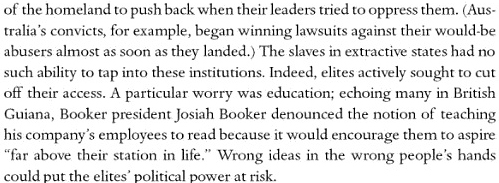
Here are some excerpts I was able to find on Google Books, to give the general thrust of what I’m talking about:

There are degrees of extraction societies, it would seem. South Carolina developed as such a society, but in modified form. There were more slaves than free whites, and only a small number even of the whites could prosper in the economy. But those few established institutions and infrastructure that allowed something better than the Guianas to develop. Still, while we started ahead of the worst extraction societies, and have made great strides since, our state continues to lag by having started so far back in comparison to other states.

It is also inhibited by a lingering attitude among whites of all economic classes, who do not want any of what wealth exists to be used on the kind of infrastructure that would enable people on the bottom rungs to better themselves. This comes up in the debate over properly funding public transit in the economic community of Columbia.

Because public transit doesn’t pay for itself directly, any more than roads do, there is a political reluctance to invest in it, which holds back people on the lower rungs who would like to better themselves — by getting to work as an orderly at a hospital, or to classes at Midlands Tech.

It’s a difficult thing to overcome. Other parts of the country, well out of the malarial zones (you have to read Mann to understand my reference here), have no trouble ponying up for such things. But here, there’s an insistent weight constantly pulling us down into the muck of our past…

Ayn Rand disciple teaching Citadel cadets

This video, brought to my attention by Nancy Mace Jackson on Twitter, is interesting on a couple of levels. First, it’s apparently a course on conservative theory taught by Mallory Factor, who’s been in the news again recently.

Second, the guest speaker appearing before the class is Yaron Brook, director of the Ayn Rand Institute. Interesting guy. He’s introduced as having served in Israeli Intelligence. He has an accent I can’t quite place — he sounds vaguely like former USC President John Palms.

The ideas he’s talking about could hardly be more timely than now, when various strains of libertarianism, from Ron Paul to the Tea Party, are striving to seize control of the Republican Party.

What I was doing all weekend

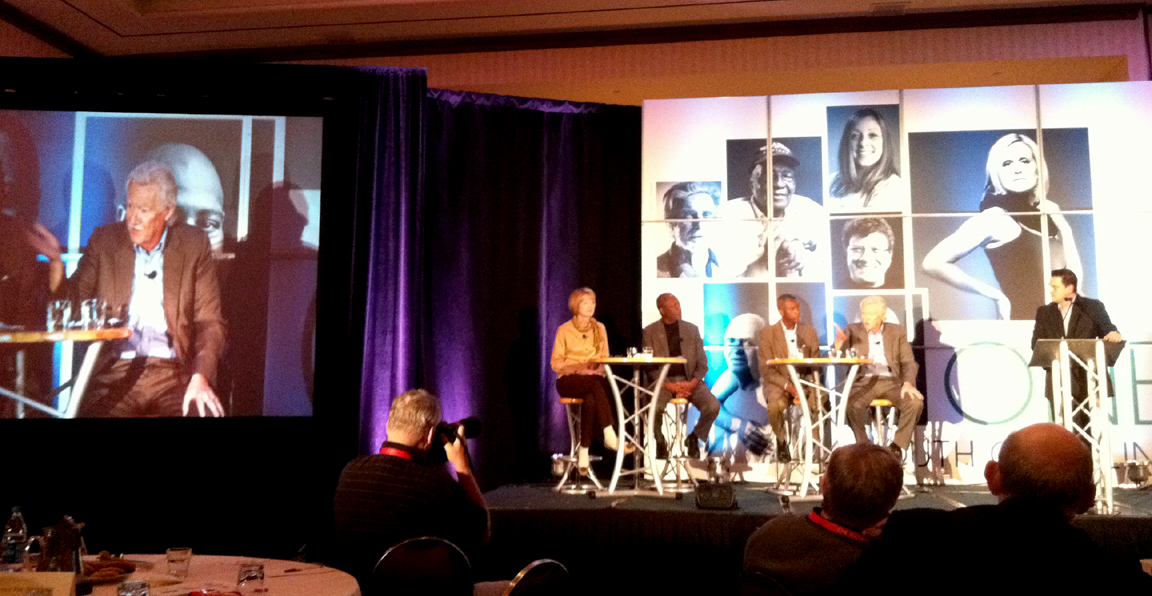
Gerrita Postlewait, Fred Washington, John Simpkins and Terry Peterson discuss "Education, Poverty and Equity on the Ground in South Carolina" with moderator Mark Quinn.

Y’all probably think I haven’t blogged in days. I have; it was just microblogging. One of these days I’m going to get social media totally integrated into this blog so y’all can immediately see my posts on Twitter, because when I’m away from my laptop, that’s where I’m sharing observations.

From Friday through Sunday, I was at the Riley Institute’s Diversity Leaders Initiative graduate weekend in Hilton Head. When I arrived, Cindy Youssef of the Riley Institute asked me to Tweet as much as possible, and to use the hashtag #onesc.

It’s dangerous to tell one of the Twitterati to Tweet as much as possible. There were others putting the word out there, but I was probably the most manic, as you can see by looking at the hashtag results. There was a respite of a couple of hours when I took my iPhone up to my room to recharge it, but other than that I didn’t slow down much.

Here you see most of my Tweets from the weekend. I left out some asides that had nothing to do with what was going on, but also left a couple of those in, for flavor.

For a complete roster of who was there, you can look here.

Most of the Tweets were when people said something I agreed with, although not all (as I’ve explained before, I favor single-payer NOT because people have a “right” to health care, but because it’s a more rational system for society overall than what we have now; but I thought it very interesting that Ed Seller thinks it’s a fundamental right).

When someone else’s Tweet is quoted, I use that person’s handle in front of it, and then insert my own as it goes back to my voice. I hope that makes this easier to follow.

Anyway, enough explanation. Here you go:

Brad Warthen ‏ @BradWarthen

Listening to Marlena Smalls singing to Riley Institute Diversity Leadership graduates in Hilton Head… He’s Got the Whole World…#OneSC

I was listening to Ken May talk about folk art traditions in SC when the coffee started to kick in… #OneSC

Just had an enjoyable political chat with Alston DeVenny, husband of Susan & law partners with the uncle of @fitsnews in Lancaster.#OneSC

Will Folks aka Sic ‏ @fitsnews

@BradWarthen ha! my uncle Robert is a good dude …

Brad Warthen ‏ @BradWarthen

Don Gordon talking about the need to transform the two South Carolinas into One… #OneSC pic.twitter.com/PQNaC7Qc

Harvey Peeler ‏ @harveypeeler

What is it about Starbucks that makes people want to tell you they are there and does the Drive-thru count ?

Brad Warthen ‏ @BradWarthen

@harveypeeler @Starbucks is awesome, they have time to kill, they’re caffeinated, and no, it doesn’t count.

In reply to Harvey Peeler

Harvey Peeler ‏ @harveypeeler

I think I can remove my “Tweeter training wheels ” when @BradWarthen pays attention to what I Tweet.

Brad Warthen ‏ @BradWarthen

“Medicine is a social science, and politics is nothing else but medicine on a large scale.” Rudolph Virchow, quoted by Ray Greenberg.#OneSC

MUSC’s Greenberg: Problem of people not getting needed meds because of cost is getting WORSE… #OneSC

MUSC’s Ray Greenberg: People with higher levels of educational attainment spend more on alcohol… #OneSC

Greenberg: Stats indicate I-95 corridor is SC’s stroke belt… #OneSC

Greenberg: In many rural counties in SC, there’s not a single OB/gyn. “Deserts” of care… #OneSC

Greenberg: SC is No. 1 in people living in mobile homes. Whoo-hoo! One-fifth of us! #OneSC

Greenberg: Health disparities are NOT the result of bad habits of the poor. #OneSC

Forrest L. Alton ‏ @YoungGunCEO

Sitting at table by @BradWarthen, master tweeter… I can’t keep up, guy is good!! #OneSC #watchandlearn

Brad Warthen ‏ @BradWarthen

Ed Sellers: In SC, income does not rise with age, but health cost rise dramatically, for blacks and whites. #OneSC

Ed Sellers, formerly of Blue Cross Blue Shield: Access to health care is a fundamental right… #OneSC

That parenthetical interjection on the last Tweet was mine, not Ed Sellers’… #OneSC

Literally jumping the shark: “@CBSNews: Video: Reporter swims with sharks – without a cage (via @CBSThisMorningbit.ly/wAhfsQ

@wesleydonehue @harveypeeler When it comes to @Starbucks, I take a backseat to no man!

Heads up, folks: “@AnitaGarrett: Ed Sellers: “There are 55% more whites than black that will be on Medicaid.” #OneSC

Carolyn Wong Simpkins: In US, we have best & worst health care.#OneSC

Ed Sellers: $24 billion spent on health care in SC annually. It goes up a billion a year… #OneSC

Ed Sellers: Other countries control health care costs by controlling growth of capacity, which (irrationally) is anathema to U.S. #OneSC

Simpkins: We are SO concerned to make sure no one undeserving gets care, we overcomplicate the system… #OneSC

Wanda Gonsalves highlights the crying need for primary care physicians, a “dying breed.” #OneSC

Watching a film that exhorts us to respect barbecue. But I don’t have to be persuaded… #OneSC

The takeaway: Don’t trust a barbecue pitmaster who doesn’t choose and cut his own wood… #OneSC

Huge applause for Pitmaster Rodney Scott of Scott’s BBQ in Hemingway, SC. #OneSC

BBQ Pitmaster Rodney Scott: Hemingway isn’t in the middle of nowhere; “It’s in the middle of everywhere.” #OneSC

Doug Woodward: SC productivity shot up from 90s thru early 00s, leveled off. And our income is FALLING, even when economy is good… #OneSC

Woodward: We must educate more of SC population at a higher level to be ready for 2030, when only 1 out of 6 will be working… #OneSC

Woodward: If we raise educational attainment to national average by 2030, personal income will rise by $68 billion. #OneSC

Jim Hammond ‏ @restlessboomer

#onesc Economist Doug Woodward: If we’d followed the policies Gov. Riley for the past 18 years, we wouldn’t have this (increase in poverty)

Brad Warthen ‏ @BradWarthen

Woodward: Key to prosperity — attracting and keeping the creative class… #OneSC

Steve Morrison quoting someone on poor towns in SC: We built Interstates so we wouldn’t have to look at them… #OneSC

Steve Morrison: If you want a safer and more secure South Carolina, teach a young man to read. #OneSC

Steve Morrison: We must get the greatest teachers to the students with the greatest need… #OneSC

Morrison: Recent trend in education in SC — cutting funding, while passing unfunded mandates to the districts… #OneSC

Morrison: Can we agree that teachers matter the most? #OneSC

Morrison: Take that tax base along the coast, and share it with the poor districts… #OneSC

Morrison: It’s great to have good private schools, but public education MATTERS… #OneSC

Morrison: The child gets off the bus at 5 years old with bright eyes. He’s not defeated. Yet. #OneSC

John Simpkins: The opposite of love isn’t hate; it’s indifference. (“My kids are fine; yours aren’t my concern.”) #OneSC

To paraphrase Terry Peterson, we need not just a love of justice, but a hard-minded understanding of what economic dev. requires. ##OneSC

What this conference keeps wrestling with is what to do about the total triumph of “I, me, mine” in SC politics. #OneSC

Ex-Gov. John Baldacci of Maine says Riley Institute is “kind of like a focus group for the state of SC.” #OneSC

Baldacci says on his first visit to SC, “I was really blown away” by downtown Greenville. (Something for Columbia to aspire to.) #OneSC

Baldacci: “The very basic foundation of our democracy is education.”#OneSC

Baldacci: As dysfunctional as our politics may be, what we have is better than what most people have had throughout history. #OneSC

Baldacci describes the surreal experience of being in Congress on 9/11/01… #OneSC

Baldacci: You can go anywhere in the world, but you can’t become Chinese; you CAN come here from China & become an American.#OneSC

Baldacci: “You’ve gotta be yourself; you’ve gotta tell the truth and you’ve gotta work hard.” (Father’s advice.) #OneSC

Baldacci: “We all have to get over it, folks… We have to realize that we have a greatness here if we work together…” #OneSC

Baldacci exhorts us to treat people as Dick Riley always has… with dignity and respect. Amen to that; we could have no better model.#OneSC

Others call Dick Riley “secretary.” I call him “Governor.” For SC, that means the most (to me, anyway). #OneSC
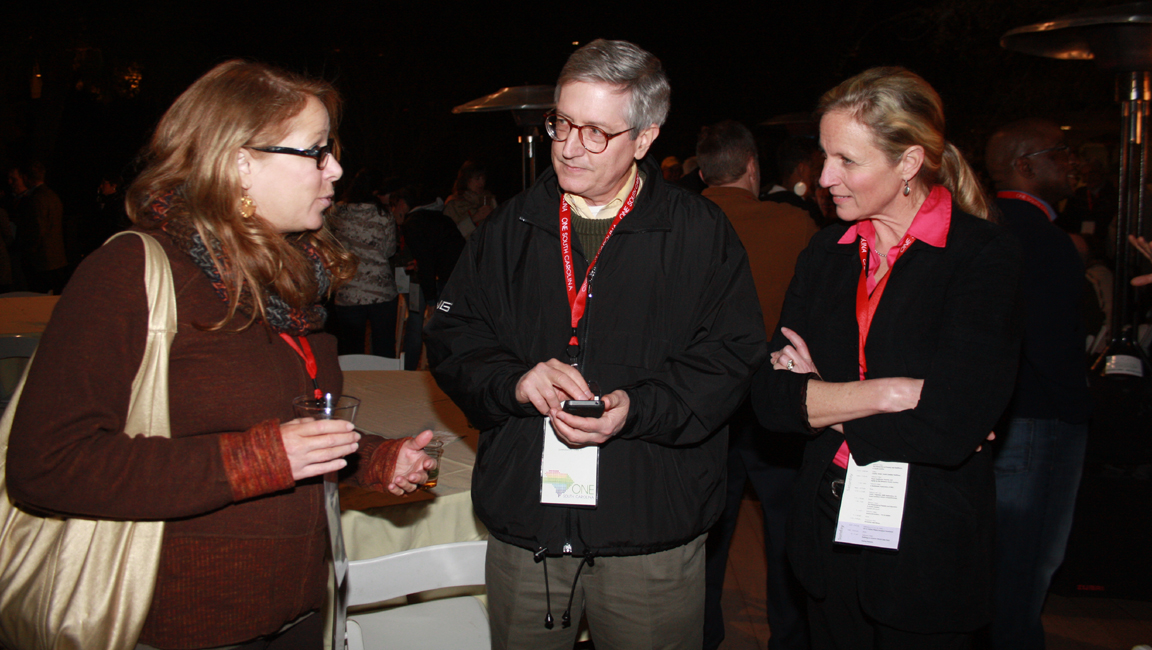
Apparently, I'm even Tweeting while talking at the barbecue with Clare of the Clare Morris Agency and Susan DeVenny of First Steps.


Harris Pastides takes the Twitter plunge

I was very interested to see Harris Pastides take the plunge into Twitter today. His first Tweet? Here:

Can’t wait for the baseball journey that begins tomorrow. Tweet the Three-peat!

And I think most of us would be happy to reTweet that. I did.

This is interesting to me because it was in a meeting with Harris that I first became a convert to Twitter. It was back when I was doing a 90-day consulting gig with the university right after I left the paper (right after I got canned, for those of you just joining us). At the time, there was a lot of discussion about how the university in general, and the president’s office in particular, needed to communicate in a social media age.

Lee Bussell from Chernoff Newman, a competitor of ADCO (you are all free to boo and hiss at this point if you feel the urge), brought in some of his people to give the president and some of the university’s communications folks a briefing on Twitter, Facebook, blogs and the like. (It should be noted that various departments in the university were already making use of such media, although there was no overall plan to it.)

For my part, I nodded sagely during the blog parts, being a four-year veteran who had just retired one blog and started this one. But I became impatient during the Twitter and Facebook bits. They seemed pointless and frivolous to me. Why fool with 140 characters when you can get into a subject as deeply as you want (with none of the finite restrictions of print) on a blog?

After the meeting, I said as much to Tim Kelly (“Crack the Bell,” “Indigo Journal”), whom I had just met for the first time, even though we had interacted in the blogosphere for years. He told me I should give those silly-sounding media a try. Why?, I asked. Because you can use them to promote your blog, he said — just post your headline and a link, and it will grow your readership.

So I tried it, and promptly got hooked. It’s like… well, you know how they say video poker is the most addictive form of gambling (particularly for women, for some reason), because of something the flashing images and quick rewards do to your brain? Well, Twitter is the crack cocaine of written communication, and probably for similar reasons. You can follow the very first stages of this conditionstarting back here.

That’s the bad news. The good news (aside from the fact that I am revered as one of the Twitterati) is that the readership of my blog  now is about five times what it was at the newspaper. Did I mention that I set a new record in January, with 272,417 page views? (And as long as we’re talking numbers, I’m up to 1,643 followers.)

Here’s hoping my friend Harris doesn’t develop a serious addiction problem. I doubt that he will. After all, he managed to hold out three years longer than I did in starting. Besides, he’s a very sober, solid, serious academic type — very grounded, and even less given to faddish enthusiasms than I.

But it will bear watching…

Jake’s annual skate party coming up

Maybe Kara’s not running against him, but Katrina Shealy is (again). Whoever runs, they won’t catch Jake Knotts napping. His particular brand of constituent service continues apace. It’s time for his annual skate party:

Sen. Jake Knotts to host 18th annual honor roll skate party

Lexington, SC – February 15, 2012 – Senator Jake Knotts today announced that his annual honor roll skate party will be held this Saturday (February 18, 2012).

An 18-year tradition in Senate District 23, Sen. Knotts sponsors a skate party each year for 23 elementary schools in Lexington School Districts 1-4.

Senator Knotts has made recognizing and rewarding academic excellence a tradition for 18 years in his Senate district. For students making the academic honor roll for this nine weeks, they’ll receive a personal skate party invitation from the Senator. It’s become something that students look forward to from the beginning of the school year – and such a tradition that many parents now remember their attendance at the skate party.

Between 300 and 400 students attend each year. Senator Knotts coordinates student and parent skate races, awarding prizes to winners and refreshments to all honorees.

The party takes place Saturday, February 18, 2012, from 9:00 am- noon, at Three Fountains Skating Rink, 2724 Emanuel Church Road in Lexington County.

Jake’s always taken a lot of pride in his skate party. And hey, it doesn’t hurt at the ballot box.

Get your No. 2 pencils ready, class — it’s time for another civics test!

Well, I’m appalled. The average American scored 49 percent on the latest civics quiz from the Intercollegiate Studies Institute. College professors, on average, scored 55 percent.

And I’m sorry, class, but I’m not grading on a curve on this one. Everything on this test is something that every American should know. Every American who is allowed to vote, that is.

That said, I missed one of the questions — I read the multiple choices too fast. I didn’t like the answer I gave, but since I had misread the right answer, I liked it better than that one. Once my error was pointed out to me, I saw my mistake right away. So it’s something that I do know. (I’m not telling you which one it was yet, because I don’t want to give you the correct answer before you take it.)

In any case, I did score 96.97 percent, which I think would qualify as an A on anyone’s scale.

Not that I’m bragging. All but three or four of the 33 questions are ridiculously easy. I could see missing one or more, or even all, of those three or four. But miss 45 percent of them? That should be impossible for anyone who has even briefly attended college, much less professors.

And when I contemplate the average person getting 49 percent, I’m reminded of something Mrs. Whitner, the English teacher, said to a boy in my class at Bennettsville High School: “Boy, when they were handing out brains, you took a ham sandwich.” Teachers were allowed to say things to kids in those days.

And to think, we let these people vote.

Go ahead, see how you do. Don’t be intimidated by my scorn; I expect most of y’all will do well.

Here’s the test. Start now.

Forget Ferris Bueller. Zais was absent 29 days

Edward R. Rooney would forget Ferris and his measly nine absences if he had Supt. Mick Zais in his school, according to this report over at Palmetto Public Record:

South Carolina Superintendent of Education Mick Zais took twice as much personal time during 2011 as the average state employee is allowed, according to an exclusive look at the schools chief’s schedule.
Zais’ personal calendar, which was made available to Sen. Phil Leventis (D-Sumter) through an open records request in November and later obtained by Palmetto Public Record, shows that Zais took 234 hours of personal time (the equivalent of 29 full workdays) between Jan. 12 and Nov. 17, when the schedule was turned over to Leventis. That number doesn’t include medical leave, of which Zais took the equivalent of six workdays during the same period. The schedule also doesn’t include the final five weeks of 2011, when Zais may have taken even more personal time for the Christmas holidays.

In sharp contrast to Zais’ considerable number of absences, a state employee with 10 or fewer years of experience is allowed 15 days of personal leave per year — about half of what Zais took during the 44 weeks covered in his schedule.

Education Department spokesman Jay Ragley said the state superintendent, as a constitutional officer, is held to a different standard than regular employees. “Because of their unique status in state government, constitutional officers are presumed to be on duty 24 hours a day, 7 days a week and are not allotted sick days or annual leave time as standard state employees accrue,” he said…

Democrats are making a big thing of this. I got this link from an advisory from Phil Bailey with the Senate Dems (under the headline, “Senators to Discuss Zais’ Truancy”), telling me that Sens. Leventis and Brad Hutto are having a press conference to talk about it at 3 today at the State House. No, I don’t know why Sen. Leventis didn’t bring it up in November, when he got the info.

“Eisenhower of our generation” visits Columbia

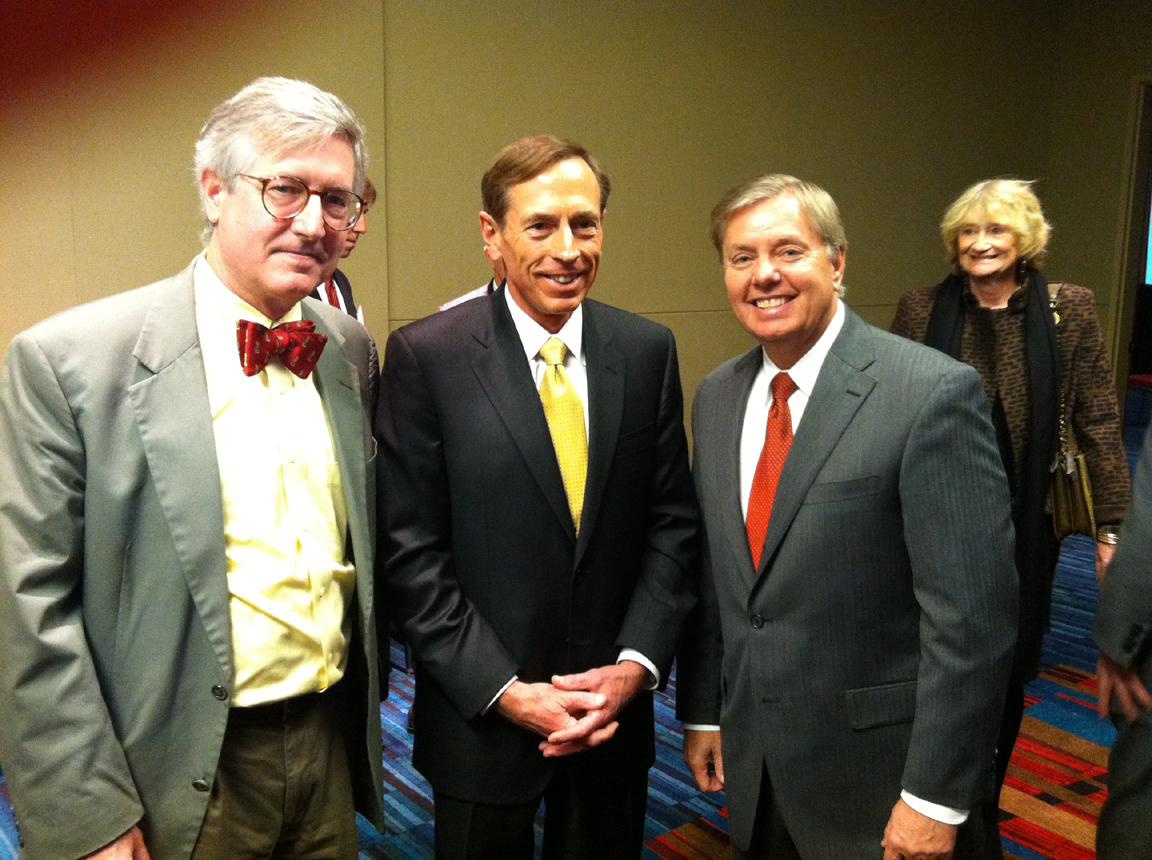
Some guy who needs a haircut, the general in mufti, and our senior senator./photo by Christy Cox

Gen. David Petraeus, now of the CIA, spoke today in Columbia, at the Riley Institute’s David Wilkins Awards for Excellence in Legislative and Civic Leadership luncheon.

Rep. James Smith and former Blue Cross CEO Ed Sellers were the recipients. It was James (a.k.a. Capt. Smith) who, in his acceptance speech, called Petraeus “the Eisenhower of our generation.” I concur. There’s no general officer in recent years who combines Ike’s strategic vision, diplomatic skill and leadership qualities to the extent that Gen. Petraeus does.

For his part, Petraeus praised not only James and Ed, but the troops he has felt privileged to lead before joining Central Intelligence. He called them “our new greatest generation.”

Those who serve certainly deserve that sobriquet. The difference is that they are only a tiny sliver of an actual generation, unlike the one that overcame the Depression and beat Hitler and Tojo.

Which only underlines how much the rest of us owe to them, each of them, from the commanding general to the lowliest buck private.

Huck and Newt speak locally, think globally

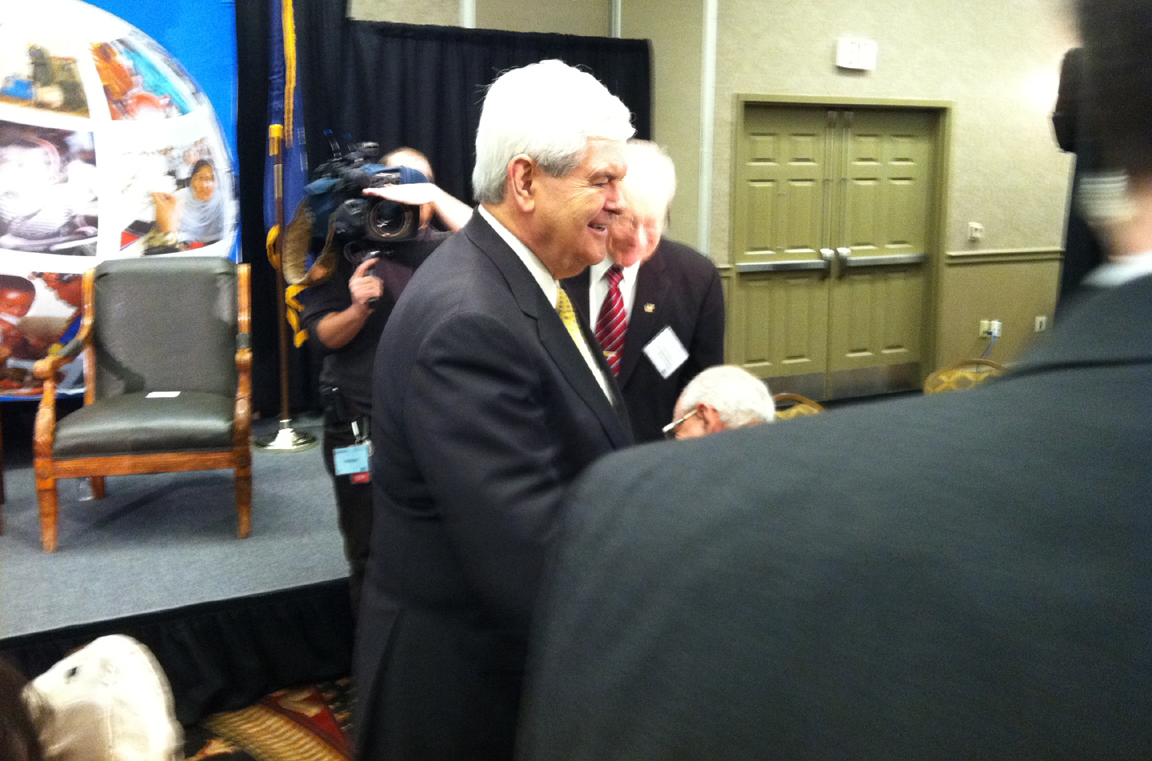
Gingrich arrives, with that Newtish look in his eye.

Newt Gingrich had the limelight to himself today at a gathering at the Columbia Hilton devoted to foreign policy.

Well, almost to himself — the featured speaker was actually Mike Huckabee, whom former ambassador to Canada David Wilkins introduced as “an alum of our primary.” But Newt was given a slot to speak as well.  The occasion was a U.S. Global Leadership Coalition luncheon, and the crowd was a mix of academic and business types — it was co-sponsored by USC, the Columbia World Affairs Council, and the Greater Columbia Chamber of Commerce. The Columbia Chamber’s Ike McLeese had some smart words to say at the outset about how “foolish” isolationism is in today’s world, and Huckabee later used the same word. I guess that’s why Ron Paul wasn’t there.

Between Huck and Newt, I preferred the comments by Huckabee, but then I’ve always sort of liked Huck. Basically, he was channeling John Donne. He didn’t actually say the words, “No man is an island,” or that if a bell tolls anywhere in the world, it tolls for us, but it amounted to the same thing.

He said that Americans — particularly those who consider themselves Christian — can’t sit by and let people in other parts of the world starve or be oppressed. And not just on moral grounds. Basically, he suggested that the world is so intertwined — and this is where the Donne stuff comes in — that our own interests and fates cannot be extricated from those of people in other parts of the world. At the very least, he said, a country we help feed tonight just might be one that we need to fly some planes over, in defense of our strategic interests, on a later date.

Huckabee graciously announced at the beginning of his remarks that whenever Gingrich showed up, he’d shut up and cede the floor. As it happened, he finished before Newt swept in.

Newt had some good stuff to say, too. He’s a smart guy — just ask him; he’ll tell you. But he was also…  more bombastic, more jingoistic, as is his wont. Which can get off-putting.

Like when he condescendingly complained about the better, higher societies — you know, Northern European ones — being dragged down by the obviously inferior ones. He didn’t think it right for America to be “trying to prop up the Germans so that they can prop up the Greeks.” Who, you know, are so worthless… “This is the country the Germans want to learn to be Germanic?” Why, he asked, should the Greeks want to be German. Their choice, as he explained it, is to sit on a beach drinking ouzo, or be miserable applying themselves like the Germans.

Then there was this: “No American president should bow ever again to a Saudi king.” He was making a good point — that we need to achieve energy independence. But there was just that unsettling tinge of complaining about having to be accommodating to the wogs.

I agree with him when he says he doesn’t want his grandchildren living in a world dominated by China, an oppressive regime. I agree that the world is, indeed, better off with the dominant country being the world’s biggest liberal democracy. But I could do without the attitude, such as when he said he would hire the most aggressive trial lawyer he could find to be trade representative to China, and he’d want that rep to get up every morning thinking about how he could maximize the other side’s discomfiture.

And with Newt, it’s not what he says (for me; I’m sure that for some of my liberal correspondents, it is what he says), but the way he says it. The president needs to be cooler than that.

Mike Huckabee addresses the U.S. Global Leadership Coalition gathering.

Yo, Lee: David Yepsen says “Hey”

Above you see David Yepsen and me, looking relieved and happy that we’re done with our panel presentation at the Senate Presidents’ Forum in Key West over the weekend, and that it went well. Funny how those kinds of things — just talking — can take a lot out of you.

It was an honor to meet David, the legend of Iowa political journalism. And of course when we met, he asked after another legend of political journalism, a man whom everyone knows — and, more remarkably, everyone likes and respects — my longtime friend and colleague Lee Bandy.

I’m lucky to have worked with both Lee and the Tennessee legend, John Parish. And while it was brief, I was honored to share the panel with David Yepsen, who is now director of the Paul Simon Public Policy Institute (he left The Des Moines Register about the same time I left The State), Saturday. And to get to know a couple of political pros I had not met before, who also served on the panel: First, John Marttila, longtime friend and ally of Joe Biden ever since he was elected to the U.S. Senate in 1972. John continues to be a senior political adviser to the vice president. From the Republican side, we had Mike DuHaime, who ran Chris Christie’s successful run for governor of New Jersey in 2009.

We had a great discussion, both during the panel and at meals and events before and after.

What did I say during the presentation? Well, not anything I haven’t shared here. I essentially scrapped my prepared remarks, as mentioned previously — which is probably a good thing, because things flow better when I’m winging it. But preparing — not only the writing, but all the conversations I had with top Republicans in SC, right up to a couple of minutes before the program — did help me get my thoughts in order. Hey, if I hadn’t made all those panicked calls Friday night and Saturday morning after seeing those poll numbers, I wouldn’t have known to call Romney a “Plastic Banana Rock ‘n’ Roller,” which still cracks me up — the idea of Romney as ANY kind of rock ‘n’ roller, actually.

Anyway, I’m back from Key West. And it’s going to be a busy week…

Mike DuHaime (or the back of his head, anyway), David Yepsen and John Marttila, during the panel discussion.

It doesn’t have to be THAT graphic for me…

USC just put out this release:

Up in smoke: Research shows graphic images can deter smokers

They say a picture is worth a thousand words, but its worth might just be measurable in terms of lives, according to research by a University of South Carolina public health professor.

That’s because visual imagery on cigarette packages deters smoking, and the more graphic they are, the better the results, said Jim Thrasher, assistant professor in the Arnold School of Public Health Department of Health Promotion, Education and Behavior.

“Tobacco use continues to be the leading cause of preventable death in the United States, and graphic health warnings are among the most cost-effective interventions that exist,” Thrasher said….

Personally, I don’t need graphic images to deter me. One whiff of the stuff is enough to persuade me to stay away from it forever.

If you must show me a “graphic” image, the one above is fine. It was the winner of a contest in California:

The challenge was to create a anti smoking ad powerful enough to turn people off cigarettes without resorting to the gruesome imagery so prevalent in anti-smoking campaigns. With the help of a couple of dancers, an up-for-anything ad agency and hundreds of yards of Lycra, Los Angeles photographer Ricardo Marenco did just that.

“I wanted to evoke a sea of people trapped inside their addiction,” says Marenco, who created the shot for the California Department of Public Health’s billboard and print campaign. To achieve his desired effect, he photographed the dancers individually inside 7-foot-tall Lycra cigarettes. Then he digitally overlaid embers and smoke from real cigarettes on the figures. The ads ran without any words, only a helpline number — the image said it all.

But apparently, you have to be really gross for some people. Below is one of the images that came with the USC release. Why is it in Spanish (“garganta” means “throat”)? I guess because of this part of the release:

As a result of his work with colleagues from Mexico’s National Institute of Public Health, Mexico’s Minister of Health adopted their recommendations for which pictorial warnings to put on cigarette packages, which began circulating in September.

Thrasher, who has a joint research and faculty appointment with Mexico’s National Institute of Public Health, is also assessing what labels are the most convincing for low socioeconomic status groups…

Column III: Kevin Bryant takes destructive approach, offers reader no way out but rage

Talk about your basic destructive nihilism.

Sen. Kevin Bryant offers nothing positive, but simply gives us a Sanfordesque trashing of USC, in his column today in The State.

Go ahead and read it, and tell me where he offers any kind of solution. Show me where he suggests how we might see to it that the university become a better steward of our money. He does not. When he complains that “USC, like much of higher education, sees itself as a sovereign empire,” does he offer a remedy?

No, he does not. He does not, for instance, offer the solution I have offered for 20 years — likely long before Kevin Bryant was thinking about such things — for the fact that our respective universities are, indeed, too autonomous: A state board of regents, answerable to the governor, that would govern the entire system of public higher education.

Or if he has some other idea (which I doubt), he could offer that.

But he doesn’t. Why not? I fear that this is the reason: He’s not sufficiently interested in solutions. What he’s interest in doing, it seems to me, is further eroding the already pathetically feeble public will to support higher education in our state.

As things stand, do you know how much of USC’s operating funds come from state taxes? 9 percent. The state general fund is like the university’s 5th source of funding in order of magnitude. When I was in school, it was closer to 90 percent. So yeah, the university does tend to act rather independently of state government as it seeks to serve our state.

I don’t think it should be that way. I think USC should be clearly a state institution — adequately funded by the state, and held accountable to the state. But I’m not holding my breath, not when our state is run by people like Kevin Bryant.

His column presents no proposals, no arguments, but merely regurgitates what has been reported in news media, only with scornful modifiers added.

His aim, or what I take to be his aim, is best expressed in his trite, hyperbolic conclusion:

The giant sucking sound that you hear is the siphon running from your wallet into the tank at USC. You might want to let your politicians know that enough is enough.

The only point to be gained from this is that he wants us all to be angry. And since he offers no program or solution to address that anger, we can only suppose that said anger is for him an end in itself, as long as you see the university as something that exists purely to waste your money (an impression he creates by ignoring how little of the taxpayers’ money the institution gets), and that you let your lawmakers know that you don’t want them ever spending another dime on that bunch over there.

Never mind that North Carolina has adequately funded its higher education system as an economic development engine (just what the senator despises), leading to the result of having a wealthier and better-educated citizenry. Every word in Sen. Bryant’s column is well designed to make sure that, if there is even a scintilla of desire remaining in the heart of the electorate to invest in public higher system in this state, it gets drowned in the proverbial bathtub.

If he had a different aim, he would offer a solution to the problems he cites. Instead, he urges us to get mad, and be more alienated.

The new iPads arrive at Lexington High School

This student, whom I cannot name because she's just 17, had found time to personalize hers...

Thursday morning I spoke to Michael Burgess’ class at Lexington High School. The format was much like one of Kelly Payne’s classes — the kids had a prepared list of questions, which is what I like. I hate a set speech, with me droning on and wondering whether anyone is interested. With questions, I at least know I’m addressing something my audience cares about — or something their teacher wants them to care about.

Sample questions:

1. How does the media influence the political process? Is this a positive or negative influence?
2. Discuss the impact of social media outlets on the political discourse of today?
3. What is the role of money in determining the outcome of elections?
4.Could you list and describe the various sources of funding for campaigns?
5.What is the real role versus the appropriate role of interest groups in influencing policy?

But my speech was definitely not the most interesting thing happening in those students’ school day, because I arrived on the same day as the new iPads.

I had trouble finding a place to park because the visitor spaces, I was told, were taken up by district people who were there for the iPad rollout.

Here’s a release on the Lexington One website about the new devices:

Last year (the 2010–2011 school year), Lexington County School District One successfully executed a personal mobile computing pilot at Gilbert High School as part of our ongoing search for ways to provide students with the tools they need to support their learning and to prepare them for higher education opportunities and careers.

At that time, we explained that we planned to expand the program to our other high schools.

This year (2011–2012), we are expanding personal mobile computing to our other three high schools. All high schools will begin issuing the devices in November.

The district feels strongly that its personal mobile computing initiative is not about the tool used. It is not about an iPad or a tablet. It is about what a personal mobile computing device enables our students to do.

With these devices, students will acquire the digital competence they need for our increasingly electronic- and technology-driven world. They will learn the essential skills they will need as consumers, citizens and workers.

The devices will give students access to the most current information available through the Internet and to the district’s Learning Management System 24 hours a day, seven days a week during the school year.

Students will be able to complete and turn in assignments, homework, projects or research electronically. Interactive applications will allow them to improve their reading fluency, build mathematics skills or create their own study cards.

Unfortunately, as yet, not all textbook publishers provide electronic copies of every textbook, so the district will not be able to eliminate textbooks. Teachers will be able, however, to supplement material found in textbooks with information they create using various multimedia or with information already available.

Lexington One purchased the personal mobile computing devices as part of the voter-approved 2008 Bond Referendum. That bond referendum included $15 million to expand and upgrade existing technology at all schools.

Read our Personal Mobile Computing Guide for high school students.

I should mention that the students were all politely attentive to my talk. I don’t think I could have been, with a new iPad in front of me…

Who’s out there polling about metro issues?

A friend sent me  this last night:

Interesting note: I just got polled about the following issues: view of city-county council, opinions of USC economic development, Harris Pastides, Innovista and funding the bus system.
Also asked about funding a new baseball stadium, riverfront and Zoo improvements.
Even (da-dum) strong mayor!
You might throw that out there (without my name, please) and see who might be paying for such a poll.

So… any of y’all know who’s doing that polling? I mean, I could call around to the usual suspects, but it’s easier to see if y’all know anything first…