Category Archives: Business

Durst to head (former) Hospitality Association

This just in from the association formerly known as Hospitality:

Hospitality Association gets new leader and name

Columbia, S. C.—The South Carolina Hospitality Association today announced that John Durst, former director of the S.C. Department of Parks, Recreation and Tourism, is the new President and CEO of the organization, whose membership is comprised of restaurant and hotel owners and operators.
The association, founded in 1993, also announced that it has changed its name to the South Carolina Restaurant and Lodging Association.
Durst, who served as the state’s top tourism official in Gov. Jim Hodges’ administration, took over as head of the state’s most prominent tourism trade group today. His background is in communications and marketing, most recently running the South Carolina office for Carolina Public Relations and Marketing based in Charlotte.
“We were flooded with interest in this position for one of the highest-profile associations in the state,” said Rick Erwin, a Greenville restaurant owner and immediate past association chairman. “But the executive committee and our board quickly came to the conclusion that John’s management skills, coupled with his marketing background, reputation, credibility and passion for our industry, were exactly what we need to position us for the future.”
Among his many awards was the Charleston Convention and Visitors Bureau Golden Pineapple Award for his role in leading the rebound of tourism in South Carolina after 9/11. “We vividly recall how John used his position at PRT to promote our state in a time when people were afraid to travel. We are fortunate to have him as the full-time face of our organization,” Erwin said.
“I am deeply honored and tremendously excited to have been selected to serve in this position,” Durst said. “We will help our members realize a great return on their investment in our Association, increase our membership base, and strengthen our strategic partnerships while becoming an even stronger voice and advocate for our state’s number one industry, tourism.”
With Durst as its new leader, the executive committee and governing board decided to change the name of the association to more accurately reflect its membership, as well as to signal a new chapter in the life of the largest tourism-related entity in the state.“We have a distinguished past, but this last year was filled with tragedy,” said David McMillan of Myrtle Beach, the new board chairman. “Hard lessons have been learned. New policies have been put in place to make sure it never happens again. And today, the South Carolina Restaurant and Lodging Association is looking toward the future in which we will serve our membership and advocate for this state’s largest economic engine more effectively than ever.”
In February, it was discovered that a trusted bookkeeper had embezzled nearly $500,000 from the organization. Tom Sponseller, the President and CEO, committed suicide.
Authorities concluded he was not associated with the crime in any way. The bookkeeper has been sentenced to prison.
Rick Erwin, who guided the association as chairman during the past year and took over as temporary President, outlined financial accountability standards that have been taken in the wake of the embezzlement:
• The association has retained the Hobbs Group (accounting firm) to reconcile and prepare quarterly reports for the board of directors.
• New bylaws require the Finance Committee to review and approve financials before they go to the board.
• A separate audit committee will conduct a comprehensive annual audit of the books.
• Policies are in place to control incoming and outgoing funds to include check logs, separate check writers, duel check signers and bank account and statement controls.
• Wells Fargo Bank’s fraud department will monitor all of the association’s account for unusual activity.
Also attending the news conference to express support for Mr. Durst and the association were Senate President Pro Tem John Courson, PRT Director Duane Parrish and South Carolina Chamber of Commerce President and CEO Otis Rawl.
###

John (brother of sometime commenter Walter), a former president of my Rotary Club, is a good choice, just the sort of guy to settle things down after the roller-coaster ride this industry association has been on, including the suicide of his predecessor and a major misappropriation of funds by another staffer.

I wish him the best.

I’ve GOT an ‘iPad Mini’ — it’s called an ‘iPhone’

Got to say I was seriously underwhelmed by Apple’s news yesterday:

SAN JOSE, Calif. — Steve Jobs once mocked tablets with small screens, saying they would need to come with sandpaper so people could sand down their fingertips to use them. But that didn’t stop his company from shrinking the iPad.

Apple’s iPad Mini, which it unveiled at a press event here on Tuesday, weighs about two-thirds of a pound and has a screen that measures 7.9 inches diagonally, making its surface area significantly smaller than that of the 9.7-inch iPad. Philip W. Schiller, Apple’s vice president for marketing, said the smaller, lighter tablet would be a good fit for people who want something more portable than the 1.44-pound iPad.

The company is selling the lowest price Mini for $330, about $130 more than similar-size tablets from competitors…

So what burst of innovation will they come out with next — an iPad that’s between the iPhone and the mini in size, or one between the mini and the full-size? Or maybe a 60 inch, for that home-theater effect while you’re sitting in the coffee shop?

And in the WSJ in the same news cycle, Walter Mossberg was highly praising the new Microsoft tablet set to come out at the end of the week. Ouch, Apple.

All of this Apple angst brings to mind this hilarious sendup of the iPhone 5 complaints, from SNL a couple of weeks back…

Clark Kent following in my footsteps

Except, get this — the dope doesn’t get laid off. He quits The Daily Planet, a newspaper still perfectly willing to keep giving him a paycheck to do what he does, to become a blogger on purpose.

Of course, I don’t suppose he’ll starve. The whole blog business model probably works a whole lot better when you can squeeze a lump of coal into a diamond whenever your ad revenues run low.

It’s all well and good to argue with your editor over news judgment. Everybody does it. And yeah, I like the touch where you invoke “truth, justice and the American way,” in the pontifical manner of scribes everywhere. But the thing is, you come back into work the next day, when you and the editor and everybody else has forgotten yesterday’s argument, and is ready to start on today’s.

Sorry, but I guess my problem is that I spent most of my newspaper career as an editor, supervising prima donna writers, so I tend to have a bit more sympathy for the multitudinous headaches of Perry White.

Oh, and another thing, Kent: Put on a damn’ tie! Great Caesar’s Ghost..

Death of a newsmagazine

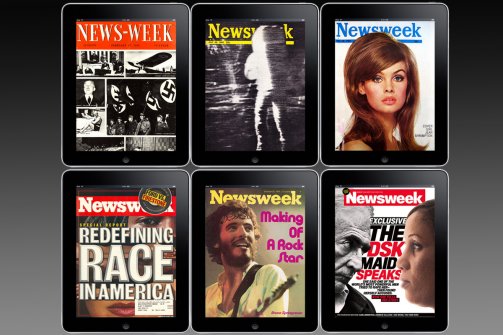
Newsweek covers on the iPad, via The Daily Beast.

Now we have the news that Newsweek will cease publication as of Dec. 31. (Yeah, I know technically, they’re going to continue to publish on the Web, but yet another light content provider on the Web is ho-hum news compared to the end of a print institution. Get back to me when a major, serious newspaper goes all-digital. That will seem like a bold step forward.) From The Daily Beast:

We are announcing this morning an important development at Newsweek and The Daily Beast. Newsweek will transition to an all-digital format in early 2013. As part of this transition, the last print edition in the United States will be our Dec. 31 issue.

Meanwhile, Newsweek will expand its rapidly growing tablet and online presence, as well as its successful global partnerships and events business.

Newsweek Global, as the all-digital publication will be named, will be a single, worldwide edition targeted for a highly mobile, opinion-leading audience who want to learn about world events in a sophisticated context. Newsweek Global will be supported by paid subscription and will be available through e-readers for both tablet and the Web, with select content available on The Daily Beast.

Four years ago we launched The Daily Beast. Two years later, we merged our business with the iconic Newsweek magazine—which The Washington Post Company had sold to Dr. Sidney Harman. Since the merger, both The Daily Beast and Newsweek have continued to post and publish distinctive journalism and have demonstrated explosive online growth in the process. The Daily Beast now attracts more than 15 million unique visitors a month, a 70 percent increase in the past year alone—a healthy portion of this traffic generated each week by Newsweek’s strong original journalism…

I’m not going to be mourning over this one. As you may recall, I referred to the folks in charge of that publication as “the superficial, pandering twits editing Newsweek,” after they had run Nikki Haley on their cover for the second time during her campaign against what’s-his-name, which is the way Newsweek and all national media treated Vincent Sheheen. (Actually, they didn’t even treat him that well; it was like he didn’t exist.) As I said further at the time:

And do they have any serious, substantive reason to do this? Of course not. The putative reason for putting Nikki’s smiling mug on the cover again is to discuss the burning issue of “mama grizzlies.” I am not making this up.

I hope Dave Barry will excuse me using his line there. It just fit so perfectly.

The sad truth is, the American “newsmagazine” is an animal that long ago ceased to be anything of substance. Of course, the genre always had its dismissive critics, but I took TIME from when I was in high school in to my 20s, and there was a lot of serious stuff to read back then, to my young eye.

But in recent years, I’ve only seen these publications in doctor’s offices in recent years, and am unimpressed, generally deciding to put them down and pick up a copy of Smithsonian or something. They look like manic collages, with scarcely a full, sustained thought to be found anywhere in their few pages.

Why can’t this country produce anything like The Economist? Of course, The Economist calls itself a “newspaper” for some quirky Brit reason or other. Maybe that’s the trick to it …

Scott thinks F-35 pretty cool after ‘flying’ it

Remember that previous post about the dog-and-pony show up in North Carolina, the one that was to allow reporters to check out an F-35 simulator?

Well, Lockheed had another one on USS Yorktown in Charleston, and they managed to wow Rep. Tim Scott:

U.S. REP. TIM SCOTT FLIES F-35 COCKPIT DEMONSTRATOR DURING USS YORKTOWN VISIT

F-35 will serve as a cornerstone of global security and create South Carolina jobs

CHARLESTON, S.C., October 18 – U.S. Rep. Tim Scott, (R-S.C.), today joined local elected officials and community leaders on the USS Yorktown at Patriots Point Naval and Maritime Museum to receive an update on the Lockheed Martin [NYSE: LMT] F-35 Lightning II program and hear about its contribution to South Carolina, national security, and the U.S. economy.

During his visit, Scott “flew” the F-35 cockpit demonstrator to experience firsthand how advanced stealth, fighter agility and integrated information systems make the F-35 the most capable multi-role fighter in the world. The cockpit is visually and audibly interactive and provides a realistic look at the F- 35’s performance, air-to-air and air-to-ground capabilities, sophisticated sensor fusion and advanced computational capabilities.

“Coming from a military family, I understand and appreciate that American men and women serving in uniform deserve the best technology that this nation can provide. Those that threaten our country are evolving everyday, and it is essential we stay ahead of them.” Scott said. “There is no doubt the fifth generation, multi-role F-35 Lightning II’s ability to defeat sophisticated surface-to-air missiles and enemy fighters in the air and on the ground will allow us to do just that.

“Our military leadership associated with Beaufort Air Station, McEntire Joint National Guard Base, and Shaw Air Force Base has told me clearly and convincingly that these capabilities are critical to defending our freedoms,” Scott added.

Lockheed officials noted that even at its current low rate of production, the F-35 program supports a broad industrial base of more than 1,300 suppliers in 45 states, contributing to more than 133,000 direct and indirect U.S. jobs and over $17.7 billion in direct and indirect annual economic impact. Those numbers are expected to grow as the program ramps up to full rate production over the next few years.

In South Carolina, the F-35 program generates nearly 123 jobs and more than $5 million annually in direct and indirect economic impact. Currently, there are four South Carolina companies supporting the program.

The F-35 is a supersonic multi-role fighter designed to replace a wide range of aging fighter and strike aircraft. Three variants derived from a common design will ensure the F-35 achieves its security mission while staying within strict affordability targets.

Lockheed Martin is developing the F-35 in conjunction with its principal partners, Northrop Grumman [NYSE: NOC] and BAE Systems, and Pratt & Whitney. Among the aircraft F-35 will replace are the A- 10, AV-8B Harrier, F-16, F/A-18, and the United Kingdom’s Harrier GR-7 and Sea Harrier.

Headquartered in Bethesda, Md., Lockheed Martin is a global security and aerospace company that employs about 123,000 people worldwide and is principally engaged in the research, design, development, manufacture, integration and sustainment of advanced technology systems, products and services. The Corporation’s net sales for 2011 were $46.5 billion.

The USS Yorktown was commissioned on April 15, 1943, and was one of the preeminent aircraft carriers to serve in the Pacific theater of operations during World War II. In the 1950’s, Yorktown was modified with the addition of an angled deck to better operate jet aircraft. In 1958, the ship was designated an anti-submarine aircraft carrier, and served admirably during the Vietnam conflict. Yorktown was decommissioned in 1970 and placed in reserve. In 1975, the ship was towed from Bayonne, N.J. to Charleston to become the centerpiece of Patriots Point Naval and Maritime Museum.

###

Hey, if I’d had a chance to go try it out, I’d probably think it was pretty cool, too. At a projected $323 billion, this is “the Pentagon’s most expensive weapons program.” In a budget like that, they ought to be able to come up with something better than my old Microsoft Combat Flight Simulator.

Last night’s debate news (or part of it) this morning — another problem for what’s left of newspapers

OK, so I’m behind the curve today. I got home from final dress rehearsal last night at about 11:30, heated up some dinner, watched a few minutes of both the beginning and the end of the debate (having heard a BBC assessment of it on the radio on the drive home) then watched some of the PBS commentary after the debate, then hit the sack.

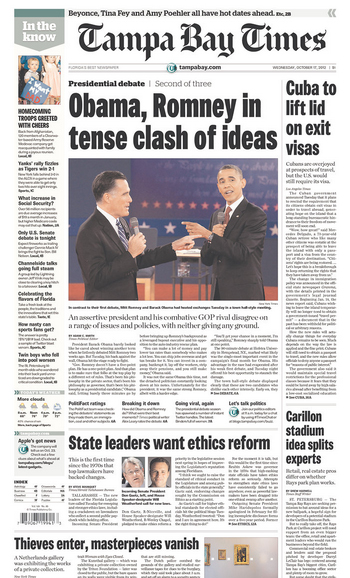
But I’m not as far behind the curve as most daily newspapers were in today’s print editions.

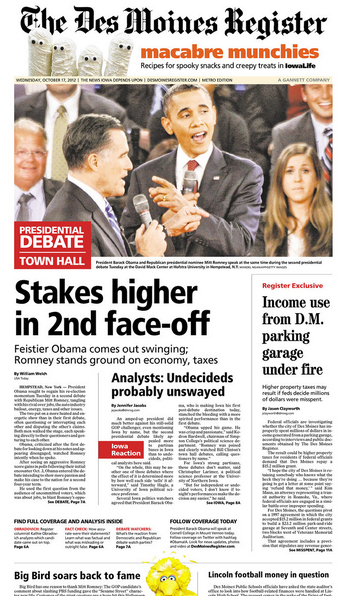
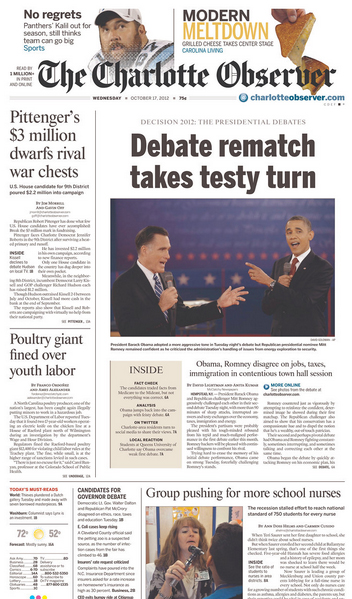
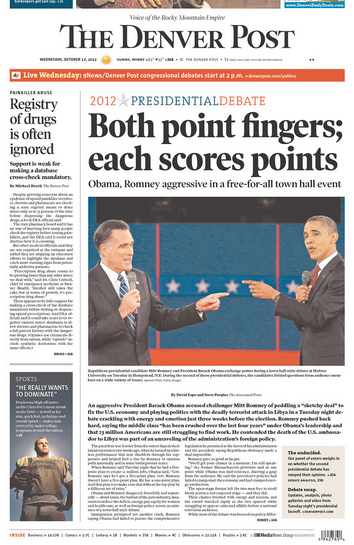
Slate calls our attention to today’s front pages (all taken from the Newseum, where you can see plenty of others), which have a sameness about them: They pretty much all say the same thing in their headlines, and most run photos of the same moment, with the candidates’ fingers pointed at each other. Sure, you might find some “analysis” in there somewhere, and the more enterprising (and better-staffed) opinion pages will have some sketchy opinions expressed. As Slate’s Josh Voorhees writes:

As we explained late last night, the insta-polls and the pundits saw a tight contest on the Long Island stage on Tuesday, but one that was won narrowly by President Obama. Given the lack of a clear-cut win, however, it should come as little surprise that a quick scan of the morning’s front pages show the nation’s headline writers and art teams focused on the on-stage clash and largely left the who-won question to the domain of the cable news talking heads (as most papers had likewise done following the previous two debates).

Once, this sameness, this lack of personality or individualized expression was the glory of newspapers. If 10 different journalists from 10 different papers covered the same event, they would all write pretty much the same thing. It was a measure of their professionalism, and the self-effacement that news writing demanded of them. It was about giving it to you straight, unadorned, plain, and God forbid there should be any hint of opinion in it. Who, what, where, when, maybe how, and, if you put an “Analysis” sig on it, why.

The monotony of it didn’t strike the reading public because unless they lived near an urban newsstand, most people only saw one daily newspaper.

But here’s the problem with that today: What newspapers put in those lede headlines today, and what they conveyed in those pictures, was all old news by the time I was driving home from rehearsal last night.

I hadn’t driven more than a few blocks when I knew the conventional wisdom on what had happened. It went something like this: Obama did all the things he failed to do in the first debate, particularly having a strong finish. Romney did fine, although was maybe not quite as sharp as in the first debate. If you’re declaring a winner, it’s Obama, although I didn’t get the sense that he dominated in this debate the way Romney did in the first one, so if you’re going on cumulative totals, Romney’s probably still ahead in this debate series. How this affects the polls remains to be seen.

I had even heard about “binders full of women,” but I was mostly confused by that.

In the post-debate analysis I watched after I got home, I heard David Brooks and Mark Shields give their assessments. Brooks said Obama won because he was able to exploit Romney’s biggest weakness better than Romney was able to press Obama on his biggest weakness. He said Romney’s biggest weakness is that his numbers don’t add up, and Obama’s problem is that he never provides a vision of what the next four years will be like if he is re-elected. Shields said it might surprise everyone, but he agreed with Brooks on all those points.

Since then, on the radio this morning, I’ve heard that “Obama hasn’t sketched a vision going forward” meme several more times.

I was also interested in what a young woman (didn’t catch her name) who analyses Twitter during debates for PBS had to say. I didn’t get as much of an overview of the Twitter take as I wanted because she decided to zero in on the reactions of women. But I’ve found her assessments interesting in the past: What was trending? What were the memes people were obsessing over? What caught on? I’ve become more and more interested in the instant reactions of Tweeters in the aggregate during events like this. It has something to do with the wisdom of crowds. It’s like having sensors attached to the brains of millions of highly engaged, clever voters — which is what the most-followed people on Twitter tend to be.

And I felt left out because I wasn’t on Twitter myself during the debate. Increasingly, that’s where I like to be during these kinds of real-time shared events, sifting through the flood of reaction as it washes over me.

And in a Twitter world, seeing these front pages feels like reading ancient history. No, it’s worse than that. Historians look at the whole of a thing after it’s over and draw conclusions. There’s a wholeness to historical accounts. These reports — and I’m just reacting to the headlines, mind you — don’t do that. They give only the most noncommital account, essentially just telling you that the candidates came together and vied against one another, and there the account ends. The Des Moines Register headline (“Stakes higher in 2nd face-off”) could have been, and possibly was, written before the debate started. (And pre-Gannett, that was one of the best papers in the country for political coverage.)

And I was already so far beyond that, without even trying hard to be, last night — without even having seen the debate.

I’m not saying these papers aren’t doing their jobs well. What I’m saying is that the job they’re doing, within two kinds of constraints — the convention of not drawing conclusions in a news account, and the severe time problem of the debate ending as they have to get those pages to the press room (depending on the edition we’re talking about, a lot of editions went to bed BEFORE that) — fails to satisfy in a Twitter world.

Again, there might be all kinds of good stuff in the stories, but the presentation — the quick impression that a glance at the front page provides — is deeply lacking. It makes you not want to read more deeply. It causes me to want to go read those papers’ websites today, and see what good stuff didn’t make it into the paper. (And the better papers will have something for me when I go there.) Because the conversation has moved, by the time the paper hits your stoop, so very far beyond what’s in those headlines.

Hey, tell me about it…

This parlous news comes over the transom from The Washington Post:

Google and a handful of other tech firms are acting as advertising middlemen for the presidential campaigns, taking a huge cut of the revenue from online ads.

These firms have given the campaigns greater precision in targeting voters, but the process is starving politically oriented media sites in what once was their most lucrative season.

If this were a just world, that revenue would be going to, you know, political blogs and other worthy venues.

What does ‘frivolous lawsuit’ mean to you?

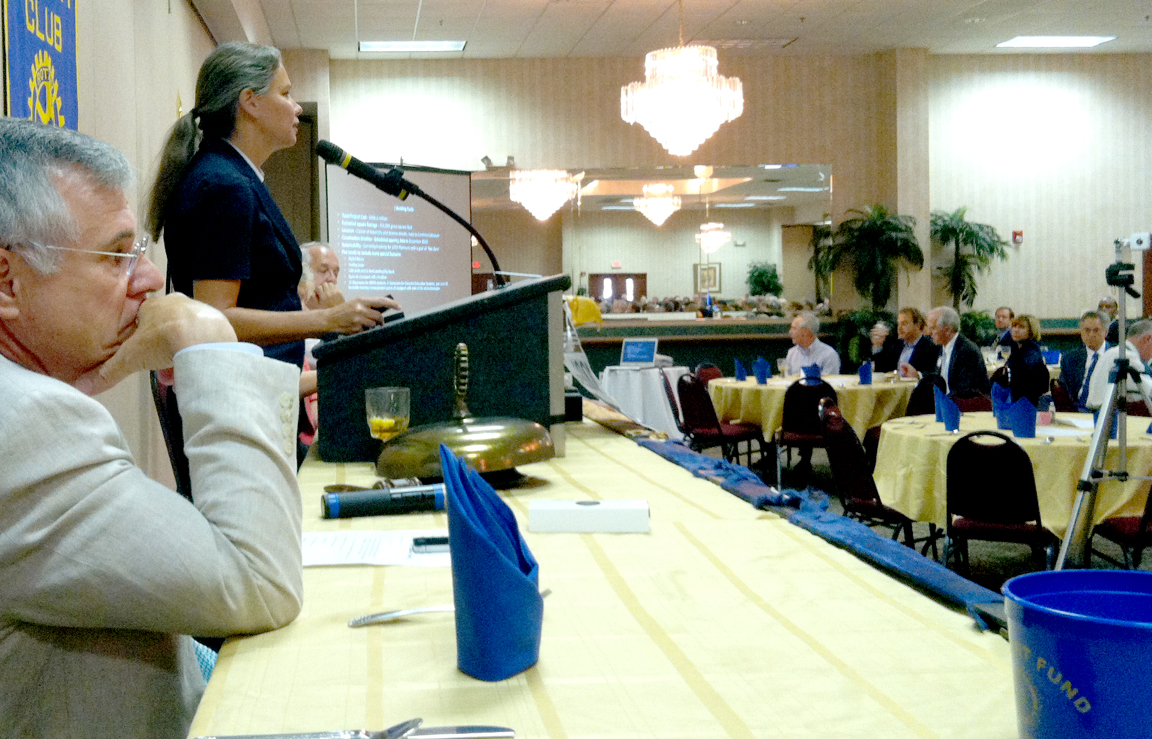
Today at the Columbia Rotary Club, our speaker was Darrell Scott, lobbyist for the S.C. Chamber of Commerce.

He talked about what he does for the Chamber over at the State House, and told some sea stories about his experiences (some people say “war stories;” I’m from a Navy family). The least convincing part of his presentation? A couple of times in explaining a close vote, he referred to the experience giving him “gray hairs.” Sorry, kid — I don’t see ’em.

Two things interested me in particular. One was the report card on the 2012 legislative session, which included grades for all of the lawmakers. You can see the full report here. I’ve reproduced the scorecard on the senators above. It’s interesting to see who stands well with the Chamber, and who does not. Some observations on that chart:

  • You see the expected split, with most Democrats scoring low and most Republicans doing better.
  • But Democrat Nikki Setlzer, who represents a big chunk of that most Republican of counties, Lexington, scored a perfect 100.
  • John Courson, recently named the Chamber’s 2012 “Public Servant of the Year,” fell a bit short of that, at 94. The disagreement was over the “Business freedom to Choose act (h.4721),” which the Chamber described as “legislation to prohibit local governments from enacting flow control ordinances on solid waste disposal.”
  • Vincent Sheheen, whom the Chamber endorsed for governor two years ago, only scored a 69 — fairly typical of Democrats.
  • That was still better than Tom Davis, who lately has been styling himself the Ron Paul of the state Senate. He got a 68. This reminds us of something — the Chamber is about as enamored of Tea Party Republicans as it is of Democrats, if not less so.

The other highlight of the meeting, I thought, was the exchange that came when attorney Reece Williams got up to ask young Mr. Scott a question. After explaining that he was a veteran of more than 200 jury trials, he asked the speaker how he would define that bete noir of the Chamber, a “frivolous lawsuit.” I enjoyed the way he asked the question — aside from the fact that he presented it in a civil, gentlemanly, even courtly manner (Reece is as nice a lawyer as you’d ever want to meet), as he spoke, he turned way and that to address the “jury” of fellow Rotarians, thereby gently suggesting that he was challenging each of us with the question as well.

The speaker answered him, but his answer wasn’t as memorable to me as what Realtor Jimmy Derrick got up to say in response. After explaining he and Reece are old friends, Jimmy said that he reckoned he had been sued about 200 times himself, and he pretty much considered those actions to be frivolous.

Afterward, I asked Reece what he thought of the answers he’d gotten. He said they pretty much confirmed what he’d thought before: “A ‘frivolous lawsuit’ is one that’s brought against me…”

Is Mitt Romney a bad CEO? No, says this writer

Over at Bloomberg Businessweek, Joshua Green insists that the chaos in Mitt Romney’s campaign does NOT mean that he’s a bad CEO:

Romney’s problem is not that he’s brought too little executive rigor to the job of running for president. It’s that he’s brought too much. He’s behaved too much like a businessman (or a consultant) and not enough like a politician. His campaign has all the hallmarks of being run by someone looking only at the numbers, someone who lacks a true politician’s appreciation for the other dimensions of a race—a feel for the electorate, a convincing long-term plan for the country. Were he forced to defend himself before a board of directors, Romney would actually have a pretty solid case for doing what he has done….

… Romney has scrupulously avoided committing to anything that is remotely unpopular, such as naming which tax loopholes he’d close to pay for his agenda. That is to say, he is doing just about everything a close reading of the polls says you should do, and he’s trying hard not to do anything the polls say you shouldn’t do. If a team of Bain consultants were hustled in to pore over the data and devise a strategy, I doubt they would have devised a meaningfully different campaign.

The problem is that politics is about much more than a tactical, short-term reading of the numbers. Candidate skills matter, and the audience in a presidential election is much more variegated than a board of directors. There isn’t much, frankly, that a stiff guy can do to make himself warm and approachable. (Earth tones, anyone?) The glaring weaknesses in Romney’s campaign—the fuzzy details, the inability to convincingly articulate plan for growth, and above all the weird tics and gaffes—are not ones that a businessman’s skills can rectify.

In other words, he’s more a bad politician than a bad CEO. We are left to conclude what we like about what sort of president he would be.

Something to consider, for all those who still think the silly phrase “run government like a business” makes sense.

It was too loose; now it’s too tight

This morning, we closed on a mortgage refinance, which we did partly because of the lower rates, but mainly to consolidate the initial mortgage and a credit line that we opened a number of years back to do some work on our house (hardwood floors, new HVAC, other stuff).

Anyway, the attorney helping us does this sort of thing all the time. (Over the years, we’ve been through this process with him — closing on a house or refinancing — at least three times.) My wife asked whether he’s keeping busy with these low rates.

Not really, he said. Oh, the demand is way up, all right. The thing is, though, about half of the loans aren’t getting approved.

Before, credit was too loose, which got us into trouble. Now, it’s too tight, which makes it harder to get out of the trouble. He said there are those who hoped real estate would lead us out of these hard times. But not at this rate, he suggested.

Just a little glimpse at the economy from a window other than my own, which I thought I’d pass on.

By the way, we had no trouble getting our refinance, through Palmetto Citizens Federal Credit Union. See the ad at right.

Product placement, baby.

Slate missed a good, timely angle on Darla Moore

Darla Moore announcing another multi-million-dollar gift to USC, shortly after Nikki Haley dumped her from the trustee board.

To us South Carolinians, Darla Moore was a logical choice to break the gender barrier at Augusta National. And then Condoleezza Rice was sort of a case of, well yeah, that makes sense, too.

But this wasn’t just a South Carolina story, and apparently folks elsewhere don’t all know Darla. Slate tried to address that with something headlined, “Mini-Explainer: Who Is Darla Moore, Augusta’s Other New Female Member?

The item was long on “mini” and short on explaining:

We’re guessing you’ve got a rather good handle on exactly who Rice is. (Hint: She’s the former secretary of state.) However, you’re probably not as familiar with Moore, a South Carolina financier who is the vice president of Rainwater, Inc., a private investment firm founded by her husband, Richard Rainwater, an American investor worth about $2.3 billion by Forbes magazine’s latest count.

According to the University of South Carolina, where Moore graduated from and where the business school bears her name, she is also the founder and chair of the Palmetto Institute, which describes itself as a nonprofit think tank aimed at boosting the per capita income of South Carolina residents. She’s also served on the boards of USC and the New York University Medical School and Hospital and was named to Fortune‘s list of the top 50 “most powerful” American businesswomen.

Her husband is now mentally incapacitated, struggling with progressive supranuclear palsy, a disease that Forbes explains is often mistaken for Parkinson’s disease, and strikes just six in every 100,000 people. His family is now funding research into a cure for the disease. CNN Money has that story here.

I would have liked to have seen a mention of the last time Darla was in the news — when Nikki Haley dumped this woman for whom USC’s business school is named in favor of a white-guy campaign contributor no one had heard of.

It would have been a great opportunity to give the world just a little perspective on our “first woman” governor, on the eve of her big moment speaking at the GOP convention. And it would have presented such a relevant contrast between the sort of woman of achievement who gets invited to join a club like this, and the sort who doesn’t.

1st Amendment meant to protect POLITICAL speech

Some of my friends here on the blog occasionally ask whether I ever change my mind about anything. They mistake the certainty, and consistency, with which I express myself for rigidity. There are a number of reasons for this. One is a certain… forcefulness… that creeps into my writing when I’m not trying to hold it back. Another is that, if I express it here, it’s usually an idea that I’ve tested many times over the course of decades. And I’m not likely to shift suddenly on a matter such as that.

But here’s an example of something I’ve changed my mind on…

Back when I was a special-assignments writer at The Jackson Sun in Tennessee — we’re talking late 70s, early 1980 perhaps — I would occasionally fill in when one of the editorial writers was on vacation. On one occasion, I wrote an editorial headlined something like “Yes, even Hustler.”

It had something to do with one of Larry Flynt’s legal battles. Basically, I was asserting that however disgusting his exercise of it may be, the free-press right guaranteed under the First Amendment applied to his publication as well.

Potter Stewart, who knew it when he saw it.

I would not write that today. My respect for the intent of the Framers has grown over the years, and I am far more reluctant to cheapen the Bill of Rights by inferring that they meant to assert a right to publish pornography. No, I’m not inclined to launch a crusade to ban such publications, either (which are almost quaint in view of what is freely available on the Web). I just wouldn’t take up my cudgel in Flynt’s defense today, because to do so would require dragging Madison, Hamilton and Jay into the gutter with him.

And I believe that would be wrong. The intent to protect citizens in expressing political ideas that may offend the government just seemed too clear to me. And no, I don’t accept the convenient canard that obscenity is in itself an inherently political statement.

The courts may not entirely agree with me all the time on this, but in general they have not granted commercial speech, or obscenity, the same protections as political speech.

What brought this to mind was something that Logan Smith — who is roughly the age I was when I wrote that defense of Flynt — posted yesterday on his blog, Palmetto Public Record:

It’s been less than a week since thousands of angry conservatives swarmed Chick-fil-A restaurants in South Carolina and across the country to support the fast food chain’s stance on same-sex marriage. Many expressed outrage that city officials in Boston and Chicago wanted to ban the restaurant, claiming that doing so would somehow violate Chick-fil-A’s “freedom of speech.”

This represents a fundamental misunderstanding of free speech and censorship, of course, but that’s beside the point. At least people are getting politically active — even if their form of activism is buying fried chicken.

However, we do agree that government officials who use regulations to target specific businesses are abusing their power. That’s why we’re waiting for those Chick-fil-A fans to launch a similar flash mob of support for another business being banned by city government for moral reasons — the Taboo Adult Superstore in Columbia.

When he called attention to his post on Twitter this morning, asking, “Why no defense of Columbia sex shop from Chick-fil-A supporters?” I replied, “Perhaps they believe (as do I) that “free speech” refers to POLITICAL speech. The Framers didn’t have sex shops in mind.”

You may argue that what Mr. Cathy engaged in was the exercise of religion, rather than politics, but hey — same amendment. More to the point, he was expressing himself on something that has undeniably become a political issue. And local government types in some jurisdictions were proposing to use governmental power to penalize him for it. (At this point, we could get really strict constructionist and say that this is not the same as Congress passing a law to abridge this right, and that would be an interesting conversation — but irrelevant to the case at hand. We’re not arguing the merits of a lawsuit here, but whether all those people who flocked to Chick-fil-A last week are consistent in their political ideas by not similarly defending a sex shop.)

Now, all of this said, I give Mr. Smith credit for not merely presenting the sort of empty, kneejerk, moral-equivalence argument that I fear I did all those years ago (the editorial is buried in a box somewhere in my garage, and fortunately not readily at hand). He gets into “adverse secondary effects,” which is more sophisticated than what I recall saying.

But I still say that the analogy is a false one. One would in no way be inconsistent to stand up for free speech rights in one case, and not the other. If I had been moved to participate in that Chick-fil-A demonstration, which I was not (aside from being, you know, allergic to chicken), I certainly would have felt no obligation to have defended the latter.

Turns out that’s a Kulturkampf cow…

At first, I thought this was the influence of longtime dairyman and Senate Majority Leader Harvey Peeler, since it came from his Senate Republican Caucus. I remember when Harvey used to pass out cow-shaped erasers over at the State House. (Or was that his brother Bob? No, I believe it was Harvey.)

Now, I see it’s something else. Sigh. The Kultukampf does go on, doesn’t it?

Dang. I heard something about this flap on the radio the other day, and it reminded me of something else entirely that I wanted to share here on the blog, and now I can’t remember what it was.

Oh, well. It will come to me again at some point…

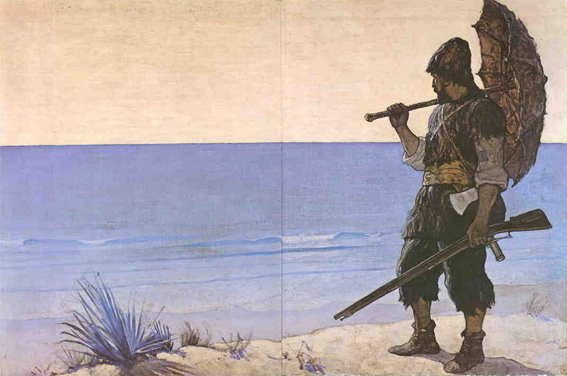
Only Robinson Crusoe did it alone — and then only until Friday came along

And note that not even he made the musket, or the hatchet.

Since I’m not at the paper any more, it fell to Cindi Scoppe to write this column that ran today, basically addressing the orgy of indignation among the libertarians who call themselves conservatives over President Obama’s unfortunate choice of words in explaining the painfully obvious fact that practically no one in our crowded, interdependent world achieves anything worthwhile alone:

A LOT OF what the president says and does is ripe for criticism. But what he said the other day about no one being an island, about how our parents and our communities and our teachers and mentors and, yes, our government all contributed to our success is not one of those things.

If you’re wondering who in the world would criticize such obvious commentary, it’s because you don’t recognize the full context of that bizarre, ridiculous, one hopes bungled quote that came in the middle of it: “If you’ve got a business — you didn’t build that. Somebody else made that happen.”…

Of course business owners built their businesses — unless they inherited them or bought them from someone who did. Their initiative and hard work and luck set them apart.

As important as parents are to our success, one sibling can create a multi-billion-dollar business while another languishes on welfare. As much as we need good teachers, even the best have some students who drop out of school. Although government policy can give some businesses a leg up, others can go bankrupt even with too-generous government grants.

That’s because some people have initiative, and some do not. Some people are creative, and some are not. Some people are smart, and some are not. And while the schools can affect which group any individual is in, government does not eliminate those basic differences.

At the same time though, the vast majority of people who own businesses would not have been able to do that if we didn’t have a monetary system and a court system and roads and police and other functions of government. The vast majority of people who have any sort of success would not have it in a world without government. In fact, they wouldn’t have it if not for the peculiar kind of government that our country embraced from the start: self-government.

Can, and should, our government be more efficient? Of course so. Is there room to debate whether the government should bail out the banks or the auto industry or help pay for our medical care? By all means. Is there a legitimate question as to whether taxes are too high or too low? Certainly.

But the vast majority of Americans would not have the lives we take for granted — lives that are inconceivably luxurious compared to the lives lived by the overwhelming majority of people throughout human history — if it weren’t for our flawed but better-than-any-alternatives government.

Seems to me Cindi was being slightly over-cautious in saying that only “the vast majority of people” would have gotten nowhere without the basic conditions — civil order, rule of law, basic infrastructure — that are provided through the processes we call “government.” I suppose there are some to whom that doesn’t apply, but very few. It’s even harder to think of anyone who accomplished anything worthwhile completely and utterly alone — without anyone, whether you’re talking about government or not.

I suppose there’s Robinson Crusoe — that is, until Friday came along. This reminds me of an economics exercise we did in high school. We had to suppose we were stranded on a desert island, and we had to allocate our resources — which included time, and effort — so as to survive. This much time building a shelter out of available materials meant that much less time spent gathering food. X amount of time spent making a tool that would facilitate building that shelter cuts the construction time, leaving more time to weave a net to make fishing easier, etc.

A castaway who is completely alone can create something useful — to him, anyway — without anyone else’s involvement. But a business, in our crowded society? Well, to start with, you have to have customers. And then, depending on your business, there are suppliers, and vendors providing services that it would be inefficient to perform yourself. And as you grow, there are employees who become essential to your further growth, etc. Without the willing participation of those often vast networks of people, you can work and create all you want, but you’re not getting anywhere.

The extreme libertarians would put government in another category from just “people.” But in our system, the government and the people are the same thing. “Government” is just the word for the set of arrangements that we have among us, the people, for handling certain things that are best handled that way, such as building roads or deepening a port or passing and enforcing the laws without which the concept of private property is meaningless.

In fact, if I had a quibble with Cindi’s column, it would be that, in her litany of things for which government is essential, she kept referring to government as “it.” As in, “It creates and maintains a monetary system,” and “It provides a civil justice system…”

Given the screwy way so many of our neighbors these days think of government, that can be misunderstood as government being some separate entity that provides certain things to us, the people. But it’s not that at all. A better word than “it” would be “we,” because government is simply the process through which we create and maintain a monetary system, provide a civil justice system, and so forth.

Government does not give or take away. It’s just the arrangements through which we, the people, do certain things that we decide, through our system of representative democracy, are best done that way.

Shawarma: The lunch of superheroes

The above sign, spotted today at Al Amir on Main St., got me to thinking of “The Avengers.”

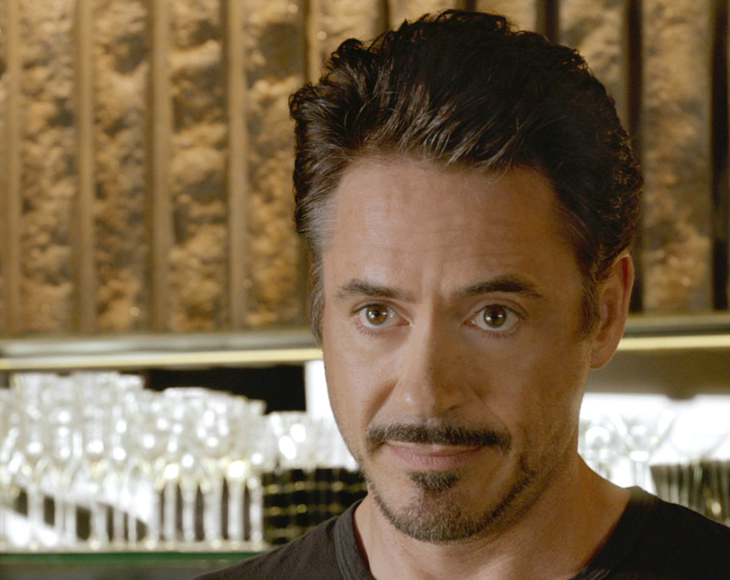
Tony Stark: You ever try shawarma?

SPOILER ALERT! OK, not really, because it reveals nothing about the plot, although it will ruin a tiny little fun surprise. It’s just one of those little lagniappe things at the end of the credits. Although, come to think of it, this does tell you that all the heroes survive the movie, so SPOILER ALERT!

At the end of the climactic battle, as he’s lying dazed among the rubble, Robert Downey Jr., who as Iron Man has 90 percent of the movie’s good lines, reassures his comrades that he is alive by saying offhandedly, “You ever try shawarma? There’s a shawarma joint about two blocks from here. I don’t know what it is, but I wanna try it.”

Then, the fun part: After all the credits — apparently, Joss Whedon needed the help of about 3.7 million people to make this flick — you see the exhausted heroes lounging, disheveled, around a table in the shawarma joint, slowly munching away in complete silence. This continues for more than 30 seconds, as a restaurant employee sweeps up in the background.

This sort of backhanded, non-branded little product placement has apparently launched a bit of a shawarma craze:

Those of you still reading will likely recall Tony Stark’s fascination with shawarma toward the end of the film. During the climactic battle, Stark suggests the team adjourn to a nearby restaurant to try the dish, which Wikipedia describes as “a pita bread sandwich or wrap” filled with spit-roasted meat (commonly lamb, goat, chicken or a mixture of various meats). At the very, very end of the film, after the credits have rolled, we witness the superhero team sitting at a table, silently eating their shawarma for a surprisingly long amount of time.

Now, based on that short in-joke, TMZ claims that the Los Angeles shawarma industry has seen a massive spike in popularity since the release of the film. “At Ro Ro’s Chicken — a famed Lebanese joint in Hollywood — the manager says shawarma sales jumped 80% in the days after the movie opened,” the gossip site claims, while saying that a number of other Lebanese restaurants offered similar results…

That’s fine. Just as long as they don’t start rebranding it the Super-Gyro…

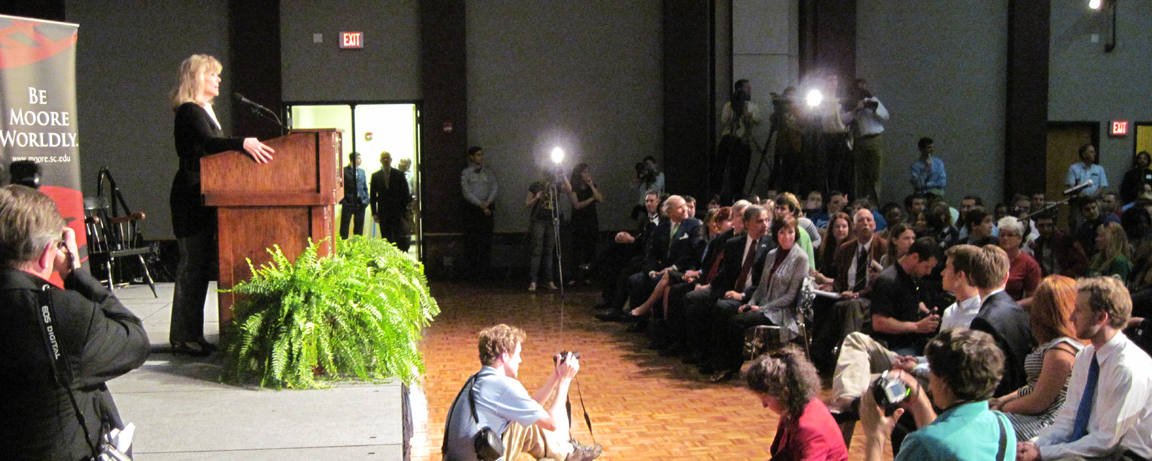
Some views of the Moore School that is to be

This is a story from the “drive-by” beat that I always wanted The State to create, but it never did. The idea would have been to satisfy people’s curiosity about things they drive by every day and wonder about. Today, we answer the question of, “What’s that thing coming out of that hole in the ground next to the Carolina Coliseum?”

That was the subject of Hildy Teegen’s talk today to the Columbia Rotary Club. (Disclosure, to the extent that it means anything: I invited Hildy to speak to the club, and introduced her.)

Speaking to Rotary. That's Club President J.T. Gandolfo in the foreground.

It’s the new Moore School of Business, of which Dr. Teegen is the dean. It’s intended, among other things, as the gateway to the Innovista, and should go a long way toward helping people understand that Innovista is NOT those two buildings everybody keeps obsessing over, but will constitute a transformation for that whole underdeveloped urban expanse from this location down to the river.

Innovista is conceived around the “live, work, play” concept, and the new Moore school has been designed to complement that. The key word Hildy keeps using to describe it is “permeable.” That goes from the literal sense of the rooftop garden, to the fact that it will be open to the whole community 24/7. In fact, she pointed out, it is architecturally impossible to close off the building.

One of the goals is for the building to achieve “net-zero” status, meaning its energy and carbon impact on the surrounding community will be nonexistent.

The building, which is to be completed in December 2013, will house the nation’s No. 1 international business master’s program and all of the school’s other business education programs — such as the night school that has just entered the top 25 in the U.S — except, of course the multiple distance-learning opportunities the school offers across SC and in Charlotte.

You can see the entire PowerPoint presentation here. And here are some pictures:

Silly me, for thinking DeMint cared what I thought

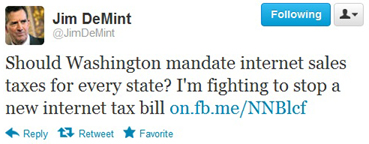
Couldn’t help responding to Jim DeMint today when he Tweeted,

My response was in two parts. First, I answered his question: Yes!

I had read with interest the top story in The Wall Street Journal this morning, which said that the long logjam on national legislation to require online businesses to pay sales taxes just like their bricks-and-mortar competitors may finally have broken:

Republican governors, eager for new revenue to ease budget strains, are dropping their longtime opposition to imposing sales taxes on online purchases, a significant political shift that could soon bring an end to tax-free sales on the Internet.

Conservative governors, joining their Democratic counterparts, have been making deals with online retail giant Amazon.com AMZN -1.09% to collect state sales taxes. The movement picked up an important ally when New Jersey Gov. Chris Christie—widely mentioned as a potential vice-presidential candidate—recently reached an agreement under which Amazon would collect sales taxes on his state’s online purchases in exchange for locating distribution facilities there.

Mr. Christie called taxation of online sales “an important issue to all the nation’s governors” and endorsed federal legislation giving all states taxing authority.

This should lead to quick resolution, in a rational universe, since Amazon has said they support a national solution. And that’s very good news for states like South Carolina, which have unwisely shifted so much of their tax burdens to sales taxes just as conventional, “analog” store sales have been drying up.

I was particularly interested because the change that had come about was that Republican governors, such as Chris Christie, saw the need to do something about the fact that their states’ coffers had been depleted by the shift of our economy to online shopping.

It caused me to wonder what it would be like to have a real conservative Republican governor, rather than a darling of the Tea Party or the Club for Growth, one who — like any real conservative — believes in responsible governance, one who sees his or her role as a steward of the state’s public sector.

And then I remembered, that I did experience that, for years, when Lamar Alexander was governor in Tennessee. And so it is fitting that Lamar is the senator pushing this legislation:

Seizing on the recent political shift, Sen. Lamar Alexander, a Tennessee Republican, and co-sponsors from both parties are attempting to speed up action on a bill they wrote to give states authority to compel online companies to collect sales taxes.

One of the co-sponsors, Sen. Dick Durbin (D., Ill.,) said, “It gets down to a basic issue…of simple fairness for small businesses that create jobs and opportunities all across America. And with the sales taxes they collect, they provide for local police and firemen, for the sewers and streets.”…

Oh, but wait… as soon as I said, Yes!, I realized that Sen. DeMint’s question was purely rhetorical, meant only to set up his announcement that he’s leaping into the fray to fight against common sense.

You can always rely on Jim DeMint. Unfortunately.

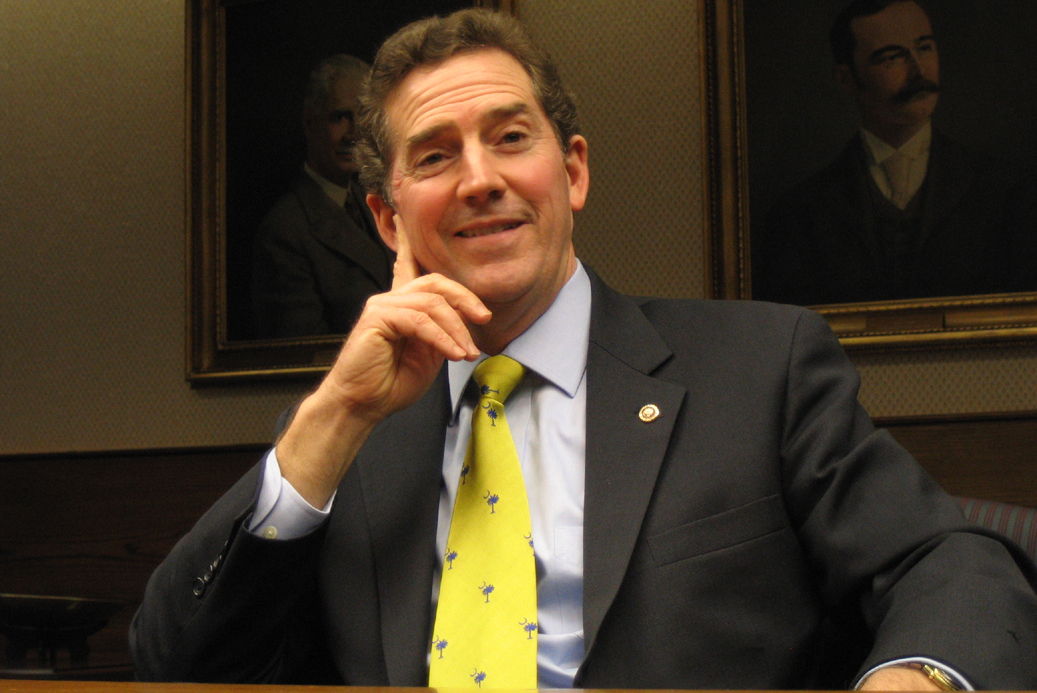
Silly me, for thinking Jim DeMint cared what I thought.

What, Me Worry about what YOU think?/File photo from an editorial board meeting in 2007.

Onion gets the scoop on The Daily Planet

This was a mildly amusing piece in The Onion yesterday:

NEW YORK—Frustrated fans of the Superman comic book said Monday the continued financial stability and cultural relevance of the series’ Daily Planet newspaper is now the most unrealistic part of its universe and an annoying distraction that has ruined their reading experience.

While they acknowledged that enjoying the adventures of a superhero who can fly, lift a bus over his head, and shoot beams of intense heat from his eyes requires some suspension of disbelief, longtime fans told reporters they simply could not accept a daily metropolitan newspaper still thriving in the media landscape of 2012.

“I can play along with Superman using a steel girder to swat someone into outer space, but I just can’t get past the idea that The Daily Planet still occupies one of the largest skyscrapers in all of Metropolis and is totally impervious to newsroom layoffs or dwindling home subscriptions,” said comics blogger Marc Daigle, adding that it was impossible for him to even look at Superman’s alter ego, Clark Kent, without immediately thinking he would have been replaced long ago by a freelancer who gets paid nine cents a word and receives no health benefits. “Every time The Daily Planetshows up, I just get taken out of the story completely. I usually flip ahead to Superman freezing a volcano with his breath or something.”…

I say “mildly” because the idea of a health Daily Planet was sufficiently absurd that it was hard to make fun of effectively.

One last excerpt:

“The least they could do is have [Daily Planet editor-in-chief] Perry White be forced into retirement by an MBA 25 years his junior,” Taft continued. “It’d be a start.”

See? Too real, too true, too matter-of-fact to be funny.

Perry! Great Caesar’s Ghost!

Only 80,000 — low jobs figure depresses markets, casts pall on Obama’s re-election

No virtual front page today, because there’s not much I’d willingly put on a front page. The biggest story of the day by far is the softer-than-expected jobs numbers — which, combined with bad news out of Spain, has sent global markets plunging.

(The only thing competing for the front with that is Hillary Clinton talking tough to China and Russia about Syria. I might do a separate post about that.)

The BBC does the basic overview:

US shares have fallen after official data showed firms had created only 80,000 new jobs in June, leaving the jobless rate unchanged at 8.2%.

Job creation remains below the 100,000 judged necessary by the Federal Reserve for a stable job market, according to the US Labor Department.

Shares slipped after the news, with the opening Dow Jones index falling 1%.

President Barack Obama said the rise in employment was “a step in the right direction”.

Campaigning in the swing state of Ohio on Friday, President Obama acknowledged that “it’s still tough out there” for ordinary Americans…

Republican White House candidate Mitt Romney said from Wolfeboro, New Hampshire, that the jobs data underlined the need for a new president, adding “this kick in the gut has got to end”…

Other angles include:

  1. String of Weak Jobs Reports Likely to Set Tone for Voters (NYT)
  2. Obama Promotes a Long View on Jobs (NYT)
  3. Jobs Report And Politics: The Monthly Spin Cycle (NPR)
  4. Jobs report makes it tougher for Obama to tout progress (WashPost)

As you can see, the political angle is getting heavy play. Although the Post did manage to show some concern for the actual economy in its lede headline: Weak jobs report adds to worry of faltering recovery.

The European problems feeding into the drop in markets is at least briefly discussed in this WSJ story. Here’s some more, courtesy of The Guardian.

Post-newspaper retail environment born in 1962

This morning was one of those moments when several threads came together for me, providing a small insight into the shape of the world in which we live.

It’s related to a moment of revelation I experienced in about 1996. I was attending one of a series of monthly meetings that our then-new publisher, Fred Mott, had instituted to brief employees in general about the state of the business side of the newspaper. I was probably sitting there trying not to let my eyes glaze over too obviously when he said something that cut through. Something that should have been obvious, but was not until that moment.

He observed — I forget exactly how he said it, but this was what I got out of it — that Walmart had shifted the ground upon which the business model of newspapers had been built. The key element was “everyday low prices.” Everyone knew that Walmart was the place to get the lowest prices available locally on anything they sold. And they sold everything. If everyone knows that you have low prices every day — and not now and then, in the form of sales events — you have nothing to communicate, on a regular basis, through advertising.

To show how that affected but one of the newspaper industry’s key advertising constituencies… people were used to reading about all the grocery stores’ specials — which changed if not day to day, then at least week to week — in the newspaper. But what’s the point in that if you can get all those same groceries — same brands and everything — cheaper at Walmart? And every day. So beyond some general branding, which it does mainly through television, reminding people of said everyday low prices, what does Walmart have to communicate? There is no news to pass on. That gives it yet another competitive advantage over those regular advertisers, because it saves the ad costs. To try to compete, those advertisers cut back on their ad budgets, and so forth.

And since Walmart sells practically everything a mass market wants, there is no retailing area unaffected. Department stores, appliance stores, clothing stores — everybody is competing against an adversary that doesn’t have to advertise to the extent that they traditionally had done.

That was just a piece of what was strangling newspapers, but a significant piece. Hence the expense cutbacks and hiring freezes that were already a monotonous part of newspaper life. The next year, Fred made me his editorial page editor, and shortly thereafter, as a measure of his confidence in me and his perception of the importance of the editorial mission, I was able to grow my department by one FTE. That was it. From then on, every budget year was an exercise in doing it with less. And less. And less. Until, two publishers later, it was decided to do without me.

But where did Walmart come from?

I got to thinking about that this morning. I was reading, in the WSJ, an oped piece about Eugene Ferkauf, who recently died at the age of 91.

In the postwar years, he pioneered discounting through his chain of stores called E.J. Korvette. This required challenging the “fair trade” price-fixing laws then in place in many states:

Retail price-fixing in the United States—often packaged for popular consumption as “fair-trade” laws—was a Depression-era concoction. Launched in California in 1931, it was quickly copied by state legislatures across the country. These statutes were premised on the idea that manufacturers retain a legal interest in the price of their products even after actual ownership has moved downstream to retailers. The laws were written so that once a single retailer in a fair-trade state agreed to observe the manufacturer’s proposed retail price list, it would in effect impose those prices on all other retailers in the state.

Conceived as a means of protecting small, independent merchants against predatory chains, fair-trade laws were pushed through state houses by legislators beholden to the influential retail chambers of commerce. The big manufacturers, especially appliance makers like GE, Westinghouse, RCA and Motorola, usually lent tacit support. It was easier for them to deal with a multitude of small customers through their wholesalers than to directly confront retailers big enough to muscle them for price concessions and promotional allowances…

I had never heard of E.J. Korvette stores, but I got to thinking, when was the first time I experienced discount store shopping? I realized that it was when we moved to New Orleans in 1965, after having lived in South America since late 1962. One of the elements of modern American culture that made an impression on me that year was the local Woolco store, a short drive from my home.

Anybody remember Woolco? They went out of business for good in the 80s, but this one was thriving in 1965.

I looked it up on Wiki, and found that Woolco was founded in 1962. This made me curious, and I looked to see when Kmart was founded. 1962. When did the first Walmart open? As it happens, 1962.

Then there was this passage in the oped piece this morning about Ferkauf:

In the end, the demise of fair-trade laws didn’t help E.J. Korvette. Ventures into high-end audio, home furnishings, soft goods and even supermarkets made E.J. Korvette considerably bigger but also shakier financially. In July 1962, Ferkauf was on the cover of Time magazine, hailed as the PiedPiper of the new consumer-centered retailing. Four years later he was ejected from his company, which by 1980 went into final bankruptcy. Ferkauf’s legacy, though, was secure. He had finally killed off legally protected price fixing.

Something about that year. A cusp of sorts. A changing of the guard, as retailing pivoted.

In his awesome book The Catalog of Cool (and if you can lay hands on a copy, you should buy it — although you may want to go the used route, since Amazon prices new copies at $127 and more), Gene Sculatti published an essay titled “The Last Good Year.” An excerpt:

Sixty-two seems, in retrospect, a year when the singular naivete of the spanking new decade was at its guileless height, with only the vaguest, most indistinct hints of the agonies and ecstasies to come marring the fresh-scrubbed, if slightly sallow complexion of the times. On the first day of that year, the Federal Reserve raised the maximum interest on savings accounts to 4 percent while “The Twist” was sweeping the nation. A month later “Duke of Earl” was topping the charts, and John Glenn was orbiting the good, green globe. That spring Wilt Chamberlain set the NBA record by scoring 100 points in a single game and West Side Story won the Oscar for Best Picture. The Seattle World’s Fair opened, followed five weeks later by the deployment of five thousand U.S. troops in Thailand. Dick Van Dyke and The Defenders won Emmys, and Adolph Eichman got his neck stretched. By that summer, the Supreme Court had banned prayer in public school, Algeria went indy, and Marilyn Monroe died of an overdose…

No mention of a major shift in retailing, though, as I recall.

One last tidbit, which you may consider to be unrelated…

Recently, I picked up several old paperbacks for 50 cents each at Heroes and Dragons on Bush River Road. One of them was The Ipcress File, which is what originally turned me on to spy fiction. You may recall the 1965 film, with Michael Caine — who expressed the cooler, hipper side of the 60s, as opposed to the mass-production James Bond.

In it is a passage in which the protagonist has a conversation with an American Army general who points out that the essential difference between the United States and Europe was this: A European develops a ballpoint pen, and sells it for a couple of quid and makes a modest living from it. An American, he said, invents the same thing and sells it for 5 cents a pop and becomes a millionaire.

Where am I going with this? Well, The Ipcress File was first published in 1962.