Category Archives: Business

Hey, that’s Duncan MacRae of YESTERDAY’S, y’all…

duncan yesterdays

Thought it was sort of odd that thestate.com showed my old friend Duncan MacRae in a montage of mugs of people who spoke out about violence in Five Points last night, but didn’t identify him beyond his name — although other speakers were identified by their roles in the district.

For the record, Duncan, who was a Marine helicopter pilot in Vietnam, is one of the founders and co-owners of Yesterday’s, my very favorite Five Points spot.

Duncan has always been deeply involved in seeking solutions to challenges faced by the district. I identify him as much with Five Points as I do Debbie McDaniel (also pictured) and Jack Van Loan.

I’d like to know what Duncan had to say. Unfortunately, he wasn’t quoted in the story. Guess I’ll have to go by and see him to find out.

Anyway, now you know who that is, in case you didn’t already…

Columbia’s homeless issue makes the NYT

Kathryn brought this to our attention on a previous thread, so I thought I’d elevate it to a separate post:

South Carolina City Takes Steps to Evict Homeless From Downtown

COLUMBIA, S.C. — In South Carolina’s capital, officials declare that their tree-lined Main Street, clogged with shops, banks, restaurants and hotels, is evidence that a long-sought economic revival has arrived.

But mere blocks north, a dozen or so of the county’s approximately 1,500 homeless people sit on a short wall near an empty parking lot, waiting for private shelters to open. They sporadically shout curses at passers-by while they smoke cigarettes and endure the summer humidity.

With business owners sounding increasingly worried about the threat they believe the homeless pose to Columbia’s economic surge, the City Council approved a plan this month that will essentially evict them from downtown streets….

Here’s my favorite part:

In Columbia, which has branded itself “the new Southern hot spot,” residents say the city’s time has come….

Go, ADCO! Hey, publicity is publicity.

So what is Amazon suggesting that Jeff Bezos buy next?

The credit for that headline goes to our own Bryan Caskey, who tweeted it to me yesterday (playing off of my earlier post wondering why Amazon would think I want to buy “geek” merchandise). How, indeed, would his own algorithms predict his future purchasing behavior based on his latest acquisition?

What, pray tell, is the founder of Amazon going to do with The Washington Post? Does he think he can make money where everyone else has failed? Does he seek influence? Or did he buy it as a hobby, sort of the way other people collect matchbooks or the like?

From his perspective, it doesn’t much matter, since he got it at such a bargain: $250 million. Less than 1 percent of his wealth. It’s about like me buying a single copy of the Post.

Let me elaborate on that figure.

Knight Ridder paid $300 million for The State and its smaller properties in 1986. As recently as 2006, when I speculated in a column about buy the paper myself, I was figuring it would still cost hundreds of millions — balancing the decline of the business against inflation. Mind you, this was just before the bottom dropped out of retail advertising.

Now, I just don’t know what it would cost. But I do know that, historically speaking, Bezos got the WashPost dirt cheap. Since the paper hasn’t changed hands before in modern times, we should look to the sale the other day of The Boston Globe by the NYT. Twenty years ago, New York bought The Globe for $1.1 billion. They sold it for $70 million. They ate a billion-dollar loss, and for all I know, consider themselves lucky.

So what is Bezos going to do with The Post? I don’t know. I wondered the same when Warren Buffett bought Media General. From what I’ve seen and heard, he hasn’t made any startling changes in the business operations.

But Bezos is more of an innovator. Is it possible that the guy who built a new kind of retail empire from the once-novel idea of selling books online has figured out, or will be able to figure out, the new business model for the news biz? I hope so. He’s got his work cut out for him. The collapse of newspapers’ business model is based on an economic trend that’s bigger than Amazon — and one of the secrets of Amazon’s success.

Newspapers — and local TV and radio stations — are the victims of a long-term trend in marketing (dating from direct mail in the early ’80s to the increasingly sophisticated targeting of the Internet) away from advertising in mass media to going after specific, individual customers. Advertisers became less interesting in reaching whole communities, choosing to be far more picky.

Since Amazon is the ultimate direct marketer to individuals, Bezos has to understand the phenomenon better than almost anyone. It will be very interesting to see how he applies his insights to The Post, if he chooses to do so…

Trees, both old and new, in South Carolina

Some of the few old-growth trees left standing, in Congaree National Park.

Some of the few old-growth trees left standing, in Congaree National Park.

Heard a pretty cool story out of South Carolina on NPR this morning:

Like much of the United States, South Carolina was once covered in old-growth forests. By the mid-20th century, virtually all of the virgin wood in the state was gone, either hauled away on trains or floated down rivers to be cut into lumber at saw mills.

But not all that timber made it to its destination. Some sank on its way down the river, where those old-growth logs have been preserved for about a century. Now, these precious leftovers can be worth up to several thousand dollars each.

But getting that treasure out is no easy task. First, anyone hoping to dredge the logs, known as sinker wood, must obtain a permit from the state. The logs weigh tons and are buried deep down in the muck. Once removed, the wood must be properly stored before milling to avoid cracking. And then, there are the alligators…

I learned several things from that piece, the most surprising of which was that wood that had been underwater for generations, even centuries, could still be useful, even valuable. I would have thought it would be ruined….

Anyway, I listened with particular interest because of an interesting project I’ve been working on. ADCO is doing some work for Hobcaw Barony. If you don’t know what or where that is, it would take a lot of words to tell you. But basically: It’s a 16,000 acre tract of land, essentially the southern end of Waccamaw Neck, just above Georgetown. It was originally a land grant to one of the Lords Proprietors, had been broken up into multiple rice plantations, and had been mostly reassembled around the time of the Recent Unpleasantness. After the end of slavery made it tough for SC planters to compete with cheaper rice from out west, the owners started using the mostly wild land for hunting clubs for rich Yankees. Bernard Baruch, the Camden native who had made an immense fortune on Wall Street and would become a close adviser to seven presidents (he’s the guy who put the term “Cold War” into circulation, in a speech to the SC Legislature), bought the tract and some additional land to more or less assemble the original royal grant. He used it as a winter home and hunting preserve.

His daughter, Belle, bought it from him in chunks, starting in the mid-30s. When she died in 1964, she left it to a foundation that was to preserve the land in its natural state in perpetuity, and open it to the state’s colleges and universities for educational and research purposes. Both USC and Clemson have operated institutes on the land since the late 60s — USC studying the estuary, Clemson the forest.

Anyway, one of the projects is to re-establish long-leaf pine, which was mostly cut down for naval stores in the age of sail. One challenge in doing this is the wild hogs on the land — descendants of swine left there by some early European settlers — which love tender young long-leaf pine roots.

OK, so it’s a thin connection, but since that’s what’s on my mind these days, that’s what caused me to be particularly interested in this NPR story…

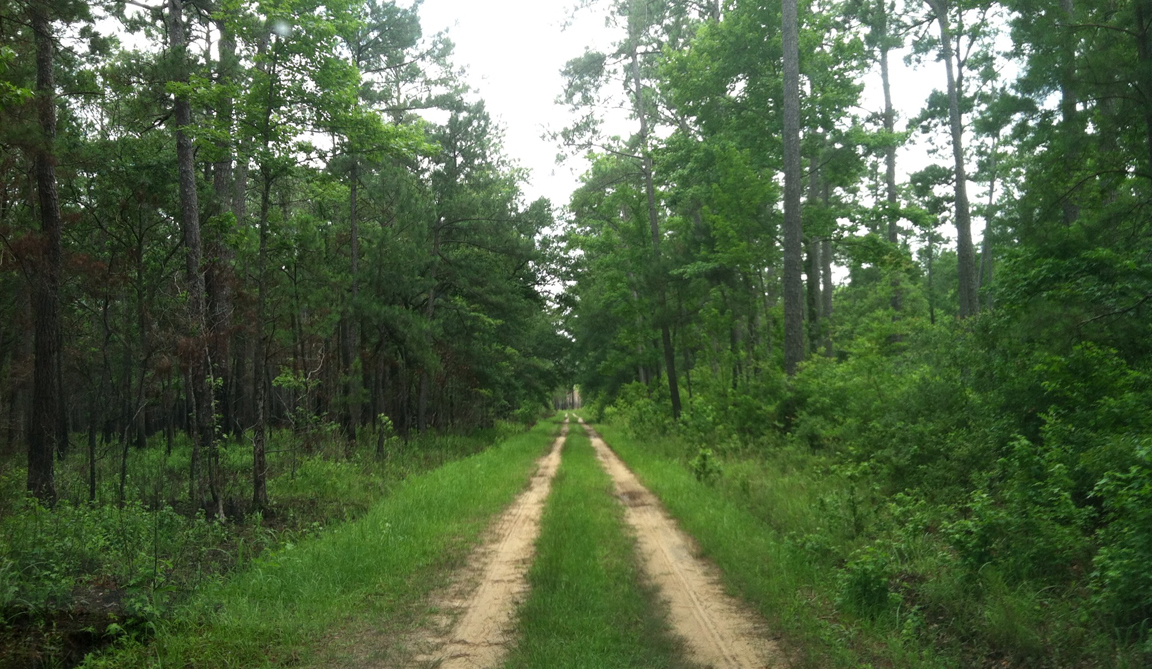
The King's Highway running through Hobcaw, looking much as it did in colonial times.

The King’s Highway running through Hobcaw, looking much as it did in colonial times.

The joys of a real bookstore

There was a thought-provoking little piece in the WSJ today by a bookstore owner in Tennessee:

The weather in Tennessee has been unaccountably beautiful this summer, with late July temperatures in the 70s rather than the 100s. The drive from Chattanooga, where President Obama gave his jobs speech at the Amazon warehouse Tuesday, to Nashville, where I am the co-owner of Parnassus Books, is a scenic two hours.

I wish he’d come by.

Thanks to the Amazon warehouse, there are about 7,000 new jobs in Chattanooga, many of them seasonal. But to celebrate Amazon as an employer is to ignore all the jobs that have been squeezed out of the economy as independent bookstores and other small businesses have been forced to close their doors, unable to compete with the undercut pricing the online retail giant offers. And with those shuttered bookstores go a big part of our community.

In the time-honored tradition of bookstores everywhere, our store is staffed by readers—people who want to talk about the books they love. We’re not handing out algorithms based on what books other people have bought. These aren’t widgets we’re selling….

Actually, it was more of a feeling-provoking piece than thought-provoking, I suppose. And my feelings were conflicted.

First, I felt sympathy for the person trying to operate a mom-and-pop bookstore in this age. At the same time, I noticed that this person didn’t get into the business until 2011. A former editor of mine retired more than 10 years ago and started an online used book business, so it’s not like this phenomenon snuck up on this person. This is somewhat different from the character in “You’ve Got Mail” who inherited a charming little bookshop.

Second, I felt identification with someone who would rather browse books in person than buy one online. That happens to be one of my very favorite leisure-time activities, when I have leisure time. So it is that I continue to root for Barnes & Noble to hang in there with the real, live bookstore thing.

Third, I felt guilty because, well, as much as I love browsing a bookstore, I’ve always had a preference for Barnes & Noble over the charming little mom-and-pop types. Even though Rhett Jackson was a friend of mine, I seldom frequented his shop. If I went there, it was to quickly find a book and buy it. There’s something, for me, about having the vast space and great variety of B&N to wander in, while sipping a hot Starbucks coffee. (Here’s another confession: When I go to the one on Harbison, the one I frequent most, I actually go to the Starbucks over across the parking lot, rather than getting my coffee in the bookstore cafe. Partly because I can use my Starbucks card there.)

Of course, as I’ve confessed before, I usually don’t actually buy a book at the end of those browses. But when I do buy a book — as I did just this last weekend — I buy it at B&N.

Finally, I felt out-bookwormed by this woman. As you would expect from someone who sells new books, she’s very up-to-date in her reading. I seldom read a book that was written in the last 10 years, or even 50 years — there’s just too great a wealth of old stuff that I’ll never get to, I have little interest in keeping up with the best-seller lists. Since I started reading the daily book reviews in the WSJ, I have gotten a little more interested in recent books — but when I get one of them, it still tends to sit on my shelves for months or even years before I actually read it. I like to let them age a little. So much of the rest of my life has been spent keeping up with the latest, and meeting deadlines. Part of the pleasure of a book is knowing it will sit there and wait for me indefinitely, and be just as rewarding when I finally pick it up.

I use Amazon for all sorts of things. Particularly phone accessories — USB cords, earbuds — which are amazingly cheaper than in a store. Or when I’m shopping for some particular item someone wants for Christmas or birthday, and I don’t immediately find it in the first store where I look — I’ll just stand there in the store and order it over my phone.

But books I want to hold in my hand before I buy.

Glad to see the administration on board with Colombia trade

Some of y’all — those who carry grudges — will recall that one of my reasons for endorsing John McCain in 2008 was that he supported the Colombian Free Trade Agreement. This caused some Obamaphiles to freak out, it just seemed so esoteric to them.

But to me, it was important to cite. First, the large portion of my childhood spent in South America causes me to care more about that part of the world than do most people in this country. I find Yankee indifference to the rest of the hemisphere pretty appalling, frankly. One reason I got into reading British publications years ago was that they actually covered news events in Latin America. Most media in this country do not, for the simple reason that their readers and viewers aren’t interested.

I also saw this as a little-discussed microcosm of a difference in judgment and decision-making with regard to foreign policy in general, one that for me made McCain look better.

I went into why I thought it was important in this post.

Anyway, spin forward more than four years, and I’m pleased to read this piece by Joe Biden in The Wall Street Journal, headlined “The Americas Ascendant.” It begins:

Last week, during a five-day trip through Latin America and the Caribbean, I visited a cut-flower farm outside Bogota, Colombia, an hour’s drive from downtown that would have been impossibly dangerous 10 years ago. Along the way I passed office parks, movie theaters and subdivisions, interspersed with small ranches and family businesses. At the flower farm, one-quarter of the workers are female heads of households. The carnations and roses they were clipping would arrive in U.S. stores within days, duty free.

What I saw on the flower farm was just one sign of the economic blossoming in the year since a U.S. free-trade agreement with Colombia went into force. Over that period, American exports to the country are up 20%…

Yeah, and we could have been enjoying that increase in trade years earlier, had not Sens. Obama and Clinton opposed it, to the gratification of Big Labor.

But hey, welcome aboard. I’m glad the administration gets it now.

I thought it particularly interesting that the vice president focused on the cut-flower trade. So did Nicholas Kristof in an April 24, 2008, piece that had helped focus my attention on the need for the agreement. It began:

BOGOTÁ, Colombia

For seven years, Democrats have rightfully complained that President Bush has gratuitously antagonized the world, exasperating our allies and eroding America’s standing and influence.

But now the Democrats are doing the same thing on trade. In Latin America, it is Barack Obama and Hillary Clinton who are seen as the go-it-alone cowboys, by opposing the United States’  free-trade agreement with Colombia….

That piece, too, focused on the cut-flower industry in Colombia. The headline was “Better Roses Than Cocaine.” Indeed.

The vice president today writes,

There is enormous potential—economically, politically and socially—for the U.S. in its relations with countries of the Western Hemisphere. And so the Obama administration has launched the most sustained period of U.S. engagement with the Americas in a long, long time—including the president’s travel to Mexico and Costa Rica last month; my own recent trip to Colombia, Trinidad, and Brazil; Secretary of State Kerry’s participation in the Organization of American States’ annual meeting in Guatemala; the president of Chile’s visit to Washington this week and a planned visit to Washington by the president of Peru. Brazilian President Dilma Rousseff arrives in Washington in October for the first state visit of the second term.

As leaders across the region work to lift their citizens out of poverty and to diversify their economies from commodity-led growth, the U.S. believes that the greatest promise—for Americans and for our neighbors—lies in deeper economic integration and openness.growth, the U.S. believes that the greatest promise—for Americans and for our neighbors—lies in deeper economic integration and openness.

I agree. And welcome aboard, Mr. Obama.

Cute to the nth degree: Lumosity’s ‘It girl,’ Emily Greco

Silence complains that I had no new posts yesterday:

Brad, do you have plans to ever do a new post again, or should we just continue to battle amongst ourselves in last month’s comment threads?

He makes it sound like forever. It was just one day — and I was responding to comments. Gee, I figured that y’all were having enough fun with that rambling 153-comment thread on last Thursday’s Virtual Front Page.

I responded that “I get into these days sometimes when the only thing I can think of to post about is either a) Too trivial to post about without it being folded in among some more serious items, or b) Way too heavy and involved to embark upon on a busy day.

I had both kinds on my mind yesterday, and didn’t get to either. Here’s the one from category A…

I’m thinking about starting a new category of posts, called something like “What I Googled today,” or “Google of the day,” or just “Googling.”

Here’s the first entry.

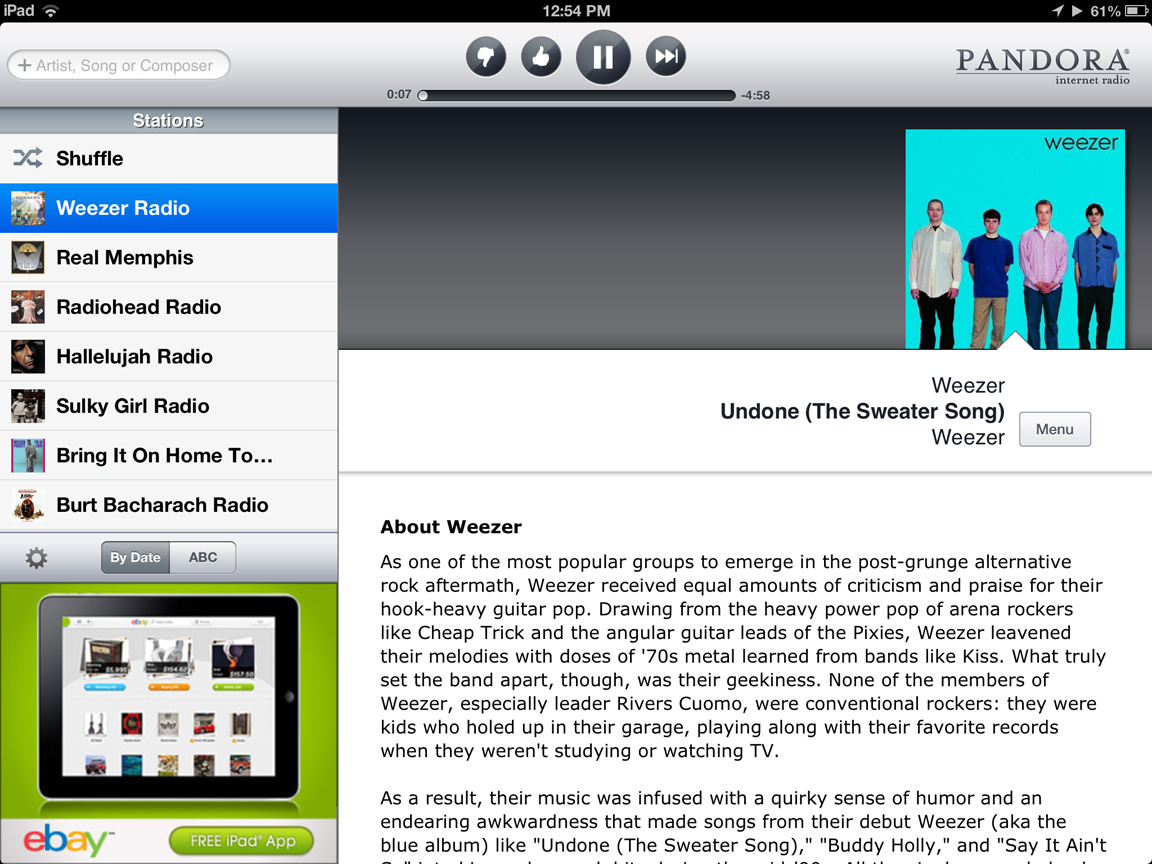
Yesterday, after I found myself once again deliberately ALT-TABbing to and watching the Lumosity ad stuck between songs on Pandora (instead of hitting the “mute” button as I do on some of them, because they’re pretty jarring, especially when they occur on my Erik Satie station, as opposed to my Weezer station), I wondered who that unbelievably cute girl is — the one who makes me want to see the ad. I was pretty sure I was not the only one who had searched to find out, and I was right.

First, let’s pause to consider terminology. Some people misunderstand the word, “cute.” (Some also misunderstand the word “girl” when applied to someone of child-bearing age, but those people aren’t as old as I am, and/or don’t have children who are most likely older than this girl.) “Cute” does not mean pretty (although it often overlaps), much less beautiful, sexy or hot. It refers to a form of appeal, but it is not (necessarily) sexual, or related to pulchritude.

To explain: Zooey Deschanel is cute. She’s also pretty, but that’s a slightly separate thing. Ingrid Bergman was beautiful, which is not exactly the same thing as pretty. Carrie-Anne Moss is hot, especially in “The Matrix” — the first one, in which she wore the leather catsuit, which reminds us that Diana Rigg was hot in “The Avengers,” and this is not a leather thing. Speaking of cat suits, as in Catwoman, Sean Young was in her heyday sexy, hot and beautiful. Just kinda batty.

Anyway, the young woman in the Lumosity ad is unbelievably cute. This does not mean I want to have an illicit relationship with her. It just means that I look forward to seeing the ad. I am not alone, either in this, or in thinking the right word for her is “cute.” Here are some YouTube comments about her:

  • “For some reason,I think that this woman is really cute. And I’m a female.”
  • “Shes so f___ing cute”
  • “Emily Greco is so cute! She’s so cute I get happy just knowing the Luminosity commercial is starting. Whatever Luminosity paid her – it’s not enough now that hearing Luminosity puts me in a happy mood because I connect it with the cute woman in the commercial. I’m sure she has the same affect on most viewers.”

Those are sandwiched among some grossly negative comments, from the kinds of people who live to make negative comments. We all know the sort.

Anyway, as you see, her name is Emily Greco, and no, she’s not just some super-cute person who happened to be a Lumosity customer. She’s an actress. That naturalness is art. Here’s her agency’s page about “Our Rising Star — Emily Greco.”

What is it that defines her appeal? What is the “it” here? Well, it involves the fourth dimension, because it doesn’t come across in a still photo (although this isn’t bad). You need the video. You need to see the thing she does at the end (25 seconds) when she bats her eyes and smiles that crooked smile (proof that she’s not beautiful, since technically “beauty” is a function of symmetry, or so I’ve been told). All in one split second. And if you’ve seen the ad before, waiting to see her do that again is what keeps you watching the ad through the boring 10-second sales-pitch part, with the graphics.

Anyway, I haven’t seen an individual in an ad with that much appeal in years and years. So I take a professional interest in this. I also want to see the ad again…

Sun-Times lays off entire photo staff

Fellow former newspaperman Burl sent me the following link yesterday, along with the message, “We got out just in time:”

Chicago Sun-Times cuts entire photography staff

The Chicago Sun-Times and its sister suburban papers have eliminated their photography staff and will ask the papers’ reporters to provide more photography and video for their stories.

Managers at Sun-Times Media Holdings LLC, the Wrapports LLC unit that owns the papers, told the photographers in a meeting this morning that it was cutting their jobs, according to people familiar with the situation. The number of full-time workers affected is about 20, but including part-time employees, it could be closer to 30, they said.

While the company, which has been trying to revive profits, still will hire professional freelance photographers for coverage, it will increasingly rely on reporters to take photos and video to accompany their stories, the sources said…

And I responded to Burl, No, actually, YOU did — you found a great job right up your alley (in an awesome location) and quit BEFORE you got laid off. Me, I got the same treatment as these photographers…

Just for the record.

There should be nothing new about reporters having to take pictures, although for some I’m sure it’s been a shock in recent years. Hey, I was usually my own photographer when I was in a rural bureau back in the late ’70s. I did a pretty good job, too. But it was always nice to have a photographer along. For one thing because, you know, some (but not all) were better photographers than I was.

But it also was helpful to double-team a source. If I was interviewing someone and needed to pause to get a picture, the person tended to tense up and look self-conscious. Whereas a photographer could get good candid shots of the subject while I was distracting him or her.

Also, it could be handy to have a partner along in a dicey, remote situation. One photog I worked with, for instance, carried a gun in his glove compartment. Just in case.

And you could learn things about people while out on assignment. Once, a photog whom I will not name but whom I had known for years and years went out with me to report on a train derailment way, way out in the boonies in West Tennessee. It had gone off a bridge over a creek a good distance from any road. We were going to have to leave the car and hike maybe half a mile over fields that had close to a foot of new snow on them.

He said we should both put on hats, since a person loses so much of his body heat through his head. I agreed — who wouldn’t? We both had knit caps. I put on mine. I didn’t realize he was building up to something. He hesitated. He said, “If you ever tell anyone about this, I’ll kill you.” About what? I started to say… and then he pulled off his hair.

I had had no idea.

Anyway, I swore I’d never tell, he put on his hat, and we set out.

Months or years later, one of the old hands in the newsroom made some casual remark about how that photographer was so sensitive about his baldness.

I said, incredulous, “You know about that?”

She was surprised at me: “Oh, everybody knows about ____’s rug.”

But I digress.

Anyway, photographers are useful (and sometimes entertaining), to have around. So I’m sorry not only for the individuals who just lost their jobs in Chicago — believe me, folks; I feel your pain — but for journalism. The craft just got even poorer.

Why does Google’s so-called “All Access” service not want my business?

Pandora accommodates me with an iPad app. Why won't Google All Access?

Pandora accommodates me with an iPad app. Why won’t Google All Access?

The moment I heard that Google was starting a music subscription service, I decided I would do with this one what I had not done with Pandora or Spotify: Pay for it.

Well, not right away. I saw that I could get it free for a month, and then pay at the discounted rate of $8 a month thereafter. If I didn’t like it the first month, I just wouldn’t pay.

But I figured it’s Google, right? So I’ll probably like it. Anyway, it would probably be integrated with my gmail and my YouTube account and everything else, so it would be convenient. Just yesterday, I used Google’s Hangout for the first time, for a three-way conversation that worked pretty seamlessly within my Google+ iPad app. There were glitches, but so far I like it better than Skype.

So I was all set to sign up when I saw this AP review:

LOS ANGELES (AP) — Google Inc.’s new music service offers a lot of eye candy to go with the tunes. The song selection of around 18 million tracks is comparable to popular services such as Spotify and Rhapsody, and a myriad of playlists curated along different genres provides a big playground for music lovers.

The All Access service represents Google’s attempt to grab a bigger piece of the digital music market as more people stream songs over mobile phones. Such services are also meant to further wed smartphone users to Google’s Android operating system, where the search leader makes money from advertising and transactions on its digital content store, Google Play.

For a monthly fee, All Access lets you listen to as much music as you want over an Internet connection. You can also download songs onto mobile devices for smooth playback later when you don’t have cellphone or Wi-Fi access.

It’s worth a try for the discounted monthly rate of $8 if you sign up by the end of June. Those who sign up later will pay $10 a month, the same amount charged by the main competitors, Spotify and Rhapsody. Either way, you get the first month free and can cancel at any time…

Sounds good, right? Then I got to this part…

All Access works on the free Google Play Music app for Android devices and over Web browsers on computers — but not on the iPhone. (Spotify and Rhapsody work on both Android and the iPhone).

And not, as I read elsewhere, on my iPad, either.

I’ve got some news for Google…

According to Google’s own Analytics, more than a fifth — 22.48 percent — of this blog’s readers read it on a smartphone or tablet.

Of those, more than three-fourths — 75.8 percent — are reading this on an Apple device.

So, unless my audience is unrepresentative of the larger world (or unless, ahem, Google Analytics is wrong), right off the bat, Google is saying it only wants the business of less than one-fourth of the mobile/tablet market.

How stupid is that?

Does anyone at Google really think that satisfied iPhone and iPad users — who know, according to Google’s own Analytics, that their platforms are the current standard for which most software will be written — are going to switch to what they consider to be a lesser product just because they can sign up for a music service? When they can already get Spotify and Pandora? And when they know that an iTunes subscription service is in the works?

This speaks to a larger problem in the tech world: I thought the people at Apple were insane when they came out with the iPhone 5 without Google Maps. It really irritated me that they weren’t smart enough, humble enough to realize that Google did maps best, that it was way out ahead of anything Apple could do to imitate it, and if they really wanted their customers to have the best, they would serve them up Google Maps, as they had done with the iPhone 4. YouTube, too.

Fortunately, I was immediately able to download those Google apps for both my phone and my iPad, so no harm done.

And I see in this report from Wired that a third-party iPhone app that will give me Google All Access is in the works, too (although, when I tried to get it from the Apps Store just now, I was told it still doesn’t work for the new service).

But why should I need workarounds? Why can’t Apple recognize that Google does maps better, and Google recognize that Apple does phones and tablets better? Or, at the very least, recognize that three-fourths of the market out there believes it does, and isn’t going to use your product unless it is accommodated?

I just don’t get these people and their proprietary hubris…

Thoughts on the Boeing expansion?

dreamliner

This release from the state Senate GOP…

Boeing has been an incredibly [sic] partner for us as a state. Despite labor unions’ early attempt to interfere with their presence here, Boeing is already creating jobs for over a thousand South Carolinians, with a multiplier effect that touches every part of our state.


We overwhelming passed a bill this week that gives Boeing the tools they need to create another 2,000 jobs here. You read that right…ANOTHER 2,000 jobs, and nearly a $1 billion more in capital investment.


It’s a great day for South Carolina not only because of the impact these jobs will have in people’s lives, but also because it solidifies our state’s reputation as a go-to destination for world-class manufacturing…

… got me to thinking I should start a thread on this major new industrial investment by our state. This thing’s moving through the Legislature pretty quickly, so don’t type too slowly if you have something to say. A quick summary of the situation from The State:

The S.C. Senate gave final approval Thursday to $120 million in state bonds, two days after the aircraft maker said it would add 2,000 jobs and $1 billion in investment at its North Charleston Dreamliner 787 jet plant. Boeing must meet those employment and investment goals by 2020 as part of the incentive agreement.

Meanwhile, the state House agreed Thursday to fast-track the incentives bill and begin floor debate Tuesday, Speaker Bobby Harrell’s office said…

“We have made a commitment to Boeing and our state keeps its word, particularly when it comes to economic development,” said Harrell, R-Charleston. “This is a good investment for our entire state that will create exciting new opportunities for our citizens and provide our state with huge returns.”…

The 15-year, state-backed bonds would pay for a 320-acre site next to Boeing’s plant at Charleston International Airport and to prepare the property for expansion. The money would not pay for new buildings, state officials said. 


Who are the ad wizards who came up with the Figo fiasco?

women

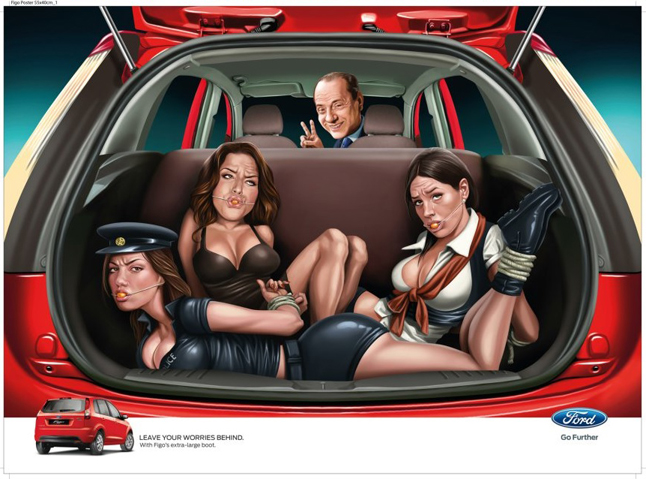
I was really busy last week when this broke, but when I saw it, my first thought was, Who thought this was a good idea?

Then I saw it came from ad designers in India, which caused me to think, Wow, like India’s reputation needed this.

My final thought on the subject — and no story I’ve seen fully answers the question — was, What were they trying to convey about the car? That it had a roomy cargo bay (the copy mentions an “extra-large boot”)? And this was the best way they could convey that? It may be more prosaic, but I think the line I once heard from a Toyota salesman that the Camry had a six-golf-bag trunk was more effective.

The stories I saw only went about this far in explaining:

The most controversial of three advertisements for the Ford Figo, meant to allude to the Indian hatchback’s spacious trunk, showed former Prime Minister Silvio Berlusconi of Italy flashing a victory sign while driving a vehicle with three scantily clad gagged women in the rear. Two other versions of the advertisement show the reality television star Paris Hilton kidnapping the Kardashian sisters and the Formula 1 driver Michael Schumacher abducting three of his rivals.

The advertisements in question were never used for a Ford campaign, but were uploaded by JWT employees on Ads of the World, an international advertising Web site which gives awards for ads submitted by users. They have since been removed from the Web site. Soon after posting, they spread quickly through social media and attracted criticism for their sexist message, particularly as India grapples with numerous high-profile incidents of violence against women…

OK, one more question: Did they think the one with the guys in it made it OK? That would be from the David Brent school of political correctness: “‘Does this make my ass look big?’ It’s not sexist, that’s the bloke saying it – at LAST…”

racecar

Somehow, I can’t bring myself to worry about Michael Dell’s job situation

The Wall Street Journal has been keeping me up-to-date on Michael Dell’s attempt to take the company he founded private.

This morning’s installment of the saga was headlined, “Michael Dell Finds His Deal, And Job, in the Cross Hairs.” An excerpt:

Michael Dell‘s DELL +2.62% plan to gain greater control of his company and take it private began to backfire, as rival bidders for the computer maker floated competing offers that, if accepted, could leave him out of a job.

Blackstone Group LP BX -0.41% and activist investor Carl Icahn delivered separate proposals to a special committee of Dell Inc.’s board before a key deadline for offers expired, people familiar with the matter said. Blackstone has been exploring the possibility of someone else leading the company, according to a person familiar with the matter.

But you know what? I’ve just gotta confess that it’s tough for me to be on pins and needles about the possibility of poor Michael losing his job.

Those of you who understand high finance might set me straight here, but near as I can tell, if he “loses” this fight, he walks away with one of the best severance deals in the history of the planet. His bid is for $24.4 billion. Presumably, the winning bid would be comparable. He controls about 16 percent of the stock.

Of course, a job is about more than money. There’s job satisfaction. There’s one’s place in a community; one’s sense of making a contribution.

But don’t you think the best days for all that are sort of behind him? How will he ever repeat the heady days of founding the company in his dorm room, and seeing it rise to where “Dude, you’re getting a Dell!” was all the rage. Now, the company, and the industry of which it has formed a prominent part, have seen their best days.

Mind you, I am sort of rooting for his bid to take the company private, just on general principles. I say this on the basis of my own experiences working for publicly-traded companies. If I were in his position, I’d want to be private, too.

But I can’t help thinking that for him, personally, the best thing might be to lose his job. Then he could take his cash and go out and do something new and exciting. Or just chill. There’s always that option.

Vista Publix — a local success story

Publix

Well, it finally happened, one day this week.

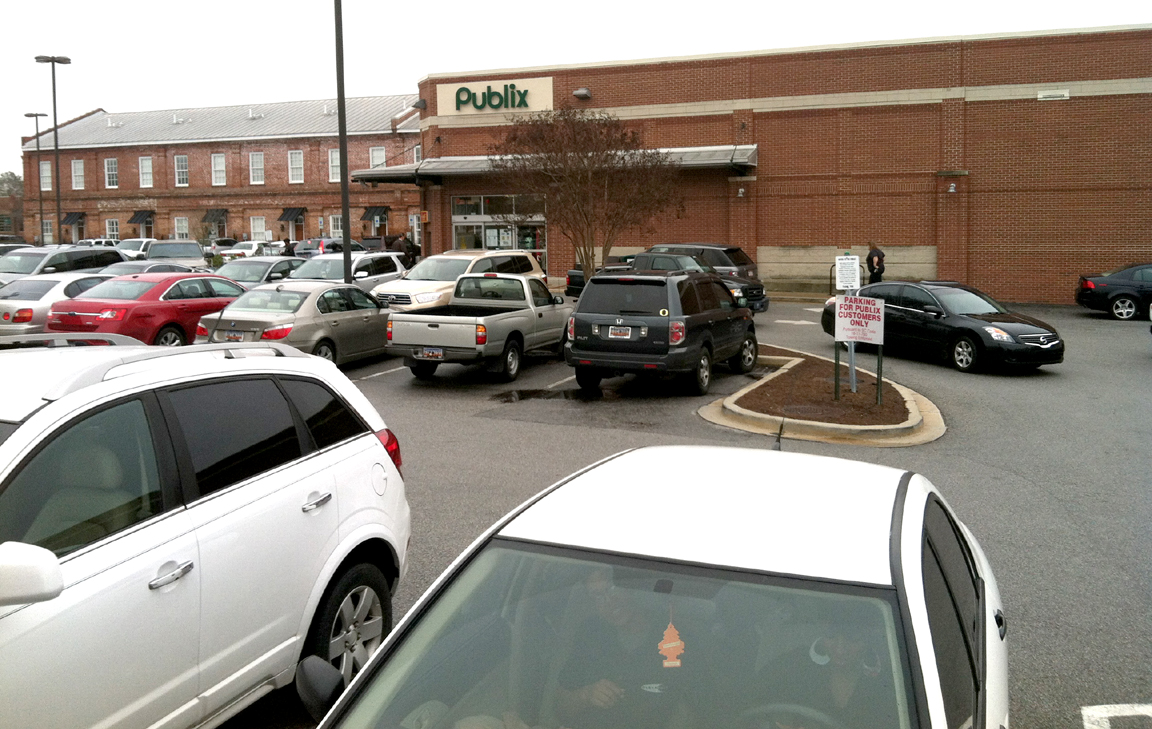
To be more specific, it happened Wednesday. The thing that happened was that I went to the Publix in the Vista, the one that’s sorta kinda in the old Confederate printing plant, and there wasn’t a single available parking space.

It was lunchtime, and it being Ash Wednesday, I needed some non-meat item for my midday repast, and what would be more appropriate than lentil soup in a convenient pop-top can? Even better, Publix had Progresso soups on sale, buy-one-get-one-free. So now I’m set for Friday as well.

Anyway, while the parking lot is often crowded, that was the first time I couldn’t find any space in the lot. (Rather than continue to circle with others, I went ahead and parked next to Trustus theater.)

So congratulations to the folks who run Publix for their success. But also, congratulations to those city leaders who had the vision to promote the redevelopment of the Vista into a district that could support, and be supported by, such a supermarket, starting with the late Mayor Kirkman Finlay.

More specifically to this case, I congratulate the city leaders who, during the last decade — no longer having The State’s archives at my fingertips, it’s hard for me to be specific as to the date — agreed to help Publix redevelop that property. That involved an investment of city funds in the range of about $300,000.

For years, we on the editorial board would refer approvingly to what we called “the Publix standard” for public investment in the local economy. We adamantly opposed the hotel the city wanted to invest millions to build, own and operate, seeing that as something far better left to the private sector. But the relatively modest ante by the city in return to a much bigger private investment — and particularly one as smart as the Publix — seemed like a nice, reasonable Baby Bear sort of risk (not too big, but just right) for the city to take with tax money.

And it paid off. Which is why I had a little trouble parking to get my lentil soup on Wednesday.

My Top Ten favorite ads from the 2013 Super Bowl

To hundreds of millions of Americans, today is the day after Super Sunday. To me, it’s Monday. (Hey, if I were a football fan I’d use those Roman numbers instead of “2013” in my headline.)

Still, I took some time this morning to look at the ads from the big event last night for the ADCO blog, and following are the ones I put in my Top Ten. (“Top Ten” may not sound very selective, until you reflect that there were 47 of them. Really.)

Here were my admittedly simplistic, off-the-top-of-my-head criteria:

  1. Does it sell the product?
  2. If it features a celebrity, does it make good use of that star power (or is it just a gratuitous appearance)?
  3. Is it original, clever, creative, witty, funny, whatever?

Anyway, here’s my list:

  1. Time Warner Cable: “Walking Dead” — Definitely sells the product, and most awesome use of star power: Isn’t Daryl everybody’s favorite “Walking Dead” survivor? “Yes, ma’am.” See video above.
  2. Mercedes: “Soul” — Great casting (nobody else can do that evil look like Willem Dafoe), and only Martin Scorsese has made better use of the Stones’ music. I was wondering how they were going to get out of the trap of the Mercedes actually being a devilish temptation; it was handled deftly, by punching the car’s (relative) low price.
  3. Dodge: “Farmer” — Accomplished what the “Jeep” one tried to do, and did it in an unexpected way. This one is the rightful successor to the much-maligned, but remembered, Clint Eastwood one.
  4. Kraft MiO Fit: “Liftoff” — I’m gonna miss that character. Or maybe not. Good thing we have Netflix. My favorite line of his from last episode of “”30 Rock”: When he calls a computer “the pornography box.”
  5. Volkswagen: “Get Happy” — Not a match for the Darth Vader kid, but a laudably original attempt.
  6. Samsung: “The Next Big Thing” — Two of Judd Apatow’s stars took it to one level, Saul from “Breaking Bad” took it to the next.
  7. Toyota: “Wish Granted” — Funny. Good star power. Give it a B+.
  8. Go Daddy: “Big Idea” — Had the hurdle of communicating (to the remaining millions who don’t have their own websites) what Go Daddy, does; jumped over it nicely. Far better than the other GoDaddy ad that everybody’s on about.
  9. Hyundai Turbo: “Stuck Behind” — Loved the “Breaking Bad” reference, if that’s what it was (the guy in the hazmat suit).
  10. Budweiser: “Brotherhood” — Deftly evokes the question, “Can a really big horse be man’s best friend?” (See video below.)


Columbia’s Donehue Direct becomes Push Digital

Wesley Donehue’s political tech outfit, which has helped campaigns across the country, is making a change, it announced today:

Top SC political internet firm rebrands as Push Digital
Columbia, SC – January 24, 2013 – Wesley Donehue, founder and CEO of leading political tech firm Donehue Direct, announced today the rebranding of his firm to Push Digital.
The new Push Digital will continue its nationally recognized work in website and application development, mobile marketing, online advertising and targeting, fundraising, brand management, and social media. Push is also reemphasizing its commitment to data collection, management and analytics, something that Donehue has working toward for several years.
“Four years ago when I was asked what the next big tech trend was, I said ‘data,’ and a lot of people rolled their eyes,” Donehue said. “Too many people think data is boring and it isn’t sexy, but we all saw firsthand the results of a data-driven campaign this year in the presidential race. Our goal, quite simply, is to be second to none when it comes to data, and that’s something that will mean big dividends to our clients in terms of their ability to target their message and raise cash.”
Push is one of the few political Internet firms that has run campaigns from top to bottom. Its team has been involved from the state legislative level all the way up to the presidential, as well as numerous marketing campaigns for state parties, issue groups and nonprofit organizations. The team has had broad experience running the political, finance, and communications operations.
Push Senior Vice President Joel Sawyer noted that too often, those branches of the campaigns are “siloed” from one another, and not integrated with regard to technology.
“Part of our new mission with Push is to give clients the tools they need to integrate tech into all aspects of a campaign, and more importantly, making sure all the data integrates,” Sawyer said. “We live in a world where the internet is completely pervasive in our lives, yet too many campaigns out there are run on a model from two decades ago.”
In addition to its political business, Push will continue its work with non-profits and issue advocacy groups. Push will maintain its office presence in both Columbia, South Carolina and San Francisco, California.
Learn more at www.pushdigital.com
Follow us on twitter: @pushdigitalinc

“Politics is always going to be our bread and butter,” Joel Sawyer told me this afternoon. But the kind of increasingly sophisticated data mining that the firm does can “apply to any persuasive endeavor.”

In the past, he said, many campaigns have had volunteers who are willing to wave a sign on a street corner on the one hand, and people who give $10 or $15 on the other — often missing that a sign-waver could well be a donor, and vice versa. What Push Digital will do is pull all of a campaign’s data together and make it work in ways it hasn’t in the past.

Y’all know Joel. He was for awhile Mark Sanford’s press secretary, and was the guy the gov left to hold the bag when he ran off the Argentina. Joel resigned shortly after that, although I don’t ever recall him saying that there was a cause-and-effect relationship between the events.

Wesley y’all will know from all those communications for the Senate Republicans, and from Pub Politics, which just kicked off its new season last night. (Joel fills in for Wesley occasionally, as their business often requires travel.)

Check out Pinterest for a look at the newly-renamed firm’s portfolio.

Good luck with the new identity, guys.


One of the newly-renamed firm’s many national clients.

Questionable claims for the AR-15

Just read an interesting piece over at Slate, by a guy who calls himself “a Second Amendment supporter” (although, living in NYC, he doesn’t own a gun — but I guess that’s as close to pro-gun as Slate gets), discussing the claims that the AR-15 is a great weapon for hunting and home defense.

Which seems doubtful to me on both counts. This writer, Justin Peters, cites most of the reasons I already thought that. If I were into hunting, I’d use a rifle (or for birds, a shotgun), rather than a weapon that, as Sean Connery’s Raizuli would say, “fires promiscuously.” A matter of sportsmanship. For home defense, a pistol seems far more practical than a long gun, even a carbine.

But then I’m not trying to sell “modern sporting rifle” to the public.

Here’s the core of the article’s argument:

But the AR-15 is not ideal for the hunting and home-defense uses that the NRA’s Keene cited today. Though it can be used for hunting, the AR-15 isn’t really a hunting rifle. Its standard .223 caliber ammunition doesn’t offer much stopping power for anything other than small game. Hunters themselves find the rifle controversial, with some arguing AR-15-style rifles empower sloppy, “spray and pray” hunters to waste ammunition. (The official Bushmaster XM15 manual lists the maximum effective rate of fire at 45 rounds per minute.) As one hunter put it in the comments section of an article on americanhunter.org, “I served in the military and the M16A2/M4 was the weapon I used for 20 years. It is first and foremost designed as an assault weapon platform, no matter what the spin. A hunter does not need a semi-automatic rifle to hunt, if he does he sucks, and should go play video games. I see more men running around the bush all cammo’d up with assault vests and face paint with tricked out AR’s. These are not hunters but wannabe weekend warriors.”

In terms of repelling a home invasion—which is what most people mean when they talk about home defense—an AR-15-style rifle is probably less useful than a handgun. The AR-15 is a long gun, and can be tough to maneuver in tight quarters. When you shoot it, it’ll overpenetrate—sending bullets through the walls of your house and possibly into the walls of your neighbor’s house—unless you purchase the sort of ammunition that fragments on impact. (This is true for other guns, as well, but, again, the thing with the AR-15 is that it lets you fire more rounds faster.)

AR-15-style rifles are very useful, however, if what you’re trying to do is sell guns. In a recent Forbes article, Abram Brown reported that “gun ownership is at a near 20-year high, generating $4 billion in commercial gun and ammunition sales.” But that money’s not coming from selling shotguns and bolt-action rifles to pheasant hunters. In its 2011 annual report, Smith & Wesson Holding Corporation announced that bolt-action hunting rifles accounted for 6.6 percent of its net sales in 2011 (down from 2010 and 2009), while modern sporting rifles (like AR-15-style weapons) accounted for 18.2 percent of its net sales. The Freedom Group’s 2011 annual report noted that the commercial modern sporting rifle market grew at a 27 percent compound annual rate from 2007 to 2011, whereas the entire domestic long gun market only grew at a 3 percent rate…

Just before that excerpt, Peters cited what I suspect is the biggest appeal of the AR-15: “because carrying it around makes you look like a badass.”

Indeed.

Which is Rothko, and which is ADCO?

Three years ago, the staff of ADCO had our annual Christmas party at Hobby Lobby. After refreshments, each us was given a canvas and paints, and challenged to create something for the walls of our offices.

We were encouraged to paint in the style of Mark Rothko, and most of us cooperated. We were generally pleased with the results, which you can still see today adorning the walls of 1220 Pickens St.

Fast-forward to this year…

Last Thursday, our office Christmas party consisted of lunch at Hampton Street Vineyard, followed by a tour of the Rothko exhibit at Columbia Museum of Art.

Now, here’s a test of your artistic perspicacity: Above and below are images of two paintings. Can you tell which is by ADCO, and which is by Rothko himself?

No cheating! To check yourself, you may look it up on Google Images after you share your answer. You’re all on the honor system, and sure, you are all honorable men. And women.

IMG_1022

Welcome to the new blog!

Yeah, it kinda looks different, doesn’t it?

But it should function much the same. Which I know some of y’all will see as a good thing, others not so good.

This was sort of a quick, semi-emergency move, meant to deal with three factors:

  1. I needed to move to a new host, because my old host — Period Three, which had generously supported me for close to three years — was getting out of doing that sort of thing.
  2. Google had for months been giving an ominous-sounding warning, along the lines of “This site may be compromised” on the search result for this blog. When I looked it up, Google said it was something only my host could solve, and I eventually determined that it was essential to get on a newer version of WordPress, which should clean up the problem. That made the need to move more urgent.
  3. I had not had any working stats for several months (Webalizer had collapsed on me, for reasons I don’t fully understand), so I had no idea what my current traffic was — which is one reason I hadn’t sold more than one or two ads during that period. Which was not good.

Chip Oglesby of Creative Spark Columbia is my new host, and he’s been extremely helpful and responsive, basically getting all of the above and more besides done in a short time span. Chip is a former colleague at the newspaper, who among many other things shot this picture of me (or my shoulder, anyway) with Barack Obama.

Beyond the immediate challenge of dealing with the above three factors, Chip has also solved some knotty problems associated with my old blog, from when I was with the paper. I continue to link regularly to posts and comments from 2005-2009 (to me, one of the best things about the Web is that everything said in the past on a topic can be instantly available), but when you got there, you probably found that the links from that period were broken. Chip has fixed those thousands of links, something I had thought impossible. Now, through this blog, you experience a seamless continuity from May 2005 to today.

Now that the main move has been made, let me know if you identify any problems in your interactions with bradwarthen.com. And yes, I know there are things that readers have long wanted, such as the ability to edit their comments. I intend to try to address those in the near future. But I needed to make this big move first. Thanks for your patience.

Free Times: No Walmart in the old ballpark

This just in from Eva Moore over at the Free Times:

The developer who planned to build a Walmart on Assembly Street says the company has pulled out and he’s searching for another anchor tenant.

Matt Sasser of the Atlanta-based development company Bright Meyers says he has some new anchor tenants in mind but isn’t ready to talk about them yet. He hopes to have one secured by the end of January…

Dang. So there’s going to be a controversial shopping facility of some kind, but now there’s not going to be a handy downtown Walmart.

That sort of seems like the worst of both worlds, but maybe I’m looking at it wrong…

In case you happen to be, or own, a business…

Because, as Mitt Romney says, corporations are people, too, I pass on this advisory from Randy Halfacre at the Greater Lexington Chamber for my friends out there who may be corporations. Or at least own or operate businesses:

It was recently announced that tax information for as many as 657,000 S.C. businesses was compromised as part of the recent cyber attack at the S.C. Department of Revenue.
The State of South Carolina has arranged through Dun & Bradstreet Credibility Corp for free credit monitoring services for all S.C. businesses for the life of the business.
Starting Friday, Nov. 2 at 8 a.m., businesses can register at www.dandb.com/sc/ or by calling 800.279.9881 to receive the credit monitoring service.  After signing up, businesses will be notified of any changes to their accounts.

The Governor’s press conference yesterday regarding the breach is available here.