Category Archives: Books

What McCain had to say about the “hobbits” who are precipitating this crisis

You may have heard about John McCain’s speech excoriating the likes of the South Carolina delegation, and the Tea Party in general. Here’s the full text. Here’s an excerpt:

I will take a backseat to none in my support of the balanced budget amendment to the Constitution. I have voted for it 13 times. I will vote for it tomorrow. What is amazing about this is, some Members are believing we can pass a balanced budget amendment to the Constitution in this body with its present representation, and that is foolish. That is worse than foolish. That is deceiving many of our constituents by telling them that just because the majority leader tabled the balanced budget amendment legislation that, through amending and debate, we could somehow convince the majority on the other side of the aisle to go along with a balanced budget amendment to the Constitution. That is not fair. That is not fair to the American people to hold out and say we will not agree to raising the debt limit until we pass a balanced budget amendment to the Constitution. It is unfair. It is bizarro. Maybe some people who have only been in this body for 6 or 7 months or so believe that. Others know better. Others know better.

I especially like the way he ended it:

It is time we listened to the markets. It is time we listened to our constituents. Most of all, it is time we listened to the American people and sit down and seriously negotiate something before we face a situation where we are depriving the American people of the fundamental right of having a government that doesn’t deprive them of the essential services, goods, and entitlements which they have earned.

Oh, and in case you wondered where the “hobbits” part come in. That was from when McCain was quoting from this piece in the WSJ. An excerpt from that:

The idea seems to be that if the House GOP refuses to raise the debt ceiling, a default crisis or gradual government shutdown will ensue, and the public will turn en masse against . . . Barack Obama. The Republican House that failed to raise the debt ceiling would somehow escape all blame. Then Democrats would have no choice but to pass a balanced-budget amendment and reform entitlements, and the tea-party Hobbits could return to Middle Earth having defeated Mordor.

You can still find good stuff in the NYT

After a bunch of y’all piled on with me as I criticized The New York Times for that Haley piece, I felt a little bad for the Gray Lady. Especially since I know they do have good writing in the paper still. Or at least in the magazine. I enjoyed this passage from a piece by Andrew Ferguson of The Weekly Standard:

Gingrich’s inattention to detail is one reason his speakership was so chaotic, as readers of a certain age will recall, and the primary reason he was shunned by his own party after four years with the gavel. “Lessons Learned the Hard Way,” released months before his defenestration, is a more conventional memoir than anything else Gingrich has written, and it was supposed to serve as a mea culpa for his mistakes as Speaker, as well as a bid to regain the loyalty of members who had grown tired of his boyish exuberance. It didn’t work.

Admitting mistakes comes easily to no public man — as memoirs from figures like Bill Clinton and Donald Rumsfeld demonstrate — but in “Lessons Learned,” Gingrich gave it the old West Georgia College try. This didn’t work, either. There’s lots of mea in “Lessons Learned,” but the culpa is all on the other side.

Early in the book, he offers an account of the drafting of the Interstate Transportation Bill of 1997. Most readers, he admits, might think such a story uninteresting. “But in this case most readers would be wrong.” In fact, in this case most readers would be right. The point of the story, though, is that Gingrich handled the transportation bill pretty damn well. Indeed, he handled nearly all his duties pretty well — except for when he worked too hard or cared too deeply or thought too much or trusted too many of the wrong people.

I only shared that for the play on mea and culpa. Good stroke, that.

I also appreciated the next paragraph:

Democrats, for instance. One lesson Gingrich claimed to learn the hard way was, as a chapter title has it, “Don’t Underestimate the Liberals.” As speaker, Gingrich discovered that Republicans are too good for their own — um, good. “The difference between the well-thought-out, unending and no-holds-barred hostility of the left,” he wrote, “and the acquiescent, friendship-seeking nature of many of my Republican colleagues never ceases to amaze me.” Democrats flatter themselves with the mirror image of this fantasy, of course, pretending to be envious of the robotic efficiency of Republicans and the freedom of action allowed them by their utter lack of conscience or shame. Self-awareness is not listed in the catalog of traits required for faithful partisanship. About the true nature of their enemies, however, if about nothing else, professional Republicans and Democrats are both exactly right.

I like it when partisans are described just as they are.

“South Carolina’s Young Governor Has a High Profile… ” well, I can’t argue with THAT part

Before we leave this subject entirely…

The governor’s memoir is one thing. We don’t expect much from it, and we probably won’t be disappointed. But there was a time when I expected something from the nation’s leading newspapers. I still do, from some. But it looks like The New York Times has fallen down on the job. Big-time.

I thought that maybe, after all the hagiographic, fawning coverage the national media had given our governor during the election campaign last year (“She’s a woman! An Indian-American woman! In the South! And she’s a reformer — she said so!”), that maybe the NYT was starting to get it when they subtitled a piece awhile back, with this bitter truism: “Nikki Haley, the governor of South Carolina, doesn’t care what you think.”

But over the weekend, the Times came out with a piece that was worse, shallower, more sycophantic, than anything we saw last year. The lede:

COLUMBIA, S.C. — Nikki Haley, at 39 the nation’s youngest governor, loves her iPod.

It gets worse from there. Get this:

She has built a governorship on aggressive budget cutting, a relentless pursuit of job growth and a cheerleader’s enthusiasm for a state that often finishes toward the back of the pack in education, economics and health.

“We are now what every state is going to want to look like,” Ms. Haley said in an interview in her office almost six months into her administration.

I don’t even know what it means. Does it mean that she cheers for the fact that her state “finishes toward the back of the pack in education, economics and health,” and that she thinks other states envy us because of that? The first part may be accurate, but could even Nikki Haley think the second part?

Check this:

She has repeatedly said she is not interested in being a vice-presidential running mate on the 2012 Republican ticket, but her name is already etched into the list of future party leaders.

And etched in our hearts, as well. And this:

Back home, legislators say her administration is a refreshing change from the tumultuous days of her predecessor, Mark Sanford, whose uncooperative relations with elected officials is legend around the Statehouse. She has also received good marks for fighting to lowerMedicaid costs and for many of her cabinet appointments.

No really, it actually says that. Whom did they talk to? Which legislators said she was a “refreshing change,” or any kind of a change?

Who wrote this? Rob Godfrey?

It ends with this standard from her stump speech:

“You can feel the energy. You can feel the buzz,” she said. “It’s because people are incredibly excited about their government and elected officials are incredibly scared and it’s a beautiful thing.”

And that’s really the way she thinks. So that part was right. It didn’t tell us anything new, but it was accurate.

Can’t Is Not a Contraction (and other options)

Some of y’all, being a hard-to-please bunch, were apparently less than impressed by the planned title of our governor’s long awaited memoir, “Can’t is Not An Option.” As Tim said:

“Can’t is Not An Option”. I guess her editor and publisher don’t not believe in double negatives. Essentially the title means “Can is an Option.” More Sarah Palindromisms, inventing the language as you speak…

OK, so let’s see if we can do better. Here are some, for want of a better word, options:

  • Failure Is Not An Option — The original, as spoken by Ed Harris as Gene Kranz in “Apollo 13,” works a lot better. More compelling. Better use of the English language. Of course, it doesn’t work for Nikki Haley. In fact, it’s about as wildly inappropriate as you can get. The phrase epitomizes the can-do spirit of a man leading a bunch of government employees determined to work together to accomplish something remarkable. No way Nikki would want any part of that. In Kranz’ place, she would have insisted that NASA was the problem, not the solution, and would be going on about how the space agency needed to be run like a business as the spacecraft ran out of oxygen.
  • Can’t Is Not a Doctrine — I like it, but I think she would disagree.
  • Can’t Do Cooperation
  • Can’t is Not a Contraction
  • Can I Have a Conniption?
  • Canned Heat, Fried Hockey Boogie
  • Can It, Knothead Unction

OK, so I’m running out of actual ideas here, although I don’t see that necessarily as a disqualification.

What do y’all have?

I’m just trying to pass the time here. It’s SO hard waiting until January, when the book comes out.

Can’t is not an option — except, of course, when you just can’t…

I’m going to be on Pub Politics tonight (my sixth time!), and one of several topics the guys want to talk about is Nikki Haley’s book deal — which is a bit of trivia I had missed (I knew she was writing a memoir, but nothing about a “deal”), so I had to go look it up:

NEW YORK (AP) — South Carolina Gov. Nikki Haley has a book deal.

Sentinel, a conservative imprint of Penguin Group (USA), announced Wednesday that Haley’s “Can’t is Not an Option” will come out in January.

Haley, a Republican and tea party favorite, was elected last year. At 39, she is the country’s youngest governor and only the second Indian-American governor.

In an interview in March with The Associated Press, Haley said writing had been “therapeutic” and that she would cover everything from growing up in rural South Carolina to her contentious 2010 campaign, when she faced — and denied — allegations of infidelity…

I wonder whether anyone at her publisher’s will pick up, between now and the pub date, on just how unsuccessful Gov. Haley has been in achieving her goals, aside from the goal of getting elected. And when they do, will they push for a title change?

Tinker, Tailor, Soldier, Trailer

Just thought I’d share this, so that if there’s anyone among you who is as big a George Smiley fan as I, you, too, can start being frustrated waiting for this movie to come out in November. (Why does it take so long? If they’ve got it edited enough to put out a trailer…)

I was putting off posting this, after Mike Fitts brought it to my attention, until I could write a longer post I’ve been meaning to write ever since January, about my own successful Quest for Smiley (yes, Circus fans, that is an allusion to the Quest for Karla). But until I do that, here’s a picture of me standing in front of George’s actual house in London. Sort of a blog trailer, if you will. I think the picture captures a Le Carre kind of feel, doesn’t it? It was taken at dusk in winter, which is appropriate. Very Cold War.

Remember I said, in a post sent from the airport in Detroit, that I was going to look for signs of Smiley in London? Well, I did. More about that later…

Coming soon: The Alvin Green graphic novel

OK, now I’m feeling bad about an idea I let slide awhile back.

Corey Hutchins of the Free Times brings this to my attention:

Current and former Columbia Free Timeswriters are teaming up to produce a black-and-white graphic novel on the bizarre rise and fall of South Carolina’s Alvin Greene.

Last year the unemployed Greene unexpectedly won the South Carolina Democratic Primary for the U.S. Senate, giving him the chance to face off against — and eventually lose to — incumbent Tea Partier Jim DeMint. Greene’s primary victory came despite the fact that he didn’t campaign, didn’t have a website, and was virtually unknown to the voting public.

“What happened in the summer of 2010 was the strangest American political story in modern times,” says Free Times staff writer Corey Hutchins, who gained national attention by exposing Greene. “It’s no wonder that it came out of South Carolina, the state that James Petigru famously called ‘too small for a republic and too large for an insane asylum’ more than 100 years ago.”

Hutchins is teaming up with former Free Times staff writer David Axe and artist Ryan Alexander-Tanner to serialize the comic online beginning in early 2012, following with a print edition in the spring.

In order to secure funding for the project, they’re using the crowd-funding site Kickstarter to attract backers. As of this writing, the team is halfway towards reaching their goal of $1,000.

That’s pretty cool. Cool enough that it make me feel bad I never followed through on my own idea.

You know, I wanted to do a graphic novel about Mark Sanford back in 2009. I even had a couple of exchanges with someone with publishing contacts in New York. But when I didn’t find an artist who was interested right away (I felt like it had to be done immediately for readers to be interested), I dropped it. I was really busy job-hunting and stuff at the time. The images were key, and while I could have written the whole thing without them, I think it would have been an inspiration to see some sketches as I went along.

I had this one really vivid image in my mind as I tried to picture the visual style of the book. It was NOT of Mark Sanford, actually. It was black-and-white. It would have been an extreme closeup, taking about half a page, of Jake Knotts as he began the process of spreading the report that Sanford was missing, in his big bid to bring down his nemesis…

The image was inspired by images of The Kingpin in Spiderman (see this or this or this or this) … Only darker…

Anyway… I actually wrote a sort of treatment for my New York contact. I was really riffing on it at the time. I wanted it all to be told by a seedy, self-hating ex-journalist narrator, sort of based on Jack Burden from All the King’s Men. The narrator would be all conflicted and guilt-ridden, because he felt responsible for having created the central character. This would give his narration a certain bitterly ironic tone. (This character would of course in no way be based on any living former editors who maybe sorta kinda endorsed Mark Sanford in 2002.)

It had levels. It had edge. It had irony. Sort of Gatsby meets Robert Penn Warren meets “Citizen Kane” meets, I don’t know, “Fight Club.”

But now I can’t even find the blasted treatment. I think I lost it in that major Outlook meltdown of my e-mail.

But it would have been good.

Talk about being Ms. Bossypants…

One of the women in my household took it back to the library, so I didn’t get far enough in Tina Fey’s Bossypants to find out what happened after she hit puberty, but that’s cool. The part I did read was pretty funny.

What is not funny is the Gov. Bossypants we have over at the State House, who did this today:

Gov. Nikki Haley ordered lawmakers back to Columbia next week after they failed to pass a key piece of her legislative agenda on the legislative session’s last day, sparking dissention among legislative Republicans and howls from Democrats.

Haley wants lawmakers to return at 10 a.m. Tuesday to consider bills creating a Department of Administration, allowing the governor and lieutenant governor to run as a ticket, allow the governor to appoint the secretary of education and a bill merging the Department of Probation, Pardon and Parole into the Department of Corrections.

“Pick any two,” Haley said, asking lawmakers to voluntarily forfeit the $250 daily pay they are due, a total of $42,500 a day….

In other words, Do my will, and don’t get paid for doing it.

What a supreme mix of autocratic egoism and faux populism. The perfect Tea Party mix, steeped so as to make the maximum Palin-style impression.

Of course, she did allow them to pick two out of four, which I suppose Her Bossiness would consider to be magnanimity.

Here’s the problem with that: I would gladly vote for three out of the four (if her Bossiness could deign to condescend to do so, I would, were I a lawmaker, have to ask her to explain the virtues of combining the D of PP&P with Corrections). You know why? Because I am one of South Carolina’s most monotonously persistent advocates of giving the executive branch the ability to effectively administer the executive branch and be accountable for it.

But this kind of presumption of dictating to the legislative branch plays straight into the hands of those lawmakers who want to mischaracterize such proposals as a case of executive overreaching: See? She’s trying to FORCE lawmakers to pass the laws she wants. She should advocate strenuously for her positions, but there is a world of difference between advocating that a coequal branch of government do something, and using the power of one’s own branch to FORCE an issue that is the prerogative of that other branch.

The latter is not cool. Which, to turn full circle, brings us back to Tina Fey — a standing prop of her comedy is that she is not cool, not by a long shot.

But when Gov. Haley does the Bossypants routine, it’s just not as funny.

Half a century, and still no flying cars

Yeah, I know it’s a cliche — here we are in the high-tech future, a whole other century from when most of the sci-fi we grew up on was written, and there are no flying cars. It’s been said many times before.

But I just got to thinking about it in terms that hadn’t occurred to me before.

My wife was reading a book out on the deck this morning (while the weather was still pleasant), and referred to it having been written 50 years ago.

That’s the shocking thing, you see. It seems that 1961 is no longer just a brief while back. It’s 50 years ago now.

As anyone who has read Gene Sculatti‘s delightful and authoritative Catalog of Cool knows, 1962 was the Last Good Year. But the year before had much to recommend it as well. It’s the year that the iconic 60’s cult novel, Stranger in a Strange Land, made its appearance. Heinlein assumed that by the end of the 20th century (there is one vague reference to the date that places it at the end of a long, hard century — and Jubal Harshaw had served in North Africa in WWII), there would be flying cars — flying cars that flew to one’s destination without being guided by a human occupant. Say your destination aloud, and the car would take you there.

Now we have the technology for most of that. We can do voice commands, and something like Google Maps and GPS working together, along with the ability that SUVs and some other cars have now for sensing the proximity of other vehicles, etc. — we could make the car go where we wanted without guiding it, although personal I wouldn’t want to be one of the first few thousand people to trust my life to it.

It’s the flying part that’s tricky. Heinlein wasn’t specific about how the cars flew. He mentioned the “Lyle Drive” for spacecraft, but not the means for making the cars fly. Aldous Huxley, years before, had had people routinely flying helicopters, but Heinlein was not so explanatory, although one gets the impression that they flew Jetson-style. His characters took such transport for granted, suggesting the technology had been around awhile, so we are expected to take it for granted as well.

There were other things — such as a form of 3D TV called “stereovision,” which I sort of gathered was holographic, and watched in a “tank” like an aquarium. And videophones — although apparently landline-based. And most dramatically (and centrally to the plot) there had been two rather significant manned flights to Mars, the second one leaving colonists.

The assumption in those days seemed to be — with jets relatively new, and JFK pushing us to the moon — that our main technological advances would be in the area of transportation. Little thought was given to information technology. While a number of the things he imagined would have been unlikely without computers — such as doors that opened to spoken commands, and “bounce tubes” replacing elevators — the idea of the personal computer, as an important element of the typical consumer’s life, from the desktop to the smartphone — was completely absent. No email, no texting, no Skype (except from the landline). Hilariously, when a character wanted to send a written message and have a record of it rather than speaking by TV phone, he went to something that sounded like a telegraph office and sent a “statprint.” Ben Caxton, a nationally syndicated columnist in the novel, has such an advanced office that it has its own “statprinter.”

A lot can change in 50 years. Especially the future. What I can’t believe is that it’s been so long.

Now read THIS: Columbia makes the top 20

Our new friends at Amazon — and I’ll have something to say about the compromise later (for starters, I think it’s good) — have checked to see which cities in the U.S. are the best-read.

And we made the top 20!

I must confess, I haven’t helped much lately. I mean, I do read at least a couple of papers a day, but as far as books are concerned, I’m mostly just been reading the same novels over and over, when I find the time for book-reading.

So congratulations to the rest of you, for making us look good.

Oh, and hey, Atlanta — not to mention Charleston or Greenville or Charlotte, which are nowhere to be seen — why don’t you pick up a book sometime? Sheesh!

Take your towel to lunch today

See? There it is...

Do you know where your towel is?

You should. And you do — if you’re a hoopy frood. After all, a towel is so useful:

A towel, it says, is about the most massively useful thing an interstellar hitchhiker can have. Partly it has great practical value. You can wrap it around you for warmth as you bound across the cold moons of Jaglan Beta; you can lie on it on the brilliant marble-sanded beaches of Santraginus V, inhaling the heady sea vapors; you can sleep under it beneath the stars which shine so redly on the desert world of Kakrafoon; use it to sail a miniraft down the slow heavy River Moth; wet it for use in hand-to-hand-combat; wrap it round your head to ward off noxious fumes or avoid the gaze of the Ravenous Bugblatter Beast of Traal (such a mind-bogglingly stupid animal, it assumes that if you can’t see it, it can’t see you); you can wave your towel in emergencies as a distress signal, and of course dry yourself off with it if it still seems to be clean enough.More importantly, a towel has immense psychological value. For some reason, if a strag (strag: non-hitch hiker) discovers that a hitch hiker has his towel with him, he will automatically assume that he is also in possession of a toothbrush, face flannel, soap, tin of biscuits, flask, compass, map, ball of string, gnat spray, wet weather gear, space suit etc., etc. Furthermore, the strag will then happily lend the hitch hiker any of these or a dozen other items that the hitch hiker might accidentally have “lost”. What the strag will think is that any man who can hitch the length and breadth of the galaxy, rough it, slum it, struggle against terrible odds, win through, and still knows where his towel is, is clearly a man to be reckoned with.

Hence a phrase that has passed into hitchhiking slang, as in “Hey, you sass that hoopy Ford Prefect? There’s a frood who really knows where his towel is.” (Sass: know, be aware of, meet, have sex with; hoopy: really together guy; frood: really amazingly together guy.)

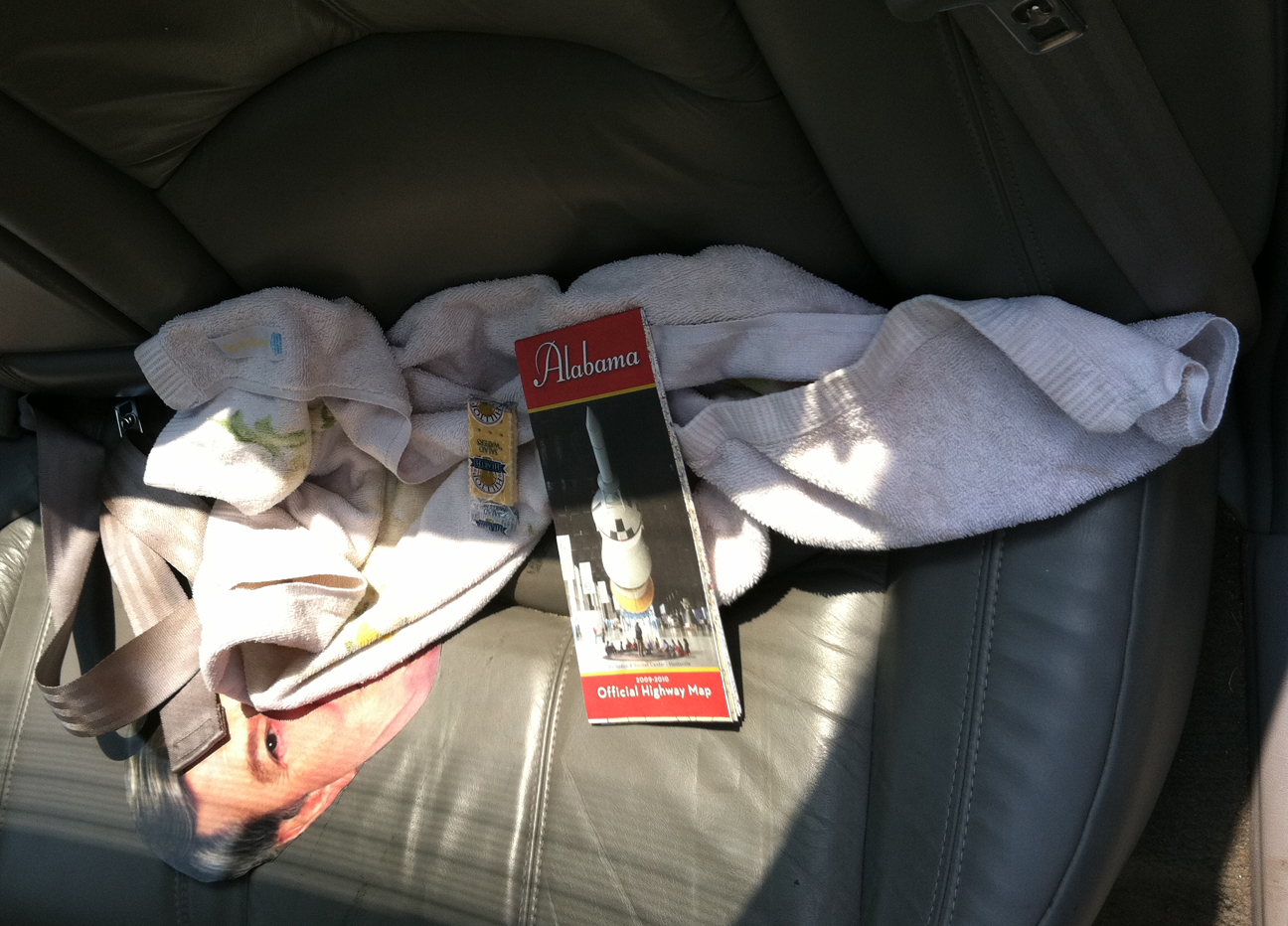
Mine is on the back seat of my car, all wadded up with a bunch of other junk. But I know where it is. Because today is Towel Day.

I don’t see any scheduled events here in SC. But Burl, there’s a guy who’s inviting people to join him for Pan Galactic Gargle Blasters at sunset in Waikiki. So we know where you’ll be…

Slight delay in the end of the world

A couple of quick pop-culture references, and Kathryn will be grateful that neither is to “The Godfather” (don’t worry, fans, I’m sure I’ll get back to the Corleones soon enough). The first is that I’m feeling sort of like Billy Jack

I want you to know… that I try. When Jean and the kids at the school tell me that I’m supposed to control my tendency to be a wiseacre, and be passive and respectful of other people’s beliefs like they are, I try. I really try. Though when I see this guy… who should know to keep quiet after this weekend… and I see him speaking up again, and getting quoted, and I think of the number of months that we’re probably going to have to keep hearing about it… I just go BERSERK!

I’m referring, of course, to the news that this Harold Camping guy is saying, Oops, the Rapture’s gonna come in October now.

The second cultural reference is more obscure. It’s to The Dirty Dozen. No, not the movie, but the (much superior) E.M. Nathanson novel on which it was based. The novel is so little-remembered that I had trouble finding a full preview of it on Google Books to check my quote. But near the end of the book, when Samson Posey, a Ute Indian, tries to perform a Sun Dance to get the weather to clear over Normandy, and one of the other 11 guys starts making fun of him, suggesting he’s doing a rain dance by mistake, an Army chaplain standing nearby says “Don’t mock him, fellow! Whatever your beliefs — if you have any — do not mock him!”

Which I’ve always thought was a pretty good thought to live by. (Look, if you want a blog that quotes Shakespeare, there are plenty of them out there.) A lot of people believe a lot of unlikely things. In this case, we have some people believing something that is directly refuted by the Bible. Which is inexplicable. OK, so Camping isn’t a biblical literalist. Cool. But we’re talking about a quote attributed to Jesus Christ himself saying No one knows the day or the hour

But I try, I really try, not to make fun. You’ll note that I did not do so last week.

But this guy is really, really trying my patience, and my resolve to be tolerant and respectful…

More on The Filter Bubble

If you were interested in this post back here, you might want to check out this review of Eli Pariser’s book, The Filter Bubble. An excerpt:

… Personalization is meant to make Internet users happy: It shows them information that mathematical calculations indicate is more likely than generalized content to be of interest. Google’s personalized search results track dozens of variables to deliver the links that a user is predicted to be most likely to click on. As a result, Google users click on more of the results that they get. That’s good for Google, good for its advertisers, good for other websites and presumably good for the user.

But Mr. Pariser worries that there’s a dark downside to giving people their own custom version of the Internet. “Personalization isn’t just shaping what we buy,” he writes. “Thirty-six percent of Americans under thirty get their news through social networking sites.” As we become increasingly dependent on the Internet for our view of the world, and as the Internet becomes more and more fine-tuned to show us only what we like, the would-be information superhighway risks becoming a land of cul-de-sacs, with each of its users living in an individualized bubble created by automated filters—of which the user is barely aware.

To Mr. Pariser, these well-intended filters pose a serious threat to democracy by undermining political debate. If partisans on either side of the issues seem uninterested in the opposition’s thinking nowadays, wait until Google’s helpful sorters really step up their game….

If you read the book, let me know how it comes out. The review said was strong on identifying a problem, not so hot on solutions. Which I wouldn’t blame on Pariser. No one else knows the answer, either.

Trotsky, and other Reds In Name Only

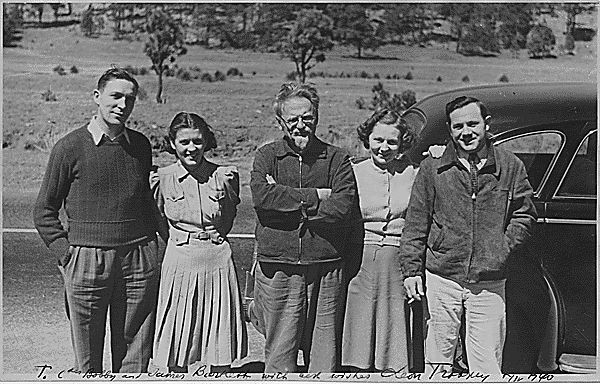
The Old Man in Mexico with some American comrades.

Something about our finding and killing bin Laden in his home after all these years got me to thinking about Leon Trotsky.

Yeah, I know — not the same thing at all. We’re not the USSR, and President Obama isn’t Stalin. And people knew Trotsky was in Mexico, and he wasn’t killed by Spetznaz commandos (and I think it would kind of anachronistic if he had been).

But still, it made me think of him. The mind sometimes makes strange leaps.

Trotsky wasn’t far from my mind because a while back, I started reading a recent biography about his Mexico years. I had been attracted to it by a review in the WSJ, and asked for it and got it for my birthday or something last year. I had been really curious about the story of a top icon of the Russian Revolution living south of our border, and largely supported by American Trotskyists.

But after the first few chapters, and reading all about the soap opera with Diego Rivera and Frida Kahlo and ALL the propaganda from Moscow and from Trotsky himself over the show trials and so forth, I got bogged down.

And the thing that wore me down the most, that frankly bored me to tears, was all the long-distance ideological arm-wrestling. You know how I have little patience with ideologues. There were all these titanic arguments going back and forth between the Trotskyites and the Stalinists about who was the REAL commie, each side working so hard to delegitimize the other (with the stakes being life or death for Trotsky), essentially accusing each other of being RINOs — Reds In Name Only.

And I just couldn’t care about any of them. I mean, talk about pointless. Trotsky was as ruthless as they come, while Stalin was one of the great monsters of the century. And it was pathetic that leftists in this country would actually take up the cudgels to defend or make excuses for either of them. The arguments over doctrine — stupid, irrelevant points of doctrine argued heatedly among people who, ironically given what they believed in, were on the wrong side of history — were particularly tedious.

At some point, I need to get back to the book and see how the guy with the ice ax got in and did the deed. But I haven’t been able to make myself do so yet…

Some nice writing; that’s all I’m saying

I don’t know whether Joe Roman can write, but Katherine Mangu-Ward certainly can.

I generally like reading the book reviews in the WSJ (which run every day but Saturday on the paper’s THIRD opinion page), but Ms. Mangu-Ward’s review of Mr. Roman’s book Listed particularly grabbed me.

My favorite part was the first two sentences of her lede, which I highlight:

Wolves are notoriously slow to hire lobbyists. Lichen doubly so. It’s no surprise, then, that the Endangered Species Act is a law written by humans and used for human ends. Ever since the act’s 1973 debut, supporters and opponents have accused each other of playing politics with the fates of nearly extinct plants and animals. To be fair, both sides are usually right. In “Listed,” conservation biologist Joe Roman recounts the uses and abuses of a well-intentioned but all-too-human law.

The very next sentence was nice, too:

The difficulty of getting off the list of endangered species ranks right up there with unsubscribing from the Pottery Barn catalog.

I was also partial to this part:

Wolves are the exception: Yesterday, President Barack Obama swiftly and unceremoniously booted the wolves of the Northern Rockies and Great Lakes off the list. Humans have strong feelings about wolves—probably because, as predators, they have been one of our major rivals for ungulate calories over the millennia—and government officials are no exception.

I mean, apart from ending the first and last sentences with “exception,” which I just now noticed.

Yeah, I know — it’s very WSJ to run a piece casting doubt on the value of such gummint meddlin’ as the Endangered Species Act. But I’m just saying it was well-written. I always appreciate that, whatever the writer may be trying to say…

She mostly seemed to like the book except at the end, which causes her writing to take on a sharper edge:

But the book takes an abrupt turn in its final pages. Mr. Roman offers a plan “to make extinction as unacceptable as slavery and child labor” and lists nine steps—he says he drew them up with biologist Paul R. Ehrlich and others. Mr. Ehrlich is most famous for predicting, in “The Population Bomb” (1968), that overpopulation would cause mass starvation. It is his cold voice, not Mr. Roman’s friendly one, that leaps off the page: “Stabilizing the human population, even humanely reducing it, will improve the lives of people and wildlife.” How the world’s population will be “humanely” reduced isn’t explained.

Anyway, I probably won’t ever get around to the book, but I enjoyed the review. I don’t say nice things about what other people do enough, so I thought I’d say this.

And now for something completely different: Some Holy Week Ezra Pound

Today there was a review in The Wall Street Journal of a book compiling letters that poet Ezra Pound wrote to his parents, which I read with some interest.

I don’t really know all that much about Pound. I remember something about him boxing with Ernest Hemingway, I recall that he was sort of a godfather to some of the young expatriates of that generation, and the fact that he took an EXTREME wrong turn when he came to support Fascism.

But my horror at his politics doesn’t keep me from appreciating an interesting piece of writing, any more than I dismiss Lindbergh’s achievement as an aviator because of his political sympathies.

And not being an English major or anything, I’m only familiar with one thing about his work. My uncle had this anthology of English literature lying about at the family home in Bennettsville, and I read this poem by Pound in it, back in my college days. And it’s always stuck with me as one of the most distinctive and iconoclastic portraits of Jesus I’ve ever read, even more so than Anthony Burgess’ version. Aside from the words, I like the rhythm of it; it’s almost like a sea chanty or something. I tend to like things that cause me to think a little harder and question my assumptions about someone, especially someone as important as Jesus. Even when it comes from a fascist.

This being Holy Week, I thought I’d share it:

Ballad of the Goodly Fere

Ha’ we lost the goodliest fere o’ all
For the priests and the gallows tree?
Aye lover he was of brawny men,
O’ ships and the open sea.

When they came wi’ a host to take Our Man
His smile was good to see,
“First let these go!” quo’ our Goodly Fere,
“Or I’ll see ye damned,” says he.

Aye he sent us out through the crossed high spears
And the scorn of his laugh rang free,
“Why took ye not me when I walked about
Alone in the town?” says he.

Oh we drank his “Hale” in the good red wine
When we last made company,
No capon priest was the Goodly Fere
But a man o’ men was he.

I ha’ seen him drive a hundred men
Wi’ a bundle o’ cords swung free,
That they took the high and holy house
For their pawn and treasury.

They’ll no’ get him a’ in a book I think
Though they write it cunningly;
No mouse of the scrolls was the Goodly Fere
But aye loved the open sea.

If they think they ha’ snared our Goodly Fere
They are fools to the last degree.
“I’ll go to the feast,” quo’ our Goodly Fere,
“Though I go to the gallows tree.”

“Ye ha’ seen me heal the lame and blind,
And wake the dead,” says he,
“Ye shall see one thing to master all:
‘Tis how a brave man dies on the tree.”

A son of God was the Goodly Fere
That bade us his brothers be.
I ha’ seen him cow a thousand men.
I have seen him upon the tree.

He cried no cry when they drave the nails
And the blood gushed hot and free,
The hounds of the crimson sky gave tongue
But never a cry cried he.

I ha’ seen him cow a thousand men
On the hills o’ Galilee,
They whined as he walked out calm between,
Wi’ his eyes like the grey o’ the sea,

Like the sea that brooks no voyaging
With the winds unleashed and free,
Like the sea that he cowed at Genseret
Wi’ twey words spoke’ suddently.

A master of men was the Goodly Fere,
A mate of the wind and sea,
If they think they ha’ slain our Goodly Fere
They are fools eternally.

I ha’ seen him eat o’ the honey-comb
Sin’ they nailed him to the tree.

Standing up for civilization, harrumph

Ever since the WSJ added a third daily opinion page (when they followed the rest of the industry and went to narrower pages to save newsprint), at about the same time we were cutting back on pages at The State in my desperate bid to get through bad times without cutting people (see how well that worked out?), I have…

Wait. I got lost in the multiple parentheticals… oh, yeah… ever since then, I’ve been hooked on the daily book review that runs all the way down the right-hand side of that page, Mondays through Fridays. For the first time in I don’t know when, I go into Barnes & Noble and am well familiar with pretty much everything on the “new arrival” shelves. And I’ve always got a list of books I want when Father’s Day, my birthday and Christmas roll around. To the point that I’m backed up on reading, and so intimidated by the stack of new books that I avoid the issue by rereading the Aubrey/Maturin series instead (I’m now on my fifth time through The Fortune of War).

But here’s another one I might have to request and add to the shelf, reviewed in today’s paper:

Among academics, the word “civilization” has long had a sinister ring to it, carrying associations of elitism and luxury. Worse, it is linked to imperialism, having provided Europeans with the justification for their far-flung conquests in centuries past—and, these days, for endless self-flagellation.

With “In Search of Civilization,” John Armstrong, the resident philosopher at the Melbourne Business School in Australia, sets out to restore the reputation of a word that, to him, represents something infinitely precious and life-sustaining, a source of strength and inspiration. The great civilizations, he says, provide “a community of maturity in which across the ages individuals try to help each other cope with the demands of mortality.”

As he makes clear, his purpose is not to provide a history of various civilizations or to update Samuel Huntington’s seminal 1996 book on the post-Cold War world, “The Clash of Civilizations,” though he cites Huntington’s conclusion that today’s real conflict is between civilization and barbarism. Mr. Armstrong wishes to convey what the idea means to him personally…

Indeed. Too bloody right. The real conflict — at home and abroad, is between civilization and barbarism. And it so often seems that civilization is losing, especially on the domestic front. And most especially in our politics, increasingly defined by mutually exclusive factions screaming pointlessly at each other.

I mean, what’s the world coming to when a guy who is supposedly all dedicated to having a civil blog starts using modifiers like “bloody?” I ask you…

Anyway, the book sounds interesting, and possibly edifying. I like the ending. After lamenting the state of the humanities in academia, the review concludes:

Our artists, too, have failed: The author sees Andy Warhol, Damien Hirst, Jeff Koons and their ilk as representatives of a decadent cultural elite that insists on provocation and newness as the only criteria for judging art. “Mockery, irony and archness,” Mr. Armstrong says, “is not what we need.” What is needed is hope and confidence. The treasures are all there to be rediscovered, if only we would bother.

Indeed, again. And harrumph, say I.

You’ve got to be kidding me

Just saw this — significantly, while I saw it on thestate.com, it’s being reported out of The Associated Press’ New York office — and I’m thoroughly boggled yet again:

South Carolina Gov. Nikki Haley is writing memoir

By HILLEL ITALIE – AP National Writer

NEW YORK — Gov. Nikki Haley of South Carolina has been busy trying to close her state’s $700 million budget gap, but she has found time for a more personal project, jotting down thoughts and memories during quiet moments in the early morning, late at night and on weekends.

She is writing a memoir.

“I will tell you that since the election it was amazing the number of people of people who wanted to know my story, about the challenges of growing up and the challenges of running for office and what got me through it,” the 39-year-old Republican, the nation’s youngest governor, told The Associated Press during a recent telephone interview….

Note that last bit: “the nation’s youngest governor.”

Indeed. She hasn’t done anything yet, and she’s writing a memoir!?!?!? Of what?!?!? I’ve known her for years, and nothing worth writing a book about has happened during that time. Maybe there’s a lot of fascinating stuff that happened before then, that I haven’t heard about — or heard her say over and over again on the stump. (You know the drill: “I’m the daughter of…,” etc.)

Of course, you know why she’s doing this, and why it’s being revealed through a national medium. For the same reason Mike Huckabee is doing a book tour, and Sarah Palin before him.

I hate even to write the words, but she thinks she’s presidential timber. There’s one thing that DOES set her apart, of course, and would be worth exploring in the book: She holds the record among SC governors for having her head turned by White House hubris. Our last four governors (each of them with less justification than his precedessor) all harbored presidential ambitions. But they, at least, waited until the got elected governor before contemplating such things. Not our Nikki. In her mind, she had already skipped over the whole being-governor thing about six months, and started looking beyond it, before she was elected.

I don’t know how much more of this I can stand. Remember my post the other day, listing three examples illustrating how “Our young governor’s presumption apparently knows no bounds?” Well, add this to the list.

A memoir. Sheesh.

Get ready to read a book, y’all — One Book

Belinda Gergel called me — and 150 or so other people — a week or two ago and asked me to be part of the effort to get Columbia to read a book together.

She called me because I’d been there before. Way back at the end of the last century, I read something about the Seattle librarian who came up with this idea to get everybody in the city to read a book together. The idea caught on, and other cities started doing thesame. I asked why not Columbia as well (or did I ask why not South Carolina? I forget, and can’t find my columns about it)? The idea appealed to my communitarianism. I’m all about reading, and books, and ideas, and when I’m reading a book I like to talk about it, and I could think of few things cooler than reading a really good book, and wanting to talk about it, and then having the satisfaction of everybody else I ran into having read it, too. Y’all are familiar with my frustration that it’s hard to find anyone other than Mike Fitts who is as into the Aubrey/Maturin universe as I am — Tolkien fanatics have their support groups, but what about those of us who want to read O’Brian over and over? Confession here — I’m now progressing (if one can call such “Groundhog Day” repetition progress) through my fifth reading of Desolation Island. Anyone want to talk about the charms of Mrs. Wogan, or the horror of seeing the Waakzaamheid go down with all hands in the Roaring Forties? Anyone? Anyone? That’s what I thought.

But I digress, as usual.

Claudia Brinson and I, with the help of some nice folks over at the SC Arts Commission, then launched an effort to get everyone to read Fahrenheit 451. My choice, of course. And it was moderately successful — I spoke to some book clubs that joined in the effort. Then we were going to do it again, but we couldn’t agree on a book (the committee wanted to go in one direction, I wanted to go in another), and it just sort of petered out.

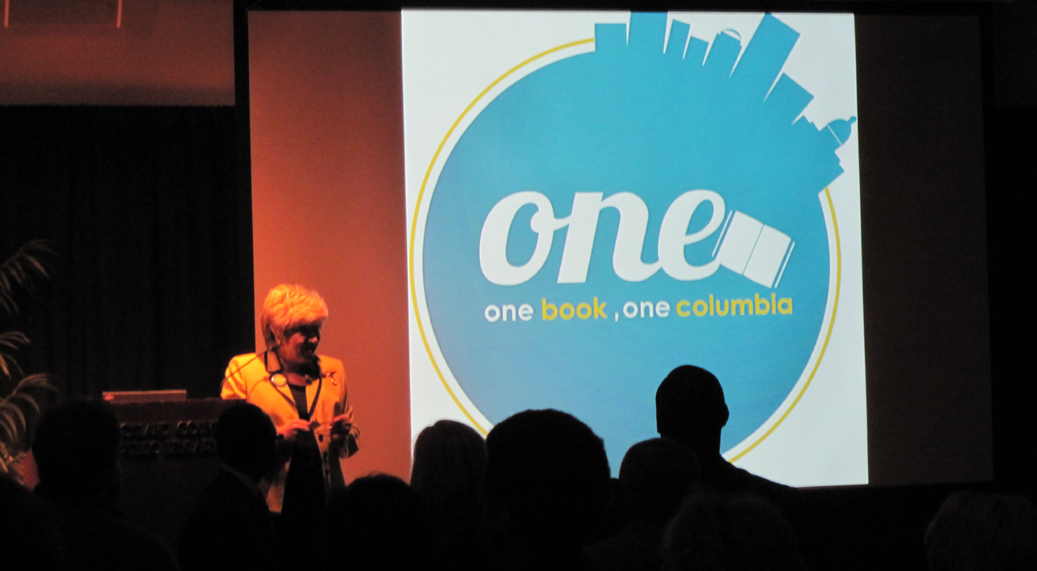
But now Belinda, and the Richland County Public Library, are launching the effort on a grander scale. The above picture is from a reception at the library Thursday night, where Belinda addressed the core group she had assembled so she could send us out as book missionaries. We got buttons to wear and everything (I still have a bag full of buttons with the numbers “451” in flames, which I ran across when I was cleaning out my office at The State.) The reception was nice, although I didn’t see any beer. Just wine. Belinda urged us to enjoy ourselves but to be in by 2 a.m. That got a good laugh, as everyone imagined this bookish crowd running riot in the streets into the wee hours.

Here’s some info Belinda sent out after the reception:

What is One Book, One Columbia?

The City of Columbia and Richland County Public Library (RCPL) have joined forces to launch their first citywide reading adventure, One Book, One Columbia, and all residents of Columbia and Richland County are invited to read the book between April 1 and May 15 then share their experiences with friends and neighbors. Numerous discussions and programs centered around the book will take place during the reading period.

What book has been selected?

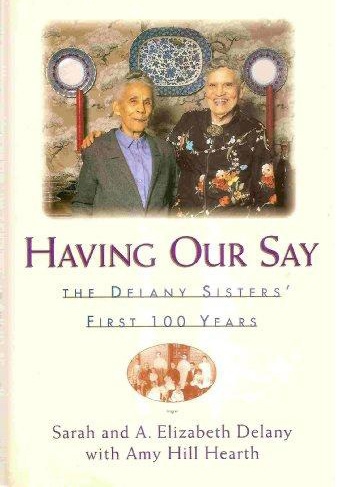
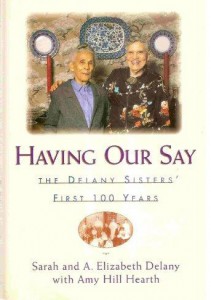
The first selection for this annual occurrence is Having Our Say: The Delany Sisters’ First 100 Years by AmyHill Hearth, Elizabeth Delany and Sarah Delany. This best-selling book tells the story of two remarkable sisters, career trailblazers, who charted their own path in the world, guided by the strength they gained from faith and family. The incredible stories of “Queen Bess” and “Sweet Sadie,” as they were known to their family, were captured by one-time Columbia resident and author Amy Hill Hearth. Upon its publication in 1993, The New York Times said of Having Our Say: “The Delany sisters were taught to participate in history, not just witness it, and they have the wit to shape their history with style… they make each memory vivid…they are literature’s living kin.”
How can I participate?

Read the book

The book is available at RCPL locations, or is available for purchase at Barnes and Noble and other retailers.

Talk to your family, friends, and neighbors about the book

Get your friends and family in on the act! An important aspect of the One Book experience is talking about what you read with others. Be on the lookout for residents wearing a One Book, One Columbia button around town – these Reading Advocates will definitely be ready to talk Having Our Say!

Participate in a One Book, One Columbia book club or event

RCPL will have special One Book, One Columbia book club meetings and events throughout April and early May at their branches. Other community organizations are getting creative with their plans: discussions, art, historic tours, and activities for kids are just a few of the ways the community has embraced the One Book, One Columbia effort. Visit www.myrcpl.com/onebook for full details.

Get connected

Visit the One Book, One Columbia page on Facebook and “like” to get all of the latest news.

I invite all of y’all to get involved, especially if you’re in a book club or something.

Now, before you say, “But that book doesn’t interest me,” allow me to be brutally honest, or perversely contrarian, or whatever: I wouldn’t have picked this book, either. It’s the kind that most modern book-clubby people would pick. It’s definitely the kind Belinda would pick — hey, it’s the kind of book Belinda would write. But it’s not exactly the first thing I’d grab off the shelf.

How should I put this? There’s a cultural divide here, perhaps effectively symbolized by the fact that there was wine at the reception, but no beer. I’m not saying that to be critical, far from it. I’m just… well, I’ll get to my point in a minute. I’m just saying, different strokes and all that.

This is related to the trouble we had coming up with a second book back when I tried to start a movement like this. I wanted to read another book like the Bradbury one. I wanted something else from the modern canon, the kinds of books that were required reading when I was in high school: 1984, The Sun Also Rises, Brave New World, Crime and Punishment if we wanted to get heavy, Catch-22, Steppenwolf, Stranger in a Strange Land, or if we wanted to be more modern, High Fidelity. I definitely would have been up for Huck Finn. The rest of the committee wanted … something by a contemporary author, someone one could invite to come speak and participate, preferably Southern, probably a woman. Hey, I was willing to read a book by a woman — but the committee rejected To Kill a Mockingbird, probably because they thought it too obvious or trite or whatever.

Thing is, there aren’t many books by living authors that interest me enough to want to read them with a group and discuss them. And I’ve also got this thing of wanting to read books I like over and over. (How about that Mrs. Wogan, huh? Anyone?) But there’s also the problem that I’m not that interested in the kinds of books that book clubs read. The last time I knew of a book club reading a book I wanted to read (aside from the Bradbury book, and I instigated that), it was James Fallows’ Breaking The News: How the Media Undermine American Democracy, which I had reviewed in the paper and a Heathwood book club asked me to address them about. That was 1996. Mostly, book clubs want to read, well, Battle Hymn of the Tiger Mother or some such.

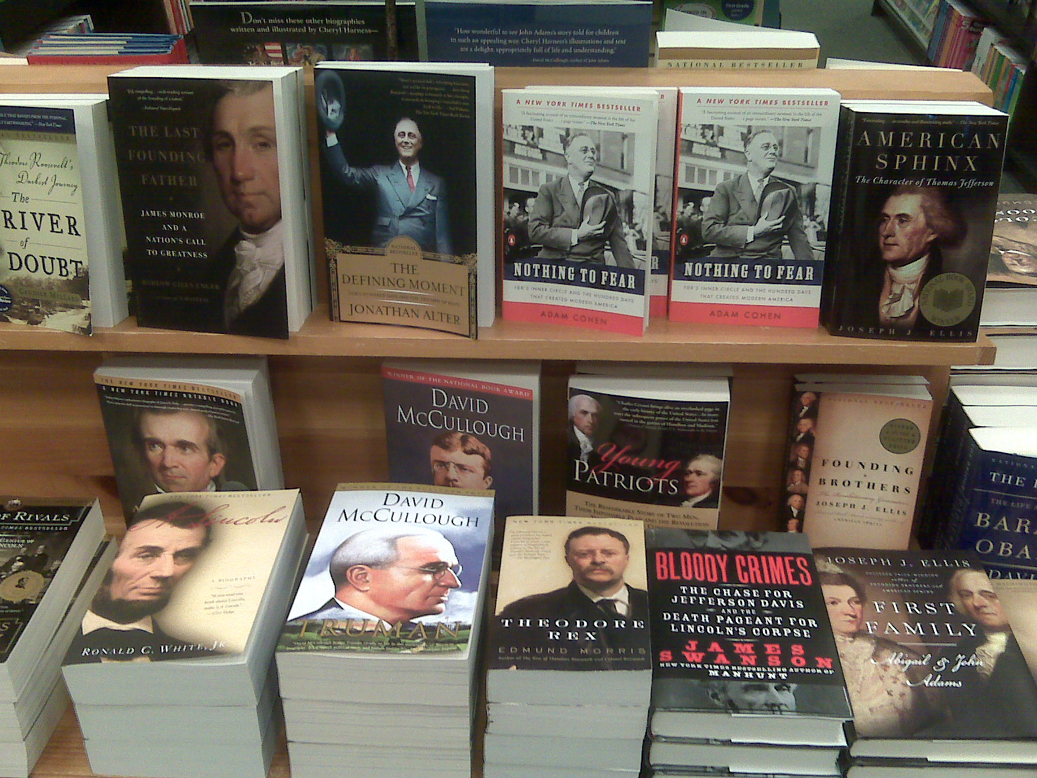
This book that Columbia is going to read isn’t exactly that, but it isn’t exactly the sort of thing I usually read, either. It’s… social history, judging it by its cover. I’m an old-school Great Men Fighting Wars kind of history buff, and that’s what I tend to read when I read nonfiction.

Which is why — and this is where I come to my point (remember, I promised I would) — it’s probably a good idea for me to read this book. And why you probably should, too. Broaden our horizons.

Also, I’ve promised I would. I’ve been wearing the button and everything. I’d best go get a copy. I’ll keep you posted — and we can discuss it. Which will be cool.
The kind of biographies I USUALLY read...

Who are your Top Five Presidents?

Salon is SO predictable. For President’s Day, they post a piece posing the question, “Who’s the worst president of them all?” And of course, since that site is totally in the grip of Bush Derangement Syndrome (still), it boils down to a choice between George W. Bush and someone else. In this case, Buchanan.

Of course, being Salon, that’s why they ran it. But you know where they would go before you clicked on the link, right? So partisan. So parochial. So lacking in historical perspective.

Yawn.

Me, I’m not interested in a worst, or a worst list, because that just doesn’t seem in the spirit of Presidents’ Day, which is about celebrating rather than tearing down. So, who are your Top Five, All Time, Desert-Island presidents?

Oh, and if you include Barack Obama, which to me would be the flip side of picking W. as the worst, as if you can’t think outside your own 21st century chauvinism, I’ll just quote Barry at you:

Couldn’t you make it any more obvious than that? What about the Beatles? What about the Rolling Stones? What about…Beethoven? Track one side one of the Fifth Symphony?…

(You sort of have to know Barry to get that. And if you don’t, I definitely recommend that you read High Fidelity, which is where I got this mania for Top Five Lists. The movie’s fine, but read the book.)

My own list is a little shaky, but I’ll just throw some out there to get this started:

  1. Abraham Lincoln — The guy who held us together at the fulcrum of our history, and did it with heroic force of will and epic strength of character while at the same time maintaining his own instinctive humility. He seemed at times to stand alone, politically, in his insistence on holding the nation together (and thank God he did). No one outdoes him in rising above finger-in-the-wind politics to embody leadership; only Washington and FDR come close. That brooding statue at the memorial is the visual evocation of what I’m talking about, which is what makes it so iconic. Of course, if you’re of pacifist tendencies, you have to note that no one person in our history was more singlehandedly responsible for the shedding of more American blood — without his force of will, the nation likely wouldn’t have stayed the course that long. But then, you have to ask yourself, was it worth it? Unfortunately, we’re still fighting over that in SC.
  2. Franklin Delano Roosevelt — Again, almost superhuman leadership through crises of such scope and sweep that they stagger the mind. Argue all you want about the effectiveness of the New Deal, I think it was this cripple’s ebullient refusal to be a cripple, or let his country wallow in its troubles, that pulled us through the Depression more than anything. As for the Second World War — the nation was right to feel panicky when he died just before we’d finished winning it; his leadership was that critical on an abstract, spiritual level. The fact that we went ahead and won it quickly is a testament to what he’d already done, but also, it should be said, proof that the nation’s greatness and strength exceeds that of one man, however great the man. You could say that anybody who was president through those crises would be deemed great after they ended successfully. But I would say the nation was very fortunate to have this particular man at that time. And the people of this country knew it, which is why they elected him four times.
  3. John Adams — OK, he’s not necessarily the greatest AS president (in fact, that was one of the low points of his career), and sure, there’s that business where he let the more partisan Federalists maneuver him into the Alien and Sedition Acts. It’s just that, if you take his whole life — and his whole adult life pretty much was devoted to getting this country started, being the most eloquent advocate for independence, getting backing from abroad (the French, the Dutch) for the revolution, suggesting Washington to head the Continental Army, (and suggesting Jefferson do the final writing on the Declaration), and on and on — it’s hard to imagine one guy contributing so much to a new country. But he did. I guess I’m putting him on here as a sort of Lifetime Achievement Award.
  4. George Washington — Back when I was in college, it wasn’t fashionable to emphasize Washington as much as some of the other Founders. You know, because he was so obvious, it was uncool. (We were like Barry, in other words.) I tended to focus on the idea guys — Adams, Madison, Jefferson, Franklin, Hamilton. But over time, I’ve come to understand better the importance of his leadership — both in terms of being an inspirational leader that the country could rally around (something he cultivated consciously, which would make some dismiss him, but I think he saw what the country needed and provided it), and in terms of his self-effacing refusal to become a king or a facsimile of one. In other words, my understanding and appreciation has progressed beyond the cherry-tree myth.
  5. Theodore Roosevelt — I used to think that Teddy was on Mount Rushmore for the same reason that people tend to put W. and Obama on their best and worst lists (depending on their inclinations): He was the president at the time, so they put him up there. But having read the first book in Edmund Morris’ trilogy (I need to get to the second; it’s sitting on my bookshelf waiting), I’m far more convinced of the role he played in transitioning the nation from what had been since 1776 and taking it to what it would be in the 20th century. His building up of the Navy would have been enough to get him on a Top Ten list. But then you look at his Progressive initiatives, his passion for reform, and that takes you much further. A lot of detractors would dismiss his imperialism, but I think that’s another sort of temporal chauvinism — applying today’s standards to a man of another time. I would look at the positive side of that — he saw the importance of the United States taking its place alongside the “Great Nations of Europe,” and saw aggressive posture as essential to that. In other words, you can take his “Bully!” a couple of ways. But in my book, as you know, I think the world is better off with the United States in the leading role, rather than some of those “Great Nations,” as they were then. And I worry about a future time when a nation that would never, ever produce a TR is in that role. Roosevelt personified American vigor, optimism, innovation and industry, making him a sort of archetype, an embodiment of the nation at that point in history — much the way JFK did later.

Wow. Barry would really be dismissive of MY list. It’s like, Mount Rushmore minus Jefferson, plus two. But I can’t help it; the “name” presidents do tend to be among the best, if you’re honest about it. (And I was going to put Jefferson on there, crediting him for the Louisiana Purchase and dealing with the Barbary Pirates — both flying in the face of his own ideology, and I love it when politicians rise above their party lines — but I wanted the other five on there more.

Go ahead, argue with me.