Just got around to looking at the photos from England from my wife’s camera last night.
Here I am posing with Professor James Moriarty at the Sherlock Holmes Museum at 221b Baker St. in London.
Which one is scarier?
Just got around to looking at the photos from England from my wife’s camera last night.
Here I am posing with Professor James Moriarty at the Sherlock Holmes Museum at 221b Baker St. in London.
Which one is scarier?
For the longest time, I didn’t have a quotation on my Facebook profile. This didn’t seem right. I’m all about words. I’m all about pithy expressions of one’s world view, yadda, yadda. (Although I fear that now that I no longer have the discipline of writing a weekly column, I’ve gotten somewhat lazy about it, hence the “yadda, yadda.”)
Loads of other people — people who were not overly thoughtful students of rhetoric, judging by the quotations they chose — had multiple quotations. They had all sorts of things they wanted to say — or rather, things they wanted to let other people say for them.
But the thing is, I like so MANY things that I read — one of my problems in reading books is that, as I read them, I follow people around reading great passages aloud to them (and a well-written book will have at least one such passage per page), which is why people avoid me when I’m reading books — that the idea of singling out one, or two, or even 10 such quotes just seemed too restrictive. I thought, What is that good that I’m willing to have it almost as a personal epitaph? People will see that and think this sums me up. What quotation is there that I like that much?
It would need to be semi-original (obviously, if it were entirely original, it wouldn’t be a quotation). It couldn’t be trite. I couldn’t have seen anyone else use it. It needed to say something I believe. And it needed to be something that has truly stuck with me over time, as opposed to, say, the funniest recent thing I’ve read on Twitter.
So one day it struck me that I should post this:
“I wouldn’t want to live without strong misgivings. Right, Chaplain?”
— Yossarian, in Joseph Heller’s Catch-22
So I did.
And for the longest time, that stood alone, and I was satisfied to let it do so. I liked it on a number of levels. For instance, in a day
when our politics are dominated by people who are SO DAMNED SURE they’re right and other people are wrong, it had a certain countercultural UnParty flavor to it. At the same time, it’s not an existential statement of doubt — the fact that he’s saying it to a chaplain, one who certainly believes in God (although in an unorthodox way, being an Anabaptist), anchors it in belief, but still expresses the idea that one should always be willing to question one’s assumptions.
It also said something I wanted others to know about me. Because I tend to argue whatever position I’m arguing rather tenaciously, even vociferously, people tend to think I’m inflexible. They’re wrong about this. I can usually think of all the reasons I might be wrong just as readily as they can, perhaps even more readily. (After all, one of the main steps in building an argument is imagining all the objections to it.) For instance, take our arguments over the Iraq War, or the debates I have with libertarians. My interlocutors think I’m a bloodthirsty war lover, and a rigid authoritarian. But I’m not, not really. I have a tendency to argue very insistently with your more radical libertarians because I think they go overboard, and that I have to pull REALLY HARD in the other direction to achieve any balance. And on the subject of the war, well… when you reach the conclusion that military action is necessary, and that action is initiated, I feel VERY strongly that you have to see it through, and that the time for debating whether to initiate it is long past. At least, that’s the way I saw the Iraq situation. That doesn’t mean I didn’t think there were viable arguments against it in the first place — I was just unpersuaded by them.
I suppose I could go on and on about why I like the quotation, but that’s not what this post is about.
This post is about the fact that I thought that quote was sort of lonesome, so I added another today:
“Stand in the place where you live.”
— R.E.M.
And here’s why I picked this one.
I’ve always had a beef with people who constantly tear down the place where they live. You know, the whiners who always want to be someplace else. The people who seem to think that if it’s local, it’s no good. These people are destructive. They’re not good neighbors to have.
You know that I’m a born critic, and I’m constantly expressing dissatisfaction with aspects of Columbia, or South Carolina. But I do it from a love of my home, and from a determination to make it better. If there’s something you don’t like about your home, you should be trying with all your might to make it better.
To me, this is a fundamental moral obligation. And like most true believers, I can find Scripture to back it up. Remember the passage that Nathan Ballentine came up with to encourage me when I got laid off? It was Jeremiah 29:11:
For I know well the plans I have in mind for you, says the LORD, plans for your welfare, not for woe! plans to give you a future full of hope.
Well, when I looked that up, I found that I liked what preceded that just as much, the passage in which the prophet told the people not to whine about being in exile, but to affirmatively embrace the place where they were, and get on with life in it:
Thus says the LORD of hosts, the God of Israel, to all the exiles whom I exiled from Jerusalem to Babylon:Build houses to dwell in; plant gardens, and eat their fruits.Take wives and beget sons and daughters; find wives for your sons and give your daughters husbands, so that they may bear sons and daughters. There you must increase in number, not decrease.Promote the welfare of the city to which I have exiled you; pray for it to the LORD, for upon its welfare depends your own.
Let’s repeat that last:
Promote the welfare of the city to which I have exiled you; pray for it to the LORD, for upon its welfare depends your own.
Amen, I say unto you. Stand in the place where you live.
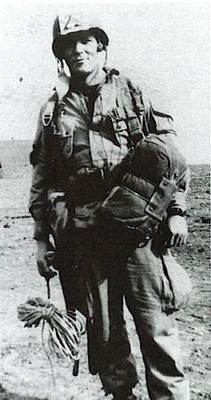
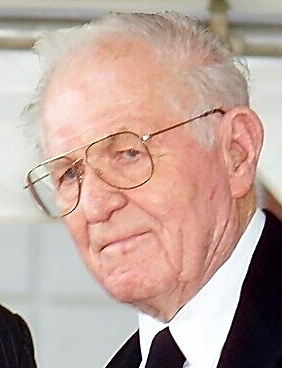
Dick Winters has died. “Captain Winters,” I think of him as, from the time when he commanded Easy Company of the 506th PIR,
101st Airborne Division — although on D-Day, the day on which his actions should have earned the Congressional Medal of Honor, he was still a lieutenant, and by the time the company had captured Hitler’s Eagle’s Nest he was a major, and battalion commander.
Yes, the guy who was the main character in “Band of Brothers.”
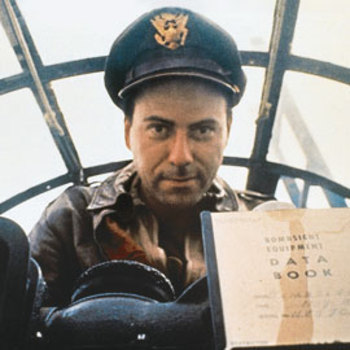
He was a peaceful, modest man who, when war was thrust upon him and the rest of the world, discovered talents and personal resources that would otherwise likely have gone unsuspected. The video clips above and below, with actor Damien Lewis in the role of Winters, perfectly illustrates the qualities that Stephen Ambrose described in the book that inspired the series: Mainly, an uncanny coolness under fire, and certain, unhesitating knowledge of exactly what to do in a given situation — knowledge which he quickly and effectively communicated to his men in real time, with a minimum of fuss. The video clips show how Winters led a tiny remnant of Easy Company (of which he was only acting commander, since the CO was missing, later found to be dead) to take several well-defended, entrenched guns trained on Utah Beach — saving untold numbers of GIs — with only a couple of casualties among his own men. This was on his very first day in combat. The action is used today at West Point as an illustration of how to take a fixed position.
This guy has long been associated in my mind with the definition of the word, “hero.”
In later years, when he was interviewed in old age about the things that happened in 1944-45, you could still see the manner of man he was. His manner was that of a man you’d be confident to follow, a man you’d want to follow if you had to go to war, while at the same time being perfectly modest and soft-spoken about it. And on this link you’ll see what some of his men thought of him.
As I wrote about him last year:
Over the last few years I had occasion to visit central Pennsylvania multiple times, while my daughter was attending a ballet school up there. Almost every time I went there, I thought about going over to Hershey to try to talk to Dick Winters, the legendary commander of Easy Company of the 506th Parachute Infantry Regiment in the 101st Airborne Division during World War II. He was the leader — one of several leaders, but the one everyone remembers as the best — of the company immortalized in Stephen Ambrose’s book Band of Brothers, and the HBO series of the same name (the best series ever made for television).
But I never did. As much as I wanted just to meet him, to shake his hand once, I never did. And there’s a reason for that.
A little while ago, I was reminded of that reason. The History Channel showed a special about D-Day, and one of the narrators was Winters, speaking on camera about 60 years after the events. He spoke in that calm, understated way he’s always had about his heroics that day — he should have received the Medal of Honor for taking out those 105mm pieces aimed at Utah Beach, but an arbitrary cap of one per division had been place on them, so he “only” received the Distinguished Service Cross.
Then, he got a little choked up about what he did that night, having been up for two days, and fighting since midnight. He got down on his knees and thanked God for getting him through that day. Then he promised that, if only he could get home again, he would find a quiet place to live, and live out the rest of his life in peace.
I figure a guy who’s done what he did — that day and during the months after, through the fighting around Bastogne and beyond into Hitler’s Eagle’s Nest itself — deserved to get his wish. He should be left in peace, and not bothered by me or anyone else.
So I’ve never tried to interview him.
Well, I never did impose upon him to get that handshake, even though I’ve been to his general neighborhood again since I wrote that. And that causes me now a mixture of satisfaction and regret.
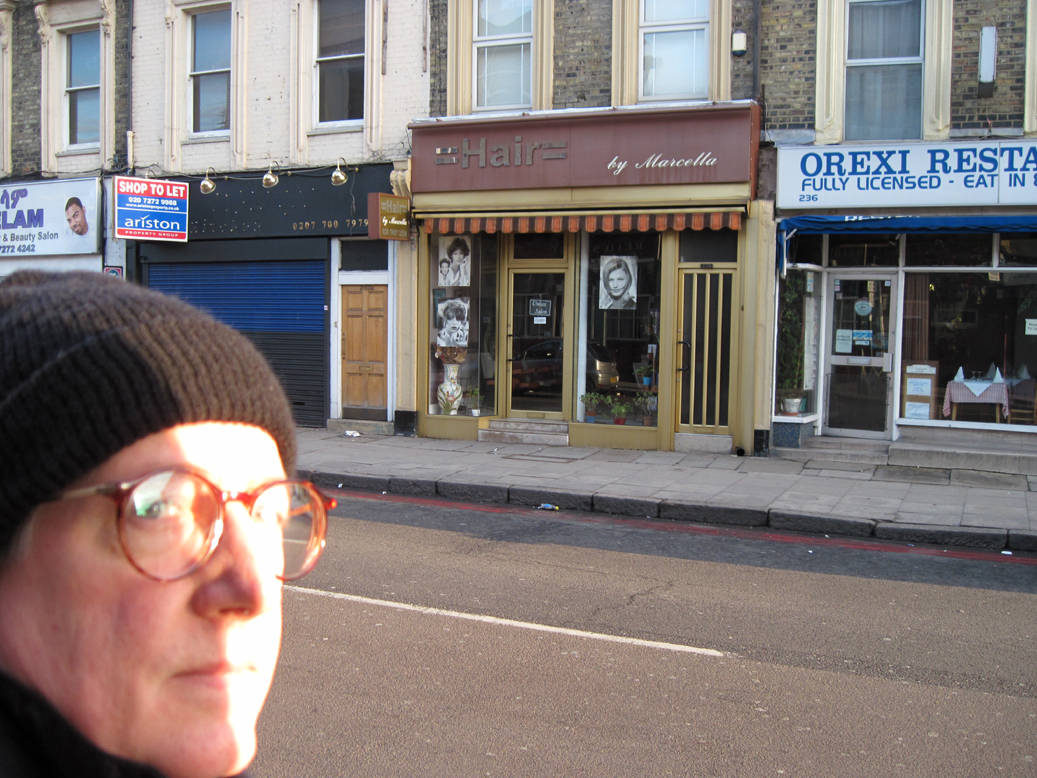
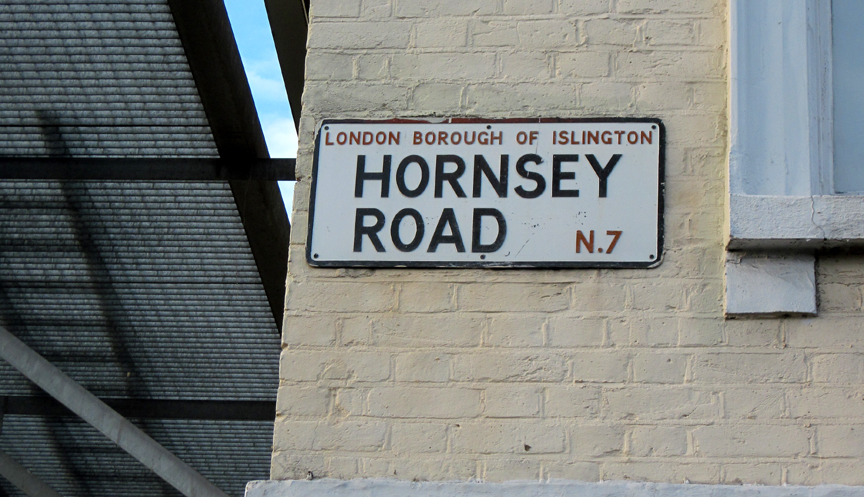
Well, I told you I would find the former site of “Championship Vinyl,” the record shop in High Fidelity, and I did. And no one (except maybe Nick Hornby) can tell me I’m wrong.
It satisfies the criteria:
I made up that last criterion, but the first three are in the book.
So, you ladies are wondering — just how patient is my wife, to go along to places like this? Well, she didn’t. This was the one thing I did
on my own. Today was the day we were leaving London for Oxford, and she just wanted to get up and get ready. So I got up before she did, hopped the Jubilee line down to Green Park and got on the Picadilly way out to Islington, to Holloway Road, and hiked over to Seven Sisters.
Then, after “finding” Championship Vinyl (it was the first street off Seven Sisters with some actual commercial fronts off the main road) on Hornsey Road, I walked back east until I got to Arsenal Stadium, the scene of other Hornby tales. At Arsenal, at least, I wasn’t the only geek taking pictures of the stadium — but the others were English football fans. One guy was having his wife take his picture there while she tried to keep the kids in order.
After I found the Arsenal Tube station (this required asking directions four times, twice from people who did not speak English), I rode back to our stop, and left Swiss Cottage station with sadness. I really, really love the Underground. (There’s no other way I could have gone all the way to Islington in a city this crowded and done all that walking about and gotten back in less than two hours.)
When I got back, J had packed for both of us, and we took a taxi to Victoria Coach Station for the ride to Oxford. Come to think of it, she really is enormously patient with me…
Oh, and if you wonder why I would want to do this… well, you just have to read High Fidelity. The movie was great, but the novel was much better.
Sitting in the Detroit airport, thinking about our eventual destination…
Maybe I’m not, as friends and family seem to think, Jethro. But I am an … idiosyncratic sort of tourist.
Sure, I want to see the usual things in and around London – the Tower, the Bridge, maybe Stonehenge when we get out of town. My granddaughter wants to see Mme. Tussaud’s. I will also reluctantly accompany her onto The Eye, even though the smallest carnival Ferris Wheels give me the fantods.
But I hope she and my wife will indulge me on a few somewhat more oblique digressions.
My notion of what to see Over There is heavily influenced by fiction. This means that I want to see places where people who never actually existed didn’t actually do the things that I read about. That means some of these sights aren’t much to look at, while some are entirely imaginary. But I want to see where they would be if they did exist. Hard to explain.
I’m not entirely alone in this. Some of the more esoteric (I thought) sights have been sought out by other fiction geeks ahead of me – which will save me time in “finding” them. Others are a bit more problematic.
Some examples:
So you see, I’ll be busy.
But you know what I want to do the most? Find and experience things I never even thought of, things I didn’t plan. The places and things I’ll just run across and be delighted by – those are the greatest rewards of travel, I find.
Don’t you?
Got an ad from Barnes & Noble via email saying, “Just Announced!… Oprah’s Latest Book Club Pick.”
Turns out it was something called A Tale of Two Cities by one Charles Dickens. I’m glad Oprah decided to help the guy out. He deserves a wider audience. I see he’s from London. Maybe I’ll look him up when I’m there at the end of the month, give him a little publicity on the blog.
This reminds me of two things:
About that review, in the WSJ — I was struck by this bit of criticism:
There is a rather significant moment in 1849 when he insists on chloroform at the birth of Henry Dickens. A tender gesture aimed at sparing his wife pain? Ms. Nayder has other ideas: “a victory of male medical expertise over natural forces,” she decides, in which such “victory” is “compromised by the method through which it is achieved: the dissociation of mind from her body . . . and her consequent objectification.” This is sharply put, but you have a feeling that Dickens’s omitting to send out for anesthetics would have been equally culpable.
The bit about “objectification” gestures at another of Ms. Nayder’s contexts, which is her determination to give Catherine not so much a life of her own as one acceptable to the ukases of 21st-century academe. Nobody in “The Other Dickens”—remember that this is the age of Gladstone and Disraeli—does anything that is merely idiosyncratic: Having been “disempowered,” they perform “transgressive acts” that may or may not leave them in a state of “valorization.”
In other words, the author was somehow ideologically incapable of reaching the conclusion that maybe, just maybe, Dickens was, as an individual person, simply a jerk.
This got me to wondering about something else, after having watched “Frida” last night and being immersed in arguments among Mexican communists back in the 1930s: Which is more given to silly, pompous jargon — feminism or Marxism. Discuss.

Sure, he wove a tangled web out there in the cold, but in a way things were more straightforward for le Carré's Alec Leamas.
I really value my Wall Street Journal. Every day, it reminds me what a well-run, thoughtful newspaper that still has some resources to work with can do. And in spite of its staid, conservative reputation, it manages to do some really interesting, creative things.
Today, we see what happened when the editors got this idea: With WikiLeaks creating a reality that no novel ever imagined, what would three spy novelists have to say about this strange new world? What does spy fiction look like in a world without secrets?
I devoured it, as I am a fan of spy fiction. And while I am not a reader of any of the three writers they chose (Alex Carr, Joseph Finder and Alex Berenson), they rose well to the occasion of having to write on a newspaper deadline. Sure, they lacked the mastery of the language of John le Carré, and the dry wit of Len Deighton. And none of them have the touch of the late Graham Greene, whose sense of the absurd (think Our Man in Havana, to which le Carré paid tribute in The Tailor of Panama) would fit so well the perversity of Julian Assange et al.
But as I say, they did fine, each taking a different approach. Alex Carr did the best job of portraying the human cost of trashing security, with a U.S. intelligence officer anxiously racing to warn her Afghan source that he has been compromised by WikiLeaks’ callous disregard for his young life.
Those of you who still fail to get, on a gut level, what is wrong with what Wikileaks does should read that one if none of the others.
Joseph Finder had the most complete, in the literary sense, tale, managing to be fairly clever and tell a full story with a twist at the end, and do it all in just over 1,000 words — the length of one of my columns when I was with The State.
Alex Berenson sets a scene pretty well in his piece, but doesn’t resolve anything. It’s a mere snapshot smack in the middle of a story. I still enjoyed reading it.
Yes, it’s fiction, but fiction can communicate truths that journalism cannot. Most of what helps us understand our world, really get it, is in the mortar that lies between the solid fact-bricks that journalism provides. That mortar consists of subjective impressions, emotions, unspoken thoughts — things only an omniscient observer (something that only exists in fiction) can provide.
If you can read those three pieces — I’m never sure what people who don’t subscribe can and can’t read on that site — please do.
I said something about “Adam Smith sermonizing” in The Wall Street Journal back on this post.
Speak of the devil, I just happened to read a book review in that paper this morning about the book, Adam Smith: An Enlightened Life (I am not making this title up), By Nicholas Phillipson.
Talk about your gushing. The reviewer writes, breathily,
Even his appearance is a mystery. The only contemporary likenesses of him are two small, carved medallions. We know Adam Smith as we know the ancients, in colorless stone.
It is a measure of Nicholas Phillipson’s gifts as a writer that he has, from this unpromising material, produced a fascinating book. Mr. Phillipson is the world’s leading historian of the Scottish Enlightenment. His “Adam Smith: An Enlightened Life” animates Smith’s prosaic personal history with an account of the eventful times through which he lived and the revolutionary ideas that inspired him. Adam Smith finally has the biography that he deserves, and it could not be more timely.
Smith’s fame, of course, was made by the “Wealth of Nations.” The book appeared in 1776, a good year in the annals of human liberty. Its teachings are so fundamental to modern economics that familiarity often dulls our appreciation of its brilliance.
Smith constructed his masterpiece on a few ingenious insights into the workings of a commercial economy….
He’s so wonderful, but so unknowable! His ways are so far above our ways, and his thoughts so far above our thoughts, that we know him only through colorless stone! Quick, a paper bag — I’m hyperventilating…
Of course, I must admit, I haven’t read Wealth of Nations. For two centuries and more, I’ve been holding out for the movie version. Maybe it’s all that and more. But at the moment I’m giving myself a break from nonfiction to reread O’Brian’s The Wine-Dark Sea, which of course actually is wonderful. (Speaking of the movie, I watched “Master and Commander” last night on Blu-Ray. If only someone would undertake to make a separate film on each book in the Aubrey/Maturin canon! As soon as it came out on Netflix, you wouldn’t see me for a year…)
After that, I’m going to read the books I got for my birthday, starting with Tony Blair’s new political autobio. Then there’s Woodward’s Obama’s War. Only then will I allow myself the pleasure of reading the latest Arkady Renko mystery, Three Stations.
Then, before I read Adam Smith, I will go back and finish Trotsky: Downfall of a Revolutionary, which I set aside to read Bob Leckie’s Helmet for My Pillow and Eugene Sledge’s With the Old Breed, back-to-back. Then, sometime after Trotsky, I’ll go read Adam Smith — right after I poke myself in the eye with a sharp stick. Twice. Colorless stone, indeed.
Many of you know Janette Turner Hospital, the novelist who for years has run the “Caught in the Creative Act” seminar at USC.
Yesterday, a reader called my attention to a piece over at Gawker, but when I got there I didn’t read the thing I was being directed to, because I got distracted by this item claiming that the Australian writer had written the “world’s haughtiest e-mail” back to her former students here in Colatown:
Janette Turner Hospital is the author of Orpheus Lost and other books, and a professor at Columbia. She sent MFA students at her old school, the University of South Carolina, the following note about their inferiority. It is amazing.
Hospital sent this note to all of the MFA students on the University of South Carolina listserv. More than one of them forwarded it to us. “We’re all enraged,” one MFA grad from USC tells us. “She is nuts!” says another. Indeed. What’s your favorite part? The personal revelations? The breathtaking undertone of insult towards those in South Carolina? Her special pet name for the Upper West Side? This is fertile ground…
After that build-up, I actually found the e-mail to be not quite as bad as advertised. After all, she says nothing BAD about USC, she just … gushes… to a rather odd extent about NYC. But she would not be the first to have her head turned a bit by the tall buildings, or the Starbucks on every corner. I’m rather fond of the city myself — as a place to visit. Follow the link and see what you think. Or if you’re too lazy to click, here’s an excerpt:
As for news from this very different MFA planet, I’m in seventh heaven teaching here, and not only because I have
Orhan Pamuk (whom I hope to bring to USC for Caught in the Creative Act), Oliver Sacks, Simon Schama, Richard Howard, Margo Jefferson, etc., etc., as colleagues, though that is obviously part of it.
My students also live and move and write in seventh heaven and in a fever of creative excitement. Columbia’s MFA is rigorous and competitive but students don’t just have publication as a goal – they take that for granted, since about half the graduating class has a book published or a publishing contract in hand by graduation – so they have their sights set on Pulitzers.
This program is huge, the largest in the country. It’s a 3-year degree, with 300 students enrolled at a given time. Each year, 100 are admitted (in fiction, poetry, nonfiction) with fiction by far the largest segment. But 600+ apply, so the 100 who get in are the cream of the cream…
And then there are all the peripheral pleasures of living on Manhattan: we’ve seen the Matisse exhibition at MOMA, have tickets for the opening of Don Pasquale at the Met Opera, have tickets to see Al Pacino on stage as Shylock in the Merchant of Venice, etc etc. Plus I’m just 15 minutes walking distance from Columbia and from all the sidewalk bistros on Broadway, and 3 minutes from Central Park where we join the joggers every morning. This is Cloud Nine living on the Upper West Side (which is known to my agent and my Norton editor, who live in Greenwich Village, as “Upstate Manhattan.” ) We love it.
What do you think? I mean, I’m glad Janette’s having a good time, and maybe she’s a bit carried away. But I guess I’m too used to the excessive rhetoric of political e-mails to be too appalled.
Or maybe my self-esteem as a South Carolinian has been so battered by the attention we’ve garnered because of the Confederate flag, Mark Sanford, Alvin Greene and Nikki Haley that I’m too numb to be insulted further.
Oh, in case you’re wondering if I’m giving her a break unduly — Ms. Hospital is an acquaintance, but we don’t know each other well. A couple of years back when Salman Rushdie was in town for her program, she asked me to moderate a panel discussion in connection with his appearance (which was flattering, but a little scary, since I hadn’t read any of his books), and I met Mr. Rushdie at a reception afterward. That’s about all I can think of to disclose.
Normally I’m not one to applaud people using positions of trust to settle personal scores, but even if that’s what you call this, in this case I’m all cheers for the Kennedys:
When retiring University of Illinois at Chicago Professor Bill Ayers co-wrote a book in 1973, it was dedicated in part to Sirhan Sirhan, Robert F. Kennedy’s assassin.
That came back to haunt Ayers on Thursday when the U. of I. board, now chaired by Kennedy’s son, considered his request for emeritus status. It was denied in a unanimous vote.
Before the vote, an emotional Chris Kennedy spoke out against granting the status to Ayers.
“I intend to vote against conferring the honorific title of our university to a man whose body of work includes a book dedicated in part to the man who murdered my father,” he said.
“There can be no place in a democracy to celebrate political assassinations or to honor those who do so.”
Later, Kennedy told the Chicago Sun-Times he and the board have not seen any signs of remorse from Ayers in the nearly 40 years since the dedication.
“There’s no evidence in any of his interviews or conversations that he regrets any of those actions — that’s a better question for him,” he told the Sun-Times…
There was a lot of back-and-forth about Ayers back during the 2008 election, you will recall. The thing I like about this personal action by Chris Kennedy is that it serves a public purpose, and of course the public good was what RFK’s memory should be about.
The public good served is that we are made to face clearly what a blackguard Ayers was, and still is (since he’s never expressed regret about what he did back in the day).
So in that sense, this isn’t personal, it’s strictly business. By the way, the “Godfather” reference here is not strictly gratuitous. Mario Puzo wrote another book called The Fourth K, which was about a latter-day member of the Kennedy family who wages unrestricted war on terrorism after his daughter is murdered by terrorists. (The whole “business-vs.-personal” theme was a big one for Puzo. He was fascinated by the idea of powerful men using their power for very personal purposes.)
In this case, Chris Kennedy found a much more gentle way to settle a family account. And good for him. And good for the board, which redeemed this act beyond the realm of personal vengeance by acting unanimously, on principle. This is the way retribution should be conducted, by the full community.
Dang it, I searched on Google Books for the quote I wanted, but you know how they leave out pages here and there? Apparently the page I wanted was one of those.
Anyway, there’s a page somewhere in John le Carre’s The Little Drummer Girl in which our heroine Charlie is being escorted through a bombed-out 1980s Beirut by a couple of young Palestinian-affiliated gunmen whom she, and the reader, find utterly charming. One of them speaks English with an odd tick: He throws “use to” in front of all verbs, giving his speech a strange poignancy at all times. At one point, he’s indicating where a certain landmark — I want to say a Holiday Inn, but my memory could be failing me (and maybe it wasn’t even in the book but in the movie, but good luck finding that; Netflix doesn’t even have it) — back before the city’s devastation, back when it was the Paris of the Mideast. Let’s say it was a Holiday Inn, in which case he would have said, “Holiday Inn — use to was…”
That line kept running through my head when I went home to Bennettsville Saturday for the funeral of “Teenie” Parks — my grandmother’s best friend, who lived next door to my grandparents and then my young uncle (only six years older than I) as he raised his family there, with Teenie taking the place for his kids of my grandmother, who died in 1969. There are people in B’ville who would ask Teenie how I was related to her, even though I wasn’t. We were all that close. Her husband Frank, who died in 1984, had grown up in the house that my grandparents lived in during my childhood and my uncle still lives in today. Then they sold the house to my grandfather and moved next door. From then on it was like one household; we walked in and out of each others’ houses as though the doors weren’t there. We were, as I said, that close.
The funeral was at Thomas Memorial Baptist Church, where I was baptized long before I became Catholic. It’s the scene of an incident for which I’m still remembered by some of the older folks in town — far more than for anything else, really. While at the visitation various folks made a point of saying what I hear so often, that “We miss you so much from the newspaper,” a couple of my relatives made a point of mentioning The Incident, and admonishing me not to repeat it.
(Here’s what happened: It was 1957, and I was four years old. Our preacher then, Mr. Thomas, was not the most accomplished homilist. He tended to drone and lose his train of thought. He was reciting a list of some sort in which towns in the Pee Dee were ranked. It went something like this: “Cheraw was first, Dillon second. Um, Marion was third. And Bennettsville was… it was… um… Bennettsville was, um…” I couldn’t take it. I shouted out, as loud as I could, “FOURTH!!!” The congregation, which had been as tense as I was, erupted into laughter, drowning out Mr. Thomas as he murmured “fourth.” I had not known I was going to do it; it was involuntary. Four, after all, was my favorite number because I was four years old. How could he not think of it? But now that I’d shouted it, the laughter of all those grownups overwhelmed me with embarrassment. I lay my head on my mother’s lap and pretended to be asleep for the rest of the service. Bottom line, to this day, I am known by some as the little boy who yelled “Fourth!”)
After the funeral, driving back through town on Main Street, I pointed out to my wife landmarks that once had been. That’s what put me in mind of the le Carre character. B.B. Sanders’ Esso station, where the proprietor would always lean into the driver’s window, while his employees swarmed over the car to check the oil and the tires and the water and wash the windshield, and ask us, “Y’all want a Co-Cola?” Use to was. Belk’s — use to was. The Bennettsville Department Store — use to was. Penney’s, Miller Thompson pharmacy, the dime stores, Bill Stanton’s daddy’s store, the movie theater, the A&P, the Harris Teeter. All “use to was.” The buildings are all still there, and most look fine from the outside. But they aren’t what they were. And there is almost no one walking on the once-busy sidewalks.
This morning, I almost got a parking ticket because lobbyist Jay Hicks sat across from me as I was about to get up from breakfast, and I stayed, and we started talking about a number of things. Eventually, we got onto the state of South Carolina’s small towns, especially the ones well off the Interstates. He spoke of Bamberg, and I mentioned to him how impressed I was the one time I visited Allendale — all those abandoned motels along 301, which died when the Interstates opened.
We talked about whether there was any hope for turning around South Carolina’s small towns, whether Nikki Haley (who hales from Bamberg) or Camden’s Vincent Sheheen is elected. We reached no conclusions.
And I spoke of visiting Bennettsville over the weekend. I didn’t mention the “use to was” part, because it would have taken too long to explain.
This morning, Henry McMaster dropped by my table at breakfast, opening our conversation by saying, “Are you blogging somebody over here?” Which I took to mean that he was somewhat wary of talking with me after this incident. Or maybe he was referring to this piece involving his protege Trey Walker.
In any case, we didn’t dwell on the subject, but moved to something more important. Henry, apparently seeing I was reading the paper, mentioned The State‘s series this week about the survivors of the Battle of the Bulge. He immediately fixed on the very thing that always fascinates me about that battle — the day-to-day, routine human suffering apart from the combat. He said something like, “And we think WE have it tough sometimes…”
Indeed. As one who has never been tested by combat, but have certainly thought a lot about it, the thing that I’ve always found most intimidating about it is not the actual shooting part. Yeah, if you survived something like the landing at Omaha Beach, you’d be marked by the trauma for life. But in my own imagination at least, that part would be easy compared to the day-to-day misery of living in the field in harsh conditions.
And what the men trapped by the German blitz in the Ardennes went through is an extreme example.
This Bulge reunion is a particularly poignant event for my family, because when I first heard about it, I had thought of how we might be able to bring my father-in-law here for it. But he didn’t make it. He died in January. And when I told y’all about it on the blog, I wrote the following:
My father-in-law, Walter Joseph Phelan Jr., lived a full and worthwhile life. I was thinking yesterday as we mucked through the ice and snow about some of the far-harsher hardships he endured along the way. He was there in the Ardennes in late 1944, the coldest winter in Europe in a century, when the massive, unexpected German attack came. He was a member of the ill-fated 106th Infantry Division (like Kurt Vonnegut). That means he was right at the point of the German spear, right where it smashed through the Allied lines. A friend fell right beside him in the snow, victim of a bullet he felt was meant for him. If he had been the one it found, I’d never have met my wife, and our children and grandchildren wouldn’t exist.
Like Vonnegut and thousands of others, he was captured and held in a German stalag in the last months of the war, when the Germans didn’t even have enough food for themselves, much less for prisoners. After that experience, he never wanted to go to Europe again, and didn’t.
The coldest winter in Europe in a century… That detail from Stephen Ambrose’s Citizen Soldiers has stuck with me ever since I read it. Some of our troops, such as members of the 101st Airborne, were out in that, living in foxholes, for over a month. Every morning, as they stirred, their clothing would crackle as the ice that had formed in it overnight would break. In many instances, they couldn’t build fires for fear of revealing their positions.
I find the idea of soldiering on under such conditions inconceivable. Even if you weren’t killed, or captured (like Mr. Phelan), or wounded (like Bill Guarnere, who lost a leg in an artillery barrage), how on Earth did they not break? Many did, of course. But who could blame them.
Right now, I’m reading With the Old Breed by Eugene Sledge. Many have noted that for the Marines in the Pacific, the entire war was just as miserable as what the Army endured at the Bulge — only it was mud and blood and jungle rot rather than sub-freezing temperatures — and such books as this one and the one I just finished, Bob Leckie’s Helmet for My Pillow, present compelling evidence to that effect. As Sledge wrote of Okinawa, the Marines lived day after day in “an environment so degrading I believed we had been flung into hell’s own cesspool.”
There was a passage Sledge’s book that sticks with me, about how after that experience, the veterans had trouble relating to the rest of us back home; they had to struggle “to comprehend people who griped because America wasn’t perfect, or their coffee wasn’t hot enough, or they had to stand in line and wait for a train or bus.”
People like me. I just notice my coffee has grown cold as I was typing this. As I go to replace it with hot, I am mindful of the privilege, and those who suffered and died to make my life so easy.
Don’t know if you saw this in The Telegraph last week, but they resurrected a 1966 interview Malcolm Muggeridge did with David Cornwell (workname John le Carré), in which he called 007 a “neo-fascist gangster” and elaborated:
“I dislike Bond. I’m not sure that Bond is a spy. I think that it’s a great mistake if one’s talking about espionage literature to include Bond in this category at all,” Le Carré said.
“It seems to me he’s more some kind of international gangster with, as it is said, a licence to kill… he’s a man entirely out of the political context. It’s of no interest to Bond who, for instance, is president of the United States or of the Union of Soviet Republics.”
Asked now about the interview for a programme to appear on BBC Four next week, he eased up a bit, but still had to say:
“But at the root of Bond there was something neo-fascistic and totally materialist. You felt he would have gone through the same antics for any country really, if the girls had been so pretty and the Martinis so dry.”
Oh, lighten up, Francis! We get it! We know Bond is a silly Hugh Hefneresque fantasy, and we know you are the gold standard for real spy fiction (although Len Deighton has occasionally given you a run for your money, such as in The Ipcress File). And we get that it was probably pretty galling in ’66 that everybody was talking about Bond when you were putting out such gritty stuff as your masterpiece, The Spy Who Came In From The Cold.
Anyone ever notice how, if you watch an early Bond movie after seeing Austin Powers, you realize Mike Myers was hardly exaggerating at all? It was all really that goofy.
But here’s the thing that concerned me the most about the Telegraph piece:
Bond has become a Hollywood hero, but Smiley may have the last laugh. While financial woes at film studio MGM have put the 23rd Bond movie on indefinite hold, a new film adaptation of Tinker, Tailor, Soldier, Spy is planned for 2012 with Gary Oldman and Benedict Cumberbatch in starring roles.
Remake “Tinker, Tailor”?!?!? Possibly the best thing ever made for the telly (closest competition being “Band of Brothers”)? Sacrilege! I mean, it’s like Anna Chapman trying to cash in on her celebrity after being blown. In either case, Smiley would be appalled. Gary Oldman is awesome and all (I sort of see him as Karla, though, who does not appear in Tinker). But let’s have a little respect. Maybe instead you could do The Honourable Schoolboy, which got skipped in the original BBC productions.
Just happened to run across this while looking for something else, employing the Dirk Gently method of living, whereby if you’re lost, you follow someone who looks like he knows where he’s going. You may not end up where you wanted to go, but you generally end up someplace you were supposed to be…
I like to include stuff that keeps this blog from being pigeonholed…
In a book review in yesterday’s Wall Street Journal — of The Five-Year Party, by Craig Brandon — there was a passage about yet another weird path down which our national obsession with, and perversion of, the notion of “privacy” has led us:
Mr. Brandon is especially bothered by colleges’ obsession with secrecy and by what he sees as their misuse of the Federal Educational Rights and Privacy Act, which Congress passed in 1974. Ferpa made student grade reports off-limits to parents. But many colleges have adopted an expansive view of Ferpa, claiming that the law applies to all student records. Schools are reluctant to give parents any information about their children, even when it concerns academic, disciplinary and health matters that might help mom and dad nip a problem in the bud.
Such policies can have tragic consequences, as was the case with a University of Kansas student who died of alcohol poisoning in 2009 and a Massachusetts Institute of Technology student who committed suicide in 2000. In both instances there were warning signs, but the parents were not notified. Ferpa’s most notorious failure was Seung-Hui Cho, the mentally ill Virginia Tech student who murdered 32 people and wounded 25 others during a daylong rampage in 2007. Cho’s high school did not alert Virginia Tech to Cho’s violent behavior, professors were barred from conferring with one another about Cho, and the university did not inform Cho’s parents about their son’s troubles—all on the basis of an excessively expansive interpretation of Ferpa, Mr. Brandon says. He recommends that parents have their child sign a Ferpa release form before heading off to college.
Good advice. Those of you who argue with me about curfews and bar closings and the like may side with those who gave us this situation. But I have a parent’s perspective. I want to know what’s going on with my kids. And moreover, I have a right to know — one that in a rational world would easily supersede any imagined “rights” granted by FERPA.
Enjoyed the book review in the WSJ this morning of the book “Getting it Wrong,” debunking some epic media myths:
William Randolph Hearst never said, “You furnish the pictures, and I’ll furnish the war.” Orson Welles’s “War of the Worlds” radio broadcast didn’t panic America. Ed Murrow’s “See It Now” TV show didn’t destroy Sen. Joseph McCarthy. JFK didn’t talk the New York Times into spiking its scoop on the Bay of Pigs invasion. Far from being the first hero of the Iraq War, captured Army Pvt. Jessica Lynch was caught sobbing “Oh, God help us” and never fired a shot.
But the best part was at the very end:
For all Mr. Campbell’s earnest scholarship, these media myths are certain to survive his efforts to slay them. Journalism can’t help itself — it loves and perpetuates its sacred legends of evil power-mongers, courageous underdogs, dread plagues and human folly. At the end of the book, Mr. Campbell offers some remedies for media mythologizing, urging journalists, among other things, “to deepen their appreciation of complexity and ambiguity.” Good luck with that, professor.
Yeah, good luck indeed. For instance, good luck expecting any depth or perspective in the PC tsunami that will wash over us from the national media as they thrill over the idea of “an Indian-American woman” becoming governor in the South. Never mind what she would do as governor, the simplistic identity politics narrative overrides all…
Thought I’d start a separate discussion based on a subthread back on the post about Nikki Haley on the cover of Newsweek.
Phillip, reaching for the bright side of the national MSM’s superficial coronation of Nikki because she’s an Indian-American woman, wrote:
Maybe this is all for a larger good. Even if I disagree with almost everything Haley or Tim Scott stand for, if this means the GOP is now abandoning the “Southern Strategy” of the Helms-Thurmond-Atwater variety, that can only be a healthy thing, for the party and for the country (and region).
Another way of putting it is that soon, racists and bigots in the South will have no one to vote for. That can only mean there’s fewer and fewer of them, and that, electorally speaking, they matter less and less.
And Kathryn chimed in, “Nice thought, Phillip–from your mouth to our ears!”
This little burst of liberal feelgoodism set me off in a way that again illustrates how impatient I am with both liberals and conservatives, even when they are respected friends such as Phillip and Kathryn:
Nice thought, but it hardly makes up for the hard reality. I’m moved to quote the last line of The Sun Also Rises: “Isn’t it pretty to think so?”
You want to hear a dark spin on Phillip’s rosy scenario? It’s all well and good for racism to have nowhere to go, and it’s fine for you to moralize about those awful racist Republicans becoming better. But here’s the other side of that: Maybe after she’s elected and we have another four, if not eight, years of Mark Sanford largely because the national media couldn’t see past being thrilled over an Indian-American woman, liberals in South Carolina (liberals elsewhere won’t notice because they don’t give a damn about SC, except as a source of their occasional amusement) will think, “Maybe this identity politics thing isn’t such a wonderful thing after all.”
Now that would be tremendous. But you know what? I’ve waited through too many 4-year chunks of wasted time in South Carolina to go through another such period just so that Republicans can be more ideologically correct and Democrats can wise up a little. It’s not worth it. Change these things about the parties, and other objectionable idiosyncrasies will simply expand to take their places, because parties are schools for foolishness.
This positive name recognition in Newsweek and elsewhere, which doesn’t go more than a micrometer deep (an Indian-American woman! in the South! Swoon. End of story) is going to make her unstoppable — until the narrative changes in some way.
If the South Carolina MSM will do its job and ask the hard questions (OK, Ms. Transparency, where are those PUBLIC e-mails, which you are hiding behind a special exemption from FOI laws that lawmakers carved out for themselves? Any more $40,000 deals to buy your “good contacts” that you haven’t seen fit to disclose?), maybe the national media, the media that people in SC are much more pervasively exposed to, will notice. Maybe. Maybe. Isn’t it pretty to think so?
As I was firing up the grill about midday, between rainstorms, I glanced at Twitter and was pleased to find this:
RT @AntonJGunn: Remembering my brother Cherone Gunn and his ship mates this Memorial Day.http://twitpic.com/1srfpw
For those of you not yet addicted to Twitter, what’s going on there is that Joe Wilson was reTweeting — that is, sharing with all of his 14,000 followers, Anton Gunn’s sharing of his memory of his brother, Cherone L. Gunn, who was one of the sailors killed on the USS Cole when it was attacked by al Qaeda the year before the 9/11 attacks.
Yes, that was Joe “You Lie” Wilson honoring the brother of the same Anton Gunn whom GOP candidate Sheri Few attacks as a dangerous socialist.
So it is that we set aside our pettier conflicts in the memory of something higher and better.
We all marked the day in our own ways. Burl went by Punchbowl to honor his parents and Ernie Pyle. For my part, I cooked out burgers and hot dogs for as many members of my family as could make it (only three of my kids, but all four granddaughters). Then I made another run with the truck to help one of my daughters get moved out of an apartment. Then I took a nap.
When I woke up, just a little while ago, I watched the end of Clint Eastwood’s “Flags of Our Fathers.”
It ended a little differently from the book, which I just finished reading last week. It ended with the scene of young “Doc” Bradley and some of the other boys splashing in the surf at Iwo Jima. After they had raised the flag over Mt. Suribachi, in a brief interlude in the fighting, some officer had the quirky idea of letting the guys go for a swim. There were weeks of nightmarish fighting against an unseen enemy yet to come, and three of the six flagraisers would be killed before it was over.
The point the narrator was making as we watched them was that they would probably rather be remembered that way, rather than as heroes. Yes, they were heroes, although not for raising a flag. They were heroes for all the other things they did on Iwo Jima, before and after that. Doc Bradley won the Navy Cross for exposing himself to withering enemy fire to treat a wounded Marine (he was a Navy corpsman). He never told his family about the medal; they learned about it after he died in 1994. He didn’t want to be known for that. He just wanted to live his life, build a business and raise his family.
The narrator closes with some words about how they didn’t perform their acts of heroism for flags, or their country, or for abstractions. They did it for each other. Which is what researchers who have studied the way men act in combat have discovered over and over. It’s all about the guy next to you. It’s about your buddies. Nothing profound about that, except that most people who’ve never been in combat probably don’t know it. The implication in this case is that once you’re separated from those buddies, by death or distance, the “heroism” doesn’t mean so much. And it’s just plain bizarre to be celebrated as heroes in the midst of the hoopla of the 7th Bond Drive, the way Bradley and Rene Gagnon and Ira Hayes were. Ira never could handle it, and ended up drinking himself to death. Rene never could get over the fact that his fame didn’t lead to fortune, and was disappointed. Only Doc Bradley seemed to get it together and live a normal, full, satisfying life after the war. Even though he would whimper and cry in the night, and never tell his wife why.
When forced to speak before crowds in the years after the battle, Bradley and the others would tell the people that they weren’t the heroes; the heroes were the ones who didn’t make it. Guys like Mike Strank — or, to go beyond the six, the most famous hero to die on that cinder: John Basilone, who had received the Medal of Honor for his actions on Guadalcanal and never had to fight again, but insisted on going back, and died on the first day of the battle for Iwo (earning the Navy Cross in the process). But that’s the conventional notion of a hero, and not necessarily what they meant.
Talk about messages… The instant I turned off the DVD player from watching “Flags of Our Fathers,” the TV switched to Henry’s “Vultures” ad, just to remind us of the nonsense facing us in the coming week.
What a bringdown, from heroism and the finest selflessness our nation is capable of, to that, which is if anything an appeal to the opposite…
I keep hearing that the Club for Growth is on Converse Chellis’ case for some raises given without performance reviews. I have no idea whether there is a problem there or not (I had trouble finding any elaboration, although I guess it’s out there somewhere).
But I do know this: In my experience (close to 30 years in management), performance reviews are THE biggest waste of time in corporate America. I have wasted YEARS of my life — late nights at the office because of the impossibility of getting this pointless crapola done during the regular working day because there’s actual WORK to do — filling out those blasted things, which sometimes go on for 10 pages or more, with essay question after essay question.
It made for a particularly vicious form of madness when I was a supervising editor in a newsroom and didn’t have a private office. Whenever you saw the metro editor or government editor or photo editor or whichever editor trying to hide in a dark corner of the newsroom at an odd hour, hunkered over a computer muttering, looking like he’d bite the head off anyone who bothered him, he was probably doing performance reviews.
Basically, I always sort of figured that if the employee didn’t know what I thought of the job he or she was doing, then somebody wasn’t paying attention, and probably would ignore the eval as well — because I’ve never been shy about telling people on the spot what I think about what they’re doing.
It particularly became absurd when I headed the editorial department, full of very senior people who usually worked out the kinks in their job performance years earlier, else they wouldn’t have gotten there. Sure, we all have flaws, but at that point in your career they’re pretty permanent, more in the nature of fundamental elements of one’s character. So you end up saying the same things year after year — he’s great at this, she’s not so great at that — and it looks like either you’re a lazy manager (failing to come up with fresh observations), or the employee is obstinately refusing to improve. When the truth of the matter is, the reason you’ve been employing the person all these years is that his or her good qualities far outweigh the bad.
I lessened the pain of doing the blasted things by inventing my own evaluation system, which I got away with in my last few years at the paper. Short and to the point: I’d list three strengths (no more than a line or two on each), three weaknesses, three accomplishments since the last review, and three goals for the coming year. And I’d have the employee do the same, and then we’d sit down and compare them, and come up with a synthesis for the official report. This didn’t take so long, but I still hated it.
Evaluations became even more onerous in recent years when, more often than not, there was no raise attached to them. At least it gave me an incentive to get them done at some point because I knew I was holding up the subject’s raise. With no raise attached, my only motivation was to end the nagging from HR. And I can take a LOT of nagging.
Anyway, all of this is to say that I was thrilled to read a review this morning (in the Club for Growth’s favorite newspaper, ironically enough) of a book entitled “GET RID OF THE PERFORMANCE REVIEW!” An excerpt:
This corporate sham is one of the most insidious, most damaging, and yet most ubiquitous of corporate activities… How could something so obviously destructive, so universally despised, continue to plague our workplaces?
Amen to that. I don’t know anything about the authors, Samuel A. Culbert and Lawrence Rout, but as far as I’m concerned they are geniuses. Someone needs to give them a good review, and a nice raise…
Big Brother would definitely love this:
May 18, 2010 · Last weekend, the Morgantown newspaper The Dominion Post ran a front-page story about the governor signing into law, Erin’s law. But the picture that accompanied the story has turned into a news story of its own.The law toughens penalties for deadly hit and run car accidents and is named in honor of Erin Keener, a WVU student from Marion County who died in a hit and run accident in 2005.
The Dominion Post decided to remove from the picture three delegates who sponsored Erin’s Law…
You’ve got to go look at the picture, before and after. Shades of Nikolai Yezhov.
And why did the paper do it? Get this: “due to the newspaper’s policy not to publish pictures of candidates running for re-election during the political season.”
I kid you not. Now you know why, during my career in newspapers, I was generally opposed to hard-and-fast rules about what we would run and what we wouldn’t. They are no substitute for what SHOULD be an editor’s most important asset: judgment.
What a classic case of rigid adherence to a simplistic rule leading to a stupid, laughable, unethical action.
This is double-plus ungood, folks.