Category Archives: Books

Remembering when I struggled to get a blog off the ground

This morning I met Kara Gormley Meador for coffee (a report is forthcoming), and she got me to thinking about some stuff that happened several years back, and in trying to look it up, I ran across the following blog item, from May 22, 2005:

Journalism in South Carolina

The Lowcountry looks like it’s been hit by Hurricane Mark.” — Rep. John Graham Altman, R-Charleston

I first learned the trade of journalism in Tennessee, so I hope I can be forgiven if I occasionally revert to an atavistic form of that genre — the form that Mark Twain lampooned so brilliantly.

I managed to shy away from that temptation in editing today’s lead editorial, which quoted recent headlines about Gov. Sanford’s vetoes in the Charleston and Greenville papers, to wit:

— “Sanford vetoes funds for local groups,” The Greenville News

— “Veto Storm Hits Lowcountry,” The Post and Courier

But this is my blog, and in the vigorous spirit of my 19th century journalistic forebears, I feel free to give vent to my righteous indignation at the cupidity of those greedy poltroons in the Upstate and the degenerate hedonists of the Lowcountry. (One must particularly admire the hyperbolic hyperventilations of our brethren down on the coast, who led their report — an apparent news story, not an editorial, mind you — thusly: “Only a hurricane could do more damage to the Lowcountry than Gov. Mark Sanford’s veto pen.” They did attribute that sentiment to local lawmakers, but we all know that dodge.)

I, me, mine — that’s all they think about. Here we are in Columbia doing our best to think about the interests of the state as a whole — our energies are devoted to nothing else — and all they can do up and down the road from us is whine about their petty, parochial little local goodies. Well, it’s enough to make a decent man blush with mortification at the state of the human race.

Of course, being eaten up with intellectual honesty as we habitually are here in the true heart of the state, we do have to acknowledge that there weren’t any local goodies in the budget for the Midlands. To which we must ask, why? You would think that, as tirelessly selfless as we are in doing good for Sandlappers everywhere, the solons could throw us an occasional budgetary bone.

Why, if only some farsighted lawgiver had thought to, say, build us a AAA minor league ballpark on the old CCI property, with a fully stocked skybox for the ladies and gentlemen of the press, we might have joined our sagacious counterparts on the coast and in the foothills, and denounced the cruel pecuniary strangulation perpetrated by that shortsighted penny-pincher in the governor’s office.

But since they didn’t, we continue to take the long view.

What’s interesting about this to me is that I tried so hard in writing that. It was only my fifth day as a blogger, and I went to all that trouble to craft a (rather stilted) Mark Twain impersonation — or rather, impersonation of his impersonation of the backwoods journalism of his day. (You have to read the linked short story, “Journalism in Tennessee,” to get the joke.)

I was trying so very hard, and for such little return. First, you’ll note that I was rewarded for that post with only one comment. I went into the guts of that old blog just now, and found that I only received 218 page views that entire day.

How far we have come. Yesterday, I had 12,432 page views. Last month, I had a record 272,417.

And without straining so hard at the writing.

Thank all of y’all for your support thus far. Here’s to comparable, or better, future growth…
Here’s hoping they just keep on flying, right on out into space

This just in from the Ayn Rand Institute:

“Atlas Shrugged” Still Flying Off Shelves!

WASHINGTON—New reports from Ayn Rand’s publisher indicates that sales figures for “Atlas Shrugged” are continuing a remarkable trend.

In 2011 all English editions of “Atlas Shrugged” sold 445,000 copies.

“This is incredible,” says Dr. Yaron Brook, executive director of the Ayn Rand Institute. “Since Obama was elected, ‘Atlas Shrugged’ has sold more than 1.5 million copies. This is unheard of in the publishing industry, for a 55-year-old novel to register sales of this magnitude. And what’s even more remarkable is that this is even more than the book sold in 1957 . . . when it was a best seller!”

In addition, Penguin’s new “Atlas Shrugged” iPad app recently won the Publishing Innovation Award for best app in the fiction category.

Atlas Shrugged” is a mystery story about the disappearance of America’s great thinkers, industrialists, inventors and artists. Its theme is the role of the mind in man’s existence. A philosophical novel of breathtaking scope, “Atlas Shrugged” has been embraced, in recent years, by people looking for answers to the problems of an ever-expanding federal government.

# # #

Come on, duh — the Tea Party has been a very popular thing in certain quarters over the last couple of years. This is right up their alley. Think about this: Ayn Rand is selling right now for the same reason Sarah Palin books sell. That, and the fact that some people probably confuse Ayn and Rand Paul.

So stick that in your Objectivist pipe and smoke it. Just be sure to do so in the designated smoking area, well away from the building.

Capt. Romney’s crew fights both sides at once

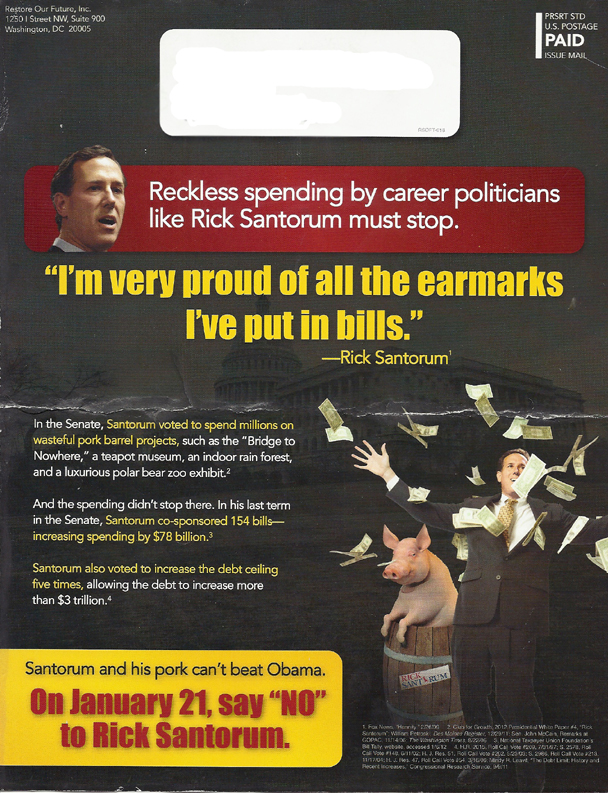
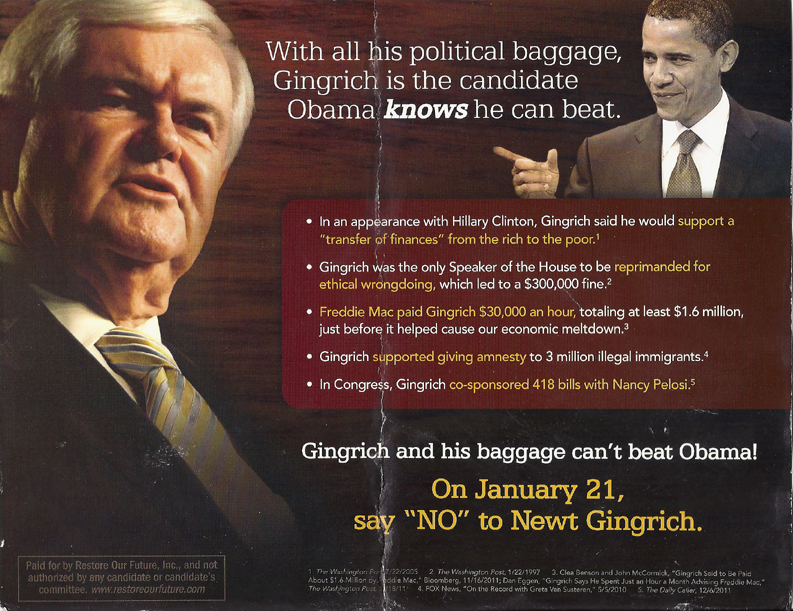
Note the two sides, above and below, of a mailer I received at home.

One of the good things about being a Patrick O’Brian fanatic is that it provides one with so many good metaphors.

For instance… one of the most difficult things for a man of war’s crew in the age of sail was to fight both sides of the ship at once. One way this might occur would be if a ship sailed between two enemy ships and fired with its larboard and starboard guns at the same time. This took not only a very well-trained crew, but a numerous one — remember, it took a lot of men just to keep changing sail and maneuvering the ship, plus twice the usual number of gun crews. Each gun required a crew of several men, and they weren’t much good if they hadn’t had plenty of experience firing live ammunition at targets under all sorts of conditions.

This required a wealthy commander, because the Royal Navy provided a minuscule amount of powder and shot, and the captain had to shell out his own money if he wanted his men to be able to perform well, even to survive, in a fight.

And only a captain with a numerous, well trained crew would attempt anything so taxing as dashing between two enemy ships to fight both sides at once.

Either that, or a very desperate captain.

I suppose you could interpret this mailer I got at home either way. It was sent out by Restore Our Future, Inc., which exists to promote Mitt Romney.

We know he’s a wealthy captain, with a numerous crew. But is he also desperate?

His foes are the ones who should be desperate. They know that if they don’t stop him in South Carolina, they are done for. But he also knows that, and probably just as soon have done with them all.

So he fires both broadsides at once; never mind the cost.

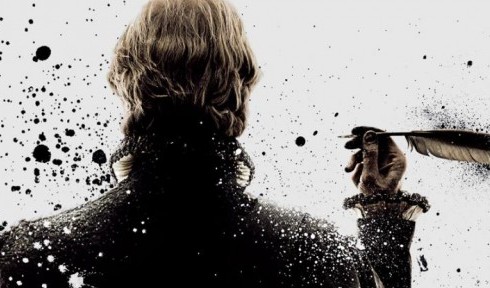
‘Tinker Tailor’ eminently worth seeing, although of course I have my pedantic objections

Well, I finally got to see the film I’d awaited for a year, and which opened in Britain in September, and in other parts of this country in December. Thanks to the Nickelodeon  for bringing it here (you can still see it there through Thursday).

And the verdict? It was good, very good. You should definitely see it, whether you’ve read the book or not, and whether or not you, like me, own the 1979 TV series on DVD.

Was it as good as that, the Alec Guinness version? No. Still, that leaves a lot of room to be very good indeed. (The series was one of the best things ever made for television.)

The film was slicker, certainly, with more impressive production values. But that’s to be expected. Everything I had read about the film’s effective evocation of mood was true. I don’t know what sort of process the film was run through, but it seemed to have been subjected to something akin to what was done with “Saving Private Ryan.” Only there is a rustiness to the scenes, rather than the greenish cast.

And Gary Oldman is wonderful, as usual. Afterward, my wife was asking where she had seen him before. She couldn’t recall. Was it just that the actor is such a chameleon? Yes, he is (as you can see here and here and here and here and here). Which makes him perfect to portray the forgettable, unremarkable George Smiley. In his own way, perhaps even as good as Guinness.

On the whole, a very good job was done in spite of not having the six hours that the TV series had to do it in.

That said, I have a number of objections, and they are mostly of the pedantic, fanboy sort. They have to do with inexplicable changes in the stories, and the characters — changes that are not excused by the demands of brevity or limitations of the medium. Changes that in some cases unnecessarily complicate the story, even making it less credible.

I’ll warn you now with a SPOILER ALERT, but ask you to return and review my list after you’ve seen the film:

  • Why on Earth does Control send Jim Prideaux to Budapest, rather than Czechoslovakia? Why make the alleged contact Hungarian? A totally gratuitous change. No harm, but unnecessary. As I viewed the scenery, I wondered whether it was easier to get establishing shots of Budapest that looked as they did in the 70s. But so what? The action, in the book (and the TV series), took place near a cabin out in the woods. There was NO need for an establishing shot, as the locale was generic. It could have been shot anywhere.
  • Why, indeed, was Jim shot in an urban setting? Just so we could be horrified by the unnecessary death of a particularly vulnerable innocent bystander — an incident completely missing from the original story?
  • Why did Colin Firth get so little to do in the film? I had assumed that he signed on because the role of Bill Haydon was such a meaty one. Haydon was not only the critical character in the story, he was a particularly charismatic and tragic figure, the hero to a generation of intelligence officers, a flamboyant and brilliant presence, a source of cuttingly ironic remarks, the cynosure of regard by all. And yet, except for a couple of obligatory scenes, he is hardly drawn for the audience at all. (This is one thing that perhaps could be explained by the need for brevity, of course, although it’s an insufficient excuse.)
  • Given that there is so little time to explain what must be explained, why is a scene added that does nothing but tell us that one of the characters is gay? A character who, by the way, is not gay — to the extent that one respects the book. (Another key character was bisexual — which is accurately touched upon in the film.) Peter Guillam is perhaps the closest to a “James Bond” type you find in the novel — a relatively uncomplicated tough guy (head of the department of tough guys, Scalphunters) with a penchant for fast cars and beautiful young women (something you see more clearly explicated in later books). Why do this? It advanced the story in no way.
  • For that matter, why was Guillam not portrayed as Smiley’s close friend? The first thing we hear him say to George is to address him as “Mr. Smiley.” In the book, Peter takes George out drinking after Smiley is fired. In this film, George’s sacking is portrayed as a long walk out of the building with Control, who was close to no one. Peter is just one of the people who watch him go. This is no minor detail. In the film, you are left to wonder why Peter is the one person still at the Circus whom George trusts. In the book, you knew why. He was like a Watson to George’s Holmes.
  • You are particularly left to wonder about that because, in the film, Peter is not that critical to setting the action in motion as he was in the book. And THIS is the biggest unnecessary flaw in the production, one that actually matters. For some bizarre reason, we are asked to believe that a mere phone call from low-level Scalphunter Ricki Tarr to senior bureaucrat Oliver Lacon (one of the few in Whitehall with keys to the secret kingdom) causes Lacon to contact George and launch him on his hunt for the mole. (Lacon hadn’t believed Control when he had alleged the same thing; it is utterly incredible that he would take such extraordinary steps on the word of the mercurial, untrusted Tarr.) We are halfway through the film when Tarr emerges from hiding to tell Smiley his story. This is completely absurd. In the book and series, Tarr contacts his boss, Guillam, who then contacts Lacon (because he is senior enough to do so and be heard), and his detailed story is what convinces Lacon, Guillam and Smiley that there is a mole at the Circus. Without that, there is no credible basis for the investigation that is the plot of this story.
  • A side casualty of this strange twist is that what should be the tensest scene in the film is missing something critical. When Percy Alleline calls Guillam on the carpet and accuses him of consorting with Tarr (officially regarded as a defector), Peter lies masterfully in the original. In this film, he doesn’t have to lie, because he has not seen Tarr.
  • Yesterday I mentioned that an unlikely actor was chosen to portray Jerry Westerby. Having seen the film, I wonder why the character was even given that name. In the film, they essentially call Sam Collins “Jerry Westerby.” I understand combining characters in movies, but this isn’t a combination; it’s a substitution. The part the character plays in the story is in every detail Sam Collins, and he in no way does or says anything that Westerby did or would have. Strange. Now that they have confused things to this extent, it will be even harder to make a sequel out of the next book in the series, in which Westerby is the title character.
  • Then there is all the gratuitous depiction of violence, twisting credibility in order to show blood. Pure Hollywood, I suppose. There’s quite a list, starting with the nursing mother who is accidentally shot in Budapest. Tufty Thesinger is brutally murdered in his office (which is also in the wrong country, by the way — why Istanbul, instead of Lisbon?). So is Boris. Tarr actually sees the brutally beaten Irina carried onto a ship on a stretcher (in the book, he persuaded a witness to tell him of seeing a woman placed on a plane). Irina is shot, shockingly, in front of Jim Prideaux during his interrogation, instead of being eliminated far from anyone’s view in a cell at Dzerzhinsky Square (in the book, Prideaux would never have met Irina, or known she existed). Then there was the implied violence of Toby Esterhase being threatened with immediate extradition — the realization of what he had done should have been enough, as it was in the book and series, to turn him.
  • Speaking of violence, there is the completely unnecessary change in how the mole Gerald meets his end. Is it really that much more appealing to movie audiences to see a man killed at long distance with a rifle than to get his neck broken with his killer’s bare hands? I wouldn’t complain, except that it makes the mole’s last-second recognition of his killer (which is important to the arcs of the characters) a little harder to believe.

One tiny, last detail — in the TV series, they at least showed George Smiley living on Bywater Street. In the film, it was somewhere else. Probably no one but me would be bothered by that. And it’s forgivable. Perhaps the neighbors wouldn’t allow it; I don’t know.

But other than all that, it was great. Don’t mind me. Just go see it. In fact, if you are a le Carre fan you must see it; excuses will not be tolerated. I look forward to discussing it with you.

I’m going to see Tinker, Tailor!

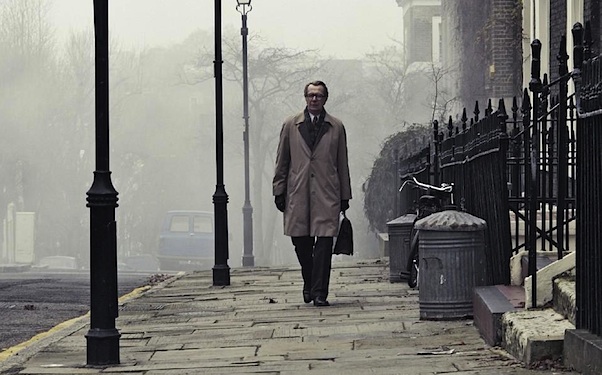
Smiley and Control, before they were sacked.

… just as soon as I finish typing this.

I’m pumped about it — and very appreciative to the folks at Nickelodeon for bringing it here in spite of Hollywood’s insulting decision not to send the film to South Carolina for standard commercial release.

I’m wondering whether I’ll like it. Gary Oldman is awesome, but how will he stack up against Alec Guinness, who so embodied the character that le Carre said he didn’t feel that he owned him any more?

Colin Firth as Bill Haydon is intriguing. But I really wonder about the decision to cast Toby Jones as Percy Alleline. When I saw Jones was cast, I assumed it was as Toby Esterhase — not because of the coincidence of given names, but because of physical similarity (“tiny Toby,” as he was called in the book). And I’m sorry, but Benedict Cumberbatch isn’t nearly tough enough, or old enough, for Peter Guillam.

I also think it strange that the filmmakers cast Stephen Graham in the minor part of Jerry Westerby. I think Graham is a fine character actor — I enjoyed him in “Band of Brothers” and “Snatch” — but Westerby is supposed to be an upper-class leading-man type. He’s the dashing sort who calls everybody “old boy.” More to the point, he is the title character of the next book in the series, The Honourable Schoolboy, and that tells me that the powers that be on this project are probably not thinking series. Which is disappointing.

Or will be, if the movie is as good as I hope it will be.

All right, I’m off!

Hey, Burl: I’m reading Black Ocean now…

Back on a previous post, Burl asked me whether I’ve ever read a book he sent me a year or two ago — which has weighed on my conscience ever since, sitting there among all the others I keep meaning to read.

Well, as it happens, that was one of the “two or three” books I was reading and rereading over the past week. Now, I’ve set the others aside, and have just started to get serious with Black Ocean.

I’m only on page 88, but I have some observations already (just to prove to Burl that I’m reading it).

One is that I’m enjoying watching familiar people pop up in the book. I felt foolish for not realizing who “Ed Burroughs” was until he mentioned his “ape-man.” But  then, how would I have known before that? I then checked Wikipedia, and found that the real-life Burroughs was, indeed, in Hawaii at the end of 1941.

Then Sammy Amalu’s name cropped up, which was really weird, because something — I forget what now — a page or two earlier had caused me to think of Sammy, then Google him on my iPhone. I think the thing that made me think of him was a mention of pidgin. And I thought I remembered that Sammy used to hold pidgin in great disdain and refuse to speak it to anyone. (By the way, Burl, did you and Sammy work together?)

Then there was a passing reference to “the Kanahamoku brothers.” Well, I know who one of them was.

I’m sure there are loads of other references that I’m just not getting, because I only lived in Hawaii for a little over a year — things that Burl will get because he has spent most of his life there, as both a journalist and historian.

This weaving of real and fictional characters is reminiscent of the style of Harry Turtledove, who dares to make historical figures main characters in his works of alternative fiction. Burroughs, for instance, is already playing a role as significant as that of Col. Leslie Groves in Turtledove’s Worldwar series.

Oh, did I mention, to those of you who don’t know? Black Ocean is a novel with the premise that the Americans attacked Pearl Harbor in December 1941, at which time the islands were controlled by the Japanese.

The second thing I’m noticing is that, at least at the outset, Black Ocean is both very much like, and very much unlike, Len Deighton’s SS-GB.

Both are set in 1941. Both take place on islands that, contrary to history, are in Axis hands at that time. Another way that they are alike is that Tad Morimura — a Honolulu policeman who now works for the Japanese — is investigating a death (actually, several) that will run him afoul of the Japanese military, the deeper he goes. In SS-GB, Douglas Archer is a renowned Scotland Yard detective who is now working for the German SS (the Germans having invaded England and won the war). He, too, is looking into matters that will get him into serious trouble with the Nazis (or the English resistance, which seems to pose just as much of a threat to him).

But the differences, so far, are more noteworthy than the similarities.

To begin with, I don’t know what’s happened that changed the direction of history. I thought, for a moment, that when Morimura was explaining to a Japanese Army officer the history of the Hawaiian royal family’s relationship with Japan, that there would be a clue — but I don’t know enough about Hawaiian and Pacific history to know where things diverged, other than that the princess Kaiulani (whom I had to look up, even to know who she was) survived her youth to become an aging queen.

By contrast, I knew from the very beginning what had happened in SS-GB. It was what everyone had feared — Hitler had not squandered his opportunity to invade, and had prevailed, well before the Americans could get into the war.

This makes me much more comfortable with the Deighton book than I am so far with this. And I find myself wondering, is this my own Anglocentrism? Am I more comfortable with it simply because I feel so much more comfortable with British history and culture? There’s no doubt that I’m better able to identify with the characters and understand where they are coming from — how they feel about the German occupation, and how conflicted they might be carrying on with their jobs under such domination.

Whereas, with Black Ocean… I don’t really understand where anyone stands. But I reject the idea that this is because of my own Western frame of reference, or (more disturbingly) that I simply understand and care more about the concerns of Anglo-Saxons than about the Japanese and Filipina and other ethnic characters in the book Burl sent. I really think it’s because the author, Rick Blaine, is being so coy with me as a reader. Yes, a man of Japanese ancestry (although he grew up in Hawaii) like Morimura is going to have an even more nuanced relationship with the Japanese authorities than the thoroughly English Archer did with the Nazis, if only because the Japanese, apparently because of their own racist assumptions, trust him more.

But there’s more than that. Blaine has really muddied the waters. In Deighton’s book, ordinary Englishmen chafe as you would expect them to at the Jerry yoke, griping openly when only their countrymen are around. But in Black Ocean, the locals take Japanese control of the islands more in stride, even alluding to “patriotism” in terms of being loyal to the current order.

A lot of things make sense, such as the Japanese military’s attempt to pin a murder on American provocateurs, or preparing the islands’ defenses. Other things don’t, such as… the journalists at the Star-Bulletin (Burl’s paper) in many ways have to deal with the hassles of occupation — tapped phones, and pressure to cover things a certain way. But beyond that, they seem to (thus far) assume more freedom than you would think they would have under this regime. For instance (SPOILER ALERT!), why would the Japanese assassinate the newspaper’s publisher, apparently not for playing ball, and no one at the paper, initially at least, suspect their hands in the killing? So far, the folks at the paper seem to assume a cocoon of invulnerability like you would typically find at an American paper, not at a paper in a place under the control of Japanese imperialists (but then again, I do know so little about how the Empire of Japan would have related to local media, and I still don’t understand the nature of the Japanese presence).

So what happened, and when did it happen, and how did it happen? I suppose I’ll have to keep reading to find out.

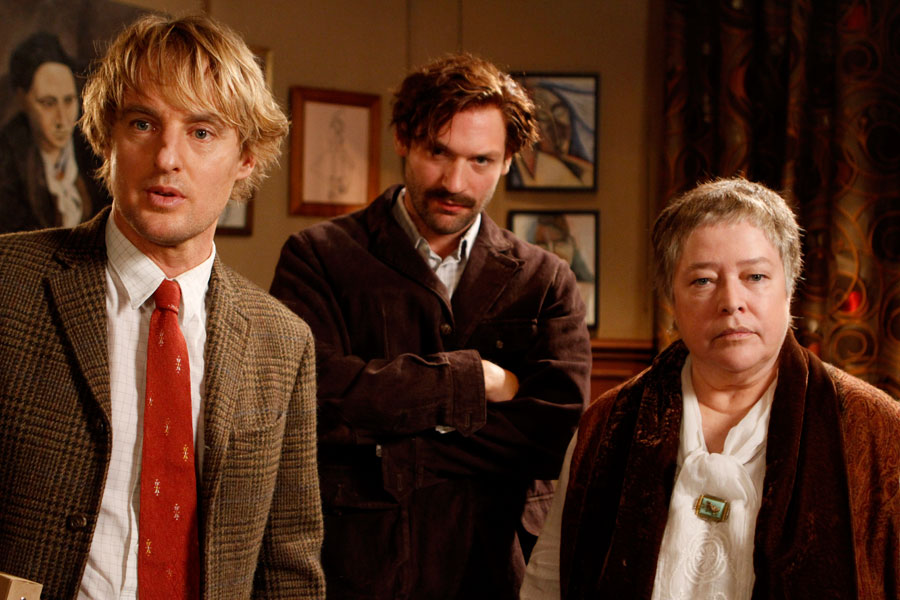
No, Allen didn’t get his ‘groove’ back with ‘Midnight.’ But wouldn’t it be pretty to think so?

The Guardian celebrated it this way: “Woody Allen gets his groove back with ‘Midnight in Paris‘ after years of decline.”

If only it were true. I mean, the part about getting it back. We have a consensus on the years of decline.

I spent the first moments of 2012 watching the latter part of the film, in which Owen Wilson speaks the Woody Allen lines. Which works pretty well. It brings a smile when this younger man speaks words that you know Allen himself would have spoken 40 years ago. There’s an echo there, and you do smile, because he really used to make you laugh. As Wilson has also done, more recently.

And then there’s the central conceit of the movie, which is that… wait… SPOILER ALERT!

… which is that after midnight, Wilson’s character — the Woody Allen character (let’s go ahead and call him “Gil” to avoid this confusion) — finds himself transported to the very best time to be in Paris.

And when was that? Well, for him it is the same time that it would be for me, the 1920s. The Lost Generation, when you couldn’t swing a bat on the Left Bank without maiming a genius in the art form of your choice. So he finds himself staggering across Montparnasse from party to party with Hemingway, the Fitzgeralds, Dali, Picasso, and the rest of the gang.

Gil is, by his own estimation, a hack writer for Hollywood who hopes to save himself with a novel he’s struggling with. Hemingway tells him to let Gertrude Stein read it. Ms. Stein, who in real life looked like this — by which I mean to say, looked like somebody no insecure writer would hand his heart to that way — is in the film a sort of amiable den mother who would LOVE to read his book and tell him encouraging things. Which she may have done for Hemingway, but for this nebbish? I don’t know.

Anyway, this premise is loaded with possibilities, and you want to see them explored. But they are not. Allen walks up to this great idea, and then shrugs, backs away and gives us a “so what?’ ending.

And it makes me sad. I mean, this is the guy who made “Manhattan.” It may or may not have been a masterpiece, but it was funny and poignant. And how about that ending: Mariel Hemingway says, “You have to have a little faith in people,”  and your heart gets sucked into such depths in a whirlpool formed by the currents of innocence, cynicism and desire. In that moment, you forgive Allen, if only momentarily, for being such a perv and corrupting young girls. In that moment, you recognize the complexity of being human.

And with this thing, what has happened? Nothing. Gil has blown off an engagement that every viewer has wanted to see him walk away from since the first 30 seconds of the film. No conflict there. Every moment spent with the grotesquely drawn caricatures of his “present” life is tedious, and obviously pointless.

There is no depth to anyone in this film, including the protagonist. Here I am thinking “this is really cool; we’re going to meet Hemingway and Fitzgerald and Picasso,” and they are played for not very good laughs, especially Hemingway. And none of the promises are realized. None of them.

So no, he doesn’t have his thing back. But I kept hoping he would; kept hoping it would be as good as it tried to be. But it wasn’t.

My deep-seated, gut-level cultural conservatism

New Year 027

This evening I was browsing Barnes and Noble (which, like Starbucks, should buy an ad here) and happened to look up and see this sign exhorting me to “Discover Great New Writers.”

I harrumphed to myself as I passed on, thinking, “If they are new, they are not great.”

Which, I realized on another level — the level that listens to everything I say and holds it in scorn — is irrational prejudice. It’s me thinking like a medieval man, thinking that all greatness occurred in the past, and if we see a distance, it was only because we stand on the shoulders of giants. Which is irrational — but, let me hasten to add, no more irrational than the idiotic modern idea that each generation is greater and wiser and more virtuous than the last, the foolish idea that just because our technology is smarter, we ourselves are. I utterly reject that modernist prejudice, and should do the same with its complement.

After all, great writers were all new once.

Still, I am hard-pressed to name a living writer of, say, fiction whom I regard as great. I tried, as I walked through the bookstore.

Patrick O’Brian, I thought. But no, he is dead, although his life did overlap mine. Ditto with Douglas Adams. Now, you are wondering that I consider those great, but I do. Matter of taste. O’Brian’s Aubrey-Maturin novels are not only, as other reviewers have said, the greatest historical fiction ever, they rank high among all fiction in my estimation. And Adams was the funniest writer of novels since Twain, again in my own necessarily limited estimation.

There is one living novelist I regard very highly, as you can tell from this recent postJohn le Carré. But the last of his books that meant much to me was The Night Manager, and that was published in 1993. Although I did think The Constant Gardener was quite good. I just wasn’t as fond of it as of his earlier stuff. (Also, it seems to me that as he gets older he gets… preachier, in a predictably political sense. Is it just me?)

I look around me and other people seem to take great delight in current authors. Back when I started an effort to get Columbia to read a book together years ago, we stopped after the first one, because the others on the committee that formed were enthusiastic about getting the sorts of authors who might be induced to come visit and speak. The committee had gone along with me on Fahrenheit 451, but after that they wanted writers that I, reactionary philistine that I am, had not heard of. Some of it, I think, was that they wanted writers who were less male, and white, and mainstream, but mostly they wanted authors who were less dead. And I wasn’t having it.

Now, Belinda Gergel’s somewhat more successful bid to have the same sort of program is picking books more like what my committee had wanted.

But are they great books? Well, that’s in the eye of the reader, isn’t it?

My (successful) Quest for George Smiley

Outside Smiley's house on Bywater Street. No need to knock. George knows I'm here. And where's he going to go? It's a cul de sac. It's over, old friend.

I’d been holding this back for when the movie comes out, but now that it’s passed me by (although I look forward to its being at the Nickelodeon next month), I am much embittered and have decided to go public with the whole story — the Official Secrets Act be damned. See how they like it when it’s all laid out in the papers. Perhaps I’ll go with The Guardian; that should sting. Let Parliament launch an inquiry. Let them connect me to the notorious Rebekah Brooks, for all I care. (After all, I’ve done a freelance job for that same outfit, in the time since they cast me out.) I’ve been a good soldier, put in my time, watched and waited. All for naught. Here’s my story…

As you know, I went to the UK a year ago, ostensibly as a tourist. That wouldn’t fool a real professional, of course, but one keeps as low a profile as one can. I have my own tradecraft for this sort of thing — I make a big splash, publicize my whereabouts… what spy would do that?

It’s worked so far.

My mission — to find the Circus, and more importantly, George Smiley himself.

It was quite a challenge. George hasn’t been seen since 1982. And the original location of the Circus, now that MI6 has the River House (all mod cons, as Bill Haydon would say), is shrouded in service legend. It’s not something you’d assign to some probationer straight out of Sarratt.

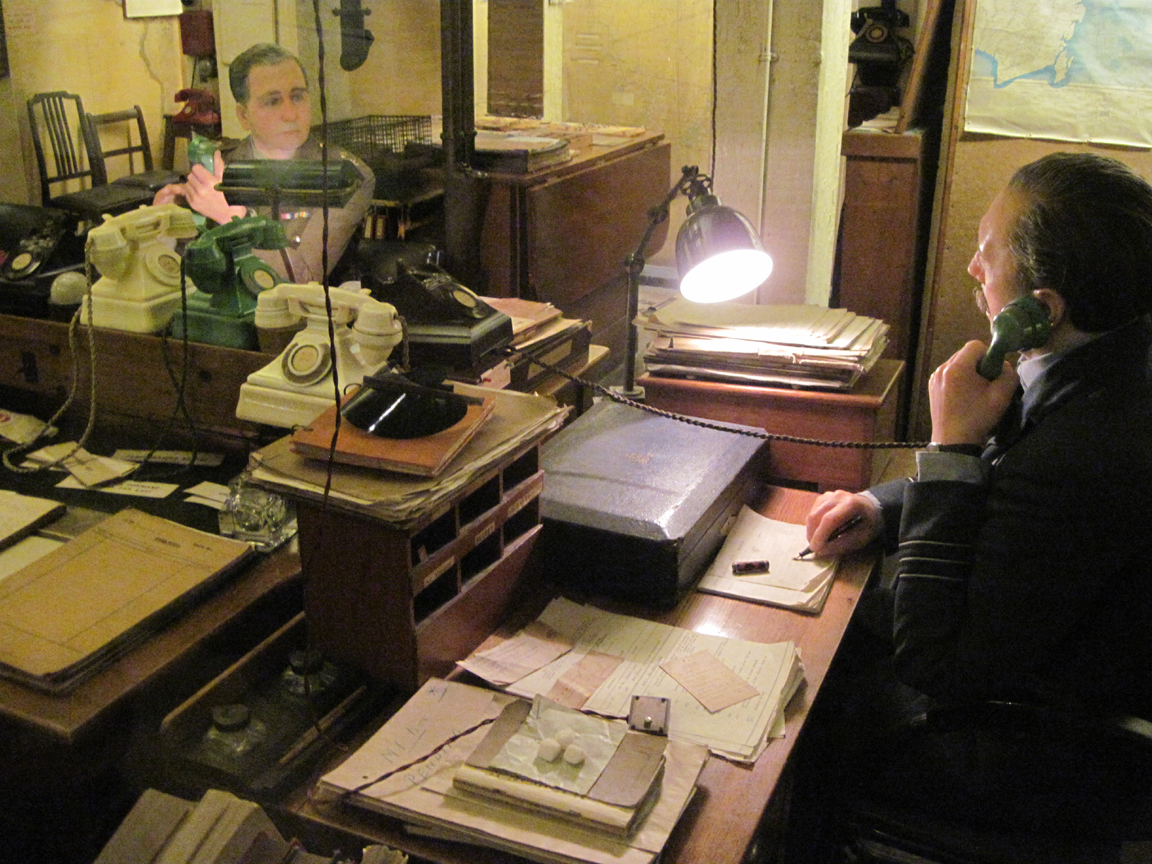
First, we spent a couple of days settling in, establishing patterns. One assumes that tiny Toby Esterhase‘s lamplighters are everywhere, so you need to paint them a picture, let them get complacent. This we did — from Heathrow to Swiss Cottage (the very spot where General Vladimir would have been picked up as a fallback, had he not been killed on Hampstead Heath), then all over the city on the Tube, aimlessly. Trafalgar Square, St. James’s, Fortnum’s, Buckingham, the Globe, the Tate, the Cabinet War Rooms, the Tower, hither and yon in the City.

Finally, at the end of our third full day, after night had fallen, we ambled up Charing Cross Road, affecting to be interested in bookshops. We almost missed it, but then there it was — the Circus itself. There was the Fifth Floor, and even Haydon’s little hexagonal pepperpot office overlooking New Compton Street and Charing Cross. Quick, I said, get the picture. It took a couple of tries, the way these things do when you need to hurry. Thank heavens for our “tourist” cover; it excuses all sorts of odd behavior. Then on up the street, and an hour or so of browsing at Foyles to check our backs. Found a couple of decent-looking biographies of Lord Cochrane, but didn’t buy one. (They had shelf after shelf of naval history; it went on and on.) Then we wandered about in the West End, to clean our backs as much as possible, before heading back to Swiss Cottage.

One thing down. Hardest part to come.

By this time, I had decided not to risk the actual modern HQ of the SIS. Mix fact with fiction like that, and it’s like mixing matter and antimatter. Could blow you clear across the universe, or at least to Brixton, and who wants to go there, really? That’s why they put Scalphunters there.

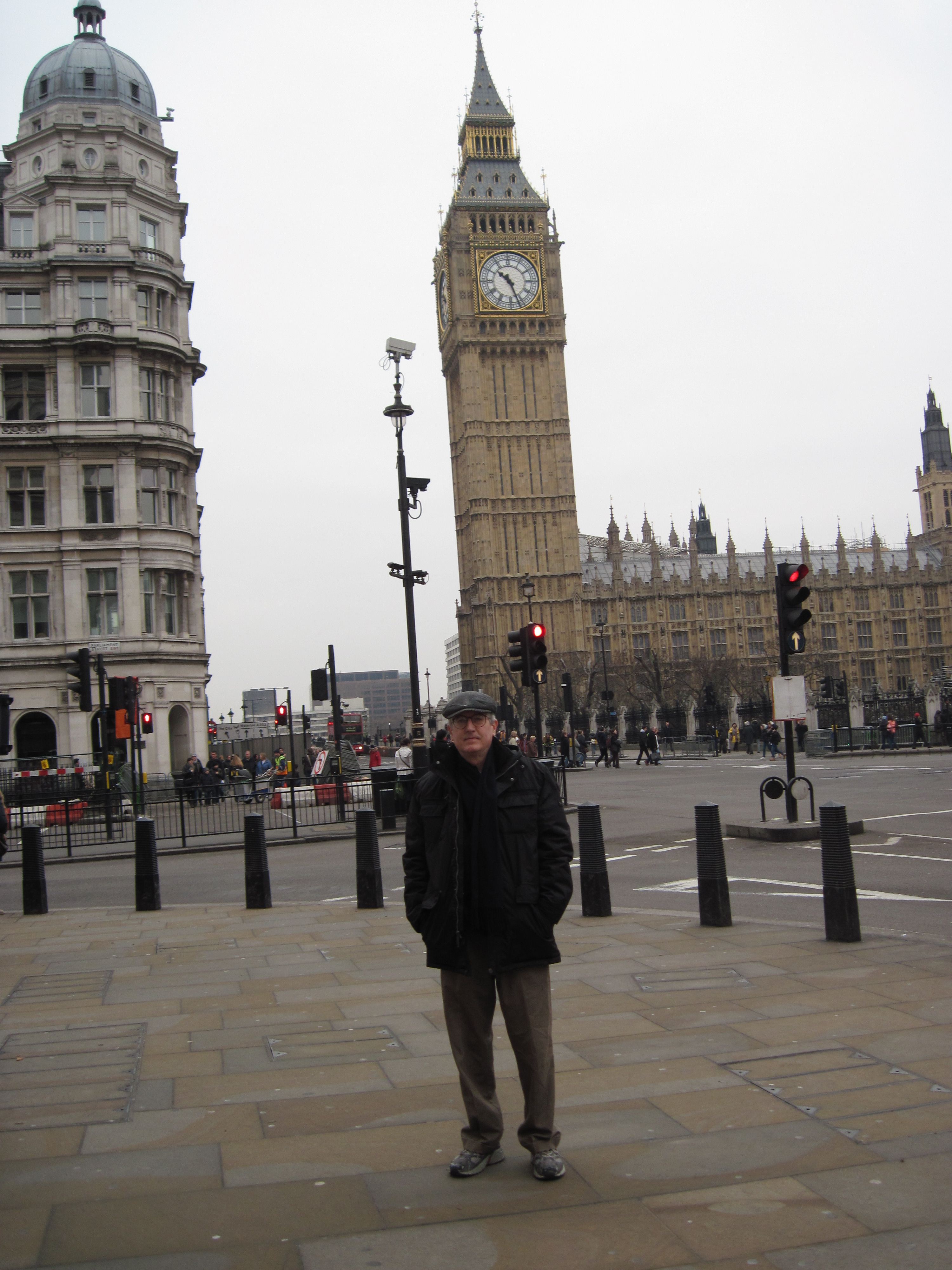
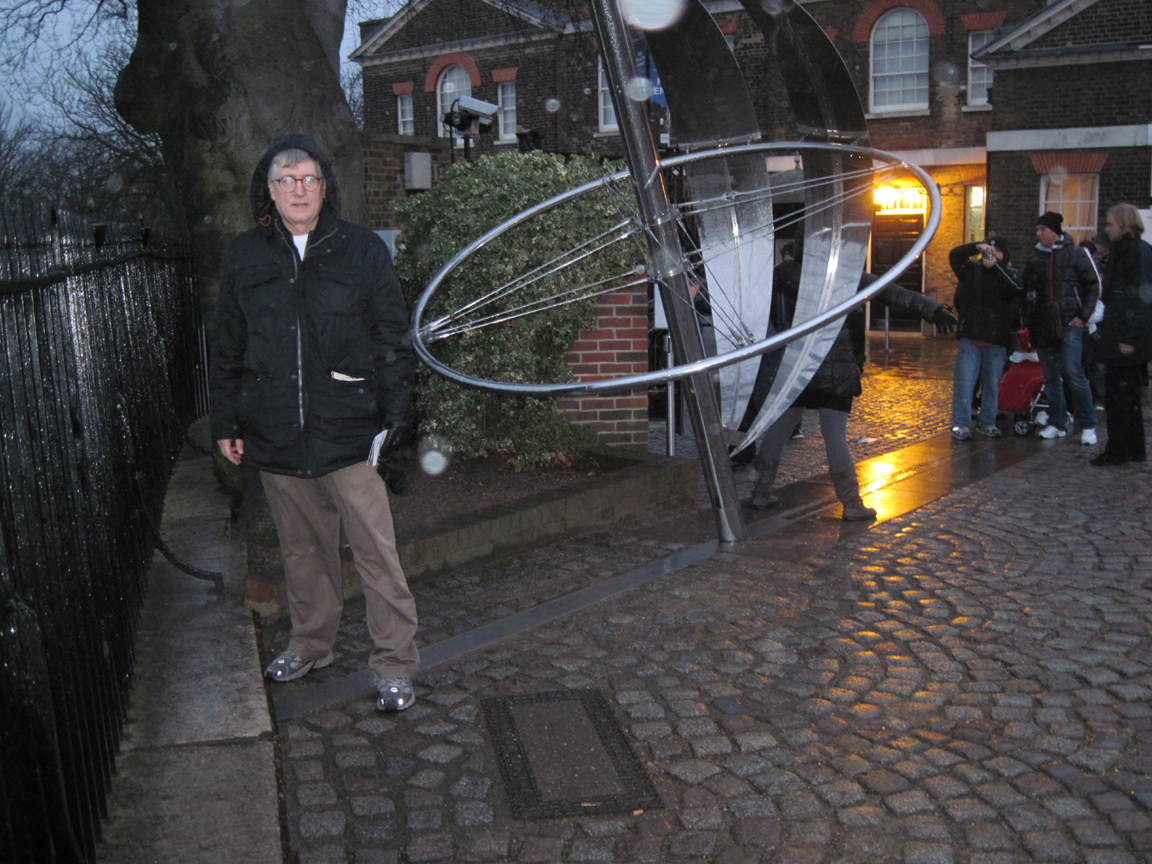
We played tourist for another day. Then another. The Sherlock Holmes museum. A side trip to Greenwich, to stand astride the Meridian, and see the coat Nelson wore at the Nile. Back into town for the British Museum.

Then, it was our last day in London. Had to go to Oxford the next day, and check on Connie. Connie is high-maintenance. So it was do-or-die time. We opted to do.

We thought that twilight would be the best time to descend on George. Vigilance is low. Everyone’s tired then; time for tea and meet the wife. So we went to that general part of town. Spent several hours at the Victoria and Albert. Loads of statues and the like.

We took the Tube to Sloan Square, a good half-kilometer from Bywater Street, and went the rest of the way on foot. We entered the cul de sac as night descended (which it does before 4 p.m. at that time of year). There wasn’t a soul on the narrow street. Everything went smoothly. When we got to the part where Smiley lives, I tried to throw the watchers off by shooting pictures of houses other than his. In a way, though, they were all relevant. George lives at No. 9, of course. But the 1979 TV series was shot at No. 10. And No. 11 has a Banham security system, which the book describes as being on George’s house. No. 9 has an ADT system.

Anyway, after doing what I could to distract any lamplighters in the vicinity, I had J (her workname — best watcher in the outfit, is J) quickly shoot a happy snap of me in front of No. 9. She was a bit nervous, because there were lights in the basement-level windows. She said people who lived there would wonder what we were doing. I muttered no, they wouldn’t: “They know exactly what we’re doing.” The thing was to get it over with quickly, so we did. Given the hurry we were in, I’m struck, as I look at the image, by how placid and dispassionate and, well, Smileyesque I look in the image. Like I was channeling him in that moment.

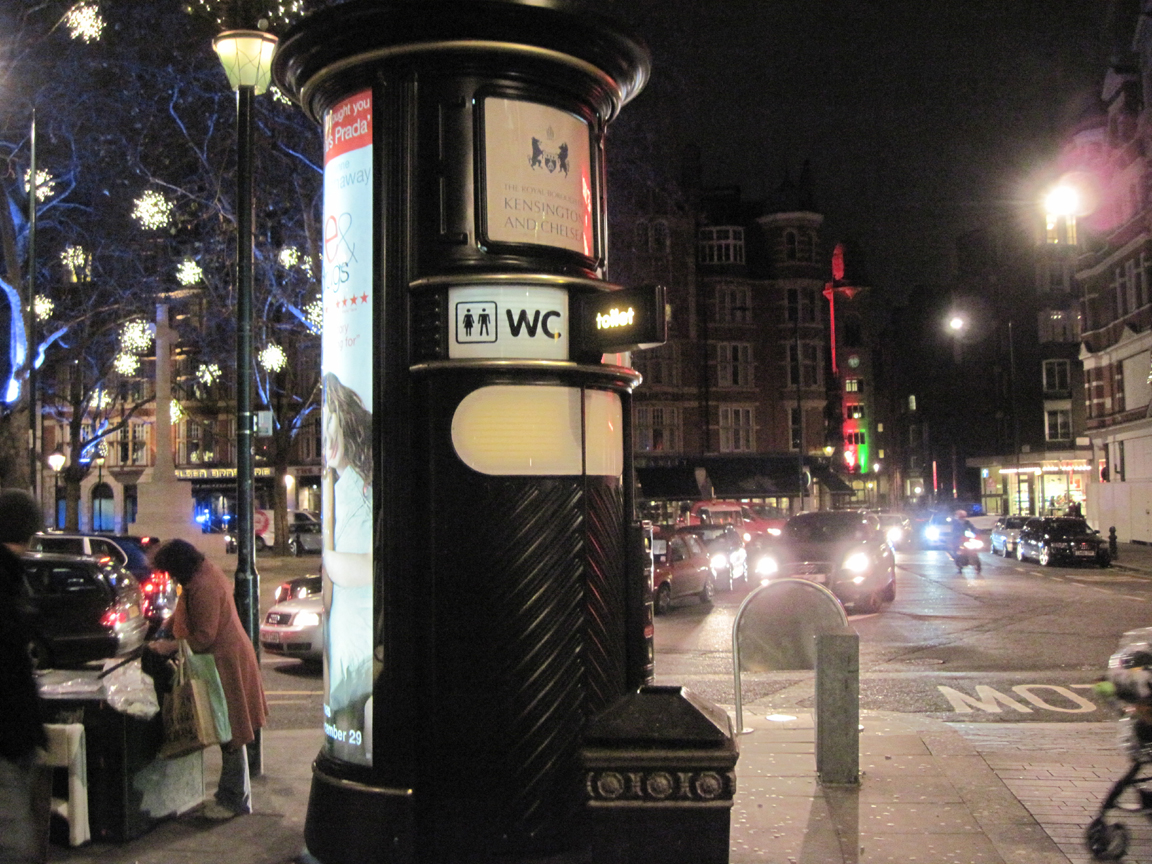
Then, it was back out to King’s Road and back to the Underground as fast as our legs would carry us, trying not to show that our hearts were pounding like Peter Guillam’s when he stole the Testify file from Registry that time. I was getting too old for this, I knew. As I looked up at the Christmas lights in the trees on Sloane Square, they were as blurry as the stars in a Van Gogh.

I can hardly remember the next couple of hours, but I can’t forget the stroke of luck that befell us later. Nothing short of a miracle, it was.

We had decided to case Victoria Station and its environs, because we knew we had to catch a coach there for the trip to Oxford next morning, and it’s good tradecraft to reconnoiter these things ahead of time. We got a bit turned-around there, and ended up touring the whole station before we discovered that the coach station was on the next block. On one aimless pass through the vicinity of the ticket windows, I looked up and there he was. George himself. Right out of the first paragraph of this passage:

He returned to the railway station… There were two ticket counters and two short queues. At the first, an intelligent girl attended him and he bought a second-class single ticket to Hamburg. But it was a deliberately laboured purchase, full of indecision and nervousness, and when he had made it he insisted on writing down times of departure and arrival: also on borrowing her ball-point and a pad of paper.

In the men’s room, having first transferred the contents of his pockets, beginning with the treasured piece of postcard from Leipzig’s boat, he changed into the linen jacket and straw hat, then went to the second ticket counter where, with a minimum of fuss, he bought a ticket on the stopping train to Kretzchmar’s town. To do this, he avoided looking at the attendant at all, concentrating instead on the ticket and his change, from under the brim of his loud straw hat…

Apparently, our appearance at Bywater Street had sent him on the run, but we had stumbled into him anyway. I left him alone, except for grabbing this picture. You doubt that’s George Smiley? Look at this picture, and this one and this one, and then tell me that. ‘Course it was him. Stuck out a mile.

But now that I’d found him, what was the point? He was just my old friend George. I could hear Toby’s triumphant voice in my ear: “Brad! All your life! Fantastic!” But I ignored him. I got the picture, and moved on. I didn’t even look to see whether he had left Ann’s lighter on the floor.

My mission had been accomplished, and then some… Why did I not exult? All I felt was the urge to polish my glasses with the lining of my tie. But I wasn’t wearing a tie…

Gimme my Tinker, Tailor! Right now!

To my considerable outrage, I just realized that Tinker, Tailor, Soldier, Spy will NOT be opening tonight at a theater near me.

I’ve been waiting for this thing for a year — it’s the only movie I’ve been eager to see in much longer than that — and the release date has been put off again and again, and I was all ready for it to finally come out on Dec. 9… and it can’t be found.

I read that it was released in the UK three months ago. This is insane. I mean, I’d love to go back to England and see it, but that’s not really an option for me at the moment. I don’t hop the pond that often. It’s sort of a once-in-a-lifetime thing. So far. (I saw “The King’s Speech” at a theater in Oxford the night it opened in England — which, weirdly, was a week or so after it opened back in the States.)

Oh, well… in lieu of that, I’ll share with you this note I wrote today to my friend Hal Stevenson, before I realized the movie wasn’t being released here. Hal recently told me that he had read The Spy Who Came in From the Cold recently, and wanted to know more about le Carre and his work. Since I’m a huge fan (of his early work, anyway), I promised to share some thoughts on what else he might want to read. It’s not brilliant, original literary criticism (I call le Carre’s most acclaimed novel “awesome,” dude), but it gives you an idea to what extent I have been thinking about and eagerly anticipating this non-event.

So I share this now with you as well, as I contemplate going home and watching the original BBC series of “Tinker, Tailor,” which I own on DVD. So there, Hollywood…

Hal,

I haven’t forgotten to write to you about John le Carre..

It’s fitting that I do so today, since the new movie, “Tinker Tailor Soldier Spy” comes out tonight.

I believe you said you had read The Spy Who Came In From the Cold. Well, that was an awesome book. As literature, it’s pure and clean and complete. If you’ve read that, you’ve read THE quintessential Cold War novel. You could stop there, if you wanted to. But who would want to?

I don’t think le Carre has written anything technically better than that novel. But he’s written stuff I enjoyed more.

The Alec Leamas novel is cold, and hard. It’s like a diamond. I can find no fault with it. But while I think it speaks profoundly to the human condition, some of his other novels are… warmer. They let you care about the characters more, get into them more.

For instance, George Smiley appears in The Spy Who Came In From the Cold, but as a peripheral character. And he comes across as a sort of reluctant agent of the cold pragmatism of Control, who duplicitously sent Leamas on this suicidal errand.

After that, le Carre decided to be more generous to Smiley. He had already been the protagonist of le Carre’s two books before The Spy Who Came In From the Cold — Call for the Dead and A Murder of Quality. Those were short murder mysteries in the Agatha Christie mold. That Smiley worked in intelligence was almost incidental.

But Smiley comes to full-blown life in the trilogy that begins with Tinker, Tailor. That’s the start of what has come to be known as “The Quest for Karla.” Here are some brief thoughts on the three books:

  1. Tinker, Tailor, Soldier, Spy – At the outset of this novel, George is already in retirement, against his will. He and the head of “the Circus” (le Carre’s euphemism for MI6, based in its supposed location near Cambridge Circus in London), known only as Control, were both canned after an operation blew up disastrously. But a Foreign Office official comes to George with evidence that Control was done in by a mole (this novel is responsible for that term entering the language) who had insinuated himself to the very top of the Circus, and was actually running the whole show now on behalf of Moscow. Smiley begins a process of backtracking through his own life and career and former colleagues as he sets a trap for the mole, unofficially, from the outside. The mole, it is known, is the agent of Karla, a mysterious figure who sort of runs his own show deep within the KGB. Karla is Smiley’s lifelong nemesis, sort of his Moby Dick. Smiley doesn’t know who the traitor is until the end – beyond the fact that it will be one of his closest associates, someone he’s known and trusted his whole adult life. The novel is about these relationships, and what they mean to Smiley, as much as it is about spies. That’s a hallmark of le Carre’s work.
  2. The Honourable Schoolboy – This second novel in the trilogy is very different from the other two. It’s sweeping, and adventurous and cinematic. The ironic thing about it is that it’s the only one that hasn’t been made into a movie (or, more accurately, TV series), even though it reads most like a movie script. It takes place after Smiley has exposed the mole, and turned the Circus inside out. George has been brought back officially into service to head the new, demoralized Circus. Trying to build the agency back up and get some decent intelligence coming in, Smiley pursues a trail of money that should lead to a top Soviet agent – another of Karla’s hand-picked people – in Hong Kong. Lacking professionals on staff he can trust, he sends an old freelance hand – a journalist named Jerry Westerby, who is sort of a half-amateur gentleman spy – to track down this second Karla agent. Westerby does so against the background of exotic locales. You get the sense that le Carre was trying to be a sort of Hollywood version of Joseph Conrad here. There is action, to an extent that is unlike le Carre, who tends to be more cerebral. On the whole, the novel isn’t as satisfying, since it’s more about Westerby and his conflicts than it is about Smiley and the characters you’ve come to care about in Tinker, Tailor.
  3. Smiley’s People – This one is everything The Honourable Schoolboy wasn’t. It’s like a reunion from the first book, and is the climactic act in Smiley’s lifelong contest with Karla. At the outset, George is in exile again from the service after the fiasco in Hong Kong. But an old Russian general, who had spied for Britain in Moscow, has been murdered in London. The Circus doesn’t want to be caught within miles of the general or his old émigré friends, and asks George to come in quietly, unofficially, and lay the general’s affairs to rest – tie up loose ends, pour oil on the waters. George discovers that the general was killed because he had possessed a secret that could be Karla’s undoing. And he spends the rest of the novel making the rounds of old friends, pulling together the strands of a noose around Karla’s neck. But as he gets closer, he comes to doubt whether that’s even what he wants to do.

Moral ambiguity is Smiley’s constant companion. He’s a good and decent man who finds himself doing abhorrent things in the service of his ideals. That is a theme in everything le Carre writes, even when Smiley doesn’t appear.

And he does NOT appear in subsequent novels, except in retrospect in The Secret Pilgrim. That was OK (as were A Perfect Spy and The Constant Gardener), but here are what I think are the best of le Carre’s post-Smiley novels:

  • The Russia House – The protagonist is so much like Jerry Westerby that it’s like le Carre saw this novel as a do-over, an attempt to get that character right this time. An amateur is recruited to act on behalf of British intelligence to make contact with a source at the heart of the Soviet nuclear weapons program – a source that insists upon dealing with no one else. But can the agent himself be trusted? And is the source for real?
  • The Night Manager – This is one you can read and enjoy without having read any other le Carre novel. It stands alone, like “The Spy Who Came In From the Cold,” but its tone is the opposite. There’s nothing cold about it. It’s very human. The protagonist is an ex-commando who, for very personal reasons, offers his services to the government to get close to, and bring down, “the worst man in the world” – a billionaire British arms dealer who sells to anyone with the right price. Not to be a plot spoiler, but it’s more of a feel-good book than almost anything else le Carre has written – sort of the opposite of The Spy Who Came In from the Cold in that regard.

I probably like those because I have pedestrian tastes. They’re not as dark as some of le Carre’s critically acclaimed work — certainly not as dark as The Spy Who Came In From The Cold. By comparison, these are sentimental, but I like them.

Well, that’s an overview. I hope you’ll read some of these; I’d enjoy discussing them with you…

Alec Guinness as George Smiley. Is Gary Oldman as good? WHO KNOWS? YOU CAN'T TELL BY ME!!!!

No, we can’t ship you that item, Mr. Yossarian…

Maj. Major: Sergeant, from now on, I don’t want anyone to come in and see me while I’m in my office. Is that clear?
First Sgt. Towser: Yes, sir? What do I say to people who want to come in and see you while you’re gone?
Maj. Major: Tell them I’m in and ask them to wait.
First Sgt. Towser: For how long?
Maj. Major: Until I’ve left.
First Sgt. Towser: And then what do I do with them?
Maj. Major: I don’t care.
First Sgt. Towser: May I send people in to see you after you’ve left?
Maj. Major: Yes.
First Sgt. Towser: You won’t be here then, will you?
Maj. Major: No.
First Sgt. Towser: I see, sir. Will that be all?
— Catch-22

To begin with, I tried to do it the old-fashioned way. I asked my Dad if he’d like to ride out to Harbison with me, and he said sure, so I picked him up in the truck and we went out there. We went into the store with me clutching the ad that showed the item on sale. After my usual thing — wandering about the store looking for it without asking for help — didn’t work, my Dad asked someone.

This led, indirectly (I’m giving you the short version here) to someone going to the back and searching for about 20 minutes before informing me that they were out of the item. They offered to order one for me, but I said, don’t bother, I’ll order it online from home. I thought I’d read that shipping was free, and I figured I’d save myself another trip to the store.

So I got home, and I went online, and there was the item, so I put one in my cart, and went to check out. Where I found that instead of $69.99, it would cost me $111.40. Turns out I would have to order another 40 bucks worth of merchandise from that store to get the free shipping.

OK, so I clicked on the “store pickup” radio button, and presto!, the shipping charges disappeared. Seemed fair enough to me… they put it on a truck that would be going there anyway, and I drive a few miles out of my way, and I pick up the item. Fine.

One more step, though: I had to click on the link that said “select a store.” Fine. I went there, and filled in my zip code, and was shown the two stores in my area.

Then came trouble: I couldn’t click on either store. They were grayed out, because the item was “Out of stock (or not carried) at this store.”

Well, duh. Otherwise I would not be placing an order from it and opting for “store pickup.”

Well, obviously there was a malfunction in the software, so I called the store to go back to Option A, which was to get them to order it for me.

I just needed to deal with a human being, thereby placing me back in the land of sweet reason.

So I called, and after listening to some singularly bad muzak (it was country, and I think it was intended to be patriotic, but it was extremely off-putting), a man came on the line.

Of course, sir, I’ll be happy to help you sir. What’s the item you were trying to order? I give him the stock number, and he keeps me waiting a brief while before politely informing me that they couldn’t order that particular item for me, because it wasn’t in the store already. If it were in the store, I could have store pickup, but not if it wasn’t already in stock.

But… they had offered to order it from me when I was there, I insisted, my voice rising a bit.

They must have meant they would order it for home delivery, he said, beginning to sound a bit put out with me.

But… if we did that, the cost of the item to me would almost double.

Yes, sir. Unfortunately, however, the store could not place the order for me unless the store already had it. Unless I’d like to have it delivered to my house for $50 more, a transaction I could easily have managed without involving him at all.

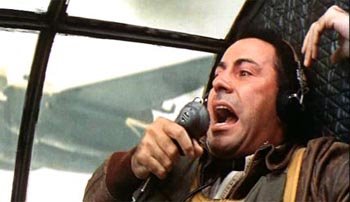
I was beginning to feel a bit panicky, like Yossarian in the nose of his B-26, surrounded by glass, with flak exploding around him so thick it looked like you could walk on it…

And as he sensed my disorder, the man tried to placate me a bit by admitting that yes, perhaps, the way it is worded, as “store pickup,” implying an item being ordered from elsewhere when it was already there, was a bit misleading, nevertheless…

Fortunately, I calmed down enough to ask him whether… by any chance… this item, which had just been advertised as being at his store today… might be coming in on a subsequent shipment without my having to place an order.

He said that was possible. And he had a truck coming in tonight. Perhaps, if I called first thing in the morning, the item would be there and I could place my order.

So I resolved to do that. But I must confess, there’s this paranoid little voice at the back of my head that tells me that by that time tomorrow morning, Colonel Cathcart will have raised the number of missions on me once again…

Yossarian, screaming: "But why would they have to ship you one if you already HAVE one?!?!"

Finally, my important discovery is recognized

For a second there, I almost deleted the comment and reported it as spam. Usually, when someone comments on a really old post, that’s what it is.

But I hesitated, and followed the link provided, and was happy to find that finally, an authoritative source had confirmed the validity of my important discovery of the actual site of the fictional Championship Vinyl.

You have to read High Fidelity to fully understand the importance of my discovery. Watching the movie is OK, but since it transports the shop to Chicago, no serious Hornbyologist would give it the time of day as a source of valid information.

I’m the one who crossed the ocean, left my wife asleep at our hotel in Swiss Cottage, crossed London in the Underground and searched the vast reaches of Islington alone, without a guide beyond the cryptic words of the novel itself, and found the hallowed spot.

And no one has fully recognized me until now, as DellaMirandola writes:

Thank you for this important discovery. I’ve just written about it here:http://thehornseyroad.blogspot.com/2011/11/championship-vinyl.html

Yes, there’s a bit of tail-chasing solipsism or some other fancy word going on here, in that the site in question is citing me as the source of truth without reference to the external world, and I’m citing him in return as the confirmation, but let’s leave that to the nitpickers. The bottom line is, what could be more expert on the validity of a find on the Hornsey Road than a website called The Hornsey Road? I ask you…

And that worthy author could hardly have been more definite:

In High Fidelity, Rob Fleming’s record shop is just off the Seven Sisters Road
This proves conclusively that it’s on the southern stretch of the Hornsey Road.

I am covered in glory. I don’t even care if there’s any money attached.

So now, I have another thing to be thankful for today.

Then they came for the people with good taste…

I really like this treatment, in The New York Times, of the silly-sounding new film, “Anonymous:”

“Was Shakespeare a fraud?” That’s the question the promotional machinery for Roland Emmerich’s new film, “Anonymous,” wants to usher out of the tiny enclosure of fringe academic conferences into the wider pastures of a Hollywood audience. Shakespeare is finally getting the Oliver Stone/“Da Vinci Code” treatment, with a lurid conspiratorial melodrama involving incest in royal bedchambers, a vapidly simplistic version of court intrigue, nifty costumes and historically inaccurate nonsense. First they came for the Kennedy scholars, and I did not speak out, because I was not a Kennedy scholar. Then they came for Opus Dei, and I did not speak out, because I was not a Catholic scholar. Now they have come for me.

Professors of Shakespeare — and I was one once upon a time — are blissfully unaware of the impending disaster that this film means for their professional lives. Thanks to “Anonymous,” undergraduates will be confidently asserting that Shakespeare wasn’t Shakespeare for the next 10 years at least, and profs will have to waste countless hours explaining the obvious…

No, I haven’t seen it, and don’t intend to. I mean, I saw “The Da Vinci Code,” and I’d like to have that time back. I also read Foucault’s Pendulum, which was essentially the same thing (grand, paranoid conspiracy, involving the Knights Templar, reaching back into ancient times). That one really disappointed me, because I had enjoyed The Name of the Rose.

Bottom line, what does it matter who wrote those plays and poems? Whoever it was was probably the most brilliant writer of English ever, largely responsible for the linguistic and cultural hegemony of the Anglosphere. But so what if it was Will Shakespeare or Joe Blow down the street? What’s in a name, yadda, yadda? It’s not like the actual person can enjoy our adulation today. We can’t shake him by the hand or anything. He can’t make any money out of it. Having that name, and that visage, associated with the works suits fine. And since no one will ever know that it was someone else — even if we found a document with a royal seal attesting to it, that could be a fraud itself — what’s the point?

Would it matter that Julius Caesar was actually someone else using that name? No. Gallia would still have been divisa in partes tres. (Latin scholars, help me out — I suspect that “divisa” is wrong with “would have been.” And to me, that matters.)

It remains most likely that

They may have come for Opus Dei and gotten away with it, but they’re not coming for me, not again.

Listening to hunterherring.com, right now

Listening right now to my fellow granddad at hunterherring.com.

The picture above shows Hunter with our youngest granddaughter (his daughter’s, my son’s) at a Lunch Money concert in front of the Columbia Museum of Art several months ago. (Hunter’s wife works with us at ADCO, and Lunch Money’s drummer is with ADCO interactive, and the cameraman for “The Brad Show.” How’s that for cross-promotion? Back off, Jack — I’m a professional…)

Right now, Hunter’s playing Mary Wells singing “You Beat Me to the Punch.”

Listening to Hunter’s web station is like experiencing Nick Hornby’s “High Fidelity” in real life. I’m pretty sure that most of the songs on the fictional Rob’s Top Five lists would eventually be played on hunterherring.com.

The diminishment of creativity over time

Lately, in my truck, I’ve been listening to “The Union,” a CD put out by Leon Russell and Elton John. Speaking of gifts, my brother gave it to me last Christmas, but I only broke it out recently.

I’ve enjoyed it. It’s quite good. I’ve kept it in the player for weeks. I’ve even caught some of the tunes going through my head during the day. They worked well together, although their styles remain quite distinct. When you hear the opening piano chords, you know which voice you’re about to hear.

But… there’s this sadness I associate with it. Good as it is, it’s simply nothing like what both of them were producing in 1970 and ’71, and for a short time after that. I really enjoyed John’s work, from “Your Song” through “Tiny Dancer” on “Madman Across the Water.” As for the Master of Space and Time, I doubt that he had any bigger fan than I, back during the “Shelter People” period. “Stranger in a Strange Land,” for instance, remains an all-time favorite. And who else could have pulled off his show-stealing performance at the Concert for Bangladesh?

On that subject, Leon put on the most awesome show I saw live in the early ’70s, if ever. It was in Memphis. The opening: All the Shelter People were on stage, without Leon. There were two grand pianos. At one of them sat a black guy (who really music aficionados can probably name, although I cannot) rocking out in a gospel style (or so it sounded to my untrained ear), and the Shelter People — or whatever they were called at this point, essentially a “hippie commune bonafied” on tour — were energetically jamming along with him. The music built, and built, still without Leon. It had been going on about 10 minutes, it seemed, and everybody was pumped, and then… Leon stolled out on stage. He was wearing a white suit, with a white top hat, and playing a white Stratocaster. He ambled, back and forth, playing lead over the music… then he climbed up onto the second piano, and stood there with the guitar, rocking away. Finally, he climbed down, put down the Strat, and got serious. He sat at the second piano, and he and other pianist duelled away, with the other dozen or so other people on stage rocking along with them…

It was amazing. What a showman.

People get older. Their powers diminish. Certainly, their energies do. One great thing about being a musician, though, is that you generally retain the ability to make something beautiful, even if it lacks the power of what you did that made you a star, if you were a star.

I got to thinking about this yesterday when I saw a Tweet leading me to a thing about Kevin’s Smith’s movies, ranked from Worst to Best. There were 10 of them. Fortunately, it was not called a Top Ten list. You couldn’t even honestly come up with a Top Five from this guy’s work, not if you had taste. Basically, he had a Top One — “Clerks.” Some of you who think me a prig would be surprised that I even liked that, but it was really well done. The pottymouthed script was inventive, clever, as were the acting and the direction. Not even Jay and Silent Bob wore thin, for as long as the film lasted. It made you want to see more from this guy.

And then you did see more, and you wished you hadn’t. It’s probably a good thing he’s decided to desert his oeuvre and turn to more pedestrian, formula comedy (“Cop Out,” which this list placed last, but which was at least mildly amusing).

Kevin Smith is only 41. He was born when Elton John and Leon Russell were at their peak. But he peaked with one film.

That happens, with creativity. It’s a tragedy, when it deserts the young. Look at the Beatles. Of course, the Beatles were so amazingly improbable to begin with. How could anyone, so naturalistically, produce so much material that was that diverse, from year to year, and that appealing? It was inhuman. It was the sort of thing that in a different cultural context gives rise to dark mutterings about clandestine meetings at the Crossroads at midnight.

But it didn’t last. As they broke up, it looked as though it would. Lennon produced “Instant Karma;” McCartney gave us “Maybe I’m Amazed.” George Harrison seemed to explode, having been repressed, with “All Things Must Pass.”

And that was it. They faded. Mozart died, but they lived to see their talents fade. The wonderful thing about Paul McCartney is that he appreciated that his fans loved the old stuff. So did he. (If you’d made John Lennon stand on stage and play Beatles songs, he’d have shot himself before that other guy did.) I saw him at Williams-Brice, and loved it. But, as I noted the other day, it’s sad to see him dyeing his hair, still trying to be the Cute One. That time is past, Paul.

Of course, one looks for such fading in oneself. Fortunately for me, I never hit the heights that these guys did. I was a decent writer by local standards, impressive to some people. Just enough people, in my book. It’s nice to have strangers come up and say kind things occasionally, but it’s also good to be able to walk down the street anonymously 99 percent of the time.

And as we age, things fade. First, one is no longer indefatigable. Gone are the days when, as a reporter, I could work all day, all night, and through the next morning before taking a nap (something I did frequently, back in the day).

But if you don’t rise too far, you don’t have as far to fall. I never wrote the Great American Novel (not yet, anyway), so I didn’t have to publicly struggle to replicate that for the rest of my life, while everyone scoffed. When one muddles along, one can continue more easily.

I look back at stuff I wrote 30 years ago when I find it moldering in a box, and it’s good. It has a spark, one that I lament. But it’s strange how one’s appreciation of one’s own work morphs. At any time in my adult life, I’ve thought the stuff I’d written six months earlier SO much better than what I was writing currently. Then, six months later, I’d think THAT stuff was the best I’d ever written. That has continued through my blogging years. (My old blog was SO much better-written than this one — even though it wasn’t nearly as well-read. And the stuff I wrote on this blog a year ago is amazingly better than this tripe I’m churning out now.)

What I’m writing now is the worst stuff I’ve ever written. (In my opinion, which is what counts, since I’m an introvert.) But it has always been thus. Aside from its lack of creativity, it’s shot through with typos and incomplete thoughts, mangled sentences. Because I don’t read back over it, and don’t have an editor — and everybody needs one. But I look forward, ever hopeful, to enjoying it later.

When I don’t do that any more, I’m not sure what I’ll do. Relax, I expect.

What about y’all, in what you do? As critics, do you disappoint yourselves? If so, take heart. Perhaps it will look better later. And even if it doesn’t, the stuff Leon and Elton are putting out is still quite good…

I love one of his children, but not the other

My sons gave me birthday gift cards for Barnes and Noble, my favorite place for hanging out aimlessly and browsing, and I’m there now, contemplating a dilemma.

A couple of days ago, I saw the review in the WSJ about this new biography of James Madison by Richard Brookhiser, and they have it here. Since college — when I took so many electives (to some extent concentrating on that period) that I ended up getting a second major in history when I hadn’t planned to — I’ve been drawn to that period, and the Founders. Particularly the Framers.

But do I really want to use one of my cards for that? The publisher overpriced it a bit, for a book with such large type and so few pages. Nowhere near the heft of McCullough’s John Adams. I could get several paperbacks for this price.

Also… I’m still reading, and fascinated by, Charles Mann’s exploration of the Americas and the world pre- and post-1492.

Do I really want to delve into my mixed attitudes toward Madison right now (I inadvertently typed “Jefferson” just then, a pre-Freudian slip)?

The thing is, I revere the man as the Father of our Constitution, a political achievement I honor as much as any in human history.

But… he’s also the father (note the lower case) of a bastard child — American partisan politics. Or one of the main fathers, anyway (the mother was indiscriminate). Certainly the most successful one. The Federalists (which, if I had to pick a party, would have been my preference then) faded away, but Madison’s Democratic Republicans remain vital, although in different form, under truncated name. (And no, for those who don’t follow such things, it’s not the Republicans, a later invention.)

I love one of his children, but the other is the bane of my life as a political writer.

Another reason to hesitate, and wait until this, too, is marked down or in paperback… I have yet to read the book about his chief rival, the one by Ron Chernow, that Fritz Hollings recommended to me several years ago. Fritz thought it was great, and I asked one of my kids for it for birthday or Christmas, and it sits on my shelf yet.

Of course, if anything, my attitudes toward Hamilton lean even more toward the jaded. Despite my Federalist leanings (which is really more of a reaction to the Democratic Republicans than a love of the Federalists), and despite my great admiration for the role that he, too, played in the Constitution, there’s that nasty partisanship thing.

While Adams and Jefferson were conducting themselves more or less above the fray, Hamilton and Madison were carrying out the nastiest sort of partisan warfare in their behalfs. But at least Madison served Jefferson well in so doing. One thing I respect about Adams is that he truly hated party politics, as much as I do, and his own party worked against him perhaps more than it supported him (to name but one example, there’s the way they blackened his legacy with the Alien and Sedition Acts). Jefferson was more affected in his nonpartisanship, and carried it off well, while Madison more smoothly conducted his dirty work.

As for my decision — oh, I’ll have to read the book at some point. I just haven’t decided whether to get it now. I’ll browse a bit more first…

Happy real Columbus Day

OK, I need to run to a meeting, but I can’t let today pass without acknowledging Columbus Day. Partly to defy political correctness… earlier this week, Kathryn said “Celebrating Columbus is a bit like flying the Confederate flag,” and martin sort of disputed her, and I responded:

Indeed. It’s foolish to get mad at Columbus. If he hadn’t been the one, it would have been the next doofus who thought the world was that much smaller than it was (or perhaps, some Portuguese captain who got blown off course on the way down the coast of Africa, which, if you’re out far enough to start with, can easily carry you to the coast of Brazil)…

Somebody was going to make the voyage that changed the world more profoundly than any other voyage in the history of the world. The one that started the continuous travel between Europe and America, as opposed to the Vikings and St. Brendan and the like. It just happened to be Columbus, because he was so stubborn about his wrong idea, and managed to persuade Isabela to part with some dough.

But there’s another reason. I’m very much looking forward to reading 1493, by Charles C. Mann. I got it for my birthday. And though I have not read it yet, I’m familiar with his thesis, because he summed it up in this remarkable piece in the WSJ recently. An excerpt:

Some 250 million years ago, the Earth contained a single landmass known as Pangaea. Geological forces broke up this vast expanse, forever splitting Eurasia and the Americas. Over time the two halves of Pangaea developed wildly different suites of plants and animals.

Before Columbus sailed the Atlantic, only a few venturesome land creatures, mostly insects and birds, had crossed the oceans and established themselves. Otherwise, the world was sliced into separate ecological domains. Columbus’s signal accomplishment was, in the phrase of the historian Alfred W. Crosby, to reknit the seams of Pangaea.

And he means that culturally, certainly. And politically, a concept we’re all familiar with. But also horticulturally, zoologically, economically, genetically, and just about any other way you want to look at it, with the exception of geologically.

Before Columbus, the world was one way. After, it was another way, in realm after realm of human, animal and plant life. The more you dig into it, the more astounding it is.

So… it doesn’t matter whether Columbus was a nice guy, or beastly to the native peoples, or a lousy geographer, or whatever. At least, no matter which of those things is true, the achievement is singular and world-shaking. That one voyage changed the world more than any other voyage, ever. Certainly infinitely more than the previous aborted connections between the continents, by Vikings, and possibly Polynesians, Africans, and Chinese. Because the connection he made was not severed, but followed up on — by quite a host of rather appalling opportunists in many cases, but as I say, this is not about the moral judgments.

It’s about what a big deal this was. And worth marking every year. (Although maybe not worth the Post Office getting a day off when I don’t.)

By the way, Mann is not about shortchanging the Indians. I’m now reading his prequel, 1491, which is about the millennia before Columbus came here. In short, it’s about all the recent research that tells us that there were many more people here than we supposed for most of our history, that they were here far longer, and that their societies were more sophisticated than even the greatest denouncers of eurocentrism would suppose. And other fascinating stuff.

A passage that sort of illustrates the paradigm-busting approach of this book (and, I assume, the new one):

Next year geologists may decide the ice-free corridor was passable, after all. Or more hunting sites could turn up. What seems unlikely to be undone is the awareness that Native Americans may have been in the Americas for twenty thousand or even thirty thousand years. Given that the Ice Age made Europe north of the Loire Valley uninhabitable until some eighteen thousand years ago, the Western Hemisphere should perhaps no longer be described as the “New World.” Britain, home of my ancestor Billington, was empty until about 12,500 B.C., because it was still covered by glaciers. If Monte Verde is correct, as most believe, people were thriving from Alaska to Chile while much of northern Europe was still empty of mankind and its works.

Worth reading.

Can you tell the sex of the writer?

I’ve given you nothing so far today, so perhaps even this, insubstantial as it is, will seem like something.

Among many things I did today instead of blogging was try to continue cleaning out my inbox, which a day or two ago was up to about 500. That happens because there are things that I don’t have time to deal with at a given moment, but that I want to do something with, so I leave them where I found them rather than filing them away, where I’ll never see them. And of course the next day another hundred and something come in, and I try to winnow those, but there are always a few more that end up staying there for the same reasons, and so on. Then, there are days I don’t really have time to cull at all, and things just get deeper and deeper.

No, it’s not a good system, but it is mine.

Anyway, I managed to dig today all the way down (I only have 211 left, mostly old stuff) to something I saved on June 3. It was this Tweet, which I had emailed to myself hoping to blog about:

Slate @Slate
Can you tell if this paragraph was written by a man or a woman? V.S. Naipaul says he can: http://slate.me/lWMWfg

Yes, I took the test provided by The Guardian — the one designed to determine whether I could do what Naipaul claimed HE could do, which was quickly tell whether something was written by a man or a woman.

And of course, I failed — I got 4 out of 10 right. Which is what the person who devised the test had intended. It’s easy enough to pick passages by men that sound like they are in the voice of a woman, and vice versa. To make it hard (or, in this case, to prove Naipaul is a sexist pig, which seemed to be the point — which he deserved, since he was being ungentlemanly).

Often, when I start out thinking, for whatever reason (say, an ambiguous byline such as “Pat,” or “Leslie”) that I’m reading something by a man or a woman and I’m wrong, at some point in the reading I go, “Wait a minute…” because something doesn’t seem right. And then I realize — the man is a woman, or vice-versa. Since, as an editor, I’ve had to critically read thousands of pieces from strangers, this has happened enough for me to note a trend.

Sometimes I’m wrong about my realization, though. I suspect, based on observations over the past thirty or forty years, that men and women (especially younger ones) are writing more and more like each other. Just as in other areas the genders are crossing paths. For instance… I’ve been driving for more than 40 years. For the last 25-30 years, I’ve noticed that young women are driving a lot more like young men than they did the first 10-15 — more aggressive, more likely to cut you off, more stupid in general, just like young guys.

Meanwhile, I’ve noticed a number of trends among young guys that combine to make it harder to determine the presence of a Y chromosome in superficial behavior. OK, guys still do more stupid stuff than women do, since testosterone still exists in them, but it seems that some of them try harder and harder, and often succeed, to express themselves like women. I won’t go into detail because one of them might punch me. Not very hard, of course, the wussies, but I still would find it inconvenient.

Anyway, take the test if you like. I’ll bet you flunk it. I certainly did. I knew I would, so I played along. When I thought the deviser of the test was trying to lead me to answer a certain way, I did.

I think I could probably devise a test you could pass along these lines. (The way to do it would be to choose paragraphs that are characteristically masculine or feminine in tone. In other words, stack the deck toward being easy rather than hard. If you chose paragraphs at random, everyone would flunk that, too. Most paragraphs provide few clues.) But you know what? I think my not having time to do that is why this post idea has sat here for almost three months…

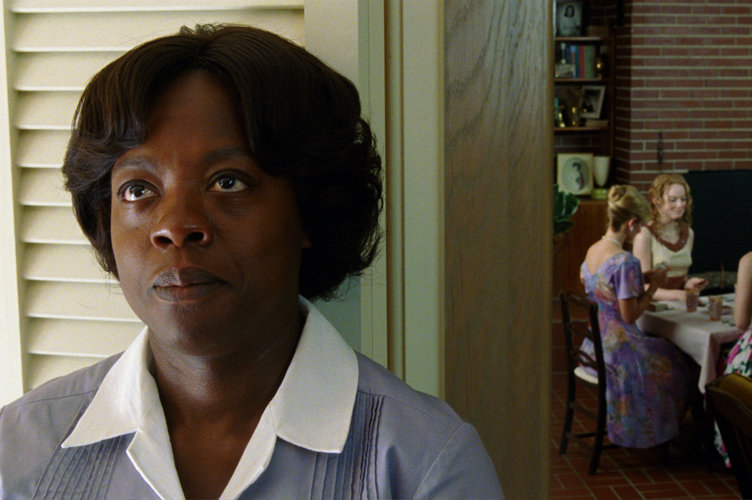
Saw “The Help” last night…

I don’t get to the actual movie theater anymore. Even though I’ve largely cut off the firehose flow of entertainment into my house, between Netflix and the DVDs I own (most recent acquisition: a Blu-Ray of “True Grit”), I’ve got more movies to watch than I really have time for — without paying those ridiculous ticket and concession prices.

But I have seen five movies this summer, which is unusual for me. Here they are, in order:

  1. Thor
  2. X-Men: First Class
  3. Green Lantern
  4. Captain America
  5. The Help

Oops, did I give you whiplash there? Did you think you knew where you were going and then, WANG!, a sudden change of direction.

Well, I went to the first four with my son, because of our shared interests in comic books, and the last one was my wife’s idea. We went to see it for our anniversary last night.

I went thinking, “This is my anniversary present, because this is a chick flick,” but I enjoyed it. And not just because of the views of that social outcast “Celia.” It was just a well-told, real-life story about people. Of course, I guess a lot of things would look like that after the other four movies I saw before it. (Best of the bunch? “Captain America.” But I expected that. The one that most exceeded my expectations? “Thor.”)

Something that struck me at the end, though: During the credits, I got up and looked around, and noticed two things. Most of the audience was female, which I had expected. And most of the audience was white. I found myself wanting to interview the audience, to get their impressions, and ask how it spoke to them and their lives. Did it match their memories? How do they think life has changed since then, and how stay the same?

More than that, I wanted to ask black folks who weren’t there: Why not? I can guess some reasons why not, but I’d probably be off-base. Then again, this audience, while numerous, may not have been representative. This was out at Harbison. Demographics would have been different somewhere else. Probably.

But I didn’t bother anybody with questions. It was our anniversary.

Last anniversary, we went to a bourbon tasting at the Capital City Club. That is to say, we went out to dinner at the club for our anniversary, and before that there was this bourbon tasting that was free to members (I think I’m remembering that right), so I managed to talk my wife into attending. It was fascinating. The speaker was a great-grandon of Jim Beam, and a very colorful and knowledgeable guy.

This year, we decided on a more low-key celebration. And “The Help” served the purpose well. It was particularly meaningful because the central character has the same last name as my wife’s maiden name. OK, that’s just a coincidence, of no interest to you, but we found it interesting… sort of like the family in “Driving Miss Daisy” being named “Werthan.”

A horrorshow comparison, oh, my brothers!

That Stan Dubinsky veck, being the sort with a large gulliver, has drawn a comparison, oh, my brothers, between the rioters in England and your own Humble Narrator’s loyal droogs.

There may be a slight resemblance to one’s glazzies at first glance, but note that those grahzny bratchnies are not dressed in the heighth of fashion; they do not wear our platties of the night! Consider that before thou dost make up thy rasoodocks.

One thing is true: There aren’t enough millicents to put their rookers on them all, much less put them in the staja where they belong…

OK, I’ll stop now. I’m just sort of randomly grabbing stuff from the Nadsat dictionary.

Says Stan (Dubinsky, not Kubrick):

Those whose attention is on the London riots of 2011 might recall that Anthony Burgess and Stanley Kubrick anticipated all this 50 and 40 years ago, respectively.  Time to dig out your copy of A Clockwork Orange, and read or watch it again.

It’s available for streaming on Netflix, by the way. But the book’s better.