Category Archives: Books

Three more nights, counting tonight

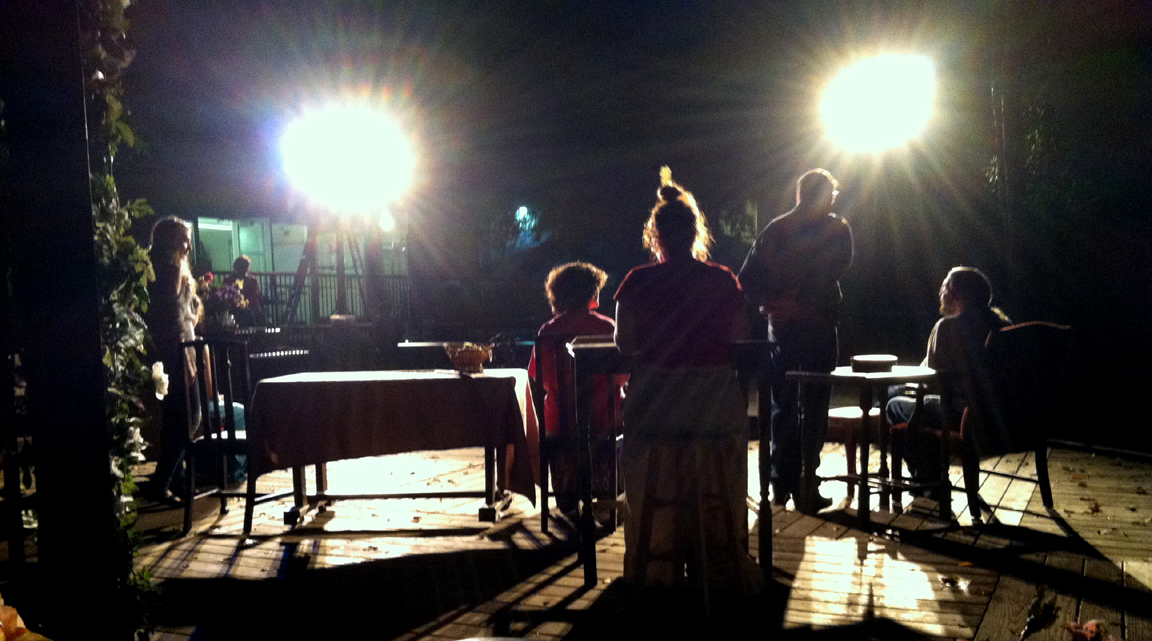
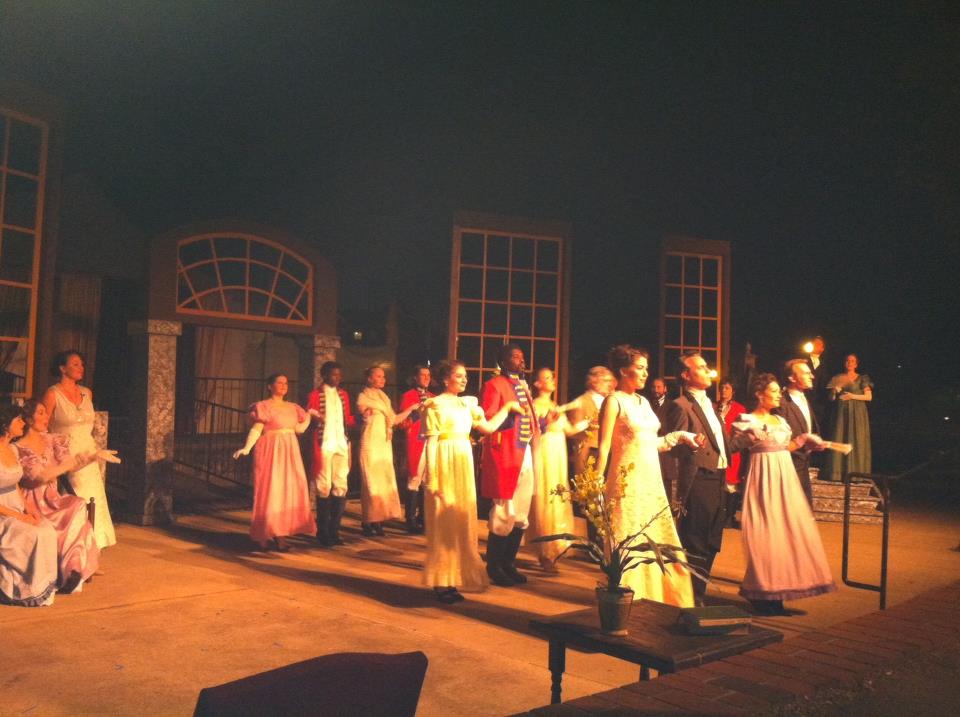
Schoolteacher and former state superintendent candidate Kelly Payne shot the picture above last night, from the moment in scene 2 when I announce, “May I present our new neighbors at Netherfield: Mr. Charles Bingley (top), Miss Caroline Bingley, and Mr. Fitzwilliam Darcy…”

Though I’ve shot a lot of pictures of the production myself, is actually the first picture I’ve seen with me in it other than the dance one in which I am tiny and blurred. Seeing this, I’m thinking I might need to make the smile bigger. Sir William is an ebullient and convivial fellow.

If you’d like a better view of the whole thing, come on out. We’re performing in the amphitheater at Finlay Park at 7:30 tonight, Friday night and Saturday night, and then that’s it.

And it’s free.

I would have liked Ike, JFK, maybe even Nixon

I was at first drawn in by this book review in The Wall Street Journal this morning, because at the outset it addressed a big concern I’ve had since the start of this election year:

Even as we tremble at the edge of a fiscal cliff, the culture war insists on our attention. Abortion, contraception, gay and women’s rights, and welfare have all returned to shake up an election season that was supposed to be a simple economy slugfest. Robert O. Self’s “All in the Family” could help explain why. Mr. Self, a professor of history at Brown University, has heroically researched the history of the culture wars from the early 1960s to the present. He offers a provocative analysis that accounts for today’s alliance between small-government and social conservatives, on the one hand, and welfare-state and social liberals, on the other….

However, I was less enchanted by what followed:

Mr. Self begins his history by describing “breadwinner liberalism” as the status quo of the early and mid-1960s. The architects of the Great Society assumed the primacy of male-earner and female-homemaker families. Labor unions fought for a family wage for their predominantly male membership, the Moynihan Report (1965) raised alarms about black male unemployment, and the first efforts at affirmative action took the form of quotas in municipal contracts for male construction workers. In all these cases “women were largely an afterthought,” Mr. Self writes. Breadwinner liberalism, he argues, was based on a model of “masculine individualism”: hardworking, striving, self-reliant….

The review goes on to recount the book’s take on the Kulturkampf that has plagued our politics since the 1960s. Apparently, the author of the book thinks the changes that have come are all to the good; the reviewer demurs.

All I know is this: In 1960, I could have been comfortable as a liberal. For that matter, in 1960, I could have been comfortable as a conservative. I can see myself having voted for Ike. I think I would have been torn between Nixon and Kennedy. (At the time, I favored Nixon, but I was only 7 years old. I don’t know what I would have done as an adult.)

Whatever happened, and however you define it, I can’t be at home in either camp today. And the Kulturkampf stuff is a big part of the reason why.

Pride and Prejudice and Skeeters

Monday was our first night with lights. In this scene (still sans costume), the Bennets get to know Mr. Collins better than they'd like to.

Just to remind y’all that one reason I’m not blogging as much as usual these days is because of rehearsals for “Pride and Prejudice,” seven days a week.

Over the weekend, we further prepared our state of mind with Karen Eterovich’s (mostly) one-woman Jane Austen show at Drayton Hall. Just days before those performances, I was asked to play a small supporting role in that. Master Thespian that I am, I quickly mastered my three lines, which were as follows:

  1. “No.”
  2. “Yes.”
  3. “YES!”

Moving on from that triumph… Sunday night, we moved to Saluda Shoals park, where we open Friday night, which I believe is starting to freak everybody out just a bit.

Sunday night, we experienced rain. We moved inside to a very small room, and did a hurried run-through, which directors Linda Khoury and Paula Peterson said were our best performance yet. It was certainly… intimate. In a dance scene, one of the actresses and I ran into each other via our posteriors. It occurred to me that this was unexplored cultural ground: I had just done “the Bump” with Miss Jane Bennet. Lydia I could see, but Jane?

Then last night, there was a challenge of outdoor theater I had never anticipated, as we stood at the edge of woods damp from the rain, waiting to go on: Mosquitoes. As I waved and slapped at them, I took solace from Marty Feldman’s immortal words: “Could be worse. Could be raining…”

Three more nights…

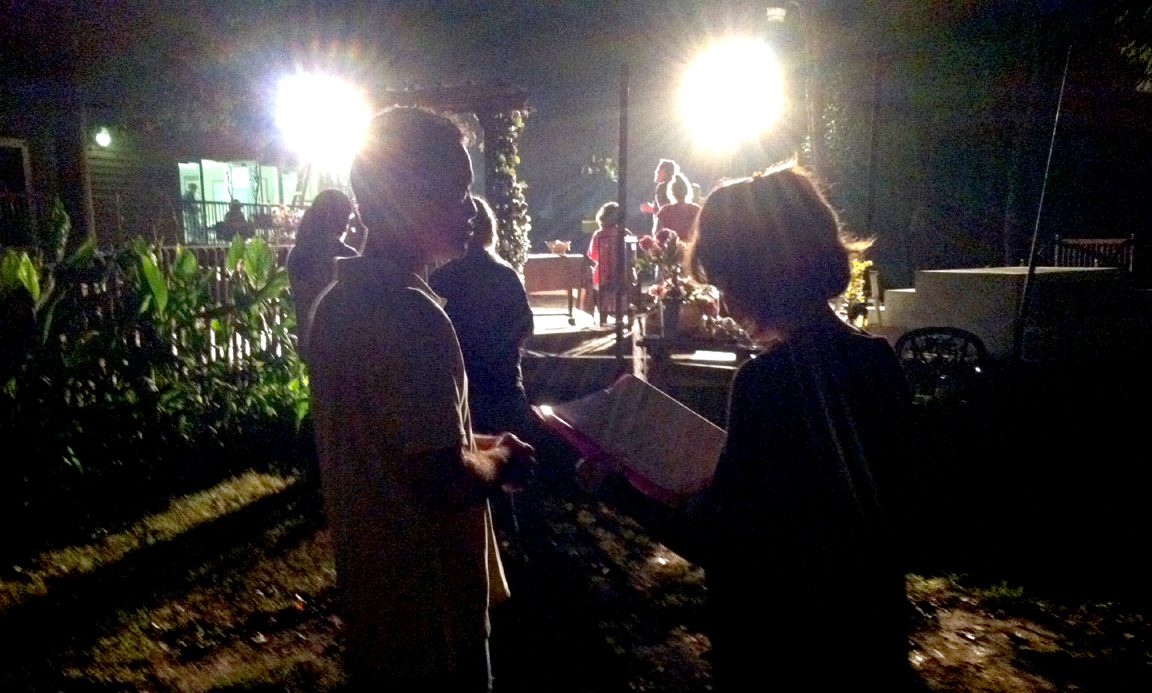
At the edge of the woods, waiting to go on: Mr. Darcy (Gene Aimone) and my daughter, who plays Lady Lucas.

I, Sir William Lucas, hereby invite every one of you to the ball we’ll be hosting next month

Have you seen any of the series AMC has been rerunning lately, “Into the West”? I watched some of the first episode. It had a lot of mountain men in it. I thought, “What a fine bunch of distinguished-looking gentlemen…”

Lately whenever we have a meeting with an ADCO client, one of my colleagues will at some point in the meeting say something like, “In case you’re wondering why Brad is looking like this…”

To put it one more way: Lately I have not been mistaken for Don Draper.

Here’s the story:  I have a role in the South Carolina Shakespeare Company’s production of “Pride and Prejudice,” which opens at Saluda Shoals Park. And yes, we all know that the Bard did not write that one. But I suppose the company’s repertoire is broader than its name suggests.

Our director, Linda Khoury, has asked us not to get our hair cut from here on — mine was already pretty shaggy by the time she said that. I had also stopped shaving at that point. But English gentlemen did not wear beards during the Regency Period, you will no doubt say. You are right. But I thought it would look a little less crazy and anachronistic if I grew the whole thing out, and then cut it back to muttonchops at the last minute.

I have a fairly small part in the production, which suits my comfort level at this point in my acting career. It’s been more than a quarter century since I have trod the boards for anything more than a cameo, so it’s nice to know I don’t have more than about five lines.

I’m playing Sir William Lucas (who was played by this guy in the definitive 1995 BBC series). If you know the story, you know Sir William and Lady Lucas are sort of the local aristocracy in the environs of Meryton in Hertfordshire (and their daughter, Charlotte, is Miss Elizabeth Bennet’s particular friend). My character was in trade before his elevation to the knighthood, which I’ll thank you not to mention. Sir William’s function in the play is to throw the ball that gets the principal characters together, introduce them, and try with mixed success to get them to dance and have a good time. Sir William is sort of an early 19th-century party animal, and regularly gives two balls a season.

In being the hearty, jovial, back-slapping good-time Charlie, I’m playing against type, which I hope everyone will take into account in assessing my performance. (The character in the play whose personality is most like mine is Mr. Darcy, and I’m just a year or two too old for that.)

I got involved in this because my daughter and granddaughter are in it. They are portraying Lady Lucas and Miss Kitty Bennet, respectively. We’re all having fun so far.

Here’s the info on the performances:

Columbia SC—The role of The Bard will be temporarily played by the world’s most famous femaleBritish literary icon, as The South Carolina Shakespeare Company (SCSC) presents a celebration of all things Jane Austen to kick off its 2012-2013 season.  With a fast-paced and engaging adaptation of Pride and Prejudice and the debut of Cheer from Chawton, an internationally-acclaimed one woman Jane Austen tribute show, the Austen performances usher in SCSC’s 20th anniversary season featuring an extended calendar of events that include a winter production of Paul Rudnick’s contemporary comedy I Hate Hamlet and Carlo Goldoni’s classic comedy A Servant of Two Masters.

Entertaining thousands of South Carolina audiences with no-cost cultural enrichment since 1992, SCSC has selected Jon Jory’s staged adaptation of Jane Austen’s most famous work, Pride and Prejudice, as its season opener. A tale of love and values in class-conscious England of the late 18th century, Pride and Prejudice is a witty romance featuring the five Bennet sisters – including strong-willed Elizabeth and young Lydia – young women who have been raised by their mother with one purpose in life: finding a husband.

“With the debut of our 20th season, we are presenting a novel experience for our loyal audience but one that is also in keeping with our classical programming,” said Linda Khoury, founding director of the SCSC. “Jane Austen is an author who shares Shakespeare’s cultural relevance and she is universally praised for her keen observations and strong critiques of classicism and economic conditions of the 1700s. The wit, wry commentary and romantic travails of her characters are contagious for both Austen-ites and new fans alike.”

With such immensely popular material that has enjoyed high-profile film and miniseries treatments, Khoury has assembled a top-notch cast that is challenged with surpassing any existing impressions people may have of this famous story.  Pride and Prejudice will feature Scott Blanks, Gene Aimone, Katie Mixon, Jessica Mitchell, Tracy Steele, Marcus Thomas, Sara Blanks, and Malie Heider.

Pride and Prejudice will be performed October 5—7 at Saluda Shoals Park at 7:30 pm and October 17—20 and October 24—27 at the Finlay Park Amphitheatre beginning nightly at 7:30 pm.

As audiences prepare to encounter Austen’s memorably rich characters, they will also have the chance meet the author herself, as Cheer from Chawton will be presented the weekend prior to the Pride and Prejudice opening. In a creative collaboration with the University of South Carolina’s School of Theatre and Dance, Cheer from Chawton is an internationally acclaimed one woman “Jane Austen experience” conceived, written and performed by professional actor and USC MFA graduate Karen Eterovich. Performed throughout the United States and UK, Cheer from Chawtonoffers an intimate glimpse into Austen’s life, including her pointed observations on family, friends, suitors, and society, as well as her own hilarious early efforts as an author. The play will be performed Friday and Saturday, September 28 & 29, 2012, 8 pm at Drayton Hall on the USC campus.

The new stylebooks are here! The new stylebooks are here!

I exchanged Tweets this morning with Paul Colford, director of media relations at The Associated Press. He was busily promoting the AP’s new U.S. Elections Style Guide, with tidbits such as this:

Election Day is uppercase; election night is not. See @AP’s new U.S. Elections Style Guide: http://bit.ly/Mrvs5u

I replied that I thought that had always been the rule, which caused Mr. Colford (see how I violated AP style there by calling him “Mr.”? I’m such a rebel) to respond that there was lots of other good stuff there.

I started looking into the subject, and saw that a whole new AP stylebook came out a couple of months ago, and I didn’t even know it. I’m not sure I even would have known it had I still been working at a newspaper. Aside from the fact that as editorial page editor I had long been deviating from AP style intentionally for years, I sensed that it wasn’t as big a deal as it had once been even among the mullahs of style orthodoxy.

(For those who have not spent their adult lives as journalists, perhaps I should explain: The AP stylebook is the guide to proper spelling and usage most widely accepted in print journalism. Newspapers that didn’t have their own full stylebooks — the vast majority — used it as their official bible, only issuing addenda for exceptions, local place names and the like.)

In my long-ago days as a copy editor (which was so long ago that I forget whether it is properly spelled that way or “copyeditor,” a lapse on my part that may be some sort of PTSD symptom), things were different. My colleagues and I who spent our days around the horseshoe-shaped desk at The Jackson Sun were really excited about the 1977 edition. We actually had a party at the managing editor’s house to distribute them. And there was much in this new release to satisfy the socially-challenged pedant. That was when the stylebook went, for the first time, from being a slim paper pamphlet that resembled the tracts that fundamentalists passed out with titles like “The Antichrist in Rome” to the thick, rich, spiral-bound volume that made it seem more like the Ultimate Answer to All Questions.

But that was then. In my last years at the paper, think I had one somewhere around my desk, but I almost never consulted it, and it was probably badly out of date. On the rare occasions when I looked something up to see what the style was so I could decide whether I wanted to follow it or not, I did so electronically. And yet I see one can still order the spiral-bound version.

Which is kind of nice. But it feels like almost as much an artifact of the past as those phone books that once so excited Navin Johnson.

The Raskolnikov Syndrome

This wonderful photo, entitled "Portrait of Raskolnikov," was taken by Samanyu Sharma of India. I hope he doesn't mind my using it here; it just illustrated my point so well. I couldn't figure out how to contact him.

“You’re crazy,” Clevinger shouted vehemently, his eyes filling with tears. You’ve got a Jehovah complex… You’re no better than Raskolnikov –“
“Who?”
“–yes, Raskolnikov, who–“
“Raskolnikov!”
“– who — I mean it — who felt he could justify killing an old woman –“
“No better than?”
“– yes, justify, that’s right — with an ax! And I can prove it to you!”

I’ve long had this theory that people who do truly horrendous things that Ordinary Decent People can’t fathom do them because they’ve actually entered another state of being that society, because it is society, can’t relate to.

Quite simply, people like James Eagan Holmes are able to spend time planning a mass murder, prepare for it, gather guns and ammunition and explosives and body armor, and actually go to the intended scene of the crime and carry it out, without ever stopping and saying, “Hey, wait a minute — what am I doing?” because they’re not interacting enough with other human beings.

This allows their thoughts, unchecked, to wander off to strange places indeed — and stay there, without other people making social demands on them that call them back.

I think there’s a quality in the social space between people that assesses the ideas we have in our heads and tells us whether they are ideas worth having, or so far beyond the pale that we should stop thinking them. This vetting doesn’t have to be conscious; it’s not like you’re overtly throwing the idea out there and seeking feedback. I think that in your own mind, you constantly test ideas against what you believe the people around you would think of them, and it naturally affects how you regard the ideas yourself. I think this happens no matter how independent-minded you think you are, no matter how introverted in the Jungian sense. Unless, of course, you are a true sociopath. And I believe a lack of sufficient meaningful interaction with other people you care about plays a big factor in turning you into one of those.

Dostoevsky’s Raskolnikov was the perfect case, fitting all the criteria we keep hearing about. Brilliant young mind, but he suffered a series of setbacks that embarrassed him and caused him to draw away from his friends. Living hundreds if not thousands of miles from his family, he was forced by lack of money to drop out of school. Rather than make money doing the translations his friend Razumikhin tried to throw his way, he fell to brooding in his ratty garret, or wandering alone through the crowded city, thinking — and not sharing his thoughts.

His murderous plan started with a provocative, if not quite mad, idea that he wrote an essay about — setting out the theory that extraordinary people who were destined to do extraordinary things for the world had a right, if not a duty, to step over the normal social rules and boundaries that restricted ordinary people. Had he been in contact with friends and family, they would have challenged him on this, as Razumikhin did late in the book, when he learned of the essay. Maybe they wouldn’t have changed his mind, in the abstract, but if he had been having dinner each night with his mother and sister, and going out for drinks regularly with Razumikhin, it would have been impossible for him to have carried it to the next level.

I’m not saying he would ever have run the idea up the flagpole with his friends and family, and then been checked outright. He wouldn’t have said, “I think my idea’s a good one, so you know what I’m going to do? I’m going to kill that old woman I keep pawning my possessions with, and take her money, and go back to school and achieve my potential.” No. What I’m suggesting is that if you are constantly around normal, decent human beings who care about you, who ground you in humanity, you won’t allow your thoughts to run that far out of bounds. You’ll check yourself.

My “proof” for this theory — which I’m sure has occurred to thousands of other people (I don’t share Raskolnikov’s delusions about my own brilliance) — lies in what happened when, unexpectedly, his mother and sister appear in his life again, right before him in his own dingy room.

It happens after Raskolnikov has committed his crime — a crime that that has an emotional impact on him he didn’t anticipate, although he’s more or less holding up. He has renewed acquaintance with Razumikhin, a bit late for any positive socializing influence to prevent the murders.

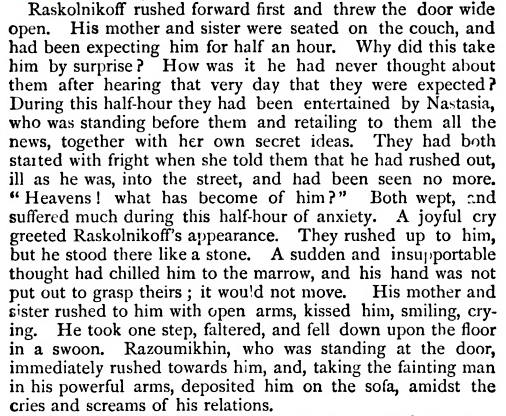
And he comes home, and BANG, there are the two most important people to him in the world, the people whose absence had sent him into such a tailspin:

The 40 years since I read that played a trick on me. I could have sworn that the passage was more specific about exactly what happened in his mind when he saw his mother and sister. I thought it said something like, “In that moment, it came to him in a flash what he had done.”

And maybe the translation I read did. Or maybe I was just so sure that that was the “sudden and insupportable thought” that “chilled him to the marrow.”

In any case, it still seems clear that while he had been able to think of his crime in one way in isolation — a way that actually made it possible — he didn’t truly realize what he had done, in human terms, until suddenly faced with the two people who most mattered to him, and who would be most horrified, to the cores of their souls, to know what he had done. He saw himself, and all he was and all his actions, in an entirely different way through their eyes.

Under my theory, if he had been in regular contact with his mother and sister, he would have had that realization long before getting to the point of committing his crime.

Tom Davis on Lindsey Graham on mandates

File photo of Tom, taken at the governor's mansion back when he worked for Mark Sanford.

Most of the time, people say that Tom Davis is gearing up to run against Lindsey Graham in the 2014 Republican primary. Sometimes, they shift and say he’s one of those preparing to run against Nikki Haley that year. But usually, it’s Lindsey Graham.

Tom encourages that way of looking at things by posting stuff like this on Facebook:

Lindsey Graham is now in front of every TV camera he can find, condemning health insurance mandates, but making no mention of the bill he cosponsored in 2009 (S. 391; the Wyden-Bennett Act) to impose mandates and corresponding noncompliance penalties.

I had forgotten about the Wyden-Bennett Act, if I ever knew about it. Well, good for Lindsey.

Tom forgets that conservatives used to be for mandates, before Barack Obama started agreeing with them. But Tom is not alone in that. Republicans in general have wiped that from their memories, because it would be inconvenient to their goal of demonizing the president over it.

Remember how in 1984, Oceania had always been at war with Eastasia? Until things changed, and all those records and memories were expunged, because now Oceania had always been allied with Eastasia, and at war with Eurasia?

It works like that.

An unpardonable insult to Jack Kerouac

I’m reeling here. I’m stunned. I’m looking about for some hope for the world.

In connection with a comment I was responding to today, I went looking for when I’d written about repealing the 17th Amendment not being such a crazy idea, and there I found a link to a Christopher Hitchens piece from early 2011, which I followed for nostalgic reasons, and noted there a link to the cover of the current edition of Vanity Fair, and there I saw the thing that shocked me.

What I saw (accompanied by a photo in which she demonstrated that, however much money you spend on a glamour shoot, there are some people you can’t MAKE glamorous, because their facial expression will drag the whole thing down) was a mention of Kristen Stewart — she’s the notably underwhelming star of the “Twilight” movies — in  the same breath as Jack Kerouac. I saw her name in connection with a coming movie adaptation of On the Road. In a connection that was crafted as though she were starring in it or something:

As the Twilight-series finale approaches, Kristen Stewart is also starring in this month’s Snow White & the Huntsman,followed by an adaptation of Jack Kerouac’s On the Road. Ingrid Sischy finds her on the run, in Paris. Photographs by Mario Testino.

See? They even used the actual word, starring! Well, first, I had to think, so is she Dean Moriarty or Sal Paradise? Or Carlo Marx? And if so, how does that work? OK, so she’s Marylou. Well, I have to admit I don’t have as clear an image in my mind of Marylou as I do the others, except for this: I can’t imagine the wild jailkid Dean, the quintessential Mad One who burns, burns, burns across the American landscape, going for anyone remotely like Kristen Stewart. There is no way you envision her as a character produced by a brain writing on a continuous roll of butcher paper under the influence of benzedrine. (OK, so she’s based on a real-life person, but you know what I mean.)

Now, I’ve seen other people say less than kind things about this actress, and I was like, Aw, leave the kid alone, but when you start talking about putting her anywhere near the centerpiece of anything as iconic as On the Road, well you’ve gone to messin’. Near as I can tell, there’s a reason why she was the star of the Twilight movies. It’s because she was so painfully ordinary and unremarkable that teenage girls everywhere could project themselves onto her, and identify.

That’s not a quality I connect with Kerouac.

Also… one expects a Kerouac project to have a bit of an alternative feel to it, and not be cast according to mundane box office considerations.

OK, that’s about all I’m going to say, except to say that this is a little bit personal for me. Kerouac introduced me to my wife. OK, not personally, because he was dead at the time. What I mean to say is, we met at this party she threw for a mutual friend, and she was reading a Kerouac biography at the time, and I was reading On the Road for the first time, and we realized it and started talking about that, and connected in a powerful way, and started dating seriously about a week later, and were married a year after that.

So, you know… it seems like whoever was in charge of casting would have checked with me or something…

Rielle Hunter: The assignment I declined to take

Sunday, I was having Father’s Day dinner with my two sons (all my daughters being out of town), my daughter-in-law and two of my grandchildren at Yesterday’s, and my phone rang.

It was The New York Post. If you’ll recall, I represented that paper at the infamous Mark Sanford confessional press conference in June 2009, and they have called me since then from time to time when pursuing a story in SC. I’m generally glad to help when I can. Working with those folks can be an interesting change of pace.

This time, when the editor heard I was having Father’s Day dinner, he said he’d let me go, which I appreciated. But my curiosity was piqued.

A couple of hours later, he called me again, and asked if I could do a job for them. I asked what job.

Basically, they had heard that someone in this part of the country had advance copies of Rielle Hunter’s book. They wanted me to obtain a copy, read it quickly, and file a story that night.

I declined, and offered them someone else who might be interested in doing the story for them.

Part of it was that I was behind on some stuff I had meant to get done during my week off, and needed to get done before heading back to the office on Monday.

But part of it, I confess, was… well, you know the adage, You couldn’t pay me enough to do that? I’d rather have my gums scraped with a rusty screwdriver than read a single page of a tell-all book by Rielle Hunter. Every second I would spend doing that, I’d be acutely aware of all the good books out there that I probably won’t have time to read in my lifetime, and the sense of wasted time would be like a physical pain. I don’t even want to spend time passively listening to someone sum up her book in 25 words or less, much less spend any of my finite time on this planet reading anything that she might have to say. Just the thought of the exertion required to pick up such a book made me recoil.

I see they got somebody to do the story. Good. Especially since it wasn’t me.

I hope this doesn’t mean they won’t call me when they have something I would jump at (like the Sanford thing — I was burning with curiosity to know where our gov had been). But if so, having dodged any contact with a book by Rielle Hunter would have been worth the loss.

Post-newspaper retail environment born in 1962

This morning was one of those moments when several threads came together for me, providing a small insight into the shape of the world in which we live.

It’s related to a moment of revelation I experienced in about 1996. I was attending one of a series of monthly meetings that our then-new publisher, Fred Mott, had instituted to brief employees in general about the state of the business side of the newspaper. I was probably sitting there trying not to let my eyes glaze over too obviously when he said something that cut through. Something that should have been obvious, but was not until that moment.

He observed — I forget exactly how he said it, but this was what I got out of it — that Walmart had shifted the ground upon which the business model of newspapers had been built. The key element was “everyday low prices.” Everyone knew that Walmart was the place to get the lowest prices available locally on anything they sold. And they sold everything. If everyone knows that you have low prices every day — and not now and then, in the form of sales events — you have nothing to communicate, on a regular basis, through advertising.

To show how that affected but one of the newspaper industry’s key advertising constituencies… people were used to reading about all the grocery stores’ specials — which changed if not day to day, then at least week to week — in the newspaper. But what’s the point in that if you can get all those same groceries — same brands and everything — cheaper at Walmart? And every day. So beyond some general branding, which it does mainly through television, reminding people of said everyday low prices, what does Walmart have to communicate? There is no news to pass on. That gives it yet another competitive advantage over those regular advertisers, because it saves the ad costs. To try to compete, those advertisers cut back on their ad budgets, and so forth.

And since Walmart sells practically everything a mass market wants, there is no retailing area unaffected. Department stores, appliance stores, clothing stores — everybody is competing against an adversary that doesn’t have to advertise to the extent that they traditionally had done.

That was just a piece of what was strangling newspapers, but a significant piece. Hence the expense cutbacks and hiring freezes that were already a monotonous part of newspaper life. The next year, Fred made me his editorial page editor, and shortly thereafter, as a measure of his confidence in me and his perception of the importance of the editorial mission, I was able to grow my department by one FTE. That was it. From then on, every budget year was an exercise in doing it with less. And less. And less. Until, two publishers later, it was decided to do without me.

But where did Walmart come from?

I got to thinking about that this morning. I was reading, in the WSJ, an oped piece about Eugene Ferkauf, who recently died at the age of 91.

In the postwar years, he pioneered discounting through his chain of stores called E.J. Korvette. This required challenging the “fair trade” price-fixing laws then in place in many states:

Retail price-fixing in the United States—often packaged for popular consumption as “fair-trade” laws—was a Depression-era concoction. Launched in California in 1931, it was quickly copied by state legislatures across the country. These statutes were premised on the idea that manufacturers retain a legal interest in the price of their products even after actual ownership has moved downstream to retailers. The laws were written so that once a single retailer in a fair-trade state agreed to observe the manufacturer’s proposed retail price list, it would in effect impose those prices on all other retailers in the state.

Conceived as a means of protecting small, independent merchants against predatory chains, fair-trade laws were pushed through state houses by legislators beholden to the influential retail chambers of commerce. The big manufacturers, especially appliance makers like GE, Westinghouse, RCA and Motorola, usually lent tacit support. It was easier for them to deal with a multitude of small customers through their wholesalers than to directly confront retailers big enough to muscle them for price concessions and promotional allowances…

I had never heard of E.J. Korvette stores, but I got to thinking, when was the first time I experienced discount store shopping? I realized that it was when we moved to New Orleans in 1965, after having lived in South America since late 1962. One of the elements of modern American culture that made an impression on me that year was the local Woolco store, a short drive from my home.

Anybody remember Woolco? They went out of business for good in the 80s, but this one was thriving in 1965.

I looked it up on Wiki, and found that Woolco was founded in 1962. This made me curious, and I looked to see when Kmart was founded. 1962. When did the first Walmart open? As it happens, 1962.

Then there was this passage in the oped piece this morning about Ferkauf:

In the end, the demise of fair-trade laws didn’t help E.J. Korvette. Ventures into high-end audio, home furnishings, soft goods and even supermarkets made E.J. Korvette considerably bigger but also shakier financially. In July 1962, Ferkauf was on the cover of Time magazine, hailed as the PiedPiper of the new consumer-centered retailing. Four years later he was ejected from his company, which by 1980 went into final bankruptcy. Ferkauf’s legacy, though, was secure. He had finally killed off legally protected price fixing.

Something about that year. A cusp of sorts. A changing of the guard, as retailing pivoted.

In his awesome book The Catalog of Cool (and if you can lay hands on a copy, you should buy it — although you may want to go the used route, since Amazon prices new copies at $127 and more), Gene Sculatti published an essay titled “The Last Good Year.” An excerpt:

Sixty-two seems, in retrospect, a year when the singular naivete of the spanking new decade was at its guileless height, with only the vaguest, most indistinct hints of the agonies and ecstasies to come marring the fresh-scrubbed, if slightly sallow complexion of the times. On the first day of that year, the Federal Reserve raised the maximum interest on savings accounts to 4 percent while “The Twist” was sweeping the nation. A month later “Duke of Earl” was topping the charts, and John Glenn was orbiting the good, green globe. That spring Wilt Chamberlain set the NBA record by scoring 100 points in a single game and West Side Story won the Oscar for Best Picture. The Seattle World’s Fair opened, followed five weeks later by the deployment of five thousand U.S. troops in Thailand. Dick Van Dyke and The Defenders won Emmys, and Adolph Eichman got his neck stretched. By that summer, the Supreme Court had banned prayer in public school, Algeria went indy, and Marilyn Monroe died of an overdose…

No mention of a major shift in retailing, though, as I recall.

One last tidbit, which you may consider to be unrelated…

Recently, I picked up several old paperbacks for 50 cents each at Heroes and Dragons on Bush River Road. One of them was The Ipcress File, which is what originally turned me on to spy fiction. You may recall the 1965 film, with Michael Caine — who expressed the cooler, hipper side of the 60s, as opposed to the mass-production James Bond.

In it is a passage in which the protagonist has a conversation with an American Army general who points out that the essential difference between the United States and Europe was this: A European develops a ballpoint pen, and sells it for a couple of quid and makes a modest living from it. An American, he said, invents the same thing and sells it for 5 cents a pop and becomes a millionaire.

Where am I going with this? Well, The Ipcress File was first published in 1962.

Apparently, war really IS hell…

Found myself back at Barnes & Noble again today, and remembered something else I took a picture of last week when I was there.

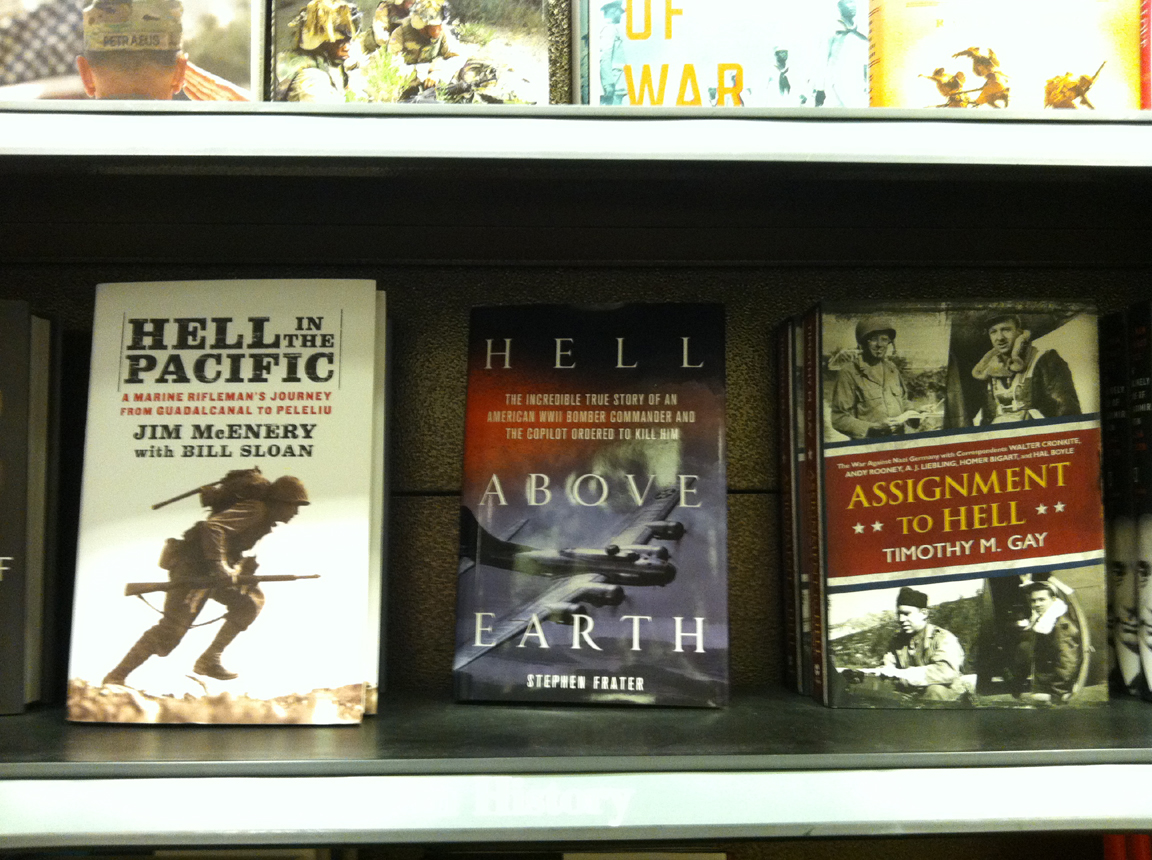
Above is a shot of one of the “New in History” shelves. OK, it’s slightly doctored. Hell in the Pacific was actually on a lower shelf and I moved it up to take this, but they were all in the same category.

Sometimes it seems that the only time “history” was happening was from 1939-45, the bookstore shelves are so dominated by that period. Or maybe it’s just because Father’s Day was coming up. In any case, it seemed that about 50 percent of all history books were about WWII, and another 40 percent was about other wars in which the United States was involved.

And I say that as a big fan of military history, and particularly the WWII period. But still, let’s have SOME perspective, people.

The least you could do is provide some variety in the titles. Does no one at the publishing house notice when it’s getting monotonous?

That is all, men. Smoke ’em if you’ve got ’em. This is my rifle; this is my gun. Off yer dead asses and on yer dyin’ feet. And other cliches of the era…

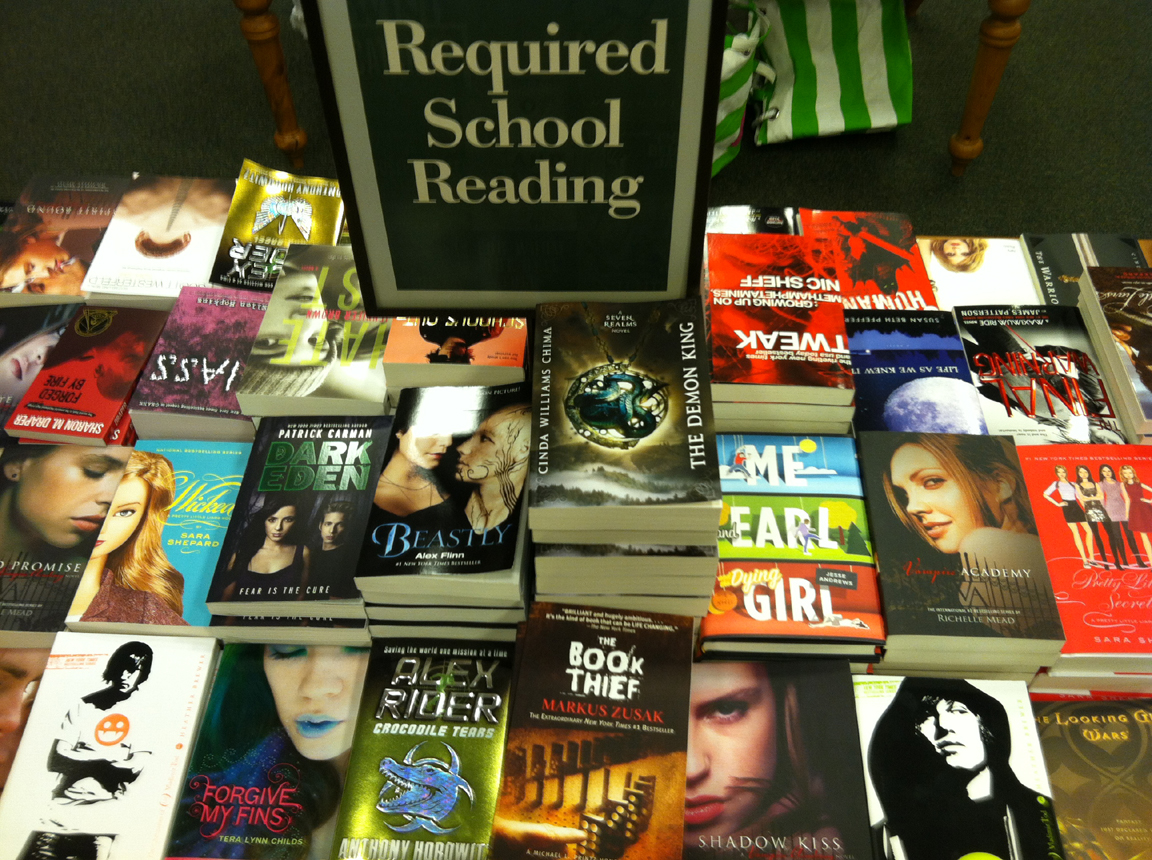
THIS is required reading? Seriously?

Having been required to leave the house because there’s a bridal shower going on there for a family friend, I came by Barnes & Noble and got some coffee, since I hadn’t made any at breakfast.

OK, technically, I got the coffee at the Starbucks about 50 yards away (yes, I’ve become that sort of coffee snob), and came in here to browse books while I drink it. I’m looking for ideas for Father’s Day — both for my Dad, and to see what there is in paperback that I might want to ask for. I’ve found one of each…

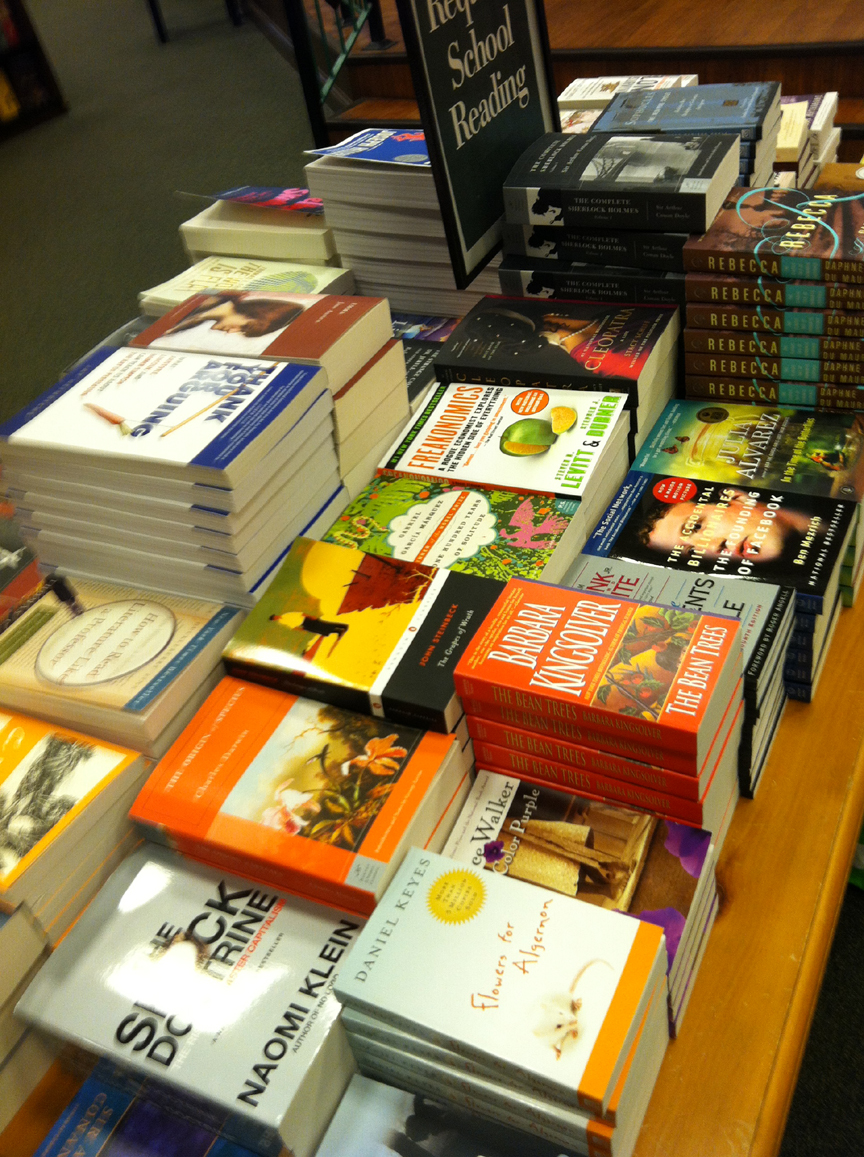
Anyway, I passed by the “Required School Reading” table, and of course it was filled with excellent, worthwhile books, many of which were required when I was in school, plus a few more recent classics. I like browsing the school reading table. It feels so substantial and worthwhile, as well as evoking pleasurable memories, because some of these came to be favorites of mine.

Note that you can see Flowers for Algernon, which I mentioned just yesterday in a comment. There were Catch-22, and Utopia, and Emma, and  A Tale of Two Cities, and other usual suspects. Then there were more recent entries, such as Freakonomics and the book that the film “The Social Network” was based on. All things that help kids think, and appreciate language, and understand their world a little better.

Then, I noticed that there were two more “Required School Reading” tables. There I found very different fare. It was all commercial, recent, crank-’em-out-on-an-assembly line “young adult” offerings. You can see them in the picture at the top of this post.

At least a plurality of them were about vampires. Teenage vampires, of course. Filled with all of the usual teenage angst, such as worrying about one’s place in society, finding true love, and of course bloodlust.

I really, really hope this was a case of the wrong sign being placed on a table. I thought of asking one of the employees, “Are these really required reading in school? If so, which school?”

But I was afraid of the answer I might get.

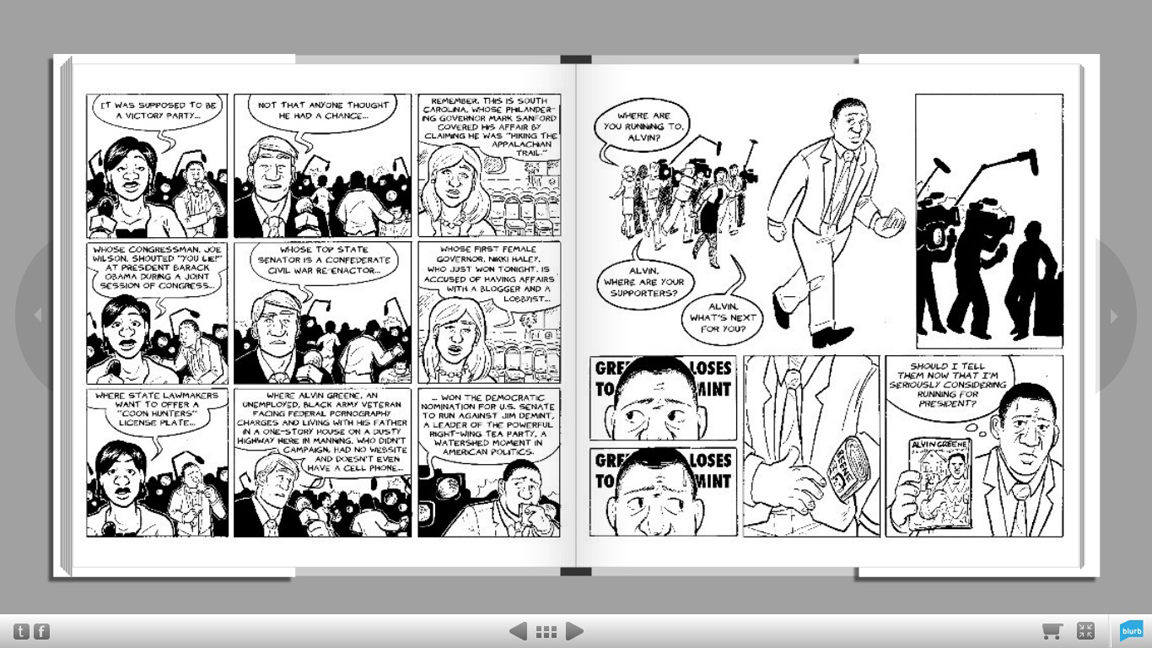
Corey’s graphic novel about Alvin Greene

I’m cleaning out my IN box, and I run across a 10-day-old message from Corey Hutchins saying that his graphic novel about Alvin Greene is available for iPhone and iPad — and probably on paper, by now (yes, it is!). This is from altweeklies.com:

Columbia Free Times staff writer Corey Hutchins and former alt-weekly writer David Axe released iPhone and iPad versions of a 100-page graphic novel that traces the stranger-than-fiction U.S Senate campaign of one of American’s most enigmatic political figures, Alvin Greene.

Readers can purchase iPhone and iPad versions of the book, The Accidental Candidate, for $4.99 prior to its release in hard copy.

“Some of my friends don’t read books,” said Hutchins, a political reporter who chronicled the story of Avlin Greene for Free Times. “But they’re on their iPhones all the time. We thought it was a way to reach an audience that’s not so much into the tree-slaying aspect of literature. Tweet that.”

If you’ll recall, Corey was the only reporter in the universe (to my knowledge, so I guess I should say, “in the known ‘verse”) who actually interviewed Greene prior to his becoming the Democratic nominee for the U.S. Senate.

Whites not the majority? Nothing new in that…

Did y’all see the “news” the other day — ironically, the day before my grandson was born — that white babies are no longer the majority? I first heard it on NPR’s Talk of the Nation. Quoth Neal Conan:

We’ve known for years this day would come, but here it is. The Census Bureau announced today that nonwhite births now make up a majority in the United States. Data gathered in 2011 show that nonwhite, Hispanic, African-American, Asian, Native American, mixed race and others combined for 50.4 percent. That’s the first time that white births were not a majority in U.S. history, and that raises some questions about policy – from education to social services programs – and about how we see ourselves as a nation….

Perhaps this is a good time to inject a bit of historical perspective…

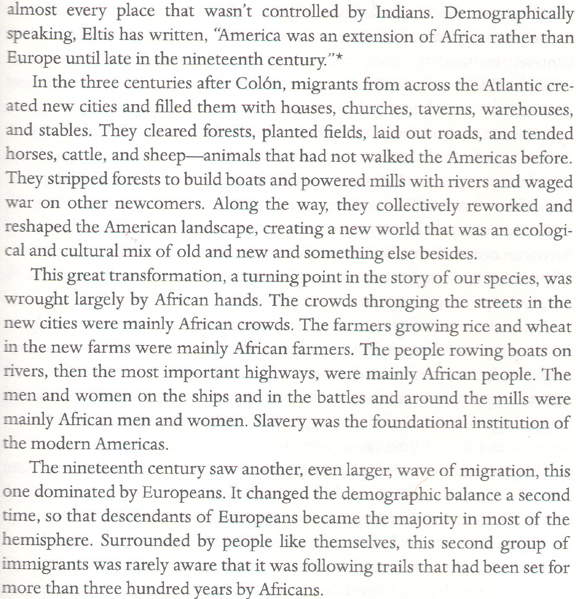
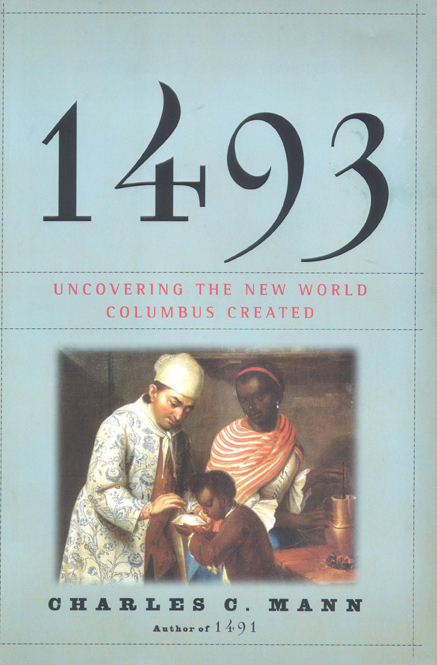
I’m still off-and-on gradually making my way through Charles C. Mann’s 1493, while reading several other books at varying rates, and every time I read a stretch in it, I learn something startling. For instance, I refer you to the fact that for most of the history of Europeans in the Americas — up to the mid-nineteenth century — there were far more people of African descent in the Western Hemisphere than there were white. Way more. An excerpt (I hope the publishers will excuse the length of this quote. I share it within the context of urging you to run out and buy this book; there are many other things in it that will surprise you, and enlarge your understanding of our world.):

This was surprising to me for a couple of reasons. For instance, I had long known that before and after the Civil War, South Carolina had a larger black population than white. Which means that before 1860, most of the state’s population was enslaved.

I used to think of that as anomalous. I thought of it as helping explain the fact that South Carolina slaveholders were more fanatically devoted to their Peculiar Institution that the white elites anywhere else. Hence that firing on Fort Sumter thing.

But as it turns out, if you look at ALL post-Columbian immigration across the hemisphere, not just English, you see that far, far more were brought here as slaves from African than came here, either free or indentured, from all Europe. By 1860, this balance had changed in many places (thereby making SC somewhat anomalous), but for most of the time from 1492 until then, a larger black population had been the norm. (Of course, for that same period, there remained more Indians than whites or blacks, in spite of the way native populations had been decimated by European and African diseases.)

I also found it surprising because I spent part of my childhood in Latin America, and it did not prepare me for this statistic — even though I studied history in Spanish in school (Mann’s references to Columbus as Cristóbal Colón seem very natural to me). In Ecuador, where I lived for two-and-a-half years, it was very unusual to see anyone who looked at all African. I knew that Brazil had imported vast numbers of slaves during the colonial period, and that you could see the results on the streets of Rio. I would have said the same of the islands of the Caribbean.

But for there to be that many more blacks than whites across all the Americas? I had no idea. We all are aware that black labor largely built this country, but I guess I thought that was because those workers were owned by a white majority. I was wrong. At least from a hemispherewide perspective.

In any case… whites not being the majority? Nothing new about that on this side of the world.

And now, for you youngsters, Maurice Sendak

Yesterday, Kathryn protested that she should not be expected to know how Paul McCartney was dressed on the cover of “Abbey Road” because she was too young. I shot back that her youth was no excuse, that she might as well claim she couldn’t picture Alberto Korda’s photo of Che Guevara because she was not a communist.

Once she followed the link I provided, of course, she responded, “Oh, that one.” The exchange sparked a fun sub-thread on iconic images of the 20th Century.

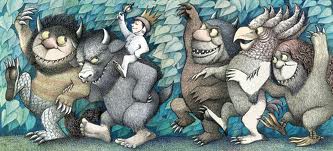
Well, this morning, I experienced the feeling of being too old for a shared cultural experience. As the news spread that Maurice Sendak, author of Where the Wild Things Are, had died, Twitter was filled with references to how important he was to the childhoods of the writers — such as this one from actor/director Jon Favreau.

I immediately felt a disconnect. I wasn’t familiar with who he was until I was an adult. Actually, he may not have fully registered on me until Richland County Public Library had some sort of special Sendak celebration several years back.

To me, his most famous work was one of those books in the stacks of books from which we read to our children, and then grandchildren. But not one that had made a big impression on me, like my favorites (Socks for Supper by Jack Kent, The King’s Stilts by Dr. Seuss, and especially Bread and Jam for Francis, by Russell and Lillian Hoban). And while I get the impression that he had greater literary cachet than the authors of “The Berenstain Bears,” I was more affected by the passing of Jan Berenstain.

How about you young folks out there? How did Sendak affect you?

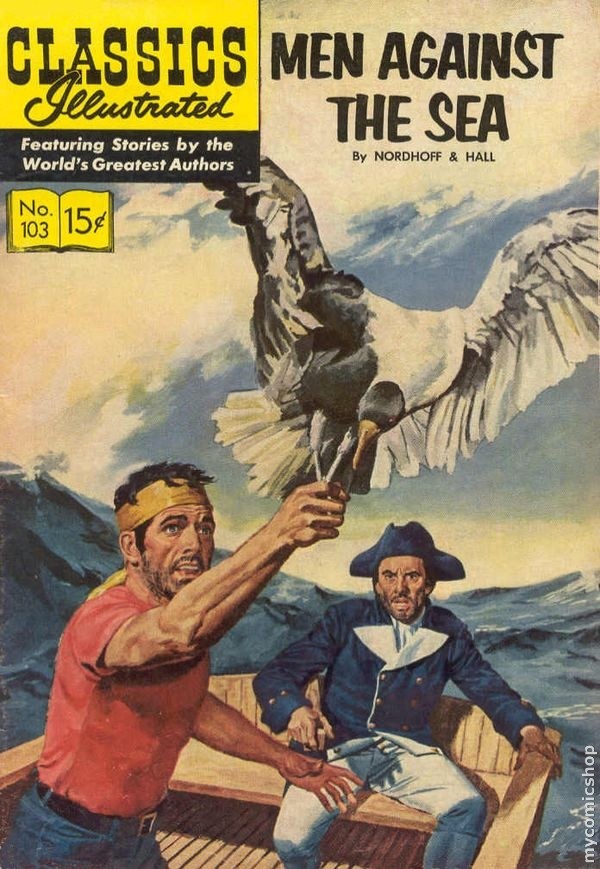
Has anyone read “Men Against The Sea”?

And if so, how was it?

I just finished reading Mutiny on the Bounty, for the first time — I think. I initially had this vague idea that I had read it as a child. Yet most of it seemed fresh to me. Of course, I knew at ever step of the way what was to happen next. Who doesn’t know the general outline of the story? Who hasn’t seen at least one of the Hollywood versions? But the actual words seemed fresh as I read them, and certain things about it — such as the fact that, bizarrely, the English sailors refer to the people of Tahiti as “Indians” throughout — seemed totally unfamiliar.

In any case, I’m certain I’ve never read either of the sequels, Men Against the Sea or Pitcairn Island. That is to say, I’ve never read the “chapter book” versions. I have a clear memory of reading the Classics Illustrated version of Men Against the Sea. What sticks out in my mind is the desperate men in the open boat managing to kill a seagull, and Captain Bligh rigidly serving out portions of its blood to the neediest men on board. (Or do I remember Charles Laughton doing that in the 1935 film?)

Anyway, now that I’ve finished the first book, I’m wondering whether it’s worth my while to read the second. I know what happened — Bligh, a tyrant of a captain but an extraordinary seaman, manages to get himself and 17 others safely to Timor, 3,500 miles away, in an open boat with practically no provisions. It stands as one of the most extraordinary feats of seafaring history.

But I’ve got to think it’s not much fun to read. It’s a tale of horrific suffering, day after day. And the main protagonist is a guy who’s hard to like. I mean, Mutiny on the Bounty had gorgeous topless Tahitian girls. (No pictures, but still…) What’s this got to recommend it?

Perhaps the fact that it’s told mainly through the experience of Thomas Ledward, acting surgeon, helps you root for these guys a bit more than you otherwise might. I’m pretty sure I wouldn’t want to read it in Bligh’s voice.

Anyway, has anyone out there read it? Did you like it? And if so, why?

Dick Clark’s dead, and Levon Helm’s dying


And to channel Lewis Grizzard, I suppose I should say I don’t feel so good myself.

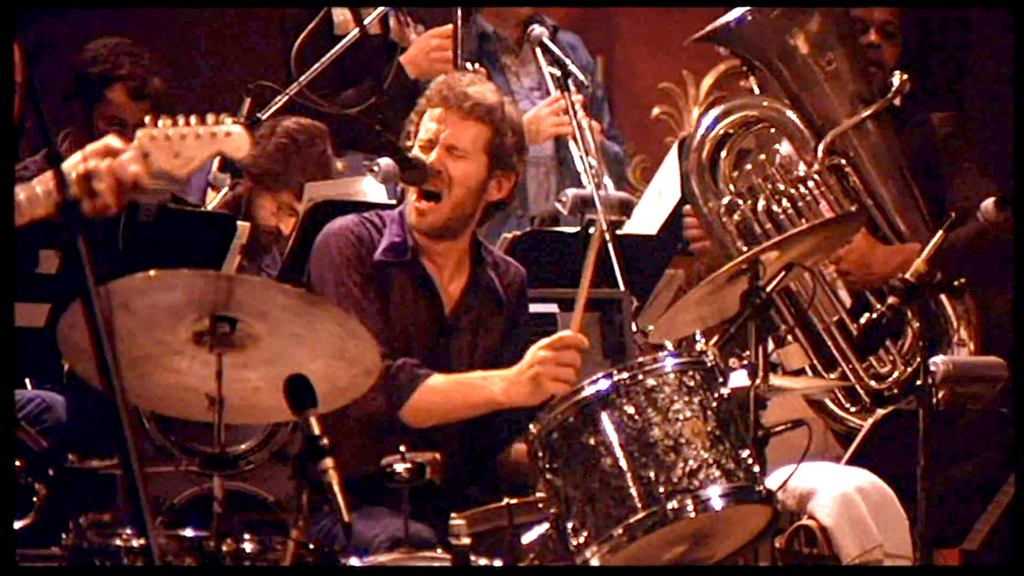
I was sad this morning to read that Levon Helm is in the last stages of cancer. Virgil Caine himself! Not only am I a huge fan of The Band (I saw them live with Bob Dylan in ’74!), but he’s the most awesome, naturalistic actor I’ve ever seen. Remember him as the coal miner himself in “Coal Miner’s Daughter”? You’d have thought they had dragged him right out of the mine, he was so real.

My favorite role was the flight engineer Jack Ridley, Chuck Yeager’s best buddy in “The Right Stuff.” Sample down-home dialogue:

Chuck Yeager: Hey, Ridley… you got any Beeman’s?
Jack Ridley: I might have me a stick.
Yeager: Well loan me some, would ya? I’ll pay ya back later.
Ridley: Fair enough.
Yeager: I think I see a plane over here with my name on it.
Ridley: Now you’re talkin’…

He was also the narrator, because he came closest to having that aw-shucks Yeager quality that the job required:

There was a demon that lived in the air. They said whoever challenged him would die. Their controls would freeze up, their planes would buffet wildly, and they would disintegrate. The demon lived at Mach 1 on the meter, seven hundred and fifty miles an hour, where the air could no longer move out of the way. He lived behind a barrier through which they said no man could ever pass. They called it the sound barrier.

And now, this afternoon, I hear this:

Dick Clark, the music industry maverick, longtime TV host and powerhouse producer who changed the way we listened to pop music with “American Bandstand,” and whose trademark “Rockin’ Eve” became a fixture of New Year’s celebrations, died today at the age of 82.

Clark’s agent Paul Shefrin said in statement that the veteran host died this morning following a “massive heart attack.”…

Clark landed a gig as a DJ at WFIL in Philadelphia in 1952, spinning records for a show he called “Dick Clark’s Caravan of Music.” There he broke into the big time, hosting Bandstand, an afternoon dance show for teenagers…

I first saw “Bandstand” on local TV in Philadelphia. I lived across the river in Woodbury, N.J., in 1960-61, and used to watch all those “big kids” talking about which songs had a good beat and were easy to dance to.

All these years, and he never got old… but time eventually took its toll.

‘No Irish Need Apply:’ Myth of victimization?

I read something that surprised me this morning, in a book review in The Wall Street Journal. As is fairly typical in opinion pieces in the Journal, the reviewer repeatedly expressed disdain for the author of a book about Irish politics in Boston whenever he failed to be insufficiently conservative (praising him for not dwelling on the Kennedys, castigating him for insufficiently respecting the Southies who fought busing for integration). But I was startled by this revelation:

Unfortunately, Mr. O’Neill has produced a rather straightforward recapitulation of Irish politics in the Hub, sticking to the well-established narrative of mustache-twisting Brahmins (or “Yankee overlords,” in Mr. O’Neill’s phrasing) doing battle against spirited, rascally Irish politicians. Indeed, “Rogues and Redeemers” doesn’t so much upend myths as reinforce them. In Irish America, tales of rampant employment discrimination by Yankee businessmen, who posted signs warning “No Irish need apply” are accepted as gospel. Such anti-Irish bias, writes Mr. O’Neill, was “commonly found in newspapers” and became “so commonplace that it soon had an acronym: NINA.”

But according to historian Richard Jensen, there is almost no proof to support the claim that NINA was a common hiring policy in America. Mr. Jensen reported in the Journal of Social History in 2002 that “the overwhelming evidence is that such signs never existed” and “evidence from the job market shows no significant discrimination against the Irish.” The tale has been so thoroughly discredited that, in 2010, the humor magazine Cracked ranked it No. 2 on a list of “6 Ridiculous History Myths (You Probably Think Are True).” Mr. O’Neill doesn’t inspire confidence by faithfully accepting NINA as fact…

I spent a few moments just now checking to see to what extent it is true that the NINA phenomenon is a “myth” of victimization. What I found kept directing me to the aforementioned Mr. Jensen, whose article on the subject is much cited.

But even Jensen documents that some (although not many) ads saying “No Irish Need Apply” appeared in American newspapers during the period. And no one disputes that such prejudice against the Irish was common in Britain; the only debate has to do with the extent of the practice in this country.

From the Jensen article:

The NINA slogan seems to have originated in England, probably after the 1798 Irish rebellion. Throughout the 19th and 20th centuries it was used by English to indicate their distrust of the Irish, both Catholic and Protestant. For example the Anglican bishop of London used the phrase to say he did not want any Irish Anglican ministers in his diocese. By the 1820s it was a cliché in upper and upper middle class London that some fussy housewives refused to hire Irish and had even posted NINA signs in their windows. It is possible that handwritten NINA signs regarding maids did appear in a few American windows, though no one ever reported one. We DO have actual newspaper want ads for women workers that specifies Irish are not wanted; they will be discussed below. In the entire file of the New York Times from 1851 to 1923, there are two NINA ads for men, one of which is for a teenager. Computer searches of classified help wanted ads in the daily editions of other online newspapers before 1923 such as the Booklyn Eagle, the Washington Post and the Chicago Tribune show that NINA ads for men were extremely rare–fewer than two per decade. The complete absence of evidence suggests that probably zero such signs were seen at commercial establishments, shops, factories, stores, hotels, railroads, union halls, hiring halls, personnel offices, labor recruiters etc. anywhere in America, at any time. NINA signs and newspaper ads for apartments to let did exist in England and Northern Ireland, but historians have not discovered reports of any in the United States, Canada or Australia. The myth focuses on public NINA signs which deliberately marginalized and humiliated Irish male job applicants. The overwhelming evidence is that such signs never existed.

Irish Americans all have heard about them—and remember elderly relatives insisting they existed. The myth had “legs”: people still believe it, even scholars. The late Tip O’Neill remembered the signs from his youth in Boston in 1920s; Senator Ted Kennedy reported the most recent sighting, telling the Senate during a civil rights debate that he saw them when growing up 5 Historically, physical NINA signs could have flourished only in intensely anti-Catholic or anti-Irish eras, especially the 1830—1870 period. Thus reports of sightings in the 1920s or 1930s suggest the myth had become so deeply rooted in Irish-American folk mythology that it was impervious to evidence…
Make of this what you will.

Personally, I think it unlikely that NO such signs existed. Given what we can see even today of nativist sentiment, and knowing the nation’s history of suspicion and even hostility toward Catholics, it seems almost certain that back in a day when the “n-word” invited no social ostracism, such alienation toward an outside group would have been expressed quite openly and without embarrassment. But I’m just extrapolating from known facts here. Jensen is right — neither I nor anyone else can produce physical evidence of such signs at worksites.

I suspect that the truth lies somewhere between the utter dismissal of the reviewer, and the deep resentment of alleged widespread practices that runs through the history of Southie politics.

What’s the proper price for books that don’t exist?

Just a couple of days after I posted a video of the director of the Ayn Rand Institute, that organization sends out this release:

Apple Should Be Free to Charge $15 for eBooks

WASHINGTON–Apple and five top book publishers have been threatened by federal antitrust authorities. According to the Wall Street Journal, they are to be sued for allegedly colluding to fix ebook prices.

According to Ayn Rand Center fellow Don Watkins, “Traditional books may come from trees but they don’t grow on trees–and ebooks and ebook readers such as the iPad definitely don’t grow on trees. These are amazing values created by publishers and by companies such as Apple. They have a right to offer their products for sale at whatever prices they choose. They cannot force us to buy them. If they could, why would they charge only $15? Why not $50? Why not $1,000?

“There is no mystically ordained ‘right’ price for ebooks–the right price is the one voluntarily agreed to between sellers and buyers. Sure, some buyers may complain about ebook prices–but they are also buying an incredible number of ebooks.

“What in the world justifies a bunch of bureaucrats who have created nothing interfering in these voluntary arrangements and declaring that they get to decide what considerations should go into pricing ebooks?”

Read more from Don Watkins at his blog.

I didn’t know what the Institute was on about until I saw this Wall Street Journal piece:

U.S. Warns Apple, Publishers

The Justice Department has warned Apple Inc. and five of the biggest U.S. publishers that it plans to sue them for allegedly colluding to raise the price of electronic books, according to people familiar with the matter.

Several of the parties have held talks to settle the antitrust case and head off a potentially damaging court battle, these people said. If successful, such a settlement could have wide-ranging repercussions for the industry, potentially leading to cheaper e-books for consumers. However, not every publisher is in settlement discussions.

The five publishers facing a potential suit areCBS Corp.’s Simon & Schuster Inc.;Lagardere SCA’s Hachette Book Group;Pearson PLC’s Penguin Group (USA); Macmillan, a unit of Verlagsgruppe Georg von Holtzbrinck GmbH; and HarperCollins Publishers Inc., a unit of News Corp. , which also owns The Wall Street Journal….

This is truly a fight in which I do not have a dog. I think. And it should please the Randians that my own attitude has to do with market forces. I can’t conceive of paying $15 for a book when, after the transaction, I don’t actually have a book.

So I can approach this dispassionately, and ask, to what extent is this a monopoly situation? After all, Apple has competitors — such as Amazon, which actually pioneered this business of selling “books” to people electronically. The WSJ story addresses that:

To build its early lead in e-books, Amazon Inc. sold many new best sellers at $9.99 to encourage consumers to buy its Kindle electronic readers. But publishers deeply disliked the strategy, fearing consumers would grow accustomed to inexpensive e-books and limit publishers’ ability to sell pricier titles.

Publishers also worried that retailers such as Barnes & Noble Inc. would be unable to compete with Amazon’s steep discounting, leaving just one big buyer able to dictate prices in the industry. In essence, they feared suffering the same fate as record companies at Apple’s hands, when the computer maker’s iTunes service became the dominant player by selling songs for 99 cents.

Now that sounds more like what I would think the market would bear, if the market were like me. $9.99 sounds closer to what I might conceivably be willing to pay in order to have access to the contents of a book without actually getting a book. But it still seems high.

Yes, I can see advantages to a e-book. You can store more of them in a smaller space. They don’t get musty, which for an allergic guy like me is nothing to sneeze at. And you can search them, to look up stuff you read, and want to quote or otherwise share. That last consideration isn’t that great for me because I have an almost eerie facility for quickly finding something I read in a book, remembering by context. But… once I’ve found it, there’s the problem that if I want to quote it, I have to type it — which is not only time-consuming, but creates the potential for introducing transcription errors. Far better to copy and paste. (At least, I think you can copy and paste from ebooks. Google Books doesn’t allow it. See how I got around that back here, by using screenshots of Google  Books.)

But I still want to possess the book. Maybe it’s just pure acquisitiveness, or maybe it’s a survivalist thing — I want something I can read even if someone explodes a thermonuclear device over my community, knocking out all electronics.

In any case, all of us are still sorting out what an ebook is worth to us. Let Apple set the price where it may, and try to compete with Amazon. Then we’ll see what shakes out.

The infrastructure of a healthy society

Well, I’m back. I had some sort of crud yesterday that made me leave the office about this time yesterday– upset stomach, weakness, achiness. It lasted until late last night. When I got up this morning, I was better, but puny. So I went back to bed, and made it to the office just after noon. Much better now.

Anyway, instead of reading newspapers over breakfast at the Capital City Club the way I usually do, I read a few more pages in my current book, 1493: Uncovering the New World Columbus Created, by Charles C. Mann. Remember how I was all in a sweat to read it several months ago after reading an excerpt in The Wall Street Journal? Well, having read the prequel, 1491, I’m finally well into this one.

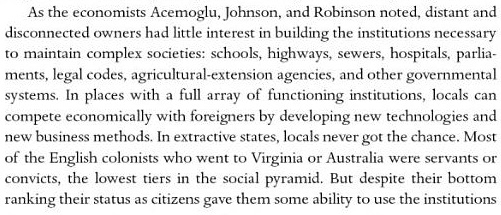
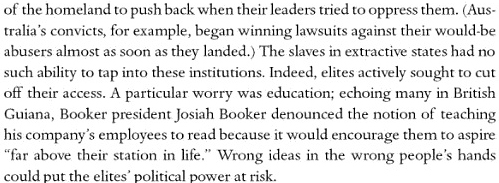
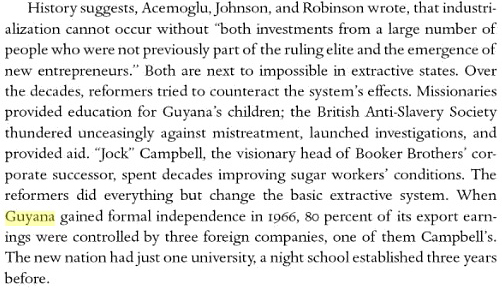
And I’m reading about how settlement by Europeans in many parts of the New World established “extraction societies.” At least, I think that was the term. (It’s one I’ve seen elsewhere, related to “extraction economy” and, less closely, to “plunder economy.” The book is at home, and Google Books won’t let me see the parts of the book where the term was used. But the point was this: Settlements were established that existed only to extract some commodity from a country — say, sugar in French Guiana. Only a few Europeans dwelt there, driving African slaves in appalling conditions. Profits went to France, and the institutions and infrastructure were never developed, or given a chance to develop.

Neither a strong, growing economy with opportunities for all individuals, nor its attendant phenomenon democracy, can thrive in such a place. (Which is related to something Tom Friedman often writes about, having to do with why the Israelis were lucky that their piece of the Mideast is the only one without oil.)

Here are some excerpts I was able to find on Google Books, to give the general thrust of what I’m talking about:

There are degrees of extraction societies, it would seem. South Carolina developed as such a society, but in modified form. There were more slaves than free whites, and only a small number even of the whites could prosper in the economy. But those few established institutions and infrastructure that allowed something better than the Guianas to develop. Still, while we started ahead of the worst extraction societies, and have made great strides since, our state continues to lag by having started so far back in comparison to other states.

It is also inhibited by a lingering attitude among whites of all economic classes, who do not want any of what wealth exists to be used on the kind of infrastructure that would enable people on the bottom rungs to better themselves. This comes up in the debate over properly funding public transit in the economic community of Columbia.

Because public transit doesn’t pay for itself directly, any more than roads do, there is a political reluctance to invest in it, which holds back people on the lower rungs who would like to better themselves — by getting to work as an orderly at a hospital, or to classes at Midlands Tech.

It’s a difficult thing to overcome. Other parts of the country, well out of the malarial zones (you have to read Mann to understand my reference here), have no trouble ponying up for such things. But here, there’s an insistent weight constantly pulling us down into the muck of our past…