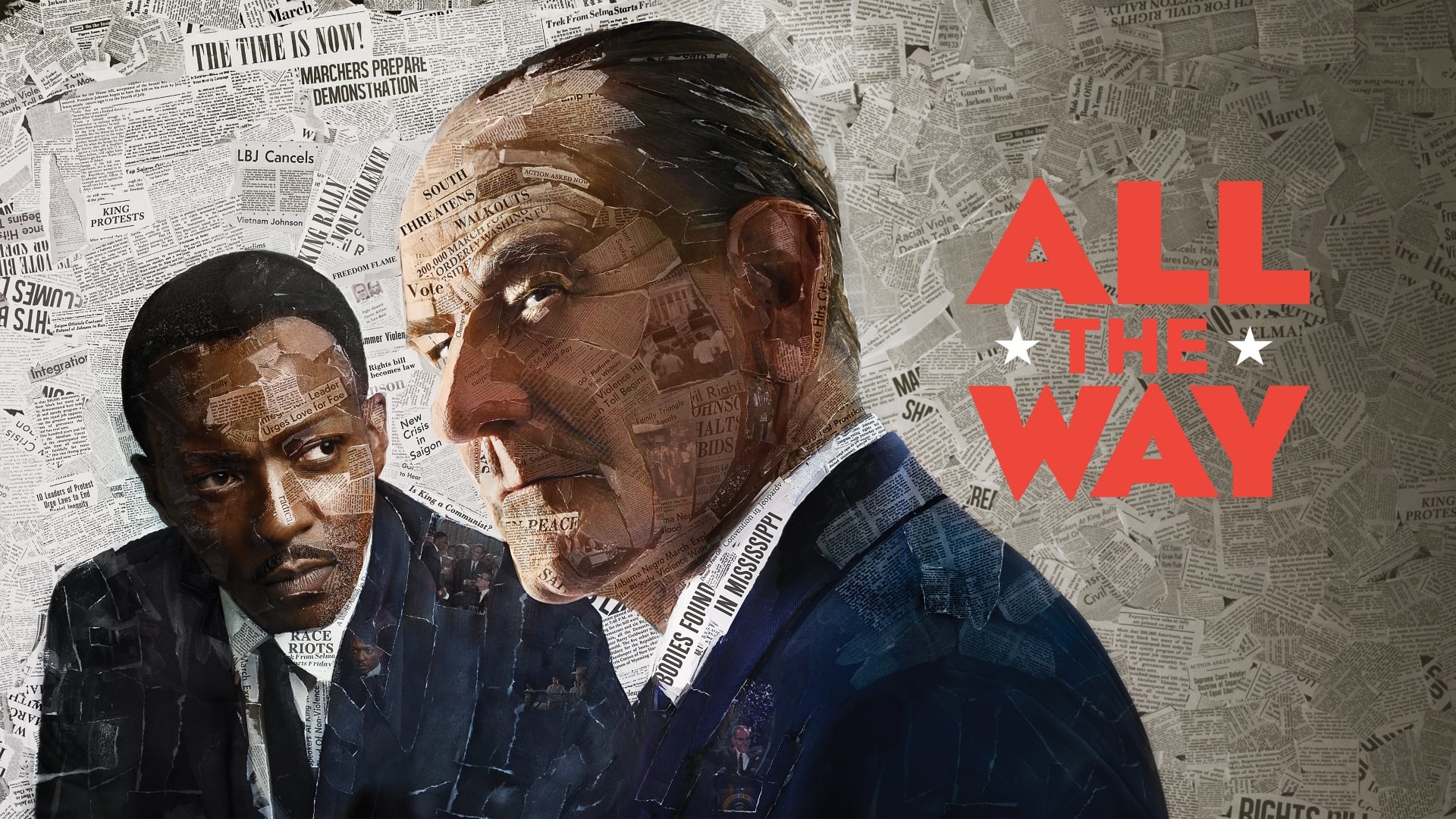
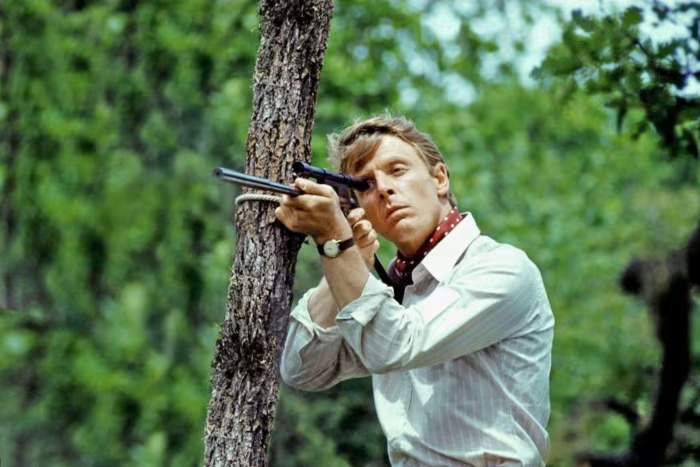
Here’s another movie that should have been onsomebody’s list of the best since the turn of the century. I had forgotten about it, then ran across it on HBO and watched it again last night. I was more impressed this time than the first time.
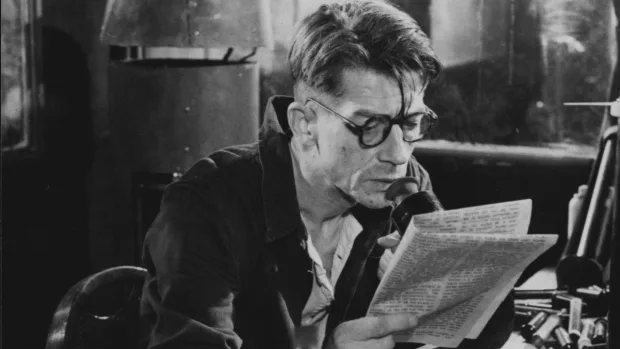
It’s “All the Way,” starring Bryan Cranston as Lyndon Baines Johnson. It covers his first year as president, from the moment JFK was pronounced dead in the hospital in Dallas to LBJ’s stunning victory over Barry Goldwater.
It was technically amazing. Cranston’s embodiment of Johnson, aided by remarkable makeup, made me feel constantly that I was watching and hearing the original man. If anything, Melissa Leo was even more impressive as Lady Bird, although she didn’t have nearly as much screen time.
Also noteworthy: Bradley Whitford as HHH, Stephen Root as J. Edgar Hoover, and Aisha Hinds as Fannie Lou Hamer. Towering above those was Frank Langella’s deft, nuanced portrayal of Senator Richard Russell. (I was less impressed with the portrayals of MLK and, in a bit part, our own Strom Thurmond. Sadly, I’ve yet to see any actor come close to recreating the power of Dr. King’s presence.)
Beyond the technical stuff, since I was out of the country during that year, I learned a lot watching it. Sure, I knew about (or learned later about) the events that were portrayed — the extraordinary exertions to pass the Civil Rights Act, the destruction of the Democratic Party’s Solid South, the deaths of the three civil rights workers in Mississippi, the Gulf of Tonkin incident, and much more — I hadn’t fully had the sense that they all happened in that year, when Johnson was trying to establish his legitimacy in the office while also winning an election. With hindsight, I’ve tended to think Goldwater was easy to beat. But not from LBJ’s perspective, with all those other things going on.
I enjoyed “Breaking Bad,” but maybe the best thing about it was that it gave Cranston the celebrity to do something like this. It was made in 2016, and it’s amazing to me that it didn’t make more of a splash (as in, the kind that gets you on a “Top 100” list.) Perhaps because it’s wasn’t available to anyone but subscribers.
If you have access to Max, or whatever you call HBO, watch this right away…
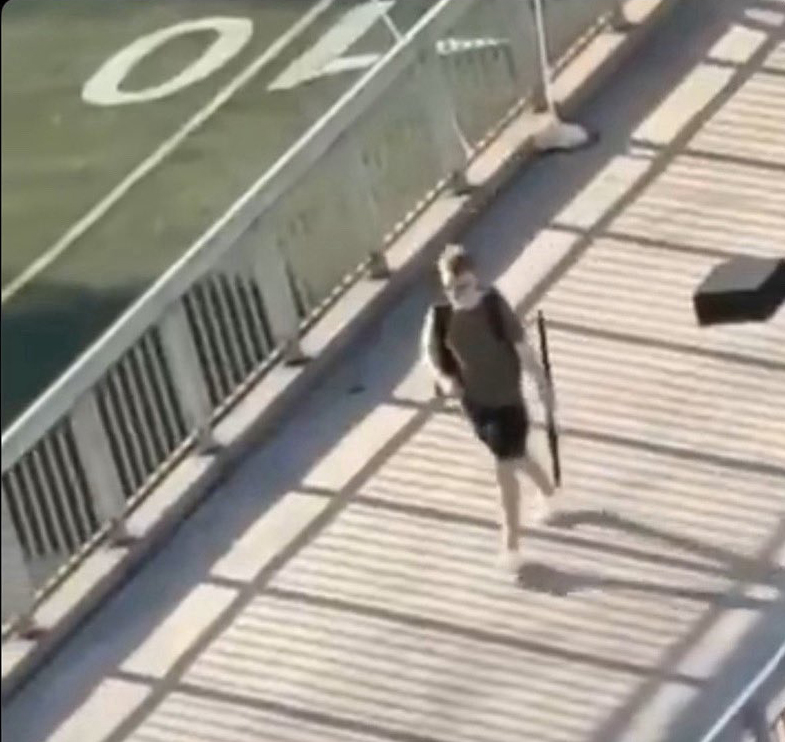
‘The umbrella guy: Were these images a cause, or an effect, of the panic?
We were having a family birthday party for one of my kids Sunday night when I got a call from my brother in Greenville. He called to make sure that we knew we shouldn’t venture near the USC campus. There was apparently an “active shooter” situation, and the campus was locked down.
I saw that one person at our party seemed to be about to leave, so I asked my brother to hold on a moment, and I made an immediate announcement to the entire household about the news, suggesting that no one head in that direction. I was very much in a mode that was a sort of cross between “Now hear this!” and “General Quarters!”
But everyone already knew. My wife informed me that everyone had been talking about it at the table. I had missed it competely, which is a frequent occurrence with the state of my hearing.
Anyway, by that time the folks in charge on campus were already stepping down the alert, and within minutes they had given the “all clear.” Not because the “shooter” had been arrested or otherwise eliminated, but because he hadn’t existed.
There were some reported minor injuries, however — people who got hurt in the stampede of students trying to evacuate the area.
He was a creation of the remarkable new technology that we enjoy in the 21st century. No, not AI. You didn’t need that to produce this panic.
I’m talking about such quaint things as Al Gore’s Internet, smartphones with ever-improving cameras, social media, and the resulting ability of practically everyone on the planet to pass information to everyone else on the planet, whether it’s true or not.
Which is all stuff I have enjoyed greatly over the last couple of decades. But I’ve also pointed out how this combination of items is destroying our country, and other countries devoted to liberal democracy. But enough politics; back to the subject.
Of course, this causes people to scoff at the old newspaper guy wishing for the good ole days. Well, let me tell you about the good old days. Over the last day, I was thinking about how this would have unfolded, say, 25 years ago.
Basically, it would not have unfolded. It wouldn’t have happened. Of course, it didn’t happen, but something else did happen — a campus full of thousands of kids, not to mention their folks back home, were scared out of their wits. And some of them got hurt (but not seriously, apparently) in the rush to the exits.
Of course, I thought of this first from the perspective of a newspaperman. Back when such things as daily newspapers existed and thrived, news happened all through the 24 hours, but it only got published once. Back then, when the word of possible shootings went out, reporters would have rushed to the campus, the way they did Sunday night, and reported what they found. And for an hour or so, the whole news structure would be in high gear to meet the challenge. But then, about an hour later, everyone would know it was a load of nothing, and calm down. There might be a story about how everyone got excited and worried for a time, but there would at no time be a story delivered to actual readers crying out about havoc on the campus.
But I’m not fully imagining what would have happened. The thing is, there wouldn’t have even have been a story about the big scare. Why? Because there would have been no scare, for a number of reasons.
First, the images of a harmless-looking guy ambling along carrying an umbrella would not have existed. If you’re young — very young — it might be hard to imagine that. But you see, a mere quarter-century ago, people didn’t photograph everything they saw around them. I was one of the few people who might have done such a thing, because starting in my own college days, I got into 35mm photography in a big way. But I didn’t shoot a tenth of the images I now shoot every day, for the simple reason that film — and the chemicals I needed to develop it and make prints from it — cost money. It also cost a lot of time. Even if you were one of those civilians who dropped off their rolls at the drugstore, it still cost you some time. And unless you went to one of those one-hour places, you wouldn’t be seeing your prints for some days.
But let’s suppose that, being the camera geek I was, I did shoot such images, and somehow made the finished image appear instantly (remember that not even Polaroids were instantaneous, and the quality was awful). And suppose I also had the poor judgment to decide I wanted urgently to share this image, and my wild imaginings, with the world. How would I have done that — physically, technically? And how many people would I have reached? I assure you I had a much greater chance than most of you to get my picture into print, but I’d have to wait some hours before the presses rolled. And after they rolled, there’d be a further wait of hours (usually) before readers beheld it.
And by that time, we would have known for some hours that the pictures showed nothing that needed to be shared with anybody. They would be worthless, and of no interest.
There is value in having time to think, time to assess, time to recognize the truth before something is shouted to the world.
But we’ve lost that precious resource, and I don’t see any way of getting it back again. So in light of the existence of these new technologies, how on Earth are we going to stop driving each other stark, raving mad?
[Editor’s note: After I wrote the above, reporting on this incident has shifted more in the direction of a deliberate hoax, part of a pattern across the country, with less emphasis on innocent mistake. That significantly reduces the role that social media played, but it doesn’t eliminated it, because it doesn’t change the dynamics of the way current technology cause panic to metastasize, far ahead of the ability of reasonable investigation to catch up. (Although authorities did an excellent job of sorting it out as quickly as possible.) Without the technology, there might have been a panic on campus, but not across the country, as occurred in this case. This explanation raises other questions — if the cause of the panic was a couple of false phone calls, what role did the photos of the guy with the umbrella play? Was that just already-panicked students shooting pics of everything they saw and sending them out? I don’t know. In any case, they played a significant role in the widespread stress, based on what I was hearing from various folks following the incident.]
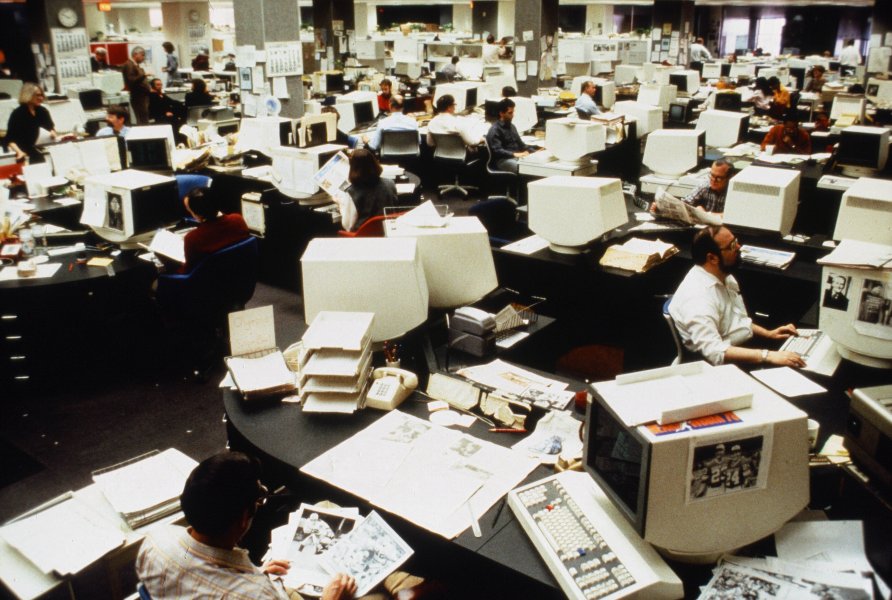
In some dreams, I’m trying to put out the paper on outdated technology like this, and strugglng to log into systems I used 40 years ago.
I have this vague memory from the psychology classes I took in college that Freud (or someone) described dreams as being about “wish fulfillment?”
Googling just now, I find that my memory was a bit off, but not entirely. And he explained, apparently, that sometimes your dreams had to be interpreted (I suppose by a guy with a couch) for us to see how they involved such satisfaciton. But explaining all that is not my point in this post, so I’m not going to break it down further. I’m just interested in asking this question: Do any dreams involve wish fulfillment?
Do yours ever involve that? I’ve read of people being disturbed because they are awakened from dreams that were so pleasant they hated for them to end. Well, good for them. I don’t have those, at least not in a long time.
Oh, occasionally I have one that might fulfill some people’s wishes, but I generally find something in them to worry about. I wrote about one of those back here.
But mostly, they’re just about stress. They’re not nightmares, not the kind of things where you wake up in a sweat and are afraid to go back to sleep. I occasionally had one of those when I was very young, but that was decades ago. No, these are just stressful, in a way that exceeds the stress levels of everyday life, but not by much. Mostly, they’re just irritating, something I could do without (as least I think so — perhaps they serve some purpose that eludes me, lacking the Freudian “interpretation”).
I’ve touched on this topic before, but I return to it now because I was particularly irritated last night, but it’s hard to describe why — beyond the fact that they woke me up repeatedly, and when I went back to sleep, I’d return to the same stupid dream (which didn’t have much plot, beyond having constant trouble performing a particularly silly task). That was unusual, and frankly I think it was drug-related. I’ve got a cold, and trying stave off chest congestion, I took something we had bought in Amsterdam when I had mild COVID during our Europe trip last year, because we couldn’t find the more familiar guaifenesin.
I’m not taking that again, at least not at night.
But that still leaves all those other, “normal,” every-night stress dreams.
So what am I talking about here? Well, there are several categories, most of them themes that I’ve visited many times:
One huge category involve riffing on the common dream that you’re in college, and it’s time for the final exam, and you’ve never been to the class, and you don’t dare ask anyone, so late in the game, where the class is. For me, these seem to be only a slight exaggeration of my first couple of years in college. But I hear almost everyone who’s been to college has them. And there are variations, such as: I’m at a conference that my work sent me to, and it’s the last night before i fly home, and it occurs to me that while I have socialized with the other attendees in the evenings, I haven’t been to a single work session.
This may occur more than any other sort — so often that I think my lack of imagination regarding regarding plot is worse than Hollywood’s. These are newspaper dreams, which is understandable. But I haven’t had a newspaper job in 16 years. I’m aware of that in the dream, but the plot twist is that I’ve been asked to come back (frequently to the most stressful paper I ever worked at, in Wichita) and do stuff I used to do. Specifically, I’ve been asked to work late nights or weekends, which means I’m entirely responsible for everything that happens. And things don’t go well. I get way behind on reading all the copy; baffling technical problems arise, etc. Routine stuff, but it’s all happening on the night I’m in charge, and I’ve still got to get the paper out, as always. Anyway, I know exactly where all this comes from; I just don’t know why I’m still having them.
Variations on details of those previous categories. For instance, it’s often the night before I have to return home from a trip, and my hotel room is unbelievably strewn with enough clothes to fill the Belk men’s department, and most are dirty, and I can’t figure out how to pack them. Or speaking of technical problems, some dreams are about nothing else: I need to look up something simple, that would be easy in waking life, but I can’t get to the right page on any device. Which is weird, because all my life I’ve loved technology, and helped my coworkers learn it. Knowing that makes it even more frustrating….
That last word might be more apropos than “stress.” I should refer to a lot of them as “frustration dreams.” But that doesn’t describe all of them, so I’ll stick to “stress” as a catchall.
I’m not looking for diagnosis, advice or a cure. I can live with these things; I’d just rather not.
And I’m wondering: Does everybody have these, all the time? If you have satisfying dreams about wonderful things, cheer me up by telling me about them. No, don’t. I might start having “envy” dreams…
The New York Times tried to sneak a “best movies list” by me last month, and almost got away with it — until “The Daily” hipped me to it a few days ago on the NYT Audio app.
Seems they’re pushing things a bit, don’t you think? I mean this century just got started, right? This is 2025, not 2100, or even 2099. Don’t ya think Hollywood might slip in one or two good flicks sometime over the next 75 years? I certainly hope so.
But humans are impatient. Anyway, some of us might not be around in 2099 (maybe even you, or that old guy over there). So they just went ahead.
I would not have been tempted to do that. I mean, if this first 25-year period had contained a 1939, or even a 1967 — a year that just put all others to shame — I would have. But while there have been a few good pictures here and there, you have to lower your standards a good bit to come up with a HUNDRED. It hasn’t been what you’d call a creatively inspired period. It’s not just with regard to movies; look at all the sad pop music since about 1993. The recent films are a bit more inspired than that, but not by much.
A top 25 would have been more doable without lowering your aim. I’m stretching the point by going full Nick Hornby — get it down to five! But you’ll see from my Honorable Mentions list that I could easily have settled on 25.
Especially if I’d seen all the pictures.
A big disclaimer: In this quarter-century of COVID, streaming to big HD screens at home, and ridiculous ticket prices, I don’t go to a lot of movies — whereas in the last century, I made a point of seeing everything that might have made such a list. Not anymore. Here are a few that are on this NYT list that I very much wanted to see, and hope to see soon — provided they come to one of my streaming services and I don’t have to pay extra. (Actually, a couple of those have done that, and I started to watch but lost interest for the moment. I’ll probably try again, though.) Here they are:
“Parasite” This tops practically any list you see — if compiled by people who saw it, of course. So I need to make the effort.
“Get Out” I love Key and Peele, and people went wild over Jordan Peele directorial debut, but I haven’t seen it yet. I haven’t tried hard partly because it seems to kinda fit in a horror-movie slot, and I mostly don’t like those, but there’s more going on than that. Has to be, given who’s involved.
“Y tu mamá también“ I’ve wanted to see that, but it has a sort of sexploitation vibe that makes me feel like it’s not quite the thing, especially with that disturbing title. But hey, it’s in Spanish! So that’s good, right? It’s educational — brush up a bit on my vocabulary!
“Whiplash” The one about the young drummer with the nightmare teacher.
There are others like that. For, instance, I watched a few minutes of both “Everything Everywhere All at Once” and “The Zone of Interest.” I didn’t get far with either. I was tired, late at night, and didn’t have the energy for “Everything.” On the other, I just didn’t feel up to dealing with such moral horror mixed with the banality that so often comes up in dealing with Nazis. I need to try again on both.
OK, here’s my Top Five:
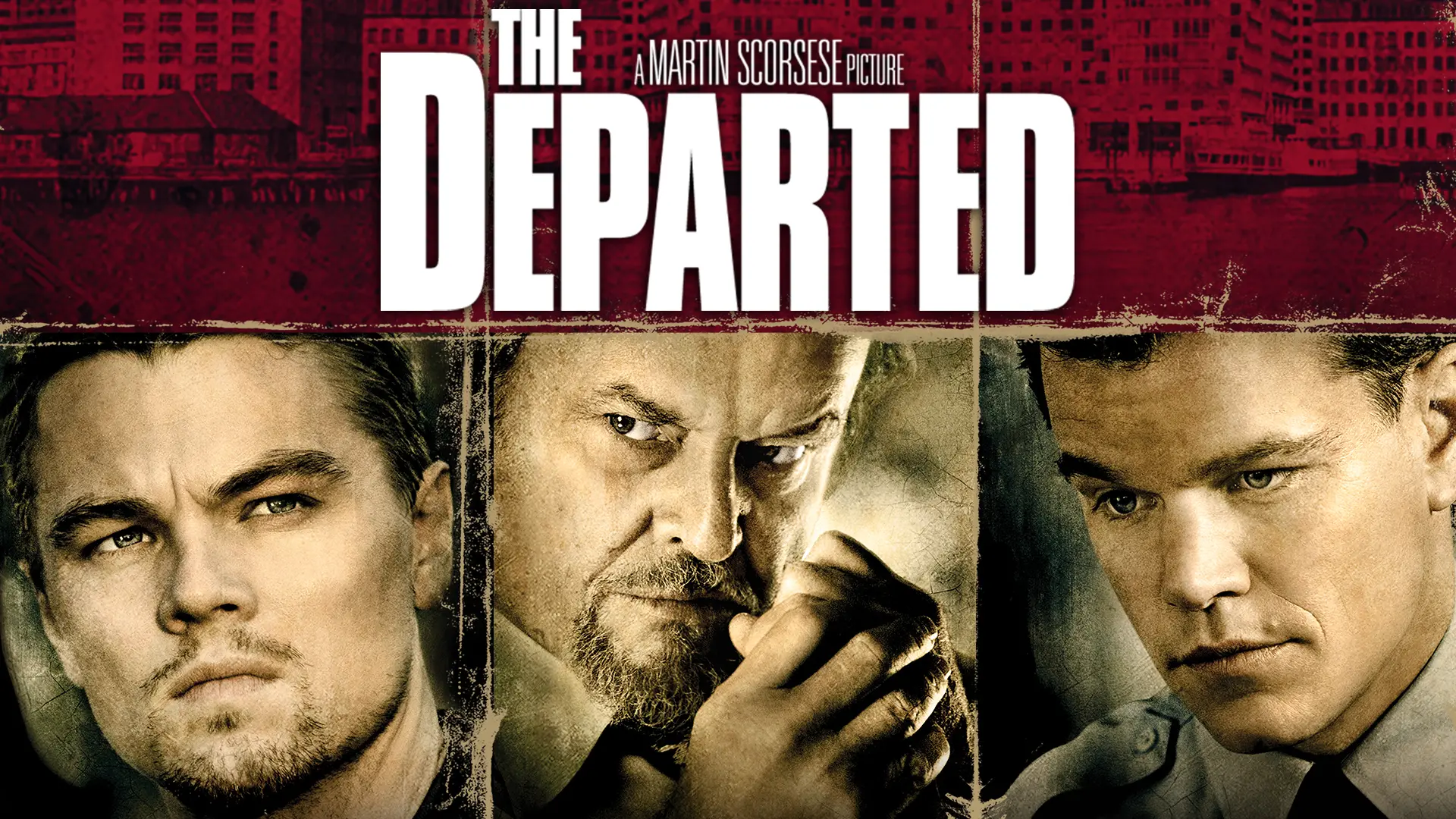
“The Departed” No question here. I go back and forth on whether “Goodfellas” or “Mean Streets” is Scorcese’s best ever, but there’s no question that this one is his best of the new century.
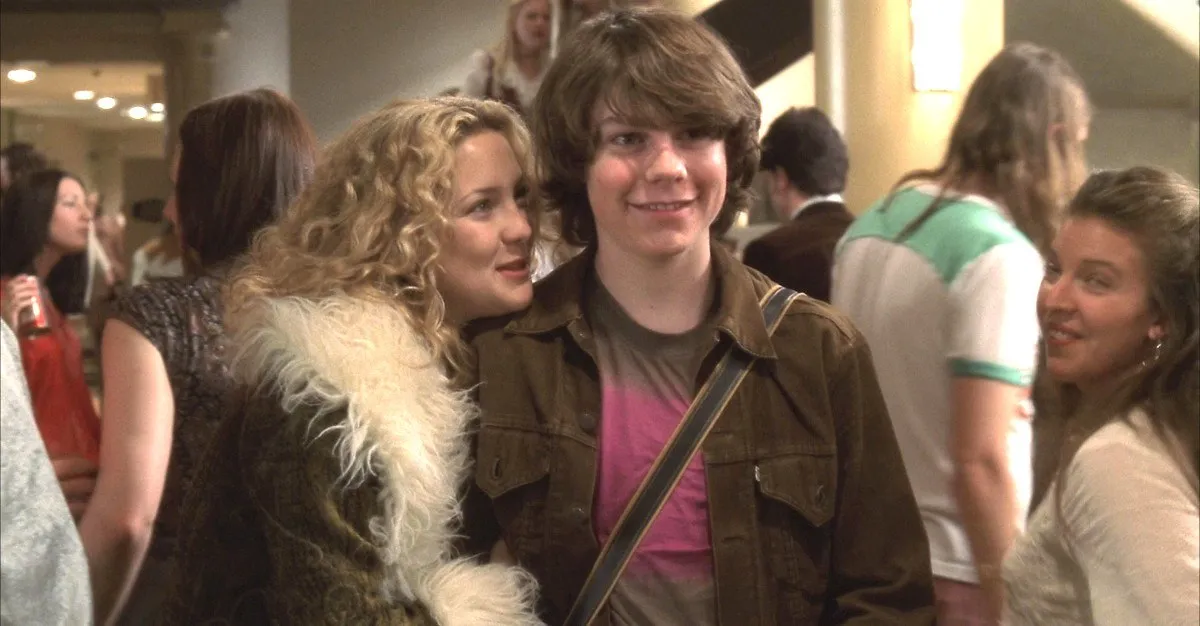
“Almost Famous” Lots of fun, extremely engaging, very polished, and a fantastic evocation of an era. Definitely the best thing Cameron Crowe’s ever done. And the cast! Kate Hudson and Patrick Fugit were the soul of it, but look at the performances of Frances McDormand, Billy Crudup and the intriguing Philip Seymour Hoffman as Lester Bangs! And let’s not forget (I won’t), this was the first time I ever saw Zooey Deschanel…
“The Lives of Others” The best German film I’ve seen this century, even as good at “Downfall” was. All you libertarians on the left and right who think government is such a big, intrusive meanie need to watch this. (Of course, we could get there ourselves, with another year or two of Trump.)
“Little Miss Sunshine” I’d heard this was good, but was blown away beyond expectation when I saw it. What a cast! Another great job by Alan Arkin, of course, but you can say the same for Toni Collette and Greg Kinnear, plus the little girl at the center of it, pursuing her dream. This was the first time I ever saw Paul Dano, and he made a great impression.
Honorable Mention, in no particular order:
“Superbad” Excellent, often too-true, story about high school boys. Don’t watch it with your parents, though.
“Moneyball” This was almost in the Top Five, but got squeezed. It’s the best sports movie yet, though. Favorite scene? When Billy’s sitting around with his staff deciding what players to go after, and nobody wants to go for Billy’s plan. They all seemed very real. Also, another great performance by Philip Seymour Hoffman.
“No Country for Old Men” Not a favorite, but I was super impressed by Javier Bardem, as perhaps the creepiest killer I’ve ever seen on film.
“Borat” I laughed way harder at “The Dictator,” but this was the one that broke new ground. At the same time, a lot of things I didn’t like about it.
“Spotlight” Excellent newspaper movie. Who knows whether we’ll ever see another, except as a “period” story.
“Gravity” Excellent space movie. Not as great as “Apollo 13” or “The Right Stuff,” but good enough for this century. I like the contrast between the feminism (female astronaut), and the old school ultimate-hero role of her male crewmate.
“Gladiator” Love it. Watched it lots of times. Great story, well told. But a bit too far from historical realism.
“Michael Clayton” Saw this years ago and was impressed, but don’t remember the details for why.
“The Lord of the Rings: The Fellowship of the Ring” I’m not a huge Tolkien fan (he’s good, but perhaps I read this too late in life to become a devotee the way some kids do), but I thought this did a good job with the admittedly rich content.
“Melancholia” A real oddball of a film, in tone as well as concept. How would you live if the Earth was about to be wiped out, and you knew exactly when?
“O Brother, Where Art Thou?” A lot of creative fun with a great cast and excellent dialogue, ranging from Holly Hunter’s persistent mispronunciation of “bona fide” to the KKK guy saying “They ain’t even old-timey!” Best acting: Stephen Root as the blind radio station manager, who pays the boys to sing into a can.
“A Serious Man” I remember being very impressed by this. But it’s been awhile, and I forget the details. Might have to watch it again.
“Anchorman: The Legend of Ron Burgundy” I was a bit shocked to see this on the list, but hey, it was funny. I didn’t realize that the first time I saw it, because I hadn’t yet learned to appreciate Will Ferrell. Later, it was hilarious.
“Memento” Yeah, the backwards story. I definitely need to see that again, and not just to see “Trinity” from “The Matrix” again. I’m watching a show on Britbox in which Guy Pearce brilliantly portrays Kim Philby, and I want to go back and see all his stuff.
“The Hurt Locker” Speaking of Guy Pearce, who throws the audience a major curveball at the beginning… A great depiction of a man addicted to danger that most of us would want to avoid. Best performance? David Morse as the disturbingly enthusiastic colonel. Of course, he’s always great.
“Ocean’s 11” Way, way better than the Rat Pack original. Best evocation of cool: George Clooney, fresh out of prison, riding up the escalator in Vegas in his new duds.
Missing. I compiled my lists from the ones the NYT published (the main one from movie people, and a second one from readers). But there were some that did not appear on those lists, and should have. Not that they were all great, but they were better than quite a few that did make the lists. Here are a few that come to mind… oh, dang! I can’t find where I put my notes on that. OK, off the top of my head:
“Minions” I don’t care at all for its predecessors in the series, or the sequel. But this origin story may be the funniest, most engaging animated movie I’ve ever seen.
“High Fidelity” The film based on the novel that got me started on “Top Five” lists! I hated that they moved it from London to Chicago, but it worked, brilliantly! Since our wonderful country is falling apart anyway, maybe Congress should pass a law forbidding anyone from compiling any kind of “best of” list and leaving this out.
“Shanghai Noon” The best by Jackie Chan. Owen Wilson, too. If you don’t love it, your “winging it” privileges should be revoked.
“Unbreakable” Best superhero movie ever, largely because it never mentions superheroes. The ordinary protagonist just slowly realizes there’s something exceptional about him.
“Black Hawk Down” The “Saving Private Ryan” of the new century, which does a good job of relating recent history.
“A Knight’s Tale” Just a lot of pure fun. Best bits: When a medieval scene suddenly breaks out with a modern pop song.
“The Bourne Identity” A lot of people praise the novel. I’ve read it, and this was way better.
“American Splendor” Just to throw in something relatively obscure, and to celebrate Paul Giamatti.
“Runaway Jury” Possibly the best of the John Grisham flicks. Alas, one of the last really good performances by John Cusack. (He was OK in “Love and Mercy,” but Paul Dano was better.) Why doesn’t he get better roles?
OK, I’ll stop. I cheated a bit. After typing the first two, I started glancing over lists of movies by year to pad out my list. I only got as far as 2003.
So maybe my whole premise was wrong. Perhaps it is time to do a “Best 100 of the Century” list.
I’ve gotta stop now before I go back and start amending my Top Five list, after being reminded of the missing films. I’ve spent enough time on this.
Or perhaps I should say Judeo-Christian. The Christian faith is built on the faith of the rabbi named Jesus, who continued to teach values already clearly and repeatedly set out in the Old Testament:
“You shall not oppress a sojourner. You know the heart of a sojourner, for you were sojourners in the land of Egypt.”
Exodus 23:9 (ESV)
You shall also love the stranger, for you were strangers in the land of Egypt.
Deuteronomy 10:19
“You shall treat the stranger who sojourns with you as the native among you, and you shall love him as yourself, for you were strangers in the land of Egypt: I am the Lord your God.”
Leviticus 19:34 (ESV)
‘Cursed is anyone who withholds justice from the foreigner, the fatherless or the widow.’ Then all the people shall say, ‘Amen!’
Deuteronomy 27:19 (NIV)
You shall allot it as an inheritance for yourselves and for the aliens who reside among you and have begotten children among you. They shall be to you as citizens of Israel; with you they shall be allotted an inheritance among the tribes of Israel.
Ezekiel 47:22
Thus says the Lord of hosts: Render true judgments, show kindness and mercy to one another; do not oppress the widow, the orphan, the alien, or the poor; and do not devise evil in your hearts against one another.
Zechariah 7:9-10
And here’s one from the New, just as an example:
I was hungry and you gave me food, I was thirsty and you gave me drink, I was a stranger and you welcomed me.
Matthew 25:35
There are a number of other such commands, admonitions and illustrations of the idea in scripture, but you get the idea. That is, you certainly should have gotten the idea by now.
Anyway, this all came to mind when I saw this in The New York Times late last week:
That’s supposed to be a free link. Let me know if it doesn’t work for you. And either way, here’s how it starts:
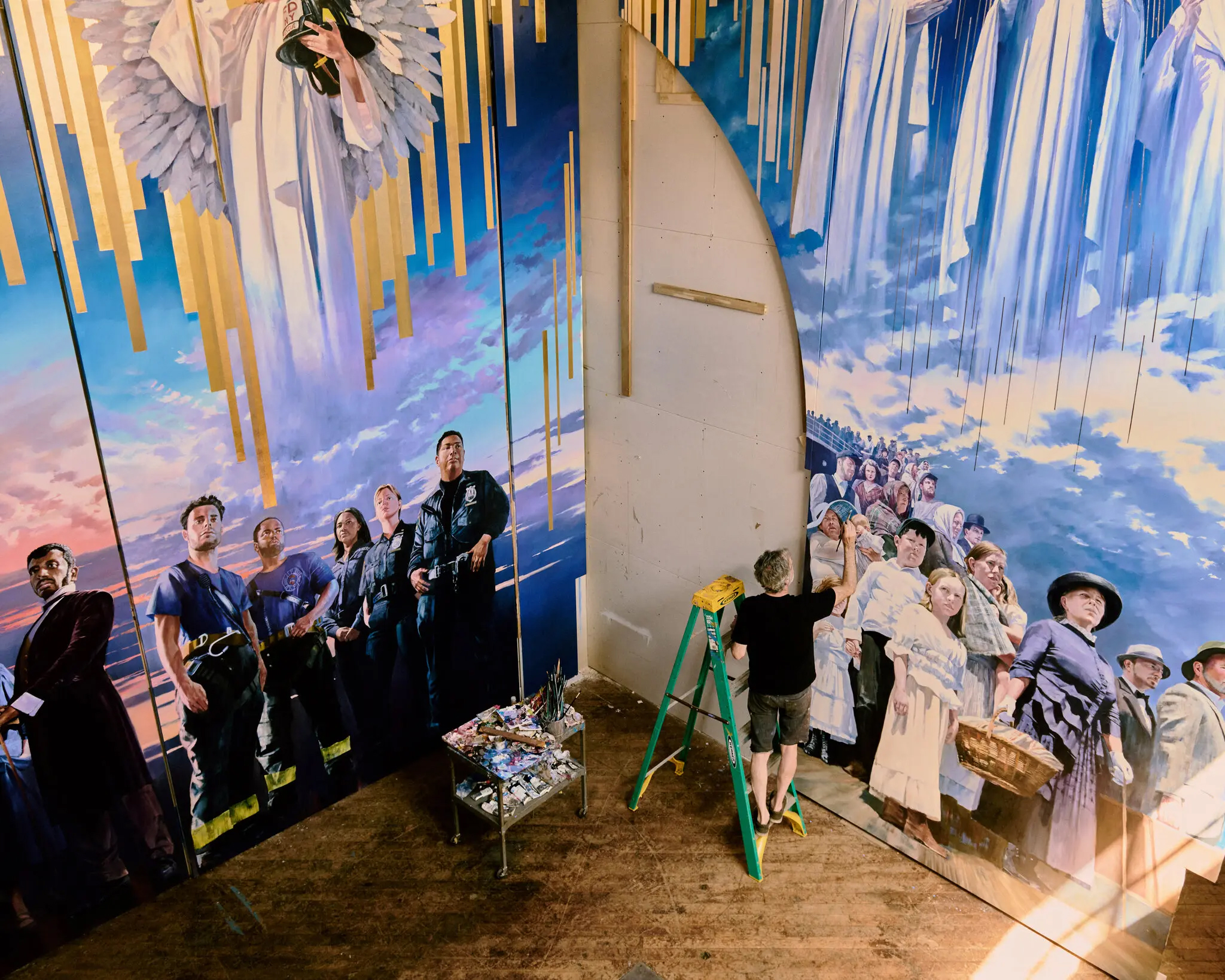
At a time when immigration is a bitterly divisive issue, with the Trump administration ramping up arrests and deportations, St. Patrick’s Cathedral will unveil a huge mural next month depicting the arrival of immigrants to New York City in the 19th century and the present.
“It’s a celebration of a city that has been built by immigrants and where immigrants have been welcomed,” Cardinal Timothy M. Dolan, who is also the archbishop of New York, said in an interview in his official residence adjoining St. Patrick’s. The first major art commission in the cathedral since bronze doors were installed at the Fifth Avenue entrance in 1949, it will be dedicated during a mass on Sept. 21.
Roughly 21 feet tall, the mural, of 12 large panels, was painted by the Brooklyn-based artist Adam Cvijanovic (pronounced svee-YAHN-o-vitch), who titled it (with a slight word adjustment) after a song popularized by Elvis Costello, “What’s So Funny About Peace, Love and Understanding.” Along with immigration, he depicted a historic event dear to the cardinal’s heart: the Holy Apparition at Knock, in which 15 people in the Irish village of that name in 1879 reported seeing the Virgin Mary, two saints and the Lamb of God, a symbol of Jesus Christ, in a vision that lasted for about two hours on a wall of the parish church.
Oh, wait! Cvijanovic? Obviously one a them foreigners, right? Well, not exactly. It’s worse, to many who would object: He was born in Cambridge, Mass. His mom’s people have been here since the 17th century. But hey, his dad is Serbian (and an associate of that Bauhaus dude Gropius!), so make what you can of that…
Back to the topic…
The artist was chosen for his realistic style. “The rest of them were a little too Picasso-like,” Dolan told the NYT. “I wanted something that people could look at and see the Holy Apparition at Knock, and not that you’d have to be on LSD to figure it out.”
Amen to that, too.
The work celebrates the Irish, of course — such as cops who saved people on 9/11 — but the cardinal with the Gaelic name wanted a lot more than that, and he got it. And of course, the many immigrants still trying to come here despite this administration’s efforts to close our nation’s welcoming arms are represented along with those from previous generations.
This mural is a sort of farewell gesture from Dolan, who you may recall, has addressed this topic before:
A week before his birthday, he had strongly criticized an assertion by Vice President JD Vance that the Roman Catholic bishops were in favor of immigration because the church profited from resettlement funds. He called it “inaccurate,” “scurrilous” and “very nasty.” In fact, he said, the church loses money “hand over fist” in caring for immigrants.
After that incident, the artist was worried that the archdiocese might want to back off from the topic a bit. But “the opposite happened,” he told the NYT. “They said, ‘We want to go right ahead.”
Good. Because it’s hard to imagine a more powerful and relevant way to express what the faith is about.
Nothing against old-style art, much of which I very much appreciate. In the article, the artist mentions Caravaggio. I like his work very much. We have a huge print of this masterpiece hanging prominently in a hall at my own parish. I also like some modern work, such as Henry Ossawa Tanner’s The Annunciation.
But maybe we’re overdue for a new approach. I have a very strong impression that we don’t necessarily need a lot more depictions of this or that event described in the Bible. People have seen those, and know the stories. Maybe we don’t need another Adoration of the Magi right now. What I believe we do need is more art that helps people get what our faith is actually about.
This is a wonderful step in that direction.
Present-day immigrants depicted with a native of Italy who became the first American saint — Mother Cabrini.
You don’t want to see certain portions of my college transcript. Or rather, I don’t want you to see them.
I had what you might call a very slow start in higher education. When I left Hawaii to travel all the way to Columbia to attend USC, I thought I was ready, and had everything I needed. I was thinking about that in recent days as I heard from folks with young kids enduring the herculean mess of moving them into their dorms for this fall semester. My parents, who in any case were back in West Honolulu, didn’t have to help me move enough stuff to furnish a small house (which seems to be the fashion today) into the Honeycombs. I just had the three things I had brought with me on the plane: my Dad’s old overseas bag, my tabletop stereo and a box full of record albums.
But at 17, I wasn’t as self-sufficient as I thought. For instance (just to keep it simple) I initially thought one of the best things about being off at college was that nobody made me get up in the morning to go to class. Turns out that was one of the worst things for a guy like me, since the people who ran the classes still expected me to show up, and would hold me accountable when they handed out grades. Who knew? Nobody told me. The only thing I remember from my freshman orientation was when the guide taught us guys what it would take to make the ball atop the Maxcy monument spin. Some of you older guys no doubt know the answer, but they probably don’t teach that anymore at orientation. If they did, they’d get canceled.
Enough about USC, which I only attended for that one wreck of a semester. I want to reflect on Memphis State, or at least on the more positive aspects of my time there. This came up because I’ve been thinking lately about taking advantage of the senior deal on tuition to take a course or two at USC, and the Gamecocks want a transcript. Turns out that you can’t order a transcript from Memphis State anymore. You have to get it from a place called “the University of Memphis.” But I sent off for one a couple of days ago, and had it back in my email almost immediately.
It contained good news and bad news. The bad news was the lingering effect of the mess I’d made in Columbia. That was because I had crammed my schedule that one semester at USC with honors and upper-level courses, but (thank goodness) had taken them on a “credit/no credit” basis. The deal was that a “no-credit” didn’t count against my GPA. But out on the Tennessee frontier they’d never heard tell of such a thing, so Memphis State carried them as Fs, until I finally spoke to the right people and got it fixed. That gave me a chance to climb out of the hole.
But just a chance. Unfortunately, my climbing those first couple of years in Memphis was not what you’d call spectacular. Lots of Cs, and a couple of times worse than that. I was still, by habit, a slacker.
Dang. I promised in my headline to show you the good side, and I’m still dwelling on what went before. Well, here we go: the good bits…
Then I met my wife. That first semester that we were dating, I picked up one of her habits. She called it “studying.” I had heard of it — I even knew some people who did it — but I had never seen it as a needful thing back in high school, and had not changed my ways. But she did it like it was a normal thing, and since I was hanging out with her so much, I just fell into the same habit. I didn’t turn into a grind or anything, I just studied some.
The results were rather remarkable. I do recommend it to young people, if they can find the time. (And I should say that none of my grandchildren should ever emulate the shameful record of their grandfather earlier in his academic career.)
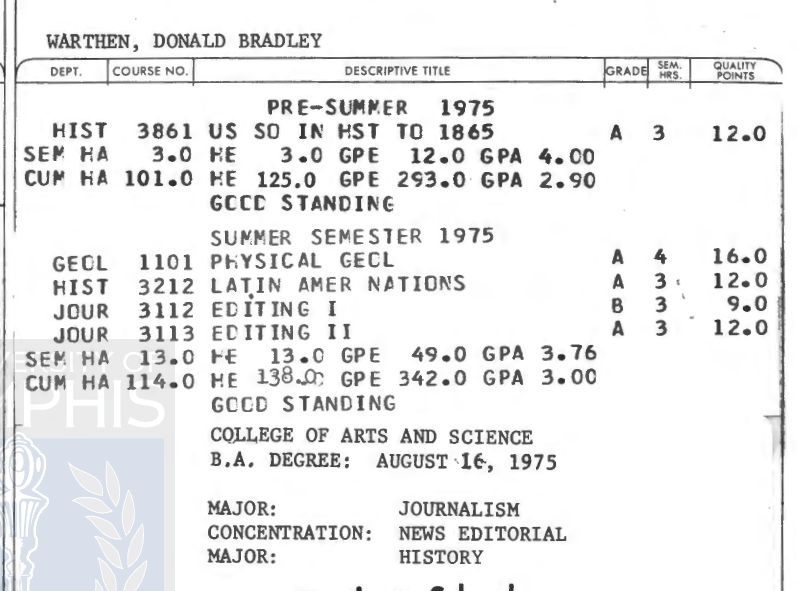
It took me awhile to get the hang of it, and the occasional C still cropped up in the first couple of semesters. But my last spring semester, and the crammed summer schedule I took on that last summer so I could graduate in August, showed the kind of work I should have been doing in Columbia back in 1971. You can see the part covering the summer above.
Sorry about that one B. My whole time since I had declared a journalism major I had been avoiding the two required editing courses taught by one L. Dupre Long. Mr. Long was the adviser to the lab newspaper The Statesman, which he ran with an iron fist. I never went near The Statesman until I was required to when I took those two courses under him. I had my existence over on the independent, relatively anarchic student paper, The Helmsman. We ran a student-drawn comic strip with a character named “El Depraved,” who was sort of a villain, or at least an object of ridicule. For some reason, this led at one point to my being invited to visit the office of the department chair, who gave me a stern talking-to, but probably not as stern as Leon (as Mr. Long’s friends called him) would have liked.
I took them both over the two summer terms, which were much shorter than regular semesters, thereby diminishing my suffering.
Anyway, the grading in the editing classes was highly subjective, and Leon just wasn’t going to give me an A in that first course. On the second one, he relented. But instead of posting it on the door of his office, he gave me the news in a face-to-face meeting that seemed to last hours, and it was mostly about how I was full of potential but too much a slacker to show it, and I sat there in agony because I knew that had once been true, but I also knew my work in his class could not be faulted, so I sat there nodding and thinking “Alright already! Just tell me the grade!”
Finally he came out with it, and it was an A, as you can see. That was the last grade I learned about before graduation, and it pulled my cumulative GPA to exactly 3.0. I walked out with the first B average I’d had in my entire college career, and in those days (before the grade inflation of the 21st century), that was enough to graduate cum laude.
But the programs for graduation had already been printed, so I never had any proof of it I could show to anyone until now. So I’m glad I got this transcript, because there it is.
Similarly, I had never declared a second major in history. But sometime toward the end of that last spring semester, I realized I had taken so many history electives that I was only six hours away from meeting the requirements of such a major. So I crammed two of them into the summer, one of them in the three-week mini session before the two summer sessions, which turned out to be one of my favorite courses ever. (“US SO IN HST TO 1865” on the transcript refers to “U.S. Social and Intellectual History to 1865.”)
I like to tell people that I majored in history, because let’s face it — journalism isn’t an academic subject. It’s a trade for literate people to engage in. You learn it working in a newsroom, not sitting in a classroom. And I want to seem at least somewhat educated. So I tell people I also majored in history, but I always explain that they would probably find no written proof of that anywhere.
I always say that because to me, one of the most amazing news stories you ever see — and you see it quite often — is about idiots who brag to the world, for instance, that they were Marines and received commendations for valor in the last war — when some aspect of that, or all of it, is a lie. And of course, the first reporter who checks it out discovers that and tells the whole world. It has always astounded me that anyone would be stupid enough to think he could get away with something like that. I would never do anything like that — not only because it’s wrong, but because I would expect to get caught.
But now, I don’t have to attach asterisks when I tell people about my history major, or my at-the-buzzer 3.0. Which is nice. I know neither is a major achievement, but I see them as better than nothing. Having done nothing at one point in my youth, I know.
This is great. I should have sent off for this transcript years ago…
Really, my headline pretty much says what I mean to say. But of course, I’ll elaborate a bit.
The above ad was in an email I received this morning from The Boston Globe. And I’ve had it with these. I’ve been seeing such ads for a decade or two now, and I’ve reached the end of my tolerance.
First, do any of you refer to what you’re wearing between your waist and ankles “a pant?” Or has a friend asked, “Hey, what do you think of my new pant?”
No, you don’t. And no, no one has (I hope).
This is exclusively something that comes out of the clothing industry, or perhaps the advertisers who tout clothing for that trade. It’s not anything any of us out here who wear the things say, near as I can tell.
We call them “pants.” And Italians say i pantaloni. Plural. Speakers of Spanish say los pantalones. Again, plural. OK, so the Dutch for some reason use the singular form (de broek). Fortunately, when I was in Amsterdam, everyone refused to speak Dutch to me, so I was spared the pain of hearing people say such a thing in real life. Maybe they do it because of the influence the textile industry once had on the country.
As for the industry, I suppose they say it because to them, a pair of pants is a singular product more than something they wear. It’s one item, and if they used a plural term it might confuse their accountants.
But I don’t know, and I don’t care, why they do it. I just want this to stop. Now. Before somebody starts wearing “an underpant” beneath the aforementioned….
This will be the second, more tangential, such post.
Paul shared this brief anecdote:
In another bookstore mentioned above, the name of which I shall not reveal, I was speaking to the owner about the new pope. The owner is a bit older than I and said, “I‘ve always thought of popes as very old men… but I just realized… I’m older than the pope!”
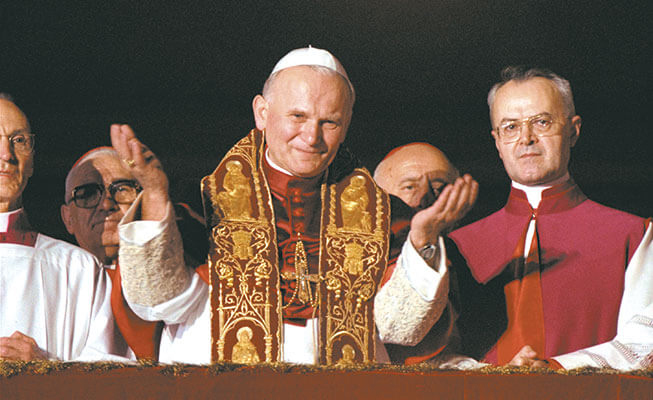
This caused me to check Wikipedia, and find out that I am indeed older than Pope Leo XIV. Not by a lot — we would have been in school at the same time; I was just a couple of years ahead. So obviously popes are not “very old men.” Of course, I realized long ago that this was the case. It was fairly obvious when the startlingly young Pope John Paul II came along. He was only 58, and obviously in his prime. I had just turned 25 when he took the chair of Peter, but you didn’t have to be older than he to perceive his youth to be exceptional.
But then Benedict and Frances were obviously up there, with Benedict retiring at 85, and Frances dying at 88. So at 69, Leo stands out a bit, but not the way John Paul did.
And like the man in the bookstore, I find it slightly jolting on a personal level to suddenly be older than the pope. But not as much as when I realized, back in September 2023, that I was older than three of my grandparents had lived to be. That was when I was the same age as Pope Leo.
And not as much as the moment in 1994, when David Beasley was meeting with the editorial board to seek our support in his bid for the governor’s office, and one of our members (technically an emeritus member, I suppose you’d call him) brought up the candidate’s extreme youth. I realized in that moment that he was only about 37 (I say “about” because I don’t recall the date of the interview). I was 40, and in that moment I was quite shocked that someone younger than I was seeking such an elevated office. The presumptuous puppy! That was a bit of a personal landmark.
That experience was repeated when Barack Obama came along. I mean, a young governor was one thing, but president of the United States? Come on. For reference: Obama moved to Hawaii about the time I was graduating from high school — but he didn’t graduate (from the posh Punahou across town from my public school) until eight years later. (That didn’t keep me from backing him for the Democratic nomination in 2008, although I went with the far more experienced John McCain in the general.)
Life can be described in many ways, but one way would be as a process of constantly modifying one’s sense of time. So having a pope roughly, but not quite, my age is not the surprise it might once have been. Governor, president, pope… there seems to be a pattern here, and I’m getting used to it.
And obviously, Pope Leo is not a “very old man,” even though he’s the age of the oldest of those three grandparents who did not live to be as old as I was when I wrote this. One’s own perception of human longevity is not the only thing that changes over time. Those three grandparents passed away in the 1950s, ’60s, and 1971. We lost my last grandparent in 1985, when she was 95. My father was three weeks short of 93 when he died in 2021. My mother is still very strong, physically and mentally, at 94. So it’s hard for me to think of myself — or the pontiff — as “very old” yet.
Today, we’re remembering my father-in-law, whose 102nd birthday this would have been, if we hadn’t lost him at 86. God bless you, Mr. Phelan, and thank you so much for all the ways you blessed us in your long life….
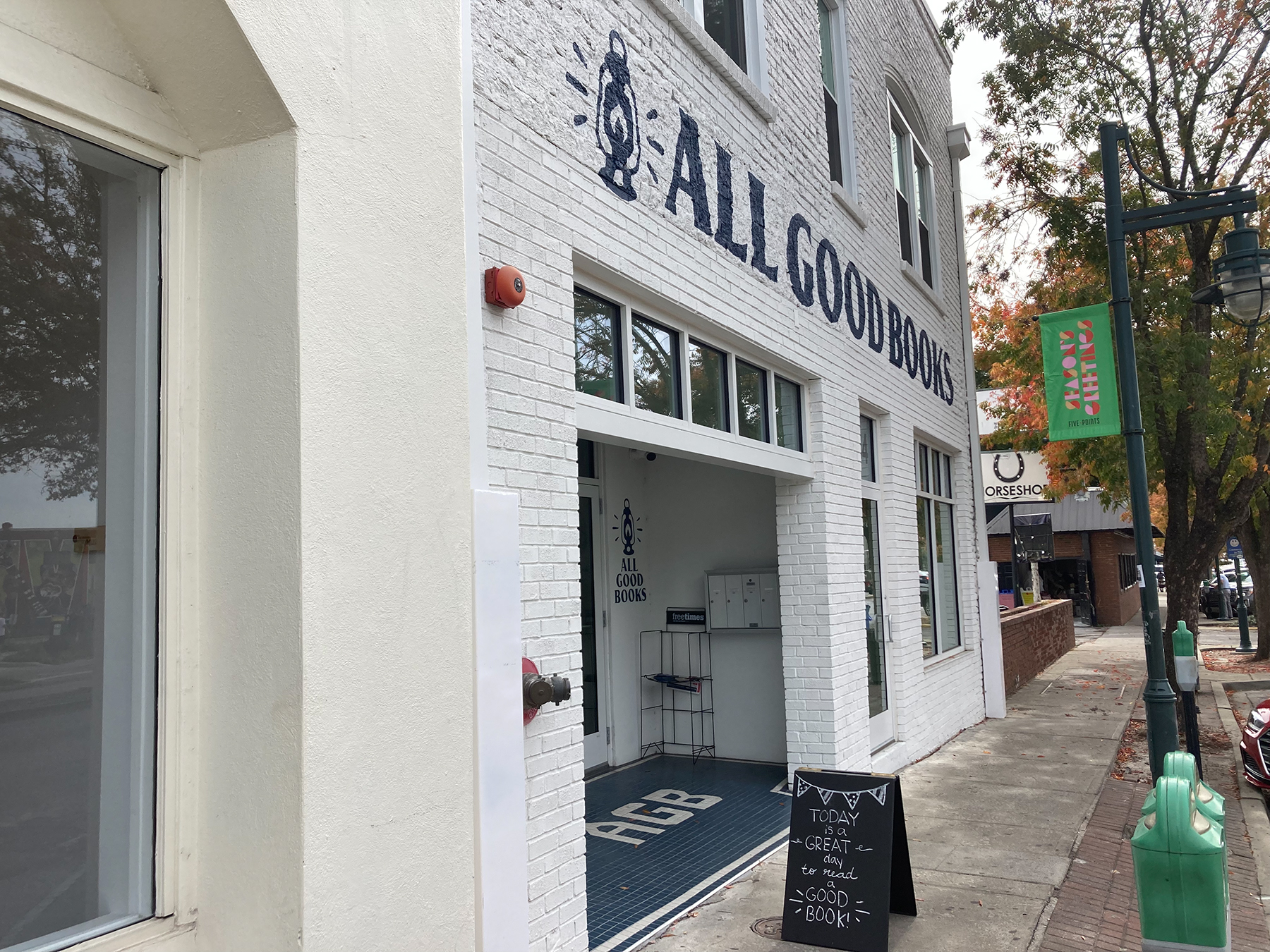
My relationship with that store began before it existed. Several years back, my daughter gave my wife and me some gift cards to Odd Bird Books, which existed in the tiny Arcade Mall downtown. When we heard it was about to close, and we still hadn’t used our gift cards, we made a point of visiting that shop for the first and last time.
We picked up several books that day. I believe one of them was the third book in Edmund Morris’ trilogy, Colonel Roosevelt. But the main thing I remember about that visit was how very impressed I was by what was being offered in that diminutive space.
The shop was only about the size of my home office — maybe smaller. So there were not that many books. But the place possessed a virtue I’d never encountered in any bookstore, whether independent or chain — more or less every single book was one that I would like to read, if my life should last so long. It was like Ben Adams, the proprietor, had been asked to collect every book he wanted to have with him on the proverbial desert island — and he happened to have excellent taste.
In other words, all good books. No junk at all. There wasn’t room.
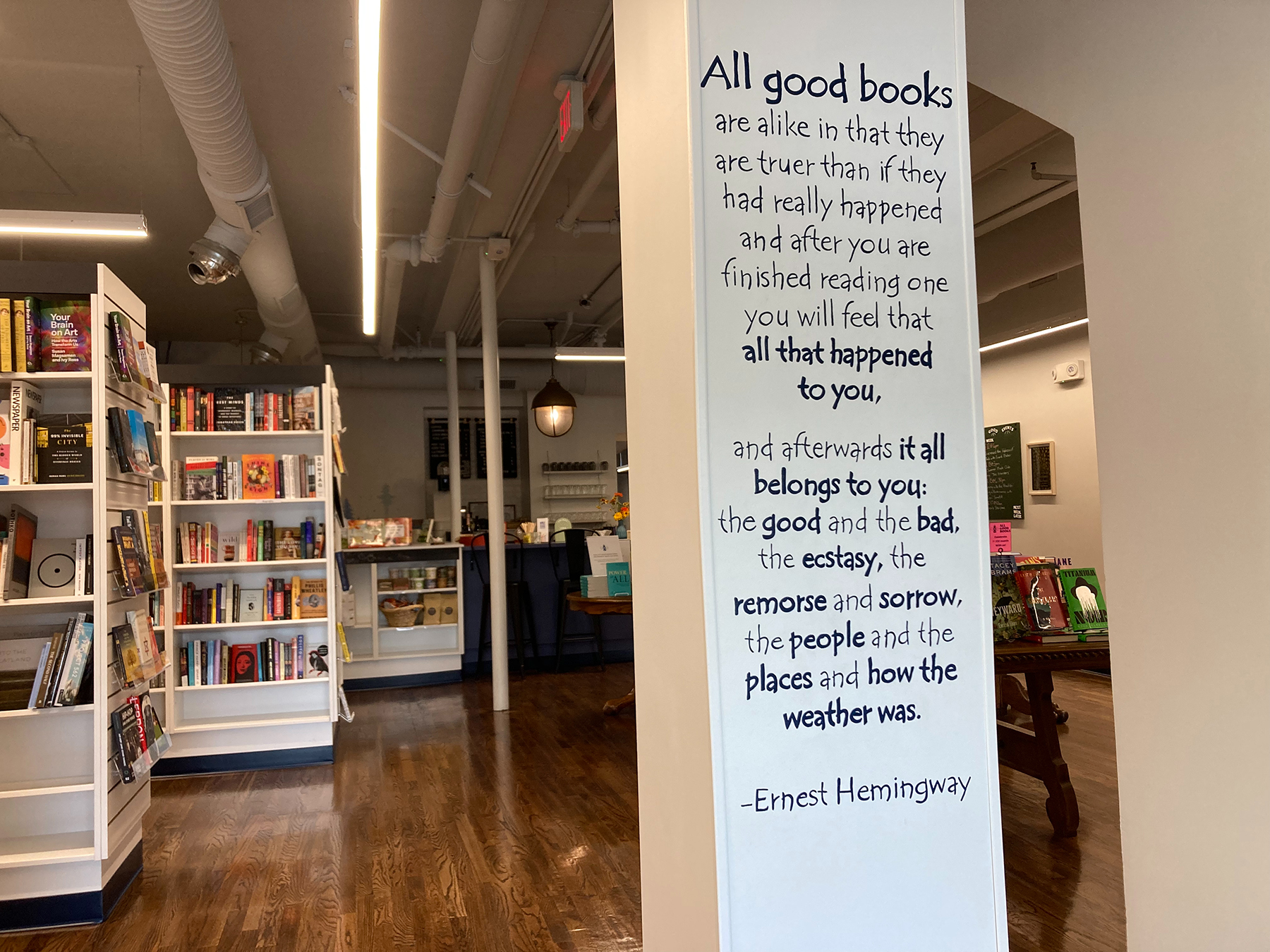
So when Ben teamed up with Clint and Jenna Wallace to open a new store, naturally it bore that name (although they didn’t get it from me — see the Hemingway quote in the picture below).
And it lives up to that name. Of course, since it’s bigger and there are many more books, they’re not all books that I particularly want to read. But we should consider that I’m not the only reader in the world (or even here in Columbia), and different strokes and all that.
Still, I’m deeply impressed by the selections. And if I happen to want something that’s not on the shelves (an astoundingly high percentage of what I seek is on the shelves), the folks behind the counter will quickly get it for me. And I’d certainly rather do that than order it from Amazon.
Oh, and there’s always coffee and other refreshments. And you may think this is odd to mention (you’ll understand if you’ve spent huge amounts of time in bookstores), but a very nice restroom. That’s essential, don’t you know.
I hope to see you at All Good Books sometime. It’s located at 734 Harden St. Now that Yesterday’s is gone, it’s my one motivation to visit Five Points.
One could argue that independent bookstores are a luxury. You can summon books to your doorstep with a few clicks, sometimes the same day. Or, if you have an E-reader, in seconds. So why do bookstores continue to survive?
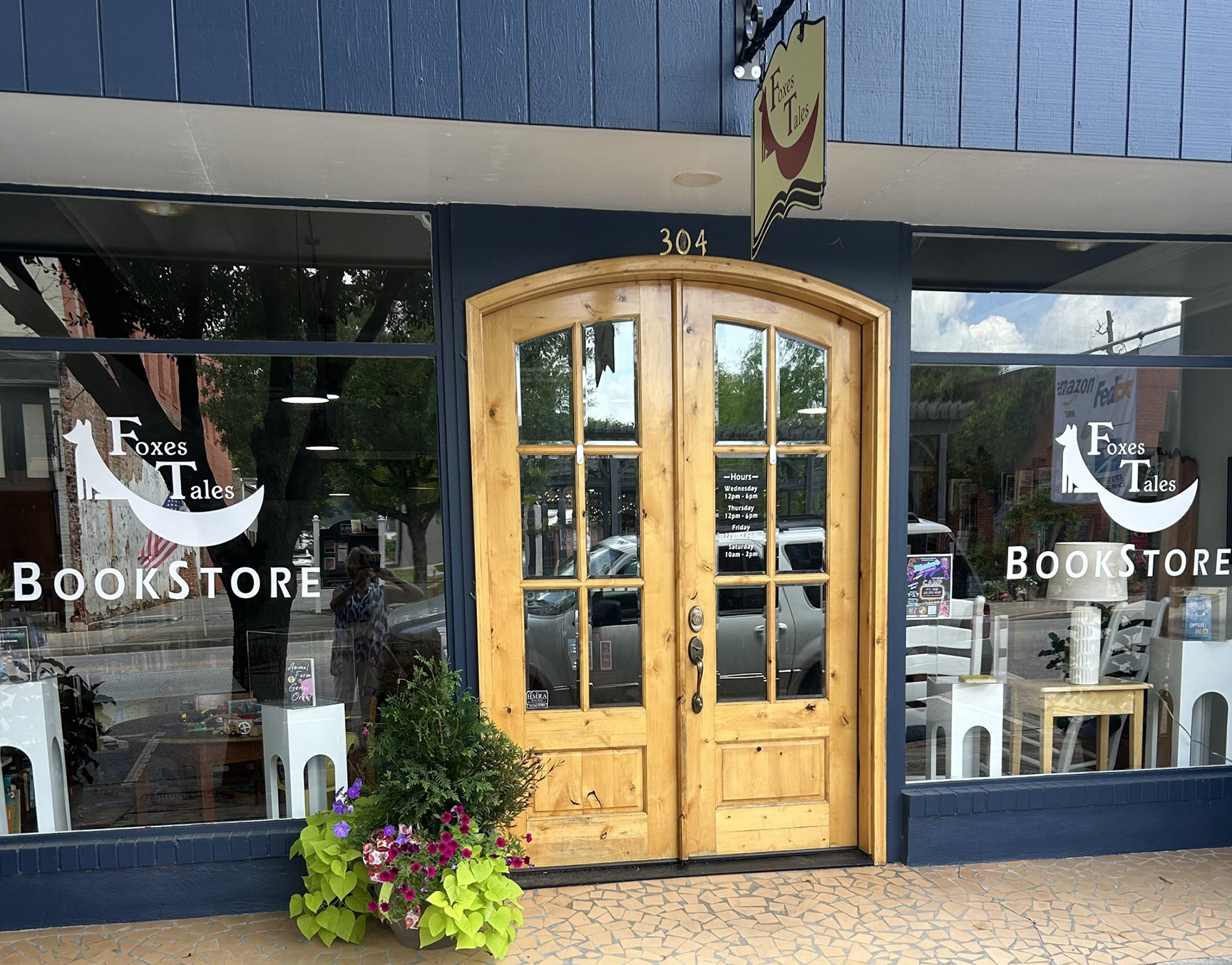
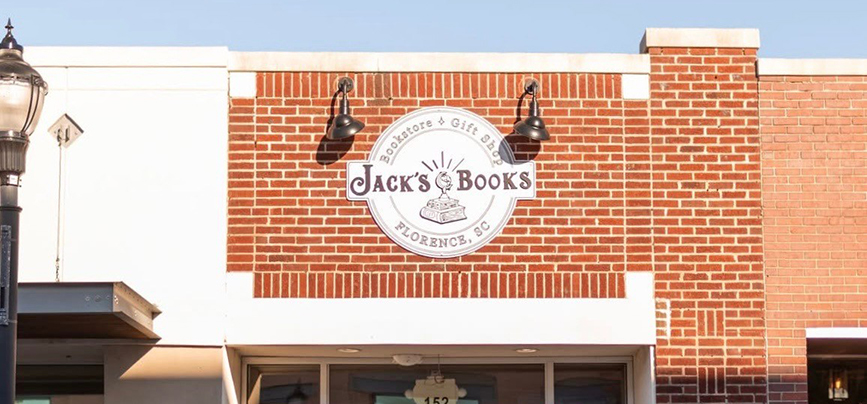
As Blockbuster faded in the 2000s, I worried that bookstores might suffer the same fate. But here they are still, and they seem to be making a resurgence. According to the American Booksellers Association, more that 200 new indie bookstores opened in 2024. We are seeing a similar renaissance locally. Since 2023, three new bookstores have opened in the Pee Dee – Jack’s Books in Florence, Foxes Tales in Marion, and Our Next Chapter in Conway. It’s worth considering why.
First, I think, are the owners. Their identities are palpable within the walls. You feel as if you are walking into an extension of their homes. I can tell you the name of the owners of almost every independent bookstore that I have frequented more than once: Gwen at Foxes Tales, Jack (Ok, that’s a gimme), Wendy and her daughter Olivia at Litchfield Books, and Clint at All Good Books in Columbia. I fondly remember Rhett and Betty Jackson who founded the Happy Bookseller in Columbia which closed in 2008. And I look forward to meeting Bob and Lisa Martire at Our Next Chapter, whom I called for this column.
Second is the product itself. There is just something about books: their personalities on a shelf, their weight in your hands, the curve of the pages, the smell of the bindings. We connect with books in a different way from the way we do with VHS tapes or DVDs. Is an E-reader more economical and practical? Undoubtedly. But after a day full of screens, can you find repose and escape in another screen? Many of us cannot.
Third is the community bookstores create. If you are new in town, where would you go to meet people? Church used to be the answer, but less so now, particularly for young people. Bars and clubs, of course. If I were young, I would head to the local coffee shop first, and the bookstore next. Shopping for books is different from shopping for groceries. You don’t always have a plan, and you aren’t focused on getting home to cook dinner. People relax in a bookstore; their minds are open. Children peruse, curious and wide-eyed.
In the past month I have had the following conversations in a bookstore: As I was entering Litchfield Books, a woman I had never met engaged me in a five-minute conversation after I bent down to greet her dog. Inside, I had a long chat with Wendy and Olivia about books, bookstore dogs, bookstore swag (I love a good bookstore T-shirt and baseball cap) and the possibility of adding a coffee bar (I voted a loud “Yes!” to coffee). In another bookstore mentioned above, the name of which I shall not reveal, I was speaking to the owner about the new pope. The owner is a bit older than I and said, “I‘ve always thought of popes as very old men… but I just realized… I’m older than the pope!”
I met a new bookstore friend recently during a trip with my wife, Debbie, to Decatur, Georgia, for a wedding. Debbie is a nurse but could have been a librarian. She was always ready with a fun, age-appropriate bedtime story for me to read to our children. That was precious time, with a little head against each shoulder.
When she saw that the wedding venue was near a children’s bookshop called Little Shop of Stories, we knew we had to visit. Which brings us to the last reason why we can’t let bookstores go. Every one has a vibe, an ambience, much like a restaurant. At Little Shop, soft Saturday afternoon sunlight flooded though the glass façade into a welcoming space that was filled with perhaps a dozen patrons milling and talking. A father and daughter sat in a chair as he read to her.
When it came time to pay, the young woman at the counter mistakenly input my transaction as a credit rather than a charge. When I discovered the error on Monday, I called and spoke with my new friend, Heather, at Little Shop, who straightened it out. She was lovely; she was kind; we laughed. It was the best customer service call I suspect I will ever have. A few days later, a care package arrived with a Little Shop mug, a tote bag, and a half dozen books.
Take that, Amazon! Yes, you will pay slightly more at an independent bookstore. But we have already made this bargain with coffee shops. We understand that we are paying too much for the liquid in the cup. But that’s not all we are buying. We are renting a small portion of the shop, that favorite table where we like to sit. We are maintaining a relationship with the shop owner (Hi Liz at Groundout and Mel at Bear Bar) or our favorite barista that would end if the shop closed.
We have a choice. We can pay the minimum and have the lonely convenience of books at our doorstep or on our screen. Or we can choose a better way. We can support a small business that provides livelihoods for its staff and weaves a beautiful thread into the fabric of a neighborhood. Find an independent bookstore, and you’ve found a place that cares about its future.
I hope the Boston Globe won’t mind my using this. I’m trying to create more Globe subscribles.
Remember when I published one of these — or earlier on, a Virtual Front Page — pretty much every day? If you do, you’re showing your age, because it’s been awhile.
But here’s one for today, anyway…
Yankee beaches — Since a lot of y’all are probably at the beach, and bemoaning the fact that there’s not enough room to walk, be glad you’re not up north. It’s getting ridiculous up there with the tent cities being set up everywhere. See the picture above. My daughter who was in Rhode Island last week said she saw a lot of that on Block Island. Why am I sharing this? Because I enjoy news that makes S.C. look good. We don’t get enough of that.
You are contaminated — This is a tad depressing — talking about how such things as plastics permeate our bodies and those of all living things on the planet. But it’s a moment of nostalgia for me. I remember the old days when we worried more about old-fashioned pollution than climate change, which sometimes seems like the only ecological problem young folks know about.
Your choices for governor — How bad can they get? Well, Nancy Mace just made her campaign official, so… Not bad enough for ya? Well, consider that Ralph Norman has also raised his absurdly unqualified hand. I was glad to see that Pam Evette was running, because it lets us know she’s still among the living — our Gov Lite is so invisible that I tend to think of her as the Ghost Who Walks. I don’t know Josh Kimbrell, but that alone would dismiss him from my consideration. The only Republican running with anything like credible credentials is Alan Wilson. But that still puts the GOP one viable candidate ahead of Democrats. Perhaps things will improve. Perhaps not.
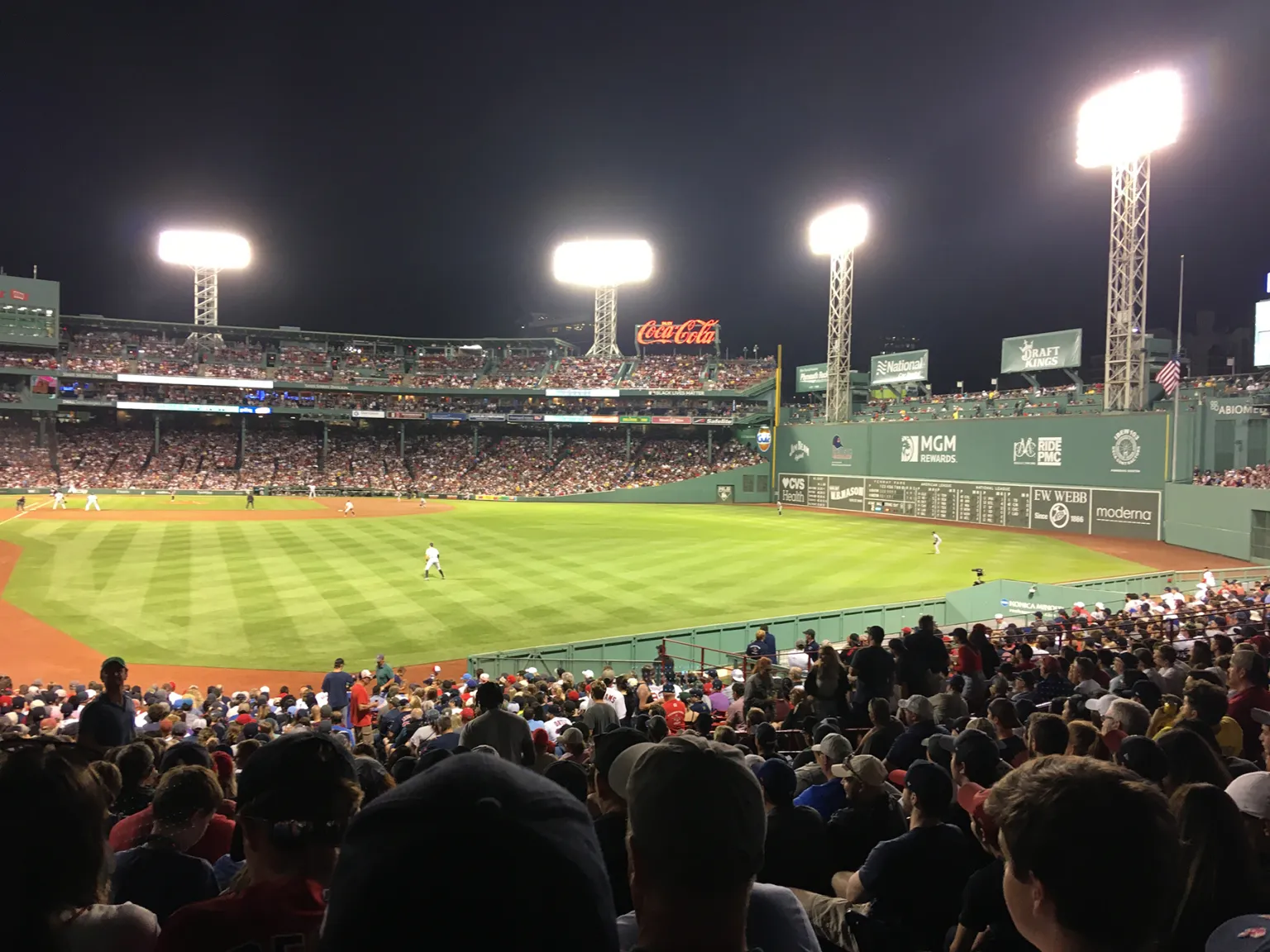
Joy in Beantown — This is the thing that most motivated me to post an Open Thread. I wanted to say something before the moment passed. The weekend just past was a great one at Fenway. The Red Sox are now ahead of the Yankees in the AL East, and only 3 games behind the leading Blue Jays. And I’m digging it, whether you are or not.
This isn’t the same Democratic Party as Trump’s first term — I posted this just to react to the headline by saying, “Yeah, crushing defeat can do things to you.” I probably won’t read the rest of the story. Y’all can tell me if there are any surprises. I haven’t seen anything in politics to surprise me since last year. I suppose I could have said what I’ve already said frequently in recent months: “Ya think?”
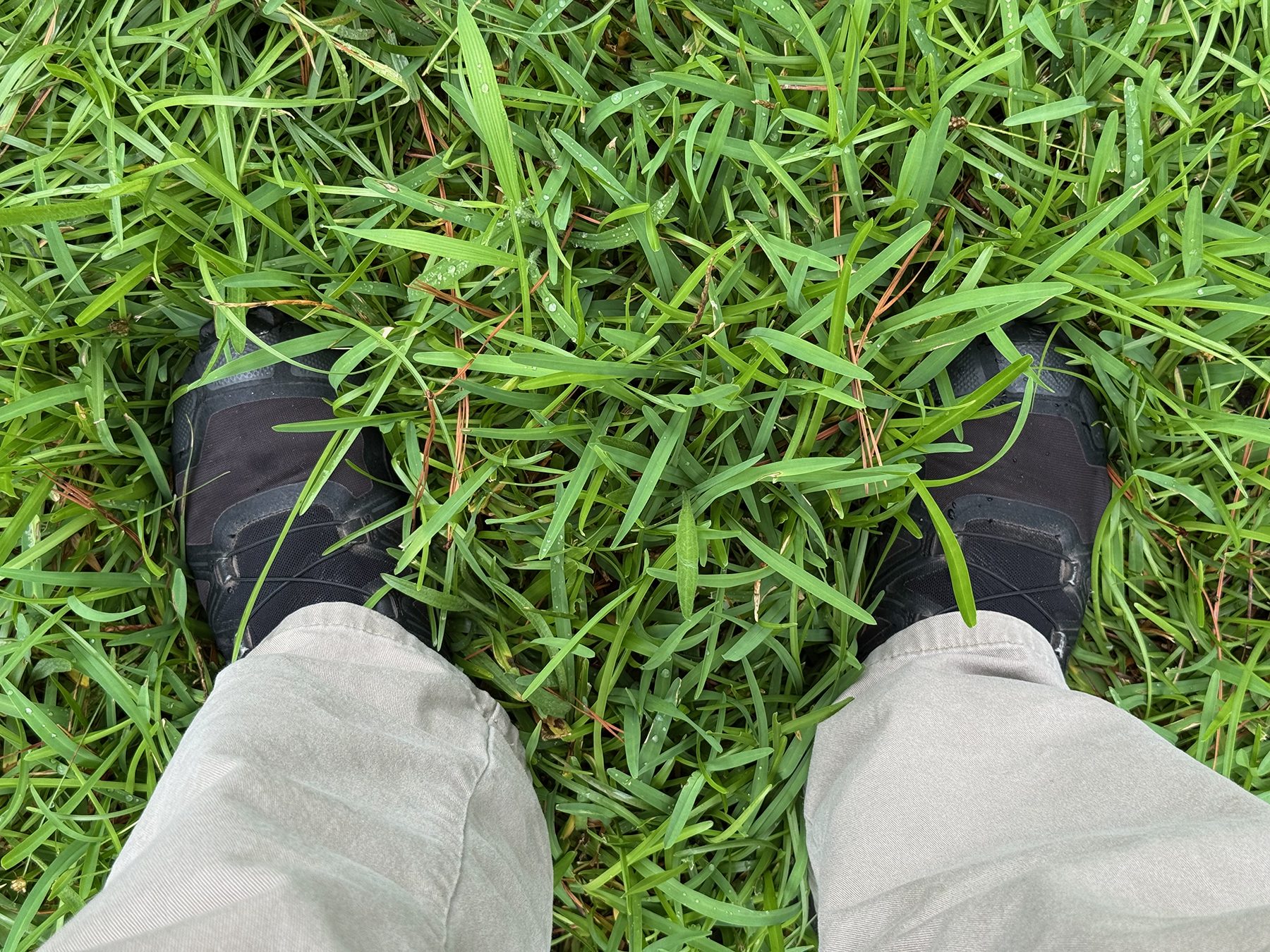
I’ve got on my walking shoes. And long pants. And look what this rain has done for my lawn!
When I’ve mentioned it, other people have told me this happens each year. Not that I’ve noticed. This is the first summer it’s made an impression on me, anyway.
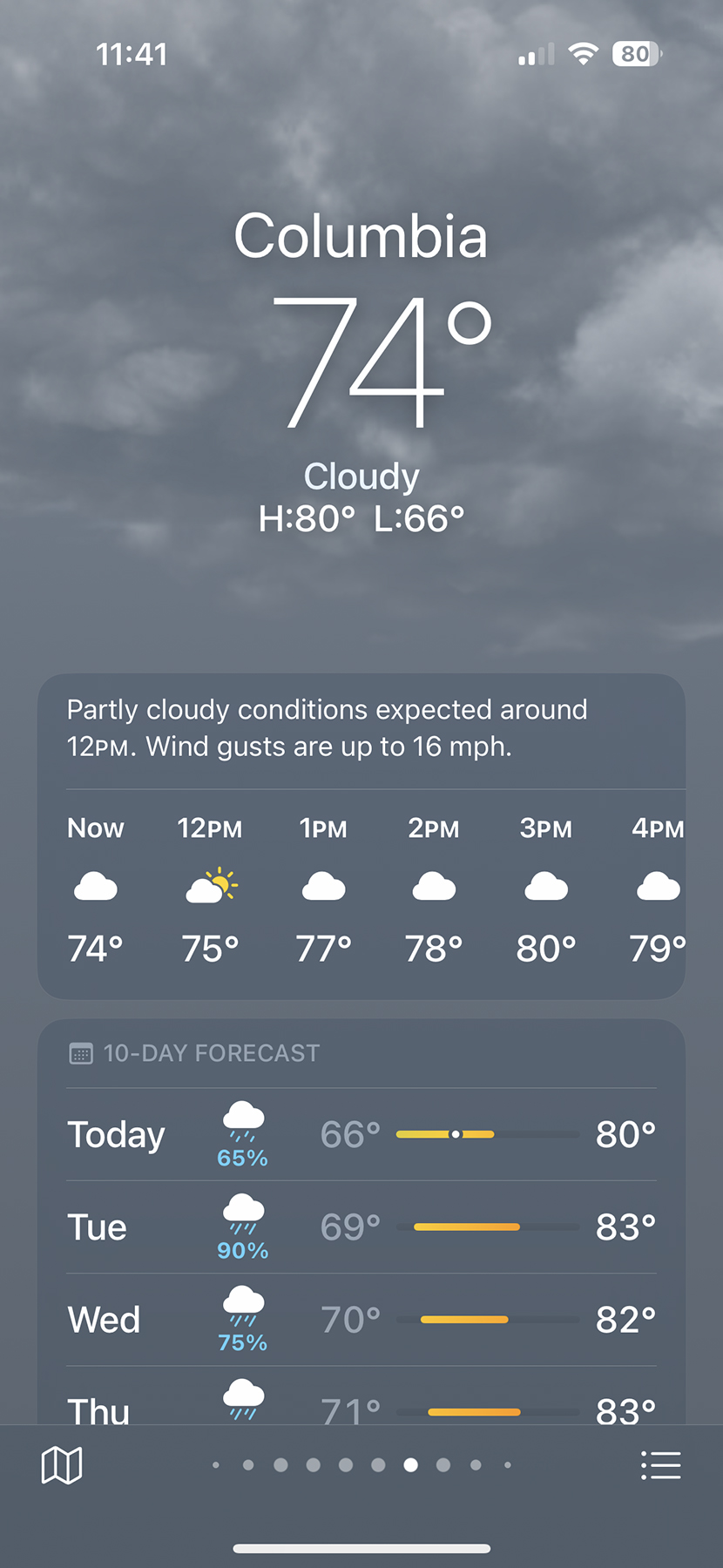
By “it” I mean this: We don’t have cold water anymore. You turn the handle with the “C” on it, and you get a liquid that is only slightly, if at all, cooler than the blood in your veins. I’ve been thinking about writing about this for some time, but I know a lot of y’all are numbers people, and I couldn’t quantify it. I couldn’t find my old thermometer that I used to use for developing film at home. The ideal temperature for developing Tri-X — which is what I usually used — was 68 degrees Fahrenheit. I don’t know how warm this water is, but I assume I’d have to greatly reduce development time to use it without cooling it somehow, with a likely loss of image quality.
And it’s cloudy! I love cloudy…
(I found one on Amazon, and it was pretty cheap, but I didn’t want to spend even that for one blog post.)
Anyway, have y’all noticed it? And is it news to you, or did you notice it years ago? (And no, I’m not talking about the usual slight warming we get every year, but something so far beyond that that I think maybe the “hot” is also on — but it isn’t.)
I might be more conscious of it because unlike most members of the fam, I’ve been here all summer (except for a few days in Memphis, which ain’t exactly the arctic.) My wife spent a week in Alaska with a bunch of friends from the all-girl high school from which she graduated. One daughter and two of her children have spent a good bit of time in Canada, when they weren’t in New York. Her other daughter lives in Asheville, which is like being in a different hemisphere from here. Another of my daughters just came back from a week in Boston and an island off the coast of Rhode Island. My third daughter has stayed closer, but did spend a few days in New York. My boys have stuck close to home, although one took his family to Costa Rica. That, of course, was a great trip, but not the same as these journeys north that turn me a bit green, while of course I’m happy for my loved ones.
Right now, though, I’m able to look back on that envy with shame, because now I’m as blessed as anybody.
Can you believe this weather? It’s felt like fall, or maybe Amsterdam, where we spent a week last summer. It’s truly wonderful. Sure, those Parisians I wrote about recently might complain that it’s getting up to 80 today, but you and I know that 80 is a treat at this time of year.
And we’ve got several days coming in this same balmy mode. it’s not going to get above 90 until next Wednesday.
And I am grateful. That God should reward me (and my neighbors) this way after my grumbling (a bit) about missing out on the Great White North, or about the lack of cold tap water, is a glorious example of His infinite forgiveness.
The last couple of days, I’ve even resumed walking outside. And I intend to do it again today. I can’t wait…
After all, I sort of did write that because I was looking for a quick-and-easy thing to post about, to assuage my guilt about not posting more often. And, I told myself, not everything has to be as long and complicated as the post that preceded that “silly” one(1,736 words, yikes!).
But… ultimately, I don’t consider the subject trivial. To explain…
Years ago, when Umberto Eco (the Italian semiotician and author of The Name of the Rose) was still alive, I saw something he wrote (or perhaps he was just being quoted) in a magazine. He predicted that our species was moving back toward nonverbal (or perhaps you would say post-literate) modes of communication. And this was years before emojis, in the ’90s or maybe the ’80s.
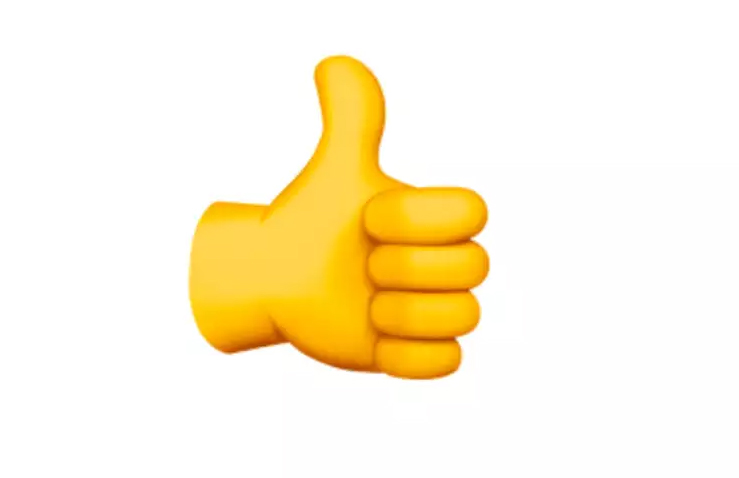
Anyway, I think of his prediction frequently these days (as I’ve mentioned before in a related rant). My question about the thumb-up emoji arises in that context.
My concern is that I see our ability to communicate flattening, becoming one-dimensional. The English language (the only one in which I am sufficiently literate to be able to perceive subtle distinctions) is amazingly versatile, flexible and able to communicate an apparent a galaxy of things with a single word, depending upon its context.
But I’ve seen a marked tendency to reduce in recent years. Sixteen year ago, I wrote about the absurdity of having my wife ask me why I was not her “friend” on Facebook. But I didn’t consider my wife absurd for wanting to include me in something she was enjoying. My problem was Facebook’s reduction of human relationships to one word. On that medium, you were either a “friend” or you were not, (which makes sense only if you haven’t advanced past the kindergarten level of social interaction). Obviously, my wife was and is much more than that to me. And yet in the years since then Facebook, in its hyperbureaucratic, ones-and-zeroes-obsessed manner, has dutifully labelled her, my parents, my children, grandchildren, cousins, acquaintances, and people I didn’t even know but approved to be polite (and no, I don’t do that any more) have all become my “friends,” without any elaboration or explanation or qualification or enhancement — without any of the things that make life rich and full.
I am reminded of the Newspeak Dictionary from Orwell’s 1984. Each edition is smaller, thinner, containing fewer words. The idea is to reduce the number of concepts a human is capable of generating or communicating, so that ideas that are troublesome to Big Brother’s state simply don’t arise or spread. As the dialectic of Oceania proceeds, language gets flatter and flatter. A thing that is in some way very, very bad is “doubleplusungood,” rather than horrible, evil, shocking, abominable, mortifying, putrid, appalling, disgusting, or … well, you get the idea, comrade.
When I first read that as a kid, being a word guy, I found the idea of such a dictionary, steadily shrinking, more terrifying than what Winston found in Room 101. Although what he encountered there was pretty doubleplusungood as well.
As these modes become common, even universal, we become less intelligent. And humanity sinks into the mire. It’s one of the reasons that “Idiocracy” arrived centuries earlier than the silly film predicted…
I ask because when I use it to respond to a text, my phone will tell me “You liked…” whatever I was responding to.
Is that how you would translate this nonverbal communication into words? That seems to me to reflect a very limited understanding of the symbol and its vast usefulness.
Sure, it can mean “like,” in certain circumstances. But if that’s what I need it for, I can just type “I like it!” easily enough. Nevertheless, I do use it for that quite frequently, and it works in the right context. I see others doing the same.
But to my point, it is far more valuable and essential for saying something that words can’t say — or can’t say without hurting feelings. To express it briefly in words, it’s something like one or more of the following:
“Check!”
“Got it!”
“Received!”
“10-4!”
“Roger!”
Or, at greater length:
“OK, you’ve sent it and I’ve seen it, and I have nothing to say about it, and certainly no value judgments to make regarding your important missive. So, with all due respect, please go away without asking further about it, so I can try desperately to dig my way out of this mountain of actual, important work I need to do…”
Employed that way, it is enormously useful.
I learned this almost immediately after joining James Smith’s gubernatorial campaign in 2018. From the first day, I was hit by a tsunami of texts that went exponentially beyond anything I had seen or imagined before. I don’t know quite how to fully convey the quantity I mean. I could easily have done nothing but read and answer texts all day long, and still not do full justice to the task. And I had a universe of other things to do, as a more or less one-man communications department in the last months of a statewide campaign.
It was immediately as horrible as email, but more immediately demanding, since most people know it’s crazy to expect a prompt reply to an email. When you got one of those back in the ’90s, you were excited. Not anymore.
Part of this was that for the most part, James and running mate Mandy Powers Norrell communicated only by text. Sure, there was the occasional phone call while they flitted daily across the state, but no emails — which sort of drove our campaign manager nuts. He’d never encountered anything like it, and his campaign experience was much greater than mine (which is to say, he’d served in a bunch of them, and I’d been in zero).
But our two principals texting all the time would have been tolerable had that been for all the other people that constantly peppered me with information and observations that seemed to them critically valuable at that moment. I’m talking about not only fellow campaign staffers, but friends and contributors and well-wishers from across the state and beyond.
Worse, it wasn’t just individuals. There was also that cruelest invention of the 21st century — the GROUP TEXT! The kind that just keeps coming at you, with multiple responses from various recipients, all day long. The emoji was magnificently effective with these. It said, with all due politeness, “Acknowledged.” But it gave no one anything to respond to, so no one noticed when I removed myself from the group.
Finding that mode of communication was, for me at that moment, as wonderful as finding a cure for the common cold. I’ve used it that way many times since. Not to be rude or dismissive — just to get on with what I need to do, without hurting feelings.
So what does it mean to you? Or perhaps I should say, in what way is it most useful to you?…
I frequently say something here and there about what’s wrong with journalism today (as opposed to what non-journalists tend to think is wrong).
Yesterday’s New York Times offered some good illustrations of two of the main problems with the reporting we now receive from what used to be called “newspapers.”
Not that the NYT isn’t still an excellent newspaper (as the word is now used), and possibly the best left in the country. But while cranking out some wonderful content and doing a better job than most in employing new technology constructively, it still prominently displays some of the worst habits of the medium today.
Before naming them, let me mention the one guiding principle that guided journalism in my day — that is, the late 20th century (and maybe the first few years of the next, but from 2006 on, everything was falling apart). We saw it as our job to inform the reader as much as we could as quickly as we could.
That meant telling the moderately interested reader everything he (or she) wanted to know about a story in the headline — and to tell a reader who couldn’t care less that this was not what he’d picked up the paper for. If you couldn’t do that in the headline, you did it in the first paragraph, the lede. By that time you had communicated the who, what, where, when and how, and maybe even a bit of why. The paragraphs after that were arranged in descending order of importance, in terms of the reader’s ability to understand what was going on. (Think “inverted pyramid.”)
This was based in respect for the busy reader. That respect is now gone, trashed, mutilated, completely irrelevant.
And so we have the present situation. The “murder of the inverted pyramid,” as one blogger has put it. I just ran across that after writing what I did above. Here’s what that writer said:
Once upon a time, when newspapers were both noble and strong, editors and publishers regarded readers’ time as very valuable. Editors and publishers understood that newspaper readers were trying to absorb as much information as possible in the least amount of time. They knew that most readers would not finish most stories. Readers would read until they had absorbed enough of a story to meet their needs, then they’d move on to another story, or move on with their day. Once upon a time, editors and publishers did not try to manipulate readers to rip off readers’ time and attention.
Indeed. Anyway, there are two maddening, insulting, stiff-arming ways that newspapers now play keep-away with the news, day after day, story after story:
The say-nothing headline. You know those little teasers that essentially say, We know something and you don’t, and you have to click just to start to get the tiniest hint of it. They tend to be shockingly frank about this, starting with such phrases as “What we know about…” and “What you need to know about…,” rather than telling you what you want to know.
The “live updates” structure. This is used on the biggest story of the day, and is usually played as the lede on a newspaper’s app or its main browser page. You know the form. You call it up, and the top item is the absolutely latest thing the reporting team (this tends to be on an “all-hands-on-deck” story) have learned. Which means the “story” leads with some low-interest detail that would have appeared in about the 20th graf of a normal, coherent news story — if at all. This is completely useless to a person who has a life, and therefore only a moment to learn about this subject. The only person who could benefit from it would be someone following every hiccup on this story since the instant that it broke — in other words, someone without a life, or someone who is somehow peripherally involved in the story. Everybody else is out of luck, and therefore uninformed, and so more likely, say, to vote for Donald Trump.
Whenever confronted with that second atrocity, if I really want to know the essentials, I look at a sidebar to the main story, and usually find something resembling a news lede within the first few grafs.
Anyway, to illustrate these phenomena, I offer you a big story out of New York from two days ago, as reported by, as I said, probably the best newspaper in the country.
It’s the shooting of three people in an office building on Park Avenue Tuesday evening….
And now, you are missing something you would no doubt find entertaining on a surveillance camera: my head is exploding. Because after starting this post yesterday and getting distracted, I’m going back to grab the screenshots I had saved yesterday to illustrate what I’m talking about. And they’re not on my iPad… or my phone… or my Mac. Well, one of them is… As for the others…
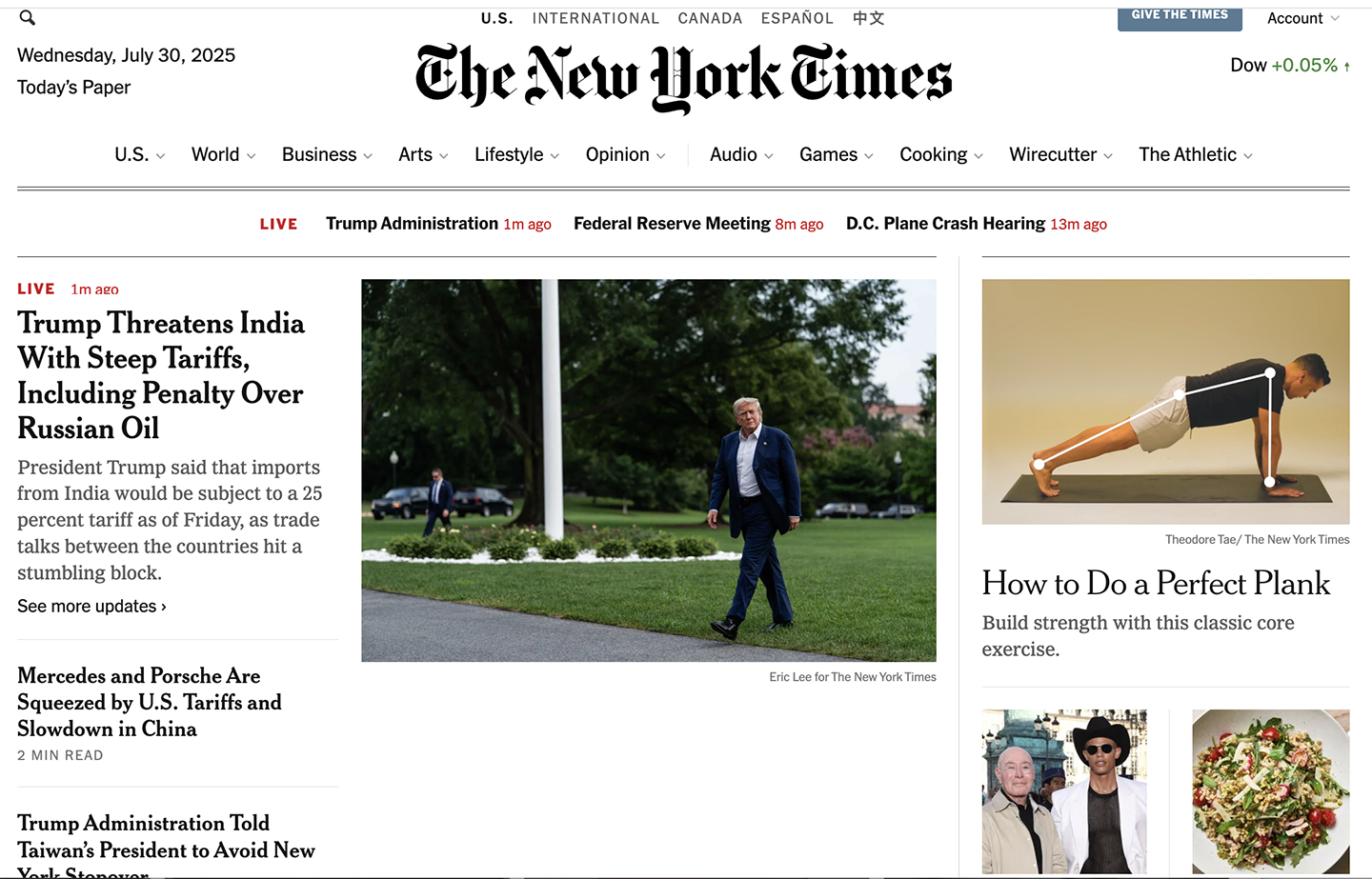
Since the image of the shooting story as it dominated the NYT app yesterday morning is gone, here’s a lesser example of it — the tariffs story currently at the top of the browser version of the Times:
You’ll see examples of what I’m talking about in the shooting case — the incoherent item labeled LIVE in red, and below it the sidebars, the related stories. It’s not a great example because it’s a calmer story; it hasn’t caused the paper to send every reporter all over Manhattan trying to discover what the hell is happening on the park. So it doesn’t lead with a breathless paragraph about the latest minor fact to slip out of a source during a press conference. It even has a nice lede-like summary at the top of it.
But it shows the typical layout. And here is the latest version of the “LIVE” story of the shooting, which now is much calmer than it was yesterday morning. But you see the pointless structure for anyone with limited time — the latest developments, rather than a summary of the important points.
Anyway, with the shooting story, I was more motivated than usual to get to the fundamental facts, because two of my grandchildren were staying with friends in Manhattan. Turning away from the mess in the NYT, I texted my daughter, their mother, who told me that their hosts lived a good distance away. That was reassuring. Not so reassuring was the fact that their daily routine up there took them right by where the shooting happened. But they were fine, thanks be to God.
Meanwhile, I had turned to the sidebars, in search of news. And I found a perfect illustration of the “say-nothing headline:”
After that, it was kind of like a real news story, except for being broken up by subheds into chunks, instead of rationally assembled in inverted pyramid. Subheds like “What happened?” and “Who were the victims?” and “Who was the gunman?” Note how the subheds also conform to the “say nothing” principle.
It was only by accident that later in the day, I happened to run across a real news story about the shooting, with a real headline, in The New York Times. I wasn’t looking for news. I had clicked on the “SECTIONS” link on my app, as a quick way to get to the opinion content
What’s that I see? A real news story?
Look, right there next to Gwyneth Paltrow! A headline! Not a “say nothing” headline, but one that actually relates the essentials! Here’s the story, so you can judge for yourself:
Presumably, lots of people had managed to find it, or else it wouldn’t have made the “Most Popular” category. But how? I had been looking at both the app and the browser version of the paper, and had seen not a hint of it — at least, not at the times I was looking. All I can guess is that people weren’t looking at the digital version of the “newspaper” at all, but coming in by direct links from social media.
Still, I was glad to see it. It was like discovering an old friend I had thought was dead. Of course, the headline was a bit long, because headline writers today are no longer restricted by limited space. I would have said something more like “Gunman kills four, self, in New York.” You could cram that into a one-column, three-deck format if necessary. It was good that they got the police officer in, though.
I was curious to see what they had done in the print version, under those restricted conditions, but I ran into another depressing fact about newspapers today. Here’s the front of that morning’s paper. If you click on that, don’t bother searching for the story; it isn’t there.
The shooting broke at 6:28 p.m. on Tuesday. But people who bought a paper the next morning wouldn’t see a word about it. That’s because putting out a print version is today an afterthought, something for those few doddering ancients (as opposed to with-it 71-year-old youths like me) who still demand a dead-tree paper. And, to save some of the ungodly cost of producing such a product (that insane $4 rack price doesn’t cover it, folks), the paper rolls off the presses at a stunningly early hour. (Maybe not “stunningly” to i, but to a guy who spent all those years working until 2 a.m. getting out the city edition containing the very latest, it’s unreal.)
(By the way, I currently subscribe to six newspapers, and read them all on my iPad. I’m not going to deal with frustration, not to mention expense, of having a hard copy delivered to my house, just so I can see what happened two days earlier.)
Anyway, as a postscript… of course, the story leads today’s print version. But it now has a second-day, or perhaps I should say third-day, headline. It was still worth four columns, giving more room than the usual one-column lede in the NYT.
Bottom line, as a reader who subscribes to six newspapers, I don’t think it’s too much to expect at least one of them to show me, at the top of its homepage, what I most want to know about the biggest news of the day. But that’s not what the business is about any more…
I don’t go see many movies in theaters. There was a time when I went to pretty much all of them, back when I was a copyeditor in Tennessee and was the paper’s film critic on the side. I wasn’t paid to do that additional work, but it wasn’t really work to me. Besides, the paper made it more than worthwhile by reimbursing me for the tickets. Not that the tickets cost much then. Fact is, I probably would have done it without the reimbursement. If, in my continuing project of cleaning out the garage, I run across a copy of my 1977 review of “Star Wars,” I’ll show to you. But I’ve promised to show it to my kids first.
Now, when I do go to a movie theater — once a year or so — I feel the need to take out a mortgage, to spread the payments out in easy installments. First, there’s the cost to get in. Of course, I can get the senior discount, but that discount is so inconsequential that the difference between that and full price is no more than the cost of a ticket in my youth. But hey, that’s just inflation over time, right? If you go to the CPI calculator, you’ll see that that the cost is about the same. Bu if you want to experience highway robbery, try to get some popcorn and a drink.
And no, the fancy recliner seats with the gigantic cupholders, arranged stadium-style, aren’t worth all that extra cost. I find myself wondering why, after the trauma of COVID and the ongoing existential threat posed by streaming and gigantic 4K screens at home, theaters didn’t go the other way — rock-bottom prices to sit on wooden benches or something. My buddy Tony and I used to go to a theater like that in Ecuador when we were about 10 to see Italian Hercules movies and “The Three Musketeers” in French (with Spanish subtitles, in case we wanted to follow the dialogue). It cost us 40 centavos to get in, which in those days amounted to about 2 cents American. And we loved it. A Coke — in a bottle — cost another 2 cents.
About now, I should start getting to my point, which is that my son who is an avid collector of Marvel comics and I were planning to see the new Fantastic Four when it comes out this Friday. (Or a few days later. You’re kind of crazy to go on opening night.) Even though we had just been to see the new Superman a couple of weeks back!
But then I found that “Happy Gilmore 2” was coming out on the same day — July 25! So what was I going to do?
OK, a word about “Happy Gilmore.” Of course, the original flick was overwhelmingly silly. But it worked! I’ve got this thing about movies (and books and other things) that work. They might be the stupidest plots acted out by actors I would never go to see under normal circumstances. But if, somehow, everthing clicks, I will watch it again and again. “Happy Gilmore” is a perfect example. “Old School” is another. They sound so stupid that you’re put off just hearing about them. But the actors — and director — take that stupid idea and make it brilliant. At least, that’s the way I reacted to it. I don’t think I’ve ever done a “Top Five Sports Comedies” list yet, but “Happy” would definitely be on it. In fact, it would be competing with “Major League” for the top spot.
And yeah, I know about sequels made 30 years after the original. They’re often sad — like that made-for-TV reunion movie for “The Beverly Hillbillies” in 1981. Buddy Ebsen had forgotten how to be Jed Clampett! But I’m not expecting brilliance — just a little bit of fun nostalgia. And I know for a fact that “Shooter” McGavin will appear!
But shell out money for a third theater visit in a year?
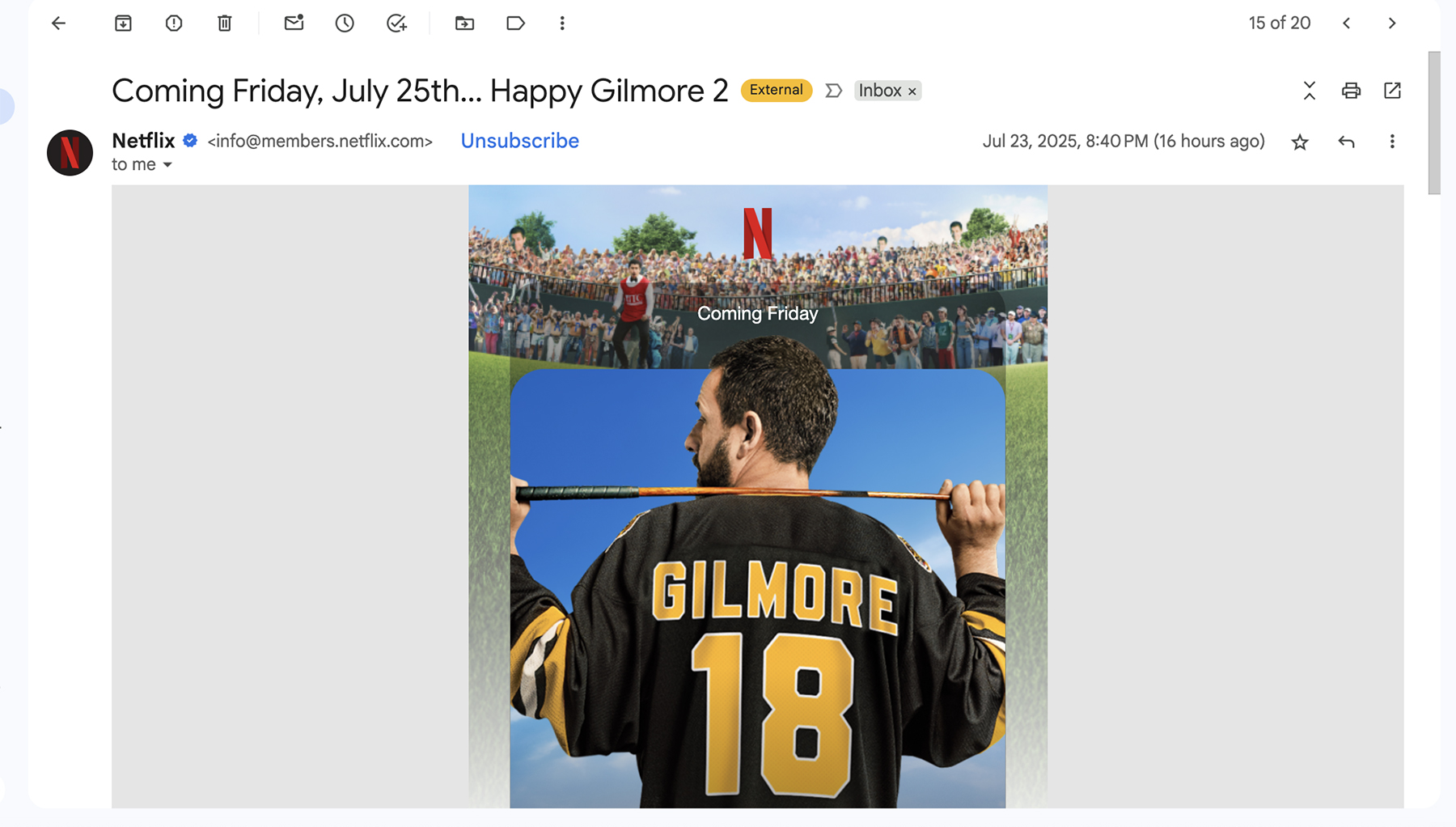
So imagine my joy when I got an email today from Netflix telling me it will be streaming “Happy Gilmore 2” starting Friday! I was already thinking I might wait for it to be streamed for free at home, and now I don’t have to wait! (Oh, and it had better be “free” to subscribers! They’d better not use this occasion to usher in a new class of premium “world premieres” or some such thieving gimmick!)
Well, I’m happy, and looking forward to Happy 2.
I wonder — how much longer will actual movie theaters continue to exist? The business model seems almost entirely unworkable now…
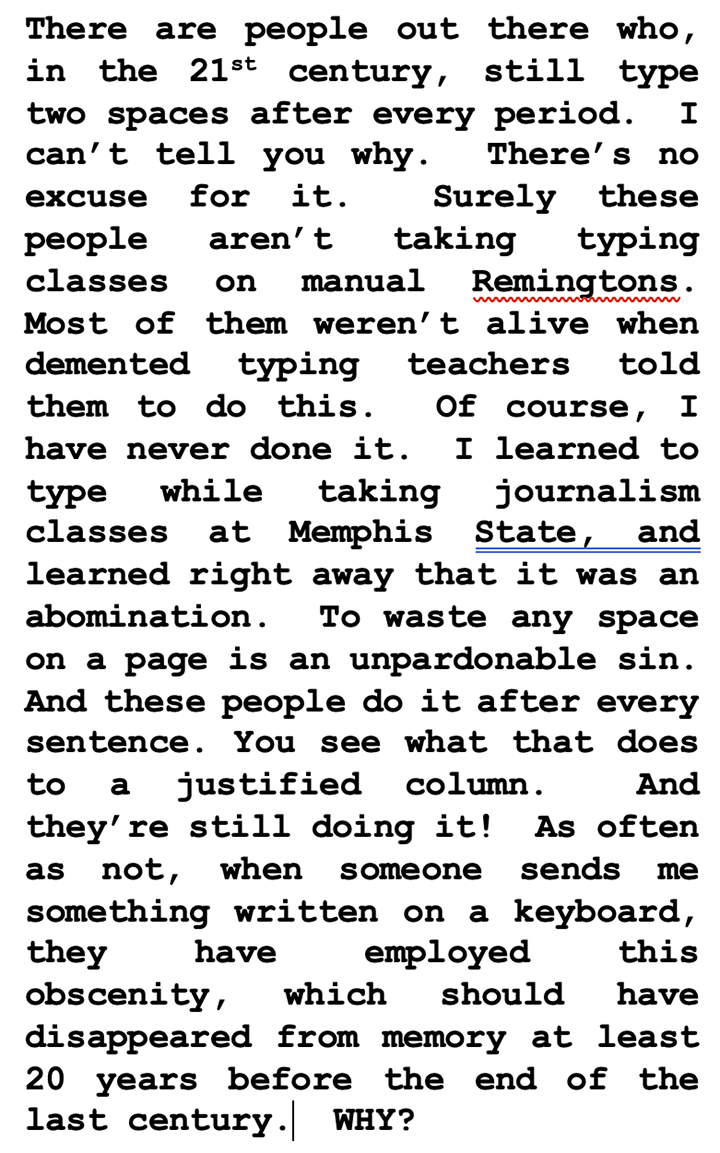
In modern writing, it’s standard to use one space after a period at the end of a sentence, not two. While two spaces were common with typewriters due to their monospaced fonts, computers and proportional fonts have made a single space the preferred and recommended style.
But could that really have been the actual reason? Could people really not see that, when a period appeared — and had a space after it — and the next word was capitalized, the old sentence had ended, and a new one begun?
Of course, I realized, as soon as I typed “and the next word was capitalized,” that a huge portion of the American population (practically everyone who had not been brought up on AP style) capitalizes words at random — which is another form of insanity, to be dealt with another day.
But let’s say that was the reason. Why do people who weren’t alive back in the days of monospacing still do it?!?!?
Perhaps it’s because they’ve grown up in the utterly undisciplined online era, which has no limits whatsoever. You can type all day for the rest of your life, and never fill the available space. In fact, “space” is no longer a concept that defines the life of a writer.
But I was brought up right, and therefore have a semi-religious horror of wasting that precious resource. Or perhaps I should say I had it. Twenty years of blogging has undone me (or undun me). Now, I vomit forth words at a phenomenal rate (when I get around to posting), and feel little or no obligation to tidy up the mess. Back in the day, I spent half my “writing time” cutting what I had initially written, stream-of-consciousness-style, down to fit. Now, I just take the first step, and move on.
Not back then, though. Back then, a good journalist would embrace discipline, thinking “I must not kill any more trees than necessary!” Or more likely (and practically) thinking, “If I don’t cut this to the assigned length, some unfeeling monster on the copy desk will slash it in the middle of my very best sentence, and toss what follows it into the composing room trash bin!” (Which has happened to me.)
But you don’t have to be a journalist who remembers having to shout over the noise of the linotype machines to see that the double-space thing is wrong. Google’s AI feature didn’t exist until last year, and yet it clearly states that “In modern writing, it’s standard to use one space after a period at the end of a sentence, not two.”
Well, I could go on, and probably would, except that I want to get back to my original question:
Why do people still do this? I’d really like to know. It’s one of those human pathologies in which a take a morbid interest…
Well, today is the day (as you know I love to tell people over and over) that was supposed to be forever cherished as our national Day of Independence. That’s what John Adams expected, and predicted at the time, because that was the day that the Second Continental Congress actually voted to separate these 13 states from the British Empire.
What happened two days later was everybody lined up and signed a piece of paper saying so. And sure, you can call that Independence Day, too, for that very reason. No argument about that. But Adams has always been my favorite Founder, so this date causes me to want to stress his achievement, which was more significant than what Thomas Jefferson did. And yet everyone associates this big move with ol’ Tom. It’s almost like his personal holiday. But come on, people. Jefferson never opened his mouth during those weeks that Adams harangued the Congress so furiously to get them to step off and make the decision. Jefferson wrote the hard-copy version because Adams persuaded him to, because he admired the Virginian’s ability to turn a phrase (and also thought it would help that Jefferson was way more popular in the Congress than he was, since Tom didn’t make such an effort to tick everybody off), and he did it not alone, but as a member of a committee including Adams, Ben Franklin and a couple of other guys.
And I’m afraid that far too many of my favorites Americans, when they think about something beyond hot dogs and fireworks at all, think of the Declaration as somethign that genius Thomas Jefferson dreamed up on his own in his hotel room in Philadelphia, and then unveiled to the whole world’s enduring admiration and gratitude. Or something like that. Which isn’t right, and doesn’t give credit where due. Y’all know that no one respects a well-turned phrase more than I, but Independence was the result of more strenuous efforts than applying quill to paper.
I could go on, but now I’m going to switch to the subject of popular music….
I’ve been sort of halfway following a newsletter feature in The New York Times called The Amplifier. Well, “follow” is a bit strong. Basically, I sometimes look at the song lists they regularly email me, and have frequently been impressed by the selections I find. These folks are widely knowledgable, and you can’t pigeonhole them. They’re neither desperately trying to convince us that pop music in the 21st century is seriously wonderful, nor stuck in 1973 and telling us that all music has been crap since Lester Bangs died, if not earlier. They have a much broader perspective.
… so I thought I’d share that with you for your enjoyment, or serious appreciation, or whatever.
I gave you the link for that list above, and I hope it works for you. If not, these are the songs:
Tracy Chapman: ‘Talkin’ Bout a Revolution’
The Isley Brothers: ‘Fight the Power, Pts. 1 and 2’
Public Enemy: ‘Fight the Power’
Michael Franti & Spearhead: ‘Yell Fire!’
Bob Marley & the Wailers: ‘Get Up, Stand Up’
Mavis Staples: ‘Eyes on the Prize’
Patti Smith: ‘People Have the Power’
Björk: ‘Declare Independence’
Rage Against the Machine: ‘Know Your Enemy’
Antibalas: ‘Uprising’
I looked at the list eagerly, having enjoyed past ones, but then I realized something… As much as a lot of people may dig those songs, they’re not really in my wheelhouse, to my knowledge. I haven’t even heard a bunch of them, but that’s beside my point.
My point is that as an Independence Day list, well, it really doesn’t work. But don’t blame the NYT folks. As much as I love American pop music, and have since “Hound Dog,” it’s just not the medium for addressing the American Revolution. Pimply-faced outcries against the Man are certainly within the reach of pop music, but that’s not what this country’s revolution was.
If you even want to call it a “revolution,” which I tend to doubt. You want a revolution? You want something that fits the tone of these kinds of songs? Well, the French had one of those, perhaps the ultimate one. And now that they’re on their Fifth Republic, I’m still not sure think they ever got over the trauma of it. The Russians, in their way, had one, too, and Vladimir Putin still isn’t coping with it in a well-adjusted manner.
Not that I’m running down our own, or anything — certainly not in this first year of our 250th commemoration. No, the American Revolution was one of the most significant and positive developments in the political history of the human race, which is why I am so grief-stricken now as I watch what it produced, all those things I love, being so rudely, stupidly and cruelly dismantled.
What do I call it? Well, one way to describe it is as a parting of the ways between a unique new country that had come into being and the country that had fostered it. This was not about oppressed people (paying taxes on tea? call that oppression?) rising up to destroy the established order, murder the royal family, obliterate religion, and that other sort of carrying-on we’ve seen elsewhere.
And it certainly wasn’t some class uprising by the sans cullotes against the rich and powerful. If you look carefully, the same people, in terms of social class or property or education levels, were in charge after independence as before. People of all classes took part, on both sides. But the guys who initiated and led this were people who knew how to run a city or colony or country (or a business, for that matter), and had been doing it in the past. Which, all the noble (and they are noble) words about freedom aside, is one of the very biggest reasons why our republic worked so well until very recently.
No. Our “revolution” was about serious people who had followed their fathers and grandfathers in building a new kind of country in what was to them (although not to, say, the Hurons) a New World. And they were pretty satisfied with what they’d built, and wanted it to continue. They saw themselves as Englishmen, but they were getting the strong impression that the British Crown didn’t really get them any more, and didn’t fully appreciate what they had become, and how they deserved to run it themselves without increasingly pesky interference from London.
Well, KIng George wasn’t going to go for that — certainly not after having expended all that treasure to protect the colonies from the French a few years earlier, as any Tory could have explained to you at the time. So yeah, there had to be a rupture, a ripping-away of the ties that bound. And eventually, starting a year before the Declaration (which continues to make me very uncomfortable, as I’ll explain again if you need me to), there was a very serious war. A particularly nasty war if you were down here in South Carolina (and elsewhere) — not a simple ones-and-zeroes matter of Patriots vs., Redcoats, but bloody, fratricidal violence between people who lived side-by-side. And (with the help of the French, of course), that war had an astounding outcome, with the world’s great superpower losing to a bunch of farmers, lawyers, shopkeepers and the like with a minimal amount of military expertise.
And the world was never the same again, and in so many ways, I thank God for that.
But “revolution?” In the French sense? In the sense of someone with such a pimply moniker as Rage Against the Machine? No. I don’t think so. It was something far bigger, far more important to human history.
But as I’ve probably also said before many times, I do have a favorite rock song about revolution. When the 45 came out, it seemed that the juke box in the cafeteria of Robinson High School in Tampa was broken. Whenever I was in there, whenever I walked by, I would hear the sweet sound of “Hey, Jude.” Which was wonderful because it’s truly one of the greats, and I love it.
However, I was frustrated because I didn’t think I was hearing the flip side nearly enough, certainly not as much as the tune deserved. So after the bus took me back home to MacDill Air Force Base after school, I made a habit for awhile of walking over over to “the Wherry.” That was a small building a couple of blocks from our apartment that contained two things — a sort of convenience store run by the Base Exchange, and a tiny snack bar where airmen, dependents and such could stop in to order a burger or hot dog or whatever.
And this snack bar had a juke box, which was very well stocked (I can’t remeber all the tunes, but I remember being impressed perusing the choices). At that time of the day the place was pretty empty, but I’d plug in my change and sit and listen to that song, which rang out with all the raw energy of its title. And then do it again. And again.
Mind you, it wouldn’t be all that long before I outgrew thinking John Lennon was a particularly wise political analyst (“Imagine” was a beautiful song, but the lyrics were vapid, which I realize I say in contradiction to wide and fervent popular opinion), but I always thought that he — in his instinctive cynicism — pretty much had the more fiery, self-righteous sort of revolutionary pegged. And he wasn’t buying. I mean people like John Adams’ cousin Samuel, or Robespierre, or certain adolescents who knew little beyond three guitar chords, but felt passionately. In this song, his was the more reflective attitude that there was a lot to consider beyond the romantic notion that revolution, per se, is necessarily a good idea, much less the perfect solution that its enthusiasts so fervently imagine:
You say you want a revolution, well, you know
We all wanna change the world
You tell me that it’s evolution, well, you know
We all wanna change the world…
But when you talk about destruction
Don’t you know that you can count me out?
You say you got a real solution, well, you know
We’d all love to see the plan
You ask me for a contribution, well, you know
We’re all doin’ what we can…
But if you want money for people with minds that hate
All I can tell you is, brother, you have to wait…
But if you go carryin’ pictures of Chairman Mao
You ain’t gonna make it with anyone anyhow…
Hey, let’s put in a quarter and listen to it AGAIN…
Yeah, I know this is a couple of days late, but when the heat was at its peak, I didn’t feel like writing about it. It had to get a little cooler first.
A week or two back I was at the beach, and since the Surfside Beach library is constantly getting rid of books, bless them, I picked up some they were selling for about three for a dollar, and one of them was The Day of the Jackal, by Frederick Forsyth. I’d never read it before. For the uninitiated, it’s fiction, but it’s based on (or perhaps I should say it opens with) a real-life attempt to kill Charles De Gaulle. Not one of those lone-gunman things, but a whole team of conspirators who hated him because he had given up control of Algeria. Really, they felt that strongly about it.
Anyway, I just started reading it last night, and was struck by a seemingly mild description of the weather on page 4, reproduced above. Note the key sentence: “Even at 7 in the evening of the hottest day of the year the temperature was still twenty-five degrees centigrade.”
I’ll wait a moment while you look up how “hot” that is in real temperature. When I did that, I learned that 25 degress C is 77 degrees F. I just now glanced at my phone and see that at 8:40 p.m., it’s 85 degrees here. And to my memory, this is the nicest day we’ve had this week. I’ve been out working in the yard, and am sitting here typing hoping to cool off a bit before showering. But Parisians were abandoning the city because on Aug. 22, 1962, it was 77 degrees and they couldn’t bear it. “Hottest day of the year.”
Maybe that was one of the fictional parts of the book. I hope so. Otherwise, we must believe one of two things: Human expectations have changed more dramatically than I had thought, because of global warming. Or, we must assume that when a character on the Simpsons called the French “cheese-eating surrender monkeys,” he was actually referring to their wimpiness regarding weather.
Alas, it’s likely the former. When we visited Boston in July 2022, it was delightfully cool in the mornings and evenings and nicely warm at midday, and it was even cooler in Amsterdam last summer. So you can still have nice weather, from a South Carolinian’s perspective, if you go way up north.
But a couple of days ago, it was 102 in Beantown. That same day, it was 100 in Philadelphia. (And last night when I started reading that book, my phone told me it was 78 in Paris in the wee hours of the morning. In June. So, way warmer than 1962, although not impressive to us.)
It wasn’t that hot here — 99 yesterday, I believe, and 98 the day before — but it was miserable enough. Inexplicably. My phone weather apps kept saying the “air quality” was fine, but for me, that was a lie. The Post and Courier was more honest than that a couple of days ago.., Of course, being an old newspaperman I may be prejudiced but for me, it’s been like trying to breathe green pea soup for about a week. Last week, I started having the first asthma trouble I’d had in a very long time. I started taking prednisone this week. I hate the side effects, but it’s got me breathing again. Still, I’ve been staying indoors, until today.
Today was nice. Really nice. I haven’t been sleeping much, thanks to the steroid, but when I got up this morning a little after 6, I didn’t mind. I started picking up branches that had fallen all over the yard, and when I found what I thought was a gumball tree that had come crashing down out back (actually, it was just a tree-sized branch of a huge one in my neighbor’s yard), I attacked it with relish. A brush saw, a pole saw, two pairs of loppers and a chainsaw, which I wore out. Had to order a new chain. Filled up the bed of my truck, and there’s enough left to fill it again after I haul it to the recycling center this weekend.
While I was working in the morning, it was about 73, I think. (My phone, to my great disappointment, never tells me was the weather was, it just makes predictions about the future, and doesn’t own up when they turn out to be wrong. Kind of like a lot of political writers.)
I hope you had a good day, too….
Edward Fox was the Jackal in the 1973 movie, which was odd. He’s usually a good guy, right?
Baseball wasn’t just always there for me, it was always there for my family. That’s my grandfather squatting to the right in this picture. He had been the captain of the team at Washington and Lee, and after college he was always playing on multiple teams in the Maryland suburbs of Washington. He only worked for the Post Office so he could play on this team. You’ll notice that others on the team played for other teams as well — they wore the wrong uniforms on picture day, without the Post Office ‘P.O.’
When I was a kid, baseball was always there.
It didn’t matter my age or where I was. As a preschooler, I always had one of those skinny little wooden bats that were later outlawed by the worrywarts. I think it came with those old solid rubber balls that didn’t bounce much, but since my Dad was a tennis champion, there were always cans full of balls around the house that really traveled when you hit them. I loved that, although Ring Lardner, the enemy of the “lively ball,” would likely have harrumphed.
When we lived in Ecuador from the time I was 9 until I was 11 and a half, I missed out on a lot of critical time for developing basketball and American football skills (which I regretted when I started 7th grade back in this country, in New Orleans), but I didn’t lose ground on baseball. We played it — or at least softball, at recess — whenever were weren’t playing fútbol (which is what we used the school’s concrete basketball court for).
My one regret was that I didn’t get to play Little League (on account of my family always traveling during baseball season) until I was 15, my last year of eligibility for Senior Little League (in Tampa). And by that time, I just hadn’t had the practice trying to hit a ball that someone was deliberately trying to throw past me. The point of “pitching” in sandlot play had always been to let somebody hit the ball, and put it in play. I did manage on one occasion that year to break up a no-hitter in the fifth inning, with a solid base hit to the opposite field. I couldn’t have hit it to left or center, because the red-headed southpaw I was up against had the sort of fastball that nightmares are made of. But I got my single, and they took that pitcher out of the game. It was my one, brief moment of baseball glory.
After that, I stuck to slow-pitch softball — in college intramurals, with the Knights of Columbus team in Jackson, Tenn., and with the Cosmic Ha-Has, a self-deprecating name for the loosely organized team of journos from The State (mostly), sponsored by the now-defunct Mousetrap restaurant and bar. That was more my speed, in the literal sense.
Now, I’m at an age when I’m finally ready to enjoy my sport vicariously. I’m ready to watch the games on TV, the way my elders did when I was a kid. Back then, even though we seldom lived in a place with the three basic channels (and sometimes only one, and that barely visible), baseball was always on the tube. And it was free. But at that age, I considered it boring to watch other people play a game — I wanted to go out and play it myself. Oh, I watched it sometimes, but I wasted a lot of time not watching it, back when it was so easy to find. My parent, grandparents, uncles and such got full enjoyment from it, but I was probably out in the heat whacking at a tennis ball — or inside reading a book. I was a mixed-up kid, right?
And then I grew older, and started wanting to watch it all the time, and it was gone. Especially if you’re like me and long ago cut the cord to cable. (Not being a consumer of TV ‘news,” I had little use for live broadcasting, other than baseball, which was too seldom on offer). Suddenly, even if you still consider it the national pasttime (the pasttime of the country that I love, anyway) you could find no evidence of it by turning on the tube.
You’ve heard me complain about this multiple times on the blog, but not lately. Because now, I have access to more baseball that my elders ever dreamed of, and on a 4k color flat screen rather than a snowy black-and-white that only worked if someone (often me) stood outside turning the antenna atop the house back and forth.
It started late last August, when I saw a promo from MLB.TV offering to let me watch the rest of the season — meaning 10 or twelve Big League games a day, for $29. It seemed worth it, and it was, even though “season” didn’t include the playoffs and World Series — which was OK, because those actually get shown on other platforms that were free to me.
A few months later, I thought a couple of times whether I ought to go in and quit that subscription to keep from being charged for the following season, which I figured would be a LOT more than $29. But I sorta kinda forgot to do it, accidentally on purpose, and next thing I knew, I was informed that $149.99 had already been taken from my account by MLB. Which was bad news. But they also told me I now had access to the whole MLB 2025 season, which was great news. I then confessed to my wife, who is responsible for handling money in this house (on account of being married to a doofus who does things like that), about my failure to prevent it from happening. But as I hoped, she didn’t make me go demand the money back, probably because she knows how much I’ve missed baseball.
I also pointed out that $150 was a lot less than it cost us to see one game at Fenway in 2022. Two seats in the right-field bleachers for about $200. That was just to get in; I paid extra for the peanuts and Crackerjack, and the Polish sausage I had for dinner. But we got to watch the Sox beat the Yankees that night, and beat them soundly! And we had either Jackie Bradley Jr. or Aaron Judge playing right field right in front of us! So it was worth it. But not something we could do every day, or perhaps ever again. Whereas with the MLB deal, I see baseball every day. So, you know, we’re saving money. You see why I don’t handle the accounts?
Anyway, it was and is really great news.
It’s been wonderful. It really has. I’ve loved it, and there’s far more there than I can ever hope to watch. I feel blessed by that. So I just watch a few teams, as I can — the Red Sox, the Phillies, the Dodgers and the Yankees, mostly. What I don’t watch is the Braves, which a few years ago I would have said was my favorite. I don’t say that now because I’m so out of touch with them that I’m not sure that I can name or picture any current players.
Why, you wonder, have I turned away from the Braves? I haven’t. They’ve turned away from me. Or rather, the MLB has separated us. All of their games are blacked out. I thought that at first they were doing that because I live so close to the ballpark. It’s only an 80-hour walk from my house, after all, according to Google Maps. But it’s more complicated than that. MLB also blacks out other games occasionally, ones that I might really, really want to watch — like the Sox playing the Yankees.
But I’m still having a great time. Alas, this is the first of a pair of posts on the subject of baseball, and the other will be less cheery, with the headline beginning “The bad news…”
That’s partly because of a piece I read in the NYT by Joon Lee, headlined “$4,785. That’s How Much It Costs to Be a Sports Fan Now.” It’s not just about the money, or the blackouts. It’s also about how the new business model of professional sports has destroyed the sense of community across the country. In other words, Mr. Lee takes a communitarian approach, as I would. More on that in a day or so…
A picture from our expensive bleacher seats in right field at Fenway. We had a great time.