An occasion worth celebrating, while still mourning

You can look upon the release of the Israeli hostages — that is, those still living after two years of unspeakable horror — with joy.

You can also note this moment grimly as you think of the dead, and the long recovery so many of the living hostages have ahead of them, if then even do return to any bearable form of future life. Trauma on this level tends to lead to lead to scars that never heal completely.

But here’s something of lesser note that at least celebrating without reservation, to some extent:

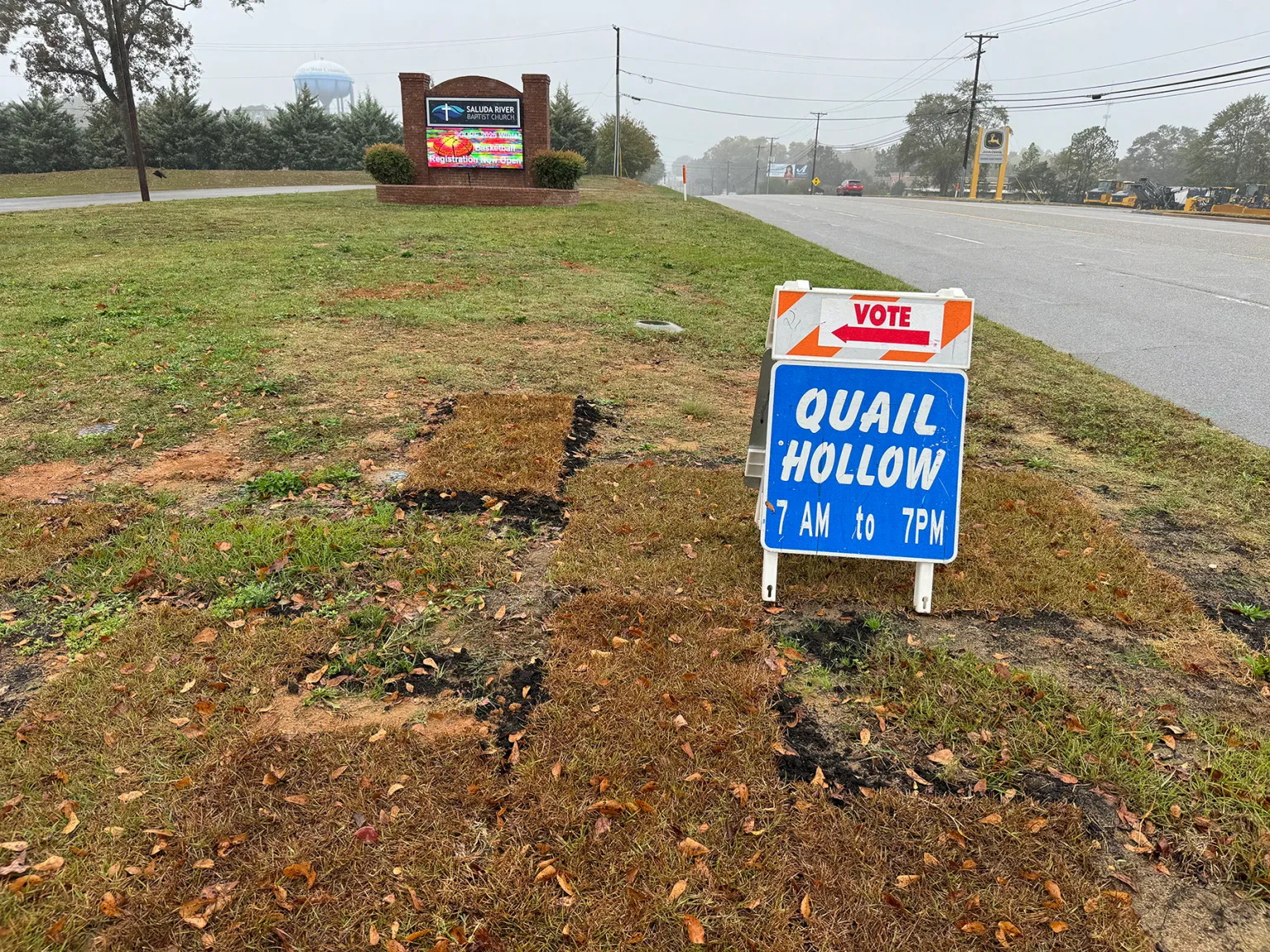
This bipartisan release isn’t at all surprising to me. It’s what I would expect. While there is a lot of partisan silliness to be sure (mostly, it seems, generated by the so-called “Freedom Caucus”), relations between Democrats and Republicans aren’t nearly so grossly dysfunctional in Columbia as they are in Washington.

But since bitterly divisive conflicts are what makes most of the political news that is thrown at you day after day, I thought I would share with you this note from two decent people who disagree about many things — one a Republican and Christian, one a Democrat and Jewish — but gladly come together over such things as this.

And look at that — I wrote a short post for once…

‘All right, y’all! Here we go again…’

I’m quoting Jack Ridley, as portrayed by Levon Helm, as he prepares to release Chuck Yeager way up in the thin air so he can pursue another speed record. It’s at the very beginning of the clip above.

That’s what came to mind when I saw that Ancestry was launching yet another rescrambling of my “ethnicity estimate.” Only this revamp was way beyond any we’d seen before, so much so that in recent days Ancestry’s been warning us about it — although in classic “You’re going to be so excited!” marketing lingo.

This was way more than the usual “you’re more Scottish than English/no, wait! You’re more English than Scottish” stuff. This was like entering a whole new dimension of perception. This was like Yeager having eaten too many peyote buttons out in the desert before going aloft.

For instance, there is no “England” any more. Alfred the Great might as well not have gone to all the trouble he had pulling it together. Now we have “Northern Wales and North West England,” “Southeastern England & Northwestern Europe” “North East England,” and even added altogether they don’t add up to “Central Scotland and Northern Ireland.”

Speaking of Alfred, it made more sense to speak in terms of “Mercia” and “Northumberland” and “Wessex.” At least you could find them on a map!

They even have a category called “Germans in Russia.” What’s that? A bunch who got left behind when Hitler’s boys skedaddled back from Leningrad? Some lost remnant of the Teutonic Knights? And when you try to find them on a map, they’re mostly out east of Ukraine (see the purple above).

About the clearest thing on the map is when they say I’m 3 percent Dutch. Yet they never said I was Dutch at all before I went and stayed in Amsterdam for a week or so last summer — like it rubs off on you or something.

Give me a break. Why don’t you take “Central Scotland” and make it a separate category from “Northern Ireland?” I mean, you’ve gotta cross the North Channel of the Irish Sea to get from one to the other! Yeah, I know, there’s this category we call “Scotch-Irish” that made such a trek centuries ago, but why don’t you just call it that, if that’s what you mean?

(This isn’t as weird as the “England and Northwestern Europe” category they’ve been pushing for years. You know what that means? It doesn’t mean “England plus France, Belgium, the Netherlands and maybe a big hunk of Germany.” It has meant “England and a tiny bit of France that’s more or less within walking distance of Calais” — although that has changed a bit from year to year. That used to describe it. Now it’s — well, it’s hard to describe.

But you know what? Instead of getting all upset with Ancestry, I’m going to assume the best of intentions. Y’all know how I’m always moaning about how sick I am of Identity Politics (most recently in my previous post)? Well, maybe this is Ancestry’s way to make sure I never fall into that trap myself. They don’t want me starting some kind of Scots-supremacy group. They don’t want me to start expressing my opinions by saying something like, “Here’s what I t’ink, speaking as a right-handed, heterosexual, near-sighted Irishman (to paraphrase Clint Eastwood in the middle of this clip).”

And I guess I should appreciate them looking out for me that way…


A finished column I never ran, 30 years ago

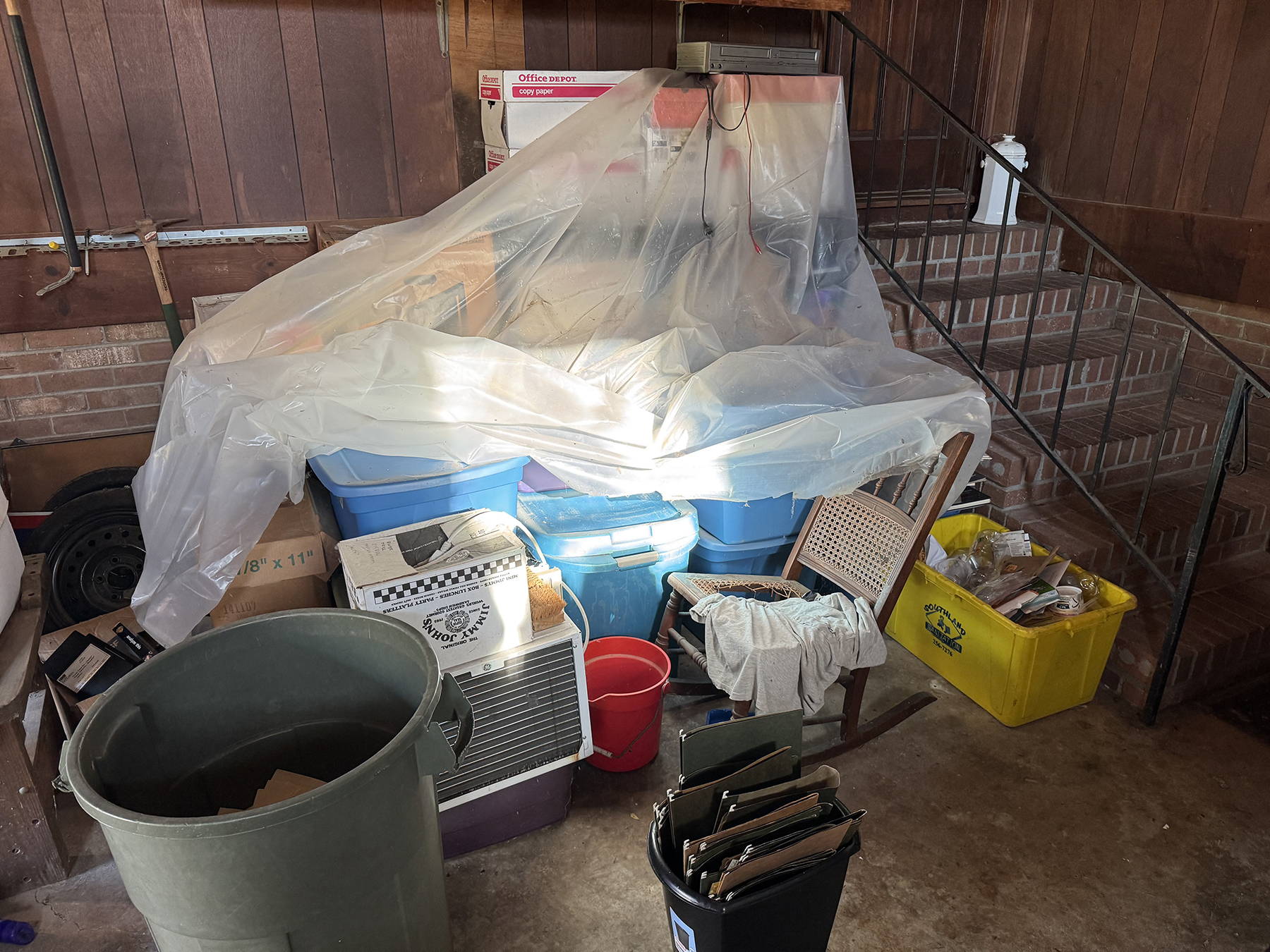
Here’s where I was in the project last November. I had already eliminated 11 boxes.

I found what you will see below last night, when I resumed the ongoing, off-and-on, project of cleaning out our two-car garage enough that I can at least park one vehicle in out of the weather.

The problem isn’t the household items one or another of our kids have stored there, or the tools accumulated over the years. The toughest category of clutter is the result of my own packrat tendencies — mostly, the boxes of paper and other items that I packed up and brought home with me when I left The State 16 years ago.

It was a huge mountain to begin with, taking me two full weeks of hauling home in the bed of my truck every night of those last two weeks. (I had a big office, but that was just the beginning. The editorial department had a roomful of filing cabinets almost entirely devoted to my files, and I had a box here and there in other locations. There wasn’t time to sort through it all; I just brought it home.) This is my third time sifting through it all. Each of the first two times, I reduced the pile somewhat. This time, I’ve been throwing away most of what I find. But occasionally, I open a box that’s harder to give up, and I have to make my way through it sheet by sheet, reading some of the letters, notes and such all the way to the end. Those I tend to keep.

I was particularly interested to find this one. I think I’ve mentioned it before, but couldn’t find it to post. I wrote a lot of columns in long draft form over the years that I ended up trashing. Sometimes I found the premise just didn’t work once I had developed it. But usually it was simply that a better idea emerged at the last minute, and I wrote and ran that instead.

But this is the only one I can remember actually completing and having ready to go, and then spiking even though I didn’t write another one to replace it with. I think maybe it was already on the page and I yanked it off and replaced it with a syndicated piece. But I’m not sure, now that 30 years have passed.

I wouldn’t have done that a year or two later. But this was very early in my time on the editorial board. I wasn’t the editor yet, or even an associate editor. This was less than two years after I left news for opinion writing, and I was just an editorial writer. And at that early stage, I couldn’t see publishing an opinion piece that didn’t offer a solution. All I was doing here was describing the problem, and that seemed incomplete. I though it was my duty to prescribe a cure.

I should have run it. It was a decent piece. It had its flaws that jump out at me now, such as that jarring, sudden switch from past to present tense in the fourth graf. But it was worth running, and I wish I had — especially since it identified a problem that at that time was just starting to tear the country apart. It hadn’t fully metasticized yet. If I had known then how bad things would get — it’s one of the things that led both to Trumpism and to the Democratic Party being completely unable to counter it — I would have run it and perhaps even campaigned (unsuccessfully, of course, due to the fundamental division between news and editorial) to have it placed on the front page.

At that time, we were already becoming a country that couldn’t pull together to solve problems. Oh, a few things came along later that harked back to the “we’re all in this together” spirit of the Second World War or LBJ’s extraordinary string of domestic policy victories in the middle ’60s — such as Teddy Kennedy initially supporting George W. Bush’s effort to add prescription coverage to Medicare, or the bipartisan successes Joe Biden had in Congress early in his all-too-brief time in the White House.

But mostly, we have hardened the divisions between “my group vs. your group” that would do our country in. Young people have never known a time when we were regularly able to see each other as fellow Americans and pull together in common cause. For older people, the memories are dimming. Sometimes the problem is simply the rapidly growing party division that started getting bad in the ’80s, and just got worse and worse each decade. Sometimes it’s the inexplicable cult of Trump. Other times, it’s about what this column was about — the growing power of identity, which has fed both of those other two problems.

Look at it either way — that my black colleagues in that gym were blinded by identity, or I was, as the white guy who couldn’t wrap my head around how they could possibly identify with that rich celebrity who had so little in common with them or me. Either way, I found the cognitive divide between my co-workers and me shocking. I thought it was a problem we needed to talk about. I should have run the column.

To place this unpublished column in time: The Simpson verdict was announced on October 3, 1995 — my 42nd birthday. When I left that gym, I showered, headed up to the third floor and wrote the column quickly enough for it to run in the next day’s paper. But it didn’t.

Here it is, as it came off the dot matrix printer, like so many other things I saved from those times:

Separated at birth? No, way BEFORE birth…

As a Superman fan from the Silver Age, I’ve always been kind of frustrated with the casting of some of the key characters in the movies. Especially Superman’s Pal, Jimmy Olsen.

The one on the TV show wasn’t TOO bad, but he could have been better. At least he had the costume right, and the attitude as well.

But the makers of the first movie got it all wrong. He acted the part OK, but he didn’t look right, and worse, FAR worse, they took the world’s most famous cub reporter and turned him into a photographer. Inexcusable. Nothing against photogs, mind you, but that not what Jimmy Olsen WAS!

From then on, things got no better. I can’t even remember the subsequent ones I’ve seen. I guess I’ve blocked them out.

But the long nightmare is over, if Hollywood would reach out NOW to New Zealand. In fact, now might be too late, since I’m seeing this guy on a show filmed in 2016. But check him out, anyway.

I’m talking about Nic Sampson, who played D.C. Sam Breen on the cop show “The Brokenwood Mysteries,” currently available on the PBS app. If he hasn’t aged too much since the third season I’m now watching, he’s perfect. Take a look:

So we’re all set, once we ditch the tie and suit, and put him in a bow-tie and sweater vest. And he can play the part. He’s the junior member of the detective (which the Kiwis pronounce “diTEECtive”) team, and his character has a definite cub-reporter feel about him. The other two main characters are sort of Clark (or a cross between Clark and Perry White) and Lois. (But alas, they don’t really look much like them.)

You doubt me? Then I refer you to the one, true version of Jimmy, that is, the Silver Age version:

Admittedly, according to the text on the cover, that’s not actually Jimmy himself, but his evil double. The real Jimmy is apparently trapped in a plastic box or something. I dunno, but a double’s a double, and Nic Sampson is definitely one of those. (Oops! I just read the cover again, and apparently the double is the one in the box, and the apparent bad guy is the REAL Jimmy. Oh, well, whatever. You get my point.)

It’s like the artist used him as a model for this cover. But that’s impossible, because this cover was published in 1965, and Nic Sampson wasn’t born yet until 1986!

Which is impressive. Maybe his mom read a lot of D.C. comics.

So that’s done and dusted. Anything else I can help you with, Hollywood?

Teague: South Carolina’s Election Commission: Troubled Waters

The Op-Ed Page

Lynn Teague
Guest Columnist

The South Carolina State Election Commission (SEC, not to be confused with anything athletic) has been in the news a lot in the past week, following the removal of Director Howard Knapp by a 3-2 vote of the commissioners last Wednesday. There had been reports of a SLED investigation involving Knapp, but no specific information.

Howard Knapp

This came during a period of uncertainty regarding the SEC’s response to the demands of the federal Department of Justice (DOJ) for our voter rolls, including sensitive personal information. The feds don’t have an impeccable record of data security of late, and this seems both not necessary (our rolls are already checked against federal databases to identify non-citizens and against multiple sources for other verifications) and a potential source of data exposure.

All of this has been further complicated by the firing of the Assistant Director of the SEC over a voice-activated recording device left, intentionally or not, in an SEC training and meeting room.

This turmoil has led to many questions. The first is whether voters should be panicked about what is happening, given elections that are coming soon. Should we panic about either the voting conditions or the integrity of the elections? This one is easy to answer.

Lynn Teague

We can expect the usual human glitches: the poll worker who forgets the key to the polling place and delays opening, the ballot marking device that won’t function, and similar technical problems. We should not expect anything else. At both the state and county levels, the people who make elections work on a day-to-day basis will continue to do the work that they know very well. They will conduct elections designed to count and report every vote, accurately. Furthermore, they will not be rudderless; they will be overseen by our bipartisan election commissioners.

However, this is followed by longer-term concerns. The privacy of our voter records is one of these. This issue is currently in court, in a case before Judge Daniel Coble in Columbia on 26 September. The data security issues around federal systems have already been mentioned.

In addition, it is here that the most important long-term issue arises: Is the South Carolina SEC the independent agency governed by appointed commissioners that we have believed that we have, or is it more vulnerable to political pressures? Commissioners are appointed by the governor, but during their terms cannot be removed except for cause. This is designed to insulate them from passing political storms.

We know that pressure from elected officlals is not unprecedented in the history of the SEC. The departure of the previous director, Marci Andino, followed some very angry comments from legislators who were disturbed by her letter suggesting an array of accommodations for voters during the pandemic. However, that what an exception to the history of the agency. On the whole, the South Carolina election management system contrasts markedly, and very favorably, with states where a partisan official oversees elections.

We should all hope that it stays that way, that South Carolina continues to preserve some measure of distance between partisan politics and the administration of what absolutely must be a non-partisan process, our elections. Politics today is highly adversarial and often becomes performance art, designed to get attention for the official or the official’s party rather than to achieve something substantive. Our elections should not be driven astray in those ugly winds.

Meanwhile, voters should check their registrations at scvotes.gov at least 30 days before elections. They should consult the League of Women Voters’ Vote411, where there is an abundance of election information, including candidate statements in their own words, not edited by anyone.

But after all that is done, we should hope that everyone will keep an eye on the General Assembly. The disturbances at the SEC are not a sound rationale for changing our election administration to one administered by partisan officials or in any way more vulnerable to manipulation. We should all be able to continue to vote with confidence that our votes are accurately tabulated and reported in a process that is not biased toward outcomes for one party or another (other than in redistricting, but that is another subject).

Lynn Teague is a retired archaeologist who works hard every day in public service. She is the legislative lobbyist for the South Carolina League of Women Voters.

Putting last night’s joyful win into perspective…

The celebration in the dugout when Yoshida brought in those two runs.

I’m still feeling the glow of last night, when the Boston Red Sox beat the New York Yankees in possibly the most intense game I’ve seen in my life between these ultimate rivals (I can’t compare it to the Summer of ’49, since I wasn’t around yet).

I was glad to have recently renewed my Boston Globe subscription (having dropped it back in August as a cost-saving measure, and immediately signed back on when they reached out to me with an offer that couldn’t been refused — they’re good at that). That meant that this morning I could relive it not only through an indepth main story about the game, but a sidebar about the man (Masataka Yoshida) who hit the single that pulled the Sox ahead after six innings of the Yankees leading, and a Dan Shaughnessy column about how the Sox’s left-handed ace (Garrett Crochet) dominated the Bronx titans for almost eight full innings.

That’s not counting that one homer Anthony Volpe hit off him in the second, which is what put the Yankees ahead for most of the game. This caused me to mull dark thoughts for several innings, fantasizing about banning home runs. I hate the things, anyway. They completely sidestep the game of baseball. Defenders have no chance to deal with them in any way, once the ball has left the bat. Baseball is about carefully balanced skills between players, not about standing there watching the ball go bye-bye. From now on, I almost tweeted (but was too engrossed in the game to bother), anything that goes over the fence should be no more than a ground-rule double — and the hitter should pay for the ball. (Yeah, I know the cost of one ball is nothing to these millionaires — and no one makes more than the big home-run hitters), but there’s a principle here.

Then, I forgot it all when Yoshida hit that beautiful single in the 7th and drove in Ceddanne Rafaela (my favorite player) and Nick Sogard — putting the Sox in the lead. Where they stayed. Note that, while they sometimes hit them, the Sox don’t need taters to win ball games — because they’re real baseball players.

Note that this happened in New York — where the second game of the series will be played tonight. And if the Sox don’t put it away tonight (and I worry about them doing it without Crochet), they’ll have to win again tomorrow. And all three games are played in New York, not in beloved Fenway.

Whoever wins the series goes on to face the Toronto Blue Jays in the AL East division championship.

But let’s not look ahead yet. Let’s look back, at Shaughnessy’s column yesterday morning, before the Sox won the first game. I almost posted it yesterday, but it’s just as good now. It’s important to share because — well, you know about how I love history, and mourn the fact that ignorance of history is destroying the country I love? Well, history is key to fully appreciating baseball. Here’s the column:

Red Sox-Yankees in the playoffs. Does it get any better than this?

Of course, the Globe needs subscribers to survive (which is why they keep offering me those deals), so they might not let you read it for free.

So I will provide you with enough of an excerpt for you to get the idea of why this thing happening in New York right now (and not in Fenway, in case I haven’t mentioned that) is so important:

Red Sox-Yankees. Again.

Do we need to educate the young’uns and remind everyone what this means?

Red Sox-Yankees is an all-timer. It’s Harvard vs. Yale, Kennedy vs. Nixon, Athens vs. Sparta.

It’s Ohio State-Michigan, Army-NavyTrump-Comey.

It is the ultimate American sports rivalry and we are getting it in the first round of baseball’s ever-expanding playoffs….

The relationship between these franchises goes back to Creation. The Boston Americans (hello, Red Sox) were part of the upstart American League in 1901 and the New York Highlanders (now the Yankees) joined them in the “Junior Circuit” two years later. Since that time, the two have walked hand-in-hand with history, usually at the painful expense of the Boston franchise.

The Red Sox won five of the first 15 World Series, then sold their soul in a Yankee swap when New York owner Jacob Ruppert swindled Boston owner Harry Frazee (a New Yorker with designs on Broadway shows), acquiring pitcher/outfielder George Herman “Babe” Ruth for $100,000 and a mortgage on Fenway Park.

The fallout from that hideous deal lasted 86 years. In that stretch, the Yankees won 26 World Series while the Red Sox won zero. Making matters worse, many of New York’s rings came at the expense of Boston. A three-time champ with the Red Sox, young Babe became the greatest player in baseball history, won four championships with the Yankees, then handed the Bronx baton to Lou Gehrig, who passed it on to Joe DiMaggio, Mickey Mantle, Derek Jeter, and today’s Ruthian Aaron Judge — 53 home runs, American League batting champ in 2025….

It goes on like that. You get the idea. It’s great, and educational.

I love baseball so much…

You know what? That was a blurry screenshot above. You should watch the full inning when it all turned around last night…

No, it’s not the funniest. It’s No. 7

Just a very quick note to correct something I ran across on YouTube while looking for something else.

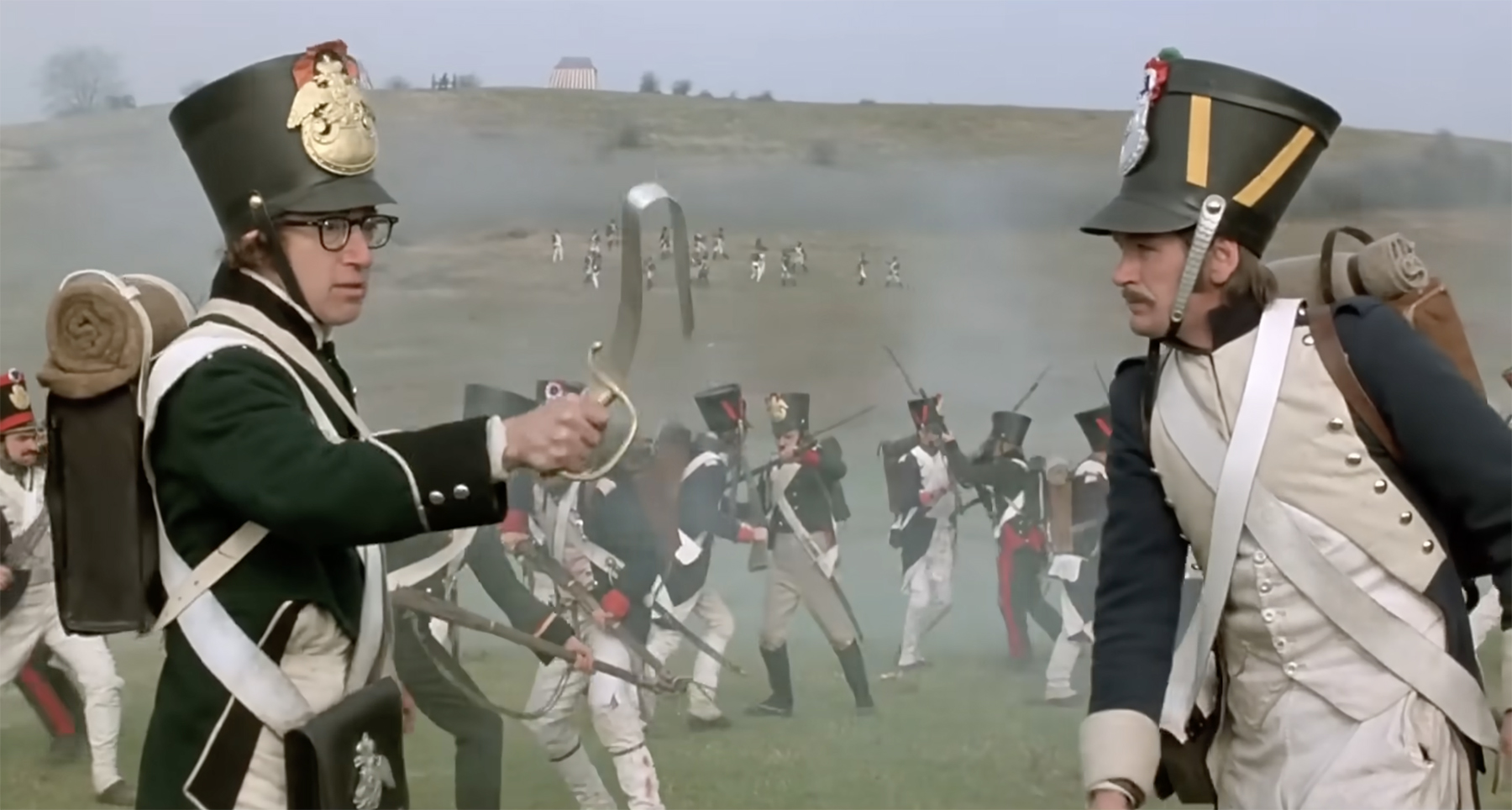
It claimed that Woody Allen’s “Love and Death” is “the funniest film of all time,” which it is not.

It’s Woody Allen’s funniest film, (“Bananas” is second, followed by “Play it Again, Sam”). It’s also, to stretch a point, the funniest comedy ever to lampoon uberserious Russian novels of the 19th century. But that’s all that can be said, except that in the larger category of best comic films of all time, it comes in at a respectable No. 7.

I won’t elaborate. I’ll just copy and paste what I wrote three years back (in a post in which I regretted having failed to put Howard Hawkes’ masterpiece “His Girl Friday” on my overall movie Top Five, although it made my Top Ten), and then we’ll move on:

  1. His Girl Friday — Yay, it’s at the top of the list! And deserves it.
  2. Young Frankenstein — Some would choose “Blazing Saddles.” I would not. Have you seen that one in the last few decades? It doesn’t hold up. This does.
  3. Ferris Bueller’s Day Off — I was looking at the AFI list of the supposed top 100 funniest movies in American cinema, and at No. 79 they had “The Freshman,” from 1925. Which I’ve never seen, but I did see “The Freshman” from 1990, and it was awesome. I mean, come on, Brando playing a guy who just happens to look like the Godfather? Still, it was not star Matthew Broderick’s best. Ferris was. And it didn’t even make this stupid list. Which is lame.
  4. This Is Spinal Tap — You can talk mockumentaries all day, but this is the granddaddy of them all, and the best ever. Because it goes to 11.
  5. Office Space — In a category by itself.
  6. My Man Godfrey — Another screwball comedy, but I think there’s room for this one and Friday both. It’s certainly different enough.
  7. Love and Death — Say what you will about Woody Allen (and there’s a good bit of creepy stuff to say), but I’ll paraphrase the fan from “Stardust Memories:” I really liked his early, funny ones. And the best of all was “Love and Death.” That’s what Tolstoy and Dostoevsky really needed — a few laughs.
  8. The Graduate — Yeah, this one is on my Top Five best ever. But it’s the only one of those to make this list. Yet I’m not sure it should be here. Was it really a comedy exactly? It’s the most category-defying of the truly great films.
  9. Groundhog Day — I had to get a Bill Murray in here, and I chose this one.
  10. The Paper — Initially, I had American Graffiti here. Or maybe Trading Places, which so brilliantly combined two Mark Twain stories, and two of his best. But I decided to end up where I started — with a film about newspapering that I could really identify with. Funny thing is, some serious journalists hated this film for some of the same factors that might cause someone to reject “Friday” — they were afraid it made us scribes look bad. But again, it was brutally dead-on caricature. Sure, we were more serious and principled that this. But I really, really identified with the Michael Keaton character, who at least had this going for him: He wasn’t as bad as Walter Burns, not by a long shot. Not as funny either, though…

I remain comfortable with those choices, although I hate that “Minions” didn’t make the list (I’m always torn on the last movie I pick). Maybe I should do a Top Five Animated Movies list…

Another point of view, which makes a strong point

In that last post, I quoted The New York Times citing a survey in which the Foundation for Individual Rights and Expression was involved. If you go to FIRE’s website, you will find an able argument that colleges should not fire faculty who, for instance, publish childish remarks about a murder.

Not that I argue they should necessarily be fired. But I do believe their behavior indicates the college was unwise in hiring them, and should do what it can to instill in them a sense of responsibility regarding what they choose to publish. Academics are expected to have deep respect for the power of publication. A snotty social media post written after a few too many for the entertainment of one’s friends is publication, on steroids. It will be instantaneously available to the whole planet, and it will be read by thousands or even millions of times as many people as viewed that thesis you agonized over so carefully — including your students.

Here’s that FIRE piece, which I urge you to read: You can’t fire your way to free speech.

It’s point, in essence, is that “When a college caves to outrage, it invites more censorship and sends the message that no speech is safe.”

That’s not the essay’s only point, but it’s the best one it makes, so I’m addressing that.

What that sentence says is entirely correct. It describes the current dysfunction of our society. Too often, we now do everything in anticipation to how others will react to it — and they far, far too often react irrationally, without carefully examining your good reasons for doing whatever you’ve done.

It’s just a perception problem, but it’s still a real one. Say you fire, or otherwise discipline, those faculty members.

The buffoons running for governor will be all puffed up and see that — in terms of the cheap things they value — they have “won,” and will proceed to step up the bullying.

Meanwhile, those who might otherwise defend the fired people will be cowed, and think they can’t express anything freely.

And then someone like ABC will suspend someone like Jimmy Kimmel, who is a professional smartass, paid and encouraged to say outrageous things, rather than a college professor. I haven’t seen anything yet that justifies such a move. (In fact, at some point last night or this morning, I saw some remarks by Kimmel in which he spoke against attitudes such as those expressed by the Clemson employees. But now I can’t find them. when I do, I’ll share that with you.)

And that action will snowball with terrible effect.

But these things — the emboldenment of GOP pols, the cowardice of other institutions, and other knee-jerk reactions — are the result of a central problem of politics in America at this point: Few people examine anything at a depth greater than a tweet, or, if they’re old-fashioned, a bumper sticker.

But you know what? Universities are supposed to be the antidote to that grotesque superficiality. They’re supposed to instill an ability and inclination to look deeply into things before drawing a conclusion. And even in these troubled times, they have an effect somewhat in keeping with that mission. For instance, in 2020, 56 percent of people who had never been to college voted for Trump, and only 41 percent for Biden.

Of course, that’s not enough. The ability of colleges to teach people to think carefully has obviously eroded when 32 percent of those with postgraduate degrees can justify voting for such a destructive candidate at Trump (although 67 of them went with Biden, so again, there is some salutary effect — the more education, the more thoughtful the voter).

(By the way, before one of you ones-and-zeroes folk points out I’m being partisan in the past two paragraphs, I refer you to everything I’ve ever written on Donald Trump. I am someone who voted for Bob Dole, George W. Bush, and John McCain, along with many other Republicans. But as I’ve explained over and over, there is a gigantic wall of logical and moral difference between Trump and everyone who has ever captured the nomination of either major party is in an entirely separate category from this most unworthy and grossly unsuitable man. A vote for him for any office, much less the most powerful one in the world, is intellectually and morally indefensible. Hence my use of those statistics.)

Nevertheless, within the walls of the academy, educators and their bosses should redouble their efforts to base their decisions on sound, well-grounded reasoning. If the administrators decide after careful discernment that they should dismiss someone who has done something wildly inconsistent with “sound, well-grounded reasoning,” they should act accordingly, and defend it with that same careful discernment that went into the decision.

Likewise, if they decide after such discernment to defend the faculty under attack, they should stand by that decision, and if necessary defend that decision with arguments far deeper than the twitch level. In other words, with statements deeper than social media and bumper stickers.

You should do that without regard to how shallowly millions of people will react.

Anyway, that’s what I think about FIRE’s strongest argument. As our friend Bryan would say, your mileage may vary.

All that really needed to be said about Kirk’s foul murder

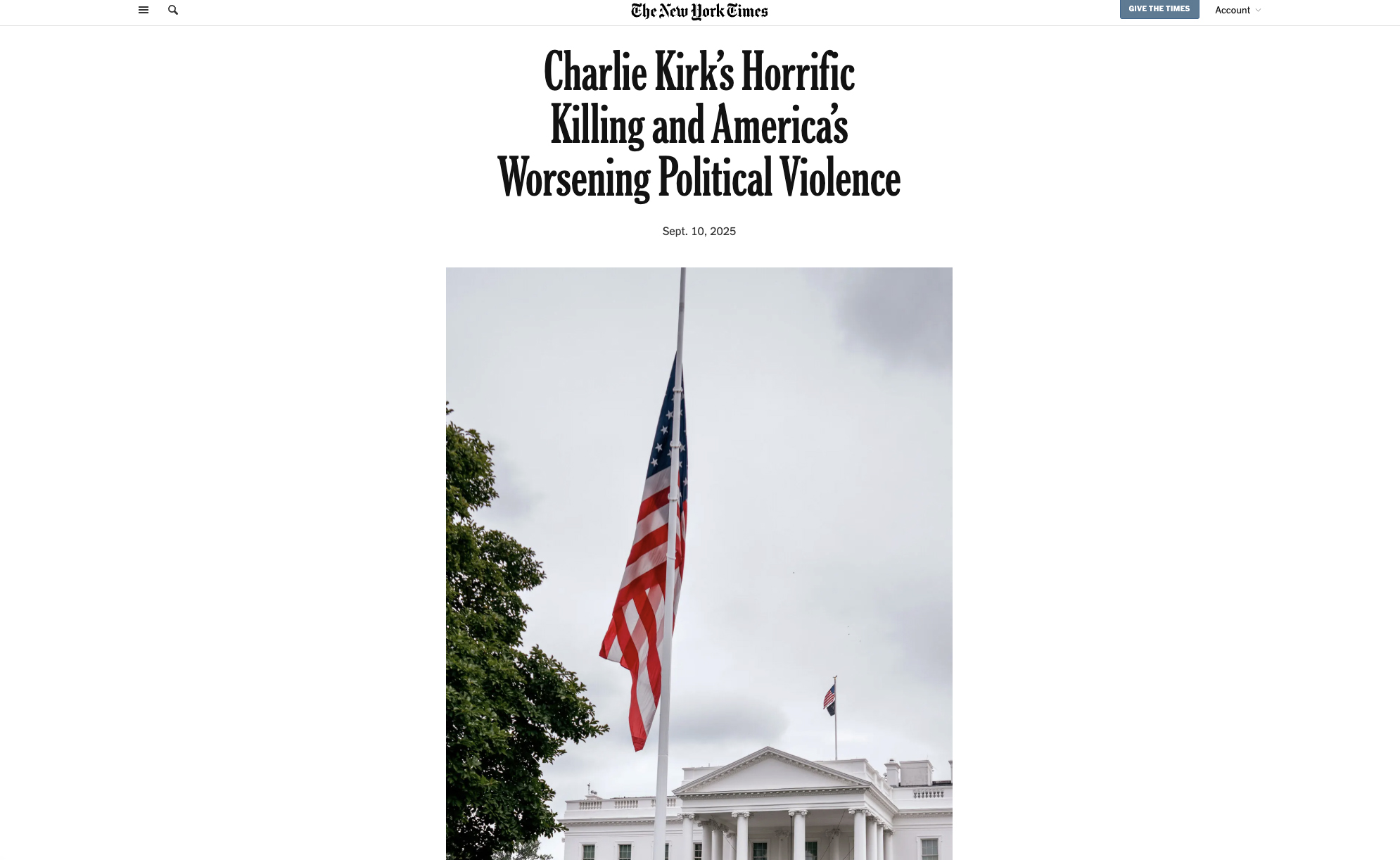
Screenshot

The evening of the day on which Charlie Kirk was murdered — a week ago today — I read an editorial about it in The New York Times that said everything that needed to be said about that appalling event.

Sorry to take so long posting it. The headline was “Charlie Kirk’s Horrific Killing and America’s Worsening Political Violence.” The link on that headline is one of those “gift” links the NYT offers, so you should be able to read it. Let me know if you can’t.

In the meantime, I’ll share some key paragraphs:

The assassination of Charlie Kirk — the founder of a youth political movement that helped revolutionize modern conservatism — at Utah Valley University on Wednesday is a tragedy. His killing is also part of a horrifying wave of political violence in America….

Such violence is antithetical to America. The First Amendment — the first for a reason — enshrines our rights to freedom of speech and expression. Our country is based on the principle that we must disagree peacefully. Our political disagreements may be intense and emotional, but they should never be violent. This balance requires restraint. Americans have to accept that their side will lose sometimes and that they may feel angry about their defeats. We cannot act on that anger with violence.

Too many Americans are abandoning this ideal. Thirty-four percent of college students recently said they supported using violence in some circumstances to stop a campus speech, according to a poll from the Foundation for Individual Rights and Expression published a day before the Kirk shooting. Since 2021, that share has risen from 24 percent, which was already unacceptably high. Surveys of older adults are similarly alarming….

The intensity of our political debates will not disappear. The stakes are too high, and the country disagrees on too many important questions. But we Americans have lost some of our grace and empathy in recent years. We too often wish ill on our political opponents. We act as if people’s worth is determined by whether they identify as a Republican or a Democrat. We dehumanize those with whom we differ….

That was the penultimate graf. Since I’ve quoted so much, I might as well give you the last one:

…This is a moment to turn down the volume and reflect on our political culture. It is a moment for restraint, rather than cycles of vengeance or the suspension of civil liberties, as some urged on Wednesday. It is also a moment to engage with people who have different views from our own. When societies lose the ability to argue peacefully and resort to violence to resolve their political debates, it usually ends very badly.

(When I read that editorial that night, I retweeted it with this comment: “NYT ably describes the violent tip of the iceberg of hostility that is sinking America. But we’re all too busy despising each other to bother trying to find a way to save our ship. “)

As for the excerpts above — if the NYT lawyers call, I’ll just have to ask them how much I have to cut to suit their definition of Fair Use. But I just thought it was too important not to share. It was a grown-up editorial. It seems to me to have been written by someone mature enough to remember when this country was healthy enough that we could disagree strongly and vehemently, and then shake hands and walk away as friends — or at least as people who recognized each other as fellow Americans, and not as “the enemy.”

Of course, maybe it was written by a younger member of the board. If so, we have someone to thank for providing that person with an excellent education, and a firm understanding of what made America great, before our country’s recent tragic decline.

Evidently the faculty members who were suspended from teaching at Clemson were not the kind who provide such intellectual enrichment. Their grotesque fulminations are an embarrassment to anyone with. conscience. Doubt me? Here are some quotes from their outbursts. If that link doesn’t work, I’ll be happy for you, because you’ll be happier for not having read them.

Should they have been fired for it? Let me pose a different question. Should people who would have deliberately published such remarks at such a time have been employed in the first place, in jobs that involve shaping young minds? Such irresponsibility is inexcusable. They weren’t courageously outspoken; they were stupid, cruel and hateful.

You would think that in an atmosphere in which more than a third of college students believe violence can be justified to stop speech they don’t like, anyone who teaches them would understand that their responsibility is to model productive speech and behavior. And the responsibility of college administrators is to make sure they hire people mature enough to understand that.

At this point in our increasingly ones-and-zeroes country, we will now start hearing the “what abouts.” What about those GOP politicians who have demanded their firings? Are you defending them?

Are you nuts? Those people are cheap opportunists, trying to make themselves heroes to an angry crowd. Or, worse, they’re trying to make a merely grieving crowd… angry. Stir things up. Because they seek higher office, and Donald Trump has taught them that the approach taken by every president before him — striving with all their mights to pull us together in troubled times by invoking the values we hold in common — is for chumps. You can win by feeding division, by pouring gasoline on the embers, he has taught them. And they’re acting upon those lessons.

Just as others have learned that if you post something stupidly inappropriate — the more hateful the better — on social media in response to any news event, there are thousands if not millions of people like them who will regard them as brave and witty, and clap them virtually upon their backs in congratulation. A certain needy type eats that sort of thing up.

Both categories are unacceptable in a rational society. But they are so richly rewarded — in the currencies that matter to them — that they just keep doing it.

One final word: If you actually believe that anything those disgraced faculty members said about Kirk was justified by his rhetoric, you are just as much a part of the problem as those hungry GOP pols.

Personally, I had never heard of Charlie Kirk before the news of his murder. But I went and looked at a couple of videos of him speaking. The entire thrust of what he said, even in the milder comments, was wrongheaded and objectionable to me. In others, he was utterly offensive. But all that was what I expected, since Trump is trying to canonize him. And all of it is beside my point.

Y’all know I don’t believe in capital punishment. But even if I did, I certainly wouldn’t support summarily executing a man for saying things that offended me. I could never support that. And I could never support or worse, applaud anyone who mocks a human being who has died that way.

Top Five Favorite Robert Redford Movies

Note that this is not “Top Five Best…”

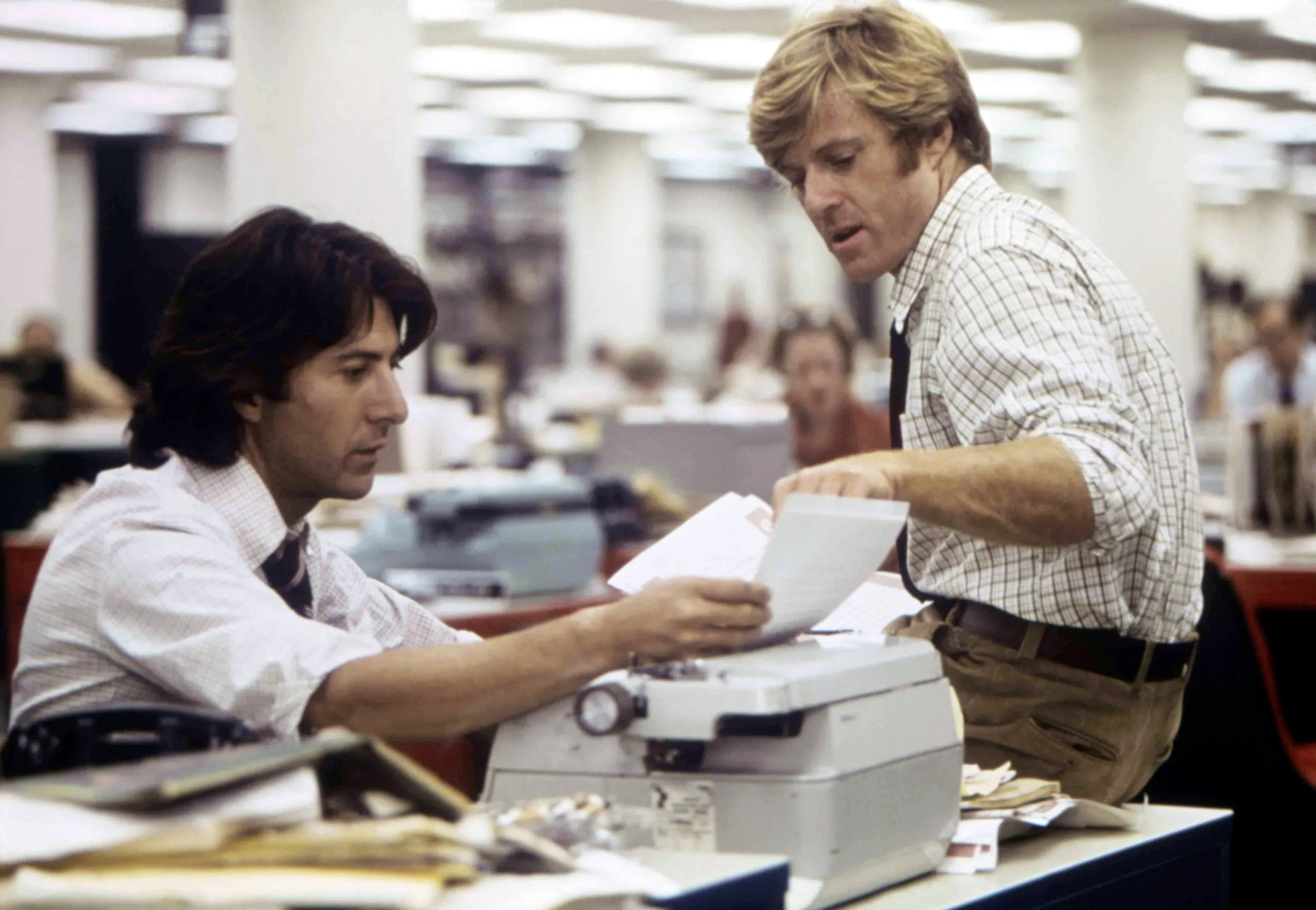
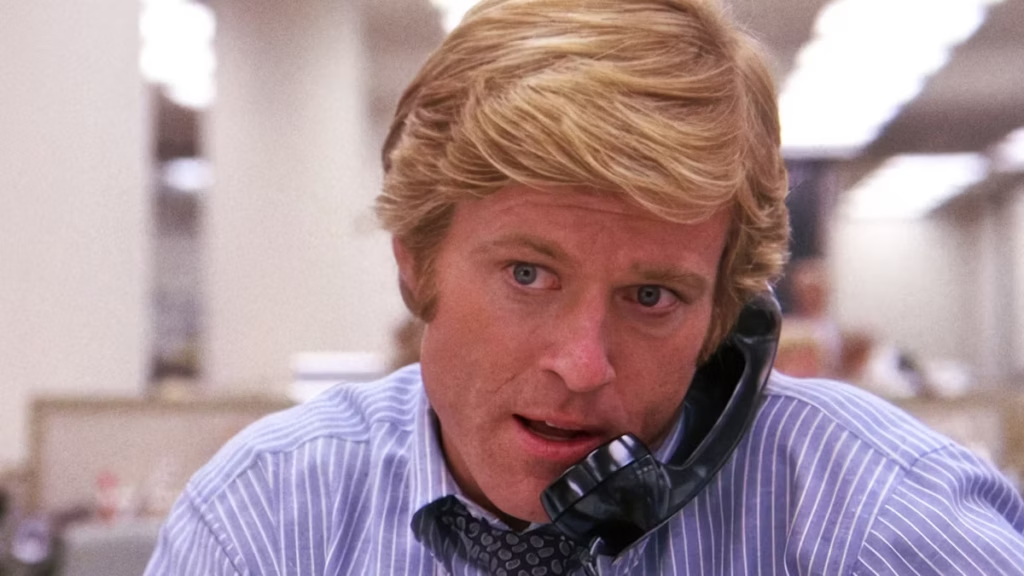
If it were that, the unquestioned winner would be “All the President’s Men.” I just watched it again recently, on Criterion. Every few years, I go back and watch it again, and every time, I’m more amazed at how much great it is. It’s the verisimilitude. Nobody’s trying to be cute, or sexy, or fun. It’s deadly realistic. The interviews conducted with people who really, really don’t want to be talking to these two reporters — the awkwardness of both the sources and the reporters themselves, polished stars that they were — is astounding. Other people like slick. I’m impressed by real.

But on this sad day, I thought I’d go with fun. What were the Redford flicks I enjoyed the most? Here they are:

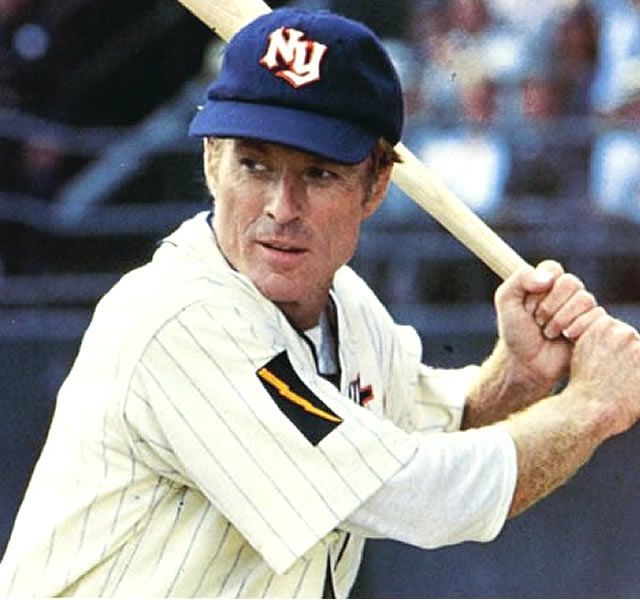
  1. The Natural — It’s only my third-fave sports flick, but it’s my favorite baseball movie (with “Major League” a close runner-up, I think), and you can’t say fairer than that.
  2. All The President’s Men — OK, so Roy Hobbs only knocked it down a notch, but that’s because my appreciation grows each time I see it. I gave it a very favorable review in my first job at a newspaper. But I like it even better now. It’s just not, you know, baseball.
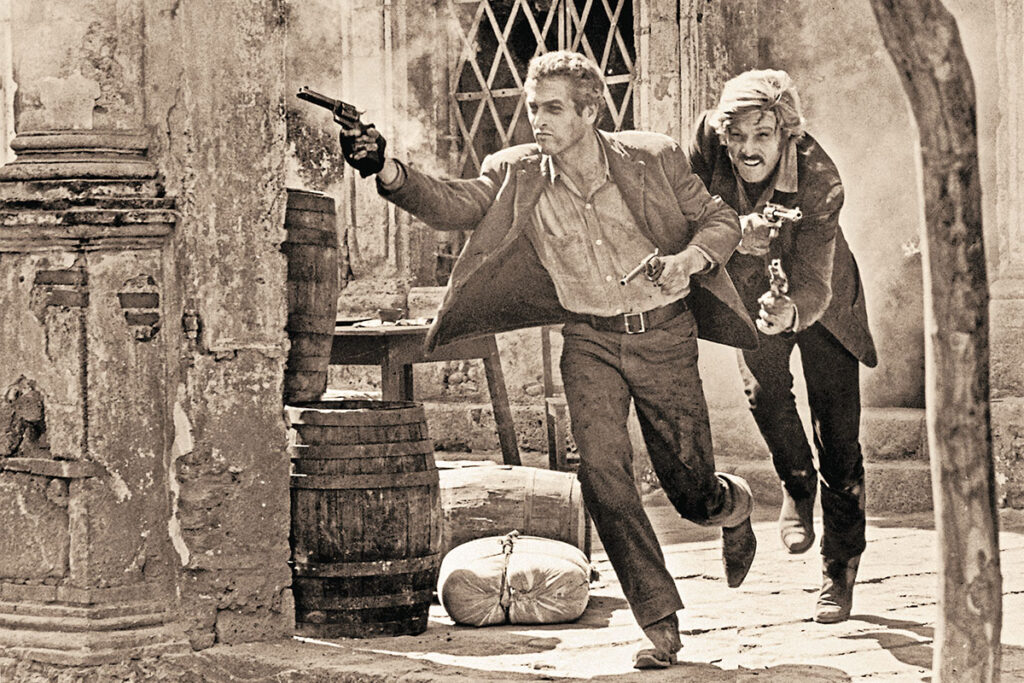
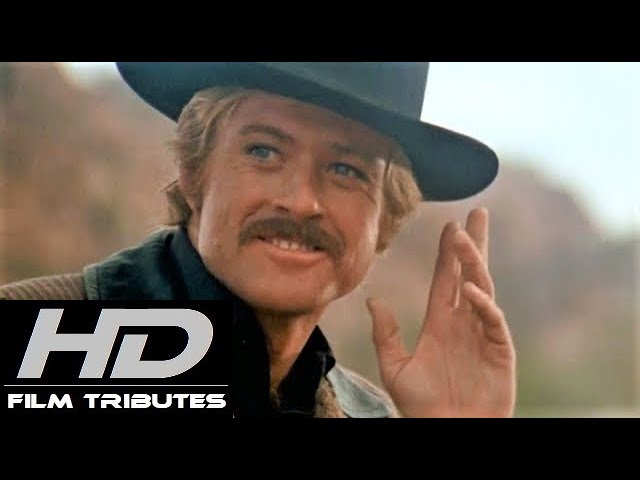
  3. Butch Cassidy and The Sundance Kid — When it came out, I loved it so much that I couldn’t imagine these actors doing anything to top it (and “The Sting” didn’t even match it, despite the obvious effort). So good. Of course, it was sort of a neo-Western, with that Burt Bacharach music. Something special.
  4. Three Days of the Condor — Generally, I’m not a huge fan of paranoia movies (“The CIA’s out to get me!”) But this one really worked. Part of that was Max von Sydow as the freelance assassin.
  5. The Candidate — This one’s less-known, but it was great. The story of a candidate who didn’t want to win — and how difficult it is to maintain such insouciance in the all-enveloping atmosphere of a campaign. And it had Peter Boyle in it, as the guy who enticed him into running.

Anyway, I think those are my faves. How about you?

Goodbye to the Kid

Robert Redford at (almost) 40.

This is the way time passes.

I had a shock glancing at the magazines at a store checkout back when I lived in New Orleans (OK, technically across the river in Algiers) when I was in junior high.

I saw a headline that said something like “PAUL NEWMAN TURNS 40!” I couldn’t believe it. This was 1965, and he had played Billy the Kid in 1958! He had been the young up-and-comer in “The Hustler” in 1961! So how could he be an old man now?

But sure enough, he was almost four years older than my Dad, so that’s getting on up there.

While I was still in high school, he portrayed Butch Cassidy alongside a guy young enough to pass as the Sundance Kid. Appropriately, Robert Redford was almost a dozen years younger. He’d been around for a bit, but playing Sundance was his big break, immediately making him a major star.

Which is interesting, looking back. Think of all the characters he played later in his huge career — Gatsby (which came out the year I got married, which is why I wore a three-piece white linen suit that day), Bob Woodward, Bill McKay (“The Candidate“), Jeremiah Johnson, Condor, Major Julian Cook (“A Bridge Too Far“), and Roy Hobbs.

He was always the straight man. So serious, hardly smiling. Kind of grim. I’m-just-hear-to-do-a-job- ma’am. When he reassures a source that he’s a Republican in “All the President’s Men,” Dustin Hoffman is suprised, but nobody else is — he looks the part. And would you ever call Jeremiah Johnson a fun guy?

By contrast the Kid was the coolest guy in the Hole-In-The-Wall Gang. Everybody was afraid of him, even Harvey. If it had been present-day, he’d have been the one in a leather jacket. He’s the one who got Katharine Ross!

Anyway, I’m sorry he’s gone, and shocked that he was 89. But I’ve noticed that a lot of people around me are getting old. Plenty of them are over 40 now.

It’s sobering.

As a senior in high school, I had this poster on my wall.

DeMarco: NPs and PAs should continue to be supervised by physicians

The Op-Ed Page

By Paul V. DeMarco
Guest Columnist

In 1993, as a new physician fresh from residency, I joined an internal medicine practice composed of three doctors and one physician assistant in Marion. The next year, one of the doctors left the practice and our call schedule went from every fourth to every third night. I was the father of two young children, and this sudden increase in my workload threatened to overwhelm me. I would have left the practice and probably the Pee Dee if we hadn’t hired another PA. She enabled me to remain living and practicing in Marion.

I tell you this to underscore how important physician assistants (PAs) and nurse practitioners (NPs), collectively known as advanced practice providers (APPs), are to the practice of medicine. In my 30-plus years of practice I have worked closely with six APPs in two different internal medicine practices. Practicing with them as colleagues has been a privilege and of great benefit to me and my patients.

However, despite my love and respect for APPs, I oppose the current bills in the SC Legislature that would allow them to practice independently (S 45 and H 3580). The bills would allow APPs to see patients independently after only a year (2,000 hours) of working with a physician.

I have a host of reasons for my opposition. I will offer two here. First, training matters. Medical school is more rigorous and almost twice as long (4 years vs. 2 to 2.5 years) than APP training. But the most important difference is clinical experience. NPs need only complete 500 hours of clinical training to satisfy their national governing body. The PA national minimum standard is higher, at 2,000 hours, which are divided into multiple rotations in different medical specialties. At best, a PA doing an internal medicine rotation might get 8 weeks (about 300 hours) of IM training. An NP would likely get even fewer hours.

In contrast, physicians come from a tradition in which training was so grueling that it had to be scaled back. I finished my residency in the early 1990s before the Accreditation Council for Graduate Medical Education put a work hours requirement in place. In those days, every other night call was allowed, which meant residents could work more than a hundred hours a week. In 2003, an 80 hours-a-week maximum was instituted. Even if we use a more conservative estimate of 60 hours a week for an IM resident, over a three-year residency internists begin practice with approximately 9,000 hours of clinical experience, 30 times as much as the best case for an APP. It is a deficit that is very difficult for an APP to make up.

It’s not only the hours, but the intensity of the training. Physician residency training is remarkable for its depth and breadth. In the first (intern) year, physicians are intimately involved in their patients’ care. We perform histories and physicals, order labs and imaging, and create differential diagnoses and treatment plans. As second- and third-year residents, we remain closely involved, but also supervise the interns. Experienced attending physicians make rounds mornings and sometimes evenings, do bedside teaching, and are available for advice, but the residents are entrusted with significant responsibility and are the patients’ primary doctors.

By the end of our residencies, we have managed a vast array of clinical problems in the office and the hospital, from the trivial to the life-threatening. An exhaustive residency is the best way to prevent knowledge gaps, which are a common source of medical errors. If a provider’s training is too short or too narrow, they may not be able to recognize a condition they have never seen.

Second, the primary argument for independent practice is that it will increase access for underserved patients. But these bills will not remedy that problem. In about half the states, APPs have independent practice authority, so there is a record to examine. But different lenses produce different conclusions. Nursing researchers have produced papers claiming that independent practice does increase patient access; unsurprisingly, data from American Medical Association refutes this, concluding that APPs tend to practice in the same areas as physicians.

Current state law allows APPs to work alone if the supervising physician is “readily available,” although that term is not defined. Specific requirements for supervising physicians’ distance (45 miles) and travel time (60 minutes) to APPs’ practice locations were eliminated in 2018. Many of these solo APPs are only lightly supervised. Eliminating supervision entirely is a step in the wrong direction. We need more collaboration with our APP colleagues, not less.

Given the demands of modern medical care, the likelihood that a private solo APP or even a small group APP practice could offer affordable care, generate acceptable revenue, and sustain bearable working conditions is low. Rural practice can be grueling and lonely, and the burnout rate is high.

The best option for APPs to offer this type of care is through a community health center like HopeHealth, where I have worked for the past 14 years. CHCs receive enhanced Medicaid reimbursement and can offer a sliding scale for uninsured patients. If they are like HopeHealth, they offer competitive salaries and benefits, strong leadership, and educational and social opportunities for all providers, physicians and APPs alike.

I urge the legislature to focus on incentivizing doctors and APPs to collaborate. APPs have rightly argued that not enough physicians are willing to work in rural areas. But there are still some of us who will. In SC, physicians can supervise up to six APPs, so a single willing physician could catalyze a large rural clinic, or several smaller ones. This model, in which the physician and APPs work together, sharing the burdens and rewards of caring for rural patients, is the best way forward.

A version of this column appeared in the August 20th edition of the Post and Courier-Pee Dee. Dr. DeMarco’s opinions are his own and do not necessarily represent those of HopeHealth.

DeMarco: Greenwood vs Guthrie

The Op-Ed Page

[EDITOR’S NOTE: Dr. DeMarco sent this with the following apology: “This column is old and was written for July 4th so you may not want to run it. But it does describe the ongoing argument we are having about America’s history, such as in exhibits at the Smithsonian.” No need to apologize. The lack of timelines might be an appropriate concern for a newspaper, but I write here about such things as the Late Bronze Age Collapse. That was in the 12th century B.C. So no worries…]

By Paul V. DeMarco
Guest Columnist

I’m willing to admit I am as much a sucker for a sentimental tune as the next guy. Am I going to confess here before my tens and tens of faithful readers that Taylor Swift’s “Tim McGraw” makes me tear up every time I hear it? No comment.

But, as I ponder my most recent July 4th celebration, I’m wondering why “God Bless The USA,” our now ubiquitous patriotic anthem, does not strike the right note for me. As I watch my fellow Americans swept up in its rousing chorus, I don’t go there with them.

I felt this acutely this year because on Sunday, July 6th, our church’s praise band played “This Land is Your Land” and my heart did swell; that patriotic flush did seize me.

I’m not the first to compare these two different visions of America, and I’m disappointed that the songs are sometimes sung by one political party at the other. GBUSA is much more likely to be heard at a Republican event, TLIYL at a Democratic one. True to form, Jennifer Lopez sang TLIYL at Joe Biden’s 2021 inauguration; Lee Greenwood, who wrote GBUSA, played it at Donald Trump’s in 2025. Trump has also featured it prominently at his rallies.

I’m off balance from the first line of GBUSA:

If tomorrow all the things were gone I’d worked for all my life
And I had to start again with just my children and my wife
I’d thank my lucky stars to be livin’ here today
‘Cause the flag still stands for freedom, and they can’t take that away

And I’m proud to be an American where at least I know I’m free
And I won’t forget the men who died, who gave that right to me
And I’d gladly stand up next to you and defend her still today
‘Cause there ain’t no doubt I love this land
God bless the USA

I’m trying to imagine what tragedy has befallen the protagonist in the song — bankruptcy, eviction, fire or flood? I’ve seen people in all those situations, and their responses are rarely, “At least I know I’m free.” Perhaps it’s because we often take that freedom for granted. But the much more common response, in addition to the grief for the loss, is gratitude for those who come to help.

The “men who died” also catches me. On July 4th, we do celebrate a freedom from foreign enemies that was won in blood, almost exclusively by male soldiers, in the American Revolution and World War II. But, fortunately, since Vietnam, a war we now realize we didn’t have to fight, fewer than 6,000 service members have been killed in combat. We understand that the strength of our nation is in keeping the peace, and our Armed Forces are now approximately 17% female.

GBUSA is a song that is written to appeal to southern (“ain’t no doubt”), male veterans. I’m the first two of those. My father, the man I respect the most, is the third. He spent more than two decades in the Air Force. And as the song says, I am proud to be an American.

The song that expresses that pride more authentically for me is Woody Guthrie’s TLIYL. Guthrie the man is an interesting, complex human being. I don’t agree with everything he said or did. But the lodestar of his life seems to be an interest in the plight of the working man and an aversion to greed. Leaving Guthrie the person for another day, TLIYL takes a different approach to our nation’s greatness. Guthrie wrote the song in 1940 as a response to Irving Berlin’s “God Bless America,” which he found saccharine and out of touch with the bleak lives many poor families were living as the Great Depression dragged on. He originally titled the song, “God Blessed America for Me” to drive home the message that those blessings were for everyone, not just the privileged.

Greenwood conveys a pugnaciousness that is part of the American character: You will have to pry my freedom from my cold, dead hands. But that’s not most of American life. When is the last time as a civilian, you felt you had to stand up to a foreign invader who was threatening your freedom? Indeed, most of the concern about losing our freedom is currently being expressed from the left-about our own government’s actions.

What TLIYL captures so masterfully are the quotidian ideas that hold us together: the bounty and beauty of our landscape, our shared sense of purpose, the worthiness of every member of society.

In researching this piece, I learned that Guthrie wrote several other verses meant to skewer Berlin’s “God Bless America” that we no longer sing, one of which is:

In the shadow of the steeple I saw my people,
By the relief office I seen my people;
As they stood there hungry, I stood there asking
Is this land made for you and me?

Perhaps on July 4th we don’t want to be reminded that America is not yet the shining city on a hill that we hope it to be. But I would rather we sing that verse to remember our flaws and to provoke us to become the more perfect union that our founding document exhorts us to be.

A version of this column appeared in the July 16th edition of the Post and Courier-Pee Dee.

A beautiful echo of The Slide

As a reborn sports fan — well, baseball fan — I’m now making like a color commentator, thinking back to the time that so-and-so did a similar thing decades ago. OK, so I do that on all subjects. But now I’m doing it with sports, or A sport, which indicates it’s really become a part of me.

It happened last night. Did you see the Red Sox game last night? Well, you should have. If you missed it, you can read about it in The Boston Globe this morning. They based their main game story on this one play that sparked the memory for me.

(By the way, yes: You can actually read this story about something that happened last night in the actual paper this morning. Like in the legendary days of newspapers. This is one of the things I love about The Globe. It’s why, after ending my subscription recently under various pecuniary pressures, I signed back up almost immediately when they offered me another sweet deal, bless them. I can now return to watching the game before I go to bed at night, and reading excellent analysis of it at breakfast when I get up. What a fascinating modern age we live in.)

What happened is this: I had been watching the game some time before dinner, and things were looking good. I think the Sox were ahead of Cleveland something like 4-1. When my iPad informed me at the table that the score was now 7-7 in the eighth, I got right up and went back to the game. I saw an inning and a half of excellent baseball.

But the main thing was this one play in the bottom of the eighth. Not a homerun, but a true baseball play, the kind worth remembering.

Here’s what happened:

There were 2 outs. The go-ahead run, Curaçaoan outfielder Ceddanne Rafaela, was on third. This was the Sox’s chance to go ahead and chalk up a win. But obviously a sacrifice fly wouldn’t bring in that run, with two outs. Alex Bregman, 31, steps up and hits with “the worst swing I took all night,” but pulls a grounder down the line. The Cleveland third-baseman has to lunge toward the line and snag it just as it’s getting by him, then somehow overcome his momentum to turn back for a long throw to first.

Meanwhile, Bregman is chugging. He knows he’s not exactly pinch-runner material at any time, and especially since his quad injury that put him out for a while in the last couple of months. Manager Alex Cora is quite frank with him about his lack of speed. But he knows the stakes, and he pushes with all he’s got, risking that quad.

And he makes it, and Rafaela goes home, and it’s 8-7. Before the inning ends, three more runs are scored, which might minimize the moment in your mind if you’re just looking at the final score. But those extra runs wouldn’t have come if Bregman had not beat out the throw to first. (Here’s video, although I couldn’t find an embed code.)

So of course, I immediately thought of The Slide — slowpoke 1st-baseman Sid Bream’s miraculous run home, just barely beating out Barry Bonds’ throw to the plate, in that instant winning the 1992 pennant for the Braves (you know, that team the MLB won’t let me watch any more). That night, Bream was a year older than Bregman is now.

OK, the stakes weren’t quite as high, but it felt a lot the same to me last night. And don’t dismiss it. It’s September, and that sprint to 1st kept the Sox a hair’s fraction behind the Yankees. They’re both 2.5 games from catching Toronto and leading the AL East (New York is a statistically behind Boston because while the Sox have won one more game, they’ve also lost one more; I don’t know what the Yankees have been doing instead of playing ball games). This is no time to be dropping one to Cleveland just because the usually infallible Garrett Crochet is having a bad night.

So that’s why Bregman ran so fast…

So much for the legendary hero of McNairy County

The Wikipedia page for Adamsville, TN, features this pic of local boy Buford Pusser’s house.

It’s been so long since Buford Pusser was a household name that this didn’t make all that much of a splash, near as I could tell (maybe it was bigger on TV, which I don’t see). Fifty years ago, it would have been as big nationally as Alex Murdaugh’s crimes — maybe bigger.

Certainly bigger. Alex Murdaugh was a prominent small-town Southern lawyer who murdered his wife and son, among a host of less-shocking crimes. Pusser was a rural Southern sheriff who impressively wielded a big stick in fighting rampant crime in his county, to the point that the bad guys ambushed him and murdered his wife, and Hollywood made him a hero — several times, if you count the two sequels and the made-for-TV movie. Apparently, a TV series as well.

Pauline Mullins Pusser

And now, the authorities say Buford himself killed his wife. This at least has made The New York Times take notice. One wonders how Hollywood will react to the news.

Pauline Mullins Pusser was killed in 1967, and her husband died seven years later. There will be no killer to prosecute, but authorities are pursuing an indictment in the cause of “giving dignity and closure to Pauline and her family and ensuring that the truth is not buried with time.” A good call, I’d say. Called for in this case, if not in others.

“Walking Tall” was something of a national hit in 1973. The NYT cites Variety in saying that it “was made for about $500,000 and earned more than $40 million worldwide.” Not one of the top-grossing films of the year, but impressive nevertheless, given the tiny investment. It reminds me in that regard of “Billy Jack” a couple of years earlier.

It’s hard for me to recall accurately how big a hit is was nationally, because I was living at the time in small-town West Tennessee, where it was a sensation. Of course, my small town was nothing like McNairy County. Millington was just a few miles north of Memphis, and was the home of NAS Memphis (now known as Naval Support Activity Mid-South). I lived on the base. I was a sophomore at Memphis State, but I knew some of the high school kids on base, who attended the local public school. And they were absolutely nuts about “Walking Tall.” Kind of the way kids my age had been about “Billy Jack” in 1971.

This one girl who lived around the corner from us on the base was certainly impressed. I didn’t really know her and don’t recall her name, but I did fall into conversation with her one day in front of her house. I say “conversation,” but I think it was mostly her talking about how wonderful the movie was. So I asked her if she’d like to see it again. She said yes, and I took her to the Millington drive-in that night.

You can forget any sordid imaginings that may conjur — the college kid taking the high school girl to a drive-in. It just seemed a natural thing to do since she was so enthusiastic about the film, and the drive-in was where it was showing.

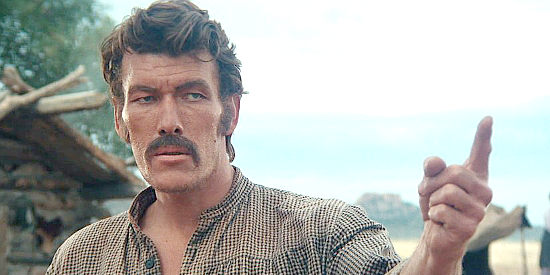
I sat on my side of the car and she sat way over on hers, with her eyes glued on the screen, rapt. I had felt a bit awkward thinking she might be nervous about this older (like two years, I guess) guy she hardly knew taking her to the drive-in, but that didn’t seem to be a problem. I was not in her thoughts. She was just digging Joe Don Baker up there and all the awesome things he was doing. I’m trying to remember whether her lips moved along with the dialog as she saw it, because it certainly seems likely given she was so fascinated and had seen it before.

I don’t remember interacting with her in any way after that night. There didn’t seem any ground for the establishment of even a platonic friendship. She was only interested in one thing, and it did not lie within my universe of interests.

No matter. I met my wife a couple of months later. The night we met we had a long talk about Jack Kerouac and On The Road. This was a good start, and things got better from there. Did I tell y’all about our big 50th-anniversary celebration with our children and grandchildren last year?

I wonder, though, whether that girl has heard this latest news. I hope she’s not too shaken by it.

Above, I sort of wondered idly how Hollywood would react. Of course, if there is ever a new movie, it won’t be in the same vein at all. It won’t inspire folks across the nation to idolize the ex-professional wrestler who becomes sheriff in a corrupt corner of the countryside and lets no one stop him while he addresses crime by whupping bad guys with his big stick. Or to idolize anyone else.

It will instead be painfully sad. I don’t think I want to see that flick, either…

Joe Don Baker as Pusser in ‘Walking Tall.’

The beauty of knowing where you are

One nice thing about ebooks is that you can keep them always handy.

I don’t have a temporary relationship with books. I think public libraries are very wonderful things, essential community assets, but I don’t often borrow books from them. If I read a book, and enjoy it or learn something from it or both, I don’t want to give it back. I want to have it handy to refer to, always.

This has led to a good bit of bookshelf-building on my part, but also a gradual turn toward downloading some of my favorite books to my iPad, using the Kindle and iBooks apps. This way, I always have a few of my favorites with me, because that’s where my iPad stays. This enables me to indulge, in quiet moments, my great weakness — rereading books I love. It’s something I can do for five or ten minutes, then move on to something else. And I almost always gain something that I didn’t fully get before.

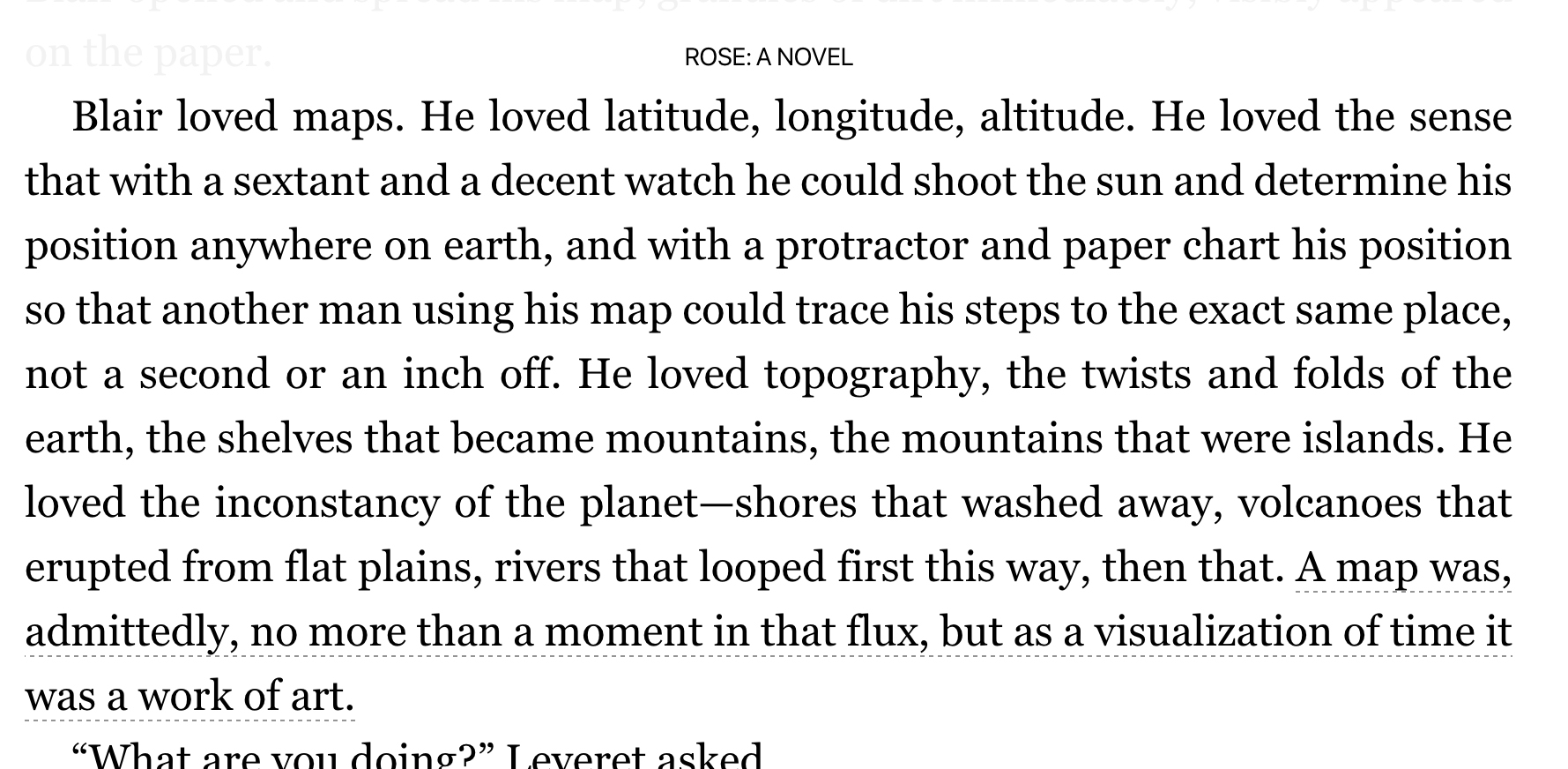
This morning, at breakfast, it was one I’ve mentioned before — Rose, by Martin Cruz Smith. I’ve praised it before, said some of the same things before, but I promise I’m making my way to a different point today. Above is one of the passages I read this morning. It’s a good reminder of why I’m so into this book. Of course, this has been a forte of Smith’s work ever since Gorky Park. As I’ve said before, of both him and Patrick O’Brian, they are “capable, to an extent I’ve never seen anywhere else, to take their readers to an alien place and time and make them feel like they are really there.”

That passage above helps me to connect closely to Blair with a certain fondness (despite his extremely off-putting personality), because while I lack his skills as a mining engineer and explorer, I have always loved maps myself — even when studying one involved pulling it out of the glove compartment, and then enduring the challenge of trying to fold it back properly when I was done. Now, of course, Google Maps and Google Earth are always right there, the apps ready for reference as I read a book, or serving as a constant guide on my car’s dashboard. Blair would have loved interactive maps.

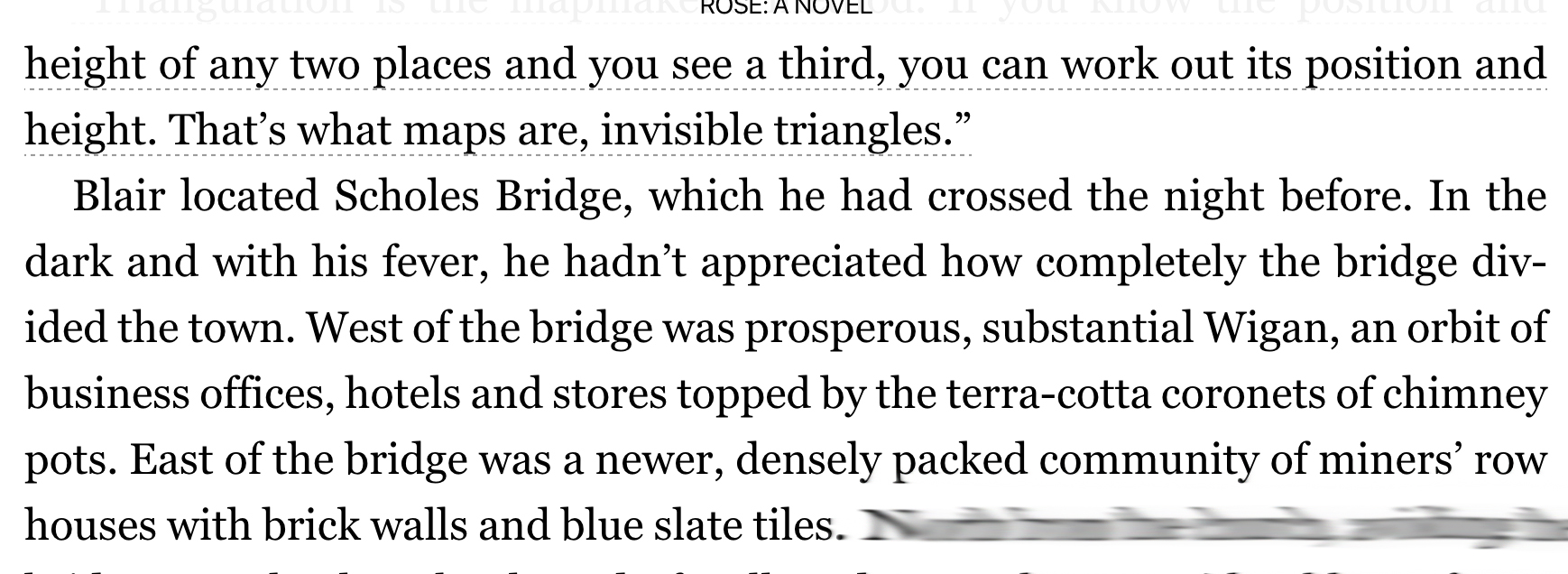
Today, though, I’m really focusing on something about entirely familiar places rather than exotic ones — although places I wish I knew as well as I know 19th-century Wigan from Smith, and Port Mahon circa 1800 from O’Brian. This is inspired by a paragraph that appears a bit after the one posted above:
Screenshot

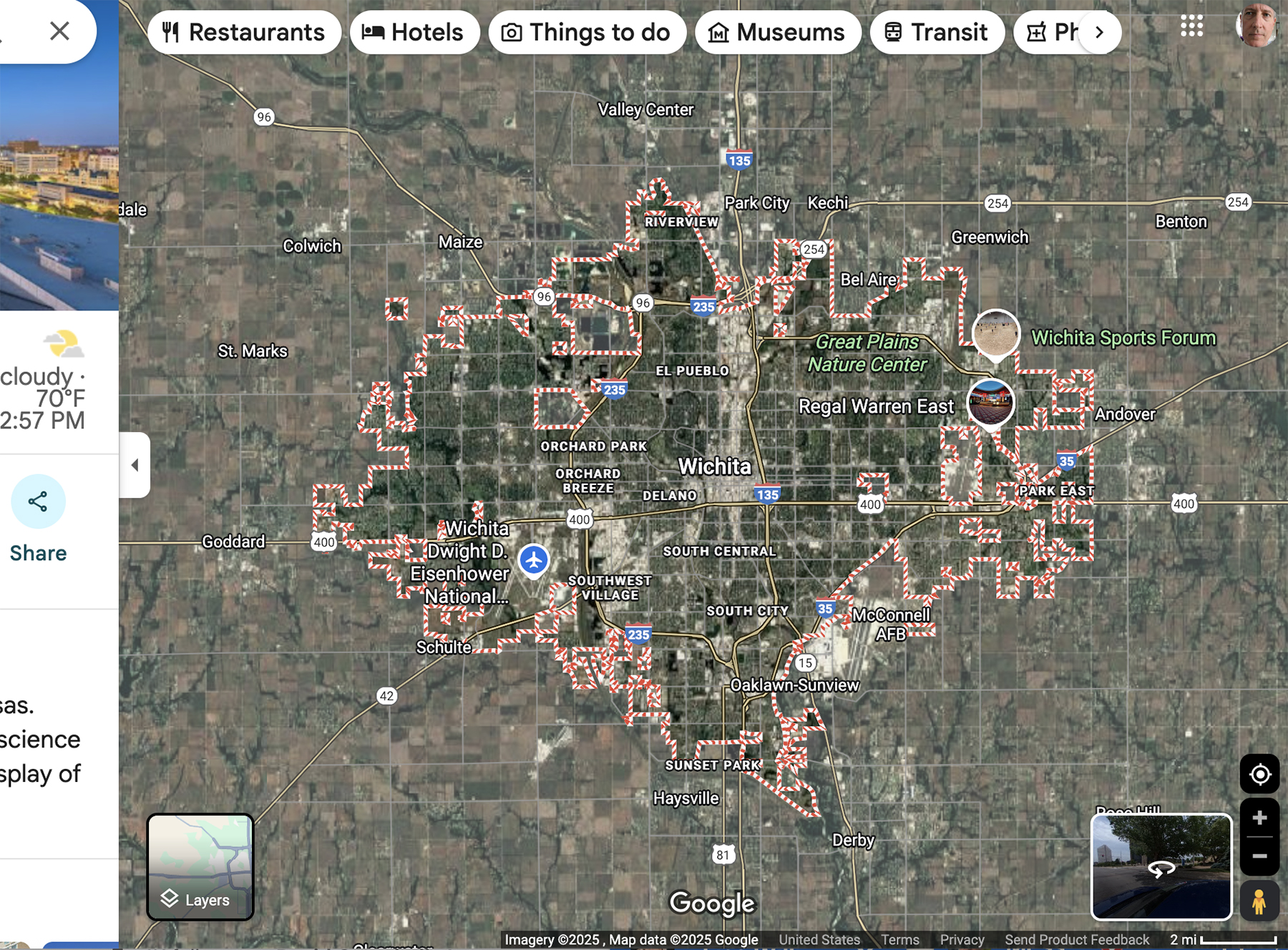
That immediately brings to mind a place where I have have actually been: Wichita, KS, which is where I lived and worked before returning to South Carolina. It’s a city like Columbia in some superficially impressive ways. For instance, it’s located at, and sprawls across, the confluence of two rivers, the Arkansas and Little Arkansas (pronounce “ar-KANSAS,” not “arkansaw”). The place where the rivers came together to form one had been an important gathering point for pow-wows between Indian tribes before the whites arrived. A cultural center sits on the joining delta today. (I’ve witnessed a pow-wow there.)

Wichita is nothing like Wigan, except in this one respect: It is historically sharply divided, by class and culture, by the river at and below the confluence. The West side was like Smith’s miner side: When the city developed in the 19th century, that was where the stockyards, saloons and brothels waited eagerly to welcome exhausted, filthy cowboys who had driven their herds hundreds of miles to get them to the railhead. They had a lot of steam built up when they got there, and Wyatt Earp was among those lawmen trying to keep them in line until they left.

Across the river to the east were the respectable folk — the people who owned those stockyards, saloons and brothels — where they lived comfortable, proper lives with their families, insulated by the river from their rowdy source of income.

An ironic thing about that… we all know that newspaper editors are, or at least do their best to emulate, “liberal elites,” right? Just full of politically correct values. Well, one of the first things I learned about my fellow editors at that paper was that they all lived on the proper, safe, smug East side of the river, largely in a Shandon-like area called College Hill.

All of them but one, a guy named Tom Suchan. I liked Tom, naturally enough. He was a Catholic like me, and had four kids, as I soon would (my fourth was born there, my fifth not until we got here). And he lived as far West as possible while remaining in the city. Across the street from his house there was a wheat field, and nothing else visible beyond it for miles and miles of prairie.

The other editors gave him constant grief for being such an outcast, a wild man beyond the pale. Oh, they did it kiddingly, but I felt the jokes covered something of a real difference between him and them, one that reflected to his credit, in my book.

When I moved to Columbia in 1987, I immediately perceived a similar dynamic. When we had our daily editors’ meetings, I looked around at the dozen or so crowded around the table, and knew that most of them lived in Shandon (while I lived over here on the West side). But a starker difference was that all of them were alumni of USC (I had never encountered such a uniformity at a newspaper). Well, all but one. Tom Priddy (who ironically had almost the same job as Suchan, being over the photographers and artists at the paper) had gone to Clemson. No one ever let him forget — joshingly, of course — what a pariah that made him.

I don’t know where he lived while he was here. But the similarity in the situations was striking.

But there was an important difference. Although I know South Carolina overall so much better than I do Kansas, I can’t sum up the central narrative of Columbia nearly as well as I can that of Wichita. There, it was simple: Cows, the railroad, cowboys and the townspeople who lived off of them. It was hard to forget, with historical reminders such as that Indian cultural center, and the “Cowtown” attraction that was located, of course, on the western side.

I know lots of things about Columbia. By the way, when I use that name, I’m referring to the overall metro area, which is stunningly fragmented, legally and politically — two counties, about 10 separate municipalies, five school districts, and so forth. Wichita has one advantage over that. Despite the historic split, it’s all one city (except from some odd little conclaves similar to, say, Arcadia Lakes. It’s all in one county. And there’s one public school district (although my kids attended a parish school in the large, separate, Catholic system).

Consequently, it’s a community that finds it easier to get its act together. For instance, its riverfront areas were completely and beautifully developed long before I there. Progress has been made here, but it’s been fitful.

Of course, there’s that huge similarity in the Big Split between East and West. And I can give you all sorts of reasons why that alienation exists here. And it’s very long-standing. It has to do with why the first editor of The State was shot and killed by the lieutenant governor in broad daylight, in front of a cop, across Gervais Street from the State House in 1903 — and his lawyers got him office by obtaining a change of venue to across the river, where folks reckoned he had it coming.

But this post is already too long for me to elaborate. I know the division exists, and you know it exists. The difference is that I can’t explain it as simply and starkly as I can the split in Wichita. The causes are more complicated here on the Eastern Seaboard. There are things we know and could explain if we were willing to talk about them, and other things we have trouble fully wrapping our heads around.

I’d like to be able to do that. I’d like to be able to explain it — to myself, to my neighbors, and to outsiders — as clearly as I can explain Wichita (or at least, how it formed).

Can anyone recommend a book that treats this entire community in a way that makes that manageable? The author doesn’t have to be a Patrick O’Brian or a Martin Cruz Smith. Just someone who explains us and the place we live clearly, coherently, accessibly, and most of all accurately.

If y’all don’t know, I’ll check with friends at the libraries on both sides of the river. I don’t check out their books much, but I know what a valuable resource they are…
Screenshot


It’s artificial, but is it actually intelligence?

I understand, from what a couple of folks in my family have said, that Gamecocks are playing football today instead of yesterday. Don’t ask me why. Also, don’t ask me why they’re playing in Atlanta when the opponent is Virginia Tech. I don’t wish to know.

But yesterday, my wife told me that my mother — unlike me, a great sports fan — was planning to watch “the game.” She always watches the Gamecock’s games, so I Googled to see where and when that day’s game was being played.

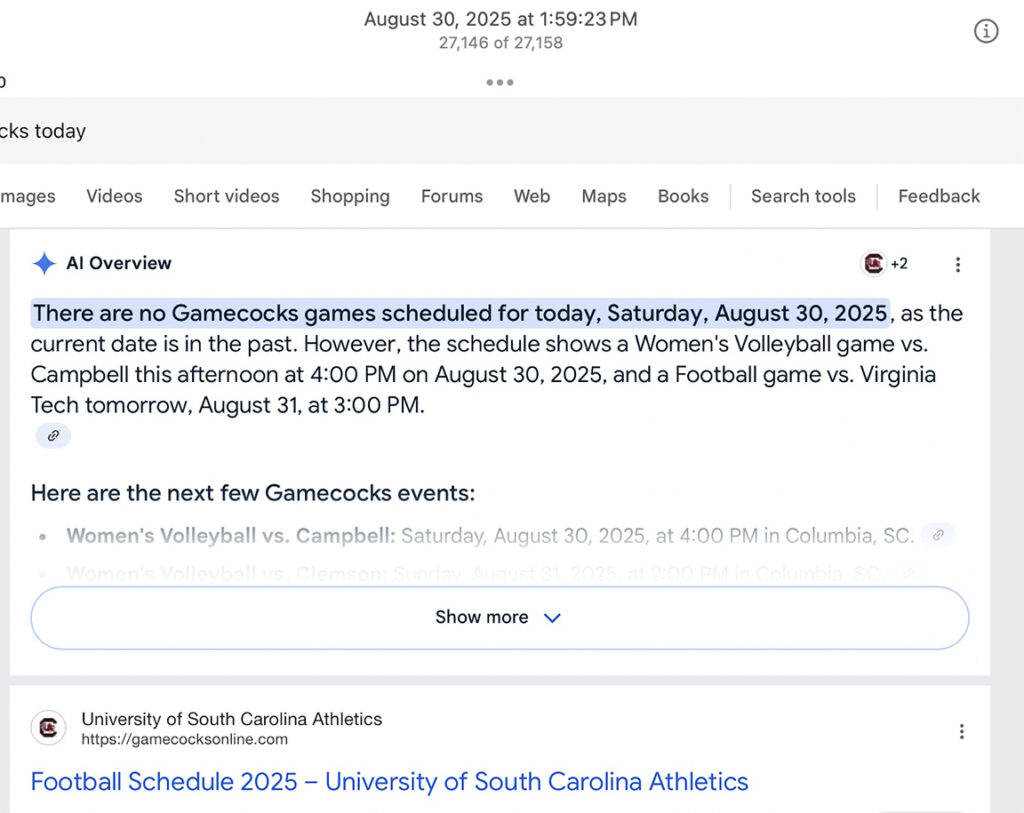
The first thing I got was of course Google’s AI response, a service of which it seems inordinately proud. Here’s what it said:

Screenshot

Uh… so how does that make sense? Read that mind-boggling bit in the middle: “…the current date is the past.”

How do you figure? In what universe is the date in which we are presently living (observe the date and time stamp at the top of the image) “in the past?”

Apparently, the universe where the algorithm lives.

A human with even moderate sense would have answered simply, “There is no game today.” If that person were a tiny bit smarter, he or she would possibly have added, “Yes, normally they would be playing today, but this time, they’re playing on a Sunday. Here’s why…” At which point it would tell me things I still don’t know yet.

Before we all bow down and start worshiping this new overlord, I appreciate that it takes the trouble to allow us to smirk at it now and then…

Here I go, dusting off my curmudgeon role…

Screenshot

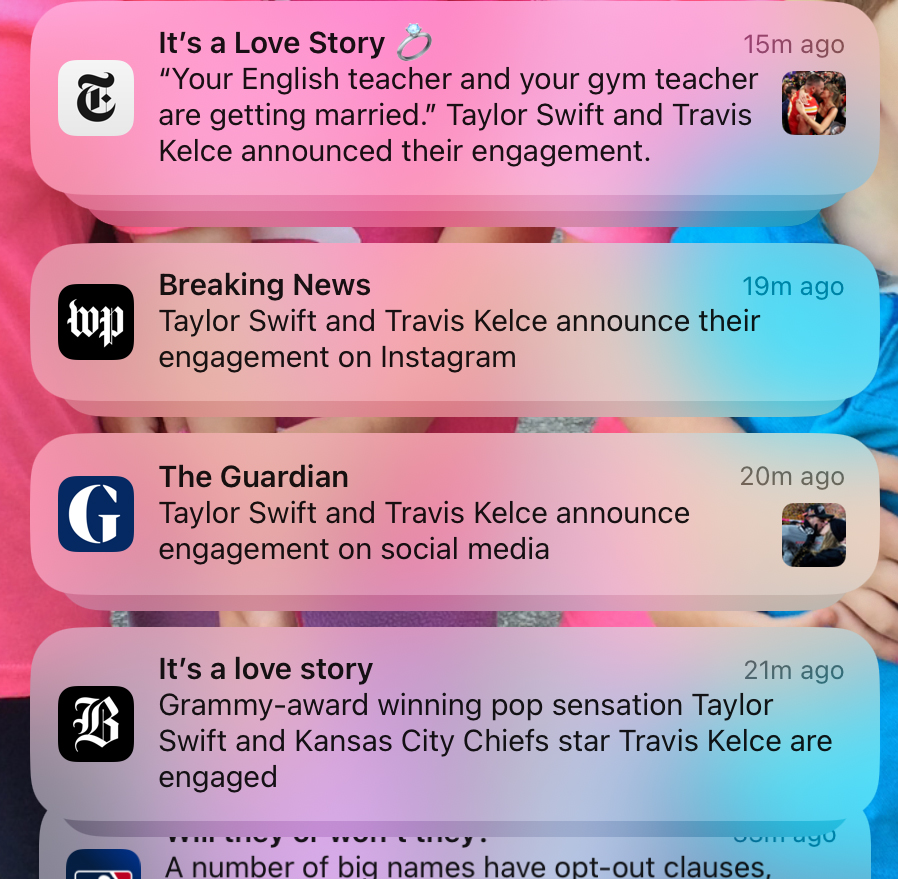
Yesterday, my iPad was dinging, so I glanced at the lock screen, and saw what you see above.

My reaction was trite. It was highly unoriginal. It was what the writers for a B movie would have written for Walter Brennan to say, or Lionel Barrymore, or maybe Ed Asner in his MTM show period (Lou Grant!). I showed it to my wife saying, “Really? That’s the most important thing going on in the world at this moment?” Yeah, it was a lame response, but I was off my game. It threw me to see these publications prioritizing this news so much: The Boston Globe, The Guardian, The Washington Post… even The New York Times! I guess those were the ones I saw because, well, I don’t have a People app to pump such notifications to me. But still. I felt like I was in yet another sequel to “Freaky Friday,” in which The Gray Lady switched places with, I dunno, Teen Beat.

After a few seconds mildly brooding over it, I forgot about it.

That was, until I saw today where someone I respect personally had tweeted about the news:


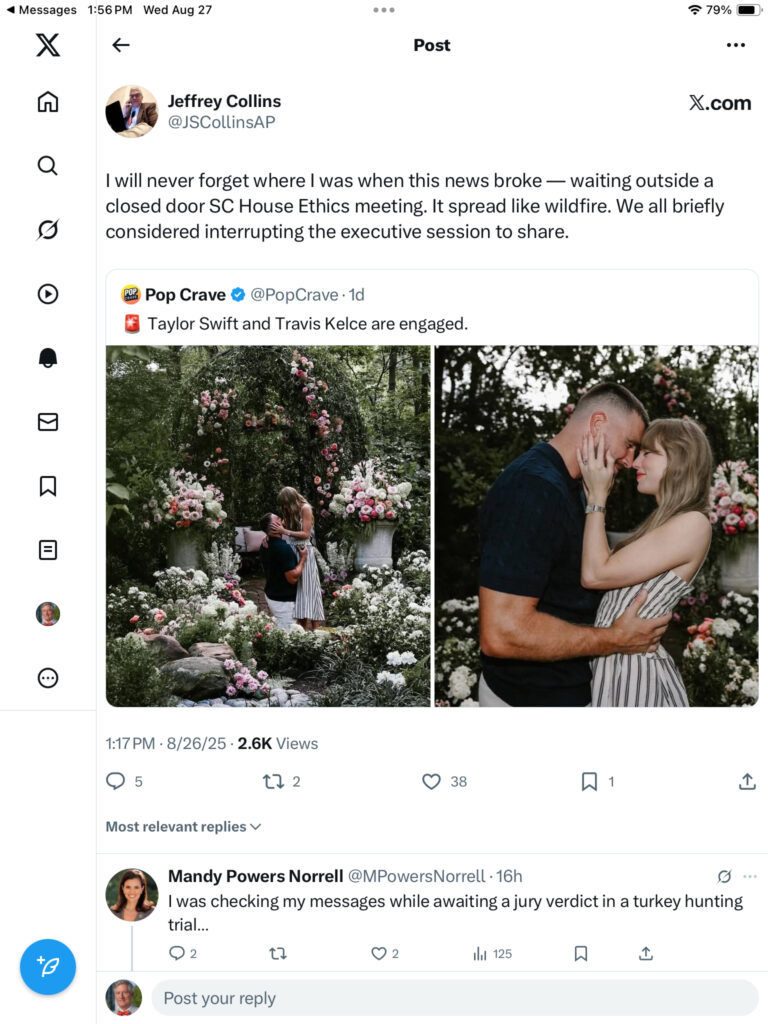
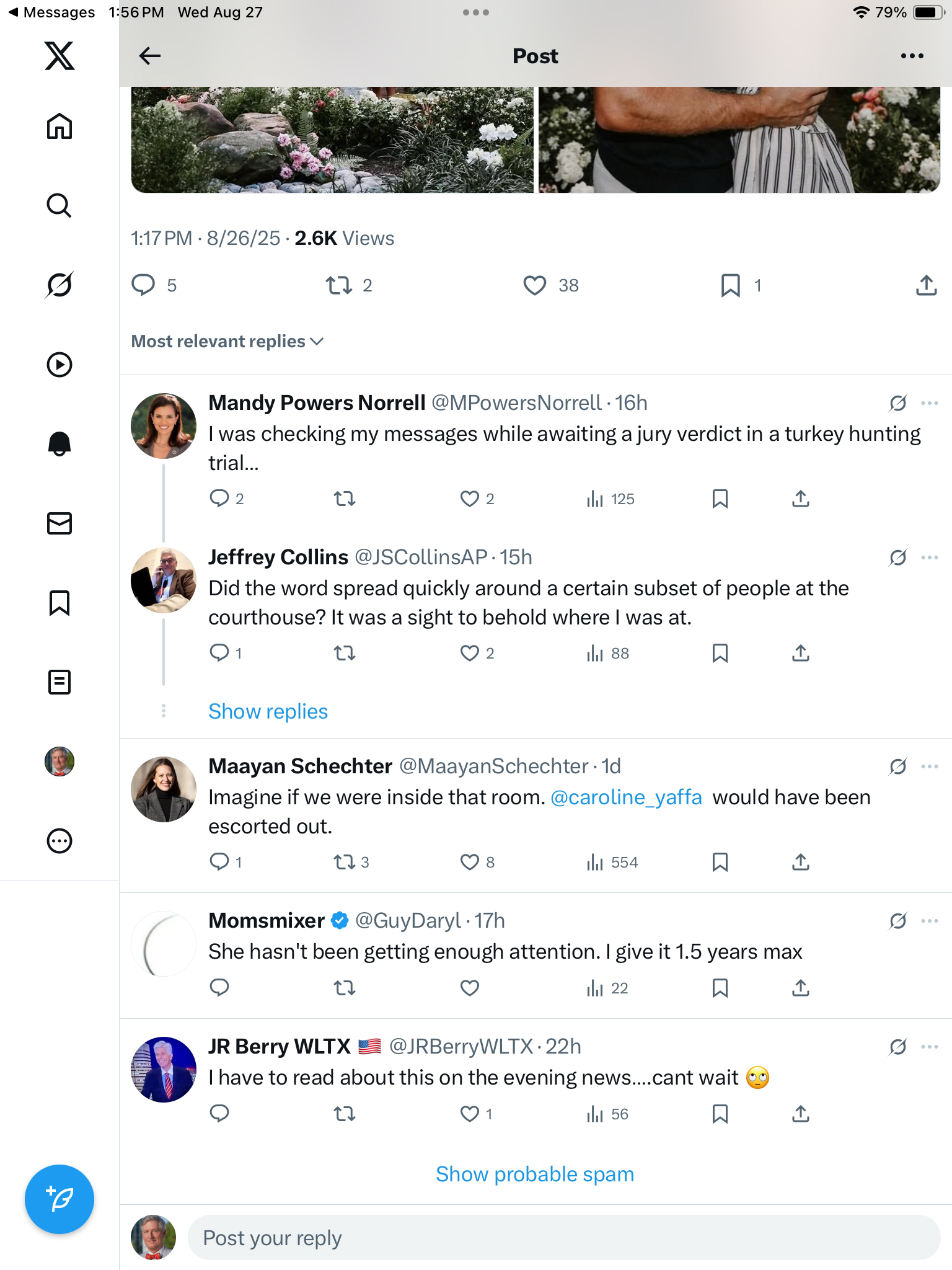
… and other people I respect just as much — see Mandy there? — responded in a similar vein. (You can see more of those responses below.)

Now, let me be perfectly clear, my fellow Americans… I do not want anyone to think for a minute that I show you this and say these things in order to criticize these smart people, or hold them up to any kind of ridicule. (Although “Never forget where I was” is what you say about the Kennedy assassination, or Pearl Harbor, if you were around for that. Come on, folks! Now back to what I meant to say…)

It’s rather the reverse. It kinda reminds me that lots of smart, analytical thinkers in this world are better-rounded human beings than I am.

Sometimes I worry about that. Not often, but sometimes. I wondered about it back during my days on the editorial board. All of my associate editors were smart people, and most of them were good at feeling and writing about things that moved so many millions of other humans, but tended to leave me cold. You know, like professional football and 21st-century pop singers (as I’ve previously explained, rock and roll died around 1993, when MTV abandoned its mission of showing music videos 24 hours a day).

For instance, when Princess Diana was killed and the commoners reacted in ways I found peculiar, I was entirely in agreement with Her Majesty the Queen: She kept her distance and did not publicly emote over the death of her former daughter-in-law. “Bloody well right,” I thought. “Her Majesty’s a pretty smart girl. She knows what she’s about.” But my man Tony Blair, exquisitely attuned to the Zeitgeist in his early days as PM, warned her she’d better change her mind or see the end of the monarchy. He was probably right — he usually was. But my gut reaction was with Elizabeth Regina.

But I was the editor of the editorial pages, and I had enough Blair in me to realize we should probably say something — and something far more empathetic than what I was thinking. So… who should write the editorial? It wasn’t going to be me. It had to be one of the people who knew how to “resonate” to the culture of the moment. But someone else on the board volunteered, and really got into the subject, just resonating like crazy. Which I knew I couldn’t do, and didn’t want to do.

Which probably made my colleague who undertood how people felt about the lady and could reflect it back to readers with complete sincerity a better person than I was. I dunno.

When I was younger, I could do that resonating thing. When I was younger, I was sometimes the one guy called upon to do it. At The Jackson Sun back in 1977, the paper’s editorial page editor, having no idea how to react to the death of Elvis (and John Lennon, three years later), came to me — and I was a news guy in those days, not an editorialist. So I knocked out those pieces, and felt honored to have the opportunity.

As you know, I still love pop culture. But I guess I’m picky about it.

I can’t work up excitement about a pop singer to whom I’ve never listened (seems like a sweet young woman, but I don’t even know her songs) and a man who plays a sport I generally ignore (but hey, how about them Red Sox?).

But just as Elizabeth was the queen, Elvis was the King. Even more so, in a way. One E was on the throne by birth and tradition; the other E was raised to that position by the will of the people of the world…

What does Google think email is FOR?

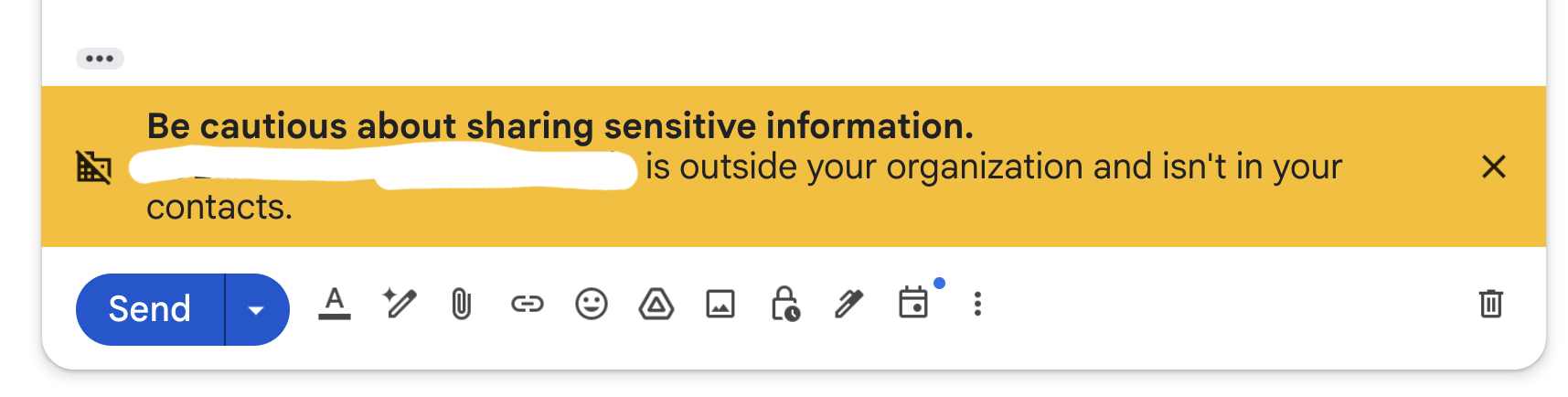
Do any of y’all get these stupid things? I’m sure you do, if you have gmail. (Or maybe you’ve turned this function off in the settings. But rather than figure out how to do that myself, I prefer to complain about it in a post.)

They don’t really get in my way of doing what I need to do, so I just ignore them when they come up. But each time, for a split second, I wonder what Google is asking me to worry about.

Here’s the situation in which the item you see above popped up this morning: I saw something in the NYT that I thought might interest a prof over at USC with whom I was conversing about the same subject a few days ago. He found it interesting, and almost immediately responded. I started to send him that emoji I wrote about recently, to acknowledge his response and to to vaguely communicate something like, “Yeah, thought you’d like that!”

Anyway, once I started the reply process to do that, I got the above orange warning. Why? I mean, I’d already written to the guy once, which indicates that yes, I am intentionally communicating with him. (Can’t remember whether I got the warning on the first message.)

And yet it still gives me an orange alert. That makes no sense.

Also, what does it mean by “outside your organization?” What organization? I’m a guy sitting here in his home office — which is so disordered that I promise the merest glance would assure you that there is nothing you would call “organization” in this vicinity.

Is it referrring to ADCO, for whom I do some writing and editing? I don’t think so. This was not on my entirely separate ADCO email address, which I keep running at the same time in a different browser. This was within my bradwarthen.com domain — that’s the ending of my address (although it’s really a Gmail account). Well, that’s hilarious! Aside from Bryan Caskey, who kindly watched over the blog while I was in Thailand a decade ago, and a couple of people who’ve helped me with technical stuff over the years, there is no one else on the planet who has ever had an email address ending in bradwarthen.com. To my knowledge, anyway. So, what — it’s going to give me a warning whenever I write to anyone else?

I remember getting something like this warning back when I worked at the paper. It seemed weird to me then, too, although I was working in a building with 500 or so people with addresses ending in thestate.com. I suppose there was someone in the building who used email to communicate only internally, but I can’t imagine who it would be. Obviously not news people. Like me, their job (at least, the reporters’ job) was to communicate with people out there. If they only wrote to their colleages in the building, they were not doing that job. Circulation people had to respond to readers. The finance people had vendors to deal with (I’m guessing). The ad account executives needed to be in touch with advertisers — although maybe they weren’t in this period (which could be a good alternative explanation for why the newspaper business collapsed).

I mean, come on! You need to talk to somebody 20 feet from you, walk over and talk. Or yell from your desk. Email is for instantaneous communication around the globe! And if it’s something confidential, hand it over on paper or a flash drive — or ask the Chief of Control if you can borrow the Cone of Silence for a few minutes.

I suppose there are large organizations in the world where such a warning might be appropriate. Say, the CIA. Or parts of Google, where thousands spend their days dealing with proprietary code. But they’d be few. How many businesses don’t need to communicate with customers?

Does Google just do this in keeping with the same CYA logic that causes sellers of packaged goods to include warnings such as: YO! THIS BOX CONTAINS NOTHING BUT RAT POISON! DON’T EAT IT! You know, to please their attorneys?

Maybe y’all can see the reason these distracting little alerts are necessary, or even slightly advisable, for gmail users in general. If so, please share the explanation…

All the Way with LBJ

Here’s another movie that should have been on somebody’s list of the best since the turn of the century. I had forgotten about it, then ran across it on HBO and watched it again last night. I was more impressed this time than the first time.

It’s “All the Way,” starring Bryan Cranston as Lyndon Baines Johnson. It covers his first year as president, from the moment JFK was pronounced dead in the hospital in Dallas to LBJ’s stunning victory over Barry Goldwater.

It was technically amazing. Cranston’s embodiment of Johnson, aided by remarkable makeup, made me feel constantly that I was watching and hearing the original man. If anything, Melissa Leo was even more impressive as Lady Bird, although she didn’t have nearly as much screen time.

Also noteworthy: Bradley Whitford as HHH, Stephen Root as J. Edgar Hoover, and Aisha Hinds as Fannie Lou Hamer. Towering above those was Frank Langella’s deft, nuanced portrayal of Senator Richard Russell. (I was less impressed with the portrayals of MLK and, in a bit part, our own Strom Thurmond. Sadly, I’ve yet to see any actor come close to recreating the power of Dr. King’s presence.)

Beyond the technical stuff, since I was out of the country during that year, I learned a lot watching it. Sure, I knew about (or learned later about) the events that were portrayed — the extraordinary exertions to pass the Civil Rights Act, the destruction of the Democratic Party’s Solid South, the deaths of the three civil rights workers in Mississippi, the Gulf of Tonkin incident, and much more — I hadn’t fully had the sense that they all happened in that year, when Johnson was trying to establish his legitimacy in the office while also winning an election. With hindsight, I’ve tended to think Goldwater was easy to beat. But not from LBJ’s perspective, with all those other things going on.

I enjoyed “Breaking Bad,” but maybe the best thing about it was that it gave Cranston the celebrity to do something like this. It was made in 2016, and it’s amazing to me that it didn’t make more of a splash (as in, the kind that gets you on a “Top 100” list.) Perhaps because it’s wasn’t available to anyone but subscribers.

If you have access to Max, or whatever you call HBO, watch this right away…