Occasionally, I have reason to open one of the many boxes containing the roomfuls of files I brought home from The State when I left (in my last two weeks, there was barely time to load it up, and practically no time to go through it, although I did throw out a few things), and sometimes I post one of the finds here.
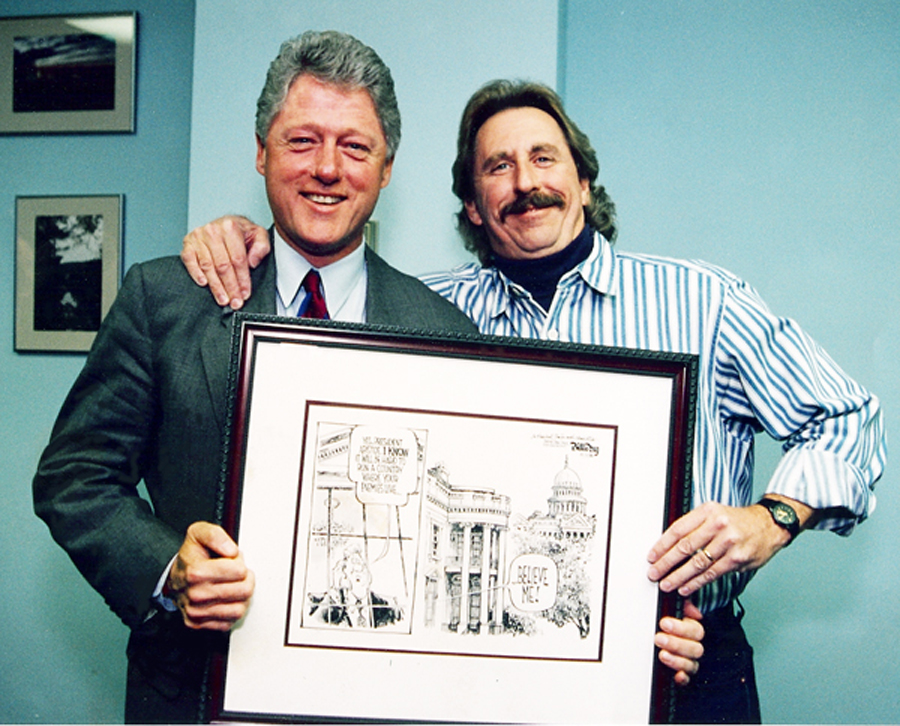
Looks like cartoonist Bill Day, formerly of The Commercial Appeal, has been doing something similar. He sent me this picture today, taken in the mid-90s, with this commentary:
I thought you might enjoy this photo. This was at the Detroit Free Press. He was a great sport posing and loved talking about cartooning. His staff told me that he was looking forward to talking to me because he’s a big fan. About a month later I received a White House photo of him showing it to everyone in the Oval Office. He signed it: ”To Bill Day, Thanks for the laughs! Bill Clinton”
Bill’s the kind of cartoonist who would get a kick out of meeting Clinton. Robert Ariail is more of a Bush guy — although Robert had so much fun with Clinton when he was in office (Clinton was a large part of his inspiration both times Robert was a Pulitzer finalist, if I recall correctly) that he would have enjoyed meeting him, too — to thank him for providing so much fodder.
That reminds me of a picture I need to show you that involved Bush — and Tony Blair. I’ll try to track it down tonight or over the weekend.
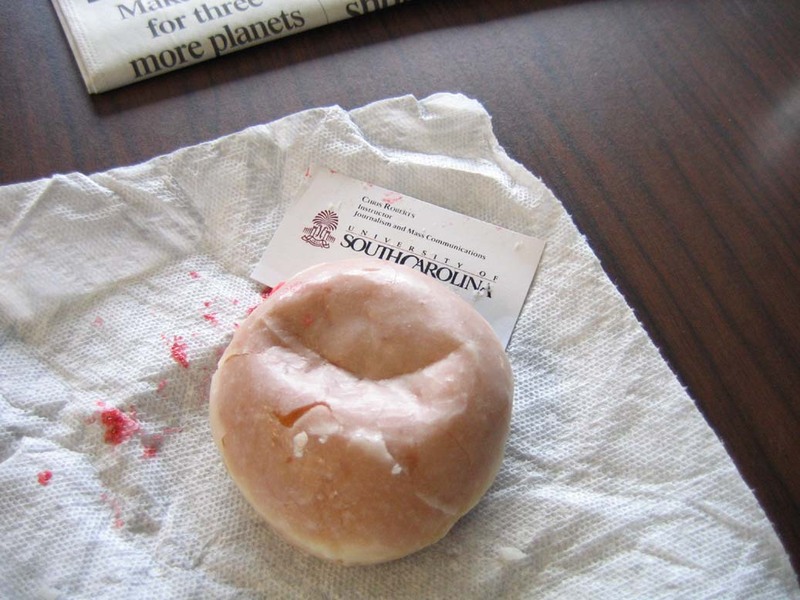
One of the doughnuts Chris left me back when some of the King's loyal subjects still worked at newspapers.
This rubble used to be the Krispy Kreme Chris went to in Tuscaloosa. Took a direct hit...
When we worked together at The State, Chris Roberts used to bring me a jelly doughnut every Aug. 16 in honor of the King.
He’s not in a position to do that now — he’s in Alabama — but he did show he was thinking of me by sending this:
He went on to say that he would have tried to get a doughnut to me, but the local Krispy Kreme got knocked down by a tornado back in April.
So I sent him a picture of one.
Chris knows how special this day is to me, because I was one of the first people in the world to hear the awful news in 1977:
MY GOOD FRIEND Les Seago was the man who told the world that the King was dead. But before he told the world, he told me.
I’ve always appreciated that, even though it didn’t do me much practical good at the time.
On Aug. 16, 1977, Les was the chief Memphis correspondent for The Associated Press. I was the slot man on the copy desk of The Jackson Sun, which meant I had been at work since 5:30 a.m. By early afternoon, the paper was on its way to readers. I had also been a stringer for Les for years, and I was used to his calls to see what was going on in our area. But he didn’t have time for that this day.
Was it too late to get something in? he demanded. Well, yeah, it was, just barely, but why…?
It looks like Elvis is dead, he said, explaining quickly that he had a source, an ambulance driver from Baptist Hospital, who told him he had just brought Elvis in, and he was pretty sure that his passenger had been beyond help. Gotta go now, ‘bye.
He must have broken all speed records getting it confirmed, because I had just begun to tell my co-workers when the “bulletin” bell went off on the wire machine as it hammered out the news.
Les himself was found dead at his home two years ago [this column ran on this day in 2006], at age 61. Though his career had spanned many years and he had covered Martin Luther King’s assassination, The Associated Press identified him in his obituaryas the man “who filed the bulletin on the death of Elvis Presley.” His ex-wife Nancy said “He wasn’t wild about Elvis, but he was glad that he did break the story.” That was Les…
A packed house watches "Page One" at the Nickelodeon last night.
Last night, I went to see “Page One: Inside The New York Times” at the Nickelodeon. I had been asked to watch the movie, a 2010 documentary, and then stay to be a panelist for a discussion — along with Charles Bierbauer of USC and Dan Cook of the Free Times.
As I arrived, I felt a pang of guilt that yet again, I was making a public appearance and forgetting to tell you, my readers, in advance, in the remote chance you’d like to attend. But I needn’t have worried. The show was sold out. The audience included a lot of familiar faces, such as my old boss Tom McLean, who hired me at The State and was my predecessor as EPE, and the paper’s long-time attorney Jay Bender.
On the way in, I ran into Bill Rogers, head of the state Press Association. He said he was sorry he wouldn’t be able to hear me, because the show was sold out. I told him they had given me two tickets, and my wife was at a book club meeting instead, so he could be my guest. When he sat next to me at the back of the theater (I couldn’t sit at the front because of my neck thing, for which I’m going to get another shot next to my spine today), I took advantage of his slightly owing me to make a pitch: Look Bill, I see that the Press Association is offering online, multi-publication ad packages, and advocacy-ad packages as well. Why not throw come blogs in? It might add some value for the buyer, and I need somebody to sell ads for me.
Shameless, huh? Well, that’s the state of news media in America today.
In fact, one of the most meaningful lines in the film, to me, was spoken by David Carr, who was essentially the star. He’s a great character. A former crack addict, he’s now a media columnist for the NYT — a brilliant reporter, and an awesome bark-off spokesman for why a dying industry matters. (Favorite momentThe movie wasn’t so much about the Times as it was about the horrific troubles of the MSM, using the media desk of the NYT as a window on that world.
Great Carr moment: He’s interviewing the founder of Vice, and said founder is going through the usual mantra about how the MSM don’t cover the real story, so you need the gutsy, edgy fringe guys to tell you what’s really going on and Carr interrupts:
Just a sec, time out. Before you ever went there, we’ve had reporters there reporting on genocide after genocide. Just because you put on a fucking safari helmet and looked at some poop doesn’t give you the right to insult what we do. So continue.
Excuse the language, but one of the things this movie does is show the way people talk in newsrooms. And Carr was talking to a guy who pumped that up to the nth degree to show how hip and edgy he is, so Carr used his own terminology to put him in his place. By the way, here’s the story Carr wrote from that interview.
But that wasn’t his most meaningful line to me. That came when he had been researching an in-depth story about how the boorish Sam Zell had run the Chicago Tribune the rest of the way into the ground, and had done the obligatory interview with the Trib’s spokesman in which you say, Here’s what I’ve got; what’s your reaction? After the ritual comments about “hatchet job” and “I’ll get back to you,” Carr hangs up the phone. Sometime later, after communications from the Trib’s lawyers, he says,
The muscles of the institution are going to kick in at some point. It’s not up to me.
Exactly. And that’s one of the virtues of working in the MSM. There’s somebody to sell the ads, and you’re not even supposed to talk to them (usually, you don’t know them). There’s somebody else to worry about threats of legal action. You just worry about getting your story, and getting it right. And people who’ve never worked at such an institution — or even the somewhat smaller ones like it, across the country — have no idea how liberating and empowering that is.
Frequently, people ask me today whether I find I have greater freedom as a blogger than I did as editorial page editor of the state’s then-largest newspaper. That’s a really stupid question, although I don’t say that, because the asker has no way of knowing that.
Part of the stupidity of the question is based in the notion that when you work at a newspaper, “They tell you what to write.” I’m not entirely clear on who “they” are, but I suppose it’s the owners of the paper. I suppose, and I’ve heard, that when you work at a locally-owned paper where your masters are intricately tied into the community you cover, there are sacred cows, and positions you are told to take and others you are told not to take. But that doesn’t happen when you’re a part of a publicly-traded corporation. In all my years as editorial page editor, only once did anyone at corporate made even a suggestion about editorial content: Tony Ridder tried to make the case to Knight Ridder editorial page editors that the company’s papers should not endorse in presidential elections. His reasons for saying that appeared to be a) that we needed to concentrate on local issues; b) that what we said on our local levels about national politics didn’t matter; and c) that such endorsements only made about half of our readers furious at us. That last reason was, as I recall, more implied and stated; he really concentrated on reason a).
I thought that was a fine theory for a guy who lived and worked in California, but a pretty silly one for an editor in the home of the first-in-the-south primaries. For months before a primary, I had media from all over the country, and from abroad, contacting me to know what I, and we, thought about the candidates. I wasn’t going to tell our readers what we thought? How absurd. I ignored Tony’s suggestion. So did most of the other editors, to the best of my knowledge — I didn’t check, because I didn’t care what they did.
There’s another comment I used to get from people a lot, when I was at the paper. They used to commend me for my “courage” for taking a certain stand. That, too, was ridiculous. I got paid no matter what I wrote. I wasn’t taking any risk, beyond the inconvenience of maybe a source not talking to me any more. So I might as well take stands that mean something rather than write pap, right? I had that whole institution standing behind me, that warm blanket of security.
Here’s what I wrote a while back about the “liberating” effect of no longer working for the MSM:
The first casualty of unemployment is the truth.
OK, maybe not the first. First there’s the blow to one’s bank account. Then the loss of self-confidence. But truth is right up there. Especially for me. Until I was laid off in March, I was editorial page editor of South Carolina’s largest newspaper. A colleague once said to me, accusingly, “You don’t think this is the opinion page. You think it’s the truth page.” I just looked at her blankly. Of course it was the truth page.
Readers expected me to tell everything I knew, and plenty that I only thought I knew – about South Carolina’s feckless politicians (Mark Sanford, Joe Wilson – need I say more?), or whatever struck me, without reservation. And I delivered.
My reputation survives my career. Recently, a friend warned me that people feel constrained in talking to me, because their confidences might turn up on my blog. After all, bloggers tell all, right? Ask Monica Lewinsky. Ask ACORN.
“HAH!” say I.
As a blogger who answers to no one, I am not nearly as frank and open as I was as a newspaper editor who thought he had a secure job.
I haven’t disclosed whom I have worked for on consulting gigs since leaving the paper, because my clients haven’t been crazy about the exposure. Every word I write, I think: Might this put off a prospective employer? And I know it has, despite my caution.
There are things I have not written – pithy, witty, dead-on observations on the passing parade, I assure you – because I think, “Do you have to write that and run the risk of offending this person who MIGHT point you to a job? Can’t you just write about something else?”
And where am I applying for jobs? Well, I’m not going to tell YOU, am I?
People used to praise me for my courage for taking on powerful people at the paper. But I was taking no risk whatsoever. As long as I was supported by advertising, a transaction I was ethically barred from even thinking about, I had impunity.
But an unaligned blogger still trying to function as a journalist stands naked and alone, and is not nearly as free and honest as he was writing from the once-impregnable citadel of an editorial page. At least, this one isn’t. Keep that in mind, citizen, as newspapers fall around you.
Watching that movie launched me on many different streams of thought; I could have talked about them all night. What I just told you describes part of my reaction to a single line. As Tom McLean said after one long-winded response I gave as a panelist, I always needed an editor.
Former Utah governor Jon Huntsman’s (R) presidential campaign manager, Susie Wiles, is resigning and will be replaced by communications director Matt David, according to the campaign.
Huntsman is announcing the changes to his staff at a meeting this afternoon. Top adviser John Weaver confirmed the changes to The Fix.
“Susie has served the campaign well and was vital in getting it off the ground in such a short time-frame,” Weaver said in a statement provided by the campaign. “In just under three months, Governor Huntsman has returned from China, launched a campaign and created a strong infrastructure in the three early primary states. He’s built important relationships with donors, as well as political, policy and grassroots leaders that other candidates have been courting for half a decade.
High-level staff departures early in a presidential campaign are generally not seen as a good thing, but thus far, Wiles is the only known departure from Huntsman’s team. (Another staffer recently took a leavefor personal reasons.)
The campaign did not expound on the reason for Wiles’s departure. Weaver said the campaign is simply shifting gears…
The thing I’ve thought about is this: Who in the world would want to work on a political campaign?
OK, that’s not quite what I mean… I know lots of people who DO work on campaigns, and who do little else. So the answer to the “who” is easy. But I’ve always sort of wondered about them, and marveled at them.
They mystified me more back when I had a long-time steady job. I just could not imagine anyone deliberately taking a job with such little job security — back when I had been working for the same company for 24 years, with good pay and benefits, and intended to stay until retirement.
Now, I’ve had more experience with the ad hoc lifestyle, and it’s not as scary as I always figured it would be. I see how someone can get used to it. I still don’t see choosing it.
Even if you really, really believed in a candidate… even if that was the only candidate in the world you would work for, and you were willing to give up all the comforts of a steady job in order to help that person get elected… it still sort of befuddles me.
There are problems with the whole campaign-staff career, as I see it, both from the perspective of the staffer, and from the perspective of those of us who want a healthy republic:
Lousy job security, in the sense that the “firm” for which you work — the campaign — is an extremely volatile enterprise. It could become essential to the success of the enterprise (or perceived as essential, which amounts to the same thing) for you to be fired at any moment. And there will be little warning, if any. One day, you’re fine. Next day something erupts that makes in impossible for you to stay.
Even worse job security, in the sense that even if things go well and you don’t get fired, the job only lasts a few months. Yeah, you might get hired by the newly elected official if things go really well and he or she wins, but that’s dicey. That’s like counting on getting hired when your boss moves on to another company. Could happen. Might not. Just as likely, you’re going to be looking for another campaign to work on the day after Election Day.
Once or twice in a lifetime, if you’re lucky, you’ll get to work for a candidate you really, truly believe in (unless you’re pretty indiscriminate). And it won’t last long.
You will probably have to associate yourself, permanently, with one of the political parties. This wouldn’t be a drawback for a lot of people — obviously is not a drawback for the people who actual do this for a living — but it certainly would be for me (speaking as a guy who’s had occasion to think of it since leaving the newspaper biz). The kinds of people who do the hiring for campaigns may run across an independent who is really knowledgeable about issues and politics and messaging and the rest, and really believes in the candidate individually, but they are not likely to hire such a person because there’s a long line of loyal party people wanting the job.
Finally, the big drawback to society of all of the above… It’s bad enough that politicians have trouble leading normal lives. It would be great if they could have some people around them who DO live normal, workaday lives in the regular economy and therefore have a deep, personal, working understanding of regular voters and their concerns. But for the reasons I cited above, the fraternity of people likely to work on a campaign and be in the best position to advise the candidate tend to be rather insular. (By the way, the newspaper industry is the same way — ever since afternoon newspapers died, newspapermen and -women have tended to be people who all work weird hours and therefore mostly associate only with people like themselves. Which is not good, in terms of staying in close touch with the community.)
It would be great if some of you folks who do this for a living, or at least have taken time out from the rest of life to work for pay on a campaign, would weigh in and enlighten us on this. I know there are quite a few of you who read this blog.
The best historical marker in the world is on the Madison County courthouse square in Jackson, TN. It tells what Davy Crockett told a group of voters, standing in that spot, after being defeated for re-election to Congress:
You can go to hell, but I am going to Texas!
Today, we have a similar case in South Carolina. Eleanor Kitzman, head of the Budget and Control board and the most passionate, emotional defender of Gov. Nikki Haley I’ve run across yet, is leaving us to go work for Rick Perry:
COLUMBIA, S.C. — The director of the South Carolina agency that oversees much of state government operations has resigned, six months after Gov. Nikki Haley picked her for the job, to take a role in government in her home state of Texas.
Texas Gov. Rick Perry’s office announced Wednesday that Eleanor Kitzman will start her job as that state’s insurance commissioner on Aug. 15. Her term there is set to expire in February 2013.
“I’m confident that Eleanor’s expertise in the insurance industry will make her a strong advocate for insurance customers in Texas,” Perry said in a release.
Kitzman, a 54-year-old Houston native, did not immediately return messages Wednesday evening.
A couple of years back… actually, to be precise, it ran on the very day before I got laid off from the paper (which really made the part where I reflected on a politician declaring the death of news media, um, interesting)… I wrote a column in which I blasted the very idea of Twitter:
… But so far I haven’t figured out what Twitter adds to modern life that we didn’t already have with e-mail and blogs and text-messaging and, well, the 24/7 TV “news.” Remember how I complained in a recent column about how disorienting and unhelpful I find Facebook to be? Well, this was worse. I felt like I was trying to get nutrition from a bowl of Lucky Charms mixed with Cracker Jack topped with Pop Rocks, stirred with a Slim Jim…
Then, a few months later, Tim Kelly persuaded me that I could promote my blog using Twitter. So I tried it. And I got hooked on the form, sort of a cross between headline writing and haiku. And Tim was prophetic. My blog gets 3 or 4 times the traffic that my old blog did when I was at the paper — something close to 200,000 page views a month, and sometimes well over that.
The former editorial page editor of The State tweets a lot and has 1,200 followers. He’s often re-tweeted, tweeted at, and he becomes involved in Twitter debates. Sometimes he’ll even play mediator in said debates.
In any case, it’s obvious that while Warthen has been out of the newspaper game for a few years now he still has some pull at the paper. On May 31, he tweeted, “What in the world are these UFO-looking things all along I-26?” Days later, The State ran a story answering this life-altering question under this headline: “What Are Those Green Things?” — Corey Hutchins
So, you just never know what’s going to happen, do you?
I was blessed with a pleasant surprise today at the Columbia Rotary Club meeting — Lee Bandy! He was there as a guest of member Joe Jones.
It was awesome to get to see Lee, my good friend and longtime colleague — tanned, rested and ready. More than two decades ago, the guy had to put up with me as his editor, and he’s never held it against me.
For you youngsters, Lee was the dean of SC political journalism until his retirement four or five years ago. Who replaced him as dean? Well, they retired the position.
A couple of weeks ago, in response to some outrageous statement about the state budget put out by someone over at the Policy Council via Twitter — I forget now who it was, or what it was he or she said, but I think it was something like “this is the biggest budget ever” — I got worked up enough to go out and get some numbers showing what total nonsense that was. Because I knew we hadn’t caught up to pre-crash spending levels.
And I got the numbers, covering the last few years. And there were supporting documents, which are hard to link on WordPress (I usually go back and use TypePad on my old blog to link a file, then copy the code over here, which is tedious), and then there was the post itself to write talking about the numbers, and somewhere in the middle of it I fell asleep or something.
Oh, wait, I know — I sent Ashley Landess a Tweet asking her something about the numbers they had used, and while she answered my initial question, she didn’t (unless I missed it) answer a follow-up, and I used waiting for that response as an excuse to just let the whole thing drift, because I had satisfied my own curiosity and justified my own outrage (this is not, of course, the biggest budget ever), and it’s hard for me to maintain interest in numbers for very long. (By the way, I’m not blaming Ashley for not answering me a second time. In fact, maybe she did and it got lost in the ether. Nobody can watch that stuff all day, or read all of it, even when alerted to it.)
Then, a few days ago, Doug got on this kick of throwing HIS favorite numbers at us (similar to the Policy Council numbers, including federal spending and probably lottery money and the kitchen sink and all kinds of stuff that the Legislature has no control over, even though what we were talking about was the budget the Legislature was voting on), and did his usual thing of “Where are YOUR numbers?” and thumping his chest and all, and I thought about going back and digging up the real numbers and answering him, but I was then filled with ennui, because I knew it wouldn’t make any difference, and I just wasn’t interested enough.
Because I know how bogus the whole conversation is. I experience state government. I follow what’s happening. I see the cuts, year after year. After all, we have 8,000 fewer state employees than in 1994, as Cindi Scoppe notes today (see, I just threw number at you, but I didn’t have to spend time digging them up, which is what matters to me)…
In fact, that is my purpose in posting on this subject. Cindi never gets bored looking at the budget, and she understands it better than most people, certainly better than most of the people who get to vote on it. Consider her an enabler of my fecklessness on the subject. I had her to worry about the budget for me for most of 22 years.
And she’s still doing it. In her column headlined “The fable of the spendthrift Legislature,” she summed it up pretty well. (It would have been a wonder if she hadn’t. The freaking thing was 30 inches long. But as I told her, “It read like 18.” Old editor joke.)
It’s worth a read. It puts things into perspective. It explains why it’s so bogus for Nikki Haley to perpetuate the myth (as did Mark Sanford) that the lawmakers are a bunch of spendthrifts out there “growing government” at a rate that exceeds the kind of bogus arbitrary caps that those two governors AND House leaders are always on about.
By the way, while the Senate won’t go along with arbitrary caps (thank goodness; they still believe in representative democracy instead of government by formula), in recent years we’ve stayed well within that population-plus-inflation formulation. The average annual increase in the general fund has been 2.4 percent since 1994 (the year the Republicans took over), including the non-recurring portion. The recurring part has grown by 1.8 percent a year.
And lawmakers are still appropriating less than they did five years ago. So these are not the biggest budgets ever.
John O'Connor, looking all self-conscious at the Capital City Club this morning, on account of someone taking his picture. I need to come up with a sneakier way to do that.
More than 2,200 Twitter followers have been sorry to hear that John O’Connor is leaving The State. But they needn’t worry. He’ll keep Tweeting. He just might have to change his avatar.
John is moving to Tampa to work for NPR. The really cool thing about this is that it’s a new initiative. Not many journalists get to plow new ground. Oh, sure, there are thousands of us blogging and Tweeting away out here. What I mean is, not many of us get to try something new and get a steady paycheck for it.
NPR is hiring people to cover specific issues on the state level. John will be covering education in Florida. The emphasis will be on computer-assisted reporting — lots of number-crunching, to measure what is working and what isn’t. Florida has the reputation nationally of being willing to try anything, and it has: vouchers, charter schools, teacher evaluations (which may or may not be connected to merit pay; I’m not sure), and so forth. Currently, it’s doing all these things under one of the most unpopular governors in the country, so it’s quite a political stew. Although John will be concentrating more on the policy and the numbers than on the politics.
This will mean a lot of people (even more, he hopes) will continue to follow his Tweets, since the nation watches Florida on education policy. He will probably still have something to say occasionally about SC, since he’s been here for eight years and has been at the middle of so much here, covering the State House.
John will supplement his radio reports with a blog, which I will make sure to add to my blogroll as soon as it’s up and running.
He’s really pumped about the new opportunity, not least because the Orioles train in Sarasota (John’s from Baltimore). I look forward to watching him have great success in this cool new endeavor.
In case you wondered — Adam Beam (another of The State’s most aggressive users of social media) is moving from City Hall to cover John’s State House beat. And veteran Clif LeBlanc is taking Adam’s place covering the city.
We should be aghast that Boeing is sending a big fat market signal that it wants a less-skilled, lower-quality work force. This country is in a debt crisis because we buy abroad much more than we sell. Alas, because of this trade deficit, foreign creditors have the country in their clutches. That’s not because of our labor costs—in that respect, we can undersell most of our high-wage, unionized rivals like Germany. It’s because we have too many poorly educated and low-skilled workers that are simply unable to compete.
We depend on Boeing to out-compete Airbus, its European rival. But when major firms move South, it is usually a harbinger of quality decline. Over and over as a labor lawyer in the 1980s and ’90s, I saw companies move away from Chicago, where the pay was $28 an hour, to some place in South Carolina or Louisiana where the pay was about half that. While these moves aggrieved me as a union lawyer, it might have consoled me as an American if those companies went on to thrive globally.
But too often, alas, it was the beginning of the end, as it was for Outboard Marine Corporation, where I once represented workers. In the 1990s the company went from the high wage union North to the low wage South and was bankrupt by 2000. There are reasons workers in the North get $28 an hour while down in the South they get $14 or even $10. Adam Smith could explain it: “productivity,” “skill level,” “quality.”
Here is yet another American firm seeking to ruin its reputation for quality. Why? To save $14 an hour!…
This gross insult not only to SC workers, but to the ability of our technical college system to train them (which the system is perfectly capable of doing — ask BMW), is apparently supported by nothing more substantial than the fact that in SC, we will work for less money. I don’t suppose you can be in actual need of a job unless you’re a stupid Southerner, huh?
This was so over-the-top that I found myself wondering: Did the WSJ deliberately pick this piece because it was so ham-handed, just to make the NLRB’s case look worse than it already did? Surely not.
Yeah, I’m still here. Been really busy with ADCO work. Maybe that’s a good sign for the economy. I don’t know; too soon to tell.
Anyway, we’re working on a couple of thing with environmental themes, and today I was brainstorming with our Creative Director (speaking of creative directors, I’m trying to carve out a niche in the ad game where all I do is what Don Draper does, which is look briefly at the product of someone else’s hard work and say, “That doesn’t work” — kind of like I used to do at the newspaper — then I’d have a drink and take a nap in my office), and… where was I before that parenthetical?
Oh, yeah. So suddenly it hit me. There’s no widely-understood symbol for environmental concerns. Not a single one, that could suggest everything — clean air and water, recycling, concern about climate change, conservation, carbon footprint, etc. Oh, you can do a stylized picture of a tree. Or the whole Earth, as seen from space (satisfied now, Stewart Brand?). But those could mean different things. And the recycling arrows are too specific. There’s the word, “green,” and you can do various visual things with that, but… there’s no one, shorthand symbol.
Then suddenly I thought of the theta symbol. But then I remembered it had been something like 40 years since I had seen that one used. But when it was used, it was used to express the whole shooting match. It was to environmentalism (which was a word we did NOT yet use, as I recall) what the peace symbol was to the antiwar movement.
I’m guessing people were turned off by the symbol’s association with death — which was, as I recall, one reason why it was used as a symbol for the movement. It was a warning that we were poisoning the Earth.
In any case, I once had a T-shirt with the above “Ecology Flag” on it. (Which the Web teaches me was created by artist Ron Cobb — not to be confused with the notorious SC lobbyist — in 1969.) At about the same time, I had a Kent State-themed one that was plain white in the front, with a big target on the back, with the word “Student” under it. I wore that around the USC campus in the fall of 1971 — my one semester as a Gamecock. Other kids wore garnet and black; I preferred to be different.
But I digress. Do any of y’all remember the theta being used to express ecological sensibilities, or am I alone here?
This seems like a good day to re-post my former boss’ column, written not all that long ago in the summer of 2007, about his gut feeling that John Edwards was “a big phony.” Got Brad Warthen national attention then, but all too obvious now.
Which I thought was nice of him to remember. I suppose it was because a certain person was back in the news…
Mike linked to the version at thestate.com, which is appropriate because that’s the one that got all the page views — 190,000 the first day, as I recall. Totally screwed up the stats for the paper’s website for the next year. Whenever the online folks presented stats at senior staff meetings, they had to explain, “We’re actually doing well, it’s just that is looks down because we’re up against that Edwards column of Brad’s…”
I was jealous of that traffic; it certainly would have been cool if it had gone to my blog. That would have been a huge hit — like months worth in a day. (Back then, I only got about 20,000 or 30,000 page views a month. You may be surprised to know that today, my traffic is closer to 200,000 a month — sometimes more, sometimes less.) Also, the version I had posted on my blog was better. I had written the column at home on my laptop and didn’t realize how long it was, and had to chop it down much more than I would have liked to get it into the paper. The version on my blog — the “director’s cut” — was shorter than the original, but quite a bit longer than the paper version. My point came across better in the blog version, because the anecdotes weren’t quite as truncated.
But still, the lesser version created a weird sort of splash. Still does. I got a letter just a week or two ago from a reader who says that he was an Edwards supporter and gave me grief in a letter at the time (I don’t recall), and is sorry now. But a lot of smart people didn’t see the problems with this guy at the time. In fact… I’ve told y’all before how I talked myself hoarse in a three-hour meeting to get the board to endorse Lieberman in the 2004 primary, right? What I may not have mentioned was that a couple of my colleagues wanted to back Edwards, and I was determined not to let that happen — so determined that I just won my point by exhausting everyone. I’m very glad not to have an Edwards endorsement on my record. (By the way, when people give me a hard time for how horribly Joe did in that primary, I have a ready answer: “Yeah, the voters went with Edwards. I’m more satisfied than ever that I was right.”)
I was shocked at the reaction the column got. It was just something I had had on a back burner for months. I had said something on my old blog about Edwards being a phony, and readers demanded to know what I meant, and when I realized how many words it would take to explain (being based on several encounters with the guy), I told them I would do a column sometime. I had been on vacation the week before I wrote this, and for one reason or another decided to take one more day — the following Monday — off as well. Feeling guilty, I told my colleagues that to make up for it, I’d whip out a column over the weekend, so nobody else would have to write one for Tuesday. This was an easy one to do, the “legwork” for it having been done inadvertently years before. So I dropped by the office Sunday just to check my memory on a couple of dates and such, wrote it that night at home, and turned it in on Monday morning — and didn’t think about it any more.
Then, the next morning, two people stopped me on the way into the building to talk about the column, and the reaction that was already manifest. I think Drudge had already picked it up. Later in the day, the column — or rather, the Edwards campaign’s reaction to it — was the LEDE political story on the Fox News site. As the week wore on, I was about worn out with media interview requests. I did as many as I could, including Dennis Miller’s show, which was fun. It was a day or so before I had any actual contact with the Edwards campaign (it led to no more than a lunch with the lovely Teresa Wells, in which she told me how wrong I was and I told her that no, I wasn’t). But I had heard that Mrs. Edwards, among others, had gone somewhat ballistic.
The media reaction surprised me. I hadn’t thought much of the column myself, and it was some time later before I figured out why the reaction was so much bigger than anything I could have imagined: The thing is, I had SO completely dismissed Edwards in my mind by that time. I had decided years earlier that I didn’t take him seriously, in spite of his having won the primary here in 2004. So who cared what I thought of him at that point, right? I mean, the column was still worth doing on a day when I just needed a column because he WAS still in the news. But I was convinced the nominee was going to be Obama or Clinton. And I just wasn’t seeing the enthusiasm for him in SC that had so alarmed me in 2004.
But a lot of folks, including national media, were very much taking him seriously still. Hence the reaction… And when I saw how the news stories about it were written, I realized: Oh. Everybody’s thinking, the editorial page editor of the largest newspaper in a state where Edwards HAS to win has just totally dismissed him. That’s the deal. The situation reminded me of that Mark Twain quote: “I was born modest; not all over, but in spots; and this was one of the spots.” It was one of those rare occasions when other people thought my opinion was a bigger deal than I thought it was. Doesn’t happen much.
I was reminded of this when the Mark Sanford Argentina thing broke. Sure it was a big story here, and pretty big nationally as well. I got that. But there’s a difference between a big story that everybody talks about, and something important enough to be the lede story in The New York Times. I’ve written before how the NYT has a VERY conservative, old school idea about its lede position — which I respect. As a front-page editor back in the 80s, I’m kind of old-school myself. There is a huge difference between the most interesting story of the day and the most important. Sometimes, the same story is both. This was not one of those times. I expected it to be a big story above the fold in The Times — maybe with a picture. But no, it was a simple, sober, one-column lede story. Which startled me.
Remember, I was helping out The New York Post on that one. (By the way, my first interaction with the Post had been when they asked to reprint the Edwards column. Dig the headline they put on it.) A story under my byline led that paper. But that was to be expected. That was the Post. I thought the NYT would have a greater sense of perspective — yes, interesting scandal, but not that earth-shattering, I thought they’d harrumph.
Here’s why I was wrong: Again, the national media were overestimating a South Carolina political figure. Since I knew Mark Sanford well, I didn’t take any of that “presidential contender” garbage seriously. The NYT did. Hence this wasn’t just a juicy scandal to them. It was a contender’s White House chances being dashed.
It’s interesting when you suddenly see things from another editor’s perspective…
A few days ago, I saw on Facebook where a mutual friend had visited Doug Nye, and he wasn’t doing well. And I thought, “I need to check on him,” and now he’s gone. My mom called me last night to say it was announced at the USC baseball game…
It’s funny the things you remember about people. Doug was a great guy to talk to about all sorts of things, and not just westerns. To many people he will be remembered as the Father of the Chicken Curse, in terms of having popularized the concept. There are complex permutations on the Curse beyond what Bill Starr wrote about this morning that I could get into, but that’s not what I remember best about Doug.
Here’s what I remember best, and most fondly: Doug and I had a number of conversations sharing our childhood memories of watching “Spaceship C-8,” a kiddie show on WBTW out of Florence, hosted by the late “Captain Ashby” Ward, who was also the news anchor. I really didn’t have all that many specific memories about the show (Doug, being older, remembered more), despite having spent many an hour watching it during the summers I spent with my grandparents in Bennettsville. (Doug watched it from another end of the coverage area — I want to say Sumter.) But I enjoyed talking about it with Doug on multiple occasions.
It was about way more than one kid’s show; it was about remembering an era, a time before media saturation. A time when WBTW was the only station you could reliably get clearly in B’ville with a home antenna (WIS also came in, depending on the weather). Then, in the late 60s, along came cable to small town America, LONG before it came to cities. That way, you could get all three networks, plus some duplicates from different cities. There was less demand in cities, because they could already get three or four channels.
Consequently, we spent an awful lot of time doing stuff other than watching TV, or engaging any other mass medium. A time that in many ways was about as close as Huck Finn’s fictional existence as it was to what kids experience today.
Odd, I suppose, that the thing I would remember best from knowing the longtime TV writer was talking about days that were practically pre-TV. But that’s what I remember. It won’t really mean anything to you, I suppose, but I’m confident it would make Doug smile.
I remember that, and the fact that, as I said, Doug was a great guy to talk to about anything. Always a ready grin (that’s why I know he’d smile at my trivial remembrance), the kind of naturally affable guy who you took a moment to chat with rather than just rushing past in the course of getting through a day’s deadlines. He stood out among newspapermen that way. Not that newspapermen were so awful; I just mean Doug stood out. Which is why so many will remember him fondly.
Markets Stumble as Factories, Hiring Slow Down; Biggest Drop in Stocks in a Year
The drumbeat of bad news about the U.S. economy got louder on Wednesday, rattling financial markets and driving stocks to their biggest drop in a year.
The U.S. factory sector, which has been an engine of the recovery, notched its biggest one-month slowdown since 1984 as companies hit the brakes on hiring and production. Another report showed private-sector hiring dropped precipitously in May, prompting economists to ratchet down their expectations for the closely watched nonfarm payrolls report due on Friday.
The Dow Jones Industrial Average tumbled 279.65 points, or 2.2%, to 12290.14, its biggest point decline since June 4 of last year. Investors piled into the safety of Treasury bonds, sending yields on the 10-year note below 3% for the first time this year. Yields move in the opposite direction of price….
Sheesh. I’m not going to go on and on about my own unified field theory of the economy (after all, I couldn’t even get y’all to watch that hilarious Keynes and Hayek rap video), but in a nutshell it is this: All the bad economic indicators result, at some point down the line, from someone having a lousy attitude.
That applies whether you’re talking the stock market, or manufacturing figures, or retail sales, or jobs, what have you. We start tightening up, and things get as bad as we thought they were, or even worse.
So snap out of it, people! I’m a veteran of the front lines of this singularly monotonous war, and have no glory or medals to show for it. Just a lot of PTSD. Don’t need any more, thanks…
Yes, I know that was a split infinitive, but I like it that way.
I was glancing over this story on the front page this morning:
WASHINGTON — Business leaders and Republican politicians Tuesday accused President Barack Obama of punishing GOP states by trying to block Boeing from opening an aircraft plant in South Carolina.
… and it struck me what a gift the NLRB had given the Republican Party in South Carolina.
By doing something SO outrageous, so without justification, and so profoundly harmful to South Carolina (if successful), the NLRB has given our state’s Republicans an issue to rally around and present themselves clearly as champions of the state’s best interests.
This doesn’t happen often. Usually, the GOP has to manufacture nonsense to fulminate about, such as “the looming specter of Obamacare” or something equally ridiculous. But this is real, it has substance, and it is clearly an attack upon the economic well-being of South Carolinians.
No wonder Republicans are rallying together, forgetting their pettier differences, to make as much noise about it as possible.
Of course, there is some overreaching, with Jim DeMint accusing the president of the United States of “thuggery.” Because, you know, wishing for his “Waterloo” isn’t malicious enough. But that’s Jim DeMint. On the whole, this makes Republicans look good, and far less silly and ideological than usual. (YES, there are some big ideological issues at stake in this matter, but you don’t actually have to care about them to care about the outcome.)
As for Mr. Obama — it’s pertinent that Nikki Haley has asked him, personally, to weigh in on this. (Which I don’t believe he’s done yet, Mr. DeMint. If he has, someone please send me a link.) Not that he’ll want to. As much as I like Mr. Obama, we all have our faults, and one of his biggest is his unwillingness to oppose Big Labor, which crowds him into some really ridiculous positions, such as his longtime, indefensible opposition to the Colombia Free Trade agreement.
This issue puts the president right where the SC GOP wants him. Since, you know, they mean him ill and want him to look bad. More to the point, it puts them in the position to look very good.
Me, I don’t care who looks good, as long as the bid to derail this project fails.
The last couple of days, I’ve been getting compliments about my performance on Michael Feldman’s “Whad’Ya Know?” over the weekend — two or three people at Rotary yesterday mentioned it, and I just got a Facebook message from Bill Day in Memphis.
That would be sort of interesting to hear again. I might go back and listen online sometime. That was in the first weeks after I was laid off, during the period that Mark Sanford was trying to deny South Carolina the stimulus money we would all be eventually paying for (and before he went to Argentina), and as I recall we talked about those things. I imagine that now it would sound kind of like a time capsule.
The National Labor Relations Board filed a complaint today, calling for Boeing to open a second 787 final assembly line in Washington state to remedy what it calls an illegal transfer of work to non-union facilities in North Charleston.
Boeing is building a multi-million dollar facility near Charleston International Airport to complement its first final assembly line in the Seattle area.
The board is pursuing an order to require Boeing to maintain a second assembly line in Washington state, though the complaint does not ask for the line in South Carolina to be closed, according to a news release from the NLRB….
You know, I’m not sure the federal gummint wants to pull something like this on SC so soon after the anniversary of our firing on Fort Sumter.
Nice of the NLRB not to “ask for” Boeing to shut down in SC. No, it’s just saying the company has to open a line it doesn’t need.
Wow. I’m with Lindsey Graham on this one:
“This is one of the worst examples of unelected bureaucrats doing the bidding of special interest groups that I’ve ever seen,” Graham said in a statement emailed from his office. “In this case, the (National Labor Relations Board) is doing the bidding of the unions at great cost to South Carolina and our nation’s economy.”
Did you see the Steven Mungo op-ed in The State Sunday? In it, he explains why he and his family are such staunch supporters of Harvest Hope Food Bank and its vital mission of feeding the increasing numbers of hungry folks in the Midlands and beyond. And they don’t just do it as a feel-good thing:
We all do this not just because it sounds like a worthwhile cause, but because we believe Harvest Hope gets the job done. It’s efficient and effective.
Harvest Hope is a very lean organization, as I have learned from closely observing it. It actually does better than give a dollar’s worth of aid for a dollar’s donation. If everybody ran their business the way Harvest Hope does, a lot fewer of us would have gotten in trouble when the recession hit.
Don’t know if you heard (even though I was Tweeting it out every day), but the $150,000 match offered by the Mungos was double-matched as of April 1. And that’s a tremendous response by the community. Of course, it gets Harvest Hope less than a fourth of the way to the $2 million it needs.
So it’s great to see that another prominent local business has stepped to the fore to make an offer identical to that of the Mungos:
Harvest Hope Announces New Matching
Campaign by Southeastern Freight Lines
(Columbia) Harvest Hope Food Bank announces the beginning of a new matching campaign sponsored by Southeastern Freight Lines. The generosity of Southeastern Freight Lines will result in a $150,000 contribution to Harvest Hope once the food bank reaches $300,000 in donations.
Southeastern Freight Lines is headquartered in Lexington and has more than 6,600 employees. “Our commitment to employees has enabled the company to build a culture of customer service excellence over our 60-year history, and we are just as committed to the communities we serve,” said Tobin Cassels, president of Southeastern Freight Lines. “We recognize the enormity of Harvest Hope’s mission and want to do our part in making sure hungry families in our community have a safety net to give them hope. We are proud to work with Harvest Hope in an effort to put food on the tables across 20 counties.”
In March Harvest Hope announced that the combination of an increase in service demand and operating costs combined with a decrease in donations had resulted in a financial crisis and they issued an appeal to the public for funding help to raise $2 million. Almost immediately, Mungo Homes staked a $150,000 matching campaign if Harvest Hope could double that amount in donations.
On Friday, April 1 Harvest Hope’s donations reached $306,293.67 which qualified them for Mungo Home’s $150,000 matching donation. With over $450,000 in donations, Harvest Hope is now almost ¼ of the way toward their $2 million goal.
Harvest Hope wishes to thank Mungo Homes for their continued generosity, and is pleased to announce that Southeastern Freight Lines has stepped up to help them achieve their funding goal. With the completion of Southeastern Freight’s generous matching campaign Harvest Hope will have achieved half of its $2 million dollar funding goal.
About Southeastern Freight Lines
Southeastern Freight Lines, a privately-owned regional less-than-truckload transportation services provider founded in 1950, specializes in next-day service in the Southeast and Southwest and operates 76 service centers in 12 states and Puerto Rico. Southeastern has a network of service partners to ensure transportation services in the remaining 38 states, Canada, the U.S. Virgin Islands and Mexico. Southeastern Freight Lines provides more than 99.35% on-time service in next day lanes. A dedication to service quality and a continuous quality improvement process that began in 1985 has been recognized by more than 300 quality awards received from customers and associations. Southeastern Freight Lines subsidiary, Southeastern Logistics Solutions, provides expedited service and multi-modal transportation services across the nation through strategic capacity partnerships. For more information, please visit www.sefl.com.
For more information about Harvest Hope’s mission to feed the hungry in 20 South Carolina counties, visit www.harvesthope.org.
That was announced last week, and since then $42,405 has been contributed toward the $300,000 needed to match. This is good progress, but we as a community have a long way to go to meet the huge need.
Really, really, REALLY have to get a bunch of nonblog stuff done today, and don’t know when I’ll get back to you. So while I’m doing it, ponder the question I just posed on Twitter:
What’s the best full-momentum, unleashed rock ‘n’ roll song: Seger’s “Katmandu,” CCR’s “Travelin’ Band,” or Elvis’ “Hard-Headed Woman”?
Why those three? Well, I was coming back from an errand with a cup of Starbucks, and “Katmandu” came on the radio. And I thought, what’s better — at what it does — than that? And the answer quickly came — “Travelin’ Band” and the best of all, “Hard-Headed Woman.”
Oops. I just gave away the answer. Well, my answer. This is one of these things where opinions are just that, without anyone being right (and despite what some people think, not everything is like that). So I’m really interested in what you think, as your opinions on the matter are just as valid as mine (he said with an air of self-congratulatory generosity and a tone of condescension).
Bonus question: To follow the Hornby orthodoxy, what other two songs sharing those characteristics would fill out the Top Five?
Stieritz has worked in the S.C. Technical College System for the past four years, most recently as vice president for economic development and workforce competitiveness.
Her responsibilities will include recruiting high-tech businesses to the Midlands and serving as the liaison between USC’s researchers and the business community.
Don Herriott, director of Innovista partnerships, said, “I have worked with Ann Marie on various boards and projects. She has demonstrated exceptional capability and leadership in her role at the South Carolina Technical College System, especially in her economic development and workforce development programs. I am confident that she will provide the industry connectivity that Innovista needs.”
Stieritz has a background in education, workforce and economic development. At the S.C. Technical College System, she has overseen the system’s two nationally recognized economic and workforce development programs, as well as other statewide initiatives that have enhanced the state’s competitiveness through education and training, USC said.
She is former statewide coordinator for 12 Regional Education Centers, which coordinate education, workforce and economic development with business and industry initiatives to develop education and workforce readiness strategies…
But then I realized that I had it all wrong! Congratulating Ann Marie was as wrong-headed, as déclassé, as congratulating the bride on her engagement.
Actually the congratulations are due to Innovista. So, Innovista, I give you joy of your new hire.
Don Herriott was a good call. He did what he should, immediately shifting the conversation about a couple of buildings to the much, much broader concept about what the juxtaposition of an urban research university and all this undeveloped land overlooking a river can add up to.
So is this. Ann Marie’s intelligence and drive will be just what Innovista needs for this movement to take off. I look forward to watching her make that happen.






 Don Herriott, director of Innovista partnerships, said, “I have worked with Ann Marie on various boards and projects. She has demonstrated exceptional capability and leadership in her role at the South Carolina Technical College System, especially in her economic development and workforce development programs. I am confident that she will provide the industry connectivity that Innovista needs.”