Category Archives: Working

Bobby Hitt on media, unions and other stuff

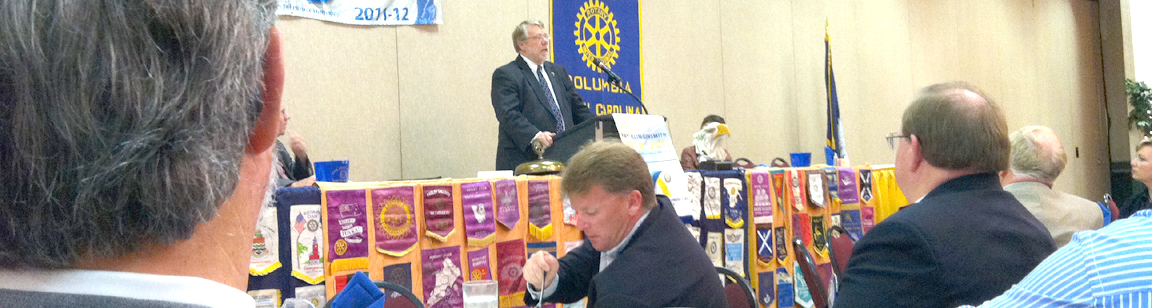
SC Commerce Secretary Bobby Hitt speaking to the Columbia Rotary Club on Monday.

Here’s a post I’ve been meaning to get to all week…

Fellow Rotarian Jimmy Covington asked my long-ago managing editor, Bobby Hitt, what he thought of the news media today. Bobby, who is now SC Commerce secretary, said:

I think that it’s as good as it can be.

That was followed by a long pause, with Bobby regarding the crowd with one of those patented Hitt wiseguy grins as they laughed with appreciation, before he added:

… but not as good as it was.

That said more succinctly what I say so often in answer to the same question. My more wordy answer goes something like, “You have to understand that my friends who still have jobs in the MSM are working heroically in the face of a really horrific lack of resources, yadda yadda….” Bobby put it more cleverly.

Here are some other things he said to the Columbia Rotary Club Monday…

  • Between the newspaper and Commerce, Bobby spent 18 years at BMW. So it was with some authority that he said that whatever you may think about the government providing economic incentives to attract jobs — however much you may want markets to take care of everything — the truth is that “BMW has never built an Interstate highway, and has no plans to do so in the future.” But without them, no BMWs would get delivered, and there would be no BMW plant in Greer.
  • A core strength of South Carolina in economic development is that “We’re good at making stuff.” When’s the last time, he asked, that a manufacturing company located here and then left? That’s why, aside from the new Bridgestone plant, Michelin has just expanded. Those are jobs that are here to stay, he said: Our grandchildren will be working at those plants. “The world gets us, maybe better sometimes than we get ourselves.”
  • Tensions between one part of the state and another are “foolish.” A great advantage we have is that we are a small state, and it’s possible for us to work together statewide. “I look at South Carolina as one big county” in promoting economic development.
  • “I would like to see a time when South Carolinians are not just on the plant floor; they’re in the front office.”
  • Staying a right-to-work state is key to economic development, and in any event it’s not up to him. He just doesn’t see any political chance of it changing. He said he doesn’t see South Carolinians as interested in third-party representation: “Most people in South Carolina don’t want to be told what to do by anyone other than the one that pays them.”

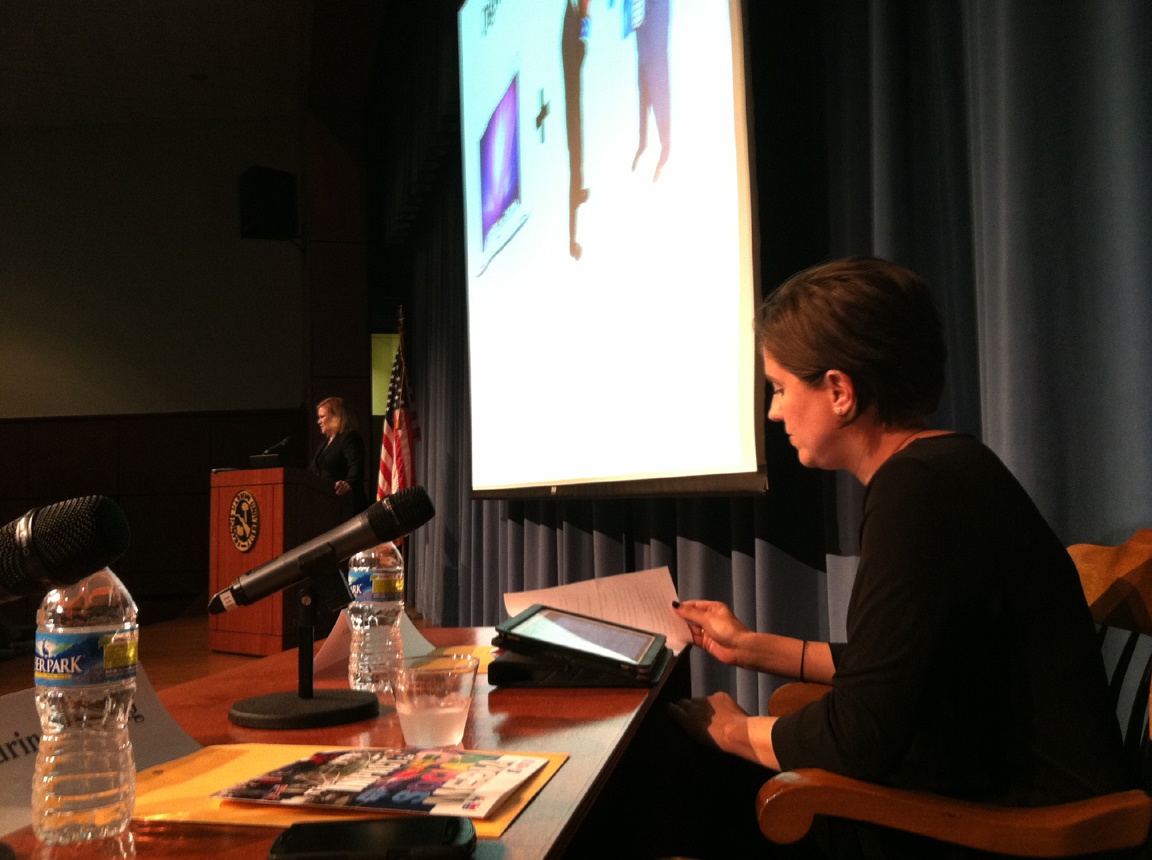
Laurin and Nancy at the social media symposium

Laurin is presenting, Nancy is going over her notes, and I'm trying to think up some mayhem that will get me sent to the principal's office. Just like school.

Last night, I participated in a symposium on politics and social media at Francis Marion University. Which was great. Trouble is, I was on a panel with Laurin Manning and Nancy Mace. And they were better prepared than I was.

See, I thought it was going to be just a panel discussion, so I had jotted some notes about points I wanted to be sure to hit on, and showed up. Laurin and Nancy had slide shows, and got up and made presentations. So I had to, too. No problem, really, because I can fill any amount of time… I talked about the old blog and why I started it and how it related to my old MSM job, and the new blog and how it’s going, my Twitter feed (dang! I forgot to mention I’m one of the Twitterati!), how I hate Facebook (it’s the AOL of this decade), “Seinfeld,” my Top Five Baseball Movies, and I don’t know what all.

Then at some point, I realized I’d gone on enough, or more than enough, and shut up. Which I think was cool, but it was way less polished than what the other panelists did.

You know how, when you were in school, there were these girls (and sometimes traitor guys) who always showed up with their homework done? And raised their hands and asked for more work, for extra credit? And when the teacher had been out of the room, and came back, they told her what you had been doing while she was gone? It was like that. Laurin and Nancy were good.

But I survived to the actual panel discussion part, and that went well (I think), so all’s well that ends that way. As it happened, I enjoyed it.

I especially enjoyed learning from Laurin and Nancy.

Laurin was sort of a mentor for me when I started blogging in 2005, and she was well established with the legendary Laurinline. She later was part of the unstoppable Obama social media machine of 2008. Recently, she’s blogged at SC Soapbox.

Nancy, the first female to graduate from The Citadel (how’s that for intimidating?), is founder and CEO of The Mace Group, LLC. She’s also partners with Will Folks in FITSNews— she does the technical side, and leaves the content to Will.

I’m not going to share with you all the cool trade secrets they imparted, because knowledge is power, and I want it all to myself. But I will share this anecdote that they told us about:

You know how Will started his blog? By accident. He was actually trying to post a comment on the Laurinline, and got so confused in trying to do so that he inadvertently set up a blog of his own. Really. That’s the way Laurin and Nancy tell it. The site is much more technologically sophisticated now with Nancy involved, and has more than a million page views a month — compared to my measly traffic, which has only broken a quarter of a million a couple of times. (That’s it. That was my display of humility for this month.)

Anyway, that’s why I was in Florence.

Fan suggests Spurrier take pay cut for Saturday

I mentioned breakfast at the Cap City Club back on my last post, which reminds me… Some of the guys at the regular round table this morning were talking about the Gamecocks-Auburn thing on Saturday, and one of them said, “I didn’t see any football over the weekend.”

What he meant was, he was there at Williams-Brice. He just didn’t see any football.

He’s not bitter or anything. He blames Coach Steve Spurrier for it, but he’s willing to forgive — if the Old Ball Coach will take a 1/12th cut in his pay for that one.

Intriguing. Since his salary is $2.8 million, that would mean a reduction of … $233,333.33.

Someone else at the table suggested that he could donate the amount to academics.

I am neither endorsing nor rejecting the idea. It’s one thing to deal in political controversy here on the blog without making suggestions about other people’s religion.

As for the rest of you… discuss.

Welcome new advertiser Palmetto Citizens FCU!

When I first went to work at The State in 1987, I immediately opened an account with the newspaper’s credit union. In our old building there in the shadow of Williams-Brice Stadium (it now houses part of S.C. ETV) it was located in what I remember as practically a closet in the Human Resources department — a cubby behind a sliding glass door and curtain.

Perhaps my memory exaggerates. In any case, it was small. But it wasn’t there for long. The company credit union soon merged with Columbia Teachers Federal Credit Union — which had been formed in 1936 when 10 individuals all chipped in $5 apiece. Columbia Teachers opened a branch just down the street from us near the intersection of Shop and George Rogers (or is it Assembly there? hard to tell), and put an ATM in the basement of our building.

By this time, the credit union had expanded well beyond just Columbia teachers, and in 2001 changed its name to Palmetto Citizens Federal Credit Union.

They’ve still got my money — what there is of it — including the account where I put revenues from the blog. Which will, for the next year, include payments from the credit union itself, for the ad you see at right. Which has a neat sort of circularity to it…

In any case, I’m pleased and proud to welcome a very fine community organization, Palmetto Citizens Federal Credit Union, to bradwarthen.com.

The worst thing about Haley’s chirpy greeting order is the insulting assumption that underlies it

The worst thing about the “It’s a great day in South Carolina!” order isn’t the fact that it is so grating and insulting to the caller. Callers can shrug that off; if they really need to do business with the state, they’ll take a breath and go ahead (even while filing a mental note that they now think less of SC government than they did before).

The worst thing is the attitude that underlies the order, which was ably set out in the newspaper this morning by Haley spokesman Rob Godfrey:

“While the press focuses on the negative, the governor is changing the culture of our state.. She is proud of South Carolina, and while we have challenges, we are making great progress every day. The focus of this greeting is to have state employees pass along a positive attitude and ask the caller, ‘How can I help you?’ so that they remember – and the people know – that they work for the taxpayers. The governor has always said that it’s time for government to work for the people, and this is the first step.”

She’s changing the culture of our state…. It’s time for government to work for the people…

This is the first step.

Because, you see, that never happened before. It’s never occurred to any state employee that they serve the people of South Carolina. Ever. Nikki Haley invented it. Thank God for Nikki Haley, because not one single state employee in the history of South Carolina has ever considered serving the public, even for a moment. If any had, this would not be the “first step” in implementing this wonderful new day. And this is the first step.

Again, we are seeing what we get when a person who does not have a clue about an organization — what it’s for, whom it serves, what its personnel are like, how it works, how it should work — is placed in charge of that organization.

Tragically for all of us, that organization is our state government — an institution that the people of our state, perhaps more than the people of any other state in the union, badly need to be well-led.

But there’s more to it than that. Nikki Haley is merely a symptom of a sickness in the politics of our state. The sickness is a nasty attitude of despising those who serve the public — and despising them more and more as their jobs become more difficult.

She is now engaged in the process of tearing down that workforce. And the first step is humiliation.

Full engagement, the only viable, effective and moral stance for the U.S. to take toward the world

Posting that column last night — the one from 9/23/01 — I realized that I had forgotten to post something else a week earlier.

When I shared with you the hasty column I wrote for the “extra” we put out on 9/11, and the one I turned around immediately and wrote for the next day, I had fully intended also to share a more important piece from several days later — the editorial I wrote for that following Sunday. But the 16th of this month came and went, and I failed to do that.

So I share it now. Being an editorial (an institutional, rather than personal opinion) and being a Sunday piece (when newspapers take a step back from immediate events, and also when they tend to express the views they regard as being of greatest import), it’s different from the other pieces. Less of my voice and style, more formalized. But at the same time, for the purposes of this blog, it also has perhaps greater value as a clear expression of my own views of what the nation should do going forward.

In it, I expressed views I had long held, and still hold, but they were sharpened and set into relief by the events of that week.

Spoiler alert: Basically, this piece is about a couple of things. The first is the need for re-engagement in the world, after a growing isolationism that had worried me all through the 90s. With notable exceptions — our involvement in the Balkans, for instance — we had become more insular, more preoccupied with our own amusements as a fat, happy nation. Up to that point, I had objected on the basis that when you are the world’s richest and most powerful nation (indisputable after the fall of the USSR), it is morally wrong to turn your back on the world, like a rich man behind the walls of his gated community. What 9/11 did was add to that the fact that such disengagement was positively dangerous.

The other main point is something I later learned an interesting term for: DIME, for “Diplomatic,” “Information,” “Military” and “Economic.” Actually, that’s not quite it, either. The DIME term refers to ways of exerting power, and that it certainly part of it, but not all of it. Another piece of the concept I was talking about was what you often hear referred to as “soft power.” Unfortunately, that is often mistakenly expressed as an alternative to “hard power.” But they complement each other. A unipolar power trying to achieve all of its goals through either alone is doomed to fail, ultimately.

No, I have to go back to the earlier, vaguer term: Engagement. On every level you can think of — diplomatic, cultural, mercantile, humanitarian, and yes, military.

Much of this piece, given the moment in which it was written, is occupied with the military part. That’s natural. That’s the hardest to persuade people of in our peaceful times (if you doubt we live in peaceful times, I plan a post after this one to address that). The rest, people just nod about and say, yes, of course we should do those things. (OK, perhaps I’m being a bit sanguine about that. I’ll just say that the people who need convincing on the military part are likely to say that — others are likely to say ‘Hell, no — let them fend for themselves.” And thus we have the two sides of isolationism.) They take more convincing on the tough stuff. (Some of you will object, “Not after 9/11! People’s blood was boiling!” But that’s not what I’m talking about. I’m not talking about passions of the moment. I was talking about long-term policy. I’m talking about what happens after people calm down and say, Never mind; let’s just withdraw.)

Reading it now, I wish the piece had been longer, with far more explication of the other elements, and how they were integrated. The following years, we saw constant argument between two views, neither of which saw the value of the whole concept. On the one hand, you had the Bushian — really, more the Rumsfeldian — notion that all you had to do was topple a tyrant and things would be fine. On the other, there was the myopic view that soft power was the only kind that was moral and effective.

These ideas are as relevant now as ever. Now that we have employed hard power to topple a tyrant in Libya, will we engage fully on other fronts to help Libya have a better future, one in which it has a chance of being a long-term friend, ally and trading partner? Or will we turn our attention away now that the loud noises have stopped going off?

Anyway, I’ve explained it enough. Here it is:

IN THE LONG TERM, U.S. MUST FULLY ENGAGE THE WORLD

State, The (Columbia, SC) – Sunday, September 16, 2001

IF YOU HAD MENTIONED the words “missile defense shield” to the terrorists who took over those planes last Tuesday, they would have laughed so hard they might have missed their targets.

That’s about the only way it might have helped.

Obviously, America is going to have to rethink the way it relates to the rest of the world in the 21st century. Pulling a high-tech defensive blanket over our heads while wishing the rest of the world would go away and leave us alone simply isn’t going to work.

We are going to have to drop our recent tendencies toward isolationism and fully engage the rest of the world on every possible term – military, diplomatic, economic and humanitarian.

Essentially, we have wasted a decade.

After the Berlin Wall fell and the Soviet Union crumbled, there was a vacuum in our increasingly interconnected world, a vacuum only the United States could fill. But we weren’t interested. After half a century of intense engagement in world affairs, we turned inward. Oh, we assembled and led an extraordinary coalition in the Gulf War – then let it fall apart. We tried to help in Somalia, but backed out when we saw the cost. After much shameful procrastination, we did what we should have done in the Balkans, and continue to do so. We tried to promote peace in the Mideast, then sort of gave up. But by and large, we tended our own little garden, and let the rest of the world drift.

We twice elected a man whose reading of the national mood was “It’s the economy, stupid.” Republicans took over Congress and started insisting that America would not be the world’s “policeman.”

Beyond overtures to Mexico and establishing a close, personal relationship with Vladimir Putin, President Bush initially showed little interest in foreign affairs.

Meanwhile, Russia and China worked to expand their own spheres of influence, Europe started looking to its own defenses, and much of the rest of the world seethed over our wealth, power and complacency.

Well, the rest of the world isn’t going to simply leave us alone. We know that now. On Tuesday, we woke up.

In the short term, our new engagement will be dominated by military action, and diplomacy that is closely related to military aims. It won’t just end with the death or apprehension of Osama bin Laden. Secretary of State Colin Powell served notice of what will be required when he said, “When we’re through with that network, we will continue with a global assault against terrorism in general.” That will likely mean a sustained, broad- front military effort unlike anything this nation has seen since 1945. Congress should get behind that.

At the moment, much of the world is with us in this effort. Our diplomacy must be aimed at maintaining that support, which will not be easy in many cases.

Beyond this war, we must continue to maintain the world’s most powerful military, and keep it deployed in forward areas. Our borders will be secure only to the extent that the world is secure. We must engage the help of other advanced nations in this effort. We must invest our defense dollars first and foremost in the basics – in keeping our planes in the air, our ships at sea and our soldiers deployed and well supported.

We must always be prepared to face an advanced foe. Satellite intelligence and, yes, theater missile defenses will play roles. But the greatest threat we currently face is not from advanced nations, but from the kinds of enemies who are so primitive that they don’t even have airplanes; they have to steal ours in order to attack us. For that reason, we must beef up our intelligence capabilities. We need spies in every corner of the world, collecting the kind of low-tech information that espiocrats call “humint” – human intelligence. More of that might have prevented what happened last week, in ways that a missile shield never could.

But we are going to have to do far more than simply project military power. We must help the rest of the world be more free, more affluent and more democratic. Advancing global trade is only the start.

We must cease to regard “nation-building” as a dirty word. If the people of the Mideast didn’t live under oligarchs and brutal tyrants, if they enjoyed the same freedoms and rights and broad prosperity that we do – if, in other words, they had all of those things the sponsors of terror hate and fear most about us – they would understand us more and resent us less. And they would, by and large, cease to be such a threat to us, to Israel and to themselves.

This may sound like an awful lot to contemplate for a nation digging its dead out of the rubble. But it’s the kind of challenge that this nation took on once before, after we had defeated other enemies that had struck us without warning or mercy. Look at Germany and Japan today, and you will see what America can do.

We must have a vision beyond vengeance, beyond the immediate guilty parties. And we must embrace and fulfill that vision, if we are ever again to enjoy the collective peace of mind that was so completely shattered on Sept. 11, 2001.

Well, I certainly hope this isn’t true about Amazon

Speaking of economic development news, I haven’t known quite what to make of this report, which one of our regulars has shared with me:

Employees say they faced brutal heat at Amazon warehouse

Twenty current and former employees at an Amazon warehouse in Pennsylvania say they were forced to work in brutal heat at a breakneck pace while hired paramedics waited outside in case anyone became dangerously dehydrated.

Spencer Soper has published an exhaustive investigation into the massive online retailer’s Lehigh Valley, Pennsylvania operation. Soper reports that a local doctor treated employees at the facility for heat-related health problems, and wound up filing a complaint about conditions there with federal regulators. Many of the warehouse’s employees were temporary and hired through a staffing company; if they did not meet packing quotas, they faced daily threats of termination, Soper writes.

He also notes that a corps of other temporary workers were poised to replace any freshly fired Amazon employee. “The safety and welfare of our employees is our No. 1 priority at Amazon, and as the general manager, I take that responsibility seriously,” Amazon warehouse manager Vickie Mortimer told the paper.

The original news story to which that summary refers is here. By the way, the summary is from Yahoo. Not sure what to make of that.

Our regular contributor sent that to me via email, so I’m guessing he meant to be an anonymous messenger. As for me, I just say I have great hopes for Amazon, and hope even more fervently that this description will in no way apply to the new facility here that will employ so many of our neighbors.

I doubt that it will. In this day and age, such stories are a bit hard to believe. But I pass it on for you to decide what you think.

Is Lamar Alexander about to do something very cool — from an UnParty perspective?

I’m puzzling, hopefully, over what this means:

The no. 3 Republican in the Senate will step down from his leadership position early next year, despite having no plans to retire from Congress.

Lamar Alexander informed his fellow GOP colleagues of his rather surprising decision on Tuesday morning in a letter obtained byPolitico, saying that the move was the best decision for him and the Senate.

“Stepping down from leadership will liberate me to spend more time working for results on the issues I care most about,” the 71-year-old former Tennessee governor wrote. “I want to do more to make the Senate a more effective institution so that it can deal better with serious issues. There are different ways to provide leadership within the Senate. After nine years here, this is how I believe I can now make my greatest contribution. For these same reasons I do not plan to seek a leadership position in the next Congress.”…

I’ve respected Lamar Alexander since  I covered him in his first successful run for governor in 1978, spending a good bit of time with him on the road (OK, so I was on the road with him 24/7 for one week before switching over to cover his opponent, but it was enough time to form a positive impression).

Lamar was never a guy you get particularly excited about. He was… bland. One of the most striking things about him was how much his speaking voice sounded like Pat Boone’s. (Once, I heard a PSA on the radio by Boone, and I thought it was the governor until he identified himself at the end — or was it the other way around?) His much-publicized walk across Tennessee in the trademark red-and-black shirt was SO contrived, such an earnest bid to be interesting, that I would joke about it, while at the same time appreciating his seriousness. He was what Tennessee needed after the rollicking corruption of Ray Blanton (who had defeated him four years earlier, on the very first election night of my newspaper career, when I was a copy boy at The Commercial Appeal). I would joke that Lamar’s main appeal to the voters was to subliminally project, “I won’t steal the silverware from the governor’s mansion.” But after Blanton, that was progress.

Turned out that there was a lot more progress to come with Alexander. He was different from any Republican governor I have seen since. He started out appointing Democrats to his Cabinet (his chief political adviser was someone who had worked for Democrats), and he reached out to the Democratic majority in the legislature to get his agenda passed, including significant movement toward merit pay for teachers. From day one, he was about raising the incomes of the average Tennessean, and he was for working with whomever it took to get that done. He worked particularly productively with the iconic speaker of the House (and later governor) Ned Ray McWherter.

He has served his state, and now his country, with pragmatic dedication and moderate sensibilities. So I’m sorry to see him leave leadership.

And puzzled. What does he mean he can be more effective outside that role? There’s a hint in the original Politico story:

Alexander says the decision was rooted in his desire to foster consensus in the gridlocked Senate, a role he felt constrained playing while spearheading the partisan Senate GOP messaging machine.

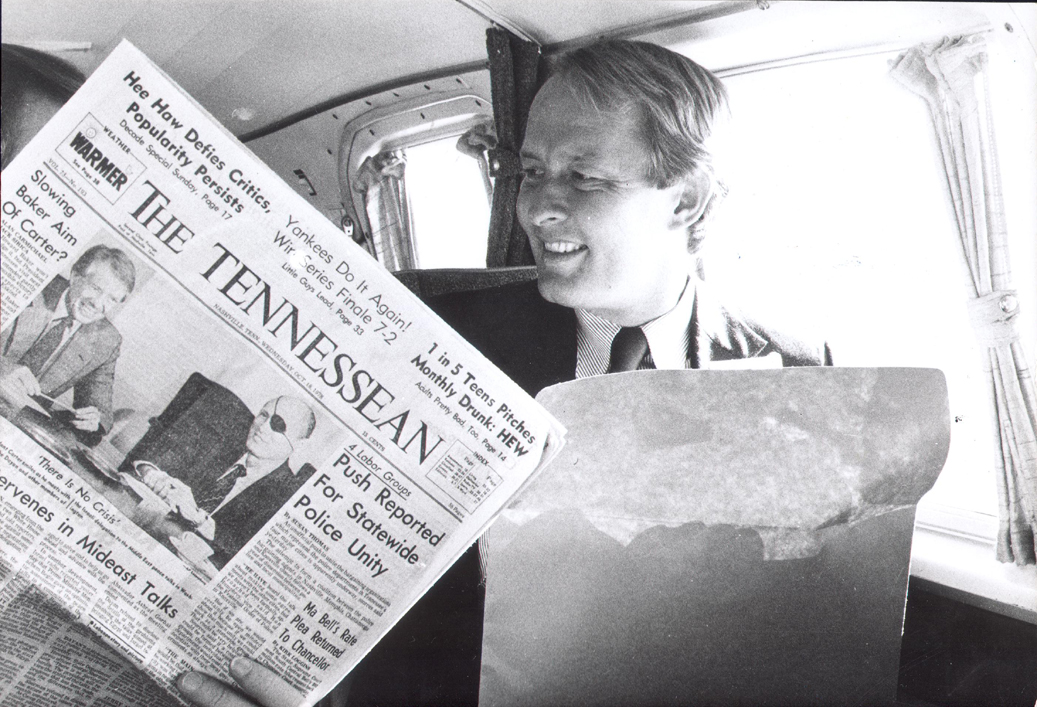
That sounds very cool — and even, despite this being Lamar Alexander, exciting. In an UnParty sense. I’d love to hear an elaboration on that. It would be nice to have back about 15 minutes of that time I spent riding around with him in cars and planes back in the day. I think I’d have more interesting questions now…

On the campaign plane with Alexander, back in the day./Brad Warthen

If she’s learned a lesson, that will be wonderful

KP brings our attention to this breaking news:

COLUMBIA, S.C. (AP) – South Carolina Gov. Nikki Haley said Monday she can’t back up claims that half of the people wanting work at the Energy Department’s Savannah River Site failed drug tests and half of the remainder couldn’t pass reading and writing tests.

Haley said in an interview with The Associated Press that she’s learned a lesson and is going to be more careful.

“I’ve never felt like I had to back up what people tell me. You assume that you’re given good information,” Haley said. “And now I’m learning through you guys that I have to be careful before I say something.”

Haley said she’d probably repeated “a million times” the story that about the test failures before being questioned about the assertions after a Lexington Rotary Club on Sept. 8. Her spokesman has been asked almost daily since then whether the claim could be substantiated…

Hey, if she has truly “learned a lesson,” I think that’s wonderful. And if she’s going to be more careful (and, dare we hope, thoughtful), that would be even better.

Hurray for the governor for admitting her error.

Greenville News gets on Nikki’s case

Don’t know whether you’ll be able to actually read this Greenville News editorial online (they make it hard), but here are excerpts:

Stop bashing state’s unemployed

The state’s more than 236,000 unemployed workers deserve better treatment than they have gotten in recent days from Gov. Nikki Haley. In her rush to score points with voters who mistakenly believe the unemployed have done something to earn their unkind fate, Haley used careless language to push a fundamentally flawed idea.

“I so want drug testing,” Haley was quoted as saying last week when discussing South Carolina’s stubbornly high unemployment rate that has gotten worse on her watch. “It’s something I’ve been wanting since the first day I walked into office.”…

Haley’s campaign mirrors those being run in a couple dozen states where some politicians are trying to convince people that drug-testing of the unemployed is needed to improve the nation’s wretched unemployment numbers. It’s an approach that simply defies the reality of what has happened over the past few years as the worst economy since the Great Depression has resulted in unemployment stuck near double digits.

This politically driven campaign ignores an important fact. Until the day they were handed their pink slip by companies looking to shore up their bottom lines, unemployed people actually had a job. And in much of America, those jobs came with a mandatory drug test before the job was filled and with other opportunities for random or for-cause drug tests during employment….

… Drugs were a factor in only about 1,000 of more than 400,000 unemployment claims, according to an Associated Press story from earlier this year.
Gov. Haley and other state leaders should focus on bringing more jobs to South Carolina and nurturing a system that better matches employers with workers. And they should stop this unseemly crusade of beating up on unemployed people just to score political points.
I’ll add a thought to that…
Who ARE these people with whom you can make political points by saying stuff like this? Who ARE these people who think of the unemployed as the undeserving “other”? It’s unimaginable to me. Well before I lost my 35-year newspaper career, I knew plenty of people who were out of work, across the economy, and plenty of others who were worried, and with good reason? Who lives in such a bubble that they don’t know all of these worthy, smart, hard-working people?
Oh, I know the answer to those questions. But I’m still incredulous that anyone could be so lacking in perception, and so mean-spirited. And I continue to be stunned that people such as Nikki Haley can appeal to such lowest common impulses and succeed in elections. And I’m sick and tired of this being the case. I want to live in a rational world.
And that’s the bottom line, really. I suppose it’s entirely about compassion in the case of people who are way nicer than I am. But I’m more about recognizing the things that are actually wrong with our economy, seeing how they affect us all, and seeing how even rational self-interest (altruism aside) requires us to address these problems realistically instead of acting like hermit crabs and reaching desperately for stupid excuses to dismiss what’s actually happening.

Why do you think all those people are out of work here in South Carolina?

I didn’t have much to say about South Carolina’s 11.1 percent unemployment rate, beyond these two thoughts: 1) I really hope this isn’t a double-dip recession (and if we actually got out of the first one, which I can’t tell; can you?), and 2) boyohboy am I sick of this stuff.

The disorienting thing for me about all this is that I can’t tell what’s happening. Outside of the newspaper business, I have trouble telling how things are going. I understood the economics of that, so I could tell as we went along: I can see things are bad. OK, now they’re worse. Now they’re WAY worse. Uh-oh, the PACE of getting worse just accelerated, dramatically. Whoa! The bottom just dropped out!

Not so much a roller-coaster ride as a fall down a well.

But out here in the world, where I’m immersed in the thing I was held away from, as a matter of policy — the thing called business — I’m disoriented, and have trouble telling what’s going on. Because it’s going on all around me, above me and below me and inside of me. It’s like… I read once that each man’s experience was totally different on Omaha Beach in the early hours, trapped on a limited scrap of sand that was all pre-sighted by the Germans, as death of various kinds rained down. You would experience one battle, and a guy 15 feet from you would experience something dramatically different.

This is like that, in the business world. Since I wasn’t supposed to touch business in the newspaper world, I could see it unfolding in front of me — like watching it on a screen. Now, I’m in it, and it’s much harder to see the real picture.

So some days I think things are going well, and the economy as a whole is picking up (based on what I see at ADCO and through the lenses of our various clients), and other days… not well at all. And it’s hard to make out the trend, the pattern.

Is it that way for you? Whether it is or not, I can tell that the unemployment rate climbing further is not one of the good signs. Not for any of us.

So that’s what I have to say about it. Someone writing in Salon decided to dig into the numbers, and this is what he had to say:

But a look inside the numbers, at the five worst and five best states, is unhappily revealing. The states with the five highest unemployment rates are Nevada (13.4 percent), California (12.1 percent), Michigan (11.2 percent), South Carolina (11.1 percent) and Florida (10.7 percent.) Nevada, California, Michigan and South Carolina all registered unemployment increases in August, compared to July. Florida held even.

The states with the lowest unemployment rates are North Dakota (3.5 percent), Nebraska (4.2 percent), South Dakota (4.7 percent), New Hampshire (5.3 percent) and Oklahoma (5.6 percent.)…

What does the geographical distribution of the hardest hit areas tell us? Again, not a whole lot that’s new. California, Florida and Nevada were among the three states hit hardest by the housing collapse, with Nevada getting the extra negative bonus of depressed Las Vegas tourism. Michigan, battered by globalization and the woes of the auto industry, has long been near the top of the unemployment charts. (Although the state had been improving quickly until about four months ago, when unemployment started rising again.) South Carolina’s high unemployment rate has been something of a mystery for years. Perhaps the most that can be said is that as a relatively low-tax state dominated by some of the most conservative Republican politicians in the country, it is certainly no advertisement for conservative orthodoxy, at least as far as boosting employment goes.

Of course, that’s about what you’d expect to read in Salon. Next time I see Salon saying anything positive about Republicans, it will be my first time.

They do have a point, though. We have pursued a certain course in South Carolina, in rather dramatic contrast to neighboring states such as Georgia and North Carolina, which decided to build up the kind of infrastructure — especially human infrastructure — that has made their economies stronger than ours.

I’ve lived all over in my life. And in my adult life, I’ve worked — and closely observed politics — in three states (the other two being Tennessee and Kansas). And I’ve never seen any place in this country more afflicted by self-destructive ideology than my home state of South Carolina.

So, you’ve heard what I think, and what some guy writing for Salon thinks. What do you think?

Disregard for facts, contempt for the jobless

SusanG brought this to my attention Friday, but what with the “little girl” flap, and the non-apology, I’d sort of had my fill of Nikki Haley gaffes that day before I got to it. In case you still haven’t seen was Susan was talking about, here’s an excerpt:

Nikki Haley’s Jobless Drug Test Claim Exaggerated

South Carolina Gov. Nikki Haley (R) wants thejobless to pass a drug test before they can receive benefits, but she seems to have an exaggerated sense of drug use among the unemployed…

Haley said scads of job applicants flunked a drug test at the Savannah River Site, a nuclear reservation along the Savannah River.

“Down on River Site, they were hiring a few hundred people, and when we sat down and talked to them — this was back before the campaign — when we sat down and talked to them, they said of everybody they interviewed, half of them failed a drug test, and of the half that was left, of that 50 percent, the other half couldn’t read and write properly,” Haley said….

Jim Giusti, a spokesman for the Department of Energy, which owns the River Site, told HuffPost he had no idea what Haley was talking about with regard to applicants flunking a drug test.

“Half the people who applied for a job last year or year 2009 did not fail the drug test,” Giusti said. “At the peak of hiring under the Recovery Act we had less than 1 percent of those hired test positive.”

The River Site doesn’t even test applicants. “We only test them when they have been accepted,” Giusti said.

A spokesman for Gov. Haley did not respond to requests for comment…

That’s some good reporting by HuffPo, although the headline was weak. If the body type was right, this was more than an “exaggeration.” Also, I’ve never heard SRS referred to on second reference as “River Site,” but whatever.

Gee, maybe if I’d given up some of those really heavy-duty drugs, I wouldn’t have been out of work for most of 2009, huh?

I’m really more than fed up with this stuff. You?

What I wrote later in the day on 9/11/01

Yesterday, I showed y’all what I wrote in the first hour, more or less, after learning of the attacks in New York and Washington 10 years ago. That raw, stream-of-consciousness piece ran in the “extra” that The State put out that day.

As soon as I had handed that to the folks putting that special edition together, I turned to what we would say for the next day’s paper — for Sept. 12. Then, almost as quickly, but with the benefit of a couple of more hours to let the news sink in, I wrote the following column.

Still nothing I would hold up as one of my best pieces of work, but it has its moments. For me. See what you think. And remember again: This is not a piece written with the benefit of years of reflection:

NOW THAT REALITY EXCEEDS FICTION, WHAT SORT OF ENDING WILL WE WRITE?

State, The (Columbia, SC) – Wednesday, September 12, 2001

Author: BRAD WARTHEN , Editorial Page Editor

WE’RE IN TOM Clancy’s world now.

Mr. Clancy is derided as a writer by critics for many reasons, one of them being the fact that his plots tend to be so fantastic and contrived. Take his novel Executive Orders. It was too much to be believed. It opened with a 747 having been deliberately flown into the U.S. Capitol, shutting down the government. This is followed by a series of coordinated terrorist attacks that result in thousands of civilian deaths on American soil. And for most of the book, no one knows who is doing this to us, or why.

We now know what that’s like. In fact, what we are now facing is worse than Mr. Clancy’s fevered imaginings.

It may seem unbelievably frivolous to be thinking about pulp fiction at a time like this, but my mind keeps returning to it, and partly because this seems so much like something from the realm of fiction – or because I wish it were.

It certainly outstrips anything that’s happened on any one day in this nation’s real-life history.

The comparisons to Pearl Harbor are inevitable. But in so many ways this is different – and worse. The death toll is larger, and the bodies we’re counting – and will continue to count for some time – aren’t wearing uniforms. They didn’t sign up to fight. They were just going to work, in what they thought was a free and peaceful country.

It’s also worse because we don’t know where to go with our grief and our rage. On Dec. 7, 1941, those sailors looking up at the red suns on the wings of the planes that were killing their buddies knew exactly what to do – and so did the rest of the nation.

I wonder if we’ll ever know what to do about this, in the same, ultimately satisfying sense of being able to restore peace and security to our nation and world. Oh, when we find out who did this, there’s no question about what we’ll do in the short term. Give us a target, something to shoot back at, and it will soon be nothing but smoke and ashes.

It will be a very short war. But what will we do when it’s over? How will we deal with the other disaffected, unconnected people around the world who will take inspiration from Tuesday’s events? What can we do, and what will we do, about the fact that there are people who hate us for no better reasons than that we are strong, wealthy and free?

Pearl Harbor isn’t our only comparison. People have mentioned the explosion of the Challenger as being comparable – then, too, the nation watched in helpless horror as fellow human beings died, in real time. But as awful as it was, there were only seven dead. And we figured out how to fix it. It was a simple problem of engineering.

Better O-rings won’t take care of this.

There are no precedents. Nothing in our past was quite like this. Even the Civil War, the most traumatic event in our collective experience, was in a sense less unsettling, in that everyone had a clearer understanding of what was going on.

Just as we can take little comfort from the past, our future offers no solace. It’s certainly not going to be anything like what we expected.

Some of the changes will come only if we’re smart enough to make them happen ourselves. Americans are going to have to start caring more about foreign affairs, if we’re ever going to deal adequately with this challenge. We can’t just fire a few cruise missiles and then hide behind a magical “Star Wars” shield. We’re going to have to engage the world – or at least, we’re going to have to demand that our elected leaders do so. And those political leaders are going to have to set aside a lot of their petty, partisan differences – or we’re going to have to replace them.

In other ways, some kind of change is inevitable, and all we can do is pick between unsavory choices.

From now on, this nation will be either less safe or less free. The openness and the freedom of movement that we take for granted make us enormously vulnerable, a fact that is absurdly obvious today. I suspect that at least in the short term, we’ll choose being a little less free in order to be a little safer. And that’s a sad choice to have to make.

I said we’re in Tom Clancy’s world. That’s true up to a point. The biggest difference is that I know how the book ends – once Jack Ryan and the other fictional protagonists figured out who was attacking the United States, they made war upon them with devastating effectiveness. In the end, the nation emerged stronger than ever.

What will happen in real life? Our capacity to make war is undisputed. But in the long term, how will we ever be the same?

The fact is, we won’t be. Our challenge is to emerge as something better than we were, not something worse.

The first words I wrote after the planes hit

I think I’ve told this story before, but to recap…

In 2001, the senior staff of The State — the heads of all the newspaper’s divisions (including news, advertising, circulation, HR, finance, production, marketing and of course, editorial) — met with the publisher ever Tuesday morning at 9. On Sept. 11, 2001, we had just sat down when someone from the newsroom came to the door seeking John Drescher, who was then our managing editor. John told us that a plane had hit the World Trade Center, then left the room.

We had it in our minds that it was a big story, and certainly John needed to get started on it, but we were picturing (at least I was) another confused amateur pilot in a Beechcraft or something. The WTC bombing of several years earlier crossed my mind, but I didn’t take it seriously yet.

It seemed we had just resumed the meeting when Drescher burst back in and told Executive Editor Mark Lett (News and editorial each had two editors who were on Senior Staff. The newsroom was represented by Lett and Drescher, while Associate Editor Warren Bolton joined me in representing editorial) that a second plane had hit the other tower.

Now we knew it was a coordinated attack  on the United States.

That was it. Meeting over. Everybody jumped up. A few of us huddled over by the window and discussed putting out an “Extra,” before moving on to putting together the regular paper for the next day. I asked whether they’d like a column from editorial, just to inject a bit of opinion into the special edition. They said “yes,” and I went to get to work.

The first job was to get some sort of sense of what was happened — I mean the total picture, not just the Twin Towers (which probably had not yet collapsed as I began). That wasn’t easy. A  lot was happening at once — the Pentagon getting hit, the Capitol evacuated, the president up in the air, somewhere. And then there were some the unconfirmed reports that later proved to be untrue — I don’t even remember the details of them now, some sorts of smaller incidents going on in the streets of Washington. Once they were discounted, I forgot them so my brain could process all the other stuff going on.

Once I turned to my keyboard, it took me about 20 minutes to write the following. That didn’t keep Drescher from sending up messages from the second floor: Where’s the copy? We’ve gotta go. Of course, all news really had to do is grab the stuff coming in and put it on a page. I had to think about what it meant, on the basis of alarmingly incomplete information, and write it.

So you might say this was written in even more of a hurry than a similar number of words on the blog, and amid great confusion and a certain amount of duress. You can read that in these words. There’s some emotion, and some thoughts, there that wouldn’t have been there a day later, or even a few hours later. Very stream-of-consciousness. I wince at some of it now. But it’s a real-time artifact, at least of what was going through my head that morning. See what you think:

AMERICA WILL FIND A WAY TO PREVAIL AGAINST COWARDLY ENEMY

State, The (Columbia, SC) – Tuesday, September 11, 2001
Author: BRAD WARTHEN, Editorial Page Editor
Sometime within the next 24 hours, no doubt, some television talking head somewhere will say, “This doesn’t happen here.”
Yes, it does. It has.
It’s happened before, in fact. It just wasn’t this close to home.
We remember Pearl Harbor. We’ll remember this, too.
The question is, what will we do about it?
Two nights ago, the nation delved back into its history with a celebrated media event, the premiere of the television version of Stephen Ambrose’s “Band of Brothers.”
We marvel at how a previous generation responded to an unprecedented crisis – a sudden attack by a ruthless, remorseless enemy. We think of those people as the “greatest generation,” and they deserve that appellation because of the way they came together to settle their own crisis and secure our future.
And we all wondered: Are we like them? Do we have it in us?
We’re about to find out.
We’re about to find out if we can snap out of shock, pull ourselves off the ground, set our petty differences aside, and come together as a nation to deal with our enemies.
For now, there is no question that we have enemies. And these enemies are in many ways different from Imperial Japan. In some ways, they are worse.
Pearl Harbor was an attack upon a distant outpost of American military power. The attack, as sudden and dishonest and vicious as it was, was at least an attack that made strategic sense in traditional military logic. And while there were civilian casualties, the obvious primary target was our fighting men and their machines of war.
This time, there is no pretense of such rudimentary “decency,” if you want to stretch so far as to call it that.
This time, civilians were the target every bit as much – if not more so – as our men and women in uniform.
This was a strike – and a temporarily successful one – at the chief power centers that have given this nation the strength to stand astride the world as its only superpower.
We are the world’s largest economy, so they struck, with devastating effect, at the very symbolic heart of that strength.
We are the undisputed military champion of the world, guarantor of security not only for this nation but for the rest of the globe. And this time they struck not just battleships and sailors, but the nerve center of our military colossus.
The greatest gift this nation has given the world is our form of democracy. And they have shut down and evacuated our Capitol and the White House. The home of the most powerful man in the world stands empty, surrounded by nervous men with automatic weapons and itchy trigger fingers.
The nation that gave the world flight is frozen, earthbound, at a standstill.
We are stunned. This attack has been devastatingly successful. We don’t know who did it, and we don’t know how much there is to come.
Our response will have to be different from the response after Pearl Harbor. This appears to be a different kind of enemy – the worst kind of coward. An enemy who strikes, and ducks and runs and hides.
How to prevail against such an enemy and restore peace and prosperity to the land is not immediately apparent.
But we will find a way. This is the same nation that was laid low 60 years ago, by an enemy who thought we lacked the will or the know-how to stop them. They were wrong then, and they’re wrong now.
We may not be the greatest generation, but we are their grandchildren. We are Americans. We are shocked, and we will mourn.
But then we’ll dust ourselves off, and find a way.

Later, I briefly attended a newsroom meeting in which they were talking about the next days paper (the only time I remember doing that during my years in editorial), and then turned to directing my own staff and writing stuff for the next day. I’ll show you that tomorrow.

Robert Ariail’s take on the anniversary

When I told Robert Ariail I had cartoon for Sunday from Bill Day and asked for one from him, he was glad to share, as always.

He decided to go back to black-and-white for this one, which I (and I think he) both prefer. I think color looks great on a lot of things, but this medium is stronger, has more gravitas, in black and white.

He mentioned that this was one he had thought of several years ago, and when he described it over the phone, I remembered it from when we were at the paper. So often, Robert had strong cartoon ideas (usually, several in a day), but came up with something he liked better for that day and set the first ones aside. I’m glad this isn’t one that ended up thrown away.

Which makes me think of something. Ten years ago, Robert, and Bill, and my old friend Richard Crowson, all had steady, good jobs at newspapers. So did I, for that matter, although I didn’t have their sort of talent.

Just another way the world changed.

Once, we had a “young lady” reporter at the paper, and a governor wanted to SPANK her. No, really.

Nowadays, we have our young lady governor calling a reporter a “little girl.” In the olden days, when men were men and so were governors,  they were somewhat more polite toward the youthful and female. But if they weren’t careful, they also came across as a bit kinky. I refer you to this column I wrote in 1994:

CARROLL CAMPBELL MUST LEARN HOW TO TAKE THE HEAT

State, The (Columbia, SC) – Sunday, April 10, 1994

Author: BRAD WARTHEN, Editorial Writer

If Carroll Campbell really wants to run for President of the United States, he will have to grow a much tougher hide.

The Governor is regularly mentioned as a top contender by some of the most respected political writers in America, including The Washington Post’s David Broder. But Broder and company are missing something. To use a baseball analogy, the top sportswriters have taken only a cursory look at this rookie. They’ve seen him field, throw and bunt. They’ve yet to determine if he can hit a curve ball. Or as Harry Truman might have asked, can he take the heat?

Mr. Campbell is an extraordinarily thin-skinned man for a politician. The general public doesn’t know this because Campbell manages his public exposure with an artful care reminiscent of the way Richard Nixon was handled in 1968. He stays above the fray.

But when he can’t do that — say, when someone surprises him with a tough question, off-camera — the image can fall apart. Experienced reporters have seen that carefully groomed mask shift, with remarkable speed, into a visage of suspicion and hostility. His eyes flash, and his answers, if he responds, are highly defensive. The motives of questioners are questioned.

This flaw isn’t fatal. People can change and, in fact, over the last couple of years, Mr. Campbell has mellowed. He’s become more statesmanlike and less confrontational. In seven years as governor, he has polished some of his rough edges.

At a luncheon briefing for editorial writers at the Governor’s Mansion in January, I saw the Carroll Campbell that Dave Broder sees. He was open, talkative and articulate, exhibiting an easy command of any topic that came up. In the next day’s editorial on his State of the State speech, I wrote about the “New Carroll Campbell .”

A month later, the Old Carroll Campbell was back.

It started with the effort by former state Rep. Luther Taylor to get his Lost Trust conviction thrown out. One of the tactics his lawyer used was to say the federal investigators had backed off investigating charges that could have implicated Mr. Campbell .

A little background: In 1990, when I was The State’s governmental affairs editor, we looked into these same charges and found an interesting story about how the Legislature gave 21 people an $8.6 million tax break. But we never found any evidence that Mr. Campbell was involved. And neither did the feds, with their far superior investigative powers.

Taylor alleged that the federal agents hadn’t gone far enough. The new U.S. attorney, a Democrat, agreed to investigate. The State’s federal court reporter,Twila Decker , concluded that the only way to check the course of the previous investigation was to gain access to Mr. Campbell ‘s FBI files, and she needed his permission. So she asked.

The Governor went ballistic. He requested a meeting with The State’s publisher and senior editors. This led to an extraordinary session on Feb. 17. Assembled in a conference room at The State were the various members of the editorial board and three people from the newsroom: Managing Editor Paula Ellis, chief political writer Lee Bandy and Ms. Decker . Mr. Campbell had a small entourage. Most of us wondered what the Governor wanted.

Over the next hour or so, we found out — sort of. Mr. Campbell had brought files with him, and between denunciations of those raising these charges anew, he read sporadically from the files. Each time Ms. Decker tried to ask a question, he cut her off, usually with a dismissive “young lady.”

Throughout the session, rhetorical chips fell from his shoulder: “This young lady had given me a deadline. . . . You’re smarter than the court. . . . I will not even be baited. . . . May I finish. . . . Now wait a minute, young lady; you’re mixing apples and oranges. . . . I really don’t care what you have, young lady. . . . You seem to be obsessed with ‘lists.’. . .”

No one in the room thought Mr. Campbell had done anything wrong, and everyone wanted him to have the chance to clear the air. But we were all riveted by his agitation, particularly as it was directed at the reporter. At one point, Editorial Page Editor Tom McLean felt compelled to explain to the Governor that Ms. Decker wasn’t imputing wrongdoing on his part by simply asking questions. It did little good.

At the end, the Governor stormed out, without the usual handshakes around the table — without even eye contact.

Later that afternoon, Consulting Editor Bill Rone, who had missed the meeting, stuck his head into my office to ask what had happened with Mr.Campbell . Bill said he had run into the Governor in the parking lot, and that he had been upset about Twila Decker . He told Bill he had been so mad he had wanted to “spank” her.

Repeatedly during the interview, Mr. Campbell had expressed indignation that he was being questioned by someone who wasn’t “here at the time.” Is that what he will say when the national press corps starts taking him really seriously, and somewhere in Iowa or New Hampshire or Georgia someone in the pack asks him about that capital gains thing in South Carolina? Or the 1978 congressional campaign against Max Heller? Or fighting busing in 1970? Or the Confederate flag?

Mr. Campbell has gotten altogether too accustomed to the relative politeness of the South Carolina press corps. Our group was throwing him softballs — real melons — and he went down swinging. What will he do when he faces major league pitching?

Of course, the late Gov.  Campbell didn’t mean anything kinky about it. He just wanted to punish her somehow. Putting Twila in the pillory would probably have satisfied him.

I remember one of the newsroom editors — someone who has not worked there for a long time — saying after he read my column, “Hey, I’d like to spank her, too.” He meant it the other way.

Something I changed my mind about…

Occasionally, I get asked here whether I ever change my mind about anything. I don’t know why I get asked that; probably because of the very definite manner in which I present opinions that I have examined and tested over and over again. I have a certain tone, people tell me.

Well, yes — sometimes I do change my mind. Here’s something I changed my mind about some time ago…

On an earlier post, “Tim” changed the subject and brought up Trey Walker’s departure to become a lobbyist for USC:

Wasn’t one of [Gov. Haley’s] points in the State of the State to eliminate state employee lobbyists?
http://www.thestate.com/2011/09/02/1955609/haley-deputy-taking-usc-job.html

And that reminded me… Back when we I led the “Power Failure” project at The State in 1991, I was convinced that state agency lobbyists were a bad idea. And I described the badness of the idea in the same terms the libertarians use: It was wrong for the taxpayers to have to pay someone to lobby the Legislature to spend more tax money in their area. Of course, that was a gross oversimplification of what lobbyists do, but it seemed convincing at the time. In those days, I was occasionally guilty of thinking about issues not much more deeply than Nikki Haley does.

Speaking of which… most of the actual good ideas that Mark Sanford and Nikki Haley espouse — and they have advocated some good one — can be found in a reprint of the “Power Failure” project. In fact, in Sanford’s case, a lot of them seem to have come directly from just such a reprint that I sent him when he was first starting to run for governor. Then, for some time, I heard my own words out on the stump and then coming from the governor’s office (and some of you still wonder why I endorsed the guy in 2002).

Anyway, back to the topic…

Over time, I changed my mind about the state agency lobbyists. About lobbyists in general, but especially state agency ones. I changed my mind about a number of things after I moved from news to editorial. I thought I was a pretty thoughtful guy when I was in news. But after I had to write opinions every day that would be read by more than 100,000 people, people who would challenge every word, every concept, who would tear into any weakness in my thinking, I thought about things on a deeper level than I had before, taking more factors into consideration than I ever had before.

One of the factors was that, as I observed the Legislature more and more, I came to value more the input that only someone with intimate knowledge of an agency could offer to the legislative process. Let’s just say that the more I knew about our lawmakers, and the harder I looked into issues before taking a position, the less impressed I was with our solons’ understanding of what was going on. Having someone there who could say, “Here’s how this works” before they make a change affecting an agency is immensely valuable. And folks, it’s not always about spending. Often, it’s about whether the policies put into law help or hurt the agency’s ability to deliver its assigned service to the people of South Carolina.

Those guys over in the State House need all the relevant, well-informed input they can get. And if the lobbyists are any good, they are worth their salaries and then some.

Even Nikki Haley thinks so, since she said about Trey’s move, “He’s a talented, loyal and committed guy — and the University of South Carolina is lucky to have him.” Which I take to mean that she agrees with me that he’ll be worth his $135,000 salary there.

Once Trey gets on board, maybe when he makes his visits to the State House, he can drop by his former boss’s office and fill her in on what USC is all about, and how important it is to this state.

If he could do that, he’d be worth twice the pay.

Gimme a little help here, Michele

After receiving yet another of these from Michele Bachmann:

Dear Fellow Conservative,

DonateIt’s hard to believe that September is already upon us. As the summer comes to an end, I hope that you are able to spend and enjoy this long Labor Day weekend with your friends and family.

It has been just over 70 days since we announced our campaign for President, and the days have flown by. Although the seasons and months may be changing, one thing remains certain in the United States: Americans are tired of President Obama’s failed leadership and policies….

Below, I’ve included some informative articles about the past week, and some great ways for you to get involved with our campaign. After reading them, I hope that you will consider making a contribution of $25, $50, $100, or any amount up to the legal limit to help spread us our message of growth and prosperity in this busy time.

Sincerely,


Michele Bachmann

Well… at least she didn’t call me “Brad,” the way those grasping missives from the Democrats do. I wrote this note in response:

I seem to have ended up on the wrong email list. I’m a journalist, a 35-year newspaper veteran. I’m now covering the campaign for my own blog, bradwarthen.com. What I need to receive are press releases and media advisories. Yet somehow I’ve gotten on the fund-raiser mailing list.

I assure you, I will not be giving to this or any other campaign. I just need the info necessary to COVER the campaign. Anything you can do for me would be appreciated.

— Brad Warthen

I have no idea whether this note will do any good. It’s one of those “info@” addresses, and those are generally not read by humans, right? But one must try.

I think I got on this list by requesting via Twitter to be included in campaign communications. I need to be more specific in the future, I guess.

The new normal: This is what a complete network TV crew looks like today

The other day, I was at the presser at which Jon Huntsman announced that Attorney General Alan Wilson was supporting him (which I still intend to write a post about, but haven’t had time to go back through all my notes), and at one point I happened to look around and think how very, very young most of the media people were.

When I stood in that same place two years ago representing The New York Post, in front of that same (I think) lectern, listening to Mark Sanford tell about his surprise vacation in Argentina, I didn’t think that. I saw mostly usual suspects I had known for years. (Although I did notice in photos of the gaggle later that I had the grayest hair in the bunch. It was one of those “Who’s that old guy? … oh!” moments.)

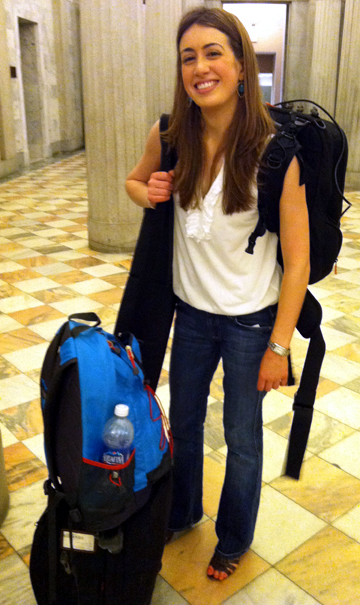
But the biggest difference between this group and the media mob scenes I experienced when I was as young as these kids were was that the TV crews are so much smaller. As I saw Ali Weinberg of NBC packing up her stuff after, I mentioned to her that back in the day, her network would have a four-person crew covering a presidential candidate: the talent, (at this point she started saying it along with me), the camera guy, the sound guy (and back then those two jobs usually were filled by guys), and the field producer. Now, it’s just her. And she’s in front of the camera, behind the camera, carrying the equipment, handling her own arrangements, Tweeting, and I don’t know what all.

Of course, it’s been this way for several years now. I remember Peter Hamby and others doing the same thing four years ago.

But seeing someone as petite as Ali getting ready to carry all that stuff kind of dramatized the situation. Yes, Ali agreed with me, all told it probably did weigh as much as she does. And no, she didn’t need any help.

Her affiliation reminds me of the NBC crew I kept running across in Iowa in 1980 when I was following Howard Baker, who was running in the caucuses that year. I rode with Jim and Flash (the sound and camera guys, respectively) through an ice storm in a four-seater plane between Des Moines and Dubuque. Just the two of them, the pilot and me. The pilot kept squirting alcohol on the outside of his windshield to make a clear space in the ice about the size of his hand to see through to fly. When we got out on the tarmac — which was covered in ice — I went to put my overcoat back on, and the wind caught it and I started gliding across the runway like a ship on the sea. (I only realized later — after the crash of Air Florida Flight 90 into the Potomac in 1982 — how dangerous that trip was.)

On another occasion, the producer of that crew — a pretty young woman who reminded me of the actress Paula Prentiss — overheard my photographer, Mark, and me discussing where we were going to stay the night and holding open our wallets to see what was left inside. She offered to put us up if we were in a bind. Producers had that kind of cash to throw around in those days. Like Ali today, we said no, thanks.

Those days are long gone.

You know what you know, you know?

People who reach conclusions rapidly, intuitively — the way I do — may have confidence in their conclusions. Which I generally do, because when the conclusions are testable, I’m wrong seldom enough that my confidence is preserved. But I know this faculty is (like all decision-making processes) fallible, and there is a certain insecurity caused by the perceptions of others, particularly the concrete thinkers, the materialists, the folks who test as an S on the Myers Briggs scale, as opposed to my extreme N. The people who view holistic, Gestalten perception with utter contempt.

This habit of thought is extremely useful in arriving at opinions on complex, controversial issues in time to write about them on deadline. It’s why I was extremely adept at being an editorial page editor, if at nothing else (something that didn’t matter in the end, since it all came down to money). Not only for the purposes of writing opinions myself, but (much more to the point, since I was the editor) for guiding the board quickly to a conclusion. We’d be arguing, and then I would say something that paid due consideration to everyone’s seemingly disparate views, but which was coherent and followed logically and made all the people who had been arguing nod and say Yes, that’s our position.

It sounds like I’m bragging about how brilliant I am, but not really. (In  fact, to doubters I’m confessing what an idiot I am.) Frankly, I suspect most people look at me and wonder whether I’m good at anything. Well, I am, and that’s the thing. The one thing that seems to impress people most when they witness it, and when they are disposed to be impressed. The rest of the time, I think they’re more inclined to wonder who let the incompetent doofus into the room.

Conveniently, it’s a talent that also occasionally comes in handy working as a Mad Man. Much of what we do at ADCO still bewilders me, but when it comes time to sum up a message that the client has been struggling to express, I am able to contribute.

This works great, when people are impressed — such as yesterday, when a client called some modest flicker of insight of mine “brilliant.” (Which it wasn’t — I later looked at it written and there was a glaring grammatical error in what I’d said. But fixable.)

It’s more of a problem when people don’t think I’m brilliant — in fact, quite the opposite — and challenge my conclusions. You know, the way Bud and Doug always do. With those guys, I get frustrated because most of my firm assertions cannot be supported by a mathematical proof that will satisfy them, so they conclude that I’m just making it all up or something. And they assert it with sufficient vehemence — being as confident in their conclusions as I am in mine — that sometimes, like a dust mote drifting into a gleaming clean room, a tiny bit of doubt surfaces in my own mind: If I’m so right, why can’t I prove it to everyone’s satisfaction? Which I knew I couldn’t do, even before meeting Bud and Doug. Anyone who thinks his beliefs are self-evident to all (however he arrives at them) will be quickly disabused by even a short stint as editorial page editor. (Yes, Virginia, before blogs and Twitter and email there was the telephone, and snail mail, and running into detractors at social occasions. All designed to take you down a notch.)

So, I find it reassuring to read something like this, in an article in Slate about the uncertainties entertained by identical twins about whether they are identical:

As science looked for more cost-effective ways to divine zygotic history, blood tests and other lab work gave way to surveys that combined objective measurements—height, weight, tone of voice, etc.—with questions about how the pairs were perceived. Were they confused for each other by teachers and friends? Parents? Strangers? But even that proved more in-depth than necessary. In a 1961 study by a Swedish scientist named Rune Cederlof, the whole exam hinged upon a single, probing question: “When growing up, were you and your twin ‘as like as two peas’ or of ordinary family likeness only?”

It turned out that whether twins thought they’d been “as like as two peas” could predict the results of every other available test with surprising accuracy. Cederlof found that the twins’ answers to this one item on the questionnaire matched overwhelmingly with five independent measures of blood type. After nearly 100 years, our finest scientists realized that discerning a man’s zygotic origin was about as easy as discerning whether he was ill by asking if he had a runny nose.

The examination of DNA, then, may be an entirely superfluous reassurance: like searching for witnesses to a murder when the act itself was caught on tape.

Yes! All right! Go, intuitive perception!

By the way, you may enjoy taking the quiz at the bottom of the first installment of that article. It will cause you to be skeptical about  your own skepticism. (Oops. Maybe I should have said “spoiler alert” first…)

I continue to believe Twin B and Twin A are identical, despite their pronounced differences. Such as the contrasting ways they habitually pose for pictures (one makes faces; the other instinctively goes for glamour). Don't be fooled by the fact that one has shorter hair.