Just had to share this Tweet from Nancy Mace, who is challenging Lindsey Graham in next year’s GOP primary:
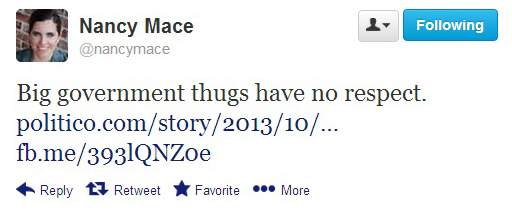
Yow! Really, Nancy? Thugs?
That doesn’t sound like you. That sounds more like, well, whoever is doing your social media…

Just had to share this Tweet from Nancy Mace, who is challenging Lindsey Graham in next year’s GOP primary:
Yow! Really, Nancy? Thugs?
That doesn’t sound like you. That sounds more like, well, whoever is doing your social media…
Yeah, I know he studied ophthalmology in England, and his wife was born and grew up there.
But I was struck by Assad’s fluency in his interview with Charlie Rose. I had called it up expecting it to be conducted through an interpreter. Even if a foreign leader speaks English well, an interpreter offers advantages — first, your own people see you speaking your native tongue; it’s a nationalistic statement. Then, it gives you extra time to think of a good answer.
But Assad didn’t choose that path. In a situation in which his regime and by extension his life are on the line, dealing with a highly respected interviewer asking probing questions, he managed to maneuver his way through the interview without stumbling. He had thoroughly internalized his talking points, his version of the story, and he stuck to it, stayed smooth.
He not only stayed on message, he showed a deft understanding of and ability to manipulate U.S. politics at this critical moment, as The Washington Post observed.
He did all that in a second language.
On one level, this is further testimony to just how ubiquitous our own language has become globally. On the personal, though, I find myself wondering how he keeps up his proficiency to this level. Surely it isn’t spoken much in his daily interaction with his officials and generals as he fights this war.
Do he and his wife speak it daily at home?
I’m intrigued…
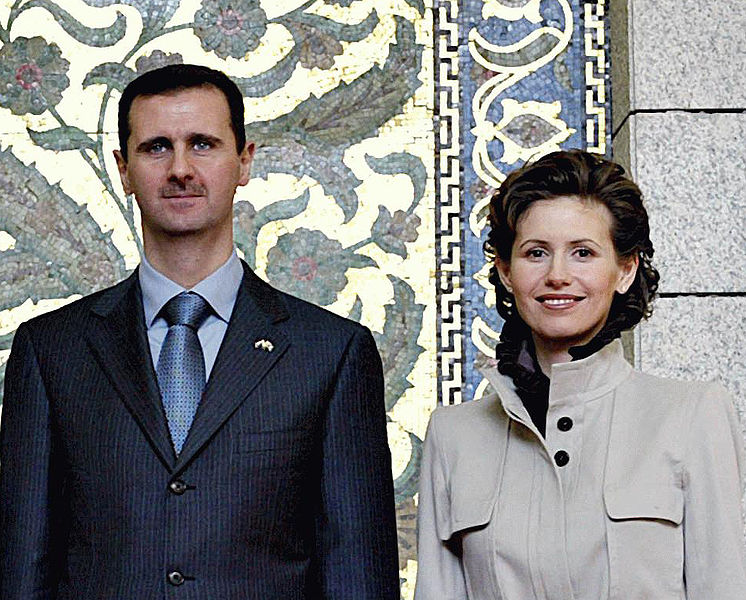
Do the Assads routinely speak English at home?
There are a number of things worth discussing in Vladimir Putin’s op-ed in The New York Times today. One of my favorites is the part where this ex-KGB man invokes God in lecturing us about our exceptionalism:
And I would rather disagree with a case he made on American exceptionalism, stating that the United States’ policy is “what makes America different. It’s what makes us exceptional.” It is extremely dangerous to encourage people to see themselves as exceptional, whatever the motivation. There are big countries and small countries, rich and poor, those with long democratic traditions and those still finding their way to democracy. Their policies differ, too. We are all different, but when we ask for the Lord’s blessings, we must not forget that God created us equal.
I guess someone at the Kremlin persuaded him that that’s how you speak to those simple, theistic folk in America.
Whatever. In any case, I am not deeply shocked that Putin does not believe in, or at least not approve of, American exceptionalism.
I’ll just say that there’s something deeply ironic about the guy whose tank treads so recently rolled over Georgia to be saying such things as, “It is alarming that military intervention in internal conflicts in foreign countries has become commonplace for the United States.”
And don’t get me started on this absurdity:
No one doubts that poison gas was used in Syria. But there is every reason to believe it was used not by the Syrian Army, but by opposition forces, to provoke intervention by their powerful foreign patrons, who would be siding with the fundamentalists…
“Every reason to believe” the rebels launched the chemical attacks? Uh, no, there isn’t. In fact, I don’t know of any reasons to believe it, unless you’re an Assad cheerleader and therefore really want to believe it. Yep, some of those rebels would do it if they could. But I’ve seen no credible arguments that any of them have the capability to do it. It’s not like we helped them. We’re just now finally getting around to supplying some of those small arms we promised months ago.
So “every reason?” No, not even close.
Let’s look at the rest of that statement. Which side has “powerful foreign patrons” who are actually actively engaged in supporting its war aims? The only side that describes is the Assad regime, which has been receiving substantial material support from both Russia and Iran. I’m not aware of the rebels having “powerful foreign patrons.” But if that’s a reference to us, then he tells yet another whopper with that bit about “who would be siding with the fundamentalists.” No, as everyone knows, the main reason we have NOT come down unequivocally on the side of the rebels, the way Putin has for Assad, is that we don’t want to risk siding with said fundamentalists.
Oh, but I said “don’t get me started.” Sorry; I seem to have started myself. I’ll stop now.
I mean, I’ll stop that, and turn to the reference to exceptionalism in the president’s speech the other night.
America is not the world’s policeman. [Wrong, but I’ve addressed that elsewhere.] Terrible things happen across the globe, and it is beyond our means to right every wrong. [Nor is any policeman able to right every wrong on his beat, making this a deeply flawed analogy, but again, I’ve discussed that elsewhere.] But when, with modest effort and risk, we can stop children from being gassed to death, and thereby make our own children safer over the long run, I believe we should act. That’s what makes America different. That’s what makes us exceptional. With humility, but with resolve, let us never lose sight of that essential truth.
No, Mr. President, our exceptionalism is not a matter of simply making “our own children safer over the long run.” Pretty much all nations will take military action if the lives of their own children are threatened. In that respect, as you once inappropriately said, American exceptionalism is no different from “Greek exceptionalism.” You’re right in that collective security affects us all, and a crime against foreign children is ultimately a crime against our own. But America is exceptional in that it has the power to act against tyranny when it’s harming other people, and when our own interests are not directly or obviously involved.
You would have been right if you’d simply said, “when, with modest effort and risk, we can stop children from being gassed to death… I believe we should act.” That is exceptional. The qualifying phrase about our own children makes us unexceptional. See what I mean?
We are exceptional because, in the ongoing effort to uphold certain basic civilizing principles across the globe, America is what former Secretary of State Madeleine Albright called “the indispensable nation.” We have the power to act for good in ways that other nations cannot, and because we have that power, we have responsibilities that we cannot abdicate. Or, at least, should not abdicate.
It doesn’t have to be rationalized in such terms as, Hey, those could be our kids.
Of course, there are many other ways, Mr. Putin and Mr. Obama, in which this nation is exceptional: This is the country where a foreign leader whose interests are clearly opposed to those of this nation can get an oped published, in the leading national journal, trashing that same nation’s cherished ideas of itself, without any consequences to anyone. It’s always been like that here, and it has set us apart starkly from such nation’s as, just to throw one out, the Soviet Union. It’s also the country that believes the whole world should enjoy such a free flow of ideas, and is wiling — occasionally, at least — to stand up for that. Just FYI…
The headline pretty much says it.
I thought the president gave a good, reasoned, tempered, well-balanced speech at a very tricky time. He scheduled this talk tonight to sell us on the idea of taking military action in Syria, and in the last two days we’ve seen developments that may preclude that.
But he handled it well. He made the case for action, should it still prove necessary, but gave diplomacy a chance to work, given the present extraordinary circumstances.
There’s only one false note he sounded — the repeated emphasis on the United States not being the world’s policeman.
Yes, we are. Everything else the president said indicated that he knows that we are.
This is not me saying that the United States should be the world’s policeman, or that’s what I think we should aspire to. That’s what we are. We have power to act effectively, and if we don’t, it’s an abdication of a moral responsibility. As the president said.
It’s silly to say something like that, just to satisfy the factions who hate the reality that that’s what we are.
Note the faulty logic in this passage:
America is not the world’s policeman. Terrible things happen across the globe, and it is beyond our means to right every wrong.
Guess what? A policeman can’t prevent every crime that happens on his beat. He’s not perfect; his power is not absolute. But he does his best.
Other than that, good speech. Just what was needed at this awkward moment.
When SC Shakespeare Company did “Pride and Prejudice” last year, we had a couple of diction coaches helping us with Received Pronunciation. Which was probably reasonably faithful to the way Austen’s characters would have spoken.
But when this company or any other wants to be true to the original productions of Shakespeare, how on Earth are they supposed to know how it should sound?
These guys say they know. And the folks who run The Globe apparently believe them. Whether they’re right or not, it’s an interesting piece.
Turns out that English accents sounded vaguely Scottish — or some other Gaelic variant. In any case, it doesn’t sound English to this modern ear.

I shot this while touring the new Globe in December 2010.
I thank Slate for bringing this to my attention:
Secretary of State John Kerry’s case for a U.S. strike in Syria seems to rest on two assumptions. One, that it is a crucial test for U.S. national security and the values of the civilized world comparable to the rise of Nazi Germany. Two, that it’s not really a big deal….
Today, Kerry—now in Britain—issued an ultimatum to Syrian President Bashar al-Assad, giving him one week to turn over his complete stockpile of chemical weapons, or else. Or else what?
Kerry said the Americans were planning an “unbelievably small” attack on Syria. “We will be able to hold Bashar al-Assad accountable without engaging in troops on the ground or any other prolonged kind of effort in a very limited, very targeted, short-term effort that degrades his capacity to deliver chemical weapons without assuming responsibility for Syria’s civil war. That is exactly what we are talking about doing – unbelievably small, limited kind of effort.”
I may not have much experience with brinksmanship, but it seems to me that threatening to hit someone becomes a lot less effective when at the same time you’re telling your friends,Don’t worry, I’m not going to hit him that hard. And convincing the public that this situation is analogous to the buildup to the largest war in human history is difficult when you’re also saying that an “unbelievably small” effort will be sufficient to deal with it. Given the blows the Assad regime has already absorbed over the last two years, it’s hard to imagine statements like these changing his thinking.
One wonders whether Bashar Assad is now laughing unbelievably hard…
POTUS delivered an impressive speech in the Rose Garden today, strongly and ably making the case for why we need to act in Syria, then noting that he is fully empowered to act without anyone’s permission… and then saying he won’t decide, but will leave it to Congress.
You know, the body that can’t pass a budget. The gang that can’t raise the debt limit to keep the government functioning without a major, credit-rating-damaging meltdown. That’s who he’s asking to decide.
First, let’s quote some of the stronger passages in which the president makes the case for action:
This attack is an assault on human dignity. It also presents a serious danger to our national security. It risks making a mockery of the global prohibition on the use of chemical weapons. It endangers our friends and our partners along Syria’s borders, including Israel, Jordan, Turkey, Lebanon and Iraq. It could lead to escalating use of chemical weapons, or their proliferation to terrorist groups who would do our people harm.
In a world with many dangers, this menace must be confronted.
Now, after careful deliberation, I have decided that the United States should take military action against Syrian regime targets…
I’m prepared to give that order…
I’m confident in the case our government has made without waiting for U.N. inspectors. I’m comfortable going forward without the approval of a United Nations Security Council that, so far, has been completely paralyzed and unwilling to hold Assad accountable….
What message will we send if a dictator can gas hundreds of children to death in plain sight and pay no price? What’s the purpose of the international system that we’ve built if a prohibition on the use of chemical weapons that has been agreed to by the governments of 98 percent of the world’s people and approved overwhelmingly by the Congress of the United States is not enforced?
Make no mistake — this has implications beyond chemical warfare. If we won’t enforce accountability in the face of this heinous act, what does it say about our resolve to stand up to others who flout fundamental international rules? To governments who would choose to build nuclear arms? To terrorist who would spread biological weapons? To armies who carry out genocide?
We cannot raise our children in a world where we will not follow through on the things we say, the accords we sign, the values that define us….
I will also deliver this message to the world. While the U.N. investigation has some time to report on its findings, we will insist that an atrocity committed with chemical weapons is not simply investigated, it must be confronted….
I don’t expect every nation to agree with the decision we have made. Privately we’ve heard many expressions of support from our friends. But I will ask those who care about the writ of the international community to stand publicly behind our action….
But we are the United States of America, and we cannot and must not turn a blind eye to what happened in Damascus. Out of the ashes of world war, we built an international order and enforced the rules that gave it meaning. And we did so because we believe that the rights of individuals to live in peace and dignity depends on the responsibilities of nations. We aren’t perfect, but this nation more than any other has been willing to meet those responsibilities…
Ultimately, this is not about who occupies this office at any given time; it’s about who we are as a country…. and now is the time to show the world that America keeps our commitments. We do what we say. And we lead with the belief that right makes might — not the other way around.
We all know there are no easy options. But I wasn’t elected to avoid hard decisions….
I’m ready to act in the face of this outrage….
That’s the speech, without all the “buts” and “howevers” removed. Wow. Pretty powerful, huh? What a call to arms. Note the repeated use of the word, “must:” this menace must be confronted… it must be confronted…
Except, in the end, it isn’t. The president said, “I wasn’t elected to avoid hard decisions,” even as he was avoiding this hard decision. Actually, it’s weirder than that. He’s made up his mind, and one of the things he’s made up his mind about is that we really don’t have a choice. We must act. And yet, he won’t.
If the world were a debating society, this wouldn’t matter. Act today, next month, next year, it would all be the same. The important thing would be to let everyone fully have their say, and make sure everybody feels great about the ultimate decision (which ain’t gonna happen, but that seems to be the idea here).
But in the real world, it may already be too late to act with any effectiveness, in terms of degrading Assad’s air assets, or ability to launch future chemical attacks on his people — or having any other effect that would actually be helpful.
As the president says, “The Chairman of the Joint Chiefs has informed me that we are prepared to strike whenever we choose.” So, if we’re going to do so, the time to do it is now. Or rather, yesterday. Or several months ago, when the president’s red line had already been crossed, and those 1,429 people were still alive, when those 400 children still had futures.
In short, I am most disappointed in the president’s abdication of responsibility — especially after he so ably made the case for immediate action.
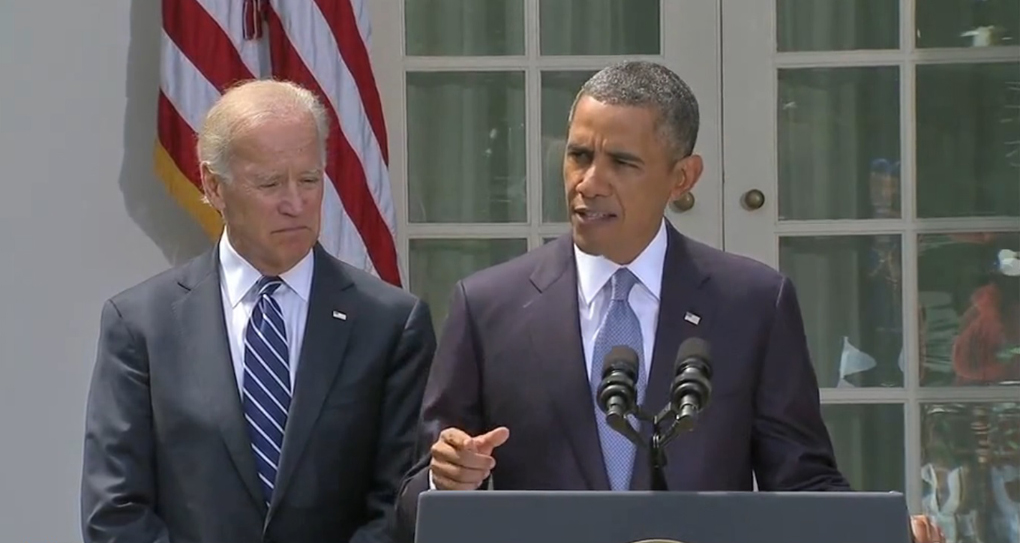
Those who wondered why the Obama administration had been slow, at least before the last few days, to acknowledge that Syria had crossed its red line — or to act (you know, by actually giving rebels those promised arms) when it did own up to it — must not have paid close attention to the specific words that the president used when he drew the line:
We have been very clear to the Assad regime … that a red line for us is we start seeing a whole bunch of chemical weapons moving around or being utilized. That would change my calculus…
How much WMD is “a whole bunch?” I don’t know. But I think maybe we’ve finally gotten to that point…
Samsung wants so badly to get me to try a Galaxy S4, that it’s offering me two for one. In Spanish, in case I find that more persuasive.
Lo siento, Samsung, pero creo que mi iPad es mucho mejor.
OK, I sort of got a kick out of this:
In 2012, Democrats’ constant refrain that the Republican party was in the midst of a “war on women” left the GOP — all the way up to presidential nominee Mitt Romney — exasperated at what they called a gross mischaracterization. Now Republicans are embracing the term as a way of reminding voters of Democratic men who have cheated, sexted, and harassed.
In e-mails, press releases and tweets, the Republican National Committee, National Republican Senatorial Committee and National Republican Congressional Committee are highlighting a “war on women” waged by San Diego Mayor Bob Filner (harassment), New York mayoral candidate Anthony Weiner (sexting), and former New York governor Eliot Spitzer (prostitutes).
Mentioned less often but still on the list: New York State Assemblyman Vito Lopez (harassment) and Tennessee Rep. Steve Cohen (mistakenly thinking he had a daughter, calling a reporter “very attractive”) among others.
“The best tools we have as Republicans to recruit women candidates this cycle are three Democrats named Bob Filner, Eliot Spitzer, and Anthony Weiner,” said NRCC spokeswoman Andrea Bozek…
Yes, it’s ridiculous to accuse an entire party of a “war on women” because of the personal misdeeds of a few. But it’s no more ridiculous than the Democrats using the hyperbolic term the way they did in last year’s election.
A recent essay in The Wall Street Journal scoffed at those who bemoan the decline in the number of students majoring in the humanities.
Perhaps that writer was right. But you know, I think it would really help if some of those left-brain STEM types would take a couple of English classes.
Remember that story from yesterday’s VFP about experiments into whether warp-speed travel is possible?
Did you see this quote?
“Space has been expanding since the Big Bang 13.7 billion years ago,” said Dr. White, 43, who runs the research project. “And we know that when you look at some of the cosmology models, there were early periods of the universe where there was explosive inflation, where two points would’ve went receding away from each other at very rapid speeds.”…
Ow! He might be a heck of a rocket scientist, or whatever, but his abuse of the language is rather distressing.

My old roommate John peers out from our room in Snowden in 2006, just before the Honeycombs were torn down.
“Snowden” is one of those names that sticks with you. Or with me, anyway. It was technically the name of the particular one of the Honeycombs I lived in that one semester I went to USC in 1971 — although I seem to recall that a lot of people called it by a letter designation. Was it “J”? I don’t know. Maybe. “Snowden” sticks better.
That’s probably because I was so hugely into Catch-22 at the time. I had first read it the summer before my senior year of high school. Then, at the start of the senior year, our English teacher, Mrs. Burchard, let us pick several of the books we would read. I pushed, successfully, for Catch-22. (not just because I’d already read it — I looked forward to discussing it) We also read Cat’s Cradle and Stranger in a Strange Land, at the urging of some of my classmates. Mrs. Burchard did make us read several of Ibsen’s plays, which I enjoyed — especially “An Enemy of the People” (“A majority is always wrong” seemed so true to me at that early age.)
Snowden, of course, was the pivotal character in Heller’s novel. He only appeared in one scene, but that scene was repeated — or rather, portions of it were repeated — over and over in the novel. All he ever had to say was “I’m cold.” But that was enough.
The novel is structured around that incident, until the very end. The plotline keeps looping around back through time, flashback after flashback, and Yossarian’s memory keeps returning to the incident with Snowden. Each time, that memory is unfolded a little more completely, toward the final, full, horrible revelation that changes Yossarian permanently.
“I’m cold,” said Snowden.
“There, there,” said Yossarian, tending the wounded gunner back toward the rear of the plane. Even after Snowden had spilled his terrible secret, that’s all Yossarian could say.
Anyway, that’s what goes through my mind as I read the name of the guy who took it upon himself to reveal the NSA’s programs. He’s a guy who looks like he could be Yossarian’s Snowden. He certainly looks young enough, unformed enough. Yet he’s a guy who’s taken on a self-righteousness akin to Ibsen’s Thomas Stockman, someone who’s decided he knows better than everyone else, and is prepared to take the burden of revelation upon himself.

It’s getting to where I find Peggy Noonan more and more tiresome, but keep reading, hoping for flashes of the grace and thoughtfulness I used to admire.
Her column over the weekend was a typical sad example. An excerpt:
The Benghazi scandal was and is shocking, and the Justice Department assault on the free press, in which dogged reporters are tailed like enemy spies, is shocking. Benghazi is still under investigation and someday someone will write a great book about it. As for the press, Attorney General Eric Holder is on the run, and rightly so. They called it the First Amendment for a reason. But nothing can damage us more as a nation than what is happening at the Internal Revenue Service. Elite opinion in the press and in Washington doesn’t fully understand this. Part of the reason is that it’s not their ox being gored, it’s those messy people out in America with their little patriotic groups.
Those who aren’t deeply distressed about the IRS suffer from a reluctance or inability to make distinctions, and a lack of civic imagination.
An inability to make distinctions: “It’s always been like this.” “Presidents are always siccing the IRS on their enemies.” There’s truth in that. We’ve all heard the stories of the president who picked up the phone and said, “Look into this guy,” Richard Nixon most showily. He got clobbered for it. It was one of the articles of impeachment.
But this scandal is different and distinctive. The abuse was systemic—from the sheer number of targets and the extent of each targeting we know many workers had to be involved, many higher-ups, multiple offices. It was ideological and partisan—only those presumed to be of one political view were targeted. It has a single unifying pattern: The most vivid abuses took place in the years leading up to the president’s 2012 re-election effort. And in the end several were trying to cover it all up, including the head of the IRS, who lied to Congress about it, and the head of the tax-exempt unit, Lois Lerner, who managed to lie even in her public acknowledgment of impropriety.
It wasn’t a one-off. It wasn’t a president losing his temper with some steel executives. There was no enemies list, unless you consider half the country to be your enemies.
Let’s just list a few of the things wrong with those few paragraphs:
What Richard Nixon did with regard to the IRS was indeed an article of impeachment. Because of the abuses of power that he, Richard Nixon, carried out.
Excuse me, but I have yet to see the evidence that indicates, even remotely, that Barack Obama was involved in this mess over at the IRS. (Please give me a link if I’ve missed it.)
And this particular scandal has been proceeding how long? A month or so? (Actually, the first press reports were in March 2012.) I seem to recall that the Watergate scandal connected directly to the White House on Day One. Reporter Bob Woodward, then a nobody, was assigned to go cover the arraignment of some guys caught breaking into Democratic headquarters, and that day found that one of them worked in the White House.
Yeah, pretty different, all right.
Oh, and by the way, I should probably say for the benefit of Steven Davis and others who labor under the delusion that I’m a Democrat or something: I don’t say “Barack Obama isn’t Nixon” because I think Obama is so awesome and Nixon was pure evil.
If I’d been old enough to vote in 1968, I’d have voted for Nixon, without hesitation. For that matter, I was solidly for him in 1960, although you may discount that because I was only 7 years old. I would have voted for him in 1972, the first time I ever voted, if not for Watergate. I pulled the lever for McGovern after standing and debating with myself in the booth for about 10 minutes. I firmly believed that Nixon was the better president — in fact, I was convinced that McGovern would be a disaster. But I was also convinced that the Democrat had zero chance, so this seemed like a safe way to register my concerns about Watergate.
(I did the same thing, only with the parties reversed, in 1996. I respected Bob Dole more as a man than I did Bill Clinton. But Dole had run such a horrendous campaign that I doubted his ability to be a good president. I actually thought Clinton better suited to the job. But I had a lot of problems with Clinton by this time and, knowing that Dole had no chance of winning, I pulled the lever for him as a protest.)
Nixon was in a number of important ways a pretty good president, on the big things. Probably better than Obama in a number of ways (although I haven’t thought deeply about that, and it’s difficult to compare, since the challenges facing them are so different). But his abuse of power on stupid, petty things did him in. And I’ve seen no evidence so far Barack Obama has done anything of that kind.
So no — Obama’s not as bad as Nixon in this regard, much less worse. It’s not even close.
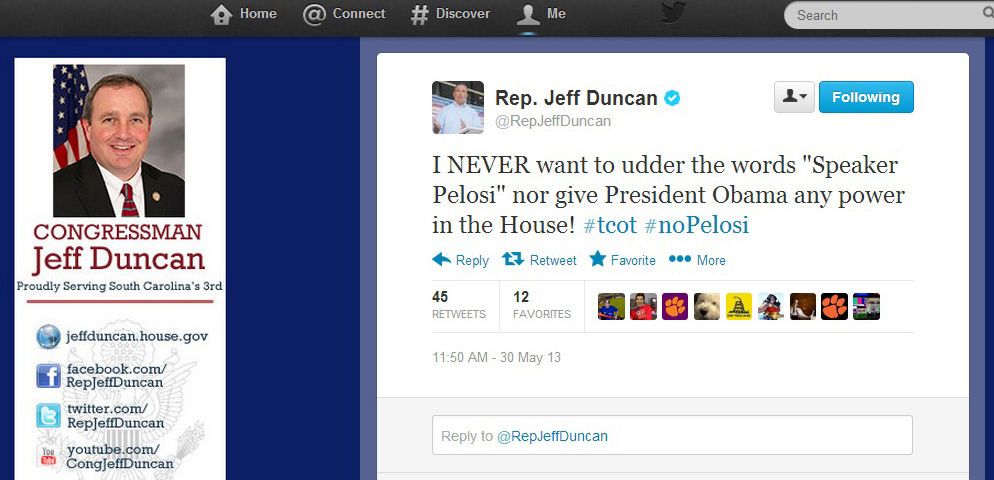
One of our readers shared a link to the above in the comments thread of last night’s Virtual Front Page. I didn’t click on it until today, and lest you miss out entirely, here’s what she linked to.
(And yes, my headline is based on the famous John Mitchell quote about another powerful woman in Washington.)
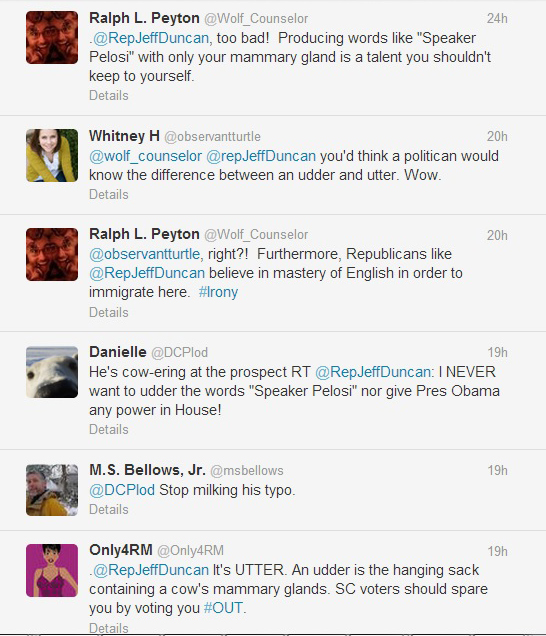
You should follow the link yourself to check out the comments, some of which are pictured below:
Sometimes I get releases that really seem to come out of left field, such as this:
Dying Pets Prescribed Marijuana
Guest Opportunity: Kim Baker, Animal Whisperer and Expert in Holistic Health for Animals
The debate over medical marijuana for pets is continuing to intensify as more veterinarians are speaking out about the pros and cons of the practice.
California vet, Dr. Doug Kramer, treated his own dog who was terminally ill from cancer.
Kramer said the marijuana regimen increased his dog’s “quality of life”. ..
Yeah, dude. I’ll bet it did.
Near as I can tell, this release did not intend to be humorous. And mind you, I’m not making fun of animals in pain. What cracks me up is the wording. This vet did NOT say the pet had less pain, or greater mobility, or improved appetite, or any other specific benefit. Just that its “quality of life” was increased.
I have to say I was completely unaware of this “issue” until now. TIME says they’re not making it up, though.
Just saw this fund-raising appeal from the Democrats:
ROLL CALL: Conservatives Buy Airtime for Mark Sanford
If you think Elizabeth Colbert Busch has a clear path to victory on Tuesday, think again.
She’s neck and neck with Mark Sanford — 46-46. And now, right-wing groups are throwing everything they’ve got at keeping this seat in Republican hands.
Brad — We can’t allow Elizabeth to be pummeled like this if we want to win on Tuesday.
There are only 4 days left. Will you dig deep for Elizabeth and Democrats in tough districts like hers?…
… and want to quibble with the wording.
Yeah, I get why the DCCC would want to say “right-wing.” Because it pushes their peeps’ buttons.
But Sanford isn’t “right-wing;” nor are those who tend to flock to his banner. He is libertarian, a classical liberal, which is why, even as his party establishment deserts him, he is backed by the likes of Ron and Rand Paul.
I looked up the group that Roll Call said was backing Sanford. It’s called “Independent Women Voice.” (Note that the Dems did NOT mention the name of the organization, because it might have provoked a positive response in their target audience, which of course is why the group calls itself that.) The organization describes itself this way:
IWV is dedicated to promoting limited government, free markets, and personal responsibility
Note that there’s no mention of traditional values, or a strong defense, or any of the other traits associated with conservatism, much less the “right wing” — only the libertarian values are mentioned.
From Rep. James Smith’s Facebook page:
If SC had seen genuine ethics reform previously and had an ethics committee with any teeth, Nikki Haley would likely have been forced out of the House and never would have made it to the Governor’s office. Her actions and the culture of corruption continue to bring shame on SC and the people of our state deserve better.
Coming from such a nice, easygoing, mild-talking guy as James Smith, that is way harsh. Especially that last sentence.
That’s the kind of stuff his neighbor Mia McLeod would say. We can see this, I suppose, as a heating-up of rhetoric as James’ friend Vincent Sheheen prepares to take on the governor. But I think it’s also a measure of the degree to which James, mild-mannered as he is, is fed up.
Anyway, for context, here’s this morning’s story in The State about the ethics bill.
My headline should seem familiar.
It seems to me that there’s a line like that in most stories about the 1st Congressional District special election. For instance, this is the only mention of her in first 16 paragraphs of the Island Packet story I referred to in my last post:
Meanwhile, his Democratic opponent in the May 7 special election, Elizabeth Colbert Busch, campaigned across Beaufort and Charleston counties where most of the district’s voters live. She attended fundraisers and forums, declaring herself the victor in Monday night’s debate.
That, of course, was the story about Mark Sanford’s endorsements by Rand Paul, Larry Flynt and a website that promotes extramarital affairs.
The pattern for both national and state stories about this race is as follows:
You get the impression that if the Democrat weren’t the sister of a national celebrity, she’d hardly ever get a headline of her own.
This underlines, yet again, the point I made in the previous post — that the only way the three-ring circus goes away is if Sanford loses next week. If he wins, this is what we have to get used to.
Earlier today, I heard Kevin Cullen of The Boston Globe on the radio, giving a riveting, shot-by-shot description of the gun battle between Boston-area cops and the Tsarnaev brothers last Thursday night. It’s a great story, and Cullen tells it well in his column this morning. In fact, I don’t recall ever having read a more compelling story about cops in action in a newspaper. An excerpt:
Joe Reynolds is a young cop in Watertown, and last Friday he was driving, alone in his cruiser, when he saw them.
The bombing suspects.
Tamerlan Tsarnaev and his brother Dzhokhar were in two cars, following each other closely.
Reynolds called it in.
Do not engage, the dispatcher told him. Not on your own.
The brothers pulled over. So did Reynolds. He didn’t know it, but he was about to interrupt the two as they tried, police believe, to transfer their crude, homemade explosives from one vehicle to another.
As Reynolds waited for backup, it felt like hours, but it was only minutes and that backup, in the form of Sergeant John MacLelland, was speeding up the street just as the Tsarnaevs turned and at least one of them opened up on Joe Reynolds. Reynolds threw his cruiser into reverse and sped backwards. He and MacLelland got out and began returning fire.
The suspects had to know they had only one chance if they were going to make their way to New York, perhaps to kill again. They had to shoot their way out. But the cavalry was on the way to ensure that would not happen. A bevy of Watertown, Boston, Transit, and State Police were rushing to help….
It’s not quite the same as hearing it in Cullen’s accent. But just pretend that when he writes “cops,” you’re hearing “cawps.” That will help…
A discussion earlier today about what Democrats and Republicans like to call things (say, “criminal” vs. “enemy combatant,” for instance) reminded me of something I noticed last week but failed to mention.
Everybody went on and on about Obama initially not using the word “terror,” and later using it.
Me, I was more impressed by another word he used:
So if you want to know who we are, what America is, how we respond to evil, that’s it. Selflessly. Compassionately. Unafraid.
“Evil,” of course, being a word out of the George W. Bush lexicon. Allegedly, liberals don’t hold with that word, suggestive as it is of moral absolutes. But the president used the word — perfectly appropriately, of course. But I noted it with interest…