Category Archives: Personal

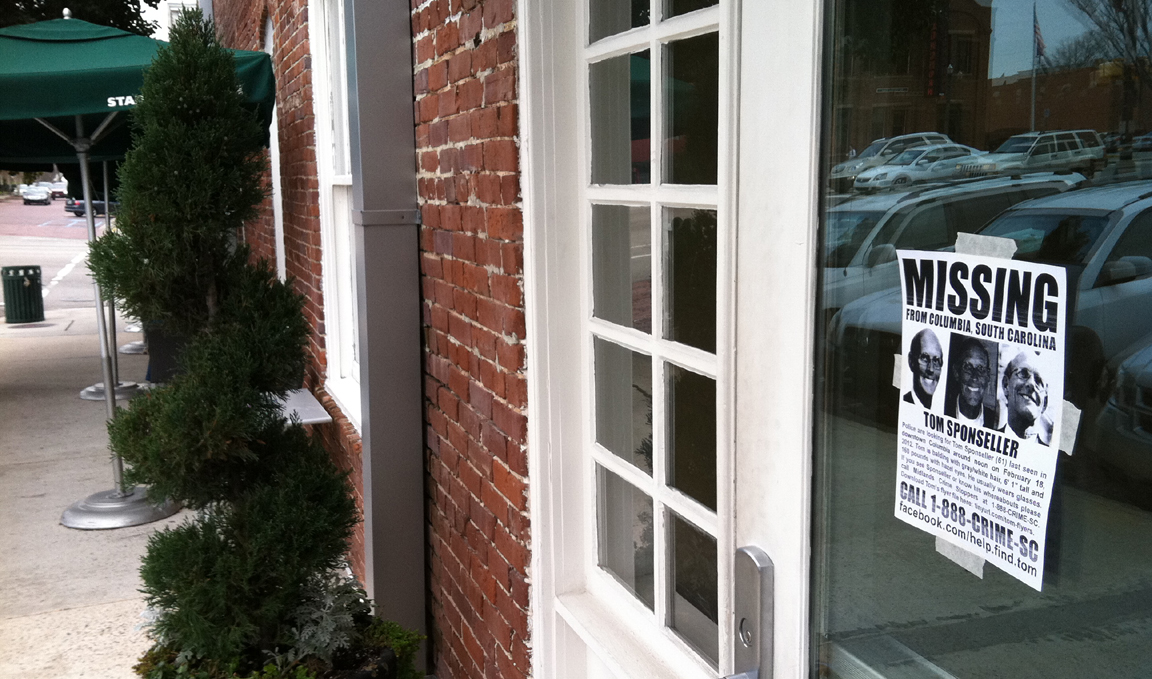
The stunning news about Tom Sponseller

Last week, I had been set to have lunch with my friend Bob McAlister, but he suddenly had to cancel because of a new client — he was representing the S.C. Hospitality Association in dealing with the media with regard to the disappearance of its CEO, Tom Sponseller.

Today was the day that we’d set for the rain check. We had just sat down with our food from the buffet at the Capital City Club when another diner came over, smartphone in hand, to tell Bob: “They’ve found Tom’s body.” In the parking garage. And Bob had to run out.

Later, on the way back to the office, I saw The State‘s John Monk and Noelle Phillips outside the building on Lady Street that houses the Hospitality Association’s offices. Chief Randy Scott had just given reporters the barest of details, and now the Association’s employees were being told what was known.

I asked John and Noelle the most obvious question: How do you not find a body for 11 days in a parking garage? The reporters told me they had searched the place themselves last week, and that there were several doors opening off the garage that they were unable to enter.

This is what little has been released so far:

The body of missing lobbyist Tom Sponseller has been found, according to Columbia police.

Sponseller killed himself, said Columbia Police Chief Randy Scott. His body was found in a lower level of the parking garage at 1122 Lady Street just before 11 a.m., said Jennifer Timmons, a Columbia Police Department spokeswoman. The S.C. Hospitality Association where Sponseller was chief executive officer has its headquarters at the building.

“It’s very devestating,” said Rick Patel, the vice chairman of the S.C. Hospitality Association.

Investigators found the body in a double enclosed room as they were conducting a follow up check of the building, she said.

Police have searched the building multiple times, including a search with dogs trained to find cadavers, Timmons said.

A 2 p.m. at Columbia police headquarters is planned, Timmons said.

As John and Noelle headed over to the police department for that presser, I left them. I’m sure they will have more to share soon.

One reason I found the reporters out on the street is that they were barred from entering the building where the SC Hospitality Association has its offices.

What I was doing all weekend

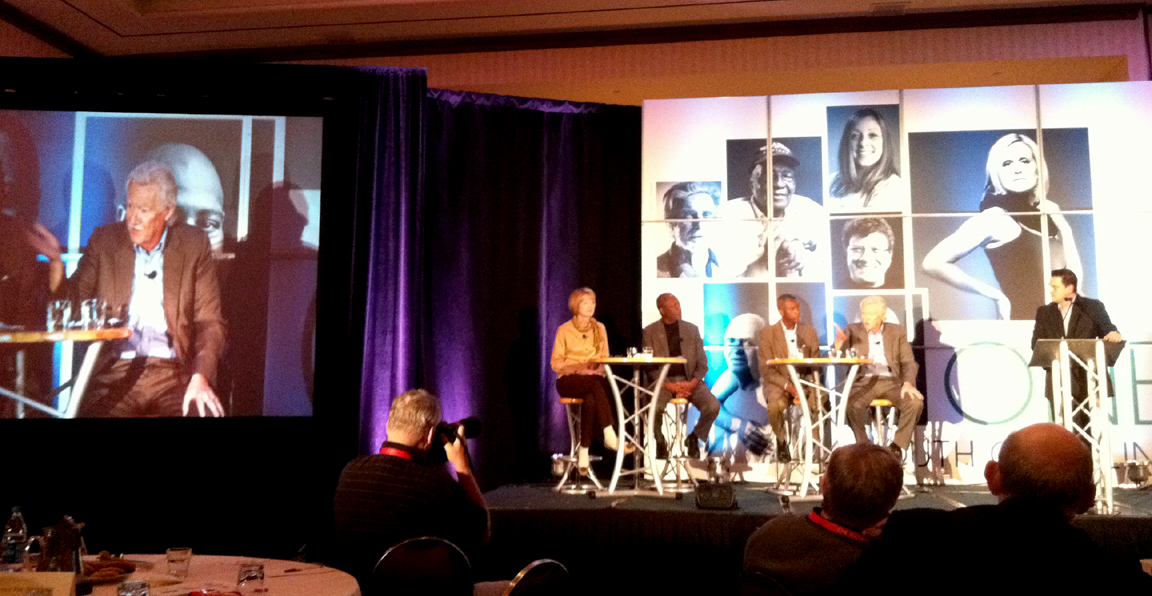
Gerrita Postlewait, Fred Washington, John Simpkins and Terry Peterson discuss "Education, Poverty and Equity on the Ground in South Carolina" with moderator Mark Quinn.

Y’all probably think I haven’t blogged in days. I have; it was just microblogging. One of these days I’m going to get social media totally integrated into this blog so y’all can immediately see my posts on Twitter, because when I’m away from my laptop, that’s where I’m sharing observations.

From Friday through Sunday, I was at the Riley Institute’s Diversity Leaders Initiative graduate weekend in Hilton Head. When I arrived, Cindy Youssef of the Riley Institute asked me to Tweet as much as possible, and to use the hashtag #onesc.

It’s dangerous to tell one of the Twitterati to Tweet as much as possible. There were others putting the word out there, but I was probably the most manic, as you can see by looking at the hashtag results. There was a respite of a couple of hours when I took my iPhone up to my room to recharge it, but other than that I didn’t slow down much.

Here you see most of my Tweets from the weekend. I left out some asides that had nothing to do with what was going on, but also left a couple of those in, for flavor.

For a complete roster of who was there, you can look here.

Most of the Tweets were when people said something I agreed with, although not all (as I’ve explained before, I favor single-payer NOT because people have a “right” to health care, but because it’s a more rational system for society overall than what we have now; but I thought it very interesting that Ed Seller thinks it’s a fundamental right).

When someone else’s Tweet is quoted, I use that person’s handle in front of it, and then insert my own as it goes back to my voice. I hope that makes this easier to follow.

Anyway, enough explanation. Here you go:

Brad Warthen ‏ @BradWarthen

Listening to Marlena Smalls singing to Riley Institute Diversity Leadership graduates in Hilton Head… He’s Got the Whole World…#OneSC

I was listening to Ken May talk about folk art traditions in SC when the coffee started to kick in… #OneSC

Just had an enjoyable political chat with Alston DeVenny, husband of Susan & law partners with the uncle of @fitsnews in Lancaster.#OneSC

Will Folks aka Sic ‏ @fitsnews

@BradWarthen ha! my uncle Robert is a good dude …

Brad Warthen ‏ @BradWarthen

Don Gordon talking about the need to transform the two South Carolinas into One… #OneSC pic.twitter.com/PQNaC7Qc

Harvey Peeler ‏ @harveypeeler

What is it about Starbucks that makes people want to tell you they are there and does the Drive-thru count ?

Brad Warthen ‏ @BradWarthen

@harveypeeler @Starbucks is awesome, they have time to kill, they’re caffeinated, and no, it doesn’t count.

In reply to Harvey Peeler

Harvey Peeler ‏ @harveypeeler

I think I can remove my “Tweeter training wheels ” when @BradWarthen pays attention to what I Tweet.

Brad Warthen ‏ @BradWarthen

“Medicine is a social science, and politics is nothing else but medicine on a large scale.” Rudolph Virchow, quoted by Ray Greenberg.#OneSC

MUSC’s Greenberg: Problem of people not getting needed meds because of cost is getting WORSE… #OneSC

MUSC’s Ray Greenberg: People with higher levels of educational attainment spend more on alcohol… #OneSC

Greenberg: Stats indicate I-95 corridor is SC’s stroke belt… #OneSC

Greenberg: In many rural counties in SC, there’s not a single OB/gyn. “Deserts” of care… #OneSC

Greenberg: SC is No. 1 in people living in mobile homes. Whoo-hoo! One-fifth of us! #OneSC

Greenberg: Health disparities are NOT the result of bad habits of the poor. #OneSC

Forrest L. Alton ‏ @YoungGunCEO

Sitting at table by @BradWarthen, master tweeter… I can’t keep up, guy is good!! #OneSC #watchandlearn

Brad Warthen ‏ @BradWarthen

Ed Sellers: In SC, income does not rise with age, but health cost rise dramatically, for blacks and whites. #OneSC

Ed Sellers, formerly of Blue Cross Blue Shield: Access to health care is a fundamental right… #OneSC

That parenthetical interjection on the last Tweet was mine, not Ed Sellers’… #OneSC

Literally jumping the shark: “@CBSNews: Video: Reporter swims with sharks – without a cage (via @CBSThisMorningbit.ly/wAhfsQ

@wesleydonehue @harveypeeler When it comes to @Starbucks, I take a backseat to no man!

Heads up, folks: “@AnitaGarrett: Ed Sellers: “There are 55% more whites than black that will be on Medicaid.” #OneSC

Carolyn Wong Simpkins: In US, we have best & worst health care.#OneSC

Ed Sellers: $24 billion spent on health care in SC annually. It goes up a billion a year… #OneSC

Ed Sellers: Other countries control health care costs by controlling growth of capacity, which (irrationally) is anathema to U.S. #OneSC

Simpkins: We are SO concerned to make sure no one undeserving gets care, we overcomplicate the system… #OneSC

Wanda Gonsalves highlights the crying need for primary care physicians, a “dying breed.” #OneSC

Watching a film that exhorts us to respect barbecue. But I don’t have to be persuaded… #OneSC

The takeaway: Don’t trust a barbecue pitmaster who doesn’t choose and cut his own wood… #OneSC

Huge applause for Pitmaster Rodney Scott of Scott’s BBQ in Hemingway, SC. #OneSC

BBQ Pitmaster Rodney Scott: Hemingway isn’t in the middle of nowhere; “It’s in the middle of everywhere.” #OneSC

Doug Woodward: SC productivity shot up from 90s thru early 00s, leveled off. And our income is FALLING, even when economy is good… #OneSC

Woodward: We must educate more of SC population at a higher level to be ready for 2030, when only 1 out of 6 will be working… #OneSC

Woodward: If we raise educational attainment to national average by 2030, personal income will rise by $68 billion. #OneSC

Jim Hammond ‏ @restlessboomer

#onesc Economist Doug Woodward: If we’d followed the policies Gov. Riley for the past 18 years, we wouldn’t have this (increase in poverty)

Brad Warthen ‏ @BradWarthen

Woodward: Key to prosperity — attracting and keeping the creative class… #OneSC

Steve Morrison quoting someone on poor towns in SC: We built Interstates so we wouldn’t have to look at them… #OneSC

Steve Morrison: If you want a safer and more secure South Carolina, teach a young man to read. #OneSC

Steve Morrison: We must get the greatest teachers to the students with the greatest need… #OneSC

Morrison: Recent trend in education in SC — cutting funding, while passing unfunded mandates to the districts… #OneSC

Morrison: Can we agree that teachers matter the most? #OneSC

Morrison: Take that tax base along the coast, and share it with the poor districts… #OneSC

Morrison: It’s great to have good private schools, but public education MATTERS… #OneSC

Morrison: The child gets off the bus at 5 years old with bright eyes. He’s not defeated. Yet. #OneSC

John Simpkins: The opposite of love isn’t hate; it’s indifference. (“My kids are fine; yours aren’t my concern.”) #OneSC

To paraphrase Terry Peterson, we need not just a love of justice, but a hard-minded understanding of what economic dev. requires. ##OneSC

What this conference keeps wrestling with is what to do about the total triumph of “I, me, mine” in SC politics. #OneSC

Ex-Gov. John Baldacci of Maine says Riley Institute is “kind of like a focus group for the state of SC.” #OneSC

Baldacci says on his first visit to SC, “I was really blown away” by downtown Greenville. (Something for Columbia to aspire to.) #OneSC

Baldacci: “The very basic foundation of our democracy is education.”#OneSC

Baldacci: As dysfunctional as our politics may be, what we have is better than what most people have had throughout history. #OneSC

Baldacci describes the surreal experience of being in Congress on 9/11/01… #OneSC

Baldacci: You can go anywhere in the world, but you can’t become Chinese; you CAN come here from China & become an American.#OneSC

Baldacci: “You’ve gotta be yourself; you’ve gotta tell the truth and you’ve gotta work hard.” (Father’s advice.) #OneSC

Baldacci: “We all have to get over it, folks… We have to realize that we have a greatness here if we work together…” #OneSC

Baldacci exhorts us to treat people as Dick Riley always has… with dignity and respect. Amen to that; we could have no better model.#OneSC

Others call Dick Riley “secretary.” I call him “Governor.” For SC, that means the most (to me, anyway). #OneSC

Apparently, I'm even Tweeting while talking at the barbecue with Clare of the Clare Morris Agency and Susan DeVenny of First Steps.

Will I get all the okra I can eat? The absurdities of job-hunting in the digital age

Back when I was job-hunting in 2009, I signed up for all sorts of services that would give me tips on openings — CareerBuilder.com, BusinessWorkforce.com, AmericaJob.com, TheLadders, and various others.

And I continue to get email alerts from all of them. They are sometimes a source of amusement — although I wouldn’t think it was funny if I were still unemployed.

Today, I’m told of 25 hot prospects, a list supposedly tailored just for me. CareerBuilder assures me that “These recommendations are based on the content of your resume.”

My favorite from today’s list is “Okra Strut Administrator:”

REQUEST FOR QUALIFICATIONS Description: Okra Strut Administrator Location: Irmo, SC Pre-Requisite: References that validate past festival coordination / management & certified by the South Carolina Festival Events Assoc. Overview: The Town of Irmo is seeking qualifications for a Festival Administrator. Interested parties should have a background in festival planning, coordinating & management. Scope of Work: Involves planning / managing of parade, street dance, amusements, craft show, food vending, safety & security along with grounds maintenance. Prepares recommendations & provides interpretations for the Okra Strut Commission & manages / coordinates financials with the Town Staff. Meets with the Town Council & other civic organizations as needed…

Yeah, that’s right up my alley. After all, I’m quite fond of okra. Unlike most people, I even like it stewed and slimy. The puzzle for me is that I don’t recall having mentioned my love of okra in my resume or any other materials that I’ve ever submitted for a prospective job.

There are one or two jobs on the list that someone who was really reaching to establish a connection to my background might see as suitable, if they sort of squinted and didn’t think about it too carefully. For instance, amazingly enough, The State is hiring a sports copyeditor. Yep, that’s a job I could easily do, although sports is probably the last department you’d want me for. It’s the sort of job that I might have done when I was 22 years old and right out of college, and would have been fully qualified for then (I covered prep sports part-time for a while for the now-defunct Memphis Press-Scimitar at about that stage of my career). But if you drew a huge square that described the universe of logical jobs based on my abilities and experience, and put this one in the bottom right-hand corner, the jobs that would be a good match for me would be in the upper left-hand corner.

In the last couple of years, on the rare occasions that I’ve actually looked at these emails, I’ve seen one job that was sort of almost kind of a good match, although it would mean moving back to news from the opinion side: The Tennessean in Nashville needed a new executive editor. That would have been something, being a successor to the legendary John Siegenthaler. It might even have provided me with a challenge, since I had not served in news at that level. But no, I didn’t apply, not least because I had no interest in moving the Nashville.

Not that jobs have to be a good match to my resume at all, since the way forward for me involves reinvention, and getting way, way out of my beaten path. From the moment I left the paper, I was more or less determined that I wasn’t looking back, but moving on. But the thing is, these tips are supposedly based on that resume. Here are some of the others I received today:

  • Executive Director of Instructional Technology
  • Loss Prevention Manager for Kmart
  • Junior Systems Performance Engineer for Windows and UNIX
  • Insurace Sales Agent
  • Occupational Therapist
  • Dentist — DDS/DMD
Really. Dentist.

All of this pointless mismatching would be pretty harmless except for one thing: I discovered during my sojourn among the unemployed that an awful lot of the hiring process these days is done by algorithms rather than people — at least in the initial stages. You submit your information electronically, and if the software doesn’t see in your resume what it wants, you don’t get to the stage of talking to humans.

This is unbelievably frustrating, because I found that these software applications have tapioca for brains. There was this one job with a major corporation that was by no means a perfect match, but any human looking at my background and qualifications would at least have been intrigued and wanted to have an exploratory chat.

I submitted my stuff electronically, and the next day received an email (the “do not reply” kind) congratulating me and saying that I looked like a very good match for what they needed, and I would be hearing from a human soon. This was on my birthday, and I was very encouraged.

Two days later I got another disembodied email telling me that the first one was wrong, and that I wasn’t a good match, so goodbye and thanks for applying.

This infuriated me to the point that I determined that I would talk to a human whatever it took. I started with NO contact information — no email for a human, no phone numbers. I just started talking to people I know who knew people who might know people who would know. My thought at the time was that the job called for someone who would do just what I was doing. A person who would take a brush-off from a machine wasn’t qualified for the job.

In the end, I had coffee with the person who was vacating the position, who told me the applications were closed at that point, although she would see if she could get them to reopen the process. This went nowhere, but I was satisfied. I had not accepted “no” from the stupid machine.

Harris Pastides takes the Twitter plunge

I was very interested to see Harris Pastides take the plunge into Twitter today. His first Tweet? Here:

Can’t wait for the baseball journey that begins tomorrow. Tweet the Three-peat!

And I think most of us would be happy to reTweet that. I did.

This is interesting to me because it was in a meeting with Harris that I first became a convert to Twitter. It was back when I was doing a 90-day consulting gig with the university right after I left the paper (right after I got canned, for those of you just joining us). At the time, there was a lot of discussion about how the university in general, and the president’s office in particular, needed to communicate in a social media age.

Lee Bussell from Chernoff Newman, a competitor of ADCO (you are all free to boo and hiss at this point if you feel the urge), brought in some of his people to give the president and some of the university’s communications folks a briefing on Twitter, Facebook, blogs and the like. (It should be noted that various departments in the university were already making use of such media, although there was no overall plan to it.)

For my part, I nodded sagely during the blog parts, being a four-year veteran who had just retired one blog and started this one. But I became impatient during the Twitter and Facebook bits. They seemed pointless and frivolous to me. Why fool with 140 characters when you can get into a subject as deeply as you want (with none of the finite restrictions of print) on a blog?

After the meeting, I said as much to Tim Kelly (“Crack the Bell,” “Indigo Journal”), whom I had just met for the first time, even though we had interacted in the blogosphere for years. He told me I should give those silly-sounding media a try. Why?, I asked. Because you can use them to promote your blog, he said — just post your headline and a link, and it will grow your readership.

So I tried it, and promptly got hooked. It’s like… well, you know how they say video poker is the most addictive form of gambling (particularly for women, for some reason), because of something the flashing images and quick rewards do to your brain? Well, Twitter is the crack cocaine of written communication, and probably for similar reasons. You can follow the very first stages of this conditionstarting back here.

That’s the bad news. The good news (aside from the fact that I am revered as one of the Twitterati) is that the readership of my blog  now is about five times what it was at the newspaper. Did I mention that I set a new record in January, with 272,417 page views? (And as long as we’re talking numbers, I’m up to 1,643 followers.)

Here’s hoping my friend Harris doesn’t develop a serious addiction problem. I doubt that he will. After all, he managed to hold out three years longer than I did in starting. Besides, he’s a very sober, solid, serious academic type — very grounded, and even less given to faddish enthusiasms than I.

But it will bear watching…

Yep, that’s Bobby all right

People wonder why I’m always late and never (well, almost never) get anything done. It’s because for me, stuff just leads to stuff. And I’m unable to resist plunging ahead to see where it all leads.

For instance, today I had a membership committee meeting at the Capital City Club. At some point our membership director said that you can now buy Smart Cards at the Club. Someone asked what that was, and I pulled mine out of my pocket to show him. This reminded me… I had arrived at the Club for a meeting before the meeting, and my two hours (it was one of the green ones, which max out at 2 hours) were probably going to run out just as we were ending the lunch meeting. And I’ve been ticketed seconds after running out before.

So I excused myself to go put some more time on the meter.

On my way out, I ran into Rep. James Smith. We exchanged pleasantries, I excused myself again and went down to the street. I put some more time on, and headed back up.

On my way into the building, a sort of familiar-looking guy walking perpendicular to my path made eye contact with that “Hey, aren’t you…” look, hesitated, nodded to me with the sort of halfway nod that feels deniable, in case you’re wrong about who it is, and I gave back a similar nod. I walked on, thinking about the odd complexities of polite human interaction, when I heard a “Hey!” behind me. It was the guy. He asked me if I was Brad and if I used to run the newspaper. I told him I ran the editorial page. He asked me about a woman named Cindi who was married to someone who had been someone high-ranking at the newspaper, saying he probably was confusing her identity. He said no, not Cindi Scoppe.

I don’t know how I got there, but I eventually I read his mind enough (after he mentioned Macon, Ga.) to venture that he was talking about Nina Brook. Her husband Steve came to the paper as business editor, she joined as a political reporter, she left to go to WIS and then was Gov. Jim Hodges’ press secretary before I hired her away (the move was widely regarded as a defection) to be an associate editor. She’s now a high school teacher. Steve is now managing editor at the paper.

She and Cindi Scoppe share a number of characteristics (they used to be a fearsome duo as reporters, covering the Legislature together), which could lead to a name confusion, but don’t tell either of them that.

That settled, I confessed to not knowing his name, and he gave it. He works at the Department of Commerce. I asked how Bobby Hitt was doing. Bobby, if you’ll recall, was very ill just before Christmas, and hospitalized for quite a while. He’s back at work now, I was told, but working more of a normal schedule instead of trying to kill himself doing everything. Good to hear.

Oh, he said, since you know Bobby from way back you should probably get off the elevator on 16 and look down the hall to see the new portrait. He said it was by that lady, and he gave a first name (again, not the right one — I have days like that, too) who works with trash. I said you mean Kirkland Smith, who… drumroll… is married to James Smith, whom I had just run into. And it’s not really garbage she uses as a medium, more like… cast-off junk. It’s a recycling thing.

So on the way back to my meeting, I stopped on 16 and looked both ways. The receptionist at Commerce asked if she could help me, and I said I was looking for the picture. She told me to step inside the double doors and look down a hall, and at more than 50 feet there was no doubt — there was Bobby.

I went on down the hall to get close enough for an iPhone picture, and ended up chatting with another lady whose desk was next to it.

Eventually, I made my way back to the meeting. It was pretty much over. I hadn’t meant to miss the rest of the meeting; stuff just happens…

Anyway, I thought Kirkland’s picture was pretty cool, just like the others of hers I’ve seen. So I’m sharing it.

My loss of innocence, in the bicentennial year

On my last post, I said something about how insulting I find it when someone says that my opinions would be different if my personal circumstances were different. Such as when people say, “A conservative is a liberal who has been mugged,” or “if your daughter were pregnant, you wouldn’t be opposed to abortion,” or whatever.

I was insufficiently clear, as I learned when one commenter thought I mean people shouldn’t change their minds. I’m all for mind-changing based upon new information. (And indeed, sometimes that new information is conveyed by changed personal circumstances.) What I object to is the suggestion that, if it were in your self-interest to change your mind, you would.

Part of the reason why I find this so offensive is the puritanism of the journalist. News journalists aren’t even supposed to have opinions, which I’ve always understood to be absurd, of course. But when journos are allowed to have opinions, and even paid to express them publicly, as I was for more than 15 years of my career, it’s such a special gift that the responsibility is huge to formulate political opinions according to the greater good of the community, limited only by your ability to discern the greater good. Anything that smacks of abusing that privilege for self-interest is appalling to me.

I’m a bit more wordly today than I was in the early stages of my journalism career, but the ideals are intact.

This led me to share an anecdote from the days when I realized that not everyone, not even all journalists, looked at the world as I did…

In 1976, I was pretty excited about Jimmy Carter’s candidacy. I saw him as what the country needed after Watergate, etc. One day close to the election, I had a conversation with another editor in the newsroom. She said she favored Gerald Ford. That sounded fine to me; I liked Ford, too — I just preferred Carter.

What floored me, flabbergasted me, shocked me, was that she said the REASON she supported Ford was that she and her husband had sat down and looked at the candidates’ proposals, and had computed (who knows how, given the variables) that if Carter were elected, their taxes would go up by $1,000 a year.

My jaw dropped. I couldn’t believe it, because of the following:

  • I couldn’t believe that ANYONE would actually make a decision based on who should lead the free world based on their personal finances. (I really couldn’t; I was that innocent.)
  • I thought that if there WERE such greedy jerks in the world, you would not find them among the ranks of newspaper journalists, who had deliberately chosen careers that would guarantee them lower salaries than their peers from college. If you care that much about money, this would be about the last line of work a college graduate would choose.
  • If there WERE a journalist whose priorities were so seriously out of whack, surely, surely, she’d never admit it to another journalist.

But I was wrong on all counts.

For a time I regarded her as an outlier, as an exception that proved the rule. But that delusion wore off, too, as I had more such conversations with many, many other people. (Although she still stands out as the must unabashedly selfish journalist I think I’ve ever met. Others may be as self-interested, but they’re more circumspect.)

Today, I have a much more realistic notion of how many people vote on the basis of self-interest. But I have never come to accept it as excusable.

Taking a risk with a mustard seed

I don’t often get releases like this one, so I thought I’d share it:

11 Trinity Youth Transform $1,100 into More Than $60,000

In Just 90 Days, through the Kingdom Assignment, Students Raise Money to Further the Kingdom of God

Thursday, February 9, 2012, Columbia, SC Trinity Cathedral’s Episcopal Youth Community (EYC) is making a big impact in their parish and in our community. In November of 2011, Canon Brian Silldorff challenged 11 members of EYC to participate in the Kingdom Assignment. The result? More than $60,000 to fund an array of projects, both sacred and secular.

The Kingdom Assignment is an international project dedicated to stewardship of God’s Kingdom that started some ten years ago in Lake City, California. You can read more about the Kingdom Assignment on their website, www.kingdomassignment.org.

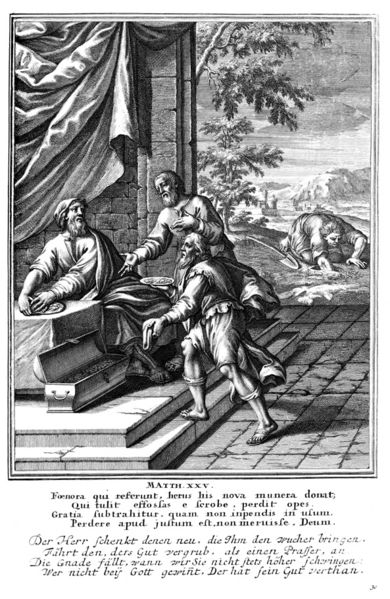
After teaching a Sunday school lesson about the Parable of the Talents, Silldorff challenged eleven youth to participate in the Kingdom Assignment and entrusted them with $1,100 and offered just three rules: 1. The money belongs to God and is entrusted to you. 2. You have 90 days to further the kingdom of God with your talent and treasure. 3. You must report back in 90 days about your project and its success.

It’s now 90 days later and the Kingdom Assignment project will culminate during Youth Sunday School on Sunday, February 12, 2012 at 10:15am in the Workshop. Students, adults, and those impacted by the project will be present along with parishioners and the media to celebrate the impact and reach of more than $60,000.

You are invited to join in the celebration and share in the success. Please email Brian Silldorff if you plan to attend as space is the Workshop is limited. The Worskshop is located on the ground floor of the Trinity Center for Mission and Ministry located at 1123 Marion Street, Columbia, SC 29201.

Way to go, kids! I’m proud of you. Even though you’re not Roman. At least you’re catholic. You know, my cousin is one of y’all’s priests.

This reminds me of the best sermon I ever heard from my own pastor, Msgr. Lehocky. It was so long ago, he probably doesn’t remember it, but I do — the main points, anyway.

I’d always had trouble with that parable — you know, the Capitalist Parable:

14`The kingdom of heaven will be like the time a man went to a country far away. He called his servants and put them in charge of his money.

15He gave five bags of money to one servant. He gave two bags of money to another servant. He gave one bag of money to another servant. He gave to each one what he was able to be in charge of. Then he went away.

16`Right away the servant who had five bags of money began to buy and sell things with it. He made five bags of money more than he had at first.

17`The servant who had two bags of money did the same thing as the one who had five bags. He also made two bags of money more than he had at first.

18But the man who had only one bag of money dug a hole in the ground. And he hid his master’s money in the ground.

19`After a long time, the master of those servants came home. He asked what they had done with his money.

20The servant who had been given five bags of money brought five bags more to his master. He said, “Sir, you gave me five bags of money. See, I have made five bags more money.”

21`His master said, “You have done well. You are a good servant. I can trust you. You have taken good care of a few things. I will put you in charge of many things. Come, have a good time with your master.”

22`The servant who had been given two bags of money came and said to his master, “Sir, you gave me two bags of money. I have made two bags more money.”

23His master said, “You have done well. You are a good servant. I can trust you. You have taken good care of a few things. I will put you in charge of many things. Come, have a good time with your master.”

24`The servant who had been given one bag of money came and said, “Sir, I knew that you were a hard man. You cut grain where you did not plant. You pick fruit where you put nothing in.

25I was afraid. So I went and hid your money in the ground. Here is your money.”

26`His master answered him, “You are a bad and lazy servant. You knew that I cut grain where I did not plant. You knew that I pick fruit where I put nothing in.

27You should have put my money in the bank. Then when I came home, I would have had my money with interest on it.

28So take the money away from him. Give it to the one who has ten bags.

29Anyone who has some will get more, and he will have plenty. But he who does not get anything, even the little that he has will be taken away from him.

30Take this good-for-nothing servant! Put him out in the dark place outside. People there will cry and make a noise with their teeth.” ‘

Not that I have anything against capitalism; I don’t. I just didn’t like it that Jesus was suggesting that the third servant had done something wrong. I mean, if someone else asks you to hold his property, shouldn’t you take every precaution to preserve it and have it ready to give back to him? Doesn’t basic honesty require that? Capitalism is a fine thing, with your own money. But do you have the right to take a risk with someone else’s, without specific (preferably written) authorization?

The risk part was what got me; that’s what seemed wrong. It was too easy to fail.

Father Lehocky urged us to look at it in a whole new way. He said people who play it safe are wasting the talents or other gifts they are entrusted with. OK, I sort of got that, but what if they fail? What if they do?, he said. Failing is part of life. You can fail big-time, and by doing so advance the cause of God. Look at Jesus himself. Was there ever a bigger failure? Look at the way he died. Charged as a criminal, whipped nearly to death, stripped naked and nailed up on a gibbet like an animal for the unfeeling community to watch his death-agonies. Abandoned by his friends, who ran like scalded dogs before the bully boys and denied even knowing him. Not a word he’d said had ever even been written down. All over, all done with, all for nothing. He’d taken a risk, and failed spectacularly, by every standard the world had for judging such things.

Except that he hadn’t, as it turned out. He’d really started something. The risk he’d taken had paid off in a way no ordinary mortal would have predicted.

That sermon made me think differently about my life and how it should be lived. It made me look at failure in a new way. Not that I’ve always lived up to that new way of looking at life. But it made me think. And now that I’m writing this, I’m thinking about it again…

There goes my Hollywood career

OK, uh, somebody hipped me to the news that this is NOT a movie teaser, but has to do with an upcoming Super Bowl ad. Good. This is good… it means somebody out there is thinking about it, and maybe the folks who own the rights would like to do a deal with somebody who has the right idea. Which would be me. So Hollywood, if you’re calling, here I am… In the meantime, here’s the post I wrote when I thought that was a for-real mini-preview…

I’m not being facetious. I think my project might have had a chance — with the right connections, and with cooperation from those holding the rights to the first movie — and now it’s gone for good. I’m actually sort of depressed about this.

For several years, I’ve been kicking around an idea for a movie. It’s a really good idea. Good enough that my daughter gave me a “Scriptwriting for Dummies” book about four years ago to encourage me to go ahead and write it. But I was so busy then at the paper, and then I was unemployed (which is really, really time-consuming) and since then I’ve been trying to learn to be a Mad Man and develop my blog into a paying concern and occasionally doing freelance gigs, and, basically, it didn’t get written.

So now Hollywood has gone ahead with the project without me. And I’m pretty sure it’s not going to be nearly as good as if they’d heard my pitch.

My pitch would have been this…

Title: “Ferris Bueller’s Off Day.” Which is better than “Ferris Bueller’s Day Off 2.” Way better.

Mine was to be a political satire. For the simple reason that I can only think of one thing Ferris would have done with his peculiar talents. He was made for it. Like Tom Sawyer. Don’t you assume Tom would have gone into politics? Of course he would have. Same with Ferris — a preternaturally gifted politician. The kind who drives his opponents insane because he has this uncanny rapport with voters, everything slides off of him, and he always comes back — kind of like Bill Clinton.

In my script, Ferris would be a member of Congress. Not a senator. That would be too grand. Just another member of Congress, enjoying the perks of office, saying what he wants, voting how he wants, and getting repeatedly re-elected no matter what he does. Which, as I say, infuriates his political opponents. Such as Edward R. Rooney.

Mr. Rooney, having abandoned education as unsuitable to his talents, is an assistant chief of staff (actually, political director) for the incumbent president. He has a wonderful office in the West Wing. Great view. Grace has accompanied him on his career, and is still his secretary. All would be right with his world, except for one thing: Ferris Bueller. Still. Ferris, through no effort or merit of his own, is talked about constantly as a potential challenger to the president in the upcoming election.  He doesn’t encourage this talk, but he enjoys it. And everything he does seems to boost him in the polls, and make the president — or at least, his assistant chief of staff — look foolish.

Mr. Rooney has collected some major dirt on Ferris. I haven’t decided what Ferris has done (and he HAS done it; our boy is not innocent), but whatever it is, he’s done it “nine times.” Instead of to Ferris’ mom, Ed rehearses saying “nine times” to the media. At some point, he says it to Ferris’ administrative assistant, Cameron, relishing the threat. (I’m toying with the idea of the scandal having something to do with contributions to Ferris’ campaign fund from Abe Froman, the Sausage King of Chicago.)

OK, I’ve set the background. Here’s what’s happening as the movie opens… Ferris is lying in bed, glassy-eyed. Only this time, he’s not faking. Some of the scandal has broken over him at a time when he’s vulnerable. His marriage to Sloan appears to finally be over, due to his proclivity for — remember how, after asking Sloane to marry him, even at the moment when his world is about to come crashing down on him, as he’s racing to get home ahead of everybody, he stops and turns and introduces himself to the sunbathing girls? Well, that sort of thing has caught up with him.

He’s convinced that all his mojo is gone. Finally, at a critical moment in his career as the incomparable Ferris, he’s having an off day. An off day when all sorts of things he got away with in the past is catching up with him. Hence the title.

Meanwhile, Cameron — who straightened himself out and become a (relative) bundle of confidence after having that little chat with his Dad about the Ferrari — is the one calling Ferris and trying to get him to stop moping and take advantage of the opportunities that lie before him. Sure, there’s a scandal to deal with, but Cameron knows Ferris can deal with it — if he’ll just snap out of this funk.

Oh, yeah — Jeannie is an investigative reporter on The Hill. Something in her childhood instilled in her a deep-seated need to catch other people doing things that they shouldn’t. And she’s not partial. Investigating Ferris is fine with her, even though they made up at the end of the last movie.

Spoiler alert: At some point in the film, Jeannie starts to look into some irregularities involving Mr. Rooney. Also, at some point, Ferris does snap out of it and find a way out of the jam he’s in. Because, you know, off day or not, he’s Ferris Bueller.

Along the way, there’s a lot of fun with cameos from real-life Washington people talking about how awesome Ferris is, plus some regular man-in-the-street interviews. For instance, there’s an interview with a guy who works in the congressional parking garage, and the first question is, “Do you speak English?,” to which he replies, “What country do you think this is?” Simone, too, will be interviewed, and her reply will be something like her “31 flavors” line from the first movie.

Remember the kid who woke up with his face in a puddle of drool on his desk? He’ll do the same in this movie, only his desk is on the floor of the House.

Ben Stein will be in it. Charlie Sheen will do a cameo…

Look at me. I keep saying “will,” when I should say, “would have.” Because my chance has passed me by.

I know I’m going to see this movie, and I’m probably going to hate it. Because I’ll know what it could have been…

What would surprise you most on Saturday?

I’m doing a number of interviews these days. I was interviewed by Canadian public radio yesterday, and taped a segment for Jeff Greenfield’s show on PBS (to air Friday). Then I had a couple of beers last night with E.J. Dionne. This morning, before I left the house, I spoke with Tom Finneran (former speaker of the Massachusetts House) on his Boston radio show.

When I got in, I was interviewed by email, which is a twist. Karin Henriksson of the Swedish newspaper Svenska Dagbladet asked me two questions:

– how has the dynamics in the state changed compared to four years ago (I was here then, too)?
– what would surprise you the most on Saturday night after the votes are counted?

Here’s how I answered:

Question 1: This is the complicated one. After 2008, the GOP in South Carolina — and elsewhere as well, but I know SC best — was traumatized. Sen. Jim DeMint and others on the right said the party had lost the White House because, in nominating McCain, it had failed to be right-wing enough. This was the start of DeMint’s rise as a national power on the far right of the party. Then, in 2010, Nikki Haley — a small-time back-bencher — rode a populist, Tea Party, Sarah Palin-flavored tsunami right over more establishment Republicans to become governor. Ever since then, observers — and the GOP itself — have been left to wonder what it means to be Republican in this state. As 2011 arrived, many of the Republicans who usually backed the winner in SC lined up behind Jon Huntsman, while others went to Rick Perry. Almost none of them backed Romney. And throughout the last few months, we saw the GOP electorate bounce from Perry to Cain to Gingrich, and then, reluctantly, start to settle for Romney.

So… while the electorate that will vote Saturday is different from four years ago, it is expected to do what it usually does: Back the closest thing to an Establishment candidate, the candidate whose turn it is.

Question 2: What would surprise me most? A win by Rick Perry. Which is ironic, since several months ago he looked like the perfect candidate for South Carolina, like he was assembled according to a South Carolina recipe. But now he’s farther from the nomination than anyone still in it.

So what do y’all think? What would surprise you the most?

I have no landline! Ha-ha-ha-ha-ha, you suckers!

In the past 24 hours I have heard heartfelt complaints from three people — my Dad, ADCO’s Lanier Jones and frequent commenter Steve Davis — about being overrun by robocalls and pollsters. Here’s what Steven said:

If Mitt Romney doesn’t control his robocallers soon he’s going to lose my vote. Two calls yesterday and three calls today.

To which I can only say: “Hah! You suckers! I got rid of my landline months ago, and haven’t been pestered by a one of these since!”

I mean… I feel for y’all; I really do…

Wait a sec! Whom will I vote for now?

You know, I was so busy last night writing about the Huntsman departure from the race that only now has this thought occurred to me: For whom will I vote on Saturday, now that he’s out of it?

That’s a toughie. Let’s look at my options, in alphabetical order:

  • Newt Gingrich — He’s a knowledgeable guy. As one uncommitted Republican (the same one who called Romney a “Plastic Banana Rock ‘n’ Roller”) said to me the other night, Newt Gingrich is like the professor and the others are like the students in debates. But knowledge and wisdom are not the same things. And a vote for Newt Gingrich is like a vote for a live grenade with the cotter pin pulled out. You’re only going to be able to hold the safety lever in place for just so long…
  • Ron Paul — No way in the world. As I often say, despite being an UnPartisan I can frequently find points of agreement with both Democrats and Republicans. But Ron Paul comes about as close as anyone can to being the polar opposite of what I believe in. Some times you can with justice call me liberal or conservative (even though I don’t like it), but no one who knows me would call me a libertarian.
  • Rick Perry — Nope. He just doesn’t bring anything to the table that I’m looking for. If all you can offer me is that you’re a Christian and you served in the military, as fine as those things are, you aren’t telling me why you should be POTUS.
  • Mitt Romney — We know about all his failings, mostly arising from his fundamental opportunism. In his favor I’ll say that I don’t think he’d lead the country down a wrong path. But that’s because I don’t think he’d lead it down any path at all. He would just manage what we have.
  • Rick Santorum — I like this guy more than I thought I would (I just thought of him as that culture warrior who got crushed by Bob Casey), and of course as a Catholic I share a lot of fundamental values — more so than with the evangelical Perry. But as much as he touts his foreign policy experience as a former senator, I find it hard to see what about his resume demonstrates a readiness to be POTUS.
I’ve got to pick somebody, because this is my one chance as a South Carolinian to have my vote count (since the November vote here is always a foregone conclusion).
However I do vote come Saturday, I doubt that I will share the decision with y’all — because I won’t feel good about it, and won’t feel like defending it…

Yo, Lee: David Yepsen says “Hey”

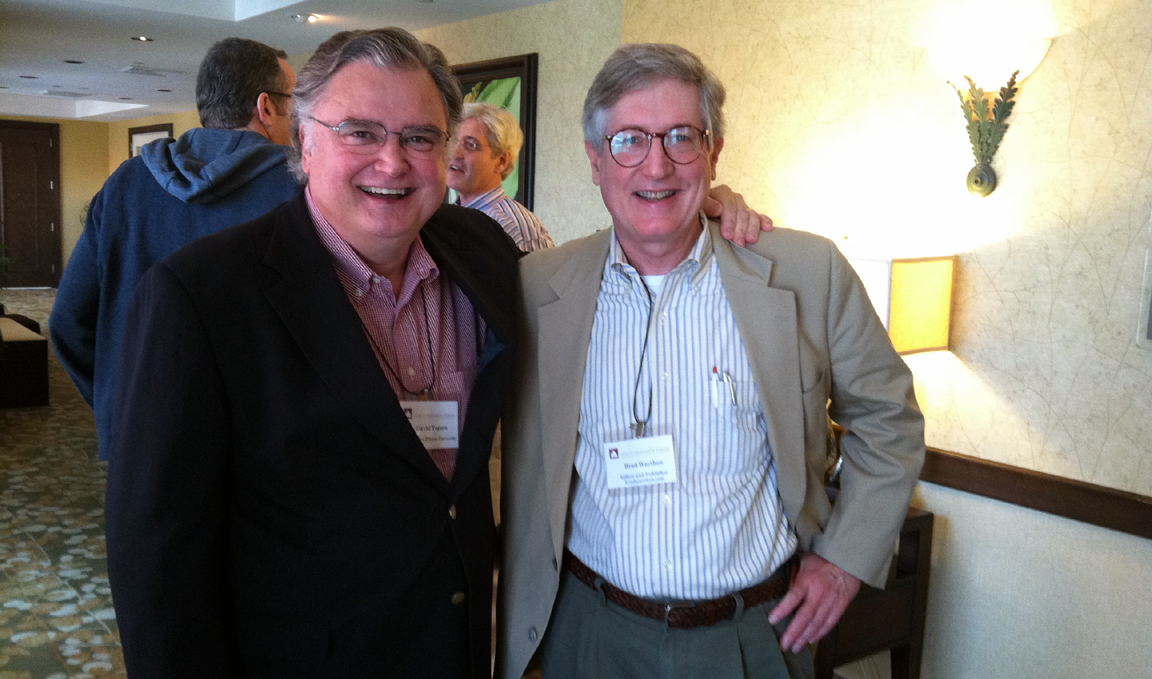
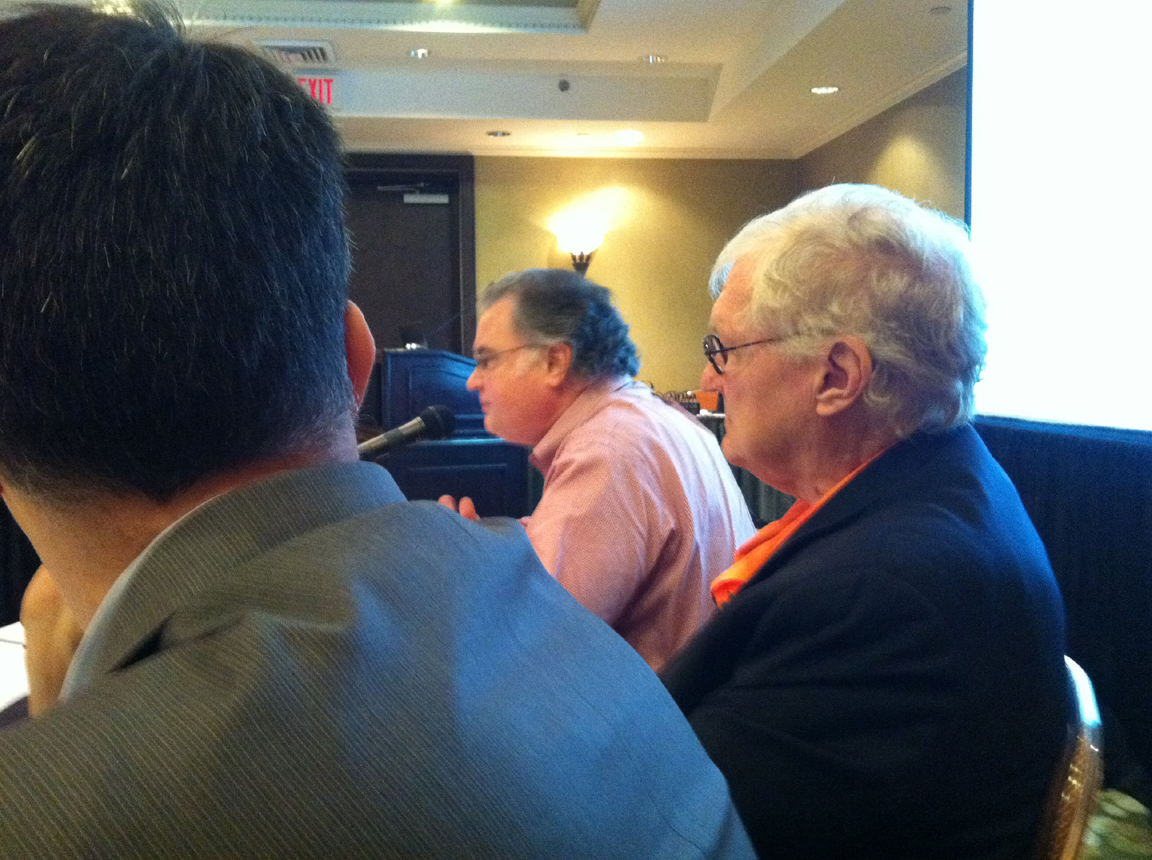
Above you see David Yepsen and me, looking relieved and happy that we’re done with our panel presentation at the Senate Presidents’ Forum in Key West over the weekend, and that it went well. Funny how those kinds of things — just talking — can take a lot out of you.

It was an honor to meet David, the legend of Iowa political journalism. And of course when we met, he asked after another legend of political journalism, a man whom everyone knows — and, more remarkably, everyone likes and respects — my longtime friend and colleague Lee Bandy.

I’m lucky to have worked with both Lee and the Tennessee legend, John Parish. And while it was brief, I was honored to share the panel with David Yepsen, who is now director of the Paul Simon Public Policy Institute (he left The Des Moines Register about the same time I left The State), Saturday. And to get to know a couple of political pros I had not met before, who also served on the panel: First, John Marttila, longtime friend and ally of Joe Biden ever since he was elected to the U.S. Senate in 1972. John continues to be a senior political adviser to the vice president. From the Republican side, we had Mike DuHaime, who ran Chris Christie’s successful run for governor of New Jersey in 2009.

We had a great discussion, both during the panel and at meals and events before and after.

What did I say during the presentation? Well, not anything I haven’t shared here. I essentially scrapped my prepared remarks, as mentioned previously — which is probably a good thing, because things flow better when I’m winging it. But preparing — not only the writing, but all the conversations I had with top Republicans in SC, right up to a couple of minutes before the program — did help me get my thoughts in order. Hey, if I hadn’t made all those panicked calls Friday night and Saturday morning after seeing those poll numbers, I wouldn’t have known to call Romney a “Plastic Banana Rock ‘n’ Roller,” which still cracks me up — the idea of Romney as ANY kind of rock ‘n’ roller, actually.

Anyway, I’m back from Key West. And it’s going to be a busy week…

Mike DuHaime (or the back of his head, anyway), David Yepsen and John Marttila, during the panel discussion.

That plastic banana rock ‘n’ roller Romney is letting me down

Drat.

To borrow from an SNL skit, this is something you can put under the heading of White People’s Problems.

While others at this conference were out playing golf and having fun, I was sitting here in my room in this Key West resort overlooking the aquamarine water, sweating away over my presentation for the panel discussion tomorrow.

In their longest form, my notes were 1,825 words in length, so I pared and whittled, and got it down so it glittered and shone.

And the upshot? After all the hemming and hawing GOP voters have done over the last few months, Romney has it sewn up.

But then I started looking at these polls Gingrich has been touting today:

ICYMI: Recent Polls Show Newt as

Clear Conservative Alternative in SC

Three recent polls show Newt Gingrich emerging as the clear conservative alternative to Mitt Romney in South Carolina.

An American Research Group (ARG) poll shows Newt Gingrich closing the gap with Mitt Romney to just four points in South Carolina, while support for Rick Santorum has collapsed from 24% to just 7% in 7 days.

The results: Romney 29%. Gingrich 25%. Paul 20%. Perry 9%. Santorum 7%. Huntsman 1%. Other 2%. Undecided 7%.

These polls reinforce trends that show Gingrich emerging as the clear conservative alternative to Mitt Romney in South Carolina.

·     Evangelical Support. Gingrich has a commanding lead among evangelical Christians with 40% support compared to Governor Perry with 15% in second.

·     Tea Party Support. Gingrich leads amongst supporters of the Tea party 28% to Governor Romney’s 24%.

Meanwhile, Governor Romney is losing his support amongst independents to Ron Paul, suggesting that the Governor’s support amongst independents is not strong, and would be lost to President Obama in the general election.

Poll Results: http://americanresearchgroup.com/pres2012/primary/rep/sc/

This poll from ARG echoes the findings of two other recent polls.

An Insider Advantage Poll from January 11th shows Newt Gingrich in a statistical tie with Governor Romney with 21% support to the Governor’s 23%.  Rick Santorum has faded to 14% support, with Ron Paul at 13%, Jon Huntsman at 7% and Rick Perry at 5%.

http://www.realclearpolitics.com/docs/2012/InsiderAdvantage_SC_0111.pdf

A Rasumussen Poll from January 12th also shows Newt Gingrich well ahead of Rick Santorum and Ron Paul with 21% support compared to their 16%. The poll results are available here.

###

And I started to fret. Gingrich has mo.  Here we have all these pols from all over the country ready to hear me in the morning, and what if I make a prediction that was completely off? David Yepsen is here. Today, a guy with PBS was asking me on the phone, “Who is the David Yepsen of South Carolina.” I resisted the temptation to say, “You’re talkin’ to him, baby!”

In any case, the actual David Yepsen (he’s the Brad Warthen of Iowa) is here, and I’m about to make a fool of myself in front of him.

So I started making phone calls to Republicans whose judgment I trust in South Carolina. And the very first one I reached said there’s no way this thing is sewn up, that there’s movement and Gingrich is impressing people.

He said he suspects Romney is going to fail in South Carolina for the same reason he failed with our voters four years ago.

Why is that, I asked?

“Because he’s a plastic banana rock ‘n’ roller.”

What does that mean, I croaked?

It means South Carolinians look at him and see a phony.

Oh.

Anyway, I’m scrapping my presentation for tomorrow. I’m going to wing it. Here’s hoping my “winging-it privileges” haven’t been revoked.

Remembering the Air Florida crash in D.C.

When I was traveling with Howard Baker in Iowa in 1980, before the caucuses, it looked like we were going to be iced in at Dubuque. We had flown in earlier in the day. I had been in the second plane, with a couple of guys from an NBC crew. It was a four-seater, and flying in from Des Moines, the pilot only had a tiny patch of windshield, about the size of my hand, that he could see through by constantly squirting alcohol on it. When I got out of the plane, I was trying to button my trenchcoat when the wind caught it like a sail and I started gliding across the frozen tarmac.

Later, I was scheduled to fly back to Des Moines in the “big” plane, which wasn’t all that much bigger, with Baker. We waited in the tiny general aviation terminal for more than an our while the wings of our plane were deiced, then deiced again, and again. Finally, we got in and took off. Someone told me that they only let us go because it was Sen. Baker.

Two years later, I realized that the aviation officials had done us no favors letting us go. I had no idea how very dangerous ice on the wings could be. Until the Air Florida crash.

In the end, SC Republicans vote for the ‘boss’

Thought I should share with you this story by my friend and former colleague Aaron Sheinin, writing in the Atlanta paper. I think this is officially the umpteenth story about South Carolina to put “down and dirty” in the headline.

Here’s the good part:

Brad Warthen, who spent 22 years writing and editing political news at The State newspaper in Columbia, said South Carolina voters are typically “boring” when it comes to presidential contests.

“Even though we are the state that seceded first and would do it again and all that kind of stuff, there is this anti-establishment, anti-government, hyperindividualism thing, but when it comes right down to it, we kind of vote for the ‘boss,’” said Warthen, now a public relations executive who still writes about politics on his personal blog.

The 2012 cycle seemed different, though, until about mid-December, Warthen said. Perry leaped to the top of the polls after joining the race in August. Then it was Georgia’s Herman Cain who enjoyed front-runner status while Gingrich held that role from late November through mid-December.

“Finally, it’s like, ‘Oh, well, we know we’re going to nominate Romney, let’s just get on with it,’” Warthen said…

After I gave that “boss” quote to Aaron, I told him I had been about to say, “in the end we kind of vote for the massa,” playing a bit on our history. But I had decided against it, partly because people might have found the reference confusing. He said he thought that was a good call.

(Here’s what I was thinking when I thought of “massa.” I was thinking of all the poor whites who got suckered into fighting the Civil War by the massas back then. Nowadays, while those same whites’ descendants love to get excited about fringe candidates, particularly the ones who appeal to their sense of personal freedom — which was the same thing the slaveowners played on in 1860 — in the end they go with the candidate who looks most like the master of the plantation. See? People wouldn’t have gotten all that. They would have thought I was saying something about black voters, and gone, “Huh?”)

Greetings from way, way, WAY on down South

I’ll be missing the craziness in SC the next day or so, as I’m in Key West talking about it.

You know how the Tea Party and the Occupiers get really worked up about the coziness between politicians and corporations? Well, I’m at the nexus of that. Or one of the nexuses. Or nexi. Or whatever.

Or at least, that’s what the protesters would probably say.

I’m at the Senate President’s Forum, where top officers from state senates across the country get together with corporate types and talk politics. So far, I haven’t met any of the participants, as the first event is tonight. I’ve never attended anything like this before; it promises to be interesting. I’ll tell you what it’s like. (Our own Senate president pro tem, Glenn McConnell, isn’t coming. SC is to be represented by Tom Alexander.)

I’m here to participate on a panel discussion about the presidential election. I’ll be joined by David Yepsen, former chief political editor at The Des Moines Register (somewhere, there are senior political editors who still have newspaper jobs, but I seldom run into them) and now director of the Paul Simon Institute at Southern Illinois University; John Marttila, President of Marttila Communications; and Mike DuHaime, Managing Director, Mercury Public Affairs and former Chief Strategist for Chris Christie’s successful gubernatorial campaign.

My job, of course, is to explain politics in the state that everyone is watching this week.

I need to write some opening remarks, which I worked on a bit on the plane this morning, but have only roughed it out. When I get it written, I’ll share it with y’all.

I’ll also be doing some walking around. This is my first time to Key West.

Hey, Burl: I’m reading Black Ocean now…

Back on a previous post, Burl asked me whether I’ve ever read a book he sent me a year or two ago — which has weighed on my conscience ever since, sitting there among all the others I keep meaning to read.

Well, as it happens, that was one of the “two or three” books I was reading and rereading over the past week. Now, I’ve set the others aside, and have just started to get serious with Black Ocean.

I’m only on page 88, but I have some observations already (just to prove to Burl that I’m reading it).

One is that I’m enjoying watching familiar people pop up in the book. I felt foolish for not realizing who “Ed Burroughs” was until he mentioned his “ape-man.” But  then, how would I have known before that? I then checked Wikipedia, and found that the real-life Burroughs was, indeed, in Hawaii at the end of 1941.

Then Sammy Amalu’s name cropped up, which was really weird, because something — I forget what now — a page or two earlier had caused me to think of Sammy, then Google him on my iPhone. I think the thing that made me think of him was a mention of pidgin. And I thought I remembered that Sammy used to hold pidgin in great disdain and refuse to speak it to anyone. (By the way, Burl, did you and Sammy work together?)

Then there was a passing reference to “the Kanahamoku brothers.” Well, I know who one of them was.

I’m sure there are loads of other references that I’m just not getting, because I only lived in Hawaii for a little over a year — things that Burl will get because he has spent most of his life there, as both a journalist and historian.

This weaving of real and fictional characters is reminiscent of the style of Harry Turtledove, who dares to make historical figures main characters in his works of alternative fiction. Burroughs, for instance, is already playing a role as significant as that of Col. Leslie Groves in Turtledove’s Worldwar series.

Oh, did I mention, to those of you who don’t know? Black Ocean is a novel with the premise that the Americans attacked Pearl Harbor in December 1941, at which time the islands were controlled by the Japanese.

The second thing I’m noticing is that, at least at the outset, Black Ocean is both very much like, and very much unlike, Len Deighton’s SS-GB.

Both are set in 1941. Both take place on islands that, contrary to history, are in Axis hands at that time. Another way that they are alike is that Tad Morimura — a Honolulu policeman who now works for the Japanese — is investigating a death (actually, several) that will run him afoul of the Japanese military, the deeper he goes. In SS-GB, Douglas Archer is a renowned Scotland Yard detective who is now working for the German SS (the Germans having invaded England and won the war). He, too, is looking into matters that will get him into serious trouble with the Nazis (or the English resistance, which seems to pose just as much of a threat to him).

But the differences, so far, are more noteworthy than the similarities.

To begin with, I don’t know what’s happened that changed the direction of history. I thought, for a moment, that when Morimura was explaining to a Japanese Army officer the history of the Hawaiian royal family’s relationship with Japan, that there would be a clue — but I don’t know enough about Hawaiian and Pacific history to know where things diverged, other than that the princess Kaiulani (whom I had to look up, even to know who she was) survived her youth to become an aging queen.

By contrast, I knew from the very beginning what had happened in SS-GB. It was what everyone had feared — Hitler had not squandered his opportunity to invade, and had prevailed, well before the Americans could get into the war.

This makes me much more comfortable with the Deighton book than I am so far with this. And I find myself wondering, is this my own Anglocentrism? Am I more comfortable with it simply because I feel so much more comfortable with British history and culture? There’s no doubt that I’m better able to identify with the characters and understand where they are coming from — how they feel about the German occupation, and how conflicted they might be carrying on with their jobs under such domination.

Whereas, with Black Ocean… I don’t really understand where anyone stands. But I reject the idea that this is because of my own Western frame of reference, or (more disturbingly) that I simply understand and care more about the concerns of Anglo-Saxons than about the Japanese and Filipina and other ethnic characters in the book Burl sent. I really think it’s because the author, Rick Blaine, is being so coy with me as a reader. Yes, a man of Japanese ancestry (although he grew up in Hawaii) like Morimura is going to have an even more nuanced relationship with the Japanese authorities than the thoroughly English Archer did with the Nazis, if only because the Japanese, apparently because of their own racist assumptions, trust him more.

But there’s more than that. Blaine has really muddied the waters. In Deighton’s book, ordinary Englishmen chafe as you would expect them to at the Jerry yoke, griping openly when only their countrymen are around. But in Black Ocean, the locals take Japanese control of the islands more in stride, even alluding to “patriotism” in terms of being loyal to the current order.

A lot of things make sense, such as the Japanese military’s attempt to pin a murder on American provocateurs, or preparing the islands’ defenses. Other things don’t, such as… the journalists at the Star-Bulletin (Burl’s paper) in many ways have to deal with the hassles of occupation — tapped phones, and pressure to cover things a certain way. But beyond that, they seem to (thus far) assume more freedom than you would think they would have under this regime. For instance (SPOILER ALERT!), why would the Japanese assassinate the newspaper’s publisher, apparently not for playing ball, and no one at the paper, initially at least, suspect their hands in the killing? So far, the folks at the paper seem to assume a cocoon of invulnerability like you would typically find at an American paper, not at a paper in a place under the control of Japanese imperialists (but then again, I do know so little about how the Empire of Japan would have related to local media, and I still don’t understand the nature of the Japanese presence).

So what happened, and when did it happen, and how did it happen? I suppose I’ll have to keep reading to find out.

A closet looms before me, demanding order

First, I should send a probe to Jupiter, to investigate the closet just like this one that has been found there...

I told my wife that today, since I’m off from work, I would clean out my closet. My rather complex, deeply messy, walk-in closet that doubles as a dressing area.

But it’s already mid-afternoon, and there are so many other things that need doing:

  • I’ve been neglecting the blog this week, and need to get back up to my usual pace of posts (why is that harder to do when I’m NOT working?)
  • I need to clean out the In boxes of both my blog and ADCO email addresses. Nearly a day’s work right there.
  • I have several good books I asked for, and received, for Christmas.
  • I have a vast number of books I’ve asked for, and received, for previous Christmases and birthdays and Father’s Days, and I really should read those, with theoretical time on my hands.
  • Then there are the comfort-reading books that I’m currently re-reading (either two, or three, depending on how you count them), and shouldn’t I finish them before starting something new?
  • My wife is out of the house this afternoon, and there are a couple of movies I’ve been wanting to watch but that she wouldn’t want to see.
  • I could even (but I admit, this is reaching into the realm of the radical) get a jump start on my New Year’s resolution to exercise by walking around the neighborhood.

And still the closet wait. Looms, actually. It stands there exactly like the monolith in “2001,” which I tried rewatching (I had not yet seen the Blu-Ray version I received for my birthday more than a year ago) last night (no one would make a movie today that requires the viewer to wait that long for something to happen).

That describes it perfectly. It stands there, fraught with meaning, with eerie music rising in the background. If I enter it, will I go on a psychedelic, mind-blowing, existential trip through space and time like the astronaut Dave in the movie? Dare I risk it?

It’s not so much the stuff hanging in there that intimidates as it is the landfill of junk piled on the floor under those things, and the rat’s nests of junk jammed onto the shelves above…

And still it looms…

My (successful) Quest for George Smiley

Outside Smiley's house on Bywater Street. No need to knock. George knows I'm here. And where's he going to go? It's a cul de sac. It's over, old friend.

I’d been holding this back for when the movie comes out, but now that it’s passed me by (although I look forward to its being at the Nickelodeon next month), I am much embittered and have decided to go public with the whole story — the Official Secrets Act be damned. See how they like it when it’s all laid out in the papers. Perhaps I’ll go with The Guardian; that should sting. Let Parliament launch an inquiry. Let them connect me to the notorious Rebekah Brooks, for all I care. (After all, I’ve done a freelance job for that same outfit, in the time since they cast me out.) I’ve been a good soldier, put in my time, watched and waited. All for naught. Here’s my story…

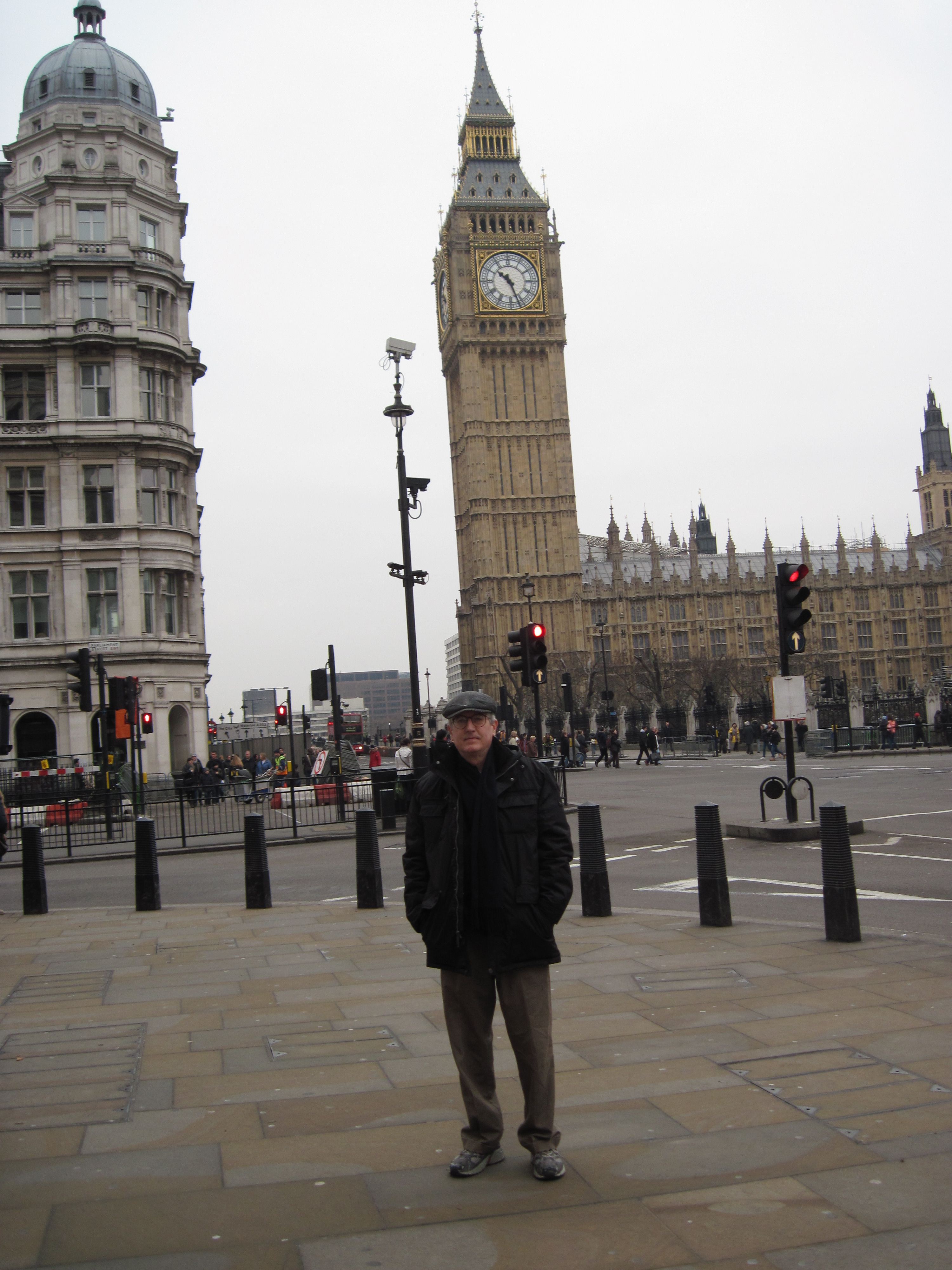
As you know, I went to the UK a year ago, ostensibly as a tourist. That wouldn’t fool a real professional, of course, but one keeps as low a profile as one can. I have my own tradecraft for this sort of thing — I make a big splash, publicize my whereabouts… what spy would do that?

It’s worked so far.

My mission — to find the Circus, and more importantly, George Smiley himself.

It was quite a challenge. George hasn’t been seen since 1982. And the original location of the Circus, now that MI6 has the River House (all mod cons, as Bill Haydon would say), is shrouded in service legend. It’s not something you’d assign to some probationer straight out of Sarratt.

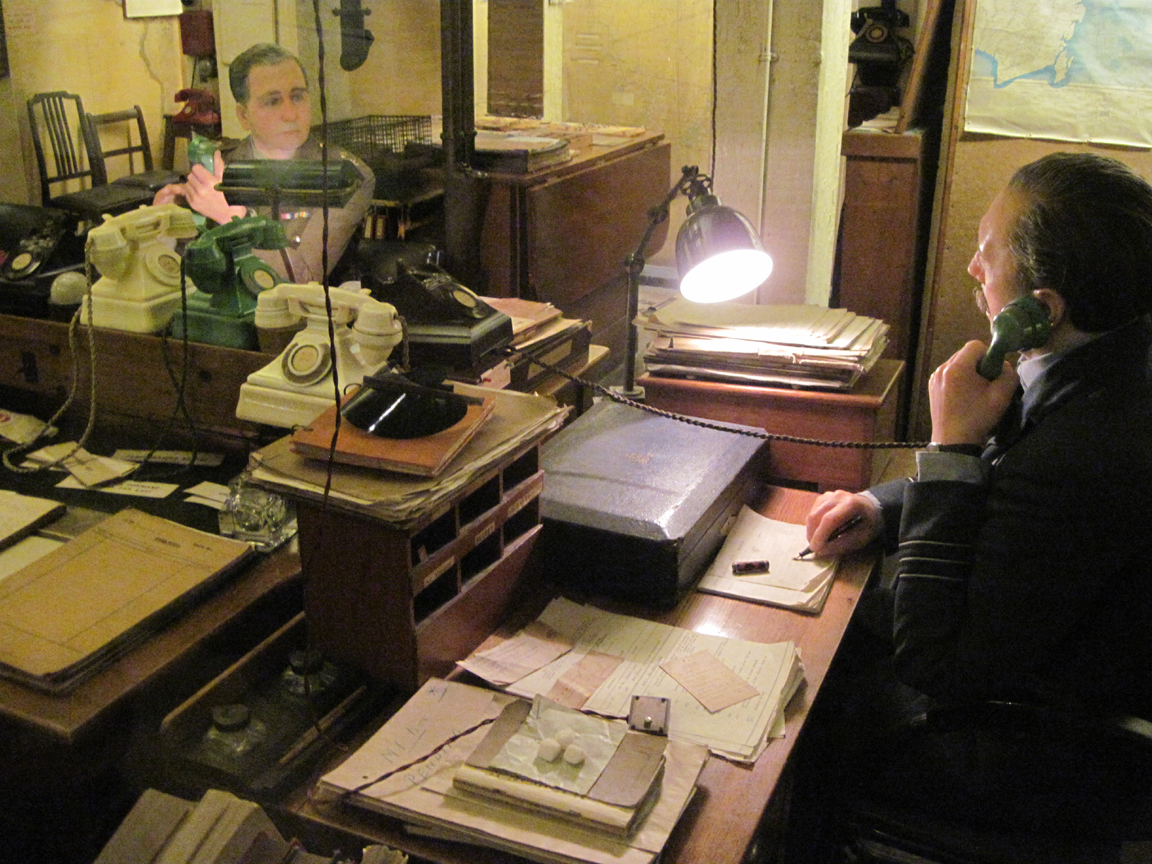
First, we spent a couple of days settling in, establishing patterns. One assumes that tiny Toby Esterhase‘s lamplighters are everywhere, so you need to paint them a picture, let them get complacent. This we did — from Heathrow to Swiss Cottage (the very spot where General Vladimir would have been picked up as a fallback, had he not been killed on Hampstead Heath), then all over the city on the Tube, aimlessly. Trafalgar Square, St. James’s, Fortnum’s, Buckingham, the Globe, the Tate, the Cabinet War Rooms, the Tower, hither and yon in the City.

Finally, at the end of our third full day, after night had fallen, we ambled up Charing Cross Road, affecting to be interested in bookshops. We almost missed it, but then there it was — the Circus itself. There was the Fifth Floor, and even Haydon’s little hexagonal pepperpot office overlooking New Compton Street and Charing Cross. Quick, I said, get the picture. It took a couple of tries, the way these things do when you need to hurry. Thank heavens for our “tourist” cover; it excuses all sorts of odd behavior. Then on up the street, and an hour or so of browsing at Foyles to check our backs. Found a couple of decent-looking biographies of Lord Cochrane, but didn’t buy one. (They had shelf after shelf of naval history; it went on and on.) Then we wandered about in the West End, to clean our backs as much as possible, before heading back to Swiss Cottage.

One thing down. Hardest part to come.

By this time, I had decided not to risk the actual modern HQ of the SIS. Mix fact with fiction like that, and it’s like mixing matter and antimatter. Could blow you clear across the universe, or at least to Brixton, and who wants to go there, really? That’s why they put Scalphunters there.

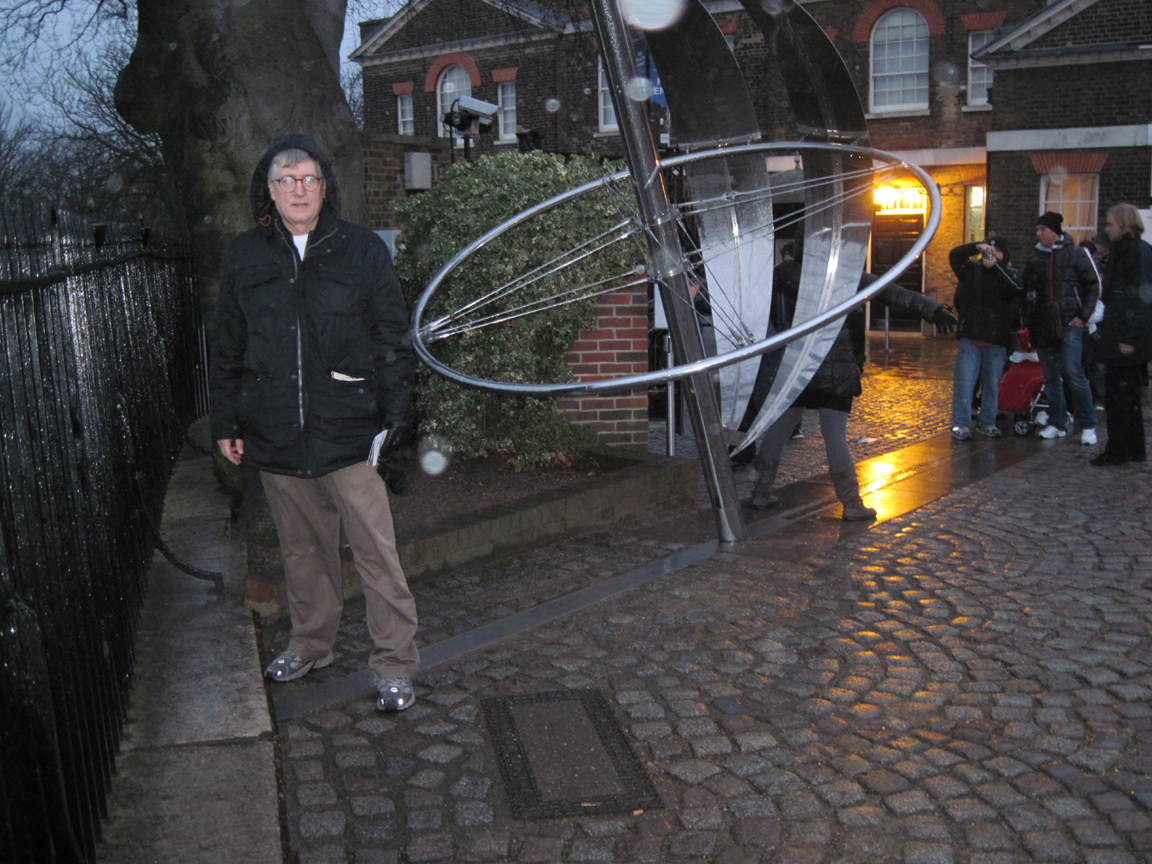
We played tourist for another day. Then another. The Sherlock Holmes museum. A side trip to Greenwich, to stand astride the Meridian, and see the coat Nelson wore at the Nile. Back into town for the British Museum.

Then, it was our last day in London. Had to go to Oxford the next day, and check on Connie. Connie is high-maintenance. So it was do-or-die time. We opted to do.

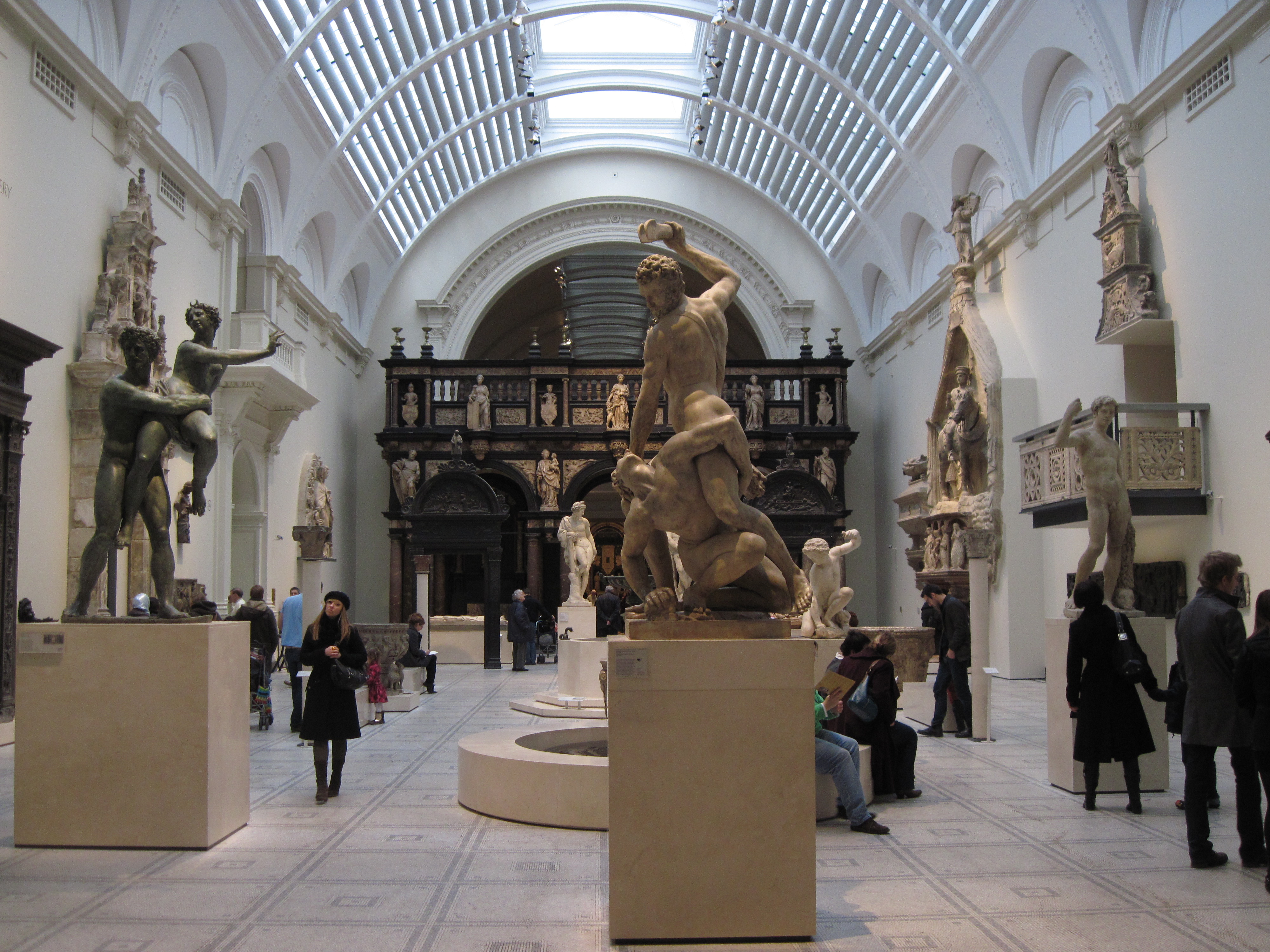
We thought that twilight would be the best time to descend on George. Vigilance is low. Everyone’s tired then; time for tea and meet the wife. So we went to that general part of town. Spent several hours at the Victoria and Albert. Loads of statues and the like.

We took the Tube to Sloan Square, a good half-kilometer from Bywater Street, and went the rest of the way on foot. We entered the cul de sac as night descended (which it does before 4 p.m. at that time of year). There wasn’t a soul on the narrow street. Everything went smoothly. When we got to the part where Smiley lives, I tried to throw the watchers off by shooting pictures of houses other than his. In a way, though, they were all relevant. George lives at No. 9, of course. But the 1979 TV series was shot at No. 10. And No. 11 has a Banham security system, which the book describes as being on George’s house. No. 9 has an ADT system.

Anyway, after doing what I could to distract any lamplighters in the vicinity, I had J (her workname — best watcher in the outfit, is J) quickly shoot a happy snap of me in front of No. 9. She was a bit nervous, because there were lights in the basement-level windows. She said people who lived there would wonder what we were doing. I muttered no, they wouldn’t: “They know exactly what we’re doing.” The thing was to get it over with quickly, so we did. Given the hurry we were in, I’m struck, as I look at the image, by how placid and dispassionate and, well, Smileyesque I look in the image. Like I was channeling him in that moment.

Then, it was back out to King’s Road and back to the Underground as fast as our legs would carry us, trying not to show that our hearts were pounding like Peter Guillam’s when he stole the Testify file from Registry that time. I was getting too old for this, I knew. As I looked up at the Christmas lights in the trees on Sloane Square, they were as blurry as the stars in a Van Gogh.

I can hardly remember the next couple of hours, but I can’t forget the stroke of luck that befell us later. Nothing short of a miracle, it was.

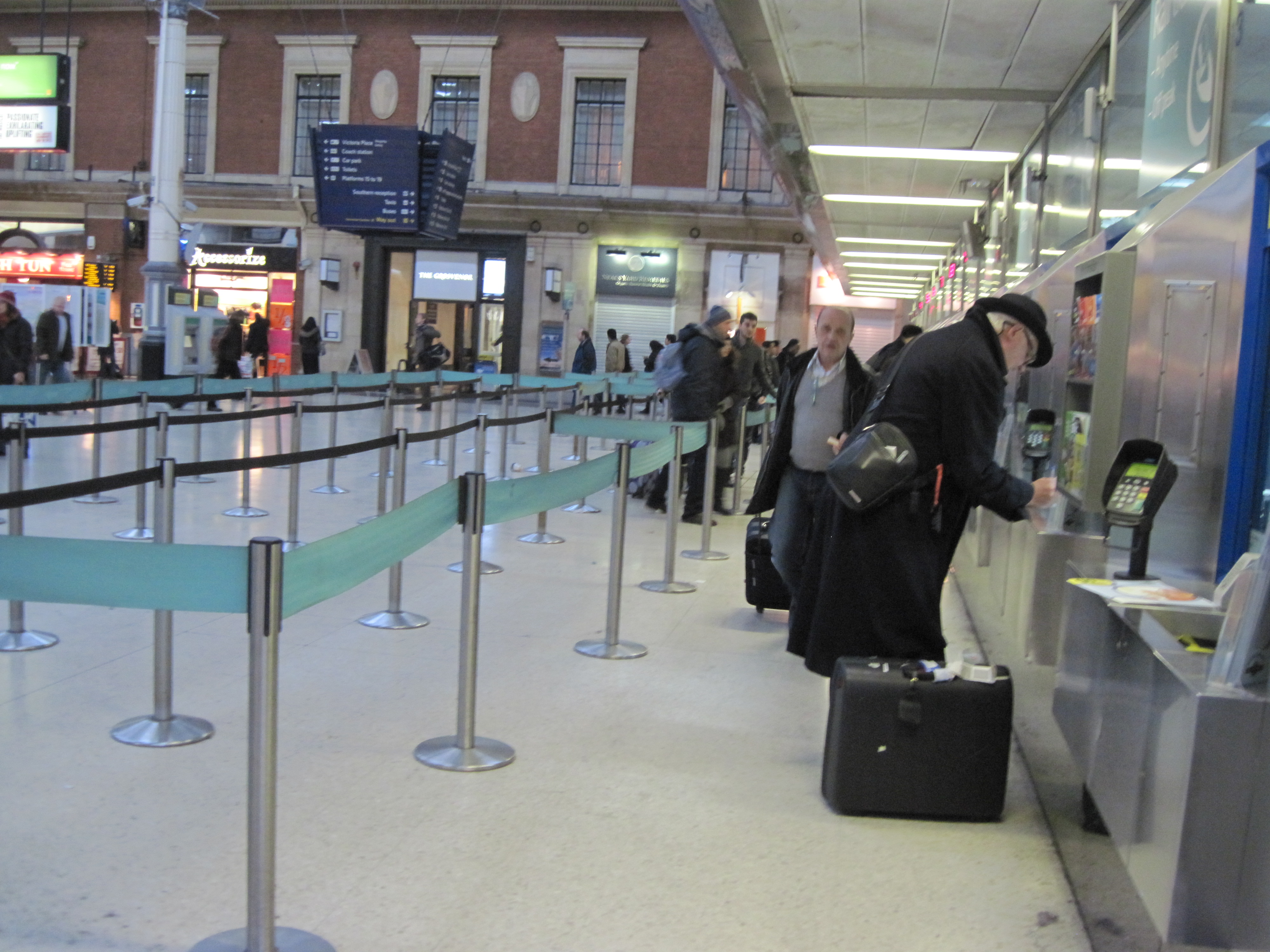
We had decided to case Victoria Station and its environs, because we knew we had to catch a coach there for the trip to Oxford next morning, and it’s good tradecraft to reconnoiter these things ahead of time. We got a bit turned-around there, and ended up touring the whole station before we discovered that the coach station was on the next block. On one aimless pass through the vicinity of the ticket windows, I looked up and there he was. George himself. Right out of the first paragraph of this passage:

He returned to the railway station… There were two ticket counters and two short queues. At the first, an intelligent girl attended him and he bought a second-class single ticket to Hamburg. But it was a deliberately laboured purchase, full of indecision and nervousness, and when he had made it he insisted on writing down times of departure and arrival: also on borrowing her ball-point and a pad of paper.

In the men’s room, having first transferred the contents of his pockets, beginning with the treasured piece of postcard from Leipzig’s boat, he changed into the linen jacket and straw hat, then went to the second ticket counter where, with a minimum of fuss, he bought a ticket on the stopping train to Kretzchmar’s town. To do this, he avoided looking at the attendant at all, concentrating instead on the ticket and his change, from under the brim of his loud straw hat…

Apparently, our appearance at Bywater Street had sent him on the run, but we had stumbled into him anyway. I left him alone, except for grabbing this picture. You doubt that’s George Smiley? Look at this picture, and this one and this one, and then tell me that. ‘Course it was him. Stuck out a mile.

But now that I’d found him, what was the point? He was just my old friend George. I could hear Toby’s triumphant voice in my ear: “Brad! All your life! Fantastic!” But I ignored him. I got the picture, and moved on. I didn’t even look to see whether he had left Ann’s lighter on the floor.

My mission had been accomplished, and then some… Why did I not exult? All I felt was the urge to polish my glasses with the lining of my tie. But I wasn’t wearing a tie…

The way we were — or the way I was, anyway

On a previous post, Bud made the observation that Hillary Clinton “seemed much more presentable 4-5 years ago.” (In Bud’s defense, it was one of our distaff contributors who brought up the subject of the secretary of state’s appearance.)

I responded, “All of us were more presentable 4-5 years ago.”

In support of that proposition, I share these photos of myself that I ran across recently, and which made me smile in remembrance.

They are a tad older than four or five years. They were taken in June 1985. I’m not sure why they are Polaroids. Maybe one of our photographers was experimenting with that as a way of checking the image before capturing it on 35mm film. Remember, in the days before digital, you didn’t know know exactly how the image would turn out until you developed it later.

In any case, the occasion for these images being taken was that it had just been announced that I would be leaving The Jackson Sun to become news editor of the much-larger Wichita Eagle-Beacon.

Something about my manic grin caused Judith, one of my best friends at the paper, to assert that I looked like I was telling my new publisher at The Sun what he could do with my old job. (Alas, my relationship with him was not nearly as positive as the one with his predecessor, Reid Ashe, whom I mentioned in my last post.)

I don’t know what I said to that. I think I just smiled — a particularly cocky, self-assured smile.