Category Archives: Education

I hope the court’s deadline doesn’t blow chance at education reform

I find myself in an unusual position.

Normally, I’d be cheering loudly for Cindi Scoppe’s column today lighting into legislative leaders for complaining that the state Supreme Court has given them a deadline for coming up with a plan to fix poor, rural schools in South Carolina. Excerpts:

Yet for 22 years, our legislators have done absolutely nothing to fix the problems raised in the Abbeville lawsuit.

No, worse than nothing.

They have spent more than two decades and God only knows how much of our tax money fighting that lawsuit — paying lawyers and experts to argue that everything in those plaintiff districts was just fine and dandy, when anyone with eyes could see that it was not.

The way forward was clear from the start: for legislators to make the lawsuit moot, by fixing the problems before the justices could get around to issuing an order. But they refused, and last fall the justices finally ruled that the state is failing its constitutional obligation to provide the children in our poorest school districts with an education they need to get good jobs and support their families and pay taxes and in other ways help make our state a better place for us all….

The court, inappropriately, it turns out, did not set a deadline. Until last week, by which time it had become painfully clear even to people who do not understand our Legislature that our Legislature does not do hard things until it has no choice. So the court set a Feb. 1 deadline for the defendants to present a plan to address the problems set forth in last year’s landmark ruling….

Were I still at the paper, I might be the one writing those words. In fact, I’d be using even stronger, more condemnatory language — and Cindi, ever pragmatic, would be the one doing her best to hold me back and telling me to recognize reality and not make perfect the enemy of the good.

But today, I’m sort of in the Cindi role, because of some unique circumstances. In fact, when I saw that the court had set a deadline for less than a month after the Legislature comes back into session, I worried, thinking, I hope this doesn’t foul up an historic opportunity.

I thought that because of what I’ve been hearing lately from my old friend Bud Ferillo.

Many of you may know Bud as the guy who made the documentary “Corridor of Shame,” which coined the phrase that all SC education reformers use to describe some of our most distressed rural schools. He’s also a dyed-in-the-wool Democrat from way back, and not one to give Republicans the benefit of the doubt.

And if there is an issue on which Republicans have earned doubt in South Carolina, it’s public education. Since they have assumed control of the Legislature, actual proposals to improve schools don’t even get a hearing in the State House, much less get approved. Say “school reform” to them, and as a group they will more than start talking about the latest plan to pay parents to abandon public schools — excuse me, “government schools,” government being by its nature a bad thing, you understand — altogether.

So I was struck when I heard Bud, as a participant in a panel sponsored by the Greater Columbia Community Relations Council over the summer, start talking almost rhapsodically about school reform — real, systemic reform that would lift up rural districts — that was coming, that was just around the corner. I didn’t get a chance to talk to Bud after that event because I left early, but then I heard him saying it again on a forum on ETV.

On both occasions, no one took him up on what he said. They just sort of nodded and moved on. So I asked Bud to breakfast one morning recently. He had an appointment he had to leave for so we didn’t get into what he was talking about as deeply as I would have liked, which is why I haven’t written about our conversation.

But here are the bare bones (and if I’m getting any of this wrong, Bud, correct me): When he became Speaker last year, Jay Lucas appointed a panel to start working on a plan to address what the court has instructed the Legislature to do about poor, rural schools. I had been vaguely aware that Lucas had such a committee holding hearings around the state. From early in the last legislative session, I had seen releases such as this one:

MEDIA ADVISORY: House Education Task Force to Host Public Hearing/Meeting in Dillon

Will receive testimony and valuable input from education leaders

(Columbia, SC) – The Education Policy Review and Reform Task Force that House Speaker Jay Lucas (District 65-Darlington) appointed in January will hold a public hearing/meeting on Monday, March 23, 2015.Jay Lucas
WHO: The Education Policy Review and Reform Task Force – a group comprised of elected officials, educators, plaintiff representatives fromAbbeville v. State, and private sector job creators who are tasked with laying the groundwork for comprehensive education reform
WHAT: Task Force members will receive testimony and valuable input form invited school superintendents, retired educators, nonprofiteducation groups, and other involved members within the education community.  After the invited guests have concluded, concerned citizens will also be given the opportunity to address the group (see additional information).
WHEN: Monday, March 23, 2015 at 4:00PM
WHERE: Dillon Middle School – 1803 Joan Drive, Dillon, SC
WHY: South Carolina’s education system needs significant reform so that every child in every part of our state has access to a 21st centuryeducation. This Task Force is responsible for putting together a report with their findings and must be submitted to Speaker Lucas before the beginning of next year’s legislative session.
But I hadn’t seen any coverage of these hearings, or read or heard anything about what the committee was doing. Were I still at the paper, and still had such people at my disposal, I would have assigned a reporter or (later) an editorial writer to look into what was going on. But I’m not, and such people are thin on the ground these days, and having one spend a day running up to Dillon for a hearing is probably not high on many editors’ priority lists.

(Actually, in defense of my friends who still have newspaper jobs, I do find some coverage when I go look for it now. I just missed it at the time.)

And since I don’t get paid to do this blog, I was in no position to undertake such legwork. So I remained in the dark, until I started getting these inklings from Bud. Bud has stayed in close touch with the process, and he says this is a great panel, largely stocked with real reformers, and they’re pulling together a lot of great ideas that are to go into legislation that we’ll be seeing in the coming session, blessed by the speaker.

But, skeptical based on decades of disappointment, I said A panel with a plan is all very well and good, but how will this fare, say, on the floor of the House? Is the speaker truly committed to push this reform you speak of when the inevitable pushback comes? I mean, he has the reputation of a reformer and he’s actually from a small town and knows about the needs in rural areas, but is he committed? Bud assured me that yes, he was — and then he had to run.

That was a couple of weeks ago.

So I’m short on details, and I really need to find some time to talk to legislative leaders about all this, and I’ve been meaning to, but haven’t. And now the court has laid down this deadline, which you know is going to get the GOP caucus all ticked off and resistant (that is, even more resistant) about doing something they don’t want to do anyway, much less do it right.

So when Speaker Lucas said, in reaction to the court’s new deadline, “Because of your actions, months and months of hard work has been potentially placed in jeopardy,” I got worried. Because I don’t think he’d say that lightly.

I got to worrying that maybe the deadline might be tossing a hand grenade into delicate preparations at precisely the wrong moment. I mean, this House coming up with real, substantive education reform is such a stretch, and would take such heavy lifting, and everything would have to go just right for it to actually happen. The forces against reform would seize on anything that might help them stop it, and the petty resentments caused by an arbitrary court deadline could give them aid and comfort.

But you know what? Cindi usually knows way more about what she’s talking about than I do. I hope that, as usual, that is the case in this instance…

 

Do college football coaches deserve their pay?

Does Steve Spurrier actually earn, in any moral sense, the more than $4 million he is paid as an ostensible public employee? Or is the $7.2 million that Alabama coach Nick Saban pulls down justified?

Mr. Saban’s biographer, Monte Burke, says yes in The Wall Street Journal. A portion of his argument:

Former Alabama President Robert Witt (now the chancellor of the Alabama university system), once told CBS’s “60 Minutes” that Mr. Saban was “the best financial investment this university has ever made.” He has a point.NickSaban_LSU-AL-07t

Mr. Saban had an immediate financial impact on Alabama. In 2007 the school was closing a $50 million capital campaign for its athletic department. After Mr. Saban arrived, the campaign exceeded its goal by $52 million. Alabama’s athletic-department revenue the year before Coach Saban showed up was $68 million. By 2013-14 it had risen to $153 million, a gain of 125%. (The athletic department kicked $9 million of that to the university.) Mr. Saban’s football program accounted for $95 million of that figure, and posted a profit of $53 million.

Mr. Witt said Mr. Saban also played a big role in the success of a $500 million capital campaign for the university (not merely the athletic department) that took place around the time the football coach was hired. Mr. Witt also credited his coach with helping grow Alabama’s enrollment—which stands at more than 36,000, an increase of 14,000 students since 2007. The university managed the neat trick of actually becoming more selective during that time. The year before Mr. Saban arrived, Alabama accepted 77% of its applicants. It now admits a little more than 50%. Mr. Saban’s three national titles at Alabama have helped the university create a winning brand….

Of course such an argument can be mounted for anyone whose hand rests on the money tap that is college football.

But in a larger sense, it’s completely absurd to say that anyone earns that much money supervising a bunch of ostensible students in doing something that has nothing to do with their studies — playing a game. When I say “larger sense,” I mean the view from 30,000 feet — the distance I try (unsuccessfully) to maintain from anything having to do with college football.

But hey, let’s keep it on a simple dollars-and-cents level (as if anyone counts cents any more): Who earns that money that flows into the program’s coffers? The coach or the players? In the NFL, top players make more than the coaches — which makes sense, when you consider who is actually out there courting brain damage and other forms of permanent injury. But am I arguing, as many do, that college players should be paid in accord with the profits they bring in?

No, I’m not. College kids getting paid millions to play a game is more or less as absurd as the coaches getting paid that much. In fact, I have no suggestions, because the problem is far too pervasive, complex and systemic to lend itself to any workable solution.

The problem isn’t that colleges are wasteful in paying coaches this much. The problem is that football brings in this much money. In other words, the problem is that we live in a society in which people value college football to a degree that is far beyond the power of the word “absurd.” And the result is, as the headline I reTweeted a week ago says:

Who is to blame? Pretty much everybody I see when I look around me, a fact borne in upon me at this time of year with all the subtlety of that trash compactor in the Death Star, its walls moving in to impartially crush Luke, Leia and Han.

Which reminds me. You know how much Mark Hamill, Carrie Fisher and Harrison Ford are being paid to reprise their roles? Well, neither do I, but … Oh, never mind…

I suggest you just require the boys to tough it out

Well, this is a new one on me.

Different men are attracted to different things about women. For instance, wrong as he may be, Jerry Seinfeld famously declared that he is not a leg man: “A leg man? Why would I be a leg man? I don’t need legs.”

Now, there’s apparently a new kind of man, or boy, given that this is high school:

High schools often have dress codes in place to keep students from dressing inappropriately or distracting fellow classmates.

But one Kentucky school is being called out for going too far, after a girl allegedly was sent home because her collarbone was exposed. 

The photo, which gained attention on Reddit recently, depicts the student wearing a tan undershirt with a white shirt on top, complete with a pair of jeans…

A caption with the photo on Imgur said, “Female students are not allowed to show their collar bone because it’s distracting the male students.”

Sure, I can imagine this girl distracting boys her age, whatever she’s wearing. She’s quite pretty. But her collarbone? Which, I should mention, you can’t even see in the picture.

In this case, I suggest the school require the boys, particularly the “clavicle men” among them, to tough it out, as a character-building exercise. There are benefits to being a teenaged boy — such as eating anything you want, and not waking up in the morning with aches and pains. But there’s a price to pay. Deal with it.

Glenn McConnell sends out College of Charleston resolution urging removal of the Confederate flag

Now there’s something I never thought I’d type. But then, I never expected anything like what I saw on Monday.

Here’s what McConnell sent out to alumni (and here’s a link):

Alumni:Today, the College of Charleston Board of Trustees approved two resolutions, one regarding the renaming of a Colonial Scholarship as the Cynthia Graham Hurd Memorial Scholarship and the other concerning the Confederate battle flag.
Please see the resolutions below.
Sincerely,

Glenn

Glenn McConnell ’69
President
College of Charleston
66 George Street Charleston, SC 29424
843-953-5500

Resolution Concerning Renaming One of the Colonial Scholarships the Cynthia Graham Hurd Memorial Scholarship 
 
Whereas, Cynthia Graham Hurd was a member of Emanuel African Methodist Episcopal Church and was a victim in the tragic events of June 17, 2015;
Whereas, Cynthia Graham Hurd was the College’s longest-serving part-time librarian, having been at the College since the 1990s;
Whereas, Cynthia Graham Hurd worked full time for the Charleston County Library system as a librarian and branch manager for more than three decades;
Whereas, Cynthia Graham Hurd was known for her quick wit, sense of humor and optimism;
Whereas, Cynthia Graham Hurd, during her life and through her work, represented the very best of our College and our beloved Charleston community;
Be it resolved, the College of Charleston Board of Trustees now and forever designates one of its most prestigious academic scholarships for South Carolinians as the Cynthia Graham Hurd Memorial Scholarship.

Resolution Concerning the Confederate Battle Flag on State House Grounds 
 
Whereas, the tragic events of June 17, 2015, occurred in Charleston, our beloved home city, and near our campus footprint;
Whereas, the city of Charleston lost nine pillars of our community, including Cynthia Graham Hurd, a longtime librarian and exceptional educator at the College of Charleston;
Whereas, the College of Charleston has and continues to play an integral role in the healing process of our city, our region and our state;
Whereas, members of the General Assembly have passed a concurrent resolution “concerning the South Carolina Infantry Battle Flag of the Confederate States of America and surrounding arrangement located at the Confederate Soldier Monument on the grounds of the State Capitol Complex”;
Whereas, the Board of Trustees is the governing body of the College of Charleston and represents the institution;
Be it resolved, the College of Charleston Board of Trustees supports the efforts of the state’s many political, civic and business leaders in urging for the removal of the Confederate battle flag from the South Carolina State House grounds.
Yes, that Glenn McConnell. While it was the board of trustees that acted, for him to be the messenger is extraordinary.

An open letter to Glenn McConnell

I was looking around to see whether anyone had spoken to Glenn McConnell during the past week. It was interesting to see national media “discovering” the unique individual we have known for so long.

One such story noted that McConnell is declining interviews until after the funerals of the dead from Mother Emanuel. That’s what I would expect; it’s the sort of sense of propriety that characterizes him.

Then, I ran across this at the site Inside Higher Ed, and I thought I’d share:

An Open Letter to College of Charleston President Glenn F. McConnell

June 22, 2015 – 6:17pm

Dear President McConnell,

First, please accept my condolences on the loss of your friend and former colleague,Rev. Clementa Pinckney, as well as our mutual colleague, College of Charleston librarian Cynthia Hurd. Their deaths, and the deaths of Rev. Sharonda Singleton, Myra Thompson, Tywanza Sanders, Ethel Lee Lance, Rev. Daniel L. Simmons Sr., Rev. DePayne Middleton-Doctor, and Susie Jackson at the hands of a white supremacist terrorist are a tragedy that we can hardly imagine. These people were giants in our community, and we feel the collective pain of their absence, but I also know the loss is particularly personal to you.

I am writing to you because you are the leader of my college and one of the most influential people in the state of South Carolina.

I am asking you to support the removal of the Confederate battle flag from the South Carolina Capitol grounds.

I know that you are a student and practitioner of the principles of servant leadership, as demonstrated during your time in the legislature, and over the past year as you’ve guided College of Charleston. You’re well aware of the controversy surrounding your initial selection as our president, and yet, in a short time, by listening to others and meeting the needs of those you lead, you’ve convinced many that you were the right choice all along.

You are now serving a different constituency than in 2000, when, as a member of the state legislature, you helped broker the compromise that removed the flag from the capitol dome to the Confederate memorial on the grounds. Then, you were looking for a solution that would defuse a politically volatile situation. Even as you declared, “Many of us who love the flag would have preferred it stayed on the dome,” you recognized that its removal was necessary.

It is clear that the legislature will soon be tasked to consider the removal of the flag from the grounds entirely. A number of your Republican former colleagues have already expressed their desire to retain the flag in its place of honor. Many say they are “undecided” or have yet to commit to a position. A statement from you in support of removal may help prevent the kind of contentious battle we do not need at this time.

If the Confederate battle flag once symbolized “heritage, not hate,” the actions of the white supremacist terrorist who proudly posed with the flag, as well as symbols of Apartheid South Africa, before murdering nine Black people in the midst of a Bible study, have rendered this distinction meaningless.

Perhaps we can argue that the flag was misappropriated by the white supremacist terrorist, the same way it was misappropriated by those who originally hoisted the flag to the top of the S.C. Capital dome in defiance of the Civil Rights Movement and support of segregation in 1961.

I accept the private and deep feelings of pride and honor absent any racial animosity that many people associate with the flag. I can respect them even as I do not share them.

But those private feelings no longer outweigh the public symbolism of a flag that for many declares them as inherently unequal. It is a flag that has been adopted by an internal terrorist enemy that we must band together to defeat.

Sadly, President McConnell, the picture of you from 1999, showing you posing in front of the flag at your family’s old memorabilia store, for me, is now indelibly associated with this heinous act. I can no longer explain it to people who ask me about College of Charleston. It is inconsistent with the pride I feel for this place and my respect for your leadership this past year.

This is, in many ways, unfair. Signaling hate is obviously not your intention. You have declared yourself a champion of equality and diversity. In fact, one of your first acts as president was to take concrete steps to increase diversity at College of Charleston. You have been walking your talk as a leader.

I hope you agree it is time to take another step.

That which we could not imagine in 1999 or 2000 has now happened in 2015.

Though, if we really search our hearts, we know that these murders were not unimaginable at all, but rather wholly predictable, inevitable even, when we refuse to confront these wounds. The white supremacist terrorist spoke openly of his plans. In his twisted mind, these murders were justified.

He found comfort in this flag, and believed its public display meant that he spoke for many.

We’ve had so many powerful gestures of healing in our community over the last week, proving that the white supremacist terrorist does not speak for us, but we cannot let these moments of solidarity distract us from these larger issues.

Yes, the flag is “just” a symbol, but it is now an irrefutably toxic one. How could we conclude otherwise?

I understand that you believe discussion of the flag should wait until after the victims have been laid to rest. I disagree. While those services help us heal, the severity of the crime also demands justice, the swifter the better. Each day the flag flies on the capitol grounds it may give sustenance to others who share the white supremacist terrorist’s twisted ideology.

This is justice denied. In your most recent message to the college you said, “The College of Charleston will need to be the center for our collective healing.” Removing the flag is only one small step, but it is necessary.

President McConnell, you have the wisdom, and spirit, and influence to help heal your college community and your state.

Please support the removal of the flag from the S.C. State Capitol grounds.

Respectfully,


John Warner
Visiting Instructor
College of Charleston

Yes, it would be wonderful for McConnell to lend his support to getting the flag down. He may even do it. If so, the effect would electrifying, among all who know him.

But there’s no way to say now. In the meantime, I was impressed by the letter — respectful, conciliatory, collegial and with just the right tone to persuade. That’s just the kind of tone all of us should adopt as we engage this debate in the coming days.

If nothing else, a professor should be able to WRITE better than that

Self-described Duke professor Jerry Hough has stepped into deep don’t-don’t with his comments on a New York Times editorial headlined “How Racism Doomed Baltimore.” If you click on this link, you’ll see his comments.

What he said has been called racially “noxious.” And he’s taken a lot of heat for it.

I’ll let others judge whether Dr. Hough is, in his heart of hearts, a racist. One thing I know for sure is that he has a very poor command of the English language, to the extent that he lacks the skill to avoid sounding like a racist.

For instance, he doesn’t seem to get it that, if he’s going to make offensive (and extremely trite) generalizations comparing the experiences of Americans of Asian and African extraction, one does better (a little better, anyway) to refer to “blacks” and “Asians” than “the blacks” and “the Asians.” I mean, who doesn’t know that? Who is that tone deaf?

Dr. Hough has been castigated, unsurprisingly, for saying “Every Asian student has a very simple old American first name that symbolizes their desire for integration. Virtually every black has a strange new name that symbolizes their lack of desire for integration.”

I mean, let’s set aside the fact that I’d like to make the prof a bet that not “every” Asian student has a name like “John.” It’s the WAY he said it. Folks who are not racists have done a great deal of hand-wringing over the fact that if you have a “black-sounding” name such as “Tyrone,” you’re less likely to get a job interview than if your name is, say, “Bradley.” (Ahem.)

This is a point that can be, and often is, made in a non-offensive manner. Dr. Hough mentions it in a way that condemns “the blacks” as a group for not wanting to play well with others.

Anyway, here are his comments in their entirety:

This editorial is what is wrong. The Democrats are an alliance of Westchester and Harlem, of Montgomery County and intercity Baltimore. Westchester and Montgomery get a Citigroup asset stimulus policy that triples the market. The blacks get a decline in wages after inflation.

But the blacks get symbolic recognition in an utterly incompetent mayor who handled this so badly from beginning to end that her resignation would be demanded if she were white.The blacks get awful editorials like this that tell them to feel sorry for themselves.

In 1965 the Asians were discriminated against as least as badly as blacks. That was reflected in the word “colored.” The racism against what even Eleanor Roosevelt called the yellow races was at least as bad.

So where are the editorials that say racism doomed the Asian-Americans. They didn’t feel sorry for themselves, but worked doubly hard.

I am a professor at Duke University. Every Asian student has a very simple old American first name that symbolizes their desire for integration. Virtually every black has a strange new name that symbolizes their lack of desire for integration. The amount of Asian-white dating is enormous and so surely will be the intermarriage. Black-white dating is almost non-existemt because of the ostracism by blacks of anyone who dates a white.

It was appropriate that a Chinese design won the competition for the Martin Luther King state. King helped them overcome. The blacks followed Malcolm X.

Wowee. I hate to show disrespect for “the old people” by saying this, but at 80, maybe the prof has lost a little zip on his fast ball in terms of being able to set out ideas in a way that he is heard, rather than making people want to shut him out. His writing is a blunt instrument that repeatedly taps on the sorest of spots, and does so with a startling lack of originality. Duke professor? He sounds more like Joe Blowhard in the local tavern after too many brewskis.

Of course, maybe he’s just racist. There’s always that possibility. But one expects even a racist Duke professor to express his views better…

Counterculture heroes, or, Back when radical was chic

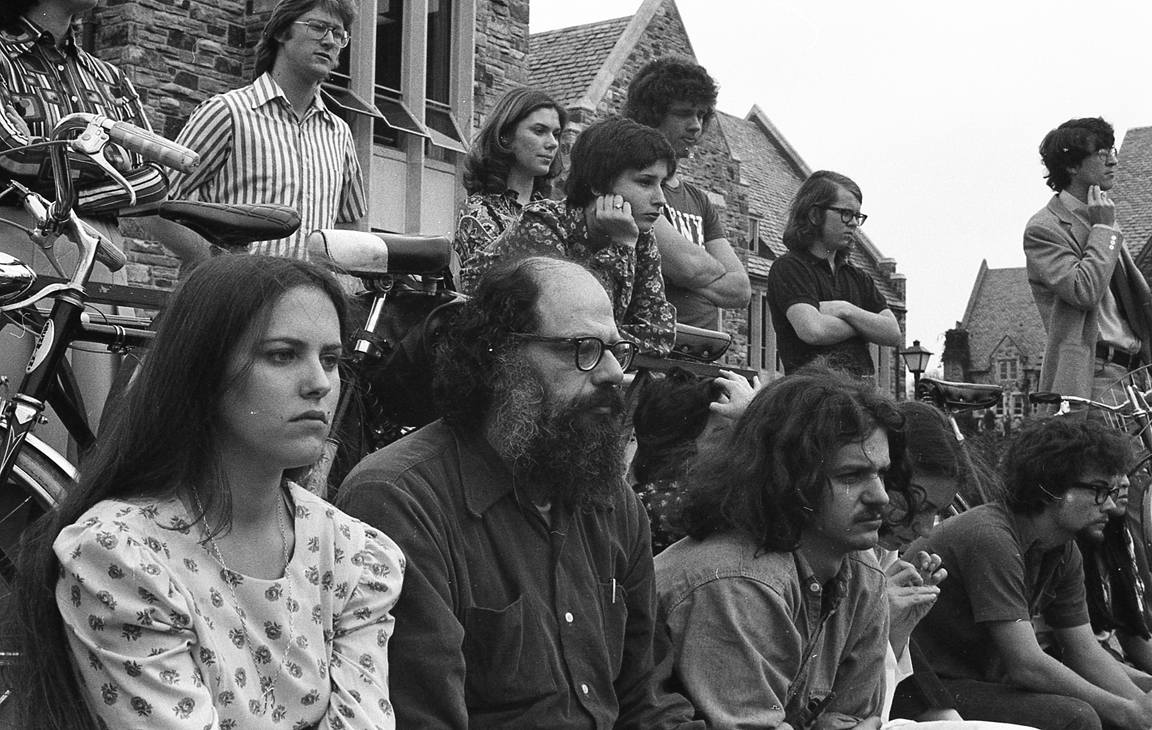
Ginsberg

I think Ginsberg was sitting among us in the amphitheater waiting to be introduced here.


Several years ago, my wife gave me a scanner with an attachment for scanning negatives and slides. I had wanted this in order to start digitizing my vast stash of 35mm film from several decades of personal and professional photography.

I’ve never really undertaken the task systematically. The idea of trying to match up separate strips of film in glassine envelopes even to the point of getting them together in their actual rolls, much less trying to assign dates to each roll to get them in chronological order, is just too Herculean. Especially since scanning a single exposure at sufficient resolution to ensure good enlargements takes a couple of minutes.

But I do leaf through my negatives randomly from time to time and blow up a forgotten image from long ago. I was doing so over the weekend, and ran across these images from about 1973 or ’74.

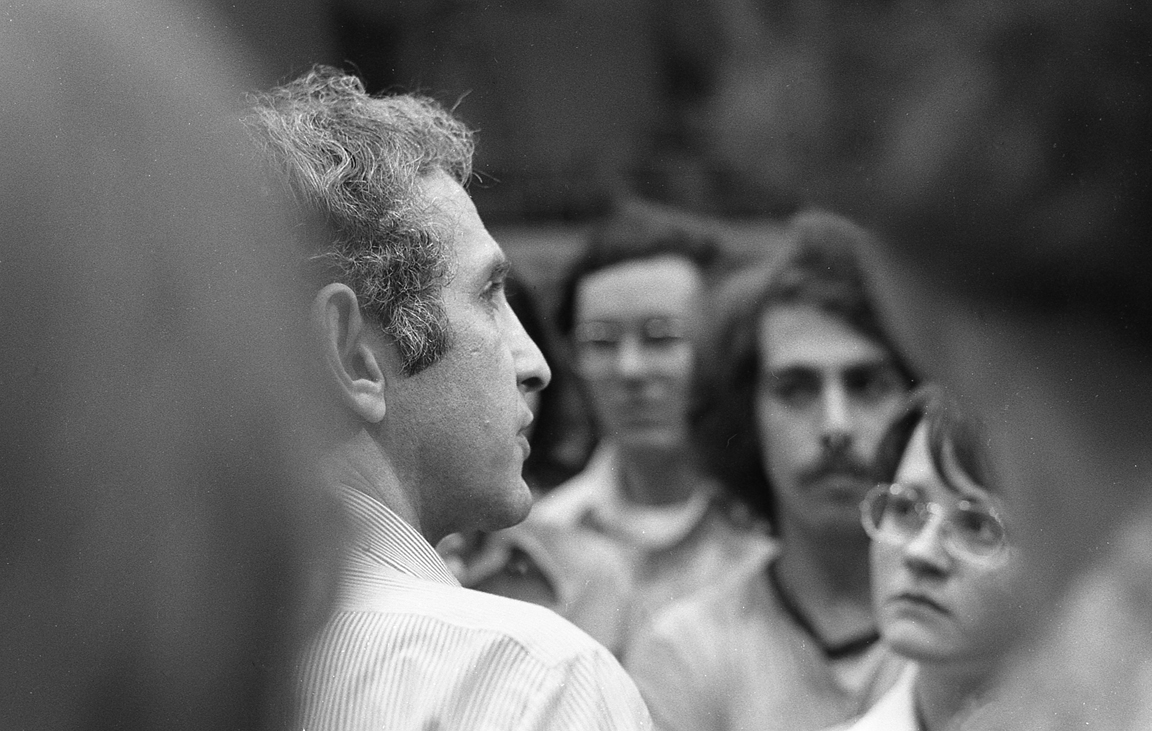
Here you see two counterculture heroes of that generation, both of whom were participants in a speaker series at Southwestern at Memphis, now known as Rhodes College. We have Allen Ginsberg of “Howl” fame, and Daniel Ellsberg of the Pentagon Papers. This was when my wife and I were students at neighboring Memphis State University, now known as University of Memphis. (What is it about Memphis and constantly changing the names of colleges?)

At least this shot of Ellsberg was in focus.

At least this shot of Ellsberg was in focus.

No, I don’t think Southwestern had a rule that your name had to end in “sberg” for you to speak there. But both were very much counterculture heroes at the time — Ginsberg as a writer and (more importantly) as the biggest surviving light of the Beat Generation, Ellsberg as the antiwar activist and forerunner of Julian Assange and Edward Snowden.

Not that they were heroes to me, mind you. But I was a student journalist, and they were big newsmakers. So I showed up, with my camera. (Also, my wife reminds me, the young woman who was our maid of honor in our wedding had been involved in bringing Ginsberg to the campus. I don’t know whether she was involved with Ellsberg.)

Also, the Beats loomed large in the legend of my wife and I getting together. We met at a party (at Southwestern, actually) that my wife and the future maid of honor were having for mutual friends who were getting married. During the party, J and I discovered that she was reading a Jack Kerouac biography even as I was reading On the Road for the first time. And the rest is history. (I had had that copy of On the Road for a couple of years, but had waited until that moment to read it.)

By this time, Kerouac and Cassady had been dead for years, so Ginsberg was the best we could do.

Anyway… I got to thinking about these photos this morning when I was reading this interesting review of a book, Days of Rage, about the violent fringes of American radicalism during that period. If you can get past the WSJ’s pay wall, you might want to check it out.

No, there’s no one-to-one comparison here. Compared to the likes of Bill Ayers (the Obama buddy!), Bernardine Dohrn and Terry Robbins, Ellsberg and Ginsberg were relatively tame. I mean, they didn’t want to blow anybody up or anything. What we had on that Memphis campus was more like “Days of Mild, Trendy Disaffection” than “Rage.”

But it still reminded me of these pictures, so I thought I’d share…

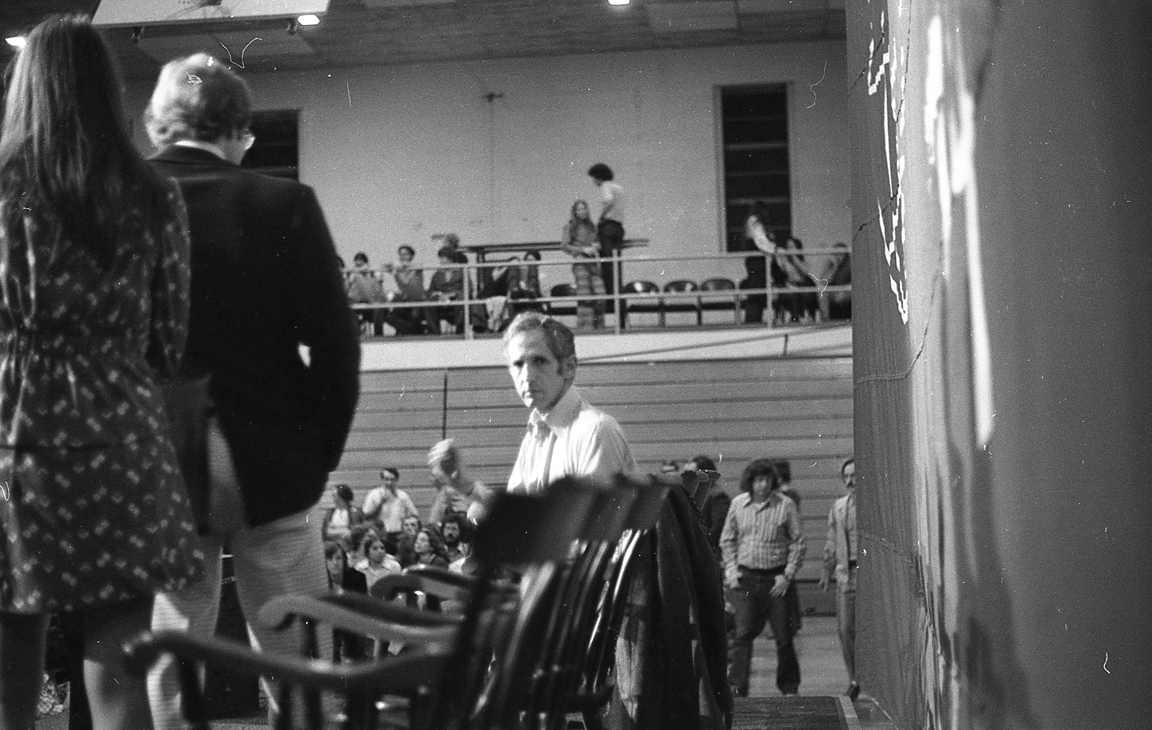
When I shot this, I thought I had an awesome picture -- I had caught Ellsberg looking RIGHT AT ME in the wings. Only later did I see that he was out of focus. Ah, the limitations of real film and manual-focus SLRs...

When I shot this, I thought I had an awesome picture — I had caught Ellsberg looking RIGHT AT ME in the wings. Only later did I see that he was out of focus. Ah, the limitations of real film and manual-focus SLRs…


Should college athletes get paid (more than the generous compensation they already receive, that is)?

If the ancient Greeks had allowed their athletes to be paid, maybe they could have afforded some clothes.

If the ancient Greeks had allowed their athletes to be paid, maybe they could have afforded some clothes.

One or two of y’all really appreciated Bryan raising sports topics in my absence, so here goes: Should college athletes get paid?

Here’s the summary section of the bill that would provide for that:

A BILL TO AMEND CHAPTER 101, TITLE 59 OF THE 1976 CODE, RELATING TO COLLEGES AND INSTITUTIONS OF HIGHER LEARNING GENERALLY, BY ADDING ARTICLE 5, TO PROVIDE THAT PARTICIPATING INSTITUTIONS IN THIS STATE SHALL ANNUALLY AWARD STIPENDS TO STUDENT ATHLETES WHO PARTICIPATE IN AN INTERCOLLEGIATE SPORT AND MAINTAIN A GOOD ACADEMIC STANDING DURING THE PREVIOUS YEAR, TO PROVIDE CONDITIONS FOR RECEIPT OF STIPENDS, AND TO DEFINE NECESSARY TERMS; TO AMEND CHAPTER 101, TITLE 59 OF THE 1976 CODE, RELATING TO COLLEGES AND INSTITUTIONS OF HIGHER LEARNING GENERALLY, BY ADDING ARTICLE 6, TO PROVIDE THAT PARTICIPATING INSTITUTIONS IN THIS STATE SHALL CREATE A STUDENT ATHLETE TRUST FUND AND FUND THE TRUST WITH A PERCENTAGE OF THE INTERCOLLEGIATE SPORT GROSS REVENUE GENERATED FROM CERTAIN SOURCES, TO PROVIDE THAT FOR EACH YEAR A STUDENT ATHLETE MAINTAINS GOOD ACADEMIC STANDING, FIVE THOUSAND DOLLARS WILL BE DEPOSITED INTO THE FUND ON HIS BEHALF AND THE TOTAL TRUST FUND AMOUNT MAY NOT EXCEED TWENTY-FIVE THOUSAND DOLLARS PER STUDENT ATHLETE; TO PROVIDE THAT AFTER FULFILLMENT OF ALL ACADEMIC REQUIREMENTS FOR GRADUATION AND COMPLETION OF A STATE-APPROVED FINANCIAL LITERACY COURSE, THE PARTICIPATING INSTITUTION SHALL PROVIDE A ONE-TIME PAYMENT TO EACH STUDENT ATHLETE IN THE FULL AMOUNT DEPOSITED IN THE FUND ON THEIR BEHALF, TO PROVIDE CONDITIONS FOR RECEIPT OF THE TRUST FUND PAYMENT, AND TO DEFINE NECESSARY TERMS.

I say no. And when you say that college athletes are providing services worth millions to their schools, and that (even though those on scholarship are provided with a free college education if they are willing and able to take advantage of it) they can easily be exploited, chewed up and spit out by such a system…

Then I say we need to change the system, not the status of the athletes. Step it back from being a big business. Move it back toward something more akin to intramural sports among actual students.

Of course, I know I’m speaking wishfully. This situation arises from a sort of mass psychosis in the general population, a society that for reasons that continue to baffle me places an absurdly high value on the outcomes of games. Actually, not only the outcomes, but on every bit of minutia in any way connected to these games.

And that’s the problem. I admit I don’t know how to change that. But I don’t think paying players is a solution to the problem. Seems to me it would take us even deeper in…

These crazy kids today: They prefer to read dead trees

I spoke to the newsroom staff of The Daily Gamecock on Friday, and learned a surprising thing: While older folks (alumni and parents) tend to read the online version, most actual students don’t. They prefer to read it on paper.

In a couple of ways that makes sense — the students can pick up the paper for free as they go into and come out of classes, so it’s just convenient to pick one up and peruse it. Meanwhile, alumni and parents don’t have such easy access to the print version.

But it still surprised me. I mean, I have easy access to The State and The Wall Street Journal, as I get both at home. But I almost never read them on paper. I prefer the iPad apps. It’s just easier to flip through the paper on a tablet while sitting at the breakfast table than to unfold the paper, turn the pages, try to fold it back into a convenient size and shape for continued reading, and so forth. And it always seems like the section you want has walked away somewhere. That doesn’t happen with a tablet.

And I never see the print version of The Washington Post, to which I also subscribe, at all.

So what’s with these wacky kids today?

I learned of this seeming anomaly from Sarah Scarborough, the advertising manager for Student Media. She told me about it before I met the news staff. Then it came up again while I was talking with the students, as they asked whether I had any ideas for making the online version more appealing to their fellow students.

But this is not just a USC phenomenon. One of the things I read on my Washington Post app this morning was this:

Why digital natives prefer reading in print. Yes, you read that right.

February 22 at 7:27 PM

Frank Schembari loves books — printed books. He loves how they smell. He loves scribbling in the margins, underlining interesting sentences, folding a page corner to mark his place.

Schembari is not a retiree who sips tea at Politics and Prose or some other bookstore. He is 20, a junior at American University, and paging through a thick history of Israel between classes, he is evidence of a peculiar irony of the Internet age: Digital natives prefer reading in print.

“I like the feeling of it,” Schembari said, reading under natural light in a campus atrium, his smartphone next to him. “I like holding it. It’s not going off. It’s not making sounds.”

Textbook makers, bookstore owners and college student surveys all say millennials still strongly prefer print for pleasure and learning, a bias that surprises reading experts given the same group’s proclivity to consume most other content digitally. A University of Washington pilot study of digital textbooks found that a quarter of students still bought print versions of e-textbooks that they were given for free.

“These are people who aren’t supposed to remember what it’s like to even smell books,” said Naomi S. Baron, an American University linguist who studies digital communication. “It’s quite astounding.”…

Anyone else find this surprising?

Join me at the Solomon-Tenenbaum Lecture tonight

poster

I’m planning to go to this lecture tonight at USC. Here’s the PDF of the image so you can read it better. And here’s a description:

Dean Nirenberg will discuss how Ancient Egyptians, Greeks, Romans, Christians and Muslims of every period, and the secularist of modernity have used Judaism in constructing their visions of the world. Do these former and modern ways of life have any relationship to each other? Do past forms of life and thought affect later ones? If so, how does past perception about Judaism influence the ways in which we perceive the world today? In the 2015 Solomon-Tenenbaum Lecture, Dean Nirenberg will examine these important questions and will discuss what, if anything, the history of anti-Judaism has to do with the present.

This is the annual lectureship that Samuel Tenenbaum funds. It’s usually pretty good. Frequently, these events give us on the Bernardin lecture committee a high bar to shoot for.

I hope to see you there.

Legislative hearing on the school equity decision

I got this advisory yesterday from Bud Ferillo, who made the influential “Corridor of Shame” documentary, in case you don’t know him otherwise:

Advisory Notice
See attached official notice for the initial meeting of the new legislative committee that will consider remedies for the Abbeville v. State of South Carolina rural schools funding case.
It will be held in Room 100, ground floor of the Blatt House Office Building, at 1:00pm next Monday, February, 23, 2015.
Former U. S. Secretary of Education and South Carolina’s first two-term Governor, Richard W. Riley, a partner in the Nelson Mullins law firm which represented the plaintiff districts prop bono publico, will be the lead off speaker. See the attached Agenda for other speakers and committee business.
PLease share with others. Come early for a seat. Enter through the center door facing the Gressette Senate Office Building. All other entrances are locked.


Apocalyptic language from the HBCU press

In light of the discussions we’re having about S.C. State, I was intrigued when Kevin Gray posted on Facebook a link to a piece from HBCUDigest.com headlined, “On HBCUs, White House Moves From Disregard to Dismantling.”

The piece takes the Obama administration to task for not sending enough federal dollars in the direction of historically black institutions, and ends painting the picture this way:

But the president couldn’t hide his coolness towards HBCUs for long. Before his first term could end, his Department of Education orchestrated and authorized the great Pell Grant/PLUS Loan debacle of 2011. Two years later, he announced plans to tie federal aid funding to a new rating system, one which will punish schools for low graduation rates, student loan defaults, alumni employment rates, and other measures which fly in the face of the HBCU mission and profile.

And here is the latest sign that the highest offices in the nation do not want HBCUs around – millions of dollars going out in an effort to stimulate innovation and opportunities to every type of school except those where the funding is needed most, and, according to data, where the dollars would be best spent.

The other side of this equation has been the easy out given to the Obama Administration with the growing movement towards support for Minority Serving Institutions, or, MSIs. Three little letters are overtaking the Big Four in the attention and support from federal and state resources, with eager legislators quick to find a way out of funding Black colleges but not taking support away from minority students.

The ironies of this movement? The hub for the research and talking points on MSI support is based at a northern, highly selective white institution, with most of its work centering on the outcomes and examples of excellence based at Black colleges. And yet, these same colleges, which totally fit the MSI billing, have found no traction from the center to advance the national HBCU narrative, or secure transformative funding for a historically Black campus from federal sources.

In the end, there aren’t enough HBCU students to boycott or march for long enough to reverse this trend. There isn’t enough wealth among HBCU graduates to stand in the gaps opened wide by federal and state neglect. And HBCU leaders have yet to figure out how to plead their own cases for existence through Black media.

At all levels, we’re all screwed up. And the people at the very top of political and financial food chains who know well our own lack of passion, knowledge, involvement or power to change the course of our institutions, are ready to deal the final death blows to our timeless institutions.

If there’s anything at all to the perceived attitude of the administration, it makes me wonder how Arne Duncan et al. would react to the proposals floating out there regarding S.C. State…


The Bingham-Mitchell plan for S.C. State

This came over the transom during the last hour:

BINGHAM-MITCHELL OFFER PLAN TO SAVE S.C. STATE

Bingham,Kenny4

Bingham

Two S.C. House Members, a Republican and a Democrat, have offered legislation to keep S.C. State University open and to return the institution to financial solvency.

S.C. Representatives Kenny Bingham (Rep-Lexington) and Harold Mitchell (Dem.-Spartanburg) are filing a bipartisan bill to rescue S.C. State from its current crisis.  Bingham and Mitchell said they believe their plan is the best way to keep the institution’s doors open, protect students and replace the leadership that has brought the school to the verge of ruin.

Bingham and Mitchell’s proposed legislation follows an unprecedented letter The S.C. Executive Budget Office sent to S.C. State University President Thomas Elzey last Friday, February 13, informing him that the University has not provided the State with a budget plan and is ending the fiscal year in a deficit which the University cannot eliminate on its own.

Harold Mitchell

Mitchell

“Declining enrollment and financial mismanagement have created a deficit of at least $18.6 million,” Bingham said.  “A clear indication that students and parents know how bad things are is the shocking 40% decline in enrollment.”

State Government was recently forced to loan S.C. State $7.5 million to pay bills and make payroll. Mismanagement has placed the institution’s national accreditation at risk.  Last June the Southern Association of Colleges and Schools (SACSCOC) put them on probation for non-compliance with standards on finances and governance.

“We are witnessing a free fall at S.C. State, and something must be done,” Mitchell said. “Losing national accreditation would devalue diplomas, undercut the investment students have made in their future, and devastate one of the oldest Historically Black Colleges in the nation.”

The Bingham-Mitchell Joint Resolution would:

  • Remove all current S.C. State Board members
  • Put S.C. State under the control of the State Budget and Control Board (SBCB)
  • Direct the SBCB to remove the current president and appoint an interim CEO
  • Direct the SBCB to make recommendations to the Legislature on how to get S.C. State through its financial crisis and secure the institution’s accreditation.

S.C. State has been in a crisis for more than three years, beginning when federal indictments for a kickback scheme forced two board members to step down.  Later, news of serious financial mismanagement surfaced, causing several administrators to be replaced and board members to resign out of frustration.

This year S.C. State notified the General Assembly that they could not make their first loan repayment. “The legislature literally had to step in to keep the lights and electricity from being cut off,” Bingham said.  “Administrators have refused to give the General Assembly basic financial information, and they clearly do not have a plan to regain solvency or to keep their school’s accreditation.”

“This was a difficult decision for us,” Rep. Mitchell said.  “But for years the Legislature has tried to bring new leaders to the board, only to see them resign in frustration as the financial crisis deepened.”

Bingham and Mitchell said in a joint statement: “We believe this type of aggressive action with immediate accountability is needed to prevent turning a very bad situation into a total disaster for the students, their parents and this historically important institution.”

# # #

And here I am as a tyro journalist, at about the same time

baby journalist

I ran across this picture during the same search that produced the one of Dylan and The Band.

Evidently, I did not take this. I don’t remember who did.

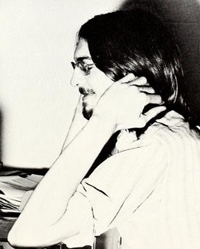
Anyway, that’s me front and center looking at the camera, with the Groucho mustache, the circa 1965 Beatles hair, the octagonal wire-rims, the distinctly big-collared 1970s sport shirt, and the white Keds. This was in the newsroom of The Helmsman, the student paper at Memphis State University, probably around the same time as the Dylan/Band picture. So somewhere in the 1973-75 range.

This was during my stint as either editorial page editor or news editor of the paper. I say this because I’m turned away from the manual typewriter and evidently pencil-editing someone else’s copy instead of writing. I’m sitting in the slot position of the copy desk, the standard U-shaped desk that an editor I worked with after graduation called “the elephant’s commode.”

Dan Henderson, our fearless leader.

Dan Henderson, our fearless leader.

But we didn’t really have a formal copy desk and slot man. There were four or five kids, of whom I was one, who were the core of the paper and made everything happen, with other contributors coming and going. Another of the inner group is in the background at far right, his finger in his near ear as he tries to hear someone on the phone. His name was Oran; I forget his last name.

I don’t know what the long-haired guy standing in the doorway of the supply closet is looking at; he seems to be just grooving on a spot in the ceiling.

Note the detritus of a paper-based publishing system. Aside from the typewriters, there’s a pencil sharpener, a tape dispenser, a stapler, and several pots of rubber cement. The rubber cement was for gluing all the pages, or takes, of a story together into one long, continuous strip of paper. The piece was sent to a commercial print shop several miles away where the paper was put together, and which we had to visit to proof and let the pages go.

The newsroom was small. Whoever shot this is standing in the middle of it.

Dan pretends to point to something on a piece of copy I'm pretending to edit. This was for the yearbook. Notice we didn't make the slightest effort to groom for the occasion.

Dan pretends to point to something on a piece of copy I’m pretending to edit. This was for the yearbook. Notice we didn’t make the slightest effort to groom for the occasion…

The closed door behind me is the Inner Sanctum of whoever was our chief editor at the time — probably the late Dan Henderson, who was later an assistant managing editor at The Commercial Appeal. Oran was to work for them later, too, in a rural bureau in West Tennessee. Those bureau people weren’t in the Guild, and were treated like dirt by the people in Memphis. One night, Oran called in his story, and the editor took it, and asked all the questions he had while editing it, and then said, “By the way, we won’t be needing your services any more.” Yeah, he was fired. He had moved out of Memphis and set up residence in some dinky town for the sake of the paper, and that’s how they let him go. Sayonara, pal.

Some would say that’s a good argument for unionizing reporters, since it was the fact that Oran was not in the Guild that let him be treated this way. For my part, I think there’s something about Guild papers (The Commercial Appeal was the only one I ever worked at) that created an unnecessarily adversarial relationship between journalists and management, so the powers that be took out their hostility on the ones they could take it out on. But that’s just my theory…

So what are we to do with S.C. State?

A couple of weeks ago, I raised the question here of whether South Carolina should continue to prop up S.C. State University, given the institution’s repeated failures to be accountable for the money that keeps getting sent its way.

Now, a legislative committee has gone farther in that direction that I expected, proposing to shut the school down completely for two years, fire all the faculty and staff, and start over in 2017.

Which is really one of the bolder moves on any issue I’ve seen SC lawmakers seriously consider in quite some time.

According to The State:

Under a budget proposal approved Tuesday by a panel of the SC House, the state would:

•  Close S.C. State for the 2015-16 school year; there would be no classes or sports also in 2016-17

•  Fire trustees, administrators, faculty and staff. Halt athletics programs

•  Allow current students to get state scholarships to attend other S.C. public college or historically black universities

•  Assume the school’s debt, more than $100 million

•  Working with a panel of current and former college presidents that is advising S.C. State, develop a plan by Jan. 1, 2017, to re-open the school in the fall of 2017…

This seems unlikely to make it through the General Assembly, but it’s already changed the conversation. The next day, the Black Caucus called for S.C. State president Thomas Elzey to be sacked.

Thoughts?

The play’s the thing: Help enrich the lives of Thai youth

10426156_1036075383087448_9165832125826871956_n

I mentioned yesterday about our plans to go visit our youngest daughter, who is in the Peace Corps in Thailand.

Today, I offer you the opportunity to help in one of the Peace Corps projects: The Thai Youth Theater Festival, a chance for kids in that country to attend “a three day festival of learning educational theater activities, developing their personal potential, and performing a performance for their audience in English.” The operative concepts being both cultural enrichment and becoming more conversant in English — which is helpful wherever you live in this world today.

I’ve chipped in, and if someone as tight-fisted as I am can do so, perhaps you will, too.

Anyway, here’s where you go to do so, if you’re willing to help out.

Let’s ask the question: Does SC need SC State?

Or to ask it another way, does the state of South Carolina need to keep propping up an institution that has become a money sinkhole, and is not delivering on its mission, with a 13.7 percent four-year graduation rate?

This is a question, of course, that has hovered out there since USC and other formerly white institutions were integrated: Given that other state institutions are open to all, do we need a separate college that formerly existed just for folks who couldn’t get in elsewhere?

And when we ask that, we hear various arguments for why an institution like SC State — or such private colleges as Benedict — have a greater affinity for, and understand better how to educate, a portion of the population that still lacks the advantages and support systems that middle-class whites take for granted. That such historically black institutions are better at meeting such students where they are, and lifting them to where they want to be.

And perhaps that is the case.

But at some point, we need to look at whether that job of lifting up the disadvantaged is getting done, and how much we are spending on dubious returns.

Note:

Struggling S.C. State University wants an added $13.7 million from House budget writers to pay off a $6 million state loan and improve operations at the college, which has one of the worst graduation rates in the state.

The Orangeburg college must get out “from under this cloud” to improve its graduation rate, S.C. State president Thomas Elzey said after he made the school’s budget presentation Wednesday to S.C. House members.

“The negative kind of statements about the quality of this university and the value of this university (need) to be taken off the table because we are valuable, and we do offer quality,” Elzey said.

However, legislators focused on S.C. State’s financial and academic woes.

S.C. State’s enrollment has fallen 20 percent recently but the school failed to cut its budget to match lost tuition payments. As a result, the state’s only historically black public university owes vendors $10 million in unpaid bills. To reduce costs, cuts have been made to staff and are being considered for athletics, the school’s president said.

The school wants its state taxpayer money doubled – to nearly $27 million in the fiscal year that starts July 1, including money to pay off the state loan – from $13 million this year.

That request does not include any money to pay back a $12 million state loan – to be issued over three years – that the Joint Bond Review Committee approved in December….

I added the bold-faced emphasis in those two places.

An institution that in recent months and years has only been in the news for financial and leadership failures wants its appropriation doubled to get out “from under this cloud?” And then what? What are the realistic prospects going forward? What do we really expect in terms of improvement and reduced need for state infusions of money?

When the bond review committee gave the school that $12 million “loan” in December, Gov. Haley said they “gave it away because they know it can’t be paid back.” And I’m not seeing any indications that she was wrong to say that.

So… where are we going with this? Where can we realistically expect to be in five years if the state keeps funneling in the money?

And at what point is it not worth it anymore?

Even hometown Rep. Gilda Cobb-Hunter says “we’re going to have to exercise some tough love” with SC State. But how much more love of any kind is it worth investing?

These are very tough questions that everyone involved is hesitant to articulate. Maybe these questions don’t occur to anyone, but that would surprise me.

There may be a million — or 27 million (wait; 39 million counting money to pay back the loan) — reasons why I’m wrong (and heartless and insensitive) to raise such questions. I hope there are. I want to hear them.

But I thought I’d play the part of the little kid in the story of the Emperor’s New Clothes, if only to see if y’all can come up with those great answers for me. I want to be embarrassed for having asked such silly questions.

But I ask them because it seems that we’re just stumbling along from crisis to crisis here. And I think it’s useful to step back, and ask where we’re going, and whether we want to go there, and whether what we’re doing is getting us there…

Speaker appears ready to get to work on improving rural schools

This came over the transom this afternoon:

Speaker Lucas Reacts to Supreme Court’s Denial for Abbeville Rehearing

Releases names of the five plaintiff participants in the education task force

(Columbia, SC) – House Speaker Jay Lucas (District 65-Hartsville) announced the five representatives who will participate in the House Education Policy Review and Reform Task Force. These individuals were selected by the plaintiffs’ attorneys in the Abbeville v. StateSupreme Court case and their names were provided to the Speaker’s office on Friday.

The House and Senate asked for a rehearing in November after the Supreme Court issued its decision on the twenty-one year old case.  Speaker Lucas, a representative from the Pee Dee, submitted the request primarily because the Court did not provide enough clarity on how to proceed in its ruling.

“Today’s Supreme Count announcement further confirms the dire need for comprehensive education reform,” Speaker Jay Lucas stated. “In light of the Court’s decision to deny a rehearing, I am hopeful that the House Education Task Force will immediately begin its work to develop a robust strategy that ensures every child is given access to the best possible education in every part of our state. These five representatives from the Abbeville v. State case will provide significant insight and help create standards that put our state back on a path towards excellence.”

Representatives from Abbeville County School Districts v. the State of South Carolina

            Wanda L. Andrews, Ed. D.

Superintendent, Lee County School District

Former Assistant Superintendent, Spartanburg County School District 7

Former Deputy Superintendent, Sumter County School District 2


            David Longshore, Jr., Ph.D.

Former Superintendent and current consultant, Orangeburg County Consolidated District 3

Former Member, State Board of Education

Former President, South Carolina Association of School Administrators (SCASA)

Former President, SCASA Superintendent’s Division

Former Consultant, Educational Testing Service

Former Member, Board of Visitors, MUSC


            Terry K. Peterson, Ph.D.

Senior Fellow, College of Charleston

Education Advisor, C.S. Mott Foundation

Former Chief Counselor to U.S. Secretary of Education, Secretary Riley

Former Education Director, Office of Governor Riley


            Rick Reames

Executive Director, Pee Dee Education Center

Former Deputy Superintendent, Florence County School District 1


            John Tindal

Superintendent, Clarendon County School District 2

Former Chair, State Board of Education

Former President, South Carolina Association of School Administrators (SCASA)

            Former President, SCASA Superintendent’s Division

Seems like the speaker has a fairly healthy attitude on the subject, in that he’s ready to get to work on the problem. Or says so, anyway.

Haley’s ‘solution’ for roads: Rob the general fund

On my way home last night, listening on the radio, I heard some things from our governor that sounded pretty good to me, including her continuing initiatives to try to help out poor, rural schools. It was refreshing to hear a South Carolina Republican say, in such a prominent venue, “for the first time in our history, we acknowledged that it costs more to teach those children mired in poverty than those born into a secure economic situation.”

I was less enchanted a moment later, when she announced, “And all of this will be done without spending a single new tax dollar.” In other words, any gains we make in education will be accomplished by cutting back on something else that state government does.

And that brings us to her proposal on paying for roads, which is essentially to take the money out of the general fund, underfunding some other state function.

She says she can go for doing the right and logical thing, the obvious thing we should do without any conditions or contortions — raise the gas tax. But only if we cut the unrelated income tax. (And restructure the transportation agency, which of course is fine — I’ve advocated it for more than two decades — although not necessarily a thing we should hold our breath on while roads and bridges fall apart.)

The foolishness of this would be immediately apparent to everyone if it were a one-to-one swap. If the income tax was dedicated to paying for roads, then no one could miss the idiocy of raising revenues for roads with the left hand while lowering them with the right.

But the income tax doesn’t pay for roads; it goes into the general fund to pay for the rest of government. And among the hate-the-government crowd, the Haley proposal will make sense. How do they get there? By clinging to the belief that most government spending is waste anyway. And to the even more absurd belief that if you just cut off the money tap, efficiencies will magically appear, and only the “waste” will be cut.

I’ll say to this what I always say to such proposals: If you believe the general fund can do without those revenues, then tell us what you want to cut. Make the cuts first, and then reduce the no-longer-needed revenues.

But they won’t do that. That would be hard. They prefer the magical-thinking approach — just cut off the money, and everything will work out OK.

The honest thing would be to say, here is the thing that I think is less important than funding roads. But that would incur a political cost. The governor, and those who will support her idea, just want the warm-and-fuzzy credit that comes from cutting a tax, any tax.

This is the kind of proposal you make when you’re more interested in staying in the good graces of the Grover Norquists than you are in governing.

I think our governor has matured in office in a number of ways. She used to call the discomfort of mainstream Republicans over her sudden rise “a beautiful thing,” with a twinkle of malice in her eye. Now, she uses that phrase in a more positive way:

Whether I’m in California or Connecticut, Montreal or Minnesota, the story of South Carolina’s success is front and center. Everywhere we go there is excitement – and frankly, not a small amount of envy – over who we are and what we’ve been able to accomplish. It’s a beautiful thing….

But the deal she is proffering on roads is a dereliction of responsibility.

Again, if we want better roads, we should dig into our pockets (and into the pockets of visitors who use our roads) and pay for them. Magic beans are not a solution.