Category Archives: Higher education

What it cost me to go to college in 1973-74

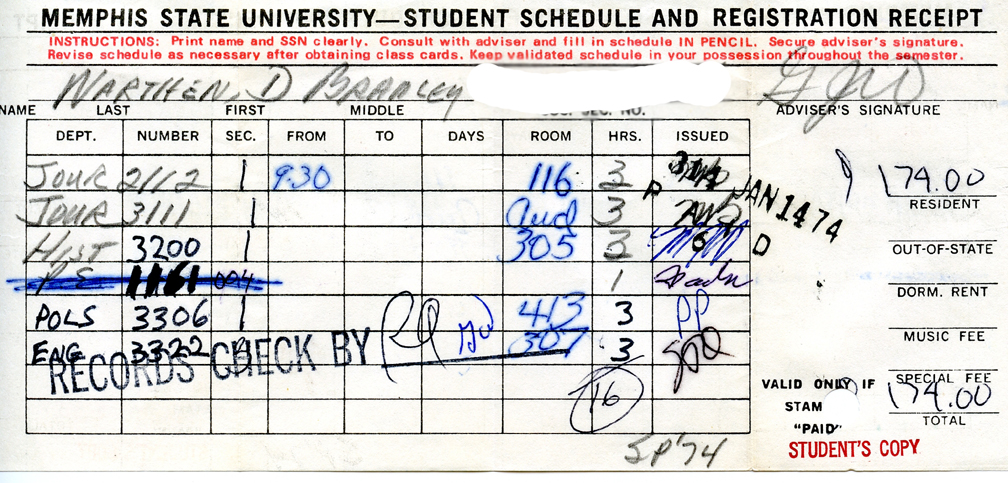
I’m going through some old boxes of stuff, and ran across a wallet I carried in my college days. I scanned for you three of the items I found in it.

The first, above, shows what I paid for a semester at Memphis State University on Jan. 14, 1974. As you can see, the total cost for 16 credit hours — as usual, crammed with journalism classes I had to take, history and English classes I didn’t have to take but wanted to, and some PE to force me to get some exercise — was $174.00.

That’s one HUNDRED — not even thousand — and seventy-four dollars.

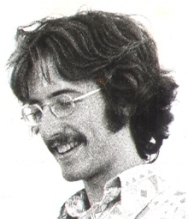
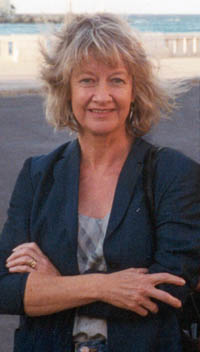
Me, at about that time.

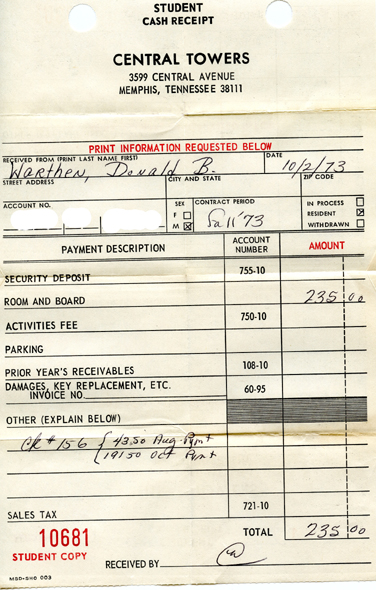
Below, I include a receipt for my room and board for the previous semester — $235. This was not for a regular dorm. This was for a room in a private dorm, right on the edge of campus. Few people actually stayed on campus at Memphis State; it was a huge commuter school (a lot of people called it “Tiger High” because people just continued on there from high school without leaving their parents’ homes). Housing was such a low priority there that there were a lot of us who couldn’t find official campus dorm space at all, but who were willing to pay private rates (that is to say, my parents were willing to pay) for the experience of staying there.

Central Towers was two 10-story towers with the boys on one side and girls on the other, although the procedures were keeping us apart were not what you would call stringent. Making this an even more fun community was the fact that the dorm would periodically throw FREE beer busts with no limit. Enough said about that.

And all of that, including pretty decent food, cost $235 a semester.

Just for fun, I’ve included a ticket stub, also from that wallet, from when my then-fiancee and I went to see Elvis — Presley, not  Costello — on March 16, 1974. It was one of seven shows in a row he did at the Mid-South Coliseum. It was originally going to be fewer than that, but the hometown demand was so great they kept adding shows. It was the first time he had performed publicly in Memphis since 1961, and almost the last time ever.

I don’t know how much it cost, but in those days it was almost certainly less than $10. The usual price I remember paying for concerts then (Bob Dylan with The Band, Leon Russell, Joe Cocker, Joan Baez and the like) was $5.

Apparently, the NLRB is trying to save the country from us stupid Southerners

Meant to share this with you the other day when I saw it. It was an op-ed piece in The Wall Street Journal, sticking up for the NLRB for attacking Boeing’s plans to produce Dreamliners in SC:

We should be aghast that Boeing is sending a big fat market signal that it wants a less-skilled, lower-quality work force. This country is in a debt crisis because we buy abroad much more than we sell. Alas, because of this trade deficit, foreign creditors have the country in their clutches. That’s not because of our labor costs—in that respect, we can undersell most of our high-wage, unionized rivals like Germany. It’s because we have too many poorly educated and low-skilled workers that are simply unable to compete.

We depend on Boeing to out-compete Airbus, its European rival. But when major firms move South, it is usually a harbinger of quality decline. Over and over as a labor lawyer in the 1980s and ’90s, I saw companies move away from Chicago, where the pay was $28 an hour, to some place in South Carolina or Louisiana where the pay was about half that. While these moves aggrieved me as a union lawyer, it might have consoled me as an American if those companies went on to thrive globally.

But too often, alas, it was the beginning of the end, as it was for Outboard Marine Corporation, where I once represented workers. In the 1990s the company went from the high wage union North to the low wage South and was bankrupt by 2000. There are reasons workers in the North get $28 an hour while down in the South they get $14 or even $10. Adam Smith could explain it: “productivity,” “skill level,” “quality.”

Here is yet another American firm seeking to ruin its reputation for quality. Why? To save $14 an hour!…

This gross insult not only to SC workers, but to the ability of our technical college system to train them (which the system is perfectly capable of doing — ask BMW), is apparently supported by nothing more substantial than the fact that in SC, we will work for less money. I don’t suppose you can be in actual need of a job unless you’re a stupid Southerner, huh?

This was so over-the-top that I found myself wondering: Did the WSJ deliberately pick this piece because it was so ham-handed, just to make the NLRB’s case look worse than it already did? Surely not.

Everybody wants to talk about nuclear, but who wants to listen?

Last night I went for the first time to one of EngenuitySC’s Science Cafe sessions at the Capital City Club. I’d been meaning to go to one for quite some time, and I finally made it to this one.

So did a lot of people. When I called at the last minute to RSVP, the session was full. But I was told to come anyway, as there were usually no-shows.

So I showed up. And while there were a few empty seats as the session was starting, I stood at first in case a latecomer needed one of the seats. Otherwise, SRO.

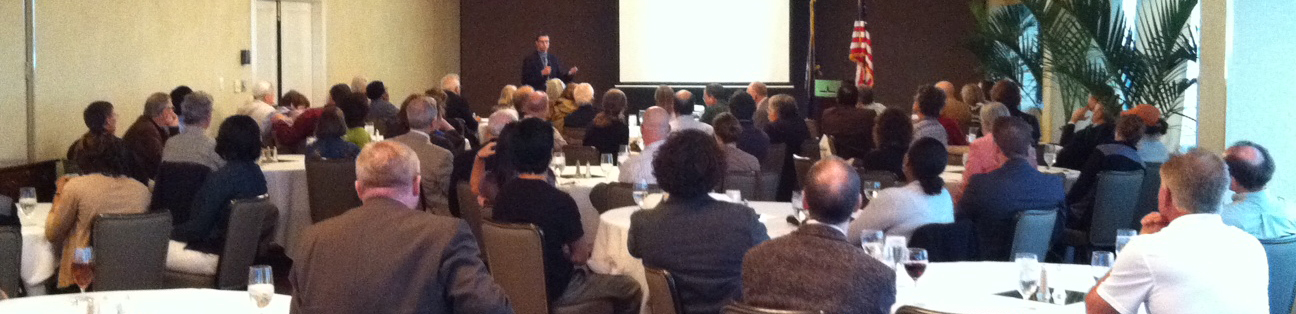
Neil McLean, Executive Director of EngenuitySC, began the evening with a somewhat wary welcome to the crowd, noting that this was the biggest turnout ever, and that he saw quite a few… new faces… in the audience. He then expressed his hope that the interaction would be civil.

The topic? “Sustainable Nuclear Power: Perspectives on Risk and External Costs.” The speaker was Travis W. Knight, the acting director of USC’s Nuclear Engineering Graduate Program.

He didn’t have an easy night of it. As I tweeted at the time,

Nuclear skeptics in crowd won’t let speaker at Science Cafe get on with his presentation; one keeps interrupting to read from The Economist.

and later…

Neil McLean of EngenuitySC has to change rules — 1 question per person — to let Science Cafe speaker continue with nuclear presentation.

When Mary Pat Baldauf, sustainability facilitator for the city of Columbia, wrote back to say it sounded like she was missing a good one, I told her she was “You’re missing humdinger. Speaker fairly rattled by crowd’s hostile interruptions. No way to have a debate, much less a lecture.”

In retrospect — and things really did settle down after Neil imposed that rule, and the speaker began to hit his stride a bit better — maybe I made it sound more dramatic than it was.

But judge for yourself. Here’s a recording from the first few minutes of the lecture. You’ll note that there are three interruptions during the 3 minutes and 25 seconds on the recording, including one from the Economist reader.

For my part, I found the lecture informative. But I went away thinking, with what is happening in Japan, everybody wants to talk about nuclear power. But how many people want to listen?

Congratulations, Innovista, on landing Ann Marie!

A little earlier, I sent an e-mail to Ann Marie Stieritz congratulating her on her new job:

Ann Marie Stieritz has been named director of business solutions for Innovista at the University of South Carolina.

Stieritz has worked in the S.C. Technical College System for the past four years, most recently as vice president for economic development and workforce competitiveness.

Her responsibilities will include recruiting high-tech businesses to the Midlands and serving as the liaison between USC’s researchers and the business community.

Don Herriott, director of Innovista partnerships, said, “I have worked with Ann Marie on various boards and projects. She has demonstrated exceptional capability and leadership in her role at the South Carolina Technical College System, especially in her economic development and workforce development programs. I am confident that she will provide the industry connectivity that Innovista needs.”

Stieritz has a background in education, workforce and economic development. At the S.C. Technical College System, she has overseen the system’s two nationally recognized economic and workforce development programs, as well as other statewide initiatives that have enhanced the state’s competitiveness through education and training, USC said.

She is former statewide coordinator for 12 Regional Education Centers, which coordinate education, workforce and economic development with business and industry initiatives to develop education and workforce readiness strategies…

But then I realized that I had it all wrong! Congratulating Ann Marie was as wrong-headed, as déclassé, as congratulating the bride on her engagement.

Actually the congratulations are due to Innovista. So, Innovista, I give you joy of your new hire.

Don Herriott was a good call. He did what he should, immediately shifting the conversation about a couple of buildings to the much, much broader concept about what the juxtaposition of an urban research university and all this undeveloped land overlooking a river can add up to.

So is this. Ann Marie’s intelligence and drive will be just what Innovista needs for this movement to take off. I look forward to watching her make that happen.

Gamecock scores major Darla Moore scoop

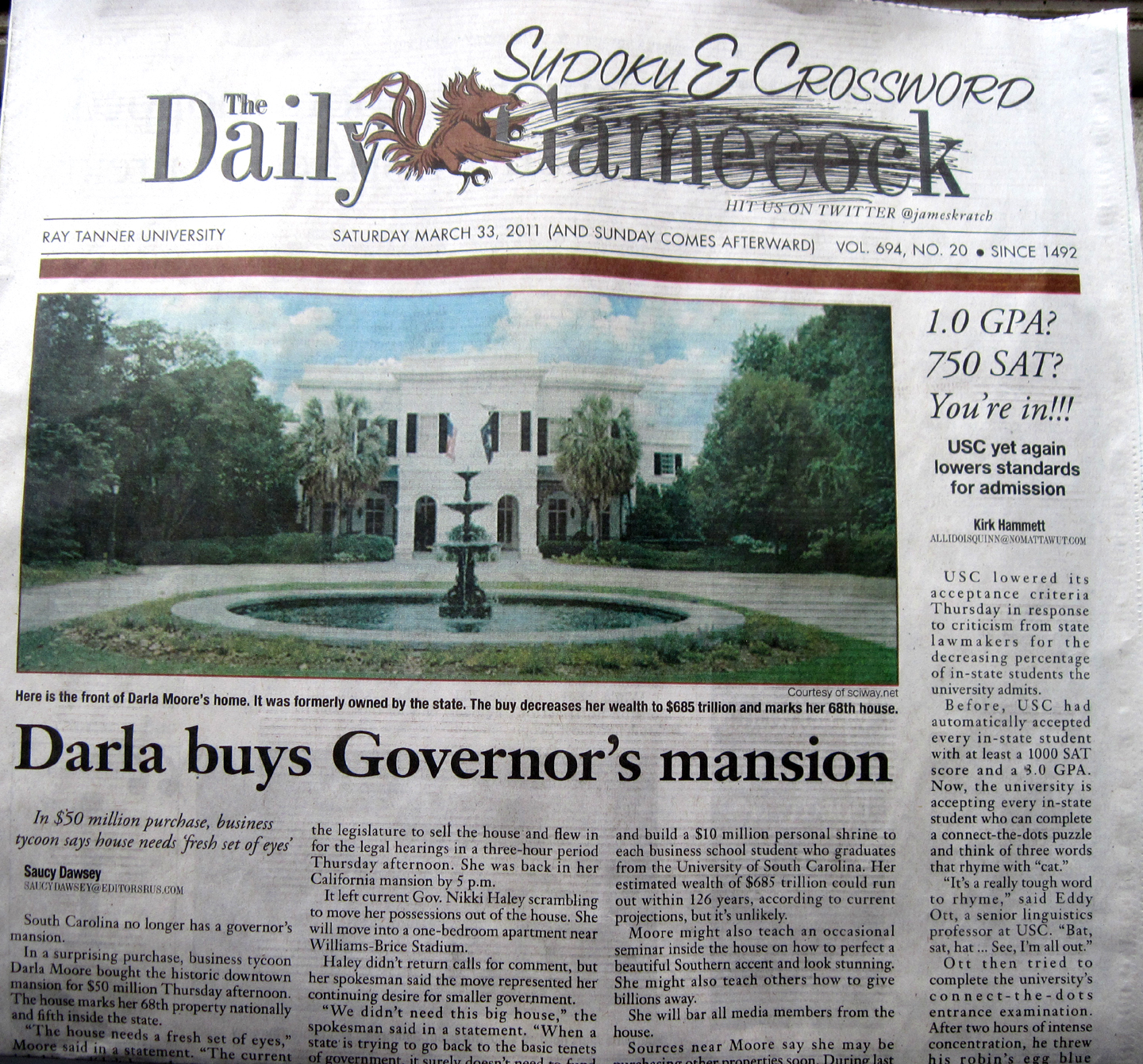
Or perhaps, rather than Gamecock, I should say, The Daily Sudoku & Crossword.

The students at “Ray Tanner University” had a bit of fun with this one, and really did a pretty good job — with the headlines, anyway (I just picked this up a few minutes ago, and haven’t had time to critique the text). The biggest laugh, of course, is “Darla buys Governor’s mansion,” but for those of more sophisticated tastes, the “1.0 GPA? 750 SAT? You’re in!” speaks to the main issue involved in Nikki Haley’s quest to replace anyone trying to elevate standards at the university.

And yes, it’s like this throughout this special April 1 edition.

Enjoy.

Darla Moore makes her voice heard, at the 5 million decibel level

When she spoke to students and others at the Russell House today (and yes, the turnout for this was SRO huge, unlike at the rally yesterday), Darla Moore acted with the class you would expect. No whining or moaning or pointless lashing out.

But boy, did she make her voice heard. You can watch the whole speech here. After thanking those present, particularly the students (and she made it clear on multiple occasions that her message was for the students rather than the media and university honchos on hand) for their “encouragement, your kind sentiments and your support,” she went on to “reaffirm my love for the USC, my support for the USC and for the state of SC,” and to speak of the “shared obligation to move this institution forward not only for ourselves but for generations to come.”

Saying she was not there to talk about “the wonder of me,” and adding, “This is also not about money,” she went on:

By your reaction, you have ignited what I believe is the collective consciousness of this state to an issue that is far more fundamental to the state’s future than any other challenge that we face. And this is about having the courage, and the singular focus to understand the critical importance of a strong, progressive and properly resourced higher education system — and I mean from technical colleges to research universities — and the role it plays in securing a bright and productive future for all of us….

We can compete at the highest level.

Just because I no longer serve on the board does not mean for one second that I will be deterred in my efforts to expand our reach for excellence.

And I’m sure y’all have noticed that I don’t need a title or a position to speak out; I just need a voice, my vision and a forum to be heard.

Just like you did this week…

Then, in her one directly defiant statement toward the governor — and by implication, toward her replacement, whom the governor said she picked because he shared her “vision,” she said:

I’ll not allow our university to become a discounted graduation mill. I want you to be proud of your degree; I want you to be first in line for the best jobs available. And I want you to stay in South Carolina, to be a part of our effort to make our state great.

Excellence is our standard, and it must be maintained even if there are those who would offer policies that would dumb us down….

Finally, she said:

This is very personal: There’s been speculation that I would take my checkbook and go home. I want you to know that my commitment to USC is as strong as ever.

She then demonstrated that by hauling off and giving another $5 million:

Ousted trustee Darla Moore told USC students today that she does not plan to take her check book and go away. Instead, Moore – removed from USC’s board by Gov. Nikki Haley – said she would give the school $5 million to start an aviation research center named after Ronald McNair, killed in the explosion of the space shuttle Challenger.

Like Moore, McNair was a native of Lake City.

USC had sought the money from the state to, it said, capitalize on Boeing’s plans to build 787 Dreamliner aircraft in Charleston.

However, House budget writers, faced with a $700 million shortfall in state money, killed the request, which Haley opposed as premature.

Moore is USC’s largest single benefactor ever. Her removal by Haley, who named a campaign donor to the USC board, has angered many USC students and graduates.

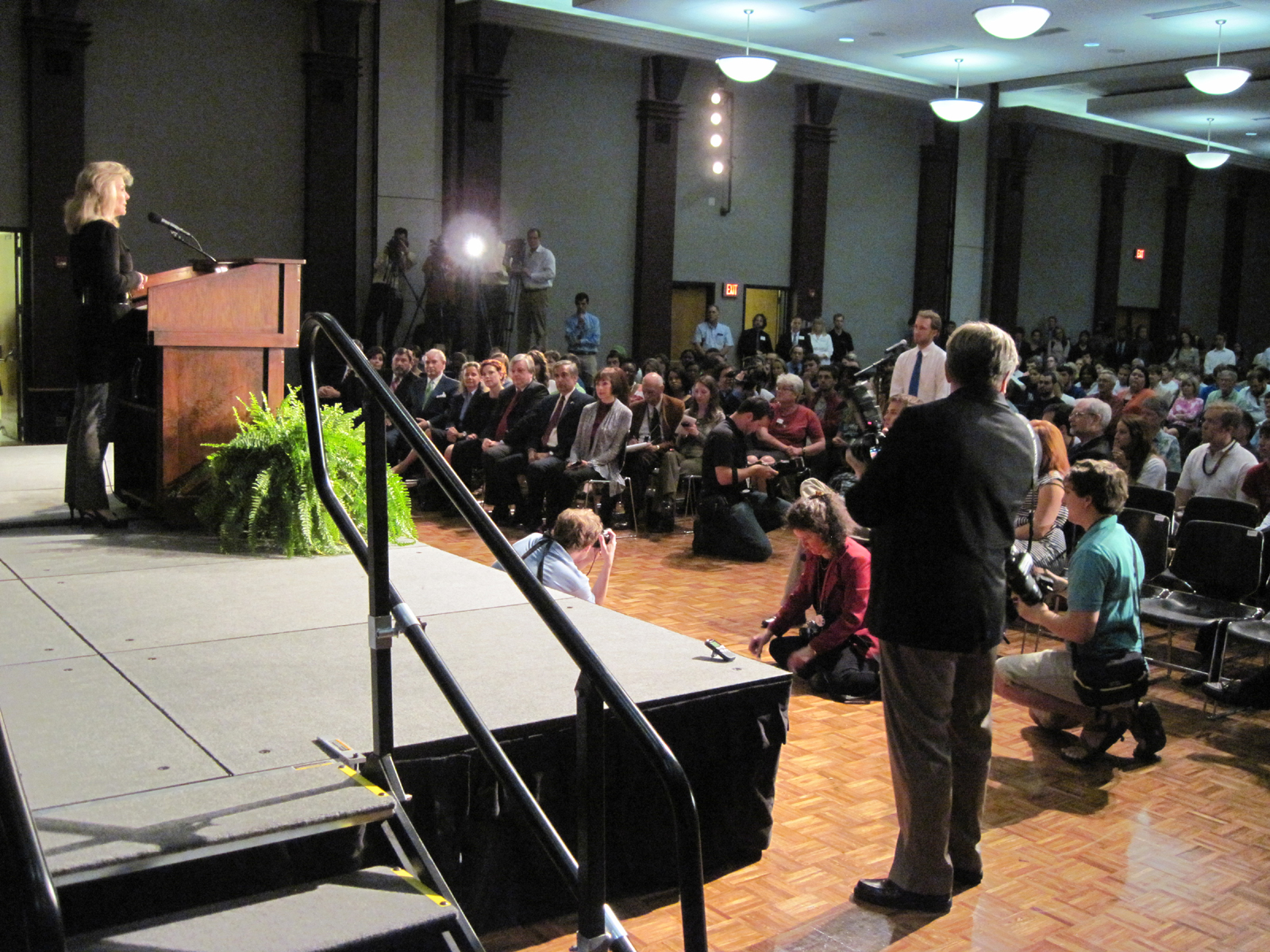
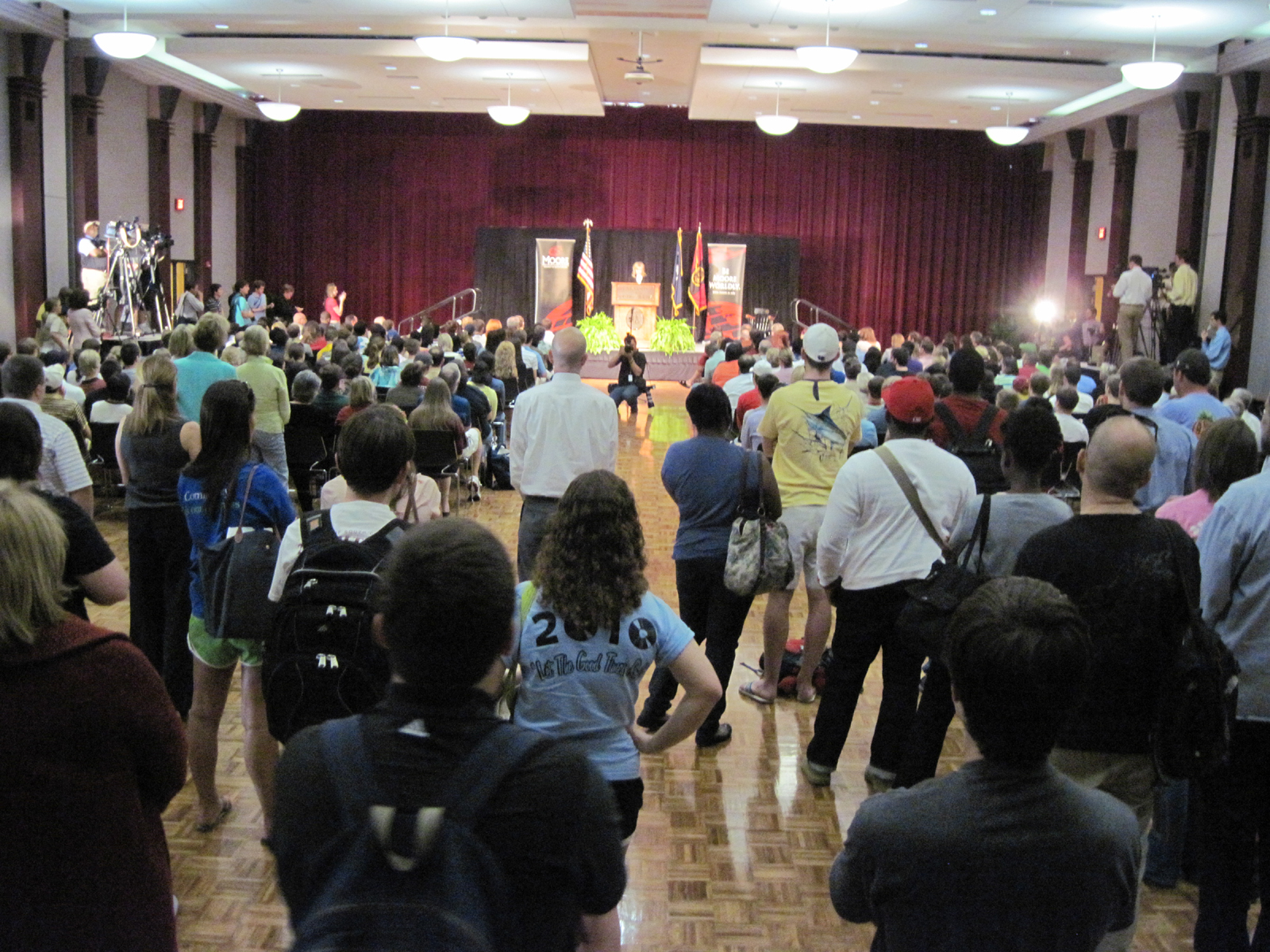
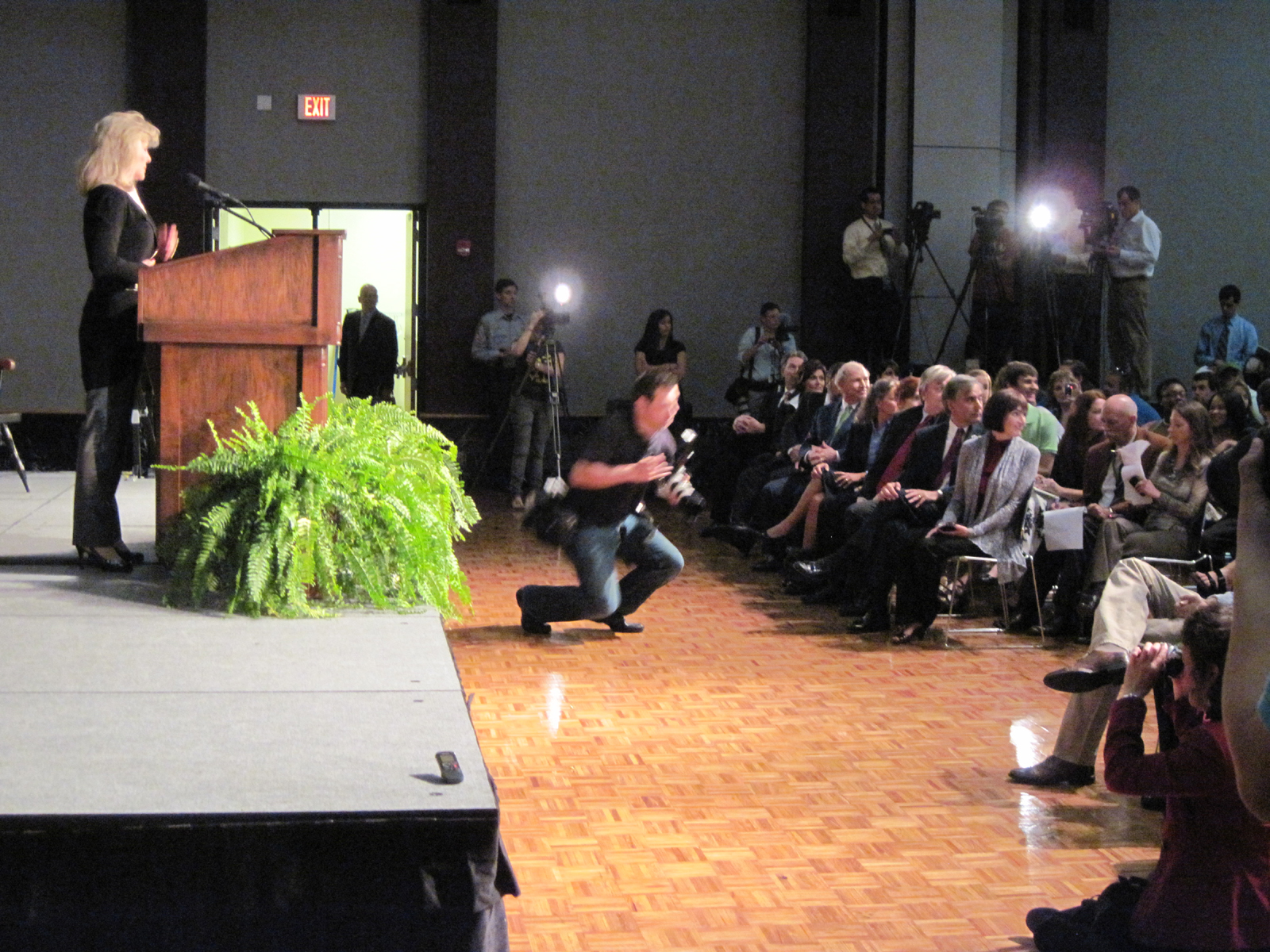
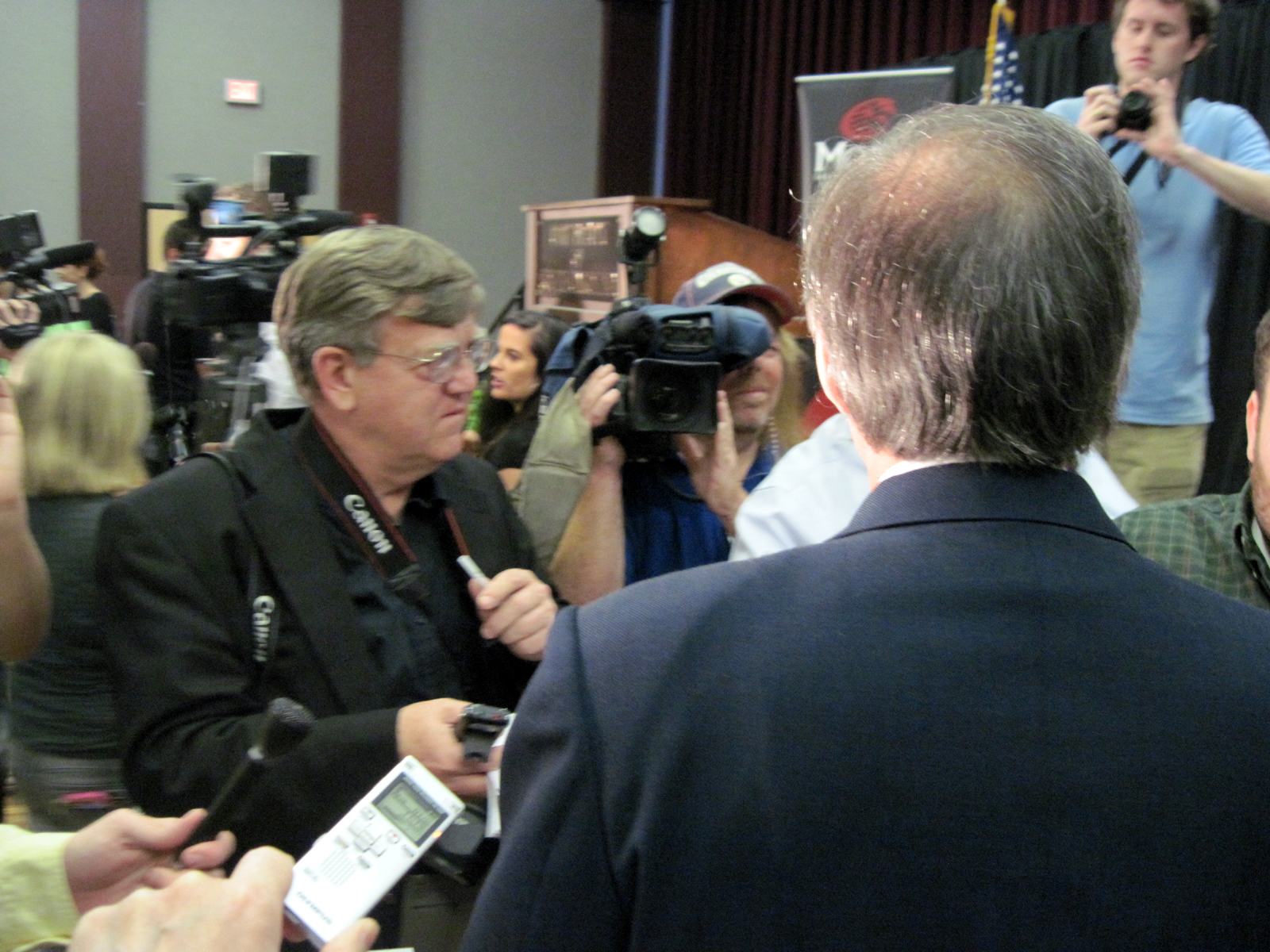
Key to photos below:

  1. There were plenty of honchos on the front row, but Ms. Moore repeatedly said she was there to speak to, and take questions from, the students.
  2. The view from the back of the ballroom.
  3. The view from the front (hey, you’re not paying extra for captioning here).
  4. Taking questions from students.
  5. President Harris Pastides was slightly mobbed by media afterward. He was very diplomatic, as I would expect him to be. He said he appreciated that the governor called to explain her decision — which was the first time I’d heard that she had (and marks the first thing I’ve heard of her doing properly — the first thing I’ve seen of her showing respect to anyone involved — in this whole affair).
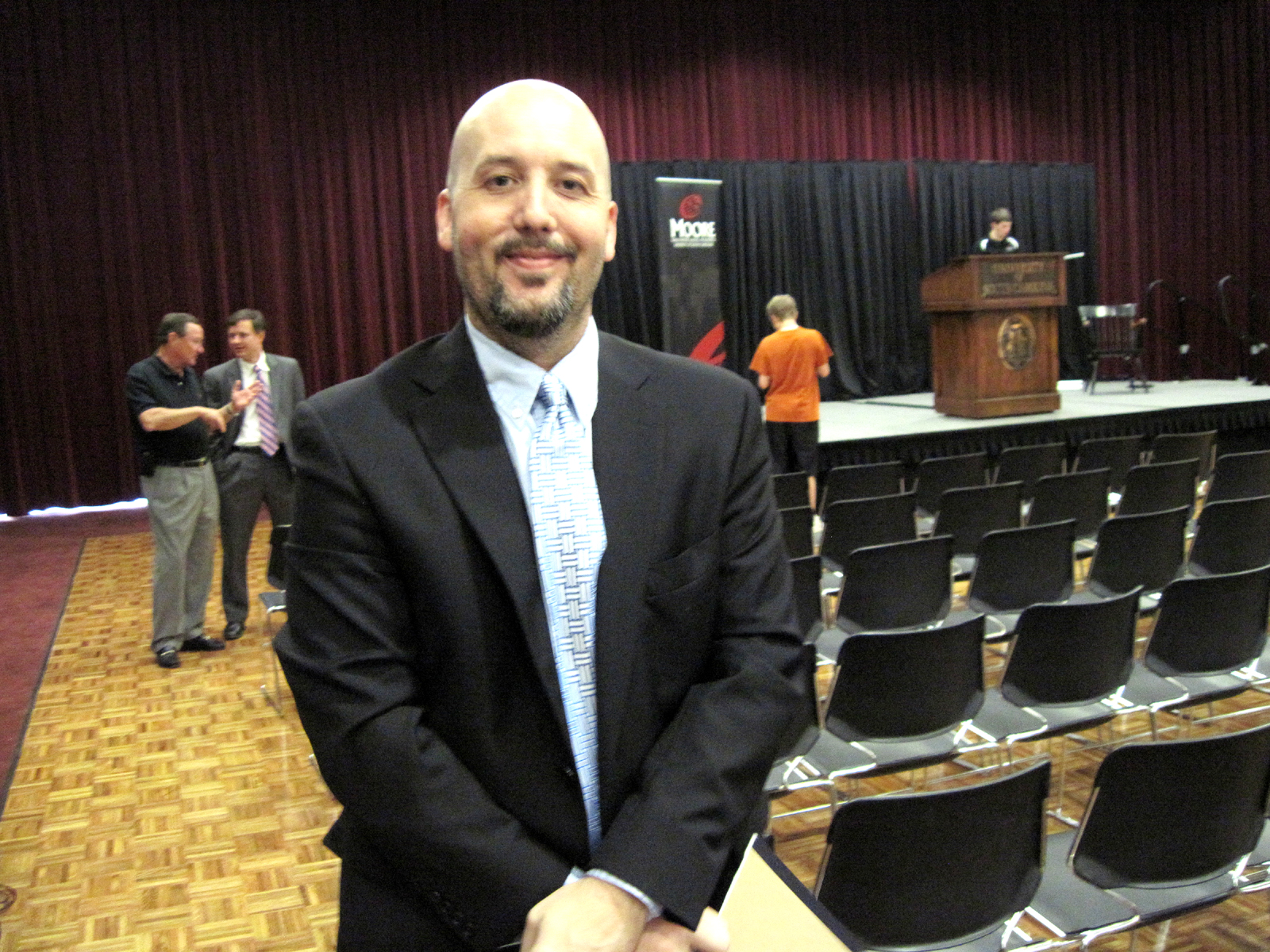
  6. Yep, that’s Will Folks, all dressed up. I don’t recall having seen him this way. By the way, he said that while he sides with the governor on this issue, he was favorably impressed by the way Ms. Moore handled it.

“Where are all the protesters?”

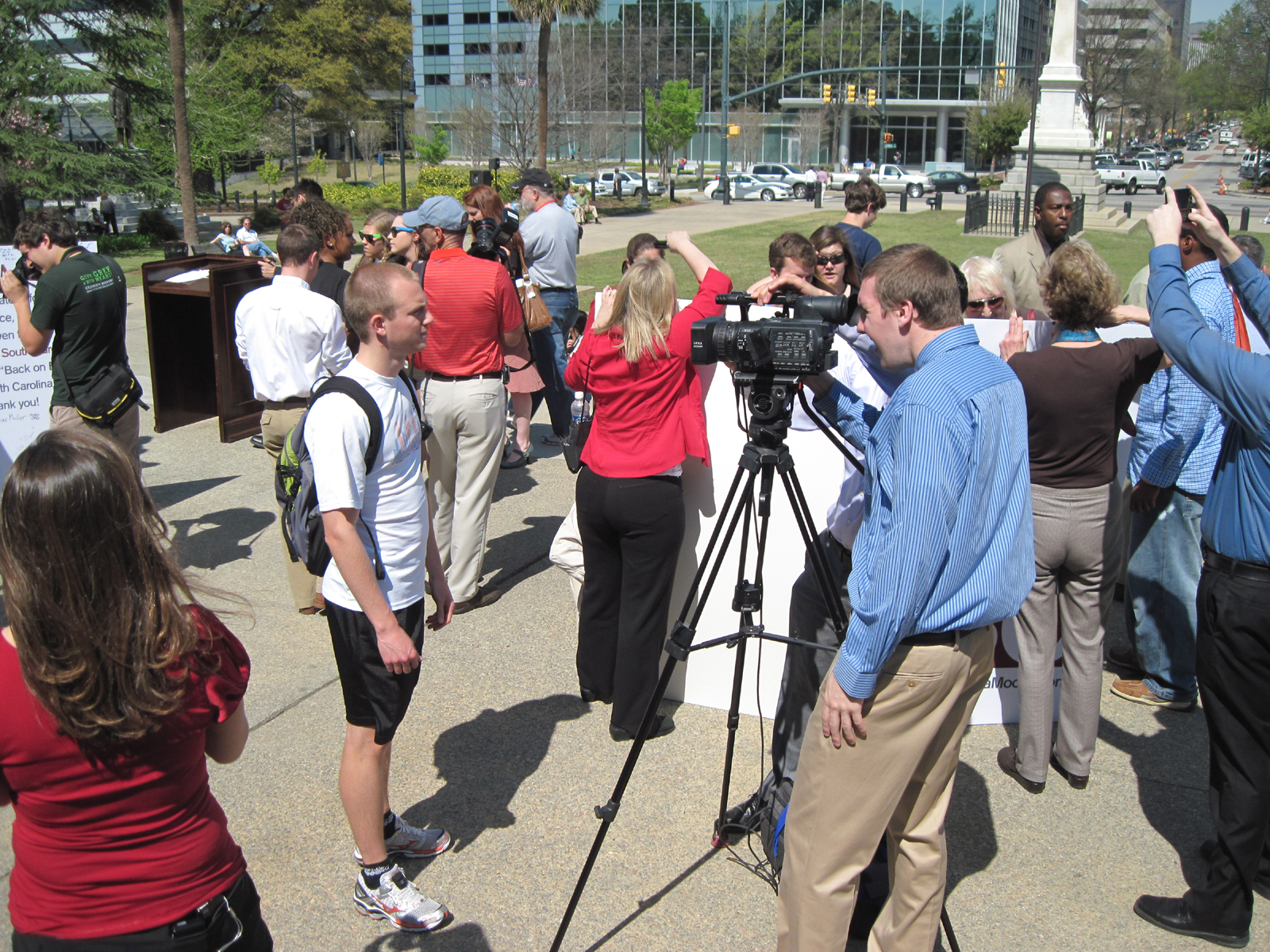
Boyd Summers, chairman of Richland County’s Democrats, got even with me for posting his picture Tuesday by sending this one out via Twitter yesterday.

In the pic, taken at the “Reinstate Darla Moore” rally at the State House, I’m going, “Where are all the protesters?”

Maybe there will be a bigger crowd when Darla speaks at the Russell House today at 12:15. Whether there’s a crowd or not, I’m curious to hear what she’ll say, and plan to drop by if I can. (And if they’ll let me in, since I don’t think my student ID from 1971, the one semester I went there before transferring to Memphis State, is valid any more.)

Surging sea of rage (not): The ‘Reinstate Darla Moore’ rally

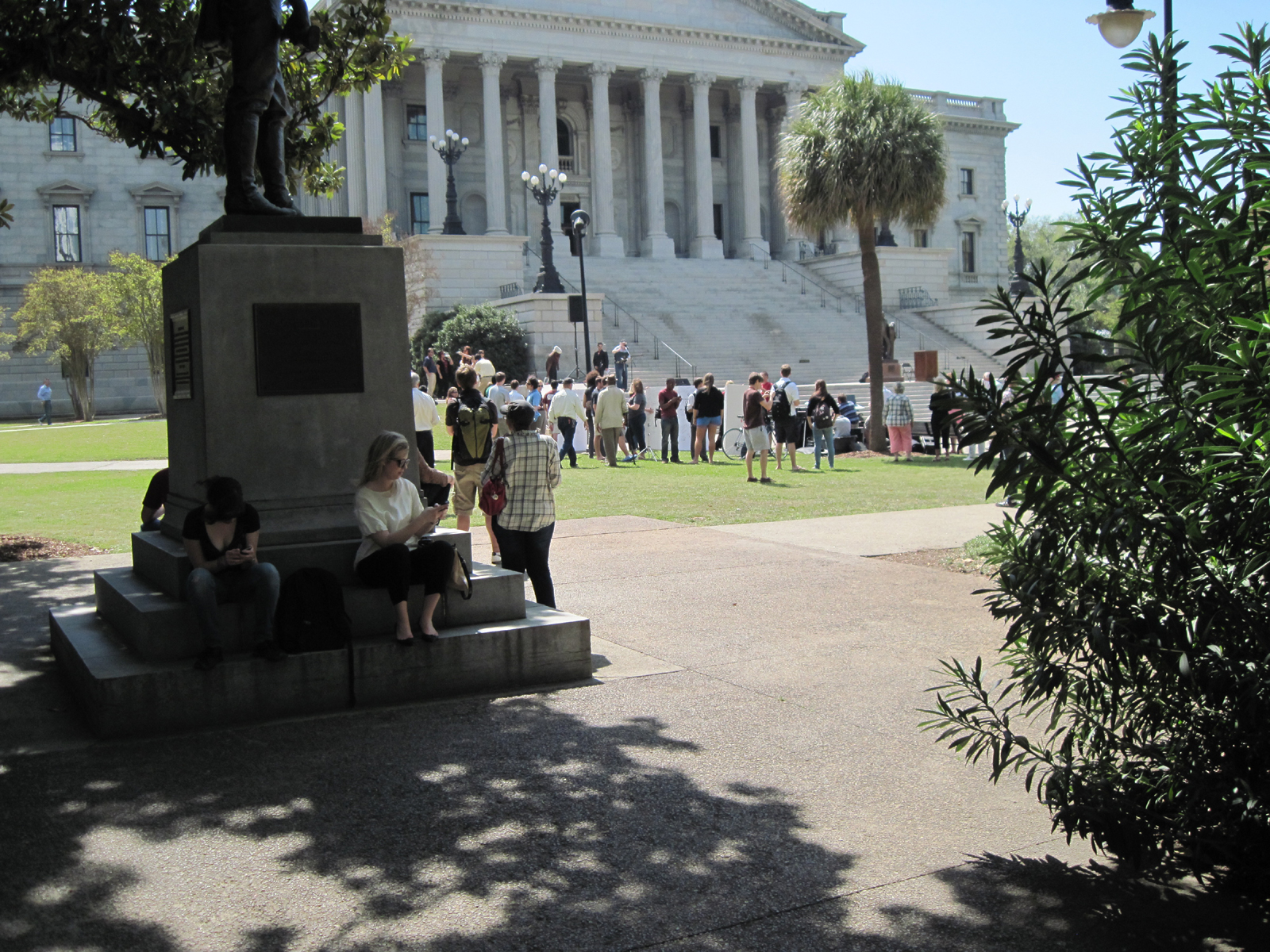
Well, that was a bust. As I Tweeted when I arrived at the “Reinstate Darla Moore” rally at the State House on this sunny day:

Brad Warthen @BradWarthen
Brad Warthen

The big protest over Darla Moore being unceremoniously dumped by Nikki Haley looks like a bit of a bust so far. They DID say noon, right?

As I said again at 12:43, it was still a bust. Which is a shame. Because Nikki Haley insulted all of the 30,000 or so students on the Columbia campus alone with her petty patronage move — not to mention the way she dissed the other 4 million of us who have a right to expect a governor to exercise some modicum of responsible stewardship at our most important state institutions. Instead of, you know, what she did.

Old New Left Activist Tom Turnipseed grumbled about these kids today who don’t know how to stage a protest: They think they do something with social media, and it’s done, he says. Well, yes — the “We Support Darla Moore” Facebook page has attracted 4,703 people who probably think they’ve made a statement by “liking” it.

But that doesn’t mean that Martha Susan Morris, the 22-year-old economic and poli sci senior who started the “Students for the Reinstatement of Miss Darla Moore” FB page, lacks seriousness in her convictions.

After all, she showed up, and spoke at the rally — once it finally got around to getting started. And she understood why she should be there, and why thousands of others should have been there with her:

Gov. Haley cited that her main reason for replacing Mrs. Moore with Mr. Cofield was the fact that Mr. Cofield’s vision was more clearly aligned with her own.

Martha Susan Morris

And we the students ask ‘What vision?’ What vision is not aligning with Gov. Haley…?… Mrs. Moore’s vision for years has been one of high expectations, increased educational funding, and increased standards for universities, research and development in our state…. and we could not be more grateful to her…

Our university is on the upswing, and we want her to be a part of it. She’s been an amazing benefactor… since she was appointed to the board in 1999…

Amen to that, Martha Susan. She said afterward that she started the FB page at 4 a.m. after having hearing about Ms. Moore being dumped. When she next looked at the page later that morning, there were 400 fans. There are now 2,495.

Too bad more of them didn’t show up. Because although we know Nikki Haley loves her some Facebook, she’d have been a tad more impressed to look out her window and see some folks show up to protest her action. Not that she’d have changed her mind, but it would have made an impression.

One of the people I chatted with before leaving was Candace Romero, communications director of the South Carolina House Democratic Caucus, who observed how much of the crowd were media types, and she complained that that there was no media turnout like that for the “Rally for a Moral Budget” back on March 12. (I asked her, and her Senate counterpart Phil Bailey, whether they were in any way involved in this rally. No, and no. They had just dropped by. That’s the answer I got from all the usual suspect-types I found.)

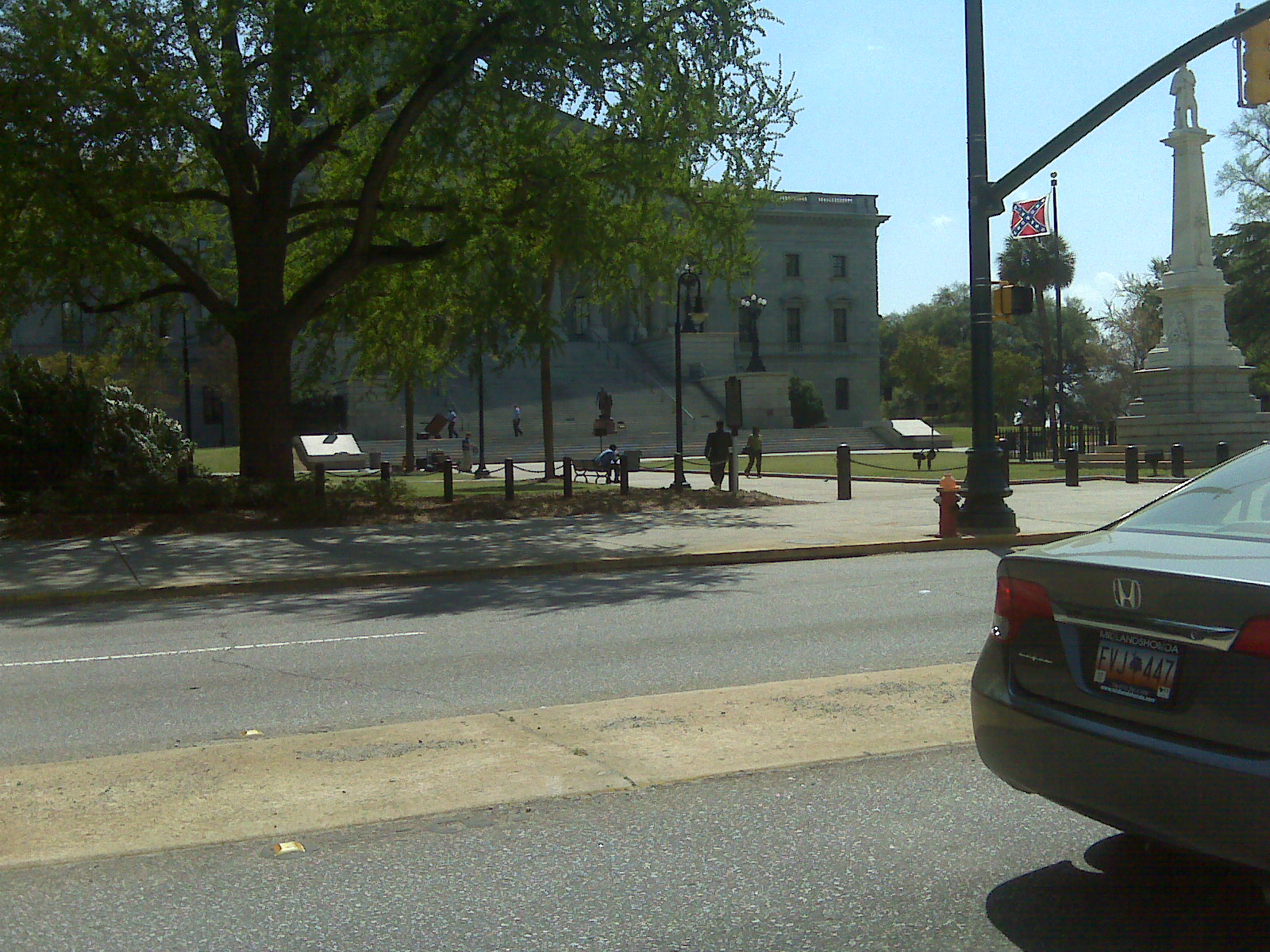
Well. As one who didn’t even thinking about going downtown on a Saturday for that particular quixotic gesture, I must accept service. But I will add that good-government-type rallies tend not to draw multitudes. Have it about something people get passionate about,  such as the Confederate flag, and you can get a crowd (5,000 or so if it’s pro, as many as 60,000 if it’s anti).

Which is a shame. Today’s rally was for good government — or at least, against grossly irresponsible government. (I enjoyed hearing  a speaker who followed Martha Susan say he and his fellow protesters were there to “change the usual business of government.” You know, what Nikki Haley is always saying she wants to do — right before she does something as old-line political Business-As-Usual as dumping a highly respected board member in favor of someone whose only known qualification is having contributed to her campaign.)

But it was a bust.

Oh, one more thing — it was announced, late in the rally, that Darla Moore herself will address students “in a town-hall meeting at 12:15 p.m. Thursday, March 24, in the Russell House.”

I wonder whether that will be better-attended.

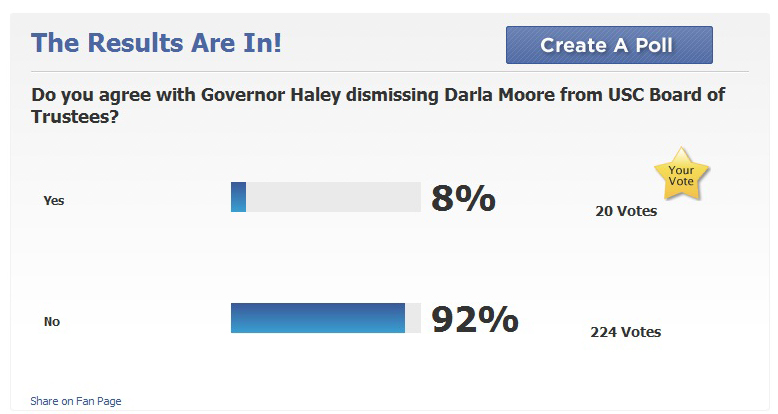
The “polls” (such as they are) run against Nikki’s “idiotic” move to replace Darla

First and foremost, a thing where you go online and click “yes” or “no” to a current-events question is not a POLL, in any meaningful sense. It has no statistical significance. If you don’t have a properly constructed sample, with the right elements of randomness and screening questions (“are you the head of household, etc.”), you cannot extrapolate that the result you obtain indicates what you would get if the entire population, or electorate, answered the question.

A self-selected sample doesn’t cut it, not by a long shot. It’s a great way to invite readers/viewers to sound off — they like that — but it doesn’t generally give you much, if anything, to base conclusions on.

Still… my eyebrows raised when I saw this “poll” result over at the WLTX Facebook page:

Yeah, I know — 244 respondents, which makes a self-selected survey even MORE meaningless. But it still surprised me. Because for the last few days, any time someone says “This is going to cost her,” I say they are totally wrong, that Nikki made the calculation that her base wouldn’t care (or would even applaud, being so anti-elitist), and therefore she’s fine — from her perspective (certainly not from South Carolina’s).

It’s one thing for all the folks I run into at the Capital City Club to be shocked and appalled. One expects that, and Nikki Haley couldn’t care less. But this kind of populist thing should draw out the Haley fan club. For that matter, particularly with such low participation, it would be so easy to stack (which is the biggest reason you don’t regard self-selected “polls” as serious).

This result has NO statistical significance, but it’s SO lopsided. At the very least, it indicates a lack of eagerness on the part of her peeps to jump out and defend her. (I mean, did even ardent fan Eleanor Kitzman vote?) The way they rushed to back her on the WACH-Fox thing. What happened to that default mode of “If the elites and the media say it about our gal, it’s WRONG! And we’re gonna run out and shout it!”?

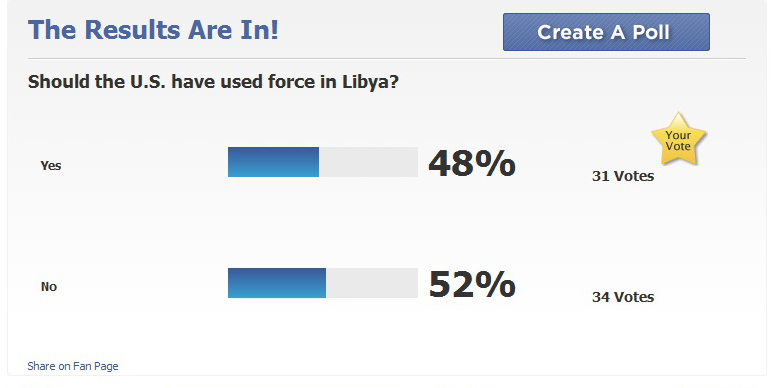
By the way, for what it’s worth… the latest WLTX nonpoll asked, “Should the U.S. have used force in Libya?” So far, this is how it’s going:

Yep, a dead heat. So far. And I figured that would be a blowout on the “yes” side. Because, you know, that’s something it looked like we had some consensus on before we went in. Of course, that consensus was among elites — including leading liberals who might otherwise oppose military action — and this is far from that. But that’s the factor that I thought would help Nikki on such a “poll” — at least to even things out for her. And it didn’t.

Once again, you can throw all of this out and you will have lost nothing of value — no methodology, tiny numbers. But it DID strike me as interesting, because it was such a blowout. And that’s all it is — interesting.

So I greeted this item from Columbia Regional Business Report in much the same spirit:

Staff Report
Published March 21, 2011

Gov. Nikki Haley made a grave misstep by removing philanthropist Darla Moore from the University of South Carolina’s board of trustees, said a vast majority of the people who responded to a two-day poll on the Daily Report.

Haley had few supporters of her move with only 7.1% saying they approve of her decision to replace Moore with Lexington attorney Tommy Cofield, who financially supported Haley’s campaign.

However, 78.8% want Moore back on the board; 44.2% of the respondents said Haley needs to admit her mistake and reinstate Moore, while 34.6% said the General Assembly should rectify the situation and by electing Moore to the board.

The remaining 14.1% asked who Tommy Cofield is.

Comments were fairly consistent, with the majority saying the move was “idiotic.”…

There was no methodology mentioned, so I figured this was an informal survey. I double-checked with CRBR Publisher Bob Bouyea, and he confirmed, “Informal poll.” Of course. No one in SC media has money to run real polls on the spur of the moment these days.

But I did find some of the comments interesting. Of course, they were fairly typical of what I’ve been hearing among the business movers and shakers, which is the same circle CRBR moves in.

As I say, interesting. Thought you might find it all interesting, too.

Nikki Haley dumps Darla Moore: A plain case of old-fashioned naked patronage

It’s really hard to keep up with all the petty outrages (both “petty” and “outrageous” — yes, that seems about right) that our new young governor keeps pumping out.

I’m a busy guy — working, blogging, trying to grab a little sleep at night — and sometimes find myself momentarily out of the loop. Particularly when there are so many far more important things going on in the world. Let’s see, the Japan earthquake, Qaddafi (I’ve gotten to where I just spell his name with the first combination of letters that my fingers hit, so I hope that suits) moving to crush the rebellion while the world is distracted with Japan, Saudis intervening in Bahrain and people getting killed… And sometimes you have to put even that aside, and do other stuff…

So when I finish my Virtual Front Page and close the laptop, I sometimes don’t see any new developments until 7ish the next morning. Which is why I was taken aback at the very first Tweet I saw this morning:

Nettie Britts @nettie_bNettie Britts

Explain Darla Moore to me.

I replied, “Well, she’s this rich lady from South Carolina who tries to give back to her home state. That’s the Twitter version, I guess…” And I went on to breakfast. There, the grill room at the Capital City Club was buzzing with what I didn’t know about, since I hadn’t sat down to read the paper yet (don’t ask me why it wasn’t on thestate.com when I was doing the Virtual Front Page yesterday; maybe it was and I just missed it). The state and community leaders weren’t going, “Did you hear about Darla?” It was more like, “What do you think of the news?” Period.

Yep, this stuff happens to me, too. Not often, but sometimes.

So I sat down, and I read the paper. And I Tweeted this out:

Brad Warthen

@BradWarthen Brad Warthen

Nikki Haley dumping Darla Moore is classic case of naked, arbitrary exercise of patronage power….http://tinyurl.com/4nu4of8

You can congratulate me later for having gotten a link, an editorial point, “Nikki Haley,” “Darla Moore,” and “naked” into the Twitter format (with 14 characters of room left!). Let’s move on to the substance.

And the substance is… well, what I just said. It just doesn’t get any more blatant, plain, slap-in-the-face, I-don’t-care-what-you’ve-done-for-our-state-or-this-institution-I’ve-got-my-own-guy than this. Just bald, plain, take-it-for-what-it-is. Although I do have to hand it to Haley staffer Rob Godfrey for managing to twist the knife a bit with this bit of sarcastic insouciance:

Asked why the appointment was not announced, he said: “Given that there are over 1,000 appointments to boards and commissions the governor can make, we never intended to have a press conference for each one.”

Because, you know, Darla Moore isn’t any more important than that.

At the Cap City Club this morning, one of the regular movers and shakers made a rather naive and innocent remark (sometimes movers and shakers can surprise you that way), honestly asking, “How do you just brush aside someone who’s given $100 million to South Carolina?” (Yeah, I know she’s only pledged $70 million to USC and $10 million to Clemson, according to the story, but I guess he was rounding.)

I replied, patiently, here’s what Nikki Haley would say to that (were she brutally honest, of course): “She didn’t give ME a hundred million dollars. Tommy over here gave me $3,500. I don’t understand the question.” That’s Tommy Cofield, by the way, a Lexington attorney.

People who are not movers and shakers (and who in fact have a sort of visceral aversion to movers and shakers) can say some naive things, too. Over in a previous comment, our own Doug said “Are we assuming that Sheheen wouldn’t have replaced anyone he didn’t like?”

To that, I responded once again with the painfully obvious: “No, Vincent would not have replaced Darla Moore with an unknown, minor campaign contributor in such a prestigious post. If that’s what you’re asking.” Of course, I should have added, “without a reason.” By that, I would mean a valid reason, one that takes South Carolina’s and USC’s legitimate interests into account, one that is not just arbitrary.

Oh she GAVE what I suppose some folks (probably including Doug, believing as he does that there is nothing so deleterious to society as experience and commitment to the public weal) will regard as a reason: “As is the case with many of our appointees, the governor looked for a fresh set of eyes to put in a critical leadership position…”

That’s it.

And if you are one of the people who takes Nikki Haley at face value, as her supporters tend to do, and you don’t know or care about Darla Moore or the University of South Carolina — you just like to cheer on your Nikki — that will suffice. In with the new, out with the old. She will feel in no way obligated to explain what was wrong with Darla Moore’s service on the board, or to cite any of the exciting new ideas that her appointee brings to the table that were previously missing. No one will expect that of her; it probably wouldn’t even occur to her to think about it. The governor will skate on this with these people — this is something that is core to her whole approach to politics ever since she transformed herself into the darling of the Tea Party in preparation for her run for this office for which she was so unprepared.

This WORKS for her. She skates on this, just as — with the voters she cares about — she will skate on apparently having told a prospective employer in 2007 that she was making $125,000 a year when she was telling the IRS that she made $22,000. This will matter not. People are just picking at her. The nasty, powerful, status quo people — those people who hang out at the Capital City Club! — are picking at Nikki because they’re mean, you see. (By the way, on the “petty” vs. “outrageous” spectrum, the thing on the job application is more the typical “petty” violation of her alleged principles that we have come to expect; the Darla Moore thing, dealing as it does with the leadership of such an important state institution, is more of an “outrage.” If you’re keeping score.)

She will not only skate, but her supporters — or at least, this is what the governor banks on — will continue, in spite of all evidence, to see her as a champion of transparency, a reformer, a nemesis of “politics as usual” and patron saint of Good Government. Which just, you know, boggles the mind if you’re the sensible sort who thinks about things.

That’s the plan, anyway. And that’s why she did this, and really doesn’t care if you, or the university, or the business community, or Darla Moore don’t like it.

Just to say something you don’t hear all that often

The quixotic demonstration at the State House yesterday by citizens sick of seeing our state’s infrastructure rapidly eroding under the stewardship of shortsighted politicians was of course an exercise in futility.

But I’m no stranger to that. A few minutes ago, looking for a link for a previous post that needed one, I went back to the last week of posts on my old blog I had at the paper, and ran across this forgotten item — which, as it happens, was day after the post in which I announced that I had been laid off:

Good job rejecting the tuition caps

This might sound strange coming from a guy who was already counting pennies (or quarters, anyway — I miscounted how many I had this morning in my truck, and ended up with a parking ticket because I didn’t have enough for the meter), with my two youngest daughters still in college. And now I’m about to be unemployed.

But I’m glad the House rejected tuition caps at S.C. colleges and universities. I have an anecdote to share about that.

Remember the recent day when college students wandered the State House lobbying lawmakers on behalf of their institutions. They wanted the state to invest in higher education the way North Carolina and Georgia have. Either that day, or the day after, I had lunch with Clemson President James Barker, and he told me an anecdote he had witnessed: He said the students were pressing a lawmaker NOT to support the tuition caps, because they were worried about their institutions being even more underfunded — they hardly get anything from the state — some are down below 20 percent funding by the state, and the rest has to come from such sources as tuition, federal research grants and private gifts. Eliminate the ability to raise tuition, and the institution’s ability to provide an excellent education is significantly curtailed. If we want lower tuitions, the state should go back to funding higher percentages of the schools’ budgets, the way our neighboring states with better higher ed systems do.

The lawmaker listened to the kids, and then said with great condescension, maybe you kids don’t care if tuition goes up, but I’ll bet your parents would like a cap. He thought he had them there, but the kids set him straight: None of their parents were paying the bills. These kids were working their way through schools and paying for it all themselves. And they didn’t want to see the quality of what they were working so hard to pay for be degraded by an artificial cap on tuition. The lawmaker had not counted on getting that answer.

I wish I had been there to see it, because I’ve been in a similar place before. Back in 95 or 96, Speaker Wilkins had brought his committee chairs to see us, and I started challenging the wisdom of their massive rollback of property taxes paid for school.One of them allowed as how he bet I was glad to get that couple of hundred dollars I didn’t have to pay. And I answered him that I was ashamed that I was paying so little through my property tax to support schools that I knew needed more resources. He said smugly that he was sure I wouldn’t want to give it back. I told him I didn’t see as how there was any channel for doing that, but if he could point me to the right person who would take my money and see it gets to the right place, I would pay the difference. He didn’t have a good answer for that.

It would be great if our lawmakers would stop assuming that all of us in South Carolina are so greedily shortsighted that we can’t see past our personal desire to pay less money, and that we are corruptible by a scheme to starve colleges of reasonable support.

Reading that now, with all that’s happened since — the rise of the Tea Party, the eagerness of Republicans, demoralized after their 2008 defeat, to embrace destructive extremism (and of course, what happens to the Republican Party as happens to South Carolina, which it dominates), the election of Nikki Haley over more experienced, less extreme candidates of both parties — it reads like thoughts from another century. And, of course, another place.

Imagine, even dreaming of our state caring enough about education to invest in it the way our neighboring states have, much less suggesting that we do so. How anachronistic can one get? All that’s happened since then is that South Carolina has run, faster every day, in the opposite direction — with out elected leaders firmly convinced that that is not only the right direction in which to run, but the only one.

“What Happens in Vagueness Stays in Vagueness”

Isn’t that a great headline?

Stan Dubinsky sends out a lot of cool stuff to read via e-mail. You should ask to be on his list — if you’ve got time to read the stuff. I don’t really, but I do tend to glance at the headlines to see if anything draws me in (which, Journalism 101 here, is what headlines are for). And “What Happens in Vagueness Stays in Vagueness” definitely did the job.

And the piece was worth reading. An excerpt:

What Happens in Vagueness Stays in Vagueness

The decline and fall of American English, and stuff

I recently watched a television program in which a woman described a baby squirrel that she had found in her yard. “And he was like, you know, ‘Helloooo, what are you looking at?’ and stuff, and I’m like, you know, ‘Can I, like, pick you up?,’ and he goes, like, ‘Brrrp brrrp brrrp,’ and I’m like, you know, ‘Whoa, that is so wow!’ ” She rambled on, speaking in self-quotations, sound effects, and other vocabulary substitutes, punctuating her sentences with facial tics and lateral eye shifts. All the while, however, she never said anything specific about her encounter with the squirrel.

Uh-oh. It was a classic case of Vagueness, the linguistic virus that infected spoken language in the late twentieth century. Squirrel Woman sounded like a high school junior, but she appeared to be in her mid-forties, old enough to have been an early carrier of the contagion. She might even have been a college intern in the days when Vagueness emerged from the shadows of slang and mounted an all-out assault on American English.

My acquaintance with Vagueness began in the 1980s, that distant decade when Edward I. Koch was mayor of New York and I was writing his speeches. The mayor’s speechwriting staff was small, and I welcomed the chance to hire an intern. Applications arrived from NYU, Columbia, Pace, and the senior colleges of the City University of New York. I interviewed four or five candidates and was happily surprised. The students were articulate and well informed on civic affairs. Their writing samples were excellent. The young woman whom I selected was easy to train and a pleasure to work with. Everything went so well that I hired interns at every opportunity.

Then came 1985….

Undergraduates… seemed to be shifting the burden of communication from speaker to listener. Ambiguity, evasion, and body language, such as air quotes—using fingers as quotation marks to indicate clichés—were transforming college English into a coded sign language in which speakers worked hard to avoid saying anything definite. I called it Vagueness….

We all note, and many of us decry, what social media have done to (and for; there’s an upside as well) effective and elegant use of language. But I found this piece interesting because it went far beyond that, and identified an insidious enemy not only to communication, but to clear thought as well.

That enemy is Vagueness.

For real accountability in higher ed, here’s the first number Haley should look at: 10.9 percent

Just read this item over at thestate.com:

Gov. Nikki Haley and higher education leaders said today they are working together on ways to objectively measure the performance of South Carolina’s public colleges and universities.

School officials said Tuesday they will provide the governor with data including class sizes, the number of in-state and out-of-state students, classroom spending and their economic development impact. The goal, Haley said, is to determine which schools were getting the best results from their budgets.

State spending on higher education has been cut in recent years, and, with the state facing an $830 million budget deficit, public colleges likely face more cuts…

College officials said they welcomed the opportunity to show their value.

“Accountability and transparency and quality can all coexist,” said Clemson University president James Barker.

Barker said he had not had a similar meeting with former Gov. Mark Sanford, who targeted rising higher education costs.

“It felt very different,” Barker said.

I’m with President Barker on this: It’s great that Nikki Haley even cares enough to talk to the public higher ed institutions. Her predecessor’s lack of interest was deafening.

But as she presumes to decide the institution’s fiscal fate (suddenly, I’m flashing on Rowan and Martin: the Fickle Finger of Fiscal Fate), there’s one number I hope she absorbs before any other: 10.9 percent.

That’s how much of the USC system’s total budget is provided by state appropriations. For USC Columbia, it’s 10.3 percent. (I don’t have the numbers for the other institutions in front of me at the moment.) It used to be more like 90.

The college administrators are too polite, and too politic to say it (personally, I’d be tempted to say to everybody at the State House, “Yeah, and I’m going to care about you and your opinion of what I’m doing, oh, about 10.9 percent.”), and I suspect they are truly pleased that Nikki wants to work with them at all. It’s a nice change. But it would be good if politicos who want to call the tune for these institutions were a little more cognizant of just how little they are paying to the piper.

“The Brad Show” is BACK! Our guest — Caroline Whitson

Well, I told you it was coming back, and here it is!

After a well-received pilot episode, “The Brad Show” got put on the back burner — not by network twits like the ones who canceled “Firefly” (and who will no doubt go to the “special hell” that Shepherd Book preached about) — but by me, because I was way busy trying to keep a blog going while working a new job.

But now it’s back, and it has cool new intro and theme music, compliments of ADCO Interactive’s Jay Barry. I told Jay I wanted something sort of NPRish, or Dick Cavettesque, and with that crystal-clear direction, this is what he came up with.

Watch, enjoy, and be edified. Not by me, but by my guest, the president of Columbia College, and leader in the effort to pass the penny sales tax for transportation — which is what we talked about.

We also talked about Caroline’s plans to don a Catwoman-like costume for the Ludie Bowl festivities over the weekend. She promises pictures, which I’m looking forward to seeing, and posting…

Buddy, can you spare a scholarship?

Got this from Stan Dubinsky. I got it without any context, so I don’t know who produced it, or anything else about the campaign it’s a part of (help me out, Stan — do you have a link?).

Most of the way through it, I was thinking, “You’ll never get anywhere with this.” That’s because the kinds of people who are the reasons higher education was never funded at a competitive level in South Carolina, and has been incredibly slashed from the already-low levels to a fraction of those levels, really don’t give a damn about the considerations depicted in the video. When the video asks the viewer to imagine “no social workers,” I’m thinking that the Tea Party types are going, “Hell, yes! Sounds great to me!” (And no, historically the “Tea Party” has not been a factor, by that name. But the mentality that it represents has long held sway in our state, and is one of the main reasons we lag economically behind much of the rest of the country. )

But then I get to the end and realize, this little film isn’t aimed at them. Or at me. It’s aimed at people in a position to give private dollars to prop up the institution. The makers of this video assume that the public conversation is long ago finished, and lost. In this piece, they’ve moved on.

And well they should. Several rounds of cuts back, the Legislature was only funding between 12-15 percent of the cost of running our supposedly “public” institutions of higher learning. I don’t know where the percentage is now. These formerly state institutions now look to the state as one of many, many donors it has to line up.

And this video is one way of doing that.

Did Janette pen “world’s haughtiest e-mail?”

Many of you know Janette Turner Hospital, the novelist who for years has run the “Caught in the Creative Act” seminar at USC.

Yesterday, a reader called my attention to a piece over at Gawker, but when I got there I didn’t read the thing I was being directed to, because I got distracted by this item claiming that the Australian writer had written the “world’s haughtiest e-mail” back to her former students here in Colatown:

Janette Turner Hospital is the author of Orpheus Lost and other books, and a professor at Columbia. She sent MFA students at her old school, the University of South Carolina, the following note about their inferiority. It is amazing.

Hospital sent this note to all of the MFA students on the University of South Carolina listserv. More than one of them forwarded it to us. “We’re all enraged,” one MFA grad from USC tells us. “She is nuts!” says another. Indeed. What’s your favorite part? The personal revelations? The breathtaking undertone of insult towards those in South Carolina? Her special pet name for the Upper West Side? This is fertile ground…

After that build-up, I actually found the e-mail to be not quite as bad as advertised. After all, she says nothing BAD about USC, she just … gushes… to a rather odd extent about NYC. But she would not be the first to have her head turned a bit by the tall buildings, or the Starbucks on every corner. I’m rather fond of the city myself — as a place to visit. Follow the link and see what you think. Or if you’re too lazy to click, here’s an excerpt:

As for news from this very different MFA planet, I’m in seventh heaven teaching here, and not only because I have Orhan Pamuk (whom I hope to bring to USC for Caught in the Creative Act), Oliver Sacks, Simon Schama, Richard Howard, Margo Jefferson, etc., etc., as colleagues, though that is obviously part of it.

My students also live and move and write in seventh heaven and in a fever of creative excitement. Columbia’s MFA is rigorous and competitive but students don’t just have publication as a goal – they take that for granted, since about half the graduating class has a book published or a publishing contract in hand by graduation – so they have their sights set on Pulitzers.

This program is huge, the largest in the country. It’s a 3-year degree, with 300 students enrolled at a given time. Each year, 100 are admitted (in fiction, poetry, nonfiction) with fiction by far the largest segment. But 600+ apply, so the 100 who get in are the cream of the cream…

And then there are all the peripheral pleasures of living on Manhattan: we’ve seen the Matisse exhibition at MOMA, have tickets for the opening of Don Pasquale at the Met Opera, have tickets to see Al Pacino on stage as Shylock in the Merchant of Venice, etc etc. Plus I’m just 15 minutes walking distance from Columbia and from all the sidewalk bistros on Broadway, and 3 minutes from Central Park where we join the joggers every morning. This is Cloud Nine living on the Upper West Side (which is known to my agent and my Norton editor, who live in Greenwich Village, as “Upstate Manhattan.” ) We love it.

What do you think? I mean, I’m glad Janette’s having a good time, and maybe she’s a bit carried away. But I guess I’m too used to the excessive rhetoric of political e-mails to be too appalled.

Or maybe my self-esteem as a South Carolinian has been so battered by the attention we’ve garnered because of the Confederate flag, Mark Sanford, Alvin Greene and Nikki Haley that I’m too numb to be insulted further.

Oh, in case you’re wondering if I’m giving her a break unduly — Ms. Hospital is an acquaintance, but we don’t know each other well. A couple of years back when Salman Rushdie was in town for her program, she asked me to moderate a panel discussion in connection with his appearance (which was flattering, but a little scary, since I hadn’t read any of his books), and I met Mr. Rushdie at a reception afterward. That’s about all I can think of to disclose.

Another step into the Innovista…

Mike Fitts chronicles this latest step toward achieving the potential of Innovista:

A company based on the engineering smarts at USC — in students and faculty — has been launched to commercialize that prowess.

SysEDA, a 10-employee company that provides engineering software, is moving into the USC Columbia Technology Incubator.

SysEDA’s software has been developed over the years principally by Roger Dougal, professor of electrical engineering at USC. Dougal estimates that about 50 students in the past 15 years have provided refinements to it, and many students in the engineering school use it regularly as part of the their work.

The software, called a Virtual Test Bed, is designed to simulate the inner workings of electrical engines. Once it is offered in the Internet “cloud,” it will allow different engineers from around the world to see how their proposed modifications to an engine affect the entire system before a prototype is built….

The company already has a client: the Office of Naval Research.

Dougal has worked with the Navy for more than a decade as it has explored electric power options for its ships. Now SysEDA has a $2.4 million contract to work with global engine giant ABB on such engines and design systems.

SysEDA is working with the incubator and is also receiving mentoring from Bang! Technologies, a company that specializes in boosting tech companies through their growth phases…

Congratulations to all involved as they take one of hundreds, perhaps thousands, of such steps that need to be taken for the Innovista to realize its potential over the next decade or two.

Privacy gone mad (again)

In a book review in yesterday’s Wall Street Journal — of The Five-Year Party, by Craig Brandon — there was a passage about yet another weird path down which our national obsession with, and perversion of, the notion of “privacy” has led us:

Mr. Brandon is especially bothered by colleges’ obsession with secrecy and by what he sees as their misuse of the Federal Educational Rights and Privacy Act, which Congress passed in 1974. Ferpa made student grade reports off-limits to parents. But many colleges have adopted an expansive view of Ferpa, claiming that the law applies to all student records. Schools are reluctant to give parents any information about their children, even when it concerns academic, disciplinary and health matters that might help mom and dad nip a problem in the bud.

Such policies can have tragic consequences, as was the case with a University of Kansas student who died of alcohol poisoning in 2009 and a Massachusetts Institute of Technology student who committed suicide in 2000. In both instances there were warning signs, but the parents were not notified. Ferpa’s most notorious failure was Seung-Hui Cho, the mentally ill Virginia Tech student who murdered 32 people and wounded 25 others during a daylong rampage in 2007. Cho’s high school did not alert Virginia Tech to Cho’s violent behavior, professors were barred from conferring with one another about Cho, and the university did not inform Cho’s parents about their son’s troubles—all on the basis of an excessively expansive interpretation of Ferpa, Mr. Brandon says. He recommends that parents have their child sign a Ferpa release form before heading off to college.

Good advice. Those of you who argue with me about curfews and bar closings and the like may side with those who gave us this situation. But I have a parent’s perspective. I want to know what’s going on with my kids. And moreover, I have a right to know — one that in a rational world would easily supersede any imagined “rights” granted by FERPA.

No. 1 on the field, No. 1 in the classroom

Two quick items on the National Champion USC Gamecocks baseball team:

First, the picture above of the Gamecock flag flying on the State House dome, taken today by my ADCO colleague Lora Prill with the iPhone 4 of which she is inordinately proud. That’s certainly infinitely better than the flag that used to fly in that third position. This one is one we can all be proud of.

Second, I was talking to my friend Jack Van Loan today, and he mentioned hearing something at the big welcome-home rally for the team yesterday (pictured below, taken by another ADCO colleague): That of the eight teams who went to Omaha for the CWS, the Gamecocks had the highest GPA, at 3.18. (I tried to check this out, and did not find that number. I found that for the most recent semester, though, they had a GPA of 3.07, which ain’t shabby. Maybe the number Jack heard was for the whole year; I don’t know.)

Jack was sufficiently impressed with that that he wrote to the athletic director at his alma mater up in Oregon to say, why doesn’t your team have a GPA like this.

As Jack said “Number One on the field, number one in the classroom.” That’s another reason for South Carolina to be proud.

Finally. Finally! The whole nation knows that SOUTH CAROLINA IS THE BEST!

Finally, something not just positive, but SUPERLATIVE for South Carolina on the national stage.

Tonight, America sees us as the BEST!

For so long, we’ve been last where we want to be first, and first where we want to be last, the punch line of far too many national jokes. I’ve grown so weary of typing it.

Not any more. Not after tonight. The Gamecocks just changed all that. We can do anything now. We’re not only the best in the country at something, but at the National Pastime, no less!

It would be sweet to see this happen with any major sport, but having it happen with baseball makes it SO much more awesome.

Congratulations, Ray Tanner! Glad we built that new ballpark for you — you’ve made good use of it. (You know, the ballpark in the Innovista.)

Congratulations, Harris Pastides, and Eric Hyman, and all the coaches.

But congratulations most of all to the kids who won it, the Gamecock nine, South Carolina’s finest!

You’ve made us all proud…