Category Archives: Higher education

Yo, Lee: David Yepsen says “Hey”

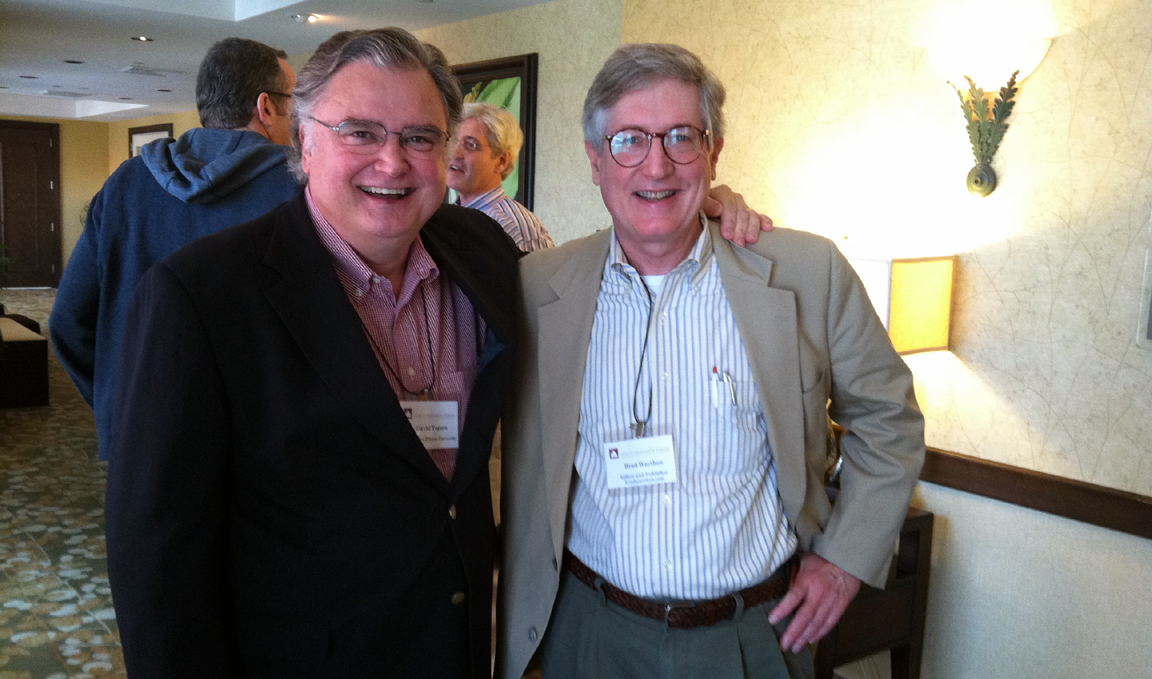
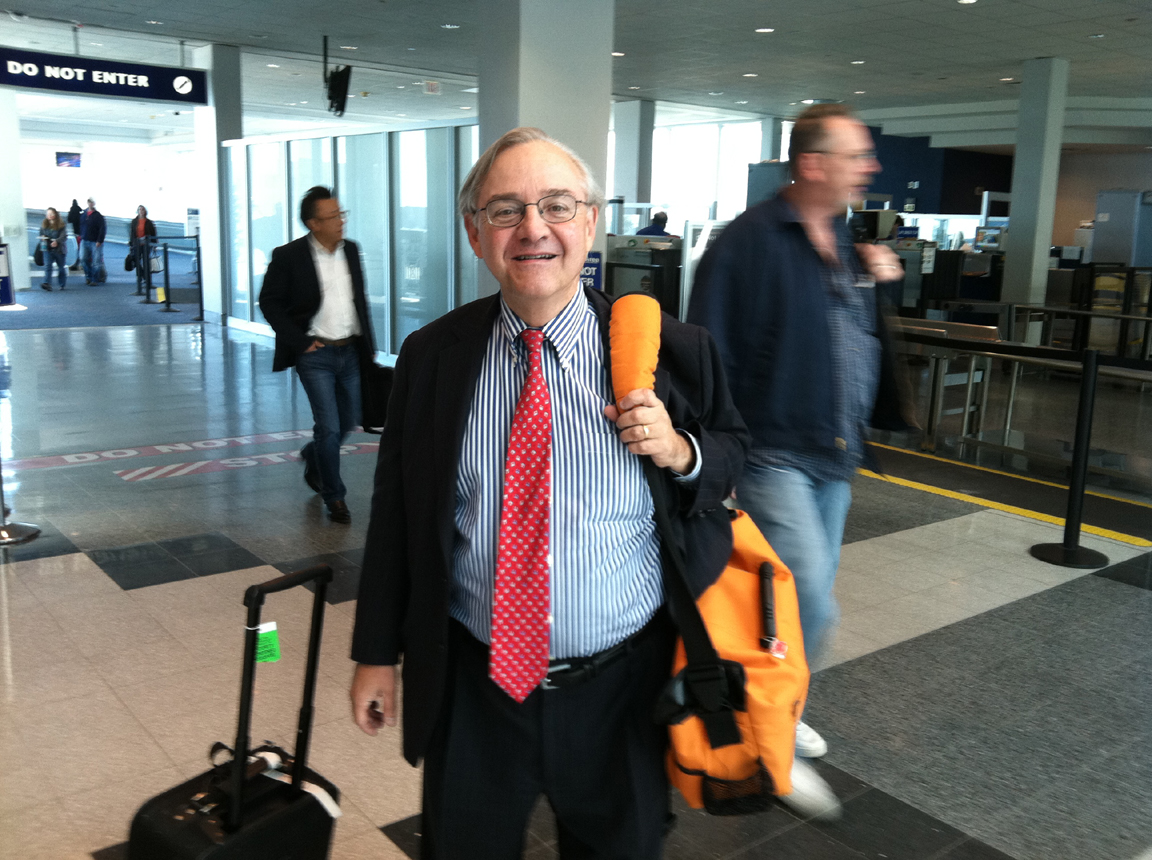
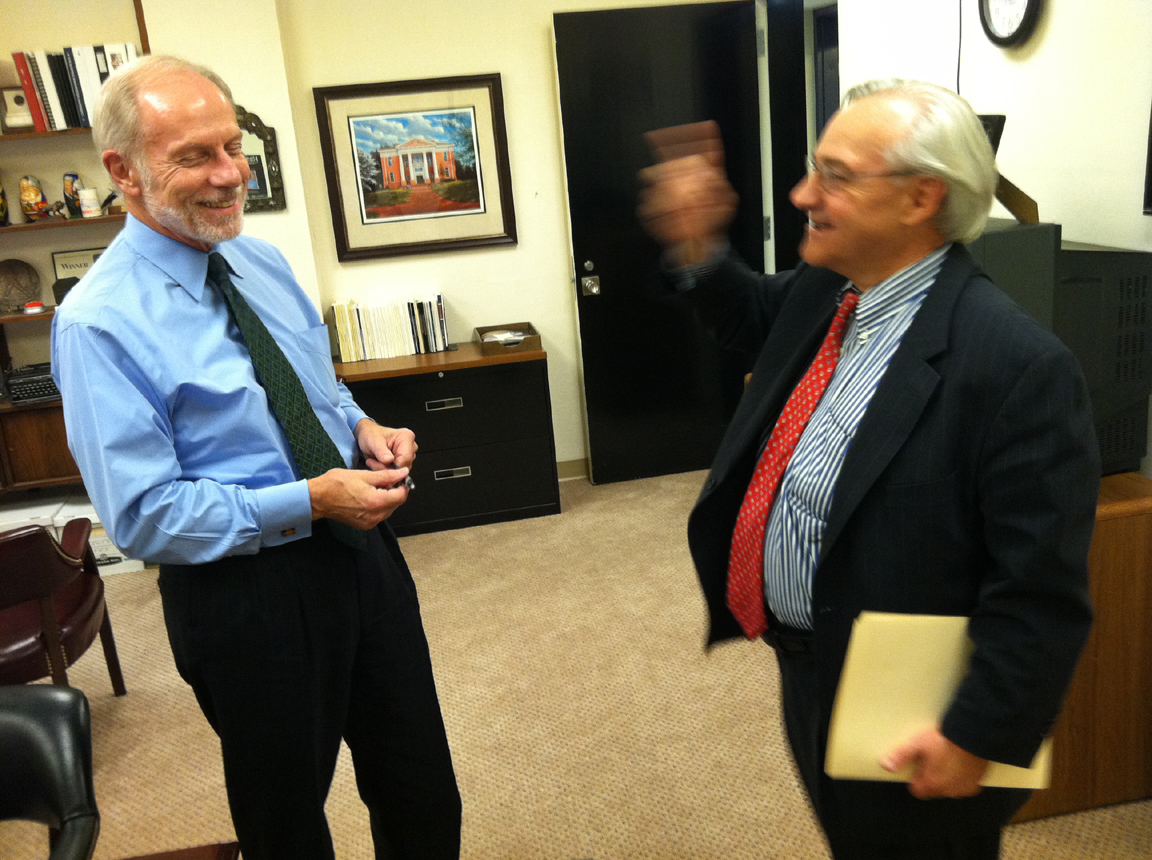
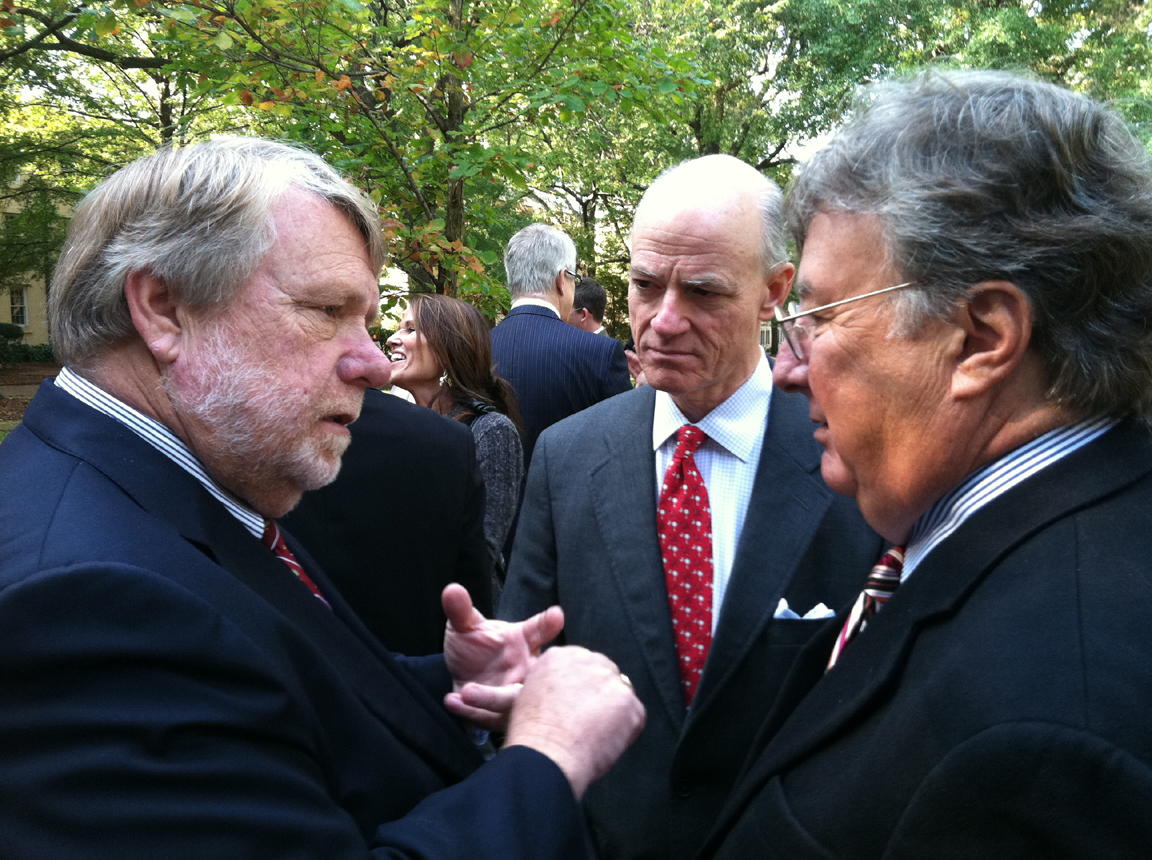
Above you see David Yepsen and me, looking relieved and happy that we’re done with our panel presentation at the Senate Presidents’ Forum in Key West over the weekend, and that it went well. Funny how those kinds of things — just talking — can take a lot out of you.

It was an honor to meet David, the legend of Iowa political journalism. And of course when we met, he asked after another legend of political journalism, a man whom everyone knows — and, more remarkably, everyone likes and respects — my longtime friend and colleague Lee Bandy.

I’m lucky to have worked with both Lee and the Tennessee legend, John Parish. And while it was brief, I was honored to share the panel with David Yepsen, who is now director of the Paul Simon Public Policy Institute (he left The Des Moines Register about the same time I left The State), Saturday. And to get to know a couple of political pros I had not met before, who also served on the panel: First, John Marttila, longtime friend and ally of Joe Biden ever since he was elected to the U.S. Senate in 1972. John continues to be a senior political adviser to the vice president. From the Republican side, we had Mike DuHaime, who ran Chris Christie’s successful run for governor of New Jersey in 2009.

We had a great discussion, both during the panel and at meals and events before and after.

What did I say during the presentation? Well, not anything I haven’t shared here. I essentially scrapped my prepared remarks, as mentioned previously — which is probably a good thing, because things flow better when I’m winging it. But preparing — not only the writing, but all the conversations I had with top Republicans in SC, right up to a couple of minutes before the program — did help me get my thoughts in order. Hey, if I hadn’t made all those panicked calls Friday night and Saturday morning after seeing those poll numbers, I wouldn’t have known to call Romney a “Plastic Banana Rock ‘n’ Roller,” which still cracks me up — the idea of Romney as ANY kind of rock ‘n’ roller, actually.

Anyway, I’m back from Key West. And it’s going to be a busy week…

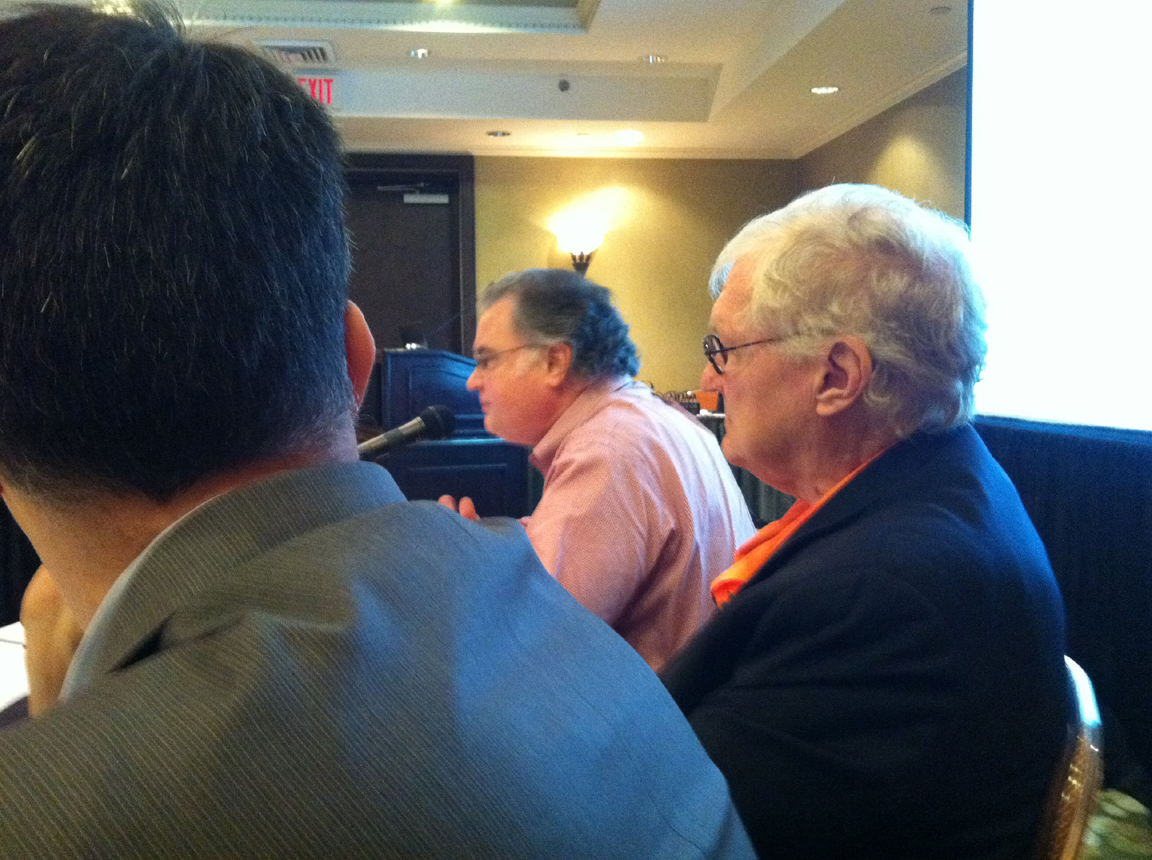
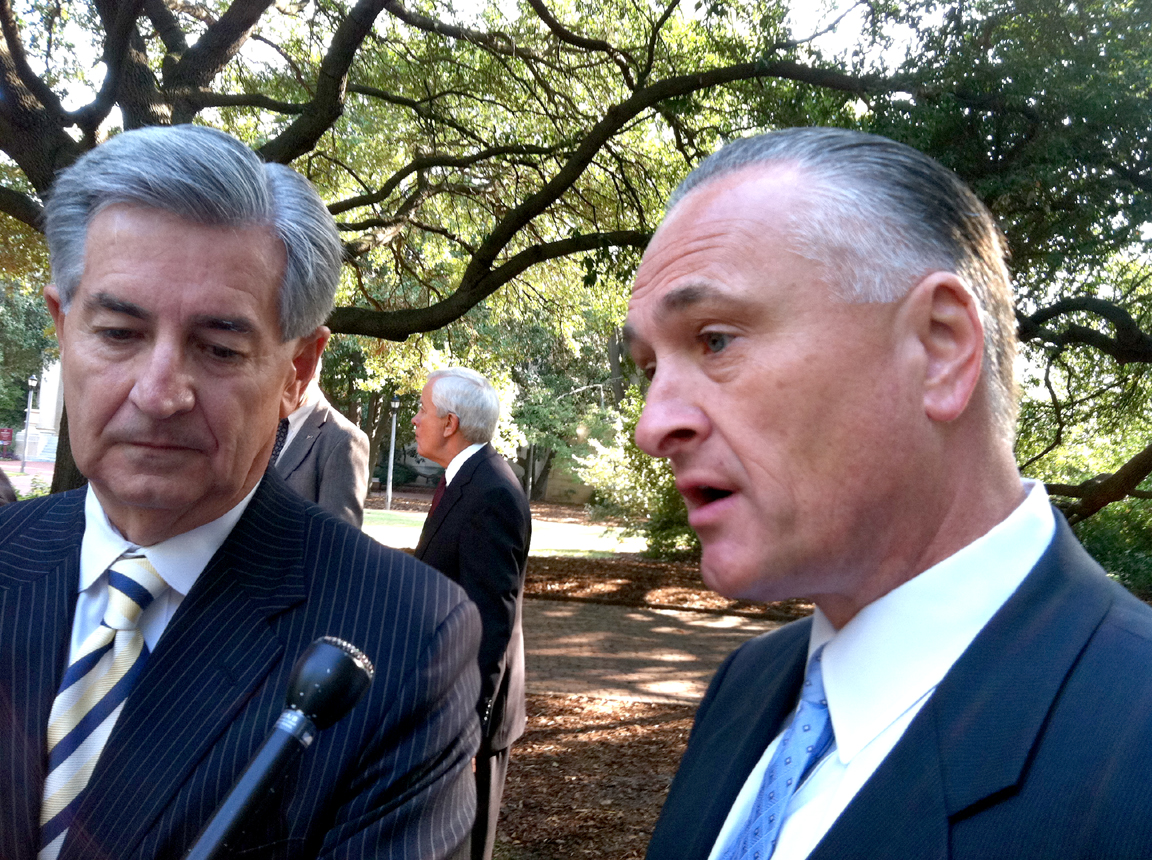
Mike DuHaime (or the back of his head, anyway), David Yepsen and John Marttila, during the panel discussion.

It doesn’t have to be THAT graphic for me…

USC just put out this release:

Up in smoke: Research shows graphic images can deter smokers

They say a picture is worth a thousand words, but its worth might just be measurable in terms of lives, according to research by a University of South Carolina public health professor.

That’s because visual imagery on cigarette packages deters smoking, and the more graphic they are, the better the results, said Jim Thrasher, assistant professor in the Arnold School of Public Health Department of Health Promotion, Education and Behavior.

“Tobacco use continues to be the leading cause of preventable death in the United States, and graphic health warnings are among the most cost-effective interventions that exist,” Thrasher said….

Personally, I don’t need graphic images to deter me. One whiff of the stuff is enough to persuade me to stay away from it forever.

If you must show me a “graphic” image, the one above is fine. It was the winner of a contest in California:

The challenge was to create a anti smoking ad powerful enough to turn people off cigarettes without resorting to the gruesome imagery so prevalent in anti-smoking campaigns. With the help of a couple of dancers, an up-for-anything ad agency and hundreds of yards of Lycra, Los Angeles photographer Ricardo Marenco did just that.

“I wanted to evoke a sea of people trapped inside their addiction,” says Marenco, who created the shot for the California Department of Public Health’s billboard and print campaign. To achieve his desired effect, he photographed the dancers individually inside 7-foot-tall Lycra cigarettes. Then he digitally overlaid embers and smoke from real cigarettes on the figures. The ads ran without any words, only a helpline number — the image said it all.

But apparently, you have to be really gross for some people. Below is one of the images that came with the USC release. Why is it in Spanish (“garganta” means “throat”)? I guess because of this part of the release:

As a result of his work with colleagues from Mexico’s National Institute of Public Health, Mexico’s Minister of Health adopted their recommendations for which pictorial warnings to put on cigarette packages, which began circulating in September.

Thrasher, who has a joint research and faculty appointment with Mexico’s National Institute of Public Health, is also assessing what labels are the most convincing for low socioeconomic status groups…

Column III: Kevin Bryant takes destructive approach, offers reader no way out but rage

Talk about your basic destructive nihilism.

Sen. Kevin Bryant offers nothing positive, but simply gives us a Sanfordesque trashing of USC, in his column today in The State.

Go ahead and read it, and tell me where he offers any kind of solution. Show me where he suggests how we might see to it that the university become a better steward of our money. He does not. When he complains that “USC, like much of higher education, sees itself as a sovereign empire,” does he offer a remedy?

No, he does not. He does not, for instance, offer the solution I have offered for 20 years — likely long before Kevin Bryant was thinking about such things — for the fact that our respective universities are, indeed, too autonomous: A state board of regents, answerable to the governor, that would govern the entire system of public higher education.

Or if he has some other idea (which I doubt), he could offer that.

But he doesn’t. Why not? I fear that this is the reason: He’s not sufficiently interested in solutions. What he’s interest in doing, it seems to me, is further eroding the already pathetically feeble public will to support higher education in our state.

As things stand, do you know how much of USC’s operating funds come from state taxes? 9 percent. The state general fund is like the university’s 5th source of funding in order of magnitude. When I was in school, it was closer to 90 percent. So yeah, the university does tend to act rather independently of state government as it seeks to serve our state.

I don’t think it should be that way. I think USC should be clearly a state institution — adequately funded by the state, and held accountable to the state. But I’m not holding my breath, not when our state is run by people like Kevin Bryant.

His column presents no proposals, no arguments, but merely regurgitates what has been reported in news media, only with scornful modifiers added.

His aim, or what I take to be his aim, is best expressed in his trite, hyperbolic conclusion:

The giant sucking sound that you hear is the siphon running from your wallet into the tank at USC. You might want to let your politicians know that enough is enough.

The only point to be gained from this is that he wants us all to be angry. And since he offers no program or solution to address that anger, we can only suppose that said anger is for him an end in itself, as long as you see the university as something that exists purely to waste your money (an impression he creates by ignoring how little of the taxpayers’ money the institution gets), and that you let your lawmakers know that you don’t want them ever spending another dime on that bunch over there.

Never mind that North Carolina has adequately funded its higher education system as an economic development engine (just what the senator despises), leading to the result of having a wealthier and better-educated citizenry. Every word in Sen. Bryant’s column is well designed to make sure that, if there is even a scintilla of desire remaining in the heart of the electorate to invest in public higher system in this state, it gets drowned in the proverbial bathtub.

If he had a different aim, he would offer a solution to the problems he cites. Instead, he urges us to get mad, and be more alienated.

Who’s out there polling about metro issues?

A friend sent me  this last night:

Interesting note: I just got polled about the following issues: view of city-county council, opinions of USC economic development, Harris Pastides, Innovista and funding the bus system.
Also asked about funding a new baseball stadium, riverfront and Zoo improvements.
Even (da-dum) strong mayor!
You might throw that out there (without my name, please) and see who might be paying for such a poll.

So… any of y’all know who’s doing that polling? I mean, I could call around to the usual suspects, but it’s easier to see if y’all know anything first…

Thanks, E.J., for giving us a piece of your mind

Before another day passes, I want to express my appreciation to E.J. Dionne of the Washington Post Writers Group and the Brookings Institution, for delivering the 2011 Cardinal Bernardin lecture at USC last night.

Perhaps because he’s from my world, he spoke to me as no previous speaker has in the 12 years of the series — of faith and public life, particularly in the sense of how the Cardinal’s life and work relate to our existence today. So I thank him for that. I also thank all those who contributed to bringing about this event — the Department of Religious Studies, the College of Mass Communications and Information Studies, President Harris Pastides’ Civil Discourse Initiative, and Samuel Tenenbaum and the Tenenbaum Lectureship Fund.

For those of you who don’t know, Joseph Bernardin was a son of Italian immigrants who grew up here in Columbia, as a parishioner at my church, St. Peter’s. He would become the leading light of the U.S. Conference of Catholic Bishops, the force behind such remarkable documents as “The Challenge of Peace: God’s Promise and Our Response.” He fostered the Church’s Common Ground Initiative, and his greatest legacy (to me) is placing the Church’s pro-life ethic within the compelling — and necessary — framework of the Seamless Garment — a legacy that, inexplicably to me, remains controversial, even anathema, among some. After becoming Archbishop of Chicago, he was widely regarded as a likely first American pope before his death of cancer in 1996 at the age of 68.

E.J. is that rare bird in the higher reaches of journalism who writes regularly of matters that bear upon ultimate questions (see, for instance, “The Vatican meets the Wall Street occupiers” from last week), and does so with an intellectual vigor that not only reflects credit upon his and my faith tradition, but shows what journalism is still capable of achieving at this late date. He knew the cardinal, and has long admired him.

Here’s a rough draft of his remarks. There are typos, and it is incomplete (entire anecdotes are missing), but it gives you an idea of what he had to say. An excerpt:

I want to close with something I have been pondering ever since the Spriritan fathers of Duquesne University asked me to give a talk about immigration. I was struck when I was preparing the talk how much both the Old and New Testament had to say about our obligations to strangers. Not to brothers or sisters or neighbors, but the strangers. And it made me think that perhaps our calling is really to create a world without strangers. Yes, that’s utopian and impractical and all sorts of other things. But it is a useful objective to ponder, a useful goal to keep in front of us. It is a world in which there is no “other,” no “them” or “those people,” just fellow citizens or fellow children of God or fellow human beings. It is a world in which we share each other’s joys and sorrows, each other’s benefits and burdens. It is a world in which the fortunate realize that their affluence depends not just on their own hard work and skill, but also on luck and providence. Often, simply, the good fortune of having been born in a particular place, to a particular family. We all owe so much of who we are to our parents and what they did for us. And not a single one of us can claim to have been wise or farsighted in our choice of parents. That truly was God’s choice, or for those who don’t believe, fate’s. And the same applies to the country in which we are born. We cannot praise ourselves for being really smart to have been born in the United States of America. A world without strangers would be a better world because all of us, everywhere, would feel at home all the time. In a world without strangers, we approach the new people we meet, anticipating the joys of friendship, not the anxieties of enmity. And yes, a world without strangers would be a world more likely to heed the injunction of the prophet Isaiah, to undo the heavy burdens and let the oppressed go free. It would be a world more likely to resemble the place imagined by the prophet Amos, who, as Dr. King taught us in his “I Have a Dream” speech, imagined that justice would roll down like waters, and righteousness like a mighty stream. I believe that Cardinal Bernardin spent his life trying to create a world without strangers. His mission to honor the dignity of every person was not just political but also personal. He provided us a model.  So let us live by his words: “Yesterday is gone. Tomorrow has not yet come. We have only today. Let us begin.”

OK, that’s heavy, I know. Hey, it was the ending. Perhaps I can show you better the spirit of the way E.J. speaks with this ice-breaker from the beginning:

Whenever someone gives me an introduction that is far too generous, I like to note what it’s like to give talks about politics and be introduced with the words: “And now, for the latest dope from Washington, here’s E. J. Dionne.”

That’s E.J. He doesn’t take himself too seriously, but he approaches the most important issues with all the respect and reverence they deserve and demand.

I hope Kathryn Fenner and “Abba,” who were both there, will weigh in with their thoughts about the lecture. I had the impression that they found it meaningful as well.

E.J.’s here — y’all come on out and hear him

Just to let you know — I collected E.J. Dionne from the airport earlier this afternoon, and left him in the custody of Charles Bierbauer.

So he made it to town. Now, y’all do your part. Come on out to hear him at 6 p.m. over at Capstone at USC.

Here’s the info again.

Come hear E.J. Dionne tomorrow night

Hey, y’all — anyone interested in hearing E.J. Dionne speak at USC tomorrow evening on the intersection of faith and public life should come over to Capstone on the USC campus at 6 p.m.

Dionne, for those of you not familiar (which you should be) is a senior fellow at the Brookings Institution, but you probably know him better as a syndicated columnist for The Washington Post. He’s also a professor in the Foundations of Democracy and Culture at Georgetown University. And you may have seen him on the tube now and again.

E.J.’s topic is,”Reweaving the Seamless Garment: Cardinal Bernardin’s Living Legacy to American Public Life.” This is the 2011 Joseph Cardinal Bernardin Lecture. I’ve been on that committee for a decade or so. He’s brought to you by The Department of Religious Studies, the College of Mass Communications and Information Studies, President Pastides’ Civil Discourse Initiative, and Samuel Tenenbaum and the Tenenbaum Lectureship Fund.

I had the honor of making the initial contact, early this year, asking E.J. to come speak to us. He was happy to do so, not only because he’s a fellow Catholic, but because Chapter Five of his recent book was entitled, “What Happened to the Seamless Garment? The Agony of Liberal Catholicism.”

I look forward to hearing him. Assuming I get him here on time — I’m supposed to pick him up at the airport.

I first met E.J. at an API seminar. Our class had lunch with some of the WashPost opinion writers, including (as I recall) Charles Krauthammer and Robert Samuelson, and E.J. was kind enough to give me a tour of the Post. He later visited me in my office at The State when he was here covering… oh, I forget what. The 2004 Democratic primary, perhaps.

I appreciate his arranging his schedule to come speak to us. And I hope some of y’all will come hear him.

About those parking garages…

A colleague (not anyone with The State) asked me this morning what I thought about that parking garages story in The State Sunday morning:

Exclusive | USC garages $4 million in the red

Two parking facilities underutilized

By WAYNE WASHINGTON – wwashington@thestate.com

The University of South Carolina has spent $4 million over the last three years to cover deficits at a pair of underutilized parking structures built to serve the school’s Innovista research campus.

And it could be another half-dozen years before the garages break even, bringing in as much money as they cost the university each year in debt payments.

Combined, the Horizon garage on Main Street and the Discovery garage on Park Street bring in roughly $764,000 a year less in parking revenue than they were expected to generate, according to figures provided by the university.

USC contractually is pledged to use its “best efforts” to cover $1.4 million a year in debt payments on the two garages…

I had to confess I hadn’t read past the top of it, because it didn’t tell me anything new. I mean, we’ve been over this ground before, many times, right? I mean, the reason so many of y’all spit on the ground every time “Innovista” gets mentioned is because USC made the mistake of building those buildings right as the economy was about to crash — causing them to be under-occupied, and therefore for the parking garages attached to be underutilized.

I guess the news in this — the “Exclusive” news — is that there are some actual numbers attached to what we already knew. I guess.

I mean, this is the same ground I covered, yet again, in an exchange with Doug this morning. In an effort to rain on the Nephron parade, Doug wrote:

I really hope this doesn’t turn into another Innovista marketing hype venture like so many of the announcements made by USC over the past few years…

Of course, Doug was trying to head off exactly what I DO say about the Nephron deal, which is that it is one small step in the direction of success for Innovista. I responded to him thusly:

Let me say it again:
Innovista is not about those buildings.
It just isn’t.

I curse the day those buildings were conceived, because they distracted everyone from what the Innovista concept is. It’s about all sorts of investments that will take place in all sorts of physical locations, mostly centered in an area bounded by the new baseball field and the State Museum along the river, and then up to Assembly Street — but NOT limited by that. It’s about leveraging that proximity to the University to promote high-tech development throughout the Midlands. Some will locate in the Innovista proper; some won’t.

As Innovista succeeds, many large and small investors will invest in all sorts of ways in infrastructure — from existing buildings to new. And the types of investors will include living space, restaurants and retail stores for the people who work in the research-related businesses there.

That’s IF it succeeds. Which is hard to do when so many people spit on the ground every time its name gets mentioned.

This IS a case of Innovista succeeding, by the way — one step in the right direction. A business first got involved with USC through Innovista, and is now expanding its business in our area, producing jobs that pay well. This is one of a number of ways that one would expect Innovista to contribute to our economy.

Back to the garages story. For me, the pertinent part, the real perspective on this, comes at the bottom, when Wayne quotes Don Herriott, the guy hired to clean up the Innovista effort after the last guy got pushed out the door:

… Don Herriott, director of Innovista, said the two 110,000-square-foot buildings already constructed are 40 percent occupied by researchers.

One of those buildings should be 60 percent occupied by early next year, Herriott said. The other should be 100 percent occupied in two to three years.

The economic downturn, which struck as the university was moving forward with Innovista, has made it difficult to get the other two buildings planned constructed, Herriott said.

Those buildings still could be erected at some time in the future, Herriott said. But rather than stick with its original, expansive vision of Innovista, USC officials are moving forward with a stripped-down plan that focuses more on selling the benefits of having a high-tech corridor and moving researchers into existing space.

“ ‘If you build it, they will come’ is not a business strategy,” Herriott said when he was hired last year.

Last week, Herriott said Innovista is coming together.

“It’s prime real estate,” he said. “There are people who want to have close proximity to the university.”

That’s the real perspective. That’s what’s happening here. And for my part, I look forward to Innovista — the real Innovista, not those stupid buildings — continuing to take off, to the point at which the $4 million shortfalls will look like a very small price to have paid.

USC connection brings 707 jobs to Midlands

First, for the overview, I’ll give you the press release from today’s event (provided by the SC Commerce Department):

Nephron Pharmaceuticals Corporation Announces New Operations in Lexington County

$313 million investment expected to create 707 new jobs

COLUMBIA, S.C. – October 28, 2011 – Nephron Pharmaceuticals Corporation today announced that the company will locate its new operations in Lexington County. The $313 million investment is expected to generate 707 new jobs.

“We are excited to expand our company by locating our new manufacturing facility in Lexington County. This is a big step for our firm and will help us meet increased demand, expand our market share and develop our pipeline of products. South Carolina has an excellent business environment and we look forward to our expansion into the Palmetto State,” said Lou Kennedy, CEO of Nephron Pharmaceuticals Corporation.

Nephron Pharmaceuticals Corporation will establish a new pharmaceutical manufacturing campus and offices in Lexington County. The company is based in Orlando where it currently operates 250,000 square feet of manufacturing, distribution and packaging facilities. Additionally, the company has distribution centers in Kentucky and Arizona.

“It’s another great day in South Carolina with today’s announcement. We celebrate Nephron Pharmaceuticals’ decision to locate its new manufacturing facility in the Midlands and create hundreds of well-paying new jobs. This is a big win for our state,” said Gov. Nikki Haley.

In June, William and Lou Kennedy were awarded the Order of the Palmetto for their philanthropy in founding the Kennedy School of Pharmacy at the University of South Carolina. Both are South Carolinians and alumni of the University of South Carolina. Discussions between the Governor and the Kennedys during the Order of the Palmetto visit led the company to consider South Carolina for the new facility.

“I am gratified that Lou and Bill Kennedy, who have already established the Kennedy Pharmacy Innovation Center at Innovista, see the University of South Carolina and our state as locations to further their commitment to pharmaceutical manufacturing with world class quality and efficiency. Their vision and keen business acumen have led to an important second step in increasing innovation and the knowledge economy in South Carolina,” said Dr. Harris Pastides, USC president.

“Nephron Pharmaceuticals’ investment and new jobs will have a huge positive impact on our state. This new facility will be a major boost for our pharmaceutical manufacturing sector. Today’s announcement is the largest one in the state’s life sciences industry this year,” said Bobby Hitt, Secretary of Commerce.

The new facility will be located on a 60-acre parcel of land near the Amazon facility in Lexington. It is expected to be up and running in the next couple of years.

“I would like to take this opportunity to publically recognize and celebrate the remarkable achievements of Nephron Pharmaceuticals and to hail their decision to expand their operations into their ‘home’ state. This expansion will bring over $313 million dollars into our local economy and will generate more than 700 jobs for the citizens of Lexington County, the Midlands and South Carolina. Nephron Pharmaceuticals Corporation is a

renowned leader in its field, and through the years has grown to manufacture over one billion units of medication. What an accomplishment,” said Lexington County Council Chairman Jim Kinard.

Central SC Alliance Chairman Jim Apple said, “Today’s significant capital investment and high-wage job creation announcement by Nephron Pharmaceuticals Corporation is a game changer in our quest to recruit international life science/biotechnology industries to the Central South Carolina region. This company is a market leader that produces millions of units of life-saving medications every year right here in the United States and shortly, product will be coming out of Lexington County. We want to recognize and thank the Kennedys for coming back home to South Carolina in making this announcement. The Central SC Alliance is proud to represent a dynamic nine-county region and we value the outstanding working relationship with the University of South Carolina and the S.C. Department of Commerce as we collectively grow our region.”

The S.C. Department of Commerce has committed a set aside grant of $4.5 million for site preparation and infrastructure. The company was also approved for job development credits, which will be available when hiring targets are met. The company will receive training support from the state’s ReadySCprogram.

Nephron Pharmaceuticals Corporation is a global leader in manufacturing generic respiratory medications. The company’s products are available to retail pharmacies, hospitals, home care companies, long term care facilities, mail order pharmacies, and various other customers. For more information about Nephron Pharmaceuticals Corporation, please visit www.nephronpharm.com.

About S.C. Department of Commerce

As South Carolina’s leading economic development agency, the Department of Commerce works to recruit new businesses and help existing businesses grow. This year, Commerce won the Gold Shovel Award and the Deal of Year Award from Area Development magazine. Commerce has been part of recruiting world-class companies to South Carolina such as Boeing, Bridgestone, Continental, Monster.com, Heinz, ZF Group, BMW and Google Inc. Commerce also supports small and existing business, rural development initiatives and offers grants for community development. For more information, visit www.SCcommerce.com.

-###-

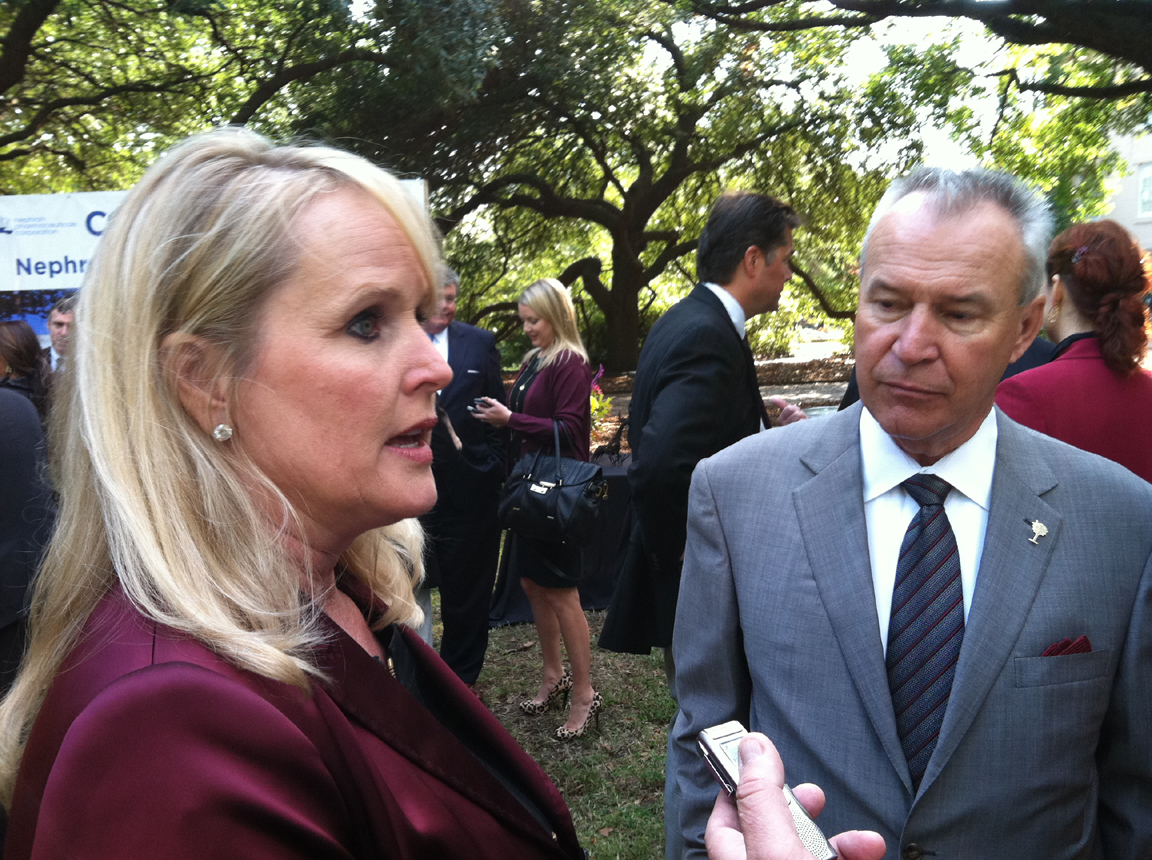
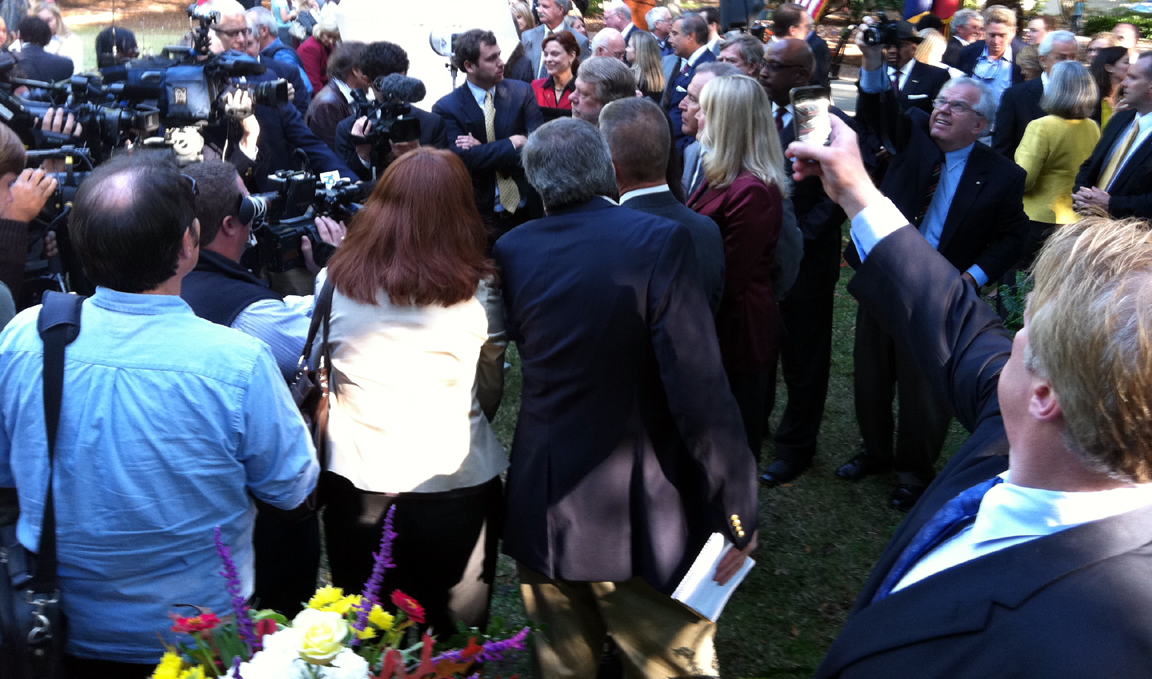
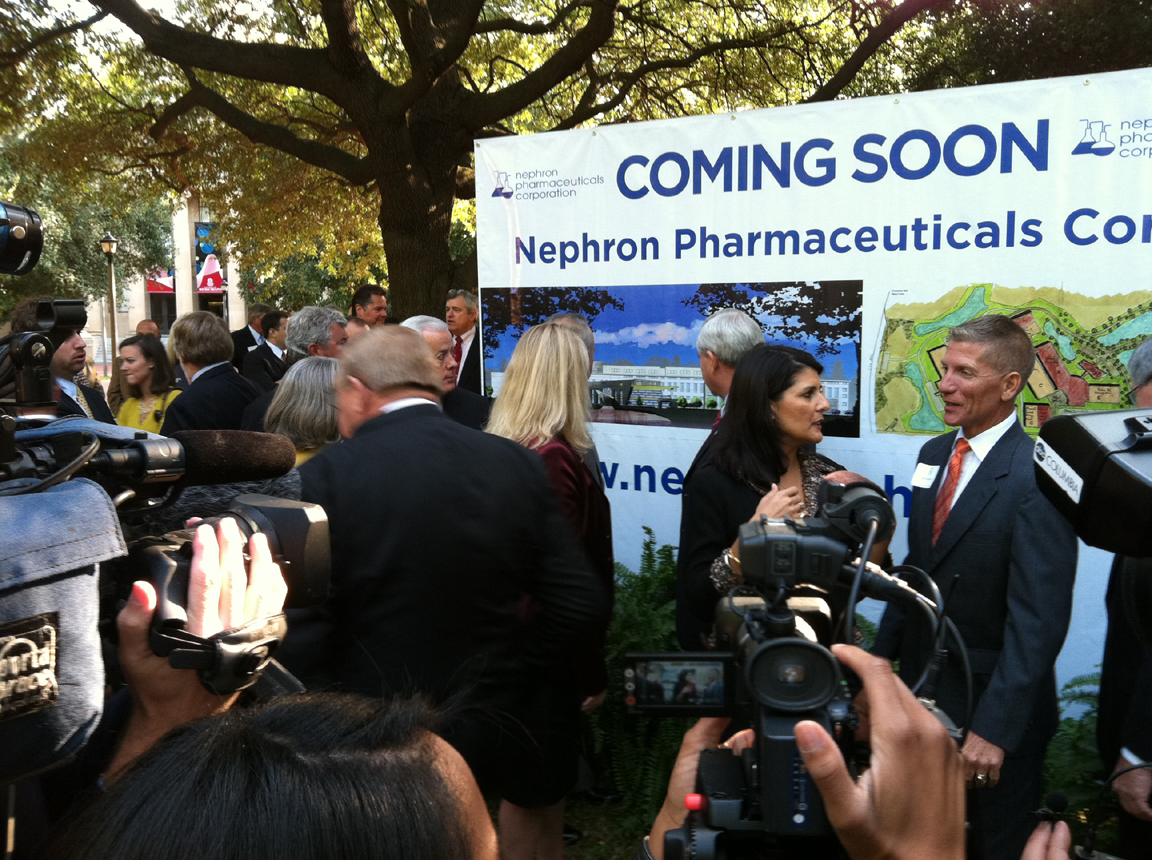
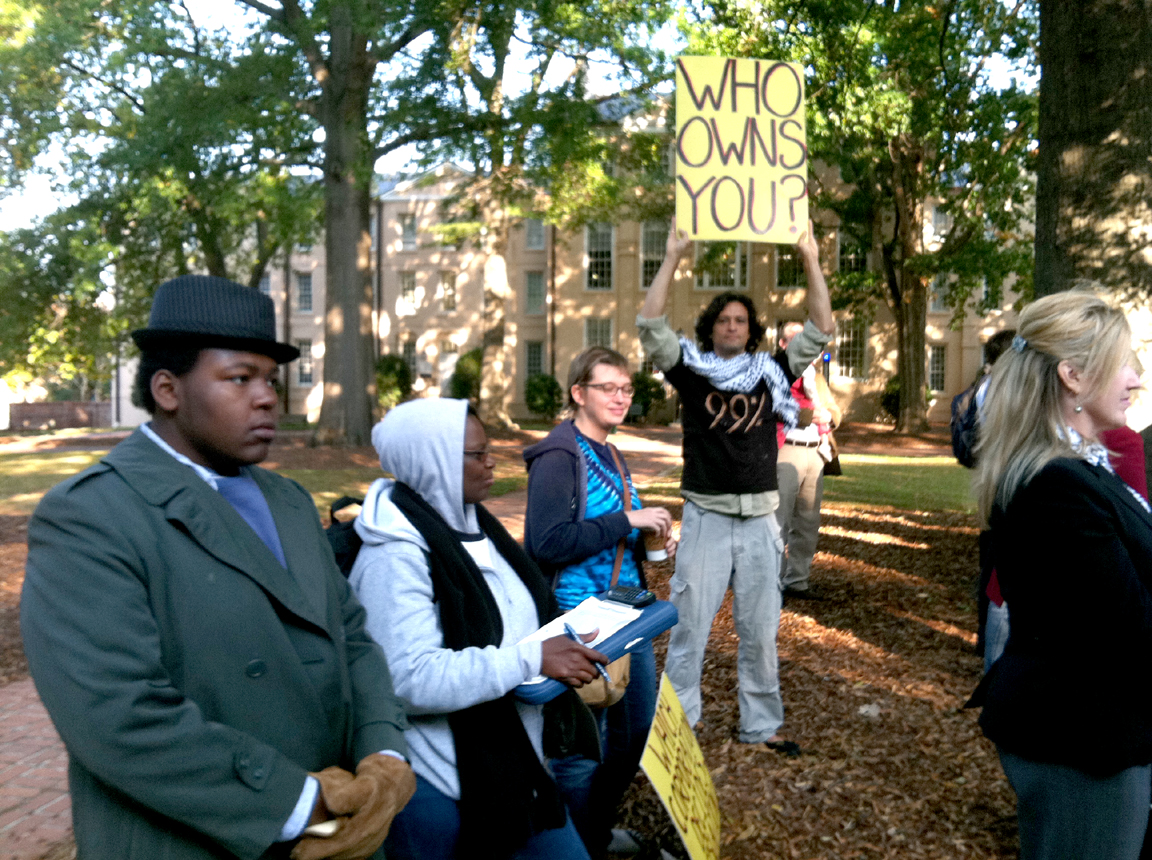
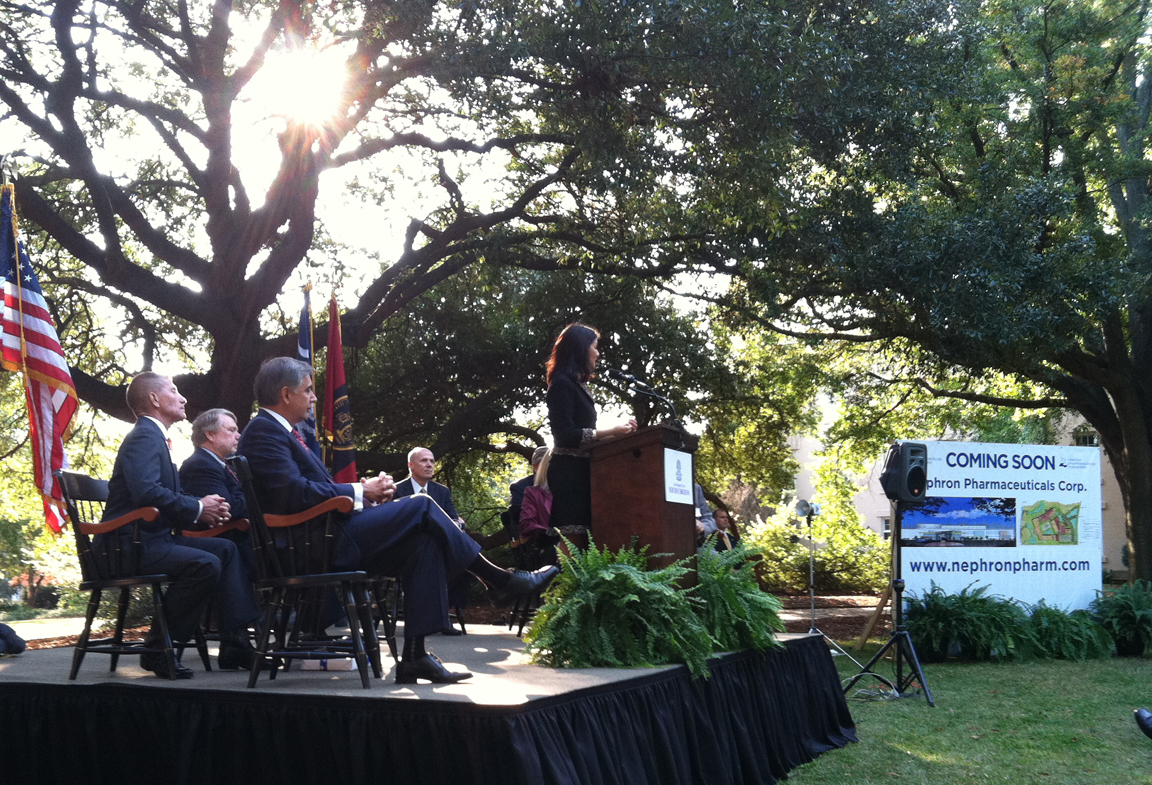
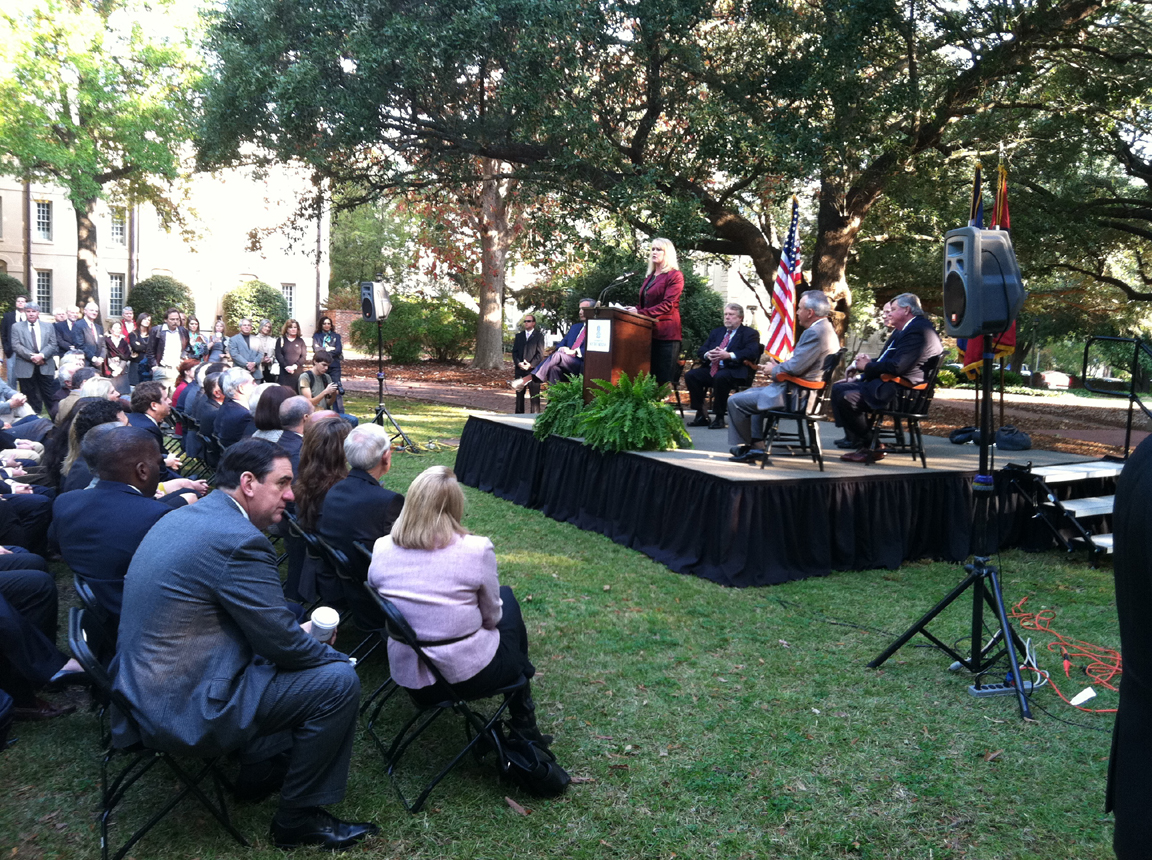
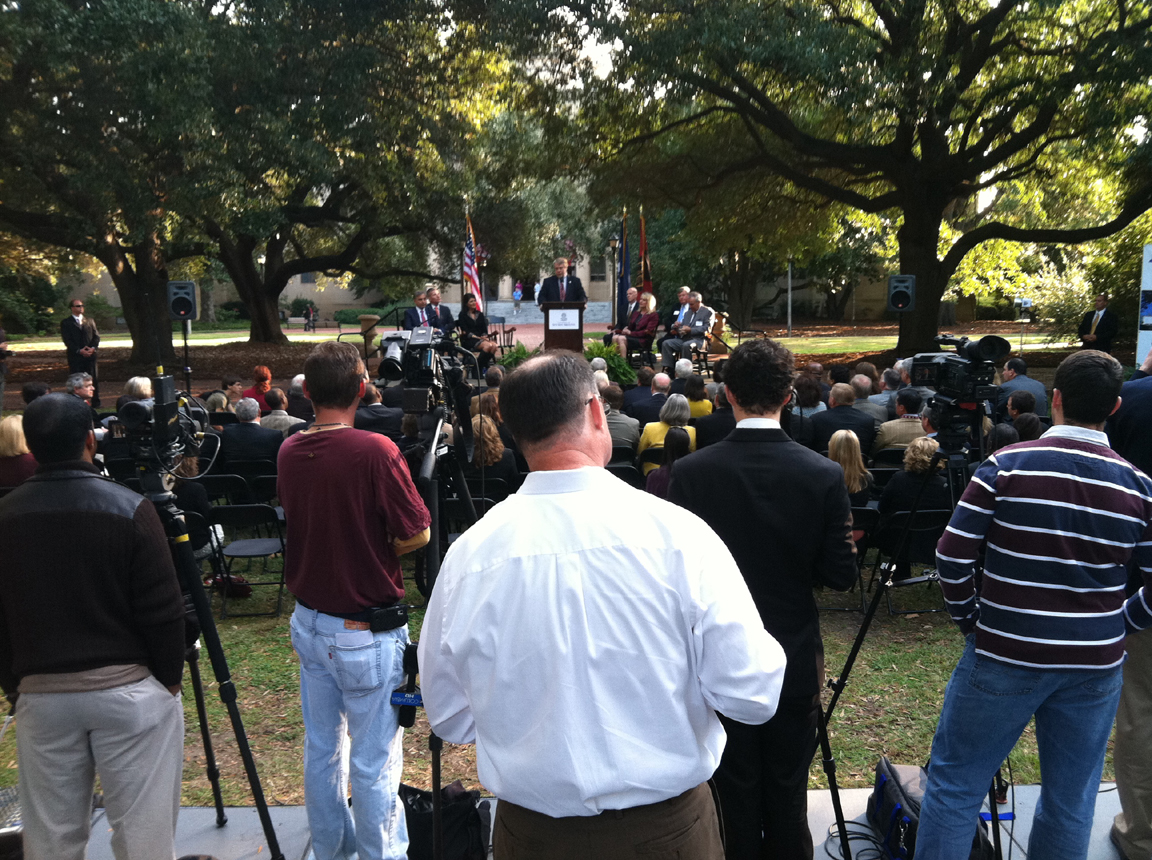
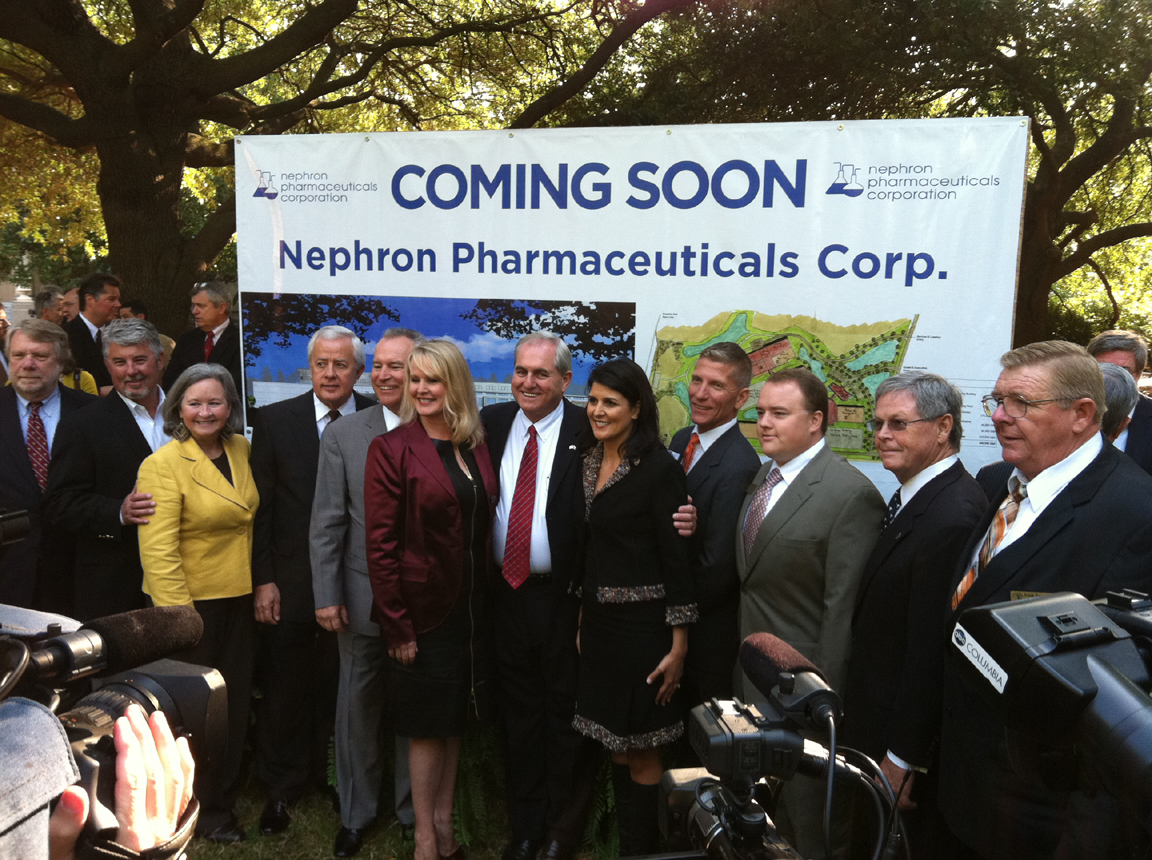
This was a big day for all concerned, as you can tell from the basic facts, but the pics below will help confirm. Everybody wanted to get in on the act — the governor, Harris Pastides and a large array of USC honchos, Lexington County Council, the Lexington legislative delegation, Steve Benjamin and his folks, and of course the whole economic development community, from Commerce Secretary Bobby Hitt (who was sort of the master of ceremonies) through all the local and regional recruiters. Walid Hakim and others from Occupy Columbia were there, which really confirmed what a big deal it was.

There was enough glory to go around for all, especially for USC. Hence the Horseshoe venue. Lou and Bill Kennedy got their start at USC, and they have a child who is a freshman at the university. More to the point, they had already set up the Kennedy Pharmacy Innovation Center as part of Innovista. This is what Innovista is to look like, folks. Not White Elephant parking garages, but industries getting a foothold here through a research relationship with the university, then expanding into good jobs for South Carolinians.

After the formal ceremony, Lou Kennedy said the jobs they’ve produced in Orlando pay an average of about $70,000. And at this point, they don’t plan on bringing any of their Orlando personnel here.

So, very good news. And very little controversy — so far. House Majority Leader Kenny Bingham was given a chance to compare this to the fight Lexington County lawmakers had with the governor over Amazon (which will be this plant’s neighbor), and he declined. This one was nothing but cooperation.

Part of that may be that the industry itself wanted to come here, rather than having to be enticed. (There apparently were incentives, but no one — aside from those involved in the deal — knows what they were yet. I ran into my friend Kevin Dietrich of The Nerve, the scourge of incentives, there, and he didn’t seem on the scent of any yet.) But whatever the reason they’re here. And I don’t feel like I’m going out on a limb when I say that’s a very good thing. Congratulations to all involved, from the governor on down.

Duke Endowment gives $11.25 million to HSSC

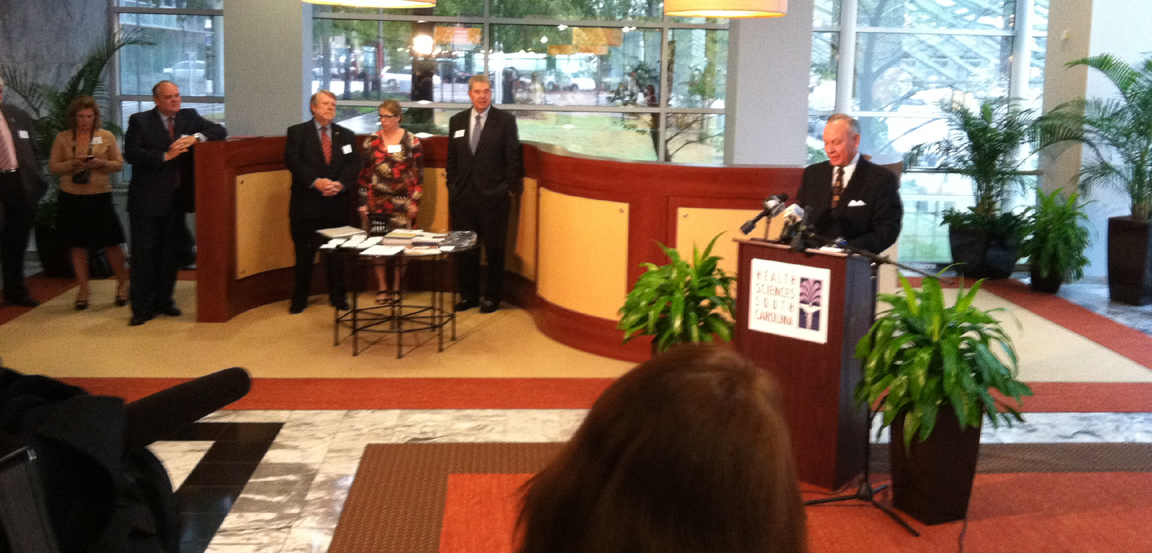
Jay Moskowitz speaks at the news conference.

I am running through so much stuff today (most of it non-blog) that I don’t have time to say much about this very development, but it’s a big deal, that could lead — among other things — to real-time information being available statewide for doctors and hospitals to better treat their patients.

There was quite a crowd at the announcement, including Commerce Secretary Bobby Hitt (the second of three times I would see him today; he was an active guy, too), and such other luminaries as ex-Spartanburg Mayor Bill Barnet and Minor Shaw President of the Micco Corporation, both members of the Duke Endowment board — as well as board chair L. Neil Williams of Atlanta — to give you an idea of how far people came to celebrate this important investment in health research and implementation in South Carolina:

FOR IMMEDIATE RELEASE

October 19, 2011

Health Sciences South Carolina lands an $11.25M grant from

The Duke Endowment

Major gift can result in health care innovation, boost economy, and translate into healthier citizens in SC.

Leaders from Health Sciences South Carolina (HSSC), The Duke Endowment, and the state gathered in Columbia today to announce significant news for the future of health care in South Carolina. HSSC, a statewide biomedical research collaborative, has been selected to receive a major grant from The Duke Endowment totaling $11.25 million.

“This grant will help us continue to improve health, health care and health research in South Carolina,” said HSSC President and CEO Dr. Jay Moskowitz. “HSSC, through the support of The Duke Endowment, can translate research discoveries into improved delivery and care models and healthier lifestyles that will benefit not only South Carolinians, but all humanity.”
Today’s grant marks the second time that The Duke Endowment has invested in HSSC’s work. In 2006, HSSC received $21 million from The Duke Endowment, the largest grant for a health care initiative in the foundation’s history. As a result of The Duke Endowment grants, HSSC, through research grants and proposals, has brought another $50 million into South Carolina.

“From the beginning, Trustees of The Duke Endowment were impressed with Health Sciences South Carolina’s vision and commitment from its partner organizations to share knowledge and to work together,” said Neil Williams, chair of the Endowment’s Trustees. “Through this new investment, we believe South Carolina has a chance to bolster leading-edge programs and impact pressing health issues. It will help HSSC continue its vital role in making good health possible in South Carolina.”

The Duke Endowment funding will enable HSSC to build on its existing infrastructure and move in a new strategic direction focused both on research and on translating that research into better clinical care in all parts of the state.
For example, the grant will support HSSC in its efforts to continue to build and implement a health care information technology and clinical trials network in South Carolina. The central feature of this effort is a statewide clinical data warehouse, which will compile real-time clinical data from across HSSC’s collaborative hospitals. The statewide IT and clinical trials network not only will make research more efficient, but also will allow medical teams to use clinical data to make evidence-based decisions, resulting in better patient care. In addition, it will help South Carolina attract clinical trials, which can benefit patients and bring economic activity to the state.

Furthermore, the new funding will enable HSSC to improve the pace at which health care quality and patient safety innovations are integrated into practice in South Carolina. By translating research into clinical practice faster, HSSC believes it can significantly improve how some of the state’s most critical chronic diseases, cardiovascular disease, diabetes and obesity, are treated.

While the grant will help HSSC foster research and translate that research into better health care, it also can strengthen South Carolina’s economy by leading to the development of new products, new jobs and new industries. Additionally, with the support of the grant, HSSC can play a role in containing and reducing health care costs in South Carolina.

“In 2004, HSSC set out to develop a health care model that was unique in the U.S. and, through it, to improve the health of all South Carolinians,” Moskowitz said. “Through HSSC’s ongoing initiatives and the support of The Duke Endowment, we are realizing the promise of new treatments, methodologies, tools and discoveries. We believe that this grant, ultimately, will translate into healthier citizens in every part of South Carolina.”

About Health Sciences South Carolina

Established in April 2004, Health Sciences South Carolina (HSSC) is a statewide public-private collaborative of research-intensive universities and major health systems possessing the shared vision of using health sciences research to improve the health, healthcare and economic wellbeing of South Carolina. HSSC includes Clemson University, the Medical University of South Carolina, the University ofSouth Carolina, Greenville Hospital System University Medical Center, Palmetto Health, Spartanburg Regional Healthcare System, McLeod Health, Self Regional Healthcare and AnMed Health.

For more information, visit www.healthsciencessc.org.

About The Duke Endowment

The Duke Endowment, a private foundation in Charlotte, N.C., seeks to fulfill the legacy of James B. Duke by enriching lives and communities in the Carolinas through higher education, health care, rural churches and children’s services. Its founder is the same Duke behind Duke University and Duke Energy, but they are all separate organizations. Since its inception in 1924, the Endowment has awarded nearly $2.8 billion in grants. For more information, visit www.dukeendowment.org.

More than one of the business and research leaders present for the announcement later said it was good to see some of that North Carolina money flowing into South Carolina — particularly since that amount can move the needle here more than it can there.

Here’s a place for you to talk about Spurrier, Morris, Garcia, etc.

A reader Tweeted, as I was headed to a late lunch (1:46 p.m. EST), “Eager to read your thoughts on Spurrier v. Morris.” I had not the slightest idea what he was talking about, but now I do. I’ve seen the video and everything. (Interestingly, I could not find anything about it on the mobile version of thestate.com, but that doesn’t mean it wasn’t on the browser version at the time.)

Of course, by that time, the news that the coach, or Eric Hyman, or somebody, had thrown Stephen Garcia off the team — apparently for real, this time. Hyman explained, “For Stephen to return to and remain with the football squad this fall, we agreed on several established guidelines. Unfortunately, he has not been able to abide by those guidelines and has therefore forfeited his position on the roster.”

I don’t know what the guidelines were, as I don’t follow this stuff. But I did see the Auburn game, and a reasonable guess would be that one of his guidelines involved throwing the football straight. Yes, I’m joking. Sort of.

But Micah apparently wanted to know what I thought about the Ron Morris thing. Gee, I don’t know.

I’m not Ron’s editor; never was. If I were, right now I’d be saying, “What the hell, Ron?” Or perhaps I’d use some other, saltier, newsroom expression. And Ron would tell me what was going on as well as he could, from his perspective. Although, based on the performance I saw on the video, it might not be altogether clear to him what it’s all about (apart from the usual animus that, from what I’ve seen, Ron is accustomed to engendering). Anyway, assuming he had the information available, I would have Ron lay out for me his version of the story. Then, I would check it out as well as I could.

If Coach Spurrier had an ounce of professionalism in him, of course, he would already have communicated to me (as Ron’s theoretical editor) what his beef was. Let’s assume he does, and he did. In that case, I would already have had it out with Ron about it and, given the way Spurrier acted today, probably would have told him I’d decided to back Ron. Hence the public tantrum.

Of course, if the coach did NOT try the normal, civil route first, then his performance today was inexcusable. Perhaps understandable on some level given that his QB was just canned after letting him down, but still not excusable in a man paid $2.8 million a year by a public institution to represent that institution.

Speaking of which, if I were Eric Hyman or Harris Pastides, I’d right now be having a serious talk with the coach about his performance — a sort of mirror of the one I’d be having with Ron as his editor. We’d start by watching his game film. Some of the things I’d be asking him:

  • What’s this really about, Steve? And don’t give me that nonsense about some column last spring. That was last spring; you blew up today. What’s really going on? (Oh, wait: Maybe THIS is the column Spurrier is referring to, in which Morris wrote, “Spurrier poached Horn’s program.”)
  • What exactly do you mean when you say it’s “my right as a head coach” not to talk to Ron Morris? Is that some special right we don’t know about? Do assistant coaches, or ordinary mortals walking the streets, not have that right? Because one would think that they do; that any human being walking the planet would have the right not to talk to Ron Morris if they chose not to. (Unless, of course, they were working for us, and we were paying them $2.8 million a year, and we told them to talk to him…) So what’s this imperious “as a head coach” stuff? Have we really made you feel that important?

And so on. That would just be for starters. And I’d be doing that in between fielding phone calls from people over at the newspaper asking me, “What the heck?” Because they use language like that in talking to the public.

So, as I say, if I were charged with taking a position on this, I’d be in fact-finding mode now before making a decision. But if you held the proverbial gun to my head (and I’d much prefer that to a literal one), I’d have to choose Ron on this one. And I might get embarrassed doing so — I might later have to run a full retraction on the challenged column last spring or something if it turned out Ron was wrong. But if you forced me, I’d go with him on this, because I know him. Or at least, I know him better than I do Spurrier, whom I’ve never met.

That means I used to run into Ron in the hallway sometimes, and stop to chat. I never actually worked with him. I don’t think he was in the newsroom when I was (pre-1994), and even if he had been, we’d have had little occasion to deal with each other. But he has always struck me as a pretty thoughtful, careful guy.

I knew people hated him — people of the “Cocky is God” persuasion. And I used to wonder about that, but I’ve often had occasion to wonder about really serious football fans. Sometimes, when one of Ron’s columns caused a splash of some sort, I’d actually turn to the sports pages and read it. And it usually read OK to me — of course, I was judging it outside the context of having any particular knowledge of the subject matter.

So Micah, that’s what I think.

Caroline Whitson to retire from Columbia College

Here’s something for the “this just in” department:

WHITSON TO RETIRE AS PRESIDENT OF COLUMBIA COLLEGE IN 2012

October 11, 2011

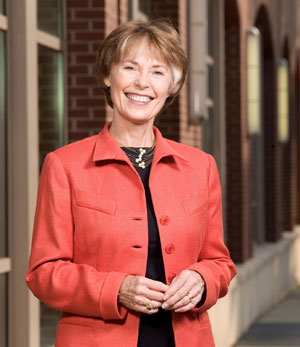
Dr. Caroline Whitson, the 17th president of Columbia College, will retire at the end of this academic year – June 30, 2012.

Since coming to the college in 2001, Dr. Whitson has been an energetic advocate for women’s education and forimproving the status of women in South Carolina.

In announcing her retirement on behalf of the Board of Trustees, Chairman Lex Knox said, “Columbia College has been very fortunate and blessed to have someone of Dr. Whitson’s character and talent to lead us for the past decade. She has been an outstanding leader through challenging times, and has steered the college through needed changes. While disappointed at the news, we respect her decision and certainly wish her well.”

Dr. Whitson said, “I am well aware that the successes the college has enjoyed during my time here are a direct result of the work of a talented, committed faculty and staff and the support of an engaged Board of Trustees. I have been fortunate to have the opportunity to work with and learn from them.”

As president, Dr. Whitson championed the establishment of the college’s 4Cs. The unique leadership model combines academic and co-curricular programming to support students in the development of the Courage, Commitment, Confidence, and Competence to lead for change. She guided the expansion of the college’s Leadership Institute, which serves both girls and professional women. Dr. Whitson founded the Alliance for Women, a partnership between Columbia College and the Governor’s Commission on Women, when the commission was targeted for closure in 2004. The Alliance has supported entrepreneurship for women, including bringing both the Women President’s Organization and Make Mine a Million to South Carolina.

During Dr. Whitson’s tenure at the college, annual fund-raising has more than doubled. The college’s endowment has increased by 40%, including the establishment of both the McNair Scholars program and the Reeves Endowed Chair in Leadership Studies.

Facility expansion at the college of 1,269 students includes the addition of a new student union, residential cottages and an athletic complex, as well as renovation of the freshman center, the Goodall Art Gallery, Edens Library and the Cottingham Theatre. The installation of solar panels and a campuswide revision of energy systems have significantly reduced the college’s carbon footprint. A campus beautification program led to implementation of an extensive landscape design.

Recently Dr. Whitson signed agreements for research and for faculty and student exchanges with both the State University of Mongolia and the Hiroshima Jogakuin Women’s University.

Since 2001, Columbia College has received national recognition for teaching and scholarly excellence from the Theodore Hesburgh Foundation, the Carnegie Foundation, the National Collegiate Honors Council, the Council for the Advancement and Support of Education, the Foundations of Excellence for the First College Year, the NAIA Champions of Character, the National Communication Association, and the National Association for the Education of Young Children.

During her tenure at the college, Dr. Whitson has been a leader in civic affairs. She chaired the Richland County Transportation Commission, the South Carolina ETV Endowment board and the Presidents’ Council of the South Carolina Independent Colleges and Universities. She has served on many boards, including those of the United Way of the Midlands, New Carolina, and the Midlands Business Leaders Group. Nationally, she has served on the University Senate of the United Methodist Church, as a member of the President’s Circle in the National Council for Research on Women, and on the board of PLEN (Public Leadership Education Network).

Dr. Whitson has been honored with a “Woman of Distinction” award from the Girl Scouts of the Congaree Area, as the “Outstanding Advocate for Women in Business” from the Greater Columbia Chamber of Commerce, and with the Martha Kime Piper award from the South Carolina Women in Higher Education.

Chairman Knox said Vice Chair of the Board Becky Laffitte will head the search committee to find a new president for Columbia College, with the rest of the committee being named within the next two weeks. The committee will include some board members as well as representatives from the rest of the college community.

Caroline has been a great person to work with in the community. I served with her on a local advisory council for the Knight Foundation years ago, and dealt with her during the effort to pass the sales tax referendum for transportation last year — which, as you’ll recall, I interviewed her about on “The Brad Show.” She had helped lead community conversations about transportation for several years leading up to that.

I understand that she plans to stay in the community. That’s good news.

The USC biomass “travesty”

Hats off to Wayne Washington (and his editor — I always like to remember the editors) for a rather overwhelmingly thorough report today on the mess that is the University of South Carolina’s biomass-to-energy project. An excerpt from the lengthy package in The State today:

On June 28, 2009, an explosion rocked the biomass-fueled power plant on the campus of the University of South Carolina.

The force of the blast sent a metal panel some 60 feet toward the control office of the plant at Whaley and Sumter streets, according to documents obtained from USC by The State newspaper through a Freedom of Information Act request.

No one was hurt, but USC officials were concerned enough about the “potentially lethal accident” that they ordered an independent safety review and, in a strongly worded letter to the company that had built the plant, made it clear that university staff would not be allowed back into the building until the review was completed.

The blast underscored what some USC officials privately grumbled about for years: That the plant has been a $20 million disaster, a money pit that was poorly planned and built by a company that had never constructed such a cutting-edge “green energy” power plant before.

Interviews with USC officials and a spokeswoman for the company as well as a review of more than 1,800 pages of documents show that…

Rich material for a discussion. Here’s how it is likely to go, although I look forward to unanticipated variations:

Some of you: Yet another example of USC wasting time and money on unproven, pie-in-the-sky energy alternatives and leaving us in a financial hole with little or nothing to show.

Others of you: What a classic case of the private sector not delivering — a Fortune 500 company that takes millions from a  public institution and doesn’t get the job done…

To me, the whole mess is too complex for simple conclusions, but here’s a stab: Some USC officials under the last administration made an unwise, expensive deal, while at the same time trying to insulate us from loss by getting the company to guarantee savings. Then after that, everything went wrong.

But tell me what y’all think.

Laurin and Nancy at the social media symposium

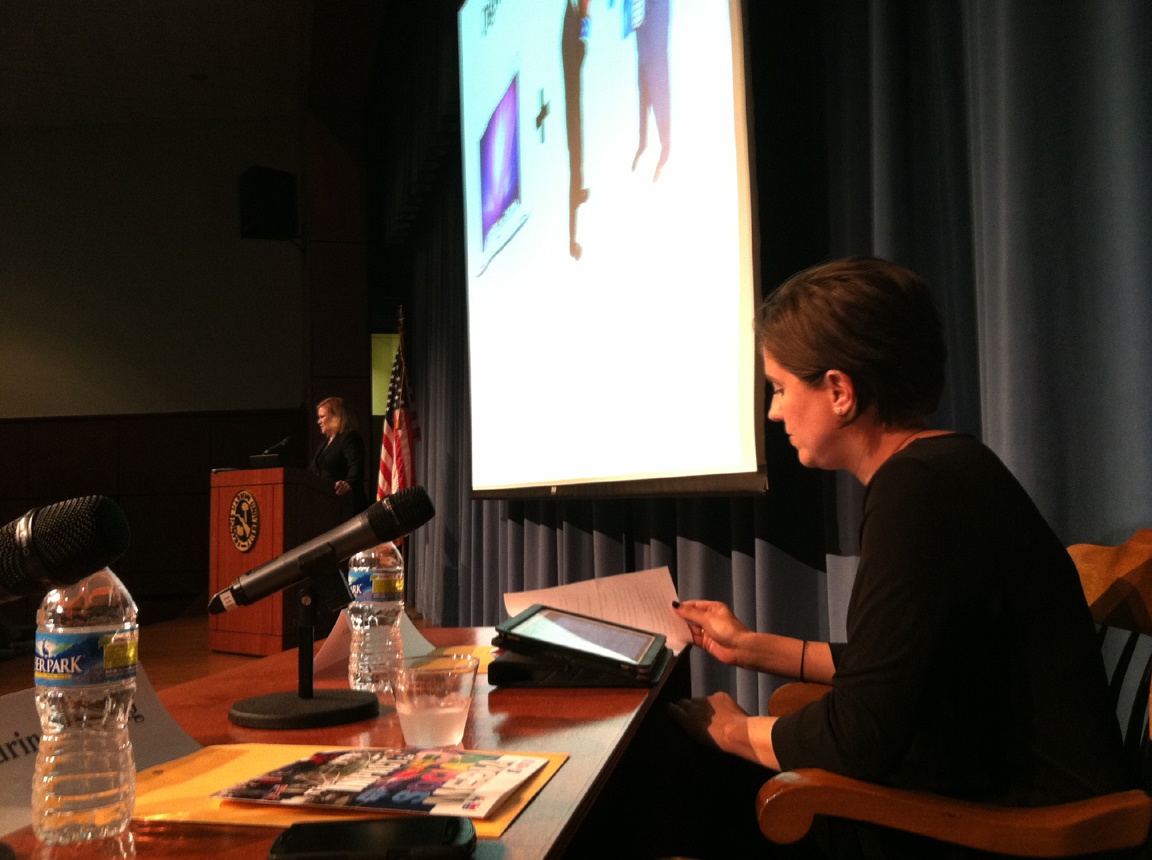
Laurin is presenting, Nancy is going over her notes, and I'm trying to think up some mayhem that will get me sent to the principal's office. Just like school.

Last night, I participated in a symposium on politics and social media at Francis Marion University. Which was great. Trouble is, I was on a panel with Laurin Manning and Nancy Mace. And they were better prepared than I was.

See, I thought it was going to be just a panel discussion, so I had jotted some notes about points I wanted to be sure to hit on, and showed up. Laurin and Nancy had slide shows, and got up and made presentations. So I had to, too. No problem, really, because I can fill any amount of time… I talked about the old blog and why I started it and how it related to my old MSM job, and the new blog and how it’s going, my Twitter feed (dang! I forgot to mention I’m one of the Twitterati!), how I hate Facebook (it’s the AOL of this decade), “Seinfeld,” my Top Five Baseball Movies, and I don’t know what all.

Then at some point, I realized I’d gone on enough, or more than enough, and shut up. Which I think was cool, but it was way less polished than what the other panelists did.

You know how, when you were in school, there were these girls (and sometimes traitor guys) who always showed up with their homework done? And raised their hands and asked for more work, for extra credit? And when the teacher had been out of the room, and came back, they told her what you had been doing while she was gone? It was like that. Laurin and Nancy were good.

But I survived to the actual panel discussion part, and that went well (I think), so all’s well that ends that way. As it happened, I enjoyed it.

I especially enjoyed learning from Laurin and Nancy.

Laurin was sort of a mentor for me when I started blogging in 2005, and she was well established with the legendary Laurinline. She later was part of the unstoppable Obama social media machine of 2008. Recently, she’s blogged at SC Soapbox.

Nancy, the first female to graduate from The Citadel (how’s that for intimidating?), is founder and CEO of The Mace Group, LLC. She’s also partners with Will Folks in FITSNews— she does the technical side, and leaves the content to Will.

I’m not going to share with you all the cool trade secrets they imparted, because knowledge is power, and I want it all to myself. But I will share this anecdote that they told us about:

You know how Will started his blog? By accident. He was actually trying to post a comment on the Laurinline, and got so confused in trying to do so that he inadvertently set up a blog of his own. Really. That’s the way Laurin and Nancy tell it. The site is much more technologically sophisticated now with Nancy involved, and has more than a million page views a month — compared to my measly traffic, which has only broken a quarter of a million a couple of times. (That’s it. That was my display of humility for this month.)

Anyway, that’s why I was in Florence.

Fan suggests Spurrier take pay cut for Saturday

I mentioned breakfast at the Cap City Club back on my last post, which reminds me… Some of the guys at the regular round table this morning were talking about the Gamecocks-Auburn thing on Saturday, and one of them said, “I didn’t see any football over the weekend.”

What he meant was, he was there at Williams-Brice. He just didn’t see any football.

He’s not bitter or anything. He blames Coach Steve Spurrier for it, but he’s willing to forgive — if the Old Ball Coach will take a 1/12th cut in his pay for that one.

Intriguing. Since his salary is $2.8 million, that would mean a reduction of … $233,333.33.

Someone else at the table suggested that he could donate the amount to academics.

I am neither endorsing nor rejecting the idea. It’s one thing to deal in political controversy here on the blog without making suggestions about other people’s religion.

As for the rest of you… discuss.

USC athletic director’s message to Rotary today

USC Athletic Director Eric Hyman spoke to the Columbia Rotary Club today. Eric’s a smart guy with a big job, but since I’m not much of a sports fan a lot of what he said went right by me. But this jumped out, and I shared it on Twitter:

Eric Hyman, USC athletic director, tells Columbia Rotary, “We do not get any state money.” He adds, “We. Do. Not. Get. Any. State. Money.”

Yeah, you knew that. I knew it, too. But it’s worth repeating, because a lot of people don’t know it. I’ve already heard from one on Twitter. She was incredulous. (Did I already say “incredulous” once today? Seems like it. Good word; don’t want to overuse it.)

Knowing that is one reason why I don’t write all that much about the Gamecocks here. If I thought it was costing us money, I’d go ahead and fight the tide and say we have better things to spend the money on. But since that’s not the case, since this a case of misplaced public priorities, I have few opinions to express. And since I know Gamecock success actually does boost the local economy, I’ll say “Go Cocks!”

I don’t have to understand why so many people are so football-crazy. I just have to acknowledge the fact.

By the way, there were some other interesting facts that Mr. Hyman threw out: that football generates 70 percent of the athletic revenue, that basketball generates 18 percent, that baseball (while he is deeply, deeply appreciative of our back-to-back national champs) is actually “expensive.”

At least, I think he said those things. The only thing I wrote down (and I had to borrow a pen to do it, having left mine at the office) was the above quote.

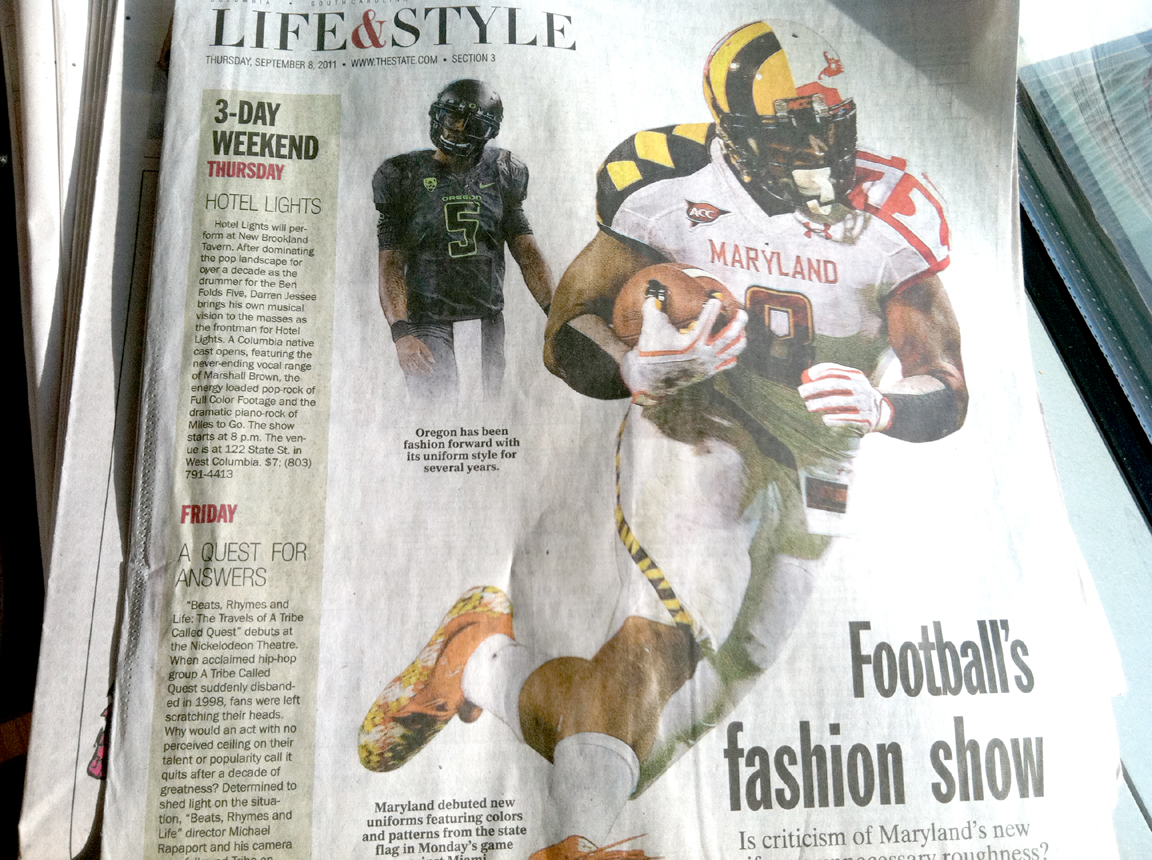
A few words about football fashion

Most mornings, I read both The State and The Wall Street Journal over breakfast. This morning, I was struck by a certain contrast.

The WSJ had, teased from the front and filling most of a section front, a feature on the coming fashion season.

The State had a fashion spread, too. But it was football fashion. That says a lot about who we are, don’t you think? The fashion thing may have seemed odd to old-time readers of the Journal, but the football stuff looked right at home in the hometown paper.

Here’s a thought: The new Maryland unis looked pretty good. They’re sharp, innovative, and yet invoke tradition, really telling you where they’re from.

Wouldn’t it be great (and I’m bracing myself as I say this, at the height of Garnet and Black Fever time) if the Gamecocks wore solid indigo blue uniforms with white lettering, and the Palmetto tree (in white) on one shoulder and the crescent moon on the other? That would say so much about this being the University of SOUTH CAROLINA.

It would also, politically, position the school as THE flagship university in an indelible manner.

And it would look really, really sharp.

But I’m not holding my breath for that to happen.

What? They got a FASHION season, too?

Why did USC build the Greek Village, anyway?

Yes, I can think of some reasons, but since all of the ones I think of are… unpersuasive… I continue to wonder whether there are any defensible reasons for having devoted that choice real estate to such a purpose (not to mention putting the Strom Taj Mahal workout center in a location that only the Greeks could walk to conveniently and safely).

If you know of any, share them.

Here’s the thing about this sudden discovery by the university that fraternities tend to encourage unseemly behavior (“USC officials, Greeks debate hospital trips, strippers,” The State) — I’ve never understood why their presence is in any way encouraged at public institutions of higher learning.

At all of our colleges and universities today, administrators know that one of the most serious problems they face is binge drinking, and other activities that most of us associate with… well, Greek life. It astounds me that, in the 21st century, we even allow these organizations onto campuses, much less do anything to make them feel welcome. Not that we independents haven’t been known to chug a brew or two in college, but most of us didn’t join societies that, to the larger world, are essentially seen as drinking clubs.

I could see it if these associations had a salutary effect — say, if they militated against such irresponsible behavior. But I’m not seeing much indication of that.

Of course, I’m prejudiced. I went through college in the early 70s, which is actually the time that the cultural phenomena we associate with the 60s kicked in across most of the country. In my day, there were Greeks, but they seemed terribly anachronistic. It was something my Dad did (Pi Kappa Alpha), but not cool people in my generation. By the 70s — or at least by 1978 — they were associated with a benighted past, an object for satire. It was like, if you were in a frat, what century (or at least, what decade) were you living in? I understood that some people had their arms twisted by their parents into joining their frats and sororities, but what was the motivation beyond that? (There was this one guy who kept calling to invite me to check out his frat, and he only did it because he was bugged by his Dad, who worked with my Dad. I always came up with excuses to be elsewhere.)

The fact that people actually attached importance to this presumed bond — which is a perfect illustration of a granfalloon — has always puzzled me, and even caused me to think a little less of the human race. (While different, it’s distantly related to the way I feel about political parties.) To share another anecdote…

Once, when I was a student at Memphis State, a bunch of us were playing basketball on an outdoor court next to my dorm. Some guy got mad about something stupid and pointless, and put on a disgusting display of petulance, quickly convincing everyone that he was a total jerk. Finally, he decided to walk away, pouting. The attitude of every guy present was, Good Riddance. Every guy but one, who had to chase after him and try to… I don’t know, console him or commiserate or whatever. “We all said, what the hell, man? The guy’s a complete d__k! Come back and play.” There was some reason that his departure mattered to us, I forget what that reason was. Maybe he was taking the ball with him. Otherwise, we probably would have said Good Riddance to him as well.

Anyway, he said he had no choice but to run after that guy, because… he was his fraternity brother. We all looked on in disgust at this display of completely misplaced loyalty based on nothing more substantial than that.

But I’m sure some of you have a different perspective. Please, help me understand the ways that frats contribute to institutions of higher education.

Clue me in as to why those brick palaces, in the core of our community, add to our community.

I receive a welcome Elvis Day invitation

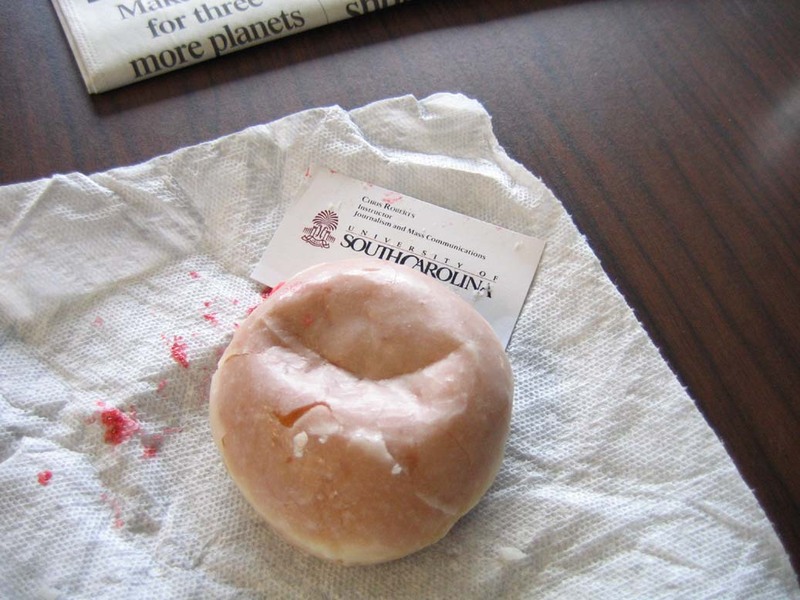
One of the doughnuts Chris left me back when some of the King's loyal subjects still worked at newspapers.

This rubble used to be the Krispy Kreme Chris went to in Tuscaloosa. Took a direct hit...

When we worked together at The State, Chris Roberts used to bring me a jelly doughnut every Aug. 16 in honor of the King.

He’s not in a position to do that now — he’s in Alabama — but he did show he was thinking of me by sending this:

He went on to say that he would have tried to get a doughnut to me, but the local Krispy Kreme got knocked down by a tornado back in April.

So I sent him a picture of one.

Chris knows how special this day is to me, because I was one of the first people in the world to hear the awful news in 1977:

MY GOOD FRIEND Les Seago was the man who told the world that the King was dead. But before he told the world, he told me.
I’ve always appreciated that, even though it didn’t do me much practical good at the time.
On Aug. 16, 1977, Les was the chief Memphis correspondent for The Associated Press. I was the slot man on the copy desk of The Jackson Sun, which meant I had been at work since 5:30 a.m. By early afternoon, the paper was on its way to readers. I had also been a stringer for Les for years, and I was used to his calls to see what was going on in our area. But he didn’t have time for that this day.
Was it too late to get something in? he demanded. Well, yeah, it was, just barely, but why…?
It looks like Elvis is dead, he said, explaining quickly that he had a source, an ambulance driver from Baptist Hospital, who told him he had just brought Elvis in, and he was pretty sure that his passenger had been beyond help. Gotta go now, ‘bye.
He must have broken all speed records getting it confirmed, because I had just begun to tell my co-workers when the “bulletin” bell went off on the wire machine as it hammered out the news.

Les himself was found dead at his home two years ago [this column ran on this day in 2006], at age 61. Though his career had spanned many years and he had covered Martin Luther King’s assassination, The Associated Press identified him in his obituaryas the man “who filed the bulletin on the death of Elvis Presley.” His ex-wife Nancy said “He wasn’t wild about Elvis, but he was glad that he did break the story.” That was Les…

Long live the King.

Building the Innovista, one brick at a time

Or maybe it’s one photon at a time. This just in from CRBR:

SCRA announced its newest tenant at the SCRA USC Innovation Center in Columbia, Nitek Inc.

SCRA described the company as a world leader and pioneer in deep ultraviolet-LED lamp technology. Nitek was launched in early 2007 with the goal of commercializing innovative micro-devices using III-Nitride technology, according to the company website.

Nitek is a spin-off of the University of South Carolina’s Photonics and Microelectronics Laboratory, which was started by USC professor Asif Khan in 1997.

The lab was formed as a small-scale, vertically integrated manufacturing facility for ultraviolet emitters, high-power electronics and visible LEDs and lasers…

The company will initially employ about 14 high-tech, high-wage employees. That number is expected to double in the next three years, SCRA said…

So… they’re selling light, from what I gather. Or something. Here’s wishing them huge success.