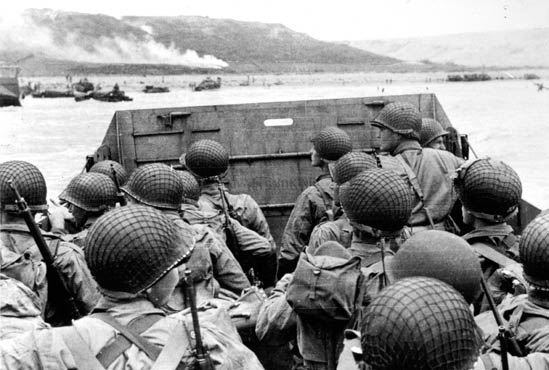
This was the Day of Days, and I am still overwhelmed by the enormity of what was undertaken, and the fact that it succeeded in spite of monumental mistakes and frightful odds:
- The idea of putting 175,000 men in one day on a beach, every square inch of which was pre-sighted by German machine guns, artillery and mortars.
- The decision that Eisenhower and Eisenhower alone had to make, giving the “go” signal after a day’s delay, with only the most primitive weather forecasting. A mind-bogglingly complex plan involving more than a million men, thousands of ships and boats, amounts of materiel that make today’s stockpiles look like nothing, all having to come together at the right instants. And he said “go,” knowing it could be a disaster — as it nearly was at Omaha, which would have rendered the whole beachhead untenable, and the invasion a failure.
- The stupendous foul-ups that nevertheless didn’t keep the invasion from succeeding — the aerial bombardment that fell too far inland to do any good (the pilots were afraid of hitting the boats approaching the beach), the rocket barrage that fell short into the sea, the naval artillery battering that failed to take out any of the German gun emplacements, the complete chaos of the airborne drop, with paratroopers landing as much as 20 miles from their drop zones, all mixed up with troops from other units and unable to find their own.
- The moment when Omar Bradley was close to declaring Omaha a failure, with a pitiful few wet, bleeding men huddled against the cliff, unable to advance or retreat, and reinforcements unable to land.
- The individual initiative here and there by sergeants, lieutenants and captains who knew the plan had gone to hell and that they had to improvise, leading small bands of men up the cliff, and (among the paratroopers behind German lines) organizing tiny ad hoc units to attack targets as they presented themselves. As impressive as what the generals had done in planning and preparation, it was these small, improvised actions that saved the day. (And, to give the generals a little of the credit, a result of the American method of training soldiers, which — unlike the doctrines of many countries — emphasized initiative, critical thinking and improvisation.)
- The incredibly difficult fighting through the hedgerows — something entirely unanticipated by intelligence, providing the Germans with multiple defensible positions to drop back to every few yards — over the coming month.
And so much more.
I’ve never in my life seen a pivot point of history condensed and crammed into one place and one day, and almost certainly never will. It just amazes me something like this, something so huge, so sweeping and momentous, such an effort, such a throw of the dice, occurred just nine years before I was born.
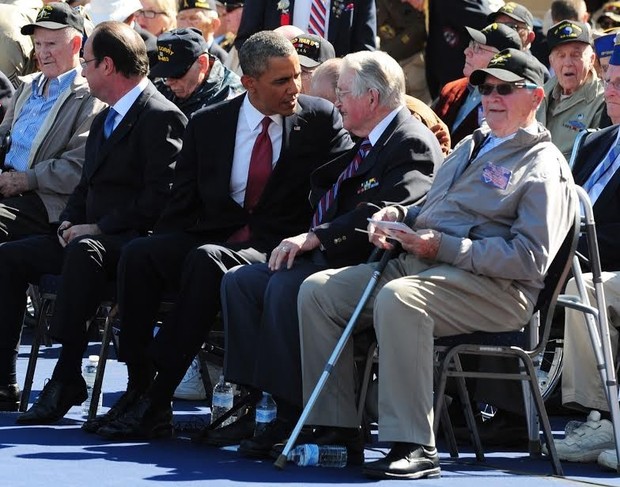
President Barack Obama chats with John Cummer of Blythewood, a World War II veteran in Normandy, France, for the 70th anniversary of D-Day. Winston Pownall of West Columbia, another veteran on the trip, is next to Cummer. SGT. MICHAEL REIHSCH — U.S. Army Europe