Category Archives: Media

The State’s endorsement generates predictable response

comments

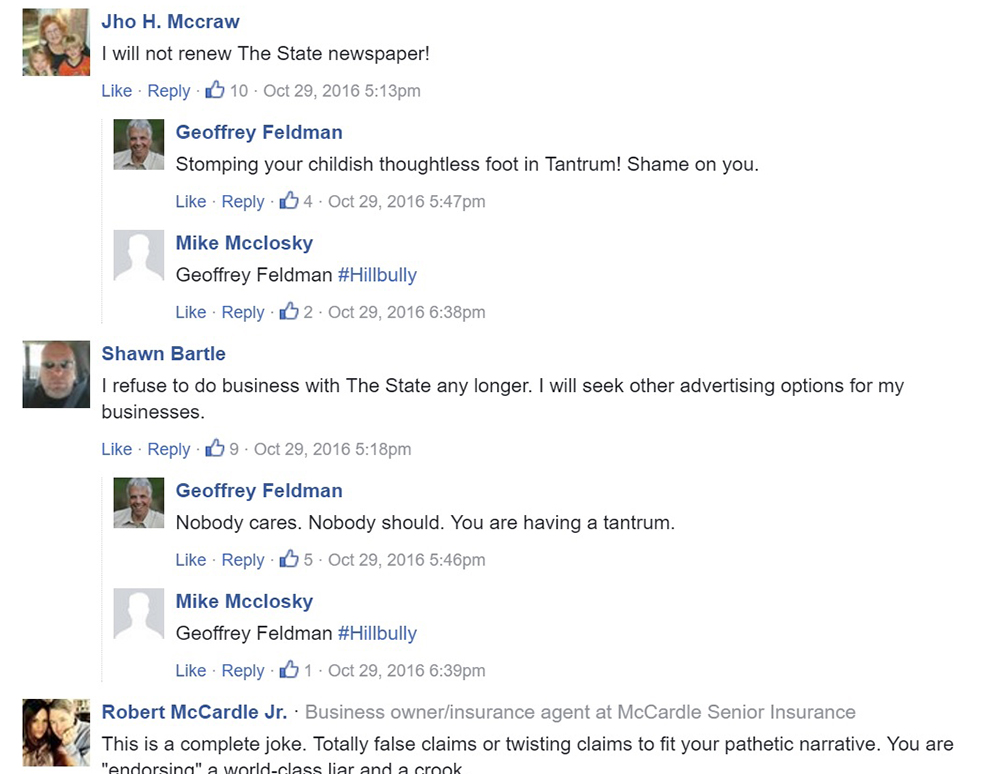
The predictable response to The State‘s endorsement of Hillary Clinton began immediately. Some of the first comments on thestate.com after the endorsement was posted Saturday evening:

  • “I will not renew The State newspaper!”
  • “I refuse to do business with The State any longer. I will seek other advertising options for my businesses.”
  • “This is a complete joke. Totally false claims or twisting claims to fit your pathetic narrative. You are ‘endorsing’ a world-class liar and a crook.”
  • “Do you think I care about the state endorsement ??? No”
  • “Very disappointing to see The State justify supporting a documented liar, who destroyed evidence AFTER SUBPOENED to produce— lying to congress –and most of all —-ALL OF THIS DOCUMENTED– it is documented for all time— Hilary Clinton should be in jail and not allowed to run for office at all…. and you all know it”
  • “Article is trash”

I especially like that the last guy was so anxious to spew that he didn’t even bother TRYING to make it into a sentence, or punctuate it.

Of course, as is the usual pattern, the paper also caught hell from people who LIKED the editorial:

A surprisingly cogent and erudite endorsement from a rag that typically follows the party marching orders. While I still disagree with The State’s ultra right wing world view I must commend them for looking beyond the smoke and mirrors, ignoring the clamor from South Carolina’s neo nazi and secessionist fringe groups, and choosing to endorse someone who, while maybe was not the best candidate, is by far the best of the last two left standing. HRC was not my first choice but she has gotten my vote for 2016. 2020 may present the opportunity to cast a dfferernt ballot however.

Partisans — you can’t live with ’em, and it would be nice to have a chance of living without ’em…

The State’s endorsement of Hillary Clinton

I could write about this at great length (as I did four years ago in reaction to The State‘s decision not to endorse), but I need to wrap up a couple of things and get over to the Big DM for the radio show, so I’ll just toss this out for y’all to discuss.

In today’s editions, The State endorsed HIllary Clinton for president, explaining why South Carolina’s many conservatives really have no other acceptable option in this election — which, of course, they don’t. And as we all know, the most pertinent part of the argument is the utter unthinkability of the alternative:

Most voters are aware of what he has said he would do: build a wall along our southern border to keep out illegal immigrants; waterboard suspected terrorists; kill innocent family members of terrorists; stifle the news media. While he has changed some of those positions — especially the killing of terrorists’ relatives — it’s troubling he ever considered them.

Also disturbing are his statements about women, his mocking of a man with a disability and his inability to focus on the big picture if it means ignoring a personal slight.

Whatever intrigue his business resume generates is overshadowed by his character and personality. He is simply unfit for the presidency, or any public office.

That means we must rely on Hillary Clinton for any meaningful change in Washington politics.

Her resume suggests Mrs. Clinton is as prepared as any of this year’s candidates to be an effective president. She played a major role in formulating policy during her husband’s administration, especially in the areas of health care and children. As a U.S. senator from New York, she served on the Armed Services Committee, earning praise from Republican John McCain. She also became secretary of state….

The piece was carefully crafted and very low-key. It wasn’t the way I would have written it, but it was fine.

Given that this was the first Democrat endorsed by the paper since 1976 — long before I or anyone currently on the board worked at the paper, I would like to have seen a companion column about the decision process. But then, that was my style, peculiar to me — I liked bringing readers into the boardroom and walking them through our discussions. Not many editors like to let it all hang out that way.

I’m sorry not to have been there for this one. I always sort of hoped we’d endorse a Democrat some day, just to make our presidential endorsements less predictable, and to shut up all the Democrats who called us a “Republican paper.” As y’all know, I don’t like being accused of having leanings toward either party, because of my strong dislike of both. It was a ridiculous charge, since overall our endorsements were about 50-50 — but all too many people pay attention only to the presidential endorsement, rather than the dozens of others we did in a given election year. All our presidential endorsements indicated that the national Democrats tended to go for candidates a bit too far to the left for us, while the national Republican Party — back when it actually was a respectable center-right party, before it went careening out of control — was more our speed. In races closer to home, Democrats tended to be closer to the center and Republicans farther to the right, so we tended more to fall right between them. (Yes, this “left-right” talk grossly oversimplifies what was going on, but it’s one shorthand way to describe our actual pattern.)

We came close in 2008, because we all liked Barack Obama. But as y’all know, John McCain had long been one of my favorite senators, and I wasn’t alone, so that didn’t happen. I argued here on the blog that 2012 — which was after my departure from the paper — should have been the year to break the pattern, because I was pretty sure Cindi and Warren agreed with me that Obama was preferable to Romney. But it didn’t happen that time, either — for a number of reasons, from what I could tell. Which was OK, I guess, given that particular choice. The country would have been OK either way.

This time, though, it was extremely important for the paper to take a stand against the greatest threat to the presidency in any of our lifetimes. It was important especially for a paper with such a solid record of endorsing Republicans to say, No, absolutely not! to Donald Trump — just as papers with even longer GOP ties had already done across the country.

As of Friday, out of the top 100 papers in the country by circulation, 55 had endorsed Hillary Clinton, including some that had gone a lot longer than The State without backing a Democrat. Only one, the Las Vegas Review-Journal, had backed Trump. And I don’t know what was wrong with them (aside from being owned by Sheldon Adelson). I don’t see how anyone with a working knowledge of our government and issues facing it, with an understanding of what America is about — and those are pretty much prerequisites for being editorial board members at most papers — could possibly back the most singularly unfit candidate ever to capture a major party’s nomination.

Anyway, The State did what it had to do, what any newspaper with a conscience needs to do this year…

I’ll be on Cynthia Hardy’s radio show at 6 p.m. tonight

onpoint

… which should give me plenty of time to get back home from the Big DM way across town in time for what could prove to be (although I hope not) the last game of the World Series.

Cynthia Hardy

Cynthia Hardy

According to the text I received asking me to be on the show, we’ll be talking about “talking the importance of down-ballot votes, red states leaning blue, and the millennial vote.” Which sounds to me like the discussion could go almost anywhere, as long as we’re talking about the election.

I’m told that Allen Olson — whom I don’t know, but I assume it’s this Allen Olson — will be in the studio as well. Kathleen Parker may join us by phone, from wherever she is at the moment. And there could be another guest. I get the distinct impression this show is a bit in flux — I was asked to participate this morning, although I usually get asked several days ahead of time.

So listen in, and if you’re inclined, call in…

‘No! The Writing Room is over THERE!…’

writing

I haven’t posted today in part because I accepted Steven Millies’ invitation to go speak to his poli sci class at USC Aiken, and I just got back.

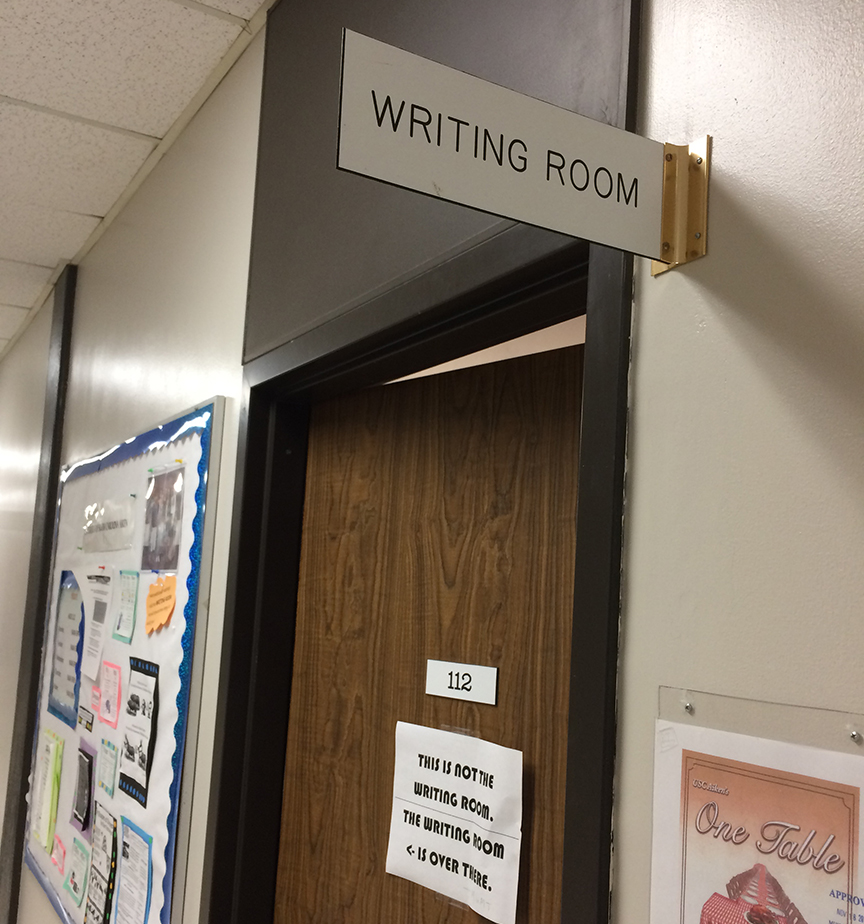
Before I tell you about the class, I want to share this door I found in the Humanities building while looking for Dr. Millies’ class. You’ll see that it leads, according to the formal signage at top, to the Writing Room.

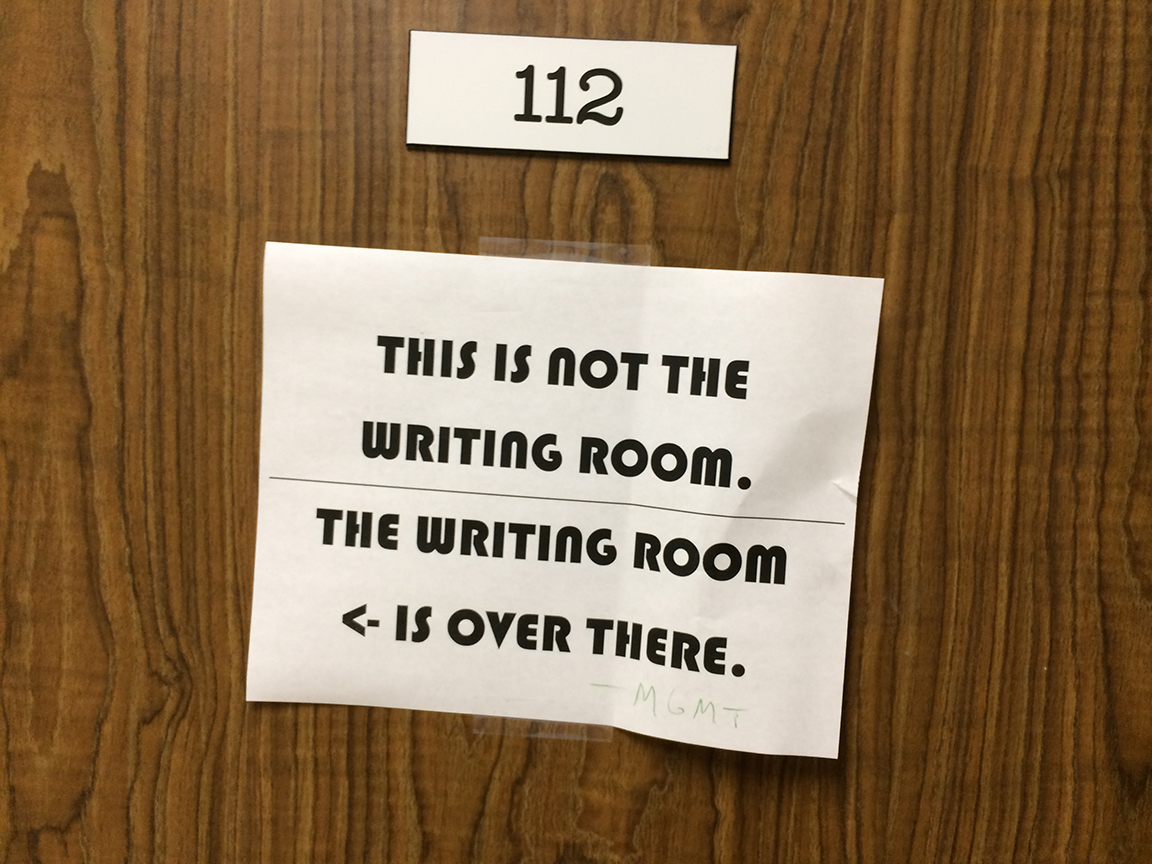
But no! When you look a bit closer (below), things are not what they seem. I don’t know why the wording of the less-formal sign struck me as so funny, but it did. The disagreement was just so stark — This is the Writing Room… NO! This is emphatically NOT the Writing Room. The Writing Room is over THERE, dummy!… The first sentence alone would have been funny. But the second sentence, with the little arrow, is what made it wonderful. I almost picture Marty Feldman pointing and saying, “There wolf! There Writing Room!…

Anyway, I offered to speak to Steven’s class during a conversation after the Bernardin Lecture the other night (he and I serve on the lectureship’s committee), when he told me his American Government class was talking about media this week. He took me up on it.

And I had a blast, especially since I didn’t have to prepare a lecture. I just showed up and answered questions. Sometimes, with undergraduates or younger students, it’s hard to get questions, or at least hard to get relevant ones. This class did great. I hope I did all right for them.

But I seriously, seriously doubt they enjoyed it as much as I did. It’s hard to explain, but standing in front of a room taking and answering questions gets me really jacked up. I don’t know what it is. I’m not crazy about giving a speech, because it’s so… one-way. I stand up there giving a prepared talk, and I look at all those people staring at me, and I wonder, Is this interesting them at all? Is this what they were looking for when they invited me?

And I’m never sure, unless they laugh at a joke or something. So when I’m asked to speak, I always ask whether it’s OK to keep the talk short and move on as soon as possible to Q&A. Then I come alive — and sometimes even the audience seems to enjoy it.

After the class, I ran out to my car, all wired up, to make an important phone call I had scheduled for that time, and I really hope I didn’t… overflow too much on the person I was calling. I may have. I looked when we were done, and the call had lasted 41 minutes. Later, driving back to Columbia, I returned a call from earlier from a reporter at The New York Times wanting to talk about something having to do with SC politics, and I may have overdone that a bit, too. To my great surprise, shortly after that call, I was already back in West Columbia…

So basically, I guess, I’ve been blogging all over people today… just not in writing.

Anyway, I’ll give y’all an Open Thread in the next hour or so. I hope y’all appreciate it more than y’all usually do on a Friday afternoon, harrumph…

room

The harshest words yet about Trump in the WSJ?

It’s interesting to watch the way The Wall Street Journal has dealt with the phenomenon they struggled so mightily to resist back during the primaries — having Donald Trump as the GOP standard-bearer. And Hillary Clinton, whom they have vilified for so long, as the only sane alternative.

One of their editorialists recently took the plunge, noting that rational people truly have no alternative:

The end of the election is now in sight. Some among the anti-Hillary brigades have decided, in deference to their exquisite sensibilities, to stay at home on Election Day, rather than vote for Mrs. Clinton. But most Americans will soon make their choice. It will be either Mr. Trump or Mrs. Clinton—experienced, forward-looking, indomitably determined and eminently sane. Her election alone is what stands between the American nation and the reign of the most unstable, proudly uninformed, psychologically unfit president ever to enter the White House….

But while he doesn’t quite go to the logical conclusion and say “vote for Hillary,” the WSJ’s Bret Stephens, deputy EPE, has perhaps gone farther than anyone in trashing the alternative.

Today, he likened Trump’s conspiracy-mongering to Joe McCarthy and Charles Lindbergh (the Nazi-loving, anti-Semitic Lindbergh, not the “Lucky Lindy” version). In other words, he invoked some of the darker strains of Western prejudice, specifically with regard to Jews:

Here, then, was the real Donald, fresh off his self-declared unshackling from the rest of the GOP. No longer will the nominee content himself with pursuing petty mysteries such as President Obama’s birth certificate or Alicia Machado’s alleged sex tape.

Bret Stephens

Bret Stephens

Now he’s after the Compleat Conspiracy, the one that explains it all: the rigged election, migrant Mexican rapists, the lying New York Times, thieving hedge funds, Obama-created ISIS, political correctness, women insufficiently attractive to grope, Chinese manufacturers, the Clinton Foundation. If it isn’t voting for Donald Trump and has recently crossed an international border, it’s a problem.

It did not escape notice that Mr. Trump’s remarks smacked of darker antipathies. A reporter for the New York Times suggested that the speech “echoed anti-Semitic themes.” The Daily Stormer, which bills itself as the premier publication of the alt-right, was less delicate, praising the speech for exposing the mass media as “the lying Jewish mouthpiece of international finance and plutocracy.”

But one needn’t accuse Mr. Trump of personal animus toward Jews (there’s no evidence of it) to point out that his candidacy is manna to every Jew-hater. Anti-Semitism isn’t just an ethnic or religious prejudice. It’s a way of thinking. If you incline to believe that the world is controlled by nefarious unseen forces, you might alight on any number of suspects: Freemasons, central bankers, the British foreign office. Somehow, the ultimate culprits usually wind up being Jews….

He adds that “a Trump administration would give respectability and power to the gutter voices of American politics. Pat Buchanan would be its intellectual godfather, Ann Coulter and Ms. Ingraham its high priestesses, Breitbart and the rest of the alt-right web its public trumpets. American Jews shouldn’t have to re-live the 1930s in order to figure out that the “globalist cabal” might mean them.”

As I say, he doesn’t quite get to the point of, “So vote Clinton.” Which would be weird, if we lived in a rational world…

The WSJ headline that, by definition, states a lie

sins

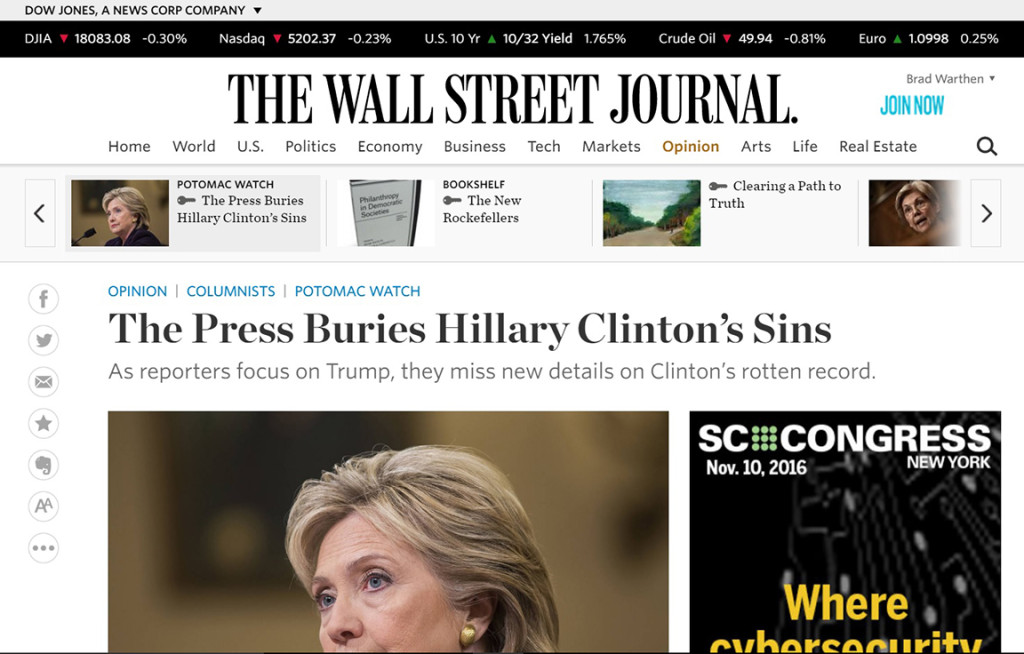
Joe Azar, via one of his regular mass emails, brings my attention to this impossible, self-negating headline in The Wall Street Journal:

The Press Buries Hillary Clinton’s Sins

So, somebody please ‘splain to me: If it’s in The Wall Street Journal, how could the press be burying it?

I understand when some loudmouth barfly spouts something like this. As bizarre as it is, I’m getting used to having a major party presidential nominee spout such paranoia.

But it takes a lot of nerve, or cognitive disconnect, or something for a columnist at one of the most widely read newspapers in the country to say something, and say “the press” is burying it. At least they could have added a parenthetical “(until now)” to give it a patina of plausibility…

The NYT, perhaps unsurprisingly, has a lawyer who can WRITE

McCraw

McCraw

You’ve got to read the letter that David E. McCraw, a lawyer for The New York Times, wrote in response to a letter from an attorney for Donald Trump asking the paper to retract an article that featured two women accusing Mr. Trump of touching them inappropriately years ago, and issue an apology.

No, really, you should read it. It’s not the usual legalese that gives you a headache before you get through the first sentence. It’s pretty awesome. It tells home truths, lays down a challenge and dares ’em to come on.

Click here to see the original document. Here’s the full text:

October 13, 2016

VIA ELECTRONIC DELIVERY

Marc E. Kasowitz, Esq.
Kasowitz, Benson, Torres & Friedman LLP
1633 Broadway
New York, NY 10019-6799

Re: Demand for Retraction

Dear Mr. Kasowitz:

I write in response to your letter of October 12, 2016 to Dean Baquet concerning your client Donald Trump, the Republican Party nominee for President of the United States. You write concerning our article “Two Women Say Donald Trump Touched Them Inappropriately” and label the article as “libel per se.” You ask that we “remove it from [our] website, and issue a full and immediate retraction and apology.” We decline to do so.

The essence of a libel claim, of course, is the protection of one’s reputation. Mr. Trump has bragged about his non-consensual sexual touching of women. He has bragged about intruding on beauty pageant contestants in their dressing rooms. He acquiesced to a radio host’s request to discuss Mr. Trump’s own daughter as a “piece of ass.” Multiple women not mentioned in our article have publicly come forward to report on Mr. Trump’s unwanted advances. Nothing in our article has had the slightest effect on the reputation that Mr. Trump, through his own words and actions, has already created for himself.

But there is a larger and much more important point here. The women quoted in our story spoke out on an issue of national importance – indeed, an issue that Mr. Trump himself discussed with the whole nation watching during Sunday night’s presidential debate. Our reporters diligently worked to confirm the women’s accounts. They provided readers with Mr. Trump’s response, including his forceful denial of the women’s reports. It would have been a disservice not just to our readers but to democracy itself to silence their voices. We did what the law allows: We published newsworthy information about a subject of deep public concern. If Mr. Trump disagrees, if he believes that American citizens had no right to hear what these women had to say and that the law of this country forces us and those who would dare to criticize him to stand silent or be punished, we welcome the opportunity to have a court set him straight.

Sincerely,
David E. McCraw

Well said, sir.

Could we go ahead and adjudicate this now?

A quick trip through the alternate reality that dittoheads mistake for the real thing

Yesterday, I hit the “source” button on my car stereo to switch from Elvis Costello’s “Green Shirt” back to FM, but only hit it once instead of twice, so it first stopped on AM — which I never listen to.

And there was Rush Limbaugh, whose voice I hadn’t heard since Robert Ariail used to play the show in the background while drawing his cartoons. And I decided to pause there, and listen.

This afforded me a glimpse into the alternative reality inhabited by Donald Trump and his supporters.

First, Limbaugh told about the early days of his career when he was first gaining notoriety, and he was so innocent as to think media people were honestly interested in learning about him — before he “wised up” and learned the truth (in the Trumpian sense of “truth”), which was that they all had an agenda and were out to get him.

He spoke of something that commonly happens in interviews — he would say something, then immediately realize that that wasn’t exactly what he meant, and ask to be allowed to rephrase it. At which point, he says, the reporter would say No way: This is what you said, and I’m not going to let you edit the story to suit you.

Yep, that happens. There are reporters who think journalism is some sort of contest conducted under rigid rules that are not subject to personal judgment, and one must never put the source in the driver’s seat, allowing him to control what goes into the paper. That’s collusion.

And they have a point, to some extent. For instance, I would not have allowed Richland County Sheriff Allen Sloan to “take back” what he said to one of The State‘s reporters in that infamous 1989 interview about crime at Columbia Mall. That was a situation of a public figure saying something that was shockingly revealing of his character (even if it was a very bad joke, it was revealing), and not to be papered over.

But in an everyday interview with someone who sincerely edits himself by saying, “That’s not exactly what I meant,” of course I allow him to rephrase it any way he wants. You know why? Because I want to know what he really thinks. It’s not rocket science. And a reporter with half a brain should be able to tell the difference between a source sincerely trying to express himself better and someone trying to manipulate. But you have to use judgment. It’s not black and white.

Anyway, back to Limbaugh. So he had some bad experiences with reporters who probably didn’t trust him any more than he did them — or any more than he does now, since he says he hadn’t wised up yet in those days.

Rush’s point in telling that story was to set up the Wikileaks “revelation” that New York Times Magazine‘s Mark Leibovich emailed a Hillary Clinton staffer to get permission to use some quotes from an interview with the former secretary of state.

Or, as Breitbart would have it (since I was driving and not writing down what Rush said):

The New York Times allowed the Clinton Campaign to pick and choose what parts of an interview with Hillary Rodham Clinton would be used in an article titled, “Re-Re-Re-Reintroducing Hillary Clinton,” the Wikileaks release of Clinton campaign chairman John Podesta’s emails have revealed.

The Clinton campaign vetoed nearly the entire interview, but even in the portions they did approve for publication, they had Mark Leibovich edit out a mention of Sarah Palin, apparently at Hillary’s personal request.

“My apologies for the delay. I finally had to get her in person,” Clinton Campaign Communication Director Jennifer Palmieri replies to Leibovich, implying that she had to wait to talk to Hillary about what parts of the interview they would allow being used. “Fine to use the moose, but appreciate leaving the mention of Sarah Palin out.”…

The email exchange (Wikileaks Podesta Email 4213) between Palmieri and New York Times writer Mark Leibovich was forwarded to John Podesta by Palmieri in July 2015. Leibovich sends a transcript from the portions of his interview with Hillary that he would like to use saying, “I wanted option to use the following (obviously wouldn’t use all, but a portion) *These exchanges were pretty interesting…..would love the option to use….*”…

After dishing out the marching orders, Palmieri finishes by telling Leibovich, “Pleasure doing business.”…

That’s pretty much the way Rush told it, with emphasis on the “Pleasure doing business” part. The alt-right seems to think that was particularly telling.

And in the Trumpkin universe, I’m sure it was. In that world, this was a huge “gotcha.” It was proof positive that the media are in bed with the Democrats!

But in the universe I live in — the universe where people know how these things actually work — I’m thinking, Well, obviously that conversation — or that part of it, anyway — was off the record. And Leibovich, being a good journalist, was pushing to get the source to go on the record with some of it.

And yep, that’s what was going on, according to Politico:

In a midsummer 2015 exchange, Leibovich wrote to campaign communications director Jennifer Palmieri, asking that certain pieces of his New Hampshire interview with Clinton be made “on the record,” for use in his July article (“Re-Re-Re-Reintroducing Hillary Clinton”)….

I hardly need mention this, but during the time I was listening, Limbaugh never said, “off the record.”

Breitbart does make some confusing references to on-and-off-the-record, but not in a way that makes it clear that this completely exonerates the writer from any sort of unethical collusion.

In fact, it shows that he was trying to get even off-the-record material onto the record, which was the point of the emails. But folks, if you’ve allowed a source to go off-the-record on something (which you have to ask for BEFORE saying something, not after), then that’s it. The source is in the driver’s seat on that material. You cannot ethically use it without the source agreeing to put it on the record.
Leibovich

Leibovich

Condemn Leibovich for going off-the-record in the first place if you’re so inclined, but I won’t — along with letting sources rephrase what they’ve said, going off the record is one of the best tools for learning what a source is really thinking. Maybe you can’t use the actual words, but that knowledge can help you to better interpret and prioritize the stuff that is on the record, and more accurately represent what’s going on.

Just as there are reporters who won’t let you rephrase, there are those who are philosophically opposed to letting anyone go off the record, ever. But I’m too curious to be one of them. I don’t just want to know what the person is willing to say for print. I want to know everything that person knows. And while going off the record may not tell me everything — and in the hands of a wily source, it can be as much a device for deception as the carefully crafted public remark — it will tell me more than I otherwise would have known. Even if it’s just what the source wants me to think he or she thinks, that in itself tells me something…

Of course, all of this would be lost on most dittoheads. Even if Limbaugh had explained about it being off the record, he probably would have said the words in a way that dripped with sarcasm, portraying “off-the-record” as another one of the tricks those shifty media types use in trying to pull the wool over the eyes of honest, hard-working, angry white men…

Or not. Since I didn’t hear the whole rant, I could have missed the part where he backed off and decided to be fair to Leibovich. In which case, good for you, Rush…

On ‘truthiness’ and the 2016 election

pilate-cropped

What is truth?” asked Pilate, and washed his hands. Sometimes I ask the same question, because it’s not always as simple as people like to think it is. At least, not in politics. (As a Catholic, I accept that the One of whom Pilate asked the question did trade in actual Truth.)

I had the chance to explore that a bit over at WACH-Fox studios this morning. Cynthia Hardy asked me to participate in a discussion of truth, lies and the current presidential election for the weekly TV version of her OnPoint show. Catch the show on WACH Sunday morning at 8:30. (Hey, you can DVR it, can’t you?)

At this point, I don’t recall precisely what was said during the taped segments, because we were talking about all this before and after the taping, and during breaks. But here are some of the points I made at some time or other while I was there:

  • Someone raised the question of why, with so many of his statements being easily proved to be false, Donald Trump’s followers still accept, and even cheer, them. I mentioned the point, made here so often before, that even though most of us once accepted Daniel Patrick Moynihan’s dictum that “Everyone is entitled to his own opinion, but not his own facts,” people today believe they are entitled to the “facts” they prefer, and gravitate toward those who offer them such.
  • Continuing on that point, I said we should think in terms of the Stephen Colbert concept of “truthiness.” Trump regularly says things that are wildly untrue, but his supporters eat it up because his claims strike them as “truthy.” It’s what they want to be true, and they appreciate him for saying it is, and never backing down on the point.
  • I tend to look askance at all these people who propose to do “fact-checking” in real time. First, even if one can determine incontrovertibly whether a statement is true or not, getting the job done frequently takes a lot of time. Not all facts can be instantly Googled. And sometimes — quite frequently — there is no pat answer. Some things are demonstrably untrue — for instance, we are spending tens of billions updating our nuclear arsenal, in direct contradiction of something Trump said in the debate Monday night. On the other hand, some assertions are more slippery, more matters of opinion. For instance, the NYT tried to “fact-check” Mrs. Clinton’s assertion that the U.S. needs an “intelligence surge” to stop homegrown terrorists before they act. The Times said we already collect and share more intel than ever. Perhaps so, but if something happens because we didn’t know something that might have enabled us to prevent it, how can one say we had enough intel? That said, there is the eternal debate over how much we need to protect people from snooping. Since Snowden, we’ve unfortunately erred in the wrong direction on that, but striking a balance will always be difficult. Bottom line, I can give you a pretty good answer to whether what she said was true if you give me 1,000 words or so to do it. Anything less and I’m shortchanging you. But be forewarned that the answer will contain a lot of my own opinion. Why? Because it’s that kind of question.
  • Elaborating on that: People who think it’s easy to separate fact from opinion should try editing editorial pages for a couple of months. The challenge is this: You’re publishing a lot of stuff written by nonprofessionals with strong opinions — letters to the editor and their big brothers, guest columns. If you’re me, you’ll have a rule against letting people make assertions of fact that are false in the course of expressing their opinions. Frequently, in the proofreading process, one of the editors — some of the top, most experienced journalists in South Carolina, when I was doing it at The State — would cross out something in a letter or oped because it was false. But then a terrific argument would ensue as we editors disagreed over whether that point was a matter of fact, or of opinion. In the latter case, we’d allow the writer to say it. These matters were never easily settled, because if you’re intellectually honest and doing your best to be fair to people and not dismissive of their views, it’s complicated.
  • It’s seldom black and white. Even lies have gradations. That’s why The Washington Post‘s pinocchio_1respected Fact Checker feature has levels. A “lie” can earn one, two, three or four “Pinocchios,” with four denoting something that is completely false. Then there is the rare “Geppetto Checkmark” for things found to be completely true. And these judgments are subjective. I forget the “fact” in question, but a couple of months ago, they gave Donald Trump four Pinocchios for something that, having read their findings, I thought should only have earned him two or three. (Of course, even if they had amended that would, Trump would still be the all-time record-holder for four-Pinocchio statements.)

I could go on and on, but there’s real work to be done. I’ll check back in and see what y’all think…

‘There is no such thing’ as ‘the media’

media

Long ago, when my friend and colleague Warren Bolton and I were both still in The State‘s newsroom, before moving to editorial — we’re talking maybe early ’90s — Warren helped lead some newsroom discussions on race.

The idea was help us all do a better, more informed job writing about subjects bearing on that issue, or set of issues, in South Carolina.

One thing I remember in particular was a meeting in which Warren and another African-American colleague urged us to avoid the habit of referring carelessly to “the black community,” as though it were some monolithic, coherent entity that thought and acted in unison, like a colonial animal.

I took that to heart because it made a lot of sense to me, and ever since I’ve hesitated to use that construction, as well as similar ones such as “LGBT community,” “Hispanic community,” and what have you. After all, we don’t write of, say, women as “the female community,” because most of us recognize women as a set of individuals containing too much diversity for such a generalization. We should follow suit with other broadly defined groups.

(Of course, it in part appealed to me because we in the white heterosexual male community are well known to prefer to deal with people as individuals rather than in terms of aggregations, something which sometimes causes members of other “communities” to counsel us to “check our privilege” and stop trying to destroy other groups’ sense of solidarity so that we may oppress them individually. Which we, both communally and individually, tend to find maddening. Smiley face.)

I am reminded of all this because of this piece in The Washington Post urging the great unwashed out there to stop referring to “the media” as though they were a single, coherent thing with one mind, acting in unison. An excerpt:

Please stop calling us “the media.”

Yes, in some sense, we are the media. But not in the blunt way you use the phrase. It’s so imprecise and generic that it has lost any meaning. It’s — how would you put this? — lazy and unfair.

As I understand your use of this term, “the media” is essentially shorthand for anything you read, saw or heard today that you disagreed with or didn’t like. At any given moment, “the media” is biased against your candidate, your issue, your very way of life.

But, you know, the media isn’t really doing that. Some article, some news report, some guy spouting off on a CNN panel or at CrankyCrackpot.com might be. But none of those things singularly are really the media.

Fact is, there really is no such thing as “the media.” It’s an invention, a tool, an all-purpose smear by people who can’t be bothered to make distinctions….

This piece, by the way, was not written by “the media,” or even by The Washington Post. It was written by this guy named Paul Farhi who is one of many individuals who works at the Post. If you want to be properly pedantic about it (and who wouldn’t want to be that?), you would only say that “The Washington Post said” something if it was said in an editorial — an editorial being an unsigned piece by the Post‘s editorial board, not something written by an op-ed columnist or someone else whose byline appears on the piece.

Yeah, I know — confusing. But to keep it simple, you’ll sound a lot smarter if you don’t refer sweepingly to “the media” as doing or saying or thinking this or that.

And we in the media community (which includes the vast army of us who no longer have actual media jobs, and a more cantankerous crowd you are unlikely to find) will appreciate it….

Should SCETV air congressional debates?

I hadn’t really focused on this until I got the release from the state Democratic Party complaining about it:

Dear Brad,
Earlier this week, SCETV announced they do not plan to televise any 2016 general election debates because they do not view the races to be “highly competitive.”  We are circulating a petition asking them to reconsider this misguided decision; clickhere to add your name.
It is regrettable that SCETV has apparently decided to focus on political punditry rather than informing the public about the choices facing voters this November.
What’s more, their political punditry is woefully off the mark.  A recent poll conducted by the Feldman Group found that 37% of South Carolina voters are more likely to vote for a Republican for Congress, while 34% are more likely to vote for a Democrat.  For the state legislature, 36% of South Carolina voters are more likely to vote for a Republican, compared to 33% for a Democrat.  Both of these results arewithin the poll’s margin of error of +/- 4%.  And while Republicans did their best to rig the districts through undemocratic gerrymandering, the poll found that in the 1st Congressional District, voters’ preferences are evenly split, and in the 5th Congressional District, voters favor a Democrat by a 5-point margin.  These results are the definition of ‘highly competitive.’
Moreover, SCETV is assessing the competitiveness of these races more than two months before Election Day, when few voters have tuned in to down-ballot races.  Denying voters the opportunity to directly compare candidates because SCETV thinks voters favor the better-known incumbents is putting the cart before the horse.  This sort of amateur political punditry is unbecoming of an institution like SCETV with such a stellar track record of enriching our democracy.  Sign the petition asking SCETV to draw upon their public interest roots and reverse this decision.
In addition, SCETV will be holding a public meeting on September 13 at 11:00 amat 1041 George Rogers Blvd. in Columbia.  Join us there as we ask SCETV to do what’s right for our democracy.  With the support of thousands of South Carolinians like you signing the petition, we can give South Carolina voters a chance to make more fully informed decisions in November.  The stakes are too high for anything less.
Sincerely,
Jaime Harrison
SCDP Chair

I wasn’t entirely clear on what the specific issue was here, so I wrote to Jaime Harrison to get clarification. Was he talking about congressional debates here, or what? The way this read, ETV could be refusing to carry presidential debates, but I didn’t think that was what this was about. And there are no statewide elections for state offices this year…

And was he saying ETV should stage debates, or merely televise (“televise” is the word the release used) debates that others are staging?

He replied:

Hi Brad!  So traditionally ETV has staged/televised debates between candidates.  They recently had such a debate between Republican primary candidates Horne and Sanford.  They also held several debates in the 2014 cycle.
In this situation, Wilson and Bjorn have agreed to have a debate.  The Bjorn campaign approached SCETV as did the SCDP.  We were told that they had decided not to stage/televise any debates this cycle.  It is one thing if this was a budgetary decision, but the quote in the paper made it seem as if it was an editorial one based on competitiveness.
Jaime

I think what he’s referring to there is this, from The State:

South Carolina’s public broadcasting network will not televise debates between S.C. candidates ahead of the Nov. 8 general election.

SCETV made the editorial decision Monday – not long after receiving a request to televise a planned 2nd District debate between U.S. Rep. Joe Wilson, R-Springdale, and Columbia librarian Arik Bjorn.

“The main thing is our own resources and our staffing,” said Tom Posey, SCETV’s director of news and public affairs. He added the decision might have been different if the state had a series of “highly competitive” general election races….

I can see ETV’s point: The way our congressional districts are gerrymandered, we do pretty much have foregone conclusions in the general election. Joe Wilson has little to sweat about, to say the least. Pretending, even for the space of an hour’s debate, that this is an actual contest can have a certain Theater of the Absurd quality.

But on the other hand, should our public TV network just acquiesce in the way the Republican Party has taken control of our elections? Should the only debates it airs be between conservative incumbents and the primary challengers who keep pulling them farther and farther to the right? (OK, admittedly, the Horne-Sanford contest was an exception to that pattern, but that’s usually what Republican primaries are about.)

Should no other views get a hearing on ETV?

I appreciate ETV wanting to be careful with its resources. But saying “That’s just the way things are” to the ugly reality that gerrymandering gives us doesn’t seem right at all to me. It’s either naive — based in a lack of understanding of the way our lawmakers stack the deck — or it’s really cynical.

It’s one thing if the free marketplace of ideas has produced a race with a popular incumbent and a super-weak candidate who has no support. I could see not wasting money on that. I’ve spent a career using the brain God gave me to decide which races are worth spending finite resources on. (The political parties do the same thing, by the way.) But this isn’t a free-market thing. Elections this lopsided don’t just happen. You know how Bernie Sanders and Donald Trump and other paranoids are always going on about how the system is rigged? Well, in this case, it actually is. And our media — especially our public media — ought to be confronting that fact, not shrugging at it.

The Dems’ interest in having ETV give their guy a boost is plain, but they do have a point on this one. Their guy is going to get creamed not because he’s such an awful candidate, but because the Republicans in our Legislature have done their best to put as many of the state’s black voters they can into Jim Clyburn’s one district, making all six other districts unnaturally white, which in SC translates to Republican.

What do y’all think?

What newsrooms used to look like, long, long ago

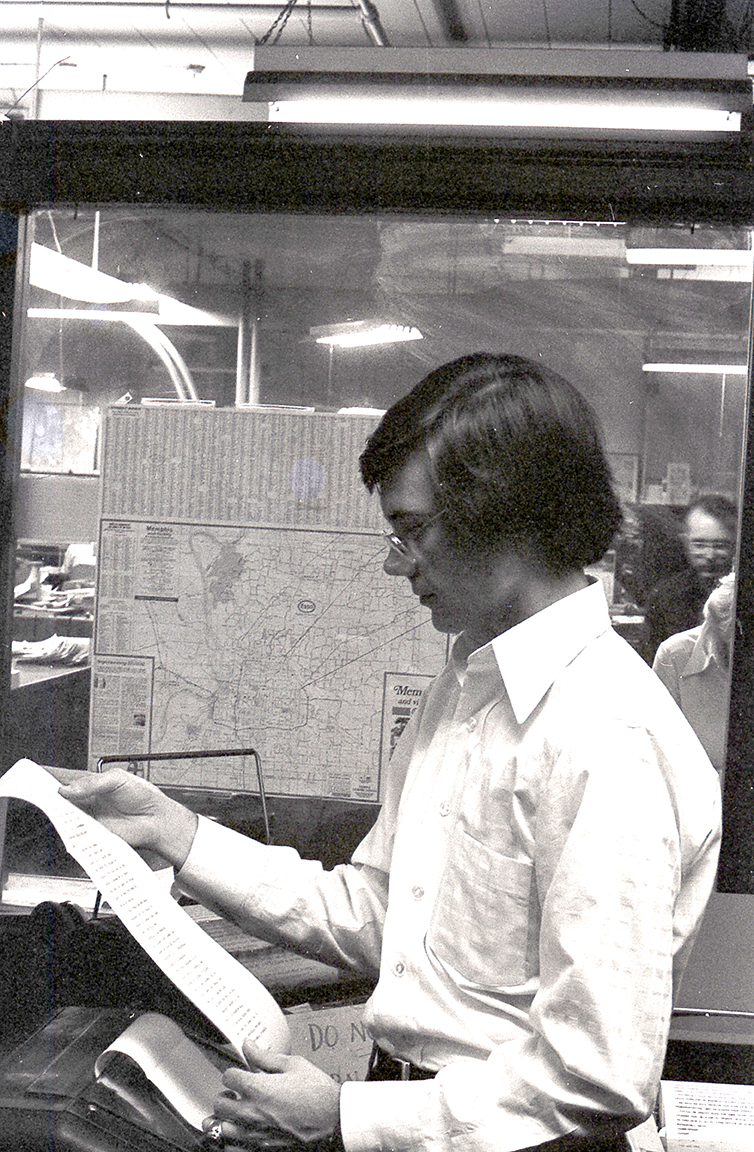
The sardonic Managing Editor Bill Sorrels presides at his desk in the middle of the newsroom (he had an office somewhere, too). You see Dave Hampton running somewhere in the background. Note the decor.

The sardonic Managing Editor Bill Sorrels presides at his desk in the middle of the newsroom (he had an office somewhere, too). He’s apparently reading one of the proofs I fetched. You see Dave Hampton striding in a blur across the room in the background. Note the go-to-hell decor — the unmatched linoleum, the rivers of proofs tumbling from spikes on the Metro Desk behind the M.E….

Having just wrestled with the new definitions of an old word, “reporter,” here are some images from the very start of my newspaper career, so very long ago. When reporters were reporters.

After I dug out those pictures from 1978 to go with this post, I started poring through some old negatives, thinking yet again about digitizing them (and again overwhelmed at the enormity of the task), when I ran across something I had forgotten existed.

Apparently, I took my camera to the paper one night during those several months I worked at my first newspaper job, back in 1974. I was a “copy clerk” at The Commercial Appeal in the spring and summer of that year, while a student at Memphis State University. That means I was a “copy boy,” with the title adjusted for the political correctness that was coming into fashion at the time (but which for the most part did not touch this newsroom). And indeed, we did briefly have one girl join us boys standing at the rail, ready to jump when someone called “copy.”

wire machines

Copy Clerk David Hampton, later longtime editorial page editor of The Jackson Clarion-Ledger, in the wire room.

We were among the last copy boys in the country, since new technology was doing away with the need for someone to run around doing the stuff we did. Which meant reporters no longer had anyone to lord it over.

I just found these three exposures, found on one short strip of 35 mm film in a glassine envelope. I don’t know whether I took more, or where the rest of the roll is.

Anyway, I appeared to be documenting what I did at the paper by taking pictures of my friend and fellow copy clerk David Hampton doing the same tasks I did every night.

You can see Dave hurrying across the newsroom on an errand in the background of the photo at top, which shows one corner of the newsroom from the perspective of the managing editor’s desk. This part of the room is mostly deserted, with a reporter casually conversing with an assistant editor over on the Metro desk. This is 7:15 p.m., shortly after most of the day side people have left. The place would have been bustling about an hour earlier. Dave and I would be running for the next six or seven hours. (I wish I’d gotten a shot of the whole newsroom when it was full of people — but I probably would have been yelled at. That would not have been a novel experience, but I preferred to avoid it.)

In the foreground of the photo is the late Bill Sorrels, the managing editor, with a characteristic smirk on his face. I had him for a reporting class at Memphis State. His “teaching” technique consisted of telling stories from his reporting days, and stopping in mid-story to go around the room asking everyone, “So what did I do next?” and smirking when they got it wrong.

Bill would look over the galley proofs I brought him with that same expression, and then call out embarrassing critical remarks to reporters and editors about the mistakes they had made. (This was the kind of old-school place where grown men were chewed out and ground into the floor in front of everybody by their bosses.) The only actual work I ever remember seeing him do was on Aug. 9, 1974. He called me over and gave me a piece of paper on which he had scrawled, “Nixon Resigns.” He told me to take it to composing (on the next floor) and have it typeset in our biggest headline type (probably about 96 points), then have them shoot a picture of that and blow it up until it went all the way across the front page — then bring it to him to approve before they set it in metal and put it on the page. Probably the most “historic” thing I did in that job.

Above and at right, you see Dave in the wire room checking one of the 10 or 12 machines there that chugged out news from across the world non-stop — back in the days when ordinary people didn’t have access to such via Twitter, etc. We were the nursemaids to those machines, making sure the paper and ribbons never ran out, that they didn’t jam, and that the stories were ripped off the machines and taken to the editors who needed to see them.

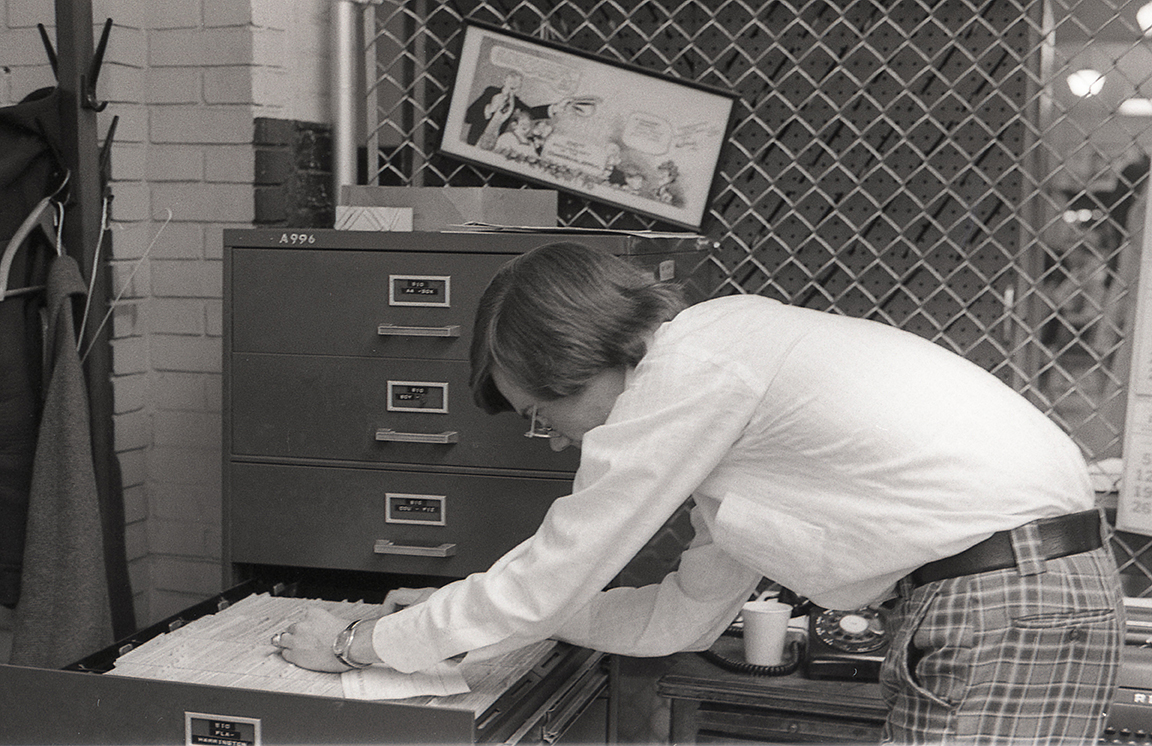
Below, Dave is in the “morgue,” in later more polite times known as the “library,” where he’s been sent to fetch something, probably a photo, that someone needs to go with a story they’re working on. Given the size of the envelopes, these are probably mug shots, or maybe metal “cuts” that were already made to run in the paper previously. We saved those, when they were of repeat newsmakers, to save time and metal. They were uniformly 6 ems (picas) in width.

Another world. I never again worked in such an old-school environment. This was the old Commercial Appeal building, torn down decades ago. The long-defunct Memphis Press Scimitar was up on the fifth floor, if I recall correctly. Most news copy was still written, edited and processed in the old way — typed on manual typewriters, the pages strung together with rubber cement, edited with pencil, and set in metal type by noisy linotype machines up in the composing room. Once the type was set for each story, individual proofs would be pulled of each story, before they were placed on the “turtle” that held the full page — which we would run down to the newsroom. There was a lot of running back and forth.

This place was already an anachronism; it would have been completely recognizable to Ben Hecht’s characters in “The Front Page” It was what the makers of “Teacher’s Pet,” which I saw on Netflix the other night, were going for in the newsroom scenes. (Nick Adams played the copy boy in that film, itching for his shot at becoming a reporter. He was excited to get to write some obits one night. For us, the transitional job was to be the copy clerk who did the “agate” — rounding up police blotter, marriages and divorces, property transfers and other routine list-type copy and typing it up to go into the paper. I got to do that once, when another guy was out, and felt I had taken a huge step up.)

But new technology was creeping in. The non-news departments wrote on IBM Selectrics, and their copy was scanned and set in cold type, and pasted up on paper pages. And maybe some of the news copy as well — I see a Selectric behind Sorrels on the Metro desk. And a couple more on the rim of the copy desk at right.

It was also a crude, rough place that was about as non-PC as anyplace you could find in the ’70s. It’s ironic that they called us “copy clerks” instead of “boys,” because there were few other concessions to modern sensibilities. Culturally, every other newsroom I ever worked in was as removed from this one as though a couple of generations had passed. Although it was 1974, this newsroom would have been more at home in the first half of the century. It was… Runyonesque.

In the following decades, I didn’t miss this place, and was happy to work in a more civil environment. But I’m glad to have had this throwback experience; it gives me something to feel nostalgic about when I watch those old movies made before I was born. Yes, I say, it was just like that — those few months at the Commercial Appeal, anyway….

Dave, fetching a "cut" from the morgue.

Dave, fetching a “cut” from the morgue.

We’ve come to this — a ‘reporter’ delivering an editorial

There’s nothing special about this example I’m sharing with you. It’s just a fairly clear-cut one of the blurring of news and editorial functions in the New Normal.

In today’s Open Thread, I shared this item about where we stand 20 years after the End of Welfare as We Knew It.

Later, I glanced at the above video that appeared on the same page with it.

Most of the way through it, I didn’t think much of it until the very end, when the young woman on camera says, “I’m Emily Badger, reporter for Wonkblog.”

Did she really just say “reporter?” I ask because if you take every word she just said and put it on an opinion page, you have an editorial. Or an op-ed column, but it was largely spoken in the truth-from-above, ex cathedra tones of an editorial. Only by an engaging young woman, rather than some gray, disembodied, royal “we.”

Which I expect from a blog. I mean, really, how many blogs do you go to for straight news? And as I say over and over to any who remain confused, this is an opinion blog. I don’t have the resources — reporters, and editors to guide and read behind them — to publish a news blog. All I can do here is comment on the information provided to us by organizations that still do have such resources. (Sure, there are exceptions — I occasionally attend some news event and share what I saw and heard — but generally I’m not set up to inform so much as to engage with information obtained elsewhere.

And I certainly don’t call myself a reporter. I haven’t been a reporter since the spring of 1980.

That’s what grabbed me — her title.

I have no problem with blogs offering opinion. That would indeed be the height of hypocrisy

But it’s an adjustment for me seeing and hearing it coming from a “reporter.”

Reporters who unapologetically spout editorials. O brave new world, That has such people in ’t!

Badger

Is this whole campaign just a business move for Trump?

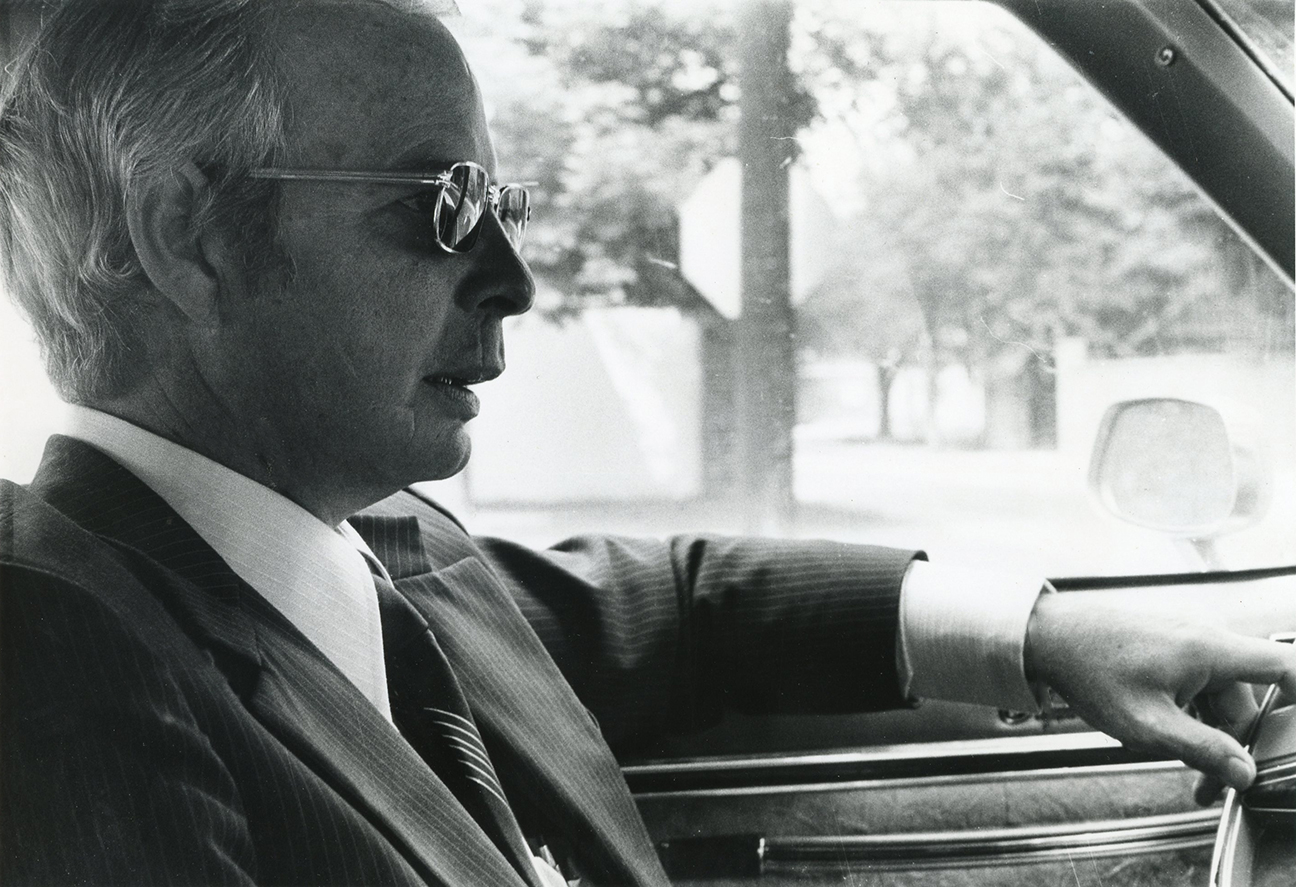
Roger Murray at the wheel in 1978. As the compleat journalist, I did my own photography.

Roger Murray at the wheel in 1978. As the complete journalist, I did my own photography, of course.

When I was a young and inexperienced reporter at The Jackson Sun in 1978, I spent a few days covering Roger Murray, who was seeking the Democratic nomination for governor of Tennessee.

It was an immersive experience, one that would seem quite alien to reporters today. I went on the road with him for several days as he traveled across Middle and East Tennessee. (For those of you not familiar, we speak of the Three Great States of Tennessee, and Jackson was located in the middle of West Tennessee.) And when I say “on the road,” I mean something more reminiscent of Kerouac than a typical political campaign.

I rode with the candidate himself, who drove his own car. I was on my own for finding places to spend the night, which wasn’t easy in some of those small towns. One night, I nearly had to double up with the woman from The Commercial Appeal who had joined us in the car for part of the trip. At least, she offered — in a matter-of-fact, platonic way. I must have looked particularly lost. But I managed to get a room of my own.

When on the road like that, I’d write out my story each night for the next day’s paper in my notebook, call it in and dictate it first thing in the morning (it was an afternoon paper), and call in updates and new ledes — from pay phones, of course — before each of the two editions. At one point on this trip, Roger asked if he could read what I’d written for that day (in those days before the web, children, he wouldn’t see the paper until we got home days later), so I handed him my notebook. He read it while driving down a two-lane highway, which I’ll have to tell you was a bit unnerving.

But Roger was like that. He was a bustling, charge-ahead, multitasking kind of guy who operated on full speed whether he was legislating in Nashville or running his business — a private security company — back in Jackson. He had made something of a name for himself chairing hearings looking into the shady doings of Gov. Ray Blanton, and he was trying to parlay that into a shot at the governor’s office.

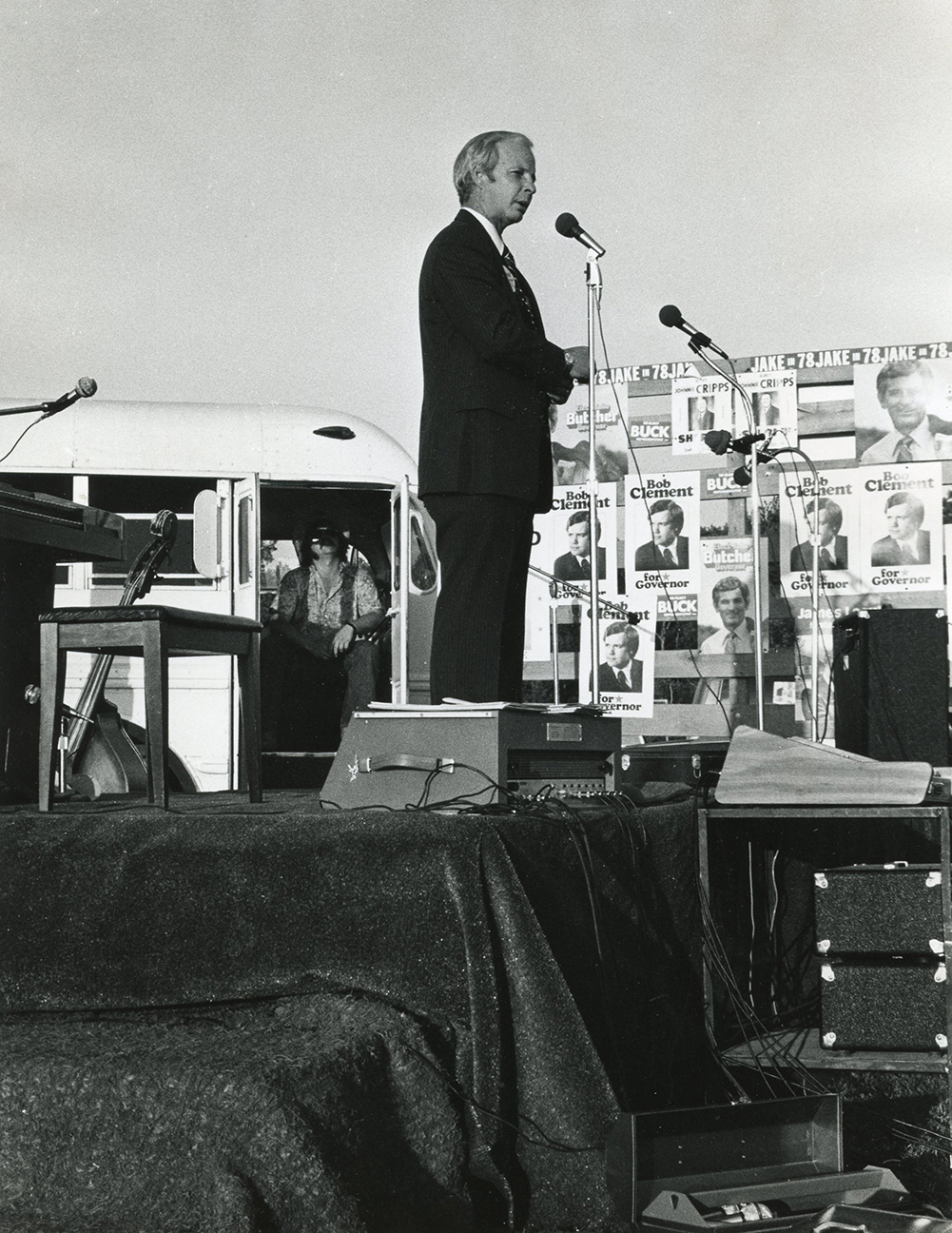
Speaking at a Democratic rally somewhere east of Nashville. I think this was the rally at which I first met Al Gore. Note all the Butcher and Clement posters.

Speaking at a Democratic rally somewhere east of Nashville. I think this was the rally at which I first met Al Gore. Note all the Butcher and Clement posters.

And inside the bubble — going everywhere he went, seeing everyone he saw — it felt like it was working. There had just been a televised with the other four or five candidates running, and everywhere we went — Democratic party rallies, factory shift changes, talking to loafers sitting on benches around a sleepy small-town courthouse — people said he had been the one who made the most sense. Which made me think that meant they were going to vote for him. But I should have listened to the few who said, “You made the most sense, but I’m going to vote for Jake Butcher or Bob Clement.”

I dismissed those who said things like that, because what they were saying was irrational. But they were the ones telling the truth. I did not yet understand two things about politics: One, voters don’t necessarily vote rationally. Two, the bandwagon effect: Clement and Butcher were seen as the two front-runners, and some people were going to vote for them simply for that reason.

I forget how much of the vote Roger got in the primary, but he came in well behind Clement and Butcher. (Butcher won the nomination, and went on to lose the election to Lamar Alexander.)

I found it shocking. Caught up in the bubble of my first gubernatorial campaign, I had thought he made the most sense, too. That was his slogan, by the way: Murray Makes Sense

Yeah, I know. I’m digressing all over the place. But I’m coming to the point.

A few days after this foray onto the campaign trail, we were visiting my in-laws in Memphis and I was telling them about my adventures on the hustings. My father-in-law, who had a more realistic impression of Murray’s chances than I did, offered the opinion that Murray was just running to raise his profile for the good of his business.

I found that a shocking idea. It seemed dishonest to me, and I didn’t see Roger as a dishonest guy. To my father-in-law, it just made sense. He, too, was a businessman. In retrospect, I’ve had occasion to think he may have been right. Roger was older and more experienced than I (which didn’t take much), and I’m sure had a much more realistic idea of his chances than I did. And whether he intended it or not, the campaign did raise his profile a bit, and may have helped his business. If I remember correctly, not all that long after, he left public office.

Which brings me to my point.

Friday morning, I heard a segment on The Takeaway suggesting that maybe Donald Trump’s whole candidacy has been a business move — something that would not shock me nearly as much as what my father-in-law said about Roger Murray, back when I was so much younger and more naive:

It’s no secret that Donald Trump is in a tough spot heading towards the November general election. Projections from FiveThirtyEight and our partners at The New York Times have former Secretary of State Hillary Clinton commanding a serious lead over the Republican presidential candidate.

So when Trump recruited Stephen Bannon of Breitbart News Network, the conservative alt-right website, as his chief campaign executive this week, it was a perplexing strategy. If you’re failing to attract mainstream voters, why further align yourself with the margins of the right wing?

Sarah Ellison, a contributing editor at Vanity Fair and author of “War at the Wall Street Journal,” suggests that Trump — understanding that a loss in November is imminent — has ulterior motives post-election: To create his own conservative media empire.

This I could believe, especially with Trump. It would explain a lot — such as his running like a guy who wants to make a big splash (to build the brand), then lose.

If, of course, all that trying-to-lose stuff wasn’t a fake.

Thoughts?

court square

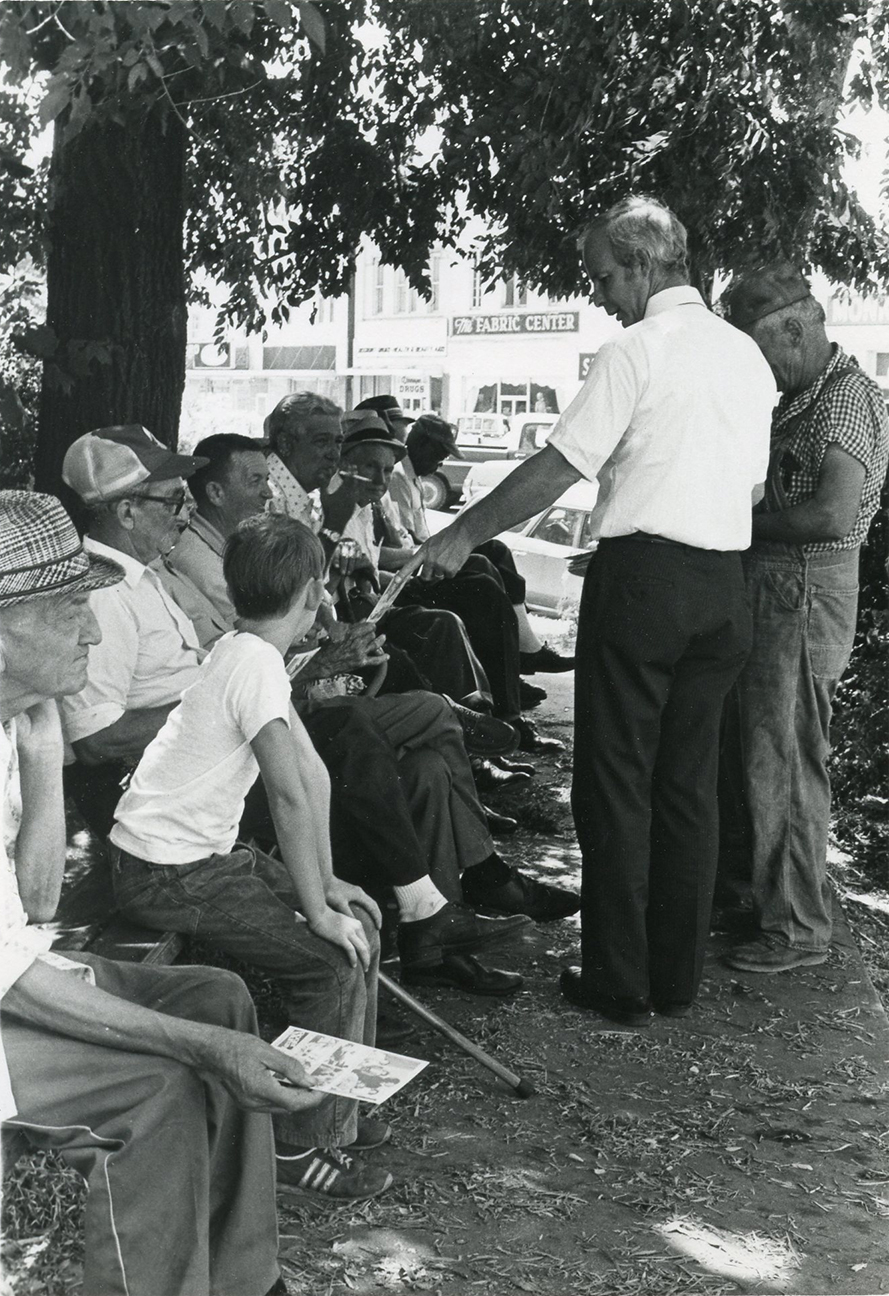
A classic old-school campaign shot: Murray works the courthouse square in a small town in Middle Tennessee, greeting the loafers — that classic Southern stereotype — and handing out leaflets.

The editor just wanted to place things in, um, perspective :)

cokie

My own editor’s note: Yeah, I know now that HuffPost puts this note on ALL stories about Trump. So OK — let’s talk about that

This gave me a good laugh this morning…

Frequently, out of a sense of obligation to the reader, an editor feels the need to write a brief note clarifying a point raised in something being published.

But I don’t think I’ve ever seen this before…

Check out this HuffPost piece about some critical things Cokie Roberts has said about Republicans who see Trump as a racist, but support him anyway.

It’s a fairly straightforward bit of reporting. Depending on your tendencies, you might say “You go, girl!,” or you might think she’s gone too far. The item notes that she may have gone too far for NPR’s sensibilities a few months back:

Roberts has been a fierce critic of Trump. In March NPR had to clarify her commentator role after she co-wrote a column asking “the rational wing” of the Republican Party to stop his march to the presidential nomination….

But that’s not the good bit. The good bit is that, after all that straining to be fair and give you all the info, someone at HuffPost felt compelled, for reasons that are unclear to me, to add this editor’s note at the end:

Editor’s note: Donald Trump regularly incites political violence and is a serial liar, rampant xenophobe, racist, misogynist and birther who has repeatedly pledged to ban all Muslims — 1.6 billion members of an entire religion — from entering the U.S.

Just in case you wondered, dear reader.

I have no idea who did that. The organizational chart of HuffPost is a mystery to me (unlike on a newspaper’s editorial page, with the EPE’s name on the masthead). It’s so unique — so, um, idiosyncratic — that it would have been nice if this editor’s note had been signed. Because I’m certainly curious.

According to its nameplate, part of the HuffPost’s mission is to entertain. Well, they got the job done with this…

huff

John Oliver on the plight of newspapers

I had trouble finding time to watch this, and if we wait until I have time to comment on it, I’ll never get around to posting it. I have actual work to do.

So… I urge y’all to watch it, and comment, and I’ll jump in and join you later.

I’ll just say that the piece is well-done, and accurate. The truest thing Oliver says is when he indicates that no one has figured out a good way to pay for the journalism our society needs going forward (now that print advertising, which used to be like a license to print money, has essentially gone away). In other words, he says a lot of things I’ve said before, in a less entertaining matter. (My Brookings piece, for instance, wasn’t crafted for laughs.)

That’s the truth, and the tragedy. One can make fun of all the media executives who are trying various stupid strategies to keep going, but the indisputable fact is that no one has come up with the right approach yet…

Let’s be clear: That one’s not sexism; it’s football

Are you ready for some football-related news from the Olympics?

Are you ready for some football-related news from the Olympics?

Feminists have the things that drive them up the wall, and I have mine.

The Washington Post today had an interesting piece about how no matter what female athletes at the Olympics accomplish, media coverage has a tendency to focus more on what their husbands do. And there are some good examples so absurd as to cause you to laugh, cry, scream with rage or tear your hair out.

But I zeroed in on this one, because it hits me where I live (and on my blog, that’s what matters, right?):

In case you’re tempted to call that a fluke, let’s look at how the Chicago Tribune wrote about Corey Cogdell-Unrein, its hometown Olympic star:

“Wife of a Bears’ lineman wins a bronze medal today in Rio Olympics,”the newspaper tweeted Sunday.

Not even her name. Or her event. Or the fact that it was Cogdell-Unrein’s second Olympic medal in trap shooting, in her third Olympic Games. The most newsworthy part: She’s married to NFL lineman Mitch Unrein.

The Trib got called out on the sexism, and not just by angry women’s studies majors.

Peters and Justins and Scotts all over Twitter had a field day.

“In other news, husband of Olympic medalist Corey Cogdell can’t seem to win a Super Bowl,”tweeted cartoonist Scott Johnson.

“Bill Clinton Back in White House. Brings Wife,” tweeted another outraged man….

Yeah, OK, maybe all those other cases are blatant sexism. But this one? This is about the American obsession, which finds its most virulent expression in newspaper sports departments, with football.

Newspapers are so incredibly obsessed with football, particularly in our own part of the country, that they cover it year-round. And it’s not just the sports guy: the best chance a story has of moving from sports to the front, it often seems, is for it to have some sort of connection to football, however tenuous or indirect.

The sports journalists involved in that story weren’t picking on this woman or being mean to her. By their lights, she was lucky to get such great coverage, because they are incapable of seeing her as anything other than someone who has a connection to what matters, which is football. In their universe, she is either the wife of a prominent football player, or she doesn’t exist.

They were doing her, and the Olympics, a favor. They were trying to get their readers to care, by explaining her in terms of her connection to something important.

So go ahead and point out when something is sexist. But know when something is not. And this particular absurdity was not. This one was football.

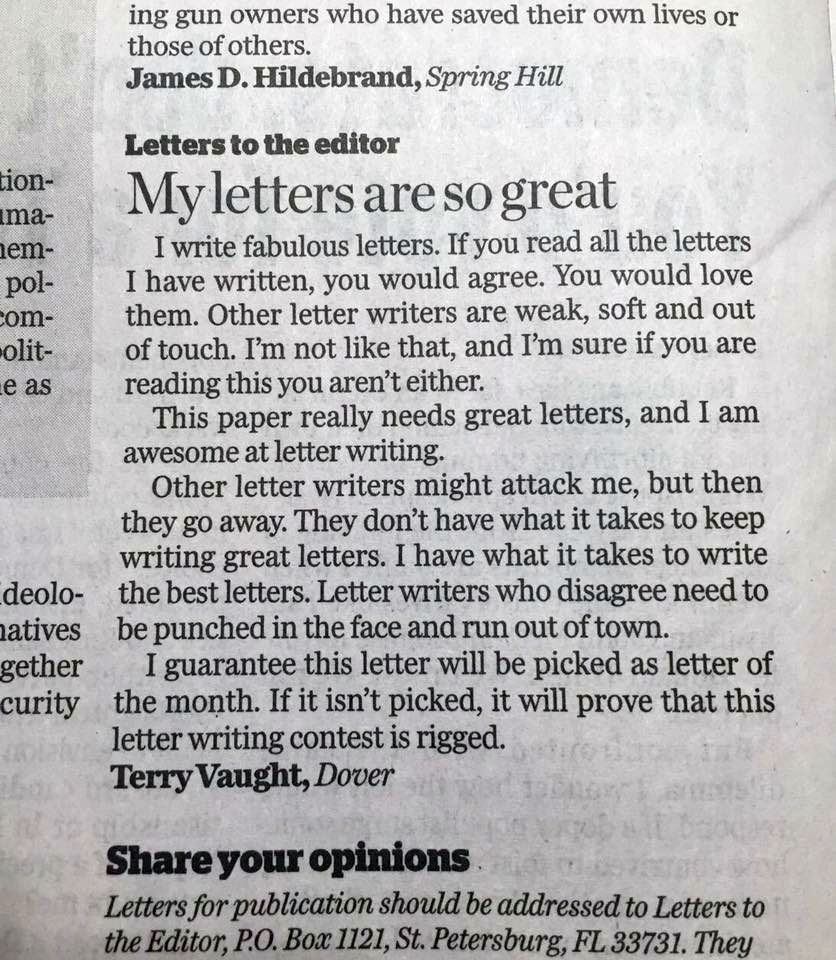
This letter is great, fantastic and YUGE!

Bill Castronuovo brought my attention to this letter that ran on the editorial page of the Sunday editions of the Tampa Bay Times (which was previously known and lauded as The St. Petersburg Times, making it one of the few newspapers I can think of that have expanded their focus area in recent years):

letter

I don’t really see Trump as a letter-writer, or letter-reader for that matter. But if he did write them…

The habitual skepticism of the BBC, taken to new lengths

EDITOR’S NOTE: DUH! Someone point out that maybe the Beeb was saying “so-called Islamic State” instead of “so-called Islamic State TARGETS” — in other words, rightly doubting the terrorist’s legitimacy as “the Islamic State” — which is an appropriate form of skepticism — rather than doubting that the targets were actually associated with the terrorist group. This seems likely. In which case, I am officially an idiot. Never mind…

“If your mother says she loves you, check it out.”

That’s the rule tyro journalists are taught from the start: Take nothing for granted; believe nothing that you haven’t checked.

But as much as American reporters may have internalized that, no one in this country takes it to the extremes that British media do. Even in their headlines, they attribute things that American media would not, putting the most routine statements of fact in quotes. For instance, today they have a headline that says, “Top Nigerian ‘internet scammer’ arrested.” Because you have to be careful — it may turn out he really IS a deposed minister who wants to share several million dollars with us.

This practice reached a new level today. I received this news alert today from The Washington Post:

WP alert

And this one right after it from the BBC:

BBC alert

I could see putting “Islamic State targets” in quotes, as the Beeb often does with government statements.

But “so-called”? To me, that’s just a few shades short of “liar, liar, pants on fire.”

Did the Beeb have some particular reason to doubt that these were actual ISIL targets in this instance — reason that escaped other news outlets?

The thing is, they had already covered themselves with “Pentagon says.” If the Pentagon had said we’d shot down pretty pink winged unicorns, you really wouldn’t need to distance yourself further, as long as you included the “Pentagon says.” No matter how scrupulous you are.

There’s such a thing as being too scrupulous by half, and I think the BBC accomplished that today…

Oh, by the way, in case y’all want to talk about the alleged U.S. airstrikes in Libya (“alleged” because, for all we know, there were no airstrikes at all!), this would be a good place to do it. Just ignore my pedantic ramblings…