Category Archives: Elections

Krauthammer’s onto something re Comey’s motivation

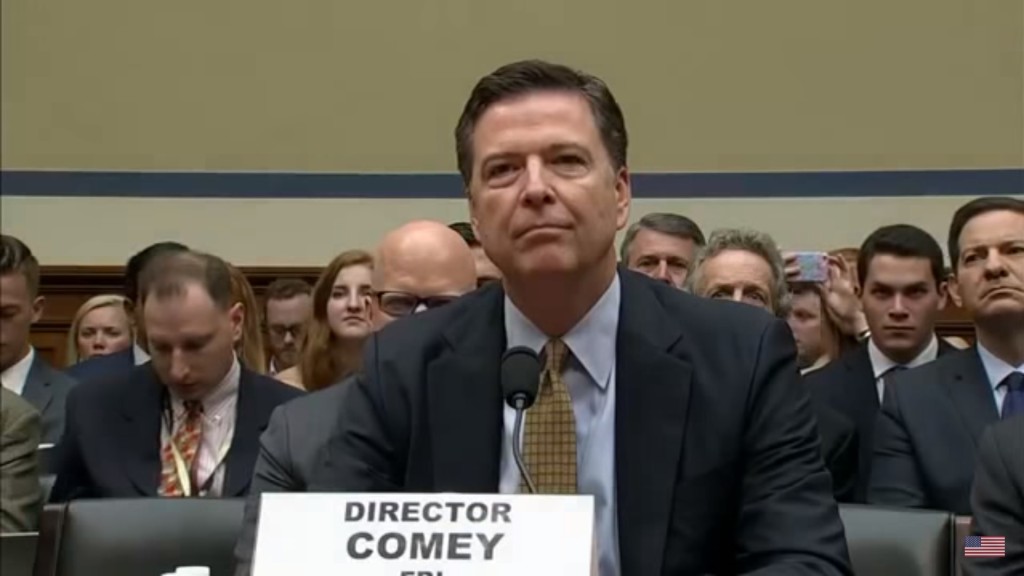
comey testify


Charles Krauthammer says he thinks he understands why FBI Director Comey recommended that Hillary Clinton not be prosecuted, despite findings of illegality — and it doesn’t fit the usual GOP conspiracy theories.

In fact, it’s remarkably like what I said earlier in the week. Says Krauthammer:

The usual answer is that the Clintons are treated by a different standard. Only little people pay. They are too well-connected, too well-protected to be treated like everybody else.

Alternatively, the explanation lies with Comey: He gave in to implicit political pressure, the desire to please those in power.

Certainly plausible, but given Comey’s reputation for probity and given that he holds a 10-year appointment, I’d suggest a third line of reasoning.

When Chief Justice John Roberts used a tortured, logic-defying argument to uphold Obamacare, he was subjected to similar accusations of bad faith. My view was that, as guardian of the Supreme Court’s public standing, he thought the issue too momentous — and the implications for the country too large — to hinge on a decision of the court. Especially afterBush v. Gore, Roberts wanted to keep the court from overturning the political branches on so monumental a piece of social legislation.

I would suggest that Comey’s thinking, whether conscious or not, was similar: He did not want the FBI director to end up as the arbiter of the 2016 presidential election. If Clinton were not a presumptive presidential nominee but simply a retired secretary of state, he might well have made a different recommendation…

I think there’s something to that. This was a judgment call, and all sorts of factors go into judgments.

As I said before, there’s a point at which it is simply not in the national interest to reach back in time and use criminal statutes to punish those with whom one disagrees. Example: There are lots of folks who’ve always hated Tony Blair because of Iraq who now want to seem him prosecuted for it, just as there were Democrats who wanted to go back and prosecute people in the Bush administration once Obama took office (a proposition that Obama wisely dismissed).

Yep, I believe firmly in the rule of law, in the importance of having a country that is no respecter of persons. But in some cases, respect for the overall good of the country overrides consideration of the legal fate of an individual.

Comey had a judgment call to make, and he chose the less harmful option.

And if you don’t like it, remember that it was just a recommendation. It did not legally bind anyone. What he said was one man’s opinion (and also the unanimous opinion of those taking part in the FBI investigation — the opinions of professionals, not partisans). And I find his opinion defensible, even laudable.

OK, now THIS was news: FBI chief recommends ‘no charges’ on Clinton email

CmnGXr5WEAAZrzI

Seconds after I posted wonder why the chattering classes went ape over Hillary Clinton’s weekend interview with the FBI, actual news was made on that front.

Here’s how I characterized what FBI Director James B. Comey had to say:

We’ll continue to argue over her judgment in setting up and using the private server. We will rightly be concerned over the potential for hostile governments and private actors to have obtained access to classified material, thanks to her carelessness.

But there will almost certainly be no indictment, unless federal prosecutors completely disregard the recommendation of the FBI.

Which could happen, but which seems unlikely.

I’m guessing that those pundits who said the FBI interview was part of a terrible week for Clinton will now be touting this as a big win. And this time, they’ll be right.

Explain to me how FBI interview exacerbated Hillary’s problem

On the way to the beach Saturday, I had my phone off my hip, plugged into the car and sitting perched on the ashtray pulled out from the dashboard. My wife, who insists on continuing to use a flip phone and is not accustomed to such distractions, kept picking it up to look at it when a tone would announce a news alert.

There were some bulletin-worthy items, such as the death of Elie Wiesel and the arrest of Columbia City Councilman Moe Baddourah on domestic violence charges. But one puzzled her:

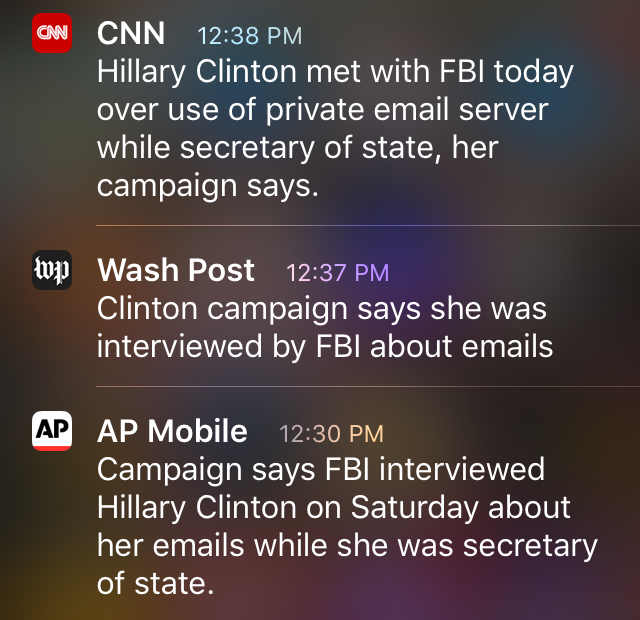
FBI

Why, she wondered, was that interesting enough to bother people with? I couldn’t really answer that, since I thought the same thing. It was a turn of the screw in an ongoing process, very much dog-bites-man. Maybe you take note of it in the course of the day’s news; it might even have its own headline. But even in this bulletin-mad era we lived in, it was hardly worth asking people to stop what they’re doing to read about it.

Others seemed to disagree. In fact, it was treated like some major blow to the Clinton campaign, on a level with Bill “It’s All About Me” Clinton’s idiotic tête-à-tête with the attorney general.

As The Washington Post said,

Hillary Clinton’s weekend interview with the FBI stands as a perfect symbol of what is probably her biggest liability heading into the fall election: A lot of people say they don’t trust her.

Clinton sat for an interview of more than three hours as part of a Justice Department investigation into the privately owned email system she operated off the books when she was secretary of state. The timing — less than three weeks before she will claim the Democratic presidential nomination — is an attempt to make the best of a situation that would look bad for any candidate but is particularly damaging for Clinton.

That the interview at FBI headquarters was voluntary does not expunge the whiff of suspicion surrounding the entire email affair that, for many voters, confirms a long-held view that Clinton shades the truth or plays by her own rules….

OK, y’all, explain to me why this was a big deal, or any kind of a deal. If she had refused to be interviewed, that would be news. If they interviewed her and learned something new and told us about it, that, too, would be news. But this? How is it more than a take-note-of-in-the-name-of-transparency thing?

We knew the FBI was investigating Hillary’s emails. They’ve been doing so forever. That’s why it was a big deal that Bill chatted with the AG.

The FBI interviews the subjects of investigations. I mean, right? Why wouldn’t they? It’s not like the headline was “FBI interviews Clinton and decides to charge her.” That would definitely be bulletin-worthy, because it would mean that it’s even more likely that a neofascist will occupy the White House. It would be more than news. It would be history. And not the good kind…

Congratulations to Micah Caskey — now I’d like to see him adopt his opponent’s issue

A week ago today, I dropped by a gathering of supporters of Micah Caskey at The Whig. It was a small group, but diverse — the person who had invited me to it was Raia Hirsch, a Democrat previously seen working in Vincent Sheheen’s gubernatorial campaign. (She and Micah had been in Law School together.)Micah Caskey cropped

I chatted briefly with Micah at the event, and he seemed quite confident that he was going to win the runoff — even though his opponent, Tem Miles, had the public backing of their chief rival in the original primary on June 14, former Lexington County Councilman Bill Banning.

Well, he was right to be confident — he won walking away, with more than two-thirds of the vote (see below). This was no doubt due to hard work, a positive message, and of course the fact that he took out a campaign ad on bradwarthen.com — that’ll do it every time. 🙂

He was a strong candidate. I guess I should say is a strong candidate, since he has opposition in the fall. In this district, you’re usually pretty safe to bet on the Republican, although I haven’t met his opposition, which I need to do at some point. He faces Democrat Peggy Butler and Constitutional candidate Robert Lampley in November.

As I think I mentioned earlier, I thought the district would have been well-served by either of these young attorneys. And there’s one thing that would make me feel even better about the prospect of Micah Caskey being my representative…

The best thing that Tem had going for him was that he had notions of reform that seemed to come straight out of the Power Failure project I conceived and directed at The State 25 years ago even though he’s too young to remember it. I had meant to encourage him further in that direction by dropping off a reprint of the series at Mr. Miles’ law office (I still have a few yellowing copies in a closet somewhere). I neglected to do that. I’ll still do so, if he’s interested.

But I’m also going to give one to the winner, next time I see him. It would be great to see him adopt the best part of his erstwhile opponent’s platform…

District 89

Ding-dong, Lee Bright is gone — but don’t ask me why

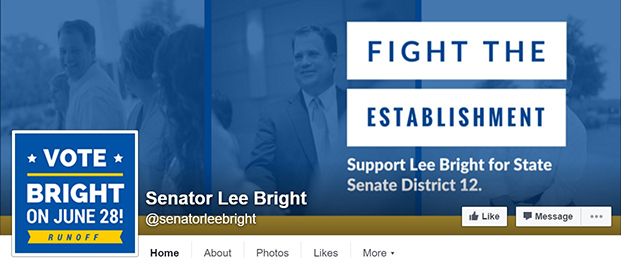
Bright FB

Pretty much everybody is celebrating the pending departure of Lee Bright from the S.C. Senate – the governor, the state Chamber’s political entity, and liberals everywhere. So many people had so many reasons to want him gone that I hadn’t even noticed how much the conservationists disliked them, as they reminded me last night in claiming credit for his defeat:

Dear Conservation Voter,

We just received the news – VICTORY!

CVSC endorsed candidate, Scott Talley, has defeated anti-conservation Senator Lee Bright with approximately 51.3% of the vote.

That’s right – “Mr. No” is gone. The worst Senator in South Carolina on conservation issues – and one of the worst in the country – has been defeated.

CVSC played a big part in Talley’s victory. We implemented our most ambitious election strategy in our history, knocking on over 21,000 doors, making over 7,500 phone calls, and sending 120,000 pieces of mail for Talley.

Our work paid off – we elected Scott Talley and defeated one of the worst legislators in the country on clean air and clean water issues.

CVSC has been an unstoppable force in this election. Almost every voter I spoke with had been contacted by CVSC in some way. I cannot thank them enough for helping get us across the finish line. I look forward to working with CVSC to protect the South Carolina we all love,” shared Senator-elect Talley at his victory party.

We had a plan to win and executed it with precision. I could not be prouder of our team and for all of you who supported our efforts. Since April, we have spoken with thousands of voters across the Upstate on the need to elect Scott Talley and were welcomed in almost every conversation we had with voters.

Our proven strategy of face-to-face contact with voters made the difference. We plan to use the skills we honed this election cycle to expand our efforts and incorporate them into our ongoing advocacy work.

This is how we will protect the South Carolina we love.

Please join me in congratulating our field team for a hard-fought race and congratulating Senator-elect Talley on his victory!

In Victory,

John F. Tynan, Political Director

By comparison, the state Chamber, response was understated. They just posted this oh-so-brief statement from Chamber chief Ted Pitts:

“The results are clear, the majority of the people two weeks ago and again tonight wanted new conservative leadership in Columbia.  The business community looks forward to working with Senator Scott Talley.”

Which almost sounded like they didn’t have a dog in the fight, but they did.

But whether Bright’s demise should be credited to the Chamber, the CVSC, or the governor dropping a house on him, everyone in Munchkinland is pleased.

Meanwhile — and this was the real news of the night — three other incumbent senators lost their positions Tuesday night. The real shockers were Republicans Larry Martin and Mike Fair, but there was also Democratic Creighton Coleman, with whom I am not as familiar (a quick search shows that I’ve only ever mentioned him once on the blog, and that was only as one name in a list of lawmakers endorsing Vincent Sheheen in his bid for the gubernatorial nomination in 2010.

Fair was phlegmatic about his loss:

“It was a bad night for incumbents, but I don’t know why,” Fair said, before calling Timmons to congratulate him. “I got clobbered. It wasn’t even close. … With the margin of victory that big for Mr. Timmons, I think the constituency here has had enough of me.”

But does “a bad night for incumbents” really describe it? I think he comes closer with the “I don’t know why.”

We should resist the temptation to boil everything down to universal formulas that explain everything. I don’t think last night’s results lend themselves to the kind of simplistic analysis that we’ve seen applied to the Brexit result, trying to tie it all into the same anti-establishment sentiment that has aided Donald Trump and Bernie Sander on this side of the pond.

Think about it — if Tuesday’s results were due to anti-incumbent, anti-establishment impulses, how do we explain the ouster of Bright?

Lee Bright was the kind of candidate the pitchforks-and-torches crowd loves. Note his chosen tagline above: FIGHT THE ESTABLISHMENT. And the forces lined up against him were as Establishment as can be — yet the voters went along with getting rid of him. Seriously, pause and ponder that: Republican primary voters, who these days supposedly immediately rebel against anything the Establishment indicates it wants, meekly went along with the pooh-bahs in District 12 yesterday.

All of this leads up to my own anti-simplistic analysis — voters tend to vote as they do in particular races for reasons specific to those individual contests, which usually have little to do with sweeping movements. I tend to be dismissive of interpretations such as “Voters wanted Republicans to run the Congress,” or “Voters were in an anti-incumbent mood.” Such things can be factors, but usually their effect is exaggerated.

Bottom line, I suspect Mike Fair was ousted for the last explanation he offered: “I think the constituency here has had enough of me.” And since I don’t live in his district and haven’t made a study of it, I can’t begin to tell you why that is. Since Mr. Fair doesn’t know, how could I? Nor can I explain to you with any degree of confidence why Sen. Martin’s voters were tired of him, or recite the completely different reasons Sen. Coleman’s constituents dumped him.

Pundits like to give you those sweeping explanations because it makes them sound like they know more about what’s going on than they do. (This is related to why they try to shoehorn everything into simple dichotomies: left-right, Democrat-Republican, black-white, winner-loser and so forth.)

I’m not going to do that. To cite one of my favorite Twain quotes, “I was born modest; not all over, but in spots….”

But while I can’t blithely give the why, I can give you a simplistic assessment of what was good and bad news for South Carolina: Bright’s departure is wonderful news — if there was a wrong side to an issue, he embraced it. On the whole, losing Martin and Fair is bad for South Carolina — particularly Martin. Nothing against their opponents because I know nothing about them (maybe they’ll turn out great), but on the whole those two guys have been positive problem-solvers in the Senate.

Creighton Coleman? I have no idea. He just never made an impression one way or the other…

Drawing a connection between Trump and Tillman

My old colleague and friend Jeff Miller brought this to my attention, as he had not seen anyone draw a direct connection between Donald Trump and Ben Tillman, although he was “Surprised it took this long.”

The relevant passage:

As the civil-rights movement burgeoned, Wallace repositioned himself to lead the white resistance and famously declared, “Segregation now, segregation tomorrow, segregation forever.” Wallace, a political innovator of the first rank, pioneered the sublimation of racial rage into hatred of government, not just the federal imposition of black rights in a second Reconstruction, but government meddling generally. This anticipated the politics of Newt Gingrich, Paul Ryan, Ted Cruz, and the Tea Party because it connected Southern racial resentment to the anti-government libertarian economics of the business right. The explicit racism became latent and coded—a dog whistle. The stars of today’s Republican right are all practitioners of this art. But Trump went them one better.

“Trump doesn’t tweet dog whistles, he blasts foghorns,” wrote Washington Post op-ed columnist Eugene Robinson. In this, Trump echoes an earlier band of 20th-century Southern demagogues. Southern politicians such as Mississippi’s Theodore Bilbo, South Carolina’s “Pitchfork Ben” Tillman, and Georgia’s Eugene Talmadge were more blatant and direct than Wallace in demeaning blacks. And like Trump, they relished the fact that they were not about issues—for issues (other than race) mattered little in traditional Southern politics. Instead, they concentrated on providing a venomous, racist form of entertainment for the white working class—another parallel with Trump.

I have to disagree with the premise, though. I don’t think Trump is more overt than Wallace, or that he “blast foghorns” rather than “dog whistles.”

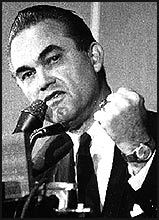
Mr. Articulate

Mr. Articulate?

The truth is that Trump is not articulate enough to blast any message clearly. He is well within the tradition of implying rather than directly stating, at least most of the time.

But that suggests to me one way in which Wallace was superior to Trump: He was far more articulate.

I watched a documentary recently about the annus horribilis 1968, and was struck by one thing: All of the candidates, including Wallace, had such a clear grasp of issues and expressed their views clearly as well.

Wallace was a hateful creep, but he was a hateful creep who could speak in complete sentences. He towers so far over Trump in that regard that it’s startling to go view those old clips, and compare them to the unintelligible mush that comes from Trump’s mouth.

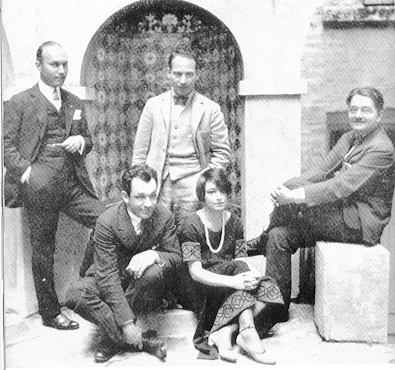
Yeah, I know — you don’t think “erudition” when you hear “George Wallace.” But compared to Trump, he was the Algonquin Round Table

Members and associates of the Algonquin Round Table... Art Samuels, Charles MacArthur, Harpo Marx, Dorothy Parker and Alexander Woollcott

Members and associates of the Algonquin Round Table… Art Samuels, Charles MacArthur, Harpo Marx, Dorothy Parker and Alexander Woollcott

Wexit: George Will leaves Republican Party

Here’s how complicated the world is, how it resists pat explanations…

Every other pundit in the Anglosphere is writing about how Brexit is the result of the same political forces that gave us Trump. It’s widely accepted as axiomatic.

Meanwhile, George F. Will is writing about how wonderful, how salutary, Brexit is, calling it “Britain’s welcome revival of nationhood.”

And yet George Will has staged his own exit — from the Republican Party. Over Trump:

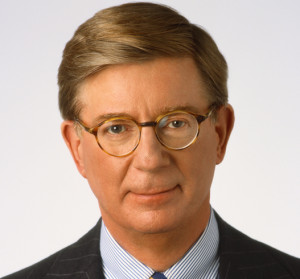
Conservative columnist George Will has left the Republican Party over its presumptive nomination of Donald Trump.George Will

Will, who writes a column for The Washington Post, spoke about his decision Friday at an event for the Federalist Society in Washington.

“This is not my party,” he told the audience, the news site PJ Media first reported.

Speaking with The Post, Will said that he changed his voter registration from “Republican” to “unaffiliated” several weeks ago, the day after House Speaker Paul D. Ryan (R-Wis.) endorsed Trump.

Will did not say which presidential candidate he will be supporting instead….

He added that it was too late for the GOP to nominate someone other than Trump. Instead, he said, Republican voters should just “make sure he loses,” then “grit their teeth for four years and win the White House.”

Having voted to exit, Brits now wonder, ‘What is the E.U.?’

Forgive me for using your signature line, Dave Barry, but I am not making this up.

Since all those awful headlines about Brexit disturbed me so much, I was wondering whether the full impact was hitting some “Leave” voters and making them have second thoughts.

Well, yes. The Washington Post had this quote today:

“Even though I voted to leave, this morning I woke up and I just — the reality did actually hit me,” one woman told the news channel ITV News. “If I’d had the opportunity to vote again, it would be to stay.”

So it appears some Brits who voted on this perhaps didn’t consider what they were doing carefully enough beforehand.

Actually, it’s much, much worse than that.

Today, faced with all the madness in the wake of the vote, here were the most popular Google searches in Britain:

You know, the sort of search you might expect a voter to have started with months ago, if he or she intended to vote yesterday. Followed up by a whole lot of other questions.

Seriously. They did not have an effing clue.

I mean, here I was, feeling bad that I didn’t focus enough on the referendum to have fully made my mind up before yesterday, and yet I — a Yank who had no say in the matter — had been far more conscientious about the issue than these twits who got to vote on it.

Of course, the feckless Brits are not alone. Wonder how people in this country could vote for someone as clueness and ridiculous as Donald Trump? It’s because of stuff like this…

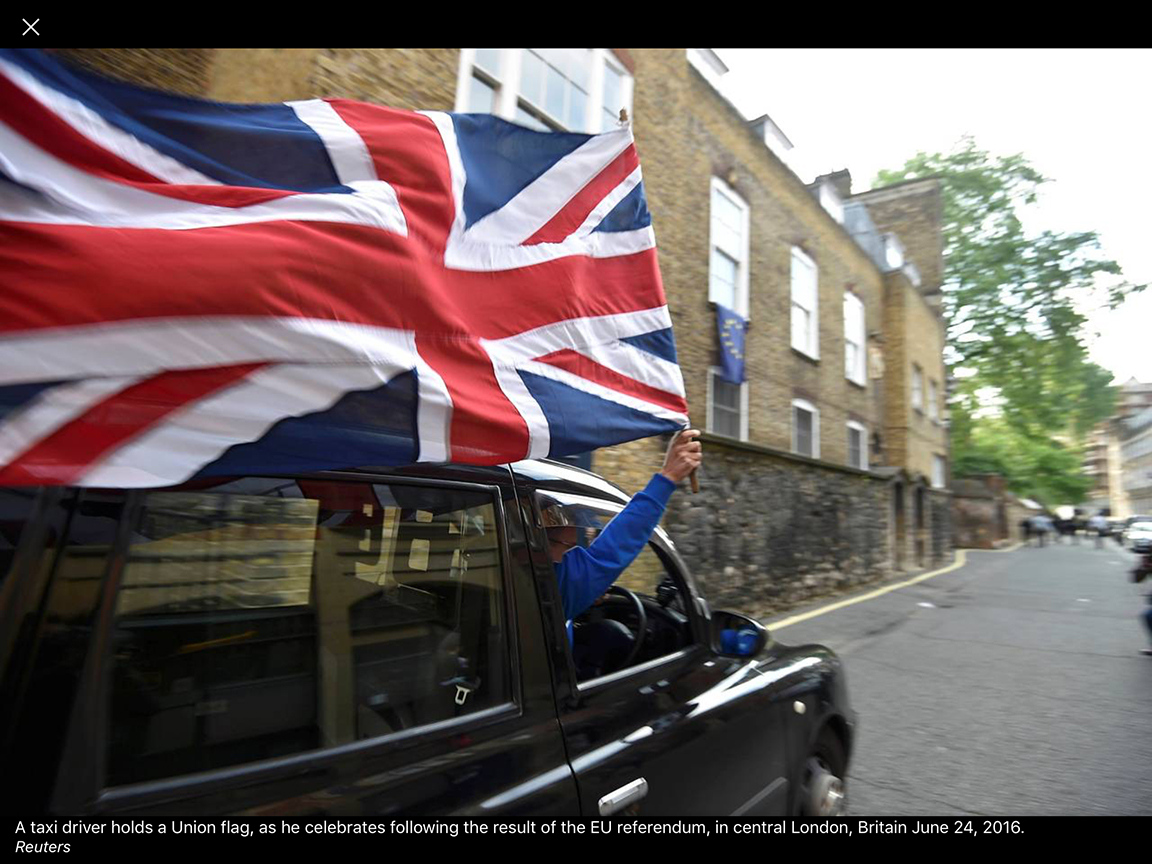
Why do Brexit fans wave Union Jack in celebration, when they just voted to do away with it?

Farage

I keep seeing images of Nigel Farage and other fans of Brexit celebrating their win by waving the Union Jack.

Which is really ironic, and seems to indicate a lack of thinking things through on their part. Which, under the circumstances, isn’t terribly surprising.

Already, Scotland — which voted strongly to remain in the E.U. — is girding itself for another vote for independence, and this time it seems likely that they’ll succeed in seceding.

As I Tweeted in the midst of it all last night:

And that, of course, would mean the end of the Union Jack. Right? I mean, how could you keep the St. Andrew’s Cross after that?

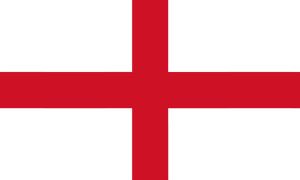
Flag of England

Flag of England

For those who haven’t paid attention the last few centuries, the Union Jack represents the union of England and Scotland, hence the combination of the St. George’s and St. Andrew’s crosses.

True, I’m no expert on heraldry or anything. Maybe an independent Scotland would still be part of the Queen’s realm, and she could still fly the Union flag when she’s in residence at her palace.

But still… that’s a rather empty sort of union these days, isn’t it?

Here’s the flag they should be waving, since this is what they voted for. Not quite as satisfying to look at, is it?

Union Jack

Tem Miles, Republican, S.C. House District 89

Tem and the Miles fam.

Tem and the Miles fam.

Tem Miles came in second in the GOP primary for S.C. House District 89 Tuesday. He got 25 percent of the vote to Micah Caskey’s 36 percent. (Those percentages are from a tiny turnout — Caskey got 1,026 actual votes, and Miles got 717.)

But he’s already gotten a boost in the runoff on June 28. Bill Banning, the former Lexington county councilman who came in third with 21 percent, has endorsed Miles, based on his belief that “experience matters.”

That’s a reference to the fact that between the two young attorneys, Miles is the only one to have held elective office previously. In fact, as a West Columbia city councilman, Miles is the veteran of some pretty unpleasant confrontations with former Mayor Joe Owens. He was re-elected last year.

Miles also cites other experience, serving in two of the state’s three branches of government. The Citadel grad formerly clerked for Appeals Court judge Paul. E. Short Jr., and served as attorney for the Office of Senate Research. Today, he’s in private practice with the McKay Firm.

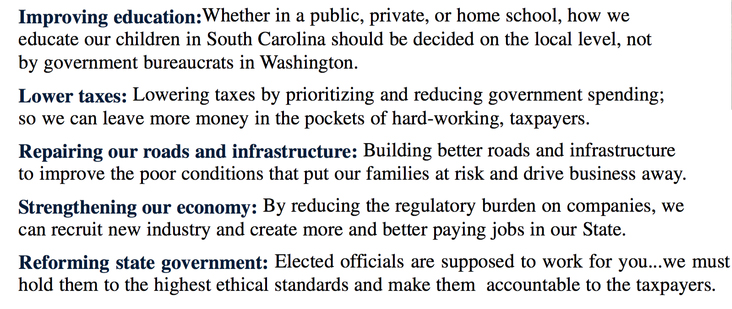
His list of goals if elected, as listed on his website, are pretty similar to those cited by his opponent, and not appreciably more detailed:

Tem Goals

Since it was the item that interested me most (hey, you want something other than that, go to some other blog!), I asked him what he meant by “reforming state government,” noting that the few words he had about it on his website suggested he was mostly talking about ethics reform.Tem Miles

But his notion of “reform,” it turns out, is much broader and to the point than that. In fact, he defines it pretty much the way I do.

Turns out that, although he was probably in middle school when my “Power Failure” project ran in the paper in 1991, he seems to have absorbed its main lessons from somewhere.

So, like Arlo Guthrie and the other fellas on the Group W bench, we just had a high ol’ time talking about the Legislative State, special purpose districts, judicial selection, co-equal branches of government, and all kinds of groovy things that would probably make your eyes glaze over — but which are the very things a lawmaker should care about if he’s running on RE-form.

Some high points from that discussion:

  • He would turn more real power over “to our governor” — although he hastened to add that he didn’t specifically mean this governor, just governors in the future. Bottom line, the executive branch must be more empowered in other to be a co-equal branch with the dominant Legislature.
  • He would empower the judiciary in part by giving it a set percentage of the state budget to run on, rather than judges having to go begging to the Legislature for funding.
  • He would further free the judiciary from the legislative branch by changing the method of judicial selection, which now lies completely in the hands of lawmakers. Rather than say he would move to the federal system, he said he would select them like worker’s comp commissioners — the governor nominates, and the full Senate confirms. In other words, the federal system.
  • “We’d be so much further along as a state,” he said, if we fully implemented Home Rule — by which he meant local governments should be run by the folks elected locally to do that, instead of by county legislative delegations and their creatures, such as SPDs.

There was more, but you get the idea. Either that, or you zoned out. Anyway, the idea is RE-form.

So that’s what I know about Tem (short for “Temus“) Miles, who is facing Micah Caskey in the runoff on June 28.

Micah Caskey, Republican, S.C. House District 89

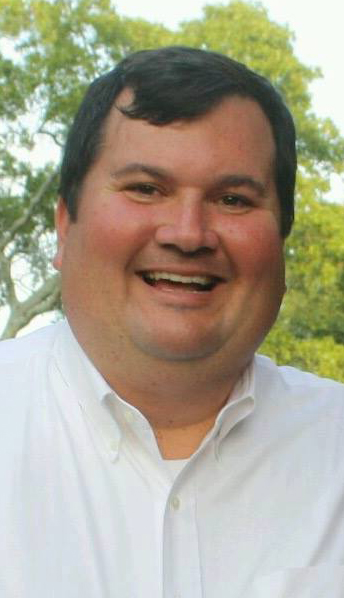
Micah Caskey

Micah Caskey

The Caskeys and the Warthens have some common history, although it’s from before my time. Remember when I mentioned that my mother was writing her childhood memories, and I was typing them and creating a blog for them? Well she made prominent mention of “Hop” Caskey, who was a teacher and coach at Bennettsville High School in the ’40s, and his wife, “Madam.” They were good friends of my mother’s family — they used to buy season tickets together for Tarheel football so they could go see Charlie “Choo-Choo” Justice play.

"Madam" and "Hop" Caskey

“Madam” and “Hop” Caskey

Well, those were Micah Caskey’s great-grandparents. I was happy to be able to share with him recently a picture of them that he’d never seen before. By the way, the photographer in the foreground is Jimmy Covington, who’s been a fixture in Columbia media circles for decades. He was at BHS with my Mom.

Still, I’d never met him until back in March, when he filed to run for Kenny Bingham’s House seat. We had a wide-ranging conversation about values and policies. Unfortunately, if I took notes I can’t find them. At the time, my main aim was to find out whether this was a someone I wanted to run against, so I don’t think I took notes at all. I was looking for an overall impression.

And the overall impression was this: I was reluctant to run against him because dang it, not only is he a Marine combat veteran, but it was eerie how many things we agreed on. Of all the things we talked about, there was one thing we sharply differed on, and now I’ve forgotten what it was.

So for blogging purposes, that was a useless interview (aside from getting the photo above). But fortunately you can find out about him at his website. He lives in Springdale, and he’s an assistant solicitor in the 11th Circuit solicitor’s office (the one Rick Hubbard and Candice Lively are competing to run). I asked him why he didn’t just run for solicitor, and he said others seeking the office had more experience than he did.

The son of a locksmith, he’s the product of Lexington 2 schools and the University of Florida. He describes his military service thusly:

After college, Micah spent the next several years on active duty in the Marine Corps—rising to the rank of Captain. Micah commanded both company and platoon-sized units during his two combat tours of duty in Fallujah and Ramadi, Iraq. Later, in 2009, Micah left law school for a year to continue his service to the country. It was during that year that he commanded a small team of specialized Marines in Helmand Province, Afghanistan.

He obtained his law degree from USC, plus a master’s in international business from the Darla Moore School. He worked as a management consultant in the oil and gas industry for awhile before joining the solicitor’s office.

Here are the issues he’s running on (which are pretty similar to the ones his runoff opponent, Tem Miles, cites):

  • I want to get government working for us. America is at its best when individuals and private businesses are pursuing life, liberty, and happiness — not when wrapped up in bureaucratic red tape.
  • I’ll fight to fix South Carolina’s roads and bridges. I’ll work for meaningful reforms that innovate the way our state government functions. We need accountability and transparency.
  • I will be a voice for public safety. Last October, when the floods came, our first responders answered the call. I’ll help ensure we are ready for the unexpected.
  • I’ll fight to ensure that South Carolina continues to be a friendly place for our military to call home. As a veteran, I know what it means to serve. I want South Carolina to remain a magnet for our military, our servicemembers, and our veterans.

That’s all from his website. One thing you won’t find there (or on his opponent’s site, either) are a lot of details about how he would accomplish the above. He says he’s following political advice on that, which runs against the grain because “I want to just tell people what I think about everything.” But he realizes that unless he has an hour to get into the nuances and layers of each position with each voter, it’s easy to be misunderstood when you get into specifics.MicahCaskey_Logo_v02

(I nodded when he said that. As you know, I am no fan of campaign promises. Tell people who you are, describe your experience and your overall interests in running. But don’t say exactly what you’re going to do, because you don’t know what you’ll be dealing with in office, and you don’t want to trapped by promises into doing something that turns out to be dumb under the circumstances.)

“Taking absolutist positions isn’t useful” because “I’ve seen how layered and complicated things can be.” To take one buzzphrase, he mentions “limited government.”

“What does that mean?” he asks. He prefers to say he likes “smart government,” but even there, you have to do a lot of explaining. For an example, he says, he’d do away with having to go to “15 different offices to start a small business.”

Bottom line,”I think I’m a common-sense candidate, a pragmatist.” He notes that someone called him a “consensus candidate,” a guy who would work with anyone from anywhere on the political spectrum who would help pass sensible legislation.

He accepts service on that.

Being about the age of my kids, he has run on the slogan of “A New Generation of Leadership.” That seems to have served him well over the much-older Bill Banning and Billy Oswald.

Now, he’s up against a contemporary and fellow attorney, Tem Miles. On June 28, GOP runoff voters will decide which young man they want representing them in this relatively new century.

FYI, the UnParty almost ran its first candidate this year

The candidate that wasn't, posing on the State House steps (for the ADCO website, NOT for a campaign!)

The Candidate Who Wasn’t, posing on the State House steps (for the ADCO website, NOT for a campaign!)

Actually, “almost” is a little strong, but the UnParty’s unleadership did think about it a good bit. (You think Ethan Hawke was good as Hamlet? That was nothing compared to this.)

I just got off the phone with both Micah Caskey and Tem Miles, who are in a runoff for the GOP nomination for Kenny Bingham’s House seat. I plan to post something about both of them before the day is over. (OK, so it took me until the next day.)

But before I do I should tell y’all something that I’ve mentioned to a handful of people, but not to you or the world at large:

When I heard that Kenny Bingham, my representative, was stepping down, I immediately thought about running for the seat myself — as an independent, of course. (I’ve told Messrs. Caskey and Miles this.)

Ever since I left the paper, I’ve thought about the fact that, after all these years of telling politicians what they ought to do, maybe I should get off the sidelines and do something myself.

The most logical office for me to run for would be the House. My understanding of state government and issues is far greater than my knowledge of local government. And the idea of trying to raise the resources needed to run as an independent for Congress, especially in my über-Republican district (represented by Congressman-For-Life Joe Wilson) was too high a mountain to contemplate climbing. Anyway, I think people should hold other offices before aiming that high.

And the state House would be easier than the state Senate.

But I wasn’t interested in running against Kenny (or my senator, Nikki Setzler), largely because I think he’s done a good job over the years. Also, I didn’t see how I could beat him.

So this seemed like my chance. And a good one, in one sense, even though an independent is always at a disadvantage: If I ran, I would run overtly against both political parties. I would tell voters exactly what I think of the parties, and that I was running because I didn’t want Columbia to become any more like Washington than it was. (I’d tell them a lot more than that, but that would be the thrust of my elevator speech.)

I’d be running against my opponent’s parties, not the opponents themselves.

If that pitch was ever to be effective, it would be in a year in which voters are highly disaffected from the parties — with most Republicans picking a non-Republican for president, and almost half of Democrats going with a non-Democrat. And when disgust with the partisan gridlock of Congress is at an all-time high.

If I would ever have a chance, that is. My chief handicaps would be:

  • Running as an independent, period. Despite all that disaffection, voters in this country for the most part have no practice at wrapping their minds around the concept of an independent candidate. It takes a lot of explaining, which means you start out in a hole. You run as an independent in a Republican district like mine and people assume you’re really a Democrat and trying to hide it. (Sure, I’ve written thousands upon thousands of words explaining my distaste for both parties, but how many people will go read all that?) Beyond that, it’s a hugely difficult task logistically — you have to gather thousands of signatures on petitions to get on the ballot. (At least I think so — I didn’t get to the point of actually going to the election commission and finding out all the rules.)
  • Raising the money. Because I simply cannot self-finance, even partially. I can’t spend what I don’t have. And raising money is hard for me, just as it’s hard to go out and sell ads on the blog. Not my forte. (I have raised money with some success — such as when I was on the Habitat board. But asking for money for a cause like that is far easier than when the cause is me.) Which means I’d be ill-equipped to overcome the difficulties that an independent would have with fund-raising to start with.
  • This is the biggie: There has possibly never been a candidate for public office in South Carolina who is on the record (on the easily-accessible record) on as many issues as I am. And none of my positions have been crafted to help me win elections. (In fact, I’ve spent a lot of time urging pols to do the right thing even when the right thing is unpopular.) I don’t regret any of them, but the fact remains that there are thousands of cudgels out there for an opponent to beat me with. And while every one of my opinions is chock full of nuance and careful rationale that I think would help if the voter bothered to go read it, a lot of them could be misrepresented with devastating effect.

But those aren’t the things that cooled my ardor to run. Two factors stopped me. (Or at least, stopped me so far. I’m 90 percent sure I won’t run. Let’s see how this runoff ends up. But the truth is, I’ve now waited so long that I’ve made the already-long odds close to impossible.) Here they are:

  1. Some people I liked — and who I thought would be strong Republican candidates in the general in this Republican district — filed to run. I liked Bill Banning when he was my county councilman, and was sorry to see him lose his seat. And I had breakfast with Micah Caskey (I was curious to meet him because my mother was friends with his grandparents and great-grandparents in Bennettsville) a couple of months back. I agreed with practically everything he had to say about why he was running. And oh, yes — he’s a combat veteran. I didn’t talk with Tem Miles until today, but knowing I liked both Bill and Micah, and that they would both be formidable opponents, was enough to seriously discourage me.
  2. I had a bad spring with my asthma. For the first time in years, it wasn’t under control, and I couldn’t do my daily workout — and undertaking a campaign of going door-to-door nights and weekends was just unimaginable for me. I’m better now, by the way, but I lost a lot of precious time. You’ve got to feel GREAT to undertake something like this, and I didn’t there for awhile.

So anyway, now you know where things stand — or might have stood. I thought you should know this stuff before I write about either of these candidates, which I hope to do within the next 24 hours…

When I told Kenny Bingham himself that I might run, he was kind -- he didn't laugh.

When I told Kenny Bingham himself that I might run, he was kind — he didn’t laugh.

Thoughts on the primary results?

Ck_4xgEUUAIyaec

Our hero’s identity revealed!

Well, I finally got to vote last night. I picked up my wife on the way there, and we were almost the last voters at Quail Hollow (there was one after us). So we did our duty.

What do y’all think about the results? Here are some random thoughts that I’ve had:

  • Wes Hayes’ loss. Well, the best of the three senators opposed by Nikki Haley was unfortunately the only one to lose. No offense to Hugh Leatherman and Luke Rankin — they both won in spite of the governor’s allies’ $500,000 onslaught, so good for them — but Wes Hayes, a.k.a. “the Dean of Ethics,” was the one whose plight most demonstrated the hypocrisy of the governor’s own commitment to ethics. So I’m sorry to see it.
  • Runoff for Kenny Bingham’s seat. This is my House district. I felt like the two strongest candidates were newcomer Micah Caskey (any relation, Bryan?) and former county councilman Bill Banning. Micah (the scion of a Bennettsville family with close ties to my own, by way of disclosure) was the top vote-getter and is in a runoff. Bill, unfortunately, did not make it. But I say this with no knowledge of the other guy in the runoff, Tem Miles — whom I have not interviewed or even met. I need to remedy that.Ballentine - Warthen Ad
  • Midlands incumbents prevail. Wes Hayes said it was a bad year for incumbents, and in many cases across the country that’s true. But most Midlands legislative incumbents with opposition did just fine. I was happy for Katrina Shealy because she’s done a good job, and I was rooting for her after that awful thing Cindi Scoppe did to her several years back (tsk, tsk).  Nathan Ballentine deserved to win, of course, because he advertised here on the blog. You see the logic in that, right? Other winners included Rick Quinn (in spite of the slight cloud from Pascoe’s investigation), and in Richland County, John Scott and Darrell Jackson (despite the election commission, the Recreation Commission and so forth).
  • Solicitor runoff. Going by The State‘s endorsement, the strongest guy in the field to replace Donnie Myers got the most votes, but he’s in a runoff with Candice Lively, about whom I need to learn more, just as I do with Tem Miles. Stay tuned for more.
  • Dems divided over whom they will sacrifice to Joe Wilson. Well, we heard a lot about how Arik Bjorn was the only real Democrat in their 2nd District primary. The state party even endorsed him, in an extremely unusual move (they didn’t want another Alvin Greene). And he did prevail — but by a grand total of 49 votes in unofficial results — over alleged interloper Phil Black. This 50.1 to 49.9 triumph is particularly pathetic when you reflect that in Lexington County, the gravitational center of the district, only the most dedicated, partisan Democrats — the kind who wouldn’t be caught dead voting Republican — would even have selected a Democratic ballot, since this was the only thing on it. Bjorn can take comfort that proportionally, he did a little better in my precinct than he did elsewhere — 14 to 9. No, those aren’t percentages; that’s how many people voted.
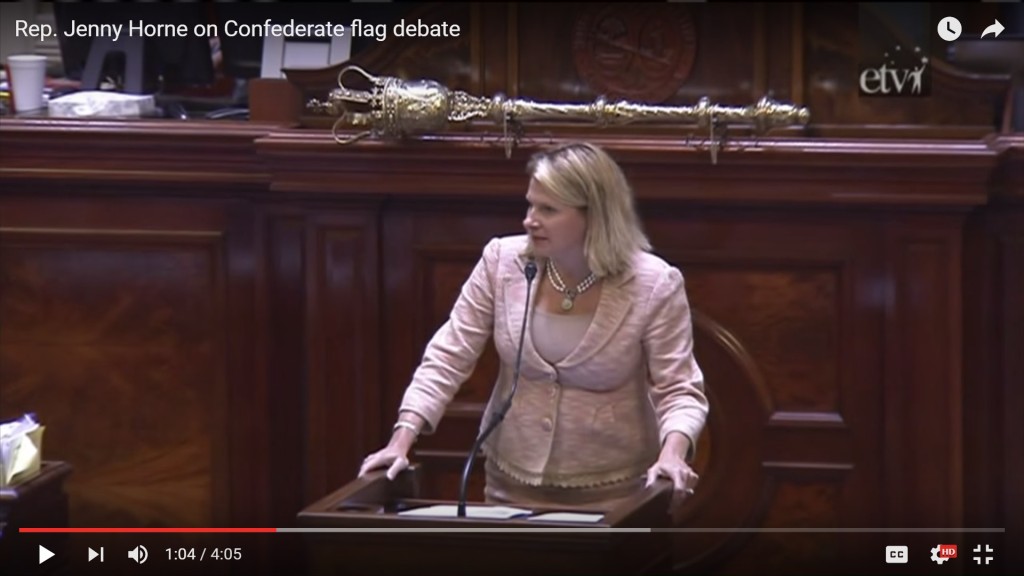
  • As expected, Sanford prevailed. Jenny Horne’s tirade against the flag, wonderful as it was at that one moment last summer (and it may have been what turned the tide in the House and got the flag down), didn’t prove enough to send her to Congress. They love them some Mark Sanford in the 1st District. I suspect it’s something in their water. But in this case, since Jenny backed Trump and Sanford did not, perhaps justice was done.
  • Lott prevails, but his secret is out! Perhaps the most satisfying result of the night was Leon Lott’s overwhelming 3-to-1 win over James Flowers for a sixth term as Richland County sheriff. I would have been cheering my twin anyway, because he’s done a great job, but that WashPost series gave us good reason to be deeply concerned about his challenger. But I’m not sure I’m happy that he’s revealed his secret identity (see photo above, which I hope The State doesn’t object to my sharing). Doesn’t this grant an advantage to the supervillains out there? I suppose the secret was bound to come out. I thought it careless of him to win those statewide Toughest Cop competitions several years back…

Your thoughts?

Horne header

I was denied the right to vote for lack of a photo ID!

direct mail

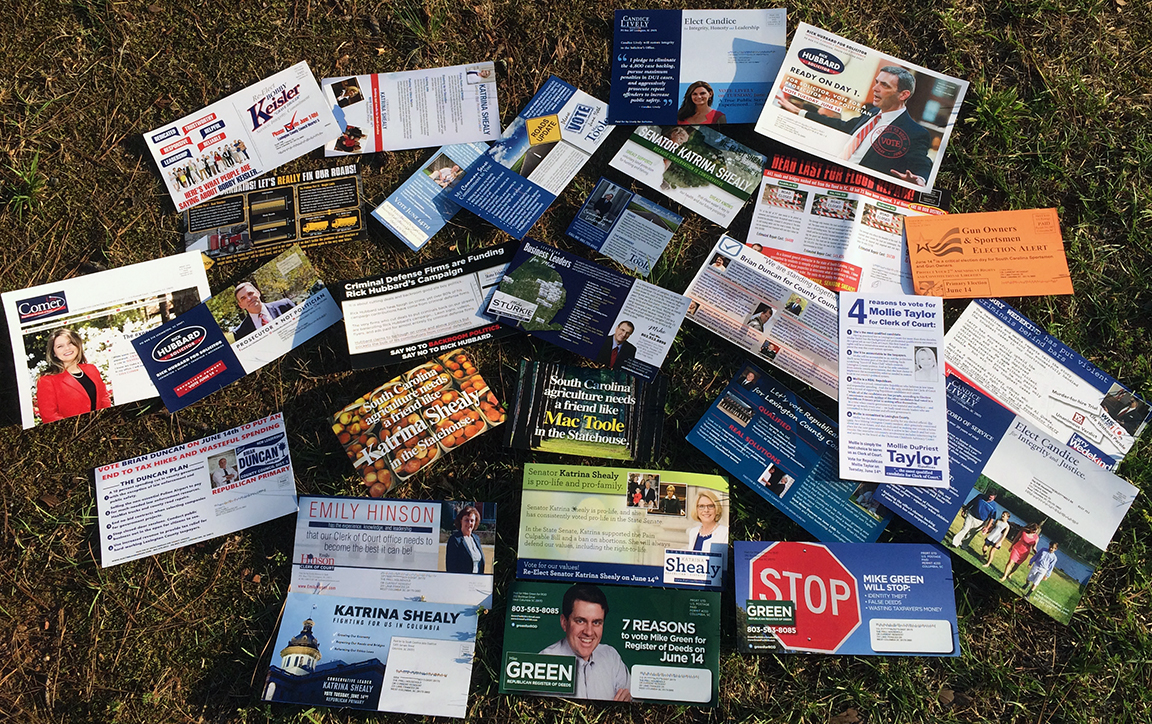
My colleague Lora Prill at ADCO brought me some of the primary-related mail she’s received at home. This is about a third of it, she says.

As you know, I’ve been pretty dismissive over the years of the respective positions of both Democrats and Republicans regarding voter ID. (Basically, I think Republicans came up with it to address a virtually nonexistent problem, and Democrats exaggerate the degree to which it amounts to an insurmountable obstacle.)

So my Democratic friends should really enjoy the irony of this:

Today, I was denied the right to vote for lack of a photo ID!

But I’m not going to picket the State House or anything, on account of it being, you know, my fault

Basically, I showed up without my wallet, something I realized when I walked into the polling place, approached the check-in table, and reached into my jacket for it. I announced my problem, was told, “You’d better go home and get it.”

Which I did. But I did it on the way downtown, and didn’t go to the polling place again, as I no longer had time. (Get this: I searched all over, and finally found it in a pocket of a pair of pants I was wearing on Sunday. Which means I drove around all day yesterday without a wallet. Sheesh.)

But I’ll go back this evening. Which makes me a little nervous. I usually vote first thing, so that I don’t have to worry about something coming up to prevent me from making it by 7 p.m.

Also, I don’t get to walk around all day with one of those “I voted” sticker, which, square that I am, always makes me feel a little bit proud of myself.

So, that’s me. How about you? Did you vote yet? How was it? Were there lines? Were there technical glitches? Share…

The difference between voting Republican or Democratic in my precinct (and yours, if you’d like to look it up)

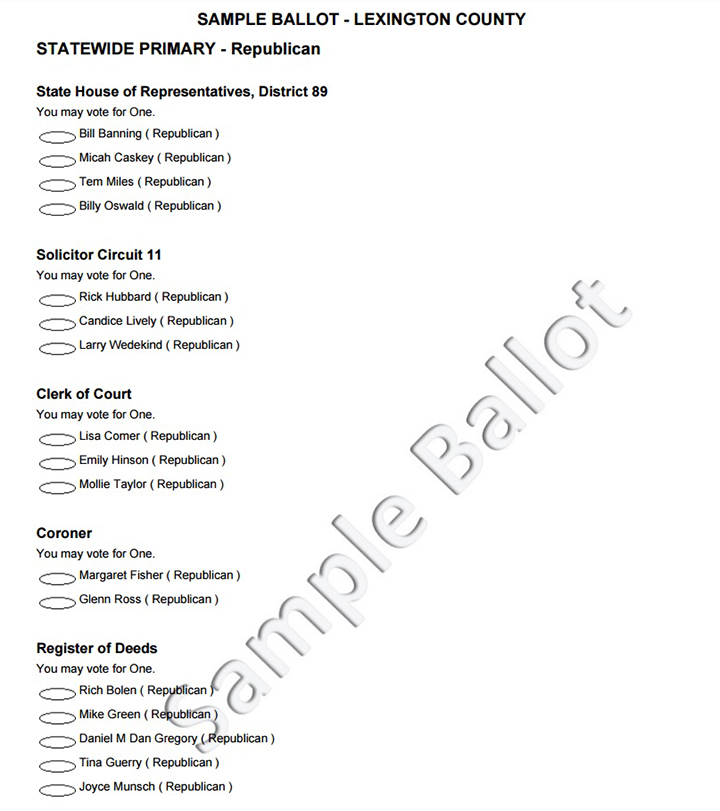
Sample GOP

On that last post, Jeff Mobley weighed in thoughtfully, and mentioned that you can go view a sample ballot for your polling place at SCVotes.org.

So I went and did that, in order to illustrate the difference between choosing a Democratic or Republican primary ballot in my precinct, Quail Hollow.

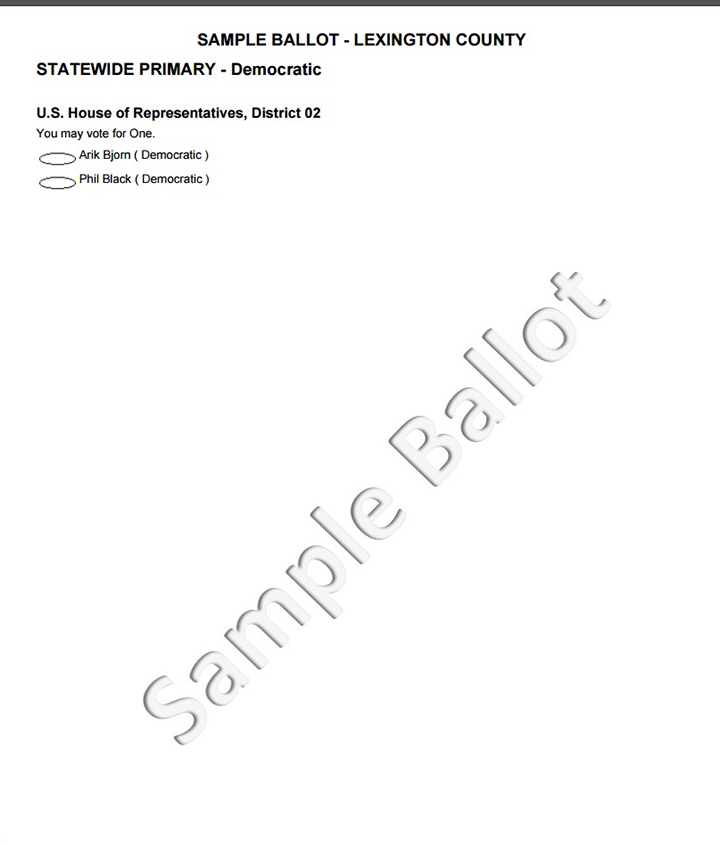
As you can see above, I get to make some significant electoral decisions if I choose a Republican ballot. As you see below, all I’d get to do on a Democratic ballot is choose who is going to lose to Joe Wilson in the fall.

For some loyal Democrats, that is enough, as my longtime colleague Rick Temple suggested on Facebook:

This is a good year for Lexington County Democrats to vote in the their party’s primary because of the 2nd Congressional District race. One of the candidates, Arik Bjorn, is actually a Democrat. The other, Phil Black, is a Republican who has admitted he is running as a Democrat because he knows he has no chance against Joe Wilson in the Republican primary.

The ephemeral abstract rewards of such a quixotic gesture, however, escape me, in part because I don’t care who is a real Democrat and who is not, but mostly because neither of them will be going to Congress.

That makes the decision very easy.

If you live in Richland County, of course, you likely have the opposite situation, and should choose a Democratic ballot tomorrow, as our Republican friend Jeff plans to do…

sample Dem

Sorry, SC Democrats! I see no point in voting in your primary — a matter of geography, you see

unnamed

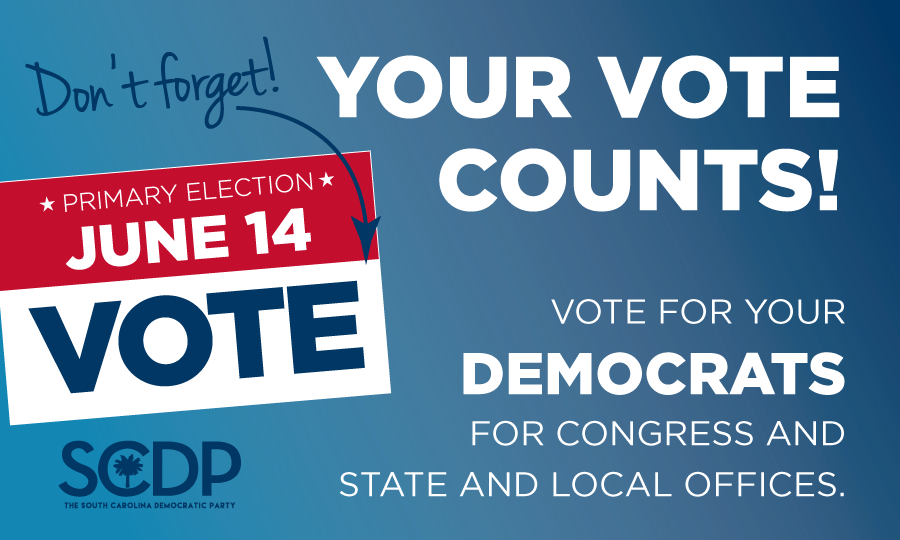
Got the above via email over the weekend.

Nice of you to think of me, SC Democrats, but I see no point in voting in your primary.

If I lived in Richland County, it would be different, as Cindi Scoppe noted in her recent column, aptly headlined “SC voters have one chance to make a difference, and it’s not in November“:

Unless you are so partisan that you can’t bring yourself to vote in a primary for the best or at least the least bad candidate in the other party, you should go where the elections are being decided. I always vote in the Republican primary when we have statewide contests, because those races are decided in the primary. This year I’m voting in the Democratic primary, because there are no statewide races and I live in Richland County, where all but one of the legislative and local contests are among Democrats. If I lived in Lexington County, I would vote in the Republican primary, for similar reasons.

Exactly.

Cindi and I agree politically about as much as any two people you’re likely to know, which means that she doesn’t care which party wins in November any more than I do. But she cares about having her vote count, which is why she votes in the Democratic primary where she lives, and I vote in the Republican over in Lexington County.

So that we get a voice in the actual election. Because where I live, the Republican primary is the election.

A heads-up: Collapse of western civilization imminent, says this one bloke

The Brexit rhetoric just heated up a notch. From The Guardian:

David Cameron and his Remain colleagues have repeatedly been accused of scaremongering. Recession, rising unemployment, rising prices, rising interest rates, falling house prices, further rise of international conflict (although not necessarily “world war three”, which was Boris Johnson’s parody) – there seems to be no end to the list of negative consequences from Brexit that Cameron has been warning people about.

But Donald Tusk, president of the European council, has gone much further. If Britain leaves the EU, that could eventually end up with the downfall of Western civilisation, he says.

He made the comment in an interview with the German newspaper Bild. Some extracts were released yesterday, but the full article became available today.

Reuters has written it up as a story. Here’s the key quote from Tusk.

Why is it so dangerous? Because no one can foresee what the long-term consequences would be. As a historian I fear that Brexit could be the beginning of the destruction of not only the EU but also of western political civilization in its entirety.

I must confess that unlike that Polish cove (and yes, I realize my grasp of British slang is a bit outdated), I have not yet made up my mind — even though it’s a huge issue involving a country I love.

Donald Tusk

That Polish cove, Donald Tusk

On the one hand, I don’t like people on the continent telling the British people how to live — Bonaparte tried that, until Nelson and Wellington sorted him out. Emotionally, I dislike anything that might make Britain even marginally less British. Tell them, Professor.

On the other, we have establishment figures (and y’all know how I love me some Establishment) from President Obama to PM Cameron, coming out against it — although I found our president’s threat that Britain would go to the back of the queue on trade deals unconvincing. Lindsey Graham and Democrat Jeanne Shaheen, they say the same, on collective security grounds.

But I’m still unsure which side to root for. You?

Apparently, Hillary is more ‘with it’ than I am

CkZqglTW0AI7gjr

I saw the reporting on this Tweet from Hillary Clinton, in reply to Donald Trump:

… and I was like, “Yeah, OK. So?” To me, it seemed to be an extremely unimaginative response, smacking slightly of authoritarianism (as though Hillary had, along with winning the nomination, just been named Hall Monitor of Twitter).

Apparently, it’s a thing, and the kids loved it:

Can we get you some ice for that burn, Donald?

Hillary Clinton shut down presumptive GOP presidential nominee Donald Trump on Thursday with a simple, three-word tweet to end all beefs.

Clinton’s tweet — repurposing a well-known and beloved Internet meme — was in response to Trump’s reaction that President Barack Obama had endorsed Clinton (his former Secretary of State) for the 2016 election. …

Well, the fact that that lame response was “a well-known and beloved internet meme” was entirely news to me, so I followed the link to the alleged best uses of the meme ever.

And you know what? Each of those struck me as just as flat and uninteresting and blah as when Hillary used it. To much-younger Twitter-users, though, it is the distilled essence of wit, or so I’m told.

Huh. They don’t ask for much, do they?

But even if the first thousand or so uses of the line were just high-larious (which I doubt, but let’s just say they were), it still shows a lack of imagination for Hillary to use it instead of coming up with something original.

And as “burns” go, it seems decidedly tepid.

But as I say, apparently the kids loved it, and isn’t that the point when you’re Hillary, and desperate for some of that juice that Bernie has with the young?

The reaction she’s gotten probably has the Democrat just hugging herself, saying, “I’m with it. I’m groovy. I’m fab. I’m a hepcat. 23 skidoo…”

Video: An upbeat Fred Sheheen, back in 2013

Fred Sheheen from Matthew Warthen on Vimeo.

My son shot this clip at a fund-raiser for Vincent Sheheen at James Smith’s law office on April 16, 2013, when he was just starting to gear up for his unsuccessful second run for governor.

This was moments before some Democratic Party operatives asked us to stop shooting video, which was a disappointment. (I’ve found that while lots of campaigns don’t mind if I slip into one of these friends-and-family affairs and mingle, they hate it if I shoot video — and with my son Matt’s big, professional camera, we were doing so ostentatiously on this occasion. The people I interviewed, such as Fred, didn’t mind a bit. It was the hired hands who didn’t like it.)

As it happened, we never used any of the footage until now. I’d like to team up with my son more for video for the blog — so much better than what I shoot with my phone — but I hate to ask him to take time away from his family. When he did the video on the flag rally last year — which I think came out wonderfully — he had to spend most of the night editing it. That was a special occasion.

Anyway, I share this now with Fred’s friends and family, as a little postscript on Vincent’s moving eulogy yesterday. It shows Fred with characteristic confidence and commitment, eager to roll up his sleeves and help his boy get elected. We know now that it didn’t work out, but Fred had good reason to think it was doable, as he explains.

Enjoy, and remember…

By comparison, Bernie is practically a moderate

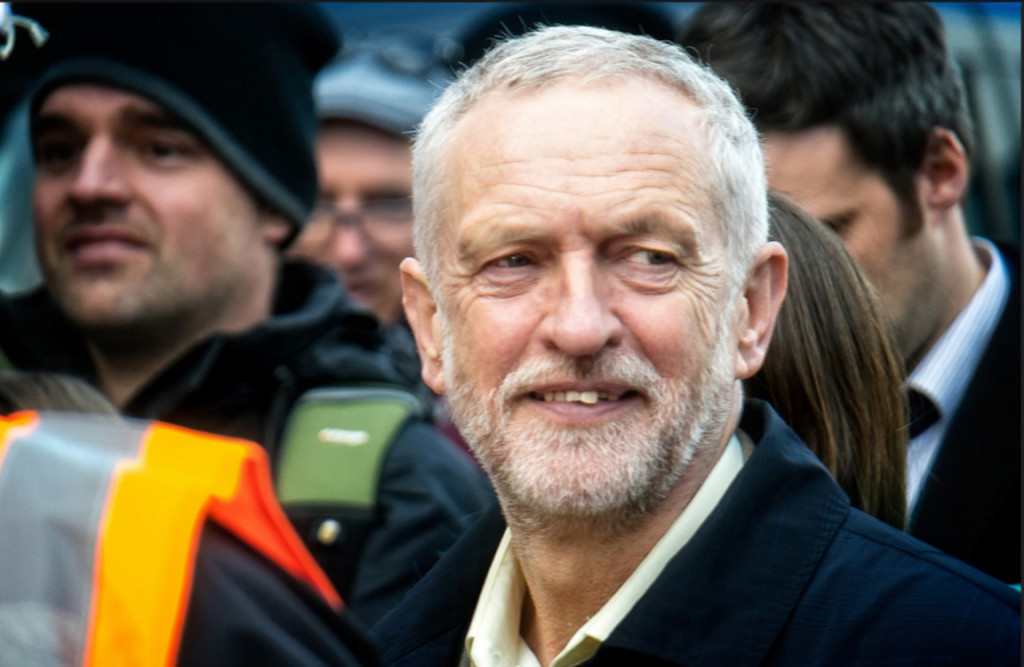
Labour Leader Jeremy Corbyn By Garry Knight - https://www.flickr.com/photos/garryknight/26392896430/, CC0, https://commons.wikimedia.org/w/index.php?curid=48525044

Labour Leader Jeremy Corbyn By Garry Knight – https://www.flickr.com/photos/garryknight/26392896430/, CC0, https://commons.wikimedia.org/w/index.php?curid=48525044

Writing about George Will’s column about Paul Ryan and Donald Trump earlier this week reminded me of a recent piece he did while in England writing about Brexit. The column I have in mind consisted mostly of marveling at what a total flake Jeremy Corbyn, the current leader of the Labour Party, is.

An excerpt:

That year, Corbyn was elected to the House of Commons. He spent his next 32 years opposing the monarchy; writing columns for a communist newspaper; expressing admiration for Hugo Chávez, whose socialism propelled Venezuela toward today’s chaos; proposing that taxpayers should be permitted to opt out of paying for Britain’s army; advocating that Britain leave NATO and unilaterally scrap its nuclear deterrent; blaming NATO, meaning the United States, for Vladimir Putin’s war against Ukraine; calling the terrorist groups Hamas and Hezbollah “friends”; appearing with and funding Holocaust deniers and other anti-Semites; criticizing China’s Communist regime for deviationism in accepting some free markets; demanding that Tony Blair, the only Labour leader since 1976 to win a general election (three of them), be tried as a war criminal (for supporting the Iraq War); praising Iraqi insurgents killing Americans; and calling the killing of Osama bin Laden a “tragedy.” Along the way, Corbyn got divorced because his wife insisted on sending their eldest son to a selective school whose admissions policy recognized merit.

Last September, in a Labour Party process in which an intense fraction of 1 percent of the British electorate participated — a cohort intensely interested in things other than winning the next election — Corbyn was elected party leader with 59.5 percent of the vote in a four-way contest. He promptly named as shadow chancellor of the exchequer a former union official who lists in “Who’s Who” his hobby as “fomenting the overthrow of capitalism,” who says he was joking when he said that if he could relive the 1980s he would have assassinated Thatcher but who was serious when he praised IRA terrorist bombers. Corbyn’s shadow farming minister, a vegan, says, “Meat should be treated in exactly the same way as tobacco, with public campaigns to stop people eating it.” Corbyn, appearing with unmatched jacket and trousers and with his tie loosened at a St. Paul’s Cathedral service commemorating the Royal Air Force’s heroism in the Battle of Britain, refused to sing the national anthem.

Wow. Practically makes Bernie Sanders look like a moderate member of the Establishment — and a natty dresser to boot.

Actually, Will saw more of a comparison to Trump, as noted in his lede:

Misery loves company, so refugees from America’s Republican Party should understand that theirs is not the only party that has chosen a leader who confirms caricatures of it while repudiating its purposes.Jeremy Corbyn, the silliest leader in the British Labour Party’s 116-year history, might kill satire as well as whatever remains of socialism….

But what he writes about Corbyn highlights how far into extremism Labour has fallen since my man Tony Blair’s day.

Which brings me to an editorial today in The Wall Street Journal, “The Clinton Restoration.” The editors stress how far away from her husband’s and Blair’s Third Way politics Hillary Clinton has moved.

Some of that is true, and I blame Bernie Sanders, Elizabeth Warren and their admirers in the party. But aside from all the Identity Politics stuff (it’s been less than two days, and I’m already tired of hearing how “historic” her nomination is), I still think Hillary’s heart is more centrist than that — and she can be downright hawkish when it comes to national and collective security.

The WSJ editors sort of acknowledge that when they grudgingly grant that “We have some hope that she would come around to support the Pacific trade deal.” I hope so, too; and if they think it’s possible, I’m even more encouraged.

This is going to be a tough few months for that editorial board. To their minds, Hillary Clinton presents such a huge, inviting target. And yet they know what a disaster Donald Trump is, and would be…